Introduction
The Humulus lupulus L. (hops) is an important plant species belonging to the family Cannabaceae and it grows like grape. Hops cones involve high incidence of polyphenolic compounds and acyl phloroglucides (Kavalier et al., Reference Kavalier, Litt, Ma, Pitra, Coles, Kennelly and Matthews2011; Clark et al., Reference Clark, Vaitheeswaran, Ambrose, Purves and Page2013; Gorjanović et al., Reference Gorjanović, Pastor, Vasić, Novaković, Simonović, Milić and Sužnjević2013; Masek et al., Reference Masek, Chrzescijanska, Kosmalska and Zaborski2014). At the present time it is a primary material in beer harsh-tasting and giving characteristic aroma (Chadwick et al., Reference Chadwick, Pauli and Farnsworth2006; Olas et al., Reference Olas, Kolodziejczyk, Wachowicz, Jędrejek, Stochmal and Oleszek2011; Arsene et al., Reference Arsene, Rodino, Butu, Petrache, Iordache and Butu2015; Taniguchi et al., Reference Taniguchi, Yamada, Taniguchi, Matsukura and Shindo2015). The hops preparations have sold in the America for anxiety and insomnia therapies and in pharmacies in the Europea (Anonymous, 2002; Chadwick et al., Reference Chadwick, Pauli and Farnsworth2006). The hops extract has antimicrobial, insecticidal, antiproliferative and detoxification activity in hepatoma and rat liver (Dietz et al., Reference Dietz, Kang, Liu, Eggler, Yao, Chadwick, Pauli, Farnsworth, Mesecar and van Breemen2005; Gokce et al., Reference Gokce, Isaacs and Whalon2006a ; Arsene et al., Reference Arsene, Rodino, Butu, Petrache, Iordache and Butu2015; Onder et al., Reference Onder, Ay, Turkoglu, Kockar and Celik2016).
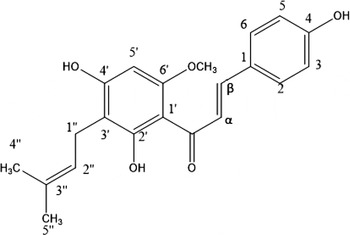
Principle component of the hops cones, xanthohumol was firstly characterized by Verzele et al. (Reference Verzele, Stockx, Fontijn and Anteunis1957) and its various biological activities are attracted notice (Liu et al., Reference Liu, Hansen, Wang, Qiu, Dong, Yin, Qian, Yang and Miao2015) (fig. 1). The xanthohumol has inhibition activity against some carcinogenesis (Zanoli & Zavatti, Reference Zanoli and Zavatti2008; Sławinska-Brych et al., Reference Sławinska-Brych, Król, Dmoszyńska-Graniczka, Zdzisińska, Stepulak and Gagoś2015), anti-infective activity against Gram-positive bacteria, viruses, fungi and malarial protozoa (Gerhäuser, Reference Gerhäuser2005; Zanoli & Zavatti, Reference Zanoli and Zavatti2008). It has also antioxidant, antiviral and antitumoral activities, including liver, breast, colon, ovarian and prostate (Venè et al., Reference Venè, Benelli, Minghelli, Astigiano, Tosetti and Ferrari2012; Yoshimaru et al., Reference Yoshimaru, Komatsu, Tashiro, Imoto, Osada, Miyoshi, Honda, Sasa and Katagiri2014; Zhao et al., Reference Zhao, Jiang, Liang and Huang2016).
Chemical structure of xanthohumol.

In the literature, insecticidal activities of the hops and its principle component xanthohumol against some insect species are reported (Gokce et al., Reference Gokce, Isaacs and Whalon2006a , Reference Gokce, Whalon, Cam, Yanar, Demirtas and Goren b , Reference Gokce, Stelinski, Isaacs and Whalon c , Reference Gokce, Whalon, Cam, Yanar, Demirtas and Goren2007, Reference Gokce, Isaacs and Whalon2012; Er et al., Reference Er, Gokce and Whalon2009; Yanar et al., Reference Yanar, Kadioglu and Gokce2011; Cam et al., Reference Cam, Gokce, Kadioglu, Yanar, Demirtas, Goren and Whalon2012; Karakoc & Gokce, Reference Karakoc and Gokce2012; Karaca & Gokce, Reference Karaca and Gokce2014; Bedini et al., Reference Bedini, Flamini, Girardi, Cosci and Conti2015; Jackowski et al., Reference Jackowski, Hurej, Rój, Popłoński, Kośny and Huszcza2015; Stompor et al., Reference Stompor, Dancewicz, Gabryś and Anioł2015). The methanolic extract of the hops showed the toxic effect against Colorado potato beetle larvae and adults (Gokce et al., Reference Gokce, Whalon, Cam, Yanar, Demirtas and Goren2006b , Reference Gokce, Whalon, Cam, Yanar, Demirtas and Goren2007, Reference Gokce, Isaacs and Whalon2012; Cam et al., Reference Cam, Gokce, Kadioglu, Yanar, Demirtas, Goren and Whalon2012; Alkan et al., Reference Alkan, Gokce and Kara2015). In an another study, it has been reported repellent activity of hops essential oils against Rhyzopertha dominica and Sitophilus granarius (L.) (Bedini et al., Reference Bedini, Flamini, Girardi, Cosci and Conti2015). The characteristic compound of the hops cone, xanthohumol exhibited potential antifeedant activity against the peach-potato aphid (Myzus persicae) (Stompor et al., Reference Stompor, Dancewicz, Gabryś and Anioł2015). Xanthohumol and carbon dioxide spent hops extract showed antifeedant activity against adults of S. granarius (L.) and T. castaneum Duv. larvae (Jackowski et al., Reference Jackowski, Hurej, Rój, Popłoński, Kośny and Huszcza2015; Stompor et al., Reference Stompor, Dancewicz, Gabryś and Anioł2015).
The stored pests are still a serious problem on grain and grain products through the harvest, transport and production process. Damages to grain products by the pests cause a serious economic losses in the world and herein, every year, thousands tons of the grain and grain products are damaged by storage pests. Therefore, the control of storage insects is extremely important issue to reduce their harmfull effects on the grain and grain products (Stejskal et al., Reference Stejskal, Hubert, Aulicky and Kucerova2015). In recent years, there is an increasing attention on the control of storage pests by natural products, including plant extracts, essential oils and their pure components (Garcia et al., Reference Garcia, Donadel, Ardanaz, Tonn and Sosa2005; Gokce et al., Reference Gokce, Isaacs and Whalon2006a , Reference Gokce, Whalon, Cam, Yanar, Demirtas and Goren b , Reference Gokce, Stelinski, Isaacs and Whalon c , Reference Gokce, Whalon, Cam, Yanar, Demirtas and Goren2007, Reference Gokce, Isaacs and Whalon2012; Kordali et al., Reference Kordali, Kesdek and Cakir2007, Reference Kordali, Cakir, Ozer, Cakmakci, Kesdek and Mete2008; Tozlu et al., Reference Tozlu, Cakir, Kordali, Tozlu, Ozer and Aytus Akcin2011; Gokce et al., Reference Gokce, Isaacs and Whalon2012; Aydin et al., Reference Aydin, Cakir, Kazaz, Bayrak, Bayir and Taskesenligil2014; Bedini et al., Reference Bedini, Flamini, Girardi, Cosci and Conti2015; Jackowski et al., Reference Jackowski, Hurej, Rój, Popłoński, Kośny and Huszcza2015; Stejskal et al., Reference Stejskal, Hubert, Aulicky and Kucerova2015; Cakir et al., Reference Cakir, Ozer, Aydin, Kordali, Tazegul Cavusoglu, Akcin, Mete and Akcin2016). Natural chemicals are less harmfull than synthetic chemicals to the environment and the health of livng organisms due to slow degradation of synthetic chemicals in the environment. In the current study, five common storage pests, S. granarius (L.), Sitophilus oryzae (L.), Acanthoscelides obtectus (Say.), Tribolium castaneum (Herbst) and Lasioderma serricorne (F.) were used to bioassay the insecticidal properties of H. lupulus cones. The S. granarius (L.) is especially known as ‘grain weevil’ or ‘granary weevil’ and a widespread pest worldwide (Yildirim, Reference Yildirim2012). Herein, this insect cause serious economical losses in the world due to its harmfull effect (Bell, Reference Bell2000). Other name of S. oryzae (L.) is ‘rice weevil’ and this pest is a seriously danger in the rice (Batta, Reference Batta2004). A. obtectus (Say.) (Coleoptera: Chrysomelidae: Bruchinae) is a pest damaging to bean. It is a serious problem against bean Phaseolus vulgaris L. (Fabaceae) in the post-harvest and field pest (Masolwa & Nchimbi, Reference Masolwa and Nchimbi1991). T. castaneum (Herbst) (Coleoptera: Tenebrionidae), the red flour beetle is common especially in the tropical and humid regions and elevated temperature. The storage foods seriously damaged by the T. castaneum (Herbst) (Garcia et al., Reference Garcia, Donadel, Ardanaz, Tonn and Sosa2005). The cigarette beetle, L. serricorne (Fabricius, Coleoptera: Anobiidae) is common and important a stored pest in the worldwide. It has damaged especially to stored cereals, tobacco, oilseeds and dried fruits (Ashworth, Reference Ashworth1993; Ebadollahi et al., Reference Ebadollahi, Safaralizadeh, Pourmirza and Gheibi2010).
According to our litarature survey, there is no report on the toxicity of the extracts (dichloromethane, ethyl acetate, acetone, ethanol and methanol) and principle component, xanthohumol of hops cones against S. granarius (L.), S. oryzae (L.), A. obtectus (Say.), T. castaneum (Herbst) and L. serricorne (F.). For this reason, the aim of the present study was to evaluate the toxicity of the extracts and its principle component, xanthohumol of H. lupulus cones and malathion, an insect control reactive against adults of S. granarius (L.), S. oryzae (L.), A. obtectus (Say.), T. castaneum (Herbst) and L. serricorne (F.).
Materials and methods
Materials and chemicals
Hops cones were provided from the Pazaryeri District Directorate of Agriculture (Turkey) in August 2014. Plant sample was deposited in the Central Research and Application Laboratory, Agri Ibrahim Çeçen University. The pure chemicals were purchased from Fluka, Merck, Aldrich and Alfa. Vanillin was used as solid chemical substances. Malathion (Fermalathion 65 EC were purchased from Fertil Kimya (Turkey).
Extraction and isolation procedures of xanthohumol
Hop cones (1120 g) was dried in shadow at room temperature and powder using a blender. Afterwards, hop cones were extracted for 24 h with 5 L n-hexane. The same procedure was repeated five times. Extracts were filtered over filter paper and n-hexane was completely removed from the residual plant by evaporation. Residual plant was again extracted for 24 h with methanol (5 × 5 liter2). Extracts were filtered over filter paper and methanol was evaporated using a rotary evaporator at low temperature and pressure. End of the evaporation of methanol, a brownish extract (128 g, yield % 11.43) was obtained. The methanol extract was solved in 500 ml of distilled water (60 °C) and then was filtered. The extract was divided into two portions, soluble (21.34 g) and insoluble (80 g).
The dried and powdered cones of hops (100 g) were individually extracted with dichloromethane (5 × 300 ml2), ethyl acetate (5 × 300 ml2), acetone (5 × 300 ml2), ethanol (5 × 300 ml2) and methanol (5 × 300 ml2) for 24 h. The amounts of dichloromethane, ethyl acetate, acetone, ethanol and methanol extracts respectively were determined as 3.90, 3.47, 4.70, 6.20 and 8.00 g, respectively.
The insoluble part of methanol extract (80 g) was fractionated by CC (SiO2 (600 g, 70–230 mesh); CH2Cl2/AcOEt 1 : 1). The fractions (50 ml each) were checked by TLC (silica gel 60 F-254, Merck, precoated plates; CH2Cl2, CH2Cl2/AcOEt, 1 : 1, AcOEt), and the fractions with the same R f values were combined. Spots on the TLC plate were visualized by UV254 and UV365, and spraying with 1% vanillin–H2SO4 followed by heating (105 °C). Two fractions, A (20.04 g) and B (22.50 g) were finally obtained. Fraction A completely dissolved in 100 ml of AcOEt and was extracted with 100 ml of 0.025 M NaOH. Thus, xanthohumol in the fraction A was transferred into aqueous phase. The extraction with NaOH solution was repeated for five times and afterward the water phase was neutralized to pH = 7.0 with acetic acid (1 M) using a pH meter. Xanthohumol in the aqueous phase was reextracted with AcOEt (3 × 100 ml2). AcOEt phase was dried over anhydrous Na2SO4 and filtered. The organic solvent was evaporated under reduced pressure and temperature using a rotary evaporator. The AcOEt phase was checked with preparative silica gel TLC using CHCl3–AcOEt (9 : 1) mobile phase. The extract (7 g) was subjected to silica gel CC (45 g, 200–400 mesh) using CHCl3/AcOEt (9 : 1) mobile phase to yield xanthohumol (2.20 g). Nuclear magnetic resonance (NMR) spectra of xanthohumol were recorded on a Bruker 400 MHz spectrometer (1H: 400 MHz and 13C: 100 MHz) using CDCl3. Chemical shifts are expressed in δ (ppm) downfield from tetramethylsilane (TMS) as an internal standard and coupling constants (J) reported in Hz. The infrared (IR) spectrum of xanthohumol was determined on a Perkin Elmer FTIR 1600 spectrophotometer (υ in cm−1). Melting point of the xanthohumol was recorded using Thermo Scientific 9200 apparatus.
Spectral information for xanthohumol: 1H-NMR (400 MHz, CDCl3): (δ, ppm) 14.66 (s, 2× H, 2′ and 4′), 7.75 (d, J = 4.56 Hz, 2H, α and β), 7.47 (d, J = 8.40 Hz, 2× H, 3 and 5), 6.87 (d, J = 8.36 Hz, 2× H, 2 and 6), 5.95 (s, 5′), 5.28 (t, J = 7.00 Hz, 2″), 4.85 (s, H-4), 3.86 (s, OCH3), 3.37 (d, J = 7.00 Hz, 1″), 1.81, (s, 3× H, 5″), 1.86 (s, 3× H, 4″). 13C-NMR (CDCl3): 193.0 (C==O), 165.1 (C3′), 161.8 (1′), 161.2 (6′), 158.3 (1), 142.5 (β), 130.3 (3 and 5), 127.9 (4), 125.0 (α), 122.0 (2″), 116.0 (2 and 6), 107.0 (4′), 106.1 (2′), 91.2 (5′), 55.7 (OCH3), 25.8 (5″), 21.6 (1″), 17.9 (4″).
Quantitavie analyses of the extracts of hops cones
Separations were performed using an high-performance liquid chromatography (HPLC) system (Shimadzu class LC) consisting of a FCV-10 ACVP pump, a DGU-20A5 degasser, a thermostated CTO-10VP column oven compartment and a SPD-20A prominence UV/VIS detector. A reverse-phase Kromasil 100-5 C18 (150 mm × 4.6 mm, 5 µm) column was used. The mobile phase consisted of solvents A (1% aqueous phosphoric acid (H3PO4)) and B (acetonitrile). The separation was performed using the following gradient conditions: 0–5 min, 40% B; 5–25 min, 85% B; 25–30 min, 95% B. The analysis duration was 20 min, and the flow rate was 1 ml min−1. The injected volume was 20 µL and the column temperature was 35 °C. The wavelength used for the detection for all samples was 365 nm.
Insect materials and bioassays
In this series of the experiments, adults of S. granarius (L.), S. oryzae (L.), A. obtectus (Say.), T. castaneum (Herbst) and L. serricorne (F.). were used to test the toxicities of the extracts of hops cones and its charasteristic compound, xanthohumol. Adults of the insects were obtained from Bozok University, Faculty of Agriculture, Department of Plant Protection. In order to the cultivation of insects, same age adults of the insects were feed on wheat in the glass jars (5 liters) at 27 ± 2 °C, 64 ± 5% relative humidity and 12 h/12 h (L : D). The lids of the jars were covered with tulle through rubber band. The solutions (2.5, 5.0, 10.0 and 20.0 mg ml−1) of the extracts and xanthohumol were prepared by suspending and/or dissolving in dimethyl sulfoxide (DMSO)/sterile water (1 : 10). A 2 µl aliquot of each solution of the extracts and xanthohumol were applied topically to the dorsal surface of one insect by a micro applicator (Hamilton, Bonaduz, GR, Switzerland). Thus, the applications corresponded to doses of 5, 10, 20 and 40 µg per insect. For each extract and dose, ten treated insects of mixed gender were placed individually into Petri dishes (9 × 1.5 cm2) containing 10 g of wheat. Then, Petri dishes were closed with adhesive tape and placed in an incubator. After exposure, number of dead insects was counted after 24, 48, 72, 96 and 120 h. Three replicates were used for each dose and exposure time combination. Malathion solution, commercial insecticide (1 mg ml−1) was used as positive control under the same conditions. Petri dishes applied with only DMSO/sterile water (1 : 10, v/v) were used as negative control groups. The toxicities of the extracts, xanthohumol and malathion were expressed as % mean mortality of the adults.
Statistical analyses
For comparison of data, one-way variance analyses (ANOVA) using SPSS 10.0 software package was applied, and differences between means were tested through LSD, and values of p < 0.05 were considered significantly different. Doses causing 50% mortality (LD50) were calculated for each treatment at 48 h by probit analysis.
Results
Quantitative amounts of xanthohumol in the extracts
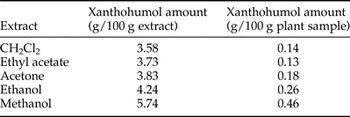
Xanthohumol is a characteristic compound of the hop cones and it was isolated from the methanol extract by column and thin layer chromatographic methods as a yellowish powder (m.p. 157–159 °C). Its chemical structure was characterized by IR, 1H-NMR, 13C-NMR, one-dimensional (1D)- and 2D-NMR methods. Its chemical structure was also confirmed by comparing the previously reported spectral data (Zhao et al., Reference Zhao, Watanabe, Nozawa, Daikonnya, Kondo and Kitanaka2005; Chen et al., Reference Chen, Fu, Chen, Liu, Liu, He and Pu2012). Furthermore, the quantitative amounts of the xanthohumol in the extracts were analyzed by HPLC to explore the relationship with xanthohumol amount of the extracts and their insecticidal effects. According to the data presented, the amount of xanthohumol increase with polarity of the organic solvent (table 1). Quantitative amount of xanthohumol of CH2Cl2, ethyl acetate, acetone, ethanol and methanol extracts were 3.58, 3.73, 3.83, 4.24 and 5.74 g/100 g extract, respectively (table 1). However, the toxicity studies showed that insecticidal effects of the extracts increased with decrease of the organic solvent. These results showed that there are no relation with the amount of xanthohumol in the extracts and insecticidal activities of the extracts (table 1).
Xanthohumol amounts of the extracts.

Insecticidal effects of the extracts and xanthohumol
The contact toxicities of dichloromethane, ethyl acetate, acetone, ethanol and methanol extracts and characteristic metabolite, xanthohumol of H. lupulus cones were evaluated against adults of five important stored pests, S. granarius (L.), S. oryzae (L.), A. obtectus (Say), T. castaneum (Herbst) and L. serricorne (F.). Four different doses, 5.0, 10.0, 20.0 and 40 µg per insect of the extracts and xanthohumol were tested, and their toxicities were compared with those of the commercial insecticide, malathion (2 µg). The mortalities of the adults of the insects were counted at 24, 48, 72, 96 and 120 h after exposure. The results were presented in Supplementary tables S1–S5. The results showed that toxicities of the extracts and xanthohumol increased with increase of doses of the substances and exposure times (Supplementary tables S1–S5). Among the tested substances, commercial insecticide, malathion was more active against the tested pests. The positive control (malathion) showed 100% mortality at a dose of 2 µg. However, mortality in the negative controls was always <10%. As can be seen from Supplementary tables S1–S5, malathion caused total mortality after 24 h of exposure. Furthermore, xanthohumol was more toxic against the all of the tested pests as compared with the toxic effects of the extracts. The 40 µg dose of xanthohumol showed higher toxicities than other concentration against all of the pests tested (Supplementary tables S1–S5). As shown in Supplementary table S1, xanthohumol showed the highest toxicity against S. granaries as well as S. oryzae (L.). Its 40 µg dose caused 100% mortality against the adults of S. granaries (L.) and S. oryzae (L.) after 48 h of exposure time (Supplementary tables S1 and S2). Xanthohumol was found to be less effective against A. obtectus (Say.) and T. castaneum (Herbst) adults (Supplementary tables S3 and S4). Moreover, the ethyl acetate extract of H. lupulus cones was the most effective extract. Among the tested extracts of hops cones, the ethyl acetate extract showed the highest toxic effects against the storage pests (Supplementary tables S1–S5). The toxic effects of dichloromethane and acetone extracts were found to be lower than the ethyl acetate extract but to be higher than ethanol and methanol extract. The 40 µg dose of ethyl acetate extract caused 100% mortality against the adults of S. granarius (L.) after 72 h of exposure (Supplementary table S1). Our results also indicated that polar extracts, ethanol and methanol extracts were less effective against the adults of the five storage pests.
The LD50 values of the extracts of H. lupulus cones and xanthohumol against adult insects after 48 h of exposure are shown in table 2. The LD50 values of the positive control, malathion were not calculated due to 100% mortality after first 24 h of exposure. Table 2 show that xanthohumol has low LD50 values as compared with those of the extracts. Its LD50 values were <5, <10, 22.3 and 26.4 µg doses. As can be seen from table 2, according to LD50 values, pure xanthohumol was classified as potent toxic insecticide (LD50 values respectively <10, <5 and <5 µg) against S. oryzae (L.), S. granarius (L.) and L. serricorne (F.) and as toxic insecticide (LD50 values 20–60 µg) against A. obtectus (Say.) and T. castaneum (Herbst) (table 2). Likewise, among the extracts contain xanthohumol, the ethyl acetate extract was classified as more toxic substance against S. granarius (L.) (LD50 = 15.4 µg) and as toxic substance against S. oryzae (L.) (LD50 = 29.2 µg), A. obtectus (Say.) (LD50 = 26.9 µg), T. castaneum (Herbst) (LD50 = 21.1 µg) and L. serricorne (F.) (LD50 = 24.1 µg). In the view of the results in table 2, the dichloromethane extract was also classified as toxic insecticide against all tested insects (LD50 values 21.9–33.2 or >40 µg). However, LD50 values were found to be high values for acetone, ethanol and methanol extracts as compared with those of xanthohumol and other extracts. These results show that the insecticidal effects of the extracts reduce with increase of polarity of the organic solvents. Many times, these extracts acted as medium insecticide reagents against the adults of some insect species such as S. granarius (L.) and L. serricorna (Ware, Reference Ware1986).
The LD 50 values of the extracts of H. lupulus cones and xanthohumol against the adults of the insects in the first 48 h.

The values in parentheses are the 95% confidence intervals.
(-): cannot be determined.
The duration times were calculated by the probit analyses for the 50% mortality of the adults of the S. granarius (L.), S. oryzae (L.), A. obtectus (Say.), T. castaneum (Herbst) and L. serricorne (F.) exposed to different concentrations of the xanthohumol and the extracts (Supplementary table S6). Durations of the practices for 50% mortality of the adults of insects decreased with increasing of the concentration. According to the present data, the toxicities of the practices were concentration dependent. Between all of the tested substance and extracts, the xanthohumol was found to be the most toxic compound against all of the adults of the storage insects with short duration times of 10.9–107.6 h at the 10 µg dose (Supplementary table S6). Otherwise, according to the durations for 50% mortality of the insects, the ethyl acetate extract was more toxic than other extracts. The shortest duration time of ethyl acetate extract (43.3 h) for 50% mortality was determined for S. garanarius adults as compared with other insects. As can be seen from Supplementary table S6, the longest duration times were found for methanol extract.
Discussions
The insecticidal effects of various extracts of H. lupulus and its principal component, xanthohumol against adults and larvae of various insects species have been evaluated, indicating various toxic effects depending on the insect species, type of extract and dose or concentration (Gokce et al., Reference Gokce, Isaacs and Whalon2006a , Reference Gokce, Whalon, Cam, Yanar, Demirtas and Goren b , Reference Gokce, Stelinski, Isaacs and Whalon c , Reference Gokce, Whalon, Cam, Yanar, Demirtas and Goren2007; Er et al., Reference Er, Gokce and Whalon2009; Yanar et al., Reference Yanar, Kadioglu and Gokce2011; Cam et al., Reference Cam, Gokce, Kadioglu, Yanar, Demirtas, Goren and Whalon2012; Gokce et al., Reference Gokce, Isaacs and Whalon2012; Karakoc & Gokce, Reference Karakoc and Gokce2012; Karaca & Gokce, Reference Karaca and Gokce2014; Bedini et al., Reference Bedini, Flamini, Girardi, Cosci and Conti2015; Jackowski et al., Reference Jackowski, Hurej, Rój, Popłoński, Kośny and Huszcza2015). Jackowski et al. (Reference Jackowski, Hurej, Rój, Popłoński, Kośny and Huszcza2015) indicated that xanthohumol and supercritical carbon dioxide extract of spent hops posssess medium deterrent activity against three stored product pests, S. granarius (L.), Tribolium confusum and Trogoderma granarium. They also showed that the spent hops extract was more active than xanthohumol. On the other hand, our results indicate that xanthohumol and the nonpolar solvent extracts of hops was found to be active against S. granarius (L.) and the toxic effect of xanthohumol was higher than those of the extracts (Supplementary table S1). Recently, some previous reports have mostly focused on the insecticidal properties of H. lupulus against the larvae and adults of Colorado potato beetle (Leptinotarsa decemlineata L.) (Gokce et al., Reference Gokce, Whalon, Cam, Yanar, Demirtas and Goren2006b , Reference Gokce, Whalon, Cam, Yanar, Demirtas and Goren2007, Reference Gokce, Isaacs and Whalon2012; Cam et al., Reference Cam, Gokce, Kadioglu, Yanar, Demirtas, Goren and Whalon2012; Alkan et al., Reference Alkan, Gokce and Kara2015). Studies on the antifeedant activity of different extracts (hexane, ethyl acetate and methanol extracts) of hops showed that this plant extract significantly reduced the feeding of Colorado potato beetle when it was tested at 1% (w/v) concentration and their antifeedant activity could be attributed to their xanthohumol contents (Alkan et al., Reference Alkan, Gokce and Kara2015), confirming previous reports of the antifeedant action of hops extracts to this important pest (Gocke et al., Reference Gokce, Whalon, Cam, Yanar, Demirtas and Goren2006b , Reference Gokce, Whalon, Cam, Yanar, Demirtas and Goren2007, Reference Gokce, Isaacs and Whalon2012). Thaumetopoea solitaria is a serious pest of some cultivated plants, in particular of pistachio throughout the Mediterranian and the surrounding regions. Ingestion of a methanolic H. lupulus extract caused 83% mortality in T. solitaria after 48 h (Er et al., Reference Er, Gokce and Whalon2009). Yanar et al. (Reference Yanar, Kadioglu and Gokce2011) has studied the contact toxic effect of the methanolic extracts of different plant extracts besides H. lupulus against two-spotted spidermite, Tetranychus urticae, is a common pest of many plant species in greenhouses and field crops and they found that a methanol extract of H. lupulus caused 67.84% mortality after 24 h exposure time. In a recent study, the essential oils of H. lupulus cones were reported as a good insecticide and molluscicide against the invasive disease vectors Aedes albopictus and Physella acuta (Bedini et al., Reference Bedini, Flamini, Cosci, Ascrizzi, Benelli and Conti2016). In accordance with our findings (table 2 and Supplementary tables S1–S6), these results suggest that H. lupulus extracts appear to have a broad spectrum of activity against insect pests, which are harmful to stored and field products.
In conclusion, the currents results show that xanthohumol and ethyl acetate extract of hops cones were found to be toxic against all the tested insects species. Xanthohumol as well as the ethyl acetate extracts can be used as botanical insecticides. Xanthohumol, characteristic compound of hops cones can be used as an alternative insecticide against the storage insects, S. granarius (L.), S. oryzae (L.), A. obtectus (Say.), T. castaneum (Herbst) and L. serricorne (F.).
Supplementary material
The supplementary material for this article can be found at https://doi.org/10.1017/S0007485317000256.
Acknowledgments
This study was financed by Ağrı İbrahim Çeçen University (BAP) (Project No: ECZF.14.004). Therefore, the authors were grateful to their universities for the financial support and to the Pazaryeri District Directorate of Agriculture for providing cones of H. lupulus. The authors were also grateful to Dr. Metin Acikyildiz (Kilis 7 Aralık University, Faculty of Science and Letter, Department of Chemistry, Kilis) for supporting on the statistical analyses.