1. Introduction
Financial hardship is often conceived as a motivational and driving force in the job search, but empirical studies show that lowering the benefits for unemployed individuals has only moderate effects on the employment rate. In this study, we investigate how social assistance recipients in Denmark feel and react when their benefits are reduced. We examine which recipients are experiencing frustrations, which are motivated and how these feelings are related to their job search and employment. In our study, we have selected a subsample of respondents who have experienced a considerable reduction in disposable income. Thus, one could expect that the economic incentives to become employed are significant. On this basis, we analyse whether there are any particular individual characteristics that make it more likely for some recipients to be employed compared to others. We find that, although the welfare recipients experienced considerable income reductions, they reacted very differently. In addition, although their reactions were different, the employment outcomes were first and foremost dependent on the recipients’ health. Moreover, self-efficacy and employability were correlated with employment. Finally, the study shows the interplay between reductions in income, health and self-efficacy among some of the most vulnerable recipients of social assistance.
In Denmark, as in most other European countries, there has been a move away from an unemployment policy that passively compensates the unemployed to a policy that actively promotes an employability strategy, including social investments in education and vocational training (van Kersbergen and Hemerijck, Reference van Kersbergen and Hemerijck2012). Unemployment in Denmark was more than halved from the mid-1990s to around 2007–2008 following the introduction of activation policies because job opportunities improved, especially for immigrants with lower qualifications. Until 2002, both flexicurity and social investment were integrated into this strategy. Therefore, the flexicurity model and the Danish active labour market policy, which is considered as the third leg in the flexicurity model, were celebrated as great successes, both in Denmark and in the European Union (Madsen, Reference Madsen, Campbell, Hall and Pedersen2006). However, from the 1990s to the early 2000s, the effectiveness of the activation policy has not been proven at the micro level. In fact, several refined measurements of the effect of activation policy have revealed that the effects, at best, were small (Ministry of Labour, 2000; Economic Council, 2007).
The Liberal-Conservative government elected in 2001 introduced a labour market policy reform (in 2002) that changed the entire system of activation policies. Education for the unemployed was taken almost completely off the table and replaced by a strategy aimed at increasing the incentives to work by reducing social assistance benefits and promoting a ‘work first’ approach as the shortest path to employment. Furthermore, the duties of the unemployed (‘conditionality’) were, as in most other European countries (Clasen et al., Reference Clasen, Kvist, van Oorschot, Kautto, Fritzell, Hvinden, Kvist and Uusitalo2001; Clasen, Reference Clasen2005), strengthened.
Prior to the 2002 reforms, the Danish public support system had been rather successful in reducing poverty by granting the unemployed relatively high benefits compared to other OECD countries. However, recent changes have moved the Danish system closer to other European systems, and it no longer stands out as distinctly as it did in the mid-1990s (Fawcett and Papadopoulos, Reference Fawcett and Papadopoulos1997; Kuivalainen and Nelson, Reference Kuivalainen, Nelson, Kvist, Fritzell, Hvinden and Kangas2012; Dølvik et al., Reference Dølvik, Fløtten, Hippe and Jordfald2015; Goul Andersen et al., Reference Goul Andersen, Schoyen, Hvinden, Taylor-Gooby, Leruth and Chung2017).
One of the most radical changes in the Danish activation policy has been the introduction of lower levels of social assistance to certain groups of benefit recipients, with the purpose of creating greater economic incentives to search for and gain employment. The lower levels of benefits are specifically targeted towards newly arrived refugees and immigrants as well as other vulnerable groups of social assistance recipients, who also consist largely of ethnic minority Danes.
Economic incentives, such as lower levels of benefits, are based on the rational choice assumption that it makes claimants intensify their job search activities and become less selective about the jobs they are willing to take, thereby moving unemployed people closer to ordinary employment on the labour market.
The reduced social assistance not only signalled a shift in the activation policy but also differentiated the social assistance benefits so that claimants were no longer treated equally. Since a large proportion of individuals who were targeted by the reduced social assistance were refugees and immigrants, the explicit intention of the new policy was also to send a signal to refugees and immigrants that they could not expect to be treated equally by the Danish welfare system before they had earned the right by working in the regular labour market (Andersen et al., Reference Andersen, Larsen and Møller2009).
These lower levels of social assistance consisted of: 1) start help and introductory social assistance benefits; 2) a ceiling on social assistance benefits; and 3) the 300 hours rule, which later changed to the 450 hours rule, reduced the benefits for people living in a marital union who have not been in unsubsidised employment for at least 300/450 hours within the last two years. If both of the spouses receive social assistance benefits, one of the spouses – most likely the female – would lose his or her benefit entitlement in the case of non-compliance.
The reduced social assistance was abolished on 1 January 2012 by the new centre-left government, but it was reintroduced in 2015 when a Liberal government came to power.
The focal point of this paper is to examine if and to what extent reduced social assistance affects job seeking behaviour and the possibility of obtaining ordinary employment. In general, few of the recipients of the lowest levels of social assistance are able to get a job. Incentives only work in a few cases for these vulnerable recipients. To explain why this is so and which recipients are most likely to get a job, the economic perspective has to be supplemented with both a sociological perspective and a perspective from industrial/organisational psychology. A multidisciplinary research agenda is needed to study the various mechanisms that have an impact on individuals’ job search and employment (Manroop and Richardson, Reference Manroop and Richardson2016).
Many sociologists have explained that individual economic rationality is neither the only nor the most important driver of actors. Bourdieu’s (Reference Bourdieu1990; Reference Bourdieu1998) theory of practice is one of the most comprehensive and relevant frames of reference because concepts such as capital, habitus and field make it clear that structure and context are very important drivers. Taylor-Gooby (Reference Taylor-Gooby2008) explicitly discusses different forms of rationality and shows that individual economic choice is frequently not the most important kind of rationality. Moreover, he shows that values and institutional frameworks have a great impact on reflections and actions. Wright (Reference Wright2012) stresses that users of public social services, such as benefit recipients, are reflexive but take different kinds of conditions, related to a specific context, into consideration, and she adds that social service providers are very important as interacting agents. In an investigation of the 300 hours rule, Diop-Christensen (Reference Diop-Christensen2015; Reference Diop-Christensen, Kamali and Jönsson2018) shows that street-level workers have been important mediators of the Danish work-first approach to vulnerable recipients of social assistance. The social workers have prioritised differently, dedicating more time and focusing on coping strategies targeting the individual receivers of social assistance.
Moreover, the individual’s ability to find a job – the employability – has to be viewed from a psychological viewpoint. This ability reflects the individual’s perception of his or her possibilities of acquiring a job. The concept of employability ‘reflects individuals’ beliefs about their possibilities of getting new employment’ (Berntson et al., Reference Berntson, Näswall and Sverke2008:414). Therefore, it is obvious that the concept of employability should be linked to self-efficacy, which Bandura defines as ‘beliefs in one’s capabilities to organize and execute the courses of action required to produce given attainments’ (Bandura, Reference Bandura1997:3).
In our study, we have the potential to determine whether some of the recipients of social assistance who have experienced a reduction in their benefits are more able to get a job than others. Accordingly, we are able to investigate whether the more successful job seekers have specific sociological characteristics in terms of, for example, gender, age, ethnicity, health, attitude or education. Moreover, we include an examination of two psychological characteristics, motivation and perceived self-efficacy (Bandura, Reference Bandura1993), due to their close relation to employability. Both types of characteristics are addressed by analysing data from a longitudinal survey study of employment status one year after the first interview of people who were receiving reduced social assistance.
The first part of the paper describes the findings of earlier Danish studies on the employment effects of lower levels of social assistance. The second part of the paper presents the longitudinal survey method that has been applied in this paper. The third part presents the results, descriptive statistics and the regression analyses. The fourth section consists of a discussion and conclusions.
2. State of the art: Findings from earlier Danish studies on the employment effects of lower levels of social assistance
2.1. Overview
In recent years, most social security systems for unemployed people have been based on conditionality. Conditionality can take many forms. For example, it may be a duty to participate in activation programmes, different forms of sanctions if one does not comply with the rules or different forms of economic incentives (Griggs and Evans, Reference Griggs and Evans2010; Arni et al., Reference Arni, Lalive and Van Ours2013; Hansen and Schultz-Nielsen, Reference Hansen and Schultz-Nielsen2015). In this paper, we are concerned with economic incentives to seek employment based on lowering levels of benefits for social assistance recipients. Our review of Danish studies on lower levels of benefits will specifically look at the effects in terms of employment. However, similar to Geiger (Reference Geiger2017), it is important to emphasise that misapplied economic incentives (conditionality) run the risk of worsening the position of the most vulnerable claimants. This is in accordance with Danish studies on the effects of lower levels of benefits, which emphasise that the effects in terms of poverty, high frequency of deprivation and other poor living conditions are severe for those who are not able to search for, obtain or keep a job (see, for example, Andersen et al., Reference Andersen, Hansen, Schultz-Nielsen and Tranæs2009, Reference Andersen, Hansen, Schultz-Nielsen and Tranæs2012; Müller et al., Reference Müller, Hussain, Larsen, Hansen, Hansen and Ejrnæs2015; Hansen and Schultz-Nielsen, Reference Hansen and Schultz-Nielsen2015).
2.2. Factors that enhance future job opportunities of marginalised social assistance recipients
In general, social assistance recipients have poor chances of getting a job. However, a literature review of the progression of these recipients (Arendt and Jacobsen, Reference Arendt and Jacobsen2017) examined the relevant studies. This review identified three factors that have positive impacts on future employment. The first factor is employability, which is an umbrella concept that covers the range of skills that are necessary to find and master a job. Five out of six relevant studies found a positive effect of employability on the future chances of getting a job (Arendt et al., Reference Arendt, Andersen and Saaby2017; van Hooft, Reference van Hooft2014; Koen et al., Reference Koen, Klehe and Van Vianen2013; Bach, Reference Bach2012; McArdle et al., Reference McArdle, Waters, Briscoe and Hall2007). The second factor is self-efficacy. Four out of four relevant studies showed a positive correlation between self-efficacy and future chances of getting a job (Arendt et al., Reference Arendt, Andersen and Saaby2017; Andersson, Reference Andersson2015; Fieseler et al., Reference Fieseler, Meckel and Muller2014; Kellett et al., Reference Kellett, Purdie, Bickerstaffe, Hopper and Scott2013). The third and most solid factor is (self-assessed) health. Six out of six relevant studies showed a strong correlation between better health and future chances of getting a job (Arendt et al., Reference Arendt, Andersen and Saaby2017; Svane-Petersen and Dencker-Larsen, Reference Svane-Petersen and Dencker-Larsen2016; Nilsson and Ekberg, Reference Nilsson and Ekberg2013; Bach, Reference Bach2012; Kemp and Davidson, Reference Kemp and Davidson2010; Apel and Fertig, Reference Apel and Fertig2009).
In the remaining part of this literature review, we will look at studies that examine the effect of reduced social assistance on employment in Denmark.
2.3. Ceiling over social assistance
Graversen and Tinggård’s (Reference Graversen and Tinggård2005) survey-data based study shows that the ceiling on social assistance has not enhanced the employment rate compared to that of individuals who were not hit by the ceiling. Furthermore, the ceiling did not lead to more intensive job searches on the part of the affected individuals. The study explains that the findings are due to the fact that claimants hit by the ceiling have other problems besides unemployment; for example, poor health and the fact that many were refugees and immigrants who had a poor mastery of the Danish language. A study of the effects of a specific reduction in social assistance of 500 Danish Kroner (67 Euros) confirms the findings of the aforementioned study (Graversen, Reference Graversen2006).
2.4. The 300 hours rule
Bach and Larsen’s (Reference Bach and Larsen2008) survey-data based study shows that 33 per cent of those who had lost their social assistance and 25 per cent of those who were at risk of losing their social assistance were employed at the time of the interview. Thirty-four per cent who had lost the social assistance were no longer part of the labour force and were classified as ‘home workers’. Among the remaining 33 per cent, it was found that their job search intensity had increased. However, due to the lack of a control group in this study, it is difficult to measure the effect more precisely. Diop-Christensen’s (Reference Diop-Christensen2015; Reference Diop-Christensen, Kamali and Jönsson2018) study of the same issue is based on register data from Statistics Denmark, and it shows that in the period from January 2006 to January 2008 there were few non-compliers to the 300 hours rule. The main reason for this is that the rule may have caused the social workers to change their evaluation of who should be moved to other benefit schemes. The actual employment effect of increased economic incentives was secondary, but both the threat of and especially the actual sanctions had positive employment effects. However, only relatively few of the affected women found a job that lasted longer than 3 months (Diop-Christensen, Reference Diop-Christensen2015: 222).
2.5. Start help and introductory benefits
There are several studies on the employment effects of start help, including those of Huynh et al. (Reference Huynh, Schultz-Nielsen and Tranæs2007; Reference Huynh, Schultz-Nielsen and Tranæs2010), Rosholm and Vejlin (Reference Rosholm and Vejlin2010), and Andersen et al. (Reference Andersen, Hansen, Schultz-Nielsen and Tranæs2009, Reference Andersen, Hansen, Schultz-Nielsen and Tranæs2012). Andersen et al.’s study shows that the start help does have a positive employment effect overall. In 2003, after 16 months of stay in Denmark, 14 per cent of the recipients of start help and introductory benefits were employed compared to eight per cent of those receiving ordinary social assistance. However, the results also indicate that the employment effect of start help decreases over time (from 2002 to 2006), as more immigrants and refugees who receive ordinary social assistance are employed in the ensuing period than those who receive start help. Start help seems to accelerate employment.
2.6. Studies of all lower levels of social assistance
Based on two surveys in 2009 and 2010 with the same recipients of the lowest levels of social assistance, Ejrnæs et al. (Reference Ejrnæs, Hansen, Hansen, Hussain and Larsen2011) show that the recipients often change positions. However, most of the recipients of the lower levels of social assistance in 2009 moved to other kinds of benefits in 2010, 28 per cent remained at the lowest levels of social assistance, and 18 per cent were employed.
Based on register data from 2004 to 2007, Hansen and Hussain (Reference Hansen and Hussain2009) show that those who receive reduced social assistance are by far the largest group receiving lower levels of social assistance, and, compared with those who receive ordinary social assistance, they have a lower employment rate (21 per cent and 24 per cent in 2007, respectively, for those who received benefits in 2004).
2.7. Summary of the findings of Danish studies on the employment effect of reduced social assistance
Overall, the findings of the studies show a mixed picture. The social assistance ceiling and other small reductions have no effect on employment. The 300 hours rule has a positive employment effect. The employment effect of the start help and the introductory benefits is relatively small (from 8 to 14 per cent) but rather indisputable. It is important to notice that the employment rate is very low in general for this group. Moreover, the 75 per cent increase in employment rate in this group only raises the total employment to 14 per cent.
However, the reviewed Danish studies lack a strong evidence base since the size of the effect is generally small and the comparison groups are rarely optimal. Therefore, it is difficult to reach a definitive conclusion as to whether lower levels of social assistance – as intended – are increasing the employment rate for those affected by the lower benefits.
3. Data and methodology
The representative survey data utilised in this paper, covering people who experienced reduced social benefits, stem from a research project financed by the Danish Council for the Socially Vulnerable. In this paper we utilize the repeated survey data from 2009 and 2010. The collection of data is described in detail in the appendix of Müller et al. (Reference Müller, Hussain, Larsen, Hansen, Hansen and Ejrnæs2015).
We are using the part consisting of a survey of recipients receiving the lowest social benefits, who were interviewed in 2009 and then re-interviewed by phone in 2010. In the 2009 interviews, 246 of the respondents reported that they had experienced reduced benefits. In the 2010 re-interviews, 200 persons answered the question about job search and discouragement. Since we also want to use other variables in the analysis, the effective sample size is reduced to 129 since more persons have missing values when including additional variables. One alternative to deleting observations is to impute the missing values. However, that was not done here since the sample is still representative: that is, no significant differences were found in the averages of the central variables, including gender, age, number of deprivations, discouragement and job search, when comparing the n=246 sample to the n=129 sample (available from authors upon request). This also means that we do not believe that the parameters suffer from attrition bias since the sample is still representative. The final sample size is not large, and there is thus a (higher) risk of a type-two error. For example, we could fail to reject a false null hypothesis (false negative finding), so we cannot be sure that statistically insignificant coefficients are unimportant.
The officially stated explicit goal of implementing reduced benefits was to increase claimants’ employment chances by making it more attractive for them to get a job. For our purpose, it was therefore important to study the interplay between reduced benefits, motivation and job search on the one hand and getting a job on the other. That is the reason we chose to work on a subsample of the data that has non-missing information regarding whether or not reduced benefits increased job search intensity and made recipients more discouraged. Individual data about these two dimensions collected in 2009 allow us to study the interplay of these factors when the recipients’ benefits were reduced. In addition, it allows us to study the impact of these factors on obtaining a job in 2010. Question number 34 was (translated like other questions below) ‘Did the reduced benefit imply that you or others in the household became more discouraged and resigned?’, with the possible answers being ‘Yes, to a high degree’, ‘Yes, to some degree’, ‘Yes, to a small degree’ and ‘No’. With the same possible answers, question number 35 was ‘Did the reduced benefit imply that you or others in the household were more encouraged to search for an ordinary job?’.
The applied success variable ‘working in 2010’ is based on question 5a from the questionnaire: ‘Where do you get your income from?’. There were seventeen possible answers, including market work, different benefits and other income. Respondents who answered ‘working on the market, e.g. wage or self-employed’ in 2010 are classified as working.
In order to give an intuitive overview of the effects of lowering already low social benefits, we start by presenting descriptive tables, with a focus on whether or not the recipients are in a job. This is followed by appropriate regressions modelling the chances of getting a job as well as other regressions to highlight the direct and indirect effects of reducing benefits. A linear probability model (LPM) is used but with robust standard errors such that known heteroscedasticity in the LPM is properly handled (Quinto Romani, Reference Quinto Romani, Hussain and Lauridsen2017; Wooldridge, Reference Wooldridge2013). It is also well known that predictions from the LPM can fall outside the valid 0–1 probability interval, but since we are not interested in predictions per se but rather the average effects, we find the LPM suitable in this context. An advantage of the LPM is that we do not need a link function to make it possible to move back and forth to and from the logit/probit; instead, we can directly estimate the effects in probability units using the estimated coefficients from the LPM.
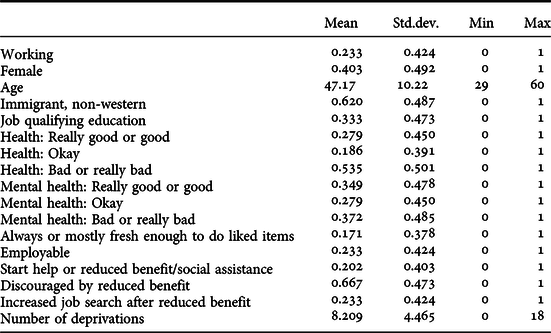
We see from the data that 23.3 per cent of individuals with reduced benefits in 2009 were working in 2010 (Table 5). The majority of the respondents (66.7 per cent) were discouraged after they experienced reductions in their social benefits, and 23.3 per cent increased their job search efforts after the benefit reduction. A total of 40.3 per cent of the sample consists of women. The age varies between 29 and 60 years with an average of 47.2 years. When re-interviewed in 2010, the sample size was reduced from 197 to 129 respondents.
The study has certain limitations. The subsample is relatively small, and the attrition is relatively high. Both characteristics are well known in studies of vulnerable persons. Thus, our subsample could be biased in such a way that the analyses of the recipients are not representative for all reduced benefit recipients. However, it is not essential for our study that the respondents be representative of all recipients of social assistance. The essential issue is to explore how some of the most vulnerable recipients of social assistance react to a reduction in income and investigate which factors have the greatest impact on employment.
The small sample size (n) means that a specific factor’s impact on the employment rate must have a certain magnitude to be statistically significant. Thus, we would have detected more significant bivariate correlations between the recipients’ individual characteristics and employment, and perhaps also some statistically significant correlations in the final model with all variables included. Therefore, we cannot conclude that only certain factors have an impact. However, this limitation does not prevent us from making important conclusions regarding the evidence of some practically significant factors (Kirk, Reference Kirk1996) that explain a substantial part of the variation.
4. Results
4.1. Descriptive analysis
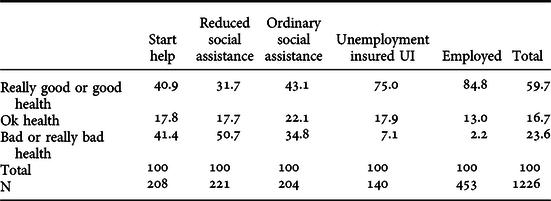
Table 1 highlights one of the main points of our study: namely, that health is one of the main differences between various benefit groups. More specifically, we see that 85 per cent of employed people reported that they had very good or good health, while this fraction was less than half for people with reduced benefits (32 and 41 per cent for reduced social assistance and start help, respectively).
Benefit group and health in initial interview in 2009

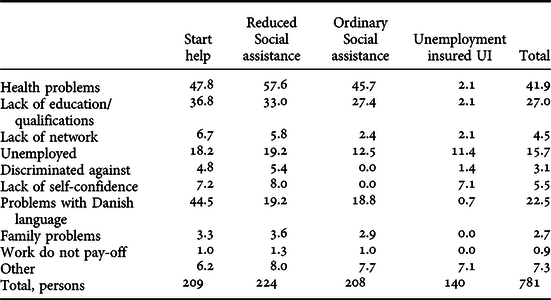
Table 2 shows a somewhat similar picture. Around half of the people on reduced benefits said that poor health is a barrier for self-sufficiency, while this fraction is only 2 per cent among the insured unemployed (UI). Another frequent barrier is a lack of education/qualifications, which points to inadequate human capital accumulation. This can be an especially large problem if the individual’s productivity is below the (implicit) minimum wage. In such a case, economic incentives will probably not work (in the short run) since the institutional setting prevents employment.
Percentage of (former) recipients who have barriers to becoming economically self-sufficient, by benefit status at time of first interview in 2009

The results show that a large number of these people do not react to the strong economic incentives. They know that their bad health or their lack of education was (and still is) a barrier to obtaining an ordinary job on the Danish labour market in 2009. Against this background, they often use other coping strategies (Müller et al., Reference Müller, Hussain, Larsen, Hansen, Hansen and Ejrnæs2015): for example, considering family values when they reduce their spending and prioritising which needs are to be fulfilled and which can be disregarded or taking actions to protect their children against deprivations (Taylor-Gooby, Reference Taylor-Gooby2008; Wright, Reference Wright2012; Müller et al., Reference Müller, Hussain, Larsen, Hansen, Hansen and Ejrnæs2015).
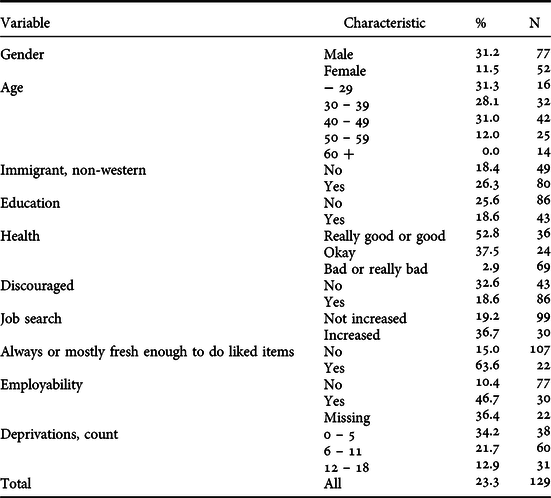
The determinants of getting a job are presented in Table 3, which displays the likelihood of obtaining a job depending on individual characteristics. Major differences exist between males and females. Males’ job chances are 31 per cent while females’ are just 12 per cent. The lower job chances of women are explained by the gender wage gap, which is based on the fact that it is cheaper on average for a household to have the woman take time off from work to take care for the children (Weichselbaumer and Winter-Ebmer, Reference Weichselbaumer and Winter-Ebmer2005; Waldfogel, Reference Waldfogel1997). Surprisingly, non-western immigrants have a higher probability (26 per cent) of employment compared to people of Danish origin or others of western origin (18 per cent). Health again appears to be important, as recipients with very good or good health have a 53 per cent chance of being in a job, compared to only 3 per cent of people with very bad or bad health. Self-efficacy in the form of being able to carry out desired activities is also important, and 64 per cent of people with this trait are employed compared to only 15 per cent of those without it. Self-reported employability shows that employable persons’ job probability is 47 per cent while that of not-so-easily employable persons is 10 per cent. People who are not discouraged by the lower benefits or who increase their job search activities roughly double their chances of becoming employed compared to discouraged persons or persons who do not increase their job search.
Percentage in work in 2010 given situation in 2009

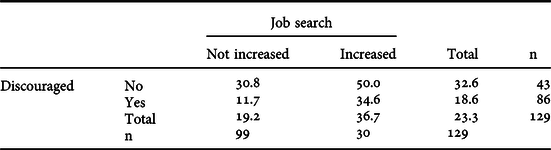
The latter observation is explored in further detail in Table 4. Together, increasing job search and not being discouraged result in an employment level of 50 per cent. ‘No further discouragement’ and ‘no increased job search’ resulted in job chances of around 31 per cent, while ‘increased job search’ and ‘being discouraged’ resulted in job chances around 35 per cent. These results show that the benefit of increased job search can be offset by discouragement, and a lack of job search can similarly offset the positive effects of lack of discouragement. Those who are both discouraged and do not increase their job search are worst off, as their employment chances are only 12 per cent.
Percentage of individuals in work in 2010 given whether discouraged or not because of lower benefits/increased job search in 2009

Summary statistics (n=129)

Note: All variables relates to the situation in 2009, except working, which is from 2010.
4.2. Regression estimates
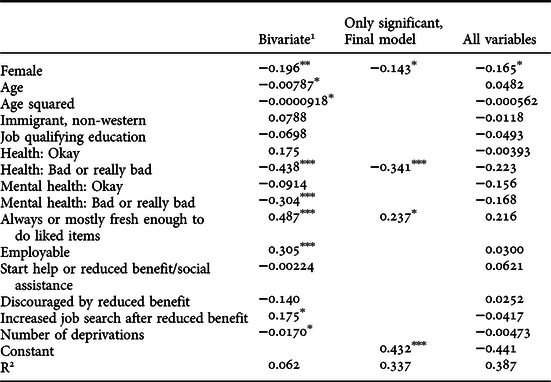
A set of regressions is used to model the probability of being employed in 2010 given certain characteristics in 2009. Summary statistics for the applied data are presented in Table 5, and the regression results are displayed in Table 6. The first column (‘Bivariate’) contains regression parameters from a set of simple bivariate regressions modelling the chances of having a job when including only a single variable at a time. In the next column (‘Only significant, Final model’), a stepwise procedure successively tests out insignificant variables but allows re-entry of earlier insignificant variables if they become significant at later stages in the exclusion/inclusion process. The last column (‘All variables’) is a regression simultaneously including all explanatory variables.
Linear regression model for probability of working in 2010 (n=129)

1 Age, health and mental health are included with two variables each. R-sq is the average of bivariate R-sq.
Significance: * p<0.05, ** p<0.01, *** p<0.001
Even in the bivariate regressions, we observe that only a few variables are significant. Females are less likely to be employed, people who are always or mostly able to engage in desired activities have higher chances of having a job (self-efficacy), bad or really bad physical health has a large negative impact on job chances (minus 44 percentage points), employability is highly significant in bivariate regressions (but almost entirely loses significance once health is included because of multi-collinearity) and age and age squared are both significant in the bivariate regressions, with job chances decreasing at an accelerating rate with age.
The effect of being a non-western immigrant on employment was not significant in the bivariate regression. This insignificant effect is surprising in the sense that non-western immigrants do not have lower job chances than people of western origin. Interestingly, increased efforts to find a job by individuals due to reduced benefits do not on average increase job chances when controlling for covariates. Although there is an estimated positive effect of 18 percentage points in the bivariate regressions, this effect becomes insignificant when including other covariates. Similarly, discouraged individuals do have lower employment chances (estimated as minus 14 percentage points in the bivariate regressions), but this effect is also insignificant when controlling for other factors.
First and foremost, bad or very bad health remains significant (34 percentage points reduction in job chances) when successively eliminating insignificant variables (‘Only significant, final model’). Two additional variables have a significant impact: self-efficacy (always or mostly able to engage in desired activities is related to a 24 percentage points increase in job chances) and gender (females have 14 percentage points lower job chances than males). It is remarkable that these three variables explain more than one-third of the variation in employment as R2 = 0.337 in the final model, where only significant variables are included. These variables are very strongly associated with employment, and none of the other variables, which are statistically significant in the bivariate analysis, retain their impact in the model with all variables included.
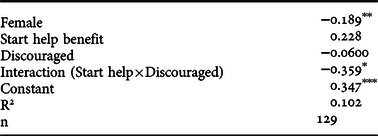
We investigate the type of benefit and discouragement further by interacting both variables, as we expect that newly arrived refugees (recipients on start help) who are discouraged may be more likely to resign themselves to the situation (Table 7). What can be observed in the final model is that respondents’ job chances are neither affected by start help nor by being discouraged. However, the existence of both (receiving start help and being discouraged) significantly reduces job chances (on average by 36 percentage points). In contrast to earlier studies, we do not find an effect of start help per se, but start help combined with discouragement has a significant negative effect, which is in line with earlier evidence on the negative effects of start help.
LPM of working in 2010 with start help and discouragement interaction.

5. Discussion and conclusion
Earlier studies (see inter alia Graversen and Tinggård, Reference Graversen and Tinggård2005; Graversen, Reference Graversen2006; Hansen and Hussain, Reference Hansen and Hussain2009; Ejrnæs et al., Reference Ejrnæs, Hansen, Hansen, Hussain and Larsen2011) have shown that various forms of benefit reduction to marginalised people do not increase the employment rate to any significant degree. Small reductions do not seem to have any effect at all. When the reductions are very large there is some effect, but the significant majority of the recipients do not get a job. The last finding is astonishing because it challenges the basic assumptions of incentive theory. Our data allow us to analyse what is happening to people who have experienced a marked loss of disposable income. In particular, we investigated the impact of incentives in combination with the family’s living conditions, attitudes and feelings. We focused on both the immediate effects on job search and discouragement and the effect on having or keeping an ordinary job.
In this paper, we have described the recipients’ immediate reactions: namely, whether they became more discouraged and whether they increased their job search activities. Four types of reactions were considered, and we found that the recipients who intensified their job search and did not become discouraged had the highest rate of employment in 2010. Specifically, when the respondents themselves expressed that the benefit reduction had not made them discouraged and they had increased their job search, then they were also more likely to get a job. The discouraged benefit recipients who did not intensify their job search had the lowest job rate in 2010. Thus, both the immediate effects of the incentives and feelings seem to have a significant impact on getting a job.
Four other results from our descriptive analysis have to be taken into consideration:
We found that the most significant difference between the recipients of benefits and the employed was undoubtedly bad health. A large number of the recipients of the lowest benefits expressed that they had physical and/or mental problems, and they also reported that these conditions were the most significant obstacles to getting a job. Moreover, the descriptive analysis showed that the healthy recipients of the lowest benefits were much more successful in getting a job.
We found that the recipients of the lowest benefits suffered serious deprivations more frequently compared with the employed, and they also experienced deprivations more often than people who received ordinary social assistance. We know that these deprivations often exhausted the recipients, who were constantly considering how to make ends meet. Thus, this exhaustion could be counter-productive regarding getting a job. On the other hand, more deprivations could be an incentive to search for jobs and gain employment.
We found that the recipients of the lowest benefits who felt that they were employable were able to successfully find a job much more frequently than the recipients who did not believe they could manage a normal job.
We have seen that the recipients who were always or mostly able to engage in desired activities were more successful in getting or keeping a job. Self-efficacy seems to be an attitude that is favourable to gaining employment.
We see employability as being closely related to self-efficacy (Berntson et al., Reference Berntson, Näswall and Sverke2008). From earlier studies, we know that, in addition to health, the factors that enhance the future job opportunities of the most marginalised unemployed benefit recipients are employability and self-efficacy (Arendt et al., Reference Arendt, Andersen and Saaby2017). In this study, we have been able to investigate whether these three factors – in a situation where the benefits have been reduced in a way that is markedly changing the living conditions of the recipients – had an impact on the individuals getting or keeping a job in 2010.
From these four descriptive results it could be expected that health, deprivations, employability and self-efficacy could be variables that explain some of the variation in job search and discouragement as well as in getting a normal job.
Our analysis shows that the persons who searched for jobs more intensively after the reduction of benefits gained employment more frequently in 2010, and both employability and self-efficacy were also strongly correlated with having a job in 2010. This seems to indicate that these variables in combination with incentives and attitudes toward the reduction in benefits could explain success in getting a job. In this study, it has been possible to investigate the recipients’ immediate attitudes and reactions toward the reductions in their benefits. We found that the recipients who did not become discouraged and at the same time intensified their job search were the most successful in getting a job. At face value, this result seems to stress that the impact of incentives strongly depends on the recipients’ motivation and feelings when they are hit by the reductions in benefits. However, when we include all variables in the regression analysis, only self-assessed health, self-efficacy and sex had a significant impact on having a job in 2010. The regression analysis shows that the most probable explanation for this is that health is an underlying variable that also explains the absence of being discouraged as well as self-efficacy, employability, intensified job search and ultimately getting a job. This result is in accordance with the literature review undertaken by Arendt and Jacobsen (Reference Arendt and Jacobsen2017). Our analysis further supports that good health is an underlying variable and often a condition for getting a job.
Our results have implications for both social policy and social work. For social policy, this result implies that it is important that individuals with poor or very poor health should be granted early retirement pensions. These people cannot react adequately to incentives such as reductions targeted to make the job search more intensive. Instead, the reductions and the subsequent deprivations only make them more discouraged. Adjustments of social assistance levels are only effective for people in good health. Further, only these people should receive some forms of social assistance, with the level dependent on the recipients’ ability to get a job on the ordinary job market. This finding implies that social workers should strive to increase the confidence of healthy recipients of social assistance so that they can do tasks they set themselves. Empowering social work could strengthen self-efficacy, and this self-efficacy combined with intensified job search is likely to increase job chances. Social work with people with poor health should mainly be targeted at ensuring security and a good quality of life.
The consequences of the reduction of social benefits have both scientific and policy relevance for other countries, as several countries (e.g. Germany) are now going down the same road as Denmark in experimenting with lower levels of benefits to certain groups of vulnerable people.