




Crossref Citations

This article has been cited by the following publications. This list is generated based on data provided by Crossref.
Bartlett, Larissa
Lovell, Pamela
Otahal, Petr
and
Sanderson, Kristy
2017.
Acceptability, Feasibility, and Efficacy of a Workplace Mindfulness Program for Public Sector Employees: a Pilot Randomized Controlled Trial with Informant Reports.
Mindfulness,
Vol. 8,
Issue. 3,
p.
639.
Day, Danette V.
and
Gregory, Jess L.
2017.
Mindfulness as a Prerequisite to Effective Leadership; Exploring the Constructs that Foster Productive Use of Feedback for Professional Learning.
Interchange,
Vol. 48,
Issue. 4,
p.
363.
Kiburz, Kaitlin M.
Allen, Tammy D.
and
French, Kimberly A.
2017.
Work–family conflict and mindfulness: Investigating the effectiveness of a brief training intervention.
Journal of Organizational Behavior,
Vol. 38,
Issue. 7,
p.
1016.
Allen, Tammy D.
Henderson, Tyler G.
Mancini, Victor S.
and
French, Kimberly A.
2017.
Mindfulness and Meditation Practice as Moderators of the Relationship between Age and Subjective Wellbeing among Working Adults.
Mindfulness,
Vol. 8,
Issue. 4,
p.
1055.
Wells, Caryn M.
and
Klocko, Barbara A.
2018.
Principal Well-Being and Resilience: Mindfulness as a Means to That End.
NASSP Bulletin,
Vol. 102,
Issue. 2,
p.
161.
Hugh-Jones, Siobhan
Rose, Sally
Koutsopoulou, Gina Z.
and
Simms-Ellis, Ruth
2018.
How Is Stress Reduced by a Workplace Mindfulness Intervention? A Qualitative Study Conceptualising Experiences of Change.
Mindfulness,
Vol. 9,
Issue. 2,
p.
474.
Bennett, Joel B.
Lucas, Gale M.
Linde, Brittany D.
Neeper, Michael A.
Hudson, Michael
and
Gatchel, Robert J.
2018.
A process model of health consciousness: Its application to the prevention of workplace prescription drug misuse.
Journal of Applied Biobehavioral Research,
Vol. 23,
Issue. 3,
Ohu, Eugene
Laguda, Emem
and
Ogunyemi, Kemi
2018.
The Palgrave Handbook of Workplace Spirituality and Fulfillment.
p.
237.
Ohu, Eugene
Laguda, Emem
and
Ogunyemi, Kemi
2018.
The Palgrave Handbook of Workplace Spirituality and Fulfillment.
p.
1.
Heckenberg, Rachael A.
Eddy, Pennie
Kent, Stephen
and
Wright, Bradley J.
2018.
Do workplace-based mindfulness meditation programs improve physiological indices of stress? A systematic review and meta-analysis.
Journal of Psychosomatic Research,
Vol. 114,
Issue. ,
p.
62.
Heckenberg, Rachael A.
Hale, Matthew W.
Kent, Stephen
and
Wright, Bradley J.
2019.
An online mindfulness-based program is effective in improving affect, over-commitment, optimism and mucosal immunity.
Physiology & Behavior,
Vol. 199,
Issue. ,
p.
20.
Lee, Soomi
Mogle, Jacqueline A.
Jackson, Chandra L.
and
Buxton, Orfeu M.
2019.
What's not fair about work keeps me up: Perceived unfairness about work impairs sleep through negative work-to-family spillover.
Social Science Research,
Vol. 81,
Issue. ,
p.
23.
Eby, Lillian T.
Allen, Tammy D.
Conley, Kate M.
Williamson, Rachel L.
Henderson, Tyler G.
and
Mancini, Victor S.
2019.
Mindfulness-based training interventions for employees: A qualitative review of the literature.
Human Resource Management Review,
Vol. 29,
Issue. 2,
p.
156.
Rauvola, Rachel S.
Vega, Dulce M.
and
Lavigne, Kristi N.
2019.
Compassion Fatigue, Secondary Traumatic Stress, and Vicarious Traumatization: a Qualitative Review and Research Agenda.
Occupational Health Science,
Vol. 3,
Issue. 3,
p.
297.
Passmore, Jonathan
2019.
Mindfulness in organizations (part 1): a critical literature review.
Industrial and Commercial Training,
Vol. 51,
Issue. 2,
p.
104.
Nübold, Annika
Van Quaquebeke, Niels
and
Hülsheger, Ute R.
2020.
Be(com)ing Real: a Multi-source and an Intervention Study on Mindfulness and Authentic Leadership.
Journal of Business and Psychology,
Vol. 35,
Issue. 4,
p.
469.
Pérez-Fuentes, María del Carmen
Gázquez Linares, José Jesús
Molero Jurado, María del Mar
Simón Márquez, María del Mar
and
Martos Martínez, África
2020.
The mediating role of cognitive and affective empathy in the relationship of mindfulness with engagement in nursing.
BMC Public Health,
Vol. 20,
Issue. 1,
Gill, Melinda
and
Cordisco Tsai, Laura
2020.
Building core skills among adult survivors of human trafficking in a workplace setting in the Philippines.
International Social Work,
Vol. 63,
Issue. 4,
p.
538.
Hafenbrack, Andrew C.
Cameron, Lindsey D.
Spreitzer, Gretchen M.
Zhang, Chen
Noval, Laura J.
and
Shaffakat, Samah
2020.
Helping People by Being in the Present: Mindfulness Increases Prosocial Behavior.
Organizational Behavior and Human Decision Processes,
Vol. 159,
Issue. ,
p.
21.
Heckenberg, Rachael A.
Hale, Matthew W.
Kent, Stephen
and
Wright, Bradley J.
2020.
Trait mindfulness and the Effort-Reward Imbalance workplace stress model: Higher trait mindfulness is associated with increased salivary immunoglobulin A.
Behavioural Brain Research,
Vol. 377,
Issue. ,
p.
112252.
In an attempt to distill what we know about the effects of workplace mindfulness-based training, Hyland, Lee, and Mills (Reference Hyland, Lee and Mills2015) cast a wide net with regard to the array of studies included in their review. For example, they include studies that investigate the benefits associated with workplace mindfulness training (e.g., Wolever et al., Reference *Wolever, Bobinet, McCabe, Mackenzie, Fekete, Kusnick and Baime2012) as well as training conducted for patients within primary care settings (e.g., Allen, Bromley, Kuyken, & Sonnenberg, Reference Allen, Bromley, Kuyken and Sonnenberg2009). In addition, their review includes studies based on self-reports of individual differences in mindfulness traits/skills (e.g., Hafenbrack, Kinias, & Barsade, Reference Hafenbrack, Kinias and Barsade2014). Reviewing a broad cross-section of research is helpful to illustrate the wide-ranging nature of mindfulness research but also has the potential to obfuscate what we know about mindfulness as it pertains to workers and workplaces.
We believe a review of the literature and additional detail with regard to work-based mindfulness training are needed to help inform and guide organizational mindfulness research and practice. Accordingly, the objectives of our article are twofold. The first is to isolate research that is based on employees and/or workplaces and that involves training mindfulness-based skills. The second is to provide an overview of the specific aspects of the training provided in such studies. This is important, given the considerable variation in training content, duration, and mode of delivery found in existing workplace mindfulness training. From this more selective review, we draw conclusions with regard to the current state of knowledge of the work-related benefits of mindfulness training.
Review
We identified studies included in Hyland et al. that were based on mindfulness training related to workers/workplaces. In addition, we identified other relevant studies not included in Hyland et al. through traditional literature searches and reviews of existing reference lists. We included studies with established work- or performance-related outcomes that used an experimental design (e.g., pretest–posttest only; waitlist control group; randomized control trial) and applied conventional tests for statistical significance to interpret the findings. Studies that involved students (e.g., medical students, therapists in training) and studies based on work simulations were excluded. Training programs had to include mindfulness as the major component. Programs that focused primarily on other modalities or forms of contemplative practice (e.g., art therapy, happiness training, Sahaja Yoga Meditation) were excluded in order to isolate mindfulness as the key component of the training. A total of 27 studies were identified that met these criteria.
Research Design and Samples
The designs used in the studies that met our inclusion criteria included pre–post with waitlist control group (n = 10, 37.04%), pre–post with control group (n = 12, 44.44%), and pre–post training group only design (n = 5, 18.52%).
The most common occupational context represented was healthcare (n = 9, 33.33%) Other occupational contexts represented with an n of 5 or less included education, science/technology, military, and financial. The most common job types included primary (e.g., nurses, physicians) and behavioral healthcare providers (e.g., rehabilitation counselors, mental health counselors; n = 9, 33.33%). Other job types represented as study participants include teachers, Marines, and customer service employees.
Program Design and Content
The majority of training provided was the Mindfulness-Based Stress Reduction (MBSR; Kabat-Zinn, Reference Kabat-Zinn1982) program or programs based on MBSR (n = 10, 37.04%). Training was also commonly developed based on a combination of MBSR and Mindfulness-Based Cognitive Therapy (MBCT; Segal, Williams, & Teasdale, Reference Segal, Williams and Teasdale2002; n = 7, 25.93%) program content. In some cases, training was developed specific to the occupational context. For example, two studies were based on the Mindfulness-Based Mind Fit Training program developed by the military.
The training interventions varied in terms of program content, training duration and contact hours, and mode of delivery. Program content commonly included formal meditation exercises. Frequently incorporated exercises include the body scan, sitting and walking meditation, and bringing attention to the breath. Training programs also often shared strategies for increasing mindfulness in daily life routines, such as eating mindfully (versus while engaged in another activity) and journaling. Several programs focused primarily on meditation practice. Duration of the programs spanned from 8 days to 6 months, with 8 weeks being the modal duration. The total number of contact training hours varied greatly, and a longer program span did not necessarily equate to a greater number of training contact hours. For example, one program that spanned 6 months only included three half-day sessions, whereas another program that spanned 8 weeks included 3 hours a week, plus an 8-hour retreat. Programs also varied in terms of delivery mode. For example, several programs were delivered entirely online, whereas most were based primarily on classroom contact. Homework assignments frequently were a part of multiweek face-to-face training.
Training Outcomes
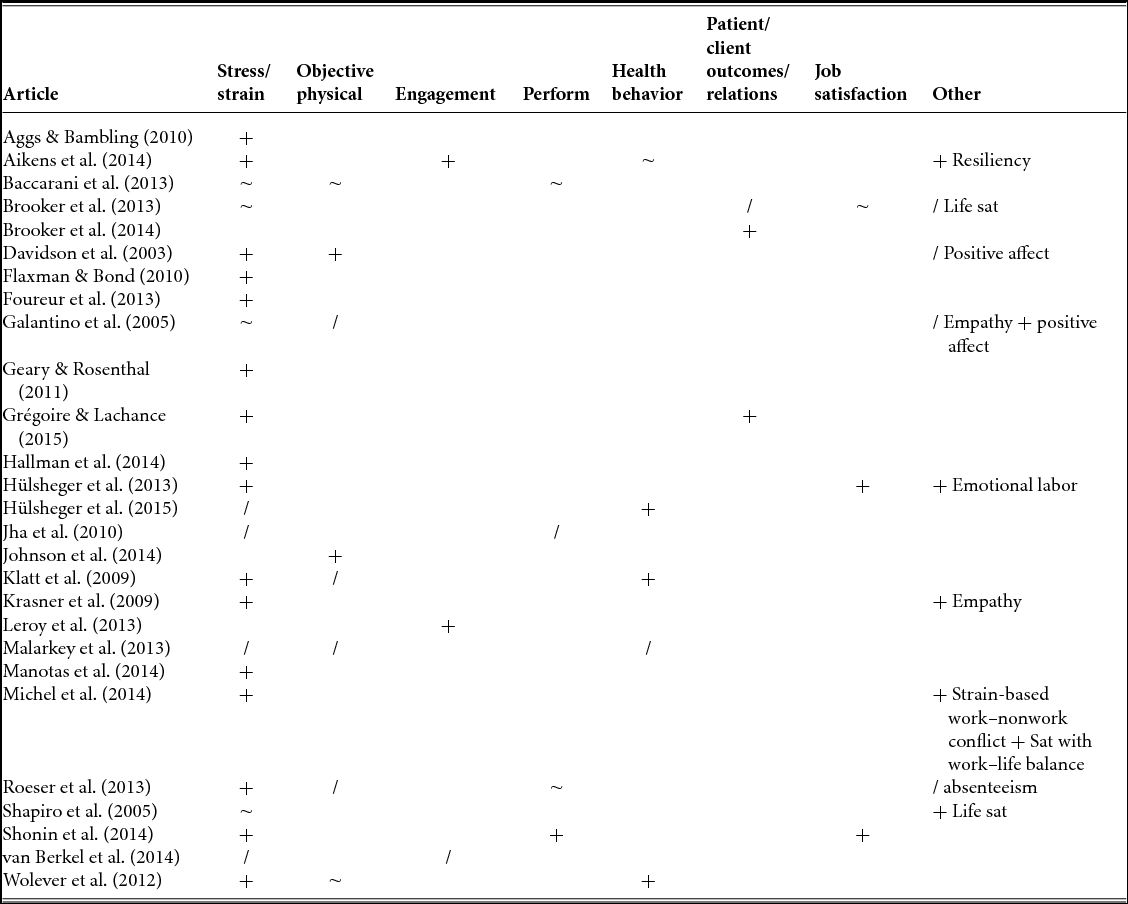
We reviewed the outcome variables investigated in each of our 27 studies. We identified seven categories of variables. Variables associated with stress and strain included depression, anxiety, tension, negative affect, burnout, general well-being, and recovery experiences. The objective physical category included physiological indicators such as cortisol, blood pressure, heart rate, immune function, and galvanic skin response. Engagement refers to work engagement. Performance includes self-reported job performance and performance-related constructs such as working memory and attention. Health behavior includes sleep quality/duration, eating fruits and vegetables, and exercise. Patient/client outcomes/relations include patient outcomes such as use of restraints and satisfaction (including those reported by the employee and patient). Job satisfaction includes facet and general job satisfaction. We included an “other” category for additional variables thought to be of interest to organizational psychologists. We coded results for each outcome, denoting whether there was a favorable significant effect (e.g., an increase in job satisfaction), no significant effect, or an unfavorable significant effect (e.g., a decrease in job satisfaction). In many studies, multiple outcomes associated with a category were examined in a single study (e.g., anxiety, depression, and burnout), or multiple facets were included (e.g., three dimensions of burnout). If there were significant effects for some variables/facets and not others, we coded this as a mixed effect. Our findings are summarized in Table 1.
Outcomes Associated With Work-Related Mindfulness-Based Training
Note. None of the studies reviewed showed significant nonbeneficial effect (e.g., a decrease in job satisfaction). Sat = satisfaction; “+” indicates significant beneficial effect; “/” indicates no effect; “~” indicates mixed effect (e.g., across a list of health behaviors, some were significant and some were not; across multiple stress-related variables some were significant and some were not).
As shown in Table 1, the most commonly studied category of variables is that associated with stress and strain. In fact, 24 of the 27 (88.89%) studies reviewed included a variable in this category. The majority of these studies (k = 16; 66.67%) indicated that mindfulness training was beneficial in reducing stress and/or enhancing well-being. Most of these studies are based on self-reports. When viewing the results from eight studies that examined objective physiological indicators, the overall pattern of results is less conclusive, with some studies finding a favorable change (e.g., lower heart rate), some reporting mixed results, and others finding no change. Three studies investigated employee engagement: two reporting an increase in engagement posttraining and one finding no significant effect. Four studies included a measure of performance, with two reporting mixed effects on performance posttraining, one finding no significant effect, and one finding a significant positive effect. However, it is important to note that none of these studies used supervisor ratings of performance or an objective assessment of on-the-job performance (e.g., sales). With regard to health behaviors, three of five studies (60%) found health benefits (e.g., improved sleep quality). The other two studies reported nonsignificant or mixed effects. Three studies included patient/client outcomes/relations. Two (66.67%) of these studies demonstrated favorable effects. A similar pattern was found for job satisfaction, with two (66.67%) of the three studies finding positive effects. Our “other” category highlights variables for which there are only one or two studies (e.g., empathy, satisfaction with work–life balance), with some studies finding beneficial effects and others reporting nonsignificant effects.
We examined the features of the training design included in the studies that tended to produce null, mixed, or nonbeneficial effects with those that tended to produce beneficial effects in an effort to identify training features that may yield more positive outcomes. No clear pattern emerged. It is also important to note that there is significant variation in the timing of posttraining data collection (e.g., immediately after training versus 6 months after training) and that change in some variables may occur more slowly than in others, making direct comparisons difficult. Our presentation of results is coarse but helps to reveal topics for which we have more or less data and thus highlights high potential areas for additional research.
Conclusion
When considering what we know about mindfulness and the workplace, we believe it is important to ensure that the conclusions drawn are based on research using employee samples and conducted in the context of improving employee outcomes. It is also important to distinguish research based on correlational designs and self-reports of mindfulness as a trait/state from research based on experimental designs and training interventions. In order to gain a firm grasp on what is known about the potential benefits of mindfulness-based training in organizational settings, we conducted a selective review of intervention studies based on employee samples.
Based on our review, there is sufficient evidence to conclude that mindfulness-based training can be effective in reducing employee stress and strain. Moreover, we find that the occupational setting and job type most commonly associated with mindfulness-based studies are in the healthcare sector. This is perhaps no surprise given that stress reduction is the focus of mindfulness-based training programs, and application began with patient populations. The results from our selective review also demonstrate the potential for mindfulness training to impact other outcomes of interest to organizational psychologists such as job performance and employee engagement. However, more research is needed before firm conclusions can be made.
As organizational psychologists continue to investigate mindfulness training, it will be important to identify the aspects of training that help explain the benefits of mindfulness. For example, at this stage it is difficult to discern whether meditation is the primary driver of benefits or whether self-reflective practices such as journaling or mindful movement (e.g., yoga) provide the same benefit. When designing studies, care is also needed in terms of selecting posttraining time intervals for data collection.
Finally, as we move toward a better understanding of mindfulness in the workplace, we need intervention-based research that empirically isolates the specific behavioral, cognitive, and affective mechanisms responsible for its beneficial effects, as well as individual and situational factors that may accentuate and attenuate such effects. This will inform theory building on mindfulness at work by identifying why mindfulness training works in organizational settings, for whom such training is optimally effective, and what key job and organizational features should be considered in the design and delivery of mindfulness-based training in organizational settings.