Introduction
Cestodes of the genus Neoskrjabinolepis Spassky, Reference Spassky1947 are characterized by high species richness and widespread occurrence in the Holarctic, as evidenced by their finds in various species of shrews Sorex (Mammalia: Soricidae) during faunal studies in various regions of Eurasia (from the Pyrenees to Chukotka and the Japanese islands) and North America (Alaska) (Zarnowski Reference Zarnowski1955; Prokopič Reference Prokopič1958; Schaldybin Reference Schaldybin1964; Arzamasov et al. Reference Arzamasov, Merkusheva, Mihulap and Chikilevskaya1969; Jourdane Reference Jourdane1971; Vaucher Reference Vaucher1971; Prokopič & Matsaberidze Reference Prokopič and Matsaberidze1972; Prokopič et al. Reference Prokopič, Karapchanski, Genov and Janchev1974; Eltyshev Reference Eltyshev, Kontrimavichus and Roytman1975; Genov Reference Genov1984; Roots Reference Roots1992; Novikov Reference Novikov1995; Hanzelová & Ryšavý Reference Hanzelová and Ryšavý1996; Tkach & Zhumabekova Reference Tkach, Zhumabekova and Akimov1996; Sawada Reference Sawada1999; Anikanova et al. Reference Anikanova, Bespyatova, Bugmyrin and Yeshko2001, Reference Anikanova, Bugmyrin and Yeshko2002; Irzhavsky & Gulyaev Reference Irzhavsky, Gulyaev and Gulyaev2002; Binkiene Reference Binkienė2006; Binkiene et al. Reference Binkienė, Kontrimavichus and Hoberg2011; Kornienko Reference Kornienko and Pugachev2012; Kornienko & Dokuchaev Reference Kornienko and Dokuchaev2012, Reference Kornienko and Dokuchaev2023; Haukisalmi Reference Haukisalmi2015; Kirillov et al. Reference Kirillov, Kirillova and Chikhlyev2018; Kornienko et al. Reference Kornienko, Kozlova, Makarikov, Zyikova, Lopatina, Ishigenova, Staheev, Dokuchaev, Kirillov, Kirillova and Konyaev2022c).
For more than a century, the history of the genus Neoskrjabinolepis has been accompanied by persistent discussion about its species composition. Some researchers have believed that the genus includes two species: Neoskrjabinolepis schaldybini Spassky, Reference Spassky1947 and N. singularis (Cholodkovsky, Reference Cholodkovsky1912) Spassky, Reference Spassky1954 (Spassky Reference Spassky1954; Spassky & Andreyko Reference Spassky and Andreyko1970; Vaucher Reference Vaucher1971; Eltyshev Reference Eltyshev, Kontrimavichus and Roytman1975; Genov Reference Genov1984). Other researchers have recognized only one species, N. singularis, with a transpalearctic range (Kobuley Reference Kobuley1953; Zarnowski Reference Zarnowski1955; Kisielewska Reference Kisielewska1958; Procopič Reference Prokopič1956; Reference Prokopič1959; Pojmańska Reference Pojmańska1957; Rybicka Reference Rybicka1959; Schaldybin Reference Schaldybin1964). Kornienko et al. (Reference Kornienko, Gulyaev and Mel’nikova2006), using a set of new morphological features, came to a conclusion about the validity of both species of the genus, as confirmed later by molecular data (Binkiene & Kontrimavichus Reference Binkienė, Kontrimavičius and Litvinov2007). Over the past 20 years, more than 10 species of the genus Neoskrjabinolepis have been described, which, until the present study, has included 16 species of cestodes (Kornienko et al. Reference Kornienko, Vasileva and Georgiev2022b).
In helminthological material from shrews of Sakhalin Island, a cestode was found that we attributed to the genus Neoskrjabinolepis. By the end of the last century, there had been only one study by Japanese authors on helminths of insectivores of Sakhalin (Sawada & Kobayashi Reference Sawada and Kobayashi1993). It listed only three species of cestodes, one of which was identified as Neoskrjabinolepis singularis (Cholodkovsky, Reference Cholodkovsky1912) Spassky, Reference Spassky1954. Currently, in Sakhalin shrews, five species of the genus Neoskrjabinolepis are registered—N. kedrovensis Kornienko, Gulyaev & Melnikova, Reference Kornienko, Gulyaev and Mel’nikova2007; N. kunashiriensis Kornienko & Gulyaev, Reference Kornienko and Gulyaev2011; N. nadtochijae Kornienko, Gulyaev & Melnikova, Reference Kornienko, Gulyaev and Mel’nikova2006; N. nana Kornienko & Gulyaev, Reference Kornienko and Gulyaev2011; and N. nuda Kornienko, Gulyaev, Melnikova & Georgiev, Reference Kornienko, Gulyaev, Mel’nikova and Georgiev2008—with three species (N. kunashiriensis, N. nana, and N. nuda) being Sakhalin–Kunashir endemics (Kornienko et al. Reference Kornienko, Gulyaev, Mel’nikova and Georgiev2008; Kornienko & Gulyaev Reference Kornienko and Gulyaev2011). The cestode we found differs from already known representatives by the presence of several characteristics, including a unique feature (alternation of genital pores in proglottids), suggesting that this cestode is a new taxon.
The widespread occurrence of the genus in the Palearctic and the substantial increase in its species diversity (from two to 17 species) necessitate a taxonomic revision of the genus Neoskrjabinolepis with clarification of species affiliation of previously found cestodes. In addition, the inclusion of new morphological features of the genus makes it necessary to expand the existing set of morphological criteria (Kornienko et al. Reference Kornienko, Gulyaev and Mel’nikova2006, Reference Kornienko, Gulyaev and Mel’nikova2007) and make additions to genus diagnosis (Kornienko et al. Reference Kornienko, Gulyaev, Mel’nikova and Georgiev2008).
The aim of this work was a taxonomic revision of the genus Neoskrjabinolepis, clarification of genus diagnosis on the basis of new diagnostic traits, and an update of the genus identification key as well as a description of a new species from shrews of Sakhalin Island.
Materials and methods
From June–September 2005, cestodes were collected from shrews at two localities on Sakhalin Island: Sokol Biological Station (SBS) and suburbs of the town of Poronaysk. Cestodes were collected from two species of Sorex: S. unguiculatus Dobson (95 specimens) and S. caecutiens Laxmann (22 specimens).
Host specimens were dissected immediately after their death. Live cestodes were isolated and relaxed in water, then fixed in 70% ethanol. For morphological analysis, six specimens were stained with Ehrlich’s hematoxylin, differentiated in a 3% aqueous solution of ferric ammonium sulphate 12-hydrate, dehydrated in an ethanol series, cleared in clove oil, and mounted in Canada balsam. Four specimens were mounted in Berlese’s medium to facilitate the examination of the rostellar hooks and copulatory apparatus.
Type specimens were deposited in collections of the Zoological Museum at the Institute of Systematics and Ecology of Animals (ISEA), Novosibirsk, and the Natural History Museum, Geneva, Switzerland (MHNG).
Measurements are given in micrometers (μm) except where otherwise stated. Metrical and meristic data are presented as a range (min–max) followed by the mean and the number of the measurements taken (n) in parentheses. Levels of infection were assessed using the following parameters (Fedorov Reference Fedorov1986): P, prevalence (percentage of individuals of a host population infected with a certain helminth species); I, the intensity range (the minimum and maximum number of cestodes of a certain species in infected individuals in the host population). The terminology used in the description of different stages of proglottid development is according to Mas-Coma & Puchades (Reference Mas-Coma and Galan-Puchades1991).
Results
Neoskrjabinolepis (Neoskrjabinolepidoides) paradoxa n. sp.
Type host: Sorex unguiculatus Dobson, 1890 (Eulipotyphla: Soricidae).
Type locality: Sokol Biological Station (SBS), Sakhalin Island, Russia (N 47°14′ E 142°46′).
Site: Intestine.
Type material: Holotype: on the slide ISEA No. 18.11.5.1 ex Sorex unguiculatus, intestine, 4 September 2005 (Dissection No. 229); the holotype specimen (placed on the right) and another cestode specimen belonging to the same species were mounted on one slide in Canada balsam. Paratypes: MHNG INVE 91138 ex Sorex unguiculatus, SBS, 4 September 2005, with the same collection data as in the holotype, a specimen stained and mounted in Canada balsam; ISEA No. 18.11.5.3 ex S. unguiculatus (Dissection No. 229), SBS, 4 September 2005, with the same collection data as in the holotype, two specimens stained and mounted in Canada balsam; ISEA No. 18.11.5.4 ex S. unguiculatus (Dissection No. 229), SBS, 4 September 2005, with the same collection data as in the holotype, a specimen stained and mounted in Canada balsam; ISEA No. 18.11.5.5 ex S. caecutiens (Dissection No. 44), Poronaysk, 8 July 2005, with the same collection data as in the holotype, three scolices and three fragments of strobila in Berlese’s medium; ISEA No. 18.11.5.6 ex S. unguiculatus (Dissection No. 92), SBS, 24 June 2005, with the same collection data as in the holotype, one scolex and one fragment of strobila in Berlese’s medium.
Another host: Sorex caecutiens Laxmann 1788
Another locality: suburbs of the town of Poronaysk, Sakhalin Island, Russia (N 49°13′ E 143°06′).
Prevalence and intensity: 2.1% and 2–10 (av. 0.13) in S. unguiculatus; 4.5% and 5 in S. caecutiens.
Etymology: The specific name paradoxa refers to the unusual (irregular) alternation of genital pores, which is unique among its congeners.
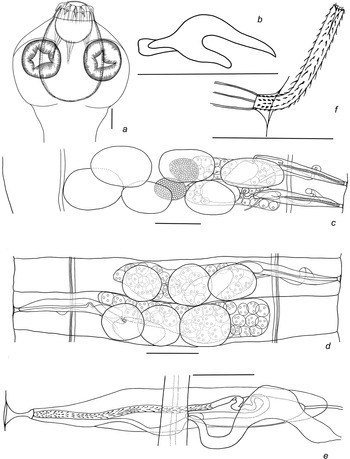
Description (based on seven strobila with one series of pregravid proglottids and three strobila with two pregravid proglottids; Figures 1a-f): body small, slender, 6.0–7.0 mm (6.6, n = 6) long; strobila flat, consisting of 250–280 proglottids; maximum width 320–340 (330, n = 6) at level of proglottids with young uterus. Strobilation serial (group of simultaneously laid down segments then develops synchronously), pregravid or gravid strobila usually consisting of four series of proglottids. First series consists of juvenile or premature proglottids; second section consists of hermaphroditic mature proglottids; third series consists of postmature or pregravid proglottids; fourth series consists of pregravid or gravid proglottids; each series consists of ca. 50–70 proglottids. Strobilar portions containing juvenile, premature, or mature proglottids without external segmentation; proglottids externally distinct at level of postmature part of strobila.
N. (Neoskrjabinolepidoides) paradoxa n. sp.: a, Scolex; b, Rostellar hook; c, Mature proglottids; d, Postmature proglottids; e, Cirrus sac; f, Cirrus. Scale bars: a, 100 μm; b, 45 μm; c & d, 50 μm; e, 20 μm; f, 30 μm.

Scolex 270–350 (320, n = 6) wide, distinctly wider than neck (Figure 1a). Suckers round, 120–130 × 110–130 (122 × 116, n = 6), with well-developed musculature. Rostellar apparatus complex. Rhynchus short, 65–82 long, 100–120 wide (72 × 114, n = 6). Rostellum sac-like, 91–120 × 92–120 (107 × 100, n = 6); its walls consist of external layer of longitudinal muscular fibers and internal layer of circular muscular bundles. Rostellar hooks 10 in number, arranged in single row, 42–45 (43, n = 10) long, with characteristic pincer-like shape; axis of blade almost parallel to axis of guard; blade almost three times length of handle, curved medially; handle causes large epiphyseal thickening. End of guard deflected away from blade (Figure 1b). When rostellar apparatus retracts, rostellar hooks with blades directed anteriorly. Rostellar pouch voluminous, 210–250 × 180–200 (230 × 190, n = 6), extending beyond level of posterior margins of suckers. Neck 180–200 (193, n = 6) wide.
Proglottids acraspedote, transversely elongate. Mature proglottids 20–33 × 240–330 (25 x 300, n = 10) (Figure 1c) [because external segmentation appears only at level of postmature proglottids, length of mature proglottids is measured as distance between genital atria of adjacent proglottids], with length/width ratio 1:10; lateral fields 50–60 (55, n = 10) wide; gonads densely situated in median field. Pregravid proglottids 54–77 × 320–340 (69 × 330, n = 8), with length/width ratio ca. 1:5–6. Osmoregulatory canals two pairs, without transverse anastomoses; ventral canals 5–7 wide; dorsal canals 1–3 wide. A special feature of this species is the irregularly alternating genital pores in postmature (3) (Figure 1d) and pregravid (4) series of strobila. In series of hermaphroditic mature proglottids, genital pores are most often located unilaterally; however, in several strobila of type series, irregularly alternating genital pores were also found in series of hermaphroditic mature proglottids. Genital atrium simple, 6–7 deep, 3–4 in diameter.
Testes three, oval or elliptical, 30–60 × 42–70 (46 × 52, n = 10), arranged in transverse row, two antiporal and one poral relative to midline of proglottid or one antiporal and two poral relative to midline of proglottid (Figure 1c). Diameter of testes greater than proglottid length and, consequently, dense dorsal testicular field formed in mature region of strobila (pattern described as “neoskrjabinolepid-type of organization,” see Gulyaev & Kornienko Reference Gulyaev and Kornienko2009). Degenerating testes persist in postmature proglottids. Cirrus sac elongate, thin-walled, cigar-shaped (Figure 7), 91–110 × 10–12 (99 × 11, n = 10), passes into median field but does not reach far median line of proglottid (Figures 1c, d). Cirrus short, cylindrical, 60–65 (63, n = 7) long; armed with different types of spines; its basal part covered with numerous small rosethorn-shaped spines; middle part armed with fine, needle-shaped spines, whose size decreases in distal direction (Figure 1e, f). Internal seminal vesicle small, 24–38 × 7–13 (29 × 9, n = 10), occupying not more than a third of cirrus sac length even when filled. External seminal vesicle 34–49 × 21–32 (40 × 29, n = 10), connected to cirrus sac by long narrow duct.
Vitellarium subspherical, 21–39 × 20–36 (29 × 25, n = 6), situated antiporally to ovary. Ovary transversely elongate, compact, 11–27 × 88–110 (19 × 99, n = 10), in poral half of median field; overlaps cirrus sac, external seminal vesicle and testes ventrally (Figure 1c). Vagina thin-walled, passes ventrally to cirrus sac, forming coil after entering median field (Figure 1e). Conductive part of vagina gradually enlarges and passes into small, sac-like seminal receptacle.
Uterus not extending into lateral fields. Uterine wall thin, membranous throughout morphogenesis of uterus. Number of eggs in uterus 45–60 (54, n = 8).
ZooBank registration: To comply with the regulations set out in Article 8.5 of the amended version of the International Code of Zoological Nomenclature (ICZN, 2012), details of the new species were submitted to ZooBank. The Life Science Identifier for Neoskrjabinolepis paradoxa n. sp. is urn:lsid:-zoobank.org: pub:69AF891D-7638-4F2D-8FC5-85EDA846D406.
Remarks
N. paradoxa n. sp. is characterized by a serial strobilar development and therefore belongs to the subgenus Neoskrjabinolepis (Neoskrjabinolepidoides) Kornienko, Gulyaev & Melnikova, Reference Kornienko, Gulyaev and Mel’nikova2006, which currently includes 10 species: N. singularis (Cholodkowsky, Reference Cholodkovsky1912); N. nadtochijae Kornienko, Gulyaev & Melnikova, Reference Kornienko, Gulyaev and Mel’nikova2006; N. corticirrosa Kornienko, Gulyaev & Melnikova, Reference Kornienko, Gulyaev and Mel’nikova2007; N. kedrovensis Kornienko, Gulyaev & Melnikova, Reference Kornienko, Gulyaev and Mel’nikova2007; N. nuda Kornienko, Gulyaev, Melnikova & Georgiev, Reference Kornienko, Gulyaev, Galaktionov and Dobrovolskii2008; N. merkushevae Kornienko & Binkiene, Reference Kornienko and Binkiene2008; N. gvosdevi Kornienko, Erzhanov & Gulyaev, Reference Kornienko, Gulyaev and Erzhanov2010; N. kunashiriensis Kornienko & Gulyaev, Reference Kornienko and Gulyaev2011; N. nana Kornienko & Gulyaev, Reference Kornienko and Gulyaev2011; and N. hobergi Kornienko & Dokuchaev, Reference Kornienko and Dokuchaev2012.
Two species, N. singularis and N. merkushevae, from the European part of the Palearctic Region and from the south of West Siberian, have been recorded (Kornienko et al. Reference Kornienko, Gulyaev and Mel’nikova2006; Kornienko & Binkiene Reference Kornienko and Binkiene2008). The remaining eight species from the shrews of the Asiatic part of the Palearctic (mainly in the Far East) have been described (Kornienko et al. Reference Kornienko, Gulyaev and Mel’nikova2006, Reference Kornienko, Gulyaev and Mel’nikova2007; Kornienko & Gulyaev Reference Kornienko and Gulyaev2011; Kornienko & Dokuchaev Reference Kornienko and Dokuchaev2012), with the exception of N. gvosdevi. This species has not been recorded outside the Kazakh Uplands and is considered endemic to Kazakhstan.
The new species has a unique feature that radically distinguishes it from all existing species in the genus, namely, the irregular alternation of the genital pores. Nonetheless, this arrangement of genital pores was noted only in the series of postmature proglottids. Therefore, the absence of a such series in the strobila may complicate the identification of cestodes of this species. In this case, the new species can be distinguished from all of these based on the length and shape of the rostellar hooks, the armament and size of the cirrus, the structure of the male copulatory apparatus, and the number of eggs per uterus.
N. paradoxa is most similar to N. gvosdevi and N. nadtochijae. These species have similar length and shape of their rostellar hooks: 42–45 μm in N. paradoxa vs. 40–44 μm in N. gvosdevi and 40–45 μm in N. nadtochijae. The cirrus of N. paradoxa is intermediate in length (60–65 μm) between N. gvosdevi (45–50 μm) and N. nadtochijae (71–74 μm). Nevertheless, the armament of cirri is different among these species. The median region of the cirrus of N. paradoxa is armed with fine, needle-shaped spines decreasing in the distal direction; in contrast, the cirri of N. gvosdevi and N. nadtochijae are armed with fine needle-shaped spines and sabre-shaped spines along the entire length, respectively. In addition, the new species differs from N. gvosdevi and N. nadtochijae by the size of the cirrus sac and the number of eggs within the uterus. The cirrus sac of N. paradoxa (91–110 μm in length) passes deeply into the median field but does not reach the median line of a proglottid; in contrast, the cirrus sac of N. gvosdevi (62–82 μm in length) slightly crosses poral osmoregulatory canals. In terms of the size of the cirrus sac, N. nadtochijae has a longer cirrus sac (160–180 μm in length) than N. paradoxa does. The numbers of eggs per uterus differ between N. paradoxa, N. gvosdevi, and N. nadtochijae, i.e. 45–64, 9–18, and 20–46, respectively.
Species N. paradoxa and N. nuda have the same length (42–45 and 40–44 μm, respectively) but different shapes of rostellar hooks. Additionally, the new species differs from N. nuda by the length (60–65 and 95–100 μm, respectively) and armament of the cirrus and by the number of eggs per gravid uterus (45–60 and 15–22, respectively).
N. paradoxa differs from all the other species of the subgenus Neoskrjabinolepidoides by having shorter rostellar hooks: 42–45 vs. 48–53 μm in N. corticirrosa, 56–65 μm in N. singularis, 53–59 μm in N. kunashiriensis, and 63–66 μm in N. hobergi. These species have short cirri but differ from each other in cirral armament and in the number of eggs per gravid uterus: 45–60 in N. paradoxa, 10–20 in N. corticirrosa, 7–13 in N. kunashiriensis, 34–43 in N. singularis, and 12–16 in N. hobergi.
The new species has longer rostellar hooks than do N. nana, N. kedrovensis, N. merkushevae: 37–39, 36–38, and 35–37 μm, respectively. Compared to N. nana and N. kedrovensis, which have a long cirrus (85–90 and 90–110 μm, respectively), that of N. paradoxa is short (60–65 μm). The cirrus of N. merkushevae is even shorter (35–40 μm). The armament of the cirrus varies greatly among these species.
Based on the above-mentioned differences, we recognize the investigated specimens as a new species. The name Neoskrjabinolepis paradoxa was published for the first time by Zubova et al. (Reference Zubova, Kornienko, Gulyaev, Dokuchaev, Galaktionov and Dobrovolskii2008a) in conference proceedings. Because the name was not accompanied by a description, this publication does not meet the availability criteria of the International Commission on Zoological Nomenclature (ICZN 1999) (Chapter 4, Article 13) and is considered a nomen nudum. According to the ICZN, this name is now proposed as available for the same concept, together with the first description of the species.
The main differential criteria of the genus Neoskrjabinolepis included in the modified genus diagnosis (Kornienko et al. Reference Kornienko, Gulyaev, Mel’nikova and Georgiev2008) are the type of strobilation, the shape and size of rostellar hooks, the size of the cirrus sac and its position relative to poral osmoregulatory canals, the size and armament of the cirrus, the number of eggs in uterine proglottid, and positioning of the uterus located in the median field of a proglottid, not beyond osmoregulatory canals. Later, in the American species N. hobergi found in Sorex tundrensis Merriam from the Seward Peninsula (Alaska, USA), a different positioning of the uterus in the proglottid was discovered: having different degrees of maturity (postmature and gravid proglottids), with the uterus crossing osmoregulatory canals and reaching lateral areas of the proglottid (Kornienko & Dokuchaev Reference Kornienko and Dokuchaev2012).
One of the features included in the latest diagnosis of the family Hymenolepididae is unilateral positioning of genital pores, with rare cases of alternations (Czaplinski & Vaucher Reference Czaplinski, Vaucher, Khalil, Jones and Bray1994). For the genus Neoskrjabinolepis, the unilateral positioning of genital pores is characteristic, and consequently this feature was not even mentioned in the genus diagnosis. Nonetheless, for the new species N. paradoxa, irregular alternation of genital pores was found in the uterus series in the strobila, whereas in a series containing mature proglottids, the positioning of genital pores is usually unilateral. Thus, because new morphological features were found (possible irregular alternation of genital pores and penetration of the uterus into lateral fields of the proglottids), we believe that it is necessary to add them to the existing genus diagnosis.
Neoskrjabinolepis Spassky, Reference Spassky 1947
Genus diagnosis [adapted from ref. (Kornienko et al. Reference Kornienko, Gulyaev, Mel’nikova and Georgiev2008)]. Cestodes of small body size, consisting of numerous acraspedote proglottids. Anterior portion of strobila (to level of postmature proglottids) without external segmentation. Both gradual and serial patterns of strobilar development occur. Mature proglottids considerably wider than long; gravid proglottids almost as long as wide or longer than wide. Scolex relatively large, having complex rostellar apparatus with invaginable rostellum. Rostellar hooks 10 in number, pincer-shaped, with epiphyseal thickening of handle. Male and female genital systems with simultaneous development. Genital pores unilateral, rarely alternating. Testes three, arranged in transverse row situated dorsally to female gonads. Cirrus sac short or long, from just crossing poral osmoregulatory canals to reaching median line of proglottid. Cirrus armed with spines, often of various shapes. Vitellarium compact, rounded, situated in antiporal half of median field. Ovary oval, transversely elongate, poral to vitellarium. Uterus sac-like, situated in median field during its entire development or rarely extends laterally beyond osmoregulatory canals. Gravid proglottid with strong persisting walls, functioning as oophore and enabling group dispersion of eggs. Parasites of shrews of genus Sorex (Eulipotyphla: Soricidae) in Palearctic and Nearctic Regions. Type species: N. schaldybini Spassky, Reference Spassky1947.
Below we propose a key representing the current taxonomic concept of the genus Neoskrjabinolepis, and it includes all known so far species.
The identification key to the species of the genus Neoskrjabinolepis

Discussion
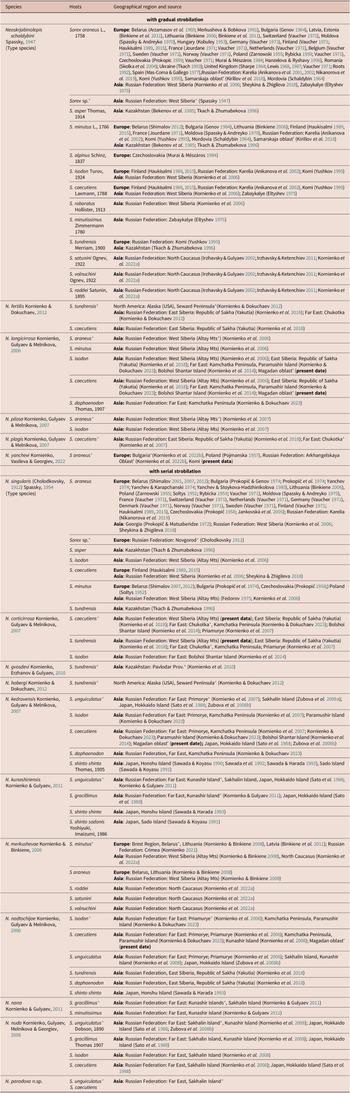
Clarification of the differential species features of this genus allowed us to show that the genus Neoskrjabinolepis is a taxon having very high species richness among the Hymenolepididae of mammals. Furthermore, it became possible to clarify species affiliation of this genus’s cestodes found by other authors in various regions of the Palearctic. Studies by most authors either represent faunistic summaries on helminths of shrews from different parts of the Palearctic without inclusion of any morphological traits of the found cestodes or contain data that do not match diagnoses of modern species; this state of affairs casts doubt on the correctness of their identification (Arzamasov et al. Reference Arzamasov, Merkusheva, Mihulap and Chikilevskaya1969; Eltyshev Reference Eltyshev, Kontrimavichus and Roytman1975; Anikanova et al. Reference Anikanova, Bespyatova, Bugmyrin and Yeshko2001, Reference Anikanova, Bugmyrin and Yeshko2002; Irzhavsky & Gulyaev Reference Irzhavsky, Gulyaev and Gulyaev2002; Haukisalmi Reference Haukisalmi2015; Kirillov et al. Reference Kirillov, Kirillova and Chikhlyev2018; Nikonorova et al. Reference Nikonorova, Kutenkov, Bugmyrin and Ieshko2019). Publications containing not only information about finds of Neoskrjabinolepis species in various hosts but also morphometric features (e.g. rostellar hook sizes and cirrus or cirrus sac lengths) enabled us to rectify species affiliation of the found cestodes, as reflected in Table 1.
The list of the species of Neoskrjabinolepis Spassky, Reference Spassky1947, their hosts, and their geographical range

* Type host and locality
Currently, the genus Neoskrjabinolepis contains 17 species (see Table 1) (Kornienko et al. Reference Kornienko, Vasileva and Georgiev2022b). Sixteen species parasitize Palearctic shrews (Kornienko et al. Reference Kornienko, Gulyaev and Mel’nikova2007, Reference Kornienko, Gulyaev, Galaktionov and Dobrovolskii2008, Reference Kornienko, Gulyaev and Erzhanov2010, Reference Kornienko, Vasileva and Georgiev2022b; Kornienko & Binkienė Reference Kornienko, Gulyaev, Galaktionov and Dobrovolskii2008; Kornienko & Gulyaev Reference Kornienko and Gulyaev2011). Two species from Nearctic shrews of Alaska (N. hobergi and N. fertilis) have been described (Kornienko & Dokuchaev Reference Kornienko and Dokuchaev2012).
Four species from European shrews are currently known: N. schaldybini, N. singularis, N. merkushevae, and N. yanchevi (Kornienko et al. Reference Kornienko, Vasileva and Georgiev2022b). Representatives of the genus have been repeatedly registered in Poland (Zarnowski Reference Zarnowski1955; Pojmanska Reference Pojmańska1957; Rybicka Reference Rybicka1959). In S. araneus and S. minutus, Zarnowski (Reference Zarnowski1955) found N. singularis with rostellar-hook lengths of 55–57 and 36–39 μm, respectively. That author attributed such a wide range of hook lengths to the size of the scolex. Rybicka (Reference Rybicka1959) associated differences in sizes of the hooks of two forms of Hymenolepis singularis (= Neoskrjabinolepis singularis) with parasitizing of different shrew species. According to her, the length of hooks in cestodes from S. minutus is 35–40 μm, and this parameter in cestodes from S. araneus is 58–60 μm. Nonetheless, because the validity of both species has already been proven (Kornienko et al. Reference Kornienko, Gulyaev and Mel’nikova2006), we believe that Rybicka and Zarnowski found both species of the genus. In S. araneus and S. minutus, Pojmanska (Reference Pojmańska1957) detected N. singularis with rostellar hooks 37–40 μm long. That author’s figures show a mature proglottid with an evaginated long cirrus and a uterine proglottid containing a small number of eggs (no more than 20). Most likely, however, not all eggs are shown in the drawing of the uterine proglottid, because usually, eggs fill the uterus tightly. We can hypothesize that the cestode found by that author belongs to the species N. yanchevi, characterized by a long cirrus and considerable hook length (Kornienko et al. Reference Kornienko, Vasileva and Georgiev2022b). Unfortunately, all processed slides of the genus Neoskrjabinolepis from the Polish helminthologists’ collection are thought to be lost (Pojmańska et al. Reference Pojmańska, Salamatin, Sulgostowska, Cielecka, Okulewicz, Niewiadomska and Grytner-Zięcina2012); therefore, it is impossible to use them to clarify species affiliation of the aforementioned specimens. While re-describing the species N. singularis from S. araneus of Hungary, Kobulej (Reference Kobuley1953) specified the length of the hooks, the location of the cirrus sac relative to poral osmoregulatory canals, and the armament of the cirrus, all of which corresponded to the species N. schaldybini.
In S. araneus and S. minutus from Mordovia, Schaldybin (Reference Schaldybin1964) discovered a cestode, identified it as N. schaldybini, and listed among differential features the serial type of strobila, rostellar hooks 39–52 μm long, and the cirrus sac 50–55 μm long. Most likely, the description is based on fragments of some strobilae, which may match N. schaldybini, N. merkushevae, and N. yanchevi. Nevertheless, it is possible that among the found cestodes, there is a new species. Because cestodes with hooks larger than 43 μm are not known among European representatives of the genus, except for N. singularis, with rostellar hooks 60-65 μm long.
Eleven species of Neoskrjabinolepis have been found in Asian Palearctic shrews (Kornienko et al. Reference Kornienko, Gulyaev and Mel’nikova2006, Reference Kornienko, Gulyaev and Mel’nikova2007, Reference Kornienko, Gulyaev, Galaktionov and Dobrovolskii2008, Reference Kornienko, Gulyaev and Erzhanov2010; Kornienko & Gulyaev Reference Kornienko and Gulyaev2011; Kornienko Reference Kornienko and Dokuchaev2012). On the territory of Kazakhstan, aside from N. schaldybini and N. singularis, Tkach & Zhumabekova (Reference Tkach, Zhumabekova and Akimov1996) recorded Neoskrjabinolepis sp. differing in the length of hooks (48–50 μm) and hypothesized that they discovered a new species. Based on this trait, we can theorize that these may be N. corticirrosa or N. pilosa, which occur in adjacent territories (Altai Mountains) (Kornienko et al. Reference Kornienko, Gulyaev and Mel’nikova2007).
In shrews (S. caecutiens and S. isodon) of the Russian Far East (Magadan Oblast), Novikov (Reference Novikov1995) detected the cestode N. singularis with rostellar hooks 41–52 μm long. Nonetheless, these hook sizes match N. longicirrosa, N. fertilis, N. nadtochijae, and N. corticirrosa. In shrews from Magadan Oblast (unpublished data), we have found all these species except for N. fertilis. All the above species have been registered in adjacent territories (Republic of Sakha [Yakutia]) (Kornienko & Dokuchaev Reference Kornienko and Dokuchaev2015; Kornienko et al. Reference Kornienko, Dokuchaev and Odnokurtsev2018). Because, aside from hook length, Novikov did not specify other parameters of the found cestodes, we believe that he could have encountered all of the above species.
While recognizing the existence of a single species—N. singularis—in the genus, Karpenko recorded this species in the shrews of Priamurye (Karpenko Reference Karpenko2004). Because that author did not specify morphological features of the found cestode, it is impossible to determine its species identity. Furthermore, according to our current data and published evidence, N. singularis and N. schaldybini have not been found east of Transbaikalia (Eltyshev Reference Eltyshev, Kontrimavichus and Roytman1975; Kornienko et al. Reference Kornienko, Gulyaev and Mel’nikova2006, Reference Kornienko, Vasileva and Georgiev2022b).
On the Japanese islands, these two species of cestodes have been recorded repeatedly (Sato et al. Reference Sato, Kamiya and Ohbayashi1988; Sawada & Koyasu Reference Sawada and Koyasu1990, Reference Sawada and Koyasu1991; Sawada et al. Reference Sawada, Harada and Koyasu1992; Sawada & Harada Reference Sawada and Kobayashi1993). The illustrated material in the form of drawings and photographs used by Japanese parasitologists for describing the cestodes has made it possible in several cases to clarify the systematic position of the cestodes that they have found. Sato et al. (Reference Sato, Kamiya and Ohbayashi1988) reported finding cestodes N. schaldybini, N. singularis, and Neoskrjabinolepis sp. in shrews S. unguiculatus, S. gracillimus Thomas, 1907, and S. caecutiens saevus on the Japanese island of Hokkaido. According to their illustrated description, the cestodes they encountered correspond to N. nuda, N. kedrovensis, and N. kunashiriensis. Moreover, we also found the latter species on Hokkaido Island (Kornienko & Gulyaev Reference Kornienko and Gulyaev2011). The species N. kedrovensis was also detected in the material collected from the shrew S. caecutiens saevus of Hokkaido (Sawada et al. Reference Sawada, Harada and Koyasu1992). Those authors presented illustrations of rostellar hooks and a uterine proglottid. N. singularis is also listed among the specimens collected by Sawada & Koyasu (Reference Sawada and Koyasu1990, Reference Sawada and Koyasu1991) from shrews S. hosonoi Imaizumi, 1954; S. shinto Thomas, 1905; and S. shinto sadonis of Honshu and Sado islands. Nevertheless, the presented photographs of hooks and their length match the species N. kedrovensis, whereas the short cirrus sac corresponds to N. kunashiriensis. Most likely, those authors presented photographs of fragments belonging to different species. In another article by Japanese authors, the length of rostellar hooks of N. singularis (43–51 μm) from S. shinto of the Honshu Islands (Sawada & Harada, Reference Sawada and Kobayashi1993) most likely also represents several species of the genus: N. nadtochijae, N. kedrovensis, and N. kunashiriensis. The illustration of rostellar hooks matches the species N. nadtochijae, whereas the illustrations of mature proglottids with a long cirrus sac and long armed cirrus correspond to N. kedrovensis. Thus, we believe that shrew cestode fauna of the Japanese islands includes the following species: N. kedrovensis, N. kunashiriensis, N. nadtochijae, and N. nuda.
The rich taxonomic diversity of the genus was initially based on morphological features. The first molecular genetic data obtained for the genus confirmed the validity of the two species N. singularis and N. schaldybini (Binkiene & Kontrimavichus Reference Binkienė, Kontrimavičius and Litvinov2007). The study of genetic variability of Neoskrjabinolepis cestodes and reconstruction of phylogenetic relationships between species of the genus by means of the gene of 28S ribosomal RNA and mitochondrial gene NAD1 suggests a high genetic diversity of the genus, validating some species of the genus (N. nadtochijae, N. nuda, N. kunashiriensis, N. kedrovensis, and N. corticirrosa) as well as to revealing heterogeneity of individual species (N. schaldybini and N. merkushevae), suggesting that they are a species complex (Kornienko et al. Reference Kornienko, Kozlova, Makarikov, Zyikova, Lopatina, Ishigenova, Staheev, Dokuchaev, Kirillov, Kirillova and Konyaev2022c). Obviously, more than one taxon is covered by these species names, and this issue requires further research.
Conclusion
The genus Neoskrjabinolepis is characterized by high species richness based on morphological diversity. Recent studies show that representatives of the genus occur in shrews of various species in various regions of Eurasia (from the Pyrenees to the Japanese Islands) and in Alaska, implying its Holarctic occurrence. In Europe, four species of the genus have been recorded to date, and we registered three of them (N. schaldybini, N. singularis, and N. merkushevae) in the Asian part of the Palearctic (Altai Mountains) (Kornienko et al. Reference Kornienko, Gulyaev and Mel’nikova2006; Kornienko & Binkienė Reference Kornienko, Gulyaev, Galaktionov and Dobrovolskii2008; Kornienko Reference Kornienko and Egorov2021). On the American continent (Seward Peninsula, Alaska, USA), two species have been found—N. hobergi and N. fertilis—which could have entered North America from Chukotka together with S. tundrensis during the course of Late Pleistocene faunal exchanges (during the existence of the “Bering Land Bridge”) (Bannikova et al. Reference Bannikova, Dokuchaev, Yudina, Bobretzov, Sheftel and Lebedev2010; Kornienko & Dokuchaev Reference Kornienko and Dokuchaev2012). Geographic ranges of most species (12), constituting ~70% of the species diversity, are located in the Asian part of the Palearctic. At the same time, species diversity of Neoskrjabinolepis from northern regions of the Palearctic, Eastern Siberia, Central Asia, and the Caucasus mountains remains poorly investigated.
The rich taxonomic diversity of the genus—exclusively based on morphological features—was later confirmed by molecular genetic data, which also point to high genetic diversity of the genus. The previously obtained molecular genetic data make the genus Neoskrjabinolepis a convenient model taxon for studies on its phylogeography and phylogeny.
Acknowledgements
We are grateful to Yu. A. Melnikova for help with the fieldwork in Sakhalin Oblast. The study was supported by Federal Fundamental Scientific Research Programs (No. 1021051703269-9-1.6.12). The English language was corrected and certified by shevchuk-editing.com.
Financial support
This research received no specific grant from any funding agency, commercial or not-for-profit sectors.
Competing interest
The authors declare no conflict of interest.
Ethical standard
The authors carefully reviewed the ethical standards of the journal and hereby certify that the procedures used with the investigated species comply fully with those standards. The authors assert that all procedures and methods contributing to this work and used in the current study comply with the ethical standards of the relevant national and institutional guides with laws of the Russian Federation and were approved by the ethics committee of the ISEA, Novosibirsk, Russia.