INTRODUCTION
Verb-phrase anaphora as a cohesive device
Imagine that you are describing a picture in which two characters are throwing balls. You might do this by referring explicitly to the ball throwing action for both characters, as in:
(1) John is throwing a ball and Mary is throwing a ball.
Alternatively, you might avoid repeating part of the verb-phrase (throwing a ball) by saying:
(2) John is throwing a ball and Mary is too.
or:
(3) John is throwing a ball and so is Mary.
These are examples of verb-phrase anaphora (VPA). The second verb phrase (is too/so is) is anaphoric in that it points back to an antecedent verb phrase (throwing a ball), on which it depends for its interpretation. More specifically, it is an example of verb-phrase ellipsis (VPE) since part of the verb phrase has been elided in the second clause. In this paper, we consider the development of children's ability to produce VPA constructions.
As well as reducing redundancy, VPA constructions enhance the cohesiveness of discourse by highlighting the relatedness of the actions described by the two verb phrases. Thus, VPA is a cohesive device which, like other cohesive devices such as pronominal anaphora, tense and conjunctions/connectives, helps to link together different parts of a discourse and to guide the listener in constructing a unified mental model from the discourse (Halliday & Hasan, Reference Halliday and Hasan1976; Johnson-Laird, Reference Johnson-Laird1983). The ability to use cohesive devices appropriately is a crucial component of a speaker's ability to produce extended discourse that flows well and is easy for listeners to understand. From a developmental point of view, therefore, it is important to investigate when and how children develop this ability. The appropriate use of cohesive devices is a complex, multi-faceted ability that involves the coordination of different types of knowledge and skills. It is grammatically demanding in that it involves expressing relationships across two or more clauses or sentences, while adhering to various rules or constraints (e.g. tense agreement, use of pronouns that are appropriate in gender and number). However, the use of cohesive devices is usually optional rather than obligatory. The speaker can choose to link two clauses with a connective or to produce two separate sentences, to use either a pronoun or a fully specified noun phrase, and to use either an anaphoric verb phrase or a fully specified verb phrase. These choices are likely to be influenced by a variety of semantic and pragmatic factors. Therefore, in studying children's developing ability to use cohesive devices, we need to consider not only the age at which a particular device enters their repertoire, but also the extent to which their uses of that device are influenced by semantic and pragmatic factors. For example, are early uses restricted to sentences expressing a particular type of semantic content? Does sensitivity to semantic/pragmatic factors increase with age?
While there is a fairly extensive body of literature on children's production of certain types of cohesive devices, most notably anaphoric pronouns (e.g. Bamberg, Reference Bamberg1987; Hickmann & Hendriks, Reference Hickmann and Hendriks1999; Karmiloff-Smith, Reference Karmiloff-Smith and Deutsch1981; Wigglesworth, Reference Wigglesworth1990) and connectives (e.g. Bloom & Capatides Reference Bloom and Capatides1987; Byrnes & Duff, Reference Byrnes and Duff1988; Clancy, Jacobsen & Silva Reference Clancy, Jacobsen and Silva1976; Diessel, Reference Diessel2004; Donaldson, Reference Donaldson1986, Reference Donaldson1996; French & Nelson, Reference French and Nelson1985; Levy & Nelson, Reference Levy and Nelson1994; McCabe & Peterson, Reference McCabe and Peterson1985), very little is known about children's production of verb-phrase anaphora. The small number of studies that have investigated VPA in children (Foley, Núñez del Prado, Barbier & Lust, Reference Foley, Núñez del Prado, Barbier and Lust2003; Matsuo & Duffield, Reference Matsuo and Duffield2001; Postman et al., Reference Postman, Foley, Pactovis, Rothenstein, Kaye, Lowe and Lust1997; Thornton & Wexler, Reference Thornton and Wexler1999) have mostly used comprehension (or metalinguistic judgment) tasks rather than production tasks. It cannot safely be assumed, however, that there is a straightforward developmental relationship between language comprehension and language production, since these two aspects of linguistic ability impose different types of demand on the child (Clark & Hecht, Reference Clark and Hecht1983; Donaldson, Reference Donaldson1986; Donaldson & Laing, Reference Donaldson, Laing, Messer and Turner1993). Furthermore, the main aim of the studies of VPA in children has been to test predictions about innate grammatical knowledge derived from the framework of Universal Grammar. These studies indicate that in interpreting other speakers' sentences, children as young as three or four years of age are sensitive to the grammatical constraints that affect VPA constructions. There is, though, a gap in the literature on children's production of cohesive devices regarding their ability to produce VPA constructions and how this is influenced by semantic/pragmatic variables. The study reported here was designed to reduce this gap.
While researchers investigating children's comprehension of VPA have emphasized the evidence for grammatical competence being present at an early age, they have also suggested that development is more gradual with respect to semantic/pragmatic influences on the implementation of grammatical principles (Foley et al., Reference Foley, Núñez del Prado, Barbier and Lust2003; Thornton & Wexler, Reference Thornton and Wexler1999). For example, Foley et al. investigated the effects of semantic/pragmatic factors on children's interpretations of personal pronouns in VPE constructions such as:
(4) Fozzie Bear rolls his orange and Bert does too.
Such sentences can be given either a ‘strict’ interpretation, in which both characters roll Fozzie Bear's orange, or a ‘sloppy’ interpretation, in which each character rolls his own orange. The three- to seven-year-old children in Foley et al.'s study showed a clear preference for sloppy interpretations, but the extent of this preference depended on semantic/pragmatic factors – whether the action was self-oriented or not and whether it applied to an alienable or inalienable object. Strict interpretations were most likely to occur for sentences, such as (4), which describe a non-self-oriented action being applied to an alienable object and least likely to occur for sentences which describe a self-oriented action being applied to an inalienable object, such as:
(5) Big Bird scratches his arm and Ernie does too.
Furthermore, the effect of these semantic/pragmatic factors was stronger for the five- to seven-year-olds than for the younger children.
Thus, there are grounds for expecting that it will be fruitful to investigate further the nature of developmental changes in the influence of semantic/pragmatic factors on children's mastery of VPA constructions. By investigating production of VPA, we aim to extend previous work on this issue, which has focused on comprehension. Moreover, rather than studying how semantic/pragmatic variables affect the interpretation of personal pronouns within VPA constructions, we will address the more fundamental question of how semantic/pragmatic variables affect VPA constructions per se, by investigating the influence of context and content on the frequency of VPA production.
Semantic/Pragmatic properties of VPA constructions
One of the main semantic/pragmatic functions of VPA is to highlight the similarities or differences between the actions described in the two clauses of a sentence. We propose that there are two aspects of the relationship between these actions that might influence children's production of VPA.
First, we predict that children will produce VPA more frequently when the two actions are presented as occurring simultaneously rather than sequentially. The rationale for this prediction is that simultaneous actions tend to be more closely integrated than sequential actions and that VPA, as a construction that reduces redundancy, will serve to highlight such integration. This prediction is partly motivated by Tager-Flusberg, de Villiers & Hakuta's (Reference Tager-Flusberg, de Villiers, Hakuta and Kuczaj1982) findings regarding three- to five-year-olds' comprehension of coordination. Sentences were typically interpreted as referring to simultaneous actions when the coordination was phrasal (e.g. The gorilla and the elephant kicked the giraffe) but as referring to sequential actions when the coordination was sentential (e.g. The gorilla kicked the giraffe and the elephant kicked the giraffe). VPA constructions are intermediate between phrasal and sentential coordination in terms of their degree of redundancy, involving less redundancy than full sentential coordinations (in that they avoid repetition of the lexical verb), but more redundancy than phrasal coordinations (in that they involve two clauses and two verb phrases). In our study, the children's task was to complete sentences in which the first clause was already provided (e.g. John threw a ball and …), so they could produce either VPA constructions or full sentential coordinations, but not phrasal coordinations. Since Tager-Flusberg et al. found that full sentential coordinations were associated with sequential actions, we anticipate that our participants will be more likely to produce full sentential coordinations, and hence less likely to produce VPA, in contexts where the actions are presented sequentially than in contexts where they are presented simultaneously.
Second, since contrasts are typically more conceptually salient and worthy of comment than similarities, we predict that children will produce VPA constructions more frequently when the actions described by the two clauses are different than when they are similar. Thus, uses of VPA will be more frequent when the two clauses differ in polarity, e.g.:
(5) John is throwing a ball but Mary isn't.
than when they have the same polarity, e.g.:
(6) John is throwing a ball and Mary is too.
There are also other reasons for regarding the semantic/pragmatic force of different polarity sentences as more powerful. Negative statements are generally regarded as ‘marked’ in comparison to positive ones. Similarly, the connective but is more specific, and hence more semantically marked, than and. In using but to link two clauses, the speaker is signalling that there is a contrast between the actions described in the two clauses, as demonstrated by the unacceptability of:
(7) *John is throwing a ball but Mary is throwing a ball.
Although and is most often used to signal that the two clauses are describing similar actions, as in example (6) above, it can also be used in a more general (or neutralized) sense to link two clauses that describe contrasting actions, as in:
(8) John is throwing a ball and Mary isn't throwing a ball.
While the use of and may be regarded as less felicitous than the use of but in such sentences, this is not comparable to the unacceptability of but in sentences like (6). (For a discussion of markedness, see Lyons, Reference Lyons1977).
AIMS OF THE PRESENT STUDY
The goal of the present study is to add to knowledge about children's production of cohesive devices by investigating the hitherto neglected topic of their production of verb-phrase anaphora. To this end, we use a sentence completion paradigm, in which participants from three age groups (four-, seven- and ten-year-olds) are presented with pictures of two characters carrying out various actions (e.g. John and Mary throwing balls) and are asked to complete spoken sentences describing the pictures (e.g. John is throwing a ball and …). The study aims to address two interrelated questions:
(a) How does children's production of VPA change with age? We predict that children in all the age groups will show some ability to produce VPA, but that there will be developmental changes in the effect of semantic/pragmatic variables.
(b) How do semantic/pragmatic variables affect children's VPA production? We predict:
(i) A context effect whereby VPA will be produced more frequently in contexts where the two actions are presented simultaneously rather than sequentially.
(ii) A polarity effect whereby VPA will be produced more frequently when the two clauses differ in polarity than when both clauses have positive polarity.
METHOD
Participants
A total of 144 children participated in the study, 48 participants in each of three age groups: Nursery (with a mean age of 4 ; 7 and an age range from 4 ; 1 to 4 ; 11), Primary 3 (with a mean age of 7 ; 7 and an age range from 7 ; 4 to 8 ; 2) and Primary 6 (with a mean age of 10 ; 6 and an age range from 10 ; 2 to 11 ; 3). The children were attending a local authority nursery or primary school and came from a variety of socioeconomic backgrounds. All the children were judged by their teachers to have native or native-like command of English.
Materials
The stimulus materials comprised a set of sentence prompts and a set of pictures. Each sentence prompt was an incomplete sentence consisting of a clause referring to an action followed by a connective (either and or but), for example John is throwing a ball and ….
The pictures consisted of line drawings of two children, John and Mary, who were either carrying out the action referred to in the sentence prompt (e.g. throwing a ball) or being passive (i.e. not carrying out any particular action). There were two parallel sets of pictures, for use in the simultaneous and sequential conditions. In the simultaneous condition set, there was a single picture for each item, depicting the activities of both John and Mary. In the sequential condition set, there was a pair of pictures for each item, one depicting John's activities and one depicting Mary's activities.
Design and procedure
A spoken sentence completion task was presented to each participant individually, in a quiet location within their nursery or school. The children in the two older age groups also received a written sentence completion task, which will be reported in a subsequent paper.Footnote 1 The sessions were audio-recorded and video-recorded to facilitate transcription and analysis.
The participants were asked to describe pictures by completing sentences, such as John is throwing a ball and …, where both characters, John and Mary, were depicted throwing a ball. This task was designed to elicit sentence completions involving VPA (e.g. Mary is too). The experimenter introduced the task by explaining that she would say something about John and that the participant's task was to say something about Mary (or vice versa). On the basis of pilot testing with another group of four-year-olds, it was decided that practice items were not necessary, since children typically understood the task requirements from the outset.
Half of the participants in each age group were randomly assigned to a sequential context condition and half to a simultaneous context condition. In the sequential condition, the two clauses were depicted by two separate drawings that were presented sequentially. For example for the item John is throwing a ball and …, the participants were shown a picture of John throwing a ball when they were presented with the first clause, and then they were shown a picture of Mary throwing a ball. In the simultaneous condition, both clauses were depicted in a single picture presented at the beginning of the item. The pictures used for the simultaneous condition varied as to whether they depicted the characters acting on a single object (e.g. John and Mary climbing the same hill) or on two distinct objects (e.g. John throwing one ball and Mary throwing another ball), depending on which was more plausible for the particular combination of lexical verb and object used in a given item. Each participant received eight items. These comprised four same polarity [++] items and four different polarity [+−] items.Footnote 2 For the [++] items, the sentence prompt consisted of a positive first clause followed by and (e.g. John is throwing a ball and …), and the accompanying picture(s) depicted both characters carrying out the same action (e.g. throwing a ball). These items were intended to elicit a positive second clause (e.g. Mary is too). For the [+−] items, the sentence prompt again consisted of a positive first clause, but this was followed by but (e.g. John is throwing a ball but …), and in the accompanying picture(s) only one of the characters was carrying out the action while the other character was passive. It was expected that these items would elicit a negative second clause (e.g. Mary isn't). Half of the participants received the [++] items before the [+−] items and the other half received the opposite order.
Two pools of items (A and B) were constructed, based on two different sets of eight transitive verbs, so that the children could be given a different item set in the spoken and written tasks, to help maintain their interest and to reduce the likelihood of them repeating their responses from the previous task. For the spoken task reported here, half of the children in each age group received an item set from Pool A and half received an item set from Pool B. As well as varying with respect to lexical verb and polarity type, the items also varied with respect to tense/aspect/modality/voice type, as illustrated in the Appendix. Eight sets of items were generated from each pool, using a partial Latin square design to balance the combinations and presentation order of lexical verbs, polarity types and tense/aspect/modality/voice types within each age group and each condition. There were five tense/aspect/modality/voice types in total: present continuous active, past simple active, past perfect active, present modal and past simple passive. However, in order to sample a range of types without overloading individual children, past simple passive was included only in item sets derived from Pool A verbs and present modal was included only in item sets derived from Pool B verbs. Within each item set, there was one [++] and one [+−] item for each of the four tense/aspect/modality/voice types, with a different lexical verb being used for each of these eight items. For active items, a given lexical verb was always paired with the same object. For passive items, in order to make the semantic content plausible, the agent usually differed from the direct object in the corresponding active item (e.g. Mary was kicked by a horse and … ; Mary kicked a ball and …).
In summary, this study was designed to investigate the effects on VPA production of the between-subjects variables of age (Nursery/Primary 3/Primary 6) and context (simultaneous/sequential) and the within-subjects variable of polarity ([++]/[+−]).
RESULTS
Responses were coded using the following categories:
(a) vpa attempts: This category comprises responses that represent attempts at producing a VPA construction. Almost all (95%) of the responses produced in this category were VPE constructions (e.g. John is chasing the ducks but … Mary isn't), although this category also included other forms of VPA, such as ‘do it’ anaphora (e.g. John washed the dog but … Mary didn't do it) or non-standard forms of ellipsis such as stripping (e.g. Mary is climbing the hill and John too). Attempts at producing VPA were included in this category irrespective of whether or not they were well-formed grammatically and/or semantically. In fact, the vast majority (81%) of VPA attempts were well-formed and even in the Nursery group, there was a clear majority of well-formed responses (65%).
(b) full responses: Responses assigned to this category contain a full VP in the second clause, e.g. John was chased by the ducks and … Mary was also chased by the ducks.
(c) no response: This category was used for instances where the participant either did not respond at all or gave a non-response such as don't know.
(d) other: This comprises responses which did not fit into any of the above categories, e.g. John is eating an apple but … Mary had got five and John had three, and they started fighting again.
The total dataset consists of 1,152 responses (3 age groups×48 participants×8 items). Overall, 56% of responses were VPA attempts. When the children did not attempt to produce VPA, they almost always produced full responses, which constituted 42% of the total responses. Responses in the no response and other categories were very rare (2% and less than 1% respectively). In subsequent analyses, the full, no response and other categories are combined into a non-attempt at VPA category.
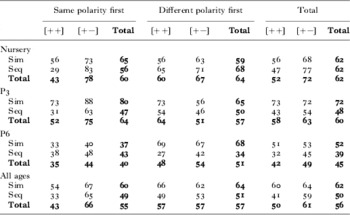
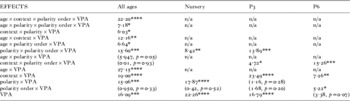
Table 1 shows how the frequency of VPA attempts varied according to age and semantic/pragmatic variables, as well as according to the order of presentation of the same polarity and different polarity items (since preliminary analysis suggested a possible interaction between polarity order and some of the other variables). To investigate the nature of these relationships, a hierarchical log-linear analysis was carried out on the dataset of 1,152 responses (treating each response as a case) in relation to five categorical variables: VPA (attempt/non-attempt), age (Nursery/P3/P6), context (simultaneous/sequential), polarity ([++]/[+−]) and polarity order (same polarity first/different polarity first). Preliminary model screening, using simultaneous tests for effects of each order and tests of individual association (partial association chi-squares), indicated that only four-way and lower-order effects should be considered further and that all five variables should be included in the model. Application of the SPSS HILOGLINEAR programme (which uses a backward stepwise procedure involving deletion of simple effects) indicated that the best model can be characterized in terms of two fourth-order effects and one third-order effect: age×context×polarity order×VPA, age×polarity×polarity order×VPA and context×polarity×VPA. Relevant lower-order effects are automatically included in a hierarchical model and are detailed in Table 2. The expected frequencies generated by this model provide a good degree of fit with the observed frequencies (goodness-of-fit likelihood ratio χ2=6·05, df=10, p=0·81).
VPA attempts as percentages of total responses per cell (by age, context, polarity and polarity order)

Log-linear analysis results – partial association chi-square values for those effects included in a given model

n/a=effect is not applicable (because only one age group is being considered).
* p<0·05 ** p<0·01 *** p<0·001 **** p<0·0001.
Effects that are not significant in their own right (but that are implied by higher order effects) are shown in parentheses.
To help clarify the nature of the effects in the overall model and in particular to address the aim of investigating developmental changes in the effect of semantic/pragmatic variables on VPA production, log-linear analyses were also carried out for each age group separately. For the Nursery group, the best model can be characterized in terms of the third-order effect of polarity×polarity order×VPA (goodness-of-fit likelihood ratio χ2=10·28, df=8, p=0·25). The best model for the P3 group likewise includes polarity×polarity order×VPA, but it also includes context×polarity order×VPA (goodness-of-fit likelihood ratio χ2=2·36, df=4, p=0·67). For the P6 group, the best model can be described in terms of the third-order effect of context×polarity order×VPA (goodness-of-fit likelihood ratio χ2=3·79, df=8, p=0·88). Again, relevant lower-order effects are automatically included in each model, as detailed in Table 2.
The log-linear model for all age groups combined, considered in conjunction with the data in Table 1, indicates that overall the children's attempts at producing VPA significantly outnumbered their non-attempts (56% versus 44%), as reflected in the first-order effect for VPA. There was also a significant second-order effect for age×VPA. Surprisingly, uses of VPA were less frequent for the P6 group (45%) than for the Nursery and P3 groups (62% and 60%), and it was only in the two younger groups that VPA attempts were significantly more frequent than non-attempts. These findings support our prediction that even the youngest age group would show some ability to produce VPA. In addition, though, the decreased frequency in the oldest group suggests that frequency of VPA use is affected by factors other than a basic ability to produce such constructions.
Our prediction regarding context is supported by the inclusion of a significant context×VPA effect in the all ages model, with VPA being used more frequently in simultaneous than in sequential contexts (62% versus 50%). The predicted effect of polarity on VPA frequency (polarity×VPA) is also confirmed by the all ages model, with VPA uses being significantly more frequent on [+−] than on [++] items (61% versus 50%).
However, the log-linear analyses indicate that the variables of age, context and polarity interact with each other and with polarity order in a number of ways. In considering this complex pattern of influences on VPA production, we will focus in turn on each of the three effects that characterize the all ages model, interpreting these in the light both of related lower-order effects and of comparisons between the models for the different age groups.
Age×context×polarity order×VPA
This fourth-order effect is partly attributable to age differences in the nature of the interplay between context and polarity order. While the effects of context and polarity order on VPA frequency do not interact significantly for all ages combined or for the Nursery group, they do show a strong interaction (context×polarity order×VPA) for the P6 group and a weaker interaction for the P3 group. For P6, VPA is produced much more frequently when the simultaneous context is combined with the different polarity first order (68%) than for any of the other permutations (sequential context and same polarity first=43%, simultaneous context and same polarity first=37%, sequential context and different polarity first=34%). For P3, the predicted effect of VPA being more frequent in simultaneous than in sequential contexts holds for both polarity orders; but in the simultaneous context, VPA is more frequent for the same polarity first (80%) than for the different polarity first order (65%), whereas in the sequential context, VPA frequency is similar for the two polarity orders (47% versus 50%). The significant third-order effect of age×context×VPA reflects the fact that the context effect holds for the P3 group (72% in simultaneous versus 48% in sequential contexts) and for the P6 group (52% versus 39%), but not for the Nursery group (62% in both contexts). There is also a significant third-order effect of age×polarity order×VPA, reflecting the finding that it is only in the P6 group that VPA is produced significantly more frequently for the different polarity first than for the same polarity first order (51% versus 40%).
Age×polarity×polarity order×VPA
This fourth-order effect partly reflects the fact that the third-order effect of polarity×polarity order×VPA features in the Nursery and P3 models but not in the P6 model. For the Nursery children, the polarity effect (whereby VPA is more frequent on [+−] than on [++] items) is much stronger when the same polarity items are presented first (78% versus 43%) than when the different polarity items are presented first (67% versus 60%). For P3, the difference in VPA frequency was again greater for the same polarity first order (75% on [+−] versus 52% on [++]) than for the different polarity first order (51% on [+−] versus 64% on [++]), where the difference between polarities was not only smaller but also in the opposite direction to what had been predicted. The third-order effect of age×polarity×VPA narrowly misses significance (p=0·05) in its own right (but is included in the model because of its contribution to the age×polarity×polarity order×VPA effect). Although all three age groups produced VPA more frequently on [+−] than on [++] items, the difference was more marked for the Nursery group (72% versus 52%) than for the P3 and P6 groups (63% versus 58% and 49% versus 42%). Comparison of the log-linear analyses for the separate age groups reveals that the polarity effect is highly significant in the Nursery model, but is not significant in its own right in the P3 model and is not included at all in the P6 model.
Context×polarity×VPA
This effect is included only in the all ages model, not in any of the models for separate age groups. It reflects a lower frequency of VPA usage on sequential context [++] items (41%) than on the other three item types (59% for sequential [+−], 60% for simultaneous [++], 64% for simultaneous [+−]).
DISCUSSION
Summary of findings
This study makes an important contribution to knowledge about children's developing ability to handle cohesive devices by showing that by the age of four years, children are able to produce VPA constructions (particularly verb-phrase ellipsis constructions) that are predominantly well-formed, both grammatically and semantically. Our findings regarding VPA production extend the evidence from previous research, which showed that young children are able to comprehend, imitate and make appropriate metalinguistic judgments about sentences containing VPA. Furthermore, our study extends upwards the age range investigated by including a group of ten-year-olds. Somewhat surprisingly, we found that the ten-year-olds produced VPA less frequently than the younger children, and that unlike the younger children, they did not show a significant preference towards producing VPA rather than full VP constructions.
While previous research on VPA has focused mainly on grammatical abilities, this study breaks new ground by investigating the influence of semantic/pragmatic variables on the frequency with which children use VPA. We found that VPA was produced more frequently in contexts where the two actions were presented as simultaneous and when the two clauses differed in polarity, but the influence of the context variable increased with age whereas the influence of the polarity variable appeared (at least at first sight) to decrease with age. Furthermore, both of these interactions between age and semantic/pragmatic variables were qualified by a higher-order interaction with polarity order (i.e. whether the same polarity or different polarity items were presented first).
A developmental sketch
The complex interplay amongst age, semantic/pragmatic variables and order effects can be summarized by the following developmental sketch. The four-year-olds showed a significant tendency to produce VPA rather than full VP constructions. The frequency of their VPA production was not affected by whether the context was simultaneous or sequential, but it was higher for different polarity [+−] items than for same polarity [++] items, especially when the same polarity items were presented first. The seven-year-olds, like the four-year-olds, produced VPA constructions significantly more than full VP constructions. However, they differed from the four-year-olds in two respects: they produced VPA significantly more frequently in simultaneous than in sequential contexts; and it was only when the same polarity items were presented first that they showed a polarity effect in favour of [+−] items. The ten-year-olds used VPA less frequently than the two younger age groups and did not show a preference for using VPA over full VP constructions. Like the seven-year-olds, they produced VPA significantly more frequently in simultaneous than in sequential contexts. Unlike the younger children though, the ten-year olds' frequency of VPA production was not affected by the polarity of individual items, but it was affected by polarity order in that VPA was more frequent when the different polarity items were presented first. In addition, the ten-year-olds' performance was characterized by an interaction between context and polarity order, which involved them using VPA most frequently when the simultaneous context was combined with the different polarity items being presented first.
Semantic/Pragmatic influences on children's VPA production
Our findings extend previous evidence that semantic/pragmatic factors play a role in children's comprehension of personal pronouns in VPA constructions (Foley et al., Reference Foley, Núñez del Prado, Barbier and Lust2003) by showing that semantic/pragmatic factors also influence the frequency with which children produce VPA constructions. In keeping with previous work, we found that the nature of the semantic/pragmatic effects changed with age.
A novel aspect of our study is that it investigated the effect of the polarity of the coordinating conjunction (and versus but) on VPA production, thus exploring the interplay between semantic content and two dimensions of syntactic structure, namely coordination and VPA. The developmental sketch presented above suggests that for all three age groups, VPA production is influenced by a semantic bias in which VPA is associated with content involving a polarity contrast, but that the way in which this influence manifests itself changes with age. While the four-year-olds are affected mainly by the polarity of individual items, the ten-year-olds are affected mainly by polarity order (i.e. the presentation order of the two blocks of polarity item types). The seven-year-olds are in an intermediate stage where they are affected by an interaction between polarity and polarity order.
While the Nursery group's production of VPA was influenced by polarity, it was not influenced by context, suggesting that developmental changes in sensitivity to this particular semantic/pragmatic variable take place between the ages of four and seven years. At first sight, this may seem surprising in the light of Tager-Flusberg et al.'s (Reference Tager-Flusberg, de Villiers, Hakuta and Kuczaj1982) finding that three- to five-year-olds' comprehension of phrasal versus sentential coordination was influenced by the distinction between simultaneous and sequential events. However, it may be that children can apply this distinction in comprehension before they can do so in production, and/or that they can apply it to the distinction between phrasal and sentential coordination before they can apply it to the distinction between VPA and full VP constructions. A related point is that in spontaneous language production, speakers are not typically faced with a choice between only two alternative constructions, but rather can choose from a wider repertoire. For example, they may be choosing amongst phrasal coordination (e.g. The gorilla and the elephant kicked the giraffe), sentential coordination with VPA (e.g. The gorilla kicked the giraffe and the elephant did too) and sentential coordination with full VP (e.g. The gorilla kicked the giraffe and the elephant kicked the giraffe). Furthermore, the number of alternative construction types will increase with age as children's syntactic repertoire develops. Therefore, in order to build up a more complete picture of how semantic/pragmatic factors influence children's use of VPA constructions, future research should consider how these constructions are used in naturalistic contexts and how uses of these constructions relate to uses of alternative constructions in children's developing repertoires.
It is also possible, though, that the lack of a significant context effect for the Nursery group is due to methodological factors. In an attempt to mimic the distinction between simultaneous and sequential events in the real world, the actions of two protagonists were depicted either in a single picture or in two separate pictures presented sequentially. It may be that this manipulation was not successful in conveying the distinction between simultaneous and sequential events to the youngest age group. To investigate this possibility, future research could use video-recordings of events, instead of static pictures, as stimulus materials.
Similarly, it is difficult to be certain whether the context effects that were obtained for the older age groups truly reflect an influence of event simultaneity/sequentiality on the pragmatics of VPA production, as opposed to a more task-specific effect of the two different methods of stimulus presentation used in this study. Again, this issue could be addressed by using video sequences as stimulus materials in experimental tasks, and also by observing which types of events elicit VPA constructions in naturalistic contexts.
Further research using different stimulus presentation methods would be valuable also in exploring how context and polarity effects may interact. In the paradigm used here, the simultaneous and sequential conditions differed in terms of how polarity information was conveyed. In the sequential condition, the children saw a picture of one action and heard the first clause and connective before they saw the picture of the second action. Thus, information about the expected polarity of the second clause was provided first by the connective and then by the second picture. Furthermore, since but is more semantically marked than and, the clue provided by the connective was stronger for [+−] than for [++] items. In the simultaneous condition, the picture depicting both actions was already visible to the children by the time they heard the connective, so information about the expected polarity of the second clause was provided first by the picture and then by the connective. A significant third-order effect of context×polarity×VPA was obtained, with uses of VPA being less frequent for [++] items in the sequential context than for any of the other three combinations of polarity and context. However, interpretation of this effect is not straightforward. On the one hand, our findings are consistent with the distinction between but and and being more important in the sequential than in the simultaneous condition, in that VPA uses were much more frequent on [+−] than on [++] sequential items (59% versus 41%), but only slightly more frequent on [+−] than on [++] simultaneous items (64% versus 60%). On the other hand, if contrasting polarity is highlighted by presenting the connective prior to presenting the pictorial representation of the content of the second clause, then uses of VPA on [+−] items might be expected to be more frequent in the sequential than in the simultaneous condition; and yet this was not found to be the case (sequential [+−]=59%, simultaneous [+−]=64%). It appears, therefore, that the most plausible interpretation of our findings is that either contrasting polarity or a simultaneous context is sufficient to increase the likelihood that VPA will be produced. This, in turn, implies that the influence of the context variable is not merely an artefact of the way the particular presentation method used here interacts with the polarity variable.
In this study, we focused on investigating the effects of two semantic/pragmatic variables, polarity and context, while counterbalancing the way these variables were combined with other potentially relevant variables, such as tense/aspect/modality/voice and the lexical content of the VP. In future research, it would be interesting to investigate whether other semantic/pragmatic and grammatical variables affect VPA production, as well as the nature of the interplay amongst these variables. For example, Li & Shirai (Reference Li and Shirai2000) propose a prototype theory for the acquisition of lexical and grammatical aspect in which particular semantic features, such as telicity (i.e. whether an event has a natural endpoint), are associated on the one hand with distinctions between categories of lexical verbs and on the other hand with morphological markers of tense/aspect distinctions. For instance, telic events (i.e. those with a natural endpoint) are prototypically described using achievement verbs (e.g. spill) and perfective aspectual morphemes (e.g. -ed), whereas atelic events tend to be associated with activity verbs (e.g. cry) and with imperfective morphemes (e.g. -ing). Since Li & Shirai argue that children initially associate each aspectual morpheme with its prototypical category of lexical verb, before learning to use it with less typical semantic content, there may be grounds for predicting that VPA will be produced more frequently (and will be more likely to be grammatically well-formed) when the lexical and grammatical dimensions of aspect are consistent rather than inconsistent, but that the strength of this effect may decrease with age.
Syntactic priming
An interesting speculation is that polarity order effects may reflect an interplay between polarity effects and syntactic priming effects, whereby the polarity of the first-presented items affects the children's choice of construction (VPA if [+−] or full VP if [++]), and their use of a particular construction on these items then primes them to use the same construction on later items. This would be consistent with recent evidence from studies of syntactic priming in children, which have shown that in picture description tasks, children (like adults) tend to produce sentences that repeat the syntactic constructions used previously in ‘prime’ sentences produced by the experimenter, even though the prime and target sentences differ in semantic content (Branigan, McLean & Jones, Reference Branigan, McLean, Jones, Brugos, Clark-Cotton and Ha2005; Huttenlocher, Vasilyeva & Shimpi, Reference Huttenlocher, Vasilyeva and Shimpi2004; Savage, Lieven, Theakston & Tomasello, Reference Savage, Lieven, Theakston and Tomasello2003). For example, children are more likely to describe a picture using a passive sentence when the experimenter's prior description (of a different picture) has used a passive rather than an active sentence. Although these findings have been interpreted as evidence that children as young as three years have abstract syntactic representations (Branigan et al., Reference Branigan, McLean, Jones, Brugos, Clark-Cotton and Ha2005), it has also been argued that the abstractness of syntactic representations increases with age, since priming in young children is sometimes lexically based (Savage et al., Reference Savage, Lieven, Theakston and Tomasello2003). This increasing robustness of syntactic priming and decreasing influence of semantic factors with age provides an interesting parallel with our argument, that there is a developmental shift from polarity effects operating at the level of the semantic content of individual items to polarity order effects operating across blocks of items and being mediated by syntactic priming effects.
Our proposal that syntactic priming effects may be operating across blocks of items is consistent with evidence from some of the studies on syntactic priming in children showing that priming effects persist or produce carry-over effects across blocks of trials even when these are a week apart (Huttenlocher et al., Reference Huttenlocher, Vasilyeva and Shimpi2004; Savage et al., Reference Savage, Lieven, Theakston and Tomasello2003). This is interesting because it suggests that priming effects in children may reflect implicit learning rather than just transient activation of particular syntactic representations. Furthermore, if our findings do reflect a priming effect, then they extend previous findings by showing that syntactic priming in children can occur when the construction that serves as the prime is produced spontaneously by the child, as well as when it is produced by the experimenter (as it has been in previous studies). This is potentially important because if syntactic priming reflects implicit learning processes that may serve as a language acquisition mechanism, then the power of this mechanism will be substantially greater if consolidation of new constructions can operate within the child's own spontaneous speech rather than being entirely dependent on repeated input from other speakers. Also, if the syntactic structure of children's speech is influenced by sentences they produced earlier in the ‘discourse’ (albeit in an artificial form of discourse), then further investigation of this effect could help to elucidate the nature of the interplay between syntactic and discourse processes in children's language production. VPE constructions provide fertile ground for probing the relation between syntactic and discourse processes, as Frazier & Clifton (Reference Frazier and Clifton2005) have shown in their studies of adults' comprehension of VPE.
A surprising aspect of our findings is that the P6 children used VPA significantly less overall than the younger groups. Interestingly, though, the P6 group's use of VPA in the simultaneous context with different polarity presented first (68%) was similar to the P3 group's (65%) and slightly higher than the Nursery group's (59%). In other words, the lower overall level of VPA use by the oldest children could be interpreted as being due to an increase with age in syntactic priming effects and in sensitivity to the prototypical context for VPA production. Under this interpretation, the age-linked decline in overall frequency of VPA and the developmental changes in semantic/pragmatic/priming effects are regarded as being two sides of the same coin. The older children's uses of VPA are less frequent but more selective. Thus, for example, the increasing strength of syntactic priming effects with age could account both for the decline in overall frequency of VPA in the P6 group and for the decline being particularly marked in the same polarity first condition.
There is also a second respect in which an increase with age in the strength of syntactic priming effects may have contributed to the lower frequency of VPA in the oldest group. At the level of individual items within a sentence completion paradigm, a priming effect would increase the likelihood of the children repeating the type of structure used by the experimenter in the first clause (i.e. a full VP) rather than producing a different type of structure (i.e. an elided VP). In other words, to achieve the goal of producing non-redundant, cohesive sentences, speakers need to overcome the tendency towards repetition/persistence of syntactic structure, which has been well documented in the literature on syntactic priming (e.g. Bock, Reference Bock1986; Pickering & Branigan, Reference Pickering and Branigan1998). This opposition between cohesion and persistence raises some intriguing questions for future research – e.g. How do speakers balance these competing forces? How does the nature of this balance change developmentally? Research addressing these questions is likely to have important theoretical implications for models of language production (in children and adults), as well as practical implications for education.
Informal observations suggest that as children progress through primary school, they are increasingly exhorted by their teachers to produce sentences that are as full as possible, especially in written tasks. Such classroom practices, perhaps in combination with increasingly strong syntactic priming effects, may have encouraged the oldest group of children to produce fully specified rather than anaphoric verb phrases, particularly since our tasks were presented in a school setting and were fairly similar to classroom tasks. If this is the case, then guidance about how to reduce redundancy and increase cohesion will need to be carefully integrated with advice about when it is appropriate to use a more fully specified construction and/or to repeat the syntactic structure used in an earlier utterance.
APPENDIX: Sample item sets
sample item set derived from pool a verbs: chase, eat, feed, follow, kick, kiss, push, wash

corresponding item set derived from pool b verbs: carry, catch, climb, find, open, pick, post, throw