

The music-publishing trade of early modern England saw significant progress towards the industry that we recognise today, not just in developments in printing techniques but also in the rise of commercialism from the middle of the seventeenth century onwards. These advances were matched by a growing domestic amateur music-making culture, which, while dating back to the mid-sixteenth century, is understood to have accelerated as a reflection of the social upheavals of the Civil Wars and Interregnum. As is well known, the majority of printed music books produced from 1650 were designed to appeal to the amateur musician, and the publisher who dominated and drove forward this market was John Playford (1623–86/7).
Playford’s commercial focus relied on making musical texts immediately accessible to more readers than ever before. In order to encourage musical literacy, and consequently provide himself with more customers, Playford compiled the treatise A Briefe Introduction to the Skill of Musick, supplied beginner books containing popular tunes for the most readily available instruments with rudimentary directions for self-instruction, and made works of contemporary composers accessible. Such printed books, for a fee, provided the amateur musician with an introduction to the art of music without the dependence on musical connections and networks of manuscript circulation that dominated the transmission of music in earlier decades. For John Playford, the development of a successful and financially viable music-publishing scene in England in the latter half of the seventeenth century required a knowledge of market demand and the clientele.
The dissemination of English late seventeenth-century printed music books has received little scholarly attention, undoubtedly due to a lack of surviving evidence beyond the books themselves. Research has focused primarily on manuscript provenance, identification of particular manuscript copyists, and the contexts of manuscript transmission and private exchange, hinting at relationships between manuscripts and prints and implying the importance of the printed book as a component in the complicated nexus of source transmission in seventeenth-century England.Footnote 1 Recently, printed music from this period has been studied as a primary source for exploring issues surrounding composers and their relationship with print,Footnote 2 the editor’s role in the production of anthologies,Footnote 3 and the role of the compositor.Footnote 4 Furthermore, Andrew Woolley’s work on manuscript additions in the form of ruled leaves bound with printed books has expanded David Greer’s work on additional manuscript items on empty printed staves or flyleaves.Footnote 5 Robert Thompson has recently outlined the importance of printed music sources in offering the sort of important codicological and historical evidence on which manuscript studies have long focused.Footnote 6
An important aspect in placing the printed music book in its cultural context of England in the second half of the seventeenth century is the very source of this cultural consumption – the customers. The printed book and the combination of social and technological factors involved in its make-up does not end with the finished product: post-production, social dimensions of the printed music trade include circulation and dissemination, and distribution and reception of the musical texts, which contribute to our interpretations of market demands and the motives behind the creators of print culture, thus feeding back into our knowledge of the production of the book. Playford was clearly aware of the need to attract as many customers as possible in order to succeed in a commercial business, maximising what must have been a very small musically literate market for his printed music. He regularly paid attention to developing the potential market outside London, frequently referring to ‘yong beginners, who live in the Countrey, and far from any Master or Teacher’ in prefatory material, particularly in his instrumental beginner books.Footnote 7 In the 1678 edition of Musick’s Hand-maid, Playford explicitly uses this potential customer base as a means of adding teaching notes to the book: ‘Many of those that bought of the former Impression of Musicks Hand-maid, were not well satisfied, (especially such who dwelt in the Country remote from an able Master) because she brought not with her some Rules and Directions for playing those Lessons contained therein.’Footnote 8 The purpose of this article is to recognise the contemporary audiences of seventeenth-century printed music books in order to place the books in the contemporary context of music-making in England. In identifying who the owners of these printed texts were and where they lived, we can begin to understand the extent to which Playford’s books circulated across the country, which in turn gives rise to questions about the mechanisms of supply, the distribution networks of printed music and the influence of Playford’s texts on musical literacy and music transmission as well as the importance of gender, occupation and wealth as determinants of the ownership of these goods. By placing the evidence of these individuals, groups and institutions who were Playford’s customers within the wider context of music-making and bookselling in seventeenth-century England, we can begin to piece together the printed-music market and understand further the production and consumption of these luxury goods.
JOHN PLAYFORD AND MUSIC BOOKSELLING
London was the unrivalled centre of England’s book trade in the seventeenth century, with traders concentrated around St Paul’s churchyard and the surrounding areas. The principal music bookshops were located around the Inns of Court. Ned Ward (1667–1731), satirical writer and author of the London Spy, provides a lively contemporary description of such music shops:
In our loitering perambulation round the outside of St Paul’s . . . We walk’d a little further, and came amongst the music-shops, in one of which were so many dancing masters’ ’prentices fiddling and piping bores and minuets, that the crowd at the door could no more forbear dancing into the shop, than the merry stones of Thebes could refuse capering into the walls, when conjur’d from confusion into order by the power of Amphion’s harmony. Amongst ’em stood a little red-fac’d blade, beating time upon his counter, as if a Bartholomew Fair consort, with the assistance of a jack-pudding, had been ridiculing an Italian sonetta, and he was as prodigally pert in giving his instructions to the rest as a young pedagogue tutoring a discipline in the hearing of his father.Footnote 9
Bookshops varied in physical form and in the sorts of customers for whom they catered: counters, shelves of bound and unbound books, and a variety of pictures and prints all feature in illustrations showing the interior of booksellers’ shops from this period.Footnote 10 Roger North recalls that John Carr’s music shop included ‘a secretary’s office . . . for wrighting the theatricall tunes, to accomodate learners and country fidlers’.Footnote 11
Bookshops fulfilled not only a commercial purpose, but were also important social centres in this period, providing public access to and opportunities to exchange printed materials as well as continuing manuscript circulation practices, and were designed to attract customers to browse and swap news. In his diary Samuel Pepys describes the nature of customers’ encounters in John Playford’s shop in the Inner Temple Churchyard: writing on 25 May 1661, he tells us he went ‘at noon to the Temple; where I stayed and looked over a book or two at Playfords and then to the Theatre’.Footnote 12 Reading in the premises before choosing whether to buy was a common part of the customers’ experience: on 8 May 1663, Pepys ‘sat till one a-clock, reading at Playford’s in Dr Ushers Body of Divinity his discourse of the Scripture’.Footnote 13 Exchange of books as well as second-hand purchases were both familiar aspects of the bookshop trade. On 13 February 1660, Pepys did just this at Playford’s shop: ‘I went to Playfords; and for two books that I had and 6s. 6d. to boot, I had my great book of songs, which he sells always for 14s.’Footnote 14 The lending of books also appears to have been one of the services of the general bookshop. Francis Kirkman (1632–c. 1680), a bookseller and writer, advertised his shop just outside Temple Bar in 1669 as a place where ‘you may be furnished with all the Plays that were ever yet Printed, and all sorts of Histories and romances, which you may buy or have lent you to read on reasonable Considerations. Also you may have ready Money for any Library, or other parcel of Books.’Footnote 15 Playford also appears to have loaned books for a fee: a reference in the Treasurer’s Accounts of Westminster Abbey for 1661 reads: ‘To John Playford for a sett of Mr Barnards collections of services and Anthemes conteyning tenn Bookes in ffolio bound in rough Leather with one Quire of Ruled Paper xiiil xs and for the Loane of another sett for foure or five Sundayes and for Portage and carrying them xs in all xiiiil.’Footnote 16
Playford’s home doubled as a site to sell and promote his books. The home was an important outlet for the wares of stationers in seventeenth-century London, as it could be used as a place of meeting and discussion. Playford, an enthusiastic amateur musician in his own right, was heavily involved in the London music-making communities of the 1650s and used his home to host music meetings. There is no evidence that Playford used his earliest dwellings for such a function, but the family’s move to Islington in 1656, where his wife set up a boarding school, provided the opportunity for the stationer to host musical gatherings.Footnote 17 In the preface of his devotional song anthology Cantica Sacra . . . The Second Sett (1674), Playford described musical gatherings in his home:
these Latin Hymns I thought to have concluded this Second Sett; but some noble Friends Seeing and Hearing perform’d (at my House) several Choice English Anthems of like nature for Two Voices to an ORGAN, which I had obtain’d from the Hands of these Excellent and knowing Masters, viz. Dr Gibbons, Dr Rogers, Mr Matthew Locke, and Others; They much importun’d me to Joyn them with the Rest.Footnote 18
Bookselling was not, however, limited to London and the city’s customers. The general book trade included shops across the country and temporary stalls in markets or on the open street by chapmen across the country. Oxford, and to a lesser extent Cambridge, had university publishing houses that produced a small amount of contemporary printed music, including Henry Bowman’s Songs (1678) and Thomas Mace’s Musicks Monument (1676) respectively. In the early seventeenth century, Robert Martin operated as a journeyman for the London bookseller Henry Fetherstone,Footnote 19 and William London, a Newcastle-based bookseller, advertised music books in his 1657 catalogue.Footnote 20 However, little is known of the networks between the London-based music publishers and wholesalers and the provincial booksellers and customers.Footnote 21 Henry Playford listed a ‘Mr. Dolliff Bookbinder in Oxford’ as a supplier of the publisher’s 1690 sale catalogue, indicating at least one working relationship with a bookseller outside London.Footnote 22 It is possible that the specialist nature of the music publishing trade required different methods of dissemination from the general book trade. Provincial cathedral musicians such as Daniel Henstridge may have acted as a conduit for printed music in a similar way as the scribal networks that operated for liturgical and instrumental consort music.Footnote 23 Provincial booksellers were certainly still important for at least the binding of music books and provision of manuscript paper.Footnote 24 A handful of surviving trade bills and receipts indicate that the Dean and Chapter of Durham Cathedral relied almost exclusively on local book traders in the seventeenth and eighteenth centuries. There are references to ‘mending and putting paper’ into anthem books by the Durham bookseller William Werdon in March 1691, and a bill in May 1692 from Durham-based Joshua Hughes includes ‘new binding of four books for the organ and quire’. A bill of books to the cathedral from William Werdon covering November 1693 to July 1694 includes a ‘quire of large ruled paper by Mr Owen’ and ‘4 anthem books got by Mr Greggs for ye boys’. Further bills including for large ruled paper and binding anthem books survive for 1694–6.Footnote 25
William London, a bookseller in Newcastle-upon-Tyne in the 1650s, published A Catalogue of Most Vendible Books (1657, with supplements in 1658 and 1660). London’s catalogues contain over 3,700 titles, probably ‘the most extensive stock of any North of England bookseller before the eighteenth century’,Footnote 26 and includes nineteen music-related publications – ten published or primarily sold by John Playford. Such evidence demonstrates that at least some music books were sold by booksellers outside London, and that there was sufficient market demand for such books to be stocked. Instrument sellers outside London may also have sold manuscripts and prints as part of their trade. There is good evidence that instrument makers were based in provincial centres as well as London. Thomas Britton mentions a viol-maker in Oxford,Footnote 27 and more recently, Christopher Marsh has listed fourteen instrument-makers in Bristol during the early modern period.Footnote 28 Marsh suggests individuals may have joined their instrument-making skills with other trades such as wood-working, indicating that music was not their sole industry. However, no evidence of bookselling as a by-product of this trade has yet come to light.
Another avenue through which consumers could obtain music books was professional music teachers. Some teachers certainly sold instruments – Pepys received ‘two new great Ivory pipes’ from flageolet-teacher Thomas Greeting on 19 July 1667, for example.Footnote 29 Teachers may have sold printed books, particularly copies of their own compilations, published ‘for the Author’. John Moss’s Lessons for the basse-viol (1671) was printed ‘for the Author’ and consisted of 104 pieces in tablature and arranged to take the player through ‘all [the] Keys usually play’d on in the scale’. Moss dedicated the book to his father, and presented it with an address to his scholars, ‘this way to ease myself of so many tedious Transcripts’.Footnote 30 Such self-publications primarily intended for a teacher’s pupils were not new during this period, and in fact, there are fewer books of this type produced in the middle decades of the seventeenth century than at the beginning or the end of the century. The printing and publishing of music by teachers for pupils seems to have gained momentum in the second half of the seventeenth century, probably due to the developments in cheap and more accessible engraving technology as well as the influx of foreign musicians seeking to make a living as freelance musicians.Footnote 31 Roger North recalled that Nicola Matteis in the 1670s had ‘found out a way of getting mony which was perfectly new. For seeing his lessons, (which were all duos), take with his scollars, and that most gentlemen desired them, he was at some charge to have them graven in copper, and printed in oblong octavos.’Footnote 32 Nicola Matteis used engraving techniques for printing single compositions for his students and subsequently collecting the sheets together into a book for the public print market. As Richard Leppert has highlighted, ‘music teachers wrote tutors not only to augment their income from direct sales, but also in the hope of attracting new students from the books’ readership’.Footnote 33 The German composer Gerhard Diesineer similarly published his [Instrumental Ayrs in Three, and Four Parts] around 1680, which contained music written ‘for the Use and Practice of my Scholars; and the little Consort of Music I often have at my owne House, to entertaine my Friends’.Footnote 34 Pietro Reggio’s The Art of Singing (1677) is another treatise undoubtedly published to augment the musician’s teaching services. Many title pages of these self-publications list the composer’s home as a venue for obtaining a copy of the book, but composers were undoubtedly still reliant upon the bookshop network for wider public exposure, with business relationships that were necessarily financially beneficial for all parties.
The majority of these books are self-publications published by the composer-teacher rather than a music publisher, which suggests such a genre was not the most commercially successful product of the time.Footnote 35 John Playford certainly seems to have decided not to publish such single-composer pedagogical books following Matthew Locke’s Little Consort (1653). It is unclear whether Matteis or his contemporaries suggested other printed music books to their pupils, or acted as agents between pupils and booksellers, although this is possible. John Playford thanked composers who contributed to his Choice Ayres and Songs . . . The Second Book (1679) ‘for their Assistance in promoting this Work’.Footnote 36 Playford clearly hoped teachers would use his books as a teaching resource. In Musick’s Hand-maid (1678) Playford suggests that ‘For the satisfaction of the aforesaid persons, and likewise for the ease of such Teachers, who account it too much pains to write down all that is necessary for their Scholars, I have in this new Edition adventured to publish the following Instructions’.Footnote 37
Amateur musicians living outside London may have relied upon London family members, friends or agents rather than teachers to supply them with music books. We lack surviving evidence during Playford’s publishing years, but these networks are highly probable, based on evidence primarily from surviving household accounts from both the early seventeenth and the eighteenth centuries. Agents of the Cavendish family located instruments and music books during London visits between 1601 and 1606, for example, and William Byrd and John Cooper acted as agents in locating music books for their pupils and patrons.Footnote 38 Sir Christopher Hatton III had direct dealings with the music supplier Robert Martin in 1638.Footnote 39 In the eighteenth century, Charles Avison in Newcastle supplied printed music and manuscript paper for the Bowes family at Gibside.Footnote 40 Pepys was certainly asked by provincial relations to supply musical instruments:
Today I received a letter from my Uncle to beg an old fiddle of me for my Cosen Perkin the Miller, whose mill the wind hath lately broken down and now he hath nothing to live but by fiddling – and he must needs have it against Whitsuntide to play to the country girls. But it vexed me to see how my Uncle writes to me, as if he were not able to buy him one. But I entend tomorrow to send him one.Footnote 41
THE PRINTED MUSIC-BOOK MARKET
With a range of possibilities for the music customer to pick up a book, from the bookshop either in or outside London, from their teacher, agent, or through networks of friends and relatives, it is quite possible that Playford’s music books circulated far beyond the cultural sphere of the capital. An analysis of his books gives us insight into the types of customers whom Playford was at least attempting to entice to buy one of his books, their gender, occupation, wealth and musical ability. Over 200 music publications were produced in England between 1650 and 1700,Footnote 42 and the Playfords were responsible for the largest contribution by a single business. Many of these books were published in numerous editions or reprints, indicating a flourishing market, particularly when the majority were printed using the laborious method of movable type. The printed music-book fulfilled a number of musical functions, some of them potentially overlapping, and they were used by a variety of different consumers. Playford appears to have relied upon professional men, gentlemen students, and ladies as the clientele for the majority of his music output, although his customer base was not limited to these. Cathedral choirs were reliant on specific publications following the Restoration, purchased from Playford: John Barnard’s The First Book of Selected Church Musick (1641) and Thomas Tomkins’s Musica Deo Sacra (1668) are recorded in a number of cathedral account books as sold by Playford.Footnote 43 The parish-church congregation was also catered for by Playford, with his Psalms & Hymns in Solemn Musick of Foure Parts (1671), and more successfully, The Whole Book of Psalmes in Three Parts (1677).Footnote 44
The amateur male and female beginner has long been regarded as the main customer cohort of Playford’s market. Certainly the printed music book was available to anyone with the financial capacity to purchase it, although the market was undoubtedly a tiny percentage of the population. Robert D. Hume has suggested that few members of the British population around 1700 were likely to have had enough spare money to indulge in expensive culture,Footnote 45 and some may not have been interested in cultural activities, so the percentage specifically interested in music or who were even musically literate must have been even smaller. The narrow concentration of the population able to purchase cultural goods was limited to members of the upper class and the ‘middling sort’, the latter being a contemporary term applied to such persons who ‘fell, economically, somewhere between artisans (who lived a notch above subsistence level) and the gentry’.Footnote 46 This section of the population included gentlemen, merchants, persons in office (including parliament, army and navy) and the law, clergymen and artisans. The magnitude of cultural consumption among these groups is difficult to establish. Not only are patterns of spending personal, but Hume highlights the differentiation between habitual and sporadic purchasers of culture: most ‘could indulge in relatively cheap books or amusements but could not regularly afford expensive ones’.Footnote 47 A certain level of financial outlay is essential for the practising of music in order to fund resources such as instruments (including second-hand instruments), teachers and manuscript paper, not to mention manuscript-copying services and printed music books. The customer base for printed music books in seventeenth-century England must have been small and, of course, not all levels of musical society were reliant on print, with the continuing tradition of scribal networks and recreational music based on oral transmission still playing a significant role in the cultural lives of the majority.Footnote 48
Evidence of the amateur clientele of Playford’s printed stock chiefly comes from the prefatory material of the books themselves as well as a few contemporary source references. The placement of the Playford business and the music shop of John Carr around the Inns of Court was an ideal location for attracting the young gentlemen students. Both the Middle Temple and Inner Temple shared their daily services in the Temple church, and Playford’s shop, located under the arch of the Temple Church Porch at the West End, must have depended much upon these potential customers. Playford’s first music book, The English Dancing Master (1651), was addressed to the ‘Gentlemen of the Innes of Court’ for ‘much commend it [dancing] to be Excellent for Recreation, after more serious Studies, making the body active and strong, gracefull in deportment, and a quality very much beseeming a Gentlemen’.Footnote 49 Furthermore, Playford’s Court Ayres (1655) is dedicated to ‘the most accomplish’d Gentleman, William Ball, Esq. (eldest Son of Sir Peter Ball) of the Middle-Temple’, and the contents ‘have bin graced with performance of your part’.Footnote 50
Music meetings were numerous during this period, although most surviving evidence naming individual musicians reports on meetings held between professional musicians and highly musically skilled amateurs in London and cathedral cities.Footnote 51 Less musically educated amateurs probably met informally with friends in such venues as taverns and coffee-houses, providing important centres for community identities of urban professional men. Michelle O’Callaghan has highlighted the social basis of the early seventeenth-century tavern societies in the Inns of Court, which ‘were home to a new class of lawyers eager to fashion a professional identity in which notions of fellowship, civility, and gentility were vital constituents’.Footnote 52 Music was a principal form of entertainment at many of these male convivial gatherings, and numerous contemporary accounts refer to music-making in taverns by a wide range of people. Pepys, for example, described ‘the King’s Head, the great musique-house’ at Greenwich,Footnote 53 and Roger North referred to a tavern near St Paul’s where ‘some shopkeepers and foremen came weekly to sing in consort, and to hear, and injoy ale and tobacco; and after some time the audience grew strong’.Footnote 54 Such groups presumably found it more difficult to obtain music without the strong personal connections and networks associated with the more formal music meetings of professional and gentleman amateur. Both print and manuscript publication, either bought, borrowed or hired, would have been useful for these individuals. Playford’s Catch that Catch can was based on the repertories of more formal music meetings held in the 1640s and 1650s and the published series was aimed at such a ‘Mutuall Society of Friends in a Modest Recreation’, suggesting a market demand to emulate the popular repertory of such musical gatherings.Footnote 55 John Hilton noted in the first edition that ‘Catches and Catchers were never so much in request’.Footnote 56 Roger North, on describing the tavern meeting near St Paul’s, mentioned that ‘their musick was chiefly out of Playford’s Catch Book’ and that ‘this shewed an inclination of the citisens to follow musick’.Footnote 57
A different sort of evidence survives for the users of printed beginner instrumental books: the title-page illustrations often depict the expected performers of the books’ contents, providing important information about associations of gender. Series such as The Pleasant Companion, Musick’s Delight on the Cithren and The Division Violin clearly portray male music enthusiasts. Depicted sitting at a table with instrument in hand, the gentleman hovers over a book learning how to play. Either on the table or hanging on the wall behind are other instruments, representing other (possible) accomplishments of the musical amateur. Women are seldom represented alone,Footnote 58 but performing as a singer or keyboard player as part of an ensemble with a gentleman amateur, such as in the Musick’s Hand-maid and Deliciae Musicae series. Such depictions of female amateurs performing in musical ensembles were probably designed more for the marketing of the book to both male and female amateurs than illustrating commonplace performing contexts, as much female music-making during this period is thought to have been solitary.Footnote 59 Musical skill was clearly regarded as an accomplishment to gain in the pursuit of a husband: as Andrew Woolley notes, female owners of music manuscripts ‘tended to be unmarried as they often sign them [the manuscripts] with maiden names’.Footnote 60 Social pressures were clearly a motivation for women to obtain musical skill, an ability that the contemporary female writer Hannah Woolley thought was essential as without it ‘a Lady or Gentlewoman can hardly be said to be absolutely accomplished’.Footnote 61
Many of Playford’s books appear to be marketed at the ‘middling sort’ of amateurs with little or no musical literacy. While A Musicall Banquet (1651) contains a list of teachers in London with Playford’s advice that ‘the successe in the practick part [of music]; would be obtained by the help of an able Master’,Footnote 62 the majority of his amateur books suggest the cutting down on costs for the ‘middling’ amateur. As early as Thomas Robinson’s Schoole of Musicke (1603), printed tutor books claimed to spare readers the cost of hiring teachers as they began to learn the lute, bandora, orpharion or viola da gamba, promising to show them ‘how you may be your owne instructor . . ., without any other teacher’.Footnote 63 The clientele in mind for such books must have included ‘recreational musicians for whom regular payments to visiting tutors were close to the limit of what seemed affordable’.Footnote 64 This long tradition of music books aimed at the amateur and for the most readily available instruments and for voice, with many providing rudimentary directions for self-instruction, was continued with John Playford supplying such books for lyra viol, cittern, gittern, harpsichord and violin. The second edition of Musick’s Hand-maid (1678) included ‘Instructions for the Learner on the Virginal or Harpsichord to Play by Book’, for
Many of those that bought of the former Impressions of Musicks Hand-maid, were not well satisfied, (especially such who dwelt in the Country remote from an able Master) because she brought not with her some Rules and Directions for playing those Lessons contained therein . . . For the satisfaction of the aforesaid persons, and likewise for the ease of such Teachers, who account it too much pains to write own all that is necessary for their Scholars, I have in this new Edition adventured to publish the following Instructions.Footnote 65
Playford’s beginner instrumental books have long been described as meeting the needs of the beginner amateur without the need of a teacher, with the books containing rudimentary instructions covering basic musical literacy, reading notation, understanding pitch, and basics specific to each instrument. Advertisements such as ‘A Brief and Plain Introduction to the Skill of Musick. By which Book may have learn’d to Sing, and Play on the Bass-Viol, and also on the Treble-Violin, without the Assistance of any Teachers’ further suggest the ability to learn music without a teacher.Footnote 66 However, Playford subtly distinguishes between the learning of music theory by book study and the ‘practick part’ of playing with the aid of a master. There are numerous passing references to teachers or to further study in the prefaces of his beginner instrumental books. The well-known list of teachers in A Musicall Banquet (1651) is prefaced with this statement:
Thus having briefely set downe these few necessary and easie principles of the theorick part of Musick, I shall wish you good successe in the practick part, which will soone bee obtained by the helpe of an able Master, this City being at present furnished with many excellent and able Masters in this Art and Science, some of whose names for information of such as desire to become Practitioners therein, I have heere inserted.Footnote 67
Playford further advises the supervision of a teacher in later instrumental beginner books. In Musicks Hand-maid (1678), for example, he suggests the assistance of a teacher, ‘having briefly set down these plain and useful Instructions, for such as learn on the Virginal or Harpsichord, I doubt not but by putting them in practice, and a little assistance from an able Master, they may in a short time learn to play all these Lessons by Book’.Footnote 68 Thomas Greeting, in his Pleasant Companion series (published and sold by Playford), similarly suggests that ‘though at first it may seem difficult to Beginners, yet the Practice of a few Hours, observing these following Directions, and a little assistance of a skilful Master, the knowledge hereof may be readily obtained’,Footnote 69 suggesting that a teacher to complement his book provided potential employment, as Greeting was a London-based flageolet teacher. Greeting points towards Playford’s Introduction for further theoretical study: ‘If what is said here concerning the Common Time be not sufficient to instruct a Beginner, I refer him to Mr. Playford’s Introduction to the Skill of Musick, where he may not only be instructed in this, and the Triple Time, but in all the Grounds of Musick, both Vocal and Instrumental.’Footnote 70 Rather than replacing the teacher, Playford’s beginner instrumental books appear to provide rudimentary instruction with accompanying lessons and tunes that are a complement to at least some music lessons with a teacher for the absolute beginner, similar to modern-day tutor books.Footnote 71 Music teachers must have been available outside London, at least in regional centres, although records tend to lack specific details beyond the description of musician.Footnote 72 A counter-example is of William Smith (d. 1646), a musician who ‘techt childre [sic] to play of the virgeners’ in Newcastle-upon-Tyne.Footnote 73 Only in Apollo’s Banquet, a beginner violin book, does Playford suggest there is no need for a teacher in the learning of the violin, which the publisher describes as ‘the only Instrument in fashion, and the delight of most Young Practitioners in Musick’ – a marketing strategy perhaps? In the preface to his fifth edition, Playford outlines
for the benefit of such Learners as live remote from any professed Teachers, I have in the following Pages set down (in the plainest Method I could invent) some Practical Rules and Instructions for Beginners; which, since my first Publication hereof, I have met with several Persons that have only by the Instructions attained to play indifferently well.Footnote 74
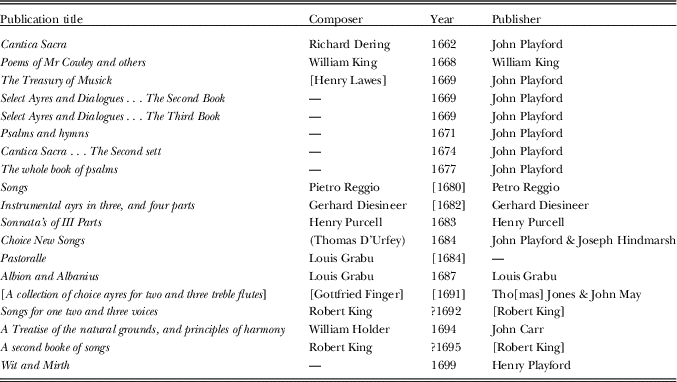
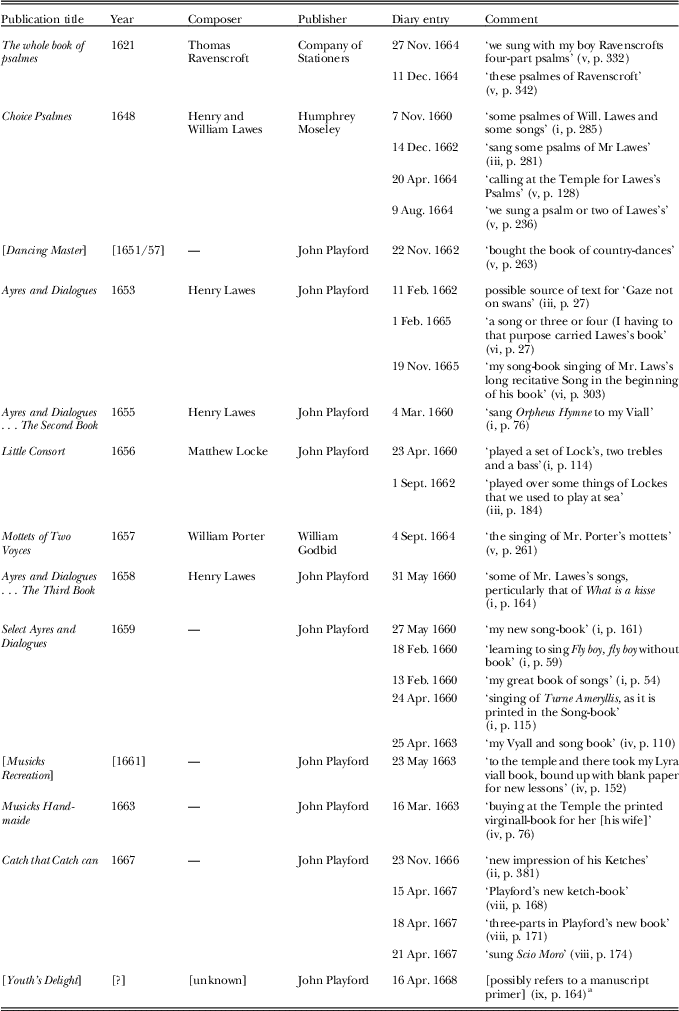
Another type of customer for Playford was the collector. A number of presentation copies survive, including Psalmes & Hymns (1671) ‘humbly presented’ by John Playford to ‘the Rt Honble Sr Francis North, his Majesties Solicitor Generall’ held at the British Library.Footnote 75 The survival of such presentation copies, flawless and evidently unused, links with the contemporary culture of collecting and the rise in antiquarianism.Footnote 76 Samuel Pepys is a prime example of a consumer in the urban elite in pursuit of luxury goods, and the discrepancies between his library catalogue and diary entries demonstrates the difference between antiquarian and educational functions of music books. Table 1 lists English music publications issued between 1650 and 1700 that form part of Pepys’s library collection, as taken from Robert Latham’s catalogue.Footnote 77 In addition to these books, we know from Pepys’s diary entries that he owned, or had use of, further music books, listed in Table 2. A comparison of these two tables certainly suggests a distinction made by Pepys between books for personal musical development and those suitable for a library collection. Both the library catalogue and diary have a combination of vocal and instrumental publications, but the type of printed music book differs between those referred to in the diary entries and those in the library catalogue. The diary refers to numerous Playford beginner instrumental music lesson books and song anthologies such as Musick’s Hand-maid (1663) and Catch that Catch can (1667), as opposed to the more monumental single-composer volumes in the library catalogue, including Purcell’s Sonnata’s of III Parts (1683). It is interesting to note that Henry Lawes’s Ayres and Dialogues volumes appear in the diary between 1660 and 1665 as important sources Pepys consulted for songs, but that the collected Henry Lawes works in Playford’s three-volume Treasury of Musick (1669) is the only vestige of the composer’s output in the library catalogue. The distortions between Pepys’s library and diary are possibly due to the fact that the diary only covers the 1660s whereas the library collection was amassed over Pepys’s lifetime: it is probable that his musical and collecting interests changed between the 1660s, when he was an active musician, and the 1690s, when he was primarily a bibliophile. However, this contrast between music books mentioned in Pepys’s diary and those gathered into his library does highlight a distinction he made between those books used daily for pedagogical and recreational purposes and the important ‘collectable’ volumes.
English music publications (1650–1700) recorded in Samuel Pepys’s library

Source: Catalogue of the Pepys Library at Magdalene College, Cambridge, ed. R. Latham, iv: Music, Maps and Calligraphy (Cambridge, 1989).
English music publications mentioned in Samuel Pepys’s diary
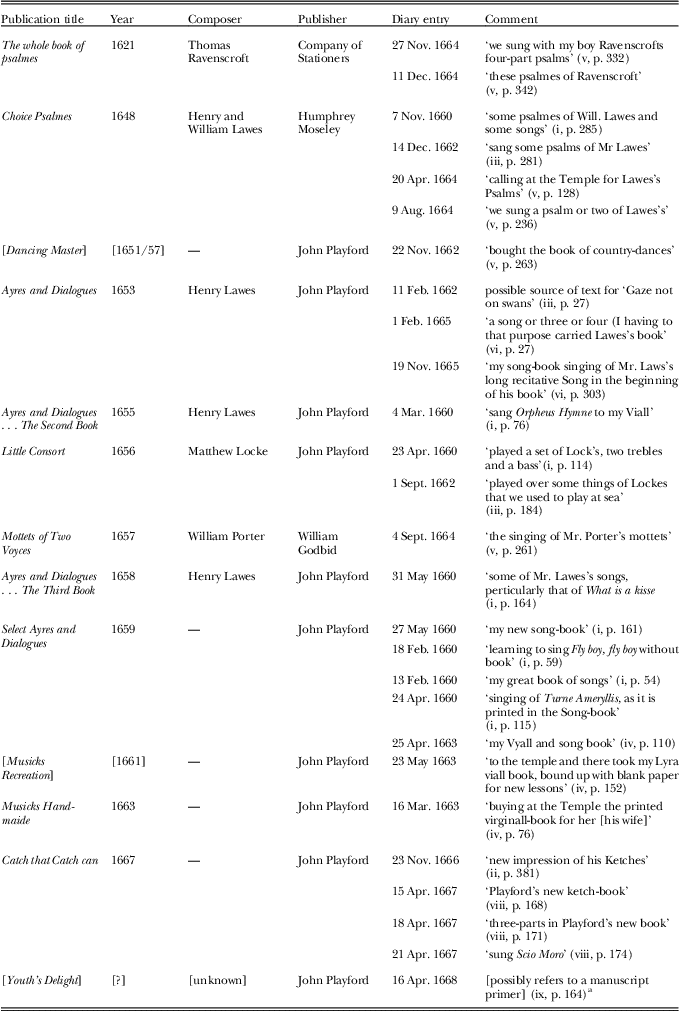
Source: The Diary of Samuel Pepys, ed. Latham and Matthews.
a S. Godman, ‘Greeting’s “Pleasant Companion for the Flagelet”’, Monthly Musical Record, 86 (1956), pp. 20–6.
PRINTED MUSIC-BOOK OWNERSHIP
Identifying individual amateurs in the sixteenth and seventeenth centuries has been severely limited by the paucity of surviving sources.Footnote 78 Few references provide information beyond a name and an instrument, and they have no guarantee of the instrument’s use; for example, one Christopher Cooke of Keverstone, Durham, is known to have owned a ‘great pair of virginals’, but no other information survives of his musical activities.Footnote 79 References to the ownership of music manuscripts or printed books are even more scarce. Pepys refers to ‘some very good song=bookes’ in the collection of Mr Davis, a navy office clerk and the storekeeper at Deptford – our only known reference to Mr Davis owning music books, and containing no indication of what music he owned or whether he used the books.Footnote 80 However, an examination of a selection of surviving printed sources brings to light new information about contemporary ownership of printed music books in late seventeenth-century England, which can aid our understanding of the types of consumers that formed Playford’s market as well as hinting at the reception and dissemination of musical texts across geographical and social boundaries.
Study of the evidence identifying the provenance of printed music texts has been largely overlooked until recently, despite the abundance of book-history research exploring marginalia and readership, undoubtedly due to the infrequent presence of annotations and marks of ownership in extant copies.Footnote 81 Marginalia allow us to explore how a printed book is a ‘carrier of relationships’,Footnote 82 catching glimpses of individuals and tracing relationships between friends and patrons, booksellers and customers, professional and amateur musicians.
My survey of English music publications produced between 1650 and 1700 included the examination of 275 surviving copies of printed music books,Footnote 83 and revealed only sixty-two sources containing annotations of any sort. This is a relatively small sample to help us understand the function and use of these books by their contemporary consumers. The lack of annotations in surviving copies may suggest an absence of use but it might also indicate the loss of potentially heavily used or annotated copies partly due to modern library trends of collecting ‘neat’, clean copies. Monique Hulvey has pointed out that ‘the destruction of manuscript annotations reached its peak in the nineteenth century, when printed leaves were washed and bleached in a concerted effort to “clean” the margins of the books, and the edges were cropped as much as possible in rebinding, in order to get rid of all the “mutilating” marks’.Footnote 84 In addition, Jonathan Wainwright has highlighted that ‘music was rarely included in general library catalogues of the period (except for theoretical music books); it seems that music was regarded as “performing material” and was therefore kept separate from the main body of a library collection (possibly stored in moveable chests)’.Footnote 85 In addition, music books may have been seen in a similar light to pamphlets or sermons, which were frequently not regarded as valuable and were discarded after use or by subsequent generations of the family.
Few copies contain performance or educational annotations similar in scale to modern-day markings found regularly on equivalent musical scores. The British Library copy of A Choice Collection of Ayres for the Harpsichord or Spinet (1700) is unusual for its numerous scribblings, including ‘Excellent’ against many of the pieces, suggesting that the print may have been used as a teaching resource or an indication of the user’s fondness for the contents.Footnote 86 Surviving annotations more often than not involve corrections of misprints, implying stop-press alterations and hand-corrections either in the print shop or by people studying different copies. Examples include William King’s Poems of Mr. Cowley and Others (1668) and Henry Purcell’s Dioclesian (1691).Footnote 87 Other annotations mostly offer illegible scribbles; however, there are a handful of handwritten additions worth noting. Blank staves inserted by the printer to fill up a page after the end of a piece were sometimes used by early owners to write out ornamentation, transposed parts or additional pieces. One of the most extensive examples of such staff-notated marginalia in late seventeenth-century English printed music books is the Library of Congress copy of The Theater of Music . . . The Fourth and Last Book (1687). Here the blank staves were used to copy out a tune, presented upside down and with apparently no correlation to its surrounding printed counterparts.
Few contemporary signatures of owners or bookplates remain, and the survival of such marginalia does not necessarily guarantee identification: to whom did the initials ‘JJ’ in the Huntington Library copy of Comes Amoris . . . The Fifth Book (1694) belong, for example? Many of the music books that have survived are copies originally in the libraries of book collectors and antiquaries, and the absence of annotations in these copies is hardly surprising as they may have been primarily purchased as a status symbol or for interest, study and collection rather than performance. They should therefore be looked at with caution as they tend to emphasise a certain type of owner – the practising musician and highly educated amateur – and are consequently not representative of typical household music collections. Furthermore, the only printed music book produced by subscription during this period for which a subscription list survives is not a typical music book: 300 subscribers are registered in the preface of Thomas Mace’s academic publication Musick’s Monument (1676), with almost half of these subscribers connected to Mace’s institution, the University of Cambridge.Footnote 88
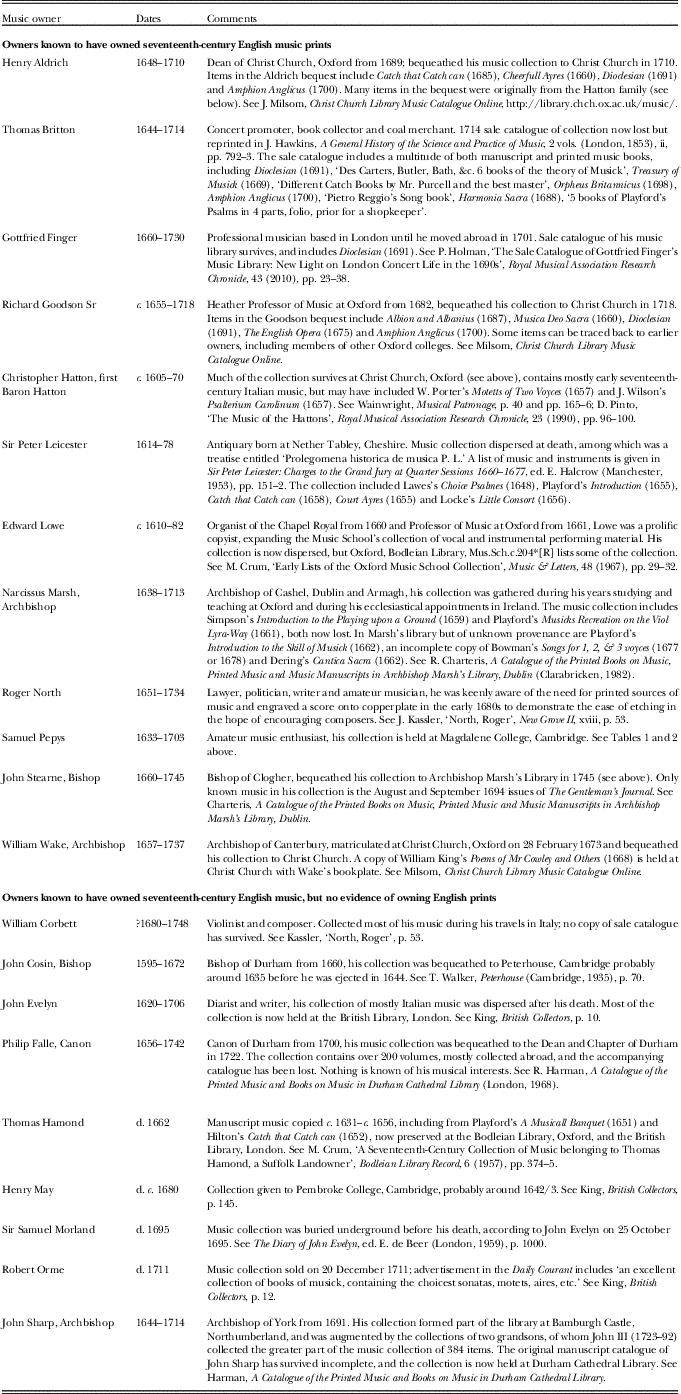
Interest in antiquarian material by music collectors often dates from the late 1640s, when many were excluded from other responsibilities due to the tumult of the Civil Wars and abandonment of the Court. The only survey of music collectors from the seventeenth century is Alec Hyatt King’s 1963 list of Some British Collectors of Music c. 1600–1900. The inventory listed in Tables 3 and 4, the details of which have been compiled from various sources including the books themselves, serves as an addition to King’s research and acts as an initial record of provenance marks in surviving seventeenth-century English music publications upon which future research can build. Table 3 lists known music owners in England in the seventeenth century, most of whom were professional musicians, highly educated amateurs of an elite social class, and academics: King states that ‘collectors of this period were to be found not solely in academic circles, but also among the country gentlemen’.Footnote 89 Thomas Hamond and Robert Orme fall into this latter category, but their ownership of printed sources, as opposed to manuscripts, is undocumented. The amateur ‘small-coal’ musician Thomas Britton is a rare example of a ‘common tradesman skilled in the arts and . . . an antiquary armed with a first-rate library’,Footnote 90 undoubtedly the primary source of material for his concert series. A copy of John Playford’s Dancing Master (1665) was owned by the parish of Warnham in West Sussex, but we have no details of when the book was obtained or why,Footnote 91 although dancing was a popular form of entertainment for a country parish community in early modern England.Footnote 92
Known seventeenth-century owners of English printed music books
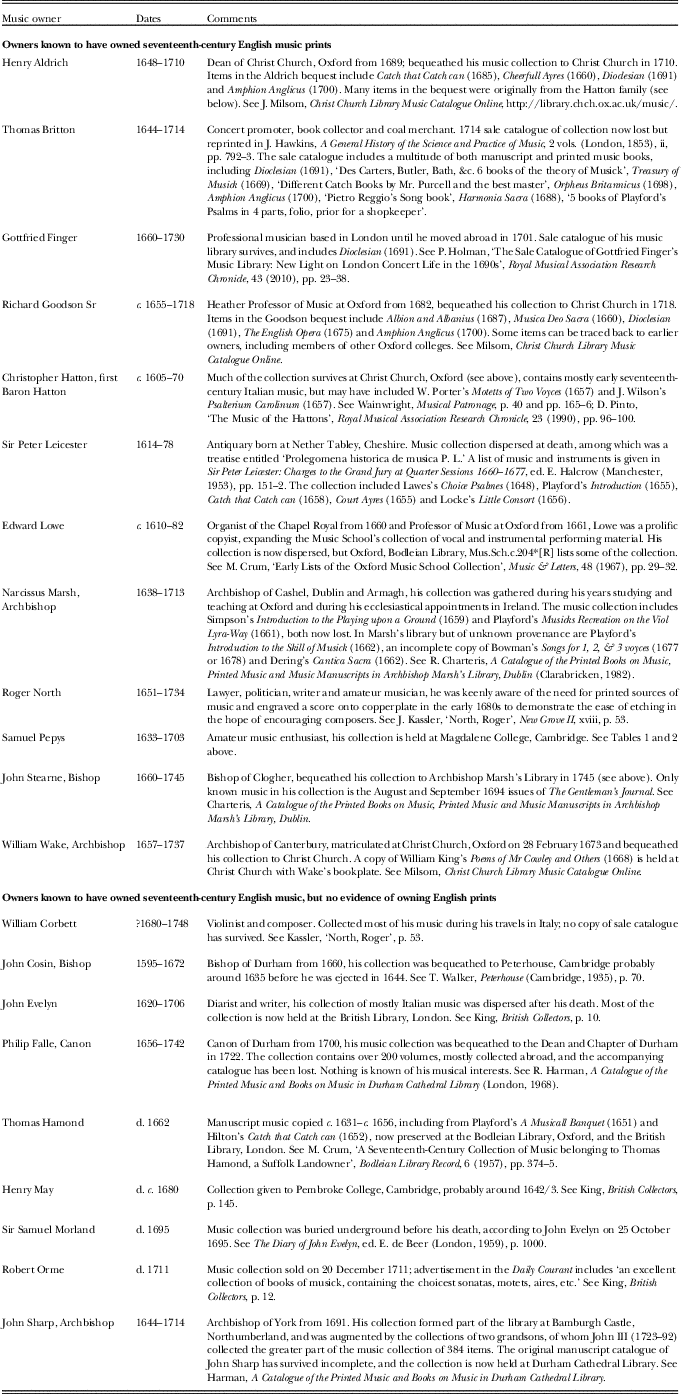
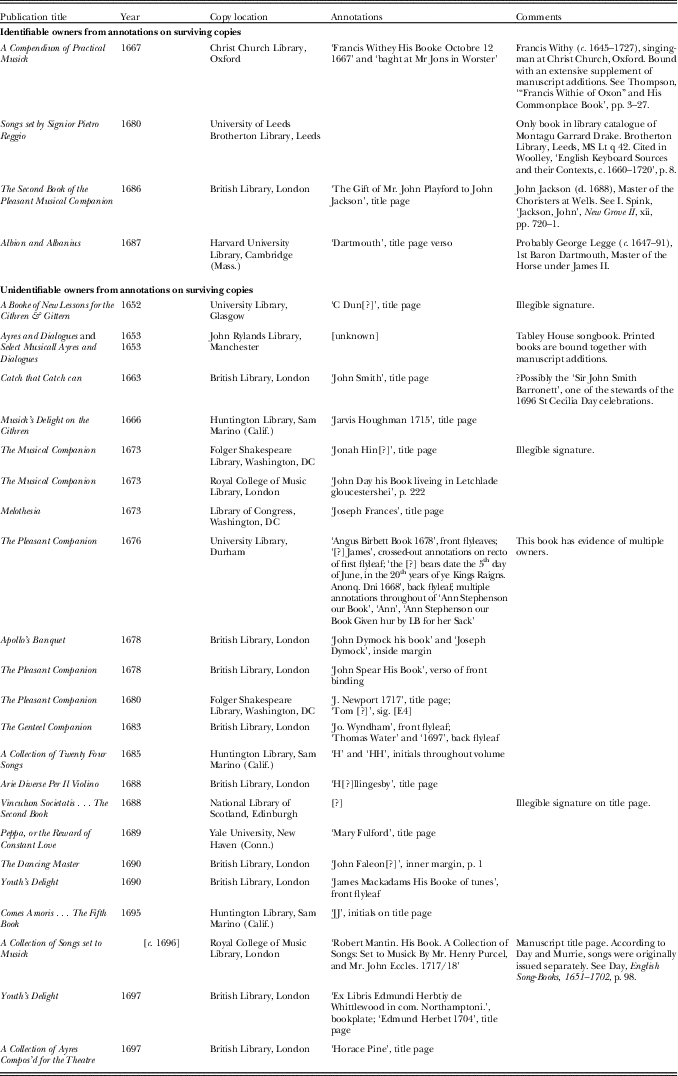
Marks of ownership on examined copies of English printed music books
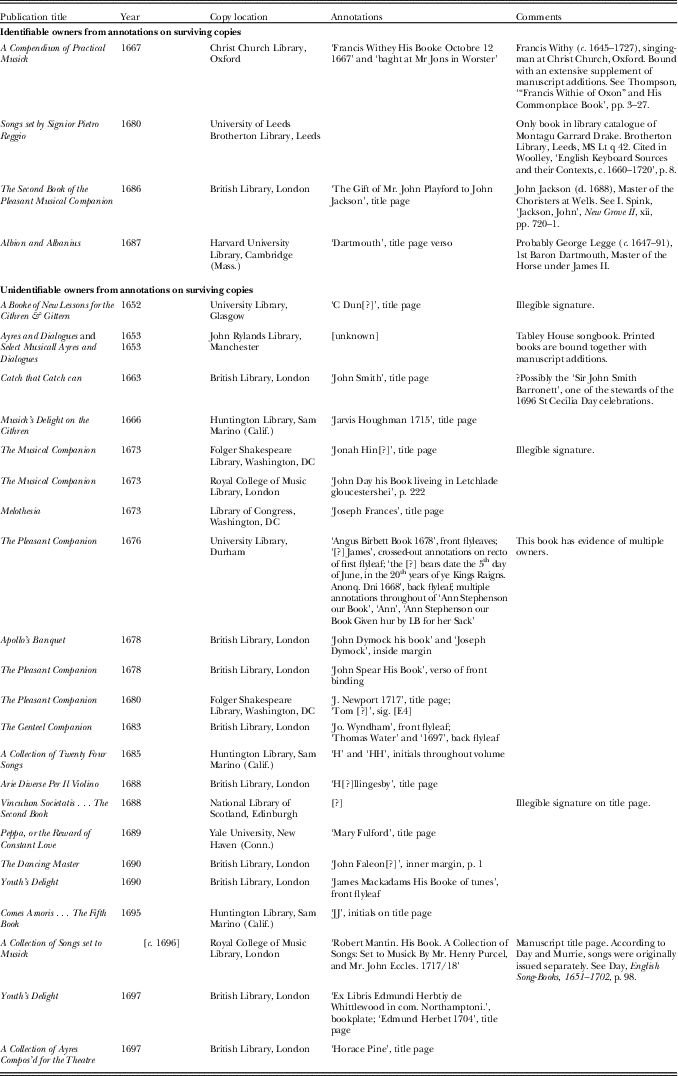
Table 4 lists both identified and unidentified owners of copies of printed music books examined. This list is dominated by owners about whom nothing is currently known, but the small quantity of identifiable owners provides much evidence concerning contemporary music book ownership. The copy belonging to John Jackson (d. 1689) of The Second Book of the Pleasant Musical Companion (1686), given to the organist at Wells Cathedral as a gift from John Playford, for example, suggests Jackson may have been involved somehow in the preparation of the volume. Francis Withy’s possession of Christopher Simpson’s A Compendium of Practical Musick (1667) bound with his commonplace book clearly indicates the use by the Oxford-based musician, himself a string player and composer of sets of divisions for solo bass viol.Footnote 93 Withy’s copy of Simpson’s Compendium includes the inscription ‘Francis Withey His Booke Octobre 12 1667’ and ‘baght at Mr Jons in Worster’.Footnote 94 In contrast, Baron Dartmouth’s possession of a copy of Louis Grabu’s Albion and Albanius (1687) is undoubtedly due to his political connections to both Charles II and James II. The lack of any practical purpose for the book – a large folio, one-volume, full score of the opera – coupled with no evidence of Dartmouth’s interest or even literacy in music, suggests that ownership of the opera score was more likely a political move than a musical one, showing allegiance and support for royalty and the cultural sphere surrounding it.Footnote 95
The list of currently unidentifiable owners includes those whose background is obscure due to indecipherable annotations or an absence of clear provenance: it is unknown who was the initial owner of the Tabley House songbook, for example. Insufficient evidence for the ownership of the British Library copy of Catch that Catch can (1663) means it is impossible to determine the correct John Smith. It is possible that the book belonged to ‘Sir John Smith Barronett’, who was one of the stewards of the 1696 St Cecilia Day celebrations, and whose signature survives on a ticket for the event.Footnote 96 However, Table 4 does shed light on a number of issues concerning book ownership in seventeenth-century England. First, it is important to note multiple ownership of a single copy. Examples include at least two owners of the British Library’s The Genteel Companion (1686) and three of Durham University Library’s copy of The Pleasant Companion (1676), two of which provide dates, of 1668 and 1678 respectively, and show evidence of both male and female ownership. In addition, the time span between initial publication date and the dated signature can be large, such as the Huntington Library’s Musick’s Delight on the Cithren, published in 1666 and annotated ‘Jarvis Houghman 1715’, also implying multiple ownership. The absence of additional provenance markings makes it unclear how many people owned this book prior to Houghman. Secondly, the combination of these unidentifiable music-book owners with the prevalence of beginner instrumental music lessons and song anthologies listed in Table 4 may provide a representative sample of the less musically educated amateur of the ‘middling sort’, with both male and female owners represented, and evidence of the dissemination of printed music books outside London. The Royal College of Music’s copy of The Musical Companion (1673) contains the inscription ‘John Day his Book liveing in Letchlade gloucestershei’, and the British Library copy of Youth’s Delight (1697) was the property of ‘Edmundi Herbtiy de Whittlewood in com. Northamptoni’. Table 4 provides the beginnings of reconstructing the fragmented evidence of early music book ownership in seventeenth-century England.
CONCLUSIONS
This article provides an expansion of the scholarship undertaken by Alec Hyatt King into British music collectors. The survey of printed music books in this study is not completely comprehensive but is intended as a snapshot of the untapped source of the books themselves. Music books were clearly owned by consumers from a range of socio-economic backgrounds, from a village parish council in West Sussex, for example, to members of the aristocracy. Books could have multiple owners, pass between men and women, and be acquired long after their original date of printing, either directly from composer, publisher or bookseller, or through donation, exchange of libraries, or personal family and friend networks.Footnote 97 In parallel with the well-known informal system that existed for manuscript exchange between musicians,Footnote 98 amateur musicians may have loaned and borrowed printed music books for performance or educational functions or for scribal copying into their commonplace books. This survey clearly highlights the dissemination of Playford’s printed music books to contemporary audiences beyond London, as far as Gloucestershire, Worcestershire and Northamptonshire. To what extent Playford’s printed music books pervaded English musical culture is a difficult question that has yet to be answered. Certainly the evidence of consumers in this study suggests that most levels of musically literate society were affected by Playford’s trade, which, coupled with scholarship in contemporary manuscript transmission, suggests a dissemination of Playford’s books across England and probably even into Scotland. The Henry Atkinson manuscript, dated 1694/5, for example, is a repository of tunes compiled in Northumberland, some of the contents of which are believed to have been copied from at least one Playford printed source.Footnote 99 The printed music market of late seventeenth-century England thus had a geographically wide circulation beyond the confines of the metropolis, with a range of distribution networks including regional booksellers, teachers, agents, family members and friends. This market must have had an important impact upon the musical literacy and transmission of musical texts across a broad spectrum of individuals, groups and institutions on a national scale.