

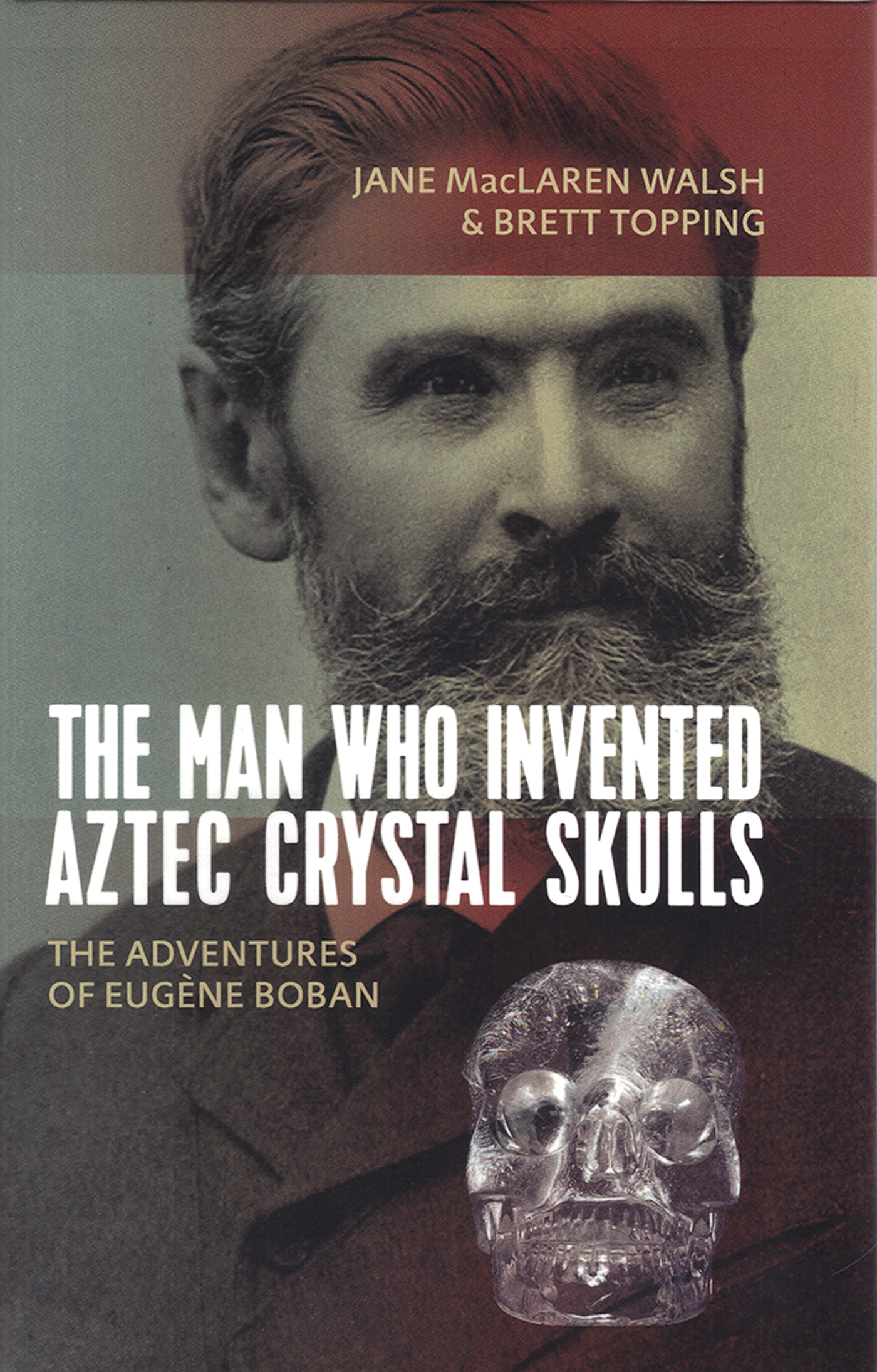
There is a good chance that any popular book, website or television programme about ‘mysteries’ will feature a crystal skull associated with one part of the hallowed trinity of Aztecs, Atlanteans or aliens. Jane MacLaren Walsh and Brett Topping demonstrate that ‘mysteries’ can be solved, if one is willing to put in the effort. The crystal skulls have occupied the hidden space between sensational museum object and rumoured hoax. The work of Walsh and Topping and others, detailed in the book, puts the ‘mystery’ to bed. As the title suggests, The man who invented Aztec crystal skulls: the adventures of Eugène Boban is both a biography and an investigation into the quartz curiosities that have illegitimately become some of the most recognisable artefacts associated with Mesoamerica. The latter aspect provides a stunning insight that I will not spoil here, but brought a smile to my face as I realised the case the authors had been laying out in previous chapters. This solution to the mystery of the crystal skulls is only revealed because of the deep research into the life and activities of Eugène Boban (1834–1908), alternately the purveyor of bogus Aztec crystal skulls and an important expert collector and scholar of Mesoamerican archaeology and codices.
In tracking the crystal skulls through Boban's life, Walsh and Topping describe the origins of Mexican archaeology. Prior to the professionalisation of archaeology, the past was largely left to elite gentlemen of means. Boban's family in France had a background in the creation of fine objects for the wealthy, arguably the same profession he followed as a purveyor of real Mexican artefacts, human remains and other questionable curios. Walsh and Topping go into extensive detail on the social and historical context of the disasters Boban had a knack for encountering. Many of them were the result of the Second French Empire (Boban became known as “the Emperor's antiquarian”, pp. 62–63), its ill-fated attempt at controlling Mexico, and the subsequent collapse of the Empire and the siege of Paris. Boban's life outside of his antiquarian work is not well documented, and Walsh and Topping strive to piece together his personal life (we do not even know the names of his first two wives).
Some of these biographical chapters at times feel like they are tangential to Mexican antiquarianism, but they establish Boban's financial and professional strategies and challenges. These are necessary for building the main thesis of the volume, that Boban was not primarily a charlatan, but an untrained enthusiast of science and anthropology who, through substantial study and field experience, legitimately earned his role as an authority on Mesoamerican archaeology. Boban sold some fraudulent artefacts and sometimes created sensational provenances for some objects (although as demonstrated in the book, in at least one case, Boban's alleged mythmaking was probably accurate), but most of his work involved dealing in and displaying real archaeological and ethnographic materials. In his later years he spent considerable effort educating the public about fakes, including the crystal skulls that he had invented. Walsh and Topping lay out an implicit case that Boban's dealing in fakes was a relic of his early and less financially successful years, which he dropped as his reputation and bank account grew. Most of Boban's falsehoods come across as human and situational, be it misrepresenting artefacts for sale on occasion or habitually falsifying his age. Boban's attempt to create a Museo Cientifico that would serve as salon, museum, school, gallery and shop may seem foreign today, but is in keeping with the Wild West nature of pre-professional archaeology. Boban's niche as an artefact collector and vendor in Mexico City would later be filled in the 1910s and 1920s by the gallery and museum of geologist, excavator and contributor to the creation of the Lost Continent of Mu, William Niven. Such activities only decline with the development of a professional archaeology beginning with Manuel Gamio. Walsh and Topping also argue that Boban, along with William Henry Holmes of the Smithsonian, invented the analysis of Mesoamerican forgeries, in part by suggesting that the other major work from this time, by Leopoldo Batres, is plagiarised.
The crystal skulls themselves are dealt with at the beginning of the book with both material analysis and historical records, making it clear that the first wave of skulls date to the 30 years of Boban's commercial activities (1860–1890). The account of three crystal skulls and a Mixtec goblet being assembled from different museums to be analysed in the Department of Scientific Research at the British Museum has the theatrical drama of a movie. In the latter half of the book, the context of their creation is revisited with detailed detective work placing them in Boban's shop and among his clients. The epilogue, on crystal skulls since Boban, explores how additional skulls were modelled on those first sold by Boban, and how despite specific research on the skulls and broader understanding of Mesoamerican archaeology, their modern legend has only grown in intricacy and popularity. Ultimately, Walsh and Topping paint Eugène Boban as a knowledgeable scholar of Mexican antiquities, skilled enough to bring real knowledge to a scholarly community that was only beginning to grapple with the complex yet alien (in the metaphorical sense) world of the Americas; the same scholarly community that he was quite capable of fooling with his forgeries. Walsh is surprised at how many of the world's top museums worked with Boban, a pattern that would continue well into the twentieth century with major museums supporting the expeditions of the likes of F.A. Mitchell-Hedges while ignoring his sometimes fraudulent grandstanding about Atlantis and death-defying adventure. Given the participation of credentialed professionals and major institutions in questionable twenty-first-century television and media presentations of ‘ancient mysteries’, we have not really come that far. Walsh and Topping's investigation is detailed, thorough, readable and the final word on one of the popular icons of archaeology.


