Johannes von Soest (also referred to as Steinwart or Steinwert) was a German singer, composer and poet. He is the author of a vernacular autobiography in couplets which is not only one of the few examples of late medieval German autobiography but also one of the very few surviving autobiographical documents written by a musician in this period.Footnote 1 The only extant source of the text was a manuscript in the Frankfurt municipal archive destroyed during the Second World War; a transcription by Johann Carl von Fichard based on this manuscript had been published, however, in 1811 in the Frankfurtisches Archiv für ältere deutsche Literatur und Geschichte,Footnote 2 and is reprinted below in the Appendix.
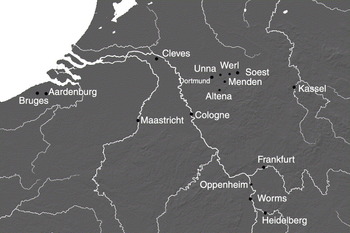
Born in Unna, Westphalia (near Dortmund), in 1448, Johannes von Soest was first trained as a chorister in Soest and briefly kidnapped by a wandering minstrel on account of his beautiful voice. Later he joined the ducal chapel in Cleves, where he became acquainted with two English musicians; he admired their music so deeply that he followed them to Bruges. Subsequently he held posts at Aardenberg (Zeeland), Maastricht, possibly Cologne, and Kassel. In 1472 Soest went to the court in Heidelberg, where he was appointed Sängermeister for life. In 1476 he matriculated at the University of Heidelberg; he studied there and in Pavia, becoming a physician by 1490. In 1495 he became a municipal doctor in Worms and later held similar positions in Oppenheim and Frankfurt a.M., where he died in 1506. (For a map showing these locations, see Figure 1.) Johannes narrates these periods of his life in considerable detail in his autobiography, describing his motivations in broad strokes and constantly lamenting the moral precariousness of particular actions and decisions (often lending the text the atmosphere of a confessional text). Unfortunately, the text does not survive intact: the section detailing his period as Kapellmeister in Heidelberg was not preserved in the unique manuscript source.
Places connected with Johannes von Soest

Scholars of Renaissance music have studied the text only in passing. Besides short mentions in lexica and general histories,Footnote 3 references to him are primarily found in studies on the places where he worked.Footnote 4 This is primarily, one imagines, because his compositions and works of music theory, although well attested, are not known to have survived.Footnote 5 Rudolph Agricola refers to Soest's nine- and twelve-voice compositions in his letter to Jacques BarbireauFootnote 6 and Soest himself writes of a now-lost music treatise De musica subalterna, which Sebastian Virdung also knew and which inspired his illustrated section on musical instruments in the Musica getutscht.Footnote 7
The great majority of Johannes von Soest's literary works have survived, however, and have been examined by literary critics.Footnote 8 While the literary merits of the autobiography have not yet been studied in any great depth,Footnote 9 scholars of literature have thus far judged von Soest as a ‘literary dilettante’,Footnote 10 ‘occasional Author’ or court-author,Footnote 11 whose text remains throughout ‘confined to conventional patterns’.Footnote 12 Nevertheless, the text translated here can be judged as a ‘mix between courtly and bourgeois biography’Footnote 13 which stands as a significant contribution to the genre of autobiography in the fifteenth century. Although Johannes's motives for his incredible mobility were far more practical, not to say prosaic, his account of widespread travel recalls some of the elements of The Book of Margery Kempe, the early fifteenth-century autobiography by a pious Englishwoman of a prosperous merchant family from Lynn, East Anglia.Footnote 14 The insight his text gives into the life of a professional has little parallel in the period – Thomas Hoccleve's autobiographical poems ‘My compleinte’ and ‘A dialoge’ are perhaps the only roughly contemporaneous text that offers as much detail on the relationship between work and art in the late Middle Ages (although in the sixteenth century Benvenuto Cellini will, of course, take this type of investigation to new heights).Footnote 15 Perhaps most engaging, however, is the account of the relationship between Johannes and his employers and patrons, especially the Duke of Cleves and the Margrave of Kassel – the language used by both is exceedingly personal and emotional, the patrons themselves demonstrating what appear to be ties of friendship with Johannes, in addition to the expectation of service.Footnote 16
Johannes von Soest hailed from Westphalia, an economically emerging region in the middle of the fifteenth century owing to income from salt mining. His birthplace Unna, like the other towns of his youth (Werl, Menden and Soest) was in a disputed region which was experiencing the effects of the expansionist efforts of the Archbishopric of Cologne and which sought to align itself during this period with the Duke of Cleves. The high point of the so-called ‘Feud of Soest’ took place in the author's birth year, 1448, in which the town, supported by Duke Johann I of Cleves, attempted to assert its liberties against the Cologne Archbishop Dietrich von Moers.
Some remarks concerning chronology would be appropriate before contextualising the professional posts Soest describes in his autobiography. The only clearly defined dates are his birth year (1448), his matriculation in the Saint Patroclus collegiate school at the age of nine, and the death of Duke Ludwig II of Hessen on 8 November 1471 (one piece of evidence among others for Soest's two-year employment at the chapel at Kassel). His education in Soest, his time at the court of Cleves, the year of education in Bruges – as well as the other positions in Aardenburg, Maastricht (Liebfrauen) and Cologne (St Gereon) – took place within the span of eleven years; however, the duration of residence in these towns, with the exception of Bruges, cannot be precisely determined. We can suppose, however, that he lived in Soest and Cleves for a longer period of time and that only after this period a certain acceleration of his mobility began. Because of his rather casual mention of Cologne, it seems likely that this stay served merely as a brief waypoint for him. In any event, it is certain that by the time of his appointment as Heidelberg Kapellmeister in 1472, which was granted despite his young age of twenty-four, he was well known as an experienced musician.
Johannes stresses at the opening of his text with considerable emphasis that he was born legitimately from the marriage of the stonemason Rotcher Grumelkut and Wendel Husselin; underlining the legitimacy of his parentage doubtless indicates its importance as a significant prerequisite for further career advancement. The most decisive moment of his childhood was the family's relocation to Soest following the early death of his father and his mother's subsequent remarriage. In this economic and cultural centre Johannes's voice could be ‘discovered’ and quickly nurtured. The school of the St Patroclus collegiate church in Soest possessed a tradition stretching back to the twelfth century and appears, on the basis of its financial wealth, to have supported music of a fairly high standard, even though concrete evidence of musical practice at the college chapel does not survive.Footnote 17 Judging from Johannes's later enthusiasm about the polyphonic singing at the court of Cleves and by the two English musicians, it seems exceedingly likely that only monophony was practised in Soest.Footnote 18
Shortly thereafter Johannes was abducted by a wandering minstrel who promised him an education and a successful career, and his readiness to get involved with this ‘minstrelsy’ certainly was abetted by the instability and financial uncertainty of his childhood. This incident reflects the widespread problems with wandering musicians of the Middle Ages as well as the fascination their considerable skills generatedFootnote 19 – and the promise to make Johannes a gentleman, in the light of the comprehensive sphere of capabilities and good connections of many minstrels, is not as unrealistic as it may appear at first glance. The shock of an instance of child abduction and the harsh countermeasures that were taken against such crimes is also evident in the prompt action of the Soest authorities, who quickly sent soldiers to rescue the child.
Soest's location itself aided Johannes's subsequent career path. Since his successful engagement in the Feud of Soest, Johann I of Cleves (1419–81) encouraged strong connections to the town; this led him to make several visits and moved him to following military engagements during the Second Feud of Soest (1462/3). It is not surprising that the nephew of Philip the Good (educated, as he was, at the Burgundian court in Brussels) had an eye on the choristers at St Patroclus, as he had strived since his accession in 1448 to establish court music of a high standard. At the latest in 1455 (on the occasion of his wedding) a permanent court chapel must already have been in place.Footnote 20 Liturgical polyphony was counted a core responsibility, according to the accounts of contemporaries: for example, the chapel performed the festal Masses at an annual procession on St Victor's day in Xanten in which six-voice polyphony was conducted by an organist (‘Our Johannes’).Footnote 21 The chapel structure roughly followed the example of the Burgundian court (which Johann could have learnt during his childhood in Brussels):Footnote 22 accounts from the 1460s and 1470s and following record the chapel staff as consisting of three chaplains and six other singers, at least half of them children, to whom nine further children could be added for special events.Footnote 23 These would come from the students of the Cleves collegiate school (founded in 1334). The special role that these schools played in musical education is reflected in the endowment of six prebendaries for young choristers in 1431, the allocation of which was tied to prominent musical competence.Footnote 24 Whether Johannes von Soest was awarded one of the prebendaries during his time at the court in Cleves is not known, but the narrative allows no doubt that he attended the collegiate school there.
Johannes's departure from Soest to Cleves, a distance of approximately 180 kilometres, indicates a definitive vocational choice; this in turn is reflected in the long episode detailing the reluctance of Johannes's mother to allow her last surviving son to leave. Career prospects were the central motivation, as is clearly expressed in hindsight: it is the declaration of the duke to make a gentleman out of Johannes that immediately persuades him. When he arrived at court, however, the youth was overwhelmed by the skills of the ducal singers. His description of their music as ‘angelic song’ (‘engelscher gesanck’) – a reaction attested in other contemporaneous iconographic and descriptive sources – offers an example of the perception of polyphony not only by a broader non-professional audience, but also by the trained musician Johannes had become when he wrote his autobiography, recalling his first impressions in retrospect.
His description of the further education he received at the court of Cleves sketches the normal curriculum of a choirboy in just a few words, just as Adriano Petit Coclico nearly a hundred years later would describe as a typical sequence for his ostensible teacher Josquin des Prez:Footnote 25 first solmisation (‘kunstlich kont solnysyrn’), followed by improvised counterpoint (‘auch contrapunckt kont iubylyrn’) and composition. After this came embellishing techniques like diminution, which Johannes later calls the crowning of the art of song; but it appears it was not a part of the core curriculum. This musical education itself was embedded within the study of the liberal arts. Johannes's apparent aptitude helped him to obtain certain privileges at the court; his quick involvement in teaching also serves to underscore his skills. Therefore the arrogance and self-contentment to which he soon tended is not particularly surprising; that he classifies this attitude as sinful in retrospect demonstrates the character of a ‘confession’, which the autobiography often adopts; on the other hand, it clarifies the remorse he experienced as a result of the changed attitude towards art which developed over the course of his career.
The visit of two English musicians to Cleves was a decisive turning point in Johannes's life. The impression their arts of singing imparted must have been formidable – it even led to a spontaneous sense of inferiority – such that the singers' offer to teach him in Bruges must have been exceedingly enticing (not to mention flattering). Accordingly, he was ready to give up his secure place at the court in Cleves and even risk irritating his employer and patron. In Bruges he learnt from the two musicians, above all, the arts of improvisation (‘contreyn und fauberdon’) as well as a deeper understanding of the relationships of note values (‘proporcion vil mancherhant’) – that is to say, aspects of musical practice for which transmission in school using educational treatises was largely ineffective and which could only be learnt through intensive practical education by well-trained specialists.Footnote 26
It is not possible to identify the two musicians with certainty. Reinhard Strohm makes the plausible suggestion that they could have been connected to the Carmelite convent of Bruges. Traditionally the Carmelites in Bruges kept the closest connections to the English merchant community in the city and provided high-level musical institutions, in part imported from England.Footnote 27 Very likely the English Carmelite John Hothby, active in Lucca from 1467, spent some time at the beginning of the 1460s in the Carmelite convent of Bruges.Footnote 28
Interestingly, in contrast to his abduction by the minstrel and the invitation of the Duke of Cleves, there is no discussion of pecuniary prospects which might have tipped the scales in favour of the decision to follow the Englishmen. On the contrary, Johannes dismisses the financial promise of the Duke in the case of his remaining at court straightforwardly with the reasoning that any riches that could be offered mean less to him than ‘being full of art’ (‘als konstrich syn’), and in connection with his completed studies in Bruges he indicates ‘art was dearer to me than all the favour of a duke’ (‘vil me lyb hatt ich zu konst / Merck dan zw aller fursten gonst’). This emphatic consciousness of an inner call to music under the influence of the English singers is astonishing and unique, offering, as it does, an insight into an otherwise barely imaginable dimension of the individual artistic self-consciousness of a professional musician of the fifteenth century. That it was English musicians is perhaps not so surprising given the well-established influence of English music on the Continent in the fifteenth century. Yet the impact of the two individuals on the young musician demonstrates the often complicated polyvalences of the transfer of musical culture, which has not only stylistic and technical elements but also aesthetic and identity-forming dimensions.
More difficult to interpret, on the other hand, is Duke Johann's strict refusal of Johannes's request for permission to spend a year furthering his education elsewhere, which does not seem an especially inappropriate request from a patron's point of view. The Duke provides a rather lapidary dismissal of the yearning for vocational growth (‘You have just enough art for me’; ‘Konst hastu glich genog fur mich’) and does not let himself be persuaded by the persistently repeated requests. Perhaps personal affection was involved. Another possible explanation could be that as a result of this supplemental education Johannes would have become overqualified for a simple post as chapel-singer, and his already established condescension towards the Kapellmeister would have been furthered and the potential for conflict within the chapel would have increased. That Johannes von Soest later does return can be interpreted as a proof of loyalty, but as Johann I was not present at court at that time the Duke's ultimate reaction can only be imagined. The friendly reception Johannes received at the court, at any rate, shows that he had not fallen out of favour entirely.Footnote 29
Before this trip to Cleves, Johannes von Soest had gone to Aardenburg and obtained a position in the Church of St Mary there.Footnote 30 From Cleves he went to Maastricht, where he gained the post of Succentor at the Church of Our Lady. Insofar as no documentation about personnel survives for this church – after St Servatius, the most important collegiate church in the city – the prestigious appointment of a well-educated musician such as Johannes von Soest is of certain interest per se: but it also confirms the sparse but clear signs of a rooted practice of liturgical polyphony.Footnote 31 In Maastricht Johannes experienced another life-change in which he, in retrospect, regrets the viciousness of musicians – a complaint he shared with Erasmus von Rotterdam, among other contemporaries.Footnote 32 It is especially interesting, however, that in Maastricht Johannes came up with the idea to make his way to Rome in order to gain admission to the papal chapel. Given the strong presence of Franco-Flemish musicians in Rome during this period,Footnote 33 it is possible that this was generally a fairly straightforward option. At any rate the nearly contemporaneous departure of the young, musically educated Maastricht humanist Matthias Herbenus (1451–1538), who in the year 1469 left for Rome at the suggestion of the papal nuncio Onofrio de Santa Croce, stands out as especially noteworthy.Footnote 34
At any rate, Johannes only reached Cologne, where he met Hermann IV of Hesse (later to be Archbishop of Cologne), about whom he writes that he was the ‘probst zu sant gerion’ and had ‘wanted to have him’ (‘wolt mich hon’). From this phrasing it is not clear whether Hermann called the gifted musician to him only as an intermediary in order to send him to his brother the Hessian Landgrave Ludwig II (‘Der Freimütige’) or whether he wanted to have him as a singer at St Gereon and perhaps employed him there briefly. Insofar as no personnel records survive from St Gereon in the fifteenth century, nearly nothing can be said about the musical institutions of the church, nor the possibility of Johannes's having been installed there.Footnote 35 At any rate, Hermann was definitely the Dean (not the Provost, as Johannes writes) of the venerable St Gereon's – a church reserved for members of the aristocracy – and was required to reside there as part of his position,Footnote 36 so that Johannes's overall description of the meeting seems trustworthy.
Through the intermediary of Hermann, Johannes von Soest went to the court of Ludwig II in Kassel, probably in the year 1469.Footnote 37 We can only speculate that one of the intentions of the appointment could have been the construction of a choir chapel (which is unfortunately not mentioned in the discussion of the range of duties of the post) based on a remarkable conflict that flared up between the Landgrave and the city of Cologne. It concerned a choirboy Johannes von Soest very likely knew during his time in Cologne; he now tried to take this youth with him to his new workplace.Footnote 38 The boy in question had just been employed in the private chantry chapel of the Cologne Burgher Johann Hardenrath. Landgrave Ludwig addressed the Cologne council with the request that they allow this talented youth to be released from his duties. After some back and forth the council refused the request, justifying their decision by claiming that the boy did not want to leave his parents. The case gives us clear evidence that the Landgrave was in the process of building a chapel, and additionally shines a revealing light on the fundamentally different character of urban and courtly musical institutions: the Landgrave sees the erection of a choir chapel an obvious princely privilege and believes he may request the civic chapel to surrender a singer without further justification. In this case Hardenrath and the council are not fundamentally against this notion, but rather argue in terms of an imperial citizen's individual rights of free will. Provided the conflict was indeed precipitated by Johannes von Soest, his willingness to operate in accordance with such a courtly logic must be noted – especially considering that in his childhood he himself had experienced the questionable dimensions of the commerce of choirboys as ‘human capital’. Clearly these efforts to build a choir chapel in Kassel were disrupted by the sudden death of the thirty-three-year-old Landgrave: his five-year-old son Wilhelm I assumed the official functions only in 1483, during which time his uncle and regent Heinrich III of Oberhessen ruled from his own court in Marburg.
How the move to the Heidelberg court chapel and the life appointment as Kapellmeister came about is not known and is not discussed in the autobiography, even though there is about a gap of about a year between the death of the Landgrave of Kassel and the date of the instrument of appointment. In retrospect it doubtlessly was considered a career leap, but it appears that Johannes von Soest would have preferred to stay in Kassel under Ludwig II (‘Hett lantgraff Lodwyg blyben leben / Zu Cassel wer ich blyben kleben’). It is known from other sources that he was intended to fulfil the same duties that he probably had in Kassel: as Sabine Žak plausibly demonstrates, the establishment of a Sängerei at Heidelberg could not have taken place before the year of Johannes's entry into service in 1472. In this context the new Kapellmeister immediately formulated a rule for the chapel to run its subsequent artistic establishment.Footnote 39 The establishment of the chapel was by no means a ‘normal’ procedure, and in the context of the other courts of the Holy Roman Empire Heidelberg stands rather alone at this point (the Cleves chapel too, which Johannes had belonged to, proved to be an episode which came to an end with the death of Johann I). Sabine Žak points to the reservations that clearly existed about the singers and bases this on Johannes von Soest's own defence of the court chapel that he interlaced in his translation of the Dutch verse-epic Die Kinder von Limburg. The critique appears here against the notion that the singers' greatest importance comes from the praise of God and that they simultaneously contribute to the physical well-being of their audience through the euphony of their singing.Footnote 40 This defence corresponds with the later explanations of Kaiser Maximilian in Weißkunig of his motives for the erection of an imperial court chapel.Footnote 41
The remaining surviving sections of the autobiography are without particular interest for music history and will be represented in the following translation by only one passage which describes his new orientation after the death of his first wife. Although at this point (around 1495) Johannes von Soest had studied medicine in Heidelberg and Pavia and was already active as a physician at the court in Heidelberg, he begins thinking of becoming a priest and exerts himself in the attempt to obtain a benefice. This process can be seen in the larger context of the problems of elderly singers in the Renaissance: perhaps because of health reasons or the decline of his voice in old age Johannes was hindered in actively pursuing the career of a singer. This was a particular concern of unmarried musicians and the solution of a great number of singers and composers of the time was to seek a spiritual position. As these efforts failed repeatedly, Johannes instead chose the alternative he had already prepared for in Heidelberg, a medical profession, and married a second time. Unfortunately, he does not comment on his stay in Italy in the surviving parts of his autobiography. Interestingly, his son Pallas also spent ten years in Italy, and came back as a rich man while Johannes was residing in Frankfurt, but nothing is said of his son's career.
As far as can be understood from the mostly fragmentary biographical evidence of other fifteenth- and sixteenth-century musicians, Johannes von Soest's career followed a fairly typical route: the demand for boys with good voices and the often dubious recruitment tactics employed by chapel agents in the service of courts across Europe is well attested;Footnote 42 Johannes's fascination for English singers was shared by a majority of musicians on the Continent, many of whom adopted the ‘contenance angloise’ as a common stylistic model; the importance of improvised counterpoint of various sorts is broadly attested by contemporary music theory; and also not untypical is Johannes's search for benefices and the change of profession at an advanced age as the obvious consequence of the limited life span of a singer's voice. Being so typical in many respects, the importance of this testimony is evident – even if Johannes von Soest's role in music history otherwise is limited: in its singularity as an extensive self-report on an exemplary life it opens an otherwise inaccessible perspective on the personal decisions, motivations and retrospective valuations of a Renaissance musician.
The veracity of this autobiography can be ascertained from archival evidence, which testifies especially to his presence in Heidelberg, but also circumstantial evidence that makes his travel to Bruges in the company of English musicians or his presence in Cologne and Kassel highly plausible. This allows us to assign a large degree of historical trustworthiness to his text. Above all, his text demonstrates the high esteem in which church music was held in cities like Soest, Cleves, or Kassel, which, lacking other evidence, are usually considered musically unsophisticated during this period. With respect to Cleves, for example, Johannes von Soest gives a quite detailed description of his acquired skills and his tasks in the otherwise almost completely undocumented court chapel. But more detailed elements also merit scholarly interest: his remarks on the plan to join the papal chapel, or the revelation of the deeper dimensions of the art of music under the influence of the English singers, which vividly attests to the deep impact of the contenance angloise.
The text used in the Appendix is based entirely on Fichard's 1811 transcription, even though this evidently contains several substantive misreadings. Fichard mentions in a short introductory note that the manuscript which he possessed contained numerous cancellations and corrections (particularly of rhyme words), leading him to believe that it was an autograph manuscript. There is unfortunately no surviving account of his editorial methods, but the printed text we offer must be considered as a diplomatic transcription of what Fichard believed to be Johannes's definitive version.
The metre and rhyme scheme used in the translation are at times rough, the tone voluble, and the superlatives often quite hyperbolic. The reader will also no doubt notice words used almost exclusively to complete the rhyme. Even a cursory look at the source text itself, however, will reveal that it has much the same quality: Soest's verse is at times breathlessly exaggerated, at times a bit glib, and often severely self-promoting (although this in turn gives way to a conventional piety and series of long confessional addresses to God). In bringing Johannes von Soest's voice to an English-speaking audience for the first time, we have aimed to match his tone and style in English verse that gives the reader an experience similar to that which one of his contemporaries might have had.
Although this text is of greatest importance for musicologists, it is not without interest for literary historians of autobiography and memoir; we kept the possibility of classroom use in our minds as well. Footnotes with more literal translations are included in places where we thought non-German-speaking readers, particularly musicologists, might benefit from a detailed look at Soest's phrasing and terminology. It was decided early on, however, that to render the translation entirely in an exact prose version would be rather stultifying and do a great disservice both to Johannes and to the new audience of this boisterous, at turns both boastful and pious, but always exuberant account of his life and times.
APPENDIX
Johannes von Soest's Autobiography
Source: The transcription made by Johann Carl von Fichard from a manuscript in the Frankfurt municipal archive (destroyed during the Second World War), published in Frankfurtisches Archiv für ältere deutsche Literatur und Geschichte (Frankfurt a.M., 1811), 84–139. Fichard added the heading ‘Johanns von Soest eigne Lebensbeschreibung (Im Original fehlt die Ueberschrift)’.
S. 84
In ellend ich geboren byn
Blosz nacket gantz on allen gwyn
Mytt hulen weynen von anfang
Gelich al menschen durch dy banck
Doch elich byn geboren ich
Dis danck ich Got von hymelrich
Myn vatter selig stenmetz wasz
Tzu Unna in Westphalen sasz
Hyess Rotcher stenmetz Grumelkut
Mytt zunam eerlich wol behutt
Stenhawen kont er meysterlich
Bekent von allermeniglich
In Unna der stat da er sass
Eyn frommer man verromet wasz
In mossen ich nach langher tziit
Virnomen hab an Wydderstrytt
Syn tziit wasz als dy bemer laghen
Fur soest ym heer on als vertzaghen
S. 85
By bischoff Dyterich genant
Von Kollen dy tziit wol bekant
Eyn graff von Mors der selben art
Wass solcher byschoff zu der fart
Und glich dy tziit als men solt kryghen
Myn mutter wart on alles lyeghen
Vermalt mym vatter obgemelt
Und ym zu elchem wyb bestelt
Yr nam wasz Wendel hubsch und fyn
Tzu Werl geborn eyn husselyn
Genent also nach dem geschlecht
Von alter her furnem und recht
Als sy nw hatt der vatter myn
Drey iarlang hatt das frewlyn fyn
Drey son myt ym der erst was ich
Der ander wart genent Henrich
Der drytt Gerwyn der broder myn
Dy dan albeyd gestorben syn
Der eyn zu Unna ligt begraben
Henrich genant by andern knaben
Da dan auch lygt der vatter myn
Dem Got der her wol gnedig syn
S. 86
Der ander Gerwyn obgenant
Zu Soest lytt eerlich wol bekant
Alleyn ich obrig blyb dy tziit
In iamer angst und hertzeleytt
Dan nach dem ich behalten hon
Nach myner lyber mutter won
So wart ich yn dem ersten iar
In oel verbrent myn antlitz gar
Und wart myn beyden aughen blynt
Dan ich so wasz eyn kleynes kynt
Das wasz myn erste abentwr
Dy ich ontpfant fast ongehwr
Myn mutter des fast ser erschragh
Sy mych gelob den selben tag
Zum helghen das ich nyt wort blynt
So lyb mich hatt als dan yr Kynt
Dy walfart ted sy bald myt mir
Yr gutten frond gynghen myt yr
Zum helghen bys an solche statt
Da sy mych hin gelobet hatt
Dan sy yr opfer hatt gethon
Trag sy mych wydder fyn und schon
Byss yn yr hauss da sy dan sasz
Dar nach mir wart ye leng ye basz
Das rechte aug hob an zu sehn
Das lyncke aug das wolt gar vergen
Dan dy lynck sytt wasz gar verbrent
In heyssem oel fur obgenent
Susz wasz myn antzlitz gar zerstortt
Von solchem brant furobgerortt
Also teglich nam tzu am lyb
Und was mynr motter tziit vertryb
S. 87
So lang bys ich drey iar alt wart
Dan starb myn vatter from von art
Dem got genad von hymelrich
Begraben lygd er eyghentlich
Zu Unna off dem Kyrchhoff dar
By andern menschen grosse schar
O got myn her erbarm dich syn
Dan er ist ye der vatter myn
Durch den du mich host mensch gemacht
Dyn gottich gnad bytt ich betracht
Das du ons aln gebotten host
Onsern eltern komen zu trost
Dem nach bitt ich got vatter myn
Mym vatter wol barmhertzig syn
Syn sond vertzye ym gantz und gar
Und fur yn in der enghel schar
Und schaff das ich genad ontpfynd
Und mynen vatter by dyr fynd
Nach dyssem leben ewiglich
Des hylff mir Got von Hymelrich. Amen.
Als nw myn vatter wasz gestorben
Myn mutter docht sy wer vertorben
Betrubt von dan tzog sy myt myr
Gen Werle tzo in dy ryfyrFootnote *
S. 88
Von Werle ich zu Menden kam
Myt myner motter lobesam
Von Menden kam ich erst zu Sost
Da ich dan fand gut eer und trost
Dan myn mutter auch da hat frond
By welchen dan dy tziit sy wond
Da selbest wochs ich off und sang
Mytt gutter stym hel das es klang
All gassen uss war hyn ich gyng
So sang ich lutt on al gedyng
So das dy lutt des wonder nam
Eyn iglicher der zu myr kam
Der sprach zu myr. Syng lyber bub
Gelich zu singhen ich an hub
Umb sus frolich und fur da hyn
Das myr bracht gonst und guten gwyn
So das iglichs mych lyb gewan
Bekent wasz ich von yderman
Tzu schol gyng ich da frw und spett
Und flyss mych synghens altziit stett
Als ich nw so wort nun Jar alt
Eyn Korschuler wart ich bestalt
In Sant Patrockles Kyrchen dort
Da ich dan sang dy helghen wort
Fast kurtz dar nach eyn gockler kam
Tzu Soest der mich dan bald vernam
Myn stym gefyl ym ser fast wol
Heymlich kam zu myr off eyn mol
Und sprach, ich solt blyben by ym
Er wolt myr helffen durch myn stym
Ich werden solt zu eynem hern
Dar tzu wolt er mych gocklen lern
S. 89
Das myr da hertzlich wol gefyl
Don ich sag by ym sollich spyl
Er sprach ich solt verschwyghen syn
Und morghens frw by sonnen schyn
Solt fur dy pforten gen allyn
Er wolt umb dy tziit by myr syn
Den helweg uss gen Werle zu
Dy gantze nacht hat ich keyn rw
Byss ess tag wart don stond ich off
Und flugs und bald dy pfort us luff
Gen Werle zu nach mym bescheit
Der gockler auch was bald bereyt
Und kam myr nach und luff zu myr
Das dy tziiz was myn grosz begyr
Syn konst dy hett ich gern gelert
Mich ducht ich wer da durch geert
Deshalb frolich strich ich myt ym
Und sang weydlich mit guter Stym
Bys wyr von Sost eyn myle kamen
Zur Hymelpforten in das closter
Dar da in wont der nunnen koster
Und glych als wyr da selbest kamen
Gar bald wyr reysig da vernamen
Soldner von Sost, dy suchten mych
Der gogler bald lyff snelliglich
Zum closter in so ser er mocht
Dan er durch mych syn leben focht
Das er mich hett von Soest gefort
Da selbs wart ich bald uffgesport
Dy soldner kamen bald zu myr
Und namen mych gantz myt begyr
Und forten mich heym wydder umb
Sus gynghen sy in alle krumb
S. 90
Den gogler suchen hy und dort
So wasz er dy tzitt yn versportt
Dem nach so ryten sy myt myr
Und brochten mych heym myt begyr
Myn mutter da von frolich wart
Das ich so heym kam ongespart
Und wydder umb zu Kor mocht gen
Myn ampt folbrenghen solt verstehn
Kurtzlich dar nach der hertzog kam
Von Kleff der selb myn stym vernam
Und glich myn stym gefyl ym wol
Das er von stund an off das mol
Mich hollen lys in syn gemach
Und fast genedig zu myr sprach
Sag Bublyn wyltu syn by myr
Eyn hern ich machen wyl von dyr
Her ia sprach ich bald und behend
Don nam er miych glich by der hend
Und mich befal sym capellon
Den er alleyn hott by ym ston
Und sprach bald, fort mir yn eyn weg
Heymlich dos nyt werd eyn geseg
Das ich den Knaben by mir hab
By myr sol syn bys in myn grab
Laest kleyden in, versorgt yn wol
Das ist myn wil genslich fur fol
Da wart ich fro von hertzen ser
Das mych so lyb hatt solcher her
S. 91
Der capellon heymlich myt myr
Gyng, da wyr vonden bald und schyr
Gut essen drincken mancherley
Myt freuden vil on grosz geschrey
Nach essens bald heymlich zu letzt
In Kamerwaghen wart gesetzt
Also fort men mich bald eyn weg
Das myr dan was eyn grosz beheg
Mynr mutter ich genslich vergasz
Dar umb sy dan betrubet wasz
Da sy dy tziit mych hatt verlorn
Das sy dy tziit gern hett onborn
Sy hult und weynt fast bytterlich
Das macht fast ser sorgt sy fur mych
Das myr dan nyt zu schaffen gab
Ich for da hyn in strenghem trab
Byss yn eyn statt der Ham genent
Myn mutter solichs hot erkent
Und kam gelauffen da zu myr
Und wolt ich solt heym gen myt yr
Ich sprach nen lybe mutter myn
Mynthalb solt yr zu frydden syn
Myn her von Kleff wyl haben mich
Da wyl ich auch myt sicherlich
Myn mutter sich des obel hylt
Sy bald behend zum fursten ylt
Das erst das sy yn fynden kont
Zu fuss dem fursten vil zu stont
Sy weynt und sprach, genedger her
Begnadet mich in Gottes eer
Myn kynt bytt ich gybt wydder myr
Dan ist verfolt al myn begyr
S. 92
Der furst myn mutter hys offsten
Und solt bass neher zu ym gen
Als sy dan thed sy gyng zu ym
Der furst sprach also, mych vernym
Nytt sorget fraw fur ewer son
Ich wyl yn by myr halten schon
Villicht zu nutz nyt ym alleyn
Auch uch zu gutt solt sycher syn
Dar umb nyt weynt gehabt uch wol
Belonen wyl ich ym furfol
Da myt der furst befal den reten
Etzlich das sy zur frawen tretten
Und retten myt yr off das best
Gelauben solt sy fynden fest
Tzwen von den reten beyd gemeyn
Dy gynghen zu der mutter myn
Und forten sy und dartzu mich
In eyn gemach wasz suberlich
Gut essen drincken wart da brocht
Myn mutter gantz nyt essen mocht
Ich sprach zu yr. Eest Mutter myn
Und drinckt und last onsz frolich syn
Ich wil by mynem gnedghen hern
Noch werden rich myt grossen eern
Dar umb so swigt syt gutter ding
Dy red der wort lachten geryng
Und leytten myner mutter fwr
Wylbrott gefanghen off der spwr
Und eyn von ynen sprach zu yr
Furwar myn fraw gelaubet myr
Ich hon auch son drey oder vyr
Wan myn genedgher her begyr
S. 93
Zu eynem hett als ewerm son
Noch dyssen tag solt er yn hon
Und sag uch das by myner trwen
Ess wort uch numerme gerwen
Dar umb stelt ewern onmut aben
Myn her versorghen wort den knaben
Da myt hob ich selbs an und sprach
Myn mutter setz uch in gemach
Da ich itz byn da ich wyl blyben
Keyn mensch mag mych von hyr vertryben
Dem nach so macht uch wydder hem
Das wort dem hern syn angenem
Myn mutter suefftzet hert und fest
Und sprach also zu myr zu lest
Wol an far hyn myn lyber son
Nyt weytter kan ich dartzu don
Da myt sy weynet bytterlich
Ach Got schepfer von hymelrich
Wy gar wenig dy tzytt betracht
Das mych myn mutter hatt gemacht
In swerer borden mych getraghen
Irn slaff gebrochen mych zu waghen
Onrug durch mych umb rug gehebt
Alleyn myt erbeytt hert anklebt
Off das myr wol wer tag und nacht
Dy tziit ich leyder nytt betracht
Ondanckber wass ich gar und blynt
Dannoch wass ich yr lybes kynt
Tzu fuss das gut wyb lyff zu myr
On essen drincken myt begyr
Mych frontlich batt ich solt myt yr
Heym wydder gen in yr ryfyr
S. 94
Und ich solt hern hern lassen syn
Sy wolt myr geben gross und kleyn
Als das sy hett gereth sy myr
Uss al yrs hertzlichen begyr
Wan ich betracht mutterlich lyb
Dy sye dy tziit myt myr vertryb
Myn allerlybste mutter myn
So werd ich foller aller pyn
Das ich so gar yr bed veracht
Krenckt mich erst ytz schyr alle nacht
Ich rad uch Kynden in gemeyn
Ir sytt hog nyder grosz und kleyn
Ewr eltern solt fur aughen haben
Wolt yr fur got syn frome knaben
Thutt yr des nyt gedenckt an mych
Gott wort uch straffen ewiglich
Doch myt vernofft mag men das don
Umb grossern nutz da von zu hon
Den eltern auch in gmeyn zu gut
So mag men sprechen oberlutt
Myn lybe mutter bdenckt uch recht
Ir wyst ich byn eyn armer knecht
So kont yr nychtz gegeben myr
Dar umb byt ich uch myt begyr
Erlaubt myr bytt eyn kleyne tziit
Beyd ons zu nutz on wydderstrytt
Das gluck itzund ist myr beschert
Wer weysz wan ess me zu myr fert
Myn lybe mutter habt gedolt
Verdynen wil sylber und golt
Und uch darnach komen zu stwr
Wan ongluck kompt myt ongehwr
S. 95
Und yr myt kranckheyt werd beladen
Da wyl ich halten uch on schaden
Und wyl uch trwlich don bystant
Im alter uch das letzt verwant
Myt solchen reden sol eyn son
Myt syner mutter reden schon
Des leyder ich nyt hab gethon
Dar umb myn mutter manchen tron
Umb mynet wyllen dy tziit weynt
Dar umb dan itz noch werd gepynt
Dy red aber dy warent wyss
Und retten solichs gantz myt flyss
Da durch myn mutter wart getrost
Und for von myr also zu Soest
Doch fur zum Hertzughen sy kam
Der sy dan by der hende nam
Und sprach zu yr fraw glaubet myr
Den son last myr ist myn begyr
Eyn herren wyl ich uss ym machen
Der uch noch sol in allen sachen
Komen zu stwr ich uch verheyss
Zu don warlich myt allem flyss
Myn mutter bald vil ym zu fusz
Und sprach also mit worten usz
Genedgher her merckt off genaw
Ich byn eyn ellend arme fraw
Keyn son hon ich nyt me dan den
Ewr furstlich gnad wol das versten
Dar umb wolt ym genedig syn
Der furst sprach lybstes frewlin myn
Keyn sorg habt forter fur den son
Ich wyl yn halten fyn und schon
S. 96
Da myt myn mutter obgenant
Schytt von dem fursten myr verwant
Ein eerlich schenck der furst gab yr
Eyn gulden tzwen drey oder vyr
Dar nach gar bald gesegent mych
Mytt freuden furbas so fur ich
Bys yn eyn stat kamen genant
Dy myr da wasz fast ombekant
Und also forter myt mym hern
By dem von hertzen ich wasz gern
Gen Wetter tzu und Altena
Keyn sorg dy tziit mych machte gra
Da fur ich hyn bys das ich kam
Gen Kleff da selbs ich dan vernam
Des fursten sengher in gemeyn
Dy songhen also grosz und kleyn
Das mych ducht engelscher gesanck
Myn hertz da von in frewden spranck
So ser das ich vor frewden weynt
Und docht ach Got werstu vereynt
Mytt solcher konst so meysterlich
Das nem ich fur al fursten rich
Myt warheytt ich wol sprechen mag
Keyn grosser freuwd hab al myn tag
Furwar off ertrich ny gehebt
Dan dy tziit myr durch gsanck anklebt
Das macht sy songhen meysterlich
Myt gutten stymen al gelich
Mytt discant tenor contrabasz
Myn hertz vor frewden frolich wasz
Ach docht ich kont ich auch dy konst
Dy nem ich fur der welde gonst
S. 97
So grosse lyb hatt ich dar tzo
Des dan myn her von Kleff wasz fro
Und ted mych bald in dy sangschol
Da lert ich bald dy konst fur fol
Das ich kunstlich kont solnysyrn
Auch contrapunckt kont iubylyrn
Dar tzu so lernt ich componyrn
Und kont myn konst warlich probyrn
So das iglicher wonder hatt
Das so bald myr solchs gyng von stat
Dan scholer dy da worn von wert
Und hatten drey vyr iar gelert
Der meyster wart ich flucks und balt
Das ich most lernen iung und alt
Der hertzog als er mercken wart
Das ich so wasz geschickt von art
Wart myr genedig starck und fest
Ich ass und dranck by ym das best
Hubsch kleyder vil so macht er myr
Und gyng myr nach al mym begyr
Des halb hoffertig da von wart
Myn gmutt und syn zu bosheyt kart
Eyns teyls durch mych selbs wort zerstort
Auch boes geselschafft mych verfort
Mych ducht ich kont dy syben kunst
Das macht alleyn des fursten gunst
Dar off mych dan fast ser verlyss
Nytt wult ich don wasz men mych hyss
Myn obern ongehorsam wass
Das gutt genslich zu mol vergasz
Tzu aller bosheytt wart geschickt
Der tuffel was yn myr verstrickt
S. 98
Myns eyghen meysters spottet ich
Mich ducht ich kont bass meysterlich
Dan er myn gsanck dyminuyrn
Dar tzw bass dan er componyrn
Mich ducht off al ort war ich keem
Solt myt gewalt syn angenem
Dan yderman wart mich erkennen
Und hub mych an sustchen zu nennen
Deshalb das ich genomen wart
Tzu Soest von mym hern edler art
Dar umb noch huttestags bekent
Werd ich Johan von Sost genent.
Ursach der hertzog ist von Kleb
Got wol er selig ewig leb
Dan er eyn anfang ist myns heyls
Off ertrich hy das merer teyls
Nest Gott der al gut tad beschert
Fur allen sol syn hog geertt
Dan er ist der al creatur
Geschaffen hot uss nychtz und pwr
Und gibt yglichem myltiglich
Obrig genad barmhertziglich
Beyd gutt und bosen yderman
Solch tughent alleyn Got henckt an
So lang als wyr off ertrich syn
Aber zu letzt eyn andern schyn
Nach dyssem leben haben wortt
Wan das dy welt wort gantz zerstortt
Dan wort er guttz und boes belonen
Nach syner düt und nymantz schonen
Nach dem ieglicher hott gethon
Fur vol wort er den lon ontpfon
S. 99
Des ich off dy tziit nytt betracht
Das mych itz krenckt gar manche nacht
Wan ich myn borsheytt so bedenck
Mytt mancherhande wylde sweng
Dy ich myn tag getryben hab
Auch don ich wasz eyn iungher knab
Ach got myn schepfer myr vertzy
Barmhertziglich myr gnad verly
Das ich myn bosheytt mog beweynen
Ee myr dyn orteyl wort erschynen
Und das ich sprech als David sprach
O her barmhertziglich erwach
Ich bitt der sond der ioghent myn
Nyt wol myn Gott indencklich syn
„Delicta Juventutis mee
„Ne memineris Domine
O Joghent Joghent wan du wyst
Wy sorglich hy dyn leben ist
Was dyr anhenckt verderblicheytt
Keyn tag numer in frolicheytt
Du leben wordest sag ych dyr
Und sonderling so dyn begyr
Myt aller wollust wort erfolt
Dan bistu in der hogsten scholt
Und gottes fynt am hogsten grott
Helstu nyt offrecht dynen stott
In mossen ich dy tziit nyt ted
Das ich beweyn itz leyder sted
Eyn iungher der sol schamhafft syn
Demuttig dynsbar in gemeyn
Wahrhafftig from kusch und gerecht
Gotfochtig erbar von geslecht
S. 100
Von gutten sytten ober al
Sol haben er eyn gutten schal
Welcher solch tughent hott an ym
Der edel ist mych recht vernym
Wan er schon ist eyns hyrten son
So mag er fur eym keyser ston
Dan adel nichts dan tughend ist
Welcher dy hott zu aller frist
Der billich wort in alle lant
Fur eynen edelman erkant
Herwydder umb wy rich eyn lebt
Wan ym nyt tughent hert anklebt
Dan nummer edel wort genent
Als dan wort durch dy schryfft erkent
Dar umb keyn mensch so er vil hott
Sich edler dunck von hoherm grott
Sonder sich des me fochten sol
Dan richtumb bryngt bosheyt fur vol
Ich glaub wer ich zu hoff nyt komen
Vil bosheytt ny hett angenomen
In armott dar ich fur in wass
Don myrs aber ye leng ye bass
Wart gon zu hoff nach mynem willen
Don mocht ich bosheytt nyt gestillen
Das ich beklag itz iemerlich
Weysz gott myn her von hymelrich
Her umb uch iunghen trwlich warn
Yr'dy da noch synt onerfarn
Lasst wollust numer uch verforn
An myr exempel wollet sporn
Das erst das ich zu Wollust kam
Vil bös gesellschaft zu myr nam
S. 101
Eyns teyls durch mych selbs wart zerstortt
Eyns teyls geselschaft mich verfortt
Dem nach solt flyhen aln anhanck
Von boser gsellschafft durch dy banck
Uch selbs in Gottes focht regyrn
Wolt yr myt cristo iubilyrn
Dan welcher des nyt flyst zu don
Dem selben wort gar boser lon
Wan er von hyn mosz ellend scheyden
Gotz angesicht mosz er ewig myden
Welcher folgt aber mynem rott
Der ewig selig wort by Gott.
Als ich nw so gyng in der yr
In wollust nach myns hertzen gyr
Und ducht mich meyster syn im synghen
Deshalp mych dan mocht nymantz tzwinghen
Von stoltzigheytt in allem schyn
Wolt nymantz onderworffen syn
Als dan sy iunghen knaben don
Ir syn musz altziit fur sich gon
Wan sollichs aber nyt geschycht
So werden sy von gmut ontricht
Und gyben ober Got und welt
Mitt zorn sy werden obersnelt
Und dick folbrynghen yrn anslag
Das sy dar nach rewt al yr tag
Der selben knaben wasz ich eyn
Das ich off dysen tag beweyn
Von solchen knaben Salmon spricht
In seynem buch von yn gedicht
Des iunglyns syn myt ongebern
Hab er nye moghen ussen lern
S. 102
Itz ist es ia dan ist ess neyn
Keyn wyser kann yn recht versten
Dar umb spricht er am andern end
Eyn nar verandert sich behend
Gelich der mon itz ist er grosz
Itz kleyn: dan gantz des lichtes blosz
Also dy iunghen narren don
Keyn wysen moghen sie nyt hon
By yn dan tughent bytter ist
By yn und swer zu aller frist
Alleyn wasz freud in brenghen mag
Nach dem sy streben nacht und tag
Der selben lutt wasz ich auch eyn
Das ich off dyssen tag beweyn
Alleyn im alter ken ich das
Das ich dy tziit onsynnig wasz
Off der tziit gab myrs nyt zu schaffen
Vil lyber wasz ich by den affen
Dan by den wysen hog gelert
Das myn gemutt itz dick beswert
Wan ich gedenck an Davitz spruch
Der in ym hott starcken geruch
Das eynem in der nasen smertzt
Das er myt wortten da nyt schertzt
„Pluet super peccatores
Im pselter du das selbig less
Und lern das selbig wol versten
Wyltu nyt in verdampnysz gen
Hett ich dy tziit den versz gemerckt
In bosheytt ny so vil gesterckt
Wer ich geworden zu der tziit
Das myr itz ist von herten leytt
S. 103
Also ich armer iungher knab
Gyng yn der yr von Got schabab
Off eyn tziit kamen sengher tzwen
Uss engellant zu mym herren gen
Dy konten ussermoss wol synghen
Fast meysterlich in allen dinghen
Als ich dy selben synghen hortt
Do vil myn konst gantz oberbort
Fur ducht mych wy ich meister wer
So hortt ich von yn so vil ler
Das ich eyn kynt was geghen yn
Das myr betrubt dan al myn syn
Von stunt myr selbs gantz vyant wart
Don ich sy hortt in yrer art
So kunslich und so meisterlich
Sy songhen beyd das ich des glich
Myn lebtag ny me hatt gehortt
Ich ted mych zu yn also fort
Und dynten uss lyb yrer konst
Da durch erlangt von yn eyn gonst
Sy saghen das ich wasz geschickt
Von yn ich heymlich wart verstrickt
Wolt ich von yn dy konst auch lern
So solt ich mych bald zu yn nehern
Tzu bruck in flandern fond ich sye
Keyn frohern menschen sagt yr nye
Dan ich wasz zu der selben stond
Als myr von yn das wort verkond
Heymlich befallen sy myr schyr
Heymlich das lassen solt by myr
Da myt sy zoghen hyn eynweg
Altziiz docht ich an das geseg
S. 104
Dy konst dy hett ich gewyssen
So wust ich wol myn her geflyssen
Was das er mych behalten mocht
Solt ich dan wychen myr nyt docht
Dan er myr wasz eyn gnedgher her
Von dem ich dan hatt gutt und eer
In myr eyn tziiz lang gyng spatzyrn
Altziit in myr zu arguyrn
Doch hinden nach beslosz in myr
Ich wolt erlaubung nemen schyr
Von mynem hern und also scheyden
Ich dacht Gott word mych wol geleyden
Eyn mol zu mynem herren kam
Demuttiglich und orlob nam
Myn her sich des verwondert ser
Er sprach das ist myr selsam mer
Myn sustchen wer hott dyr gethon
Begerstu von myr grossern lon
So sag mir das du solt yn hon
Sag ich dyr tzu yn warem won
Neyn her sprach ich alleyn myt gonst
Ewern Gnaden wolt ich lernen konst
Und darnach wydder komen her
Myn her sprach also ongefer
Konst hastu glich genog fur mich
Blyb hy ich sag dyr sicherlich
Eyn rychen hern wyl von dyr machen
Myt geystlich weltlich so verfachen
Das du dar tzu und al dy dyn
Des sollent hog gebessert syn
Ich sprach dar off Genedgher her
Keyn gold noch silber also ser
S. 105
Myr lyebt so vil als konstrich syn
Dar umb so thutt den wyllen myn
Und myr erlobt eyn eynigs iar
Ewr gnad sol fynden offenbar
So ich gelern wyl wyddern komen
Myn her sprach du hast mych vernomen
Da myt stond off und von myr gyng
Ich docht wy fechstu an dysz dyng
Myn her dartzu nyt lustig ist
Doch mych fredocht bald zu der frist
Des andern tags ich wydder kam
Und glich wy for eyn orlob nam
Myn her altziit gab myr gut wortt
Doch mocht myn bed nytt syn erhortt
Des drytten tags kam aber eyns
Myn bed und wortt was alles keyns
Tzu lest sprach ich uss hohem gmutt
Genedgher Her ich bytt ewer gut
Erlaubet myr ist myn begerd
Susz selbest orlob nemen werd
Don wart myn her beweghet fest
Und sprach also zu myr zu lest
Wyltu zu nutz nyt blyben dyr
So lauff an galghen wyt von myr
Das worn von ym dy lesten wort
Dy ich von mynem fursten hortt
Noch wasz ich im mym gmutt so hart
Ich wolt nyt blyben in der art
Gelich den abent fyng men mych
Und leytt mich in eyn torn gelich
Dar zu eyn andern also balt
Solt sollichs mytt myr hon bestalt
S. 106
Und myr geraten weg zu tzyhen
Das doch nyt wasz mosz ich veriehen
In der gefengniss manigfalt
Mytt myr rett wy ich blyben solt
Da ich mych doch gantz nyt an kart
Eyn weg wolt ich gantz ongespart
Des ich mych gantz hatt furgesetzt
Deshalp lyss men mich uss zu letzt
Und kam zu myr eyn kammer knecht
Und fort mych uss der pforten recht
Und sprach zu myr du wylt nyt blyben
Dar umb wyl dich myn her vertryben
Gee hyn gen Sost das ist der weg
Da in hatt ich eyn grosz beheg
Mytt frewden fwr ich also hyn
Ich docht zu lernen myr zu gwyn
Wasz lyber myr dan furstlich gnad
Deshalb gyng ich bald snel und drad
Gen flandern tzo on gelt und gut
Myn bucher kleyder worn behutt
Tzu Kleff der ich nyt haben mocht
Da in ich dan hatt gantz keyn focht
Als ich so stracks gyng uss das felt
Von eynem knecht wort obersnelt
Der selb was auch eyn kammer knecht
Fast lyff myr nach den weg uss schyr
Und bat mych frolich myt begyr
Ich solt da blyben by mym hern
Er wolt mych warlich des gewern
Myn her syn tzorn ab leghen solt
Und solt myr geben wasz ich wolt
Ich sprach neyn front ich danck uch ser
Ich wyl hyn gen nach konst und ler
S. 107
So ich dy kan wyl mych nyt sumen
Und wydder zu mym herren komen
Da myt gyng und sag nytt zu ruck
So lang bys das ich kam zu bruck
In flandern dar ich dy tzwen vant
Gutt sengher myr in lyb verwant
Dy mych dan hyssen wylkom syn
Und mych tractyrten schon und fyn
Da lert ich synghen erst uss konst
Contreyn und fauberdon myt gonst
Der meister tzwen uss engellant
Proporcion vil mancherhant
Dy ich fur nye me hatt erkant
Das myr wasz lyber dan eyn lant
Dan vil me lyb hatt ich zu konst
Merck dan zw aller fursten gonst
Von bruck kam ich zu Ardenburg
Da ich dan wont on alle sorg
Im styfft wart ich eyn capellon
Des gab men myr eyn gutten lon
Jars sess pfunt grott anfenglich nam
Zu lon das erst als ich da kam
Ee das iar uss wasz wolt men myr
Tzwyfelt lon geben myt begyr
Das alles dy tziit ich veracht
Und fluchs und bald mych danen macht
Und glich das febres styss mich an
Da durch wart ich eyn armer man
Der got nyt nutz was auch der welt
Mosz ich bekennen onverhelt
Den nesten weg zog ich gen kleb
Myn seckel wasz fast ombeheb
S. 108
Von tuffels ledder wasz gemacht
Was montz hat krutz das was veracht
Myn hern ich nyt zu klebe fant
Der myr myt gnaden war verwant
Doch eerlich tzerung bracht da von
Des glich myn kleyder fyn und schon
Da mytt macht ich mych zu mastricht
Vyr myl von luttich denckt mich recht
Da selbs gyng ich dy statt beschawen
Succentor wart zu onser frawen
Und iars verdynt eyn gutten solt
Fluchs wol betzalt an barem golt
Was ich da hatt fur tziit vertryb
Mytt vil geselschafft man und wyb
Das lass ich sten fur synen wert
Der ewig Got das hogst geertt
Wol myr vertzyhen al myn sonde
Nytt nott ist das ich sy verkonde
An dyssem end al hy zu geghen
Fur Gott aber syn nyt verswighen
Ess gyng myr wol nach allem lust
Dan genslich hatt ich keyn gebrust
Dem nach vergass ich gotz myns hern
Keyn bosheytt ducht mych syn beswern
Dan aller wollust wasz fur mych
Ich docht gantz an keyn hymelrich
Der tuffel hatt mych gantz besessen
Das end kont ich nyt uss gemessen
In mossen dan dy iunghen don
Den dan al wysheytt ist eyn hon
Al wysheytt ist yn grosser spott
Uss bosheytt sy verachten gott
S. 109
Und alles gutt von ym geschaffen
Und syn gelich den wylden affen
Dy numerme zu tzemen syn
Der selben affen wasz ich eyn
Wan mych got dick nyt hett behutt
Ich wer vertorben in mym blutt
Mytt lyb und sel ewig verdampt
Durch bosheytt der ich mych nyt schampt
Sonder zu wyl berompt wolt syn
Das ich off dyssen tag beweyn
O ellend wollust dysser welt
Wy vil werden durch dich gefelt
Und gott verachten und dy syn
Alleyn hoffart nach allem schyn
Mytt hohem flyss verbonden syn
Onkuscheytt dar tzu gytigheytt
Sy oeben stetz zu aller tziit
Alleyn sich achten: ander lutt
Nytt moghen haben myt yn butt
Wan tzu yn kompt eyn armer man
Den selben sehen sy nytt an
Sy spotten syn und in verachten
Alleyn wollust yst yr betrachten
Und wy sy richer mochten werden
In wollust hy off dysser eerden
Wan sy schon rich syn hilfft sy nytt
Sy willen auch syn in dem gliit
Da men grosz eer hott syn erkent
Auch haben gwalt im regement
Und duncken sich des wyrdig syn
In richtumbhalb in stoltzem schyn
Das ist der richen eyghenschafft
So sy schon nyt hont wysheytt krafft
S. 110
Dar umb dy richen kumerlich
Besitzen gottes hymelrich
Als dan in hott in eyner sum
Das heylich ewangelium
Vil lichter kompt eyn kemmeltyr
Durch nadeln auch gelaub des myr
Dan eyn welt man der da rich ist
Spricht gott onser her Ihesu crist
Her umb richtumb verachten sollen
Und wollust hy so ver wyr wollen
Gotz rich besitzen myt cristo
Und by ym leben ewyg fro
Mytt freuden gross on onderlass
Dy armen und ellenden bloss
Dy sol wir genslich nyt vernychten
Dan ich sag uch by mynen pflichten
Welcher eyn armen man veracht
Verachtet Gott der yn gemacht
Dar umb spricht Gott in syner schryfft
Den armen den ich hon gestyfft
Der den veracht, veracht auch mych
Verflocht sol der syn ewiglich
Am iungsten gricht das reden wortt
Wan erd und hymel wort zerstortt
Ich sprich und sag by mynem eytt
Das armott hy in dysser tziit
Dem menschen besser myt gedolt
Ist dan richtumb und alles golt
Dan welcher mensch armott veracht
Und hy stetz lebt in hohem bracht
Myt wollust hy in dysser welt
Der selbig mensch sprych onverhelt
S. 111
Wort ewiglich von gott geschant
Des setz ich dyr myn sel zu phant
Her wydder umb wer armott lytt
Geduldig in demuttigheytt
Der sicher ist on wydderstrytt
Das er an syner letzten ziit
Getroest wort werden in syner nott
Wan myt ym rynghen wort der dott
Und dar nach mytt gott ewiglich
Frolich regyrn im hymelrich
Less alle wortt der helghen schryfft
So findestu das klor gestyfft
Das ich ytzunder hab gerett
Wyl gott hanthaben fest und stett
Des hab ich leyder nyt gewost
Don ich myr sucht allen wollust
Dar umb byn ich geganghen yr
Mych itz berwt gelaub des myr
Alleyn im alter das erkant
Don ich vil bucher umb gewant
Hett ich der selben nyt gelesen
Von bosheytt nummer wer genesen
Und wy wol ich grosz sonder byn
Dannoch hab ich doch zu gewyn
Durch lesen das ess myr ist leytt
Und wil don boes in dysser tziit
Myt gottes hylff dem ich getrw
Er werd myr geben leytt und rew
Fur mynem end barmhertziglich
Des trw ich Gott von hymelrich
Dan ich weysz und byn so gelert
Das sollichs wort von Got bewert
S. 112
Vil me ist syn barmhertzigheytt
Dan aller tod sonder bosheytt
Sy sy so grosz auch als sy wol
Deshalp nymantz vertzwyfeln sol
Als ich nw so wasz zu Mastricht
Myt allem laster tyff verpflicht
Eyn mol kam myr das in myn syn
Das ich wolt gen das welchslant yn
Tzu rom tzu dar da dy gesellen
Wol songhen in des babst capellen
Gen kollen zu nam ich myn weg
Und felten myr doch myn ansleg
Das macht der probst zu sant gerion
Der schickt nach myr und wolt mych hon
Vernommen hatt des synghens konst
In myr deshalp erlangt ich gonst
Eyn Lantgraff wasz herman genant
Bischoff zu Collen itz bekant
Der selbig nw ein broder hatt
Zu Cassel sytzen in der statt
Tzu dem mych schickte also balt
Und glich by ym wort ich bestalt
Syn nam merck lantgraff Ludwig wass
Den hubschen frewlyn nyt gehass
S. 113
Eyn schoner furst wass von person
By dem hatt ich eyn gutten lon
Doch wass ess alles gar verthon
Myt fressen suffen dantzen springhen
On suss myt andern bosen dinghen
Durch boess geselschafft gantz zerstort
Ich armer sonder wart verforrt
By tzwey iar tryb ich sollichs an
Den starb myr ab der edel man
Da von ich dan wart ser betrubt
Dan by syn gnaden wart geobt
In lyb syner eyghen personen
Und ted myr auch fast wol belonen
Deshalb so wasz ich by ym gern
Doch leyder most ych syn ombern
Der dott nam yn dy tziit von myr
Dar nach tzog ych nyt wytt von Spyr
Zum pfaltzgraven gen Heydelberg
Durch weg dy leng und obertzwerg
Hett lantgraff Lodwyg blyben leben
Zu Cassel wer ich blyben kleben
Don aber er myr abe gestarb
Eyn andern dynst bald myr erwarb
By pfaltzgraf Fridrich obgemelt
Da by myn lebtag wart bestelt
Deshalb eyn iuncfraw ich da nam
Durch welche ich da glich wart tzam
In welcher mosz das selb geschag
Hab ich gelegt auch in den tag
S. 114
Im andern buch nach dyssem teyl
Da yn das leesz von tzyl zu tzyl
So vyndestu vil gutter sweng
Da selbest du myn by bedenck
Also horstu das leben myn
Von anbegyn gedichtet fyn
Byss zu der tziit mych eben merck
Das ich mych fogt gen Heydelberg
Tzwentzig und vyr iar wasz ich alt
Als pfaltzgraff Friedrich mich bestalt
Dy selben vyr und tzwentzig iar
Beklag ich itzund offenbar
Dan dy tziit boeslich hab verthon
Gelich als der verloren son
Und wan mych got nyt hett behutt
Gefallen wer in obermutt
In alle laster grosz und kleyn
O got wol myr barmhertzig syn
„Delicta Juventutis mee
„Ne memineris Domine
„Da queso penitenciam
„Propter tuam clemenciam
„Ut ante diem exitus
„Sim puro corde monitus
„Ut discam bonum facere
„In hoc mortali carcere
S. 115
„Et tota mente diligam
„Te Deum et perficiam
„In omni bono opere
„Ut anima et corpore
„Finaliter perveniam
„Ad paradisi gloriam
„Qui vivis eternaliter
„Regnans universaliter
„Que tu creasti omnia
„Deus per cuncta secula
„Ne derelinquas Domine
„Neque dicesseris a me
„Tu esto adjutorium
„Nunc hic et in perpetuum
„Ihesu salvator omnium
„Expelle in me sordidum
„Juventutis maliciam
„Fac Deus ut abjiciam
„Contrito corde domine
„In tuo sancto nomine
„Virtutes sic perficiam
„Nec amplius deficiam
„Et sic eternam gloriam
„In evum tecum habeam
„Laudando te feliciter
„In celis eternaliter. Amen.”
Von zytten der iughent myt etzlichen gutten lern.
Dy wyl mich ioghent hott verfortt
In mossen yr fur habt gehort
S. 116
So will ich setzen hy eyn ler
Da durch eyn iungher on beswer
Mag lichtlich lernen syn gebresten
Und wenden den zum allerbesten
Dan iughent art mych recht vernym
Gmeynlich tzwolff stuck hott in ym
Tzum ersten geben sy gern uss
Das dan nit nutz brengt in dem huss
Dan on vernunfft vil uss zu geben
Brengt hynden nach eyn armes leben
Tzum andern mol gutt hoffnung haben
Und syn fast keck dy iunghen knaben
Tzum dritten hohe ding zu don begern
Durch hog gemutt on al beswern
Tzum vyrden nyt boshafftig syn
Betruglich ist yn fast gemeyn
Tzum funfften myt barmhertzigheytt
Syn bald bewegt zu allertziit
Und ist an yn eyn edle art
Gerechtigheyt doch ongespartt
Tzum sesten sy schamhaftig syn
Das dan stett an den iunghen fyn
Tzum sybenden hengt an yrm stott
Gemeynlich syn passionott
Dan genslich nyt verdulden moghen
Mytt wahrheytt sprich und ist keyn loghen
Myt mynem son wyl das bewysen
Beslaghen auch mytt solchem ysen
Tzum echten syn sy nyt stantfest
Al stund nw meynung ist dy best
Tzum nunden al dinck glauben balt
Das macht von iarn syn sy nyt alt
S. 117
Dan lichtlich glauben oberlengt
Dy iunghen und yn schaden brengt
Tzum tzenden sy ser kefflecht syn
In byttrigheytt wy surer wyn
Mytt nachreden in manchem weg
Durch onnutz wort und böss geseg
Tzum elfften sprich ich ongefer
Tzu wylen lyghen sy fast ser
Eyn lughen myt der andern fest
Bewern sy off das allerbest
Tzum tzwelfften syn sy indiscrett
Wasz sy anfon in hendeln stett
Dy rechte mosz da nytt zu halten
Als dyngs zu vil sy wollen walten
Dy leer nyt halten ist gewysz
Lutend also „Ne quid nimis”
Ir syn dunckt in der beste syn
Der iunghen art ist ingemeyn
In dysen stucken hy beschryben
Hab leyder ich myn tziit vertryben
Das mych dan rwt und ist myr leytt
Mytt warheytt sprich by mynem eytt
Her umb yr iunghen merckt myn ler
Dy gutten zytt solt oben ser
Dy bosen solt uch flyssen myden
So mogt yr erlich gen und ryden
In aller welt hyn war yr wolt
Wort uch syn besser dan das golt
Flyht boess geselschafft alle tziit
Auch schentlich wyber fer und wytt
Al spyl on schach solt hassen yr
Dan schach vernunfft brengt dar tzu tzyr
S. 118
By fursten hern beyd grosz und kleyn
Worckt numer wydder dy gemeyn
Sytt dynsthafft erlich ydermann
Der leer solt altziit hanghen an
Dan welcher mensch ist ongelert
Der ist veracht und gantz nychtz wert
Mytt essen drincken sober sytt
Tzuchtigher wort on wydderstrytt
Wasz yr sytt schuldig gern betzalt
So wortt uch loben iung und alt
Sucht eerlich frewd flyhd trurigheytt
Alleyn dy sond in byttrigheyt
Beweynen solt zu allertziit
Den armen gmeyn barmhertzig sytt
Gybt mytt vernofft so vil yr mogt
Das obrig teyl uch selbs zu fogt
Da myt yr selbs nyt manghel habt
Nach ern und konst fast ernstlich trabt
Al hoffart solt verachten yr
Demutigheyt lernt myt begyr
Habt lyb stettz dy gerechtigheytt
Und syt starckmuttig alle tziit
Gantz onerschrocken hy zu geghen
Sytt heymlich und genslich verswighen
Nyt solt getruwen yderman
Dan wer weyss wasz iglicher kan
Alleyn got yr getruwen solt
Dem tzorn dem solt yr nyt syn holt
Sonder yn myden vest und hertt
So wort uch werden gluck beschert
Tzu gottes dynst solt flyssig syn
Gern horn gotz empter in gemeyn
S. 119
So word uch gott genade geben
Folkomlich hy in dyssem leben
Da mytt gott lybt fur allen dinghen
So mag uch nummerme myslinghen
Got fochtet und hofft fest in yn
Da by stelt fest in ewern syn
Tzu sterben in cristlichem glauben
Da myt uch nymantz wort berauben
Den hymel sonder ewiglich
Werd yr regyren seliglich
By gott dem hern in ewygheytt
Eyns wesens in dryfeltigheytt
Myn kynd zu lon bytt gott fur mich
Das er mych wol barmhertziglich
Begnaden und myn sond vertzyhen
Das ich sy hy so mag beschreyen
Das ich hernach durch sy nytt lyd
Wan ich gestyrb nach dysser tziit
O got myn her dar zu helff myr
Myn eyngher trost myn hogst begyr
Nach disser tziit wart ich geöbt
Mitt trwrigheytt und gantz betrwbt
Dan gar vil wydderwertigheytt
Mit manchem grossen hertzeleytt
S. 120
Begegnet myr nach irem dott
In armutt kranckheytt angst und nott
In mossen ich hy schryben werd
Dy gruntlich warheyt onverkerd
Alleyn merckt off dy rede myn
Alhy begryffen kurtz und fyn.
Nach myner hausfrawn selghen dot
Wasz ich betrubt hertzlich weysz Gott
Myn meynung wasz fest pryster werden
Fur allen stenden off der erden
Beducht mych syn der pfaffen stant
Der best tzu welchem mich dan want
Und genslich prister werden wolt
Dem pfaffen stott wass ich fast holt
Dar umb nach pfronden grosz und kleyn
Stond ich myt ernst in der gemeyn
Den fursten bad ich myt begyr
Das er doch geb eyn pfronde myr
Dan ich slechtlich der meynung wer
Eyn pfaff zu werden got zu eer
Er sagt myr tzo er wolt das don
Dy erst fellig word myr zu lon
Des glichen ander gunstig hern
Myt pfronden wolten mich gewern
Des ich da acht nam hert und vest
Und blyb doch alle tziit der letzt
Dan wan eyn pfronde ledig wart
So bad ich dar umb ongespart
Dan wart myr antwort off das nest
Ich wer dy tziit zu lang gewest
Eyn mol zwo drey begent myr das
Da myt myn bryff so worden nasz
S. 121
Genslich keyn pfrond stetz wolt zu myr
Doch ledig worden me dan vyr
Ich docht villicht Gotz wil das ist
Das ich keyn pfaff zu dysser frist
Sol werden und glich vil myr in
David nach dem latynschen syn
„Quoniam si voluisses
„Sacrificium dedisses
„Sed hoc non delectaberis”
Ontpfind ich itz und byn gewyss
Dan ich langtziit gebetten hon
Doch ny keyn haben mocht zu lon
Von pfronden auch beyd grosz und kleyn
Wolan myn got und schepfer myn
Nach dynem willen myr geschee
Tzu aller tziit dich bytt und flehe
Alleyn behalt dy sele myn
Barmhertziglich fur helscher pyn
Da myt genslich satz ich myr fur
Geistlich und weltlich beyde kur
Das erst myr zu kem wolt angen
Und krefftiglich da in besten
Das ich dan got heym satz alleyn
Und stond nach beyden stenden gmeyn
Nach wybern pfronden wasz erst kam
Wasz myr wilkom in gottes nam
Myn hoffnung stalt alleyn zu Gott
Der mych noch ny verlassen hott.
In dysser meynung blyb ich sten
Stant fest genslich on alles nen
Das erst das myr zu handeln kem
Solt genslich myr syn angenem
S. 122
Ess wer geistlich oder weltlich
Von beyden eyns galt myr gelich
Dem nach dy tziit nach beyden stont
In mossen furhyn ob verkont
Darnach off eyn tziit lag und slyff
In eynem drom verwickelt tyff
Mich ducht wy ich eyn iuncfraw bett
Das sy bald myr dy ee gerett
Sy sprach sy wolt das gerne don
Und ted das glich ducht mych gar schon
Mich ducht sy wer hubsch dar tzu iunck
Licht aughen hett sy wy eyn funck
Als ich erwacht bald mych besan
Und docht wass hengt dem drom doch an
Ess ducht mych syn eyn selsem sach
Doch ich nytt vil syn dar umb brach
Ich docht ess ist eyn fantesey
Als ander drom syn mancherley
Und gyng so hyn den selben tag
Hortt wonder tzu wass myr geschag
Tzu Heydelberg stont off der brucken
So kompt dy hechtyn zu her rucken
Mytt yren kyndern grosz und kleyn
Auch melcher hecht da by erscheyn
Mytt syner hausfrawen Kattryn
Sy troghen by in in gemeyn
Eyn grosse flesch dy wasz fol wyn
Da by gyng eyn hubsch iuncfraw fyn
By achtzehn iarn sprich ongefer
Wasz Melchers swester from von eer
Lang swang fast tzuchtig von gesicht
Als ich sy sag bald dy geschicht
S. 123
Myns dromsz gelich kam in myn syn
Das frylich ist dy iunckfraw fyn
Von der dyr hott gedrompt dyss nacht
Ich sy besag mytt gantzer macht
In dem spricht Melcher so zu myr
Her Doctor secht by wyn und byr
Geet myt ons in eyn garten schon
Der hebt glich an zu werden gron
Ich danckt ym seer und sprach gett hyn
Villicht kompt myr das in den syn
So wil ich tzu uch komen dortt
Hog acht nam ich der selben wortt
Sy gynghen hyn also fur sich
Bald ich hernach tratt heymelich
Von wyttem nam ich yr in acht
Myn hertz wartt klucken gantz myt macht
Dy iuncfrau hett ich gern gesehn
Ich docht was da doch wolt geschehn
Myn drom myr stezt lag in mym syn
Dy iuncfrawn hett ich myr tzu gwyn
Fur mynen draum genomen gern
In dem ted ich mych zu yn neehrn
Sy alsam in yrm garten fant
Tarsbach genent fast wol bekant
Da sy in sassen druncken assen
Das myr gab freyde ussermossen
Als ich so fur den garten kam
Ir bruder myn bald war genam
Den garten ab lyff bald zu myr
Und hyss mich komen bald und schyr
Eyns drincken by in da by eyn
Ich sprach ich wolt balt by in syn
S. 124
Furhyn wolt ich eyn krutlyn brechen
Das wost ich in der hecken stechen
Wan ich das brech dan wolt ich komen
Und drincken dan myt in zu fromen
Also gyng ich dy hecken uss
Doch bald keert wydder off dem fuss
Off das sy nytt ontgynghe myr
Nach der dan stond al myn begyr
Eyn krutt raffelt ich uss dem grasz
Nytt weys ich selbest was ess wasz
Myn meynung stont nytt nach dem krautt
Sy stond nach eyner glatten hautt
Als dan dy iuncfraw an yr hatt
Dan sy mich hubsch ducht dar tzu glatt
Deshalb myn syn das kraut nyt acht
Alleyn dy iuncfrawn ich betracht
Wy ich dy recht wol mocht besehn
Deshalb wolt ich mych zu yr nehn
Als ich dan ted dem garten by
Kam ich myt reuspern und gescherey
Das dan yr bruder bald vernam
Und von dem garten zu myr kam
Und batt eyn drunck myt im zu don
Das mych dan ducht dy tziit fast schon
Also yn garten gyng myt ym
Und sag dy iuncfraw mich vernym
Dy hand bott ich yr zu der fart
Dy iuncfraw Margreth hubsch und zart
Behend yr aughen nyder slog
Das myr gefil in guttem fog
Dan wan eyn iuncfraw sich nytt schemtt
So ist das halb teyl sy verlempt
S. 125
Und hott in yr geschicklicheytt
Tzu bobery on wydderstrytt.
Als ich nw da eyn tziit gesass
Und swatzt myt yn und dranck und ass
Dar nach nam orlob und wolt gen
Sy wolten ich solt blyben sten
Noch lengher des ich nyt wolt don
Als sy das mercken worden schon
Sy sprachen da in der ryvyr
Sy wollten glich auch gen myt myr
Als sy dan daten zu der fart
Tzu yrem bruder ych mych kart
Und sprach heymlich zu ym alleyn
Myn Melcher gyb myr zu versten
Ich hor dyn swester sy vermalt
Sag myr doch wy hott ess gestalt
Der bruder sprach ich wyls uch saghen
Als morn sol wyr letzt dar umb taghen
Gelich umb tzolff sol wyr in gen
Und sollent geben zu versten
On me ustzug und vil geschrey
In onsers fursten cantzeley
Fur dem hoffmeyster und den synen
Der letzte tag wortt da erschynen
Doch ist noch gantz nyt zu gesagt
Deshalb noch ledig ist dy magt
Margreth myn swester hy zu geghen
Ich sprach Melcher sy myr versweghen
Eyn bessern ratt dyr geben will
So ver du des wilt swighen stil
Er sprach ia her versweghen sol
Das warlich syn genslich fur fol
S. 126
Ich sprach gelich gered myr das
Er sprach furwar on onderlass
Solt yr das fynden ganz versweghen
Heymlich fur vol von mynent weghen
Da myt syn trw gab yn myn hant
Don sprach ich zu dem obgenant
Wyltu dyn swester wol beraden
Mytt eynem der yr sy on schaden
Auch erlich nutzlich alle tziit
So folg du myr on wydderstryt
Er sprach wer ist er nent den man.
Ich sprach ich byns heysz Johan
Von Soest. Er sprach potz angst fur fol
Eyn sollichs villicht wesen sol
Ich sprach magstu mych lyden sag
Das fursich gee so myn anslag
Dyn swester beger ich zu der ee
Und nyt zu oneern nummerme
Er sprach. Ja her von hertzen gern
Ich sprach. So gang hyn on beswern
Erfar ob sy gutwillig sy
Und sag myr wydder das geschrey
Er sprach er wolt das ernstlich don
Don tratt ich zu der iuncfrawn schon
Und furt sy an dem arme myn
Und syrach zu yr. Tzart iuncfraw fyn
Wan ich da in dem Necker leg
Genslich on hilff und alle alle pleg
Und nymantz susz dan yr alleyn
Von allen menschen in gemeyn
Und yr myr mochten helffen wol
Wolt yr mich lassen gantz fur vol
S. 127
Ertrincken also iemerlich
Sy sprach furwar nen sicherlich
So ich eyn sollichs mocht gedon
Furwar von myr solt rettung hon
Habt danck sprach ich myn iuncfraw tzart
Dy antwort kompt von fromer art
Also gyng wyr den necker aben
Gemeynlich durch dy berg und graben
Byss off dy bruck da blyb ich sten
Und lyss dy andern innen gen
Doch Melcher gab ich syn bescheytt
Er solt noch komen frw by tzytt
Den selben abent myr don wyssen
Ob syn swester auch wer geflyssen
Der mos als ich und mich mocht haben
Fur yrem man zum elchen knaben
Da myt gesegent ich sy al
Und gyng so in das kalten tal
Da itz dy muntz ist wass myn huss
Da in gyng ich mytt gutter muss
Und lyss bereytten fyn und schon
Von hechten eyn collacion
Mytt fyghen kuchen kleyn rasyn
Auch ewen dartzu vyrnen wyn
Dan dy tziit in der vasten wasz
Als dan anhub zu wassen grasz
Fur palmen dynstag merck mich eben
Tusend vyrhondert und dar neben
Nüntzig und vyr in solcher frist
Solchs obgemelt geschehen ist
Der bruder kam wy er verhyss
Dy sach geworben hatt myt flys
S. 128
Den selben abent kam zu myr
Und brocht myr gutte botschafft schyr
Syn swester hett er uss gespeet
Und sagt wy sy so hett gerett
Was er sy hyss das wolt sy don
Das mych dy tziit dan ducht fast schon
Da by sprach er mytt worten stett
Wy sy eyn gutten wyllen hett
Tzu myr da von ich frolich wartt
Und sprach zu ym dy selbig fart
Wolan das ich on al gefer
Eyn sollichs merck und ussen leer
So schaff off morn frw morghens schyr
Umb echt das ich sy fynd by dyr
So wyl ich komen myt yr reden
Dy sach durch dich an sy gebeden
Fynd ich dan krefftig solche wortt
In mossen itz von dyr gehortt
So wyl ich kurtz geben bescheytt
In eern der iuncfrawn hubsch gemeytt
Er sprach er wolt das so bestellen
Da myt wyr warent gutt gesellen
Und assen druncken das ess kracht
Myn hertz in mynem lyb das lacht
Das ich dy iuncfrawn wyllig vant
Alleyn off den tag myr bekant.
Des morghens frw bald ich erwacht
Der red des nachtz nam ich in acht
Zu kyrchen furhyn gyng myt yl
Und docht also dy selbig wyl
Wer weysz wy ess geraten mag
Zu erst gee hyn off dyssen tag
S. 129
Und hor fur mesz ist wol gethon
Darnach gee tzu der iuncfrawn schon
Als ich dan ted glich nach der mess
Behend und snel flysz ich mych des
Und gyng hyn in irs bruders hausz
Da ich sy dan fand off dem fusz
Myt yrem bruder und gesweyen
Ich satz mych nydder an den reyen
An eynen tisch myt yn al dreyen
Und nam zu myr dy ich wolt freyen
Und sprach zu yr necht etzlich wort
Von ewerm bruder habt gehortt
Antreffen mich hab williglich
Gefonden uch fast zuchtiglich
Und erbar antwortt schon und fyn
Sag ich uch danck zart iuncfraw myn
Und wyl verdynen das altziit
Umb ewer lyb on wydder strytt
Eynsz sagt myr bit off dysser ban
Mocht yr mych hon zu elchem man
Bald ia sprach sy ducht mich fast gutt
Ich sprach furbas also behutt
Mocht yr umb mynent willen lassen
Wass myr wer leyt off allen strassen
Herwydder umb was myr lyb wer
Mocht yr das don sy sprach ia her
Do sprach ich zu der iuncfrawn fyn
So nympt das gulden ringelin
Von myr und nympt mich zu der ee
Das ist an uch myn bed und flehe
Von stunden an so wasz sy dar
Und nam des gulden rings gewar
S. 130
Und nam yn frolich so zu yr
Don wasz erfult al myn begyr.
Von stund so docht ich an myn drom
Wy er eyn hubsche iuncfraw from
In mynem sloff myr hett ertzogt
Da durch myn gmutt dan word erhogt
Ich batt sy myr geloben solt
Das sy dan ted behend und balt
Ich docht gelich itz off dem fuss
So ist myn drom warhafftig uss
In aller mosz wy mych gedrompt
Wartt myr dy iuncfraw hog berompt
Von stund ir bruder und geswey
Ons wonschten glucks on grosz geschrey
Dy iuncfraw nam ich in myn arm
Myn hertz von freuden wart fast warm
Ich lud sy al mytt myr zu gen
In myn hausz konten bald versten
Und kamen zu myr nach myttag
Ich lyss yn allen zu vertrag
Eyn batstublyn bereytten schon
Zu eern der iuncfrawn wol gethon
Im namen das sy blyben uss
Also by myr in mynem huss
Ir bruder dar tzu yr geswey
So lang bys das dy tziit kam by
S. 131
Das men den kirchgang haben solt
Und ich nyt lengher beytten wolt
Fur pfingsten hogtziit hatten wyr
Myt erbarn lutten hubscher tzyr
Der furst gab wylbrott dar tzu fisch
Im harneschhuss lw er myr tisch
Gutt malvysyr und beyers byr
Hatt ich dy hogtziit myr zu tzyr
Alleyn yr vatter tzornig wass
Das selbig macht eyn alter hass
Antreffen tusent gulden bar
Dy dan der vatter gern nym war
Der tochter fast gern hett ontfortt
Deshalb der vatter wass zerstortt
Nyt wolt er by der hogtziit syn
Deshalber ym dan dy gemeyn
Fast obel rett das macht er wolt
Der tochter silber hon und golt
Das yr altfatter sterbend gab
Im testament byss in syn grab
Der iuncfrawn gantz zu eyghen gar
Das wolt der vatter han so bar
Und onnutzlich als for verdon
Des wolt nyt don dy iuncfraw schon
Dar umb der vatter tzornig wasz
Sym eyghen kynd ward er gehass
Und wolt nyt by der hogtziit syn
Das dan beklagt dy iuncfraw fyn
S. 132
Suss eyn tag ich furgnomen hatt
Das ich der hogtziit geeb fol statt
Als ich dan ted eyn tag herlich
Das macht myn hausfraw snelliglich
Glich in dem iar gestorben wass
Dar umb wolt ich nyt dansen bass
Nyt me dan eyn tag hoffelich
Als dan geschag fyn tzuchtiglich
Des andern tags myr bettler nam
Tzu myr in myn hauss allesam
Und botz yn wol myt fleysch und fisch
Mytt allem ratt off alle tisch
Dar nach des nachtes als men ass
Dy armen betten gracias
Dar nach ych in zu drincken gab
Und mosten dantzen an eym stab
Dy alten wyber betteler
Beyd fraw und man sprang hyn und her
Fast frolich worn in der ryfyr
Dy tziit dy betler al by myr
Dar nach gab orlob in gemeyn
Und legt mych zu der iuncfrawn fyn
Da by dan wasz dy heylesy
Dy ons dan dynt ons tzu gewyn
Eyn erbar wyb in wytwem stott
From und offrecht am hogsten grott.
Nach dysser tziit kam ich zu strytt
Myt mynem sweher der mych benytt
Der tochter er nichtz geben wolt
Dar in ich hatt grosz ongedold
Myt recht dy tziit nam ich yn fur
Und sprach in an in solcher spor
S. 133
Der tochter gutt das hett er yn
Und wer so hertt in synem syn
Das er yr nytt gegeben hett
Das wolt er yn behalten stett
Und nyt gedencken ducht mych swer
Vom alt vatter gekommen wer
Und sonderlich des hauss halbteyl
Da er dar yn ses itz dy wyl
Yr vatter dar off sprach Hansz hecht
Er keert sich nyt an das gemecht
Syns vatters gut wer er eyn erb
Ich solt sus sochen ander gwerb
Von synem gutt wolt myr nichtz geben
So lang er in im hett das leben
Solch wortt ich dan verachten wartt
Ich lyss ym saghen ongespartt
Der tochter solt er geben balt
Das yr so das ess het gestalt
Und solt der red bald mossig gen
Er solt anders eyn stant besten
Das ym zu letzt solt werden leytt
So gab ich kurtzlich ym bescheytt
Myn wortt worden von ym veracht
Deshalb so spranck ich ombetracht
Tzu ym in kram und gyng insz hausz
Und wolt dy tziit auch nyt dar uss
Synr tochter teyl besyttzen wolt
Mytt frontschafft oder mytt gewalt
Dan ich wost das er hatt onrecht
Dar tzu myt worten mych gesmecht
Des ich ym nyt vertraghen wolt
Myn hausfraw bald auch wart geholt
S. 134
Myt mynen kynden al gemeyn
Sy solten alsampt by myr syn
Dasz halbteyl hausz wolt ich besitzen
Al solt ich blutt auch dar umb swytzen
Als ich also das hausz in kam
Dy gantze statt das bald vernam
Des glich auch selbs myn gnedgher her
Der da verstont auch solche mer
Und bald von synen reten drey
Hergotzen und Zyckyng da by
Mytt docktor bernhart zu der tziit
Sy myr gebotten by mym eytt
Dy hausung ich bald rumen solt
Myn her myr anders word abholt
Keyn gwalt solt ich da forter tryben
Sonder das recht solt ich fwr schyben
Hett ich myt ymantz ichtz zu don
Das recht das solt ich suchen schon
Da wydder ich mych struben wart
Und wolt nyt wychen zu der fart
Myn swer hans hecht erschrack des ser
Er meynt der tufel in myr wer
Dy gantze welt dy ryff er an
Dy er mocht fynden off der ban
Dy ret dy tziit myr gonten gutz
Und sprachen stee von solchem trutz
Nytt tryb gewalt anders das recht
Wortt machen dich zum armen knecht
Dan welcher myt eygnem gewalt
Eyn hausz yn nympt solcher gestalt
Verlewrt al syn gerechtigheytt
Dem nach doe nach onserm bescheit
S. 135
Und gang myt wyb und kynd bald uss
Anders du kompst umb sollichs huss
Dy red ernstlich vermercket ich
Und gyng auch uss so bald gelich
Myt dem gedyng myn her eyn tag
Ons setzen wolt und eyn vertrag
Tzwischen ons beyden ondersten
Tzu machen glich on alles nen
Der dan ons kurtzlich wart gesetzt
Und da by billigheytt geschetzt.
Als nw der tag her tzuher kam
Myns teyls ich myner schantz war nam
Myn klag ted ich so vil ich mocht
Hans hecht syn wydder red furbrocht
Vil redens nam ess hyn und her
Tzu lang sollichs zu reden wer
Kurtzlichen doch beslossen wart
Das ich von myner wydderpart
Das nw hausz hynden nemen solt
Von mynem swer fur solche scholt
Dar tzu etzlich dyng me dy tziit
Da von gereth in ver und wytt
Wy dan verschrybung wart gemacht
Dy ich dy tziit her ussen bracht
Eyn erb von kynden wart gemacht
Das hausz bevor wart myr geacht
Dy tziit da myt zu frydden wasz
Und stalt da myt ab nytt und hasz.
Nach dysser tziit ich orlob nam
Von mynem fursten lobesam
S. 136
Orsach wasz marschalck hansz vom drott
Der dy tziit wasz oberster rott
Eyn smacheytt hatt er myr gethon
Tzu hoff bedocht mych syn eyn hon
Am tisch geschag das offiglich
Das ich dan klagt mym hern gelich
Und batt yn myr halten zu recht
Myn her antwortt myn lyber knecht
Lasz dich nyt yrren solche sach
Myn hertz da von grosz ongemach
Heymlichen lytt nyt blyben wolt
Deszhalb umb keyn gutt oder zolt
Myn hern bad ich umb orlob ser
So wasz myn bed doch altziit ler
Eyn gantz iar lang tryb ich das an
So lang bys ich orlob gewan
Also tzog ich gen Wormes balt
Tzu eynem artzt wart ich bestalt
Vom ratt zu Wormsz myr daten eer
Myn zold aber der wasz nyt swer
Deshalp lyd ich mich hert und fest
Eyn strohensbed das wasz myn nest
Das macht myn bed mocht ich nyt hon
Dy ich zu heydelberg hatt schon
Myn hausfraw iung in der ryvyr
Geduldig lyd sy sich myt myr
Da selbs sy gwan eyn tochterlyn
Begraben lytt by sant martyn
Sant Lampertz kyrchhoff wol bekant
Eyn stat wart des kyntz obgenant
Eva wart syn getoffter nam
Gar bald zu Got in hymel kam
S. 137
Dan sy des elfften tags nym war
Genners myn hausfraw sy gebar
Am mytwochen gelaub des myr
Darnach des donerstags umb vyr
Des abentz fur da hyn nym war
Myt freuden in der enghel schar
O lybes kyndlyn bytt fur mych
Das ich auch kom in sollichs rych
Dy tziiz der Konig eben lag
Zu wormsz und hylt eyn furstentag
Mytt sampt der romschen konighyn
Da von ich auch hatt gutten gwyn
Durch ertzeny off manchen weg
Dar ich dan in hatt gut beheg
In dysser tziit tzwydrechtig worden
Dy stat myt sampt geystlichen orden
Berorn den bischoff und dy hern
Vom thum gemeyn in hohen eern
Deshalb dy pfaffen tzoghen uss
Und lyss iglicher sten syn huss
Don wolt ich auch nyt lengher blyben
Dan wenig gab recepten schryben
S. 138
Dem nach zog ch gen oppenhem
Der statt artzet wartt ich bequem
Sy taten myr an eer und tzucht
By in erlangt ich nutz und frucht
Fast gern sy hetten mich behalten
So docht ich wytter doch zu schalten
Tzu franckfort myr geraten wartt
Das wer eyn fleck von gutter art
Da dan eyn artzt mocht sammeln gelt
Ich tzog da hyn und wart bestelt
Vom rad gelich in kurtzer tziit
Und byn noch da on wydderstrytt
Myn sach zu franckfort ongespart
Je leng ye me fast besser wartt
Myn hern des ratz myr gunstig worden
Des glich ander geystliche orden
Und byn noch da so lang Got wyl
Wy sich anlossen wyl myn spyl
Fur bas das selb gott kent alleyn
Doch ich verlor da tochter tzwen
Als Steffeny und myn Kordellyn
Dar nach gelich nwmer vernam
Myn pallus uss welsch landen kam
Den ich da tzehn iar hat verlorn
Der kam geritten in syn sporn
Vyr hondert guld wert brocht er myt
Eyn fyner gsel zuchtiger ziit
Myn hertz da von fast frolich wart
Das ich noch eyn hat myner art
Tzwey iar darnach eyn kindlyn kleyn
Myn hausfraw gwan eyn sonlyn fyn
Der wart gedofft Solon genant
Der pferrer hub yn myt der hant
S. 139
Am nuntzensten tag decembris
Tusent funffhondert is gewyss
Dar tzu vyr iar ist das geschehn
Off dem kornmarckt darff ich veriehn
Tzum alten korp in mynem hauss
Dar ich teglichs gee in und uss
Der ewig gott gyb myr genad
Das ich myn leben besser drad
Und al myn sond fur mynem end
Mag bossen hy bald und behend
Da myt ich gotlich gnad erlang
So das ich ewig gott anhang
In lyb myn tag byss in myn tott
Des hilff myr her barmhertzig gott.
Translation of Selected Passages
PAGE 84
In squalor I was born, naked
Entirely, no privilege had I –
Howling, crying from the start, beset
As all mankind under the sky.
Yet I was born legitimate –
God in heaven be thanked for this! –
My blessed father's work did sit
In Unna, Westphalia, and his
Name was Rotcher the Stonemason;
Grumelkut was his surname hon'rable.
Masterfully he could cut stone; in
Unna he was known by all.
And he was full of piety.
After a long time, conflict came
When the Bohemian army
Besieged Soest – during this campaign
Of Bishop Dietrich of Cologne
And a Count from Mors
(both at this time quite well known),
In the midst of these men's wars
My mother was – and that's no lie –
Espoused to my father and given
To him as a conjugal wife.
Her name was Wendel Hesselin.
Pretty and fine, born in Werle
And named for a family of
Age, distinction, and honesty,
She had three sons with my father
Over the course of three years. I
Was the first, the second was named
Heinrich, the third was my
Brother Gerwyn. Then both of them died.
[The main episode Johannes details from his childhood is an accident in which his face was horribly burnt by oil, an accident which initially cost him his sight. After his mother's pious prayers and a pilgrimage to an unnamed town to pray to unnamed saints, he regains his sight. When he was three years old, his father died and was buried in Unna.]
PAGE 88
With my mother – bless'd be her name –
I went from Werle to Menden, then
From Menden first to Soest I came
And found comfort from welcoming men.
There I grew and began to sing.
With a voice fair that sounded clear
I sang so loudly about all things
In alleyways both far and near.
And thus the folk were deeply impressed:
They came to me and bade me sing.
So they all became quite fond of me
And I was known by each and all.
I worked on my singing continually –
Early and late to the school hall.
And when I turned nine I became
A chorister at St Patroclus'
Singing the Scripture to praise God's name.
Soon, a minstrel came to Soest – this
Juggler heard me sing and was glad: he came
To me secretly and bade me stay with him!Footnote 1
PAGE 89
That pleased me exceedingly when
I saw him hatch these plans. He said
I should be completely silent, then
At dawn, alone, to the gates head.
He wanted to meet me at that time
And take the Helweg out towards Werle.
All night long I found no rest; at prime
I struck off, and out the gate to Werle.
I walked, just as I'd been told.
The minstrel, too, was ready then.
He followed then ran to me, behold –
This had till now my desire been.
His art I dearly longed to learn;
It seemed to me an enrichment greatFootnote 2
So I gladly went. Round ev'ry turn
I sang heartily; until the gate
Of Himmelpforten we reached – a mile
From Soest – at the cloister where
The nuns live frugally. Meanwhile,
Just as we arrived there,
Soldiers from Soest arrived, searching
For me! The minstrel quickly ran
Into the cloister – he was risking
His life by taking me from Soest. Then
I myself was quickly found;
The soldiers came to me right away
And took hold of me with arms held sound
And took me home again, but they
First went off in ev'ry direction
PAGE 90
Searching for the minstrel here and there
Until he was at last locked up; then
We rode off – they brought me home with care.
My mother then was joyful that
I came home safely and again
Wanted to go back to the choir
To understand and fulfil my office. Then
Soon after, the Duke of Cleves came;
He himself listened to my voice –
It pleased him indeed; this very same
Moment he called me to his chamber
And said ‘My little one dear, do
You wish to be with me? I'd assay
To make a gentleman of you.’
‘Yes sir!’ I spoke without delay.
Then he took me by the hand to lead
Me to his chaplain – he who alone
Was close to the Duke – and said
‘Take him away secretly, unknown,
So that no rumour might grow
That I have now this boy with me
Whom I will keep until below
In my grave I lie. Fine clothes see
To, take good care of him, for that
Is my will indeed.’ I was glad then,
Deep in my heart, that I was at
Last dear to such a great gentleman.
PAGE 91
The chaplain went secretly with me
And then we soon found a great deal
Of food and drink and constant glee
And joyous shouts. After the meal
I secretly went and was placed
In a carriage, and thus was guided away
Which brought me great satisfaction.
[Johannes rides with the court to Hamm. His mother follows them there, considerably troubled by his departure, and tries to persuade him to return. She talks to both Johannes and the Duke, but ultimately departs in tears; the Duke promises to take care of Johannes and gives her money. Johannes takes this scene as an opportunity to exercise retrospective self-reproach.]
PAGE 96
Onwards I went until, behold!
In Cleves I heard at last the throng
Of ducal singers young and old –
It struck me as angelic song.
My heart began to leap for joy,
So much that from delight I wept
And thought ‘Good God, could I employ
Such skill in art as these adepts,
That I'd prefer to a duke's estate.’
I must speak in truth to you, sincere:
Such joy I felt never so great
As when my days by song were cheered.
So skilfully they sang, such grace!
Together voices sounded fair
With descant, tenor, counterbass –
My heart rejoiced without compare.
‘Ah!’ I thought, ‘if that art I knew,
That I'd prefer to worldly reward!’
PAGE 97
Such great desire I had thereto,
Soon the choir school my Lord
Of Cleves happily sent me to.
And soon I could sing solfege well,
Jubilate in counterpoint true,
And compose. Soon all had heard tell
Of my art – a wonder, they agreed.
And gained in such a short time! Indeed,
Compared to great scholars who'd studied
Three, four years: these I did exceed
And became a master quickly;
I had to teach both young and old.
As he was watching, the Duke noticed
That I was skilled in my art – then
He was quickly gen'rous, the best
Of food and drink I had with him.
Beautiful clothes he made for me
And gave me all that I desired –
All of this soon made me proud – see
How my mind to evil turned.
One part of this was my own fault
But bad company misled me too.
The Seven Liberal Arts I thought
I'd learn, for the Duke's favour I'd accrued.
From then I was very lost indeed –
I didn't do what men told me to do.
Against my superiors I disobeyed.
I forgot good deeds entirely, it's true.
I was sent to every evil
And inside me was knotted up – the devil!
PAGE 98
At my own teacher I did laugh,
For I thought my diminutionFootnote 3
Was far better than his by half,
And in composing he was outdone.
I thought that all places I
Came to would always be pleasant.
Then everyone would recognise me
And call me the dear one from Soest.Footnote 4
Because I was taken at Soest
By my noble Lord
I am known to this day by most
As Johannes von Soest.
[Following this, Johannes engages in a prolonged episode of self-reproach over the sins of his youth.]
PAGE 103
Once upon a time two singers
From England came to see my Lord.
We at Cleves had heard none finer,
And their singing – my art fell overboard!
Masterful in everything,
Without compare we heard them sing.
I heard so much teaching from them –
It made me think I was no master, as
Like a child by comparison; my own
Enemy, sadness in all my senses
I'd never felt as deeply as this.
Then I heard them in their art –
So masterful, I felt such bliss
As they sang together. No part
Of me had heard their equal all
The days of my life. I went to them
Right away and served them, in thrall
To my love of their art. And then
This earned me a favour – they said
That I was skilled enough to join them
And that if I would learn their art bade
Me follow them to Bruges. For then
I was inwardly fascinated
by them; one could never speak of a
Happier person than I was at
That very moment when they
Had told me these things. Secretly
They told me to keep these things quiet.
Then they took their way while I always
Kept their sayings in mind that
PAGE 104
Surely I had the required skills.
But I well knew that my Lord would try
To keep me, so I hesitated for still
He was a merciful Lord from whom I
Had received both honour and goods.
I meditated a while on these things
To ponder all the arguments I could.
But in the end I decided to bring
My petition to my Lord, have him receive
My request for permission to leave.
‘God truly will guide me well’, I thought.
And then one time to my lord I came
And humbly took my leave. Distraught,
He marvelled greatly and exclaimed:
‘This is strange, my darling from Soest!
Did someone harm you? Do you desire
Richer rewards from me? The best
I'll give you – all that you require.
Just say the word and you'll have it.’
‘No lord’, I said, ‘with your permission,
Your Grace, to learn art, if you permit,
And later return is my sole ambition.’
My lord told me, ‘enough art
You have for what I want – stay here
I tell you, and surely I'll impart
Riches upon you and yours; a peer
I'll make of you, grants spiritual
And secular will be yours!’ To this
I replied, ‘Lord most merciful,
Heaps of gold and silver are no bliss
PAGE 105
Compared to the riches of art.
Thus do my will and give me leave
For one single year to depart,
Your grace will find that I've achieved
Great learning when I return to you.’
My Lord said ‘you have heard me’
And stood up and went from me. Anew
I thought how to make him agree
With me on this – my Lord does not
Desire it, I knew. Yet again
I tried; I came to him and sought
To have leave to depart. Then
My Lord spoke kindly, but didn't
Agree to my request. Now the third
Day came, and still my wish and word
Were all for nothing.
Yet I spoke with spirits high:
‘Blessed Lord, I ask your favour,
Permit me take leave from here, my
Desire allow me now pursue, Sir!’
My lord became angry indeed,
And spoke to me finally: ‘if you
Do not want to be useful here, speed
Your way to the gallows! Adieu!’
These words were the last I heard from my Duke.
I was in such a bad mood, I
Didn't want to stay after this rebuke.
That same evening they arrested me
And led me to a tower right away
Together with another one …
PAGE 106
And advised me which way to take.Footnote 5
And a chamberlain came to me, to
Lead me out the right gate, saying:
‘You do not want to stay here, so
My Lord wants you gone – no delaying.
Go take the road to Soest, be gone!’
I rejoiced and went on my way,
Thinking at last for joy I'd learn –
This was dearer to me than princely grace.
Therefore I went without delay
To Flanders without money or goods.
My clothes and books in Cleves could stay –
I didn't want them at all, nor would
I fear as I hurried away through the land.
Though soon a boy came running near,
A chamberlain. He outran me, and
Came to me and bade me with good cheer
To stay, to remain with my Lord –
He wanted to assure me, truly,
That my Lord would forgive and award
Me what I desired – his fury
He would dismiss. I said ‘Friend, no,
I thank you deeply, but to seek
Art and teaching I must go
PAGE 107
That I might be skilled in technique,
Later to return to my Lord.’
With this I went and didn't look back
Until at last in Bruges I arrived.
In Flanders I found the two singers,
Bound to me by love – they told me
I was welcome there, they treated
Me kindly and wonderfully.
Only then I truly learnt to sing:
Discant and fauxbourdon – these new –
Dearer than the lands of a king,
All from these English masters two,
Even many kinds of proportions
That I had never known before.
This was dearer to me than all
The rewards of a duke, or
The lands of a king – such desire
I had for art. From Bruges I came
To Ardenburg, and soon acquired
A chaplaincy where I could claim
Six pounds a year at the start,
And lived trouble-free. But before
The year was out they'd gladly part
With twice the salary! But I abhorred
My entire time there, and soon
I left quickly – through this I became
A poor man, neither useful nor good
For this world, I openly proclaim.
The next road I took was to Cleves –
My money-pouch was nearly empty.
PAGE 108
It was made of devil's leather
And coins with crosses stayed away.
I did not find my Lord, he who
Was bound to me by grace, at Cleves,
But provisions fine from there I drew,
And my clothes of finest weave.
With these I headed to Maastricht –
Four miles from Liège if I recall aright –
I went to see the town and was picked
As Succentor of Our Lady's – quite
A fine salary I earned for one year,
Quickly paid in purest gold. Yet
How I passed my time with my peers –
Both men and women – that I will let
Remain unspoken. The eternal God
Most highly praised may forgive me
All my sins – so I need not
Reveal them here. To no degree
Before God will they be
allowed to remain secret.
[Johannes laments the sins that have driven him to riches, pride and lust. Only in old age would he be able to repent.]
PAGE 112, LINE 5
So now I was in Maastricht, deeply
Involved with all vices. One time the
Idea came to me that I
Would like to go to Italy –
To Rome, where a group sang well
In the papal chapel. I'd begun
To make my way to Cologne, though to tell
The truth I lacked motivation.
Because the Presbyter of Saint Gereon
Sent for me and wanted to have me –Footnote 6
He had heard my art of song
And so soon I'd acquired his gree.
His name was Herman – a Landgrave –
Now known as the Bishop of Cologne.
He sent me to his brother Margrave
Ludwig in Kassel right away. Known
It was this Margrave certainly
Didn't dislike pretty maidens.
Immediately he hired me.
And a lovely, fair prince was he;
He paid me well, and yet again
Everything was squandered entire.
With feasting, dancing, drinking and
Gamboling – and evil desires.
I was entirely through bad
Company destroyed – and poor me, I
Was especially dissolute.
For two years I continued awry –
Then the noble man died. Acute
Grief I felt, for I had truly known
His grace. I had loved him truly
And he paid me well, and quickly,
So I was always gladly by him.
Yet, alas!, I had to do without him
For death took him from me at this time.
After that I moved not far from Speyer
To the Palatine, to Heidelberg,
Taking the path both rough and high.
Had Ludwig lived I'd have preferred
To stay in Kassel, but he died –
And soon for another position
With Duke Friedrich I applied
And received a post for life. Then
I took a maiden – she tamed me.
How this happened I have described
PAGE 114
In the second book: read it and see!
But read line by line, for I've inscribed
Many good things in it – My thoughts
You'll find within. So then, here you
Have my life, from the very start
Finely versified until to
Heidelberg I came, as I stated.
Twenty-four years old I was when
at Duke Friedrich's I was instated.
Yet all those years I lived in sin –
I must lament this openly –
Just like the prodigal son.
And if God had not protected me
In endless pride I would have fallen.
In all afflictions, great or small,
O God, be merciful to me.
[The following Latin verses begin with the well-known Psalm quotation ‘Delicta iuventutis meae’ (Ps. 24:7), after which Johannes attaches Latin verses he probably composed himself (along with a vernacular translation) that are a prayer for forgiveness. Presumably this was originally followed by a description of his time as Kapellmeister at Heidelberg, but these passages were already missing in Fichard's exemplar. The narrative resumes after the death of Johannes's first wife, by which time he has both retired from his musical career and completed his medical studies.]
PAGE 120, LINE 7
After my blessed wife's death I was
Deeply bereft, God knows, and I
Thought of becoming a priest because
No other post under the sky
Seemed as fitting for me as the
Priest's – I was sure that this
Was the best for me and so I
Began to search for benefices
Large and small. Earnestly pursuing
These, I stood in the court and begged
The duke that he allow me to win
A benefice. For a priest I would
Become, to praise God. He said to me
He wanted to do this, and that
The very first to become free
Would be mine. And yet
Likewise the gracious Lord wished to fortify me
With benefices; I took firm and solid note of it,
And yet the whole time I was the last.
And when a benefice was available,
I asked for it without reserve,
And the answer to me was – next time.
At that time I had been too long
Once, twice, thrice it happened to me thus;
With this my letters became wet.Footnote 7
PAGE 121
Yet still I ever had no benefice,
Even though more than four opened up!
I thought perhaps God's will is in this –
I should not become a priest. Of
David's Latin psalm I thought:
Quoniam si voluisses
Sacrificium dedissem
Sed hoc non delectaberis.Footnote 8
I thought of this saying because
Although I had prayed a long time
I still received no reward, thus
I had no benefice to call mine,
Neither large nor small. And so my God
And my creator, thy will be done
At all times, I pray, and do not
Forget my soul, but keep me from
The pains of hell, by your mercy.
I would eagerly take the first
Post to come to me, happily,
secular or spiritual, and do my best
Therein, for then I'd sit in God's home,
Alone, and take either a benefice
Or marriage; whichever came
First would be welcome, bliss,
In God's holy name. My hope remains
In God alone, he who has never forsaken me.
[Johannes continues with a detailed report of how he met his second wife (he first sees her in a dream, and then the next day is shocked to encounter the same young girl on a bridge in Heidelberg) and married her despite her family's strong resistance. Next, he gets into a long dispute with his brother-in-law over a house. After this has been resolved, troubles arise at court, leading Johannes to ask the Count Palatine for leave. The ending is a short account of his years in Worms, Oppenheim and Frankfurt, which primarily consists of stories about his children.]