




No CrossRef data available.
Engaging Subjective Knowledge: How Amar Singh's Diary Narratives of and by the Self Explain Identity Formation
Published online by Cambridge University Press: 24 May 2004
Abstract
What should count as knowledge in political science? We have tried here to show that subjectivity is valid and useful, that firstperson accounts of experience—‘telling what I know,” narratives of and by the self, partial and contingent truths, and self-asother ethnography—contribute to knowledge. The move to subjective knowledge does not require the abandonment of objectivity. Self-consciousness and reflexivity simply make it possible to render the familiar unfamiliar, to gain a certain detachment, to achieve “objective subjectivity.” Subjective knowledge helps to explain identity and category formation and the politics of recognition. Accessibility to the politics of those taken to be outside the public sphere, those whose behavior is not easily observed or counted by objective political science—colonized persons, subalterns, and marginalized minorities—depends on their ability to articulate their identities, purposes, and interests. Such forms of identity politics have become of increasing interest to political scientists concerned with subaltern agency, multiculturalism, and ethnic conflict and peace.
Information
- Type
- Articles
- Information
- Copyright
- © 2003 by the American Political Science Association
Our account of subjective knowledge as it is found in the first-person voice of Amar Singh's diary raises questions about what counts as knowledge in political science.1
This essay draws on our 2002 Nora and Edward Ryerson Lecture given at the University of Chicago on April 15, 2002. Rudolph and Rudolph 2002b.
By telling what he knows in his diary, Amar Singh makes the personal political. His narratives of and by the self breach conventional liberal understandings about separating private and public realms. He wrote in his diary secretly, in private space, but much of what he wrote addressed public questions. He wrote about living as a colonial subject of the British Raj in India. He wrote about experiencing political domination and racial inferiority. He wrote about being a young man restrained by expectations of deference and obedience to one's elders. He wrote about the suffering and oppression his wife and mother endured under his grandfather's patriarchal rule of the 100-person Kanota household.
More broadly, subjective knowledge provides access to the political life of subalterns2
Subaltern is a term of art launched in 1982 with volume 1 of Subaltern Studies, a series now in its 10th volume. Guha 1997 [1982]. Subaltern studies quickly became a “school” with worldwide reach. It liberated the mostly Bengali intellectuals from the confines of the Marxist category “proletariat,” by encompassing the oppressed, dispossessed, and marginalized—not only workers but also peasants, Dalits (ex-Untouchables), tribals, and women. For a historical and conceptual overview, see Young 2001, section 7 of chapter 24. James Scott was among the first scholars to attend to the subjective knowledge of those located below the radar screen of public discourse. See Scott 1985. In Seeing Like a State (Scott 1998), he inter alia juxtaposes the practical and local knowledge of peasants and pastoralists with the abstract, modernist, universal knowledge involved in state surveillance and control.
Taylor 1989; Taylor 1992. “Our identity,” Taylor argues, “is shaped by recognition or its absence, often by the misrecognition of others.” Taylor 1992, 34. An outstanding recent study of the politics of recognition in India is Jenkins 2003. For our use of the politics of recognition, see Rudolph and Rudolph 1993; Rudolph and Rudolph 2001; Rudolph and Rudolph 2002a.
Among the works we have found particularly helpful in the large literature on the politics of difference and multiculturalism are Mahajan 1998; Mahajan 2002; Young 1990; Benhabib 1996; Kymlicka 1996; Parekh 2000; Mayaram 1999.
But isn't a diary a singular representation? Don't we need many diaries, or at least a sample, before we can treat them as representative of a time and place? How can one person's diary stand for anything more than a single, perhaps idiosyncratic way of life? The answer lies in the elective affinity of what Ludwig Wittgenstein calls “following a rule.”5
Wittgenstein 1953.
What is meant by “following a rule”? A person can be said to follow a rule “if he acts the same way on the same occasion.”6
To know if someone is following a rule, “one has to take into account not only the actions of the person whose behavior is in question … but also the reactions of other people to what he does…. [It is only when] somebody else could in principle discover the rule I am following that I can intelligibly be said to follow a rule at all.”7Winch 1967, 30.
Many political scientists interpret political behavior by using structural explanations based on “objective” independent variables (such as income and education levels) to show variation in a dependent variable (for instance, voter choice). Using multipleregression techniques, such scholars rely on independent variables to explain as much of the variance as possible.8
For recent overviews of political behavior methodology and research, see Carmines and Huckfeldt 1996 and Miller 1996. For a trenchant inner critique of political behavior methodology, see Dunleavy 1996.
Wendt 1987.
In addition to examining culture10
We distinguish the reified, essentialized understanding of culture that Lisa Wedeen found characterized the 1960s literature on political culture and national character from the use of culture by anthropologists such as Clifford Geertz, James Clifford, and Richard Shweder, a use we appreciate and critique below. See Wedeen 2002; Geertz 1973; Geertz 1995; Clifford 1986a; Clifford 1986b; Shweder 1991.
Amar Singh's diary conveys discovery, enactment, and interpretation of rules relevant to several cultural contexts. It teaches us about identity formation in a colonial context. Located between the cultural norms and practices of both princely and British India, between black and white racial categories, between colonial rulers and colonial subjects, between male patriarchy and female oppression, Amar Singh adopts liminal and hybrid responses. British Raj interlocutors wonder whether they should read him as a Rajput ruler, an Edwardian officer and gentleman, or an impostor, a black native who doesn't know his station.11
For example, he could be read in light of David Cannadine's trope of “ornamentalism” (i.e., colonies of the British Empire replicating and emulating the theater and deference of hierarchy). Rajput princes and noblemen could be esteemed for class reasons by socially inferior but socially ambitious British civilians and military officers. At the same time, they could be disesteemed by British civilians and military officers as racially and culturally inferior others. Thus, Lord Curzon, the viceroy, could imagine blue-blooded Indian princes and noblemen, perceived as loyal feudal vassals of the queen empress, joining the all-white Indian army officer corps as King's Commissioned Officers (KCOs) after graduating from the Imperial Cadet Corps (about which, more below). But he could also envision Raj elites recognizing—when blocked at the highest levels of the empire from exercising their “power”—that no one will “look at” a black man commanding a white man. Cannadine 2001.
Introducing Subjective Knowledge
We start our account of “engaging subjective knowledge” by locating ourselves as subjects.12
See Rudolph and Rudolph 2002c, introduction.
Here, it seems appropriate to recall a story familiar to anthropologists: A Cree hunter is asked by a Canadian court to tell the truth, the whole truth, and nothing but the truth about his people's way of life. “I'm not sure I can tell the truth,” he says, “but I can tell what I know.”13
Clifford 1986a, 8.
Rudolph and Rudolph 2002c, 55.
Amar Singh, like the Cree hunter, takes a position on the epistemology of subjective knowledge; he tells what he knows about what he has experienced. His knowledge is situated and contextual; his voice is located in a time, place, and circumstance. The epistemology of subjective knowledge stands counter to that of objective knowledge—i.e., knowledge based on a view from nowhere; unmediated, transparent observation generated by unmarked and unencumbered observers.15
Donald (now Deirdre) McCloskey has discounted the objective-truth claims of social scientists because they mistakenly assume a disinterested and omniscient observer or clothe themselves in the authority of the gnomic present's general truth. McCloskey 1990.
Gadamer 1989. As Jean Grondin reminds us, Gadamer argued that “our prejudices are ‘conditions of understanding.’” Grondin 2002, 44. A recent lightheartedly insightful defense of this view can be found in McCloskey 2000, particularly the sections “Be Who You Are, Even If an Economist” and “Make Your Economics Courageously Part of Your Identity, and Vice Versa.”
According to Brice Wachterhauser, Gadamer problematizes claims about objective knowledge by arguing that “every truth claim comes somehow laced with the values and interests of the researchers and the research community.” All truth claims, Wachterhauser continues, “are in some sense ‘relative’ to the point of view or ‘interpretation’ of the researchers…. Gadamer's hermeneutics hopes to teach us…that all human understanding is ‘finite’…. ‘Finitude’ points to a dependency of knowledge on conditions that the human knower can never fully know…[and] this challenges us to revise our understanding of the type of autonomous control we can hope to exercise over our own cognitive endeavors.” Wachterhauser 2002, 52–3, 56–7.
Working with Amar Singh's diary, we have considered the relationship between a personal document written daily in the first person and subjective knowledge. We began to ask ourselves, What kind of knowledge can be found in a diary? And how does such knowledge differ from other forms of knowledge? Monopoly claims have been made for objective knowledge, particularly knowledge based on stereotypical views of science and scientific method. Influential, powerful voices have asserted that only science can ask and answer questions. If it isn't scientific, it can't be true. Subjective knowledge poses a challenge to such claims. We are not arguing that subjective knowledge is the only form of knowledge or even that it is the best or a better form of knowledge. But there is room at the roundtable of knowledge for the imaginative truths found in literature, myth, and memory; for the archival truths of history; for the spiritual truths of religions and religious experience; and for the aesthetic truths of the visual and performing arts.18
We find that Stephen Toulmin's admonition in Return to Reason to “live with uncertainty,” along with his historical and philosophical exposition of pluralism and pragmatism, comes closest to our epistemological outlook. See Toulmin 2001, particularly the chapters “The Invention of Disciplines” and “The Trouble with Disciplines.”
Max Weber embraced a similar commitment to pluralism in ways of knowing and forms of knowledge on the last page of The Protestant Ethic and the Spirit of Capitalism:
It is not our aim to substitute for a one-sided materialistic an equally one-sided spiritualistic causal interpretation of culture and history. Each is equally possible, but each, if it does not serve as the preparation, but as the conclusion of an investigation, accomplishes equally little in the interest of historical truth.19
Weber 1976, 183.
Subjective Knowledge and Identity Formation
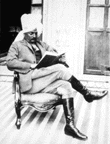
How does a diary written daily, in private and in the first person, clarify the relationship between subjective knowledge and identity formation? We “read” Amar Singh's identity formation not only through his words but also through his photographic selfrepresentations. Preserved in 35 albums in his ancestral haveli, Amar Singh's photographs constitute an important dimension of his narrative. We begin with a picture that represents his construction of a liminal self.
Figure 1 displays the multivalent identity he assembles:20
This is the photo used on the dust jacket of Reversing the Gaze. Rudolph and Rudolph 2002c.

Given Amar Singh's location in fin de siècle imperial India, we prefer the term liminal over the related term hybrid to characterize his identity.21
Liminality has more than one meaning. One variant can be found in narratives of rites of passage, such as Turner 1967. As the text makes clear, Turner's is not the variant of liminality we have in mind. For Turner, liminality designates an indeterminate moment in the life cycle, a vertical process as boy becomes man; it is a destabilizing moment fraught with hazard. For us, liminality refers to cultural location and context, a horizontal process in which a person's identity and practices adjust to changing cultural settings. For Robert Young's reading of liminality and hybridity and his account of Ashis Nandy's interpretation of Gandhi's liminality and hybridity—a reading and an account that bear a family resemblance to ours—see subsections 4 and 5 of chapter 24 in Young 2001. Young first notes that Nandy speaks of Gandhi's colonialera construction of “cultural hybridity.” He then goes on to characterize Nandy as arguing that “'liminality'…is not only the state of being of the postcolonial migrant, as [Homi] Bhabha has since suggested [see Bhabha 1994], but amounts to an authentic state of Indianness itself.” Young 2001, 346.
For more on the conceptualization and location of hybridity at the end of the twentieth century, see Bhabha 1994.
Amar Singh captures his sense of living liminally—sometimes on one side of the border between two cultures, sometimes on the other—in a remark about what makes Indian and English food taste good. Indian food tastes best, he writes, when it is eaten from a thali with the hand; English food tastes best when eaten from a plate with knives and forks. Like the photo in Figure 1, the food metaphor suggests that Amar Singh most of the time is comfortable with his interstitial location.
At the end of the nineteenth century, when Amar Singh began to write his diary, most Englishmen didn't accept liminal practices, much less hybrid identities. Both were rejected as fake. A “black Englishman” was at best an anomaly, at worst an abomination. He either had assimilated imperfectly and become a bad copy, or had assimilated perfectly and become deracinated, an inauthentic self, a phony. It was a time when imperial narratives conflated culture and biology. Cultural traits were seen as inbred, like blue eyes and blond hair. Ethnic and racial identities were everywhere essentialized;23
When Amar Singh was experiencing the apartheid of the Indian army, American imperialists such as Theodore Roosevelt shared the British Raj's dichotomous, essentialized thinking about race and ethnicity. President Roosevelt enthusiastically embraced Rudyard Kipling's phrase “the white man's burden” in his successful quest for empire.
Kipling 1989.
Forster 1978.
Upon graduating in 1905 from Lord Curzon's “dear child,” the Imperial Cadet Corps, Amar Singh and his classmates didn't pass the “Englishness” test either. Although the cadets as princes or noblemen were regarded as superior persons, they were not deemed worthy of being made King's Commissioned Officers (KCOs) in the British Indian army, an honor the viceroy, Lord Curzon, had led them to expect. Racial inferiority and segregation remained the order of the day. Rebuffed at the highest levels of the empire, Curzon accepted his defeat by recognizing that making Indians KCOs would have meant “a black man commanding a white man,” which “no one will look at.”26
Quoted in Dilks 1970, 240. Lord Curzon wrote these words in the early stages of a protracted but ultimately unsuccessful effort that reached up to the prime minister, Lord Salisbury, and the queen empress, Victoria. Salisbury supported Indian army opinion against the viceroy in opposing Imperial Cadet Corps graduates for KCOs, and he seems to have advised the queen empress along the same lines.
Ten years later, during World War I, there were highlevel efforts to end the Indian army's apartheid system. On November 18, 1915, with the shedding of Indian blood in Flanders on behalf of the British cause fresh in mind, the secretary of state for India, Austen Chamberlain, telegraphed the viceroy, Charles Hardinge, that “on imperial grounds early action [with respect to granting the status of KCO to Indian officers] seems to me desirable in order to mark the part played by Indian troops in the war and refute the colour bar theory [emphasis added]…. The following have, I understand, all proved their fitness for commissions in Indian regiments both as officers and comrades.” Captain Amar Singh's name is the first of the six mentioned. See Telegram No. 2012.
It did not happen—at least not on January 1, 1916, when Chamberlain thought it could more easily appear as an “act of grace and not in response to agitation.” On August 25, 1917, five days after the “momentous declaration” committing Britain to “responsible government” for India, it did happen, but only for a few years—roughly until Amar Singh's retirement from the Indian army in 1922. With Liberals member Edwin Montagu as secretary of state for India, and Lord Chelmsford the viceroy, and a “powerful and increasing demand for a greater Indian share in the administration of the country,” the title of KCO was offered to Captain Amar Singh and eight other former Imperial Cadets.
For more on Amar Singh's Indian army career, the Imperial Cadet Corps, and early efforts to desegregate and thereby Indianize the Indian army, see Rudolph and Rudolph 2002c, part IV. We examine the Indian army's racial apartheid, Amar Singh's liminal positioning from 1905 through 1917, and the window of nominal racial equality he experiences as a KCO from 1917 through 1922. See also Mason 1974 and Sundaram 1996.
Three years earlier, while serving with the Jodhpur Lancers in the Allied Expeditionary Force in China during the Boxer Rebellion, Amar Singh had experienced how the British construction of race affected the way Indians were perceived by other Europeans:
Here is another proof of the slight treatment that the Indian officers receive…. Jasjee and Bhabootjee, who are both a major and a captain respectively, are kept down in a wretched hole in the second class with six others. The four British sergeants are there in a separate cabin…but on better footing. Major Turner and Capt Hudson had a greater anxiety for these four sergeants than they had for the others whom they put down as merely native officers, which means nothing worth bothering….
Again there is another example. British sergeants and soldiers never salute Indian officers…. They look as if they expect the others to salute them…. [I]t is a mark of great favour on the part of the sergeant or soldier if he even condescends to say good morning…. I do not blame the French soldiers for calling the Indians coolies, considering the way the British treat them. They of course know what they see or hear. If a foreign soldier sees a British soldier not saluting an Indian officer, they naturally come to the conclusion that the latter is a coolie and so they call him. The British make a great row when they hear the foreigners calling Indian soldiers and officers coolies, though they do not mind treating them as such themselves. Aboard S. S. Itria Sunday, July 14, 1901.27
Rudolph and Rudolph 2002c, 159.
Nevertheless, despite the hazards of liminality, we find Amar Singh navigating its turbulent waters with considerable ease and success. It is an old skill on the subcontinent. From at least Mughal times, reciprocal cultural adaptation and borrowing was common. Rajput kings and courts adopted Mughal architecture, art, dress, and food. Mughal emperors learned from Rajput rulers. “[T[he greatest of Indian social and political leaders,” Ashis Nandy argues, “built their self-definitions as Indians over the last two centuries” on liminality.28
Nandy 1988, 104.
In the next picture, Figure 2, Amar Singh's grandfather, Zorawar Singh, enacts a liminality that encompasses subcontinental and transcontinental cultural differences.29
We follow Emma Tarlo in believing that “clothing matters.” She demonstrates the semiotic richness of dress in Tarlo 1996; the introduction and chapter 3 are particularly compelling analyses of how clothes make meaning and identity.
Harris 2001.

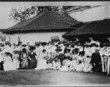
Two more photos of the young Amar Singh—as a staff officer serving in the Indian army—display the environment that enabled and limited his identity choices. From 1905 until the outbreak of World War I in 1914, he was the only Indian in a white British officers' mess and cantonment society at Mhow in central India. Figure 3, a portrait of the Ormerod-Westcott wedding, is one of many photos in Amar Singh's albums in which his is the only Indian sapha in an English sea of ladies' garden hats and men's straw boaters. On the far right side, Amar Singh's dark face and white sapha appear just behind a clergyman in a black suit. The picture shows Amar Singh's ethnic and cultural liminality. Figure 4 displays the Edwardian drawing room of the officer's bungalow he occupied in the Mhow cantonment. He has surrounded himself with objets d'art, paintings, and elegant fin de siècle furniture. While his code switching between cultural contexts —eating from thalis, eating from plates—suggests the fluidity of his liminal condition, his lifestyle and dress suggest the durability of the hybrid identity that he has begun to construct.


The subjective knowledge of the diary provides us with an account of how and why liminal and hybrid identities are constructed. To evaluate the significance of this process, we reach forward in time to two postcolonial theorists of identity questions, Ashis Nandy and Partha Chatterjee.31
Contrary to the expectations of many nationalists, independence from British rule in 1947 didn't put an end to liminal and hybrid identities or provide an answer to the question of what constitutes an authentic Indian. Hybridity is seen by some cultural theorists and cultural nationalists as an identity failure. British sovereignty ended, but Britain's cultural presence lingered in the English language and in the categories of thought among independent India's educated classes. Should their colonial liminality or hybridity count as Indian? Nandy and Chatterjee say no. For these scholars, the realization of a postindependence, authentic Indianness was radically compromised by the cumulative and insidious effects of Thomas Babington Macaulay's 1835 essay “Minute on Indian Education.” Proudly ignorant of “Oriental” languages and learning, and convinced of the superiority of European civilization and the English language, Macaulay aimed to create “a class of persons Indian in blood and colour, but English in taste, in opinions, in morals, and in intellect.”32Macaulay 2001, 430.
Nandy indicts an “intimate enemy,” the internalization of the former colonial master's mentality, for blocking the realization of an authentic Indian self. For Chatterjee, “derivative discourse,” the assimilation of the colonial master's conceptual vocabulary, handicaps postindependence thought and action. It can, perhaps, be overcome by resorting to an inner space where an uncompromised Indian identity is said somehow to survive.33
Nandy 1988; Chatterjee 1986. For a Marx-flavored postcolonial theory reading of these two texts, see Young 2001, sections 2 and 3 of chapter 24. In the 1960s, the negative valuation assigned by colonial masters and triumphant nationalists to liminality and hybridity migrated to the modernization theory that social scientists, mostly American, used to explain “development” in the “new nations” of the postcolonial world. Modernization theory held that “new nations” would experience social change as a transition from the darkness of tradition to the light of modernity. No longer traditional but not yet modern, liminal and hybrid transitional personalities, like transitional societies, were viewed as unfinished, unstable, and inauthentic.
Three influential modernization theory books of the early 1960s illustrated the negative valuation of transitional personalities and societies: Almond and Verba 1963; Riggs 1964; Pye 1962. Gabriel Almond and Sidney Verba's concept of civic culture, which they expected would civilize the new nations of the third world, bore a suspicious resemblance to American democracy at its best. Fred Riggs envisioned tradition and modernity as “agraria” and “industria,” respectively, and the transition between them in terms of a “prismatic” society suspended between the “fused” (traditional) and the “diffracted” (modern). Lucian Pye found that “transitional personalities are peculiarly prone…to essentially self-defeating practices; and…they lack the stable and more impersonal institutional forms which can harness man's more irrational purposes.” Pye 1962, 36–7.
For a critique and an alternative to 1960s modernization theory, see the introduction of Rudolph and Rudolph 1967.
But for others, pre-independence hybridity anticipated India's transnational future. In today's universe of postcolonial discourse and practice, hybridity is celebrated by many as an authentic Indian identity. The diasporic experience so common to educated Indians has helped legitimate hybridity, making it more an object of admiration than of derision. Novelist Salman Rushdie exemplifies the arrival of hybrid identity on the postcolonial, postmodern scene in what he writes and how he lives—in Bombay, Karachi, London, and New York. So too do the information technology engineers straddling Silicon Valley and Bangalore. As we enter the twenty-first century, global processes have intensified rather than resolved the search for and debate over an authentic Indian identity.
Self-as-Other Ethnography
Now that we have introduced Amar Singh, the subject, and examined how his narratives of and by the self clarify colonial identity formation, we want to make space for subjective knowledge in political science. We turn to the voices of anthropologists who, as ethnographers, observed the other in the colonial relationship. Our story of the diary as a form of subjective knowledge begins and, in a sense, ends with the thoughts of the late M. N. Srinivas, an anthropologist and sociologist whose work on culture and social change transformed the way social scientists understand caste and modernization in India. In texts written and published just before his death in Bangalore in November 1999, Srinivas provided warrants for the approach we take here. By the late 1990s, he had gone beyond explanations based on social structure and social function, which characterized his major works, to an appreciation of the importance of subjective knowledge and human agency in the making and shaping of culture:
Every life mirrors to some extent the culture and the changes it undergoes. The life of every individual can be regarded as a “case study,” and who is better qualified than the individual himself to study [it]…. Anthropology started as the study of “the other,” an exotic other…. [T]he culmination of the movement from the study of the other to studying…one's own culture is surely the study of one's own life…. The latter can be looked at as a field, with the anthropologist being both the observer and the observed, ending for once the duality which inheres in all traditional fieldwork.34
Srinivas 1996, 657.
As we read and reread Amar Singh's diary, it gradually dawned on us that it provided not only an account of a self in formation, but also an ethnography, a cultural account of a way of life. We combined the two by thinking of the diary's narratives as a selfconstructing culture, what we subsequently came to call “self-asother ethnography.”
The claim that Amar Singh was an ethnographer, of whatever stripe, runs counter to what anthropologists claimed they did from the time when, at the beginning of World War I, Bronislaw Malinowski invented anthropology as a “science” based on “fieldwork” and participant/observer methodology. In the beginning, there was the self and the other. European anthropologists initially went to study the alien, exotic, and distant “other” in colonial places such as the Trobriand Islands or an Indian village, places where the natives could be observed enacting their culture, fulfilling cultural “obligations,” behaving in culturally appropriate ways. Anthropologists from the metropole formulated a culture for the natives and told the Western world and the natives about it in their scholarly monographs.
One of James Clifford's stories about a graduate student ethnographer and an African chief captures the process of defining the natives' culture for them. (To put you in the proper frame of mind and to illustrate the ambiguity of the relationship that Clifford examines, we ask you to look at Figure 5, from the cover of the January 12, 2000, Times Literary Supplement, which featured Tanya Luhrmann's review of books about and by Clifford Geertz. Who is the self, and who is the other?) The story goes like this: A graduate student of African ethnohistory prepares for his fieldwork in Gabon among the Mpongwe by consulting an earlytwentieth-century work of a pioneering ethnographer, André Raponda-Walker. When he reaches the field, the student's interview with a Mpongwe chief proceeds well until the chief has trouble with a particular word: “‘Just a moment,’ he says cheerfully, and disappears into his house to return with a copy of Raponda-Walker's compendium. For the rest of the interview the book lies open on his lap.”35
Clifford 1986b, 116.

The “us” in the early days of ethnography referred to “Europeans” from imperial metropoles; the “them,” natives living under colonial domination in what were deemed cultural isolates —denizens of remote islands, villagers living behind mud walls, tribals hidden away in the bush. Natives were objects to be studied, subjects of alien rulers, peoples that administrators had to control and civilize—the white man's burden, in Kipling's unintendedly ironic phrase.
So how did we get from “self and other” to “self as other”? How did the natives lose culture and gain voice? The transformation did not occur overnight or even recently. An important move in the direction of “self as other” took place when Srinivas's friend and younger colleague, Triloki Nath Madan (like Srinivas, an Indian ethnographer of India), wrote “On Living Intimately with Strangers.”36
Madan 1975.
Ibid., 156.
Arguing that an anthropologist can go home again if he or she can “render the familiar unfamiliar,” Madan went home again to study his own Kashmiri Pandit community. He recognized that “detachment” distinguished his way of studying his own community from the “empathy” called for by participant observation of an “other.” What he did, he said, was closer to “objective subjectivity” than it was to the “subjective objectivity” of participant/observer ethnography.38
Studying his culture in his own country and, more decisively, his own community led him in time to the view that anthropologists should “not divide humankind into ‘ourselves’ and ‘others.’”39Madan 1994, 159.
The “other” of participant/observer anthropology is not, it seems, barred from self-understanding—the capacity, in Srinivas's words, of making himself or herself “a case study,” if he or she can render the familiar unfamiliar. “Critical self-awareness,” Madan says, is available to ethnographers who can access “distance,” a “sense of surprise,” and “anthropological doubt.” This kind of selfconsciousness and reflexivity can, according to Srinivas, remove the epistemological divide between self and other and open the way to ending “the duality which inheres in all traditional fieldwork.”40
Srinivas 1996, 657.
Amar Singh's self-as-other ethnography helps him to avoid some of the obfuscating mediations associated with self-and other ethnography: the subjectivity and the projections that affect observation and knowing, the fortuitous or calculated resistance and/or compliance of the native subject, and the objectivist fictions of scientific narration and authorial rhetoric. Geertz tells us how anthropologists try to persuade us to believe them despite such difficulties:
The ability of anthropologists to get us to take what they say seriously has less to do with either a factual look or an air of conceptual elegance than it has to do with their capacity to convince us that what they say is a result of having actually penetrated (or, if you prefer, been penetrated by) another form of life, of having, one way or another, truly “been there”…. Persuading us that his offstage miracle has occurred…is where the writing comes in.”41
The erosion of the self-and-other trope and of the accompanying asymmetry between observer and observed began after World War II, when decolonization abroad and the rise of minorities at home started to erase the line between “them” and “us.” Renato Rosaldo captured what was happening when he wrote, “The more power one has, the less culture one enjoys, and the more culture one has, the less power one wields.”42
Rosaldo 1989, 201.
Our readers, however, are more likely to be familiar with the novels of Edith Wharton than with the sociological works of E. Digby Baltzell. The appearance of Baltzell 1958 made a case inter alia for the rise and fall of Anglo-Saxon–Protestant rule in America. Baltzell had been preceded in writing about the culture of fading WASPs by William Lloyd Warner in his Yankee City Series about Newburyport, Massachusetts, and by Robert S. and Helen Merrell Lynd in their Middletown books about Muncie, Indiana.
In some ways, it was a strange question to ask. Yes, the subaltern can speak. Natives and minorities began to do so in the name of authenticity. Then they went further and claimed that only they could represent themselves. French ethnographers looking at Madagascar, MIT economists observing Pakistan, and white men from the National Opinion Research Center observing the black ghetto could not speak for the natives or minorities they claimed to know and represent. As our daughter Amelia learned as a student in the Graduate Theological Union in Berkeley, authenticity makes an epistemological claim. When she set out to study a witch sect in California, the witches told her that you have to be a witch to study witches.44
Tanya Luhrmann reported a similar experience in a lecture about the writing of Persuasions of the Witch's Craft. See Luhrmann 1989; Luhrmann 2001.
Lurie 1967.
Paradoxically, Henry Louis Gates, Jr.—who presides over an enterprise that sometimes trades on authenticity claims, Harvard's Department of Afro-American Studies—has mounted a serious challenge to essentialist versions of authenticity.46
Gates 1991.
Carter 1976.
Gates 1991, 29–30.
Gates challenges authenticity's epistemological and ontological claim that only a native can know a native—that, for instance, it takes an African American to know and to tell about an African American. He praises slave novels pseudonymously written by whites in the voice of slaves and other novels pseudonymously written by whites in the voice of blacks. If all writers are “cultural impersonators,” though, some are better impersonators than others. Authenticity for Gates is in the quality of the telling, not in the provenance of the teller.49
Complicating the case for authenticity in the telling rather than the teller are the remarkable contributions to English literature of hybrid Indian authors—for example, Indian authors writing in English, such as Booker Prize winners Salman Rushdie and Arundhati Roy. How much weight should be accorded to their hybrid identity and how much to the genius of their work? See Strongman 2002, which discusses the innovative English prose and cultural creativity of Rushdie, Roy, and other Indian authors. Also relevant is the New Yorker's Special Fiction Issue dated 23 and 30 June 1997, which celebrates the work of Indian authors writing in English.
Before we follow Gates and throw out the baby of subjective knowledge with the bathwater of authenticity, let us consider a story from Amar Singh's diary that raises questions about Gates's claim that authenticity can be judged independent of the speaker. The entry for October 15, 1915, written on the Western front, includes an essay entitled “The Importance of Keeping Records.” Amar Singh is concerned that, in the absence of “eye witness” accounts, the story of Indian soldiers' contribution to the Allies' victory in World War I might be lost from view. That contribution was considerable. The war began for England on August 4, 1914. By late September, an Indian expeditionary force was at the front in Flanders, where British forces were falling back. The German army's Schlieffen Plan to encircle Paris by invading through Belgium and penetrating to the Marne was moving toward success. Without the arrival of an Indian corps of twoplus divisions and their valiant and determined resistance, the German offensive might very well have succeeded.50
As Philip Mason puts it, “It is hard to see how the Germans could have failed to pierce the line” if the Indians had not been there and held. Mason 1974, 414.
Amar Singh feared that this story of the Indian soldiers' contribution to fighting and winning World War I would fall victim to India's colonial relationship to Britain:
To my mind it is a thing of the greatest importance to keep a nation's records. In this we are backward…. [W]e ought to have brought our own charans, who are our hereditary [bards]…. What we want is a man of learning and imagination who could and would write from personal experience…. The English historians will simply treat…the war in a very general way…. [W]hat we can expect is a mere mention.51
Amar Singh diary, entry for 15 October 1915.
And a mere mention is what they received. This diary entry seems to resuscitate claims that being a witch provides a special vantage point for knowledge about witches and that power enhances the witch's ability to speak and to be heard. Impersonation does not always yield subjective knowledge. Sometimes knowing depends on direct experience and being heard depends on occupying a seat at the table.
Let us return to the theory and practice of self-as-other ethnography and see what light it casts on the standing of subjective knowledge in the social sciences. In recent decades, the dichotomies of self and other, participant and observer, ethnographer and native, even subjectivity and objectivity, have eroded. Among anthropologists, such dichotomies have given way to first-person fieldwork accounts of the theater of the other. In “polyphonic,” “dialogic” textual production, both the ethnographer/writer and the subject/native are on stage. As Figure 5 makes clear, the asymmetries of power have faded; the observer and the observed engage each other in scripted conversation.
But the ethnographer and the native do not share in the crafting of the script. Despite the appearance on stage of reciprocity and mutual determination, the writing of the play, however literary and “partial” it may be, remains the task of the ethnographer, the self of the self/other duality. Politically, he or she retains authority over the text about the other. Amar Singh, a reflexive other writing in his diary about culture in the making as well as the doing, is located outside a participant/observer relationship. By conflating self and other, he constitutes himself, in Srinivas's words, as a “case study.” He is “both the observer and the observed,” a condition that ends “the duality which inheres in all traditional fieldwork.”52
Srinivas 1996, 657.
So what should count as knowledge in political science? We have tried here to show that subjectivity is valid and useful, that firstperson accounts of experience—“telling what I know,” narratives of and by the self, partial and contingent truths, and self-as-other ethnography—contribute to knowledge. The move to subjective knowledge does not require the abandonment of objectivity. Selfconsciousness and reflexivity simply make it possible to render the familiar unfamiliar, to gain a certain detachment, to achieve, in Madan's phrase, “objective subjectivity.”
We have drawn the attention of political scientists to the anthropological writing of the postcolonial era because it directly confronted an epistemological challenge common to the social sciences: the duality of the observer and the observed, and the associated claim that observation can be unmediated or transparent. With the end of colonialism, anthropologists began to question the way they represented the other. They found that they had been obscuring the other's voice and self-representation—sometimes, however inadvertently, speaking for the other. After gaining political independence and empowerment in the postwar era, native subjects and marginalized minorities increasingly spoke for themselves. Self-knowledge and self-representation made subjective knowledge more visible and accessible.
Subjective knowledge helps to explain identity and category formation and the politics of recognition. Accessibility to the politics of those taken to be outside the public sphere, those whose behavior is not easily observed or counted by objective political science—colonized persons, subalterns, and marginalized minorities—depends on their ability to articulate their identities, purposes, and interests. Such forms of identity politics have become of increasing interest to political scientists concerned with subaltern agency, multiculturalism, and ethnic conflict and peace.
References
Almond Gabriel A., and
Sidney Verba.
1963
The Civic Culture: Political Attitudes and Democracy in Five Nations.
Princeton:
Princeton University Press.
Amar Singh diary manuscript.
Kanota Fort.
Jaipur District, Rajasthan,
India.
Baltzell E. Digby.
1958
Philadelphia Gentlemen: The Making of a National Upper Class.
Glencoe, Ill.:
Free Press.
Benhabib Seyla, ed.
1996
Democracy and Difference: Contesting the Boundaries of the Political.
Princeton:
Princeton University Press.
Bhabha Homi K.
1994
The Location of Culture.
London:
Routledge.
Cannadine David.
2001
Ornamentalism: How the British Saw Their Empire.
New York:
Oxford University Press.
Carmines Edward G., and
Robert Huckfeldt.
1996
Political behavior: An overview.
In A New Handbook of Political Science,
eds. Robert E. Goodin and
Hans-Dieter Klingemann.
Oxford:
Oxford University Press,
223–54.
Carter Forrest.
1976
The Education of Little Tree.
New York:
Delacorte Press/E. Friede.
Chatterjee Partha.
1986
Nationalist Thought and the Colonial World: A Derivative Discourse?
London:
Zed Books.
Clifford James.
1986a
Introduction: Partial truths.
In Writing Culture: The Poetics and Politics of Ethnography,
eds. James Clifford and
George Marcus.
Berkeley:
University of California Press,
1–
26.
Clifford James.
1986b
On ethnographic allegory.
In Writing Culture: The Poetics and Politics of Ethnography,
eds. James Clifford and
George Marcus.
Berkeley:
University of California Press,
98–
121.
Dilks David.
1970
Achievement, vol. 1 of Curzon in India.
New Delhi:
Taplinger Publishing.
Dunleavy Patrick.
1996
Political behavior: Institutional and experiential approaches.
In A New Handbook of Political Science,
eds. Robert E. Goodin and
Hans-Dieter Klingemann.
Oxford:
Oxford University Press,
276–93.
Edmonds David, and
John Eidinow.
2001
Wittgenstein's Poker: The Story of a Ten-Minute Argument Between Two Great Philosophers.
New York:
Ecco/HarperCollins.
Forster E. M.
1978
A Passage to India.
London:
E. Arnold.
Gadamer Hans-Georg.
1989
Truth and Method, trans.
J. Weinsheimer and
D. G. Marshall. 2d rev. ed.
New York:
Seabury Press.
Gates Henry Louis,Jr.
1991
“Authenticity,” or the lessons of Little Tree.
New York Times Book Review,
24 November
26–
30.Google Scholar
Geertz Clifford.
1973
The Interpretation of Cultures: Selected Essays.
New York:
Basic Books.
Geertz Clifford.
1988
Works and Lives: The Anthropologist as Author.
Stanford:
Stanford University Press.
Geertz Clifford.
1995
After the Fact: Two Countries, Four Decades, One Anthropologist.
Cambridge:
Harvard University Press.
Grondin Jean.
2002
Gadamer's basic understanding of understanding.
In The Cambridge Companion to Gadamer,
ed. Robert J. Dostal.
Cambridge:
Cambridge University Press,
36–
51.
Guha Ranajit, ed.
[1982]
Subaltern Studies 1: Writings on Southern Asian History and Society.
Reprint edition.
Oxford:
Oxford University Press.
Harris Russell.
2001
The Lafayette Studio and Princely India.
New Delhi:
Roli Books.
Jenkins Laura Dudley.
2003
Identity and Identification in India: Defining the Disadvantaged.
London:
Curzon Press.
Kipling Rudyard.
1989
“Pagett, M. P.”
In Rudyard Kipling: Complete Verse.
Definitive edition.
New York:
Anchor Press
26.
Kymlicka Will.
1996
Multicultural Citizenship: A Liberal Theory of Minority Rights.
Oxford:
Clarendon Press.
Luhrmann T. M.
1989
Persuasions of the Witch's Craft: Ritual Magic in Contemporary England.
Cambridge:
Harvard University Press.
Luhrmann T. M.
2001
Ecstasy and despair: Ethnographic approaches to religious and psychiatric experience. Inaugural lecture for the Dean's Lecture Series,
University of Chicago,
24 October.
Lurie Alison.
1967
Imaginary Friends.
New York:
Coward-McCann.
Macaulay Thomas.
2001
Minute on Indian education.
In The Post-Colonial Studies Reader,
eds. Bill Ashcroft,
Gareth Griffiths, and
Helen Tiffin.
London:
Routledge,
428–30.
Madan T. N.
1975
On living intimately with strangers.
In Encounter and Experience: Personal Accounts of Fieldwork,
eds. André Béteille and
T. N. Madan.
Delhi:
Vikas Publishing House,
131–56.
Madan T. N.
1994
On critical self-awareness.
In Pathways: Approaches to the Study of Society in India.
Delhi:
Oxford University Press,
147–66.
Mahajan Gurpreet.
1998
Identities and Rights: Aspects of Liberal Democracy in India.
Delhi:
Oxford University Press.
Mahajan Gurpreet.
2002
The Multicultural Path: Issues of Diversity and Discrimination in Democracy.
New Delhi:
Sage Publications.
Mason Philip.
1974
A Matter of Honour: An Account of the Indian Army, Its Officers and Men.
London:
Jonathan Cape.
Mayaram Shail.
1999
Recognizing whom? Multiculturalism, Muslim minority identity, and the Mers.
In Multiculturalism, Liberalism, and Democracy,
eds. Rajeev Bhargava,
Amiya Kumar Bagchi, and
R. Sudarshan.
Delhi:
Oxford University Press.
McCloskey Deirdre.
2000
How to Be Human Though an Economist.
Ann Arbor:
University of Michigan Press.
McCloskey Donald (Deirdre).
1990
If You're So Smart: The Narrative of Economic Expertise.
Chicago:
University of Chicago Press.
Miller Warren E.
1996
Political behavior, old and new.
In A New Handbook of Political Science,
eds. Robert E. Goodin and
Hans-Dieter Klingemann.
Oxford:
Oxford University Press,
294–
309.
Nandy Ashis.
1988
The Intimate Enemy: Loss and Recovery of Self Under Colonialism.
Delhi:
Oxford University Press.
Nandy Ashis.
2001
Time Warps: The Insistent Politics of Silent and Evasive Pasts.
Delhi:
Permanent Black.
New Yorker.
1997
Special fiction issue (India Focus),
ed.
Bill Buford.
23 and 30 June.
Parekh Bhikhu.
2000
Rethinking Multiculturalism: Cultural Diversity and Political Theory.
Cambridge:
Harvard University Press.
Polanyi Michael.
1962
Personal Knowledge: Towards a Post-Critical Philosophy.
Chicago:
University of Chicago Press.
Pye Lucian W.
1962
Politics, Personality, and Nation Building: Burma's Search for Identity.
New Haven:
Yale University Press.
Riggs Fred W.
1964
Administration in Developing Countries: The Theory of Prismatic Society.
Boston:
Houghton Mifflin.
Rosaldo Renato.
1989
Culture and Truth: The Remaking of Social Analysis.
Boston:
Beacon Press.
Rudolph Lloyd I., and
Susanne Hoeber Rudolph.
1967
The Modernity of Tradition: Political Development in India.
Chicago:
University of Chicago Press.
Rudolph Susanne Hoeber, and
Lloyd I. Rudolph.
1993
Modern hate: How ancient animosities get invented.
The New Republic,
22 March,
24–
9.Google Scholar
Rudolph Susanne Hoeber, and
Lloyd I. Rudolph.
2001
Living with difference in India: Legal pluralism and legal universalism in historical context.
In Religion and Personal Law in Secular India: A Call to Judgment,
ed. Gerald James Larson.
Bloomington:
Indiana University Press,
36–
65.
Rudolph Susanne Hoeber, and
Lloyd I. Rudolph.
2002a
Living with multiculturalism: Universalism and particularism in an Indian historical context.
In Engaging Cultural Differences: The Multicultural Challenge in Liberal Democracies,
eds. Richard Shweder,
Martha Minow, and
Hazel Rose Markus.
New York:
Russell Sage Foundation,
43–
62.
Rudolph Susanne Hoeber, and
Lloyd I. Rudolph.
2002b
The Nora and Edward Ryerson Lecture: Engaging subjective knowledge: Narratives of and by the self in the Amar Singh diary.
The University of Chicago Record,
23 May,
2–
5.Google Scholar
Rudolph Susanne Hoeber, and
Lloyd I. Rudolph. eds.
2002c
Reversing the Gaze: Amar Singh's Diary, A Colonial Subject's Narrative of Imperial India, with Mohan Singh Kanota.
Boulder, Colo.:
Westview Press.
Scott James C.
1985
Weapons of the Weak: Everyday Forms of Peasant Resistance.
New Haven:
Yale University Press.
Scott James C.
1998
Seeing Like a State: How Certain Schemes to Improve the Human Condition Have Failed.
New Haven:
Yale University Press.
Sewell William H.,Jr.
1999
Geertz, cultural systems, and history: From synchrony to transformation.
In The Fate of “Culture”: Geertz and Beyond,
ed. Sherry B. Ortner.
Berkeley:
University of California Press,
35–
55.
Shweder Richard A.
1991
Thinking Through Cultures: Expeditions in Cultural Psychology.
Cambridge:
Harvard University Press.
Srinivas M. N.
1996
Indian anthropologists and the study of Indian culture.
Economic and Political Weekly,
16 March,
656–7.Google Scholar
Strongman Luke.
2002
The Booker Prize and the Legacy of Empire.
Amsterdam:
Rodopi.
Sundaram Chandar S.
1996
A grudging concession: The origins of the Indianization of the Indian armies, 1817–1917.
Ph.D. diss.,
History Department,
McGill University.
Tarlo Emma.
1996
Clothing Matters: Dress and Identity in India.
Chicago:
University of Chicago Press.
Taylor Charles.
1989
Sources of the Self: The Making of the Modern Identity.
Cambridge:
Harvard University Press.
Taylor Charles.
1992
The politics of recognition.
In Multiculturalism and “The Politics of Recognition,”
ed. Amy Gutmann.
Princeton:
Princeton University Press,
25–
74.
Telegram No. 2012,
Secretary of State to Viceroy.
Telegram P., 18 November 1915, 7:00 p.m. Cambridge University Library, Hardinge Papers, v: l, 103. Correspondence re: European war, part I. Courtesy of DeWitt Ellinwood.
Toulmin Stephen.
2001
Return to Reason.
Cambridge:
Harvard University Press.
Turner, Victor.
1967
The Forest of Symbols: Aspects of Ndembu Ritual.
Ithaca:
Cornell University Press.
Wachterhauser Brice.
2002
Getting it right: Relativism, realism, and truth.
In The Cambridge Companion to Gadamer,
ed. Robert J. Dostal.
Cambridge:
Cambridge University Press,
52–
78.
Weber Max.
1976
The Protestant Ethic and the Spirit of Capitalism,
trans. Talcott Parsons.
New York:
Scribner.
Wedeen Lisa.
2002
Conceptualizing culture: Possibilities for political science.
American Political Science Review
96:
4,
713–28.Google Scholar
Wendt Alexander.
1987
The agent-structure problem in international relations theory.
International Organization
41:
3,
335–70.Google Scholar
Winch Peter.
1967
The Idea of a Social Science and Its Relation to Philosophy.
London:
Routledge and Kegan Paul.
Wittgenstein Ludwig.
1953
Philosophical Investigations,
trans. G. E. M. Anscombe.
New York:
Macmillan.
Young Iris Marion.
1990
Justice and the Politics of Difference.
Princeton:
Princeton University Press.
Young Robert J. C.
2001
Postcolonialism: An Historical Introduction.
Oxford:
Blackwell Publishers.



 You have
Access
- 5
- Cited by