



1. Introduction
In this paper, we introduce an adelic refinement of the Eisenstein cohomology classes introduced by Beilinson, Kings and Levin in [Reference Beilinson, Kings and LevinBKL18] (which in turn are an integral refinement of the Eisenstein classes introduced by Nori [Reference NoriNor95]). The classes of Beilinson, Kings and Levin are elements in the cohomology of
 $\mathrm{GL}_n({\mathbb Z})$
, or some of its subgroups, in degree
 $n\!-\!1$
with coefficients in the completed group ring of the free-abelian group
 ${\mathbb Z}^n$
. Their construction is given in terms of
 $\mathrm{GL}_n({\mathbb Z})$
-equivariant sheaf cohomology on the n-dimension real torus
 ${\mathbb R}^n/{\mathbb Z}^n$
with coefficients in the so-called logarithm sheaf
 ${{\mathscr L} og}$
, the locally constant sheaf associated to the completed group ring.
The adelic Eisenstein classes introduced in this paper are cohomology classes of the group
 $\mathrm{GL}_n({\mathbb Q})$
in degree
 $n\!-\!1$
with coefficients in a module
 ${\mathcal D}_{\mathrm{lpol}}$
that we call the module of locally polynomial distributions on
 ${\mathbb Q}^n$
.Footnote
1
In principle, our construction is modelled after that introduced in [Reference Beilinson, Kings and LevinBKL18]. We consider the
 $\mathrm{GL}_n({\mathbb Q})$
-equivariant sheaf cohomology of the adelic solenoid
 $({\mathbb A}/{\mathbb Q})^n$
. However, one of the difficulties in generalizing the approach of [Reference Beilinson, Kings and LevinBKL18] to the adelic setting is that the usual topology of the adeles and the adele class group is too fine to produce meaningful sheaf cohomology groups. Instead, we introduce a certain coarse Grothendieck topology, which we call lattice topology, and develop a
 $\mathrm{GL}_n({\mathbb Q})$
-equivariant sheaf cohomology with respect to this topology. Another difficulty that we have encountered is the fact that the logarithm sheaf does not seem to admit a natural adelic counterpart. We work instead with the sheaf of locally polynomial distributions
 ${\mathscr D}$
.
The interest in studying Eisenstein cohomology classes lies in their relation to special values of L-functions. This was first exploited by Nori (and independently by Sczech in [Reference SczechScz93]), who reproved the theorem of Siegel and Klingen regarding the rationality of the values of partial zeta functions of totally real fields at non-positive integers. Using their integral refinement of Nori’s classes, Beilinson, Kings and Levin were able to reprove the integrality results of Cassou-Noguès and Deligne-Ribet for these special L-values.Footnote 2 Our adelic variants of the Eisenstein classes allow us to refine these results further by proving certain divisibility properties for Stickelberger elements at non-positive integers. A first result in this direction had been obtained in joint work of the second author with Dasgupta [Reference Dasgupta and SpiessDS18]. There, a different and rather concrete construction of Eisenstein cohomology classes, based on Shintani’s method to study special L-values, has been used. We feel that the construction using equivariant sheaf cohomology introduced here is conceptually particularly satisfying and that it adds a new tool to study properties of special L-values. The relation between the Eisenstein classes introduced here and in [Reference Dasgupta and SpiessDS18] remains unclear.Footnote 3
We now give the reader some idea about the topological (i.e. topos-theoretic) constructions on which our definition of the adelic Eisenstein classes is based. For the purpose of keeping the technical details to a minimum, we consider here only a somewhat simplified situation and refer to §§ 2, 3 and 4 for the general framework. We fix a totally real number field
 $F\subseteq {\mathbb C}$
of degree n over
 ${\mathbb Q}$
with ring of integers
 ${\mathcal O}_F$
. Let
 ${\mathcal I}$
denote the set of all fractional ideals of F. We attach to the ring of finite adeles
 ${\mathbb A}_f$
the ring of adeles
 ${\mathbb A}$
and the adele class group
 ${\mathbb A}/F$
of F certain sitesFootnote
4
denoted by B, A and T. We refer to these as lattice topologies on
 ${\mathbb A}_f$
,
 ${\mathbb A}$
and
 ${\mathbb A}/F$
, respectively. They are much coarser than the usual topologies. For example, an open subset
 $U\subseteq B$
(i.e. an object of B) is a subset
 $U\subseteq {\mathbb A}_f$
that is
 ${\widehat{{\mathfrak a}}}$
-stable for some fractional ideal
 ${\mathfrak a}\in {\mathcal I}$
(i.e. we have
 ${\widehat{{\mathfrak a}}} + U=U$
). Here,
 ${\widehat{{\mathfrak a}}} := {\mathfrak a}\otimes {\widehat{{\mathbb Z}}}$
is the closure of
 ${\mathfrak a}$
in
 ${\mathbb A}_f$
. A covering of an open subset
 $U\subset B$
consists of a collection of open subsets
 $\{U_i\}_i$
of B so that
 $U=\bigcup_i U_i$
and so that there exists
 ${\mathfrak a}\in {\mathcal I}$
such that each
 $U_i$
is
 ${\widehat{{\mathfrak a}}}$
-stable. The lattice topologies A and T are defined in a similar way.
The group
 $\widetilde{\Gamma}:= F^*\ltimes F$
acts continuously on B and A, whereas
 ${\Gamma} := F^*$
acts continuously on T. Moreover, the site T can be identified with the ‘quotient’ of A with respect to the natural projection
 $\mathrm{pr}: {\mathbb A}\to {\mathbb A}/F$
. Hence the pullback
 $\mathrm{pr}^*: {\mathcal S}h(T, {\Gamma}) \to {\mathcal S}h(A, \widetilde{\Gamma})$
defines an equivalence between the category of
 $\widetilde{\Gamma}$
-equivariant sheaves on A and the category of
 ${\Gamma}$
-equivariant sheaves on T. The basic properties of (equivariant) sheaf cohomology for sites of the type B, A and T will be established in § 3.
The construction of the
 $\Gamma$
-equivariant sheaf
 ${\mathscr D}$
on T is based on the notion of a locally polynomial function that we now review. Let
 $U\subseteq B$
be an open subset and put
 ${\mathcal U} := U\cap F$
. A map
 $f: {\mathcal U} \to {\mathbb Z}$
is called a locally polynomial function if there exists
 ${\mathfrak a}\in {\mathcal I}$
such that U is
 ${\widehat{{\mathfrak a}}}$
-stable and so that for a
 ${\mathbb Z}$
-basis
 $(\omega_1, \ldots, \omega_n)$
of
 ${\mathfrak a}$
and for every
 $x\in {\mathcal U}$
the map
 ${\mathbb Z}^n \to {\mathbb Z}, (x_1, \ldots, x_n) \mapsto f(x+ \sum_{i=1}^n x_i \omega_i)$
is a polynomial function, i.e. there exists a polynomial
 $P\in {\mathbb Q}[X_1, \ldots, X_n]$
with
 $f(x+ \sum_{i=1}^n x_i \omega_i)=P(x_1, \ldots, x_n)$
for every
 $x_1, \ldots, x_n\in {\mathbb Z}$
. The locally polynomial function
 $f: {\mathcal U} \to {\mathbb Z}$
is said to be of bounded support if there exists
 ${\mathfrak a}\in {\mathcal I}$
such that
 ${\mathcal U}$
is
 ${\mathfrak a}$
-stable and so that the support of f is contained in finitely many
 ${\mathfrak a}$
-orbits in
 ${\mathcal U}$
. We denote by
 $\mathrm{Int}_{\mathrm{lpol}, b}({\mathcal U}, {\mathbb Z})$
the ring of locally polynomial functions on
 ${\mathcal U}$
of bounded support and put
 ${\mathcal D}_{\mathrm{lpol}}(U) := \mathrm{Hom}(\mathrm{Int}_{\mathrm{lpol}, b}({\mathcal U}, {\mathbb Z}), {\mathbb Z})$
. The assignment
 $U\mapsto {\mathcal D}_{\mathrm{lpol}}(U)$
defines a
 $\widetilde{\Gamma}$
-equivariant sheaf on B, the sheaf of locally polynomial distributions on B. By pulling it back to A via the morphism
 $\mathrm{pr}_B: A\to B$
induced by the natural projection
 ${\mathbb A}= {\mathbb A}_f\times F_{\infty}\to {\mathbb A}_f$
, we obtain a
 $\widetilde{\Gamma}$
-equivariant sheaf
 ${\mathcal D}_{\mathrm{lpol}, A}=(\mathrm{pr}_B)^*({\mathcal D}_{\mathrm{lpol}})$
on A. As alluded to above, the sheaf
 ${\mathcal D}_{\mathrm{lpol}, A}$
descends to a
 ${\Gamma}$
-equivariant sheaf
 ${\mathscr D}$
on T, i.e. we have
 $\mathrm{pr}^*({\mathscr D}) = {\mathcal D}_{\mathrm{lpol}, A}$
.
In § 4, we investigate the (
 $\Gamma$
-equivariant) cohomology groups of T with coefficients in
 ${\mathscr D}$
. One of our key results (cf. Proposition 4.5) is that the cohomology
 $H^{{\bullet}}(T, {\mathscr D})$
is concentrated in degree n and that we have
 $H^n(T, {\mathscr D})\cong {\mathbb Z}$
. We then proceed in defining the adelic Eisenstein classes following the blueprint of Beilinson, Kings and Levin. We also establish a direct connection between our classes and theirs (cf. Proposition 4.13). This will be used in § 5 to link the adelic Eisenstein classes to special values of partial zeta functions and to Stickelberger elements.
We now describe our main application.Footnote
5
Namely, in § 6 we prove certain divisibility properties of Stickelberger elements. For that, we fix a finite abelian extension
 $K/F$
,
 $K\subseteq {\mathbb C}$
with Galois group G. Let S be a finite set of nonarchimedean places of F that contains all places that are ramified in K. Recall that the partial zeta function associated to an element
 $\sigma\in G$
is given by
 \begin{equation}\zeta_S(\sigma, s)\,\, =\,\,\sum_{({\mathfrak a},S)=1, \sigma_{{\mathfrak a}}=\sigma}\, \mathrm{N}({\mathfrak a})^{-s}\end{equation}
for
 $\mathrm{Re}(s) \gt 1$
, where
 $\sigma_{{\mathfrak a}}$
is the image of the ideal
 ${\mathfrak a}$
under the Artin map. It admits a meromorphic continuation to the whole complex plane with a single simple pole at
 $s=1$
. We package the partial zeta functions into a
 ${\mathbb C}[G]$
-valued function
 $\Theta_S(K/F, s)$
, the Stickelberger element, defined by
 \begin{equation}\Theta_S(K/F, s)\, = \, \sum_{\sigma\in G} \zeta_S(\sigma,s) [\sigma^{-1}].\end{equation}
By the theorem of Siegel and Klingen, we have
 $\Theta_S(K/F, -k)\in {\mathbb Q}[G]$
for
 $k\in {\mathbb Z}_{\ge 0}$
. It is well known that in order to obtain integrality results, it is necessary to consider a variant of (2), namely the T-smoothed Stickelberger element
 $\Theta_{S, T}(K/F, s)$
defined by
 \begin{equation}\Theta_{S, T}(K/F, s)\, =\,\prod_{{\mathfrak q}\in T} (1-\mathrm{N}({\mathfrak q})^{1-s} [\sigma_{{\mathfrak q}}^{-1}]) \Theta_S(K/F, s).\end{equation}
Here, T is an additional set of nonarchimedean places of F that is disjoint of S. Under certain mild conditions on T, we have
 $\Theta_{S, T}(K/F, -k)\in {\mathbb Z}[G]$
for
 $k\in {\mathbb Z}_{\ge 0}$
.Footnote
6
To state our result, we will introduce some ideals in the group ring
 ${\mathbb Z}[G]$
. For a place v of F, let
 $G_v\subseteq G$
be the decomposition group of v. If v is nonarchimedean, then we denote by
 $I_v\subseteq G_v$
the inertia group at v and let
 $\sigma_v\in G_v/I_v$
be the Frobenius at v. If v is archimedean, then
 $\sigma_v$
denotes the generator of
 $G_v$
. For
 $k\in {\mathbb Z}_{\ge 0}$
and
 $v\in S\cup S_{\infty}$
, we define ideals
 ${\mathcal I}_v^{(k)}\subseteq {\mathbb Z}[G]$
by
 \begin{equation*}{\mathcal I}_v^{(k)}\,:= \left\{ \begin{array}{ll} \ker({\mathbb Z}[G]\to {\mathbb Z}[G/I_v]/([\sigma_v^{-1}]-\mathrm{N}(v)^k) ) & \quad \text{if $v\nmid \infty$,}\\([\sigma_v] + (-1)^{k+1})\, {\mathbb Z}[G] & \quad \text{if $v\mid \infty$.}\end{array}\right.\end{equation*}
Note that for
 $k=0$
, we have
 ${\mathcal I}_v^{(0)}= \ker({\mathbb Z}[G]\to {\mathbb Z}[G/G_v])$
for every
 $v\in S\cup S_{\infty}$
.
We also consider the following obvious map between Galois cohomology groups:
 \begin{equation}H^0(K, {\mathbb Q}/{\mathbb Z}(k+1)) \longrightarrow \bigoplus_{v\in T_K} H^0(k(v), ({\mathbb Q}/{\mathbb Z})'(k+1)),\end{equation}
where
 $T_K$
denotes the set of places of K that lie above a place in T and where k(v) is the residue field of
 $v\in T_K$
. The Galois module
 ${\mathbb Q}/{\mathbb Z}(k+1)$
appearing in the source of (4) is the group
 ${\mathbb Q}/{\mathbb Z}$
, with the action of the absolute Galois group
 ${\mathcal G}_K = \mathrm{Gal}({\overline{K}}/K)$
of K given by the
 $(k\!+\!1)$
th power of the cyclotomic character
 $\chi_{\mathrm{cycl}}: {\mathcal G}_K\to \mathrm{Aut}(\mu({\overline{\mathbb Q}}))\cong {\widehat{{\mathbb Z}}}^*$
.Footnote
7
Similarly, for a place
 $v\in T_K$
with residue characteristic p, the Galois modules
 $({\mathbb Q}/{\mathbb Z})'(k+1)$
appearing in the summand
 $H^0(k(v), ({\mathbb Q}/{\mathbb Z})'(k+1))$
of the target of (4) are the group
 $({\mathbb Q}/{\mathbb Z})' : = \{x\in {\mathbb Q}/{\mathbb Z}\mid \gcd(\mathrm{ord}(x), p)=1\, \}= \bigoplus_{\ell\ne p} {\mathbb Q}_{\ell}/{\mathbb Z}_{\ell}$
, where the action of the absolute Galois group
 ${\mathcal G}_{k(v)}=\mathrm{Gal}({\overline{{\mathbb F}}}_p/k(v))$
is again given by the
 $(k\!+\!1)$
th power of the cyclotomic character
 $\chi_{\mathrm{cycl}}: {\mathcal G}_{k(v)}\to \mathrm{Aut}(\mu({\overline{{\mathbb F}}}_p))= \mathrm{Aut}({\overline{{\mathbb F}}}_p^*)\cong ({\widehat{{\mathbb Z}}}')^*$
(with
 ${\widehat{{\mathbb Z}}}':=\prod_{\ell\ne p} {\mathbb Z}_{\ell}$
).
Note that if
 $k=0$
, then (4) is the obvious map
 $\mu(K) \to \bigoplus_{v\in T_K} \mu(k(v))$
. Our main result is the following.
Theorem 1.1. Let
 $k\in {\mathbb Z}_{\ge 0}$
and let
 ${\mathfrak p}\in S$
be a fixed place. Let T be a finite set of nonarchimedean places of F disjoint from S such that the map in (4) is injective. Then, we have
 \begin{equation}\Theta_{S, T}(K/F, -k)\in \prod_{v\in S \cup S_{\infty}, v\ne {\mathfrak p}} {\mathcal I}_v^{(k)}.\end{equation}
Hence, under the assumption that (4) is injective, we have in particular
 $\Theta_{S, T}(K/F, -k)\in {\mathbb Z}[G]$
.
Remark 1.2.
-
(a) The map in (4) is injective if T contains two primes of different residue characteristics. It is also injective if
 $k=0$
and if T contains one prime of residue characteristic larger than
$n + 1$
.
-
(b) Theorem 1.1 is already known in the case
$k=0$
. It has first been proved in [Reference Dasgupta and SpiessDS18], except that there it has been shown, under a certain mild assumption on T, that
$\Theta_{S, T}(K/F, 0)$
is contained in
$\prod_{v\in S \cup S_{\infty}, v\ne v_0} {\mathcal I}_v^{(0)}$
where
$v_0$
is a fixed archimedean place of F. Hirose [Reference HiroseHir23] has later obtained the slightly stronger result given in (5). In fact, in his work, the ‘exceptional place’
${\mathfrak p}$
can be any element of
$S\cup S_{\infty}$
. It should be noted that in both [Reference Dasgupta and SpiessDS18] and [Reference HiroseHir23], the ‘Shintani method’ of constructing a degree
$(n\!-\!1)$
Eisenstein cohomology class is used.


By work of Burns [Reference BurnsBur07], it is known that (5) (for
 $k=0$
) can also be deduced from a special case of the equivariant Tamagawa number conjecture. The latter has recently been established in [Reference Dasgupta, Kakde and SillimanDKS23] if K is a CM field.
-
(c) For
$k\gt 0$
, the only previously known result towards (5) is the assertion that
$\Theta_{S, T}(K/F, -k)$
is contained in the product of the ideals
${\mathcal I}_v^{(k)}$
taken over all archimedean places v of F except one (see [Reference Dasgupta and SpiessDS18, Theorem 5.9(b)]).


We now explain the strategy of the proof of Theorem 1.1. Our method is, of course, related to that developed in [Reference Dasgupta and SpiessDS18]. However, we use a somewhat different homological algebra machine that is partly inspired by ideas of Hirose [Reference HiroseHir23]. First, as in [Reference Dasgupta and SpiessDS18], we represent the Stickelberger element at
 $s=-k$
as a cap product of some adelic Eisenstein class Eis with a homology class that is naturally associated to the global reciprocity map for the extension
 $K/F$
. The key novelty in our approach is that we enrich this homology class ‘locally’ at each place in
 $S\setminus\{{\mathfrak p}\}$
. This new class does not lie in a homology group any more, but in a certain hyperhomology group that can be capped with Eis as well. The resulting element then lies in a degree-0 hyperhomology group that maps naturally into the product of the ideals
 ${\mathcal I}_v^{(k)}$
, thus implying the divisibility result in (5) (first, though, only when
 $T=\{{\mathfrak q}\}$
and up to denominators that are powers of the residue characteristic of
 ${\mathfrak q}$
; by varying
 ${\mathfrak q}$
and using an argument involving §ebotarev’s density theorem, we are then able to get rid of the denominators).
1.1 Notation
Throughout this paper, we use the following notation. For sets X and Y, we let
 $\mathrm{Maps}(X,Y)$
be the set of maps
 $X\to Y$
. For a partially ordered set
 ${\mathcal I}=({\mathcal I}, \le)$
, we denote by
 ${\mathcal I}^{\mathrm{opp}}$
the same set but with the reversed partial ordering. The torsion subgroup of an abelian group A will be denoted by
 $A_{\mathrm{tor}}$
.
By
 $\underline{Top}$
, we denote the category of Hausdorff spaces with continuous maps as morphisms. If
 $X, Y\in \underline{Top}$
, then we let
 $C(X,Y)\subseteq \mathrm{Maps}(X,Y)$
denote the subset of continuous maps
 $X\to Y$
. Note that if Y is discrete, then C(X, Y) consists of locally constant maps
 $X\to Y$
. If
 $Y=R$
is a ring (equipped with the discrete topology), then we let
 $C_c(X,R)$
denote the subset of C(X, R) of locally constant maps with compact support.
Unless stated otherwise, all rings are commutative with
 $1\ne 0$
. For a ring R, we denote by
 $\mathrm{Mod}_R$
the category of left R-modules. If A is an R-algebra and N an R-module, then we put
 $N_A= N\otimes_R A$
. If
 $M_{{\bullet}}$
is a bounded complex of R-modules, then we denote by
 ${\mathscr H}_n(M_{{\bullet}})$
its nth homology module. Also, if
 $M_{{\bullet}}$
and
 $N_{{\bullet}}$
are bounded complexes of R-modules, then we denote by
 $M_{{\bullet}}\otimes_R N_{{\bullet}}$
the associated double complex and also, by abuse of notation, its total complex. If G is a group and
 $\chi: G \to R^*$
is a character (i.e. a homomorphism), then we denote by
 $R(\chi)$
the R[G]-module R with G-action given by
 $\chi$
. More generally, if M is an R[G]-module, then
 $M(\chi)$
denotes the R[G]-module
 $M\otimes_R R(\chi)$
.
For a ring R, we denote by
 $\mathrm{Aff}(R)$
the group
 $R^*\ltimes R$
, i.e.
 $\mathrm{Aff}(R)$
is the subgroup of
 $\mathrm{GL}_2(R)$
of matrices of the form
 $(\begin{smallmatrix} a & b\\[1pt]0 & 1\end{smallmatrix})$
with
 $a\in R^*$
and
 $b\in R$
. More generally, for an R-module M, we denote by
 $\mathrm{Aff}_R(M)$
the group
 $\mathrm{GL}(M)\ltimes M$
. We often identify an element
 $\varphi= (\alpha, m)\in \mathrm{Aff}_R(M)$
with the map
 $\varphi: M\to M$
that it induces, i.e. the map
 $M\to M, x \mapsto \alpha(x) + m$
.
Let V be a finite-dimensional
 ${\mathbb Q}$
-vector space. By a lattice L in V, we mean a finitely generated subgroup of V that generates V as a vector space, i.e. we have
 $\mathrm{rank}(L) = \dim(V)$
. The set of lattices in V will be denoted by
 ${\mathrm{Lat}}(V)$
. More generally, if F is an algebraic number field with ring of integers
 ${\mathcal O}_F$
and if V is a finite-dimensional F-vector space, then we denote by
 ${\mathrm{Lat}}_{{\mathcal O}_F}(V)$
the set of all lattices L in V that are also
 ${\mathcal O}_F$
-submodules of
 $V\!$
. In particular,
 ${\mathrm{Lat}}_{{\mathcal O}_F}(F)$
is the set of fractional ideals of F. We say that V is oriented if
 $V_{{\mathbb R}}$
is equipped with an orientation. In this case, a basis
 $(v_1, \ldots, v_n)$
of V is called positively oriented if it belongs to the orientation.
Places of F will be denoted by v,w or also by
 ${\mathfrak p}, {\mathfrak q}$
, etc., if they are finite. In the latter case, we denote the corresponding prime ideal of
 ${\mathcal O}_F$
by
 ${\mathfrak p}, {\mathfrak q}$
, etc., as well. The norm of a fractional ideal
 ${\mathfrak a}$
of F will be denoted by
 $\mathrm{N}({\mathfrak a})$
. By
 $E_F = {\mathcal O}_F^*$
, we denote the group of global units of F. More generally, for a finite set S of nonarchimedean places of F, we let
 $E_S = E_{F,S}$
be the group of S-units of F. For a prime number p, we denote by
 $S_p$
the set of primes of F that lie above p and by
 $S_{\infty}$
, the set of archimedean places of F. For a place v of F, we denote by
 $F_v$
the completion of F at v. Also, we let
 $|\mathrm{\, \cdot\, }|_v$
be the associated normalized multiplicative valuation on
 $F_v$
. If v is nonarchimedean, then
 ${\mathcal O}_v$
denotes the valuation ring of
 $F_v$
,
 $U_v = {\mathcal O}_v^*$
its group of units and
 $\mathrm{ord}_v$
the corresponding the normalized (additive) valuation on
 $F_v$
(so
 $\mathrm{ord}_v(\varpi_v) =1$
if
 $\varpi_v\in {\mathcal O}_v$
is a local uniformizer at v). Moreover, if
 $v={\mathfrak p}$
is finite, then given a non-negative integer
 $m\ge 0$
, we let
 $U_{{\mathfrak p}}^{(m)}$
be the mth higher unit group, i.e.
 $U_{{\mathfrak p}}^{(m)}=\{x\in U_{{\mathfrak p}}\mid x \equiv 1 \mod {\mathfrak p}^m{\mathcal O}_{{\mathfrak p}}\}$
.
In §§ 5 and 6, we assume that F is a totally real field of degree n over
 ${\mathbb Q}$
. Recall that if
 $v\in S_{\infty}$
corresponds to the embedding
 $\xi: F \to {\mathbb R}$
, then
 $|x|_v = |\xi(x)|$
and if
 $v={\mathfrak q}$
is finite, then
 $|x|_{{\mathfrak q}} = \mathrm{N}({\mathfrak q})^{-\mathrm{ord}_{{\mathfrak q}}(x)}$
. For
 $v\in S_{\infty}$
, we put
 $U_v = {\mathbb R}_+ = \{x\in {\mathbb R}\mid x\gt 0\}$
. We denote by
 ${\mathbb A}= {\mathbb A}_F$
(respectively,
 ${\mathbb A}_f={\mathbb A}_{F, f}$
) the ring of adeles of F (respectively, the ring of finite adeles). For a set S of places of F, we let
 ${\mathbb A}\!^S$
(respectively,
 ${\mathbb A}_f^S$
) denote the ring of S-adeles (respectively, finite S-adeles). We also define
 $U^S =\prod_{v\not\in S} U_v$
,
 $U_f^S =\prod_{v\not\in S, v\nmid \infty} U_v$
and
 $U_S = \prod_{v\in S} U_v$
. If S contains all archimedean places, then the factor group
 $({\mathbb A}^S)^*/U^S$
is canonically isomorphic to the group
 ${\mathcal I}^S$
of fractional
 ${\mathcal O}_F$
-ideals that are coprime to S. We sometimes view F as a subring of
 ${\mathbb A}\!^S$
via the diagonal embedding. If S consists of finitely many nonarchimeden places, then we let
 ${\mathcal O}_S: = F\cap \bigcap_{v\in S}{\mathcal O}_v$
be the associated semilocal subring of F.
If
 $\Sigma$
is a set of places of
 ${\mathbb Q}$
, then
 $S_{\Sigma}$
denotes the set of places of F that lie above a place of
 $\Sigma$
. We often write
 ${\mathbb A}_{S, \Sigma}$
,
 ${\mathbb A}\!^{S, \Sigma}$
, etc., for
 ${\mathbb A}_{S\cup S_{\Sigma}}$
,
 ${\mathbb A}\!^{S\cup S_{\Sigma}}$
, etc. We also write
 $U^{S, p}$
,
 $U_{S, p}$
,
 $U^{S, \infty}$
,
 $U^{p, \infty}$
, etc., for
 $U^{S, \{p\}}$
,
 $U_{S, \{p\}}$
,
 $U^{S\cup S_{\infty}}$
,
 $U^{S_p\cup S_{\infty}}$
, etc., and use a similar notation for adeles. For example,
 ${\mathbb A}^{S, \infty}={\mathbb A}_f^S$
denotes the ring
 $S\cup S_{\infty}$
-adeles of F. If
 $S=\emptyset$
, then we drop it from the notation (e.g.
 ${\mathbb A}^p$
denotes the set of
 $S_p$
-adeles of F for a prime p). For
 $p\in\{ 2,3,5, \ldots, \infty\}$
, we put
 $F_p= F\otimes {\mathbb Q}_p = \prod_{v\in S_p} F_v$
. We shall denote by
 $F^*_+$
,
 $E_+= E_{F,+}$
,
 $E_{S,+}$
, etc., the elements of F,
 $E_F$
,
 $E_{S}$
, etc., that are positive with respect to every embedding
 $F\hookrightarrow {\mathbb R}$
.
For an ideal
 ${\mathfrak m}\subseteq {\mathcal O}_F$
,
 ${\mathfrak m}\ne (0)$
, we let
 $F^{{\mathfrak m}}$
be the ray class field of F in the narrow sense associated with
 ${\mathfrak m}$
. If
 $U_{{\mathfrak m}}$
denotes the open subgroup
 $U_{{\mathfrak m}} =\prod_{{\mathfrak p}\nmid \infty} U_{{\mathfrak p}}^{(m_{{\mathfrak p}})}\times \prod_{v\mid \infty} U_v$
of
 ${\mathbb A}^*$
, with
 $m_{{\mathfrak p}}$
being the exponent of
 ${\mathfrak p}$
occurring in
 ${\mathfrak m}$
, then the Galois group
 $\mathrm{Gal}(F^{{\mathfrak m}}/F)$
is isomorphic to
 ${\mathbb A}^*/F^*U_{{\mathfrak m}}$
via the reciprocity map. Or in terms of ray class groups, we have
 $\mathrm{Gal}(F^{{\mathfrak m}}/F)\cong {\mathcal I}^{{\mathfrak m}}/{\mathcal P}^{{\mathfrak m}}$
. Here,
 ${\mathcal I}^{{\mathfrak m}}:={\mathcal I}^{S_{{\mathfrak m}}}$
and
 $S_{{\mathfrak m}}$
is the set of nonarchimedan places of F that divide
 ${\mathfrak m}$
and
 ${\mathcal P}^{{\mathfrak m}}$
is the subgroup of
 ${\mathcal I}^{{\mathfrak m}}$
consisting of principal fractional ideals (x) with
 $x\in F^*_+$
and
 $x\in U_{{\mathfrak p}}^{(m_{{\mathfrak p}})}$
for all
 ${\mathfrak p}\in S$
. We also denote by
 $E_{{\mathfrak m}}$
(respectively,
 $E_{{\mathfrak m}, +}$
) the subgroup of
 $E_F$
consisting of units
 ${\epsilon}\in E_F$
(respectively,
 ${\epsilon}\in E_{F,+}$
) that are
 $\equiv 1$
modulo
 ${\mathfrak m}$
. Thus we have
 $E_{{\mathfrak m}, +}= F^*\cap U_{{\mathfrak m}}$
.
2. Locally polynomial functions and distributions
2.1 Polynomial functions and polynomial distributions on lattices
In the following, by a lattice we mean a free-abelian group L of finite rank. For a subring R of
 ${\mathbb Q}$
, we recall the notion of an R-valued polynomial function on L (see, e.g., [Reference Cahen and ChabertCC96, Chapter XI]).
Definition 2.1. Let L be a lattice of rank n. A map
 $f: L \to R$
is called an (R-valued) polynomial function if for some (hence any) choice of a
 ${\mathbb Z}$
-basis
 ${\lambda}_1, \ldots, {\lambda}_n$
of L, there exists a polynomial
 $P(X_1, \ldots, X_n)\in {\mathbb Q}[X_1, \ldots, X_n]$
such that
 \[f(x_1{\lambda}_1 + \cdots + x_n {\lambda}_n) \, =\, P(x_1, \ldots, x_n)\quad \forall \, (x_1, \ldots, x_n)\in {\mathbb Z}^n. \]
By
 $\mathrm{Int}(L, R)$
, we denote the ring of all R-valued polynomial functions
 $f: L\to R$
.
In particular, if
 $L={\mathbb Z}^n$
, then a polynomial
 $P(X_1, \ldots, X_n)\in {\mathbb Q}[X_1, \ldots, X_n]$
, viewed as a map
 ${\mathbb Z}^n\ni (x_1, \ldots, x_n)\mapsto P(x_1, \ldots, x_n)$
, lies in
 $\mathrm{Int}({\mathbb Z}^n, R)$
if and only if it has values in R. For
 $m\in {\mathbb Z}_{\ge 0}$
, we put
 $\binom{X}{m} =({\prod_{i=0}^{m-1} (X-i)})/{m!}\in {\mathbb Q}[X]$
. More generally, for a multi-index
 ${\underline{m}}=(m_1, \ldots,m_n)\in ({\mathbb Z}_{\ge 0})^n$
, we set
 \begin{equation}\binom{{\underline{X}}}{{\underline{m}}} := \prod_{i=1}^n \binom{X_i}{m_i}\in {\mathbb Q}[X_1, \ldots, X_n].\end{equation}
Any polynomial
 $P\in {\mathbb Q}[X_1, \ldots, X_n]$
can be uniquely written as
 \begin{equation*}P(X_1, \ldots, X_n)\, =\, \sum_{{\underline{m}}\in ({\mathbb Z}_{\ge 0})^n} a({\underline{m}}) \binom{{\underline{X}}}{{\underline{m}}} ,\end{equation*}
where the coefficients
 $a({\underline{m}})$
lie in
 ${\mathbb Q}$
and vanish for almost all
 ${\underline{m}}\in ({\mathbb Z}_{\ge 0})^n$
. The polynomial P lies in
 $\mathrm{Int}({\mathbb Z}^n, R)$
if and only if all its coefficients
 $a({\underline{m}})$
lie in R, i.e. the polynomial functions in (6) form an R-basis of
 $\mathrm{Int}({\mathbb Z}^n, R)$
for any subring
 $R\subseteq {\mathbb Q}$
(cf. [Reference PolyaPol15, Reference OstrowskiOst19]).
For an arbitrary ring R, we define
 \begin{equation*}\mathrm{Int}(L, R):= \,\mathrm{Int}(L, {\mathbb Z})\otimes R.\end{equation*}
As explained above, if
 $R\subseteq {\mathbb Q}$
, then this definition agrees with the previous one. We can attach to an element
 $f=\sum_{i=1}^r f_i\otimes a_i \in \mathrm{Int}(L, R)$
a map
 $L\to R$
given by
 $L\ni {\lambda} \mapsto \sum_{i=1}^r f_i({\lambda}) a_i$
. Therefore, elements of
 $\mathrm{Int}(L, R)$
will be called R-valued polynomial functions on L and we use the symbolic notation
 $f:L\to R$
. In practice, we consider only the case where R is torsion-free, so that the passage from an element of
 $\mathrm{Int}(L, R)$
to the map
 $L\to R$
does not ‘lose information’ (i.e. the obvious map
 $\mathrm{Int}(L, R)\to \mathrm{Maps}(L, R)$
is injective if
 $R_{\mathrm{tor}}=0$
).
If
 $\varphi: L'\to L$
is an affine map between lattices (i.e.
 $L'\to L, {\lambda}\mapsto \varphi({\lambda}) -\varphi(0)$
is a homomorphism), then
 $\varphi^*:\mathrm{Maps}(L, {\mathbb Z}) \to \mathrm{Maps}(L', {\mathbb Z}), \, f\mapsto f\circ \varphi$
maps the subring
 $\mathrm{Int}(L, {\mathbb Z})$
into
 $\mathrm{Int}(L', {\mathbb Z})$
and hence induces, by extension of scalars, a ring homomorphism
 $\varphi^*: \mathrm{Int}(L, R)\to \mathrm{Int}(L', R)$
. In particular, if
 $L'\subseteq L$
and
 $\varphi$
is the inclusion, then we denote
 $\varphi^*$
by
 $\mathrm{Int}(L, R)\to \mathrm{Int}(L', R), f\mapsto f|_{L'}$
and call it restriction. If
 $L=L'$
and
 $\varphi =\tau_{{\lambda}}:L\to L$
is the translation by a fixed element
 ${\lambda}\in L$
, then, by abuse of notation, we denote
 $\varphi^*$
by
 $\tau_{{\lambda}}$
as well (hence we have
 $\tau_{{\lambda}}(f)(v) = f(v+{\lambda})$
for all
 $v\in L$
). The map
 $\tau_{{\lambda}}: \mathrm{Int}(L, R)\to \mathrm{Int}(L, R)$
will be called translation (by
 ${\lambda}$
).
Lemma 2.2.
-
(a) Let
$L'\subseteq L$
be a subgroup of the same rank n and assume that the index
$d=[L:L']$
is invertible in R. Then the restriction
$\mathrm{Int}(L, R)\to \mathrm{Int}(L', R), f\mapsto f|_{L'}$
is an isomorphism. -
(b) For every polynomial function
$f: L\to R$
, there exist finitely many polynomial functions
$f_1, \ldots, f_r, g_1, \ldots, g_r:L\to R$
such that (7)for every
\begin{equation}\tau_{{\lambda}}(f)\, =\, \sum_{i=1}^r g_i({\lambda}) f_i\end{equation}
${\lambda}\in L$
.


Proof.
-
(a) We choose basis
${\lambda}_1, \ldots, {\lambda}_n$
of L and positive integers
$d_1, \ldots, d_n$
such that
$d_1{\lambda}_1, \ldots, d_n{\lambda}_n$
is a basis of L’, so that
$d=d_1 \cdot \ldots \cdot d_n$
. If
$P(X_1, \ldots, X_n)\in {\mathbb Q}[X_1, \ldots, X_n]$
is a polynomial such that
$P(d_1 x_1, \ldots, d_n x_n)\in {\mathbb Z}[1/d]$
for every
$(x_1, \ldots, x_n)\in {\mathbb Z}^n$
, then, clearly, we also have
$P(x_1, \ldots, x_n)\in {\mathbb Z}[1/d]$
for every
$(x_1, \ldots, x_n)\in {\mathbb Z}^n$
. Thus the restriction
$\mathrm{Int}(L, {\mathbb Z}[1/d])\to \mathrm{Int}(L', {\mathbb Z}[1/d]), f\mapsto f|_{L'}$
is an isomorphism. Tensoring it with R yields the assertion. -
(b) It suffices to consider the case
$L= {\mathbb Z}^n$
,
$R={\mathbb Z}$
and
$f= \binom{{\underline{X}}}{{\underline{m}}}$
. In this case, the assertion follows from Here, we have equipped
\[ \binom{{\underline{X}}+ {\underline{Y}}}{{\underline{m}}} = \sum_{{\underline{k}}\in ({\mathbb Z}_{\ge 0})^n, {\underline{k}}\preceq {\underline{m}}} \binom{{\underline{X}}}{{\underline{k}}} \binom{{\underline{Y}}}{{\underline{m}}-{\underline{k}}}. \]
$({\mathbb Z}_{\ge 0})^n$
with the following partial order: for
${\underline{k}}=(k_1, \ldots,k_n), {\underline{l}}=(l_1, \ldots, l_n)\in ({\mathbb Z}_{\ge0})^n$
, we define
${\underline{k}} \preceq {\underline{l}}$
if
$k_i\le l_i$
for all
$i=1, \ldots, n$
.






Definition 2.3. Let R be a ring. The R-module of (R-valued) polynomial distributions on L is defined as
 \[{\mathcal D}_{\mathrm{pol}}(L, R)=\mathrm{Hom}_{{\mathbb Z}}(\mathrm{Int}(L, {\mathbb Z}), R) = \mathrm{Hom}_{R}(\mathrm{Int}(L, R), R). \]
Example 2.4. Let L be a lattice of rank n and let
 $R=K$
be a field of characteristic 0. Let
 $\xi_1, \ldots, \xi_n: L \to K$
be a K-basis of
 $\mathrm{Hom}(L, K)$
. Then
 $\xi_1, \ldots, \xi_n$
can be viewed as elements of
 $\mathrm{Int}(L, K)$
. In fact, elements of
 $\mathrm{Int}(L, K)$
can be written as polynomials in
 $\xi_1, \ldots, \xi_n$
, i.e. the collection of functions
 ${\underline{\xi}}^{{\underline{m}}} := \prod_{k=1}^n \xi_k^{m_k}$
for
 ${\underline{m}}\in ({\mathbb Z}_{\ge 0})^n$
forms a K-basis of
 $\mathrm{Int}(L, K)$
. Hence there exist unique elements
 $z_1, \ldots, z_n\in {\mathcal D}_{\mathrm{pol}}(L, K)$
given by
 $z_i({\underline{\xi}}^{{\underline{m}}}) = 1$
if
 ${\underline{m}} = e_i$
and
 $z_i({\underline{\xi}}^{{\underline{m}}}) = 0$
if
 ${\underline{m}}\ne e_i$
. For
 ${\underline{a}}=(a_1, \ldots, a_n)\in ({\mathbb Z}_{\ge 0})^n$
, the element
 ${\underline{z}}^{{\underline{a}}}:= z_1^{a_1} \cdot \ldots \cdot z_n^{a_n}\in {\mathcal D}_{\mathrm{pol}}(L, K)$
is characterized by
 \begin{equation}{\underline{z}}^{{\underline{a}}}({\underline{\xi}}^{{\underline{m}}}) \, =\, \left\{ \begin{array}{cc} {\underline{a}}! & \quad \mbox{if ${\underline{a}} = {\underline{m}}$,}\\ 0 & \quad \mbox{otherwise} \end{array}\right.\end{equation}
(with
 ${\underline{a}}!=\prod_{k=1}^n a_k!$
) for every
 ${\underline{m}}\in ({\mathbb Z}_{\ge 0})^n$
.
For
 $\mu\in {\mathcal D}_{\mathrm{pol}}(L, R)$
, we write
 $\int_L f({\lambda}) \,d\mu({\lambda})$
for the evaluation of
 $\mu$
at
 $f\in \mathrm{Int}(L, R)$
. Convolution defines a (commutative) ring structure on
 ${\mathcal D}_{\mathrm{pol}}(L, R)$
. Concretely, the product
 $\mu_1\star \mu_2$
of two elements
 $\mu_1, \mu_2\in {\mathcal D}_{\mathrm{pol}}(L, R)$
is defined as usual by
 \begin{equation}\int_L f({\lambda})\, d(\mu_1\star \mu_2)({\lambda}) = \int_L\!\bigg(\! \int_L f({\lambda}_1 + {\lambda}_2)\,d\mu_2({\lambda}_2)\!\bigg)\, d\mu_1({\lambda}_1)\end{equation}
for every
 $f\in \mathrm{Int}(L, R)$
. Note that by Lemma 2.2(b), the map
 ${\lambda}_1\mapsto \int_L f({\lambda}_1 + {\lambda}_2)\, d\mu_2({\lambda}_2)$
again lies in
 $\mathrm{Int}(L, R)$
, so that (9) is well defined. More precisely, for
 $f\in \mathrm{Int}(L, R)$
, we can choose
 $f_1, \ldots, f_r, g_1, \ldots, g_r\in \mathrm{Int}(L, R)$
such that (7) holds. Then,
 \[L\longrightarrow R, \quad {\lambda}_1\mapsto \int_L f({\lambda}_1 + {\lambda}_2)\, d\mu_2({\lambda}_2) \]
is the symbolic notation for the element
 $\sum_{i=1}^r (\int_L f_i({\lambda}_2)d\mu_2({\lambda}_2)) g_i$
of
 $\mathrm{Int}(L, R)$
.
Let R[L] denote the R-group algebra of L. For
 ${\lambda}_0 \in L$
, we let
 $\delta_{{\lambda}_0}\in {\mathcal D}_{\mathrm{pol}}(L, R)$
be the Dirac distribution, i.e. for
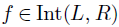 $f\in \mathrm{Int}(L, R)$
we have
 $\int_L f({\lambda})\, d\delta_{{\lambda}_0}({\lambda}) =f({\lambda}_0)$
. Note that
 $\delta_0\star \mu =\mu$
for every
 $\mu \in{\mathcal D}_{\mathrm{pol}}(L, R)$
and that
 $\delta_{{\lambda}_1}\star \delta_{{\lambda}_2}= \delta_{{\lambda}_1 + {\lambda}_2}$
for all
 ${\lambda}_1, {\lambda}_2\in L$
. Thus the map
 $L\to {\mathcal D}_{\mathrm{pol}}(L, R), {\lambda}\mapsto \delta_{{\lambda}}$
extends to a ring homomorphism
 \begin{equation}\delta: R[L] \longrightarrow {\mathcal D}_{\mathrm{pol}}(L, R),\quad \sum_{{\lambda}\in L} a_{{\lambda}} [{\lambda}] \mapsto \sum_{{\lambda}\in L} a_{{\lambda}} \ \delta_{{\lambda}}.\end{equation}
There is also a natural
 $\mathrm{Aff}(L)=\mathrm{Aff}_{{\mathbb Z}}(L)$
-action on
 ${\mathcal D}_{\mathrm{pol}}(L, R)$
,
 \begin{equation}\mathrm{Aff}(L)\times {\mathcal D}_{\mathrm{pol}}(L, R)\longrightarrow {\mathcal D}_{\mathrm{pol}}(L, R), \quad (\varphi, \mu)\mapsto \varphi_*(\mu),\end{equation}
characterized by
 $\int_L f({\lambda})\, d\varphi_*(\mu)({\lambda}) =\int_L \varphi^*(f)({\lambda})\, d \mu({\lambda})$
for
 $f\in \mathrm{Int}(L, R)$
,
 $\varphi\in \mathrm{Aff}(L)$
and
 $\mu\in {\mathcal D}_{\mathrm{pol}}(L, R)$
. Note that we have
 \begin{equation}(\tau_{{\lambda}})_*(\mu) = \delta_{{\lambda}}\star \mu\end{equation}
for every
 ${\lambda} \in L$
and
 $\mu\in {\mathcal D}_{\mathrm{pol}}(L, R)$
, i.e. the R[L]-module structure on
 ${\mathcal D}_{\mathrm{pol}}(L, R)$
induced by the action (11) and by the ring homomorphism given in (10) are the same.
The translations
 $\tau_{{\lambda}}$
for
 ${\lambda}\in L$
also induce an R[L]-module structure on
 $\mathrm{Int}(L, R)$
, given by
 \begin{equation*}\star: R[L] \times \mathrm{Int}(L, R) \longrightarrow \mathrm{Int}(L, R), \quad \bigg(\sum_{{\lambda}\in L} a_{{\lambda}} [{\lambda}]\bigg)\star f:= \sum_{{\lambda}\in L} a_{{\lambda}} \cdot\tau_{{\lambda}}(f).\end{equation*}
By (12), we have, for
 $\mu\in {\mathcal D}_{\mathrm{pol}}(L, R)$
,
 $\alpha\in R[L]$
and
 $f\in \mathrm{Int}(L, R)$
,
 \begin{equation}\int_L f({\lambda}) \, d(\delta(\alpha) \star \mu)({\lambda}) \, = \, \int_L (\alpha\star f)({\lambda})\, d\mu({\lambda}) .\end{equation}
Let
 $R[\![L]\!]$
denote the completion of R[L] with respect to the kernel I(L) of the augmentation map
 ${\varepsilon}: R[L] \to R, \sum_{{\lambda}\in L} a_{{\lambda}} [{\lambda}]\mapsto \sum_{{\lambda}\in L} a_{{\lambda}}$
, i.e. we have
 \begin{equation*}R[\![L]\!] \, =\, \underset{\underset{m}{\longleftarrow}}{\lim} R[L]/I(L)^m.\end{equation*}
Proposition 2.5. The homomorphism given in (10) induces an isomorphism of R-algebras
 \begin{equation*}R[\![L]\!]\longrightarrow {\mathcal D}_{\mathrm{pol}}(L, R).\end{equation*}
Proof. For
 $m\in {\mathbb Z}_{\ge 0}$
, we let
 $\mathrm{Int}^m(L, {\mathbb Z})$
be the submodule of
 $\mathrm{Int}(L, {\mathbb Z})$
of integer-valued polynomial functions
 $f:L\to {\mathbb Z}$
of degree
 $\le m$
, i.e. the total degree of the polynomial
 $P(X_1, \ldots, X_n)$
in Definition 2.1 is
 $\le m$
. Put
 $\mathrm{Int}^m(L, R):=\mathrm{Int}^m(L, {\mathbb Z})\otimes R$
,
 ${\mathcal D}_{\mathrm{pol}, m}(L, R):=\mathrm{Hom}(\mathrm{Int}^m(L, {\mathbb Z}), R)$
and let
 \begin{equation}R[L] \longrightarrow {\mathcal D}_{\mathrm{pol}, m}(L, R), \quad \sum_{{\lambda}\in L} a_{{\lambda}} [{\lambda}] \mapsto \sum_{{\lambda}\in L} a_{{\lambda}} \ \mathrm{res}(\delta_{{\lambda}})\end{equation}
be the composite of (10) with the restriction
 $\mathrm{res}:{\mathcal D}_{\mathrm{pol}}(L, R)\to {\mathcal D}_{\mathrm{pol}, m}(L, R)$
, i.e. the dual map of inclusion
 $\mathrm{Int}^m(L, R)\hookrightarrow \mathrm{Int}(L, R)$
. We will show that (14) is surjective with kernel
 $I(L)^{m+1}$
. Hence it induces an isomorphism
 \begin{equation}R[L]/I(L)^{m+1} \longrightarrow {\mathcal D}_{\mathrm{pol}, m}(L, R).\end{equation}
Passing to the inverse limit over all m yields the assertion.
For the surjectivity of (14), it suffices to consider the case
 $L={\mathbb Z}^n$
. Let
 $\mu \in {\mathcal D}_{\mathrm{pol}, m}({\mathbb Z}^n, R)$
and let
 $\Xi$
be the set of
 ${\underline{k}}=(k_1, \ldots, k_n)\in ({\mathbb Z}_{\ge 0})^n$
such that
 $\sum_{i=1}^n k_i \le m$
. To see that
 $\mu$
lies in the image of (14), it is enough to show that there exists
 $(a_{{\underline{k}}})_{{\underline{k}}\in \Xi}\in R^{\Xi}$
such that
 \begin{equation}\mu\, =\, \sum_{{\underline{k}}\in \Xi} a_{{\underline{k}}} \mathrm{res}(\delta_{{\underline{k}}}).\end{equation}
Since the polynomials
 $({{\underline{X}}}/{{\underline{l}}})$
, with
 ${\underline{l}}\in \Xi$
form an R-basis of
 $\mathrm{Int}^m({\mathbb Z}^n, R)$
, an element
 $(a_{{\underline{k}}})_{{\underline{k}}\in \Xi}\in R^{\Xi}$
satisfies (16) if and only if it is a solution to the system of linear equations
 \begin{equation}\mu\left(\!\binom{{\underline{X}}}{{\underline{l}}}\!\right)\, =\, \sum_{{\underline{k}}\in \Xi} a_{{\underline{k}}} \binom{{\underline{k}}}{{\underline{l}}}\quad \forall\, {\underline{l}}\in \Xi.\end{equation}
For that, we equip
 $\Xi$
with the lexicographic order, i.e. for
 ${\underline{k}}=(k_1, \ldots, k_n), {\underline{l}}=(l_1, \ldots, l_n)$
, we have
 ${\underline{k}} \lt {\underline{l}}$
if there exists an index
 $i\in \{1, \ldots, n\}$
such that
 $k_j=l_j$
for
 $j=1, \ldots, i-1$
and
 $k_i \lt l_i$
. Note that
 \[\binom{{\underline{k}}}{{\underline{l}}}\, =\, \left\{ \begin{array}{cc} 0 & \quad \mbox{if ${\underline{k}} \lt {\underline{l}}$,}\\ 1 & \quad \mbox{if ${\underline{k}} = {\underline{l}}$,} \end{array}\right. \]
so that
 $( {{\underline{k}}}/{{\underline{l}}})_{{\underline{k}}, {\underline{l}}\in \Xi}$
is an upper triangular matrix with entries in
 ${\mathbb Z}$
and diagonal entries
 $=1$
. Hence the system of equations given in (17) has a unique solution
 $(a_{{\underline{k}}})_{{\underline{k}}\in \Xi}\in R^{\Xi}$
.
To show that
 $I(L)^{m+1}$
lies in the kernel of (14), we argue as in [Reference Dasgupta and SpiessDS18, Lemma 4.3]. Note that for
 ${\lambda}\in L$
and
 $f\in \mathrm{Int}^m(L, R)$
, we have
 $([{\lambda}] - [0])\star f= \tau_{\lambda}(f) - f\in \mathrm{Int}^{m-1}(L, R)$
. It follows that
 $I(L)\star \mathrm{Int}^m(L, R)\subseteq \mathrm{Int}^{m-1}(L, R)$
; hence
 $I(L)^{m+1}\star \mathrm{Int}^m(L, R)=0$
. Since by (13) we have, for
 $\alpha\in I(L)^{m+1}$
and
 $f\in \mathrm{Int}^m(L, R)$
,
 \begin{equation*}\int_L f({\lambda}) \, d \delta(\alpha) ({\lambda}) \, = \, \int_L (\alpha\star f)({\lambda}) \, d\delta_0({\lambda}) \, =\, 0\end{equation*}
we conclude that
 $I(L)^{m+1}$
lies in the kernel of (14).
We have shown that (14) induces an epimorphism given in (15). To show that the latter is an isomorphism, it suffices to remark that both the source and the target are free R-modules of the same rank. Since
 $\mathrm{Int}^m(L, R)$
is a free R-module of rank
 $\sharp(\Xi) = \binom{m+n}{m}$
, the same is true for its dual
 ${\mathcal D}_{\mathrm{pol}, m}(L, R)$
. On the other hand, the choice of a basis
 ${\lambda}_1, \ldots, {\lambda}_n$
of L yields an isomorphism
 $R[T_1^{\pm 1}, \ldots, T_n^{\pm 1}]\cong R[L]$
and hence an isomorphism
 \begin{equation*}R[t_1, \ldots, t_n]/(t_1, \ldots, t_n)^{m+1} \, \cong \, R[L]/I(L)^{m+1},\end{equation*}
with
 $t_i := T_i-1$
for
 $i=1, \ldots, n$
. Thus
 $R[L]/I(L)^{m+1}$
is a free R-module of rank
 $\binom{m+n}{m}$
as well.
Note that the
 $\mathrm{Aff}(L)$
-action on
 ${\mathcal D}_{\mathrm{pol}}(L, R)$
induces a
 $\mathrm{GL}(L)$
-action on
 $\mathrm{Ext}_{R[L]}^i(R, {\mathcal D}_{\mathrm{pol}}(L, R))$
for every
 $i\ge 0$
.
Corollary 2.6. Let L be a lattice of rank n. Then there exists a canonical isomorphism of
 $R[\mathrm{GL}(L)]$
-modules
 \[\mathrm{Ext}_{R[L]}^i(R, {\mathcal D}_{\mathrm{pol}}(L, R))\, =\, \bigg\{ \begin{array}{ll} (\bigwedge^{\!n} L)_R & \quad \mbox{if $i=n$,}\\ 0 & \quad \mbox{if $i \ne n$.} \end{array}\bigg. \]
for every
 $i\in {\mathbb Z}_{\ge 0}$
.
Proof. This follows from Proposition 2.5 and [Reference Beilinson, Kings and LevinBKL18, Theorem 3.25]. We give a purely algebraic proof. First, we assume that
 $L={\mathbb Z}^n$
, so that
 $R[{\mathbb Z}^n]$
can be identified with the ring of Laurent polynomials in n variable
 $R[T_1^{\pm 1}, \ldots, T_n^{\pm 1}]$
, I(L) with the ideal
 $(t_1, \ldots, t_n)$
with
 $t_i:=T_i-1$
and
 ${\mathcal D}_{\mathrm{pol}}({\mathbb Z}^n, R)\cong R[\![{\mathbb Z}^n]\!]$
with the power series ring
 $R[\![t_1, \ldots, t_n]\!]\cong \underset{\longleftarrow}{\lim}_m R[T_1^{\pm 1}, \ldots, T_n^{\pm 1}]/(t_1, \ldots, t_n)^m$
. We have to show that
 \begin{equation}\mathrm{Ext}_{R\left[T_1^{\pm 1}, \ldots, T_n^{\pm 1}\right]}^i(R, R[\![t_1, \ldots, t_n]\!])\, =\, \left\{ \begin{array}{ll} R & \quad \mbox{if $i=n$,}\\ 0 & \quad \mbox{if $i \ne n$.} \end{array}\right.\end{equation}
Since
 ${\underline{t}}:=(t_1, \ldots, t_n)$
form a regular sequence of
 $R[T_1^{\pm 1}, \ldots, T_1^{\pm 1}]$
, we have (see [Reference WeibelWei94, Corollary 4.5.5 and Example 4.5.2])
 \[\mathrm{Ext}_{R[T_1^{\pm 1}, \ldots, T_n^{\pm 1}]}^i(R, M)\, =\, H^i({\underline{t}}, M)\, =\, H_{n-i}({\underline{t}}, M) \]
for any
 $R[T_1^{\pm 1}, \ldots, T_n^{\pm 1}]$
-module M and any
 $i\in {\mathbb Z}_{\ge 0}$
(here,
 $H^{{\bullet}}({\underline{t}}, M)$
and
 $H_{{\bullet}}({\underline{t}}, M)$
denote Koszul cohomology and homology). Note also that
 $t_1, \ldots, t_n$
forms a regular sequence of
 $R[\![t_1, \ldots, t_n]\!]$
and that we have
 \[R[\![t_1, \ldots, t_n]\!]/(t_1, \ldots, t_n) \cong R[\![t_1, \ldots, t_{n-1}]\!]/(t_1, \ldots, t_{n-1})\cong \ldots \cong R[\![t_1]\!]/(t_1)\cong R. \]
Thus (18) follows from [Reference WeibelWei94, Corollary 4.5.4].
Now assume that L is an arbitrary lattice of rank n. The choice of a basis
 ${\underline{\lambda}}=({\lambda}_1, \ldots, {\lambda}_n)$
of L induces isomorphisms
 $\bigwedge^{\!n} L \cong {\mathbb Z}$
and
 \begin{equation}\mathrm{Ext}_{R[L]}^n(R, {\mathcal D}_{\mathrm{pol}}(L, R))\, \cong \, \mathrm{Ext}_{R[{\mathbb Z}^n]}^n(R, {\mathcal D}_{\mathrm{pol}}({\mathbb Z}^n, R))\, \cong \, R.\end{equation}
Changing the basis changes both isomorphisms by the factor
 $\mathrm{sign}(\det(A))$
, where
 $A\in \mathrm{GL}_n({\mathbb Z})$
is the associated transition matrix. Thus there is a canonical isomorphism
 $\mathrm{Ext}_{R[L]}^n(R, {\mathcal D}_{\mathrm{pol}}(L, R))\cong (\bigwedge^{\!n} L)_R$
that is independent of the choice of
 ${\underline{\lambda}}$
.
We finish this section by introducing generalizations of Definitions 2.1 and 2.3 to (left) L-sets. The latter is a set H together with an L-action
 $+: L\times H\to H, (\lambda, h) \mapsto {\lambda} + h$
. The example the reader should have in mind is that L is a subgroup of a rational vector space V and H is an L-stable subset of V, i.e. we have
 ${\lambda} + h\in H$
for every
 ${\lambda}\in L$
and
 $h\in H$
. An L-subset of H is a subset
 $H'\subseteq H$
that is stable under the L-action. An L-set H will be called finite if there are only finitely many L-orbits.
Definition 2.7. Let H be an L-set.
-
(a) A map
$f: H \to {\mathbb Z}$
is called an integer-valued polynomial function if for every
$h\in H$
and every
${\mathbb Z}$
-basis
${\lambda}_1, \ldots, {\lambda}_n$
of L, there exists a polynomial
$P(X_1, \ldots, X_n)\in {\mathbb Q}[X_1, \ldots, X_n]$
such that The ring of integer-valued polynomial functions
\[f(x_1{\lambda}_1 + \cdots + x_n {\lambda}_n + h) \, =\, P(x_1, \ldots, x_n)\quad \forall \, (x_1, \ldots, x_n)\in {\mathbb Z}^n. \]
$f: H\to {\mathbb Z}$
will be denoted by
$\mathrm{Int}_L(H, {\mathbb Z})$
(or by
$\mathrm{Int}(H, {\mathbb Z})$
for short). More generally, for an arbitrary ring R, we define
$\mathrm{Int}_L(H, R):= \mathrm{Int}_L(H, {\mathbb Z})\otimes R$
. An element
$f\in \mathrm{Int}_L(H, R)$
will be called an (R-valued) polynomial function on H and we again use the symbolic notation
$f:H\to R$
.
-
(b) An integer-valued polynomial function
$f: H \to {\mathbb Z}$
is said to be of bounded support if its support is contained in a finite L-subset
$H'\subseteq H$
, i.e. if there exist finitely many elements
$h_1, \ldots, h_m\in H$
such that
$\mathrm{supp}(f)=\{h\in H\mid f(h)\ne 0\}\subseteq \bigcup_{i=1}^m L+ h_i$
. The ring of integer-valued locally polynomial functions
$H\to {\mathbb Z}$
with bounded support will be denoted by
$\mathrm{Int}_{L, b}(H, {\mathbb Z})$
(or simply by
$\mathrm{Int}_b(H, {\mathbb Z})$
). For a ring R, we put
$\mathrm{Int}_{L, b}(H, R):= \mathrm{Int}_{L, b}(H, {\mathbb Z})\otimes R$
. -
(c) The dual of
$\mathrm{Int}_{L, b}(H, R)$
will be denoted by It is called the module of R-valued polynomial distributions on H.
\[{\mathcal D}_{\mathrm{pol}}(H, R)\, =\, {\mathcal D}_{\mathrm{pol}, L}(H, R) \, = \, \mathrm{Hom}_{{\mathbb Z}}(\mathrm{Int}_{L, b}(H, {\mathbb Z}), R) \, =\, \mathrm{Hom}_R(\mathrm{Int}_{L, b}(H, R), R). \]


Clearly, for a sublattice L’ of L, we have
 $\mathrm{Int}_L(H, {\mathbb Z})\subseteq \mathrm{Int}_{L'}(H, {\mathbb Z})$
and
 $\mathrm{Int}_{L, b}(H, {\mathbb Z})\subseteq \mathrm{Int}_{L', b}(H, {\mathbb Z})$
. Also, for an L-subset
 $H'\subseteq H$
, there exist canonical ring homomorphisms
 \begin{eqnarray}\mathrm{Int}_L(H, {\mathbb Z}) &\longrightarrow& \mathrm{Int}_L(H',{\mathbb Z}), \quad{\kern-3pt} f \mapsto f|_{H'} \mbox{'Restriction',}\end{eqnarray}
 \begin{eqnarray}\mathrm{Int}_L(H', {\mathbb Z}) &\longrightarrow& \mathrm{Int}_L(H,{\mathbb Z}),\quad f \mapsto f_! \mbox{'Extension by zero'}\end{eqnarray}
that map
 $\mathrm{Int}_{L, b}(H, {\mathbb Z})$
(respectively,
 $\mathrm{Int}_{L, b}(H', {\mathbb Z})$
) into
 $\mathrm{Int}_{L, b}(H', {\mathbb Z})$
(respectively,
 $\mathrm{Int}_{L, b}(H, {\mathbb Z})$
).
Remark 2.8.
-
(a) Let
$\varphi: H_1 \to H_2$
be an L-equivariant map between L-sets. The map
$\varphi^*: \mathrm{Maps}(H_2, {\mathbb Z}) \to \mathrm{Maps}(H_1, {\mathbb Z}), f\mapsto f\circ \varphi$
maps
$\mathrm{Int}_L(H_2, {\mathbb Z})$
into
$\mathrm{Int}_L(H_1, {\mathbb Z})$
. Moreover, if
$\varphi$
is injective, then
$\varphi^*$
maps
$\mathrm{Int}_{L,b}(H_2, {\mathbb Z})$
into
$\mathrm{Int}_{L,b}(H_1, {\mathbb Z})$
, i.e. it induces a homomorphism of L-algebras
$\varphi^*: \mathrm{Int}_b(H_2, R)\to \mathrm{Int}_b(H_1, R)$
. We denote the dual map by
\begin{equation*}\varphi_*: {\mathcal D}_{\mathrm{pol}, L}(H_1, R) \longrightarrow {\mathcal D}_{\mathrm{pol}, L}(H_2, R).\end{equation*}
-
(b) In particular, for an L-set H and
${\lambda} \in L$
, the map
$\varphi: H \to H, h \mapsto {\lambda} + h$
is L-equivariant. The induced homomorphism of R-algebras
$\tau_{{\lambda}}:= \varphi^*:\mathrm{Int}(H, R)\to \mathrm{Int}(H, R)$
will be called translation by
${\lambda}$
. Similarly to Lemma 2.2(b), for every polynomial function
$f: H\to R$
there exist finitely many polynomial functions
$f_1, \ldots, f_N: H\to R$
and
$g_1, \ldots, g_N:L\to R$
such that (22)for every
\begin{equation}\tau_{{\lambda}}(f)\, =\, \sum_{i=1}^r g_i({\lambda}) f_i\end{equation}
${\lambda}\in L$
. Moreover, if f has bounded support, then
$f_1, \ldots, f_N$
can be chosen to have bounded support as well. The collection of translations
$\tau_{{\lambda}}$
for
${\lambda}\in L$
induces an R[L]-module structure on
$\mathrm{Int}(H, R)$
. It will be denoted by
$\star: R[L] \times \mathrm{Int}(H, R) \to \mathrm{Int}(H, R)$
.
-
(c) By using the property given in (22) for
$\mu\in {\mathcal D}_{\mathrm{pol}}(L, R)$
and
$\nu\in {\mathcal D}_{\mathrm{pol}, L}(H, R)$
, one can define the convolution
$\mu\star \nu\in {\mathcal D}_{\mathrm{pol}, L}(H, R)$
similarly to (9). Namely, we have for every
\begin{equation*}\int_H f(h)\, d(\mu\star \nu)(h) = \int_H \bigg(\! \int_Lf({\lambda} + h)\, d\mu({\lambda})\!\bigg)\, d\nu(h)\end{equation*}
$f\in \mathrm{Int}_{L,b}(H, R)$
. Thus the convolution product defines on
${\mathcal D}_{\mathrm{pol}, L}(H, R)$
a
${\mathcal D}_{\mathrm{pol}}(L, R)$
-module structure.
-
(d) Let H be an L-set and let
$H= \bigcup_{i\in I} H_i$
be a covering by disjoint L-subsets. The family of maps
$\mathrm{Int}_{L, b}(H_i, {\mathbb Z}) \to \mathrm{Int}_{L, b}(H, {\mathbb Z}), f_i \mapsto (f_i)_!$
induces an isomorphism (23)For that, it suffices to verify surjectivity. Let
\begin{equation}\bigoplus_{i\in I} \mathrm{Int}_{L, b}(H_i, {\mathbb Z}) \longrightarrow \mathrm{Int}_{L, b}(H, {\mathbb Z}).\end{equation}
$f\in \mathrm{Int}_{L, b}(H, {\mathbb Z})$
there exists a finite L-subset H’ of H such that
$\mathrm{supp}(f)\subseteq H'$
. Note that the set
$J:=\{i\in I\mid H_i\cap H'\ne \emptyset\}$
is finite since H’ has only finitely many L-orbits. If we put
$f_i := f|_{H_i}$
for
$i\in I$
, then we have
$f_i=0$
except possibly for
$i\in J$
. It follows that
$(f_i)_{i\in I}\in \bigoplus_{i\in I} \mathrm{Int}_{L, b}(H_i, {\mathbb Z})$
is mapped to f under (23).


2.2 Locally polynomial distributions
In the following, V denotes a
 ${\mathbb Q}$
-vector space of dimension n (in Proposition 2.15 we assume, moreover, that V is oriented). Recall that
 ${\mathrm{Lat}}(V)$
is the set of all subgroups
 $L\subseteq V$
that are free abelian of rank n. Elements of
 ${\mathrm{Lat}}(V)$
will be called lattices. We fix a non-empty subset
 ${\mathscr L}$
of
 ${\mathrm{Lat}}(V)$
such that we have
 \begin{equation} L_1\cap L_2, \quad L_1 + L_2 \in {\mathscr L} \quad \text{for all } L_1, L_2\in {\mathscr L}.\end{equation}
For such
 ${\mathscr L}$
, we put
 \begin{equation*}\Lambda\,=\, \Lambda({\mathscr L}):= \, \bigcup_{L\in {\mathscr L}} L.\end{equation*}
Note that
 $\Lambda$
is a subgroup of V. For such data, we consider the group
 \begin{equation*}\mathrm{Aut}_{{\mathscr L}}(\Lambda)\, =\, \{\alpha\in \mathrm{GL}(V)\mid \alpha(L), \alpha^{-1}(L)\in {\mathscr L} \, \forall \, L\in {\mathscr L}\}.\end{equation*}
The elements of
 $\mathrm{Aut}_{{\mathscr L}}(\Lambda)$
map
 $\Lambda$
onto itself, i.e. we have
 $\mathrm{Aut}_{{\mathscr L}}(\Lambda)\subseteq \mathrm{GL}(\Lambda)$
. Let
 ${\Gamma}$
be a subgroup of
 $\mathrm{GL}(V)$
. The set
 ${\mathscr L}$
will be called
 ${\Gamma}$
-stable if
 ${\Gamma}\subseteq \mathrm{Aut}_{{\mathscr L}}(\Lambda)$
.
Example 2.9.
-
(a) Let F be a number field of degree n over
${\mathbb Q}$
with ring of integers
${\mathcal O}_F$
. The set of all fractional ideals
${\mathcal I}={\mathrm{Lat}}_{{\mathcal O}_F}(F)$
of F is a closed
$F^*$
-stable subset of
${\mathrm{Lat}}(F)$
and we have
$\Lambda= F$
. More generally, the set of fractional ideals
${\mathcal I}^S$
of F that are coprime to a fixed finite set S of nonarchimedean places of F is a closed subset of
${\mathrm{Lat}}_{{\mathcal O}_F}(F)$
. If
${\mathcal O}_S=\{x\in F\mid \mathrm{ord}_{{\mathfrak p}}(x) \ge 0\,\forall \,{\mathfrak p} \in S\}$
is the semilocal subring of F associated to S, then we have
$\Lambda({\mathcal I}^S) = {\mathcal O}_S$
and
${\mathcal I}^S$
is
${\mathcal O}_S^*$
-stable. -
(b) More generally, let
$n=dm$
, let F be a number field of degree d over
${\mathbb Q}$
and let V be a m-dimensional F-vector space. Let S as above be a finite set of nonarchimedean places of F and let
${\mathcal M}$
be a finitely generated
${\mathcal O}_S$
-submodule of V with
$\mathrm{rank}_{{\mathcal O}_S} {\mathcal M} = m$
, i.e. we have
${\mathcal M}\otimes_{{\mathcal O}_S} F=V$
. Then, we consider the set
${\mathscr L}={\mathscr L}({\mathcal M})$
of finitely generated
${\mathcal O}_F$
-submodules
$L\subseteq {\mathcal M}$
satisfying
$L\otimes_{{\mathcal O}_F} {\mathcal O}_S = {\mathcal M}$
. It is a closed
$\mathrm{GL}_{{\mathcal O}_S}({\mathcal M})$
-stable subset of
${\mathrm{Lat}}_{{\mathcal O}_F}(V)$
and we have
$\Lambda({\mathscr L}) = {\mathcal M}$
.


For later use, we note that the set
 ${\mathscr L}({\mathcal M})$
admits an adelic description (similar to the description of
 ${\mathcal I}^S$
as
 ${\mathcal I}^S\cong ({\mathbb A}_f^S)^*/U_f^S$
). More precisely, there is a canonical transitive action of the group
 $\mathrm{GL}_{{\mathbb A}_f^S}({\mathbb A}_f^S\otimes_{{\mathcal O}_S} V)$
on
 ${\mathscr L}({\mathcal M})$
: given
 $L\in {\mathscr L}({\mathcal M})$
and
 $g\in \mathrm{GL}_{{\mathbb A}_f^S}({\mathbb A}_f^S\otimes_{{\mathcal O}_S} V)$
we define
 $g\cdot L$
by
 $g\cdot L = \, g (L\otimes_{{\mathcal O}_F}\widehat{{\mathcal O}}^S) \cap {\mathcal M}$
, where
 $\widehat{{\mathcal O}}^S:=\prod_{v\not\in S, v\nmid \infty} {\mathcal O}_v$
(the intersection is taken within
 $V\otimes_F {\mathbb A}_f^S$
). Note that the stabilizer of
 $L\in {\mathscr L}({\mathcal M})$
is the group
 $\mathrm{GL}_{\widehat{{\mathcal O}}^S}(\widehat{L}^S)$
, where
 $\widehat{L}^S = L\otimes_{{\mathcal O}_F}\widehat{{\mathcal O}}^S$
.
Let
 ${\mathcal H}$
be a (left)
 $\Lambda$
-set, i.e.
 ${\mathcal H}$
is a set together with a
 $\Lambda$
-action
 $\Lambda\times {\mathcal H} \to {\mathcal H}, ({\lambda}, h) \mapsto {\lambda} +h$
. For
 $L\in {\mathscr L}$
, we say that a subset
 $H\subseteq {\mathcal H}$
is L-stable if
 ${\lambda} +x \in H$
for every
 $x\in H$
and
 ${\lambda} \in L$
. We put
 \begin{equation*}\mathfrak{Open}(\mathcal{H}) \,=\, \mathfrak{Open}_{\mathscr{L}}(\mathcal{H})\, := \, \{\, H \subseteq \mathcal{H} \mid H \text{ is } L\text{-stable for some } L \in \mathscr{L} \,\}.\end{equation*}
An element
 $H\in {\mathfrak{Open}}({\mathcal H})$
will be called finite if H is L-stable and has only finitely many L-orbits for some
 $L\in {\mathscr L}$
. The collection of finite elements of
 ${\mathfrak{Open}}({\mathcal H})$
will be denoted by
 ${\mathfrak{Open}}_{\mathrm{fin}}({\mathcal H})$
. Also, for
 $H\in {\mathfrak{Open}}({\mathcal H})$
, we let
 ${\mathfrak{Open}}_{\mathrm{fin}}(H)$
be the collection of subsets
 $H'\subseteq H$
with
 $H'\in {\mathfrak{Open}}_{\mathrm{fin}}({\mathcal H})$
.
We are now in the position of defining R-valued locally polynomial functions and locally polynomial distributions with respect to the family of lattices
 ${\mathscr L}$
.
Definition 2.10. Let
 ${\mathcal H}$
be a
 $\Lambda$
-set and let
 $H\in {\mathfrak{Open}}({\mathcal H})$
.
-
(a) A map
$f: H \to {\mathbb Z}$
will be called an integer-valued locally polynomial function (with respect to
${\mathscr L}$
) if there exists
$L\in {\mathscr L}$
such that H is L-stable and so that
$f\in \mathrm{Int}_L(H, {\mathbb Z})$
. The ring of all integer-valued locally polynomial functions
$H\to {\mathbb Z}$
with respect to
${\mathscr L}$
will be denoted by
$\mathrm{Int}_{{\mathscr L}\mathrm{\mbox{--}loc}}(H, {\mathbb Z})$
or simply by
$\mathrm{Int}_{\mathrm{loc}}(H, {\mathbb Z})$
. For a ring R, we define
$\mathrm{Int}_{\mathrm{loc}}(H, R):= \mathrm{Int}_{\mathrm{loc}}(H, {\mathbb Z})\otimes R$
. Elements of
$\mathrm{Int}_{\mathrm{loc}}(H, R)$
will be called R-valued locally polynomial functions on H. -
(b) An element
$f\in \mathrm{Int}_{\mathrm{loc}}(H, {\mathbb Z})$
is called an integer-valued polynomial function with bounded support if there exists a subset
$H'\subseteq H$
with
$H'\in {\mathfrak{Open}}_{\mathrm{fin}}({\mathcal H})$
and
$\mathrm{supp}(f)\subseteq H'$
. The abelian group of locally polynomial functions
$H\to {\mathbb Z}$
with bounded support will be denoted by
$\mathrm{Int}_{{\mathscr L}\mathrm{\mbox{--}loc}, b}(H, {\mathbb Z})=\mathrm{Int}_{\mathrm{loc}, b}(H, {\mathbb Z})$
. For a ring R, we define
$\mathrm{Int}_{\mathrm{loc}, b}(H, R):= \mathrm{Int}_{\mathrm{loc}, b}(H, {\mathbb Z})\otimes R$
. -
(c) The dual of
$\mathrm{Int}_{\mathrm{loc}, b}(H, R)$
will be denoted by It is called the module of locally polynomial R-valued distributions on H with respect to
\[{\mathcal D}_{\mathrm{lpol}}(H, R)\, =\,{\mathcal D}_{{\mathscr L}\mathrm{\mbox{--}lpol}}(H, R)\, =\, \mathrm{Hom}_{{\mathbb Z}}(\mathrm{Int}_{\mathrm{loc}, b}(H, {\mathbb Z}), R) = \mathrm{Hom}_R(\mathrm{Int}_{\mathrm{loc}, b}(H, R), R). \]
${\mathscr L}$
.
-
(d) An additive map
$\mu: \mathrm{Int}_{\mathrm{loc}}(H, {\mathbb Z})\to R$
will be called an R-valued locally polynomial distribution on H with bounded support if there exists a subset
$H'\subseteq H$
with
$H'\in {\mathfrak{Open}}_{\mathrm{fin}}({\mathcal H})$
such that
$\mu(f)$
depends only on
$f|_{H'}$
, i.e. there exists an additive map
$\mu': \mathrm{Int}_{\mathrm{loc}}(H', {\mathbb Z})\to R$
such that
$\mu(f) =\mu'(f|_{H'})$
for every
$f\in \mathrm{Int}_{\mathrm{loc}}(H, {\mathbb Z})$
. We denote by
${\mathcal D}_{\mathrm{lpol}, b}(H, R)$
the module of R-valued locally polynomial distributions on H with bounded support.


Let
 $H\in {\mathfrak{Open}}({\mathcal H})$
and assume that H is L-stable for
 $L\in {\mathscr L}$
. If we put
 ${\mathscr L}(L):= \{L'\in {\mathscr L}\mid L'\subseteq L\}$
and consider it as a partially ordered set (ordered by inclusions), then we have
 \[\mathrm{Int}_{\mathrm{loc}, b}(H, {\mathbb Z}) = \underset{\longrightarrow}{\lim}_{L'\in {\mathscr L}(L)} \mathrm{Int}_{L', b}(H, {\mathbb Z}) \quad \mbox{and} \quad \mathrm{Int}_{\mathrm{loc}}(H, {\mathbb Z}) = \underset{\longrightarrow}{\lim}_{L'\in {\mathscr L}(L)} \mathrm{Int}_{L'}(H, {\mathbb Z}). \]
It follows that for an arbitrary coefficient ring R, we have
 \begin{equation}{\mathcal D}_{\mathrm{lpol}}(H, R) \, =\, \underset{\longleftarrow}{\lim}_{L'\in {\mathscr L}(L)^{\mathrm{opp}}} {\mathcal D}_{\mathrm{pol}, L'}(H, R).\end{equation}
Note that for any
 $L'\in {\mathscr L}(L)$
and
 $m\in {\mathbb Z}$
, we have
 $\mathrm{Int}_{L', b}(H, {\mathbb Z})\cap m\mathrm{Int}_{L'}(H, {\mathbb Z}) = m\mathrm{Int}_{L', b}(H, {\mathbb Z})$
, i.e.
 $\mathrm{Int}_{L'}(H, {\mathbb Z})/\mathrm{Int}_{L', b}(H, {\mathbb Z})$
is torsion-free. Therefore,
 \[\mathrm{Int}_{\mathrm{loc}}(H, {\mathbb Z})/\mathrm{Int}_{\mathrm{loc}, b}(H, {\mathbb Z})= \underset{\longrightarrow}{\lim}_{L'\in {\mathscr L}(L)} \mathrm{Int}_{L'}(H, {\mathbb Z})/\mathrm{Int}_{L', b}(H, {\mathbb Z}) \]
is torsion-free as well. It follows that we have
 $\mathrm{Int}_{\mathrm{loc}, b}(H, R)\subseteq \mathrm{Int}_{\mathrm{loc}}(H, R)$
(in fact,
 $\mathrm{Int}_{\mathrm{loc}, b}(H, R)$
is an ideal in
 $\mathrm{Int}_{\mathrm{loc}}(H, R)$
).
For
 $\mu\in {\mathcal D}_{\mathrm{lpol}}(H, R)$
(respectively,
 $\mu\in {\mathcal D}_{\mathrm{lpol}, b}(H, R)$
) we write
 $\int_H f(h)\, d\mu(h)$
for the evaluation of
 $\mu$
at
 $f\in \mathrm{Int}_{\mathrm{loc}, b}(H, R)$
(respectively, at
 $f\in \mathrm{Int}_{\mathrm{loc}}(H, R)$
). More generally, for an R-algebra A we have an evaluation pairing that will again be denoted by
 \begin{equation}{\mathcal D}_{\mathrm{lpol}}(H, R)\times \mathrm{Int}_{\mathrm{loc}, b}(H, A)\, \longrightarrow\, A, \quad (\mu, f) \mapsto \int_H f(h)d\mu(h).\end{equation}
Let
 $H', H\in {\mathfrak{Open}}({\mathcal H})$
with
 $H'\subseteq H$
. Again, there exist canonical ring homomorphisms
 \begin{eqnarray}\mathrm{Int}_{\mathrm{loc}}(H, {\mathbb Z}) &\longrightarrow&\mathrm{Int}_{\mathrm{loc}}(H', {\mathbb Z}), \quad{\kern-3pt} f \mapsto f|_{H'} \quad\mbox{'Restriction',}\end{eqnarray}
 \begin{eqnarray}\mathrm{Int}_{\mathrm{loc}}(H', {\mathbb Z}) &\longrightarrow& \mathrm{Int}_{\mathrm{loc}}(H, {\mathbb Z}), \quad f \mapsto f_! \quad\mbox{'Extension by zero'}\end{eqnarray}
that map
 $\mathrm{Int}_{\mathrm{loc}, b}(H, {\mathbb Z})$
(respectively,
 $\mathrm{Int}_{\mathrm{loc}, b}(H', {\mathbb Z})$
) into
 $\mathrm{Int}_{\mathrm{loc}, b}(H', {\mathbb Z})$
(respectively,
 $\mathrm{Int}_{\mathrm{loc}, b}(H, {\mathbb Z})$
). Dually, we obtain maps
 \begin{eqnarray}{\mathcal D}_{\mathrm{lpol}}(H', R) &\longrightarrow& {\mathcal D}_{\mathrm{lpol}}(H, R), \quad{\kern3pt} \mu \mapsto \mu_! \quad\mbox{'Extension by zero'}\end{eqnarray}
 \begin{eqnarray}{\mathcal D}_{\mathrm{lpol}}(H, R) &\longrightarrow& {\mathcal D}_{\mathrm{lpol}}(H', R), \quad \mu \mapsto \mu|_{L'} \quad\mbox{'Restriction'}\end{eqnarray}
i.e. (29) and (30) are characterized by
 \begin{equation*}\int_H f(h) \, d\mu_! (h) = \int_{H'} (f|_{H'})(h')\, d\mu(h'), \quad \int_{H'} g(h')\, d(\nu|_{H'}) ({\lambda}')=\int_H g_{!}(h) \, d\nu (h)\end{equation*}
for all
 $\mu\in {\mathcal D}_{\mathrm{lpol}, L}(H', R)$
,
 $f\in \mathrm{Int}_{\mathrm{loc}, b}(H, R)$
and
 $\nu\in {\mathcal D}_{\mathrm{lpol}, L}(H, R)$
,
 $g\in \mathrm{Int}_{\mathrm{loc}, b}(H', R)$
. Moreover, note that (27) also induces a map
 \begin{equation}{\mathcal D}_{\mathrm{lpol}, b}(H', R) \longrightarrow {\mathcal D}_{\mathrm{lpol}, b}(H, R), \quad \mu \mapsto \mu_! \quad \mbox{'Extension by zero'}\end{equation}
Note that for
 $H\in {\mathfrak{Open}}({\mathcal H})$
, we have
 \begin{equation*}\mathrm{Int}_{\mathrm{loc}, b}(H, {\mathbb Z}) \, =\, \underset{\longrightarrow}{\lim}_{H'\in {\mathfrak{Open}}_{\mathrm{fin}}(H)} \mathrm{Int}_{\mathrm{loc}}(H', {\mathbb Z}) ,\end{equation*}
where the transition maps in the limit are given by (28). It follows that
 \begin{equation}{\mathcal D}_{\mathrm{lpol}}(H, R) \, =\, \underset{\longleftarrow}{\lim}_{H'\in {\mathfrak{Open}}_{\mathrm{fin}}(H)^{\mathrm{opp}}} {\mathcal D}_{\mathrm{lpol}}(H', R).\end{equation}
Moreover, we note that for the R-module
 ${\mathcal D}_{\mathrm{lpol}, b}(H, R)$
, we have
 \begin{equation*}{\mathcal D}_{\mathrm{lpol}, b}(H, R) \, =\, \underset{\longrightarrow}{\lim}_{H'\in {\mathfrak{Open}}_{\mathrm{fin}}(H)} {\mathcal D}_{\mathrm{lpol}}(H', R).\end{equation*}
Here, the transition map
 ${\mathcal D}_{\mathrm{lpol}}(H_1', R)\to {\mathcal D}_{\mathrm{lpol}}(H_2', R)$
for
 $H_1' \subseteq H_2'\subseteq H$
with
 $H_1', H_2'\in {\mathfrak{Open}}_{\mathrm{fin}}({\mathcal H})$
is the map given in (29).
Let
 $H\in {\mathfrak{Open}}({\mathcal H})$
and let
 $H= \bigcup_{i\in I} H_i$
be a covering of H by disjoint subsets of
 ${\mathfrak{Open}}({\mathcal H})$
. The family of maps
 $\mathrm{Int}_{\mathrm{loc}, b}(H_i, {\mathbb Z}) \to \mathrm{Int}_{\mathrm{loc}, b}(H, {\mathbb Z}), f_i \mapsto (f_i)_!$
induces a homomorphism
 \begin{equation}\bigoplus_{i\in I} \mathrm{Int}_{\mathrm{loc}, b}(H_i, {\mathbb Z}) \longrightarrow \mathrm{Int}_{\mathrm{loc}, b}(H, {\mathbb Z})\end{equation}
and, by passing to duals, a homomorphism
 \begin{equation}{\mathcal D}_{\mathrm{lpol}}(H, R) \longrightarrow \prod_{i\in I} {\mathcal D}_{\mathrm{lpol}}(H_i, R), \quad \mu \mapsto (\mu|_{H_i})_{i\in I}\end{equation}
for any ring R.
Lemma 2.11.
Let
 $H\in {\mathfrak{Open}}({\mathcal H})$
and let
 $H= \bigcup_{i\in I} H_i$
be a covering by disjoint subsets of
 ${\mathfrak{Open}}({\mathcal H})$
. If there exists
 $L\in {\mathscr L}$
such that
 $H_i$
is L-stable for every
 $i\in I$
, then (33) and (34) are isomorphisms.
Proof. It suffices to prove the surjectivity of (33). For a given
 $f\in \mathrm{Int}_{\mathrm{loc}, b}(H, {\mathbb Z})$
, we can choose
 $L\in {\mathscr L}$
sufficiently small such that all
 $H_i$
are L-stable and such that
 $f\in \mathrm{Int}_{L, b}(H, {\mathbb Z})$
. The assertion now follows from Remark 2.8(d).
Remark 2.12. Note that under the assumptions of the lemma, the collection of maps
 ${\mathcal D}_{\mathrm{lpol}, b}(H_i, R) \to {\mathcal D}_{\mathrm{lpol}, b}(H, R), \mu \mapsto \mu_!$
for
 $i\in I$
induces an isomorphism
 \begin{equation*}\bigoplus_{i\in I}{\mathcal D}_{\mathrm{lpol}, b}(H_i, R) \longrightarrow {\mathcal D}_{\mathrm{lpol}, b}(H, R).\end{equation*}
To discuss further functorial properties of the above Definition 2.10, we introduce the notion of an
 ${\mathscr L}$
-affine map.
Definition 2.13. Let
 ${\mathcal H}_1$
,
 ${\mathcal H}_2$
be
 $\Lambda$
-sets. A map
 $\varphi:{\mathcal H}_1 \to {\mathcal H}_2$
will be called an
 ${\mathscr L}$
-affine map if there exists
 $\alpha\in \mathrm{Aut}_{{\mathscr L}}(\Lambda)$
such that
 $\varphi({\lambda} + h) = \alpha({\lambda}) + \varphi(h)$
for every
 ${\lambda}\in \Lambda$
and
 $h\in {\mathcal H}_1$
.
Remark 2.14. Let
 ${\mathcal H} =\Lambda$
be equipped with the obvious structure as a
 $\Lambda$
-set. An
 ${\mathscr L}$
-affine map
 $\varphi:\Lambda\to \Lambda$
is an automorphism composed with a translation. Thus every
 ${\mathscr L}$
-affine map
 $\varphi:\Lambda\to \Lambda$
is a bijection. Hence the
 ${\mathscr L}$
-affine maps
 $\varphi:\Lambda\to \Lambda$
form a group, denoted by
 $\mathrm{Aff}_{{\mathscr L}}(\Lambda)$
, and we have
 $\mathrm{Aff}_{{\mathscr L}}(\Lambda)=\mathrm{Aut}_{{\mathscr L}}(\Lambda)\ltimes \Lambda$
.
Let
 $\varphi:{\mathcal H}_1\to {\mathcal H}_2$
be an
 $\mathscr{L}$
-affine map between
 $\Lambda$
-sets. Note that for
 $H \in {\mathfrak{Open}}({\mathcal H}_2)$
, we have
 $\varphi^{-1}(H)\in {\mathfrak{Open}}({\mathcal H}_1)$
and that
 $\varphi^*: \mathrm{Maps}(\varphi^{-1}(H), {\mathbb Z}) \to \mathrm{Maps}(H, {\mathbb Z}), f\mapsto f\circ \varphi$
maps the subring
 $\mathrm{Int}_{\mathrm{loc}}(\varphi^{-1}(H), {\mathbb Z})$
into
 $\mathrm{Int}_{\mathrm{loc}}(H, {\mathbb Z})$
. Now assume that
 $\varphi:{\mathcal H}_1\to {\mathcal H}_2$
is injective. In this case, we have that
 $\varphi^{-1}(H)\in {\mathfrak{Open}}_{\mathrm{fin}}({\mathcal H}_1)$
for every
 $H\in {\mathfrak{Open}}_{\mathrm{fin}}({\mathcal H}_2)$
. It follows that the homomorphism
 $\varphi^*: \mathrm{Maps}(\varphi^{-1}(H), {\mathbb Z}) \to \mathrm{Maps}(H, {\mathbb Z})$
for
 $H \in {\mathfrak{Open}}({\mathcal H}_2)$
maps the subring
 $\mathrm{Int}_{\mathrm{loc}, b}(\varphi^{-1}(H), {\mathbb Z})$
into
 $\mathrm{Int}_{\mathrm{loc}, b}(H, {\mathbb Z})$
. By passing from
 $\varphi^*: \mathrm{Int}_{\mathrm{loc}, b}(\varphi^{-1}(H), {\mathbb Z})\to \mathrm{Int}_{\mathrm{loc}, b}(H, {\mathbb Z})$
to duals, we obtain a map
 \begin{equation}\varphi_*: {\mathcal D}_{\mathrm{loc}}(H, R) \longrightarrow {\mathcal D}_{\mathrm{loc}}(\varphi^{-1}(H), R).\end{equation}
Now assume that
 ${\mathcal H}= \Lambda$
and let
 $H=L\in {\mathscr L}$
. Then,
 ${\mathcal D}_{\mathrm{lpol}}(L, R)$
carries a natural ring structure given by the convolution given in (9) and the map
 \begin{equation}{\mathcal D}_{\mathrm{lpol}}(L, R) \longrightarrow {\mathcal D}_{\mathrm{pol}}(L, R)\end{equation}
dual to the inclusion
 $\mathrm{Int}(L, R)\hookrightarrow \mathrm{Int}_{\mathrm{loc}}(L, R)$
is a ring homomorphism. Since the Dirac distributions
 $\delta_{{\lambda}}$
,
 ${\lambda}\in L$
lie in
 ${\mathcal D}_{\mathrm{lpol}}(L, R)$
, the map
 $L\to {\mathcal D}_{\mathrm{lpol}}(L, R), {\lambda}\mapsto \delta_{{\lambda}}$
extends to an R-algebra homomorphism
 $R[L]\to {\mathcal D}_{\mathrm{lpol}}(L, R)$
and (36) is a homomorphism of R[L]-algebras.
The R-module
 ${\mathcal D}_{\mathrm{lpol}}(\Lambda, R)$
is equipped with a left action of the group
 $\mathrm{Aff}_{{\mathscr L}}(\Lambda)$
defined by the homomorphisms given in (35); i.e. it is equipped with a natural
 $R[\mathrm{Aff}_{{\mathscr L}}(\Lambda)]$
-module structure. Similarly, one defines an
 $R[\mathrm{Aff}_{{\mathscr L}}(\Lambda)]$
-module structure on
 ${\mathcal D}_{\mathrm{lpol}, b}(\Lambda, R)$
so that the canonical map
 ${\mathcal D}_{\mathrm{lpol},b }(\Lambda, R)\to {\mathcal D}_{\mathrm{lpol}}(\Lambda, R)$
is
 $\mathrm{Aff}_{{\mathscr L}}(\Lambda)$
-equivariant.
Now assume that V is oriented and let
 \begin{equation}{\epsilon}: \mathrm{GL}(V) \longrightarrow \{\pm 1\} = {\mathbb Z}^*, \quad \alpha \mapsto \mathrm{sign}(\det(\alpha)).\end{equation}
The orientation on
 $V_{{\mathbb R}}$
induces an isomorphism
 $\bigwedge^{\!n} L\cong {\mathbb Z}$
for every lattice
 $L\subset V$
. Indeed, if
 ${\underline{\lambda}}=({\lambda}_1, \ldots, {\lambda}_n)$
is a
 ${\mathbb Z}$
-basis of L that is positively oriented, then we map
 ${\lambda}_1 \wedge \cdots \wedge {\lambda}_n\in \bigwedge^{\!n} L$
to
 $1\in {\mathbb Z}$
. Thus, under this identification, Corollary 2.6 can be rephrased as an isomorphism of
 $\mathrm{GL}(L)$
-modules,
 \begin{equation}\mathrm{Ext}_{R[L]}^i(R, {\mathcal D}_{\mathrm{pol}}(L, R))\, =\, \left\{ \begin{array}{ll} R({\epsilon}) & \quad \mbox{if $i=n$,}\\ 0 & \quad \mbox{if $i \ne n$,} \end{array}\right.\end{equation}
where, by abuse of notation,
 ${\epsilon}$
denotes the restriction of (37) to the subgroup
 $\mathrm{GL}(L)\subseteq \mathrm{GL}(V)$
.
The
 $\mathrm{Aff}_{{\mathscr L}}(\Lambda)$
-action on
 ${\mathcal D}_{\mathrm{lpol}}(\Lambda, R)$
induces an
 $\mathrm{Aut}_{{\mathscr L}}(\Lambda)$
-action on
 $\mathrm{Ext}_{R[\Lambda]}^i(R, {\mathcal D}_{\mathrm{lpol}}(\Lambda, R))$
for every
 $i\ge 0$
. Similarly to (38), we have the following.
Proposition 2.15.
For every
 $i\ge 0$
,
 \[\mathrm{Ext}_{R[\Lambda]}^i(R, {\mathcal D}_{\mathrm{lpol}}(\Lambda, R))\, =\, \left\{ \begin{array}{ll} R({\epsilon}) & \quad \mbox{if $i=n$,}\\ 0 & \quad \mbox{if $i \ne n$.} \end{array}\right. \]
as
 $R[\mathrm{Aut}_{{\mathscr L}}(\Lambda)]$
-modules.
For the proof, we need the following obvious lemma.
Lemma 2.16.
For a ring R and
 $L', L\in {\mathscr L}$
with
 $L'\subseteq L$
, the canonical map
 \begin{equation*}{\mathbb Z}[L]\otimes_{{\mathbb Z}[L']} \mathrm{Int}(L', {\mathbb Z}) \longrightarrow \mathrm{Int}_{L'}(L, {\mathbb Z}), \quad \alpha\otimes f \mapsto \alpha \star f_{!}\end{equation*}
and its dual
 \begin{equation*}{\mathcal D}_{\mathrm{pol}, L'}(L, R) \longrightarrow \mathrm{Hom}_{R[L']}(R[L], {\mathcal D}_{\mathrm{pol}}(L', R))\end{equation*}
are isomorphisms.
Proof of Proposition 2.15. First, note that by (32), we have
 \begin{equation*}{\mathcal D}_{\mathrm{lpol}}(\Lambda, R) \, =\, \underset{\longleftarrow}{\lim}_{L\in {\mathscr L}^{\mathrm{opp}}} {\mathcal D}_{\mathrm{lpol}}(L, R).\end{equation*}
We fix a lattice
 $L_0$
in
 ${\mathscr L}$
. The homomorphism of
 $R[L_0]$
-modules
 ${\mathcal D}_{\mathrm{lpol}}(L_0, R) \to {\mathcal D}_{\mathrm{lpol}}(\Lambda, R)$
(see (29)) induces a homomorphism of
 $R[\Lambda]$
-modules
 \begin{equation}{\mathcal D}_{\mathrm{lpol}}(\Lambda, R) \,\longrightarrow \, \mathrm{Hom}_{R[L_0]}(R[\Lambda], {\mathcal D}_{\mathrm{lpol}}(L_0, R)).\end{equation}
It is an isomorphism by Lemma 2.11. Indeed, if
 ${\mathcal R}$
is a system of representatives for the
 $L_0$
-cosets in
 $\Lambda$
, then the map given in (39) can be identified with the map given in (34) for the covering
 $\Lambda = \bigcup_{{\lambda}\in {\mathcal R}} {\lambda} +L_0$
. Moreover, by (25) and Lemma 2.16, we have
 \begin{equation*}{\mathcal D}_{\mathrm{lpol}}(L_0, R) \, =\, \underset{\longleftarrow}{\lim}_{L\in {\mathscr L}(L_0)^{\mathrm{opp}}} {\mathcal D}_{\mathrm{pol}, L}(L_0, R)\, =\, \underset{\longleftarrow}{\lim}_{L\in {\mathscr L}(L_0)^{\mathrm{opp}}} \mathrm{Hom}_{R[L]}(R[L_0], {\mathcal D}_{\mathrm{pol}}(L, R)) ;\end{equation*}
hence
 \begin{eqnarray}{\mathcal D}_{\mathrm{lpol}}(\Lambda, R) & \cong & \mathrm{Hom}_{R[L_0]}(R[\Lambda], \underset{\longleftarrow}{\lim}_{L\in {\mathscr L}(L_0)^{\mathrm{opp}}} \mathrm{Hom}_{R[L]}(R[L_0], {\mathcal D}_{\mathrm{pol}, L}(L, R)))\nonumber \\& \cong &\underset{\longleftarrow}{\lim}_{L\in {\mathscr L}^{\mathrm{opp}}}\mathrm{Hom}_{R[L]}(R[\Lambda], {\mathcal D}_{\mathrm{pol}}(L, R)).\end{eqnarray}
By Corollary 2.6 and Shapiro’s lemma, we have
 \begin{equation}\mathrm{Ext}_{R[\Lambda]}^i(R, \mathrm{Hom}_{R[L]}(R[\Lambda], {\mathcal D}_{\mathrm{pol}}(L, R))) \, = \, \mathrm{Ext}_{R[L]}^i(R, {\mathcal D}_{\mathrm{lpol}}(L, R)) \, =\, \left\{ \begin{array}{ll} R({\epsilon}) & \quad \mbox{if $i=n$,}\\ 0 & \quad \mbox{if $i \ne n$,} \end{array}\right.\end{equation}
for every
 $i\ge 0$
and
 $L\in {\mathscr L}$
. On the other hand, (40) and the first equality in (41), together with [Reference WeibelWei94, Theorem 3.5.8], imply that there exists a short exact sequence
 \begin{eqnarray} 0 \longrightarrow \underset{\longleftarrow}{\lim}_{L\in {\mathscr L}^{\mathrm{opp}}}^{(1)} \mathrm{Ext}_{R[L]}^{i-1}(R, {\mathcal D}_{\mathrm{lpol}}(L, R)) &&\longrightarrow \mathrm{Ext}_{R[\Lambda]}^i(R, {\mathcal D}_{\mathrm{lpol}}(\Lambda, R))\nonumber\\&& \longrightarrow \underset{\longleftarrow}{\lim}_{L\in {\mathscr L}^{\mathrm{opp}}} \mathrm{Ext}_{R[L]}^i(R, {\mathcal D}_{\mathrm{lpol}}(L, R)) \longrightarrow 0.\end{eqnarray}
From (41), we deduce that the first term in (42) vanishes for every i and the third for every i except for
 $i=n$
, when it is
 $\cong R$
. By keeping track of the
 $\mathrm{Aff}_{{\mathscr L}}({\Lambda})$
-action on the inverse system
 $\{\mathrm{Ext}_{R[L]}^n(R, {\mathcal D}_{\mathrm{lpol}}(L, R))\}_{L\in {\mathscr L}^{\mathrm{opp}}}$
, one checks that
 $\alpha\in \mathrm{Aff}_{{\mathscr L}}({\Lambda})$
acts on
 $\mathrm{Ext}_{R[\Lambda]}^i(R, {\mathcal D}_{\mathrm{lpol}}(\Lambda, R))\cong R$
via multiplication with
 ${\epsilon}(\alpha)$
.
2.3 Change of
${\mathscr L}$

We also need to investigate the effects of changing the subset
 ${\mathscr L}\subseteq {\mathrm{Lat}}(V)$
in specific circumstances. For that, let
 ${\mathscr L}_1$
and
 ${\mathscr L}_2$
be non-empty closed subsets of
 ${\mathrm{Lat}}(V)$
and put
 $\Lambda_i:= \Lambda({\mathscr L}_i)$
for
 $i=1,2$
. We assume that
 $\Lambda_2 \cap L_1 \in {\mathscr L}_2$
for every
 $L_1\in {\mathscr L}_1$
and that
 \begin{equation*}{\mathscr L}_1\longrightarrow {\mathscr L}_2, \quad L_1\mapsto \Lambda_2 \cap L_1\end{equation*}
is a bijection. This implies, in particular, that
 $\Lambda_1\supseteq \Lambda_2$
. We consider a
 $\Lambda_1$
-set
 ${\mathcal H}_1$
and a
 $\Lambda_2$
-subset
 ${\mathcal H}_2\subseteq {\mathcal H}_1$
. Let
 $H_1\in {\mathfrak{Open}}({\mathcal H}_1)$
and let
 $L_1\in {\mathscr L}_1$
such that
 $H_1$
is
 $L_1$
-stable. Then,
 $H_2:=H_1\cap {\mathcal H}_2$
is
 $L_2:=L_1\cap\Lambda_1$
-stable. Moreover, if
 $f\in \mathrm{Int}_{L_1}(H_1, {\mathbb Z})$
(respectively,
 $f\in \mathrm{Int}_{L_1, b}(H_1, {\mathbb Z})$
), then
 $f|_{H_2} \in \mathrm{Int}_{L_2}(H_2, {\mathbb Z})$
(respectively,
 $f|_{H_2}\in \mathrm{Int}_{L_2, b}(H_2, {\mathbb Z})$
).
It follows that the map
 \begin{equation}\mathrm{Int}_{{\mathscr L}_1\mathrm{\mbox{--}loc}}(H_1, {\mathbb Z}) \longrightarrow \mathrm{Int}_{{\mathscr L}_2\mathrm{\mbox{--}loc}}(H_2, {\mathbb Z}), \quad f \mapsto f|_{H_2}\end{equation}
is well defined for every
 $H_1\in {\mathfrak{Open}}({\mathcal H}_1)$
and
 $H_2\in {\mathfrak{Open}}({\mathcal H}_2)$
with
 $H_2\subseteq H_1$
. Moreover, (43) maps the subring
 $\mathrm{Int}_{{\mathscr L}_1\mathrm{\mbox{--}loc}, b}(H_1, {\mathbb Z})$
of
 $\mathrm{Int}_{{\mathscr L}_1\mathrm{\mbox{--}loc}}(H_1, {\mathbb Z})$
into
 $\mathrm{Int}_{{\mathscr L}_2\mathrm{\mbox{--}loc}, b}(H_2, {\mathbb Z})$
. Therefore, (43) induces R-linear maps
 \begin{eqnarray} {\mathcal D}_{{\mathscr L}_2\mathrm{\mbox{--}lpol}, b}(H_2, R) &\longrightarrow& {\mathcal D}_{{\mathscr L}_1\mathrm{\mbox{--}lpol}, b}(H_1, R), \quad \mu \mapsto \mu_! , \end{eqnarray}
 \begin{eqnarray} {\mathcal D}_{{\mathscr L}_2\mathrm{\mbox{--}lpol}}(H_2, R) &\longrightarrow& {\mathcal D}_{{\mathscr L}_1\mathrm{\mbox{--}lpol}}(H_1, R), \quad{\kern5.8pt} \mu \mapsto \mu_!\end{eqnarray}
that are characterized by
 \begin{equation*}\int_{H_1} f(h_1) \, d\mu_! (h_1) \,=\, \int_{H_2} (f|_{H_2})(h_2)\, d\mu(h_2)\end{equation*}
for all
 $\mu\in {\mathcal D}_{{\mathscr L}_2\mathrm{\mbox{--}lpol}, b}(H_2, R)$
(respectively,
 $\mu\in {\mathcal D}_{{\mathscr L}_2\mathrm{\mbox{--}lpol}}(H_2, R)$
) and
 $f\in \mathrm{Int}_{{\mathscr L}_1\mathrm{\mbox{--}loc}}(H_1, {\mathbb Z})$
(respectively,
 $f\in \mathrm{Int}_{{\mathscr L}_1\mathrm{\mbox{--}loc}, b}(H_1, {\mathbb Z})$
). In particular, for
 $H_1={\mathcal H}_1$
and
 $H_2={\mathcal H}_2$
, we obtain maps
 \begin{eqnarray} {\mathcal D}_{{\mathscr L}_2\mathrm{\mbox{--}lpol}, b}({\mathcal H}_2, R) &\longrightarrow& {\mathcal D}_{{\mathscr L}_1\mathrm{\mbox{--}lpol}, b}({\mathcal H}_1, R), \quad \mu \mapsto \mu_! , \end{eqnarray}
 \begin{eqnarray} {\mathcal D}_{{\mathscr L}_2\mathrm{\mbox{--}lpol}}({\mathcal H}_2, R) &\longrightarrow& {\mathcal D}_{{\mathscr L}_1\mathrm{\mbox{--}lpol}}({\mathcal H}_1, R), \quad{\kern5.8pt} \mu \mapsto \mu_!.\end{eqnarray}
Under certain conditions on
 ${\mathscr L}_1$
,
 ${\mathscr L}_2$
,
 ${\mathcal H}_1$
,
 ${\mathcal H}_2$
and R, these are isomorphisms.
Proposition 2.17. Assume the following.
-
(i) The index
$d:=[L_1 : \Lambda_2 \cap L_1]$
is independent of the choice of
$L_1\in {\mathscr L}_1$
. -
(ii) The action of
${\Lambda}_i$
on
${\mathcal H}_i$
is faithful for
$i=1,2$
and the map
$\Lambda_2\backslash {\mathcal H}_2 \to \Lambda_1\backslash {\mathcal H}_1, \Lambda_2+h\mapsto \Lambda_1+h$
is bijective.
-
(iii) The index
$d=[\Lambda_1 : \Lambda_2]$
is invertible in R.


Then, the maps given in (44) and (45) for
 $H_1={\mathcal H}_1$
and
 $H_2={\mathcal H}_2$
are isomorphisms.
Proof. Note that (i) implies
 $d=[\Lambda_1 : \Lambda_2]$
. By Lemma 2.11 and Remark 2.12, it suffices to consider the case when
 $\Lambda_2$
acts freely and transitively on
 ${\mathcal H}_2$
(hence
 $\Lambda_1$
acts freely and transitively on
 ${\mathcal H}_1$
as well, by (ii)). Thus we may assume
 ${\mathcal H}_i=\Lambda_i$
for
 $i=1,2$
.
We fix
 $L_1\in {\mathscr L}_1$
and put
 $L_2=L_1\cap \Lambda_2$
. As remarked in the proof of Proposition 2.15, we have
 \begin{equation*} {\mathcal D}_{{\mathscr L}_i\mathrm{\mbox{--}lpol}}(\Lambda_i, R) \,\cong \, \mathrm{Hom}_{R[L_i]}(R[\Lambda_i], {\mathcal D}_{{\mathscr L}_i\mathrm{\mbox{--}lpol}}(L_i, R))\end{equation*}
for
 $i=1, 2$
. Similarly, using Remark 2.12, one can show that
 \begin{equation*} {\mathcal D}_{{\mathscr L}_i\mathrm{\mbox{--}lpol}, b}(\Lambda_i, R) \,\cong R[\Lambda_i]\otimes_{R[L_i]} {\mathcal D}_{{\mathscr L}_i\mathrm{\mbox{--}lpol}}(L_i, R).\end{equation*}
Thus it suffices to show that the map given in (44) for
 $H_1=L_1$
,
 $H_2=L_2$
, i.e. the map
 \begin{equation*}{\mathcal D}_{{\mathscr L}_2\mathrm{\mbox{--}lpol}}(L_2, R) \longrightarrow {\mathcal D}_{{\mathscr L}_1\mathrm{\mbox{--}lpol}}(L_1, R), \quad \mu \mapsto \mu_! ,\end{equation*}
is an isomorphism.
First, note that (iii) and Lemma 2.2(a) imply that
 ${\mathcal D}_{\mathrm{pol}}(L_2, R)\to {\mathcal D}_{\mathrm{pol}}(L_1, R), \mu\mapsto \mu_!$
is an isomorphism. Note also that the map
 ${\mathscr L}_1(L_1)\to {\mathscr L}_2(L_2), L_1'\mapsto L_2 \cap L_1'$
is a bijection. Moreover, note that by (25), we have
 \begin{equation*}{\mathcal D}_{{\mathscr L}_i\mathrm{\mbox{--}lpol}}(L_i, R) \, =\, \underset{\longleftarrow}{\lim}_{L_i'\in {\mathscr L}(L_i)^{\mathrm{opp}}} {\mathcal D}_{\mathrm{pol}, L_i'}(L_i, R)\end{equation*}
for
 $i=1, 2$
. Thus, if we fix
 $L_1'\in {\mathscr L}_1(L_1)$
and put
 $L_2':=L_2\cap L_1'$
, then it suffices to show that the canonical map
 \begin{equation}{\mathcal D}_{\mathrm{pol}, L_2'}(L_2, R) \longrightarrow {\mathcal D}_{\mathrm{pol}, L_1'}(L_1, R)\end{equation}
is an isomorphism. From (i), we deduce that
 $R[L_2]\otimes_{R[L_2']} R[L_1']\cong R[L_1]$
. Since, again by Lemma 2.2(a), the map
 ${\mathcal D}_{\mathrm{pol}}(L_2', R)\to {\mathcal D}_{\mathrm{pol}}(L_1', R), \mu\mapsto \mu_!$
is bijective, it induces an isomorphism
 \begin{eqnarray} \mathrm{Hom}_{R[L_2']}(R[L_2], {\mathcal D}_{\mathrm{pol}}(L_2', R)) & \stackrel{\cong}{\longrightarrow} & \mathrm{Hom}_{R[L_2']}(R[L_2], {\mathcal D}_{\mathrm{pol}}(L_1', R))\nonumber \\& \cong & \mathrm{Hom}_{R[L_1']}(R[L_2]\otimes_{R[L_2']} R[L_1'], {\mathcal D}_{\mathrm{pol}}(L_1', R))\nonumber\\& \cong & \mathrm{Hom}_{R[L_1']}(R[L_1], {\mathcal D}_{\mathrm{pol}}(L_1', R)).\end{eqnarray}
According to Lemma 2.16, it can be identified with (48).
We apply Proposition 2.17 in the following situation. As in Example 2.9(b), let F be a number field of degree d over
 ${\mathbb Q}$
, V a m-dimensional F-vector space, S a finite set of nonarchimedean places of F and
 ${\mathcal M}\subseteq V$
a finitely generated
 ${\mathcal O}_S$
-submodule of V with
 $\mathrm{rank}_{{\mathcal O}_S} {\mathcal M} = \dim_F(V)$
. Let
 ${\mathscr L}\subseteq {\mathrm{Lat}}_{{\mathcal O}_F}(V)$
be the set of
 $L\in {\mathrm{Lat}}_{{\mathcal O}_F}(V)$
with
 $L\subseteq {\mathcal M}$
and
 $L\otimes_{{\mathcal O}_F} {\mathcal O}_S= {\mathcal M}$
, i.e. L generates
 ${\mathcal M}$
as an
 ${\mathcal O}_S$
-module.
Corollary 2.18.
Let
 $v\in V$
and let h be the order of
 $v+{\mathcal M}$
in
 $V/{\mathcal M}$
, i.e. h is the minimal positive integer such that
 $h v\in {\mathcal M}$
. If h is invertible in R, then there exist natural isomorphisms
 \begin{equation*} {\mathcal D}_{{\mathscr L}\mathrm{\mbox{--}lpol}, b}(v+ {\mathcal M}, R) \,\cong\, {\mathcal D}_{{\mathscr L}\mathrm{\mbox{--}lpol}, b}({\mathcal M}, R), \quad {\mathcal D}_{{\mathscr L}\mathrm{\mbox{--}lpol}}(v+ {\mathcal M}, R) \,\cong\, {\mathcal D}_{{\mathscr L}\mathrm{\mbox{--}lpol}}({\mathcal M}, R) . \end{equation*}
Proof. Let
 ${\mathcal M}'\subseteq V$
be another finitely generated
 ${\mathcal O}_S$
-submodule of V with
 ${\mathcal M}'\supseteq {\mathcal M}$
and put
 ${\mathscr L}'=\{L'\in {\mathrm{Lat}}_{{\mathcal O}_F}(V)\mid L'\subseteq {\mathcal M}', L'\otimes_{{\mathcal O}_F} {\mathcal O}_S = {\mathcal M}'\}$
. We remark that the map
 ${\mathscr L}' \longrightarrow {\mathscr L}, \quad L'\mapsto L'\cap {\mathcal M}$
is a bijection and that
 $L'/L \to {\mathcal M}'/{\mathcal M}, {\lambda} + L\mapsto {\lambda} + {\mathcal M}'$
is an isomorphism for every
 $L'\in {\mathscr L}'$
and
 $L:=L'\cap {\mathcal M}$
(these facts can be easily seen using the adelic descriptions of the sets
 ${\mathscr L}'$
and
 ${\mathscr L}$
given in Example 2.9(b)). If we choose
 ${\mathcal M}' := {1}/{h} {\mathcal M} : = \{w\in V\mid h w\in {\mathcal M}\}$
, then we see that conditions (i) and (ii) of Proposition 2.17 hold for
 ${\mathscr L}_1= {\mathscr L}'$
,
 ${\mathscr L}_2:= {\mathscr L}$
,
 ${\mathcal H}_1 = {\mathcal M}'$
and
 ${\mathcal H}_2:= v+ {\mathcal M}$
. Moreover, the index
 $[{\mathcal M}':{\mathcal M}]$
is a divisor of
 $h^n$
with
 $n=dm$
and hence is invertible in R, so (iii) holds as well. Thus we can apply Proposition 2.17 and obtain
 \[{\mathcal D}_{{\mathscr L}\mathrm{\mbox{--}lpol}, b}(v + {\mathcal M}, R) \,\cong\, {\mathcal D}_{{\mathscr L}'\mathrm{\mbox{--}lpol}, b}({\mathcal M}', R), \quad {\mathcal D}_{{\mathscr L}\mathrm{\mbox{--}lpol}}(v + {\mathcal M}, R) \,\cong\, {\mathcal D}_{{\mathscr L}'\mathrm{\mbox{--}lpol}}({\mathcal M}', R). \]
Since
 $v\in {1}/{h} {\mathcal M}$
was arbitrary, the assertion follows.
Remark 2.19. Note that the only possible prime divisors of h are the primes numbers lying below the places in S.
3. Lattice topology, sheaves and cohomology
3.1
$({\mathscr L}, \widetilde{\Gamma})$
–spaces and lattice topology

As in § 2, we fix a finite-dimensional
 ${\mathbb Q}$
-vector space V and a non-empty subset
 ${\mathscr L}\subseteq {\mathrm{Lat}}(V)$
with the property given in (24). Recall that
 $\Lambda = \Lambda({\mathscr L})=\bigcup_{L\in {\mathscr L}} L$
is a subgroup of V. We also fix a subgroup
 $\Gamma\subseteq \mathrm{GL}(V)$
such that
 ${\mathscr L}$
is
 $\Gamma$
-stable and put
 $\widetilde{\Gamma}:= \Gamma\ltimes \Lambda\subseteq \mathrm{Aff}_{{\mathbb Z}}(\Lambda)$
. Elements of
 $\widetilde{\Gamma}$
will be denoted by
 ${\widetilde{{\gamma}}}= ({\gamma}, {\lambda})$
, where
 ${\gamma}\in \Gamma$
and
 ${\lambda}\in \Lambda$
.
We associate to this data the following category
 ${\mathcal C}({\mathscr L}, \widetilde{\Gamma})$
. Its set of objects is
 ${\mathscr L}$
. For
 $L_1$
,
 $L_2\in {\mathscr L}$
, a morphism
 $\varphi: L_1 \to L_2$
is a triple
 $\varphi=({\widetilde{{\gamma}}}, L_1, L_2)\in \widetilde{\Gamma}\times {\mathscr L}\times {\mathscr L}$
with
 $\gamma(L_1) \subseteq L_2$
if
 ${\widetilde{{\gamma}}}= (\gamma, {\lambda})$
. The composition of two morphisms
 $\varphi_1=({\widetilde{{\gamma}}}_1, L_1, L_2)$
and
 $\varphi_2=({\widetilde{{\gamma}}}_2, L_2, L_3)$
is the morphism
 $\varphi_2\circ \varphi_1:= ({\widetilde{{\gamma}}}_2\cdot{\widetilde{{\gamma}}}_1, L_1, L_3)$
. Given a morphism
 $\varphi = ({\widetilde{{\gamma}}}, L_1, L_2)$
with
 ${\widetilde{{\gamma}}}= (\gamma, {\lambda})$
, we define its degree by
 \begin{equation*}\deg(\varphi):=[L_2:\gamma(L_1)].\end{equation*}
The degree is multiplicative, i.e. we have
 $\deg(\varphi_2\circ \varphi_1) = \deg(\varphi_2)\cdot \deg(\varphi_1)$
for two morphisms
 $\varphi_1: L_1 \to L_2$
and
 $\varphi: L_2 \to L_3$
in
 ${\mathcal C}({\mathscr L}, \widetilde{\Gamma})$
. Morphisms of the form
 $\varphi=(1, L_1, L_2)$
(i.e. when the first component of
 $\varphi$
is the neutral element in
 $\Gamma$
) will be denoted by
 \begin{equation}\pi =\pi_{L_1, L_2}: L_1 \hookrightarrow L_2.\end{equation}
For these morphisms, we have
 $\deg(\pi_{L_1, L_2}) = [L_2: L_1]$
. For
 $L\in {\mathscr L}$
and
 ${\widetilde{{\gamma}}}=(\gamma, {\lambda})\in \widetilde{\Gamma}$
, we denote the morphism
 $({\widetilde{{\gamma}}}, L , \gamma(L))$
by
 \begin{equation}{\widetilde{{\gamma}}}_*: L \longrightarrow \gamma(L).\end{equation}
Consider the special case when
 $\gamma=1$
, i.e. when
 ${\widetilde{{\gamma}}}=(1, {\lambda})$
. Then, the morphism given in (51) will be denoted by
 \begin{equation*}{\lambda}_*: L \longrightarrow L.\end{equation*}
We note that an arbitrary morphism
 $\varphi=({\widetilde{{\gamma}}}, L_1, L_2)$
with
 ${\widetilde{{\gamma}}}=(\gamma, {\lambda})\in \widetilde{\Gamma}$
can be factored as a composition of morphisms of the type given in (50) and (51). Indeed, we have
 \begin{equation*}\varphi = {\widetilde{{\gamma}}}_* \circ \pi_{L_1, \gamma^{-1}(L_2)} = \pi_{\gamma(L_1), L_2} \circ {\widetilde{{\gamma}}}_* .\end{equation*}
We consider a functor
 $X: {\mathcal C}({\mathscr L}, \widetilde{\Gamma})\to \underline{Top}$
. For
 $L\in {\mathscr L}$
, we will write
 $X_L$
instead of X(L). The image of a morphism
 $\varphi: L_1\longrightarrow L_2$
under X will be denoted by
 $\varphi: X_{L_1} \to X_{L_2}$
as well. In particular, for
 $L, L_1, L_2\in {\mathscr L}$
with
 $L_1\subseteq L_2$
and
 ${\widetilde{{\gamma}}}=(\gamma, {\lambda})\in \widetilde{\Gamma}$
, we obtain morphisms
 \begin{equation*}\pi =\pi_{L_1, L_2}: X_{L_1} \longrightarrow X_{L_2}\quad \mbox{and}\quad {\widetilde{{\gamma}}}_*: X_L\longrightarrow X_{\gamma(L)}.\end{equation*}
Definition 3.1.
-
(a) A functor
$X: {\mathcal C}({\mathscr L}, \widetilde{\Gamma})\to \underline{Top}$
will be called a
$({\mathscr L}, \widetilde{\Gamma})$
-space if the map
$\varphi: X_{L_1}\to X_{L_2}$
is a covering of degree
$\deg(\varphi)$
for every morphism
$\varphi: L_1\to L_2$
in
${\mathcal C}({\mathscr L}, \widetilde{\Gamma})$
. -
(b) A
$({\mathscr L}, {\Gamma})$
-space is a
$({\mathscr L}, \widetilde{\Gamma})$
-space such that the map
$X_L \to X_L$
induced by the morphism
$\lambda_*: L\to L$
is the identity for every
$L\in {\mathscr L}$
and
${\lambda}\in \Lambda$
. -
(c) A morphism of
$({\mathscr L}, \widetilde{\Gamma})$
-spaces
$f: X\to Y$
is a morphism of functors such that for every morphism
$\varphi: L_1\to L_2$
in
${\mathcal C}({\mathscr L}, \widetilde{\Gamma})$
the diagram is cartesian. The set of morphisms
$X\to Y$
will be denoted by
$\mathrm{Hom}_{\widetilde{\Gamma}}(X,Y)$
.


For a
 $({\mathscr L}, \widetilde{\Gamma})$
-space X, we are going to associate a certain site that allows us to consider
 $\widetilde{\Gamma}$
-equivariant sheaves on X. For that, we put
 \begin{equation*}\widehat{X} : = \underset{\longleftarrow}{\lim}_{L\in {\mathscr L}} X_L ,\end{equation*}
i.e. as a set,
 $\widehat{X}$
is the projective limit of the inverse system consisting of the sets
 $X_L$
for
 $L\in {\mathscr L}$
and the maps
 $\pi_{L_1, L_2}$
for
 $L_1, L_2\in {\mathscr L}$
with
 $L_1\subseteq L_2$
. For
 $L\in {\mathscr L}$
, we let
 $\pi_L: \widehat{X} \to X_L$
denote the canonical projection. A subset
 $S\subseteq \widehat{X}$
will be called L-stable if it is of the form
 $S =\pi_L^{-1}(S')$
for a subset
 $S'\in X_L$
. The set
 $\widehat{X}$
is equipped with a natural
 $\widetilde{\Gamma}$
-action induced by the collection of maps
 $\{{\widetilde{{\gamma}}}_*:X_L\to X_{\gamma(L)}\}_{L\in {\mathscr L}, {\widetilde{{\gamma}}}\in \widetilde{\Gamma}}$
. Indeed, given
 ${\widetilde{{\gamma}}}=(\gamma, {\lambda})\in \widetilde{\Gamma}$
, we define the map
 ${\widetilde{{\gamma}}}\cdot : \widehat{X} \to \widehat{X}, x\mapsto {\widetilde{{\gamma}}} \cdot x$
by
 \begin{equation}{\widetilde{{\gamma}}}\cdot : =\underset{\longleftarrow}{\lim}_L ({\widetilde{{\gamma}}}, L, \gamma(L)): \widehat{X} = \underset{\longleftarrow}{\lim}_{L\in {\mathscr L}} X_L \longrightarrow \underset{\longleftarrow}{\lim}_{L\in {\mathscr L}} X_{\gamma(L)} = \widehat{X}.\end{equation}
Rather than equipping
 $\widehat{X}$
with the projective limit topology we consider a much coarser notion of open sets and coverings on
 $\widehat{X}$
. Namely, a subset U of
 $\widehat{X}$
will be called open if and only if there exists
 $L\in {\mathscr L}$
and an open subset W of
 $X_L$
with
 $U=\pi_L^{-1}(W)$
. Equivalently, U is open if and only if it is L-stable for some
 $L\in {\mathscr L}$
and if
 $\pi_L(U)$
is open in
 $X_L$
. We let
 ${\mathfrak{Open}}(\widehat{X})$
be the collection of all open subsets of
 $\widehat{X}$
. For an open set U of
 $\widehat{X}$
, a family of open subsets
 $\{U_i\}_{i\in I}$
of U will be called a covering of U if
 $\{U_i\}_{i\in I}$
is a covering in the naive sense (i.e. we have
 $U = \bigcup_{i\in I} U_i$
) and if there exists
 $L\in {\mathscr L}$
such that every
 $U_i$
is L-stable. Equivalently, there exist an open subset W of
 $X_L$
and an open covering
 $\{W_i\}_{i\in I}$
of W such that
 $U=\pi_L^{-1}(W)$
and
 $U_i=\pi_L^{-1}(W_i)$
for all
 $i\in I$
. The collection of all coverings of U will be denoted by
 $\mathrm{Cov}(U)$
.
Lemma 3.2. The triple
 $(\widehat{X}, {\mathfrak{Open}}(X), \mathrm{Cov})$
is a site (in the sense of Definition A.1(b) of Appendix A).
Proof. One easily checks that for open subsets
 $U, V\subseteq \widehat{X}$
, both
 $U\cup V$
and
 $U\cap V$
are open and that for
 $\{U_i\}_{i\in I}\in \mathrm{Cov}(U)$
, we have
 $\{U_i\cap V\}_{i\in I}\in \mathrm{Cov}(U\cap V)$
.
We refer to
 $\widehat{X}=(\widehat{X}, {\mathfrak{Open}}(X), \mathrm{Cov})$
as the adelic space associated to X and say that
 $\widehat{X}$
is equipped with the lattice topology. Note that the map
 $\pi_L: \widehat{X}\to X_L$
is continuous as a morphism between sites for every
 $L\in {\mathscr L}$
(in the sense of Definition A.1(c)) and that we have chosen
 ${\mathfrak{Open}}(X)$
as well as Cov to be minimal with this property. Note also that the map given in (52) is continuous for every
 ${\widetilde{{\gamma}}}\in \widetilde{\Gamma}$
. Thus
 $\widehat{X}$
is equipped with a continuous
 $\widetilde{\Gamma}$
-action. Moreover, if X is a
 $({\mathscr L}, {\Gamma})$
-space, then the
 $\Lambda$
-action on
 $\widehat{X}$
is trivial, so that
 $\widehat{X}$
is just equipped with a
 ${\Gamma}$
-action.
Remark 3.3.
-
(a) We remark that, in general, the lattice topology is not a topology in the usual sense, i.e. the site
$(\widehat{X}, {\mathfrak{Open}}(X), \mathrm{Cov})$
is not a topological space. In fact, although the union of a finite collection of open subsets of
$\widehat{X}$
is open as well, this does not hold for the union of an arbitrary collection of open subsets. Moreover,
$(\widehat{X}, {\mathfrak{Open}}(X), \mathrm{Cov})$
is, in general, not a site in the sense of [Sta00, Tag 00VH]. Indeed, albeit conditions (3) and (4) of [Reference Fresnel and van der PutFvdP04, Definition 2.4.1] hold, condition (5) usually does not. Namely, if an open subset
$U\subseteq \widehat{X}$
together with
$\{U_i\}_{i\in I}\in \mathrm{Cov}(U)$
and
$\{U_{ij}\}_{j\in J_i}\in \mathrm{Cov}(U_i)$
for each
$i\in I$
are given, then the collection of subsets
$\{U_{ij};\; i\in I, j\in J_i\}$
of U is, in general, not a covering. -
(b) We note that a morphism
$f: X\to Y$
of
$({\mathscr L}, \widetilde{\Gamma})$
-spaces induces a
$\widetilde{\Gamma}$
-equivariant continuous morphism
\begin{equation*}\hat{f} := \underset{\longleftarrow}{\lim}_{L\in {\mathscr L}} f_L : \widehat{X} \longrightarrow \widehat{Y}.\end{equation*}


The obvious way to produce examples of
 $({\mathscr L}, \widetilde{\Gamma})$
-spaces is as follows. Let
 ${\mathcal X}$
be a locally compact Hausdorff space equipped with a free and continuous left
 $\widetilde{\Gamma}$
-action (i.e. every
 ${\widetilde{{\gamma}}}\in \widetilde{\Gamma}$
acts as a homeomorphism on
 ${\mathcal X}$
). We denote the action of the subgroup
 ${\Lambda}\subseteq \widetilde{\Gamma}$
on
 ${\mathcal X}$
additively. Assume that every
 $L\in {\mathscr L}$
, viewed as a subgroup of
 ${\Lambda}\subseteq \widetilde{\Gamma}$
, acts properly discontinuously on
 ${\mathcal X}$
. For
 $L\in {\mathscr L}$
, we let
 $X_L =\{ L + x\mid x\in {\mathcal X}\}$
be the set of L-orbits in
 ${\mathcal X}$
equipped with the quotient topology. For a morphism
 $\varphi=({\widetilde{{\gamma}}}, L_1, L_2)$
in
 ${\mathcal C}({\mathscr L}, \widetilde{\Gamma})$
with
 ${\widetilde{{\gamma}}}=({\gamma}, {\lambda})\in \widetilde{\Gamma}$
, we consider the induced map
 $\varphi_*: X_{L_1} \to X_{L_2}, \quad x + L_1\mapsto {\widetilde{{\gamma}}}\cdot x + L_2$
. It is easy to see that the assignment
 $L\mapsto X_L, \varphi\mapsto \varphi_*$
is a
 $({\mathscr L}, \widetilde{\Gamma})$
-space X. Also, any
 $\widetilde{\Gamma}$
-equivariant continuous map
 $f: {\mathcal X}\to {\mathcal Y}$
between locally compact Hausdorff spaces with such
 $\widetilde{\Gamma}$
-actions induces a morphism of the associated
 $({\mathscr L}, \widetilde{\Gamma})$
-spaces.
In this example, the site
 $(\widehat{X}, {\mathfrak{Open}}(X), \mathrm{Cov})$
admits a rather simple description. Namely, the set
 ${\mathfrak{Open}}(X)$
can be identified with the collection of open subsets
 $U\subseteq {\mathcal X}$
that are stable under the action of some
 $L\in {\mathscr L}$
(i.e. we have
 $L+U=U$
). Moreover, the coverings of the site can be identified with open coverings
 $U = \bigcup_{i} U_i$
in the usual sense such that there exists
 $L\in {\mathscr L}$
so that every
 $U_i$
is L-stable.
In principle, all the specific examples of
 $({\mathscr L}, \widetilde{\Gamma})$
-spaces considered below and that are relevant to us arise in this way. However, in the construction of the adelic Eisenstein classes in § 4, we have to consider certain morphisms between
 $({\mathscr L}, \widetilde{\Gamma})$
-spaces that do not stem from
 $\widetilde{\Gamma}$
-equivariant continuous maps
 $f: {\mathcal X}\to {\mathcal Y}$
as discussed above. Also, we will later consider the notion of stalks for a sheaf on the site
 $\widehat{X}$
at truly adelic points. For these reasons, it is not sufficient to work entirely within the realm of spaces
 ${\mathcal X}$
with a
 $\widetilde{\Gamma}$
-action as described above. Our construction of Eisenstein classes is of a genuine adelic nature.
Example 3.4. (a) We consider the above example for
 ${\mathcal X}={\Lambda}$
equipped with the discrete topology and the obvious
 $\widetilde{\Gamma}$
-action. Thus, for
 $L\in {\mathscr L}$
, we consider the quotient
 $B_L:= \Lambda/L$
as a discrete space and for a morphism
 $\varphi=\varphi_{{\widetilde{{\gamma}}}, L_1, L_2}: L_1\to L_2$
in
 ${\mathcal C}({\mathscr L}, \widetilde{\Gamma})$
, we consider the map
 \begin{equation*}\varphi=\varphi_{{\widetilde{{\gamma}}}, L_1, L_2}:B_{L_1}=\Lambda/L_1\longrightarrow B_{L_2}=\Lambda/L_2, \quad {\lambda} + L_1 \mapsto {\widetilde{{\gamma}}}({\lambda}) + L_2.\end{equation*}
This is the simplest example of a
 $({\mathscr L}, \widetilde{\Gamma})$
-space. It will be denoted by
 $B = B^{{\mathscr L}}$
and will be called the basic
 $({\mathscr L}, \widetilde{\Gamma})$
-space. Note that we have
 \begin{equation}\widehat{B} \,= \,\underset{\longleftarrow}{\lim}_{L\in {\mathscr L}} \Lambda/L \, = : \widehat{\Lambda}.\end{equation}
We shall describe the lattice topology on
 $\widehat{\Lambda}$
. For
 $L\in {\mathscr L}$
, we define
 $\widehat{L} = \widehat{L}^{{\mathscr L}}:=\ker(\pi_L: \widehat{B}=\widehat{\Lambda}\to B_L=\Lambda/L)$
so that
 \begin{equation*}\widehat{L} \,:=\, \underset{\longleftarrow}{\lim}_{L'\in {\mathscr L}(L)} L/L'.\end{equation*}
A subset
 $U \subseteq \widehat{\Lambda}$
is open if and only if there exists
 $L\in {\mathscr L}$
such that U is a union of
 $\widehat{L}$
-cosets. Equivalently, U is open if it is
 $\widehat{L}$
-stable for some
 $L\in {\mathscr L}$
, i.e. we have
 $x + U = U$
for all
 $x\in \widehat{L}$
. A covering of an open subset
 $U\subseteq \widehat{\Lambda}$
consists of a covering
 $\bigcup_{i\in I} U_i = U$
, so that there exists
 $L\in {\mathscr L}$
such that
 $U_i$
is
 $\widehat{L}$
-stable for all
 $i\in I$
. Note that since
 ${\Lambda}/L\cong \widehat{\Lambda}/\widehat{L}$
, an
 $\widehat{L}$
-stable subset of
 $\widehat{\Lambda}$
is necessarily of the form
 ${\mathcal U} + \widehat{L}= \bigcup_{{\lambda}\in {\mathcal U}} {\lambda} + \widehat{L}$
for a unique L-stable subset
 ${\mathcal U}\subseteq \Lambda$
(namely
 ${\mathcal U}=U\cap \Lambda$
). Thus the map
 \begin{equation*}\mathfrak{Open}(B)\longrightarrow\{\, \mathcal{U} \subseteq \Lambda\mid\mathcal{U} \text{ is } L\text{-stable for some } L \in \mathscr{L}\,\},\quad U \mapsto U \cap \Lambda\end{equation*}
is bijective.
(b) If X is an
 $({\mathscr L}, \widetilde{\Gamma})$
-space and Y is a topological space equipped with a
 $\Gamma$
-action, then we denote by
 $X\times Y$
the following
 $({\mathscr L}, \widetilde{\Gamma})$
-space. For
 $L\in {\mathscr L}$
, we put
 $(X\times Y)_L:= X_L\times Y$
. Also, for a morphism
 $\varphi=\varphi_{{\widetilde{{\gamma}}}, L_1, L_2}: L_1\to L_2$
in
 ${\mathcal C}({\mathscr L}, \widetilde{\Gamma})$
with
 ${\widetilde{{\gamma}}}=({\gamma}, {\lambda})$
, we define the induced map
 $\varphi: (X\times Y)_{L_1} \to (X\times Y)_{L_2}$
by
 \begin{equation*}\varphi: X_{L_1}\times Y \longrightarrow X_{L_2}\times Y, \quad (x, y) \mapsto (\varphi(x), \gamma\cdot y).\end{equation*}
Note that the projection onto the first factor
 $\mathrm{pr}_X: X\times Y\to X$
is a morphism of
 $({\mathscr L}, \widetilde{\Gamma})$
-spaces. Also, if
 $Y_1$
and
 $Y_2$
are topological spaces equipped with a
 $\Gamma$
-action and if
 $f: Y_1 \to Y_2$
is a continuous
 $\Gamma$
-equivariant map, then
 $\mathrm{id}\times f: X\times Y_1\to X\times Y_2$
is a morphism of
 $({\mathscr L}, \widetilde{\Gamma})$
-spaces.
For example, if we equip
 $\Lambda_{{\mathbb R}} = V_{{\mathbb R}}$
with usual topology and the obvious
 $\Gamma$
-action, then the product
 \begin{equation}A\,=\,A^{{\mathscr L}}\,:=\, B\times V_{{\mathbb R}}: {\mathcal C}({\mathscr L}, \widetilde{\Gamma})\longrightarrow \underline{Top}, \quad L\mapsto A_L = B_L \times V_{{\mathbb R}}= \Lambda/L\times V_{{\mathbb R}}\end{equation}
is a
 $({\mathscr L}, \widetilde{\Gamma})$
-space and
 $\xi: B\cong B\times \{0\} \hookrightarrow B\times V_{{\mathbb R}} = A$
and
 $\mathrm{pr}_B : A= B\times V_{{\mathbb R}}\to B$
are morphisms of
 $({\mathscr L}, \widetilde{\Gamma})$
-spaces. We call A the adelic
 $({\mathscr L}, \widetilde{\Gamma})$
-space. We have
 \begin{equation*}\widehat{A} =\,\widehat{\Lambda} \times V_{\mathbb R} .\end{equation*}
Note that the morphism
 $\widehat{\mathrm{pr}_B}: \widehat{A}\to \widehat{B}$
induced by the projection
 $\mathrm{pr}_B: A \to B$
is given by
 $\widehat{\Lambda} \times V_{\mathbb R}\to \widehat{\Lambda}, ({\lambda}, v)\mapsto {\lambda}$
.
(c) In the example given in (54), each space
 $A_L=B_L \times V_{{\mathbb R}}$
is equipped with a natural
 $\Lambda$
-action given by
 $(v + L, v_{\infty}) + {\lambda} := (v+ {\lambda} + L, v_{\infty} +{\lambda})$
for
 $(v + L, v_{\infty})\in B_L \times V_{{\mathbb R}}$
and
 ${\lambda}\in \Lambda$
. We define the
 $({\mathscr L}, \widetilde{\Gamma})$
-space T as
 $T= A/\Lambda$
. More precisely, for
 $L\in {\mathscr L}$
, we let
 $T_L:= A_L/\Lambda \cong V_{{\mathbb R}}/L$
and we let
 $\mathrm{pr}_L : A_L\to T_L$
be the quotient map. Note that each is an n-dimensional real torus. It is clear that a morphism
 $\varphi: L_1\to L_2$
in
 ${\mathcal C}({\mathscr L}, \widetilde{\Gamma})$
induces a canonical map
 $\varphi: T_{L_1}\to T_{L_2}$
such that the diagram

commutes. Thus,
 \begin{equation}T= T^{{\mathscr L}}: {\mathcal C}({\mathscr L}, \widetilde{\Gamma})\longrightarrow \underline{Top}, \quad L\mapsto T_L, \quad (\varphi: L_1\to L_2)\mapsto (\varphi: T_{L_1}\to T_{L_2})\end{equation}
is a
 $({\mathscr L}, \widetilde{\Gamma})$
-space. It is, in fact, a
 $({\mathscr L}, {\Gamma})$
-space, called the torus
 $({\mathscr L}, {\Gamma})$
-space. Note that each
 $T_L \cong V_{{\mathbb R}}/L$
is an n-dimensional real torus. For
 $\widehat{T}$
, we obtain
 \begin{equation*} \widehat{T} \, =\, (\widehat{\Lambda} \times V_{\mathbb R})/\Lambda.\end{equation*}
The collection of maps
 $\mathrm{pr}_L: A_L\to T_L$
,
 $L\in {\mathscr L}$
is a morphism of
 $({\mathscr L}, {\Gamma})$
-spaces
 $\mathrm{pr}: A \to T$
. The induced morphism
 $\widehat{A}\to \widehat{T}$
is the map
 \begin{equation}\mathrm{pr}: \widehat{\Lambda} \times V_{\mathbb R}\longrightarrow (\widehat{\Lambda} \times V_{\mathbb R})/\Lambda, \quad x \mapsto x+ \Lambda.\end{equation}
It is easy to see that the lattice topology on
 $\widehat{T}$
can also be defined as the quotient topology of the lattice topology on
 $\widehat{A}$
with respect to (56). More precisely, a subset
 $U\subseteq \widehat{T}$
is open if and only if
 $\mathrm{pr}^{-1}(U)$
is open in
 $\widehat{A}$
and a family of subsets
 $\{U_i\}_{i\in I}$
of an open subset
 $U\subseteq \widehat{T}$
is a covering if and only if
 $\{\mathrm{pr}^{-1}(U_i)\}_{i\in I}$
is a covering of
 $\mathrm{pr}^{-1}(U)$
.
Consider the composition of morphisms
 \begin{equation}{\iota}:=\mathrm{pr}\circ \xi: B\longrightarrow T .\end{equation}
It has the following concrete description. For
 $L\in {\mathscr L}$
, we identify
 $T_L$
with
 $V_{{\mathbb R}}/L$
. Then, the map
 ${\iota}_L: \Lambda/L\longrightarrow V_{{\mathbb R}}/L$
is induced by the inclusion
 $\Lambda\hookrightarrow V_{{\mathbb R}}$
.
(d) Consider the case of Example 2.9(a) above, i.e. where
 $V=F$
is a number field and
 ${\mathscr L}={\mathcal I}^S\subseteq {\mathrm{Lat}}(F)$
is the set of fractional ideals in F that are coprime to a finite set of nonarchimedan places S of F and
 $\widetilde{\Gamma}={\mathcal O}_S^*\ltimes {\mathcal O}_S= \mathrm{Aff}({\mathcal O}_S)$
. For
 ${\mathfrak a}\in {\mathcal I}^S$
, we have
 \[B_{{\mathfrak a}} \, =\, {\mathcal O}_S/{\mathfrak a}, \quad A_{{\mathfrak a}}\,=\, (B\times F_{\infty})_{{\mathfrak a}} = {\mathcal O}_S/{\mathfrak a} \times F_{\infty} \quad \mbox{and}\quad T_{{\mathfrak a}}\, = \, F_{\infty}/{\mathfrak a} , \]
where
 $F_{\infty}:= F\otimes {\mathbb R}$
. It will be useful to have adelic descriptions of B, A and T. Recall that
 ${\mathbb A}_f^S=\prod_{v\not\in S, v\nmid\infty}' F_v$
(respectively,
 ${\mathbb A}^S= \prod_{v\not\in S}' F_v$
) are the finite prime-to-S (respectively, the prime-to-S) adeles of F. By the strong approximation theorem, we have
 \begin{equation}B_{{\mathfrak a}}\, =\, {\mathbb A}_f^S/{\widehat{{\mathfrak a}}}^{S}, \quad A_{{\mathfrak a}}\, =\, {\mathbb A}^S/{\widehat{{\mathfrak a}}}^{S}\quad \mbox{and}\quad T_{{\mathfrak a}}\, =\, {\mathbb A}^S/({\mathcal O}_S+ {\widehat{{\mathfrak a}}}^{S}) ,\end{equation}
where
 ${\widehat{{\mathfrak a}}}^{S} := (\prod_{v\not\in S, v\nmid\infty}{\mathcal O}_v)\, {\mathfrak a}\subseteq {\mathbb A}_f^S$
.
Using (58), we obtain
 \begin{equation*}\widehat{B} \,= \,\underset{\longleftarrow}{\lim}_{{\mathfrak a}\in {\mathcal I}^S} {\mathcal O}_S/{\mathfrak a} \, =\, \underset{\longleftarrow}{\lim}_{{\mathfrak a}\in {\mathcal I}^S} {\mathbb A}_f^S/{\widehat{{\mathfrak a}}}^{S}\, =\, {\mathbb A}_f^S.\end{equation*}
Note that for
 ${\mathfrak a}\in {\mathcal I}^S$
, we have
 \begin{equation*}{\widehat{{\mathfrak a}}}^{{\mathcal I}^S}:=\, \underset{\longleftarrow}{\lim}_{{\mathfrak a}'\in {\mathcal I}^S\, {\mathfrak a}'\subseteq {\mathfrak a}} {\mathfrak a}/{\mathfrak a}' \, =\, {\widehat{{\mathfrak a}}}^{S}.\end{equation*}
Thus a subset
 $U\subseteq {\mathbb A}_f^S$
is open if and only if there exists
 ${\mathfrak a}\in {\mathcal I}^S$
such that U is a union of
 ${\widehat{{\mathfrak a}}}^{S}$
-cosets.
For
 $\widehat{A}$
and
 $\widehat{T}$
, we obtain
 \begin{equation}\widehat{A} =\,{\mathbb A}^S \quad \mbox{and}\quad \widehat{T} \, =\, {\mathbb A}^S/{\mathcal O}_S\end{equation}
and
 $\mathrm{pr}: \widehat{A}\to \widehat{T}$
(respectively,
 $\mathrm{pr}_B: \widehat{A}\to \widehat{B}$
) is the natural projection
 ${\mathbb A}^S \to {\mathbb A}^S/{\mathcal O}_S$
(respectively,
 ${\mathbb A}^S \to {\mathbb A}_f^S$
). We also remark that under the identifications given in (58) and (59), the map
 $\pi_{{\mathfrak a}}: \widehat{T}\to T_{{\mathfrak a}}$
is given by the projection
 \begin{equation*}\pi_{{\mathfrak a}}: {\mathbb A}^S/{\mathcal O}_S \longrightarrow {\mathbb A}^S/({\mathcal O}_S+ {\widehat{{\mathfrak a}}}^{S}).\end{equation*}
Note that the lattice topologies on
 $\widehat{B}$
,
 $\widehat{A}$
and
 $\widehat{T}$
are coarser than the usual topologies on
 ${\mathbb A}_f^S$
,
 ${\mathbb A}^S$
and
 ${\mathbb A}^S/{\mathcal O}_S$
, respectively. For example, a subset
 $U\subseteq {\mathbb A}^S$
is open in the lattice topology if and only if it is open in
 ${\mathbb A}^S$
with respect to the usual topology and if it is
 ${\widehat{{\mathfrak a}}}^{S}$
-stable for some
 ${\mathfrak a}\in {\mathcal I}^S$
.
(e) More generally, we consider the framework of Example 2.9(b), i.e. we have
 $n=dm$
,
 $F/{\mathbb Q}$
is an extension of degree m, V is a d-dimensional F-vector space,
 ${\mathcal M}$
is a finitely generated
 ${\mathcal O}_S$
-submodule of V with
 ${\mathcal M}\otimes_{{\mathcal O}_S} F=V$
and
 ${\mathscr L}={\mathscr L}({\mathcal M})$
is the set of finitely generated
 ${\mathcal O}_F$
-submodules L of
 ${\mathcal M}$
satisfying
 $L\otimes_{{\mathcal O}_F} {\mathcal O}_S = {\mathcal M}$
. In this case, the associated
 $({\mathscr L}, \widetilde{\Gamma})$
-spaces B, A and T (for
 $\widetilde{\Gamma}=\mathrm{Aff}_{{\mathcal O}_S}({\mathcal M})$
) admit the adelic descriptions
 \[B_L \, =\, ({\mathcal M}\otimes_{{\mathcal O}_S} {\mathbb A}_f^S)/\widehat{L}^S , \quad A_L \, =\, ({\mathcal M}\otimes_{{\mathcal O}_S} {\mathbb A}^S)/\widehat{L}^S\quad \mbox{and}\quad T_L \, = \, ({\mathcal M}\otimes_{{\mathcal O}_S} {\mathbb A}^S)/({\mathcal M} + \widehat{L}^S) \]
for every
 $L\in {\mathscr L}$
(where
 $\widehat{L}^{S}$
is the closure of L in
 ${\mathbb A}_f^S$
, i.e.
 $\widehat{L}^{S} = (\prod_{v\not\in S, v\nmid\infty}{\mathcal O}_v) L$
). Moreover, we have
 \begin{equation*}\widehat{B} \,= \, V \otimes_F {\mathbb A}_f^S, \quad \widehat{A}\, =\, V\otimes_F {\mathbb A}^S \quad \mbox{and}\quad \widehat{T} \, =\, (V\otimes_F {\mathbb A}^S)/{\mathcal M}.\end{equation*}
Again,
 $\mathrm{pr}: V\otimes_F {\mathbb A}^S \to (V\otimes_F {\mathbb A}^S)/{\mathcal M}$
and
 $\mathrm{pr}_B: V\otimes_F {\mathbb A}^S\to V \otimes_F {\mathbb A}_f^S$
are the natural projections.
3.2 Sheaves on
$({\mathscr L}, \widetilde{\Gamma})$
-spaces

Let R be a ring and let X be a
 $({\mathscr L}, \widetilde{\Gamma})$
-space. We denote the category of R-sheaves on the site
 $X=(\widehat{X}, {\mathfrak{Open}}(X), \mathrm{Cov})$
by
 ${\mathcal S}h(X, R)$
. The objects of
 ${\mathcal S}h(X, R)$
will be called R-sheaves on X. The notion of an R-presheaf on X is defined similarly. By Proposition A.3, the category
 ${\mathcal S}h(X, R)$
is R-linear, abelian and has enough injectives. Also, for
 $L\in {\mathscr L}$
, there is a pair of adjoint functors
 $\pi_L^*: {\mathcal S}h(X_L, R)\to {\mathcal S}h(X, R)$
and
 $(\pi_L)_*: {\mathcal S}h(X, R)\to {\mathcal S}h(X_L, R)$
associated to the projection
 $\pi_L: X\to X_L$
. We will denote the second by
 \begin{equation}{\mathcal S}h(X, R) \longrightarrow {\mathcal S}h(X_L, R), \quad {\mathscr F} \mapsto {\mathscr F}_L.\end{equation}
Recall that for
 ${\mathscr F}\in {\mathcal S}h(X, R)$
, the sheaf
 ${\mathscr F}_L$
is given by
 ${\mathscr F}_L(W) := {\mathscr F}((\pi_L)^{-1}(W))$
for every open subset
 $W\subseteq X_L$
. Note that for
 $L_1, L_2\in {\mathscr L}$
with
 $L_1\subseteq L_2$
, we have
 ${\mathscr F}_{L_2} \cong (\pi_{L_1, L_2})_*{\mathscr F}_{L_1}$
.
More generally, if
 $\widetilde{\Gamma}'\subseteq\widetilde{\Gamma}$
is a subgroup, then we define a
 $\widetilde{\Gamma}'$
-equivariant R-sheaf
 ${\mathscr F}$
on X to be a
 $\widetilde{\Gamma}'$
-equivariant R-sheaf on
 $\widehat{X}$
(see Definition A.8). The category of
 $\widetilde{\Gamma}'$
-equivariant R-sheaves on X will be denoted by
 ${\mathcal S}h(X, \widetilde{\Gamma}', R)$
.
We note that sheaves on X can be completely described in terms of collections of sheaves
 ${\mathscr F}_L$
on
 $X_L$
for
 $L\in {\mathscr L}$
together with the collections of isomorphisms
 ${\mathscr F}_{L_2} \cong (\pi_{L_1, L_2})_*{\mathscr F}_{L_1}$
for every pair
 $L_1\subseteq L_2$
in
 ${\mathscr L}$
. More precisely, let
 ${\mathcal S}h'(X, R)$
denote the category whose objects
 \begin{equation*}{\mathscr F}' = \{{\mathscr F}'_L, \rho_{L_1, L_2}; L, L_1, L_2\in {\mathscr L}, L_1\subseteq L_2\}\end{equation*}
consist of a collection of sheaves
 ${\mathscr F}'_L\in {\mathcal S}h(X_L, R)$
for
 $L\in {\mathscr L}$
together with a collection of isomorphisms
 $\rho_{L_1, L_2}: {\mathscr F}_{L_2} \to (\pi_{L_1, L_2})_*{\mathscr F}_{L_1}$
that satisfy the cocycle condition
 \begin{equation*} (\pi_{L_2, L_3})_*(\rho_{L_1, L_2})\circ \rho_{L_2, L_3} \,= \, \rho_{L_1, L_3}\end{equation*}
for every triple of lattices
 $L_1 \subseteq L_2\subseteq L_3$
in
 ${\mathscr L}$
. A morphism
 $\alpha: {\mathscr F}'\to {\mathscr G}'$
in
 ${\mathcal S}h'(X, R)$
between two objects
 ${\mathscr F}'= \{{\mathscr F}'_L\}_{L\in {\mathscr L}}$
and
 ${\mathscr G}'= \{{\mathscr G}'_L\}_{L\in {\mathscr L}}$
consists of a collection of morphisms
 $\alpha_L: {\mathscr F}'_L \to {\mathscr G}'_L$
in
 ${\mathcal S}h(X_L, R)$
for every
 $L\in {\mathscr L}$
that are compatible with the isomorphisms
 $\rho_{L_1, L_2}$
in the obvious sense. We have the following obvious lemma.
Lemma 3.5. The functor
 \begin{equation*}{\mathcal S}h(X, R) \longrightarrow {\mathcal S}h'(X, R),\quad {\mathscr F}\mapsto \{{\mathscr F}_L\}_{L\in {\mathrm{Lat}}}\end{equation*}
is an equivalence of categories.
As a first application, we obtain the following.
Proposition 3.6 The functor given in (60) is exact and preserves injectives. In fact, a sequence of R-sheaves
 ${\mathscr F}_1 \longrightarrow {\mathscr F}_2 \longrightarrow {\mathscr F}_3$
on X is exact if and only if the sequence
 ${\mathscr F}_{1, L} \longrightarrow {\mathscr F}_{2, L} \longrightarrow {\mathscr F}_{3, L}$
of R-sheaves on
 $X_L$
is exact for every
 $L\in {\mathscr L}$
.
Proof. This can be easily deduced from the exactness of the functor
 $(\pi_{L_1, L_2})_*: {\mathcal S}h(X_{L_1}, R)\to {\mathcal S}h(X_{L_2}, R)$
for every pair of lattices
 $L_1\subseteq L_2$
in
 ${\mathscr L}$
.
Let
 $f: X\to Y$
be a morphism of
 $({\mathscr L}, \widetilde{\Gamma})$
-spaces. As mentioned before, f induces a
 $\widetilde{\Gamma}$
-equivariant continuous morphism of sites
 $\hat{f}: \widehat{X}\to \widehat{Y}$
. We will denote the functor
 $\hat{f}_*$
and its left adjoint
 $\hat{f}^*$
(see (A.1) and (A.2)) by
 \begin{equation*}f_*: {\mathcal S}h(X, R) \longrightarrow {\mathcal S}h(Y, R) \quad \mbox{and} \quad f^*: {\mathcal S}h(Y, R) \longrightarrow {\mathcal S}h(X, R).\end{equation*}
Thus
 $f_*$
is given
 $f_*({\mathscr F})(V) = {\mathscr F}(\hat{f}^{-1}(V))$
for every open subset
 $V\subseteq \widehat{Y}$
.
Proposition 3.7. The functor
 $f^*: {\mathcal S}h(Y, R) \to {\mathcal S}h(X, R)$
is exact. Moreover, for
 ${\mathscr G}\in {\mathcal S}h(Y, R)$
and
 $L\in {\mathscr L}$
, we have
 \begin{equation}f^*({\mathscr G})_L\,=\, (f_L)^*({\mathscr G}_L).\end{equation}
Also, for the right derived functors of
 $f_*$
, we have
 \begin{equation}(R^i f_*({\mathscr F}))_L\,=\, (R^i f_L)_*({\mathscr F}_L)\end{equation}
for every
 $i\ge 0$
and
 ${\mathscr F}\in {\mathcal S}h(X, R)$
.
Proof. The first assertion and (61) can be seen by interpreting the functor
 $f_*$
in terms of the categories
 ${\mathcal S}h'(X, R)$
and
 ${\mathcal S}h'(Y, R)$
(cf. Lemma 3.5). Namely, by the definitions, we have
 $(f_*({\mathscr F}))_L=(f_L)_*({\mathscr F}_L)$
for every
 $L\in {\mathscr L}$
and
 ${\mathscr F}\in {\mathcal S}h(X, R)$
. Thus the functor
 $f_*: {\mathcal S}h(X, R) \to {\mathcal S}h(Y,R)$
corresponds under the equivalences
 ${\mathcal S}h(X, R)\simeq {\mathcal S}h'(X, R)$
,
 ${\mathcal S}h(Y, R)\simeq {\mathcal S}h'(Y, R)$
to
 \begin{equation}f_*: {\mathcal S}h'(X, R) \longrightarrow {\mathcal S}h'(Y, R),\quad \{{\mathscr F}'_L, \rho_{L_1, L_2}\} \mapsto \{(f_L)_*({\mathscr F}'_L), (f_{L_2})_*(\rho_{L_1, L_2})\} .\end{equation}
Since the maps
 $\pi_{L_1, L_2}$
are coverings, we have
 $(\pi_{L_1, L_2})_* \circ (f_{L_1})^* \cong (f_{L_2})^*\circ (\pi_{L_1, L_2})_*$
for every pair
 $L_1\subseteq L_2$
in
 ${\mathscr L}$
. From this, it follows easily that the functor
 \begin{equation*}f^*: {\mathcal S}h'(Y, R) \longrightarrow {\mathcal S}h'(X, R),\quad \{{\mathscr G}'_L, \rho_{L_1, L_2}\} \mapsto \{(f_L)^*({\mathscr G}'_L), (f_{L_2})^*(\rho_{L_1, L_2})\}\end{equation*}
is well defined, exact and left adjoint to (63).
For (62), note that
 $\pi_L \circ f = f_L \circ \pi_L$
; hence
 $(\pi_L)_* \circ R^i f_* = R^i (\pi_L \circ f)_* = R^i(f_L \circ \pi_L)_* = R^i(f_L)_* \circ (\pi_L)_*$
by Proposition 3.6.
Example 3.8. Let
 $\mathrm{pr}: A\to T$
be the natural morphism between the
 $({\mathscr L}, \widetilde{\Gamma})$
-spaces defined in Example 3.4(b) and (c), i.e. we have
 $\mathrm{pr}_L: A_L =\Lambda/L\times V_{\mathbb R}\to T_L = (\Lambda/L\times V_{\mathbb R})/\Lambda \approx V_{{\mathbb R}}/L$
is the natural projection for every
 $L\in {\mathscr L}$
with
 $\Lambda =\bigcup_{L\in {\mathscr L}} L$
. Since the lattice topology on
 $\widehat{T}$
can also be defined as the quotient topology of the lattice topology on
 $\widehat{A}$
with respect to (56), we see that the functor
 \begin{equation*}{\mathcal S}h(T, R) \longrightarrow {\mathcal S}h(A, \Lambda, R), \quad {\mathscr F} \mapsto \mathrm{pr}^*({\mathscr F})\end{equation*}
is an equivalence of categories.
Definition 3.9. A
 $({\mathscr L}, \widetilde{\Gamma})$
-space X will be called discrete if
 $X_L$
is a discrete topological space for every
 $L\in {\mathscr L}$
.
In the case of a discrete
 $({\mathscr L}, \widetilde{\Gamma})$
-space, it is easy to characterize when an R-presheaf
 ${\mathscr F}$
on X is a sheaf.
Lemma 3.10.
Let X be a discrete
 $({\mathscr L}, \widetilde{\Gamma})$
-space and let
 ${\mathscr F}$
be an R-presheaf
 ${\mathscr F}$
on
 $\widehat{X}$
.
-
(a)
${\mathscr F}$
is a sheaf if and only if the map is an isomorphism for every
$L\in {\mathscr L}$
, every L-stable subset
$U\subseteq \widehat{X}$
and every covering
$U=\bigcup_{i\in I} U_i$
of U by disjoint L-stable subsets.
-
(b) Assume that
${\mathscr F}$
is a sheaf and let
$U_1\subseteq U_2 \subseteq \widehat{X}$
be open subsets. Then, the restriction
$\mathrm{res}_{U_2, U_1}: {\mathscr F}(U_2) \to {\mathscr F}(U_1)$
has a canonical section i.e. we have
\begin{equation*}{\iota}_{U_1, U_2}: {\mathscr F}(U_1) \, \longrightarrow\, {\mathscr F}(U_2) ,\end{equation*}
$\mathrm{res}_{U_2, U_1}\circ {\iota}_{U_1, U_2} =\mathrm{id}_{{\mathscr F}(U_1)}$
.


Proof of (b). Since X is discrete, the complement
 $U_2\setminus U_1$
is again open and
 $U_2=U_1 \cup (U_2\setminus U_1)$
is an open covering. Hence

is an isomorphism.
3.3 Stalks
Let X be a
 $({\mathscr L}, \widetilde{\Gamma})$
-space and let
 ${\mathscr F}$
be an R-sheaf on X. For a point
 $x\in\widehat{X}$
, we introduce two types of R-modules,
 ${\mathscr F}_x$
and
 ${\mathscr F}^x$
, which may both be viewed as certain kinds of stalk of
 ${\mathscr F}$
in x. For
 $L\in {\mathscr L}$
, put
 $x_L:=\pi_L(x)$
. First, we consider the case where X is discrete. Then, for
 $L_1, L_2\in {\mathscr L}$
with
 $L_1\subseteq L_2$
, the fibers
 $\pi_{L_1}^{-1}(x_{L_1})\subseteq \pi_{L_2}^{-1}(x_{L_2})$
are open subsets of
 $\widehat{X}$
containing x. By Lemma 3.10(b), the restriction map
 \begin{equation}p_{x, L_2, L_1}:= \mathrm{res}_{\pi_{L_2}^{-1}(x_{L_2}), \pi_{L_1}^{-1}(x_{L_1})}: {\mathscr F}(\pi_{L_2}^{-1}(x_{L_2})) \longrightarrow {\mathscr F}(\pi_{L_1}^{-1}(x_{L_1})), \quad s\mapsto s|_{\pi_{L_1}^{-1}(x_{L_1})}\end{equation}
has a canonical section
 \begin{equation}{\iota}_{x, L_1, L_2}: {\mathscr F}(\pi_{L_1}^{-1}(x_{L_1}))\longrightarrow {\mathscr F}(\pi_{L_2}^{-1}(x_{L_2})).\end{equation}
The collection of R-modules
 $\{{\mathscr F}(\pi_L^{-1}(x_L))\}_{L\in {\mathscr L}}$
, together with the maps given in (65), form a direct system of R-modules over the ordered set
 ${\mathscr L}= ({\mathscr L}, \subseteq)$
, so we can consider the direct limit
 \begin{equation*}{\mathscr F}_x := \, \underset{\longrightarrow}{\lim}_{L\in {\mathscr L}} {\mathscr F}(\pi_L^{-1}(x_L)).\end{equation*}
Similarly, the collection of R-modules
 $\{{\mathscr F}(\pi_L^{-1}(x_L))\}_{L\in {\mathscr L}}$
, together with the maps given in (64), form an inverse system over
 ${\mathscr L}^{\mathrm{opp}}$
and we can define
 \begin{equation*}{\mathscr F}^x := \, \underset{\longleftarrow}{\lim}_{L\in {\mathscr L}^{\mathrm{opp}}} {\mathscr F}(\pi_L^{-1}(x_L)).\end{equation*}
For an arbitrary
 $({\mathscr L}, \widetilde{\Gamma})$
-space X, we define
 ${\mathscr F}_x$
and
 ${\mathscr F}^x$
by first pulling
 ${\mathscr F}$
back to the associated discrete
 $({\mathscr L}, \widetilde{\Gamma})$
-space
 $X_{\mathrm{disc}}$
(i.e.
 $(X_{\mathrm{disc}})_L$
is the set
 $X_L$
equipped with the discrete topology for every
 $L\in {\mathscr L}$
). More precisely, we define the following.
Definition 3.11. Let
 ${\mathscr F}$
be an R-sheaf on a
 $({\mathscr L}, \widetilde{\Gamma})$
-space X. For a point
 $x\in \widehat{X}$
, we define the R-modules
 ${\mathscr F}_x$
and
 ${\mathscr F}^x$
by
 \begin{equation}{\mathscr F}_x := {\iota}^*({\mathscr F})_x \quad \mbox{and} \quad {\mathscr F}^x := {\iota}^*({\mathscr F})^x ,\end{equation}
where
 ${\iota}: X_{\mathrm{disc}}\to X$
is the identical map viewed as a morphism of
 $({\mathscr L}, \widetilde{\Gamma})$
-spaces. We call
 ${\mathscr F}^x$
the upper and
 ${\mathscr F}_x$
the lower stalk of
 ${\mathscr F}$
at x.
Example 3.12. Let B be the discrete
 $({\mathscr L}, \widetilde{\Gamma})$
-space defined in Example 3.4(a) and let
 ${\mathscr F}$
be an R-sheaf on B. We consider the upper stalk of
 ${\mathscr F}$
at
 $0\in \widehat{B}=\widehat{\Lambda}$
. For that, put
 $0_L: =\pi_L(0) = L\in \Lambda/L=B_L$
so that
 $\pi_L^{-1}(0_L)=\widehat{L}$
for every
 $L\in {\mathscr L}$
. Note that we have
 $\widehat{B}= \bigcup_{L\in {\mathscr L}} \pi_L^{-1}(0_L)$
. Moreover, for a fixed lattice
 $L_0\in {\mathscr L}$
, every element of the family
 ${\mathcal U}= \{\pi_L^{-1}(0_L)\}_{L\in {\mathscr L}, L\supseteq L_0}$
is
 $\widehat{L}_0$
-stable; hence
 ${\mathcal U}$
is an open covering of
 $\widehat{B}$
. Since
 $\{ L\in {\mathscr L}\mid L\supseteq L_0\}^{\mathrm{opp}}$
is a filtered partially ordered set, the sheaf property implies the last equality in
 \begin{equation*}{\mathscr F}^0 \,= \, \underset{\longleftarrow}{\lim}_{L\in {\mathscr L}^{\mathrm{opp}}} {\mathscr F}(\pi_L^{-1}(x_L))\, =\, \underset{\longleftarrow}{\lim}_{\{ L\in {\mathscr L}\mid L\supseteq L_0\}^{\mathrm{opp}}} {\mathscr F}(\pi_L^{-1}(0_L))\, =\, {\mathscr F}(\widehat{B}).\end{equation*}
Remark 3.13.
-
(a) If
${\mathscr F}$
is a
$\widetilde{\Gamma}$
-equivariant sheaf, then the
$\widetilde{\Gamma}$
-actions on
${\mathscr F}$
and
$\widehat{X}$
induce canonical homomorphisms for every
\begin{equation*}{\widetilde{{\gamma}}}: {\mathscr F}_x \longrightarrow {\mathscr F}_{{\widetilde{{\gamma}}}^{-1}(x)}, \quad {\widetilde{{\gamma}}}: {\mathscr F}^x \longrightarrow {\mathscr F}^{{\widetilde{{\gamma}}}^{-1}(x)}\end{equation*}
${\widetilde{{\gamma}}}\in \widetilde{\Gamma}$
. In particular, if x is a
$\widetilde{\Gamma}$
fixed point, then
${\mathscr F}_x$
and
${\mathscr F}^x$
are
$R[\widetilde{\Gamma}]$
-modules. A similar remark holds for
${\Gamma}$
-equivariant sheaves.
-
(b) One could also consider the stalk of
${\mathscr F}\in {\mathcal S}h(X, R)$
at
$x\in \widehat{X}$
defined in the usual sense; namely, as the direct limit
$\underset{\longrightarrow}{\lim}_{U\in {\mathcal U}_x} {\mathscr F}(U)$
, where
${\mathcal U}_x$
consists of all open subsets of
$\widehat{X}$
that contain x and where the transition maps are the restrictions. The above two R-modules given in (66) differ, in general, from this ‘naive’ stalk. For that, assume that X is discrete so that the fibers
$\{\pi_L^{-1}(x_L)\}_{L\in {\mathscr L}}$
form a cofinal subset of
${\mathcal U}_x$
. Thus we have , where the transition maps are the maps given in (64).


 , where the transition maps are the maps given in (
Lemma 3.14.
Let X be a
 $({\mathscr L}, \widetilde{\Gamma})$
-space and let
 ${\mathscr F}$
be an R-sheaf on X. Let
 $x\in \widehat{X}$
and put
 $x_L=\pi_L(x)$
for
 $L\in {\mathscr L}$
. Then, we have that
 \begin{equation}{\mathscr F}_x \,= \, \underset{\longrightarrow}{\lim}_{L\in {\mathscr L}} ({\mathscr F}_L)_{x_L} \quad \mbox{and} \quad {\mathscr F}^x \,= \,\underset{\longleftarrow}{\lim}_{L\in {\mathscr L}^{\mathrm{opp}}} ({\mathscr F}_L)_{x_L}.\end{equation}
Proof. First, assume that X is discrete. Then, the R-module
 ${\mathscr F}(\pi_L^{-1}(x_L))={\mathscr F}_L(\{x_L\})$
is equal to the stalk of the sheaf
 ${\mathscr F}_L$
on
 $X_L$
at the point
 $x_L$
for every
 $L\in {\mathscr L}$
(since
 $X_L$
is discrete). Therefore, (67) holds in this case. If X is not discrete, then by applying (61) to the morphism
 ${\iota}: X_{\mathrm{disc}}\to X$
, we obtain
 \begin{equation*}{\mathscr F}_x \,= \, {\iota}^*({\mathscr F})_x \, =\, \underset{\longrightarrow}{\lim}_{L\in {\mathscr L}} ({\iota}^*({\mathscr F})_L)_{x_L} \, =\, \underset{\longrightarrow}{\lim}_{L\in {\mathscr L}} ({\iota}_L)^*({\mathscr F}_L)_{x_L}\, =\, \underset{\longrightarrow}{\lim}_{L\in {\mathscr L}} ({\mathscr F}_L)_{x_L} .\end{equation*}
The proof of the second equality in (67) is analogous.
An immediate consequence of Proposition 3.7 and Lemma 3.14 is the following.
Proposition 3.15.
Let
 $f:X\to Y$
be a morphism of
 $({\mathscr L}, \widetilde{\Gamma})$
-spaces and let
 ${\mathscr F}\in {\mathcal S}h(Y, R)$
. We have
 \begin{equation*}f^*({\mathscr F})_x \, =\, {\mathscr F}_{\hat{f}(x)}\quad \mbox{and} \quad f^*({\mathscr F})^x \, =\, {\mathscr F}^{\hat{f}(x)}\end{equation*}
for every
 $x\in \widehat{X}$
.
3.4
$\widetilde{\Gamma}$
-stable closed subspaces

We introduce the notion of a
 $\widetilde{\Gamma}$
-stable closed subspace of a
 $({\mathscr L}, \widetilde{\Gamma})$
-space. The main example that we have in mind is that of a finite set of torsion points of the torus
 $({\mathscr L}, \widetilde{\Gamma})$
-space.
Definition 3.16. Let X be a
 $({\mathscr L}, \widetilde{\Gamma})$
-space. A
 $\widetilde{\Gamma}$
-stable closed subspace of X is a pair
 $(C, {\iota})$
consisting of a topological space C equipped with a
 $\widetilde{\Gamma}$
-action and a
 $\widetilde{\Gamma}$
-equivariant morphism
 ${\iota}: C\to \widehat{X}$
of sites such that
 ${\iota}_L:= \pi_L\circ \iota: C\to X_L$
is a closed embedding for every
 $L\in {\mathscr L}$
, i.e. we have that:
-
(i)
${\iota}_L: C\to X_L$
is injective and
$C_L:= {\iota}_L(C)$
is closed in
$X_L$
; and -
(ii) the induced map
${\iota}_L: C\to C_L$
is a homeomorphism.


Note that the fact that
 ${\iota}$
is
 $\widetilde{\Gamma}$
-equivariant implies that we have
 ${\widetilde{{\gamma}}}(C_L) = C_{\gamma(L)}$
for every
 $L\in {\mathscr L}$
and
 ${\widetilde{{\gamma}}}=(\gamma, {\lambda})\in \widetilde{\Gamma}$
. Note also that condition (i) implies (ii) if C is finite. If X is a
 $({\mathscr L}, \widetilde{\Gamma})$
-space and
 $(C, {\iota})$
is a
 $\widetilde{\Gamma}$
-stable closed subspace of X, then the
 $\widetilde{\Gamma}$
-action on X factors through
 ${\Gamma}$
(i.e.
 ${\Lambda}$
-acts trivially on C). In this case, we call
 $(C, {\iota})$
a
 ${\Gamma}$
-stable closed subspace of X.
Example 3.17. Let F be a number field, S a finite set of nonarchimedean places of F and
 ${\mathbb A}^S$
(respectively,
 ${\mathbb A}_f^S$
) the prime-to-S (respectively, finite prime-to-S) adeles of F. We give examples of
 $\widetilde{\Gamma}$
-stable closed subspaces of the
 $({\mathscr L}, \widetilde{\Gamma})$
-spaces A and T considered in Example 3.4(d) and (e).
-
(a) Let
$V=F$
and
${\mathscr L} = {\mathcal I}^S$
be as in Example 3.4(d). We fix a subgroup
${\Gamma}$
of
${\mathcal O}_S^*$
and put
$\widetilde{\Gamma} = {\Gamma}\ltimes {\mathcal O}_S\subseteq \mathrm{Aff}({\mathcal O}_S)$
. First, we describe certain
${\Gamma}$
-stable closed subspaces of the
$({\mathscr L}, {\Gamma})$
-space T. For that, note that for
${\mathfrak a}\in {\mathcal I}^S$
, the restriction of the projection
$\pi_{{\mathfrak a}}: \widehat{T}= {\mathbb A}^S/{\mathcal O}_S\to {\mathbb A}^S/({\mathcal O}_S+{\widehat{{\mathfrak a}}}^{S}) \cong F_{\infty}/{\mathfrak a}$
to the subset
$F/{\mathcal O}_S\subseteq {\mathbb A}^S/{\mathcal O}_S$
is injective. Indeed, if we put
$S^{-1}{\mathfrak a} := (S^{-1}{\mathcal O}_F)\cdot {\mathfrak a}$
, then we have
$F={\mathcal O}_S+S^{-1}{\mathfrak a}$
and
${\mathcal O}_S\cap S^{-1}{\mathfrak a} ={\mathfrak a}$
and hence
$S^{-1} {\mathfrak a}/{\mathfrak a} \cong F/{\mathcal O}_S$
. Under this identification, the restriction of
$\pi_{{\mathfrak a}}$
to
$F/{\mathcal O}_S$
is given by the inclusion
$S^{-1} {\mathfrak a}/{\mathfrak a}\hookrightarrow F/{\mathfrak a}\hookrightarrow F_{\infty}/{\mathfrak a}$
. Thus, if C is a finite
${\Gamma}$
-stable subset of
$V/{\mathcal O}_S\subseteq \widehat{T} = {\mathbb A}^S/{\mathcal O}_S$
, then the pair
$(C, {\iota})$
, where
${\iota}=\mathrm{incl}: C\hookrightarrow V/{\mathcal O}_S\hookrightarrow {\mathbb A}^S/{\mathcal O}_S$
is the inclusion, is a
${\Gamma}$
-stable closed subspaces of T. For example, if
${\mathfrak A}$
is an ideal of
${\mathcal O}_S$
and if we put
$T[{\mathfrak A}]:= {\mathfrak A}^{-1}/{\mathcal O}_S$
, then the pair
$(T[{\mathfrak A}], {\iota})$
a
${\mathcal O}_S^*$
-stable closed subspace of T. -
(b) Let F, S, V,
${\mathcal M}$
and
${\mathscr L}$
be as in Examples 2.9(b) and 3.4(e). Again, it is easy to see that the restriction of the projection
$\pi_L : \widehat{T}={\mathcal M}\otimes_{{\mathcal O}_S} {\mathbb A}^S/{\mathcal M}\to T_L = ({\mathcal M}\otimes_{{\mathcal O}_S} {\mathbb A}^S)/({\mathcal M} + \widehat{L}^S)$
to the subset
$V/{\mathcal M} = {\mathcal M}\otimes_{{\mathcal O}_S} F/{\mathcal M} \subseteq {\mathcal M}\otimes_{{\mathcal O}_S} {\mathbb A}^S/{\mathcal M}$
is injective. Hence, if
${\Gamma}$
is a subgroup of
$\mathrm{GL}_{{\mathcal O}_S}({\mathcal M})$
and
$C \subseteq V/{\mathcal M}$
a finite
${\Gamma}$
-stable subset, then the pair
$(C, \mathrm{incl})$
is a
${\Gamma}$
-stable closed subspace of T. For example, if
${\mathcal N}\supseteq {\mathcal M}$
is another finitely generated
${\mathcal O}_S$
-submodule of V and if
${\Gamma}$
is a subgroup of
$\mathrm{GL}_F(V)$
leaving both
${\mathcal M}$
and
${\mathcal N}$
invariant, then the pair
$({\mathcal N}/{\mathcal M}, {\iota})$
is a
$\widetilde{\Gamma}$
-stable closed subspace of T.


3.5 Sheaf cohomology
Let X be a
 $({\mathscr L}, \widetilde{\Gamma})$
-space and let R be a ring. For
 ${\mathscr F}\in {\mathcal S}h(X, R)$
(respectively,
 ${\mathscr F}\in {\mathcal S}h(X, \widetilde{\Gamma}, R)$
), we will write
 $H^i(X, {\mathscr F})$
(respectively,
 $H^i(X, \widetilde{\Gamma}, {\mathscr F})$
) for the cohomology groups
 $H^i(\widehat{X}, {\mathscr F})$
(respectively,
 $H^i(\widehat{X}, \widetilde{\Gamma}, {\mathscr F})$
). Also, if X is a
 $({\mathscr L}, {\Gamma})$
-space and if
 ${\mathscr F}\in {\mathcal S}h(X, {\Gamma}, R)$
, then the cohomology groups
 $H^i(\widehat{X}, {\Gamma}, {\mathscr F})$
will be denoted by
 $H^i(X, {\Gamma}, {\mathscr F})$
. We have the following.
Proposition 3.18.
For every
 $L\in {\mathscr L}$
and
 ${\mathscr F}\in {\mathcal S}h(X, R)$
, there exists a canonical isomorphism
 \[H^i(X, {\mathscr F})\, \cong \, H^i(X_L, {\mathscr F}_L). \]
Proof. This follows immediately from Proposition 3.6 and the fact that we have
 ${\mathscr F}(\widehat{X}) = {\mathscr F}_L(X_L)$
for every
 ${\mathscr F}\in {\mathcal S}h(X, R)$
.
In particular, we obtain the following.
Corollary 3.19.
Let X be a discrete
 $({\mathscr L}, \widetilde{\Gamma})$
-space. We have:
-
(a)
$H^i(X, {\mathscr F})=0$
for every
${\mathscr F}\in {\mathcal S}h(X, R)$
and
$i\ge 1$
; and -
(b)
$H^i(X, \widetilde{\Gamma}, {\mathscr F})\, =\, H^i(\widetilde{\Gamma}, H^0(X, {\mathscr F}))$
for every
${\mathscr F}\in {\mathcal S}h(X, \widetilde{\Gamma}, R)$
and
$i\ge 0$
.


Proof. (a) Let
 $L\in {\mathscr L}$
. By Proposition 3.18, we have
 $H^i(X, {\mathscr F}) = H^i(X_L, {\mathscr F}_{L}) = 0$
for every
 $i\ge 1$
since
 $X_L$
is discrete.
For (b), note that (a) implies that the spectral sequence given in (A.8) degenerates.
Now assume that there exists
 $L\in {\mathscr L}$
that is stabilized by the action of
 ${\Gamma}$
so that the topological space
 $X_L$
becomes equipped with a
 $\widetilde{\Gamma}={\Gamma}\ltimes \Lambda$
-action and that
 ${\mathscr F}_L$
for
 ${\mathscr F}\in {\mathcal S}h(X, \widetilde{\Gamma}, R)$
becomes a
 $\widetilde{\Gamma}$
-equivariant sheaf on
 $X_L$
. In this case, we can compare the cohomology groups
 $H^{{\bullet}}(X, \widetilde{\Gamma}, {\mathscr F})$
with the equivariant cohomology groups
 $H^{{\bullet}}(X_L, \widetilde{\Gamma}, {\mathscr F}_L)$
in the usual sense.
Corollary 3.20.
Let X be a
 $({\mathscr L}, \widetilde{\Gamma})$
-space. Assume that
 $L\in {\mathscr L}$
is
 ${\Gamma}$
-stable, i.e. that we have
 $\overline{\gamma}(L) = L$
for every
 $\overline{\gamma}\in {\Gamma}$
. Then, there are canonical isomorphisms
 \begin{equation}H^{{\bullet}}(X, \widetilde{\Gamma}, {\mathscr F})\, \cong\, H^{{\bullet}}(X_L, \widetilde{\Gamma} {\mathscr F}_L).\end{equation}
for every
 ${\mathscr F}\in {\mathcal S}h(X, \widetilde{\Gamma}, R)$
. A similar statement holds for
 ${\Gamma}$
-equivariant cohomology if X is a
 $({\mathscr L}, {\Gamma})$
-space and
 ${\mathscr F}$
is a
 ${\Gamma}$
-equivariant sheaf on X.
Remark 3.21. Let X be a
 $({\mathscr L}, {\Gamma})$
-space and assume that
 ${\mathscr L}$
contains a maximal element
 $L_0$
(so that
 $\Lambda =L_0$
and
 ${\Gamma}\subseteq \mathrm{GL}(L_0)$
). Then, Proposition 3.18 and Corollary 3.20 imply
 \[H^{{\bullet}}(X, {\mathscr F})\, =\, H^{{\bullet}}(X_{L_0}, {\mathscr F}_{L_0}) \quad \mbox{and}\quad H^{{\bullet}}(X, {\Gamma}, {\mathscr F})\, =\, H^{{\bullet}}(X_{L_0}, {\Gamma}, {\mathscr F}_{L_0}) \]
for
 ${\mathscr F}\in {\mathcal S}h(X, R)$
and
 ${\mathscr F}\in {\mathcal S}h(X, {\Gamma}, R)$
, respectively.
Proof. We show that there exists a morphism of spectral sequences for
 $\widetilde{\Gamma}$
-equivariant cohomology (see Proposition A.11)
 \begin{eqnarray}&& (E_2^{rs} = H^r(\widetilde{\Gamma}, H^s(X, {\mathscr F})) \, \Longrightarrow\, E^{r+s}=H^{r+s}(X, \widetilde{\Gamma}, {\mathscr F})) \nonumber \\&& \quad \longrightarrow \, (E_2^{rs} = H^r(\widetilde{\Gamma}, H^s(X_L, {\mathscr F}_L)) \, \Longrightarrow\, E^{r+s}=H^{r+s}(X_L, \widetilde{\Gamma}, {\mathscr F}_L)) .\end{eqnarray}
By Proposition 3.18, it is an isomorphism on the
 $E_2$
-page, and hence also on the limit terms.
To define (69), we argue as in [Reference SpiessSpi20, Proposition 3.42]. Let
 $0\to {\mathscr F} \to {\mathscr I}^{{\bullet}}$
be an injective resolution of
 ${\mathscr F}$
in
 ${\mathcal S}h(X, \widetilde{\Gamma}, R)$
. By Proposition A.9(b), the sequence
 $0\to {\mathscr F}_L \to {\mathscr I}_L^{{\bullet}}$
is still exact. Let
 $0\to {\mathscr F}_L \to {\mathscr J}^{{\bullet}}$
be an injective resolution of
 ${\mathscr F}_L$
in the category
 ${\mathcal S}h(X_L, \widetilde{\Gamma}, R)$
and let
 $\alpha: {\mathscr I}_L^{{\bullet}}\to {\mathscr J}^{{\bullet}}$
be a morphism such that

commutes. Passing to global sections yields a homomorphism of complexes of
 $R[\widetilde{\Gamma}]$
-modules

that induces a morphism between
 $\widetilde{\Gamma}$
-hypercohomology spectral sequences
 \begin{eqnarray*}&& (E_2^{rs} = H^r(\widetilde{\Gamma}, H^s({\mathscr I}^{{\bullet}}(X)))\, \Longrightarrow\, E^{r+s}=H^{r+s}(\widetilde{\Gamma}, {\mathscr I}^{{\bullet}}(X))) \, \longrightarrow \, \\&& \hspace{3cm} (E_2^{rs} = H^r(\widetilde{\Gamma}, H^s({\mathscr J}^{{\bullet}}(X_L)))\, \Longrightarrow\, E^{r+s}=H^{r+s}(\widetilde{\Gamma}, {\mathscr J}^{{\bullet}}(X_L))).\end{eqnarray*}
The first spectral sequence can be identified with the source (by Proposition A.9(d)) and the second with the target of (69).
We can also define cohomology with support in a
 $\widetilde{\Gamma}$
-stable closed subspace
 $(C, {\iota})$
. As before, for
 $L\in {\mathscr L}$
, we put
 ${\iota}_L= \pi_L\circ {\iota}: C\hookrightarrow X_L$
and set
 $C_L:= {\iota}_L(C)$
. For
 ${\mathscr F}\in {\mathcal S}h(X, R)$
, we set
 \begin{equation*}H_{\langle C \rangle}^0(X, {\mathscr F}) \, =\, \big\{ s\in {\mathscr F}(\widehat{X})\mid \exists L\in {\mathscr L}, s|_{\widehat{X}\setminus \pi_L^{-1}(C_L)} =0\big\}.\end{equation*}
For
 $L_1, L_2\in {\mathscr L}$
with
 $L_1\subseteq L_2$
, we have
 $\widehat{X}\setminus \pi_{L_2}^{-1}(C_{L_2}) \subseteq \widehat{X}\setminus \pi_{L_1}^{-1}(C_{L_1})$
and hence
 \begin{align} H^0_{C_{L_1}}(X_{L_1}, {\mathscr F}_{L_1}) &=\ker(\mathrm{res}: {\mathscr F}(\widehat{X}) \longrightarrow {\mathscr F}(\widehat{X}\setminus \pi_{L_1}^{-1}(C_{L_1})))\nonumber \\ \subseteq H^0_{C_{L_2}}(X_{L_2}, {\mathscr F}_{L_2})&=\ker(\mathrm{res}: {\mathscr F}(\widehat{X}) \longrightarrow {\mathscr F}(\widehat{X}\setminus \pi_{L_2}^{-1}(C_{L_2}))).\end{align}
It follows that
 \begin{equation}H_{\langle C \rangle}^0(X, {\mathscr F}) \, =\, \bigcup_{L\in {\mathscr L}} \ker(\mathrm{res}: {\mathscr F}(\widehat{X}) \longrightarrow {\mathscr F}(\widehat{X}\setminus \pi_L^{-1}(C_L))) \, =\, \underset{\longrightarrow}{\lim}_{L\in {\mathscr L}} H_{C_L}^0(X_L, {\mathscr F}_L),\end{equation}
where we again view
 ${\mathscr L}$
as a partially ordered set with respect to the inclusion. We also define
 \begin{equation}H^0(X\setminus \langle C \rangle, {\mathscr F}) : =\, \underset{\longrightarrow}{\lim}_{L\in {\mathscr L}} {\mathscr F}(\widehat{X}\setminus \pi_L^{-1}(C_L)) \, =\, \underset{\longrightarrow}{\lim}_{L\in {\mathscr L}} H^0(X_L\setminus C_L, {\mathscr F}_L),\end{equation}
where the transition maps in the direct limit are restriction maps. We note that if
 ${\mathscr F}$
is a
 $\widetilde{\Gamma}$
-equivariant R-sheaf, then
 $H_{\langle C \rangle}^0(X, {\mathscr F})$
and
 $H^0(X\setminus \langle C \rangle, {\mathscr F})$
carry natural
 $\widetilde{\Gamma}$
-actions, so we may consider their submodules of invariants
 \begin{equation}H_{\langle C \rangle}^0(X, \widetilde{\Gamma}, {\mathscr F}) := \,H_{\langle C \rangle}^0(X, {\mathscr F})^{\widetilde{\Gamma}},\quad H^0(X\setminus \langle C \rangle, \widetilde{\Gamma}, {\mathscr F}) := \,H^0(X\setminus \langle C \rangle, {\mathscr F})^{\widetilde{\Gamma}}.\end{equation}
Definition 3.22.
-
(a) The ith right derived functor of the functor
$H_{\langle C \rangle}^0(X, \mathrm{\, \cdot\, })$
will be denoted by and the ith right derived functor of
\begin{equation*}H_{\langle C \rangle}^i(X, \mathrm{\, \cdot\, }): {\mathcal S}h(X, R) \longrightarrow \mathrm{Mod}_R, \quad {\mathscr F}\mapsto H_{\langle C \rangle}^i(X, {\mathscr F})\end{equation*}
$H^0(X\setminus \langle C \rangle, \mathrm{\, \cdot\, })$
by
\begin{equation*}H^i(X\setminus \langle C \rangle, \mathrm{\, \cdot\, }): {\mathcal S}h(X, R) \longrightarrow \mathrm{Mod}_R, \quad {\mathscr F}\mapsto H^i(X\setminus \langle C \rangle, {\mathscr F}).\end{equation*}
-
(b) The derived functors of the two functors given in (73) will be denoted by
\begin{eqnarray*}&& H_{\langle C \rangle}^i(X, \widetilde{\Gamma}, \mathrm{\, \cdot\, }): {\mathcal S}h(X, \widetilde{\Gamma}, R) \longrightarrow \mathrm{Mod}_R, \quad {\mathscr F}\mapsto H_{\langle C \rangle}^i(X, \widetilde{\Gamma}, {\mathscr F})\end{eqnarray*}


and
 \begin{eqnarray*}&& H^i(X\setminus \langle C \rangle, \widetilde{\Gamma}, \mathrm{\, \cdot\, }): {\mathcal S}h(X, \widetilde{\Gamma}, R) \longrightarrow \mathrm{Mod}_R, \quad {\mathscr F}\mapsto H^i(X\setminus \langle C \rangle, \widetilde{\Gamma}, {\mathscr F}),\end{eqnarray*}
respectively.
Proposition 3.23.
Let X be a
 $({\mathscr L}, \widetilde{\Gamma})$
-space and let
 $(C, {\iota})$
be a
 $\widetilde{\Gamma}$
-stable closed subspace of X.
-
(a) We have
for every
\begin{eqnarray*}H_{\langle C \rangle}^i(X, {\mathscr F}) & = & \underset{\longrightarrow}{\lim}_{L\in {\mathscr L}} H_{C_L}^i(X_L, {\mathscr F}_L),\\H^i(X\setminus \langle C \rangle, {\mathscr F}) & = & \underset{\longrightarrow}{\lim}_{L\in {\mathscr L}} H^i(X_L\setminus C_L, {\mathscr F}_L)\end{eqnarray*}
$i\in {\mathbb Z}_{\ge 0}$
and
${\mathscr F}\in {\mathcal S}h(X, R)$
. Moreover, if
${\mathscr F}$
is a
$\widetilde{\Gamma}$
-equivariant sheaf, then the R-modules
$H_{\langle C \rangle}^i(X, {\mathscr F})$
and
$H^i(X\setminus \langle C \rangle, {\mathscr F})$
carry a natural
$\widetilde{\Gamma}$
-action.
-
(b) There exists a long exact sequence
(74)for every
\begin{equation}\cdots\longrightarrow H_{\langle C \rangle}^i(X, {\mathscr F}) \longrightarrow H^i(X, {\mathscr F}) \longrightarrow H^i(X\setminus \langle C \rangle, {\mathscr F}) \longrightarrow H_{\langle C \rangle}^{i+1}(X, {\mathscr F})\longrightarrow \cdots\end{equation}
${\mathscr F}\in {\mathcal S}h(X, R)$
.


Proof. Part (a) follows immediately from (71) and (72), Proposition 3.6(b),(c) and the exactness of the direct limit. Part (b) follows from (a) by passing in the long exact sequence
 \begin{equation*}\cdots\longrightarrow H_{C_L}^i(X_L, {\mathscr F}_L) \longrightarrow H^i(X_L, {\mathscr F}_L) \longrightarrow H^i(X_L\setminus C_L, {\mathscr F}_L) \longrightarrow H_{C_L}^{i+1}(X_L, {\mathscr F}_L)\longrightarrow \cdots\end{equation*}
to the direct limit over
 $L\in {\mathscr L}$
.
Remark 3.24. Note that Proposition 3.23 implies that there are canonical homomorphisms
 \begin{equation}H_{C_L}^i(X_L, {\mathscr F}_L)\, \longrightarrow \, H_{\langle C \rangle}^i(X, {\mathscr F}), \quad H^i(X_L\setminus C_L, {\mathscr F}_L)\, \longrightarrow \, H^i(X\setminus \langle C \rangle, {\mathscr F})\end{equation}
for every
 $L\in {\mathscr L}$
,
 ${\mathscr F}\in {\mathcal S}h(X, R)$
and
 $i\ge 0$
. If L is
 $\widetilde{\Gamma}$
-stable lattice and
 ${\mathscr F}$
is a
 $\widetilde{\Gamma}$
-equivariant sheaf, then it is easy to see that the maps given in (75) are
 $\widetilde{\Gamma}$
-equivariant.
Corollary 3.25. Let X be a
 $({\mathscr L}, \widetilde{\Gamma})$
-space and let
 $(C, {\iota})$
be a
 $\widetilde{\Gamma}$
-stable closed and finite subspace of X (i.e. C consists of a finite number of points).
-
(a) Let
${\mathscr F}\in {\mathcal S}h(X, R)$
and assume that the following conditions hold:-
(i)
$X_L$
is an oriented n-dimensional manifold for every
$L\in {\mathscr L}$
; -
(ii) the covering
$\pi_{L_1, L_2}: X_{L_1}\subseteq X_{L_2}$
preserves the orientations for every pair
$L_1\subseteq L_2$
in
${\mathscr L}$
; and
-
(iii)
${\mathscr F}_L$
is a locally constant sheaf.
-


Then, we have
 \begin{equation}H_{\langle C \rangle}^i(X, {\mathscr F}) \, \cong \, \left\{\begin{array}{ll} \bigoplus_{c\in C} {\mathscr F}_c & \quad \mbox{if $i=n$,}\\0 & \quad \mbox{if $i\ne n$.}\end{array}\right.\end{equation}
-
(b) Let
${\mathscr F}\in {\mathcal S}h(X, \widetilde{\Gamma}, R)$
. Assume that (i), (iii) and
-
(iiʹ) the covering
$\varphi: X_{L_1} \to X_{L_2}$
preserves orientations for every morphism
$\varphi: L_1 \to L_2$
in
${\mathcal C}({\mathscr L}, \widetilde{\Gamma})$
-


hold. Then, (76) is a
 $\widetilde{\Gamma}$
-equivariant isomorphism.
Proof. By [Reference Kashiwara and ShapiraKS90, 3.2.3], we have
 \begin{equation*}H_{\langle C \rangle}^i(X, {\mathscr F}) \, = \, \underset{\longrightarrow}{\lim}_{L\in {\mathscr L}} H_{C_L}^i(X_L, {\mathscr F}_L)\, = \, \left\{\begin{array}{ll} \underset{\longrightarrow}{\lim}_{L\in {\mathscr L}} ({\mathscr F}_L)|_{C_L} & \quad \mbox{if $i=n$,}\\0 & \quad \mbox{if $i\ne n$.}\end{array}\right.\\\end{equation*}
Moreover, Lemma 3.14 implies that
 \begin{equation*}H_{\langle C \rangle}^n(X, {\mathscr F}) \, =\, \underset{\longrightarrow}{\lim}_{L\in {\mathscr L}} ({\mathscr F}_L)|_{C_L} \, =\, \underset{\longrightarrow}{\lim}_{L\in {\mathscr L}} \bigoplus_{c\in C} ({\mathscr F}_L)_{{\iota}_L(c)}\,=\, \bigoplus_{c\in C} \underset{\longrightarrow}{\lim}_{L\in {\mathscr L}} ({\mathscr F}_L)_{{\iota}_L(c)}\,=\, \bigoplus_{c\in C} {\mathscr F}_c.\end{equation*}
In the examples that we are interested in (namely, the examples given in (54) and (55)), the strong condition (ii’) usually does not hold. Instead of (ii’), we assume that the sign character given in (37) restricted to
 $\Gamma$
indicates whether or not the covering
 $\varphi: X_{L_1} \to X_{L_2}$
preserves the orientation.
Corollary 3.26.
Let X be a
 $({\mathscr L}, \widetilde{\Gamma})$
-space, let
 $(C, {\iota})$
be a
 $\widetilde{\Gamma}$
-stable closed and finite subspace of X and let
 ${\epsilon}: \Gamma\to \{\pm 1\}$
be the restriction of (37) to
 $\Gamma$
. Let
 ${\mathscr F}\in {\mathcal S}h(X, \widetilde{\Gamma}, R)$
and assume that the conditions (i) and (iii) of Corollary 3.25 as well as
-
(iiʺ) the covering
$\varphi: X_{L_1} \to X_{\gamma(L_2)}$
preserves (respectively, reverses) orientations for every morphism
$\varphi = ({\widetilde{{\gamma}}}, L_1, L_2)$
,
${\widetilde{{\gamma}}}=(\gamma, {\lambda})$
in
${\mathcal C}({\mathscr L}, \widetilde{\Gamma})$
with
${\epsilon}(\gamma) = 1$
(respectively,
${\epsilon}(\gamma) = -1$
)


hold. Then, there exists an isomorphism of
 $\widetilde{\Gamma}$
-modulesFootnote
8
 \begin{equation*}H_{\langle C \rangle}^n(X, {\mathscr F}({\epsilon})) \, \cong \, \bigoplus_{c\in C} {\mathscr F}_c.\end{equation*}
We briefly address functorial properties for some of the cohomology groups introduced in this section. Let
 $f: X\to Y$
be a morphism of
 $({\mathscr L}, \widetilde{\Gamma})$
-spaces. By (A.11) and (A.12), there exist natural morphisms of
 $\delta$
-functors
 \begin{eqnarray} H^i(Y, {\mathscr F})&\longrightarrow& H^i(X, f^*({\mathscr F})),\quad\quad{\kern1.5pt} i\ge 0, \,{\mathscr F}\in {\mathcal S}h(Y, R), \end{eqnarray}
 \begin{eqnarray} H^i(Y, \widetilde{\Gamma}, {\mathscr F})&\longrightarrow& H^i(X, \widetilde{\Gamma}, f^*({\mathscr F})), \quad i\ge 0, \,{\mathscr F}\in {\mathcal S}h(Y, \widetilde{\Gamma}, R).\end{eqnarray}
Now assume that
 $(C, {\iota})$
is a
 $\widetilde{\Gamma}$
-stable closed subspace of Y disjoint from the image of f; i.e. we assume that
 $C_L$
is disjoint of
 $f_L(X_L)$
for every
 $L\in {\mathscr L}$
.Footnote
9
It follows immediately from the definitions that the functor given in (77) for
 $i=0$
factors canonically in the form
 \begin{equation*}H^0(Y, {\mathscr F})\longrightarrow H^0(Y\setminus \langle C \rangle, {\mathscr F}) \longrightarrow H^0(X, f^*({\mathscr F})).\end{equation*}
The second homomorphism extends to a morphism of
 $\delta$
-functors
 \begin{equation*}H^i(Y\setminus \langle C \rangle, {\mathscr F})\longrightarrow H^i(X,f^*({\mathscr F})),\quad i\ge 0,\, {\mathscr F}\in {\mathcal S}h(Y, R),\end{equation*}
so that the composition
 $H^i(Y, {\mathscr F}) \to H^i(Y\setminus \langle C \rangle, {\mathscr F})\to H^i(X, f^*({\mathscr F}))$
is the morphism given in (77). Similarly, for
 $\widetilde{\Gamma}$
-equivariant sheaves, there exists a natural morphism of
 $\delta$
-functors

so that (78) factors in the form
 $H^i(Y, \widetilde{\Gamma}, {\mathscr F})\to H^i(Y\setminus \langle C \rangle, \widetilde{\Gamma}, {\mathscr F})\to H^i(X, \widetilde{\Gamma}, f^*({\mathscr F}))$
.
4. Adelic Eisenstein classes
4.1 The sheaf of locally polynomial distributions
In this section, we let V be an oriented
 ${\mathbb Q}$
-vector space of dimension n, we let
 ${\mathscr L}$
be a non-empty subset of
 ${\mathrm{Lat}}_V$
such that (24) holds and we put
 $\Lambda= \Lambda({\mathscr L})= \, \bigcup_{L\in \mathscr{L}} L$
. Moreover, we fix a subgroup
 ${\Gamma}$
of
 $\mathrm{GL}_{{\mathbb Q}}(V)$
such that
 ${\mathscr L}$
is
 $\widetilde{\Gamma}$
-stable and we put
 $\widetilde{\Gamma} := {\Gamma}\ltimes {\Lambda}\subseteq \mathrm{Aff}_{{\mathbb Q}}(V)$
. In the following, we denote by B, A and T the
 $({\mathscr L}, \widetilde{\Gamma})$
-spaces of Example 3.4(a), (b), and (c). Recall that we have
 $\widehat{B} = \widehat{\Lambda} := \underset{\longleftarrow}{\lim}_{L\in {\mathscr L}} \Lambda/L$
(see (53)) and that a subset
 $U\subseteq \widehat{B}$
is open if and only if there exists
 $L\in {\mathscr L}$
such that U is
 $\widehat{L}$
-stable.
For a fixed ring R, we define an R-presheaf
 ${\mathcal D}_{\mathrm{lpol}}={\mathcal D}_{\mathrm{lpol}, B}$
on B by
 \begin{equation*}{\mathcal D}_{\mathrm{lpol}}(U): =\, \ {\mathcal D}_{{\mathscr L}-\mathrm{lpol}}(U\cap \Lambda, R) \, =\, \mathrm{Hom}(\mathrm{Int}_{{\mathscr L}\mathrm{\mbox{--}loc}, b}(U\cap \Lambda, {\mathbb Z}), R)\end{equation*}
for
 $U\subseteq \widehat{\Lambda}$
open. For a pair of open subsets
 $U_1 \subseteq U_2\subseteq \widehat{\Lambda}$
, the restriction is the map
 \begin{equation*}{\mathcal D}_{\mathrm{lpol}}(U_2)\longrightarrow {\mathcal D}_{\mathrm{lpol}}(U_1), \quad \mu\mapsto \mu|_{U_1\cap {\Lambda}}\end{equation*}
(cf. (30)). By Lemmas 2.11 and 3.10,
 ${\mathcal D}_{\mathrm{lpol}}$
is a sheaf. Moreover, it carries a canonical
 $\widetilde{\Gamma}$
-action given by the maps given in (35).
Recall that
 $A= B\times V_{{\mathbb R}}$
and that
 $T = A/\Lambda$
and that there are canonical morphisms
 $\mathrm{pr}: A\to T$
and
 $\mathrm{pr}_B : A\to B$
. The pullback of
 ${\mathcal D}_{\mathrm{lpol}, B}$
under
 $\mathrm{pr}_B: A\to B$
will be denoted by
 ${\mathcal D}_{\mathrm{lpol}}={\mathcal D}_{\mathrm{lpol}, A}$
as well. By Example 3.8, there exists a natural
 ${\Gamma}$
-equivariant R-sheaf
 ${\mathscr D}={\mathscr D}_{\mathrm{lpol}}$
on T such that
 \begin{equation*}\mathrm{pr}^*({\mathscr D})\, =\, {\mathcal D}_{\mathrm{lpol}, A} \,=\, (\mathrm{pr}_B)^*({\mathcal D}_{\mathrm{lpol}, B}).\end{equation*}
Concretely, the sections of
 ${\mathscr D}$
over an open subset
 $U\subseteq \widehat{T} = (\widehat{\Lambda} \times V_{\mathbb R})/\Lambda$
are the
 $\Lambda$
-invariant elements of
 ${\mathcal D}_{\mathrm{lpol}, A}(\mathrm{pr}^{-1}(U))$
.
Definition 4.1. The sheaves
 ${\mathcal D}_{\mathrm{lpol}, B}$
,
 ${\mathcal D}_{\mathrm{lpol}, A}$
and
 ${\mathscr D}_{\mathrm{lpol}}$
will be called the sheaf of locally polynomial R-valued distributions on B, A and T, respectively.
We are going to describe the sheaf
 ${\mathscr D}_L$
on
 $T_L\cong V_{{\mathbb R}}/L$
for
 $L\in {\mathscr L}$
. Let
 \begin{equation*}j : V_{{\mathbb R}} \longrightarrow \widehat{T} = (\widehat{\Lambda} \times V_{\mathbb R})/\Lambda, \quad v \mapsto (0, v) + \Lambda.\end{equation*}
The composition
 $\pi_L\circ j$
is the universal covering of
 $T_L$
; namely, it is the map
 \begin{equation*}q_L : V_{{\mathbb R}} \longrightarrow V_{{\mathbb R}}/L, \quad v \mapsto v + L.\end{equation*}
Since the group of deck transformations of the covering
 $q_L$
is the group L, any R[L]-module M defines a local system
 $\widetilde{M}$
on
 $T_L$
. Recall that its sections over an open subset
 $U\subseteq T_L$
are given by
 \begin{equation}\widetilde{M}(U)\, =\, \left\{ f\in C(q_L^{-1}(U), M)\mid f({\lambda} + v) = {\lambda}\cdot f(v)\,\, \forall\, {\lambda} \in L, v\in V_{{\mathbb R}}\right\}.\end{equation}
Lemma 4.2.
We have
 ${\mathscr D}_L= \widetilde{{\mathcal D}_{\mathrm{lpol}}(L, R)}$
; i.e.
 ${\mathscr D}_L$
is the sheaf associated to the R[L]-module
 ${\mathcal D}_{\mathrm{lpol}}(L, R)=\mathrm{Hom}(\mathrm{Int}_{\mathrm{loc}}(L, {\mathbb Z}), R)$
on
 $T_L$
.
Proof. First, note that
 $({\mathcal D}_{\mathrm{lpol}, A})_L\in {\mathcal S}h(A_L, R)$
is the pullback of the sheaf
 $({\mathcal D}_{\mathrm{lpol}, B})_L$
on the discrete space
 $B_L=\Lambda/L$
under the projection
 $\mathrm{pr}_1: A_L= \Lambda/L \times V_{{\mathbb R}}\to \Lambda/L$
. We define
 ${\iota}: V_{{\mathbb R}} \to A_L= \Lambda/L \times V_{{\mathbb R}}, v\mapsto (0, v)$
so that
 $\mathrm{pr}_L\circ {\iota} = q_L$
. Both of the maps
 $\mathrm{pr}_L: A_L \to T_L$
and
 $q_L:V_{{\mathbb R}}\to T_L$
are Galois coverings with group of deck transformation
 $\Lambda$
and L, respectively. Hence the functors
 $(\mathrm{pr}_L)^*: {\mathcal S}h(T_L, R) \to {\mathcal S}h(A_L, \Lambda, R)$
and
 $(q_L)^*: {\mathcal S}h(T_L, R) \to {\mathcal S}h(V_{{\mathbb R}}, L, R)$
are equivalences of categories. Since the pullback of
 ${\mathscr D}_L$
under
 $\mathrm{pr}_L:A_L\to T_L$
is the
 $\Lambda$
-equivariant sheaf
 $({\mathcal D}_{\mathrm{lpol}, A})_L$
on
 $A_L$
, we see that the pullback of
 ${\mathscr D}_L$
under
 $q_L:V_{{\mathbb R}}\to T_L$
is the L-equivariant sheaf
 ${\iota}^*({\mathcal D}_{\mathrm{lpol}, A})_L= (\mathrm{pr}_1 \circ {\iota})^*(({\mathcal D}_{\mathrm{lpol}, B})_L)$
. Note that
 $\mathrm{pr}_1 \circ {\iota}$
is the constant map
 $V_{{\mathbb R}} \to \Lambda/L, v\mapsto 0$
. Hence
 $(q_L)^*({\mathscr D}_L)= {\iota}^*({\mathcal D}_{\mathrm{lpol}, A})_L$
is the constant L-equivariant sheaf on
 $V_{{\mathbb R}}$
associated to the L-module
 $({\mathcal D}_{\mathrm{lpol}, B})_L(\{0\})= {\mathcal D}_{\mathrm{lpol}}(L, R)$
.
Next, we determine the stalks of
 ${\mathcal D}_{\mathrm{lpol}, B}$
,
 ${\mathcal D}_{\mathrm{lpol}, A}$
and
 ${\mathscr D}_{\mathrm{lpol}}$
.
Lemma 4.3.
-
(a) There exist canonical isomorphisms
for every
\begin{equation*}\beta_b: ({\mathcal D}_{\mathrm{lpol}, B})_b \longrightarrow {\mathcal D}_{\mathrm{lpol}, b}(\Lambda, R) \quad \mbox{and} \quad \beta^b: ({\mathcal D}_{\mathrm{lpol}, B})^b \longrightarrow {\mathcal D}_{\mathrm{lpol}}(\Lambda, R)\end{equation*}
$b\in \widehat{B}$
. Moreover, the diagrams (81)commute for every
${\widetilde{{\gamma}}}\in \widetilde{\Gamma}$
and
$b\in \widehat{B}$
.
-
(b) Similarly, there exist canonical isomorphisms
for every
\begin{equation*}\beta_a: ({\mathcal D}_{\mathrm{lpol}, A})_a \longrightarrow {\mathcal D}_{\mathrm{lpol}, b}(\Lambda, R) \quad \mbox{and} \quad \beta^a: ({\mathcal D}_{\mathrm{lpol}, A})^a \longrightarrow {\mathcal D}_{\mathrm{lpol}}(\Lambda, R)\end{equation*}
$a\in \widehat{A}$
. Also, the diagrams analogous to (81) for
${\mathcal D}_{\mathrm{lpol}, A}$
commute for every
$a\in \widehat{A}$
and
${\widetilde{{\gamma}}}\in \widetilde{\Gamma}$
.
-
(c) There exist canonical isomorphisms
(82)for every
\begin{equation}\beta_t: {\mathscr D}_t\, \longrightarrow \, {\mathcal D}_{\mathrm{lpol}, b}(\mathrm{pr}^{-1}(t), R)\quad \mbox{and} \quad \beta^t: {\mathscr D}^t\, \longrightarrow \, {\mathcal D}_{\mathrm{lpol}}(\mathrm{pr}^{-1}(t), R)\end{equation}
$t\in \widehat{T}$
. Moreover, the diagrams commute for every
$\gamma\in {\Gamma}$
and
$t\in \widehat{T}$
. In particular, if
$t\in \widehat{T}$
is a
${\Gamma}$
fixed point, then the maps given in (82) are isomorphisms of
$R[{\Gamma}]$
-modules.


Proof. (a) Let
 $b\in \widehat{B}= \widehat{\Lambda}$
and put
 $b_L :=\pi_L(b) \in \Lambda/L$
for
 $L\in {\mathscr L}$
. Since
 $\widehat{\Lambda}=\bigcup_{L\in {\mathscr L}} \widehat{L}$
, we have
 $b\in \widehat{L}$
for
 $L\in {\mathscr L}$
sufficiently large. It follows that
 \begin{equation*}({\mathcal D}_{\mathrm{lpol}, B})_b =\underset{\longrightarrow}{\lim}_{L\in {\mathscr L}} {\mathcal D}_{\mathrm{lpol}, B}(\pi_L^{-1}(b_L))= \underset{\longrightarrow}{\lim}_{L\in {\mathscr L}, b\in \widehat{L}} {\mathcal D}_{\mathrm{lpol}, B}(\widehat{L})\,= \, \underset{\longrightarrow}{\lim}_{L\in {\mathscr L}} {\mathcal D}_{\mathrm{lpol}}(L) = {\mathcal D}_{\mathrm{lpol}, b}(\Lambda, R)\end{equation*}
and, similarly,
 $({\mathcal D}_{\mathrm{lpol}, B})^b= {\mathcal D}_{\mathrm{lpol}}(\Lambda, R)$
. Part (b) follows immediately from (a) and Proposition 3.15.
For (c), note that for the stalk
 ${\mathscr D}_t$
for
 $t\in \widehat{T}$
can be identified with the
 $\Lambda$
-invariant elements of
 $\prod_{a\in \mathrm{pr}^{-1}(t)} ({\mathcal D}_{\mathrm{lpol}, A})_a$
. Thus, according to (b), the R-module
 ${\mathscr D}_t$
can (and will) be identified with the set of maps
 $\mu: \mathrm{pr}^{-1}(t)\to {\mathcal D}_{\mathrm{lpol}, b}(\Lambda, R), a\mapsto \mu_a$
that satisfy
 $\mu_{{\lambda} + a} = (\tau_{-{\lambda}})_*(\mu_a)$
for every
 ${\lambda}\in \Lambda$
and
 $a\in \mathrm{pr}^{-1}(t)$
. For such
 $\mu$
, choose
 $a\in \mathrm{pr}^{-1}(t)$
and define
 $\widetilde{\mu} := (\psi_a)_*(\mu_a)\in{\mathcal D}_{\mathrm{lpol}, b}(\mathrm{pr}^{-1}(t), R)$
, where
 $\psi_a$
is the
 $\Lambda$
-equivariant bijection
 $\psi_a: \Lambda\to \mathrm{pr}^{-1}(t), {\lambda} \mapsto {\lambda} +a$
. We show that
 $\widetilde{\mu}$
is independent of the choice of a. For that, let
 $a'\in \mathrm{pr}^{-1}(t)$
and let
 ${\lambda}\in \Lambda$
with
 $a'={\lambda} +a$
. Then, we have
 \[ (\psi_a')_*(\mu_a') = (\psi_{{\lambda} + a})_*(\mu_{{\lambda} + a}) = ((\psi_{{\lambda} + a})_*\circ (\tau_{-{\lambda}})_*) (\mu_a) = (\psi_a)_*(\mu_a). \]
It is easy to see that the map
 $\mu \mapsto \widetilde{\mu}$
is the desired isomorphism
 $\beta_t$
. The existence of the second isomorphism
 $\beta^t$
is proved similarly.
Remark 4.4. For
 $L\in {\mathscr L}$
, the stalks of the sheaf
 ${\mathscr D}_L$
on
 $T_L$
admit a description similar to that for
 ${\mathscr D}$
in Lemma 4.3(c). Namely, there exists a canonical isomorphism
 \begin{equation}({\mathscr D}_L)_x \, \longrightarrow \, {\mathcal D}_{\mathrm{lpol}}(q_L^{-1}(x), R)\end{equation}
for every
 $x\in T_L$
. Indeed, by Lemma 4.2 and (80), the stalk
 $({\mathscr D}_L)_x$
can be identified with the set of maps
 $\mu: q_L^{-1}(x) \to {\mathcal D}_{\mathrm{lpol}}(L, R), h\mapsto \mu_h$
that satisfy
 $\mu_{{\lambda} + h} = {\lambda} \cdot \mu_h$
for every
 $h\in \mathrm{pr}_L^{-1}(t)$
and
 ${\lambda}\in L$
. Given such
 $\mu$
, we define its image under (83) as the unique
 $\widetilde{\mu}\in {\mathcal D}_{\mathrm{lpol}}(q_L^{-1}(t), R)$
that satisfies
 \begin{equation*} \int_{q_L^{-1}(t)} f(h)\, d\widetilde{\mu} (h)\, =\, \int_L f({\lambda} +h')\, d(\mu_h')({\lambda}).\end{equation*}
for every
 $f\in \mathrm{Int}_{\mathrm{loc}}(q_L^{-1}(t), {\mathbb Z})$
and
 $h'\in q_L^{-1}(t)$
.
Next, we are going to determine the cohomology of T with coefficients in the twisted sheaf
 ${\mathscr D}({\epsilon})$
(see Remark A.10). Here,
 ${\epsilon}$
denotes the sign character of
 $\mathrm{Aff}(V)$
introduced in (37), i.e. we have
 ${\epsilon}((\gamma, v))=\mathrm{sign}(\det(\gamma))$
for every
 $(\gamma, v)\in \mathrm{Aff}(V)=\mathrm{GL}(V)\ltimes V$
. First, note that according to Corollary 3.19, we have
 \begin{equation}H^i(A, {\mathcal D}_{\mathrm{lpol}, A}) \,=\, H^i(B, {\mathcal D}_{\mathrm{lpol}, B}) \,=\, \left\{\begin{array}{ll} {\mathcal D}_{\mathrm{lpol}}(\Lambda, R) & \quad \mbox{if $i=0$,}\\0 & \quad \mbox{if $i\ge 1$.}\end{array}\right.\\\end{equation}
The second equality follows from Corollary 3.19. The first equality can be seen using the Leray spectral sequence given in (A.4) associated to the morphism
 $\mathrm{pr}_B : A\to B$
. For that, note that according to Proposition 3.7, we have
 $(\mathrm{pr}_B)_*{\mathcal D}_{\mathrm{lpol}, A} = {\mathcal D}_{\mathrm{lpol}, B}$
and
 $R^i (\mathrm{pr}_B)_*{\mathcal D}_{\mathrm{lpol}, A}=0$
for
 $i\ge 1$
, since the fibers of
 $\mathrm{pr}_{B, L} : A_L \approx {\mathbb R}^n \times B_L\to B_L$
are contractible for every
 $L\in {\mathscr L}$
.
Proposition 4.5.
-
(a) For
$i\ge 0$
, we have (85)and
\begin{equation}H^i(T, {\mathscr D}({\epsilon})) \,=\, \left\{\begin{array}{ll} R & \quad \mbox{if $i=n$,}\\0 & \quad \mbox{if $i\ne n$}\end{array}\right.\\\end{equation}
$H^i(T, {\Gamma}, {\mathscr D}({\epsilon})) \,=\, \mathrm{Ext}_{R[{\Gamma}]}^{i-n}(R, R)$
.
-
(b) Let
$(C, {\iota})$
be a finite
${\Gamma}$
-stable closed subspace of T. Then, (86)and
\begin{equation}H_{\langle C \rangle}^i(T, {\mathscr D}({\epsilon})) \,=\, \left\{\begin{array}{ll} {\mathcal D}_{\mathrm{lpol}, b}(\mathrm{pr}^{-1}(C), R) & \quad \mbox{if $i=n$,}\\0 & \quad \mbox{if $i\ne n$}\end{array}\right.\\\end{equation}
(87)
\begin{equation}H_{\langle C \rangle}^i(T, {\Gamma}, {\mathscr D}({\epsilon})) \,=\, \left\{\begin{array}{ll} {\mathcal D}_{\mathrm{lpol}, b}(\mathrm{pr}^{-1}(C), R)^{{\Gamma}} & \quad \mbox{if $i=n$,}\\0 & \quad \mbox{if $i\le n-1$.}\end{array}\right.\\\end{equation}
-
(c) Under the assumptions of (b), we have
(88)and
\begin{equation}H^i(T\setminus \langle C \rangle, {\mathscr D}({\epsilon})) \,=\, \left\{\begin{array}{ll} \ker (\mathrm{aug}: {\mathcal D}_{\mathrm{lpol}, b}(\mathrm{pr}^{-1}(C), R) \to R) & \quad \mbox{if $i=n-1$,}\\0 & \quad \mbox{if $i\ne n-1$}\end{array}\right.\end{equation}
(89)
\begin{equation}H^i(T\setminus \langle C \rangle, {\Gamma}, {\mathscr D}({\epsilon})) \,=\,\left\{\begin{array}{ll} \ker (\mathrm{aug}: {\mathcal D}_{\mathrm{lpol}, b}(\mathrm{pr}^{-1}(C), R)^{{\Gamma}} \to R) & \quad \mbox{if $i=n-1$,}\\0 & \quad \mbox{if $i\ne n-1$.}\end{array}\right.\end{equation}


On the right-hand side of (86)–(89), we have identified C with
 ${\iota}(C)\subseteq \widehat{T}$
so that
 $\mathrm{pr}^{-1}(C)$
is a
 $\Lambda$
-subset of
 $\widehat{A}$
. The map
 $\mathrm{aug}: {\mathcal D}_{\mathrm{lpol}, b}(\mathrm{pr}^{-1}(C), R) \to R$
is given by evaluating
 $\mu\in {\mathcal D}_{\mathrm{lpol}, b}(\mathrm{pr}^{-1}(C), R)$
at the constant function
 $\equiv 1$
on
 $\mathrm{pr}^{-1}(C)$
.
Proof.
-
(a) Consider the spectral sequence given in (A.8) for the
$\Lambda$
-equivariant cohomology of A with coefficients in
${\mathcal D}_{\mathrm{lpol}, A}({\epsilon})$
By (84), the spectral sequence degenerates, i.e. we have
\begin{equation*}E_2^{rs} = \mathrm{Ext}_{R[\Lambda]}^r(R, H^s(A, {\mathcal D}_{\mathrm{lpol}}({\epsilon}))) \, \Longrightarrow\, E^{r+s}=H^{r+s}(A, \Lambda, {\mathcal D}_{\mathrm{lpol}}({\epsilon})).\end{equation*}
$E_2^{i0}= E^i$
for every
$i\ge 0$
. Moreover, the fact that the functor given in (3.8) is an equivalence of categories implies that
$H^{{\bullet}}(T, {\mathscr D}) \cong H^{{\bullet}}(A, \Lambda, {\mathcal D}_{\mathrm{lpol}, A})$
. Together with Proposition 2.15, we conclude that The last assertion follows from (85) by applying the spectral sequence given in (A.8) to
\begin{equation*}H^i(T, {\mathscr D}({\epsilon})) \,=\,\mathrm{Ext}_{R[\Lambda]}^i(R,H^0(A, {\mathcal D}_{\mathrm{lpol}}({\epsilon}))) \,=\,\mathrm{Ext}_{R[\Lambda]}^i(R, {\mathcal D}_{\mathrm{lpol}}(\Lambda, R)({\epsilon}))\, = \left\{\!\begin{array}{ll} R & \quad \mbox{if $i=n$,}\\0 & \quad \mbox{if $i\ne n$.}\end{array}\right.\\\end{equation*}
$X=\widehat{T}$
and
${\mathcal F}={\mathscr D}$
.
-
(b) The first assertion follows from Corollary 3.26 and Lemma 4.3(c); the second follows from the first and Lemma A.12.
-
(c) The equality given in (88) follows from (a) and (b) using the long exact sequences given in (74), and (89) follows from (88) and Lemma A.12.


Let
 $t\in \widehat{T}$
be a
 ${\Gamma}$
fixed point and put
 $t_L:=\pi_L(t)\in T_L$
for every
 $L\in {\mathscr L}$
. We define a morphism of
 $({\mathscr L}, \widetilde{\Gamma})$
-spaces
 \begin{equation*}{\iota}_t := t + {\iota} : B \longrightarrow T,\end{equation*}
where
 ${\iota}: B\to T$
has been defined in (57). More precisely, we define
 ${\iota}_{t, L}: B_L \to T_L$
by
 ${\iota}_{t, L}(b) = {\iota}_L(b) + t_L$
for every
 $L\in {\mathscr L}$
and
 $b\in B_L$
. For the
 ${\Gamma}$
-equivariant cohomology of B with coefficients in
 ${\iota}_t^*({\mathscr D}({\epsilon}))$
, we obtain the following.
Proposition 4.6.
For
 $i\ge 0$
, we have
 \begin{equation}H^i(B, {\iota}_t^*({\mathscr D}({\epsilon}))) \,=\, \left\{\begin{array}{ll} {\mathcal D}_{\mathrm{lpol}}(\mathrm{pr}^{-1}(t), R)({\epsilon}) & \quad \mbox{if $i=0$,}\\0 & \quad \mbox{if $i\ge 1$}\end{array}\right.\\\end{equation}
and
 \begin{equation*}H^i(B, {\Gamma}, {\iota}_t^*({\mathscr D}({\epsilon}))) \,=\, H^i({\Gamma}, {\mathcal D}_{\mathrm{lpol}}(\mathrm{pr}^{-1}(t), R)({\epsilon})).\end{equation*}
Proof. By Corollary 3.19(a), we have
 $H^i(B, {\iota}_t^*({\mathscr D}({\epsilon})))=0$
if
 $i\ge 1$
. Moreover, by Example 3.12, Proposition 3.15 and Lemma 4.3(c), we have
 \begin{equation*}H^0(B, {\iota}_t^*({\mathscr D}({\epsilon}))) \, =\, ({\iota}_t^*({\mathscr D}({\epsilon})))^0 \, =\, {\mathscr D}^t({\epsilon})\, =\, {\mathcal D}_{\mathrm{lpol}}(\mathrm{pr}^{-1}(t), R)({\epsilon}).\end{equation*}
This proves (90). The second assertion follows from the first and Corollary 3.19(b).
4.2 Adelic Eisenstein classes
In this section, we continue with the set-up of the last section but for specific V and
 ${\mathscr L}$
. Namely, we choose the set-up of Example 2.9(b), i.e. F denotes a number field of degree d over
 ${\mathbb Q}$
, S a finite set of nonarchimedean places of F, V an F-vector space of dimension m (so that
 $n=dm$
),
 ${\mathcal M}$
a finitely generated
 ${\mathcal O}_S$
-submodule of V with
 ${\mathcal M}\otimes_{{\mathcal O}_S} F=V$
and
 ${\mathscr L}$
the set of finitely generated
 ${\mathcal O}_F$
-submodules
 $L\subseteq {\mathcal M}$
satisfying
 $L\otimes_{{\mathcal O}_F} {\mathcal O}_S = {\mathcal M}$
(note that we have
 $\Lambda({\mathscr L}) = {\mathcal M}$
). Moreover, we fix a subgroup
 ${\Gamma}$
of
 $\mathrm{GL}_{{\mathcal O}_S}({\mathcal M})$
. Note that
 ${\mathscr L}$
is
 ${\Gamma}$
-stable and that it satisfies (24). According to Example 3.4(e), we have
 $\widehat{T} = (V\otimes_F {\mathbb A}^S)/{\mathcal M}$
. As in the last section, let R be a ring and let
 ${\mathscr D}={\mathscr D}_{\mathrm{lpol}}$
be the associated sheaf of locally polynomial R-valued distributions on T.
Let
 $v\in V$
and put
 $t=v+ {\mathcal M} \in V/{\mathcal M} \subseteq V\otimes_F {\mathbb A}^S/{\mathcal M}= \widehat{T}$
. Recall that, by Lemma 4.3(c), there exist canonical isomorphisms
 \begin{equation*}\beta_t: {\mathscr D}_t\, \longrightarrow \, {\mathcal D}_{\mathrm{lpol}, b}(v + {\mathcal M}, R)\quad \mbox{and} \quad \beta^t: {\mathscr D}^t\, \longrightarrow \, {\mathcal D}_{\mathrm{lpol}}(v + {\mathcal M} , R).\end{equation*}
According to Corollary 2.18, if the order of t in
 $V/{\mathcal M}$
is invertible in R, then the targets of these maps can be identified with
 ${\mathcal D}_{\mathrm{lpol}, b}({\mathcal M}, R)$
and
 ${\mathcal D}_{\mathrm{lpol}}({\mathcal M}, R)$
, respectively, i.e. in this case there exist canonical isomorphisms
 \begin{equation}\beta_t: {\mathscr D}_t\, \longrightarrow \, {\mathcal D}_{\mathrm{lpol}, b}({\mathcal M}, R)\quad \mbox{and} \quad \beta^t: {\mathscr D}^t\, \longrightarrow \, {\mathcal D}_{\mathrm{lpol}}({\mathcal M} , R).\end{equation}
Let
 $C\subseteq V/{\mathcal M}$
be a finite
 ${\Gamma}$
-stable subset. By Example 3.17(b), the pair
 $(C, {\iota})$
is a closed subspace of T (where
 ${\iota}=\mathrm{incl}: C\hookrightarrow V/{\mathcal M}\hookrightarrow \widehat{T}$
is the inclusion). If the order of every element in C is invertible in R, then the
 $\Gamma$
-module
 ${\mathcal D}_{\mathrm{lpol}, b}(\mathrm{pr}^{-1}(C), R)$
appearing in (89) can be identified with
 $\mathrm{Maps}(C, {\mathcal D}_{\mathrm{lpol}, b}({\mathcal M}, R)$
. Thus we obtain the following.
Proposition 4.7. Let C be a finite
 ${\Gamma}$
-stable subset of
 $V/{\mathcal M}$
and assume that the order of every element in C is invertible in R. Then,
 \begin{equation*}H^i(T\setminus \langle C \rangle, {\Gamma}, {\mathscr D}({\epsilon})) \,=\,\left\{\begin{array}{ll} \ker(\mathrm{aug}: \mathrm{Maps}_{{\Gamma}}(C, {\mathcal D}_{\mathrm{lpol}, b}({\mathcal M}, R)) \to R) & \quad \mbox{if $i=n-1$,}\\0 & \quad \mbox{if $i\ne n-1$.}\end{array}\right.\end{equation*}
Here, the homomorphism aug is given by mapping
 $\mu\in \mathrm{Maps}_{{\Gamma}}(C, {\mathcal D}_{\mathrm{lpol}, b}({\mathcal M}, R))$
to the sum (over
 $c\in C$
) of the evaluation of
 $\mu(c)$
at the constant function
 $\equiv 1$
on
 ${\mathcal M}$
.
Let
 $v_0\in V$
and assume that
 $t=v_0+{\mathcal M} \in V/{\mathcal M} \subseteq \widehat{T}$
is a
 ${\Gamma}$
fixed point. According to Proposition 4.6, for the
 ${\Gamma}$
-equivariant cohomology of B with coefficients in
 ${\iota}_t^*({\mathscr D}({\epsilon}))$
we obtain
 \begin{equation}H^i(B, {\Gamma}, {\iota}_t^*({\mathscr D}({\epsilon}))) \,=\, H^i({\Gamma}, {\mathcal D}_{\mathrm{lpol}}(v_0+ {\mathcal M}, R)({\epsilon}))\end{equation}
for every
 $i\ge 0$
. If the order of t is invertible in R, then this simplifies to
 \begin{equation*}H^i(B, {\Gamma}, {\iota}_t^*({\mathscr D}({\epsilon}))) \,=\, H^i({\Gamma}, {\mathcal D}_{\mathrm{lpol}}({\mathcal M}, R)({\epsilon})).\end{equation*}
With this preparation, we are able to define our adelic Eisenstein classes. The construction is modelled after that of the Eisenstein classes of Beilinson, Kings and Levin [Reference Beilinson, Kings and LevinBKL18, Definition 3.32]. We fix a finite
 ${\Gamma}$
-stable non-empty subset
 $C\subseteq V/{\mathcal M}$
. In the following, we assume that the order of every element of C is invertible in R.Footnote
10
Let
 $t\in V/{\mathcal M}$
be a
 ${\Gamma}$
fixed point that does not lie in C. We need the following simple lemma.
Lemma 4.8.
The image of
 ${\iota}_t$
is disjoint from C, i.e. the image of
 ${\iota}_{t, L}: B_L \to T_L$
is disjoint from
 $\pi_L(C)$
for every
 $L\in {\mathscr L}$
.
Proof. It suffices to see that the image of
 $\widehat{{\iota}_t}: \widehat{B}\to \widehat{T}$
is disjoint from C. For that, we write elements of
 $V\otimes_F {\mathbb A}^S$
as pairs (x,y) with
 $x\in V\otimes_F {\mathbb A}_f^S$
and
 $y\in V\otimes_F F_{\infty} = V_{{\mathbb R}}$
. Concretely,
 $\widehat{{\iota}_t}$
is the map
 $V\otimes_F {\mathbb A}_f^S \to V\otimes_F {\mathbb A}^S/{\mathcal M}, x \mapsto (x+v, v) \mod {\mathcal M}$
. Assume that
 $c\in C$
,
 $c= w + {\mathcal M}\in V/{\mathcal M}$
lies in the image of
 $\widehat{{\iota}_t}$
. Thus there exists
 $x\in V\otimes_F {\mathbb A}_f^S$
with
 $(x+v, v) = (w, w) \mod {\mathcal M}$
, i.e.
 $(x+v, v) = (w, w) + (m, m)$
for some
 $m\in {\mathcal M}$
. It follows that
 $x=0$
and
 $v-w = m\in {\mathcal M}$
; hence
 $t=c$
, a contradiction.
Remark 4.9. The image of
 ${\iota}_{t,L}: {\mathcal M}/L \subseteq V_{{\mathbb R}}/L$
can be characterized as follows. It consists of those elements
 $t_0\in V/L\subseteq V_{{\mathbb R}}/L$
that are mapped to t under the canonical projection
 $V/L\to V/{\mathcal M}$
.
By (79), the morphism
 ${\iota}_t$
induces a homomorphism
 \begin{equation*}H^i(T\setminus \langle C \rangle, {\Gamma}, {\mathscr D}({\epsilon})) \longrightarrow H^i(B, {\Gamma}, {\iota}_t^*({\mathscr D}({\epsilon})))\end{equation*}
for every
 $i\ge 0$
. Together with Proposition 4.7 and (92), we obtain for
 $i=n-1$
the homomorphism
 \begin{equation} \ker(\mathrm{aug}: \mathrm{Maps}_{{\Gamma}}(C, {\mathcal D}_{\mathrm{lpol}, b}({\mathcal M}, R)) \to R) \longrightarrow H^{n-1}({\Gamma}, {\mathcal D}_{\mathrm{lpol}}(v+ {\mathcal M}, R)({\epsilon})).\end{equation}
By viewing
 $R\subseteq R[{\mathcal M}]$
as submodules of
 ${\mathcal D}_{\mathrm{lpol}, b}({\mathcal M}, R)$
, we obtain
 \[R[C]\,=\,\mathrm{Maps}(C, R)\subseteq \mathrm{Maps}(C, R[{\mathcal M}])\,\subseteq \,\mathrm{Maps}_{{\Gamma}}(C, {\mathcal D}_{\mathrm{lpol}, b}({\mathcal M}, R)); \]
hence
 $(R[C]^0)^{{\Gamma}}\subseteq \ker(\mathrm{aug}: \mathrm{Maps}_{{\Gamma}}(C, {\mathcal D}_{\mathrm{lpol}, b}({\mathcal M}, R)) \to R)$
, where
 $R[C]^0:=\ker(\deg: R[C]\to R)$
.
Definition 4.10. Let
 \begin{equation}\mathrm{\mathbb{E}is}(t): (R[C]^0)^{{\Gamma}}\longrightarrow H^{n-1}({\Gamma}, {\mathcal D}_{\mathrm{lpol}}(v+ {\mathcal M}, R)({\epsilon})) \quad \alpha \mapsto \mathrm{\mathbb{E}is}_{\alpha}(t)\end{equation}
be the restriction of the map given in (93) to the subgroup
 $(R[C]^0)^{{\Gamma}}$
. The element
 \begin{equation}\mathrm{\mathbb{E}is}_{\alpha}(t)\in H^{n-1}({\Gamma}, {\mathcal D}_{\mathrm{lpol}}(v+ {\mathcal M}, R)({\epsilon}))\end{equation}
will be called the adelic Eisenstein class associated to t and
 $\alpha$
.
Remark 4.11. If the order of t is invertible in R as well, then the coefficients of the cohomology group in (95) can be identified with
 ${\mathcal D}_{\mathrm{lpol}}({\mathcal M}, R)$
, i.e. in this case we have
 \begin{equation*}\mathrm{\mathbb{E}is}_{\alpha}(t)\in H^{n-1}({\Gamma}, {\mathcal D}_{\mathrm{lpol}}({\mathcal M}, R)({\epsilon})).\end{equation*}
We want to relate our adelic Eisenstein classes given in (95) to the classes of Beilinson, Kings and Levin (see [Reference Beilinson, Kings and LevinBKL18, Definition 3.32]). For
 $L\in {\mathscr L}$
, put
 $t_L = \pi_L(t)\in T_L$
. Let
 $t_0\in T_L$
be contained in the image of the morphism
 ${\iota}_t:B\to T$
, i.e. we assume that
 $t_0$
is of the form
 $t_0= t_L + t_1\in V/L\subseteq T_L$
for some
 $t_1 = m + L \in {\mathcal M}/L$
, so that
 $t_0 = v_0 + L$
with
 $v_0 := v + m\in V$
. Let
 ${\Gamma}_0$
be a subgroup of
 ${\Gamma}$
that stabilizes L and
 $t_0$
, i.e. we have
 ${\gamma}(L) = L$
and
 ${\gamma}(t_0) = t_0$
for every
 ${\gamma}\in {\Gamma}_0$
. Since
 $q_L^{-1}(t_0) = v_0 + L \subseteq v_0 + {\mathcal M} = v+ {\mathcal M}\subseteq V$
, we can consider the
 ${\Gamma}_0$
-equivariant restriction (see (30))
 \begin{equation}{\mathcal D}_{\mathrm{lpol}}(v+ {\mathcal M}, R)\, \longrightarrow\, {\mathcal D}_{\mathrm{lpol}}(v_0 + L, R), \quad \mu \mapsto \mu|_{v_0 + L}.\end{equation}
Recall that the logarithm sheaf
 ${{\mathscr L} og}_L$
on
 $T_L$
introduced in [Reference Beilinson, Kings and LevinBKL18, § 3.4] is defined as the local system associated to the R[L]-algebra
 $R[\![L]\!]\cong {\mathcal D}_{\mathrm{pol}}(L, R)$
. The
 ${\Gamma}_0$
-action on L provides
 ${{\mathscr L} og}_L$
with the structure of a
 ${\Gamma}_0$
-equivariant sheaf. The stalks of
 ${{\mathscr L} og}_L$
admit a description similar to those of
 ${\mathscr D}_L$
(see Remark 4.4); namely, for
 $x\in T_L$
, we have
 ${{\mathscr L} og}_{L, x}\cong {\mathcal D}_{\mathrm{pol}, L}(q_L^{-1}(x), R)$
. Since
 $t_0$
is stabilized by
 ${\Gamma}_0$
and disjoint from C, there exists a canonical map (see [Reference Beilinson, Kings and LevinBKL18, Definition 3.32])
 \begin{eqnarray}&&\mathrm{Eis}_L(t_0): (R[C]^0)^{{\Gamma}_0}\longrightarrow H^{n-1}({\Gamma}_0, ({{\mathscr L} og}_L)_{t_0}({\epsilon})) \cong H^{n-1}({\Gamma}_0, {\mathcal D}_{\mathrm{pol}}(v_0 + L , R)({\epsilon})),\\&&\hspace{3cm} \alpha \longmapsto \mathrm{Eis}_{L, \alpha}(t_0).\nonumber\end{eqnarray}
Its definition is similar to that of the map given in (94) above. We are going to review the main steps of the construction at the beginning of the proof of Proposition 4.13 below.
Remark 4.12. If the order of
 $t_0$
is invertible in R, then there exists a canonical isomorphism of
 ${\Gamma}_0$
-modules
 ${\mathcal D}_{\mathrm{pol}}(v_0 + L, R)=({{\mathscr L} og}_L)_{t_0}\cong {\mathcal D}_{\mathrm{pol}}(L, R)\, =\, R[\![L]\!]$
(see [Reference Beilinson, Kings and LevinBKL18, 3.24]), so that
 $\mathrm{Eis}_{L, \alpha}(t_0)\in H^{n-1}({\Gamma}_0, R[\![L]\!]({\epsilon}))$
in this case.
Composing (96) with the canonical map
 ${\mathcal D}_{\mathrm{lpol}}(v_0 + L, R)\to {\mathcal D}_{\mathrm{pol}}(v_0 + L , R)$
yields a
 ${\Gamma}_0$
-equivariant homomorphism
 ${\mathcal D}_{\mathrm{lpol}}(v+ {\mathcal M}, R)\, \longrightarrow\, {\mathcal D}_{\mathrm{pol}}(v_0 + L, R)$
. Together with the inclusion
 ${\Gamma}_0\hookrightarrow {\Gamma}$
, it induces a homomorphism
 \begin{equation}H^{n-1}({\Gamma}, {\mathcal D}_{\mathrm{lpol}}(v+ {\mathcal M}, R)({\epsilon})) \, \longrightarrow \, H^{n-1}({\Gamma}_0, {\mathcal D}_{\mathrm{pol}}(v_0 + L, R)({\epsilon})).\end{equation}
Proposition 4.13. For every
 $\alpha\in (R[C]^0)^{{\Gamma}}$
, the image of the adelic Eisenstein class
 $\mathrm{\mathbb{E}is}_{\alpha}(t)$
under the homomorphism given in (98) is the Eisenstein class
 $\mathrm{Eis}_{L, \alpha}(t_0)$
of Beilinson, Kings and Levin.
Proof. Let
 \begin{equation}H^{{\bullet}}(T_L\setminus C_L, {\Gamma}_0, {{\mathscr L} og}_L({\epsilon})) \, \longrightarrow \, H^{{\bullet}}(\{t_0\}, {\Gamma}_0, {\iota}_{t_0}^*({{\mathscr L} og}_L({\epsilon}))) \, \cong \, H^{{\bullet}}({\Gamma}_0, ({{\mathscr L} og}_L)_{t_0}({\epsilon}))\end{equation}
be the canonical homomorphism of equivariant cohomology groups induced by the
 ${\Gamma}_0$
-equivariant embedding
 ${\iota}_{t_0}:\{t_0\}\hookrightarrow T_L\setminus C_L$
. Using similar arguments as in the proof of (89) above, one shows that
 \begin{equation}H^{n-1}(T_L\setminus C_L, {\Gamma}_0, {{\mathscr L}og}_L({\epsilon})) \, \cong \, H^{n-1}(T_L\setminus C_L, {\mathscr{L} og}_L({\epsilon}))^{{\Gamma}_0}\, \cong\,\ker\bigg(\!\bigg(\bigoplus_{c\in C_L} {{\mathscr L}og}_c\!\bigg)^{\!{\Gamma}_0} \to R\!\bigg).\end{equation}
Since all points in
 $C_L$
are torsion points of
 $T_L$
whose orders are invertible in R, there are canonical isomorphisms of
 ${\Gamma}_0$
-modules
 $\bigoplus_{c\in C_L} {{\mathscr L} og}_c \cong \mathrm{Maps}(C, {\mathcal D}_{\mathrm{pol}}(L , R))$
(see [Reference Beilinson, Kings and LevinBKL18], 3.24). Therefore, the source of the map given in (99) in degree
 $n-1$
can be identified with
 $\ker(\mathrm{aug}: \mathrm{Maps}_{{\Gamma}_0}(C, {\mathcal D}_{\mathrm{pol}}(L , R)) \to R)$
. The map given in (97) is the restriction of (99) (in degree
 $n-1$
) to the subgroup
 $(R[C]^0)^{{\Gamma}_0}$
.
Note that in the construction of (97), we could have replaced the sheaf
 ${{\mathscr L} og}_L$
with
 ${\mathscr D}_L$
and the coefficients
 ${\mathcal D}_{\mathrm{pol}}(v_0 + L , R)({\epsilon})$
in the target of (97) with
 ${\mathcal D}_{\mathrm{lpol}}(v_0 + L , R)({\epsilon})$
. Indeed, it again follows from Proposition 4.5(c) (applied to
 $T= T^{{\mathscr L}(L)}$
; cf. Remark 3.21) that [Reference Beilinson, Kings and LevinBKL18, Proposition 3.24 and Corollary 3.28] hold as well if we replace
 ${{\mathscr L} og}_L$
with the sheaf
 ${\mathscr D}_L$
.
Consider the following diagram.

Here, the maps 2, 3 and 4 are all induced by the canonical map
 ${\mathcal D}_{\mathrm{lpol}}(L, R)\to {\mathcal D}_{\mathrm{pol}}(L , R)$
respectively the associated morphism of sheaves
 ${\mathscr D}_L\to {{\mathscr L} og}_L$
. The isomorphism 5 is defined similarly to (100) and maps 1 and 6 similarly to (79). Map 7 is induced by the canonical map
 ${\mathcal D}_{\mathrm{lpol}}(L, R)\to {\mathcal D}_{\mathrm{lpol}, b}({\mathcal M}, R), \mu \mapsto \mu_!$
(see (31)). Map 8 is defined by first identifying source and target with
 $H^{n-1}(T_L\setminus C_L, {\mathscr D}_L({\epsilon}))^{{\Gamma}_0}$
and
 $H^{n-1}(T\setminus \langle C \rangle, {\mathscr D}({\epsilon}))^{{\Gamma}_0}$
, respectively. It is then obtained by passing in the second map of (75) to
 ${\Gamma}_0$
-invariants. Map 9 is the isomorphism given in (68) of Corollary 3.20 (for
 $X=B$
and
 ${\mathscr F}={\mathscr D}$
). Maps 10 and 11 are the obvious maps.
Let
 $c\in H^{n-1}(B_L, {\Gamma}_0, {\iota}_{t,L}^*{\mathscr D}_L({\epsilon}))$
denote the image of
 $\alpha\in (R[C]^0)^{{\Gamma}}\subseteq (R[C]^0)^{{\Gamma}_0}$
under the composition of 5 and 6. By (92), we can identify the group in the lower-right corner of the diagram with
 $H^{n-1}({\Gamma}, {\mathcal D}_{\mathrm{lpol}}(v +{\mathcal M}, R)({\epsilon}))$
. Hence
 $\alpha$
is mapped under the composition of the lower two horizontal maps to
 $\mathrm{\mathbb{E}is}_{\alpha}(t)$
. Therefore, the commutativity of the diagram shows that
 $\mathrm{\mathbb{E}is}_{\alpha}(t)$
is mapped to c under the composition of 11 with the inverse of 9. On the other hand, by the definition of (97), the image of c under the composition of 4 with the map
 \[H^{n-1}(B_L, {\Gamma}_0, {\iota}_{t, L}^*{{\mathscr L} og}_L({\epsilon}))\,\longrightarrow \, H^{n-1}(\{t_1\}, {\Gamma}_0, {\iota}^*({\iota}_{t, L}^*{{\mathscr L} og}_L)({\epsilon}))\, \cong\, H^{n-1}({\Gamma}_0, ({{\mathscr L} og}_L)_{t_0}({\epsilon})) \]
induced by the inclusion
 ${\iota}: \{t_1\}\hookrightarrow B_L$
is easily seen to be equal to
 $\mathrm{Eis}_{\alpha}(t_0)$
. The proves the assertion.
5. Eisenstein classes and special values of partial zeta functions
The aim of this section is to relate the adelic Eisenstein classes defined in the previous section to special values of partial zeta functions and to Stickelberger elements. Throughout this section, F denotes a totally real number field of degree
 $n\ge 2$
over
 ${\mathbb Q}$
. We choose an ordering
 $\xi_1, \ldots, \xi_n: F\to {\mathbb R}$
of the set of field embeddings
 $\mathrm{Hom}(F, {\mathbb R})$
. Note that this choice provides
 $F_{\infty} = F\otimes {\mathbb R}$
with an orientation. We recall the notion of a partial zeta function associated to a ray class of F. For that, we fix an ideal
 ${\mathfrak m}\subseteq {\mathcal O}_F$
,
 ${\mathfrak m}\ne (0)$
. For a ray class
 ${\mathfrak A}\in {\mathcal I}^{{\mathfrak m}}/{\mathcal P}^{{\mathfrak m}}$
, the partial zeta function
 $\zeta({\mathfrak m}, {\mathfrak A}, s)$
is defined as
 \begin{equation*}\zeta({\mathfrak m}, {\mathfrak A}, s)\,\, =\,\, \sum_{{\mathfrak a}\in {\mathfrak A}, {\mathfrak a} \subseteq {\mathcal O}_F} \mathrm{N}({\mathfrak a})^{-s}\end{equation*}
for
 $\Re(s) \gt 1$
. It admits an analytic continuation to the whole complex plane except for a single simple pole at
 $s=1$
.
Recall from (1) that there are also partial zeta functions
 $\zeta_S(\sigma,s)$
associated to an element
 $\sigma$
of the Galois group G of an abelian extension of
 $K/F$
. It is given by
 $\zeta_S(\sigma, s)=\sum_{({\mathfrak a},S)=1, \sigma_{{\mathfrak a}}=\sigma}\, \mathrm{N}({\mathfrak a})^{-s}$
if
 $\mathrm{Re}(s) \gt 1$
. Here, S is a finite set of nonarchimedean places of F containing all places that are ramified in K and the sum is taken over all ideals
 ${\mathfrak a}\subseteq {\mathcal O}_F$
that are relatively prime to the elements in S and such that their image
 $\sigma_{{\mathfrak a}}\in G$
under the Artin map is equal to
 $\sigma$
. If
 ${\mathfrak m}$
is the nonarchimedean part of a cycle of declaration of
 $K/F$
(cf. [Reference NeukirchNeu86, p.103]), so that
 $K\subseteq F^{{\mathfrak m}}$
, and if S consists of all prime divisors of
 ${\mathfrak m}$
, then we have
 \begin{equation}\zeta_S(\sigma,s)\,\, =\,\,\sum_{{\mathfrak A}} \zeta({\mathfrak m}, {\mathfrak A}, s).\end{equation}
Here, the sum is taken over the finite number of ray classes
 ${\mathfrak A}\in {\mathcal I}^{{\mathfrak m}}/{\mathcal P}^{{\mathfrak m}}$
that are mapped to
 $\sigma$
under the Artin map.
Also recall the T-smoothed Stickelberger element
 $\Theta_{S, T}(K/F, s)$
defined in (3) in § 1 (where T is an additional finite set of nonarchimedean places of F disjoint from S). In this section, we will consider only the case when T consists of a single place
 ${\mathfrak q}$
, where we simply write
 $\Theta_{S, {\mathfrak q}}(K/F, s)$
instead of
 $\Theta_{S, \{{\mathfrak q}\}}(K/F, s)$
. Note that we have
 \begin{equation}\Theta_{S, {\mathfrak q}}(K/F, s)\, =\, \sum_{\sigma\in G} (\zeta_S(\sigma,s) - \mathrm{N}({\mathfrak q})^{1-s} \zeta_S(\sigma \sigma_{{\mathfrak q}}^{-1}, s)) [\sigma^{-1}].\end{equation}
5.1 The Eisenstein class
$\mathrm{\mathbb{E}is}_{{\mathfrak b}, {\mathfrak c}}$

We fix two non-trivial coprime ideals
 ${\mathfrak b}, {\mathfrak c}\subsetneq {\mathcal O}_F$
with
 $2\not\in {\mathfrak c}$
. Let
 ${\Sigma}$
be the set of prime factors of
 ${\mathfrak b}\cdot {\mathfrak c}$
and put
 \begin{equation*}{\Gamma}:= {\mathcal O}_{\Sigma, {\mathfrak c}}^{\,*} :=\, \{\gamma\in {\mathcal O}_{\Sigma}^{\,*}\mid \gamma \equiv 1 \mod {\mathfrak c} {{\mathcal O}_{\Sigma}}\}.\end{equation*}
We consider the Eisenstein classes given in (95) defined in the previous section in the case
 $V=F$
,
 ${\mathcal M} = {\mathfrak c} {{\mathcal O}_{\Sigma}}$
and
 ${\Gamma}$
. Thus we have
 ${\mathscr L}= {\mathfrak c} \cdot {\mathcal I}^{{\Sigma}}$
(i.e.
 ${\mathscr L}$
is the set of fractional ideals of the form
 ${\mathfrak c} \cdot {\mathfrak a}$
with
 ${\mathfrak a}$
coprime to
 ${\Sigma}$
) and
 $\widehat{T}= {\mathbb A}^{{\Sigma}}/{\mathfrak c} {{\mathcal O}_{\Sigma}}$
. Put
 \begin{equation*}C = T[{\mathfrak b}]:= {\mathfrak b}^{-1}{\mathfrak c} {{\mathcal O}_{\Sigma}}/{\mathfrak c} {{\mathcal O}_{\Sigma}} \quad \mbox{and} \quad t:= 1 + {\mathfrak c} {{\mathcal O}_{\Sigma}}\in F/{\mathfrak c} {{\mathcal O}_{\Sigma}}.\end{equation*}
Note that C is a finite
 ${\Gamma}$
-stable subset of
 $F/{\mathfrak c}{{\mathcal O}_{\Sigma}}$
and that
 $t\in F/{\mathfrak c}{{\mathcal O}_{\Sigma}}$
is a
 ${\Gamma}$
fixed point with
 $t\not\in T[{\mathfrak b}]$
. We choose a coefficient ring
 $R\subseteq {\mathbb C}$
such that
 $\mathrm{N}({\mathfrak b})$
is invertible in R. In this set-up, the map given in (94) will be denoted by
 \begin{equation*}\mathrm{\mathbb{E}is}_{{\mathfrak c}} = \mathrm{\mathbb{E}is}_{{\mathfrak c}}(t): (R[T[{\mathfrak b}]]^0)^{{\Gamma}}\longrightarrow H^{n-1}({\Gamma}, {\mathcal D}_{\mathrm{lpol}}(1+{\mathfrak c}{{\mathcal O}_{\Sigma}}, R)({\epsilon})), \quad \alpha \mapsto \mathrm{\mathbb{E}is}_{\alpha, {\mathfrak c}}.\end{equation*}
Here,
 ${\epsilon}: F^* \to \{\pm 1\}$
is the character given by
 ${\epsilon}(x) = \mathrm{sign}(\mathrm{N}_{F/{\mathbb Q}}(x))$
for
 $x\in F^*$
. We consider the following special choice for
 $\alpha$
(after [Reference Beilinson, Kings and LevinBKL18]),
 \begin{equation*}\alpha[{\mathfrak b}]: = \, \mathrm{N}({\mathfrak b}) \cdot 0 - \sum_{c\in T[{\mathfrak b}]} c,\end{equation*}
and define
 \begin{equation}\mathrm{\mathbb{E}is}_{{\mathfrak b}, {\mathfrak c}} :=\mathrm{\mathbb{E}is}_{\alpha[{\mathfrak b}], {\mathfrak c}}\in H^{n-1}({\Gamma}, {\mathcal D}_{\mathrm{lpol}}(1+{\mathfrak c}{{\mathcal O}_{\Sigma}}, R)({\epsilon})).\end{equation}
In order to establish the relation of the class given in (103) to partial zeta values in Theorem 5.5 below, we will rephrase Proposition 4.13 in a special case. Namely, if
 ${\mathfrak m}, {\mathfrak a} \subseteq {\mathcal O}_F$
are coprime ideals that are also relatively prime to
 ${\Sigma}$
, then we apply Proposition 4.13 to the element
 $t_0:=1 + {\mathfrak c} {\mathfrak m} {\mathfrak a}^{-1}$
of
 $T_{{\mathfrak c}{\mathfrak m}{\mathfrak a}^{-1}}=F_{\infty}/{\mathfrak c}{\mathfrak m}{\mathfrak a}^{-1}$
(it lies in the image of
 ${\iota}_{t, {\mathfrak c} {\mathfrak m} {\mathfrak a}^{-1}}$
by Remark 4.9). Note that we have
 $E_{{\mathfrak c}} =\{\gamma \in {\Gamma}\mid \gamma \cdot {\mathfrak c}{\mathfrak m}{\mathfrak a}^{-1} = {\mathfrak c}{\mathfrak m}{\mathfrak a}^{-1}\}$
and that
 $E_{{\mathfrak m} {\mathfrak c}}$
is the stabilizer of
 $t_0\in T_{{\mathfrak c}{\mathfrak m}{\mathfrak a}^{-1}}$
in
 $E_{{\mathfrak c}}$
. We denote the class given in (97) for
 $L:= {\mathfrak c} {\mathfrak m} {\mathfrak a}^{-1}$
, the group
 $\Gamma_0=E_{{\mathfrak m} {\mathfrak c}, +}$
and
 $\alpha = \alpha[{\mathfrak b}]$
by
 \begin{equation*}\mathrm{Eis}_{{\mathfrak c} {\mathfrak m} {\mathfrak a}^{-1}, {\mathfrak b}}(t_0)\in H^{n-1}(E_{{\mathfrak c}{\mathfrak m}, +},{\mathcal D}_{\mathrm{pol}}(1+{\mathfrak c}{\mathfrak m}{\mathfrak a}^{-1}, R)).\end{equation*}
Consider the pair of essentially dual maps
 \begin{eqnarray}&& j: \mathrm{Int}(1 + {\mathfrak c}{\mathfrak m}{\mathfrak a}^{-1}, {\mathbb Z})\to\mathrm{Int}_{\mathrm{loc}, b}(1 + {\mathfrak c} {{\mathcal O}_{\Sigma}}, {\mathbb Z}), \quad f\mapsto f_! , \end{eqnarray}
 \begin{eqnarray}&& j^{\vee} : {\mathcal D}_{\mathrm{lpol}}(1+ {\mathfrak c} {{\mathcal O}_{\Sigma}}, R) \to {\mathcal D}_{\mathrm{pol}}(1+{\mathfrak c}{\mathfrak m}{\mathfrak a}^{-1}, R), \quad \mu \mapsto \mu|_{1 + {\mathfrak c}{\mathfrak m}{\mathfrak a}^{-1}}.\end{eqnarray}
Together with the inclusion
 $E_{{\mathfrak c}{\mathfrak m}, +}\hookrightarrow {\Gamma}$
, they induce homomorphisms
 \begin{eqnarray}\!\!\!\!\!\!\!\!\!\!\!\!\!\!\mathrm{cor} &:=& \mathrm{cor}_{E_{{\mathfrak c}{\mathfrak m}, +}}^{{\Gamma}} \circ j_*: H_{n-1}(E_{{\mathfrak c}{\mathfrak m}, +}, \mathrm{Int}(1 {\kern-1pt}+{\kern-1pt} {\mathfrak c}{\mathfrak m}{\mathfrak a}^{-1}, {\mathbb Z})) \to H_{n-1}({\Gamma}, \mathrm{Int}_{\mathrm{loc}, b}(1 {\kern-1pt}+{\kern-1pt} {\mathfrak c}{{\mathcal O}_{\Sigma}}, {\mathbb Z})({\epsilon})), \end{eqnarray}
 \begin{eqnarray}\!\!\!\!\!\!\!\!\!\!\!\!\!\! \mathrm{res}&:=& (j^{\vee})_* \circ \mathrm{res}_{E_{{\mathfrak c}{\mathfrak m}, +}}^{\Gamma}: H^{n-1}({\Gamma}, {\mathcal D}_{\mathrm{lpol}}(1{\kern-1pt}+{\kern-1pt}{\mathfrak c}{{\mathcal O}_{\Sigma}}, R)({\epsilon})) \to H^{n-1}(E_{{\mathfrak c}{\mathfrak m}, +},{\mathcal D}_{\mathrm{pol}}(1{\kern-1pt}+{\kern-1pt}{\mathfrak c}{\mathfrak m}{\mathfrak a}^{-1}, R)).\end{eqnarray}
By Proposition 4.13, we have
 \begin{equation}\mathrm{res}(\mathrm{\mathbb{E}is}_{{\mathfrak b}, {\mathfrak c}}) \, =\, \mathrm{Eis}_{{\mathfrak c} {\mathfrak m} {\mathfrak a}^{-1}, {\mathfrak b}}(t_0).\end{equation}
5.2 Homology classes associated to ray classes
Let A be another ring (later,
 $A={\mathbb Z}$
or
 $A={\mathbb Z}[G]$
is the group ring of an abelian Galois group). The pairing in (26) induces a cap-product pairing
 \begin{equation*}\cap: H^{n-1}({\Gamma}, {\mathcal D}_{\mathrm{lpol}}(1+{\mathfrak c}{{\mathcal O}_{\Sigma}}, R)({\epsilon}))\times H_{n-1}({\Gamma}, \mathrm{Int}_{\mathrm{loc}, b}(1 + {\mathfrak c}{{\mathcal O}_{\Sigma}}, A)({\epsilon}))\, \longrightarrow \, A\otimes R.\end{equation*}
Our aim is to show that the cap product of the Eisenstein class given in (103) with certain homology classes associated canonically to ray classes yields the values of partial zeta functions at non-positive integers. To define these homology classes, we follow mostly [Reference Dasgupta and SpiessDS18, §§ 3 and 5.3].
First, we present a general set-up to produce non-trivial homology classes in degree
 $n-1$
. To fix ideas, let
 ${\mathcal U}\subseteq U^{{\Sigma}}$
be a closed subgroup containing
 $U_{\infty}$
and let M be an abelian group. We consider the
 $({\mathbb A}^{{\Sigma}})^*$
-module
 $C(({\mathbb A}^{\Sigma})^*/{\mathcal U}, M)$
of locally constant maps
 $\varphi: ({\mathbb A}^{\Sigma})^*/{\mathcal U}\to M$
and its submodule
 $C_c(({\mathbb A}^{\Sigma})^*/{\mathcal U}, M)$
consisting of those
 $\varphi$
that have compact support. The
 $({\mathbb A}^{{\Sigma}})^*$
-action is defined by
 $(x \varphi)(a{\mathcal U}) :=\varphi(x^{-1}a{\mathcal U})$
for
 $x\in ({\mathbb A}^{{\Sigma}})^*$
,
 $a{\mathcal U}\in ({\mathbb A}^{\Sigma})^*/{\mathcal U}$
and
 $\varphi \in C(({\mathbb A}^{\Sigma})^*/{\mathcal U}, M)$
.
Now assume that M is a
 ${\Gamma}$
-module. We equip
 $C(({\mathbb A}^{\Sigma})^*/{\mathcal U}, M)$
with a
 ${\Gamma}$
-action defined by
 $({\gamma} \varphi)(a{\mathcal U}) := {\gamma} \cdot \varphi({\gamma}^{-1}a{\mathcal U})$
for
 ${\gamma}\in {\Gamma}$
,
 $\varphi \in C(({\mathbb A}^{\Sigma})^*/{\mathcal U}, M)$
and
 $a{\mathcal U}\in ({\mathbb A}^{\Sigma})^*/{\mathcal U}$
. If
 ${\mathcal U}_1 \subseteq {\mathcal U}_2$
are closed subgroups of
 $U^{{\Sigma}}$
containing
 $U_{\infty}$
and if
 $\mathrm{pr}: ({\mathbb A}^{\Sigma})^*/{\mathcal U}_1\to ({\mathbb A}^{\Sigma})^*/{\mathcal U}_2$
denotes the projection, then we can (and will) identify
 $C(({\mathbb A}^{\Sigma})^*/{\mathcal U}_2, M)$
with its image under the monomorphism
 $C(({\mathbb A}^{\Sigma})^*/{\mathcal U}_2, M)\to C(({\mathbb A}^{\Sigma})^*/{\mathcal U}_1, M),\varphi \mapsto \varphi\circ \mathrm{pr}$
. With this convention, we have
 $C_c(({\mathbb A}^{\Sigma})^*/{\mathcal U}_2, M)= C_c(({\mathbb A}^{\Sigma})^*/{\mathcal U}_1, M)\cap C(({\mathbb A}^{\Sigma})^*/{\mathcal U}_2, M)$
.
Suppose that
 ${\mathcal U}_1, {\mathcal U}_2, {\mathcal U}_3\subseteq U^{\Sigma}$
are closed subgroups containing
 $U_{\infty}$
with
 ${\mathcal U}_3\subseteq {\mathcal U}_1\cap {\mathcal U}_2$
. Consider the
 ${\Gamma}$
-equivariant pairing
 \begin{equation}C((\mathbb{A}^{\Sigma})^* / \mathcal{U}_1, M)\times C((\mathbb{A}^{\Sigma})^* / \mathcal{U}_2, \mathbb{Z})\longrightarrow C((\mathbb{A}^{\Sigma})^* / \mathcal{U}_3, M),\quad(\varphi, \psi) \mapsto \varphi \odot \psi.\end{equation}
defined by
 $(\varphi\odot \psi)(a{\mathcal U}_3)= \psi(a{\mathcal U}_2)\cdot \varphi(a{\mathcal U}_1)$
for every
 $a\in ({\mathbb A}^{\Sigma})^*$
. Note that if
 $\psi$
has compact support, then
 $\varphi\odot \psi$
has compact support as well, i.e. (109) restricts to a pairing
 \begin{equation}C((\mathbb{A}^{\Sigma})^* / \mathcal{U}_1, M)\times C_c((\mathbb{A}^{\Sigma})^* / \mathcal{U}_2, \mathbb{Z})\longrightarrow C_c((\mathbb{A}^{\Sigma})^* / \mathcal{U}_3, M).\end{equation}
The latter induces a cap-product pairing
 \begin{equation}\cap: H^i({\Gamma}, C(({\mathbb A}^{\Sigma})^*/{\mathcal U}_1, M)) \times H_j({\Gamma}, C_c(({\mathbb A}^{\Sigma})^*/{\mathcal U}_2, {\mathbb Z})) \, \longrightarrow \, H_{j-i}({\Gamma}, C_c(({\mathbb A}^{\Sigma})^*/{\mathcal U}_3, M))\end{equation}
for every
 $i,j\in {\mathbb Z}$
.
For an ideal
 ${\mathfrak m}\subseteq {\mathcal O}_F$
coprime to
 $\Sigma$
, there exists a canonical homology classFootnote
11
(cf. [Reference Dasgupta and SpiessDS18, § 3.1])
 \begin{equation}\vartheta_{{\mathfrak m}}\in H_{n-1}({\Gamma}, C_c(({\mathbb A}^{\Sigma})^*/U_{{\mathfrak m}}^{\Sigma}, {\mathbb Z})).\end{equation}
We recall its definition. By Dirichlet’s unit theorem, the homology group
 $H_{n-1}(E_{{\mathfrak m} {\mathfrak c}, +}, {\mathbb Z})$
is a free
 ${\mathbb Z}$
-module of rank one. Due to the chosen ordering of the embeddings
 $F\hookrightarrow {\mathbb R}$
, there is a canonical choice of a generator
 $\eta_{{\mathfrak c}{\mathfrak m}}\in H_{n-1}(E_{{\mathfrak m} {\mathfrak c}, +}, {\mathbb Z})$
. Let
 ${\mathcal F}\subseteq ({\mathbb A}^{\Sigma})^*/U_{{\mathfrak m}}^{\Sigma}$
be a fundamental domain for the action of
 ${\Gamma}/E_{{\mathfrak m} {\mathfrak c}, +}$
on
 $({\mathbb A}^{\Sigma})^*/U_{{\mathfrak m}}^{\Sigma}$
. Since
 $C_c(({\mathbb A}^{\Sigma})^*/U_{{\mathfrak m}}^{\Sigma}, {\mathbb Z})\, \cong \, \mathrm{Ind}^{{\Gamma}}_{E_{{\mathfrak m} {\mathfrak c}, +}} C({\mathcal F},{\mathbb Z})$
as
 ${\Gamma}$
-modules, by Shapiro’s lemma we have
 \begin{equation*}H_{n-1}({\Gamma}, C_c(({\mathbb A}^{\Sigma})^*/U_{{\mathfrak m}}^{\Sigma}, {\mathbb Z}))\, \cong \, H_{n-1}(E_{{\mathfrak m} {\mathfrak c}, +}, C({\mathcal F},{\mathbb Z})) \, \cong \, C({\mathcal F},{\mathbb Z})\otimes H_{n-1}(E_{{\mathfrak m} {\mathfrak c}, +}, {\mathbb Z}).\end{equation*}
The homology class
 $\vartheta_{{\mathfrak m}}$
is the class that is mapped to
 $1_{{\mathcal F}}\otimes\eta_{{\mathfrak c}{\mathfrak m}}$
under this isomorphism. If
 ${\mathfrak m}={\mathcal O}_F$
, then we write
 $\vartheta$
instead of
 $\vartheta_{{\mathfrak m}}$
.
For
 ${\mathcal U}_2= U^{{\Sigma}}$
and
 ${\mathcal U}_1={\mathcal U}_3={\mathcal U}\subseteq U^{{\Sigma}}$
, taking the cap product with
 $\vartheta$
in (111) yields the map
 \begin{equation*}H^0({\Gamma}, C(({\mathbb A}^{\Sigma})^*/{\mathcal U}, M))\, \longrightarrow \, H_{n-1}({\Gamma}, C_c(({\mathbb A}^{\Sigma})^*/{\mathcal U}, M)), \quad \rho\mapsto \rho\cap \vartheta.\end{equation*}
Now consider the special case
 $A={\mathbb Z}=M$
(with trivial
 ${\Gamma}$
-action) and
 ${\mathcal U}=U_{{\mathfrak m}}^{{\Sigma}}$
, where
 ${\mathfrak m}\subseteq {\mathcal O}_F$
is an ideal that is coprime to
 ${\Sigma}$
. For
 $a\in ({\mathbb A}^{\Sigma})^*/U_{{\mathfrak m}}^{{\Sigma}}$
, let
 ${\iota}_a: {\mathbb Z} \to C_c(({\mathbb A}^{\Sigma})^*/U_{{\mathfrak m}}^{{\Sigma}}, {\mathbb Z})$
be the homomorphism that maps 1 to the characteristic function of the subset
 $\{a\}\subseteq ({\mathbb A}^{\Sigma})^*/U_{{\mathfrak m}}^{{\Sigma}}$
. Together with the inclusion
 $E_{{\mathfrak c}{\mathfrak m}, +}\hookrightarrow {\Gamma}$
, it induces a homomorphism
 \begin{equation*}\mathrm{sh}_a:= \mathrm{cor}_{E_{{\mathfrak c}{\mathfrak m}, +}}^{{\Gamma}} \circ \, ({\iota}_a)_*: H_{n-1}(E_{{\mathfrak c}{\mathfrak m}, +}, {\mathbb Z})\, \cong \, H_{n-1}({\Gamma}, C_c({\mathcal A}, {\mathbb Z}))\stackrel{(j_!)*}{\longrightarrow} H_{n-1}({\Gamma}, C_c(({\mathbb A}^{\Sigma})^*/U^{\Sigma}, {\mathbb Z})),\end{equation*}
where
 ${\mathcal A}: = {\Gamma} \cdot a\subseteq ({\mathbb A}^{\Sigma})^*/U_{{\mathfrak m}}^{{\Sigma}}$
is the
 ${\Gamma}$
-orbit of a and
 $j:{\mathcal A} \hookrightarrow ({\mathbb A}^{\Sigma})^*/U^{\Sigma}$
is the inclusion. Note that if
 $a_1, \ldots, a_h$
is a system of representatives of the
 ${\Gamma}={\mathcal O}_{\Sigma, {\mathfrak c}}^{\,*}$
-orbits in
 $({\mathbb A}^{\Sigma})^*/U_{{\mathfrak m}}^{\Sigma}$
, then we have
 \begin{equation}\vartheta_{{\mathfrak m}} \, = \, \sum_{i=1}^h \mathrm{sh}_{a_i}(\eta_{{\mathfrak c}{\mathfrak m}}).\end{equation}
Lemma 5.1.
Let
 $1_{{\mathcal A}}\in H^0({\Gamma}, C(({\mathbb A}^{\Sigma})^*/U_{{\mathfrak m}}^{{\Sigma}}, {\mathbb Z}))$
be the characteristic function of
 ${\mathcal A}$
. We have
 $1_{{\mathcal A}} \cap \vartheta = \mathrm{sh}_a(\eta_{{\mathfrak c}{\mathfrak m}})$
.
Proof. Let
 ${\iota}: C_c(({\mathbb A}^{\Sigma})^*/U^{\Sigma}, {\mathbb Z})\, \to C_c(({\mathbb A}^{\Sigma})^*/U_{{\mathfrak m}}^{\Sigma}, {\mathbb Z})$
be the inclusion. It can be easily seen (by using
 $\mathrm{cor}_{E_{{\mathfrak c}{\mathfrak m}, +}}^{E_{{\mathfrak c}, +}}(\eta_{{\mathfrak c}}) = \eta_{{\mathfrak c}{\mathfrak m}}$
) that the induced homomorphism
 \begin{equation*}{\iota}_*: H_{n-1}({\Gamma}, C_c(({\mathbb A}^{\Sigma})^*/U^{\Sigma}, {\mathbb Z}))\, \longrightarrow \, H_{n-1}({\Gamma}, C_c(({\mathbb A}^{\Sigma})^*/U_{{\mathfrak m}}^{\Sigma}, {\mathbb Z}))\end{equation*}
maps
 $\vartheta$
to
 $\vartheta_{{\mathfrak m}}$
. If we denote the cap product given in (111) for
 ${\mathcal U}_1= {\mathcal U}_2= {\mathcal U}_3= U_{{\mathfrak m}}^{{\Sigma}}$
by
 $\cap'$
, then together with (113) we obtain
 \[1_{{\mathcal A}} \cap \vartheta \,=\, 1_{{\mathcal A}} \cap' {\iota}_*(\vartheta) \,= \,1_{{\mathcal A}} \cap' \vartheta_{{\mathfrak m}}\,=\, \sum_{i=1}^h 1_{{\mathcal A}} \cap' \mathrm{sh}_{a_i}(\eta_{{\mathfrak c}{\mathfrak m}}). \]
The assertion now follows from
 $1_{{\mathcal A}} \cap' \mathrm{sh}_{a_i}(\eta_{{\mathfrak c}{\mathfrak m}})= \mathrm{sh}_{a_i}(\eta_{{\mathfrak c}{\mathfrak m}})=\mathrm{sh}_{a}(\eta_{{\mathfrak c}{\mathfrak m}})$
if
 $a_i\in {\mathcal A}$
and
 $1_{{\mathcal A}} \cap'\mathrm{sh}_{a_i}(\eta_{{\mathfrak c}{\mathfrak m}})=0$
if
 $a_i\not\in {\mathcal A}$
.
Let S be a finite set of nonarchimedean places of F disjoint from
 ${\Sigma}$
. In order to define homology classes in
 $H_{n-1}({\Gamma}, \mathrm{Int}_{\mathrm{loc}, b}(1 + {\mathfrak c}{{\mathcal O}_{\Sigma}}, {\mathbb Z}))$
that are related to partial zeta values, we recall the definition of the
 $({\mathbb A}_f^{{\Sigma}})^*$
-equivariant homomorphism
 \begin{equation}\Delta_{S, f}^{\Sigma}: C_c( ({\mathbb A}_f^{\Sigma})^*/ U_f^{S, \Sigma}, {\mathbb Z})\,=\, C_c( F_S^*\times ({\mathbb A}_f^{S, \Sigma})^*/ U_f^{S, \Sigma}, {\mathbb Z}) \,\longrightarrow \, C_c({\mathbb A}_f^{\Sigma}, {\mathbb Z})\end{equation}
introduced in [Reference Dasgupta and SpiessDS18, § 5.3]. Since
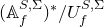 $({\mathbb A}_f^{S, \Sigma})^*/U_f^{S, \Sigma}$
is canonically isomorphic to the group of fractional ideals
 ${\mathcal I}^{S, \Sigma}:= {\mathcal I}^{S\cup \Sigma}$
that are coprime to
 $S\cup {\Sigma}$
, we can identify the space
 $({\mathbb A}_f^{\Sigma})^*/ U_f^{S, \Sigma}$
with
 $F_S^*\times {\mathcal I}^{S, \Sigma}$
. There exists a canonical isomorphism (see [Reference Dasgupta and SpiessDS18, § 2] or [Reference Dasgupta, Honnor and SpiessDHS25, Proposition 5.3])
 \begin{equation}C_c(F_S^*, {\mathbb Z}) \otimes {\mathbb Z}[{\mathcal I}^{S, \Sigma}]\, \cong\, C_c(F_S^*, {\mathbb Z}) \otimes C_c({\mathcal I}^{S, \Sigma}, {\mathbb Z})\,\stackrel{\cong}{\longrightarrow} \, C_c( F_S^*\times {\mathcal I}^{S, \Sigma}, {\mathbb Z})\,= \,C_c( ({\mathbb A}_f^{\Sigma})^*/ U_f^{S, \Sigma}, {\mathbb Z}).\end{equation}
Hence we can (and will) identify the source of (114) with the module
 $C_c(F_S^*, {\mathbb Z}) \otimes {\mathbb Z}[{\mathcal I}^{S, \Sigma}]$
. We define
 \begin{eqnarray} \delta_S: C_c(F_S^*, {\mathbb Z}) &\longrightarrow& C_c(F_S, {\mathbb Z}) , \quad f \mapsto f_! \end{eqnarray}
 \begin{eqnarray} \delta_f^{S, \Sigma}: {\mathbb Z}[{\mathcal I}^{S, \Sigma}]&\longrightarrow & C_c({\mathbb A}_f^{S, \Sigma}, {\mathbb Z}), \quad \sum_{{\mathfrak a} \in {\mathcal I}^{S, \Sigma}} m_{{\mathfrak a}} \, [{\mathfrak a}] \mapsto \sum_{{\mathfrak a} \in {\mathcal I}^{S, \Sigma}} m_{{\mathfrak a}} 1_{\widehat{{\mathfrak a}}^{S, \Sigma}},\end{eqnarray}
where
 $1_{\widehat{{\mathfrak a}}^{S, \Sigma}}$
is the characteristic function of
 $\widehat{{\mathfrak a}}^{S, \Sigma} := \widehat{{\mathfrak a}}^{S\cup \Sigma} \subseteq {\mathbb A}_f^{S, \Sigma}$
. Furthermore, let
 \begin{equation}C_c(F_S, {\mathbb Z}) \otimes C_c({\mathbb A}_f^{S, \Sigma}, {\mathbb Z})\,\longrightarrow \, C_c({\mathbb A}_f^{\Sigma}, {\mathbb Z}), \quad \varphi_S \otimes \varphi^S\mapsto (\varphi_S \circ \mathrm{pr}_1) \cdot (\varphi^S\circ \mathrm{pr}_2),\end{equation}
where
 $\mathrm{pr}_1: ({\mathbb A}_f^{\Sigma})\to F_S$
and
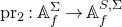 $\mathrm{pr}_2: {\mathbb A}_f^{\Sigma}\to {\mathbb A}_f^{S, \Sigma}$
denote the projections. The map given in (114) is defined as the composite of
 $\delta_S \otimes \delta_f^{S, \Sigma}$
with (118).
Note that the restriction of a locally constant map
 $\varphi: {\mathbb A}_f^{{\Sigma}} \to {\mathbb Z}$
with compact support to the subset
 $1 + {\mathfrak c}{{\mathcal O}_{\Sigma}}\subseteq {\mathbb A}_f^{\Sigma}$
is contained in
 $\mathrm{Int}_{\mathrm{loc}, b}(1+ {\mathfrak c}{{\mathcal O}_{\Sigma}}, {\mathbb Z})$
(in fact, if we denote the restriction by f, then there exists a fractional ideal
 ${\mathfrak a}\in {\mathcal I}^{{\Sigma}}$
such that
 $f|_{x+ {\mathfrak c}{\mathfrak a}}$
is constant for every
 $x\in 1 + {\mathfrak c}{{\mathcal O}_{\Sigma}}$
and non-zero for only finitely many cosets
 $x+{\mathfrak c}{\mathfrak a}$
). Therefore,
 \begin{equation}C_c({\mathbb A}_f^{\Sigma}, {\mathbb Z})\, \longrightarrow \, \mathrm{Int}_{\mathrm{loc}, b}(1 + {\mathfrak c}{{\mathcal O}_{\Sigma}}, {\mathbb Z}), \quad \varphi \mapsto \varphi|_{1 + {\mathfrak c}{{\mathcal O}_{\Sigma}}}\end{equation}
is a well-defined
 ${\Gamma}$
-equivariant homomorphism. By abuse of notation, we denote the composite of (114) and (119) by
 \begin{equation}\Delta_{S, f}^{\Sigma}: C_c( ({\mathbb A}_f^{\Sigma})^*/ U_f^{S, \Sigma}, {\mathbb Z}) \,\longrightarrow \, \mathrm{Int}_{\mathrm{loc}, b}(1 + {\mathfrak c}{{\mathcal O}_{\Sigma}} {\mathbb Z})\end{equation}
as well. Finally, we incorporate the archimedean places as well, i.e. we extend (120) to a
 ${\Gamma}$
-equivariant homomorphism
 \begin{equation}\Delta_S^{\Sigma}: C_c( ({\mathbb A}^{\Sigma})^*/ U^{S, \Sigma} , {\mathbb Z}) \,\longrightarrow \, \mathrm{Int}_{\mathrm{loc}, b}(1 + {\mathfrak c}{{\mathcal O}_{\Sigma}}, {\mathbb Z})({\epsilon})\end{equation}
as follows. For a function
 $\varphi: ({\mathbb A}^{\Sigma})^*/ U^{S, \Sigma} = ({\mathbb A}_f^{\Sigma})^*/ U_f^{S, \Sigma} \times F_{\infty}^*/U_{\infty} \to {\mathbb Z}$
with compact support and
 $x_{\infty}\in F_{\infty}^*/U_{\infty}$
, we let
 $\varphi(\mathrm{\, \cdot\, }, x_{\infty})$
denote the map
 $({\mathbb A}_f^{\Sigma})^*/ U_f^{S, \Sigma}\to {\mathbb Z}, x \mapsto \varphi(x, x_{\infty})$
. We define (121) by
 \begin{equation*}\Delta_S^{\Sigma}(\varphi)\, =\, \sum_{x_{\infty}U_{\infty} \in F_{\infty}^*/U_{\infty}} {\epsilon}(x_{\infty}) \cdot \Delta_{S, f}^{\Sigma}(\varphi(\mathrm{\, \cdot\, }, x_{\infty}U_{\infty})).\end{equation*}
where
 ${\epsilon}(x_{\infty})= \prod_{v\mid \infty} \mathrm{sign}(x_v)$
for
 $x_{\infty}= (x_v )_{v\mid \infty}\in \prod_{v\mid\infty} F_v^*$
.
More generally, if
 ${\mathcal U}\subseteq U^{{\Sigma}}$
is a closed subgroup containing
 $U^{S, \Sigma}$
and M is an abelian group, then we define
 \begin{equation}\Delta_S^{\Sigma}: C_c( ({\mathbb A}^{\Sigma})^*/ {\mathcal U} , M) \,\longrightarrow \, \mathrm{Int}_{\mathrm{loc}, b}(1 + {\mathfrak c}{{\mathcal O}_{\Sigma}}, {\mathbb Z})({\epsilon})\otimes M\end{equation}
as follows. Note that we can identify the source with the module
 $C_c(({\mathbb A}^{\Sigma})^*/{\mathcal U}, {\mathbb Z})\otimes M$
and that
 $C_c( ({\mathbb A}^{\Sigma})^*/ {\mathcal U}, {\mathbb Z})$
can be viewed naturally as a submodule of
 $C_c( ({\mathbb A}^{\Sigma})^*/ U^{S, \Sigma} , {\mathbb Z})$
. Therefore, we can write elements of the source of (122) as finite sums
 $\sum_{i=1}^r \varphi_i \otimes m_i$
with
 $\varphi_1, \ldots, \varphi_r\in C_c(({\mathbb A}^{\Sigma})^*/{\mathcal U}, {\mathbb Z})$
and
 $m_1, \ldots, m_r\in M$
and define
 \begin{equation}\Delta_S^{\Sigma}\bigg(\!\sum_{i=1}^r \varphi_i \otimes m_i\!\bigg):=\, \sum_{i=1}^r\Delta_S^{\Sigma}(\varphi_i) \otimes m_i.\end{equation}
Note that if M is a
 ${\Gamma}$
-module, then (122) is
 ${\Gamma}$
-equivariant. For
 $M = \mathrm{Int}_{\mathrm{loc}, b}(1 + {\mathfrak c}{{\mathcal O}_{\Sigma}}, A)$
, composing (122) with the map
 \begin{equation}\mathrm{Int}_{\mathrm{loc}, b}(1 + {\mathfrak c}{{\mathcal O}_{\Sigma}}, {\mathbb Z})({\epsilon})\otimes \mathrm{Int}_{\mathrm{loc}, b}(1 + {\mathfrak c}{{\mathcal O}_{\Sigma}}, A)\to \mathrm{Int}_{\mathrm{loc}, b}(1 + {\mathfrak c}{{\mathcal O}_{\Sigma}}, A)({\epsilon}), \quad f_1 \otimes f_2 \mapsto f_1 \cdot f_2\end{equation}
induces a
 ${\Gamma}$
-equivariant homomorphism
 \begin{equation}\widetilde{\Delta}_S^{\Sigma}: C_c(({\mathbb A}^{\Sigma})^*/{\mathcal U}, \mathrm{Int}_{\mathrm{loc}, b}(1 + {\mathfrak c}{{\mathcal O}_{\Sigma}}, A)) \, \longrightarrow \, \mathrm{Int}_{\mathrm{loc}, b}(1 + {\mathfrak c}{{\mathcal O}_{\Sigma}}, A)({\epsilon}).\end{equation}
Remark 5.2. We recall the dependence of the map given in (123) on the set S (cf. [Reference Dasgupta and SpiessDS18, Remark 5.5]). Let
 $v\in S$
, put
 $S'= S\setminus \{v\}$
and assume that
 ${\mathcal U}$
contains
 $U^{S', \Sigma}$
. Then we have
 \begin{equation*}\Delta_S^{\Sigma}(\varphi) \, =\, \Delta_{S'}^{\Sigma}(\varphi - [\varpi_v] \cdot \varphi)\end{equation*}
for every
 $\varphi\in C_c( ({\mathbb A}^{\Sigma})^*/ {\mathcal U} , M)$
. Here,
 $[\varpi_v]\in({\mathbb A}^{\Sigma})^*$
denotes the adele whose component at v is a uniformizer
 $\varpi_v\in F_v^*$
and whose other components are
 $=1$
. Similarly, for the map given in (125), we obtain
 \begin{equation}\widetilde{\Delta}_S^{\Sigma}(\varphi) \, =\, \widetilde{\Delta}_{S'}^{\Sigma}(\varphi - [\varpi_v] \cdot \varphi)\end{equation}
for every
 $\varphi\in C_c( ({\mathbb A}^{\Sigma})^*/ {\mathcal U} , \mathrm{Int}_{\mathrm{loc}, b}(1 + {\mathfrak c}{{\mathcal O}_{\Sigma}}, A))$
.
For open subgroups
 ${\mathcal U}_1, {\mathcal U}_2\subseteq U^{{\Sigma}}$
with
 $U^{S, \Sigma}\subseteq {\mathcal U}_1, {\mathcal U}_2$
, we consider the
 ${\Gamma}$
-equivariant pairing
 \begin{equation}\langle\mathrm{\, \cdot\, } , \mathrm{\, \cdot\, } \rangle_S: C(({\mathbb A}^{\Sigma})^*/{\mathcal U}_1, \mathrm{Int}_{\mathrm{loc}, b}(1 + {\mathfrak c}{{\mathcal O}_{\Sigma}}, A)) \times C_c(({\mathbb A}^{\Sigma})^*/{\mathcal U}_2, {\mathbb Z}) \longrightarrow \mathrm{Int}_{\mathrm{loc}, b}(1 + {\mathfrak c}{{\mathcal O}_{\Sigma}}, A)({\epsilon}),\end{equation}
defined as the composition of (110) (for
 ${\mathcal U}_3 := {\mathcal U}_1 \cap {\mathcal U}_2$
and
 $M= \mathrm{Int}_{\mathrm{loc}, b}(1 + {\mathfrak c}{{\mathcal O}_{\Sigma}}, A)$
) with the homomorphism
 $\widetilde{\Delta}_S^{\Sigma}$
(for
 ${\mathcal U}= {\mathcal U}_3$
), i.e. we have
 \begin{equation*}\langle \varphi, \psi\rangle_S \, =\, \widetilde{\Delta}_S^{{\Sigma}}(\varphi\odot \psi)\end{equation*}
for
 $\varphi \in C(({\mathbb A}^{\Sigma})^*/{\mathcal U}_1, \mathrm{Int}_{\mathrm{loc}, b}(1 + {\mathfrak c}{{\mathcal O}_{\Sigma}}, A))$
and
 $\psi\in C_c(({\mathbb A}^{\Sigma})^*/{\mathcal U}_2, {\mathbb Z})$
. The pairing in (127) induces for every
 $i,j\in {\mathbb Z}$
a cap-product pairing
 \begin{eqnarray}&& \cap: H^i({\Gamma}, C(({\mathbb A}^{\Sigma})^*/{\mathcal U}_1, \mathrm{Int}_{\mathrm{loc}, b}(1 + {\mathfrak c}{{\mathcal O}_{\Sigma}}, A))) \times H_j({\Gamma}, C_c(({\mathbb A}^{\Sigma})^*/{\mathcal U}_2, {\mathbb Z}))\hspace{2cm}\nonumber\\&& \quad\;\; \longrightarrow \quad H_{j-i}({\Gamma}, \mathrm{Int}_{\mathrm{loc}, b}(1 + {\mathfrak c}{{\mathcal O}_{\Sigma}}, A)({\epsilon})).\end{eqnarray}
In particular, for
 ${\mathcal U}_1={\mathcal U}_2= U_{{\mathfrak m}}^{{\Sigma}} \subseteq U^{{\Sigma}}$
and
 $i=0$
, taking the cap product with the homology class
 $\mathrm{sh}_a(\eta_{{\mathfrak c}{\mathfrak m}})$
associated to a point
 $a\in ({\mathbb A}^{\Sigma})^*/U_{{\mathfrak m}}^{{\Sigma}}$
yields a map
 \begin{align*}H^0({\Gamma}, C(({\mathbb A}^{\Sigma})^*/U_{{\mathfrak m}}^{{\Sigma}}, \mathrm{Int}_{\mathrm{loc}, b}(1 + {\mathfrak c}{{\mathcal O}_{\Sigma}}, A))) &\longrightarrow \, H_{n-1}({\Gamma}, \mathrm{Int}_{\mathrm{loc}, b}(1 + {\mathfrak c}{{\mathcal O}_{\Sigma}}, A)({\epsilon})),\\& \;\qquad\varphi\mapsto \varphi\cap \,\mathrm{sh}_a(\eta_{{\mathfrak c}{\mathfrak m}}).\end{align*}
Lemma 5.3.
For
 $\varphi\in H^0({\Gamma}, C(({\mathbb A}^{\Sigma})^*/U_{{\mathfrak m}}^{{\Sigma}}, \mathrm{Int}_{\mathrm{loc}, b}(1 + {\mathfrak c}{{\mathcal O}_{\Sigma}}, A)))$
, we have
 \[\varphi \cap \,\mathrm{sh}_a(\eta_{{\mathfrak c}{\mathfrak m}}) \, = \, \mathrm{cor}_{E_{{\mathfrak c}{\mathfrak m}, +}}^{{\Gamma}} (\varphi(a) \cap \eta_{{\mathfrak c}{\mathfrak m}}). \]
Proof. Let
 $\mathrm{ev}_a : C(({\mathbb A}^{\Sigma})^*/U_{{\mathfrak m}}^{{\Sigma}}, \mathrm{Int}_{\mathrm{loc}, b}(1 + {\mathfrak c}{{\mathcal O}_{\Sigma}}, {\mathbb Z})) \to \mathrm{Int}_{\mathrm{loc}, b}(1 + {\mathfrak c}{{\mathcal O}_{\Sigma}}, {\mathbb Z}),\varphi\mapsto \varphi(a)$
denote the evaluation map at a. We have
 \[\langle \varphi , {\iota}_a(m) \rangle \, =\, m \cdot \mathrm{ev}_a(\varphi) \]
for every
 $\varphi\in C(({\mathbb A}^{\Sigma})^*/U_{{\mathfrak m}}^{{\Sigma}}, \mathrm{Int}_{\mathrm{loc}, b}(1 + {\mathfrak c}{{\mathcal O}_{\Sigma}}, {\mathbb Z}))$
and
 $m\in {\mathbb Z}$
. Standard functorial properties of the cap product with respect to restrictions and corestrictions therefore imply that
 \[\mathrm{cor}_{E_{{\mathfrak c}{\mathfrak m}, +}}^{{\Gamma}}(((\mathrm{ev}_a)_* \circ \mathrm{res}_{E_{{\mathfrak c}{\mathfrak m}, +}}^{{\Gamma}}( \kappa )) \cap \eta_{{\mathfrak c}{\mathfrak m}}) \, =\, \kappa\cap \mathrm{sh}_a(\eta_{{\mathfrak c}{\mathfrak m}}) \]
for every
 $\kappa \in H^i({\Gamma}, C(({\mathbb A}^{\Sigma})^*/U_{{\mathfrak m}}^{{\Sigma}}, \mathrm{Int}_{\mathrm{loc}, b}(1 + {\mathfrak c}{{\mathcal O}_{\Sigma}}, A)))$
.
Remark 5.4. (a) For the applications in § 6, we need to address the dependence of the pairing in (127) on the set S. Let
 $v\in S$
, put
 $S'= S\setminus \{v\}$
and assume that
 $U^{S', \Sigma}\subseteq {\mathcal U}_3= {\mathcal U}_1 \cap {\mathcal U}_2$
. By (126), we have
 \begin{equation}\langle \varphi, \psi\rangle_S \, =\,\langle [\varpi_v]\cdot \varphi, \psi - [\varpi_v] \cdot \psi \rangle_{S'} + \langle \varphi - [\varpi_v] \cdot \varphi, \psi \rangle_{S'}\end{equation}
for every
 $\varphi \in C(({\mathbb A}^{\Sigma})^*/{\mathcal U}_1, \mathrm{Int}_{\mathrm{loc}, b}(1 + {\mathfrak c}{{\mathcal O}_{\Sigma}}, A))$
and
 $\psi\in C_c(({\mathbb A}^{\Sigma})^*/{\mathcal U}_2, {\mathbb Z})$
.
(b) We also need a more concrete description of the pairing in (127) in the case
 ${\mathcal U}_2= U^{{\Sigma}}$
and where
 ${\mathcal U}={\mathcal U}_1\subseteq {\mathcal U}_2$
is of the form
 ${\mathcal U}=V \times U^{S, {\Sigma}}$
for some open subgroup
 $V\subseteq U_S$
. We write elements of
 $({\mathbb A}^{\Sigma})^*$
as triples
 $a=(a_1, a_2, a_{\infty})$
with
 $a_1=(a_v)_{v\in S}\in F_S^*$
,
 $a_2= (a_v)_{v\not\in S\cup {\Sigma}, v\nmid \infty}\in ({\mathbb A}_f^{S, \Sigma})^*$
and
 $a_{\infty}\in F_{\infty}^*$
. We have
 \begin{equation*}\Delta_S^{{\Sigma}}(1_{a {\mathcal U}}) \, =\, {\epsilon}(a_{\infty}) \cdot 1_{{\mathfrak X}_{a, V, S}},\end{equation*}
where
 ${\mathfrak X}_{a, V, S}$
denotes the set
 \begin{equation*}{\mathfrak X}_{a, V, S} = \{x\in 1+ {\mathfrak c} {\mathcal O}_{{\Sigma}}\mid x\in a_1 V\, \text{and} \,\mathrm{ord}_v(x) \ge \mathrm{ord}_v(a_v)\, \forall \, v\not \in S\cup {\Sigma} \cup S_{\infty} \}.\end{equation*}
Note that if
 ${\mathfrak a}\in {\mathcal I}^{{\Sigma}}$
denotes the fractional ideal associated to the idele
 $(a_1, a_2)\in ({\mathbb A}_f^{\Sigma})^*$
, then we have
 ${\mathfrak X}_{a, V, S}\subseteq {\mathfrak a}\cap 1+ {\mathfrak c} {\mathcal O}_{{\Sigma}}$
. Since for
 $\varphi \in C(({\mathbb A}^{\Sigma})^*/{\mathcal U}, \mathrm{Int}_{\mathrm{loc}, b}(1 + {\mathfrak c}{{\mathcal O}_{\Sigma}}, A))$
and
 $\psi\in C_c(({\mathbb A}^{\Sigma})^*/U^{{\Sigma}}, {\mathbb Z})$
we have
 \[\varphi\odot \psi = \sum_{a {\mathcal U} \in ({\mathbb A}^{\Sigma})^*/{\mathcal U}} \psi(a U^{{\Sigma}}) 1_{a {\mathcal U}} \otimes \varphi(a{\mathcal U}), \]
we obtain
 \begin{equation}\langle \varphi, \psi\rangle_S \, =\,\sum_{a {\mathcal U} \in ({\mathbb A}^{\Sigma})^*/{\mathcal U}} {\epsilon}(a_{\infty})\, \psi(a U^{{\Sigma}})\, 1_{{\mathfrak X}_{a, V, S}} \cdot \varphi(a {\mathcal U}).\end{equation}
We now consider (128) for
 ${\mathcal U}_1={\mathcal U}\subseteq {\mathcal U}_2=U^{\Sigma}$
. Taking the cap product with
 $\vartheta$
yields a map
 \begin{equation}H^0({\Gamma}, C(({\mathbb A}^{\Sigma})^*/{\mathcal U}, \mathrm{Int}_{\mathrm{loc}, b}(1 + {\mathfrak c}{{\mathcal O}_{\Sigma}}, A)))\, \longrightarrow \, H_{n-1}({\Gamma}, \mathrm{Int}_{\mathrm{loc}, b}(1 + {\mathfrak c}{{\mathcal O}_{\Sigma}}, A)({\epsilon})), \quad \rho\mapsto \rho\cap \vartheta.\end{equation}
We define certain canonical elements in the source of (131). For that, put
 $N:= \mathrm{N}_{F/{\mathbb Q}}: F\to {\mathbb Q}$
and let
 ${\mathbb N}={\mathbb N}^{\Sigma}: ({\mathbb A}^{\Sigma})^*\to {\mathbb Q}^*$
be the idele norm character given by
 ${\mathbb N}((a_v)_v)= \prod_{v\not\in \Sigma} {\mathbb N}_v(a_v)$
, where
 \begin{equation*}\mathbb{N}_v(a_v) \,=\,\begin{cases}|a_v|_v^{-1}, & \text{if } v \text{ is nonarchimedean},\\[4pt]\mathrm{sign}(a_v), & \text{if } v \text{ is archimedean}.\end{cases}\end{equation*}
For an idele
 $a=(a_v)_{v\not\in{\Sigma}}\in ({\mathbb A}^{{\Sigma}})^*$
, let
 be the associated fractional ideal. Note that
 ${\mathbb N}(a) = \pm \mathrm{N}({\mathfrak a})$
and
 ${\mathbb N}(a) = \mathrm{N}({\mathfrak a})$
if
 $a_v>0$
for all
 $v\nmid \infty$
. Moreover, if
 $a={\gamma} \in {\mathcal O}_{\Sigma}^{\,*}\subseteq ({\mathbb A}^{{\Sigma}})^*$
, then we have
 ${\mathbb N}(a) = N({\gamma})$
. Consider the map
 \begin{equation}{\mathcal N}: ({\mathbb A}^{\Sigma})^*/U^{\Sigma}\longrightarrow \mathrm{Int}_{\mathrm{loc}, b}(1 + {\mathfrak c}{{\mathcal O}_{\Sigma}}, {\mathbb Z}), \quad a U^{{\Sigma}} \mapsto {\mathbb N}(a)^{-1} 1_{{\mathfrak a} \cap 1+{\mathfrak c}{{\mathcal O}_{\Sigma}}} \cdot N.\end{equation}
If we identify the group
 $({\mathbb A}^{\Sigma})^*/U^{\Sigma}$
with
 ${\mathcal I}^{{\Sigma}}\times F_{\infty}^*/U_{\infty}$
and, correspondingly, write its elements as pairs
 $({\mathfrak a}, a_{\infty} U_{\infty})$
, then we have
 \begin{equation}{\mathcal N}({\mathfrak a}, a_{\infty} U_{\infty}) \, =\, {\epsilon}(a_{\infty})\,\mathrm{N}({\mathfrak a})^{-1} 1_{{\mathfrak a} \cap 1+{\mathfrak c}{{\mathcal O}_{\Sigma}}} \cdot N,\end{equation}
with
 ${\epsilon}(a_{\infty})= \prod_{v\mid \infty} \mathrm{sign}(a_v)$
for
 $a_{\infty}= (a_v )_{v\mid \infty}\in \prod_{v\mid\infty} F_v^*$
.
Since
 $\mathrm{N}({\mathfrak a})^{-1} N(x) \in {\mathbb Z}$
for every
 $x\in {\mathfrak a}$
, we see that the right-hand side of (133) indeed lies in
 $\mathrm{Int}_{\mathrm{loc}, b}(1 + {\mathfrak c}{{\mathcal O}_{\Sigma}}, {\mathbb Z})$
. The map given in (132) is
 ${\Gamma}$
-equivariant because of
 \begin{equation}{\mathcal N}({\gamma} \cdot a U^{{\Sigma}}) = {\mathbb N}({\gamma} a)^{-1} \cdot 1_{{\gamma}{\mathfrak a} \cap 1+ {\mathfrak c}{{\mathcal O}_{\Sigma}}} \cdot N = {\mathbb N}(a)^{-1} {\gamma} \cdot (1_{{\mathfrak a} \cap 1+ {\mathfrak c}{{\mathcal O}_{\Sigma}}} \cdot N)= {\gamma} {\mathcal N}(a U^{{\Sigma}})\end{equation}
for every
 ${\gamma}\in {\Gamma}$
and
 $aU^{{\Sigma}}\in ({\mathbb A}^{\Sigma})^*/U^{\Sigma}$
. It follows that we can view
 ${\mathcal N}^k$
for
 $k\in {\mathbb Z}_{\ge 0}$
as an element of
 $H^0({\Gamma}, C(({\mathbb A}^{\Sigma})^*/U^{\Sigma}, \mathrm{Int}_{\mathrm{loc}, b}(1 + {\mathfrak c}{{\mathcal O}_{\Sigma}}, {\mathbb Z})))$
. We remark that for
 $k=0$
, the map
 ${\mathcal N}^0: ({\mathbb A}^{\Sigma})^*/U^{\Sigma}\to \mathrm{Int}_{\mathrm{loc}, b}(1 + {\mathfrak c}{{\mathcal O}_{\Sigma}}, {\mathbb Z})$
is given by
 ${\mathcal N}^0( a U^{{\Sigma}}) = 1_{{\mathfrak a} \cap 1+{\mathfrak c}{{\mathcal O}_{\Sigma}}}$
.
Let
 ${\mathfrak m}\subseteq {\mathcal O}_F$
again be an ideal coprime to
 ${\Sigma}$
. For a ray class
 ${\mathfrak A}\in {\mathcal I}^{{\mathfrak c}{\mathfrak m}}/{\mathcal P}^{{\mathfrak c}{\mathfrak m}}$
and
 $k\in {\mathbb Z}_{\ge 0}$
, we introduce a certain homology class
 \begin{equation}\varrho_{{\mathfrak A}}^k \, =\, \varrho_{{\mathfrak A}, S, {\mathfrak c}}^k \in H_{n-1}({\Gamma}, \mathrm{Int}_{\mathrm{loc}, b}(1 + {\mathfrak c}{{\mathcal O}_{\Sigma}}, {\mathbb Z})({\epsilon}))\end{equation}
as follows. We identify the ray class group
 ${\mathcal I}^{{\mathfrak c}{\mathfrak m}}/{\mathcal P}^{{\mathfrak c}{\mathfrak m}}$
with the idele class group
 $({\mathbb A}^{\Sigma})^*/U_{{\mathfrak m}}^{\Sigma}{\Gamma}$
, so that we can (and will) view
 ${\mathfrak A}$
as a
 ${\Gamma}$
-orbit in
 $({\mathbb A}^{\Sigma})^*/U_{{\mathfrak m}}^{\Sigma}$
. The class in (135) is given by
 \begin{equation*}\varrho_{{\mathfrak A}}^k \,:= \, ({\mathcal N}^k\cup 1_{{\mathfrak A}}) \cap \vartheta \in H_{n-1}({\Gamma}, \mathrm{Int}_{\mathrm{loc}, b}(1 + {\mathfrak c}{{\mathcal O}_{\Sigma}}, {\mathbb Z})({\epsilon}))\end{equation*}
where
 $1_{{\mathfrak A}}\in H^0({\Gamma}, C(({\mathbb A}^{\Sigma})^*/U_{{\mathfrak m}}^{\Sigma}, {\mathbb Z}))$
denotes the characteristic function of
 ${\mathfrak A}$
and where we view
 ${\mathcal N}^k$
for
 $k\in {\mathbb Z}_{\ge 0}$
as an element of
 $H^0({\Gamma}, C(({\mathbb A}^{\Sigma})^*/U^{\Sigma}, \mathrm{Int}_{\mathrm{loc}, b}(1 + {\mathfrak c}{{\mathcal O}_{\Sigma}}, {\mathbb Z})))$
. Moreover, the cup product
 ${\mathcal N}^k\cup 1_{{\mathfrak A}}$
is induced by the pairing in (109) for
 $M= \mathrm{Int}_{\mathrm{loc}, b}(1 + {\mathfrak c}{{\mathcal O}_{\Sigma}}, {\mathbb Z})$
.
Theorem 5.5. We have
 \begin{equation}\mathrm{\mathbb{E}is}_{{\mathfrak b}, {\mathfrak c}} \cap \varrho_{{\mathfrak A}}^k \, =\, (-1)^{n-1} \mathrm{N}({\mathfrak b}) \, \zeta({\mathfrak c}{\mathfrak m}, {\mathfrak A}, -k) + (-1)^n \mathrm{N}({\mathfrak b})^{-k} \, \zeta({\mathfrak c}{\mathfrak m}, {\mathfrak A}{\mathfrak B}, -k),\end{equation}
where
 ${\mathfrak B}=[{\mathfrak b}]\in {\mathcal I}^{{\mathfrak c}{\mathfrak m}}/{\mathcal P}^{{\mathfrak c}{\mathfrak m}}$
denotes the ray class of
 ${\mathfrak b}$
.
For the proof, we choose a fractional ideal
 ${\mathfrak a}\subseteq {\mathcal O}_F$
coprime to
 $S\cup {\Sigma}$
such that
 ${\mathfrak a}^{-1}$
is a representative of
 ${\mathfrak A}$
. If we identify
 $({\mathbb A}^{\Sigma})^*/U_{{\mathfrak m}}^{\Sigma}$
with the product
 $F_S^*/U_{{\mathfrak m}, S} \times {\mathcal I}^{S, \Sigma} \times F_{\infty}^*/U_{\infty}$
, then
 ${\mathfrak A}$
is the
 ${\Gamma}/E_{{\mathfrak c}{\mathfrak m}, +}$
-orbit of the element
 \begin{equation*}a:=(1, {\mathfrak a}^{-1}, 1)\in F_S^*/U_{{\mathfrak m}, S} \times {\mathcal I}^{S, \Sigma} \times F_{\infty}^*/U_{\infty}\, =\, ({\mathbb A}^{\Sigma})^*/U_{{\mathfrak m}}^{\Sigma}.\end{equation*}
Let
 ${\mathcal N}_0\in \mathrm{Int}(1 + {\mathfrak c}{\mathfrak m}{\mathfrak a}^{-1}, {\mathbb Z})$
denote the polynomial function
 ${\mathcal N}_0(x) := \mathrm{N}({\mathfrak a})\mathrm{N}(x)$
for
 $x\in 1 + {\mathfrak c} {\mathfrak m} {\mathfrak a}^{-1}$
. Since
 $N({\varepsilon})=1$
for every
 ${\varepsilon}\in E_{{\mathfrak c}{\mathfrak m}, +}$
, we have
 ${\mathcal N}_0\in H^0(E_{{\mathfrak c}{\mathfrak m}, +}, \mathrm{Int}(1 + {\mathfrak c}{\mathfrak m}{\mathfrak a}, {\mathbb Z}))$
.
Lemma 5.6.
We have
 $\varrho_{{\mathfrak A}}^k = \mathrm{cor}({\mathcal N}_0^k\cap \eta_{{\mathfrak c}{\mathfrak m}})$
.
Footnote 12
Proof. Note that
 ${\mathcal N}^k(a) = j({\mathcal N}^k_0)$
. Together with Lemmas 5.1 and 5.3, we obtain
 \begin{align*}\varrho_{{\mathfrak A}}^k & = ({\mathcal N}^k\cup 1_{{\mathfrak A}}) \cap \vartheta \, =\, {\mathcal N}^k \cap (1_{{\mathfrak A}} \cap \vartheta) \, =\, {\mathcal N}^k \cap\, \mathrm{sh}_a(\eta_{{\mathfrak c}{\mathfrak m}})\, =\,\mathrm{cor}_{E_{{\mathfrak c}{\mathfrak m}, +}}^{{\Gamma}} ({\mathcal N}(a)^k \cap \eta_{{\mathfrak c}{\mathfrak m}})\\& = \mathrm{cor}_{E_{{\mathfrak c}{\mathfrak m}, +}}^{{\Gamma}} (j_*({\mathcal N}_0^k) \cap \eta_{{\mathfrak c}{\mathfrak m}})\, =\, \mathrm{cor}({\mathcal N}_0^k\cap \eta_{{\mathfrak c}{\mathfrak m}}). \\[-35pt]\end{align*}
Proof of Theorem 5.5. By (108) and Lemma 5.6, we have
 \begin{eqnarray*}\mathrm{\mathbb{E}is}_{{\mathfrak b}, {\mathfrak c}} \cap \varrho_{{\mathfrak A}}^k & = & \mathrm{\mathbb{E}is}_{{\mathfrak b}, {\mathfrak c}} \cap \mathrm{cor}({\mathcal N}_0^k\cap \eta_{{\mathfrak c}{\mathfrak m}})\, =\, \mathrm{res}(\mathrm{\mathbb{E}is}_{{\mathfrak b}, {\mathfrak c}}) \cap ({\mathcal N}_0^k\cap \eta_{{\mathfrak c}{\mathfrak m}})\\& = & \mathrm{Eis}_{{\mathfrak c} {\mathfrak m} {\mathfrak a}^{-1}, {\mathfrak b}}(t_0)\cap ({\mathcal N}_0^k\cap \eta_{{\mathfrak c}{\mathfrak m}})\, =\, {\mathcal N}_0^k\cap (\mathrm{Eis}_{{\mathfrak c} {\mathfrak m} {\mathfrak a}^{-1}, {\mathfrak b}}(t_0)\cap \eta_{{\mathfrak c}{\mathfrak m}}).\end{eqnarray*}
To finish the proof, we recall the relation between  and values partial zeta functions from [Reference Beilinson, Kings and LevinBKL18, § 5]. For that, we enlarge R by passing to the complex numbers (i.e. we set
 $R={\mathbb C}$
).
To rephrase the result of Beilinson, Kings and Levin suitably for our framework, we fix an ideal
 ${\mathfrak n}\subseteq {\mathcal O}_F$
coprime to
 ${\mathfrak c}{\mathfrak m}$
(in the formula given in (137) below,
 ${\mathfrak n}$
will be either
 ${\mathfrak a}$
or
 ${\mathfrak a}{\mathfrak b}$
). Put
 $L = {\mathfrak c} {\mathfrak m} {\mathfrak n}^{-1}$
,
 $H= 1+ L$
,
 ${\Gamma}_0=E_{{\mathfrak c}{\mathfrak m}, +}$
and
 $t_0= t+L\in F_{\infty}/L$
. As in [Reference Beilinson, Kings and LevinBKL18, § 5], we consider the following composition of isomorphisms:
 \begin{equation}\Phi_{{\mathfrak n}}: {\mathbb C}[\![w]\!]\, \stackrel{\cong}{\longrightarrow}\, {\mathcal D}_{\mathrm{pol}}(L, {\mathbb C})_{{\Gamma}_0} \, \stackrel{\cong}{\longrightarrow}\, {\mathcal D}_{\mathrm{pol}, L}(1+ L, {\mathbb C})_{{\Gamma}_0}.\end{equation}
The first isomorphism is given as follows. We view the embeddings
 $\xi_1, \ldots, \xi_n: F\to {\mathbb R}$
as polynomial functions on L, i.e. we have
 $(\xi_i)|_L\in\mathrm{Int}(L, {\mathbb C})$
. In fact, the powers
 ${\underline{\xi}}^{{\underline{m}}}$
,
 ${\underline{m}}\in ({\mathbb Z}_{\ge 0})^n$
form a
 ${\mathbb C}$
-basis of
 $\mathrm{Int}(L, {\mathbb C})$
. As in Example 2.4 for
 $i=1, \ldots, n$
let
 $z_i \in {\mathcal D}_{\mathrm{pol}}(L, {\mathbb C})$
be given by
 $z_i({\underline{\xi}}^{{\underline{m}}}) = 1$
if
 ${\underline{m}} = e_i$
and
 $z_i({\underline{\xi}}^{{\underline{m}}}) = 0$
if
 ${\underline{m}}\ne e_i$
. If we put
 $w:= z_1\cdot \ldots \cdot z_n$
, then we have
 ${\mathcal D}_{\mathrm{pol}}(L, {\mathbb C})^{{\Gamma}_0} = {\mathbb C}[\![w]\!]$
(see [Reference Beilinson, Kings and LevinBKL18, Lemma 5.4]). Now, the isomorphism
 ${\mathbb C}[\![w]\!]\cong {\mathcal D}_{\mathrm{pol}}(L, {\mathbb C})_{{\Gamma}_0}$
is induced by the projection
 ${\mathcal D}_{\mathrm{pol}}(L, {\mathbb C})\to {\mathcal D}_{\mathrm{pol}}(L, {\mathbb C})_{{\Gamma}_0}$
. For the second isomorphism in (137), note that a polynomial function
 $f: L \to {\mathbb C}$
extends uniquely to a polynomial function
 $\tilde{f}: {\mathbb Z}+ L\to {\mathbb C}$
. We obtain an isomorphism
 $\mathrm{Int}(L, {\mathbb C}) \to \mathrm{Int}_L(1+ L, {\mathbb C}), f\mapsto \tilde{f}|_{1 + L}$
, and hence dually an isomorphism
 ${\mathcal D}_{\mathrm{pol}, L}(1+ L, {\mathbb C})\to {\mathcal D}_{\mathrm{pol}}(L, {\mathbb C})$
. Passing to
 ${\Gamma}_0$
-coinvariants yields the isomorphism
 ${\mathcal D}_{\mathrm{pol}}(L, {\mathbb C})_{{\Gamma}_0} \cong {\mathcal D}_{\mathrm{pol}, L}(1+ L, {\mathbb C})_{{\Gamma}_0}$
.
By [Reference Beilinson, Kings and LevinBKL18, 3.44, 5.6 and (5.10)], we have

Note that the second summand is initially an element of
 ${\mathcal D}_{\mathrm{pol}}(1+ {\mathfrak c}{\mathfrak m}({\mathfrak a}{\mathfrak b})^{-1}, {\mathbb C})_{{\Gamma}_0}$
. However, since we work with complex coefficients, we can identify it canonically with the group
 ${\mathcal D}_{\mathrm{pol}}(1+ {\mathfrak c}{\mathfrak m}{\mathfrak a}^{-1}, {\mathbb C})_{{\Gamma}_0}$
.
To finish the proof, note that by (8) we have
 \[{\mathcal N}_0^k\cap \Phi_{{\mathfrak a}}(w^j) \, =\, {\mathcal N}_0^k\cap \Phi_{{\mathfrak a}{\mathfrak b}}(w^j)\, =\, \left\{ \begin{array}{ll} \mathrm{N}({\mathfrak a})^k (k!)^n & \quad \mbox{if $k = j$,}\\ 0 & \quad \mbox{otherwise.} \end{array}\right. \]
We conclude that

We will now give formulas for the values of the partial zeta functions
 $\zeta_S(\sigma, s)$
and the Stickelberger elements
 $\Theta_{S, {\mathfrak q}}(K/F, s)$
(see (1) and (102)) at non-positive integers in terms of a cap product of an Eisenstein class with certain homology classes. For that, we make specific choices for the coprime ideals
 ${\mathfrak b}$
and
 ${\mathfrak c}$
of
 ${\mathcal O}_F$
.
To fix ideas, let
 $K/F$
be a finite abelian extension with Galois group G. Let
 ${\mathfrak p}$
be a fixed nonarchimedean place of F and let S be a finite and set of nonarchimedean places of F with
 ${\mathfrak p}\not\in S$
and such that
 $S'= S\cup \{{\mathfrak p}\}$
contains all places that are ramified in
 $K/F$
. Let
 ${\mathfrak f}$
be the nonarchimedean part of the conductor of
 $L/K$
. For
 ${\mathfrak b}$
, we choose any non-trivial ideal of
 ${\mathcal O}_F$
coprime to S’ and for
 ${\mathfrak c}$
, we choose a sufficiently high power of
 ${\mathfrak p}$
. Namely, if
 ${\mathfrak p}^f$
is the exact power of
 ${\mathfrak p}$
that divides
 ${\mathfrak f}$
(the case
 $f=0$
is allowed), then we put
 ${\mathfrak c} :={\mathfrak p}^m$
, where m is any integer
 $\ge \max(f, n+1)$
.
For
 $\sigma\in G$
and
 $k\in {\mathbb Z}_{\ge 0}$
, we define
 \begin{equation*}\varrho_{\sigma}^k \, =\, \varrho_{\sigma, S, {\mathfrak c}}^k\,:= \, ({\mathcal N}^k\cup 1_{\mathrm{rec}^{-1}(\sigma)}) \cap \vartheta \in H_{n-1}({\Gamma}, \mathrm{Int}_{\mathrm{loc}, b}(1 + {\mathfrak p}^m{{\mathcal O}_{\Sigma}}, {\mathbb Z})({\epsilon})),\end{equation*}
where
 ${\Sigma}$
again denotes the set of all prime factors of
 ${\mathfrak b}{\mathfrak c}$
and where
 $1_{\mathrm{rec}^{-1}(\sigma)}\in H^0({\Gamma}, C(({\mathbb A}^{\Sigma})^*/ U^{S, \Sigma}, {\mathbb Z}))$
is the characteristic function of the preimage of
 $\sigma$
under the reciprocity map
 $\mathrm{rec} : ({\mathbb A}^{\Sigma})^*/U^{S, \Sigma}\to G$
.
Corollary 5.7. We have
 \begin{equation}\mathrm{\mathbb{E}is}_{{\mathfrak b}, {\mathfrak c}} \cap \varrho_{\sigma}^k \, =\, (-1)^{n-1} \mathrm{N}({\mathfrak b}) \, \zeta_{S'}(\sigma, -k) + (-1)^n \mathrm{N}({\mathfrak b})^{-k} \, \zeta_{S'}(\sigma\sigma_{{\mathfrak b}}, -k).\end{equation}
Recall that
 $\sigma_{{\mathfrak b}}$
denotes the image of
 ${\mathfrak b}$
under the Artin map
 ${\mathcal I}^S\to G$
.
Proof. We choose an ideal
 ${\mathfrak m}\subseteq {\mathcal O}_F$
whose set of prime factors is equal to S and so that
 ${\mathfrak c}{\mathfrak m}$
is a multiple of
 ${\mathfrak f}$
(hence
 $K\subseteq F^{{\mathfrak c}{\mathfrak m}}$
). If
 $\mathrm{rec}: {\mathcal I}^{{\mathfrak c}{\mathfrak m}}/{\mathcal P}^{{\mathfrak c}{\mathfrak m}} \to \mathrm{Gal}(F^{{\mathfrak c}{\mathfrak m}}/F)$
denotes the reciprocity isomorphism, then we have
 \begin{equation*}\varrho_{\sigma}^k \,= \,\sum_{{\mathfrak A}} \varrho_{{\mathfrak A}}^k,\end{equation*}
where the sum is taken over the ray classes
 ${\mathfrak A}\in{\mathcal I}^{\mathfrak c \mathfrak m}/{\mathcal P}^{\mathfrak c \mathfrak m}$
with
 $\mathrm{rec}({\mathfrak A})|_K = \sigma$
. Thus the assertion follows from (101) and (136).
Finally, we give a formula similar to (139) for the Stickelberger elements
 $\Theta_{S', {\mathfrak q}}(K/F, -k)$
. Recall that
 ${\mathfrak q}$
denotes an additional place not contained in S. We now choose
 ${\mathfrak b}:={\mathfrak q}$
so that
 ${\Sigma}=\{{\mathfrak p}, {\mathfrak q}\}$
. Moreover, if q denotes the characteristic of the residue field of
 ${\mathfrak q}$
, then we can choose the coefficient ring R to be
 ${\mathbb Z}[1/q]$
. As in [Reference Dasgupta and SpiessDS18, § 5.4], by composing the reciprocity map
 $\mathrm{rec}: ({\mathbb A}^{{\Sigma}})^*/U^{S, {\Sigma}}\to G$
with the inclusion
 $G\hookrightarrow {\mathbb Z}[G]$
, we view it as a homomorphism
 \begin{equation}\mathrm{rec}: ({\mathbb A}^{{\Sigma}})^*/U^{S, {\Sigma}}\longrightarrow {\mathbb Z}[G].\end{equation}
The fact that
 ${\Gamma}$
lies in its kernel implies that
 $\mathrm{rec}\in H^0({\Gamma}, C(({\mathbb A}^{{\Sigma}})^*/U^{S, {\Sigma}}, {\mathbb Z}[G]))$
. For
 $k\in {\mathbb Z}_{\ge 0}$
, we define
 \begin{equation}\varrho_{K/F}^k\, =\, \varrho_{K/F, S, {\mathfrak c}, {\mathfrak q}}^k\,:= \, ({\mathcal N}^k\cup (\mathrm{inv}\circ \mathrm{rec})) \cap \vartheta \in H_{n-1}({\Gamma}, \mathrm{Int}_{\mathrm{loc}, b}(1 + {\mathfrak p}^m{{\mathcal O}_{\Sigma}}, {\mathbb Z}[G])({\epsilon})),\end{equation}
where inv denotes the involution
 ${\mathbb Z}[G]\to {\mathbb Z}[G], \, \sum_{\sigma\in G} n_{\sigma} [\sigma]\mapsto \sum_{\sigma\in G} n_{\sigma} [\sigma^{-1}]$
.
Corollary 5.8. With
 $\mathrm{\mathbb{E}is} : = \mathrm{\mathbb{E}is}_{{\mathfrak q}, {\mathfrak p}^m}$
, we have
 \begin{equation}\mathrm{\mathbb{E}is} \cap \varrho_{K/F}^k \, =\, (-1)^n \mathrm{N}({\mathfrak q})^{-k} \, [\sigma_{{\mathfrak q}}] \cdot \Theta_{S', {\mathfrak q}}(-k).\end{equation}
Note that (142) is an equality in the group ring
 ${\mathbb Z}[1/q][G]$
.
Proof. Under the canonical isomorphism
 \begin{eqnarray*}H_{n-1}({\Gamma}, \mathrm{Int}_{\mathrm{loc}, b}(1 + {\mathfrak p}^m{{\mathcal O}_{\Sigma}}, {\mathbb Z}[G])({\epsilon})) & \cong & H_{n-1}({\Gamma}, \mathrm{Int}_{\mathrm{loc}, b}(1 + {\mathfrak p}^m{{\mathcal O}_{\Sigma}}, {\mathbb Z})({\epsilon}))\otimes {\mathbb Z}[G] \\& = & \bigoplus_{\sigma\in G} H_{n-1}({\Gamma}, \mathrm{Int}_{\mathrm{loc}, b}(1 + {\mathfrak p}^m{{\mathcal O}_{\Sigma}}, {\mathbb Z})({\epsilon})) \otimes [\sigma],\end{eqnarray*}
the class given in (141) decomposes as
 $\varrho_{K/F}^k = \sum_{\sigma\in G} \varrho_{\sigma^{-1}}^k\otimes [\sigma]$
. Together with (139), we deduce
 \begin{eqnarray*}\mathrm{\mathbb{E}is} \cap \varrho_{K/F}^k & = & (-1)^n \sum_{\sigma\in G}( \mathrm{N}({\mathfrak q})^{-k} \zeta_{S'}(\sigma^{-1}\sigma_{{\mathfrak q}}, -k) - \mathrm{N}({\mathfrak q}) \zeta_{S'}(\sigma^{-1}, -k) ) [\sigma]\\& = & (-1)^n \mathrm{N}({\mathfrak q})^{-k}\, [\sigma_{{\mathfrak q}}] \cdot \Theta_{S', {\mathfrak q}}(-k).\\[-35pt]\end{eqnarray*}
6. Divisibility properties of Stickelberger elements
As at the end of last section (i.e. the paragraph before Corollary 5.8), we let S be a finite set of nonarchimedean places of F of cardinality r and let
 ${\Sigma}=\{{\mathfrak p}, {\mathfrak q}\}$
, where
 ${\mathfrak p}$
and
 ${\mathfrak q}$
are two distinct fixed nonarchimedean places of F not contained in S. As before, we put
 ${\Gamma} := {\mathcal O}_{\Sigma, {\mathfrak c}}^{\,*}$
and consider
 ${\mathbb Z}[1/q]$
-coefficients, where q is the residue characteristic of
 ${\mathfrak q}$
. We also put
 ${\mathfrak c} = {\mathfrak p}^m$
(for m sufficiently large). The aim of this section is to prove Theorem 1.1. In order to obtain this refinement of Corollary 5.8, we work in a more general framework than in the last section; namely, we take the cap product of our adelic Eisenstein class
 $\mathrm{\mathbb{E}is}:= \mathrm{\mathbb{E}is}_{{\mathfrak q}, {\mathfrak p}^m}$
with certain hyperhomology groups and we work with more general characters than the reciprocity map given in (140).
To begin with, let R be an arbitrary
 ${\mathbb Z}[1/q]$
-algebra and let
 ${\mathcal U}$
be an open subgroup of
 $({\mathbb A}^{{\Sigma}})^*$
that contains
 $U^{S, {\Sigma}}$
. For this data, we consider the trilinear map
 \begin{eqnarray}&&\!\!\!\!\!\!\!\!\! \beta_S: {\mathcal D}_{\mathrm{lpol}}(1\!+\!{\mathfrak p}^m{{\mathcal O}_{\Sigma}}, {\mathbb Z}[1/q])({\epsilon})\! \times \! C(({\mathbb A}^{\Sigma})^*/{\mathcal U}, \mathrm{Int}_{\mathrm{loc}, b}(1 \!+\! {\mathfrak p}^m{{\mathcal O}_{\Sigma}}, R))\! \times \!C_c(({\mathbb A}^{\Sigma})^*/U^{\Sigma}, {\mathbb Z})\! \to\! R,\nonumber\\&&\hspace{2cm} (\mu, \Psi, \varphi) \mapsto \beta_S(\mu, \Psi, \varphi) := \int_{1+{\mathfrak p}^m{{\mathcal O}_{\Sigma}}} \langle \Psi, \varphi \rangle_S(x)\, d\mu(x).\end{eqnarray}
Here,
 $\langle \Psi, \varphi\rangle_S\in \mathrm{Int}_{\mathrm{loc}, b}(1 + {\mathfrak p}^m{{\mathcal O}_{\Sigma}}, R)$
denotes the image of the pair
 $(\Psi, \varphi)$
under (127). Note that (143) is
 ${\Gamma}$
-equivariant, i.e. we have
 \begin{equation}\beta_S({\gamma} \mu, {\gamma} \Psi, {\gamma} \varphi) \, =\, \beta_S(\mu, \Psi, \varphi)\end{equation}
for every
 ${\gamma}\in {\Gamma}$
.
We now fix
 $k\in {\mathbb Z}_{\ge 0}$
and consider a continuous homomorphism that is unramified outside of S:
 \begin{equation*}\chi: ({\mathbb A}^{{\Sigma}})^*\longrightarrow R^*,\end{equation*}
i.e.
 $\ker(\chi)$
contains the subgroup
 $U^{S, {\Sigma}}$
. Here, we have equipped
 $R^*$
with the discrete topology, i.e. we require that
 $\ker(\chi)$
is an open subgroup of
 $({\mathbb A}^{{\Sigma}})^*$
. Let
 ${\mathcal U}$
be an open subgroup of
 $({\mathbb A}^{{\Sigma}})^*$
such that
 $U^{S, {\Sigma}} \subseteq {\mathcal U}\subseteq U^{{\Sigma}}\cap \ker(\chi)$
. Therefore, we can (and will) view
 $\chi$
as a homomorphism
 $\chi: ({\mathbb A}^{{\Sigma}})^*/{\mathcal U}\to R^*$
. We define
 \begin{equation*}\chi {\mathcal N}^k: ({\mathbb A}^{{\Sigma}})^*/{\mathcal U} \, \longrightarrow\, \mathrm{Int}_{\mathrm{loc}, b}(1 + {\mathfrak p}^m{{\mathcal O}_{\Sigma}}, R),\quad a {\mathcal U} \mapsto ({\mathcal N}^k)(a U^{{\Sigma}}) \otimes \chi(a {\mathcal U})\end{equation*}
and consider the map given in (143) for
 $\Psi= \chi{\mathcal N}^k$
fixed, i.e. we consider the pairing
 \begin{equation}\langle \mathrm{\, \cdot\, }, \mathrm{\, \cdot\, } \rangle_{\chi, k, S}:= \beta_S(\mathrm{\, \cdot\, }, \chi {\mathcal N}^k, \mathrm{\, \cdot\, }): {\mathcal D}_{\mathrm{lpol}}(1+{\mathfrak p}^m{{\mathcal O}_{\Sigma}}, {\mathbb Z}[1/q])({\epsilon}) \times C_c(({\mathbb A}^{\Sigma})^*/U^{\Sigma}, {\mathbb Z}) \longrightarrow R.\end{equation}
Thus, for
 $\mu\in {\mathcal D}_{\mathrm{lpol}}(1+{\mathfrak p}^m{{\mathcal O}_{\Sigma}}, {\mathbb Z}[1/q])({\epsilon})$
and
 $\varphi\in C_c(({\mathbb A}^{\Sigma})^*/U^{\Sigma}, {\mathbb Z})$
, we have
 \begin{equation*}\langle \mu, \varphi \rangle_{\chi, k, S} := \beta_S(\mu, \chi{\mathcal N}^k, \varphi)\,=\,\int_{1+{\mathfrak p}^m{{\mathcal O}_{\Sigma}}} \langle \chi {\mathcal N}^k, \varphi\rangle_S(x) \, d\mu(x).\end{equation*}
Note that the pairing in (145) is independent of the choice of
 ${\mathcal U}$
. Note also that (144) and (134) imply that
 $\langle {\gamma} \mu, {\gamma} \varphi \rangle_{\chi, k, S}=\chi({\gamma}) \cdot \langle \varphi, \mu \rangle_{\chi, k, S}$
for every
 ${\gamma} \in {\Gamma}$
. Therefore, (145) induces cap-product pairings
 \begin{equation*}\cap_{\chi, k, S}: H^i({\Gamma}, {\mathcal D}_{\mathrm{lpol}}(1+{\mathfrak p}^m{{\mathcal O}_{\Sigma}}, {\mathbb Z}[1/q])({\epsilon}))\times H_j({\Gamma}, C_c(({\mathbb A}^{\Sigma})^*/U^{\Sigma}, {\mathbb Z})) \, \longrightarrow \, H_{j-i}({\Gamma}, R(\chi))\end{equation*}
for
 $i,j\in {\mathbb Z}$
. In particular, for
 $i=j=n-1$
we can consider the homology class
 \begin{equation*}\mathrm{\mathbb{E}is} \cap_{\chi, k, S} \,\vartheta \in H_0({\Gamma}, R(\chi))\end{equation*}
For a place v of F with
 $v\ne {\mathfrak p}, {\mathfrak q}$
, we let
 $\chi_v: F_v^* \to R^*$
be the local component of
 $\chi$
at v. Our main technical result is the following.
Theorem 6.1. Let
 $\{{\mathfrak a}_v\}_{v\in S\cup S_{\infty}}$
be a collection of ideals of R that satisfies the following properties.
-
(i) For
$v\in S$
, the local component
$\chi_v$
is unramified modulo
${\mathfrak a}_v$
Footnote 13
and
$\chi_v(\varpi_v) \equiv \mathrm{N}(v)^k\!\! \mod {\mathfrak a}_v$
. -
(ii) For
$v\in S_{\infty}$
, we have
$\chi_v(-1) \equiv (-1)^k \!\!\mod {\mathfrak a}_v$
.


Put
 ${\overline{R}} = R/\prod_{v\in S\cup S_{\infty}}{\mathfrak a}_v$
and let
 $\pi: R\to {\overline{R}}$
be the projection. Then, we have
 \begin{equation}\pi_*(\mathrm{\mathbb{E}is} \cap_{\chi, k, S}\, \vartheta) \,= \,0 \quad \text{in} \quad H_0({\Gamma}, {\overline{R}}(\chi)).\end{equation}
The proof of Theorem 6.1 is given in several steps. It uses ideas introduced in [Reference SpiessSpi14, § 3], [Reference Dasgupta and SpiessDS18, § 3] and [Reference HiroseHir23]. In order to deal with the vanishing of the left-hand side of (146) modulo the product over the infinite places
 $\prod_{v\in S_{\infty}}{\mathfrak a}_v$
, we need the following.Footnote
14
Lemma 6.2. Assume that
 $\chi$
and
 $\{{\mathfrak a}_v\}_{v\in S\cup S_{\infty}}$
satisfies the conditions of Theorem 6.1. Then, the image of the pairing in (145) is contained in
 $\prod_{v\in S_{\infty}} {\mathfrak a}_v$
.
Proof. By shrinking
 ${\mathcal U}$
if necessary, we may assume that it is of the form
 ${\mathcal U} = {\mathcal U}_f \times U_{\infty}$
, where
 ${\mathcal U}_f$
is an open subgroup of
 $({\mathbb A}_f^{{\Sigma}})^*$
with
 $U_f^{S, {\Sigma}}\subseteq {\mathcal U}_f \subseteq U_f^{{\Sigma}}$
. The first key ingredient in the proof is the formula
 \begin{equation}\langle \Psi, \varphi\rangle_S\, =\, \langle P_{f, {\epsilon}}(\Psi), P_f(\varphi)\rangle_{S, f}\end{equation}
for
 $\Psi \in C(({\mathbb A}^{\Sigma})^*/{\mathcal U}, \mathrm{Int}_{\mathrm{loc}, b}(1 + {\mathfrak c}{{\mathcal O}_{\Sigma}}, R))$
and
 $\varphi\in C_c(({\mathbb A}^{\Sigma})^*/U^{\Sigma}, {\mathbb Z})$
. We explain the terms on the right-hand side of (147). First, we define the map
 $P_{f, {\epsilon}}$
as
 \begin{eqnarray}&& P_{f, {\epsilon}}: C(({\mathbb A}^{\Sigma})^*/{\mathcal U}, \mathrm{Int}_{\mathrm{loc}, b}(1 + {\mathfrak c}{{\mathcal O}_{\Sigma}}, R))\longrightarrow C(({\mathbb A}_f^{\Sigma})^*/{\mathcal U}_f, \mathrm{Int}_{\mathrm{loc}, b}(1 + {\mathfrak c}{{\mathcal O}_{\Sigma}}, R))({\epsilon})\nonumber\\&& \hspace{2cm}\Psi \mapsto P_{f, {\epsilon}}(\Psi)= \sum_{x_{\infty}U_{\infty} \in F_{\infty}^*/U_{\infty}} {\epsilon}(x_{\infty}) \cdot \Psi(\mathrm{\, \cdot\, }, x_{\infty}U_{\infty})\end{eqnarray}
and the map
 $P_f$
by
 \begin{equation*}P_f: C_c(({\mathbb A}^{\Sigma})^*/U^{{\Sigma}}, {\mathbb Z})\longrightarrow C_c(({\mathbb A}_f^{\Sigma})^*/U_f^{{\Sigma}}, {\mathbb Z}), \quad \varphi \mapsto P_f(\varphi)= \sum_{x_{\infty}U_{\infty} \in F_{\infty}^*/U_{\infty}} \varphi(\mathrm{\, \cdot\, }, x_{\infty}U_{\infty}).\end{equation*}
The pairing
 \begin{equation*}\langle\mathrm{\, \cdot\, } , \mathrm{\, \cdot\, } \rangle_{S, f}: C(({\mathbb A}_f^{\Sigma})^*/{\mathcal U}_f, \mathrm{Int}_{\mathrm{loc}, b}(1 + {\mathfrak c}{{\mathcal O}_{\Sigma}}, R))({\epsilon}) \times C_c(({\mathbb A}_f^{\Sigma})^*/U_f^{{\Sigma}}, {\mathbb Z}) \longrightarrow \mathrm{Int}_{\mathrm{loc}, b}(1 + {\mathfrak p}^m{{\mathcal O}_{\Sigma}}, R)({\epsilon})\end{equation*}
is defined similarly to (127) by using the map
 $\Delta_{S, f}^{\Sigma}$
instead of
 $\Delta_S^{{\Sigma}}$
in its definition. More concretely, we define
 \begin{equation}\widetilde{\Delta}_{S, f}^{\Sigma}: C_c(({\mathbb A}_f^{\Sigma})^*/{\mathcal U}_f, \mathrm{Int}_{\mathrm{loc}, b}(1 + {\mathfrak p}^m {{\mathcal O}_{\Sigma}}, R))({\epsilon}) \, \longrightarrow \, \mathrm{Int}_{\mathrm{loc}, b}(1 + {\mathfrak p}^m {{\mathcal O}_{\Sigma}} R)({\epsilon})\end{equation}
similarly to (125), by replacing in its definition the map given in (121) with the map given in (120). We then define (6) as the composite of the obvious pairing
 \begin{equation}C((\mathbb{A}_f^{\Sigma})^* / \mathcal{U}_f,\,\mathrm{Int}_{\mathrm{loc}, b}(1 + \mathfrak{c}\mathcal{O}_{\Sigma}, R))\times C_c((\mathbb{A}_f^{\Sigma})^* / U_f^{\Sigma}, \mathbb{Z})\longrightarrow C_c((\mathbb{A}_f^{\Sigma})^* / \mathcal{U}_f,\,\mathrm{Int}_{\mathrm{loc}, b}(1 + \mathfrak{c}\mathcal{O}_{\Sigma}, R)).\end{equation}
with (149).
Second, we show that
 $P_{f,{\epsilon}}(\Psi)$
has values in
 $\mathrm{Int}_{\mathrm{loc}, b}(1 + {\mathfrak c}{{\mathcal O}_{\Sigma}}, \prod_{v\in S_{\infty}}{\mathfrak a}_v)$
. Let
 $a=(a_v)_{v\not\in{\Sigma}\cup S_{\infty}}\in ({\mathbb A}_f^{{\Sigma}})^*$
be an idele and let
 ${\mathfrak a}\in {\mathcal I}^{{\Sigma}}$
be the associated fractional ideal. We have
 \begin{equation*}P_{f,\epsilon}(\chi \mathcal{N}^k)(a \mathcal{U}_f)\,=\,\mathrm{N}(\mathfrak{a})^{-k}\, 1_{\mathfrak{a} \cap (1+\mathfrak{p}^m \mathcal{O}_{\Sigma})}\cdot N^k \otimes\bigg(\chi_f(a \mathcal{U}_f)\cdot\sum_{a_{\infty} U_{\infty} \in F_{\infty}^* / U_{\infty}}\chi_{\infty}(a_{\infty})\, \epsilon(a_{\infty})^{k+1}\bigg).\end{equation*}
where
 $\chi_f$
(respectively,
 $\chi_{\infty}$
) denotes the nonarchimedean (respectively, the archimedean) component of
 $\chi$
. Since
 \[\sum_{a_{\infty}U_{\infty} \in F_{\infty}^*/U_{\infty}} \chi_{\infty}(a_{\infty}){\epsilon}(a_{\infty})^{k+1}=\prod_{v\in S_{\infty}} (1 + \chi_v(-1)(-1)^{k+1}) \in \prod_{v\in S_{\infty}} {\mathfrak a}_v, \]
we obtain
 \begin{equation}P_{f,{\epsilon}}(\chi {\mathcal N}^k)(a {\mathcal U}_f) \in \mathrm{Int}_{\mathrm{loc}, b}(1 + {\mathfrak c}{{\mathcal O}_{\Sigma}}, {\mathbb Z}) \otimes \prod_{v\in S_{\infty}}{\mathfrak a}_v.\end{equation}
Now, using (147) and (150) we conclude that
 \begin{align*}\langle \mu, \varphi \rangle_{\chi, k, S} \,=\,\int_{1+{\mathfrak p}^m{{\mathcal O}_{\Sigma}}} \langle P_{f,{\epsilon}}(\chi {\mathcal N}^k), P_f(\varphi)\rangle_{S, f}(x) \, d\mu(x) \in \prod_{v\in S_{\infty}}{\mathfrak a}_v.\\[-45pt]\end{align*}
For the proof of Theorem 6.1, we need further preparation. To begin with, we recall the definition of the homology class
 \begin{equation}\vartheta^S\in H_{n+r-1}({\Gamma}, C_c(({\mathbb A}^{S, \Sigma})^*/U^{S, \Sigma}, {\mathbb Z})).\end{equation}
introduced in [Reference Dasgupta and SpiessDS18, § 3]. Its definition is similar to that of the class given in (112). One only has to replace the group
 $E_+$
with the group
 $E_{S,+}$
of totally positive S-units of F (which is free abelian of rank
 $n+r-1$
) and use the fact that
 \begin{equation*}H_{n+r-1}({\Gamma}, C_c(({\mathbb A}^{S, \Sigma})^*/U^{S, \Sigma}, {\mathbb Z}))\,\cong \, C({\mathcal F}, {\mathbb Z})\otimes H_{n+r-1}(E_{S,+}, {\mathbb Z}),\end{equation*}
where
 ${\mathcal F}$
now denotes a fundamental domain for the action of
 ${\Gamma}/E_{S, +}$
on
 $({\mathbb A}^{S, \Sigma})^*/U^{S, \Sigma}$
. The class
 $\vartheta^S$
corresponds to
 $1_{{\mathcal F}}\otimes \eta_S$
under this isomorphism, where
 $\eta_S$
denotes a generator of the group
 $H_{n+r-1}(E_{S,+}, {\mathbb Z})$
. In order to have a canonical choice for
 $\eta_S$
, we have to fix an ordering
 $v_1, \ldots, v_r$
of the primes in S.
We will reinterpret the class given in (151) as a
 ${\Gamma}$
-hyperhomology class in degree
 $n-1$
. For that, we introduce the following
 $({\mathbb A}^{{\Sigma}})^*$
-modules. Given a subset
 $S_1\subseteq S$
, define
 \begin{equation*}{\mathcal C}_c(S_1, {\mathbb Z}) := C_c(F_{S_1} \times ({\mathbb A}^{S_1, \Sigma})^*/U^{S_1, \Sigma}, {\mathbb Z})^{U_{S_1}} = C_c(F_{S_1} \times ({\mathbb A}_f^{S_1, \Sigma})^*\times F_{\infty}^*/U_{\infty}, {\mathbb Z})^{U_{S_1} \times U_f^{S_1, \Sigma}},\end{equation*}
i.e.
 ${\mathcal C}_c(S_1, {\mathbb Z})$
consists of locally constant functions
 $\varphi: F_{S_1} \times ({\mathbb A}_f^{S_1, \Sigma})^*\times F_{\infty}^*/U_{\infty}\to {\mathbb Z}$
with compact support such that
 $\varphi(u_1 x_1, u_2 x_2, x_3U_{\infty}) = \varphi(x_1, x_2, x_3U_{\infty})$
for every
 $(x_1, x_2, x_3)\in F_{S_1}\times ({\mathbb A}^{S_1, \Sigma})^*\times F_{\infty}^*$
and
 $(u_1, u_2)\in U_{S_1} \times U_f^{S_1, \Sigma}$
. Note that if
 $S_2\subseteq S_1$
, then
 $F_{S_2} \times ({\mathbb A}_f^{S_2, \Sigma})^*\times F_{\infty}^*/U_{\infty}$
is an open subset of
 $F_{S_1} \times ({\mathbb A}_f^{S_1, \Sigma})^*\times F_{\infty}^*/U_{\infty}$
. Hence we can view
 ${\mathcal C}_c(S_2, {\mathbb Z})$
as a submodule of
 ${\mathcal C}_c(S_1, {\mathbb Z})$
; namely,
 ${\mathcal C}_c(S_2, {\mathbb Z})$
consists of those
 $\varphi\in {\mathcal C}_c(S_1, {\mathbb Z})$
with
 $\mathrm{supp}(\varphi) \subseteq F_{S_2} \times ({\mathbb A}_f^{S_2, \Sigma})^*\times F_{\infty}^*/U_{\infty}$
.
Remark 6.3. Let
 $S_1\subseteq S$
be a subset, let
 $v\in S_1$
and let
 $\varphi\in {\mathcal C}_c(S_1, {\mathbb Z})$
. Then, the function
 $\varphi- [\varpi_v] \varphi$
vanishes at every element
 $x\in F_{S_1} \times ({\mathbb A}_f^{S_1, \Sigma})^*\times F_{\infty}^*/U_{\infty}$
whose v-component is
 $=0$
, i.e. we have
 $\varphi - [\varpi_v] \varphi \in {\mathcal C}_c(S_2, {\mathbb Z})$
with
 $S_2 : = S_1\setminus \{v\}$
.Footnote
15
Thus if we extend the
 $({\mathbb A}^{{\Sigma}})^*$
-action on
 ${\mathcal C}_c(S_1, {\mathbb Z})$
to an action of the group ring
 ${\mathbb Z}[({\mathbb A}^{{\Sigma}})^*]$
, then we have
 $(1- [\varpi_v]) \cdot {\mathcal C}_c(S_1, {\mathbb Z})\subseteq {\mathcal C}_c(S_2, {\mathbb Z})$
. Hence we obtain
 \begin{equation}\prod_{v\in S_1} (1 - [\varpi_v]) \cdot {\mathcal C}_c(S_1, {\mathbb Z})\subseteq {\mathcal C}_c(\emptyset, {\mathbb Z})= C_c(({\mathbb A}^{\Sigma})^*/U^{\Sigma}, {\mathbb Z}).\end{equation}
We consider the bounded chain complex of
 ${\Gamma}$
-modules

defined by
 \begin{equation*}{\mathcal C}_{-i} \, =\, \bigoplus_{\tiny{\begin{array}{c} S_1 \subseteq S\\ \# S_1 = i\end{array}}} \, {\mathcal C}_c(S_1, {\mathbb Z})\end{equation*}
for
 $i\in \{0, 1, \ldots, r\}$
and
 ${\mathcal C}_i=0$
if
 $i\not\in \{-r, \ldots, -1, 0\}$
. The boundary map
 $\partial_{-i}: {\mathcal C}_{-i}\to {\mathcal C}_{-i-1}$
for
 $i\in \{0, 1, \ldots, r-1\}$
is defined as follows: if
 $S_2$
and
 $S_1$
are subsets of S of cardinality i and
 $i +1$
, respectively, then the
 $(S_2, S_1)$
-component of
 $\partial_{-i}$
is
 $=0$
if
 $S_2\not\subset S_1$
and is
 $(-1)^{\nu} \cdot \mathrm{incl}: {\mathcal C}_c(S_2, {\mathbb Z})\hookrightarrow {\mathcal C}_c(S_1, {\mathbb Z})$
if
 $S_2\subseteq S_1$
and
 $S_1 = \{v_{j_0}, \ldots, v_{j_i}\}$
,
 $S_2 = S_1\setminus \{v_{j_{\nu}} \}$
with
 $1\le j_0 \lt \ldots \lt j_i \le r$
.
For the homology of
 ${\mathcal C}_{{\bullet}}$
and hyperhomology of
 ${\Gamma}$
with coefficients in
 ${\mathcal C}_{{\bullet}}$
, we have the following.
Lemma 6.4.
For every
 $i\in {\mathbb Z}$
, we have:
-
(a)
-
(b)
$H_i({\Gamma}, {\mathcal C}_{{\bullet}}) = H_{i+r}({\Gamma}, C_c(({\mathbb A}^{S, \Sigma})^*/U^{S, \Sigma}, {\mathbb Z}))$
.


Proof. (a) For a nonarchimedean place v, we consider the short exact sequence

(cf. [Reference Dasgupta and SpiessDS18, § 3.1]). Note that it remains exact if we pass to
 $U_v$
-invariants. Thus, if let
 ${\mathcal C}_{{\bullet}}^v$
be the complex
 $[C_c(F_v^*, {\mathbb Z})^{U_v} \hookrightarrow C_c(F_v, {\mathbb Z})^{U_v}]$
concentrated in degree 0 and
 $-1$
, then its homology vanishes except in degree
 $-1$
, where it is
 $={\mathbb Z}$
. Now, for a subset
 $S_1$
of S with complement
 $S_2$
, there exists a canonical isomorphism
 \begin{eqnarray*}{\mathcal C}_c(S_1, {\mathbb Z}) & \cong & \bigotimes_{v\in S_1} C_c(F_v, {\mathbb Z})^{U_v} \otimes \bigotimes_{v\in S_2} C_c(F_v^*, {\mathbb Z})^{U_v} C_c(({\mathbb A}^{S, \Sigma})^*/U^{S, \Sigma}, {\mathbb Z})\\& = & \bigotimes_{v\in S_1} {\mathcal C}_{-1}^v\otimes \bigotimes_{v\in S_2} {\mathcal C}_0^v\otimes C_c(({\mathbb A}^{S, \Sigma})^*/U^{S, \Sigma}, {\mathbb Z}).\end{eqnarray*}
By putting these isomorphisms together for varying
 $S_1$
, we obtain
 \[{\mathcal C}_{{\bullet}} \, \cong \, \bigg(\!\bigotimes_{i=1}^r{\mathcal C}_{{\bullet}}^{v_i}\!\bigg) \otimes C_c(({\mathbb A}^{S, \Sigma})^*/U^{S, \Sigma}, {\mathbb Z}). \]
Passing to homology yields the assertion.
(b) There is a homological spectral sequences (see [Reference WeibelWei94, 5.7.8])
 \[E_{ij}^2 = H_i({\Gamma}, {\mathscr H}_j({\mathcal C}_{{\bullet}})) \, \Longrightarrow\, E_{i+j}= H_{i+j}({\Gamma}, {\mathcal C}_{{\bullet}}). \]
By (a), it degenerates and we have
 $E_i \cong E_{i+r,-r}^2$
.
By the above lemma, we can view (151) as a hyperhomology class
 \begin{equation*}\vartheta^S\in H_{n-1}({\Gamma}, {\mathcal C}_{{\bullet}}) = H_{n+r-1}({\Gamma}, C_c(({\mathbb A}^{S, \Sigma})^*/U^{S, \Sigma}, {\mathbb Z})).\end{equation*}
Remark 6.5. Note that
 ${\mathcal C}_0 = C_c(({\mathbb A}^{\Sigma})^*/U^{\Sigma}, {\mathbb Z})$
. Thus, if we view
 $C_c(({\mathbb A}^{\Sigma})^*/U^{\Sigma}, {\mathbb Z})$
as a complex concentrated in degree 0 and if
 ${\iota}: {\mathcal C}_{{\bullet}} \to C_c(({\mathbb A}^{\Sigma})^*/U^{\Sigma}, {\mathbb Z})$
denotes the forgetful chain map (i.e. it is the identity in degree 0), then it induces a homomorphism
 \begin{equation}H_{n-1}({\Gamma}, {\mathcal C}_{{\bullet}}) \longrightarrow H_{n-1}({\Gamma}, C_c(({\mathbb A}^{\Sigma})^*/U^{\Sigma}, {\mathbb Z})).\end{equation}
Lemma 3.1 of [Reference Dasgupta and SpiessDS18] can be rephrased by stating that the class
 $\vartheta^S$
is mapped to
 $\vartheta$
under the homomorphism given in (153).
The following lemma is the key technical result that we use to deal with the places in S in (146).
Lemma 6.6.
Let
 $v\in S$
and let
 $S_0=S\setminus \{v\}$
. Assume that
 \begin{equation}\chi_v(x) = |x|_v^{-k}, \quad \forall\, x\in {\mathcal O}_v, x\ne 0.\end{equation}
Then, we have
 \begin{equation*}\langle \mu, \varphi \rangle_{\chi, k, S} \, =\, \beta_{S_0}(\mu, [\varpi_v]\cdot (\chi{\mathcal N}^k), (1- [\varpi_v]) \varphi)\end{equation*}
for every
 $\mu\in {\mathcal D}_{\mathrm{lpol}}(1+{\mathfrak p}^m{{\mathcal O}_{\Sigma}}, {\mathbb Z}[1/q])$
and
 $\varphi\in C_c(({\mathbb A}^{\Sigma})^*/U^{\Sigma}, {\mathbb Z})$
.
Footnote 16
Note that the property given in (154) is equivalent to requiring that
 $\chi_v$
is unramified and that
 $\chi_v(\varpi_v) = \mathrm{N}(v)^k$
holds.
Proof. Since
 $\chi$
is unramified outside of
 $S_0$
, we can choose
 ${\mathcal U} = V \times U^{S_0, {\Sigma}}$
for some open subset
 $V\subseteq U_{S_0}$
. By (129), we have
 \begin{equation}\langle \chi{\mathcal N}^k, \varphi\rangle_S \, =\, \langle [\varpi_v]\cdot (\chi {\mathcal N}^k), (1 - [\varpi_v]) \varphi \rangle_{S_0} + \langle \chi{\mathcal N}^k - [\varpi_v] \cdot (\chi{\mathcal N}^k), \varphi \rangle_{S_0}.\end{equation}
Thus to prove (6.6) it suffices to verify
 \begin{equation} \langle \chi{\mathcal N}^k - [\varpi_v] \cdot (\chi{\mathcal N}^k), \varphi \rangle_{S_0}\, =\, 0\end{equation}
for every
 $\varphi\in C_c(({\mathbb A}^{\Sigma})^*/U^{\Sigma}, {\mathbb Z})$
. In fact, by Remark 5.4(b) (and in particular (130)), it is enough to show that
 \begin{equation}1_{{\mathfrak X}_{a, V, S_0}} \cdot (\chi {\mathcal N}^k- [\varpi_v] \cdot (\chi {\mathcal N}^k))(a) \, =\, 0\end{equation}
for every
 $a\in ({\mathbb A}^{\Sigma})^*$
.
Let
 ${\mathfrak r}$
denote the prime ideal of
 ${\mathcal O}_F$
corresponding to the place v and put
 $\varrho:= \chi_v(\varpi_v)$
so that
 $\varrho =\mathrm{N}({\mathfrak r})^k\in {\mathbb Z} \cdot 1_R \subseteq R$
. Fix
 $a = (a_1, a_2) \in ({\mathbb A}^{\Sigma})^*= F_v^* \times ({\mathbb A}^{v, \Sigma})^*$
and put
 $\nu=\mathrm{ord}_v(a_1)$
so that
 $\chi_v(a_1) = \varrho^\nu$
. Let
 $\chi_2: ({\mathbb A}^{v, \Sigma})^*\to R^*$
be the composition
 \[({\mathbb A}^{v, \Sigma})^* \cong 1\times ({\mathbb A}^{v, \Sigma})^*\hookrightarrow F_v^* \times ({\mathbb A}^{v, \Sigma})^* =({\mathbb A}^{\Sigma})^*\stackrel{\mathrm{pr}}{\longrightarrow} ({\mathbb A}^{\Sigma})^*/{\mathcal U} \longrightarrow R^*. \]
We have
 $\chi(a {\mathcal U})= \varrho^\nu\cdot \chi_2(a_2)$
and, by (133),
 \begin{equation*}{\mathcal N}(a U^{{\Sigma}}) \,=\, {\epsilon}(a_{\infty}) \mathrm{N}({\mathfrak r}^{\nu} {\mathfrak a}_2)^{-1} 1_{{\mathfrak r}^{\nu} {\mathfrak a}_2 \cap 1+{\mathfrak p}^m{{\mathcal O}_{\Sigma}}} \cdot N.\end{equation*}
Here,
 ${\mathfrak a}_2\in {\mathcal I}^{\{v\}\cup {\Sigma}}$
denotes the fractional ideal associated to
 $a_2$
and
 $a_{\infty} \in F_{\infty}^*$
is its archimedean component. Because of
 $\varrho =\mathrm{N}({\mathfrak r})^k$
, we obtain
 \begin{eqnarray}(\chi{\mathcal N}^k)(a {\mathcal U}) & = & {\epsilon}(a_{\infty})^k \cdot ( \mathrm{N}({\mathfrak r}^{\nu}{\mathfrak a}_2)^{-k} 1_{{\mathfrak r}^{\nu} {\mathfrak a}_2 \cap 1+{\mathfrak p}^m{{\mathcal O}_{\Sigma}}} \cdot N^k) \otimes (\varrho^{\nu}\cdot \chi_2(a_2))\nonumber\\& = & {\epsilon}(a_{\infty})^k \cdot ( \mathrm{N}({\mathfrak r}^{\nu-1}{\mathfrak a}_2)^{-k} 1_{{\mathfrak r}^{\nu} {\mathfrak a}_2 \cap 1+{\mathfrak p}^m{{\mathcal O}_{\Sigma}}} \cdot N^k) \otimes (\varrho^{\nu-1}\cdot \chi_2(a_2)).\end{eqnarray}
Applying (158) to the adele
 $a[\varpi_v]^{-1}$
yields
 \begin{equation}([\varpi_v] \cdot (\chi{\mathcal N}^k))(a) \, = \, {\epsilon}(a_{\infty})^k \cdot ( \mathrm{N}({\mathfrak r}^{\nu-1}{\mathfrak a}_2)^{-k} 1_{{\mathfrak r}^{\nu-1} {\mathfrak a}_2 \cap 1+{\mathfrak p}^m{{\mathcal O}_{\Sigma}}} \cdot N^k) \otimes (\varrho^{\nu-1}\cdot \chi_2(a_2)).\end{equation}
Therefore, by combining (158) and (159) we obtain
 \begin{equation*}(\chi{\mathcal N}^k- [\varpi_v] \cdot (\chi{\mathcal N}^k))(a)\, =\, -{\epsilon}(a_{\infty})^k \cdot ( \mathrm{N}({\mathfrak r}^{\nu-1}{\mathfrak a}_2)^{-k} 1_{{\mathfrak X}} \cdot N^k) \otimes (\varrho^{\nu-1}\cdot \chi_2(a_2)),\end{equation*}
where
 ${\mathfrak X} = ({\mathfrak r}^{\nu-1}{\mathfrak a}_2 \setminus {\mathfrak r}^{\nu}{\mathfrak a}_2) \cap (1+{\mathfrak p}^m{{\mathcal O}_{\Sigma}})$
. Now (157) follows from
 \begin{equation*}1_{{\mathfrak X}_{a, V, S_0}} \cdot (\chi {\mathcal N}^k- [\varpi_v] (\chi {\mathcal N}^k))(a) = \pm ( \mathrm{N}({\mathfrak r}^{\nu-1}{\mathfrak a}_2)^{-k} 1_{{\mathfrak X}_{a, V, S_0} \cap {\mathfrak X}} \cdot N^k) \otimes (\varrho^{\nu-1} \chi_2(a_2)) = 0,\end{equation*}
where we have used
 ${\mathfrak X}_{a, V, S_0} \cap {\mathfrak X}\subseteq {\mathfrak r}^{\nu}{\mathfrak a}_2 \cap ({\mathfrak r}^{\nu-1}{\mathfrak a}_2 \setminus {\mathfrak r}^{\nu}{\mathfrak a}_2) = \emptyset$
.
Now, the key observation is that if
 $S_1\subseteq S$
is a subset such that (154) holds for every
 $v\in S_1$
, then the pairing in (145) extends canonically to a pairing
 ${\mathcal D}_{\mathrm{lpol}}(1+{\mathfrak p}^m{{\mathcal O}_{\Sigma}}, {\mathbb Z}[1/q])({\epsilon}) \times {\mathcal C}_c(S_1, {\mathbb Z}) \to R$
. Namely, we define a pairing
 \begin{equation}\langle \mathrm{\, \cdot\, }, \mathrm{\, \cdot\, } \rangle_{\chi, k, S_1, S}: {\mathcal D}_{\mathrm{lpol}}(1+{\mathfrak p}^m{{\mathcal O}_{\Sigma}}, {\mathbb Z}[1/q])({\epsilon}) \times {\mathcal C}_c(S_1, {\mathbb Z}) \longrightarrow R\end{equation}
by
 \begin{equation*}\langle \mu, \varphi \rangle_{\chi, k, S_1, S}:= \beta_{S \setminus S_1}\bigg(\mu,\,\prod_{v \in S_1} [\varpi_v] \cdot (\chi \mathcal{N}^k),\,\prod_{v \in S_1} (1 - [\varpi_v]) \, \varphi\bigg).\end{equation*}
for
 $\mu\in {\mathcal D}_{\mathrm{lpol}}(1+{\mathfrak p}^m{{\mathcal O}_{\Sigma}}, {\mathbb Z}[1/q])({\epsilon})$
and
 $\varphi\in {\mathcal C}_c(S_1, {\mathbb Z})$
. Note that it is well defined by (152). The pairing in (160) has the following properties.
Lemma 6.7.
Let
 $S_1\subseteq S$
be a subset such that (154) holds for every
 $v\in S_1$
.
-
(a) If
$S_2\subseteq S_1$
, then we have (161)for every
\begin{equation}\langle \mu, \varphi \rangle_{\chi, k, S_1, S}= \langle \mu, \varphi \rangle_{\chi, k, S_2, S}\end{equation}
$\mu\in {\mathcal D}_{\mathrm{lpol}}(1+{\mathfrak p}^m{{\mathcal O}_{\Sigma}}, {\mathbb Z}[1/q])({\epsilon})$
and
$\varphi\in {\mathcal C}_c(S_2, {\mathbb Z})$
.
-
(b) The pairing in (160) is
${\Gamma}$
-equivariant, i.e. we have for every
\[\langle {\gamma} \mu, {\gamma} \varphi \rangle_{\chi, k, S_1, S}\, =\, \chi({\gamma}) \cdot \langle \varphi, \mu \rangle_{\chi, k, S_1, S} \]
${\gamma} \in {\Gamma}$
,
$\mu\in {\mathcal D}_{\mathrm{lpol}}(1+{\mathfrak p}^m{{\mathcal O}_{\Sigma}}, {\mathbb Z}[1/q])({\epsilon})$
and
$\varphi\in {\mathcal C}_c(S_1, {\mathbb Z})$
.
-
(c) Let
$\{{\mathfrak a}_v\}_{v\in S_{\infty}}$
be a collection of ideals of R such that condition (ii) of Theorem 6.1 holds. Then, the image of the pairing in (160) is contained in
$\prod_{v\in S_{\infty}} {\mathfrak a}_v$
.


Note that (a) for
 $S_2=\emptyset$
implies, in particular, that the pairing in (160) extends (145), i.e. we have
 \[\langle \mu, \varphi \rangle_{\chi, k, S_1, S}= \langle \mu, \varphi \rangle_{\chi, k, S} \]
for every
 $\mu\in {\mathcal D}_{\mathrm{lpol}}(1+{\mathfrak p}^m{{\mathcal O}_{\Sigma}}, {\mathbb Z}[1/q])({\epsilon})$
and
 $\varphi\in C_c(({\mathbb A}^{\Sigma})^*/U^{\Sigma}, {\mathbb Z})$
.
Proof. For (a), it suffices to consider the case
 $S_1 = S_2 \cup \{w\}$
,
 $w\not\in S_2$
. Note that if
 $S_2=\emptyset$
,
 $S_1=\{w\}$
, then this is just the statement of Lemma 6.6 above. The proof there can be easily adapted to the more general case, so we only sketch the argument. Put
 $S_3=S\setminus S_1$
,
 $S_4=S\setminus S_2= S_3 \cup\{w\}$
,
 $\Psi := \prod_{v\in S_2} [\varpi_v]\cdot (\chi{\mathcal N}^k)$
and
 $\varphi': = \prod_{v\in S_2} (1 - [\varpi_v]) \varphi$
. Similarly to (155), Remark 5.4(b) yields
 \begin{equation*}\langle \Psi, \varphi'\rangle_{S_4} \, =\, \langle [\varpi_w] \Psi, (1 - [\varpi_w]) \varphi'\rangle_{S_3} + \langle (1- [\varpi_w]) \Psi , \varphi' \rangle_{S_3}\end{equation*}
and (161) follows once we have established that
 $\langle (1- [\varpi_w]) \Psi , \varphi' \rangle_{S_3}=0$
. This can be seen by an argument that is almost identical to (156).
The second assertion again follows from (144) and (134) and the third can be proved by the same arguments as Lemma 6.2. Note that one only has to verify that (150) holds if we replace the function
 $\chi{\mathcal N}^k$
with
 $\prod_{v\in S_1} [\varpi_v]\cdot (\chi{\mathcal N}^k)$
.
Now assume that
 $\{{\mathfrak a}_v\}_{v\in S\cup S_{\infty}}$
is a collection of ideals of R such that conditions (i) and (ii) of Theorem 6.1 are satisfied. Recall that the second condition is equivalent to requiring that we have
 $\chi_v(x) \equiv |x|_v^{-k}\!\! \mod {\mathfrak a}_v$
for every
 $x\in {\mathcal O}_v$
,
 $x\ne 0$
and
 $v\in S$
. For
 $v\in S$
, we put
 $R(v) := R/{\mathfrak a}_v$
and let
 $\chi(v): ({\mathbb A}^{{\Sigma}})^*/{\mathcal U}\to R(v)^*$
be the reduction of
 $\chi$
modulo
 ${\mathfrak a}_v$
. More generally, for a non-empty subset
 $S_1\subseteq S$
, we put
 $R(S_1) := R/{\mathfrak a}_{S_1}$
, where
 ${\mathfrak a}_{S_1} = \sum_{v\in S_1} {\mathfrak a}_v$
and we let
 $\chi^{(S_1)}: = \mathrm{pr}\circ \chi: ({\mathbb A}^{{\Sigma}})^*/{\mathcal U}\stackrel{\chi}{\longrightarrow} R^*\stackrel{\mathrm{pr}}{\longrightarrow} R(S_1)^*$
be the reduction of
 $\chi$
modulo
 ${\mathfrak a}_{S_1}$
. For
 $S_1=\emptyset$
, we put
 $R(\emptyset) = R$
and
 $\chi^{(\emptyset)}=\chi$
.
We consider the bounded complex

defined by
 \begin{equation*}{\mathcal R}_{-i} \, =\, \bigoplus_{{\begin{array}{c} S_1 \subseteq S\\ \# S_1 = i\end{array}}} \, R(S_1)\end{equation*}
for
 $i\in \{0, 1, \ldots, r\}$
and
 ${\mathcal R}_i=0$
if
 $i\not\in \{-r, \ldots, -1, 0\}$
. The boundary map
 $\partial_{-i}: {\mathcal R}_{-i}\to {\mathcal R}_{-i-1}$
for
 $i\in \{0, 1, \ldots, r-1\}$
is defined as follows. Let
 $S_2$
and
 $S_1$
be subsets of S of cardinality i and
 $i +1$
, respectively. The
 $(S_2, S_1)$
-component of
 $\partial_{-i}$
is
 $=0$
if
 $S_2\not\subset S_1$
. It is
 $(-1)^{\nu} \cdot \mathrm{pr}$
, where
 $\mathrm{pr}: R(S_2)\to R(S_1)$
is the natural projection, if
 $S_2\subseteq S_1$
and
 $S_1 = \{v_{j_0}, \ldots, v_{j_i}\}$
,
 $S_2 = S_1\setminus \{v_{j_{\nu}} \}$
with
 $1\le j_0 \lt \cdots \lt j_i \le r$
. Alternatively, the complex in (162) may be defined as follows. For
 $v\in S$
, let
 ${\mathcal R}_{{\bullet}}^v$
be the complex
 $[R\stackrel{\mathrm{pr}}{\longrightarrow} R/{\mathfrak a}_v]$
concentrated in degree 0 and
 $-1$
. Then, we have
 \begin{equation*}{\mathcal R}_{{\bullet}} \, =\, {\mathcal R}_{{\bullet}}^{v_1}\otimes_R \cdots \otimes_R {\mathcal R}_{{\bullet}}^{v_r}.\end{equation*}
We can extend the pairing in (145) to a pairing
 ${\mathcal D}_{\mathrm{lpol}}(1+{\mathfrak p}^m{{\mathcal O}_{\Sigma}}, {\mathbb Z}[1/q])\times {\mathcal C}_{{\bullet}} \to {\mathcal R}_{{\bullet}}$
, i.e. to a chain map
 \begin{equation}\Xi_{{\bullet}}: {\mathcal D}_{\mathrm{lpol}}(1+{\mathfrak p}^m{{\mathcal O}_{\Sigma}}, {\mathbb Z}[1/q])({\epsilon}) \otimes {\mathcal C}_{{\bullet}} \longrightarrow {\mathcal R}_{{\bullet}},\end{equation}
by defining
 $\Xi_{-i}$
for
 $i\in \{0, 1, \ldots, r\}$
as the direct sum (the sum over all
 $S_1\subseteq S$
with
 $\# S_1=i$
) of the maps
 \begin{equation*}{\mathcal D}_{\mathrm{lpol}}(1+{\mathfrak p}^m{{\mathcal O}_{\Sigma}}, {\mathbb Z}[1/q])({\epsilon}) \otimes {\mathcal C}_c(S_1, {\mathbb Z}) \longrightarrow R(S_1), \quad \mu \otimes \varphi \mapsto \langle\mu, \varphi \rangle_{\chi^{(S_1)}, k, S_1, S}.\end{equation*}
In fact, by Lemma 6.7(c), we see that the image of (163) is contained in
 ${\mathcal R}_{{\bullet}} \otimes_R (\prod_{v\in S_{\infty}} {\mathfrak a}_v)$
. That (163) is indeed a chain map follows from Lemma 6.7(a). If we take into account the
 ${\Gamma}$
-actions, then Lemma 6.7(b) implies that
 \[\Xi_{{\bullet}}: {\mathcal D}_{\mathrm{lpol}}(1+{\mathfrak p}^m{{\mathcal O}_{\Sigma}}, {\mathbb Z}[1/q])({\epsilon}) \otimes {\mathcal C}_{{\bullet}} \to {\mathcal R}_{{\bullet}}\otimes_R \bigg(\prod_{v\in S_{\infty}}{\mathfrak a}_v\bigg)(\chi) \]
is a chain map of
 ${\Gamma}$
-modules. It therefore induces cap-product pairings
 \begin{equation*}\cap_{\chi, k, S}: H^i({\Gamma}, {\mathcal D}_{\mathrm{lpol}}(1+{\mathfrak p}^m{{\mathcal O}_{\Sigma}}, {\mathbb Z}[1/q])({\epsilon}))\times H_j({\Gamma}, {\mathcal C}_{{\bullet}}) \, \longrightarrow \, H_{j-i}({\Gamma}, {\mathcal R}_{{\bullet}}\otimes_R \bigg(\prod_{v\in S_{\infty}}{\mathfrak a}_v\bigg)(\chi))\end{equation*}
for
 $i,j\in {\mathbb Z}$
.
We now make specific choices for R,
 $\chi$
and the ideals
 ${\mathfrak a}_v$
,
 $v\in S\cup S_{\infty}$
; namely, we choose them to be ‘universal’. First, choose an ideal
 ${\mathfrak m}\subseteq {\mathcal O}_F$
whose set of prime factors is contained in S and let
 $\chi$
be the universal homomorphism from
 $({\mathbb A}^{{\Sigma}})^*/U_{{\mathfrak m}}^{{\Sigma}}$
into the group of units of a
 ${\mathbb Z}[1/q]$
-algebra. More precisely, we consider the
 ${\mathbb Z}[1/q]$
-group algebra
 $R=R^{\mathrm{univ}}:= {\mathbb Z}[1/q][({\mathbb A}^{{\Sigma}})^*/U_{{\mathfrak m}}^{{\Sigma}}]$
and let
 $\chi$
be the obvious homomorphism
 \begin{equation*}\chi= \chi^{\mathrm{univ}}:({\mathbb A}^{{\Sigma}})^*/U_{{\mathfrak m}}^{{\Sigma}}\longrightarrow R^*, \quad xU_{{\mathfrak m}}^{{\Sigma}}\mapsto [xU_{{\mathfrak m}}^{{\Sigma}}].\end{equation*}
For
 $v\in S\cup S_{\infty}$
, we choose for
 ${\mathfrak a}_v$
to be the smallest ideal of R such that condition (i) (respectively, (ii)) of Theorem 6.1 holds. Specifically, if
 $m_v$
denotes the exponent of
 $v\in S$
occurring the prime decomposition of the ideal
 ${\mathfrak m}$
, then we set
 \begin{equation*}{\widetilde{{\mathfrak a}}}_v\, :=\, \bigg\{\begin{array}{ll} \ker({\mathbb Z}[1/q][F_v^*/U_v^{(m_v)}]\stackrel{\mathrm{pr}}{\longrightarrow} {\mathbb Z}[1/q][F_v^*/U_v]/([\varpi_v]- \mathrm{N}(v)^k)) & \quad \mbox{if $v\in S$,}\\\ker({\mathbb Z}[1/q][F_v^*/U_v] \stackrel{\mathrm{pr}}{\longrightarrow} {\mathbb Z}[1/q][F_v^*/U_v]/([(-1) U_v] + (-1)^{k+1} [U_v])) & \quad \mbox{if $v\in S_{\infty}$}\end{array}\Big.\end{equation*}
and put
 \begin{equation*}{\mathfrak a}_v={\mathfrak a}_v^{\mathrm{univ}} \,:= \,{\widetilde{{\mathfrak a}}}_v \otimes {\mathbb Z}[1/q][({\mathbb A}^{{\Sigma}, v})^*/U_{{\mathfrak m}}^{{\Sigma}, v}].\end{equation*}
Note that
 ${\mathfrak a}_v$
is indeed contained in R, since
 ${\mathbb Z}[1/q][({\mathbb A}^{{\Sigma}, v})^*/U_{{\mathfrak m}}^{{\Sigma}, v}]$
is a free
 ${\mathbb Z}[1/q]$
-algebra. With these choices for R and
 ${\mathfrak a}_v$
, we obtain the following.
Lemma 6.8.
For every
 $i\in {\mathbb Z}$
, we have:
-
(a)
-
(b)
$H_i({\Gamma}, {\mathcal R}_{{\bullet}}\otimes_R (\prod_{v\in S_{\infty}}{\mathfrak a}_v)) = H_i({\Gamma}, (\prod_{v\in S\cup S_{\infty}}{\mathfrak a}_v)(\chi))$
.


Proof. (a) For
 $v\in S_{\infty}$
, the quotient
 $({\mathbb Z}[1/q][F_v^*/U_v])/{\widetilde{{\mathfrak a}}}_v$
is isomorphic to
 \[{\mathbb Z}[1/q][F_v^*/U_v]/([(-1) U_v] + (-1)^{k+1} [U_v])\cong {\mathbb Z}[1/q]; \]
hence it is, in particular, a flat
 ${\mathbb Z}[1/q]$
-algebra. It follows that we have
 \[\prod_{v\in S_{\infty}} {\mathfrak a}_v \,=\, {\mathbb Z}[1/q][({\mathbb A}^{{\Sigma}, \infty})^*/U_{{\mathfrak m}}^{{\Sigma}, \infty}] \otimes_{{\mathbb Z}[1/q]} \bigotimes_{v\in S_{\infty}}{\widetilde{{\mathfrak a}}}_v. \]
For
 $v\in S$
, we put
 $R_v:= {\mathbb Z}[1/q][F_v^*/U_v^{(m_v)}]$
,
 ${\overline{R}}_v:= {\mathbb Z}[1/q][F_v^*/U_v]/([\varpi_vU_v]-\mathrm{N}(v)^k)$
and let
 $\pi_v: R_v \to {\overline{R}}_v$
be the canonical projection so that
 ${\widetilde{{\mathfrak a}}}_v$
is its kernel. If we denote by
 $\widetilde{{\mathcal R}}_{{\bullet}}^v$
the complex
 $[R_v \stackrel{\pi_v}{\longrightarrow}{\overline{R}}_v]$
concentrated in degree 0 and
 $-1$
and put
 $M^S:={\mathbb Z}[1/q][({\mathbb A}_f^{S, {\Sigma}})^*/U_f^S]\otimes_{{\mathbb Z}[1/q]} (\bigotimes_{v\in S_{\infty}}{\widetilde{{\mathfrak a}}}_v)$
, then we have

Note that
 $R_v$
,
 ${\overline{R}}_v$
and
 $M^S$
are flat as
 ${\mathbb Z}[1/q]$
-modules. Indeed,
 $R_v$
and
 $R^S$
are free as
 ${\mathbb Z}[1/q]$
-modules and we have
 ${\overline{R}}_v\cong {\mathbb Z}[1/q][T^{\pm 1}]/(T-1)\cong {\mathbb Z}[1/q]$
if
 $k=0$
and
 ${\overline{R}}_v\cong {\mathbb Z}[1/q][T^{\pm 1}]/ (T-\mathrm{N}(v)^k)\cong {\mathbb Z}[1/q, 1/\mathrm{N}(v)]$
if
 $k\gt 0$
. It follows that

Part (b) follows immediately from (a) using the homological spectral sequences (see [Reference WeibelWei94, 5.7.8]).
Proof of Theorem 6.1. We first prove the assertion for
 $R=R^{\mathrm{univ}}$
,
 $\chi=\chi^{\mathrm{univ}}$
,
 $\{{\mathfrak a}_v\}_{v\in S\cup S_{\infty}}=\{{\mathfrak a}_v^{\mathrm{univ}}\}_{v\in S\cup S_{\infty}}$
and
 $\pi=\pi^{\mathrm{univ}}: R^{\mathrm{univ}} \to {\overline{R}}^{\mathrm{univ}} = R^{\mathrm{univ}}/\prod_{v\in S\cup S_{\infty}}{\mathfrak a}_v^{\mathrm{univ}}$
. Consider the following commutative diagram.

The first lower horizontal map is induced by the composite of the forgetful map

with the inclusion
 $\prod_{v\in S_{\infty}}{\mathfrak a}_v\hookrightarrow R$
. Therefore, by Lemma 6.8(b), the lower sequence of the diagram can be identified with the exact sequence

where
 ${\iota}: \prod_{v\in S\cup S_{\infty}}{\mathfrak a}_v \hookrightarrow R$
is the inclusion. Using Remark 6.5, we obtain
 \[\pi_*(\mathrm{\mathbb{E}is} \cap_{\chi, k, S}\, \vartheta)\, =\, \pi_* \circ {\iota}_*(\mathrm{\mathbb{E}is} \cap_{\chi, k, S}\, \vartheta^S )=(\pi\circ {\iota})_*(\mathrm{\mathbb{E}is} \cap_{\chi, k, S}\, \vartheta^S )\,=\, 0. \]
We now consider the case of an arbitrary ring R, character
 $\chi: ({\mathbb A}^{{\Sigma}})^*/{\mathcal U}\to R^*$
and collection of ideals
 $\{{\mathfrak a}_v\}_{v\in S\cup S_{\infty}}$
of R satisfying the conditions (i) and (ii). We choose an ideal
 ${\mathfrak m}\subseteq {\mathcal O}_F$
whose set of prime factors is contained in S and such that
 $U_{{\mathfrak m}}^{{\Sigma}}\subseteq {\mathcal U}$
. Then,
 $\chi$
induces a
 ${\mathbb Z}[1/q]$
-algebra homomorphism
 $X: R^{\mathrm{univ}}\to R$
such that
 $\chi= X\circ \chi^{\mathrm{univ}}$
and
 $X({\mathfrak a}_v^{\mathrm{univ}}) \subseteq {\mathfrak a}_v$
for all
 $v\in S\cup S_{\infty}$
. Therefore, X induces a homomorphism
 ${\overline{X}}: {\overline{R}}^{\mathrm{univ}}\to {\overline{R}}$
and standard properties of the cap product imply that

We now turn to the proof of Theorem 1.1. Therefore, in the following
 $K/F$
denotes a finite abelian extension with Galois group G and S a finite set of nonarchimedean places of F that contains all places that are ramified in
 $K/F$
. We fix a place
 ${\mathfrak p}\in S$
and an additional nonarchimedean place
 ${\mathfrak q}$
of F not contained in S.
Proposition 6.9. For every
 $k\in {\mathbb Z}_{\ge 0}$
, we have
 \begin{equation}\Theta_{S, \mathfrak{q}}(K/F, -k)\in\bigg(\prod_{v \in S \cup S_{\infty},\, v \ne \mathfrak{p}}\mathcal{I}_v^{(k)}\bigg)\otimes\mathbb{Z}[1/q].\end{equation}
Here, q again denotes the residue characteristic of
 ${\mathfrak q}$
.
Proof. We apply Theorem 6.1 to the ring
 $R= {\mathbb Z}[1/q][G]$
, the character
 $\chi= \mathrm{inv}\circ \mathrm{rec} : ({\mathbb A}^{{\mathfrak p}, {\mathfrak q}})^*/{\mathcal U}\longrightarrow {\mathbb Z}[1/q][G]$
(where
 ${\mathcal U}$
is a sufficiently small open subgroup of
 $U^{{\mathfrak p}, {\mathfrak q}}$
that contains
 $U^{S, {\mathfrak q}}$
) and the collection of ideals
 ${\mathfrak a}_v\otimes {\mathbb Z}[1/q]:= {\mathcal I}_v^{(k)}\otimes {\mathbb Z}[1/q]$
for
 $v\in S\setminus \{{\mathfrak p}\}$
. Thus, by (146) and Corollary 5.8, we haveFootnote
17
 \[\pi_*((-1)^n \mathrm{N}({\mathfrak q})^{-k} \, [\sigma_{{\mathfrak q}}] \cdot \Theta_{S, {\mathfrak q}}(-k)) \, =\, \pi_*(\mathrm{\mathbb{E}is} \cap_{\chi, k, S\setminus \{{\mathfrak p}\}}\, \vartheta)\, =\, 0\quad \text{in}\ H_0({\Gamma}, {\overline{R}}(\chi)), \]
where
 $\pi: {\mathbb Z}[1/q][G] \to {\overline{R}}:=({\mathbb Z}[G]/\prod_{v\in S \cup S_{\infty}, v\ne {\mathfrak p}} {\mathcal I}_v^{(k)})\otimes {\mathbb Z}[1/q]$
is the projection. Note that because
 $\chi$
is trivial on
 ${\Gamma}$
, we have
 $\pi_* = \pi: R= H_0({\Gamma}, R(\chi)) \to H_0({\Gamma}, {\overline{R}}(\chi)) = {\overline{R}}$
; hence
 \[(-1)^n \mathrm{N}({\mathfrak q})^{-k} \, [\sigma_{{\mathfrak q}}] \cdot \Theta_{S, {\mathfrak q}}(-k)\,\in \ker(\pi)= \prod_{v\in S \cup S_{\infty}, v\ne {\mathfrak p}} {\mathcal I}_v^{(k)}\otimes {\mathbb Z}[1/q]. \]
Since
 $\mathrm{N}({\mathfrak q})$
and
 $[\sigma_{{\mathfrak q}}]$
are units in
 ${\mathbb Z}[1/q][G]$
, we conclude that
 $\Theta_{S, {\mathfrak q}}(K/F, -k)\in \prod_{v\in S \cup S_{\infty}, v\ne {\mathfrak p}} {\mathcal I}_v^{(k)}$
.
For
 $s\in {\mathbb C}$
, put
 $\delta_T(s):= \prod_{{\mathfrak q}\in T} (1-\mathrm{N}({\mathfrak q})^{1-s} [\sigma_{{\mathfrak q}}^{-1}])\in {\mathbb C}[G]$
so that
 $\Theta_{S, T}(K/F, s)\, =\,\delta_T(s) \Theta_S(K/F, s)$
. The following lemma generalizes [Reference HiroseHir23, Lemmas 62 and 63].Footnote
18
Lemma 6.10.
For
 $k\in {\mathbb Z}_{\ge 0}$
, we have:
-
(a)
$\delta_T(-k) \in \mathrm{Ann}_{{\mathbb Z}[G]}(\bigoplus_{v\in T_K} H^0(k(v), ({\mathbb Q}/{\mathbb Z})'(k+1)))$
; and
-
(b) if we let
$m:= \#(H^0(K, {\mathbb Q}/{\mathbb Z}(k+1)))$
, let
$X\subseteq \mathrm{Spec} {\mathcal O}_F[1/m]$
be a non-empty open subset disjoint from S and let
${\mathcal J}(X)\subseteq {\mathbb Z}[G]$
be the ideal generated by the set
$\{1-\mathrm{N}({\mathfrak q})^{k+1} [\sigma_{{\mathfrak q}}^{-1}] \mid {\mathfrak q}\in X\}$
, then
\[\mathrm{Ann}_{{\mathbb Z}[G]}(H^0(K, {\mathbb Q}/{\mathbb Z}(k+1))) \, = \, {\mathcal J}(X). \]


Proof. (a) Let
 ${\mathfrak q}\in T$
and let v be a place of K above
 ${\mathfrak q}$
. Since the Frobenius
 $\sigma_{{\mathfrak q}}$
acts by multiplication with
 $\mathrm{N}({\mathfrak q})^{k+1}$
on
 $H^0(k(v), ({\mathbb Q}/{\mathbb Z})'(k+1))$
, we have
 $(1-\mathrm{N}({\mathfrak q})^{1 + k} [\sigma_{{\mathfrak q}}^{-1}])\cdot H^0(k(v), ({\mathbb Q}/{\mathbb Z})'(k+1))= 0$
. Because
 $\delta_T(-k)$
is a multiple of
 $1-\mathrm{N}({\mathfrak q})^{1 + k} [\sigma_{{\mathfrak q}}^{-1}]$
, we conclude that
 \[\delta_T(-k) \cdot \left(\bigoplus_{v\in T_K} H^0(k(v), ({\mathbb Q}/{\mathbb Z})'(k+1))\right)\, =\, 0. \]
(b) The action of G on
 $H^0(K, {\mathbb Q}/{\mathbb Z}(k+1))$
is given by a character
 $\psi: G \to ({\mathbb Z}/m{\mathbb Z})^*$
. By replacing K with the fixed field of
 $\ker(\psi)$
if necessary, we may assume that
 $\psi: G \to ({\mathbb Z}/m{\mathbb Z})^*$
is injective. The character
 $\psi$
induces a ring homomorphism
 $\Psi: {\mathbb Z}[G]\to {\mathbb Z}/m{\mathbb Z}$
. If
 ${\mathfrak q}\in X$
, then
 $\psi(\sigma_{{\mathfrak q}}) = \mathrm{N}({\mathfrak q})^{k+1}\!\!\pmod m$
; hence
 $1-\mathrm{N}({\mathfrak q})^{k+1} [\sigma_{{\mathfrak q}}^{-1}]\in \ker(\Psi)$
. In particular, we have
 \begin{equation}\mathrm{N}({\mathfrak q})^{k+1} \equiv 1 \mod m \quad \Longleftrightarrow \quad \psi(\sigma_{{\mathfrak q}}) = 1 \quad \Longleftrightarrow \quad \sigma_{{\mathfrak q}} = 1.\end{equation}
Note that the ring homomorphism
 ${\mathbb Z}\to {\mathbb Z}[G]/{\mathcal J}(X)$
is surjective with non-trivial kernel. Indeed, for any
 $\sigma\in G$
, there exists
 ${\mathfrak q}\in X$
with
 $\sigma_{{\mathfrak q}}=\sigma$
, so we have
 $[\sigma]-\mathrm{N}({\mathfrak q})^{k+1} = [\sigma_{{\mathfrak q}}] (1-\mathrm{N}({\mathfrak q})^{k+1} [\sigma_{{\mathfrak q}}^{-1}]) \in {\mathcal J}(X)$
. Let
 $m'\in {\mathbb Z}_{\ge 1}$
with
 $m' {\mathbb Z}={\mathbb Z} \cap {\mathcal J}(X)$
. We will show that
 $m'=m$
, which implies
 \[\mathrm{Ann}_{{\mathbb Z}[G]}(H^0(K, {\mathbb Q}/{\mathbb Z}(k+1)))\,= \,\ker(\Psi)\,= \,{\mathcal J}(X). \]
First, since
 $m'\in {\mathcal J}(X) \subseteq \ker(\Psi)$
, we have
 $m\mid m'$
. Note that for
 ${\mathfrak q}\in X$
, we have
 \begin{equation}\mathrm{N}({\mathfrak q})^{k+1}\equiv 1 \mod m \quad \Longrightarrow \quad \mathrm{N}({\mathfrak q})^{k+1}\equiv 1 \mod m'.\end{equation}
Indeed, if
 $1-\mathrm{N}({\mathfrak q})^{k+1}\in m{\mathbb Z}$
, then
 $\sigma_{{\mathfrak q}} =1$
by (165) and therefore
 $1- \mathrm{N}({\mathfrak q})^{k+1} = (1-\mathrm{N}({\mathfrak q})^{k+1} [\sigma_{{\mathfrak q}}^{-1}])\in {\mathcal J}(X) \cap {\mathbb Z}=m'{\mathbb Z}$
. To prove
 $m= m'$
, we consider the action of
 ${\mathcal G}_F$
on the group
 $\mu_{m'}({\overline{\mathbb Q}})^{\otimes^{k+1}}$
. It is given by a character
 $\psi': {\mathcal G}_F \to ({\mathbb Z}/m'{\mathbb Z})^*$
. We denote by K’ the fixed field of
 $\ker(\psi')$
, by G’ the Galois group of
 $K'/F$
and by
 $\Psi': {\mathbb Z}[G'] \to {\mathbb Z}/m'{\mathbb Z}$
the ring homomorphism induced by
 $\psi'$
. As before, the ideal
 ${\mathcal J}(X)'\subseteq {\mathbb Z}[G']$
generated by the set
 $\{1-\mathrm{N}({\mathfrak q})^{k+1} [(\sigma'_{{\mathfrak q}})^{-1}] \mid {\mathfrak q}\in X\}$
is contained in
 $\ker(\Psi')$
(here
 $\sigma'_{{\mathfrak q}}$
denotes the Frobenius at
 ${\mathfrak q}$
in G’). Now, by (165) and (166), a prime
 ${\mathfrak q}\in X$
that splits completely in
 $K/F$
splits completely in
 $K'/F$
as well. Since
 $K\subseteq K'$
this implies, by §ebotarev’s density theorem, that
 $K=K'$
; hence
 $m'=m$
.
Proof of Theorem 1.1. It suffices to show that
 \begin{equation}{\mathcal J}:= \mathrm{Ann}_{{\mathbb Z}[G]}(H^0(K, {\mathbb Q}/{\mathbb Z}(k+1))) \subseteq {\mathcal I} : = \bigg\{ x\in {\mathbb Z}[G]\mid x\cdot \Theta_S(K/F, -k)\in \prod_{v\in S \cup S_{\infty}, v\ne {\mathfrak p}} {\mathcal I}_v^{(k)}\bigg\}.\end{equation}
Indeed, the injectivity of (4), together with Lemma 6.10(a), implies that
 $\delta_T(-k)\in {\mathcal J}$
. Hence (167) yields
 \[\Theta_{S, T}(K/F, -k)\, =\, \delta_T(-k) \cdot \Theta_S(K/F, -k) \in \prod_{v\in S \cup S_{\infty}, v\ne {\mathfrak p}} {\mathcal I}_v^{(k)}. \]
To prove (167), note that by (164), for every
 ${\mathfrak q}\in X$
there exists
 $n_{{\mathfrak q}}\in {\mathbb Z}_{\ge 0}$
with
 \begin{equation}\mathrm{N}({\mathfrak q})^{n_{{\mathfrak q}}}(1-\mathrm{N}({\mathfrak q})^{k+1} [\sigma_{{\mathfrak q}}^{-1}]) \in {\mathcal I}.\end{equation}
By Lemma 6.10(b), for any non-empty open subset
 $X\subseteq \mathrm{Spec} {\mathcal O}_F[1/m]$
disjoint from S, we have
 ${\mathcal J}(X) = {\mathcal J}$
. In fact, since
 ${\mathbb Z}[G]$
is noetherian, the lemma implies that we can choose two disjoint finite sets
 $X_1, X_2\subseteq \mathrm{Spec} {\mathcal O}_F[1/m]\setminus S$
such that
 ${\mathcal J}(X_1) = {\mathcal J} = {\mathcal J}(X_2)$
and so that
 $M_1:= \prod_{{\mathfrak q}\in X_1} \mathrm{N}({\mathfrak q})^{n_{{\mathfrak q}}}$
and
 $M_2:= \prod_{{\mathfrak q}\in X_2} \mathrm{N}({\mathfrak q})^{n_{{\mathfrak q}}}$
are coprime. Now, (168) implies that
 $M_i\cdot {\mathcal J} = M_i \cdot {\mathcal J}(X_i) \subseteq {\mathcal I}$
for
 $i=1,2$
and hence
 ${\mathcal J} = \gcd(M_1, M_2) \cdot {\mathcal J} \subseteq {\mathcal I}$
.
Appendix A. Sites, sheaves and some homological algebra
A.1 Topologies and sheaves
Let X be a set. We consider a collection
 ${\mathfrak{Open}}(X)$
of subsets of X with the property that
 $\emptyset, X\in {\mathfrak{Open}}(X)$
and that for any pair
 $U, V\in {\mathfrak{Open}}(X)$
, we have
 $U\cap V, U\cup V\in {\mathfrak{Open}}(X)$
. The pair
 $(X, {\mathfrak{Open}}(X))$
will be called a pre-site. Elements of
 ${\mathfrak{Open}}(X)$
will be called open subsets of X. For an arbitrary subset
 $X'\subseteq X$
, we let
 ${\mathfrak{Open}}(X')$
be the set of subsets of X’ of the form
 $U\cap X'$
with
 $U\subseteq X$
open. Clearly
 $(X', {\mathfrak{Open}}(X'))$
is again a pre-site. Let
 $(X, {\mathfrak{Open}}(X))$
and
 $(Y, {\mathfrak{Open}}(Y))$
be pre-sites. A pre-continuous morphism
 $f: (X, {\mathfrak{Open}}(X))\to (Y, {\mathfrak{Open}}(Y))$
is a map
 $f:X\to Y$
such that we have
 $f^{-1}(V) \in {\mathfrak{Open}}(X)$
for every
 $V\in {\mathfrak{Open}}(Y)$
.
Let R be a ring. A contravariant functor
 ${\mathcal F}:{\mathfrak{Open}}(X)\to \mathrm{Mod}_R$
with
 ${\mathcal F}(\emptyset) =0$
will be called an R-presheaf on
 $(X, {\mathfrak{Open}}(X))$
. Here, we view
 ${\mathfrak{Open}}(X)$
as a category; its set of objects are the open subsets of X and the only morphisms are inclusion maps. A morphism of R-presheaves is a morphism of functors. As usual, if
 $V\subseteq U$
are open subsets of X, then the image of the inclusion
 $V\hookrightarrow U$
under
 ${\mathcal F}$
will be denoted by
 ${\mathcal F}(U) \to {\mathcal F}(V), s\mapsto s|_V$
. The category of R-presheaves on
 $(X, {\mathfrak{Open}}(X))$
will be denoted by
 ${\mathcal PS}h(X, {\mathfrak{Open}}(X); R)$
(or by
 ${\mathcal PS}h(X, R)$
for short, if it is clear which collection of subsets
 ${\mathfrak{Open}}(X)$
of X we are considering). It is an abelian category with enough injectives. If
 $(Y, {\mathfrak{Open}}(Y))$
is another pre-site and if
 $f: X\to Y$
is pre-continuous, then for
 ${\mathcal F}\in {\mathcal PS}h(X, R)$
we define
 $f_*({\mathcal F})\in {\mathcal PS}h(Y, R)$
as usual by
 $f_*({\mathcal F})(V):={\mathcal F}(f^{-1}(V))$
for every open
 $V\subseteq Y$
.
We collect certain facts and notions from [Reference JohnstoneJoh02, Chapter C 2, § 1], [Reference Kashiwara and ShapiraKS06, §§ 16–18] and [Sta00, 7.47], adapted to the specific framework that is relevant to us. First, we recall the notion of a coverage and of a site (as defined in [Reference JohnstoneJoh02, Chapter C 2, Definition 2.1.1]).
Definition A.1.
-
(a) Let
$(X, {\mathfrak{Open}}(X))$
be a pre-site. A coverage
${\mathfrak C}$
on
${\mathfrak{Open}}(X)$
is a function assigning to each open subset U of X a collection
${\mathfrak C}(U)$
of families
$\{U_i\}_{i\in I}$
of elements in
${\mathfrak{Open}}(U)$
called (
${\mathfrak C}$
-)coverings of U. It has the following property.(C) For open subsets U and V of X and a covering
$\{U_i\}_{i\in I}$
of U, the family
$\{U_i\cap V\}_{i\in I}$
is a covering of
$U\cap V$
. -
(b) The triple
$(X, {\mathfrak{Open}}(X), {\mathfrak C})$
consisting of a pre-site
$(X, {\mathfrak{Open}}(X))$
and a coverage
${\mathfrak C}$
on
${\mathfrak{Open}}(X)$
will be called a site.Footnote
19
-
(c) A continuous morphism
$f:(X, {\mathfrak{Open}}(X), {\mathfrak C}_X)\to (Y, {\mathfrak{Open}}(Y), {\mathfrak C}_Y)$
between sites is a map
$f:X\to Y$
that is pre-continuous (i.e. we have
$f^{-1}(V) \in {\mathfrak{Open}}(X)$
for every open subset
$V\subseteq Y$
) and is cover preserving (i.e. for every
$V \in {\mathfrak{Open}}(Y)$
and a covering
${\mathcal V}=\{V_i\}_{i\in I}$
of V the collection of pre-images
$f^{-1}({\mathcal V}):= \{f^{-1}(V_i)\}_{i\in I}$
is a covering of
$f^{-1}(V)$
).


Note that a topological space X defines, in a canonical way, a site in the above sense that, by abuse of notation, will be denoted by X as well. Moreover, a map between topological spaces
 $f: X\to Y$
is continuous if and only if it is continuous as a morphism between sites.
Let
 $X=(X, {\mathfrak{Open}}(X), {\mathfrak C})$
be a site. An R-sheaf on X is an R-presheaf that satisfies the sheaf property for
 ${\mathfrak C}$
-coverings. More precisely, we have the following.
Definition A.2. An R-sheaf
 ${\mathcal F}$
on
 $X=(X, {\mathfrak{Open}}(X), {\mathfrak C})$
is an R-presheaf on
 $(X, {\mathfrak{Open}}(X))$
such that for every open subset
 $U\subseteq X$
and every
 ${\mathfrak C}$
-covering
 $\{U_i\}_{i\in I}$
of U, the sequence of R-modules

is exact.
A homomorphism of R-sheaves on X is a morphism of presheaves. The category of R-sheaves on X will be denoted by
 ${\mathcal S}h(X, R)={\mathcal S}h(X, {\mathfrak{Open}}(X), {\mathfrak C}; R)$
.
Proposition A.3.
-
(a) Let X be a site. The category
${\mathcal S}h(X, R)$
is an R-linear Grothendieck category (in the sense of [Reference Kashiwara and ShapiraKS06], 8.3.24). It particular, it has enough injectives. -
(b) Let
$f:X\to Y$
be a continuous morphism between sites. The functor (A.1)is well defined and admits an exact right adjoint
\begin{equation}f_*: {\mathcal S}h(X, R)\longrightarrow {\mathcal S}h(Y, R), \quad {\mathcal F} \mapsto f_*({\mathcal F})\end{equation}
(A.2)
\begin{equation}f^*: {\mathcal S}h(Y, R)\longrightarrow {\mathcal S}h(X, R),\quad {\mathcal G} \mapsto f^*({\mathcal G}).\end{equation}


For the proof, we need some preparation. Let
 $U\subseteq X$
be open. Recall that a subset
 ${\mathcal S}$
of
 ${\mathfrak{Open}}(U)$
is called a sieve over U if for every pair of open subsets U, V of X with
 $U\in {\mathcal S}$
and
 $V\subseteq U$
, we have
 $V\in {\mathcal S}$
. A coverage
 ${\mathfrak C}$
on
 ${\mathfrak{Open}}(X)$
is called sifted if every covering is a sieve. Given an arbitrary coverage
 ${\mathfrak C}$
on
 ${\mathfrak{Open}}(X)$
, there is an associated sifted coverage
 ${\overline{{\mathfrak C}}}$
that defines the same category of R-sheaves. We recall its definition. Given an open subset
 $U \subseteq X$
and a collection
 ${\mathcal U}=\{U_i\}_{i\in I}$
of open subsets of U, the set of open subsets of U
 \begin{equation*}{\mathcal S}({\mathcal U}) :=\, \{V\in {\mathfrak{Open}}(X)\mid \exists i\in I, V \subseteq U_i\}\end{equation*}
is a sieve. It is called the sieve generated by
 ${\mathcal U}$
. If
 ${\mathfrak C}$
is a coverage on
 ${\mathfrak{Open}}(X)$
, then
 ${\overline{{\mathfrak C}}}$
is the coverage defined by
 ${\overline{{\mathfrak C}}}(U) :=\, \{{\mathcal S}({\mathcal U})\mid {\mathcal U}\in {\mathfrak C}(U)\}$
for every open
 $U\subseteq X$
. By [Reference JohnstoneJoh02, Chapter C 2, Lemma 2.1.3], we have
 ${\mathcal S}h(X, {\mathfrak{Open}}(X), {\mathfrak C}; R)= {\mathcal S}h(X, {\mathfrak{Open}}(X), {\overline{{\mathfrak C}}}; R)$
. We recall the following.
Definition A.4.
-
(a) A sifted coverage
${\mathfrak C}$
on
${\mathfrak{Open}}(X)$
is called a Grothendieck topology if the following holds.


(GT1) For every open
 $U\subseteq X$
, the maximal sieve over U (i.e. the sieve
 ${\mathfrak{Open}}(U)$
) is a
 ${\mathfrak C}$
-covering.
(GT2) If
 ${\mathcal U}$
is a
 ${\mathfrak C}$
-covering of U and if
 ${\mathcal S}$
is another sieve over U such that
 ${\mathcal S}_{V}:=\{W\in {\mathfrak{Open}}(V)\mid W\in {\mathcal S}\}$
is a
 ${\mathfrak C}$
-covering of V for every
 $V\in {\mathcal U}$
, then
 ${\mathcal S}$
is a
 ${\mathfrak C}$
-covering of U.
A triple
 $(X, {\mathfrak{Open}}(X), {\mathfrak C})$
consisting of a pre-site
 $(X, {\mathfrak{Open}}(X))$
and a Grothendieck coverage
 ${\mathfrak C}$
on
 ${\mathfrak{Open}}(X)$
will be called a Grothendieck site.Footnote
20
-
(b) Let
$X=(X, {\mathfrak{Open}}(X), {\mathfrak C}_X)$
and
$Y=(Y, {\mathfrak{Open}}(Y), {\mathfrak C}_Y)$
be Grothendieck sites. A Grothendieck continuous morphism
$f:X\to Y$
is a map of the underlying sets that is pre-continuous and so that for every open subset
$V \subseteq Y$
and
${\mathfrak C}_Y$
-covering
${\mathcal V}$
of V, the sieve
${\mathcal S}(f^{-1}({\mathcal V}))$
generated by
$f^{-1}({\mathcal V})= \{f^{-1}(W)\mid W\in {\mathcal V}\}$
is a
${\mathfrak C}_X$
-covering of
$f^{-1}(V)$
.


By [Reference JohnstoneJoh02, Chapter C 2, Proposition 2.1.9], given a coverage  on
 ${\mathfrak{Open}}(X)$
, there is a smallest Grothendieck coverage
 ${\widetilde{{\mathfrak C}}}$
on
 ${\mathfrak{Open}}(X)$
containing
 ${\mathfrak C}$
(i.e. we have
 ${\mathfrak C}(U) \subseteq {\widetilde{{\mathfrak C}}}(U)$
for every open
 $U\subseteq X$
) and for this coverage we have
 ${\mathcal S}h(X, R)={\mathcal S}h(X, {\mathfrak{Open}}(X), {\mathfrak C}; R)= {\mathcal S}h(X, {\mathfrak{Open}}(X), {\widetilde{{\mathfrak C}}}; R)$
. By [Reference Kashiwara and ShapiraKS06, 18.1.6], this implies that
 ${\mathcal S}h(X, R)$
is a Grothendieck category and hence it has enough injectives (see [Reference Kashiwara and ShapiraKS06, 9.6.2]). This proves the first part of Proposition A.3. For (b), we need the following.
Lemma A.5. Let
 $f: (X, {\mathfrak{Open}}(X), {\mathfrak C}_X)\to (Y, {\mathfrak{Open}}(Y), {\mathfrak C}_Y)$
be a continuous morphism between sites. Then, f is a Grothendieck continuous morphism, when viewed as a morphism between the Grothendieck sites
 $(X, {\mathfrak{Open}}(X), {\widetilde{{\mathfrak C}}}_X)\to (Y, {\mathfrak{Open}}(Y), {\widetilde{{\mathfrak C}}}_Y)$
.
Proof. We define a coverage
 ${\mathfrak D}$
on
 ${\mathfrak{Open}}(Y)$
by letting
 ${\mathfrak D}(V)$
for
 $V\in {\mathfrak{Open}}(Y)$
consist of all sieves
 ${\mathcal S}'$
over V such that the sieve
 ${\mathcal S}(f^{-1}({\mathcal S}'))$
over
 $f^{-1}(V)$
generated by
 $f^{-1}({\mathcal S}')=\{f^{-1}(W)\mid W\in {\mathcal S}'\}$
is a
 ${\widetilde{{\mathfrak C}}}_X$
-covering of
 $f^{-1}(V)$
. One easily verifies that
 ${\mathfrak D}$
is a Grothendieck coverage that contains
 ${\overline{{\mathfrak C}}}_Y$
; hence also
 ${\widetilde{{\mathfrak C}}}_Y$
.
Proof of Proposition A.3(b). By the Lemma and [Reference Kashiwara and ShapiraKS06, 17.5.1], we have
 $f_*({\mathcal F}) \in {\mathcal S}h(Y, R)$
for
 ${\mathcal F}\in {\mathcal S}h(X, R)$
. This proves that (A.1) is well defined and that it admits a right adjoint (A.2). Since the map
 $f^{-1}: {\mathfrak{Open}}(Y)\to {\mathfrak{Open}}(X), V\mapsto f^{-1}(V)$
, when viewed as a functor, is clearly left exact (cf. [Reference Kashiwara and ShapiraKS06, Definition 3.3.1]), the functor given in (A.2) is exact by [Reference Kashiwara and ShapiraKS06, 17.5.2 (iv)].
Remark A.6. The key step in the proof that the category
 ${\mathcal S}h(X, R)$
has enough injectives given in [Reference Kashiwara and ShapiraKS90] is to show that
 ${\mathcal S}h(X, R)$
has a system of generators. In fact, in [Reference Kashiwara and ShapiraKS06, 18.1.6] it is shown that for every open subset
 $U\subseteq X$
there exists a sheaf
 $R_U\in {\mathcal S}h(X, R)$
with the property
 \begin{equation*}\mathrm{Hom}_{{\mathcal S}h(X, R)}(R_U, {\mathcal F})\,\cong\, {\mathcal F}(U)\end{equation*}
for every
 ${\mathcal F}\in {\mathcal S}h(X, R)$
, i.e. the sheaf
 $R_U$
represents the functor
 ${\mathcal S}h(X, R)\to \mathrm{Mod}_R, {\mathcal F}\mapsto {\mathcal F}(U)$
. The family of sheaves
 $\{R_U\}_{U\in {\mathfrak{Open}}(X)}$
is then a system of generators of
 ${\mathcal S}h(X, R)$
.
Corollary A.7. The functor of global sections
 \begin{equation}H^0(X, \mathrm{\, \cdot\, }): {\mathcal S}h(X, R)\longrightarrow \mathrm{Mod}_R, \quad {\mathcal F} \mapsto H^0(X, {\mathcal F}):= {\mathcal F}(X)\end{equation}
has an exact left adjoint
 \begin{equation*}\mathrm{Mod}_R\longrightarrow {\mathcal S}h(X, R), \quad M\mapsto \underline{M}_X.\end{equation*}
We call
 $\underline{M}_X$
the sheaf on X associated to the R-module M.
Proof. The category of sites has a final object pt, the one-pointed topological space. Let
 $f:X\to \mathrm{pt}$
be the unique morphism. For pt, we have that
 ${\mathcal S}h(\mathrm{pt}, R) = \mathrm{Mod}_R$
and
 $f_*$
corresponds to the functor given in (A.3) under this identification. Therefore, the assertion is a special case of Proposition A.3(b), namely the case of the morphism
 $f:X\to \mathrm{pt}$
.
Recall that the sheaf cohomology groups
 $H^{{\bullet}}(X, {\mathcal F})$
are defined as the right derived functors of (A.3). More precisely, for
 $i\in {\mathbb Z}_{\ge 0}$
the ith right derived functor of (A.3) will be denoted by
 \begin{equation*}H^i(X, \mathrm{\, \cdot\, }): {\mathcal S}h(X, R)\longrightarrow \mathrm{Mod}_R, \quad {\mathcal F} \mapsto H^i(X, {\mathcal F}).\end{equation*}
We note that if
 $f:X\to Y$
is a continuous morphism between sites, then by Proposition A.3(b) the functor
 $f_*$
is left exact and preserves injectives. As in the case of usual topological spaces, this implies that there exists a Leray spectral sequence
 \begin{equation}E_2^{rs} = H^r(Y, R^s f_* {\mathcal F}) \, \Longrightarrow\, E^{r+s}=H^{r+s}(X, {\mathcal F})\end{equation}
for every R-sheaf
 ${\mathcal F}$
on X.
A.2 G-equivariant sheaf
Let G be a group and let
 $X=(X, {\mathfrak{Open}}(X), {\mathfrak C}_X)$
be a site equipped with a continuous G-action
 $G\times X\to X, (g, x)\mapsto g\cdot x$
. By that, we mean that the underlying set X is equipped with a G-action
 $G\times X\to X, (g, x)\mapsto g\cdot x$
and that
 $g\cdot : X\to X, x\mapsto g\cdot x$
is a continuous morphism of sites for every
 $g\in G$
.
Definition A.8. Let R be a ring and let X be a site equipped with a continuous G-action.
-
(a) A G-equivariant R-sheaf
${\mathcal F}$
on X is an R-sheaf together with a collection of isomorphisms
$\rho_{g, {\mathcal F}}: {\mathcal F}\to g_*{\mathcal F}$
such that
$(g_1)_*(\rho_{g_2, {\mathcal F}}) \circ \rho_{g_1, {\mathcal F}}=\rho_{g_2\cdot g_1, {\mathcal F}}$
for all
$g_1, g_2\in G$
. -
(b) A morphism of G-equivariant R-sheaves
$\alpha:{\mathcal F}\to {\mathcal G}$
is a morphism of sheaves that commutes, in the obvious sense, with the isomorphisms
$\rho_{g, {\mathcal F}}, \rho_{g, {\mathcal G}}$
for every
$g\in G$
. -
(c) The category of G-equivariant R-sheaves on X will be denoted by
${\mathcal S}h(X, G, R)$
.


The collection of isomorphisms in (a) will be called the G-action on
 ${\mathcal F}$
. Note that it induces a G-action on the R-module of global sections
 $H^0(X, {\mathcal F})= {\mathcal F}(X)$
.
Proposition A.9.
-
(a) The category
${\mathcal S}h(X, G, R)$
is an R-linear abelian category. -
(b) The forgetful functor
(A.5)is exact and has an exact left adjoint. In particular, it preserves injectives.
\begin{equation}{\mathcal S}h(X, G, R)\longrightarrow {\mathcal S}h(X, R)\end{equation}
-
(c) The category
${\mathcal S}h(X, G, R)$
is a Grothendieck category. In particular, it has enough injectives. -
(d) The functor of global sections
$H^0(X, \mathrm{\, \cdot\, }): {\mathcal S}h(X, G, R)\to \mathrm{Mod}_{R[G]}$
has an exact left adjoint.


Proof. Part (a) and the exactness of (A.5) follow easily from Proposition A.3(a) and from the fact that the kernel and cokernel of a morphism of G-equivariant R-sheaves
 $\alpha:{\mathcal F}\to {\mathcal G}$
in the category
 ${\mathcal S}h(X, R)$
again carry a canonical G-action. The left adjoint
 \begin{equation}\mathrm{Ind}^G: {\mathcal S}h(X, R)\longrightarrow {\mathcal S}h(X, G, R)\end{equation}
of (A.5) can be defined as follows. For
 ${\mathcal F}\in {\mathcal S}h(X, R)$
, the underlying sheaf of
 $\mathrm{Ind}^{G}({\mathcal F})$
is given by
 \begin{equation*}\mathrm{Ind}^{G}({\mathcal F}) = \bigoplus_{g\in G} g_*({\mathcal F}).\end{equation*}
For
 $g\in G$
, we define the isomorphism
 \begin{equation*}\rho_{g}:\mathrm{Ind}^{G}({\mathcal F})= \bigoplus_{h\in G} h_*({\mathcal F}) \longrightarrow g_*(\mathrm{Ind}^{G}({\mathcal F}))=\bigoplus_{h\in G} (gh)_*({\mathcal F})\end{equation*}
by just permuting the individual summands
 $h_*({\mathcal F})$
of
 $\mathrm{Ind}^{G}({\mathcal F})$
indexed by
 $h\in G$
via left multiplication with
 $g^{-1}$
, i.e. the summand
 $h_*({\mathcal F})$
is mapped identically to the summand
 $g_*((g^{-1}h)_*({\mathcal F}))$
of
 $g_*(\mathrm{Ind}^{G}({\mathcal F}))$
. That the functor given in (A.6) is exact follows from the fact that
 ${\mathcal S}h(X, R)$
is a Grothendick category, so that
 ${\mathcal F} \mapsto \bigoplus_{g\in G} g_*({\mathcal F}) = \underset{\longrightarrow}{\lim}_{S\subseteq G, S\, \text{finite}} \bigoplus_{g\in S} g_*({\mathcal F})$
is exact.
(c) Note that the colimit of a filtered inductive system of morphisms in
 ${\mathcal S}h(X, G, R)$
, taken in the category
 ${\mathcal S}h(X,R)$
, carries a canonical G-action. Therefore, the fact that filtered inductive limits exist and are exact in
 ${\mathcal S}h(X, R)$
implies that the same holds for
 ${\mathcal S}h(X, G, R)$
. It remains to show that
 ${\mathcal S}h(X, G, R)$
admits generators. For an open subset
 $U\subseteq X$
, let
 $R_U$
be the sheaf representing the functor
 ${\mathcal S}h(X, R)\to \mathrm{Mod}_R, {\mathcal F}\mapsto {\mathcal F}(U)$
(see Remark A.6). Then,
 $\mathrm{Ind}^G R_U$
represents the functor
 ${\mathcal S}h(X, G, R)\to \mathrm{Mod}_R, {\mathcal F}\mapsto {\mathcal F}(U)$
. This implies that the family
 $\{\mathrm{Ind}^G R_U\}_{U\subseteq \widehat{X}\mathrm{open}}$
is a system of generators of
 ${\mathcal S}h(X, G, R)$
.
Part (d) follows immediately from Corollary A.7 using the fact that a G-action on a R-module M induces a G-action on the sheaf
 $\underline{M}_X$
associated to M.
Remark A.10. In § 3, we have considered equivariant sheaves twisted by a character
 $\chi:G \to R^*$
. To explain this notion, let
 $({\mathcal F}, (\rho_{g, {\mathcal F}})_{g\in G})$
be a G-equivariant R-sheaf. We define the twisted G-equivariant R-sheaf
 ${\mathcal F}(\chi)$
by
 ${\mathcal F}(\chi)= {\mathcal F}$
and
 $\rho_{g, {\mathcal F}(\chi)}:= \chi(g) \cdot \rho_{g, {\mathcal F}}$
for
 $g\in G$
.
We recall the definition of equivariant sheaf cohomology and the spectral sequence linking it to ordinary sheaf cohomology. For
 ${\mathcal F}\in {\mathcal S}h(X, G, R)$
, taking the G-invariant elements of
 $H^0(X, {\mathcal F})$
defines a left exact functor
 \begin{equation}{\mathcal S}h(X, G, R) \longrightarrow \mathrm{Mod}_R, \quad {\mathcal F} \mapsto H^0(X, {\mathcal F})^G.\end{equation}
Its right derived functors will be denoted by
 \begin{equation*}H^i(X, G, \mathrm{\, \cdot\, }): {\mathcal S}h(X, G, R) \longrightarrow \mathrm{Mod}_R, \quad {\mathcal F} \mapsto H^i(X, G, {\mathcal F}).\end{equation*}
The cohomology groups
 $H^{{\bullet}}(X, G, {\mathcal F})$
are called the equivariant cohomology of X with coefficient in the G-equivariant R-sheaf
 ${\mathcal F}$
.
Proposition A.11. For
 ${\mathcal F} \in {\mathcal S}h(X, G, R)$
, there exists a spectral sequence
 \begin{equation}E_2^{rs} = \mathrm{Ext}_{R[G]}^r(R, H^s(X, {\mathcal F})) \, \Longrightarrow\, E^{r+s}=H^{r+s}(X, G, {\mathcal F}).\end{equation}
Proof. The functor given in (A.7) factors as follows.

By Proposition A.9(d), the first functor has an exact left adjoint; hence it preserves injectives. Therefore, there exists a Grothendieck spectral sequence corresponding to the decomposition in (A.9) of the functor given in (A.7). Finally, by Proposition A.9(b), for the
 $E_2$
-terms of said spectral sequence, we have
 $E_2^{rs} = \mathrm{Ext}_{R[G]}^r(R, H^s(X, {\mathcal F}))$
.
Let
 $f: X\to Y$
be a continuous morphism between sites. For
 ${\mathcal F}\in {\mathcal S}h(Y, R)$
, passing in the adjunction map
 ${\mathcal F}\to f_*(f^*({\mathcal F}))$
to global sections yields a homomorphism
 \begin{equation}H^0(Y, {\mathcal F})\longrightarrow H^0(X, f^*({\mathcal F})).\end{equation}
As in [Reference IversenIve86, Chapter II.5], the exactness of
 $f^*$
(see Proposition A.3(b)) implies that (A.10) extends to a morphism of
 $\delta$
-functors
 \begin{equation}H^i(Y, {\mathcal F})\longrightarrow H^i(X, f^*({\mathcal F}))\quad i\ge 0, \,{\mathcal F}\in {\mathcal S}h(Y, R).\end{equation}
Similarly, if X and Y are equipped with a continuous G-action, if f is G-equivariant and if
 ${\mathcal F}$
is a G-equivariant sheaf on Y, then (A.10) is a homomorphism of R[G]-modules; hence passing in (A.10) to G-invariants leads to homomorphism
 $H^0(Y, G, {\mathcal F})\to H^0(X, G, f^*({\mathcal F}))$
that extends to a morphism of
 $\delta$
-functors
 \begin{equation}H^i(Y, G, {\mathcal F})\longrightarrow H^i(X, G, f^*({\mathcal F})) \quad i\ge 0, \,{\mathcal F}\in {\mathcal S}h(Y, G, R).\end{equation}
as well.
A.3 Some homological algebra
Let
 $F:{\mathcal A}\to {\mathcal B}$
and
 $G:{\mathcal B}\to{\mathcal C}$
be left exact additive functors between abelian categories and assume that
 ${\mathcal A}$
and
 ${\mathcal B}$
have enough injectives. There exist obvious morphisms
 \begin{align}&& e_A^{(1), i}: R^i G(F(A))\longrightarrow R^i(G\circ F)(A)\quad \forall \,A\in {\mathcal A}, i\ge 0,\end{align}
 \begin{align}&& e_A^{(2), i}: R^i(G\circ F)(A) \longrightarrow G(R^i F(A))\quad \forall \,A\in {\mathcal A}, i\ge 0.\end{align}
If there exists a Grothendieck spectral sequence associated to the composition of functors
 $G\circ F: {\mathcal A}\to {\mathcal C}$
, then (A.13) are just edge morphisms. Moreover, the following lemma would be a direct consequence of the existence of such a spectral sequence. However, we will apply it in situations where the existence of the Grothendieck spectral sequence is unclear.
Lemma A.12.
Let
 $n\in {\mathbb Z}_{\ge 1}$
such that
 $R^i F(A)=0$
for all
 $i=1, \ldots, n$
. Then, the morphism (A.13) is an epimorphism for
 $i=0, 1, \ldots, n$
and
 \begin{equation}e_A^{(2), n+1}: R^{n+1}(G\circ F)(A) \longrightarrow G(R^{n+1} F(A))\end{equation}
is an isomorphism. In particular, if we additionally have
 $F(A)=0$
, then
 $R^i(G\circ F)(A)=0$
for all
 $i=0, 1, \ldots, n$
.
Proof. We prove the assertion by induction on n. So assume that
 $n\ge 1$
and that the assertion holds for
 $n-1$
. Let
 $0\longrightarrow A\longrightarrow I\longrightarrow A'\longrightarrow 0$
be a short exact sequence in
 ${\mathcal A}$
with I being injective. Then, by assumption, the sequence
 $0\longrightarrow F(A)\longrightarrow F(I)\longrightarrow F(A')\longrightarrow 0$
is exact as well and we have
 $R^i F(A') \cong R^{i+1} F(A) =0$
for
 $i=1, \ldots, n-1$
. The assertion regarding (A.13) follows by a diagram chase in

using the fact that
 $R^i(G\circ F)(I)=0$
for
 $i\ge 1$
and that
 $e_{A'}^i$
is an epimorphism for
 $i=1, \ldots, n-1$
. Moreover, that (A.15) is an isomorphism follows from the commutativity of the following diagram.

Acknowledgements
The authors are truly grateful to the referee for carefully reading our paper and for the detailed list of comments that helped to improve it significantly.
Conflicts of interest
None.
Financial support
Both authors acknowledge support by the Deutsche Forschungsgemeinschaft (DFG, German Research Foundation) via the grant SFB-TRR 358/1 2023 – 491392403.
Journal information
Compositio Mathematica is owned by the Foundation Compositio Mathematica and published by the London Mathematical Society in partnership with Cambridge University Press. All surplus income from the publication of Compositio Mathematica is returned to mathematics and higher education through the charitable activities of the Foundation, the London Mathematical Society and Cambridge University Press.



