INTRODUCTION
Living with cancer might be equivalent to living with death approaching in a longer or shorter time, which is likely to raise questions about existential issues. For patients in palliative care, existential questions are even more important as symptoms and complications occur more frequently and death might be experienced as coming closer and being more threatening (WHO, 2002). Patients in such a situation might experience a need for existential support, although it has been stated that health care staff sometimes fail to support the patients as regards existential issues (Strang et al., Reference Strang, Strang and Ternestedt2001; de Vogel-Voogt et al., Reference de Vogel-Voogt, van der Heide and van Leeuwen2007).
In an integrative literature review, it was found that existential issues for patients with cancer concerned their struggle to maintain self-identity and to repel the threats to self-identity (Henoch & Danielson, Reference Henoch and Danielson2009). Both physical and psychological issues were related to existential concerns. The review also showed that only a few intervention studies were found to target existential issues in which health care professionals in the daily care of patients with cancer were involved (Henoch & Danielson, Reference Henoch and Danielson2009).
Existential issues are often described as concerning meaning (Yalom, Reference Yalom1980; Tanyi, Reference Tanyi2002; Henery, Reference Henery2003; Murata et al., Reference Murata and Morita2006), freedom (Yalom, Reference Yalom1980), loneliness (Yalom, Reference Yalom1980; Murata et al., Reference Murata and Morita2006), and death (Yalom, Reference Yalom1980). Many patients with cancer desire to share their existential issues with health care staff, and staff are aware of this need but are sometimes unable to satisfy this desire. What is the reason for this lack of correspondence? The present focus group study was conducted in order to clarify health care staff's opinions about important existential issues among patients with cancer. The objective was twofold: (1) to explore health care staff's opinions about what existential issues are important to patients with cancer and (2) staff's responsibility when existential issues are raised by the patients.
METHOD
In this qualitative study, data were collected from four focus groups. The aim of using focus groups was to discuss, in a social interaction, health care staff's (registered nurses and enrolled nurses) opinions about patients' existential issues and their own responsibility when existential issues are raised by patients. The study was approved by the Regional Ethical Review Board in Gothenburg (GU, 426-08).
Participants
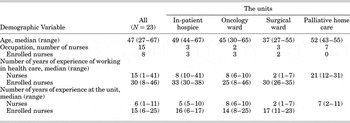
This study involved health care staff in two different geographical areas in Sweden (Table 1). Participants worked at one in-patient hospice, on one oncology ward in an urban area and one surgical ward, and in one palliative home care team in a sparsely populated area. All units cared for patients with cancer.
Demographics and work experience of participants

Procedure
The units were contacted by the research team in order to recruit interested members and to schedule a time for the interviews. The aim of the study was presented at meetings and in communication with the head of the units. Staff members were also informed in a letter about the study and about confidentiality, and thereafter they signed an informed consent form. The focus group interviews were conducted at each unit in a separate room.
Focus Groups
All four focus group interviews were conducted in the same way, according to the procedure described by Kreuger and Casey (Reference Kreuger and Casey2000). Two persons from the research team were present at each interview, and one of them acted as moderator (i.e., the third and the fourth authors) and the other assistant moderator took notes during the session (i.e., the first, second, and fifth authors). The reason for having different moderators and assistant moderators was the geographical distance, about 900 km, between the interview locations. The moderators posed the same two questions at all the interviews: (1) What existential issues are important for patients at your unit? (2) What is the health care staff's responsibility when existential issues are raised by the patients at your unit? Additional questions were posed in order to clarify participants' opinions about the issues, and the assistant moderator took notes to capture different topics that came up during the interviews and, if needed, followed them up. The focus group interviews lasted about 45 minutes and were taperecorded and transcribed verbatim.
Content Analysis
The focus group interviews were analyzed using qualitative content analysis according to Krippendorff (Reference Krippendorff2004). Meaning units were extracted from the interview transcripts, and these were coded and classified into subcategories and categories for each of the two questions. These analyses were conducted by all the authors independently and were then revised and adapted until consensus was reached. Subcategories and categories were found to be mutually exclusive and exhaustive.
RESULTS
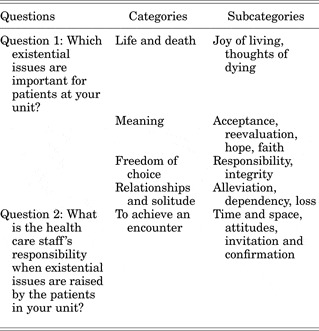
The focus group interviews with health care staff consisted of two questions, and the results are presented on the basis of these questions. Four categories and 10 subcategories emerged after analyzing Question 1. One category and 3 subcategories emerged after analyzing Question 2 (Table 2). The quotations are taken from interviews at the different units, which are indicated in the parentheses after the quotation, that is, OU (Oncology Unit), SU (Surgical Unit), HU (Hospice Unit), and PHT (Palliative Homecare Team).
Categories and subcategories related to Questions 1 and 2

The following four categories emerged from data belonging to the first question: “life and death,” “meaning,” “freedom of choice,” and “relationships and solitude.”
Life and Death
The category “life and death” includes the subcategories joy of living and thoughts of dying.
Joy of Living
Patients' existential issues concerned what happened here and now and were not always related to death and what happened during and after death. Health care staff described it as being natural for patients to focus on life and be satisfied with life here and now and enjoying small things in life, such as having a glass of wine with dinner on a Friday evening. Staff said that it was also important to patients to talk about everyday things in life. This brought them joy as it helped them to escape from their illness.
Well we talked about flowers and gardening and everything and then once she said to me that it's so nice when you call me because you, you don't go on about illness, you talk about other things with me. (PHT)
Thoughts of Dying
Health care staff said that the last weeks or days of a patient's life were rarely an urgent struggle against death. Rather, patients were led into death without a struggle by their illness, even though illness compelled patients into death. This was illustrated by one patient who had experienced that death was calling her and that her husband, already dead, wanted her to follow him. Staff also described how some patients were afraid of death and felt anxious. They feared what would happen after death and did not believe in the existence of God. Some patients were worried that they would not die properly, that they would only be asleep.
One patient made his family promise that he had to lie in the coffin at home for three days after his death to be sure that he wouldn't wake up in his grave. (PHT)
Most of the patients seemed to be calm when they were close to death, and living, dying and being parted from one's family was regarded as a natural process. Staff also stated that patients felt it was important to die in a place where they felt the most secure.
Meaning
The category “meaning” includes the subcategories acceptance, re-evaluation, hope, and faith.
Acceptance
A relieving thought for a patient who was dying was when he or she had accepted that death could not be avoided. Staff described how patients seemed to be resigned when they said that “well, it seems I am not allowed to live any longer.” But it was difficult for staff to distinguish between whether patients had accepted death or whether they had lost the spark of life. A patient struggling for a long time against death might, after a while, express a wish to die. To staff, this did not seem to be something negative; rather, it was something positive and it could be satisfying for the patient to be allowed to lay down one's arms in front of death.
We had a patient that struggled, a woman, and she fought and fought and fought and then she just came up and then she said … that she wanted to die, … this was not something negative, instead it was something positive because she was so incredibly social; this person had an incredible social network and had had a wonderful time and for her I thought it was just comfortable when she laid down the arms when she didn't want [to live] any more. (OU)
Staff also said that reaching acceptance could include anxiety and that young patients with cancer could feel that it was unfair that they had to die. On the other hand, staff on the palliative homecare team when patients had accepted that they were going to die could make comments like: “Now things are like this and there is nothing I can do about it. I must leave my life, even if life did not get any better than this.” Others seemed to be confident about talking about death. They had accepted that life would end this way and could feel that they had lived a rich life. But some patients did not want to talk about death and avoided the subject. They did not want to die and questioned why this was happening. Meaning-based questions concerned “Why me?” or “What will happen here next?” Other questions concerned finding direction in life such as “Is there a God?” Patients tried to find some meaning in the current events and of life itself. Even very old patients could say that they were not ready to die and leave their life.
Reevaluation
The immediacy of death gave a new zest for and value to life. Details that had previously been annoying were now less important. Staff said that patients reevaluated things in their lives and had a need to summarize it and narrate the story of their lives. When they were given the opportunity, they could also find their own answers.
It's there … as long as it's not you, you don't have the same thoughts because you want to find … when something happens, you want to find some meaning in it. (HU)
Hope
Health care staff stated that hope was a constant theme for patients. Although the patients were aware that they were dying, they expressed hope about the future, indicating that people have a fundamental faith in life. Patients had thoughts about the future even if they were aware of the severity of the situation. They could still feel hope and make plans for the future. They could talk about the weather, but also about the fact that spring was on the way although they were aware that they could hardly stay alive for many more weeks. Staff regarded this as some kind of escape from reality—a way for patients to find hope by running away from disease. Moreover, many patients hoped for a last-minute reprieve because “you never know.”
But as long as you stay on a ward, there is always a hope that my doctor will come tomorrow and say well, we can try this new medicine now or something like that. (OU)
Faith
Faith gave meaning in life when close to death. Staff described how patients believed that there was some kind of higher power that sheltered them and that made it easier to accept whatever happened. Each patient had his or her own picture of what was going to happen afterward: you can carry on living in another dimension, you can communicate with others after death, and you can have a belief in a higher power, a higher meaning or God. Some patients can be helped by their faith through difficult times, whereas others do not have faith.
You can feel in those patients who have a belief rooted in their childhood, that, e.g., what is going to happen afterwards, those thoughts are more natural and they don't feel fear in the same way and, sort of, if you strongly believe in God, you almost look forward to going to heaven, there is no fear. (SU)
Freedom of Choice
The category “freedom of choice” includes the subcategories responsibility and integrity.
Responsibility
Responsibility concerned feelings of guilt and reconciliation. Health care staff said that existential issues for patients in the palliative phase often concerned questions about why things happened and about their own responsibility for their situation. These thoughts made the patients lose their direction in life and feelings of guilt appeared.
Why, why, why am I stricken, it causes so many thoughts, anxiety and so much pondering about what this could be a punishment for. What evil have I done, since I am stricken? Where am I going? (PHT)
The senses of guilt, according to staff, could originate in choices the patients have made during their lives causing pain to other people or guilt from getting lung cancer through smoking.
One narrative by health care staff member concerned both the feelings of guilt and the fact that the patient took responsibility for her actions and contributed to reconciliation: One woman admitted to the ward had feelings of guilt because she had given up her child and given her daughter away for adoption. The woman wrote a letter to the daughter and tried to explain why she had acted as she did, in an attempt towards reconciliation. The woman was assured that the letter would be given to the daughter when the woman had died.
Integrity
To maintain integrity, some patients choose to shut out the health care staff, as described in a narrative:
You couldn't reach out much to him, he kept his distance and integrity was important to him. You wondered how he felt during the last week of his life? We tried to get into his world, but it was very difficult due to his integrity. (OU)
The staff members continued their narrative about how the patient suffered when his integrity was violated, when he needed help to wash, and this resulted in a wish to die. Some staff members felt that the patient had surrendered when he stopped taking medication, agreed to have a urine catheter, stopped eating and drinking, and only wanted to go home and die, which was impossible.
Relationships and Solitude
The category “relationships and solitude” includes the subcategories alleviation, dependency, and loss.
Alleviation
Health care staff described how important it was that the family members had an open and clear approach to questions about existential issues. This enabled the staff to feel the ambiance between family members and the patient, which affected the way staff could interact and care for the patient. With an atmosphere of openness about existential issues, nursing care and encounters with the family were easier to carry out and gave more satisfaction.
Because every family has a different strategy and different ways of tackling things and this is what you think is fascinating when I enter a home and feel what it's like in this family. And sometimes you feel it as soon as you cross the threshold; you could cut it with a knife. (PHT)
Relationships are often lifelong, and when questions about life and death were brought up, reflections on how a person has lived his/her life and the way one has nurtured relationships became important. Staff described how they could sense if the patient had had a rich life with good relationships and was comfortable with him/herself, which facilitated the community to others. Some patients had a lot of unresolved relationships and the sadness that the patient showed about this was often experienced as difficult for staff to share.
But in our situation as nurses who meet these dying people, it's important to remember that those relationships that haven't worked for 25 years, they can't. (PHT)
Dependency
To be dying also meant being dependent on others in everyday life. Suddenly the patient had to ask other people for help, which could mean that he/she was changing and becoming another person. This could be perceived by health care staff as offensive because the patient had lost his/her self-image and was no longer strong and independent, which in itself could mean that patients were facing an existential crisis.
That you lose the picture of me being strong and good—I've done these things and I've succeeded in these things—always, and quite suddenly it isn't … you lose everything. (PHT)
Loss
A seriously ill person experiences loss when death forces him or her to break up from various relationships. Health care staff often described how patients desperately talked about their family relationships and all those they were forced to leave. Issues like “who will take care of my children when I no longer exist,” were often addressed when caring for women with children, such as the not being involved in future festivities such as high school degree celebrations and weddings or having grandchildren. For many, especially those with small children, this loss became a struggle to defeat death for their children's sake.
[I see] the mothers' lonely struggle to defeat death for their children's sake, but I think this feels more when you have a family with children, specially when you have a mother with young children: “Why me? I won't see my children growing up. What will happen to them? How can I help them before [I die].” These sorts of questions often come up, particularly mothers who are going to die. (PHT)
Staff described how patients cared more for others at their own expense. Not being able to speak about one's own grief, fear, or anxiety when facing death may create a sense of abandonment despite having people around you.
[When you] talk about death, if you ask how they want it to be and that sort of thing, they push it away, they don't dare tackle it, it's difficult to talk about it with their relatives because they feel that then they're making their relatives sad. (SU)
To Achieve an Encounter
The category “to achieve an encounter” emerged from the second question and includes three subcategories: time and space, attitudes, and invitation and confirmation.
Time and Space
Time and space were important for health care staff's dialogue with patients. Several things could limit the dialogue, such as lack of time and lack of an undisturbed place to be in. In spite of lack of time and space, the staff tried to take the opportunity to have a dialogue with patients when possible:
Only when they have a room of their own or you help them with showering or are alone with the patients, is it easier to talk, when no one is disturbing, very often in the shower room. (OU)
Because the opportunity to have an existential dialogue cannot be scheduled in advance, health care staff described how they created time for each other to make it easier to have an important dialogue with the patient. One way was to take over a colleague's tasks that could not wait. In addition, the lack of documentation about existential or psychosocial concerns was a major obstacle to dialogue.
Attitudes
Other prerequisites for bringing about an encounter concerned the staff's attitudes, for example, treating every patient as unique, respecting the patient's integrity, and being aware of cultural differences. Attitudes also concerned being aware of responsibility to have a dialogue with the patients but also being aware of their own limitations.
It is our responsibility to listen to [the patients] if they have existential concerns and to listen and talk to them, that is my opinion. (HU)
Another attitude was that staff included family and close ones in the necessary relationships that would make it easier to have a dialogue. It was important to have a comprehensive view of the situation including the patient, family, and health care staff. The attitudes also included the negative feelings relatives could display toward health care staff that were caused by their own bereavement.
I mean you turn your frustration towards health care professionals in some way, most often in that they become sorry, angry, or frustrated at things we do, which might be caused by sorrow that they are going to lose a close one or by powerlessness; they can't cope or control the situation and then, I mean, it is easier to turn aggression towards us in some way. (OU)
Some of the staff had the attitude that having a dialogue depended on how well the patient and the staff knew each other, expressed as:
[When the patient] had been on the ward for a long time, when you know the patient, then you dare [to begin a dialogue]. (SU)
Existential issues were seldom raised in the surgical unit, but more often in the hospice, oncology, and palliative home care units. For example, staff on the surgical ward requested more knowledge to be able to deal with patients' existential issues, but at the hospice, the staff thought they have had enough education and dealing with these questions increased their skills:
But you learn while you are here, every day, to say good things, and deal with these [existential] questions. (HU)
Invitation and Confirmation
According to staff, starting a dialogue involved inviting the patients to talk by being open to dialogue, which could be shown in body language and eye contact. It was also acknowledged by staff that patients were sensitive to staff members' deliberate or accidental glances and tone of voice, signaling that a staff member was unwilling to talk at that moment. To be able to invite the patient to dialogue, it was important for health care staff to be able to observe only a small hint, indicating that the patient wanted to talk. It was important to seize the opportunity, to give the patient confirmation that someone is listening and to be able to adapt to what the patients wanted to talk about. Staff also had to be aware of relatives' situation and acknowledge their feelings and understand that they could be tired after many years of caring. Acknowledgment was very important in the dialogue with patients, and acknowledgment in itself could be an existential issue, as one nurse expressed it:
Someone need[s] to just talk, to sit and talk to a patient, to confirm [for] her that someone is listening, that might be a variation of the existential question, not only talking about death. (OU)
When working with cancer patients, the staff said that they have a huge responsibility to listen and to have the courage to remain in the situation and dare to remain silent. Furthermore, staff had practical suggestions about how to phrase a question in order to initiate a dialogue about existential issues. Initiating questions could be “Are you afraid?” or “What is most distressing for you now?”
DISCUSSION
The present study was conducted in order to clarify the lack of correspondence between patients' desire to raise existential issues and staff's failure to fulfill this desire. The study revealed that encounters were occasionally achieved between patients and staff, especially at the hospice and palliative care team units, and that staff also sometimes are aware of patients' important existential issues. This knowledge needs to be further distributed to staff members who experience this lack of knowledge.
The results showed that important existential issues for patients in different settings were, according to health care staff, life and death, meaning, freedom of choice, and relationships and solitude. These categories are quite similar to the areas death, freedom, isolation, and meaninglessness described by Yalom (Reference Yalom1980). The differences between the categories found in the present study and Yalom's areas might be due to the fact that Yalom's existential psychotherapy was elaborated for patients with mental health problems. The present study was conducted among health care staff caring for mentally healthy patients suffering from an incurable disease, mostly cancer. Health care staff's responsibility when existential issues were raised concerned ways of achieving an encounter.
The results from the present study are in line with the findings from two recently published concept analyses of spirituality (Sessanna et al., Reference Sessanna, Finell and Jezewski2007; Vachon et al., Reference Vachon, Fillion and Achille2009). The following elements in the definition of spirituality confirm the categories in our focus group study: meaning and purpose, mutuality and feeling of communion, faith and beliefs, hope, attitudes toward death, and appreciation of life. In our study, we assumed that existential issues are a more comprehensive concept than spirituality and that existential issues might include spirituality but also go beyond it. However, the similarities between the concept analyses performed by Sessanna et al. and Vachon et al. and the results from our study indicate that existential issues and spirituality can sometimes be used interchangeably.
In the present study, life and death became important to patients with cancer. This is well known and not surprising, as the disease could lead to death (Strang, Reference Strang1997). Still, several studies show that “keeping in good spirit” and being positive are important for being able to value ordinariness in everyday life in spite of a serious disease (Larsson et al., Reference Larsson, Haglund and Von Essen2003; O'Baugh et al., Reference O'Baugh, Wilkes and Luke2003; Johansson et al., Reference Johansson, Axelsson and Danielson2006). The importance of finding joy in life can also be due to the fact that patients have a strong will to live and fight against death and negative thoughts and an intense wish to be normal and healthy when death is close (Landmark et al., Reference Landmark, Strandmark and Wahl2001). The will to be normal and not to be seen as “a cancer case” has also been expressed by women with breast cancer during adjuvant treatment (Browall et al., Reference Browall, Gaston-Johansson and Danielson2006). The women in that study expressed a feeling of not being afraid of dying, but they wanted more time to prepare themselves. On the other hand, there are studies that show that fear may be prevalent during the dying process (Wilson & Fletcher, Reference Wilson and Fletcher2002; Grumann & Spiegel, Reference Grumann and Spiegel2003; Thomé et al., Reference Thomé, Dykes and Gunnars2003, Coward & Kahn, Reference Coward and Kahn2004). According to staff members' opinions in our study, fear was present in many patients, but mostly they described that patients seemed to be able to be calm when close death if they felt secure. These findings compel health care staff to be sensitive to the patient's state of mind when caring for patients at the end of life.
Creating meaning in current events and in life itself was an important existential issue found in our study and has also been found in numerous studies in various settings (Murray et al., Reference Murray, Kendall and Boyd2004; Tan et al., Reference Tan, Braunack-Mayer and Beilby2005; Boston & Mount, Reference Boston and Mount2006; Westman et al., Reference Westman, Bergenmar and Andersson2006). In the present study, meaning concerned acceptance, reevaluation of life, hope, and faith. According to Kubler-Ross's (Reference Kubler-Ross1969) stage theory, dying is a process of emotional stages that patients facing death go through as they progress from a state of denial to acceptance. Other feelings such as anger, bargaining, and depression may also be experienced during this process. The fact that life is valued in a different way when you have a life-threatening disease, such as cancer, is known (Landmark et al., Reference Landmark, Strandmark and Wahl2001) and is also described in the literature as a response shift (Sprangers & Schwartz, Reference Sprangers and Schwartz1999), which includes a change of internal standards in the respondent's values and in the conceptualization of the target construct, for example, quality of life. Lowey (Reference Lowey2008) points out in a review article that “letting go,” the acceptance of impending death, appears to be a universal domain. It is important that clinicians communicate with the family and that everything possible has been done prior to the death.
Hope is important when creating meaning, which has been acknowledged in several research studies (Buckley & Herth, Reference Buckley and Herth2004; Morita et al., Reference Morita, Kawa and Honke2004; Tan et al., Reference Tan, Braunack-Mayer and Beilby2005). Tan et al. found that hope concerned both being cured and finding a meaning in life in some way. The participants in our study described that patients were hoping to be healed by, as expressed by Yalom (Reference Yalom1980), “an ultimate rescuer.” Our finding about creating meaning through religious faith, which is in line with other studies (Grumann & Spiegel, Reference Grumann and Spiegel2003; Grant et al., Reference Grant, Murray and Kendall2004; Boston & Mount, Reference Boston and Mount2006) was somewhat surprising because Sweden is one of the most secularized countries in the Western world.
Freedom of choice in the present study concerned both responsibility and integrity. Responsibility included feelings of guilt and the view that death was a punishment, but it also acts to achieve reconciliation. Feelings of guilt have also been found in patients with lung cancer, who felt that they themselves had caused their disease by smoking (Chapple et al., Reference Chapple, Ziebland and McPherson2004), something that was also mentioned by staff in the present study. The fact that feelings of guilt are frequently prevalent at the end of life compel health care staff to intervene when they recognize such feelings. Integrity was another aspect that was found in our study, which concerned that patients made their own choices and strived to maintain their integrity; this has also been expressed as autonomy by Hermann (Reference Hermann2001), Bolmsjo et al. (Reference Bolmsjo, Hermeren and Ingvar2002), and Blinderman and Cherny (Reference Blinderman and Cherny2005). On the other hand, when patients are no longer able to participate in making decisions, this might be delegated to others, such as health care staff. Delegating decision making to staff may increase the patient's dependency on others, which means that health care staff need to help patients to endure their dependency (Flanagan & Holmes, Reference Flanagan and Holmes1999).
Relationships and openness to existential issues in some way ameliorated patients' distress, but they also caused sorrow and feelings of loss. For example, patients sometimes struggled to survive as long as possible in order not to leave their children, something that was also found by Kawa et al. (Reference Kawa, Kayama and Maeyama2003). Consequently, a forgiving ambience between the patient, family, and staff was highly important for a caring and forgiving atmosphere.
As found in our study, an encounter was possible if there was enough time and space and depended on the staff's attitudes and whether staff invited and confirmed patients in the dialogue. Van Leeuwen et al. (Reference Van Leeuwen, Tiesinga and Post2006) also pointed out the importance of communication with patients. These prerequisites for the encounter are also highlighted by Paterson and Zderad (Reference Paterson and Zderad1988/1976) and O'Connor (Reference O'Connor1993), who stated that nursing implies a meeting of human persons. This meeting occurs as a need related to the patient's health–illness situation, which was also acknowledged by staff in the present study, who had suggestions as to how to make possible the encounter with the ill persons. Furthermore, Paterson and Zderad acknowledged the environment, including time and space, in which nursing takes place. The staff in our study acknowledged these as being prerequisites of achieving an encounter. These similarities place the health care staff's suggestions for achieving an encounter in line with nursing theory. Being able to create a dialogue with patients with cancer depended on the maturity and self-knowledge of caregivers as well as on time, space, and continuity. In our study, we also found that the existential questions were almost self-evident in palliative care settings, but not quite as significant in the surgical ward. The questions of life and death are constantly present, but staff have difficulties in recognizing and prioritizing them.
Methodological Considerations
The strength of the present study was that data were collected in interviews with health care staff, both registered nurses and enrolled nurses. Data were collected in four focus groups in four different settings in two different geographical areas, one urban and one rural. In spite of the diversity of settings and areas, the findings are fairly congruent. The purpose of the focus group interviews was to stimulate the participants to interact and communicate with each other about existential issues involving patients. We used descriptive content analysis and a clear pattern was found: Health care staff in the hospice and on the palliative home care team were more reflective when discussing the interview questions than the staff in the other units. This could be due to staff in the hospice and in palliative home care having more time and being more used to discussing these matters with patients and colleagues than staff on hospital wards. One of the limitations was that we interviewed health care staff and not the patients themselves about existential issues at the end of life. The reason for this was that it is quite difficult to discuss existential issues with patients at the end of life in focus groups (Johansson et al., Reference Johansson, Axelsson and Danielson2006). It is also well known that one of the research problems in palliative care is the difficulties in recruiting patients due to their being a vulnerable population.
When researchers collect qualitative data, it is important that they assess and reflect on trustworthiness and appraise the quality of data collection, interpretation, and conclusions (Polit & Beck, Reference Polit and Beck2008). Consequently, we spent considerable time in the research group clarifying the best way to investigate and analyze which existential issues are important for patients and health care staff's responsibility when existential issues are raised by the patients. We tried to give prominence to the participants' values and withhold our own in the analyzing process. To make the process discernible, the findings were validated with quotations and similar findings from other studies. This focus group study has been essential for the research group in further development of an experimental design for continuing research about existential issues.
Clinical Implications
The present study showed that, according to health care staff, existential issues important to patients with cancer concern mainly meaning and direction, such as when patients ask meaning-based questions like “Why me?” or “Why am I being punished?” and direction questions such as “Where am I going?” To be able to respond to these existential questions, health care staff must understand their responsibility to support patients in their existential concerns and that they have to invite patients to a dialogue. Ways of initiating the dialogue about existential issues consist of staff asking the patients questions such as “Are you afraid?” and “What is most distressing to you?” To be able to have this dialogue, the staff needs to help each other to find time and space and give each other the opportunity to “seize the moment” when the patient is willing and in need of expressing and sharing his or her existential thoughts. The dialogue will fill the gap between patients' need to talk about existential issues and staff members' lack of strategies for meeting them.
ACKNOWLEDGMENT
This study was funded by the Association for the Cancer and Traffic Injury Fund, Sweden.