Case report
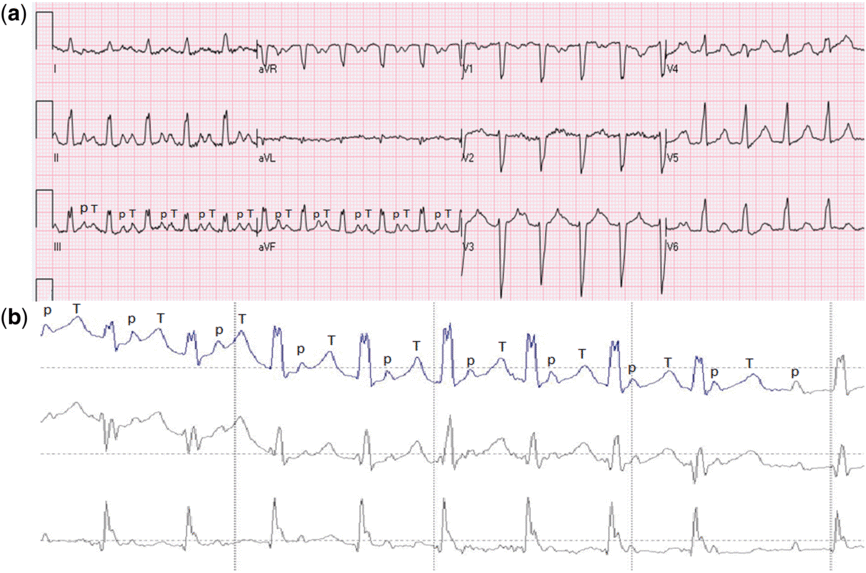
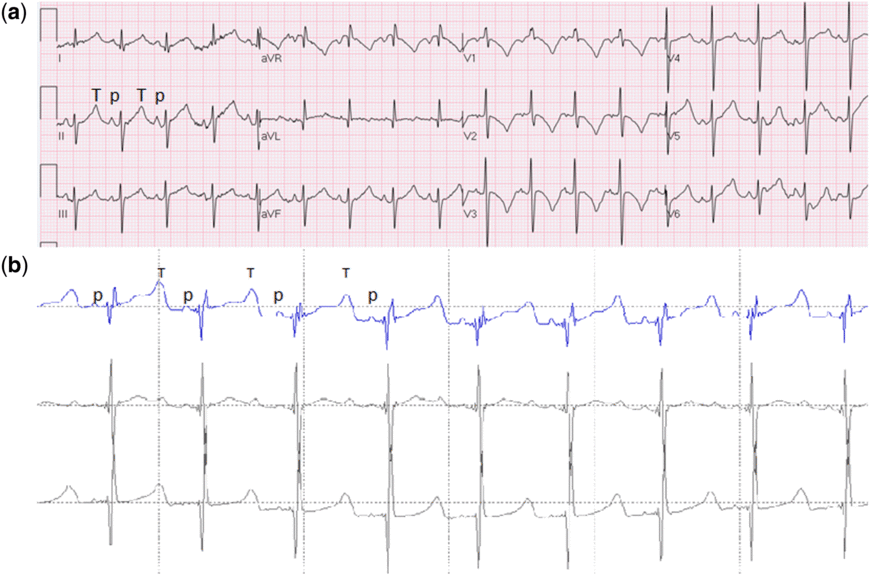
A 40-day-old male infant was referred due to auscultation of a cardiac murmur. The family history did not suggest an inherited arrhythmia syndrome. Recordings from a 12-lead surface electrocardiography showed a prolonged QT interval with a calculated QTc of ∼590 ms, a first-degree atrioventricular block and a partial intraventricular block (Fig 1a). The first-degree atrioventricular block and, rarely, a Mobitz type 1 second-degree atrioventricular block were seen on a 24-hour ambulatory electrocardiography. At first glance, the P and T waves were indistinguishable during the first-degree atrioventricular block, but during the Mobitz type 1 second-degree atrioventricular block, they were easily distinguished. As the P-R interval lengthened, a prolonged QT interval also appeared (Fig 2a). Medical treatment was initiated with propranolol. After a switch to mexiletine, marked improvements in the first-degree atrioventricular block and the intraventricular block were seen during follow-up in both the 12-lead surface electrocardiography and the 24-hour ambulatory electrocardiography (Fig 2a and b). Genetic testing for long QT syndrome revealed a missense mutation (p.Y493C (c.1478A>G)) in the KCNH2 gene, confirming long QT type 2 syndrome. After the mexiletine therapy was initiated, the calculated QTc decreased to 500 ms. During follow-up medical therapy, no additional complications were detected.
(a) The recordings from a 12-lead electrocardiography show prolonged QT (QTc: ∼590 ms), first-degree AV block and intraventricular block. (b) The 24-hour ambulatory electrocardiography reveals a Mobitz type 1 second-degree AV block. The first wave after the QRS complex is a P wave, and the second is a T wave. AV=atrioventricular.

(a and b) The recordings from a 12-lead electrocardiography and a 24-hour ambulatory electrocardiography show marked improvement in the first-degree AV and intraventricular blocks after mexiletine treatment. AV=atrioventricular.

Financial Support
This research received no specific grant from any funding agency, commercial or not-for-profit sectors.
Conflicts of Interest
None.
Ethical Standards
Informed consent was taken from the parents and all procedures contributing to this work has been approved by the institutional committees of Istanbul Mehmet Akif Ersoy Thoracic and Cardiovascular Surgery Education and Research Hospital.