


Introduction
A number of models of parenting stress have been developed and applied to intellectual disability (ID) research (Hill and Rose, Reference Hill and Rose2010). Such models have included the Double ABCX model (McCubbin and Patterson, Reference McCubbin, Patterson, McCubbin, Sussman and Patterson1983), the Transactional Model of Stress and Coping (Lazarus and Folkman, Reference Lazarus and Folkman1984), the Two-factor Model of Psychological Well-being (Lawton, Moss, Kleban, Glicksman and Rovine, Reference Lawton, Moss, Kleban, Glicksman and Rovine1991) and the Model of Parent-Child Interactive Stress (Johnston and Mash, Reference Johnston and Mash1989). These models propose that a number of specific inter-linking factors contribute to stress in parents and families. Such factors broadly include child characteristics, parental characteristics and environmental characteristics. Within these over-arching themes, the specific factors incorporated into each proposed model and the way they inter-link, have varied.
These models emphasise the important role of parental cognitions in influencing parental/ family stress and adjustment. They suggest that parental cognitions may mediate and/ or moderate specific relationships, which impact upon parental stress and well-being (e.g. Johnston and Mash, Reference Johnston and Mash1989). This may in part explain why parental stress is not an inevitable result of having a child with an ID (Hastings, Reference Hastings2002; Hastings and Taunt, Reference Hastings and Taunt2002). While many studies have been open to both mothers and fathers, in practice the majority of participants have been mothers, and other studies have restricted participation to mothers only; as a result, these types of studies are reviewed together. Various types of parental cognitions have been examined: these have included attributions (such as locus of control, stability and controllability), self-efficacy, satisfaction, optimism, hope, psychological acceptance, avoidant coping and mindfulness (e.g. Drysdale, Jahoda and Campbell, Reference Drysdale, Jahoda and Campbell2009; Lloyd and Hastings, Reference Lloyd and Hastings2009a).
One pathway proposed to be affected by parental cognitions is that between child characteristics (e.g. degree of disability) and parental stress and well-being. One child characteristic found to be related to parental stress and well-being is challenging behaviour (Hastings, Reference Hastings2002). Many studies have shown that challenging behaviour is related to levels of parenting stress and well-being, with more challenging behaviour being associated with higher levels of parenting stress and lower levels of well-being (e.g. Baker, Blacher, Crnic and Edelbrock, Reference Baker, Blacher, Crnic and Edelbrock2002; Lecavalier, Leone and Wiltz, Reference Lecavalier, Leone and Wiltz2006; Orsmond, Seltzer, Krauss and Hong, Reference Orsmond, Seltzer, Krauss and Hong2003. Other studies have also shown that challenging behaviour significantly predicts parental stress and well-being (e.g. Kersh, Hedvat, Hauser-Cram and Warfield, Reference Kersh, Hedvat, Hauser-Cram and Warfield2006; Woodman and Hauser-Cram, 2012). Although a number of studies have focused on this direct relationship, some research has been published on the influence of parental cognitions via mediation or moderation (e.g. Hassall, Rose and McDonald, Reference Hassall, Rose and McDonald2005; Hastings and Brown, Reference Hastings and Brown2002).
Some research has found evidence for the mediation or moderation of parental cognitions on this relationship. For example, Hastings and Brown (Reference Hastings and Brown2002) assessed the influence of self-efficacy on the relationship between behavioural difficulties and parental well-being in parents of children with autism. Self-efficacy mediated the relationship between behaviour problems and both anxiety and depression in mothers. This suggested that children's behavioural problems lowered self-efficacy in mothers leading to increased mental health difficulties. Baker, Blacher and Olsson (Reference Baker, Blacher and Olsson2005) found that optimism moderated the relationship between child behavioural problems and maternal well-being. This suggested that mothers of children with more behavioural problems who were less optimistic experienced lower levels of well-being compared to optimistic mothers.
On the other hand, some studies have found no evidence for parental cognitions mediating or moderating the relationship between challenging behaviour and parental well-being. Hassall et al. (Reference Hassall, Rose and McDonald2005) found that locus of control and parenting satisfaction significantly predicted parenting stress but they did not mediate the relationship between child behavioural difficulties and parenting stress. Hill and Rose (Reference Hill and Rose2009) used the same measures with mothers of adults with ID and found that maternal satisfaction and locus of control significantly predicted maternal stress. Again, these cognitions did not mediate this relationship. Feldman et al. (Reference Feldman, McDonald, Serbin, Stack, Secco and Yu2007) found that social support rather than self-efficacy mediated the relationship between child behaviour problems and depression. Also, Norizan and Shamsuddin (Reference Norizan and Shamsuddin2010) found that depression rather than acceptance mediated the relationship between child behavioural difficulties and parental stress. To date, the research findings appear inconclusive.
One limitation of the research on parental cognitions is the lack of discrimination between different topographies of challenging behaviour. Within the literature on staff, some studies have compared the attributions of different forms of challenging behaviour (e.g. Dilworth, Phillips and Rose, Reference Dilworth, Phillips and Rose2011). Stanley and Standen (Reference Stanley and Standen2000) found that staff working in day services perceived individuals with challenging behaviour to have significantly greater control of aggressive behaviour compared to self-injurious behaviour. However, staff perceived self-injurious behaviour to be significantly more stable than aggressive or destructive behaviour. Bailey, Hare, Hatton and Limb (Reference Bailey, Hare, Hatton and Limb2006) found that staff perceived other forms of challenging behaviour as significantly more uncontrollable and less stable than self-injurious behaviour. No significant difference was found between the internal attribution scores for these behaviours. The results to date suggest that staff attributions are affected by topography of behaviour.
A limitation to this area of research is the absence of measures that specifically examine parents’ cognitions of their child's challenging behaviour. The Challenging Behaviour Perception Questionnaire (CBPQ) is based upon the self-regulation model of illness behaviour and has been used to explore whether this alternative theory can expand our knowledge of staff attributions (Leventhal, Nerenz and Steel, Reference Leventhal, Nerenz, Steel, Baum, Taylor and Singer1984; Leventhal, Diefenbach and Leventhal, Reference Leventhal, Diefenbach and Leventhal1992; Williams and Rose, Reference Williams and Rose2007).
The aim of the current study was to examine whether mothers’ cognitions of their child's challenging behaviour mediates the effect of challenging behaviour on their stress levels. Self-injurious behaviour (SIB) and aggression/destruction were examined separately to assess whether differences occur between topography of behaviour. The mediation of cognitions as proposed by the Model of Parent-Child Interactive Stress was examined (Hassall et al., Reference Hassall, Rose and McDonald2005; Johnston and Mash, Reference Johnston and Mash1989), this model predicts that parental cognitions will mediate the relationships between challenging behaviour and family characteristics, such as support and parental stress. This research will only investigate the impact of cognitive mediation of the elements of the CBPQ on the relationship between challenging behaviour and parental stress. Specific hypotheses were generated regarding the relationship between the study variables:
-
1. Challenging behaviour would be positively correlated with parenting stress.
-
2. There would be a significant relationship between challenging behaviour and mothers’ cognitions.
-
3. There would be a significant relationship between mothers’ cognitions and parenting stress.
-
4. Mothers’ cognitions would mediate the relationship between their child's challenging behaviour (specifically aggression/destruction and self-injurious behaviour) and their stress levels; and cognitions mediating this relationship would differ in accordance with the topography of behaviour.
Directional hypotheses were not made for hypotheses three and four as the CBPQ consists of six scales, which, as far as we are aware, have not been investigated previously in this population.
Method
Measures
Background information. The information obtained, included the participant's ethnicity and age; their child's age and gender; whether their child has a diagnosis of a syndrome; and the name of the syndrome they have been diagnosed with, if applicable.
The Wessex Scale (Kuschlick, Blunden and Cox, Reference Kuschlick, Blunden and Cox1973) is an informant-based questionnaire examining social and physical abilities of children and adults with ID. The Wessex scale has good interrater reliability at the subscale level for both children and adults with ID (Kushlick et al., Reference Kuschlick, Blunden and Cox1973; Palmer and Jenkins, Reference Palmer and Jenkins1982).
The Behavior Problems Inventory (BPI; Rojahn, Matson, Lott, Esbensen and Smalls, Reference Rojahn, Matson, Lott, Esbensen and Smalls2001) is an informant-based measure examining the frequency and severity of challenging behaviour over the previous 2 months. It assesses three types of behavioural difficulties: self-injurious behaviour, stereotyped behaviour, and aggressive/destructive behaviour. Each item is scored on a frequency scale ranging from “never” to “hourly” and a severity scale ranging from “slight” to “severe”. Internal consistency ranged from .61 to .82 at subscale level for frequency scores and test-retest reliability for frequency scales ranged from .64 to .76 at subscale level (Rojahn et al., Reference Rojahn, Matson, Lott, Esbensen and Smalls2001). Only the self-injurious and aggressive/destructive behaviour subscales were utilised for this study (alphas for this sample: 0.64–0.85). In order to reduce the number of variables, the severity and frequency scores were summed for each behaviour, producing a total self-injurious behaviour score and a total aggressive/destructive behaviour score. The severity and frequency scores were highly correlated for the same topography of behaviour (self-injurious behaviour, Spearman rho = 0.917; aggressive behaviour, Spearman rho = .925), hence it was considered that analysing severity and frequency separately would add little to the analysis.
The Challenging Behaviour Perception Questionnaire (CBPQ; Williams and Rose, Reference Williams and Rose2007) was developed to assess the cognitions of staff working with people with ID about episodes of challenging behaviour. The CBPQ has been modified for parents (Rose and Nelson, Reference Rose and Nelsonin press) and the new version consists of 24 statements about the person's challenging behaviour. These are split into six subscales: Consequences for client; Consequences for carer; Treatment; Timeline chronic; Timeline episodic; Emotional representation. Parents are asked to rate their response to each statement on a 5-point Likert scale ranging from “strongly disagree” to “strongly agree”. The alpha co-efficients at subscale level ranged from .70 to .85 with three subscales showing good internal consistency and three showing acceptable internal consistency. Concurrent validity of the CBPQ subscales has also been investigated and some support for the validity of the CBPQ has been found (Rose and Nelson, Reference Rose and Nelsonin press).
The Parental Stress Index-short form (PSI; Abidin, Reference Abidin1995) is a 36-item questionnaire consisting of three subscales: Parental Distress (PD), Parent-Child Dysfunctional Interaction (P/CDI) and Difficult Child (DC). A total score (PSI-TOT) is obtained by summing the subscale scores. Alpha coefficients for internal consistency range from .80 to .91 (.69 to .85, this study), and test-retest reliability coefficients over a 6-month interval range from .68 to .85 at subscale level (Abidin, Reference Abidin1995). Higher scores are indicative of greater parenting stress.
Procedure
Ethical approval was obtained through the local NHS research ethics committee and approval was also sought through the appropriate Research and Development departments. The inclusion criteria for the study were mothers of children and young adults (>30 years) with ID who lived with their child at home. Participants were recruited initially through clinicians working in two child Learning Disability services. As a result of low levels of recruitment, information packs were also sent via the Learning Disability register held in one district and through three schools for children with learning disabilities. Mothers were chosen as the focus for this study as they are most likely to be the main caregiver and to enable comparison with previous research that largely focuses on mothers. The inclusion of participants up to the age of 30 was also a pragmatic one and was extended from 25 years to increase the return rate. The overall return rate was approximately 15%.
If mothers completed and returned the consent forms, they were contacted to arrange a visit to complete the questionnaires via interview or to complete the questionnaire pack themselves and return it through the post, if preferred (n = 11).
Data analysis
Examination of Q-Q plots and Shapiro-Wilk tests were used to initially assess the distribution of data. Some data from the BPI and CBPQ were not normally distributed so non-parametric tests were employed throughout the analysis. Before conducting the main analysis, the following variables were correlated with parental stress (PSI total) to explore whether there were confounding variables: participant’s age; children's age; and children's self help, literacy and mobility scores. All correlations were not significant, indicating that these variables did not need to be controlled for in the main analysis.
Hypothesis 4, considering whether maternal cognitions mediate the effect of challenging behaviour on maternal stress, was examined using mediation analysis. One of the most commonly used methods of mediation analysis is the Sobel test (Reference Sobel1982). However, this test cannot be used in the current analysis as some of the variables were not normally distributed. The bootstrap procedure is more appropriate as it is independent of sample and population distribution and provides robust confidence intervals in small samples (Preacher and Hayes, Reference Preacher and Hayes2008). Given the relatively small sample size, bootstrapping procedures were used as this has been recommended when there is an inadequate sample size for straightforward statistical inference (Adèr, Mellenbergh and Hand, Reference Adèr, Mellenbergh and Hand2008). The bias-corrected bootstrap was used as it has been shown to be the most powerful mediation test when compared to other methods (Fritz and MacKinnon, Reference Fritz and MacKinnon2007). Preacher and Hayes (Reference Preacher and Hayes2004) developed a macro script that can be used in SPSS to analyse full mediation via bootstrapping and this was used in the current study. In order to show significant mediation, zero cannot be within the confidence intervals. From the tables of statistical power provided by Fritz and MacKinnon (Reference Fritz and MacKinnon2007), a mediated pathway of medium effect size (Beta = 0.39) can be identified with a power of 0.80 in a sample of 71 participants using the bias corrected bootstrap methods described by Preacher, Rucker and Hayes (Reference Preacher, Rucker and Hayes2007). If one of the pathways in the mediation effect were larger (e.g. 0.59) then a sample size of 54 would be required to achieve a power of 0.80. As small effects often provide limited opportunities for the development of clinical intervention, a sample size in excess of 55 participants would be a reasonable balance between explanatory power and clinical utility. However, significant mediation has been found in previous studies with smaller samples (Hassall et al., Reference Hassall, Rose and McDonald2005; Hill and Rose, Reference Hill and Rose2009).
Participants
Participants were 46 mothers of children and young adults with ID, their ages ranged from 28 to 59 years (M = 44.33; SD = 7.89). Of the total sample, 91.3% (n = 42) described themselves as White British, 4.3% (n = 2) as Black African, 2.2% (n = 1) as Pakistani and 2.2% as White Irish (n = 1). The age range of their children was 4 to 27 years (M = 11.63; SD = 6.14) and 37% (n = 15) were female. All children had received a diagnosis by a professional. Diagnoses reported by parents were: Autism/Autism spectrum disorder/ Asperger syndrome (39.1%; n = 18), Cerebal palsy (4.3%; n = 2), Down syndrome (4.3%; n = 2), Aicardi syndrome (2.2%; n = 1), Alagille syndrome (2.2%; n = 1), Fragile X syndrome (2.2%; n = 1), Di George syndrome (2.2%; n = 1), Shprintzen's syndrome (2.2%; n = 1) and Trisomy 9p (2.2%; n = 1). The abilities of children were measured using the Wessex Scale (Kushlick, Blunden and Cox, Reference Kuschlick, Blunden and Cox1973). Vision and hearing were reported to be unimpaired for 69.6% (n = 32) and 84.8% (n = 39) of individuals, respectively. 78.3% (n = 36) were reported to be fully mobile, 82.6% (n = 38) had speech, and 63% (n = 29) were partly able/fully able in terms of self-help skills (feeding, washing and dressing).
Results
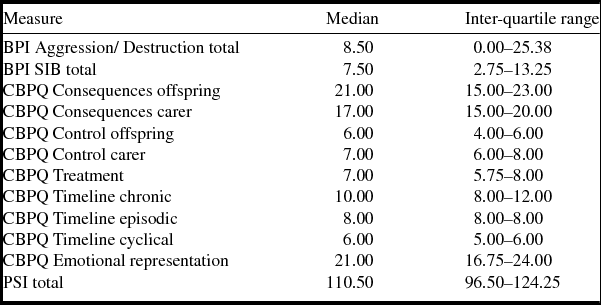
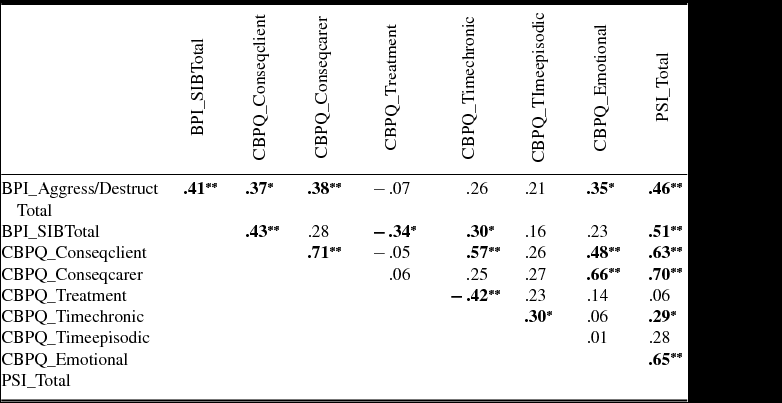
Medians and inter-quartile ranges of the main measures are provided in Table 1. Spearman correlations were used to address hypotheses 1–3 by examining the relationship between challenging behaviour, parental cognitions (using the CBPQ) and parental stress (see Table 2 for the correlation matrix). In order to compare the children demonstrating different topographies of behaviour, the children were split into three age groups, 1–10, 11–20 and 21–30 and compared as to whether they displayed any aggressive behaviour, self-injurious behaviour or not. The proportions of children in each age group displaying both self-injurious and aggressive behaviour were not significantly different and when visually compared across the groups the proportions in each group very similar.
Descriptive information for the questionnaires

Correlation matrix for study variables

Notes: Spearman's Rho *p < .05, **p < .01
(BPI: The Behavior Problems Inventory; CBPQ: The Challenging Behaviour Perception Questionnaire; PSI: The Parental Stress Index-short form
Hypothesis 1. Challenging behaviour would be positively correlated with parenting stress.
Table 2 shows that the BPI Aggression/destruction and self-injurious behaviour (SIB) subscales were both significantly positively correlated with the PSI total score. This indicates that more aggression/destruction and SIB were both associated with higher parenting stress levels.
Hypothesis 2. There would be a significant relationship between challenging behaviour and mothers’ cognitions.
Table 2 shows that BPI Aggression/destruction and SIB scores were both significantly correlated with three subscales from the CBPQ. The BPI Aggression/destruction score was significantly positively correlated with Consequences client, Consequences carer and Emotional representation subscales. This suggests that more aggression/destruction is associated with the belief that challenging behaviour has more negative consequences for parents and children and there is a more negative emotional impact on parents.
The BPI SIB score was positively correlated with the Consequences client and Timeline chronic subscales and negatively correlated with the Treatment subscale from the CBPQ. This suggests that greater levels of SIB are associated with the belief that challenging behaviour has more negative consequences for the child, that the challenging behaviour would be longer lasting and treatment would not be as effective. These findings partially support hypothesis 3, as only some of the CBPQ subscales correlated significantly with BPI scores.
Hypothesis 3: There would be a significant relationship between mothers’ cognitions and parenting stress.
Table 2 shows that four of the subscales of the CBPQ (Consequences client, Consequences carer, Timeline chronic and Emotional representation) were significantly correlated with the PSI total score. This indicated that higher levels of parenting stress are associated with the belief that challenging behaviour has more negative consequences for the parent and child, the belief that challenging behaviour would be longer-lasting and the belief that challenging behaviour has more negative emotional consequences for the parent. These findings provide partial support for hypothesis 3 as only some of the CBPQ subscales correlated significantly with the PSI total score.
Hypothesis 4: Mothers’ cognitions would mediate the relationship between their child's challenging behaviour (specifically aggression/destruction and self-injurious behaviour) and their stress levels; and cognitions mediating this relationship would differ in accordance with the topography of behaviour.
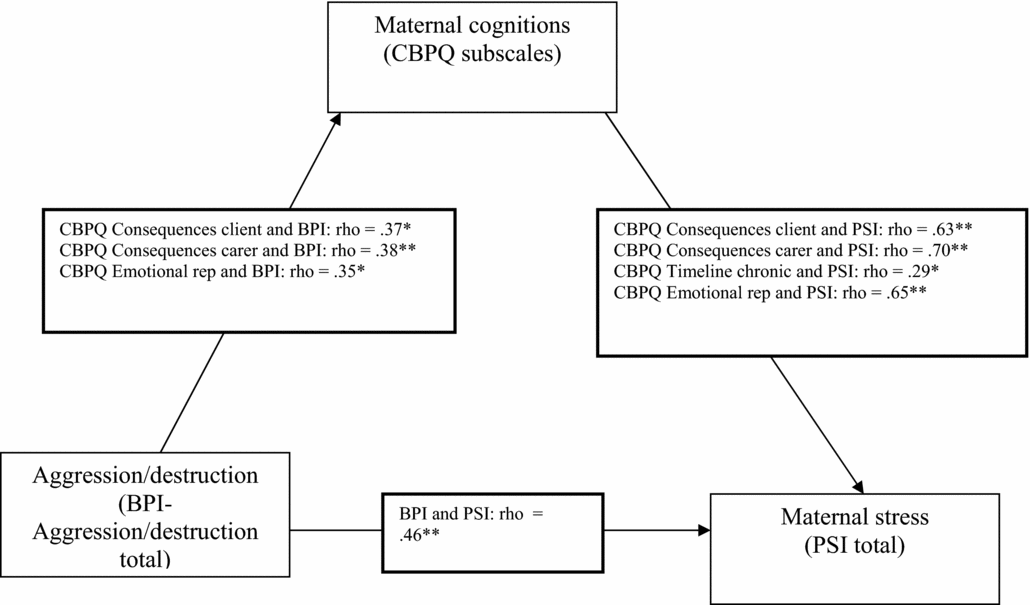
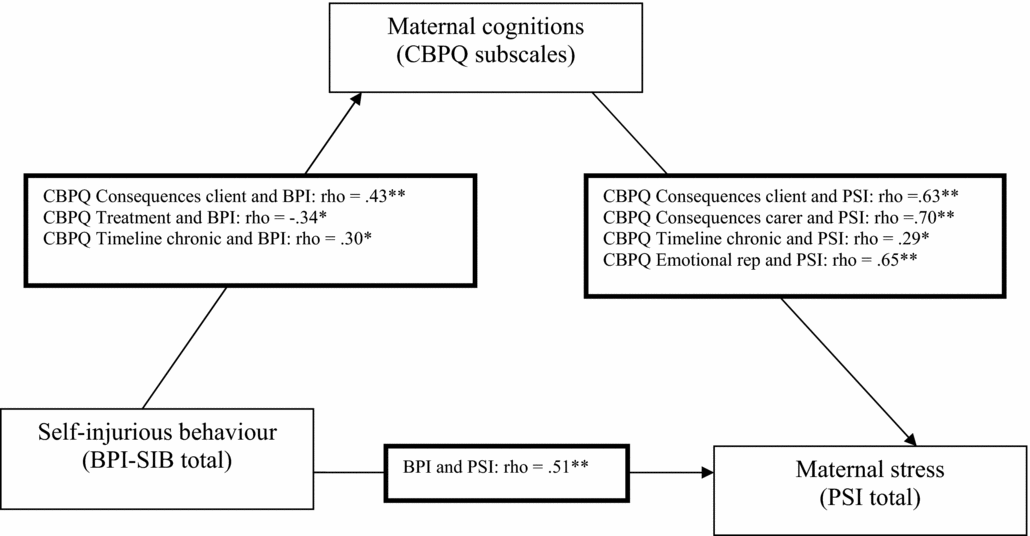
The mediation analysis addressed hypothesis 4. Mothers’ cognitions would mediate the relationship between their child's challenging behaviour (specifically aggression/destruction and self-injurious behaviour) and their stress levels; and cognitions mediating this relationship would differ in accordance with the topography of behaviour. Significant correlations between the three variables (see Table 2) are shown in the mediation models for aggression/destruction and SIB in Figures 1 and 2.
Significant Spearman's correlations between the variables in the proposed model for aggression/destruction

Significant Spearman's correlations between the variables in the proposed mediation model for self-injurious behaviour

Figure 1 shows that the cognitive variables that correlated significantly with both aggression/destruction and maternal stress were Consequences client, Consequences carer and Emotional representation. Figure 2 shows that the cognitive variables that correlated significantly with both SIB and maternal stress were, Consequences client and Timeline chronic. Only variables that were significantly correlated as shown in Figures 1 and 2 were entered into a mediation analysis.
Mediation analysis for aggression/destruction and parental stress
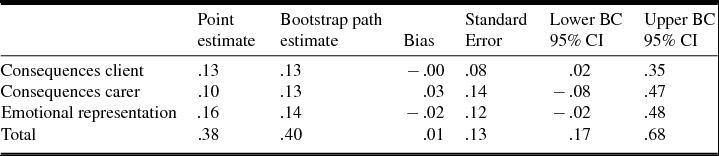
The CBPQ subscales that significantly correlated with the BPI aggression/destruction score and the PSI total score were included in the mediation analysis. These were Consequences client, Consequences carer, and Emotional representation (see Figure 1). Table 3 shows the results of the mediation analysis.
Mediation of the effect of aggression/destruction on maternal stress through maternal cognitions of challenging behaviour

n = 46; Bootstrap sample size = 10,000; BC: Bias corrected.
The analysis showed that the overall model was significant (R2 = .59; p < .0001) and accounted for 59% of the variance in maternal stress. Table 3 shows that, taken as a whole, Consequences client, Consequences carer and Emotional representation mediated the effect of aggression/destruction on maternal stress. However, the only individual significant mediator of aggression/destruction on maternal stress was Consequences client. Neither Consequences carer nor Emotional representation contributed to the indirect effect, above and beyond, Consequences client.
Mediation analysis for self-injurious behaviour and parental stress
The CBPQ subscales that significantly correlated with the BPI SIB score and the PSI total score were included in the mediation analysis (see Figure 2). These were Consequences client and Timeline chronic. Table 4 shows the results of the mediation analysis.
Mediation of the effect of self-injurious behaviour on maternal stress through maternal cognitions of challenging behaviour

n = 46; Bootstrap sample size = 10,000; BC: Bias corrected.
The bootstrapping analysis showed that the overall model was significant (R2 = .43; p < .0001) and accounted for 43% of the variance in maternal stress. Table 4 shows that, taken as a set, Consequences client and Timeline chronic mediated the effect of SIB on maternal stress. However, the only individual significant mediator of SIB on maternal stress was Consequences client. Timeline chronic did not contribute to the indirect effect, above and beyond, Consequences client. The findings provide partial support for hypothesis 4; mothers’ cognitions were found to mediate the effect of challenging behaviour on maternal stress and the overall mediation models for SIB and aggression/destruction differed; however, the same variable (Consequences client) was a significant independent mediator in both models.
Discussion
The aim of the current study was to investigate the relationship between challenging behaviour, maternal cognitions and maternal stress and examined whether maternal cognitions mediated the effect of challenging behaviour on parenting stress. Correlations were used to investigate hypotheses 1–3. Support was found for hypothesis one, whilst partial support was found for hypotheses two and three. As predicted in hypothesis 1, significant positive relationships were identified between aggression/destruction and maternal stress; and SIB and maternal stress. These findings provide further support for the body of research demonstrating the relationship between challenging behaviour and parental well-being (e.g. Baker et al., Reference Baker, Blacher, Crnic and Edelbrock2002; Lecavalier et al., Reference Lecavalier, Leone and Wiltz2006; Lloyd and Hastings, Reference Lloyd and Hastings2009b; Orsmond et al., Reference Orsmond, Seltzer, Krauss and Hong2003). For example, Lloyd and Hastings (Reference Lloyd and Hastings2009b) found that child behavioural difficulties were positively correlated with maternal anxiety, depression and stress; and negatively associated with maternal positive affect.
Significant relationships were found between challenging behaviour and maternal cognitions, providing some support for the third hypothesis. Three significant correlations between aggression/destruction and maternal cognitions (Consequences client, Consequences carer and Emotional representation subscales) suggested that more aggression/destruction is associated with the belief that challenging behaviour has more negative consequences for the parents and child and it has a more negative emotional impact on parents. The significant correlations between SIB and maternal cognitions (Consequences client, Timeline chronic and Treatment subscales) indicated that more SIB is associated with the belief that challenging behaviour has more negative consequences for the child, that challenging behaviour would be longer lasting and treatment not be as effective. Other than Consequences client, the cognitive variables significantly related to the two behaviours, differed.
Correlations between maternal cognitions and maternal stress also revealed significant relationships, providing partial support for hypothesis 3. Significant correlations were found between four of the CBPQ subscales (Consequences client, Consequences carer, Timeline chronic and Emotional representation) and the PSI total score. The direction of the relationships indicated that higher levels of parenting stress are associated with the belief that challenging behaviour has more negative consequences for the parent and child, the belief that challenging behaviour would be longer-lasting and challenging behaviour have a more negative emotional consequence for the parent. As far as we are aware, no study in the family domain has examined the relationship between specific cognitions of challenging behaviour and parental well-being. Previous research findings have shown associations between more general parental cognitions and parental well-being (e.g. MacDonald, Hastings and Fitzsimons, Reference MacDonald, Hastings and Fitzsimons2010). Studies, for example, have reported associations between higher levels of maternal stress and lower levels of parenting satisfaction and a more external locus of control (Hassall et al., Reference Hassall, Rose and McDonald2005; Hill and Rose, Reference Hill and Rose2009). Resilience factors, such as hope, have also been associated with maternal well-being (Lloyd and Hastings, Reference Lloyd and Hastings2009b).
Maternal cognitions as a mediator of challenging behaviour on maternal stress
The findings show that mediation models for both challenging behaviours were significant. The overall model for aggression/destruction accounted for 59% of the variance in parenting stress, whilst the overall model for SIB accounted for 43% of the variance in maternal stress. The overall models differed between the behaviours but the only independent significant mediator for both behaviours was the belief about the impact of challenging behaviour on the child, thus providing only partial support for hypothesis 4.
For both SIB and aggressive/destructive behaviour the belief that this behaviour had a significant impact on the child was significant. It seems likely for SIB that this impact was personal to the child in that it is likely to have a direct impact. For aggressive/destructive behaviours the mechanism is likely to be indirect as aggressive/destructive behaviours are likely to have an impact through a variety of indirect effects, such as exclusion from activities or through limiting access to opportunities. These results provide support for previous studies showing a mediating effect of cognitions. Hastings and Brown (Reference Hastings and Brown2002) found that self-efficacy mediated the relationship between behaviour problems and both anxiety and depression in mothers of children with autism. Also, MacDonald et al. (Reference MacDonald, Hastings and Fitzsimons2010) found that psychological acceptance partially mediated the impact of child behavioural problems on paternal stress and well-being. The current results are in contrast to several studies showing no mediating effect of cognitions on the relationship between challenging behaviour and maternal well-being (Feldman et al., Reference Feldman, McDonald, Serbin, Stack, Secco and Yu2007; Hassall et al., Reference Hassall, Rose and McDonald2005; Hill and Rose, Reference Hill and Rose2009). It may be that the employment of general measures of cognition and the examination of all challenging behaviours together have resulted in the absence of significant findings.
Limitations
One of the most obvious limitations is the low return rate. This, in combination with the small sample size, represents a threat to external validity and caution must be exercised in generalizing the findings. It is difficult to understand the exact cause of the low return-rate but anecdotal reports suggest that it was due to a variety of factors, such as being offered an interview initially rather than a postal questionnaire. In addition, the small sample size limits the conclusions that can be drawn from the bootstrapping analysis. The power analysis suggests that 55 participants were required rather than 46; as a result a larger sample is required to reliably interpret the results from the bootstrapping analysis based upon the correlations between the study variables and so caution must be exercised when interpreting these results (Fritz and MacKinnon, Reference Fritz and MacKinnon2007). It is possible that with a larger sample more of the cognitive variables would have mediated the relationship between challenging behaviour and parental stress. Another limitation is the mixed-methodological design used, due to the initial low return rate. The low return rate resulted in a broader sampling frame than was initially envisaged, with a wider range of groups being sampled that included young adults. While this could have some advantages in reflecting a broader range of participants and thus enhancing generalization, a lack of homogeneity in the sample means that it may be difficult to apply the results to specific age groups.
The study also showed that maternal cognitions mediated the effect of challenging behaviour on maternal stress. This study examined separate mediation models for aggression/destruction and SIB; the numbers of children and their age stratification demonstrating these behaviours were similar across topographies suggests that these differences were not due to age of onset. However, further research is needed to provide greater insight into the similarities and differences between these mediation models using larger samples.
Conflict of interest: The authors have no conflicts of interest with respect to this publication.




Comments
No Comments have been published for this article.