Neonates with hypoplastic left heart syndrome and its variants typically undergo the first of three staged surgical palliations in the first week of life. This operation carries the highest mortality of all neonatal cardiac surgeries.Reference Jacobs, Mayer and Pasquali1 Stage 1 palliation establishes parallel systemic and pulmonary circulations, necessitating meticulous post-operative management to balance these circulations and maximise tissue oxygen delivery in the setting of lower ventricular mass. Circulatory imbalance may result in post-operative shock, with impaired tissue oxygenation and end-organ dysfunction.Reference Hornik, He and Jacobs2 Neonates with impaired tissue oxygen delivery are at high risk of post-operative cardiac arrest, in-hospital mortality and major ICU morbidity.Reference Hornik, He and Jacobs2, Reference Arnold3 Immature neonatal coagulation and exposure to cardiopulmonary bypass results in higher risk of post-operative bleeding in neonates.Reference Arnold3 For these reasons, ICU providers routinely use red blood cell transfusion to support neonates after stage 1 palliation.Reference Armano, Gauvin, Ducruet and Lacroix4, Reference Kwiatkowski and Manno5
While red cell transfusion increases red cell mass and intravascular oxygen content, data indicating improved tissue oxygen delivery after red cell transfusion are limited. In a single centre retrospective study, 617 red cell transfusions were administered to 45 children on extracorporeal membrane oxygenation with an overall median haematocrit of 37%.Reference Fiser, Irby and Ward6 Only 9% of transfusions resulted in pre-defined improvement in markers of tissue oxygen (either 5% improvement in mixed venous saturation or cerebral near infrared spectroscopy).Reference Fiser, Irby and Ward6 Notably, this lack of tissue oxygen delivery improvement was independent of extracorporeal membrane oxygenation indication (cardiac versus respiratory) and haematocrit pre-transfusion threshold (25–45%).Reference Fiser, Irby and Ward6
In addition, red cell transfusions are associated with many risks including haemolytic reactions, transfusion-related acute lung injury, transfusion-associated circulatory overload, thrombotic complications, multi-organ dysfunction syndrome, and mortality.Reference Armano, Gauvin, Ducruet and Lacroix4, Reference Kwiatkowski and Manno5, Reference Lavoie7–Reference Manlhiot, Menjak and Brandao9 In adult cardiac surgery, higher rates of infection and mortality are reported with increased post-operative red cell transfusion.Reference Bracey, Radovancevic and Riggs10–Reference Horvath, Acker and Chang13
In an effort to identify optimal red cell mass for tissue oxygen delivery while avoiding unnecessary transfusion-related risks, several recent trials evaluated restrictive (~21%) versus liberal (~30%) haematocrit threshold for transfusion.Reference Lacroix, Hebert and Hutchison14, Reference Willems, Harrington and Lacroix15 Restrictive transfusion thresholds have been trialed in a broad range of critically ill patients including those with sepsis, trauma, stroke, haemorrhagic shock, respiratory failure, and after cardiac surgery for acyanotic lesions.Reference Horvath, Acker and Chang13, Reference Lacroix, Hebert and Hutchison14, Reference Willems, Harrington and Lacroix15 These data indicate that a restrictive transfusion threshold is non-inferior and, in some cases, superior to more a liberal red cell transfusion threshold.Reference Lacroix, Hebert and Hutchison14, Reference Hajjar, Vincent and Galas16–Reference Jairath, Hearnshaw and Brunskill18
Current literature informing transfusion practice in cyanotic and single ventricle subjects is very limited. Small single centre studies demonstrated increased cerebral near infrared spectroscopy or central venous oxygen saturation with red cell transfusion but failed to show improvement in clinical outcomes.Reference Kuo, Maher, Kirshbom and Mahle19–Reference Cholette, Swartz and Rubenstein22 Transfusion decision-making is multi-factorial. A recent survey of Canadian ICU providers attempted to understand factors affecting red cell transfusion decision-making after congenital heart surgery; haemodynamic instability and cyanotic heart disease were identified as influencing transfusion decision-making.Reference Tremblay-Roy, Poirier, Ducruet, Lacroix and Harrington23 Of note, providers chose a widely ranging haemoglobin threshold (ranging from <7 to 14 g/dl) to transfuse after surgery, illustrating the complete lack of consensus around red cell transfusion decision-making.Reference Tremblay-Roy, Poirier, Ducruet, Lacroix and Harrington23
In clinical practice, the decision to transfuse after stage 1 palliation depends on a complex interplay of institutional, provider, and patient factors. In an effort to characterise decision-making around red cell transfusion after stage 1 palliation, we sought to explore ICU providers’ red cell transfusion practices and to identify factors affecting the decision with a case-based survey instrument. We hypothesised that red cell transfusion practices after stage 1 palliation are variable and that this variability is driven by institutional, provider, and patient factors.
Materials and methods
Survey design
We conducted an online survey through the Pediatric Cardiac Intensive Care Society membership (n = 542 members in 12 nations) from August until October 2016. The Pediatric Cardiac Intensive Care Society is an international forum of healthcare professionals providing care for neonates, children, and adults with CHD. Patients answered demographic questions, including patient and institutional variables, followed by case-based questions about red cell transfusion after stage 1 palliation (Supplemental figure 1). All questions were composed by the authors (PY, AB).
To better assess the influence of the respondent and respondent’s institution, we included six provider characteristics and six institutional characteristics. Respondent characteristics included age, gender, subspecialty (cardiology versus critical care), role (attending versus non-attending clinician), practice setting (i.e. academic hospital), and years of ICU experience. Institutional characteristics included presence of a separate cardiac ICU, number of cardiothoracic surgeons, surgical volume and annual stage 1 palliation volume, blood transfusion protocol, and laboratory testing protocol. Eight specific transfusion indications were surveyed: bleeding, delayed sternal closure, low cardiac output syndrome, haemodynamic instability, need for inotropes, mechanical ventilation, worsening ventricular function, and pulmonary vein desaturation. We did not include a scenario involving mechanical circulatory support due to the existence of institutional protocolisation around blood product transfusion.
Each question had relevant clinical details, including a haematocrit value; respondents were required to decide whether or not to transfuse at the given haematocrit (Supplemental table 1). If respondents chose not to transfuse at the pre-defined haematocrit, they were asked to provide the haematocrit threshold at which would transfusion would occur. Consent occurred at the time of the survey completion. The survey instrument took approximately 10 minutes to complete. No identifying information was collected from survey respondents, and the study was determined to be exempt from review by the Institutional Review Board at the Children’s Hospital of Philadelphia. This survey attempted to simulate clinical situations. Mutiple transfusion indications may occur contemporaneously and are interdependent (e.g. neonate with bleeding after stage 1 palliation may also have high inotropic requirement and haemodynamic instability). A pilot survey was conducted among the authors’ local cardiac ICU attending physician and nurse practitioner group to assess the fidelity of the proposed scenarios.
Survey administration
Study data were collected and managed using Research Electronic Data Capture supported by the Children’s Hospital of Philadelphia.Reference Harris, Taylor, Thielke, Payne, Gonzalez and Conde24 Research Electronic Data Capture is a secure, web-based application designed to support data capture for research studies. Reminder emails were sent out after 1 and 2 months.
Statistical analysis
We used frequency counts and percentages for categorical variables to summarise the data. Each scenario was categorised into a transfusion indication, with some scenarios carrying multiple indications. Haematocrit in the survey scenarios ranged from 35 to 45% (35, 36, 37, 38, 40, 41, 42, and 45%). If a respondent would not transfuse at the threshold listed in the scenario, respondents chose one of the six options provided (<33, <36, <39, <42, <45, and <48%). If the listed haematocrit was between two values, it was counted as the higher value (i.e. haematocrit of 35% is <36% and haematocrit of 45% is <48%). A haematocrit score was assigned to each scenario and ranged from a possible score of 1–6, with 1 indicating transfusion threshold at a low haematocrit (<33%) and 6 indicating transfusion threshold at a high haematocrit (<48%). An overall haemoatcrit score was calculated as the average score summed from 19 scenarios. The overall scores were truncated to correspond to existing categories only in figures, not in the analysis (Supplemental figure 2). Only one respondent had an overall score of 4 or greater, corresponding to an average cut-off for a haematocrit of 39%. We divided the overall score into two groups: low ≤ 2.5 and high > 2.5. For example, if the respondent selected a haematocrit 48% to transfuse for a given scenario, the respondent was cohorted into the high haematocrit score group. Lower Hematocrit (HCT) score suggest lower threshold for transfusion. Similarly, higher HCT score suggest higher threshold for transfusion. In other words, lower HCT score means higher likelihood for transfusion and higher HCT score means lower likelihood for transfusion.
Scenarios were designed to reflect real-world conditions with multiple potential transfusion indications within a single scenario (Supplemental figure 1). Characteristics (respondent, institutional, and patient) were compared between the low and high HCT transfusion groups using Fisher’s exact test. For individual comparisons, the statistical significance level was set at p < 0.05. Bonferroni correction was performed to adjust the p-value for multiple comparisons with an adjusted significance level of p < 0.004. We used Stata 15.0 (Stata Corporation, College Station, TX, USA) to generate the summary statistics and statistical analyses.
Results
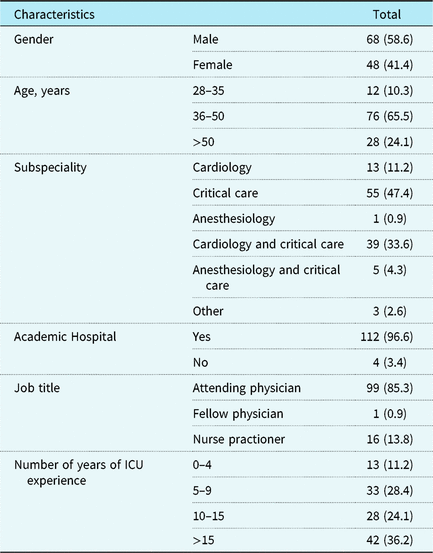
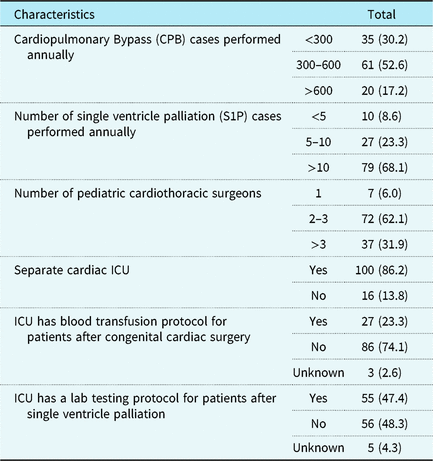
Characteristics of respondents and respondents’ institutions are outlined in Tables 1 and 2, respectively. We had 116 responses (21% response rate). The majority were male (59%) and most were attending physicians (85%) with >5 years of ICU experience (89%). Patients most often had subspeciality training in critical care (47%) or combined training in critical care and cardiology (34%). Most had dedicated cardiac ICUs (86%) and performed >5 Stage 1 palliation (S1P) cases annually (91%). Nearly half of institutions (47%) had laboratory testing protocols after S1P, but few had blood transfusion protocols (23%).
Characteristics of respondents

Characteristics of institutions
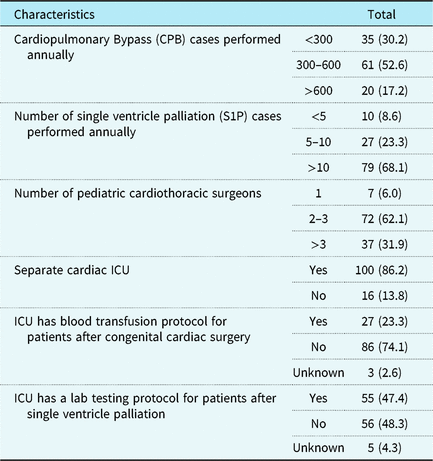
More than one respondent may have come from a single institution
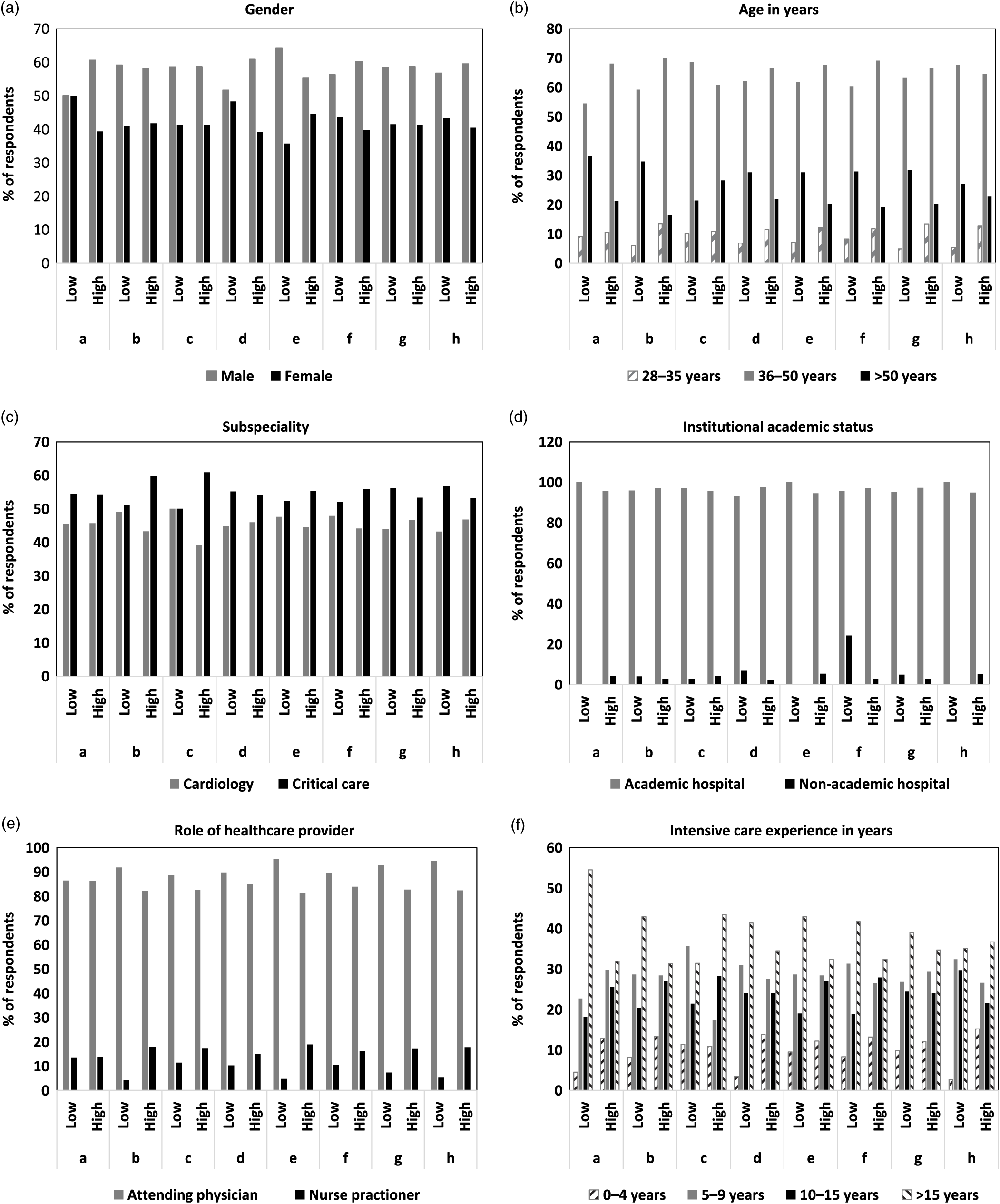
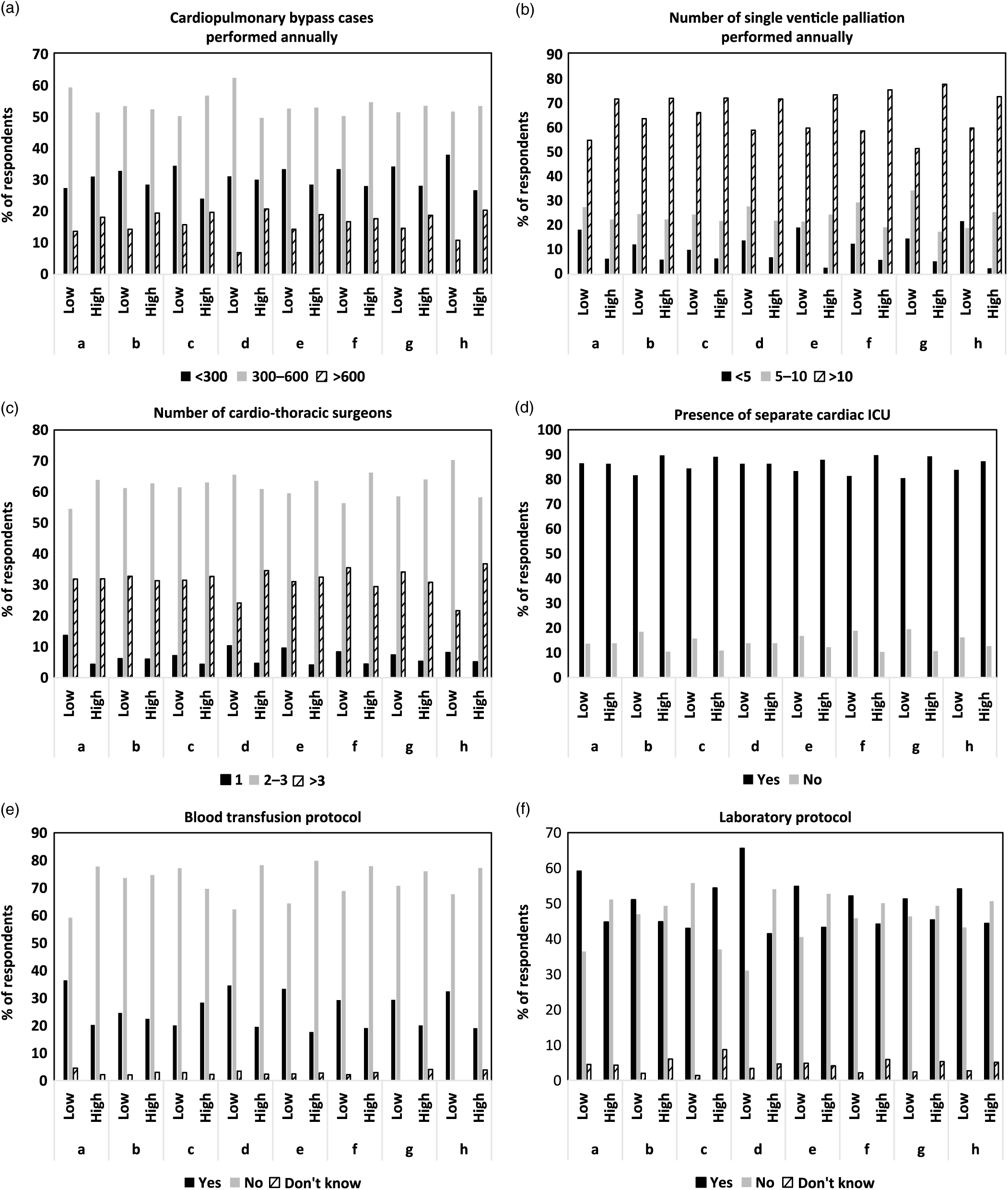
Overall responses by transfusion indications showed wide variation in respondents’ decisions to transfuse. Respondent and institutional characteristics did not vary between the low and high HCT transfusion cohorts (Figs 1a–f and 2a–f and Supplemental tables 2 and 3). We assessed the impact of six provider and six institutional characteristics against all eight transfusion indications. Some comparisions were initially significant, such as the respondent’s role affected their likelihood to transfuse in case of failure to wean from the mechanical ventilation. Attending practioners reported higher likelihood to transfuse, while nurse practioners reported lower likelihood to transfuse in case of failure to wean from the mechanical ventilation (attending physician 95.2 versus 81.1% and nurse practitioner 4.8 versus 18.9%, lower versus higher HCT scores, p = 0.048). We applied Bonferonni correction, as we compared several respondent, and institutional factors with eight indications. After applying Bonferonni correction due to multiple comparisons, none of the provider or institutional characteristics remained statistically significant for any transfusion indication (Figs 1a–f and 2a–f and Supplemental tables 2 and 3).
(a–f) Respondent’s characteristics – gender, age in years, sub-specialty, academic status of the respondent’s hospital, job title, and intensive care experience impact on haematocrit score by the eight transfusion indications, respectively. Of note, none of these differences were statistically significant.

(a–f) Institutional characteristics – number of cardio-pulmonary bypass cases annually, number of stage 1 palliation cases annually, number of cardio-thoracic surgeons, presence of separate cardiac ICU, blood transfusion, and laboratory protocol impact on haematocrit score by the eight transfusion indications, respectively. Of note, none of these differences were statistically significant.

Discussion
In this study, we are adding to the existing body of literature seeking to understand transfusion-related decision-making after congenital heart surgery. We found significant variability among providers’ transfusion practice following stage 1 palliation. None of the respondent-, patient-, and institution-related factors we tested appeared to influence red cell transfusion decision-making.
Literature regarding red cell transfusion practices after congenital heart surgery is limited. A survey-based study by Tremblay-Roy et al examined red cell transfusion practices of Canadian providers in a broad cohort of children after congenital heart surgery. The survey used 4 case-based scenarios and 11 transfusion indicators.Reference Tremblay-Roy, Poirier, Ducruet, Lacroix and Harrington23 Providers were more likely to transfuse cyanotic and unstable patients.Reference Tremblay-Roy, Poirier, Ducruet, Lacroix and Harrington23 Among cyanotic patients, providers exhibited substantial transfusion threshold variability, with treatment thresholds ranging from 7 to 14 g/dl.Reference Tremblay-Roy, Poirier, Ducruet, Lacroix and Harrington23
In comparison, our survey was focused on a narrower cohort of neonates undergoing stage 1 palliation. It is well known that neonates after stage 1 palliation receive substantial post-operative blood product transfusions.Reference Dasgupta, Parsons and McClelland20, Reference Gupta, King and Benjamin25 In clinical practice, the transfusion indications are interdependent and can occur simultaneously during the post-operative period (e.g. a neonate with an open sternum may bleed and have high inotrope need). In our survery, we presented scenarios to simulate clinical practice and compared several provider and institutional factors with multiple transfusion indications to better understand the complex decision-making process. Our results showed similar lack of consensus around transfusion decision-making. This may explain the significant practice variability.
Wide variability in transfusion thresholds may be explained by provider and institutional biases, as well as the inherent complexity of critical care decision-making. Complex decision-making and the impact of potential unmeasured biases have long been recognised in the aviation industry and economics.Reference Duignan, Ryan, O’Keeffe, Kenny and McMahon26 Increasingly, investigators have identified the impact of heuristics, biases, and cognitive traps on medical decision-making.Reference Ryan, Duignan, Kenny and McMahon27 Heuristics are unconscious routines that enable providers to cope complex decision-making when evidence is limited.Reference Hammond, Keeney and Raiffa28 Heuristics introduce unconscious biases that prevent nimble decision-making when clinicians are presented with conflicting data. Tversky et al described three types of heuristics.Reference Tversky and Kahneman29 “Representativeness” describes a total or partial similarity of a scenario to its parent population. Using representativeness in decision-making may increase risk of an error as a scenario being more representative does not make it more likely.Reference Duignan, Ryan, O’Keeffe, Kenny and McMahon26, Reference Tversky and Kahneman29 “Anchoring” is a second type of heuristic by which the first bit of data the provider receives disproportionately affects decision-making.Reference Duignan, Ryan, O’Keeffe, Kenny and McMahon26, Reference Tversky and Kahneman29 The third type of heuristic is “availability.” Availability highlights providers’ bias of relying on the most available knowledge while making a decision.Reference Duignan, Ryan, O’Keeffe, Kenny and McMahon26, Reference Tversky and Kahneman29 Providers remember the most recent bad outcome after an intervention which influences decision-making the next time a provider encounters a similar scenario. As there are few data informing red cell transfusion decision-making after stage 1, a “knowledge gap” exists. The lack of data-based guidelines results in the use of the heuristics and likely result in the heterogeneity found in our study.
There are several important limitations to this study. Although we made considerable efforts to reach every member of Pediatric Cardiac Intensive Care Society, our survey response rate was only 21%, potentially limiting the generalisability of our findings. Surveys are self-reported instruments and may not represent what providers actually do when making clinical decisions. To minimise this potential reporting bias, we structured the survey into clinical scenarios, pilot tested the survey at our institution, and assessed multiple transfusion indicators to better understand the transfusion decision-making process. However, creating realistic case-based scenarios that capture the complexity of post-operative care after stage 1 palliation is challenging. We provided haematocrit value for all scenarios to represent the clinical situation well. Unfortunately, a given value of haematocrit in the scenario may influence the respondent due to anchoring. In an effort to mitigate this, we provided free text option to provide HCT threshold for each scenario for the respondent to minimise this limitation; however, the degree to which anchoring influenced the study results is unknown As a result, our ability to understand the nuances of decision-making may be limited. At this level of investigation, it is notable that we could not detect any consistent factors associated with a decision to transfuse, highlighting the overall variability that exists in practice. We did not include scenarios describing a neonate requiring post-operative mechanical circulatory support because transfusion thresholds may be more protocolised when compared to neonates not requiring mechanical circulatory support. Finally, we did not specify the use of whole blood as opposed to packed red blood cells because the post-operative utilisation of whole blood is limited.Reference Tremblay-Roy, Poirier, Ducruet, Lacroix and Harrington23
Conclusions
Transfusion practices in the post-operative period after stage 1 palliation vary widely. We identified no demographic, institutional, or patient factors that consistently influence decision-making around red cell transfusion after stage 1 palliation. Our study highlights the existing knowledge gap around the care of neonates after stage 1 palliation. Red cell transfusion decision-making is complicated and likely involves cognitive biases and heuristics. Lack of evidence-based guidelines may increase cognitive biases. Further investigation aimed at understanding red cell transfusion decision-making after stage 1 palliation is necessary to inform evidence-based guidelines and care standardisation to limit unnecessary transfusion exposure.
Supplementary Material
To view supplementary material for this article, please visit https://doi.org/10.1017/S1047951119002385
Acknowledgements
We are thankful to the Pediatric Cardiac Intensive Care Society for their support.
Author Contributions
Conceptualisation: AB, PY, DD, JB.
Data curation: AB, PY, FM.
Formal analysis: OE.
Methodology: AB, PY, DD, OE, XZ, FM, JB.
Project administration: AB, PY, FM, JB
Resources: JB, DD.
Software: OE, XZ.
Supervision: DD, JB.
Validation: OE, XZ, JB.
Writing – original draft: AB, PY, OE, FM, JB.
Writing – review and editing: AB, PY, DD, OE, FM, JB.
Financial Support
This research received no specific grant from any funding agency, commercial or not-for-profit sectors.
Conflicts of Interest
None for all authors pertaining to this study.