


1. Introduction
A parent mortgages a flat that stands registered in the name of her young child, pledging it to secure a loan for the family’s business, its housing, or a pressing debt. On its face the transaction is a commonplace of contemporary Chinese economic life. Yet when its validity is litigated, the outcome is anything but settled. In one court, the mortgage is upheld, the lender’s security preserved, on the reasoning that a child living within a household shares in, and is sustained by, that household’s prosperity.Footnote 1 In another court, on facts a layperson would struggle to tell apart, the same kind of transaction is struck down, the security defeated, on the reasoning that a minor’s estate may not be hazarded for a debt that is not the minor’s own.Footnote 2 The two courts apply the identical statutory command. They reach opposite results.
This is not an occasional anomaly. Across an original dataset of 58 cases in which the guardian’s disposition of the ward’s property was adjudicated, Chinese courts divide almost exactly in half: in 27 they uphold the disposition and leave the ward to bear its consequences; in 26 they protect the ward, voiding the contract, refusing enforcement, or charging the guardian in damages; and in 5 they reach partial or mixed results. The governing text never varies. Every court reasons from the two clauses of Article 35 of the Civil Code of the People’s Republic of China (CCPRC): the guardian must act “in accordance with the principle most beneficial to the ward,” and “may not dispose of the ward’s property except to protect the ward’s interest” (Zhu, Reference Zhu2020, pp. 15–19; Xu and Zhang, Reference Xu and Zhang2022, pp. 36–37). The same command, applied to like facts, yields contradictory holdings. That a single open-textured standard produces inconsistency is unsurprising; the analytically interesting question, and the one this article takes up, is why the inconsistency runs as it does: why a court reaches for protection here and exposure there, and whether the pattern is intelligible.
The three logics as ideal types

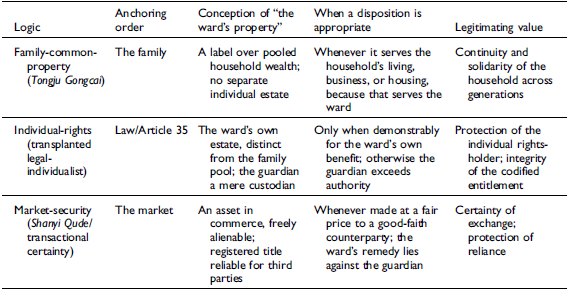
Table 1. Long description
A table with four columns and three rows. The columns are labeled Logic, Anchoring order, Conception of the ward’s property, When a disposition is appropriate, and Legitimating value. The rows are labeled Family-common-property (Tongju Gongcai), Individual-rights (transplanted legal-individualist), and Market-security (Shanyi Qude/transactional certainty). Row 1: Family-common-property (Tongju Gongcai), The family, A label over pooled household wealth; no separate individual estate, Whenever it serves the household’s living, business, or housing, because that serves the ward, Continuity and solidarity of the household across generations. Row 2: Individual-rights (transplanted legal-individualist), Law/Article 35, The ward’s own estate, distinct from the family pool; the guardian a mere custodian, Only when demonstrably for the ward’s own benefit; otherwise the guardian exceeds authority, Protection of the individual rights-holder; integrity of the codified entitlement. Row 3: Market-security (Shanyi Qude/transactional certainty), The market, An asset in commerce, freely alienable; registered title reliable for third parties, Whenever made at a fair price to a good-faith counterparty; the ward’s remedy lies against the guardian, Certainty of exchange; protection of reliance.
The divergence, this article argues, reflects an unresolved ambiguity about what the ward’s property is. The ambiguity is not metaphysical but social. Chinese parents routinely place assets in a child’s name for strategic reasons that have nothing to do with conferring an estate on the child: to bypass restrictions on housing purchases, to manage tax exposure, to position the family’s wealth, while continuing to regard, and to use, the asset as common family property under their own control. The practice is neither marginal nor peculiar to guardianship: courts across Chinese jurisdictions routinely confront property registered in one family member’s name yet understood by the family to belong to, and to be controlled by, another (Hung, Reference Hung2023, pp. 143–150). In the years following the 2011 reinterpretation of the Marriage Law, a substantial share of mainland households shifted the registered title of the family home into their children’s names while the home remained, in substance, the family’s (Zang, Reference Zang2020, p. 1225). The flat is at once the child’s home, which a protective law treats as inalienable shelter, and the family’s asset, which an enabling law treats as fungible capital. Is Article 35 of the CCPRC a shelter or just all about capital? This is the question on which the courts cannot agree, and, as Section 4 shows, it is litigated not only in the abstract but in the very menu of remedies the courts deploy.
The collision has surfaced now, and litigated now, for reasons that are themselves socio-economic.Footnote 3 The financialisation of household wealth, in which housing and land now account for roughly four-fifths of Chinese household wealth (Zang, Reference Zang2020, p. 1215), and much of it is registered in the names of minors and incapacitated dependants, has multiplied the occasions on which a guardian transacts over a ward’s nominal property (Zhang, Yan and Saisho, Reference Zhang, Yan and Saisho2021). At the same time, the atomisation of the family, through divorce, business failure, and indebtedness, has multiplied the occasions on which the household’s interest and the dependant’s interest pull apart. What was once a latent contradiction in the law of guardianship has become a recurrent and contested question of adjudication.
The diagnosis disciplines the prescription. If “best interests” is a genuine collision of legitimate orderings rather than a standard with a hidden determinate content, then it cannot be resolved by judicial fiat or by a single doctrinal grid that pretends otherwise. What the law can do is supply a floor. The article’s normative proposal, developed in Section 5 and deliberately modest, is for a fiduciary duty anchored in the ward’s subsistence interest in shelter, a threshold beneath which neither the family-common nor the market logic may push and above which the household understanding that the Tongju Gongcai (同居共财, “living together, holding property in common”) tradition legitimately protects is left its room. Companion work develops the fuller doctrinal architecture appropriate to the space above that floor, including the calibration of standards for ameliorative and appreciative dispositions; that architecture is not the burden of this article. This limited prescription also clarifies the article’s intended audience. The aim is not to instruct Chinese courts in how to administer Article 35, but to use the Chinese cases to show how an open-textured standard absorbs the friction between a transplanted individual-property norm and an indigenous household-property order. In this sense, the article speaks to comparative socio-legal readers as a study of adjudication under institutional complexity.
The article proceeds as follows. Section 2 sets out the analytical framework, constructing the three logics from the societal orders they instantiate and situating their collision within the literatures on legal transplantation and legal pluralism. Section 3 presents the empirical field: the dataset and method, the even split on like facts, and the visibility of the three logics in the courts’ own reasoning. Section 4 turns from description to explanation, identifying the antecedent facts that determine which logic prevails, the doctrinal channels through which they operate, and the patterns by which courts manage the collision, culminating in the remedial pluralism in which the “shelter or capital” question is most concretely litigated. Section 5 develops the fiduciary floor. The conclusion follows.
2. Three logics of the ward’s property
2.1. The institutional-logics lens and its use in this field
An institutional logic, in the now-standard formulation, is the set of material practices and symbolic constructions, namely the assumptions, values, and beliefs, through which actors give meaning to their activity and organise it in time and space (Friedland and Alford, Reference Friedland, Alford, Powell and DiMaggio1991; Thornton, Ocasio and Lounsbury, Reference Thornton, Ocasio and Lounsbury2012). On this view, society is an inter-institutional system whose orders, among them the family, the market, the state, the profession, the community, and religion, each supply a distinct logic, and any concrete field may be animated by several at once, in tension or in combination.
Two features of the framework govern how it is used here. First, the societal orders are ideal types, offered as meta-theory and method rather than as a description of any particular field; the analyst is expected to specify which logics are operative in the domain under study and to differentiate these field-level logics from the abstract societal ones (Thornton and Ocasio, Reference Thornton, Ocasio, Greenwood, Oliver, Sahlin and Suddaby2008; Ocasio, Thornton and Lounsbury, Reference Ocasio, Thornton, Lounsbury, Greenwood, Oliver, Lawrence and Meyer2017, pp. 512–515). Second, logics are near-decomposable: their elements may be transposed, combined, and segregated so that a field-level logic can draw selectively on the practices and substances of a societal order (Thornton, Ocasio and Lounsbury, Reference Thornton, Ocasio and Lounsbury2012). The three logics set out below are therefore not borrowed off a shelf but constructed for the law of guardian dispositions, anchored in the societal orders where possible, defined by their constitutive practices, and, as Section 3 shows, demonstrated to be operative in the courts’ own reasoning.
Bringing the lens to a field of adjudication is not itself novel. Competing institutional logics, including, expressly, law and family, have been analysed in concrete decisional settings (Heimer, Reference Heimer1999), and law has been theorised as a central institutional order in its own right, animated by the substance of justice and varying with a society’s legal tradition (Mutch, Reference Mutch2025). What is new is bringing the perspective to the Chinese law of the ward’s property, where a transplanted individual-property norm sits athwart an indigenous family-property order, a juxtaposition the institutional-logics perspective has not, to my knowledge, yet been used to examine.
2.2. Three conceptions of one asset
The disputes activate three logics, each returning a different answer to a single question: what is the ward’s property, and when may the guardian alienate it?
The family-common-property logic instantiates the societal family order in Tongju Gongcai tradition, the household run as a single joint account, in which the household is the property-holding and welfare unit (Wong, Reference Wong2021, pp. 248–249; Lam, Reference Lam2017; Lai, Reference Lai2021; Zhao, Reference Zhao2018, p. 202). On this understanding, assets registered in a particular family member’s name, especially a minor’s, are often perceived as part of a collective “family pot” (Liao, Reference Liao2022, pp. 5–6). The tradition is old and was once legally compulsory: the imperial codes, from the Tang dynasty onward, required descendants to keep the household’s property undivided while the parents lived (Schurmann, Reference Schurmann1956, pp. 511–512; Hung, Reference Hung2023). On this logic, the ward has no sharply separate estate: a child’s or an incapacitated adult’s registered share is a label over pooled household wealth, held for the family’s collective welfare, of which the ward’s welfare is one part. The registered holder is, on this view, not an owner but a steward: in the classical understanding, the family head merely manages the common property and may not dispose of it at his own pleasure, the estate belonging not to him as an individual but to the line he holds it for (Schurmann, Reference Schurmann1956, p. 511; Wong, Reference Wong2021, p. 255). A disposition that serves the household therefore serves the ward, and the guardian acts within the family’s authority to manage its common property; a guardian’s misconduct is an internal family matter, not a defect cognisable by outsiders. Its legitimating substance is the continuity and solidarity of the household across generations.
In the empirical data, it speaks through findings that a loan was a joint debt “used for the family’s common life and production,” that a parent’s gain “benefits the child’s living security,” and that a guardian’s lapse “is an internal family matter” that “cannot be set up against the creditor.”Footnote 4
The individual-rights logic instantiates the legal order itself, law as a logic animated by justice, in the specific form of the transplanted civil-law norm codified in Article 35 of CCPRC. On this logic, the ward is a discrete bearer of rights whose estate is analytically separate from the family pool (Guzei-Mangu, Reference Guzei-Mangu2024, pp. 131–133; Doughty-Wagner, Reference Doughty-Wagner2025, pp. 74, 76, 83), and the guardian is a custodian who may reach that estate only for the ward’s own benefit. Its constitutive moves are to treat the registered title as the ward’s own, to presume that a disposition not shown to benefit the ward is unauthorised, to require proof that the proceeds reached the ward, and to void dispositions made for a third party or for the guardian’s own debt. Its legitimating substance is the protection of the individual rights-holder and the integrity of the codified entitlement: the promise the transplant makes. It speaks through the statutory command itself and through the presumption that a parent’s mortgage of a minor’s home “is presumed not to be for the ward’s benefit unless proven otherwise” (Xia, Reference Xia2018, p. 186).
The market-security logic instantiates the societal market order. On this logic, the ward’s share is an asset in commerce, alienable like any other, and the registered title is something third parties are entitled to rely on. Its constitutive moves are to protect the Shanyi Qude (善意取得, “good-faith acquisition”), to treat a guardian’s breach as sounding in the guardian’s own liability rather than in the validity of the contract, to characterise Article 35 of the CCPRC as a “managerial” rather than a “validity” rule, and to decline to unwind a completed, fairly priced transaction. Its legitimating substance is the certainty of exchange and the protection of reliance. It speaks through holdings that Article 35 “is not a validity-type mandatory rule” and “does not negate the effect of the disposition,” and that any harm to the ward “is the guardian’s own liability” and “cannot be set up against the third party.” Table 1 summarises these three logics as ideal types.
The selection of these three, rather than the full societal typology, follows the disputes rather than the theory. The state order is present, but as author and enforcer of the individual-property norm, operating through the individual-rights logic rather than as a separate value-ordering with its own stake in who prevails. The remaining orders, namely community, religion, and profession, do not surface in the reasoning of these private family-property disputes. What the courts actually deploy, and what the coded reasoning reveals (Section 3), is a contest among a household conception, an individual-rights conception, and a market conception of one and the same asset; these three, and only these three, recur. Constructing them inductively from the judgements, rather than imposing them deductively, also guards against the standard objection to logics-based work, namely that the categories are read into the data rather than found in it.
2.3. A transplant athwart a tradition: situating the collision
To name the individual-rights logic a transplant is to locate this field within a long debate about whether, and how, law travels. The image, posited by Article 35 of the CCPRC, of the ward as an autonomous owner whose property may be reached only for the ward’s own benefit is not native to the Chinese law of the family; it is an individualising norm drawn from the civil-law tradition and consonant with the child-centred, welfarist standard of the Convention on the Rights of the Child.
On the optimistic view, such borrowings transplant readily, law being a technology that can be moved between systems with comparatively little friction (Watson, Reference Watson1993, p. 18). The sceptical tradition denies it: that meaning is constituted by its native context so that what crosses a border is at most words, never the rule (Legrand, Reference Legrand1997); and, in a more productive register, that a transplanted norm is not absorbed intact but functions as a legal irritant, setting off transformations in the host system that neither the donor nor the recipient anticipated (Teubner, Reference Teubner1998). On this last view, a transplant often operates through a kind of working misunderstanding, the imported form persisting while its substance is quietly reworked by the receiving order (Chen-Wishart, Reference Chen-Wishart2013, pp. 1–3, 28). This tension between indigenous family norms and a transplanted statutory framework has accordingly drawn sustained scholarly attention (Garayová, Reference Garayová2025). On their account, Chinese family traditions such as Tongju Gongcai emphasise kinship ties, mutual dependence, and the priority of collective welfare over individual interest (Chen-Wishart, Reference Chen-Wishart2013, pp. 17–18).
The Chinese law of the ward’s property is a vivid instance of exactly this, and not for the first time. When the Republican Civil Code of 1930 first laid a Western, individual-property template over Chinese soil, the codified norm and the living relations of the household failed to merge: the new law of real property remained, as Niida observed, far from the modern ideal it announced, the local family-property arrangements surviving largely intact beneath it (Schurmann, Reference Schurmann1956, p. 508). The receiving order, in other words, was occupied then as it is now, by the Tongju Gongcai understanding of family property, an understanding that, in Ehrlich’s sense, functions as living law: the norm that actually orders household economic life, as against the law on the books that the state has enacted (Ehrlich, Reference Ehrlich1936). Where the books make the child an owner, the living law makes the child a member of a propertied household; and it is the living law, not the code, that explains why a parent registers a flat in a child’s name while treating it as the family’s own. The persistence of the indigenous understanding is reinforced, moreover, at the level of legal consciousness: ordinary litigants, and not infrequently the judges who hear them, give weight to qing (情, “human feeling”) and li (理, “social propriety”) over formal legality so that the household conception is not merely a sociological fact external to the law but a value that presses inside the courtroom (Liu, Reference Liu2018, pp. 7–9).
Seen this way, the field is a natural experiment in transplant friction, and the contribution of the institutional-logics lens is to specify what other accounts leave diffuse. The “gap” between law on the books and living law, or between state law and social norm, names the phenomenon but does not give it structure; it tells us that the transplant is resisted without telling us how the resistance is organised or when it prevails. Read as a collision of logics, the friction acquires structure: it is a contest among a determinate set of conceptions, each with its own constitutive moves and legitimating value, each traceable in the courts’ reasoning, and, as shown in Section 4, each prevailing under specifiable conditions. The transplant has not failed; nor has it succeeded. It has entered a field already governed by a rival logic, and the two now divide the cases between them.
2.4. Institutional complexity: “best interests” as a site, not a standard
Because the three logics are simultaneously available and each is legitimate, a court confronting a guardian’s disposition faces what the literature calls institutional complexity: incompatible prescriptions issuing from orders it cannot simply rank (Greenwood et al., Reference Greenwood, Raynard, Kodeih, Micelotta and Lounsbury2011). It is tempting to read the resulting inconsistency as a failure of doctrine, as evidence that “best interests” is too vague, or that the courts are insufficiently disciplined. The argument here is the opposite. The near-even divergence documented in Section 3 is not the symptom of a defective standard; it is the predictable trace of a genuine collision that the standard, by its openness, neither resolves nor conceals. On this account, “the best interests of the ward” is not a rule awaiting correct interpretation but the doctrinal site at which three orderings of property are made to meet, the place in the law where the transplant and the tradition are forced into the same sentence and a court must choose between them under cover of a single open-textured phrase.
Treating the standard as a site also clarifies what kind of empirical claim this article makes. The judgements are not used here as evidence that Chinese courts misunderstand Article 35, or that one line of cases is correct and the other mistaken. They are used as traces of a field in which legal meaning is produced under competing institutional pressures. A court that protects the ward is not simply applying the statute more faithfully; a court that sustains the transaction is not simply ignoring it. Each is selecting, often without saying so, the social setting in which the ward’s property is to be imagined: the separate estate of a vulnerable rights-holder, the shared resource of a household, or an object of market reliance. The doctrinal language remains constant, but the social unit to which that language is attached changes. This is why the cases matter for law-and-society readers. They show adjudication not as the mechanical application of a rule, nor as unconstrained discretion, but as the translation of social order into legal form through apparently technical choices. It also explains why the analysis begins from patterns of reasoning and remedy rather than from the search for a single correct interpretation.
If that is right, two tasks follow, and they occupy the remainder of the article. The first is explanatory: to show that the choice is not random but governed, that the patterned ways courts manage the collision are intelligible, and that the determinants of which logic prevails can be identified from the face of the cases, which is discussed in Sections 3 and 4. The second is reconstructive: not to pretend that “best interests” has a settled content that disciplined interpretation could recover, but to give the contested site a defensible floor and to be candid about what lies, legitimately, above it, which is discussed in Section 5.
3. A divided field
In Section 2, we argued that the “best interests of the ward” is not a standard with hidden determinate content but a doctrinal site at which three incompatible orderings of one asset are forced to meet. That argument generates two empirical claims, and this section tests them against the record of adjudication. The first is that the courts’ disagreement is real and patterned rather than occasional: confronted with the same statutory command on materially similar facts, courts divide, and they divide in a way no account of “best interests” as a single recoverable standard would predict. The second is that the three logics are not an analyst’s imposition on the data but the vocabulary the courts themselves deploy so that one can read, in the judgements’ own reasoning, the family-common-property, individual-rights, and market-security conceptions doing the work of justification. Establishing both is the burden of this section. Explaining why one logic prevails over another in a given case is the question reviewer-style scepticism rightly presses, and the question that turns a description of disorder into an account of structure. This explanation is deferred to Section 4.
3.1. Data and method
The analysis draws on an original dataset of 58 cases, in which the guardian’s disposition of the ward’s property was adjudicated on the merits. The dataset was assembled in a deliberately conservative order: a broad, over-inclusive search of PKulaw Database was narrowed to the on-target cases by a screening applied before any outcome or reasoning variable was coded. This sequence is the methodological point that matters. After multiple documents arising from a single dispute (a first-instance judgement with its appeal or retrial, or an anonymised model-case version of a named judgement) were treated as a single case, 71 decided disputes remained; of these, 58 were on target and form the analytical dataset, 7 were excluded on the merits, and 6 were folded into a linked instance of the same dispute.Footnote 5 Because the narrowing turned on whether a case was on-target and reasoned, not on how it came out, the dataset is the population of qualifying disputes rather than a selection assembled to fit a thesis. Each case was then coded along three blocks of variables: its outcome; the operative logic on which the court’s reasoning principally rests; and the antecedent facts that precede the court’s value judgement and that Section 4 shows to be decisive. Outcome and antecedent-fact variables were taken from the findings and operative parts of the judgements; the operative-logic variable was taken from the courts’ stated reasoning.
Two limitations bear on what the findings can show. First, the dataset comprises litigated, published judgements; disputes that were settled, abandoned, or never brought, and decisions never posted, are absent. The cases analysed here are therefore not a random sample of all guardian dispositions, although the great majority of such dispositions never reach a court, and the claims below are claims about contested dispositions of this kind, not estimates of a base rate. Whether the even division within this litigated population is the patterned product of antecedent facts, rather than an artefact of which disputes are selected for litigation, is the question Section 4 takes up; as that section shows, the divergence tracks identifiable features of the cases in a way a pure selection effect would not produce. Second, the availability of judgements on the platform has varied over time, with a marked thinning of recently published decisions, so temporal patterns are read with caution and not pressed beyond what the data will bear.
For that reason, the dataset is best understood not as a measure of all guardian dispositions, but as a map of how legally contested dispositions are translated into judicial reasons and remedies.
3.2. An even split on like facts
The first finding is the central one. Contrary to the impression that a protective mandate of this kind yields uniform outcomes, the field is neither uniformly protective nor uniformly permissive: across the 58 cases the courts divide almost exactly in half. In the 27 cases, the court let the guardian’s disposition stand against the ward by enforcing the mortgage, validating the sale, and preserving the transaction; the ward was left to bear its consequences. In the 26 cases, it protected the ward, voiding or refusing to enforce the disposition against the ward’s asset, or shifting the loss onto the guardian. Five produced mixed results, binding the ward in part only. Set the five partial outcomes aside and the contested cases split 27 to 26, within a single case of one another (Table 2).
Outcomes of adjudicated dispositions (N = 58)
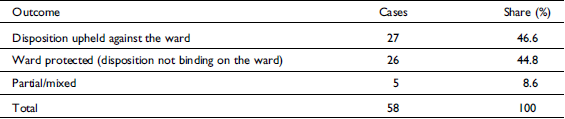
Table 2. Long description
A table comparing outcomes of adjudicated dispositions with cases and share percentages. The table has 4 rows and 3 columns. Column headers are Outcome, Cases, and Share (%). Row 1: Disposition upheld against the ward, 27, 46.6 percent. Row 2: Ward protected (disposition not binding on the ward), 26, 44.8 percent. Row 3: Partial/mixed, 5, 8.6 percent. Row 4: Total, 58, 100 percent.
The significance lies in what this does to the standard. A single open-textured command produces some inconsistency in any system, and that alone would warrant no more than a call for clearer rules. The near-even split shows something stronger: that the standard does not discriminate between the cases at all. These are not outcomes scattered around a settled centre, with a protective rule occasionally misapplied at the margins; they are two roughly equal bodies of confident, internally reasoned decisions reaching opposite results on cases the standard itself cannot tell apart. “Best interests” does not, in operation, identify a determinate answer that disciplined courts converge upon and undisciplined courts depart from; it accommodates both answers equally. That is the signature not of a vague rule awaiting refinement but of a genuine collision of orderings that the rule, by its openness, neither resolves nor conceals.
The paired cases that open this article show the pattern at the level of the single decision. The two cases, as noted at the outset, are alike in just the respects the statutory standard foregrounds: in each, a guardian encumbered the ward’s registered dwelling to secure a debt. The operative difference lies not in anything Article 35 of the CCPRC names but in a set of antecedent facts it leaves unmentioned. Identifying those facts, and showing that they sort the cases in a regular way, is the work of Section 4. For the present, the point is only that the split is not a scattering of outcomes around a settled rule but a collision of two rules in cases the standard cannot itself distinguish.
3.3. The three logics in the court’s reasoning
The second finding moves from outcomes to reasons, and meets a natural objection to Section 2, namely that the three logics are the analyst’s categories rather than orderings the courts inhabit. They are not imposed. Read against the constitutive moves discussed above, each logic is legible on the face of the judgements, in the courts’ own language of justification.
Where the family-common-property logic governs, the court reasons that the ward shares in the household’s fortunes so that a transaction serving the household serves the ward: that borrowing was for the family’s “common life and production,” that the parent’s dealing secured “the child’s living security,”Footnote 6 or that the guardian’s lapse was “an internal family matter” that “cannot be set up against” the counterparty. Where the individual-rights logic governs, the court treats the registered title as the ward’s own estate and the guardian as a custodian who may reach it only for the ward’s benefit, presuming a disposition not shown to benefit the ward unauthorised, demanding proof that the proceeds reached the ward, and voiding dispositions made for a third party or the guardian’s own debt.Footnote 7 Where the market-security logic governs, the court protects the good-faith counterparty and the certainty of exchange, characterising Article 35 as managerial rather than validity-conferring, holding that it “does not negate the effect of the disposition” and that any harm to the ward “is the guardian’s own liability,”Footnote 8 sounding against the guardian and not the third party. These are three distinct grammars of decision, and a case can be assigned to one, with any secondary logic noted, by attending to which grammar carries its result.
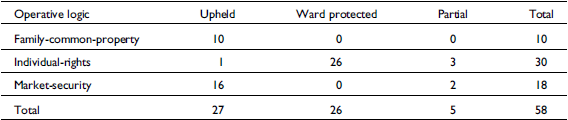
Cross-tabulating the operative logic against the outcome makes the alignment visible (Table 3).
Operative logic by outcome (N = 58)

Table 3. Long description
A table titled ‘Operative logic by outcome (N=58)’ with four rows and five columns. The columns are labeled ‘Operative logic’, ‘Upheld’, ‘Ward protected’, ‘Partial’, and ‘Total’. The rows are labeled ‘Family-common-property’, ‘Individual-rights’, ‘Market-security’, and ‘Total’. Row 1: Family-common-property, Upheld 10, Ward protected 0, Partial 0, Total 10. Row 2: Individual-rights, Upheld 1, Ward protected 26, Partial 3, Total 30. Row 3: Market-security, Upheld 16, Ward protected 0, Partial 2, Total 18. Row 4: Total, Upheld 27, Ward protected 26, Partial 5, Total 58.
Two things must be said about this table, the second the more important. First, the separation is near-total. Every one of the 26 decisions that protect the ward rests on the individual-rights logic; of the 27 that uphold the disposition, all but one rest on a family-common or market-security logic; and not a single case in which a family or market logic predominates protects the ward. The three idioms do not merely correlate with outcomes; they very nearly map onto them, which establishes, as firmly as coding of this kind can, that the three logics are the axis along which this body of law varies and that they are present in the courts’ own reasoning rather than imposed from outside. Second, and decisively, this near-identity is precisely why the table cannot explain the divergence: a court’s predominant logic is read from the same stretch of reasoning that announces its holding so that to say the individual-rights logic prevailed is, in substance, only to restate that the court protected the ward. The logics are real, and showing that the courts deploy them is a necessary finding; but they are the medium of the disagreement, not its cause. The explanatory question lies one step earlier: what leads a court to reach for one logic rather than another. It is answered not by the reasoning but by the antecedent facts the reasoning responds to: the character of the property, the destination of the proceeds, whether the ward’s home is at stake, the era of the judgement, and the procedural posture. Those determinants, and the doctrinal channel through which they operate, are the subject of Section 4.
4. The anatomy of divergence
4.1. From logic to antecedent fact
Section 3 left a puzzle and a constraint. The puzzle is the even split: contested dispositions of the ward’s property divide almost in half. The constraint is that the three logics cannot themselves account for the division, because each is read from the same passage of reasoning that announces the result, so that naming the logic only restates the holding. The way forward is to ask what the court confronts before it settles on a logic at all.
The answer is that the choice is not free. It follows from a small set of facts present in the record before any value judgement is made: the character of the property, the destination of the proceeds, whether the ward’s home is at stake, and the procedural posture in which the dispute arrives. These facts are not inferred from the outcome. They are findings the court makes about the world, and they predict, with considerable force, which logic will prevail.
This also disposes of a deflationary objection. A sceptic might argue, after Priest and Klein (Reference Priest and Klein1984), that an even split among litigated cases shows nothing: parties settle the clear disputes and litigate the close ones, so the cases that reach judgement cluster at the margin of uncertainty, where a near-even division of outcomes is mechanical and uninformative. If “best interests” were a single standard with one threshold, the objection would have real force. But the division documented here is not the structureless scatter that a single threshold produces. It is sorted, almost deterministically, by substantive facts. Cases do not divide because they sit at the indeterminate edge of one rule; they divide because two rules are in play, each tolerably determinate in its own terms, with the facts assigning a given case to one or the other. The structure is the evidence. Selection can explain why a litigated sample over-represents contested dispositions, a limitation already conceded in Section 3.1; it cannot explain why those disputes resolve along clean factual lines. That they do is the central finding of this section, and it is what turns a description of disorder into an account of structure.
4.2. The master variable: individual title versus Tongju Gongcai
The most consequential fact in the field is also the one courts least often state plainly: whether the asset is treated as the ward’s own property or as property pooled within the household. This characterisation is antecedent. It is read from the registry, the source of the purchase money, and the structure of the family, and it does most of the work that “best interests” appears to do.
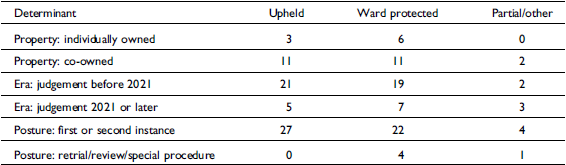
Where the asset is the ward’s individually owned property, courts protect. The solely titled flat of an incapacitated adult, mortgaged to secure a friend’s loan, was held ineffective against him.Footnote 9 A mentally disabled adult’s sole flat, transferred away for no consideration, was recovered and restored to her.Footnote 10 Where parents or grandparents funded the home and the child’s name is treated as a formality over family wealth, courts uphold. A bank loan secured on a flat the grandfather had bought and titled in the child’s name was sustained on the reasoning that the family’s gain secured the child’s living security.Footnote 11 The aggregate confirms the pattern: individually owned property tilts protective, while co-owned property splits evenly (Table 4).
Selected antecedent determinants and outcome (N = 58)

Table 4. Long description
The table presents data on selected antecedent determinants and outcomes for 58 cases. It has six rows and four columns. The columns are labeled Determinant, Upheld, Ward protected, and Partial/other. The determinants include property ownership, era of judgment, and posture of the case. Row 1: Property: individually owned, Upheld: 3, Ward protected: 6, Partial/other: 0. Row 2: Property: co-owned, Upheld: 11, Ward protected: 11, Partial/other: 2. Row 3: Era: judgement before 2021, Upheld: 21, Ward protected: 19, Partial/other: 2. Row 4: Era: judgement 2021 or later, Upheld: 5, Ward protected: 7, Partial/other: 3. Row 5: Posture: first or second instance, Upheld: 27, Ward protected: 22, Partial/other: 4. Row 6: Posture: retrial/review/special procedure, Upheld: 0, Ward protected: 4, Partial/other: 1.
4.3. What moves the case: proceeds, shelter, and the burden of proof
Three further facts determine which way a case tips, and each often works by settling the characterisation question itself.
The first is the destination of the proceeds. Where the funds served the household, whether a loan for family living or a family business whose profits support the ward, or where they reached the ward indirectly, courts uphold. Where they served a pure third party, or repaid the guardian’s own debt or a usurious loan, courts void the disposition or at least contest it. In one case, a sale whose proceeds cleared a father’s loan-shark debt was undone.Footnote 12 A mixed purpose does not rescue a transaction where benefit to the ward cannot be shown. A notarised guarantee, a public-notary certification, and private-lending registration together failed to save a mortgage whose stated purpose blended the children’s schooling with the borrowers’ business.Footnote 13
The second is whether the ward’s home is at stake. Where the asset is the ward’s only dwelling, courts turn protective and reach for a distinct vocabulary: shengcunquan (生存权, “right to subsistence”) and, for elderly incapacitated wards, gongxu liangsu (公序良俗, “public order and good morals”). A mortgaged flat that was the ward’s residence and concerned his right to subsistence was protected.Footnote 14 A disabled adult’s only home, sold below market to a granddaughter, was voided to protect the elderly couple’s right to subsistence.Footnote 15 The contrast with fungible holdings is sharp since a flat used as a company office or as non-essential housing is treated as freely alienable. Shelter is handled differently from capital, and Section 4.4 shows that the distinction is built into the very menu of remedies.
The third is the allocation of proof. Because the same facts can be read either way, the case is often decided by who must prove what, before any balancing begins. Protective courts presume that the disposition is not for the ward’s benefit and place the burden on the guardian or lender to rebut the presumption.Footnote 16 Validity-favouring courts place the burden on the ward, to prove harm or to establish the source of the title, requiring the ward’s side to show the guardian’s subjective malice.Footnote 17 The same notarised undertaking to dispose of a minor’s housing is read as curative by one camp and as proving nothing by the other, so the institutional artefact settles little. The burden rule settles it.
4.4. The remedial menu and the signature of institutional complexity
The protection a ward receives is not all-or-nothing, and the menu of remedies is where this article’s title is litigated. Courts deploy outright voidness; partial invalidity, carving the ward’s share out of an otherwise enforced mortgage;Footnote 18 a decoupling that leaves the contract valid while freeing the ward’s home in fact; and guardian liability in damages. The damages route reflects the remedy repeatedly invoked by the validity-upholding line: a breach gives rise to the guardian’s personal liability rather than invalidating the disposition (Xie, Reference Xie2017, p. 136).
This menu is the structural form of the question in the title. Voidness treats the home as inalienable shelter, which may not be turned into money over the ward’s protected interest. Damages treat it as fungible capital, whose value can be restored in cash so that the disposition may stand. The two remedies encode two theories of what the ward’s property is, and the divergence in outcomes is, at bottom, an unresolved divergence about that prior question.
Seen whole, the determinants show that courts manage the collision in four recurring ways. Under domination, one logic is allowed to prevail outright, which is the great majority of cases in both directions. Under blending, the family and market logics are fused to sustain a transaction while gesturing at the ward, as in the resettlement-housing upholds that pair family benefit with transactional security. Under compartmentalisation, the asset itself is divided and the ward’s share carved from the alienable remainder. Under decoupling, the contract’s validity is preserved for the market while the ward is protected by other means, the home freed in fact or the loss rerouted to a damages award.
On this reading, the divergence is not disorder but the signature of institutional complexity: a field in which a transplanted norm and an indigenous understanding are both live, both legitimate, and not yet reconciled by any hierarchy. That diagnosis frames the argument of Section 5. The remedy is not to pretend that “best interests” carries a settled content it has never had. It is to supply a floor, a fiduciary duty anchored in the ward’s subsistence interest in shelter, beneath which the family-common and market logics may not push, while leaving room above it for the household understanding that the Tongju Gongcai tradition legitimately protects.
5. A floor, not a grid
5.1. Why a floor
The analysis of Sections 3 and 4 does not license the reform it might seem to invite. Confronted with a body of law in which a single standard yields opposite results on like facts, the natural impulse is to supply the standard with content: to draw up a schedule that tells a court, case by case, when a guardian’s disposition serves the ward and when it does not. That impulse should be resisted, and the diagnosis of the preceding sections explains why.
The divergence is not the product of an indeterminate rule that clearer drafting would cure. It is the surface of a collision between two orderings of the same asset, each of which is, in its own domain, legitimate. The individual-rights conception is the law on the books; the family-common conception is the living law that actually orders household economic life, and it presses inside the courtroom through the value its participants, and not infrequently its judges, attach to the household. A schedule that resolved every case would have to choose between these orderings in advance, and in practice it could only install the individual conception over the indigenous one. Such a choice would be doubly mistaken. It would be normatively partial, treating as error what is in fact a competing and legitimate understanding of family property. And it would be practically idle, since a living norm is not displaced by a drafting amendment, and courts that find the household conception compelling will go on reaching for it whether or not a schedule forbids them.
What the diagnosis licenses instead is a floor. Where the problem is a collision of legitimate orderings, the appropriate intervention is not to crown one of them but to identify the irreducible core that all of them must respect, to protect that core, and to leave the contested space above it open. This is a modest ambition by design. It does not tell a court how to decide the ordinary case, and it does not pretend that “best interests” conceals a determinate answer awaiting recovery. It identifies, rather, a single constraint that any acceptable resolution of the collision must honour, whichever ordering a court otherwise prefers.
5.2. The floor: the ward’s subsistence in shelter
The core to be protected is the ward’s subsistence interest in the home. Stated as a constraint, the floor is this: a guardian may not dispose of the ward’s dwelling so as to extinguish the ward’s subsistence in it, whatever the household’s needs and whatever the destination of the proceeds. Above that line the asset may be treated, contestably, as deployable family wealth. At that line it is shelter, and shelter is not the household’s to convert into money over the protected member’s subsistence.
The reason this, and not some fuller standard, is the right floor is that it is the one interest the competing orderings share rather than contest. The individual-rights conception protects it as a matter of course. The market-security conception is largely indifferent to it because a constraint this narrow reaches only the rare transaction that would leave a dependent person without a home and leaves ordinary secured lending untouched. And the family-common conception, understood at its best, does not oppose it either, for the household norm is one of sustaining the household’s members and not of sacrificing a member’s shelter for a debt that is not the member’s own. The floor is therefore the point at which the orderings overlap rather than a victory of one over the others, and that is precisely what makes it defensible in a field defined by their coexistence. It is also, not incidentally, the principle that the protective cases already reach for when they speak of a ward’s right to subsistence; the floor names and stabilises what those courts are doing at their best, rather than importing a norm alien to the field.
The floor has a footing in property theory that is independent of any one legal system. The distinction it draws is the distinction between property held as the material foundation of a person’s life and property held as fungible capital, the line that a long tradition treats as marking the limit of commodification (Radin, Reference Radin1982; Radin, Reference Radin1987). The home of a dependent person, at the level of subsistence, is the paradigm case of property that resists being turned wholly into money because what is lost when it is lost is not an exchangeable value but the person’s standing as a member of a household and a holder of a place to live. Seen in this light the floor is one application of the broader idea that ownership carries an obligation not to undermine the material basis on which others depend (Alexander, Reference Alexander2009). It is also where this article’s title is answered. The ward’s property is capital and shelter at once, and the floor holds only that its character as shelter, at the point of subsistence, may not be overridden by its character as capital.
The doctrinal vehicle best suited to carry the floor is a fiduciary duty. The guardian–ward relationship exhibits the hallmark characteristics of a fiduciary relationship: structural inequality, discretionary power, and the vulnerability of the beneficiary (Frankel, Reference Frankel2011, pp. 4–6). Hence, parents should be viewed as fiduciaries for their minor children in the same way property managers are fiduciaries for their clients (Miller, Reference Miller, Gold and Miller2014, p. 64; Smith, Reference Smith2020). The guardian holds the ward’s home not as the household’s freely disposable asset but as a fiduciary bound, at the least, to preserve the ward’s subsistence in it. The fiduciary lens forces the guardian to justify their actions not based on their status as a guardian but on the outcome for the beneficiary (Scott and Chen, Reference Scott, Chen, Criddle, Miller and Sitkoff2019, p. 226).
The construction of that duty within Chinese law, its statutory anchorage and its remedial consequences, will be developed in separate work and is not rebuilt here. What matters for the present argument is not the doctrinal carpentry but the shape of the constraint and its justification, which follow from the institutional-logics analysis rather than from fiduciary doctrine alone.
5.3. What the floor leaves open
A floor is valuable as much for what it permits as for what it forbids. Above it, the household-unit understanding keeps its proper domain. The floor does not decide whether a genuinely shared family flat may be mortgaged to fund the household’s enterprise, or whether a child is benefited by the prosperity of the household in which the child lives. Those are the contested questions on which the orderings legitimately differ, and the analysis here leaves them contested. What the family-common logic loses is only its overreach, the licence to treat a member’s shelter as expendable for ends that are not the member’s. What it keeps is its core, the deployment of authentically common wealth for the household of which the ward is part.
The floor disciplines the doctrinal fork of Section 4 without abolishing it. The managerial and validity characterisations of Article 35 of the CCPRC remain available across the run of cases; the floor withdraws the managerial option in one class of case only, the class in which the disposition would destroy the ward’s subsistence in shelter, where the provision must operate as a validity constraint and the disposition cannot be allowed to stand against the ward. Elsewhere the fork is untouched. The intervention is thus narrow and targeted, a constraint on the characterisation at a single point rather than a wholesale reordering of the doctrine.
That the floor is modest is not a defect but a consequence of the diagnosis. The claim of this article is that the divergence in the case law is the signature of institutional complexity and not of judicial error, and a problem of complexity does not have the shape to which a comprehensive solution would answer. There is no single correct content of “best interests” to be recovered and installed. There is a core that every ordering of the ward’s property must preserve, and a plurality of legitimate understandings to be respected above it. A floor, and not a grid, is what an honest reading of the field allows one to propose.
6. Conclusion
This article began with a standard that appeared to fail. Article 35 of the CCPRC instructs a guardian to deal with a ward’s property only for the ward’s benefit, and yet courts applying that single command to closely comparable facts divide almost evenly between upholding the disposition and striking it down. The temptation is to read the division as the ordinary indeterminacy of an open-textured rule, to be reduced by clearer drafting or firmer guidance. The argument here has been that this reading mistakes the phenomenon. The divergence is not the scatter of a vague rule misapplied at the margins. It is structured: it tracks a small set of facts that precede the court’s value judgement, the character of the property above all, and it runs along the line between an individual and a familial understanding of what the ward owns. A standard does not behave this way because it is merely unclear. It behaves this way because it is the site at which two orderings of the same asset, each legitimate in its own domain, are made to meet.
Reading the field in this way joins two literatures that rarely speak to one another. From the study of legal transplantation it takes the insight that a borrowed norm and its receiving order can remain in unresolved tension long after the borrowing is complete (Watson, Reference Watson1993; Legrand, Reference Legrand1997; Teubner, Reference Teubner1998); from institutional-logics scholarship it takes the apparatus for seeing how that tension is organised, as the activation of competing logics rather than as disorder (Friedland and Alford, Reference Friedland, Alford, Powell and DiMaggio1991; Thornton, Ocasio and Lounsbury, Reference Thornton, Ocasio and Lounsbury2012). The contribution is to show where the tension lives and how it is absorbed. It is not displayed in open resistance to the transplant, nor in its formal rejection, but is housed inside an open-textured standard, where it surfaces only in the pattern of decisions. The “best interests of the ward” is one such housing: a phrase that looks like a test and works like a container, holding a collision the code does not acknowledge. That a transplant can persist in friction by being absorbed into the discretionary joints of a mature legal system, rather than by being repelled at its surface, is a mechanism the transplant debate can carry well beyond this case.
The point is therefore methodological as well as substantive. Instead of asking only whether a transplant succeeds or fails, the article asks where the friction goes once the borrowed norm has become ordinary legal language. The answer offered here is that such friction may be displaced into standards, burdens of proof, remedial choices, and factual characterisations. These are not marginal technicalities. They are the legal forms through which social orders continue to compete after formal reception has occurred.
The claim is empirical before it is theoretical, and that order matters. It would be easy, and unpersuasive, to assert that “best interests” is indeterminate and leave it there. What the anatomy of divergence shows is that the indeterminacy has a shape. Across the coded cases, the outcomes do not merely vary; they sort, in a regular and predictable way, by antecedent facts, in a manner that a pure artefact of which disputes are litigated could not produce. The same facts that decide outcomes also decide which logic a court will voice so that the divergence becomes legible as the product of a structured choice rather than of caprice. Demonstrating the structure is what turns a familiar complaint about open-textured standards into an account of how one particular standard does its work.
The normative implication follows the diagnosis and shares its modesty. Where a standard houses a collision of legitimate orderings, the impulse to resolve every case by supplying determinate content is both partial and idle: partial because it installs one ordering over another that is not in fact mistaken, and idle because living law is not amended by redrafting. The disciplined response is to protect the core the orderings share and to leave the space above it open, a floor rather than a grid. Here the floor is the ward’s subsistence in shelter, the one interest the individual, familial, and market logics can all recognise; above it the household conception keeps its proper domain. The lesson is not confined to guardianship. Wherever law must govern a field in which a transplanted norm and an indigenous understanding both remain alive, the choice is seldom between one and the other, and the most an honest intervention can claim is to fix the floor beneath which neither may push.
This is why the Chinese material is a case and not a curiosity. The collision it stages, between an imported image of the individual owner and a resilient tradition in which the household holds property as a unit, is not peculiar to China. It is the predictable consequence of grafting an individualist property law onto a society whose family economy was not built on individual ownership, and it recurs, in its own idiom, wherever that graft has been attempted (Banda and Eekelaar, Reference Banda and Eekelaar2017, pp. 833–835). Moreover, in many Asian countries the same complex interweaving of qing (情, “human feeling”) and li (理, “social propriety”) within the relationship between family norms and statutory regulation likewise exists; it is not unique to China (Jain, Reference Jain2023). The guardianship cases are a particularly clean window onto the collision because guardianship forces the question of whose property is at stake into the open; but the phenomenon they reveal is general, and the way of reading it offered here travels with it.
The account has limits that bound its claims rather than undermine them. It speaks to contested, litigated dispositions and not to the base rate of guardian dealings, most of which never reach a court; the coding reflects the author’s interpretation of the judgments; and the floor it defends is a constraint, not a complete theory of the ward’s property, which on the argument here no single theory could supply. Within those limits the title’s question can be answered. A ward’s home is shelter and capital at once, and the law’s long difficulty in saying which has not been a failure of draftsmanship. It has been a faithful registration of a question the society itself has not settled. The task of the law is not to force that question to an answer it does not have, but to hold the one line that all of its competing answers concede: that whatever else the ward’s property may be made to do, it may not be made to stop being a place to live.
Acknowledgements
I am grateful to Professor Yun-chien Chang and Professor Gregory S. Alexander at Cornell Law School, and to Dingyurui Bao at Renmin University of China Law School, for their generous guidance, insightful comments, and encouragement during the development of this article. Any errors remain my own.

 Open access

