

Introduction
The genus Streptocarpus Lindl. (Gesneriaceae) is recorded from tropical and southern Africa, Madagascar and the Comores. Hilliard & Burtt (Reference Hilliard and Burtt1971), in their excellent monograph of the genus, listed 132 species, but this included four Asian species that are now believed to be more closely allied to other Asian genera than to the African Streptocarpus (Möller & Cronk, Reference Möller and Cronk2001; Möller et al., Reference Möller, Pfosser, Jang, Mayer, Clark and Hollingsworth2009). Since this revision, a number of rare and range-restricted species have been newly described, for example Streptocarpus burttianus Pócs from the Nguru Mts of Tanzania (Pócs, Reference Pócs1991), S. mbeyensis I.Darbysh. from the Southern Highlands of Tanzania (Darbyshire, Reference Darbyshire, Beentje and Ghazanfar2006), and S. actinoflorus T.J.Edwards & M.Hughes and S. aylae T.J.Edwards from eastern South Africa (Edwards et al., Reference Edwards, Hughes, Möller and Bellstedt2008). In addition, several small genera have now been merged within Streptocarpus to avoid paraphyly, including Linnaeopsis Engl. (Darbyshire, Reference Darbyshire, Beentje and Ghazanfar2006), Schizoboea (Fritsch) B.L.Burtt and, most notably, Saintpaulia H.Wendl. (Christenhusz, Reference Christenhusz2012). Approximately 150 species are now recorded in Streptocarpus. Many have very small ranges, sometimes restricted to single mountains or mountain ranges. For example, Mt Gorongosa in Mozambique has one endemic species, the Mulanje massif in Malawi has three endemic species, and the Uluguru Mts of Tanzania have eight endemic species and two endemic subspecies (Hilliard & Burtt, Reference Hilliard, Burtt and Launert1988; Darbyshire, Reference Darbyshire, Beentje and Ghazanfar2006). This paper describes two further range-restricted species of Streptocarpus from the mountains of tropical Africa.
The first of these species, Streptocarpus mazumbaiensis, was noted as an undescribed taxon in the Flora of Tropical East Africa Gesneriaceae account under Streptocarpus sp. A (Darbyshire, Reference Darbyshire, Beentje and Ghazanfar2006). At that time, the two collections housed at DSM were not available for study by the author and so the description remained incomplete; these collections have since been sent on loan to Kew allowing completion of the description here. The second species, Streptocarpus acicularis, is based upon a single collection made in 1974 which was misidentified at Kew as the widespread S. eylesii S.Moore and so overlooked until now.
The two species covered here fall within Streptocarpus subgen. Streptocarpus. Streptocarpus acicularis has the classic acaulescent growth form and a large cotyledon-derived ‘leaf’ (= phyllomorph, see Jong & Burtt, Reference Jong and Burtt1975) of that subgenus. Streptocarpus mazumbaiensis is less typical in that it is caulescent, but it is assigned to that subgenus on the basis that it is clearly allied to S. schliebenii Mansf., S. bullatus Mansf. and to the species previously separated as Linnaeopsis, which molecular work has demonstrated to fall within Streptocarpus subgen. Streptocarpus (Möller & Cronk, Reference Möller and Cronk2001).
Conservation assessments for the two formally published species follow the categories and criteria of IUCN (2001).
Species Descriptions
Streptocarpus mazumbaiensis I.Darbysh., sp. nov.Fig. 1.
Resembling S. parensis B.L.Burtt but differing in having alternate (not opposite) leaves which are ovate or oblong-ovate (not oblong-elliptic to oblanceolate) and long-petiolate (3–6.5 cm vs. 0.5–2 cm) and in the stems being predominantly eglandular-pilose (vs. densely glandular-pubescent). – Type: Tanzania, Usambara Mts, Mazumbai Forest, 1850 m, fl. & fr. 15 viii 1982, Hall MAZ 226 (holo DSM sheet 1; iso DSM sheet 2).
Streptocarpus parensis auct. non B.L.Burtt: Iversen, SAREC Usambara Rain Forest Project Report 36 (1988), quoad Procter 179.
Streptocarpus sp. A sensu Darbyshire, Fl. Trop. E. Africa, Gesneriaceae 27 (2006).
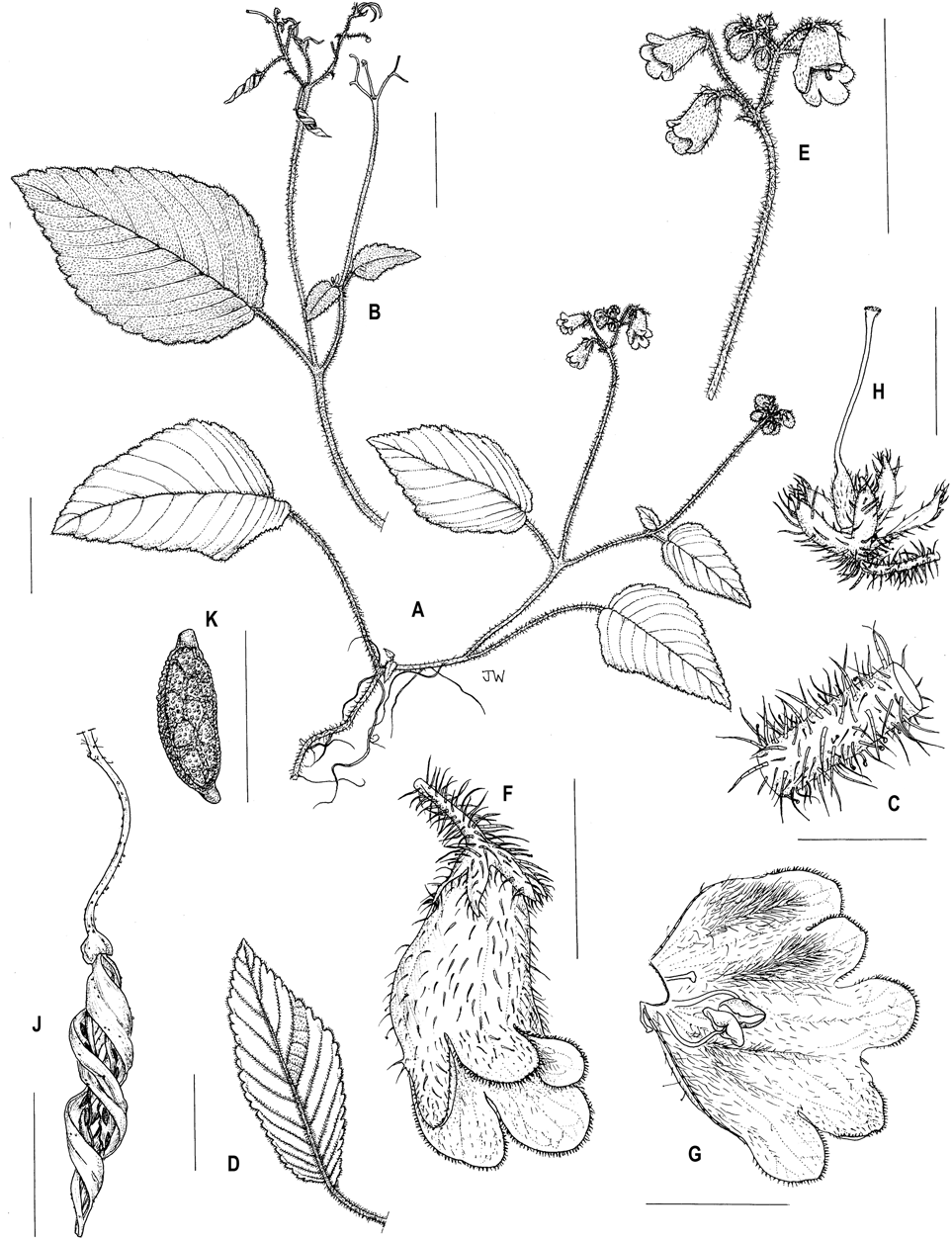
Streptocarpus mazumbaiensis I.Darbysh. A, habit, flowering plant; B, habit, fruiting plant; C, detail of stem indumentum; D, leaf undersurface; E, detail of inflorescence; F, detail of flower; G, dissected corolla with androecium; H, pistil within calyx; J, capsule; K, seed. A, E–K from Hall MAZ 226; B–D from Hall MAZ 102. Scale bars: A, B, D & E = 2 cm; C & H = 3 mm; F, G & J = 5 mm; K = 0.5 mm. Drawn by Juliet Williamson.

Caulescent herb to 10 cm tall with a small rootstock, creeping towards the base and rooting at the nodes, ± decumbent above; internodes up to 3.5 cm long. Stems slender, 0.5–1.5 mm in diameter, eglandular-pilose, with or without interspersed shorter glandular hairs. Leaves alternate, blade oblong-ovate to ovate or lowermost leaves sometimes elliptic, 2.3–10.5 × 1.7–4.5 cm, base attenuate to rounded or shallowly cordate, often asymmetric, margin serrate, apex acute to subattenuate, surfaces eglandular-pilose, principally on the lateral veins beneath and between the lateral veins above where most dense towards the margin when mature; lateral veins 10–12 pairs on the largest leaves, as few as 7 pairs on smaller mature leaves; petiole 3–6.5 cm long on the largest leaves, rather densely eglandular-pilose and with occasional glandular hairs. Inflorescences axillary, solitary, few-flowered; primary peduncle 4–9.5 mm long, indumentum as stem but the eglandular hairs more variable in length; bracts linear to oblanceolate, 1–3 mm long, pilose, caducous; pedicels 3.5–11 mm long, with both long and short eglandular hairs or just the latter, and with occasional glandular hairs. Calyx lobes lanceolate, 1.3–2 mm long in flower, up to 2.5 mm long in fruit, eglandular-pilose externally and with occasional glandular hairs at least at the base. Corolla white, 8–12 mm long, glandular-pubescent externally; tube obliquely subcampanulate, ventrally declinate, 5–7 mm long, with long unicellular hairs within, dense dorsally, more sparse elsewhere, mouth open, rounded, c.4–5 mm wide; limb weakly 2-lipped, upper lip of 2 rounded lobes, 1.8–2.2 mm long and wide, lower lip ± 3 mm long, deeply divided into 3 rounded lobes, 1.8–2.7 × 1.7–2.5 mm. Stamens arising from near the base of the corolla, included within the tube, the two stamens convergent and apically connate; filaments 1.7–2.5 mm long, curved, glabrous; anthers with thecae divergent, c.0.8 mm wide; lateral staminodes minute to c.0.6 mm long. Ovary cylindrical, narrowed at the apex, 1.6–1.8 mm long, either glandular-pubescent or eglandular-pubescent and with subsessile glands; style 2.5–3.5 mm long, glabrous except at the base; stigma shallowly bilobed or barely so, c.0.35 mm wide, papillose. Capsule 8–12 mm long, spirally twisted; seeds fusiform, 0.4–0.5 mm long, verruculose.
Distribution. Usambara Mts, NE Tanzania.
Habitat and ecology. Damp shaded rock faces and crevices in montane rainforest at 1850–1980 m.
Etymology. The species is named after the type locality of Mazumbai Forest. It is hoped that the naming of this rare species after this important but fragile site will help to promote conservation efforts here and in the wider Usambara range.
Proposed IUCN conservation status. Endangered (EN B2ab(iii)). Streptocarpus mazumbaiensis appears to be restricted to only two localities in the West Usambara Mts. This mountain range is heavily populated, with the result that the forests are heavily fragmented and now largely restricted to formally protected reserves. Mazumbai is a small (0.4 km2) area of submontane and montane rainforest, donated to the University of Dar es Salaam by private owners in the 1980s and subsequently overseen by the Forestry Division of Sokoine University, Morogoro (Iversen, Reference Iversen1988). This site is consequently afforded some protection and remains one of the most intact sites in the Usambara Mts (K. Vollesen, pers. comm.). Iversen (Reference Iversen1988), however, noted that some timber poaching had occurred in the 1980s and that the southern boundary of the site is rather vulnerable. Here, Streptocarpus mazumbaiensis was recorded as the ‘rarer of the Mazumbai Streptocarpus species; very local’ (Hall MAZ 102). The second site, Shagayu, is a Forest Reserve of c.79 km2, this being the largest block of continuous forest cover in the Usambara Mts. Iversen (Reference Iversen1988), however, noted that pit-sawing continued to occur illegally here in the 1980s. Streptocarpus mazumbaiensis is clearly scarce at this site, having been collected once and with no recent records. Thus, although the known populations (if still extant) are afforded some protection, the small area of occupancy (max. 80 km2) in only two locations, and the inferred threat of decline in quality of habitat from illegal disturbance, render this species globally endangered.
Additional specimens examined. Tanzania. Usambara Mts, Lushoto District: Mazumbai Forest, below central part of main ridge, alt. not recorded, fr. 22 xii 1980, Hall MAZ 102 (DSM); Shagayu Forest, 1980 m, fl. [date unknown*] Procter 179 (EA). Cultivated: fl. in hort., Hall (photograph at K).
* Procter 179 is currently missing at EA and the date of collection was unfortunately not recorded when it was on loan for study at K.
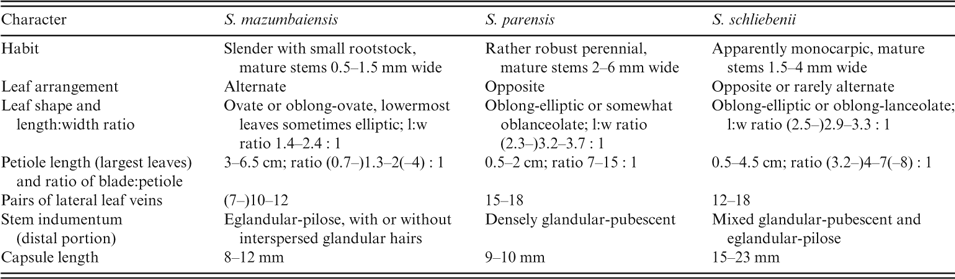
As noted in the Flora of Tropical East Africa (Darbyshire, Reference Darbyshire, Beentje and Ghazanfar2006), this species is allied to Streptocarpus parensis from the Pare Mts which lie to the northwest of the Usambara chain. Indeed, the flowers and fruits of the two species are very similar. However, they are easily separated by differences in habit, foliage and indumentum which are listed in Table 1. Streptocarpus schliebenii from the Ukaguru and Nguru Mts, some way to the south of the Usambara chain, also falls within the same species group and so is included in Table 1. This species differs most notably from both Streptocarpus mazumbaiensis and S. parensis in the longer and more tightly coiled capsules.
The main diagnostic characters for separation of Streptocarpus mazumbaiensis from S. parensis and S. schliebenii
The growth habit is quite unusual in this species in that the leaves are alternately arranged, with the stem altering direction somewhat at each node and the axillary inflorescence continuing the original stem line such that it can appear as if the inflorescence is terminal with an overtopping lateral shoot (see Fig. 1). It seems that this is an extreme example of the ‘groove meristem’ growth pattern characteristic of Streptocarpus subgen. Streptocarpus (see Hilliard & Burtt (Reference Hilliard and Burtt1971) and Jong & Burtt (Reference Jong and Burtt1975) for detailed discussion on patterns of growth in this subgenus). A similar growth habit can be observed in a number of species within this subgenus, for example Streptocarpus leandrii Humbert ex B.L.Burtt from Madagascar and S. bullatus from the Uluguru Mts in Tanzania. In the latter, however, the lowermost ‘leaf’ (the cotyledon-derived phyllomorph) is disproportionately enlarged relative to the remaining leaves and all the leaves are sessile. Whilst Streptocarpus schliebenii usually has opposite leaves, the Kew sheet of Manktelow 91429A from the Nguru Mts includes one plant with a growth habit very similar to that of S. mazumbaiensis (pers. obs.).
We are pleased to report that Streptocarpus parensis has recently been rediscovered in the Pare Mts, with the first collection since its original discovery in 1915. The ‘new’ collection (Mlangwa et al. 1554, 9 iv 2001; K!, MO, NHT) was made from a site within the Chome-Shengena Forest Reserve where it was described as abundant in open rocky areas in Erica–Dodonaea bushland at 2000 m. This specimen only came to light after the completion of the Flora of Tropical East Africa (Darbyshire, Reference Darbyshire, Beentje and Ghazanfar2006), where S. parensis was assessed as Vulnerable (VU D2). Whilst this assessment still stands, it appears that the new population is presently secure.
Streptocarpus acicularis I.Darbysh. & Massingue, sp. nov.Fig. 2.
Resembling S. dolichanthus Hilliard & B.L.Burtt but differing in having solitary (not rosulate) leaves which are much broader (up to 20 cm wide, vs. 4–6.5 cm), in having shorter calyx lobes (up to 3.5 mm vs. 6–7.5 mm), in the ovary having mixed glandular and eglandular hairs (vs. exclusively eglandular) and in having longer fruits (to 14.5 cm, vs. to 8 cm). – Type: Mozambique, Manica Prov., Sussundenga Dist., eastern foothills of Chimanimani Mts, c.28 km W of Dombe, confluence of Nazengwe and Mevumozi Rivers, 19°55′S 33°08′E, 280 m, fl. & fr. 25 iv 1974, Pope & Müller 1307 (holo K; iso ?SRGH).
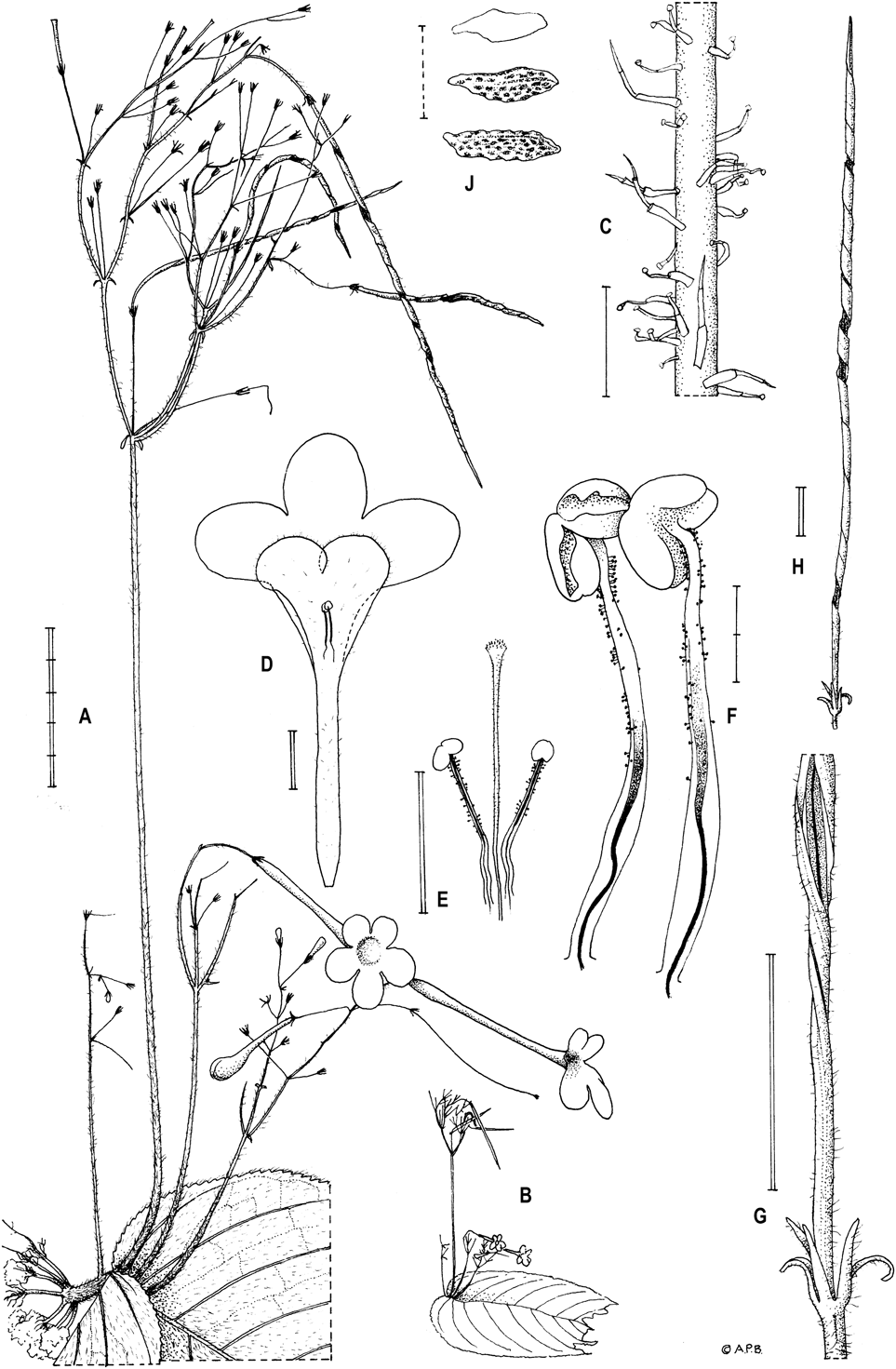
Streptocarpus acicularis I.Darbysh. & Massingue. A, habit; B, thumbnail habit to show scale of complete leaf; C, detail of inflorescence axis indumentum; D, corolla drawn from above, with position of stamens within the tube; E, stamens and style to show relative position at anthesis, stamens folded out; F, detail of stamens; G, base of capsule with calyx; H, mature capsule; J, immature seeds. All from Pope & Müller 1307. Scale bars: dashed bar = 500 μm; single bar = 1 mm; graduated single bar = 2 mm; double bar = 1 cm; graduated double bar = 5 cm. Drawn by Andrew Brown.
Acaulescent herb, ?monocarpic. Unifoliate, the phyllomorph on a short stout petiolode which is 2 × 0.4 cm; blade green, broadly oblong, c.32 × 20 cm, base cordate, margin finely serrate, apex withered, surfaces pubescent, hairs mainly along the principal veins beneath, more evenly distributed above; lateral veins widely divergent from the midrib, weakly ascending. Inflorescences borne at the base of the lamina, 4 (on the plant observed), erect, paniculate, up to c.40-flowered; primary peduncle up to 26 cm long, spreading eglandular-pubescent, distal portion of inflorescence branches and pedicels with mixed spreading short glandular hairs and longer eglandular hairs; pedicels 18–39 mm long; bracts at apex of primary peduncle ligulate, green, 4.5–6.5 × 1 mm, pubescent; bracts in distal portion of inflorescence smaller, linear, 2.5–3 mm long. Calyx lobes linear-lanceolate, 2.8–3.5 mm long in flower, up to 3.8–5 mm in fruit, apex becoming slightly recurved in fruit, with mixed short glandular and longer eglandular hairs. Corolla purple-blue, c.70 mm long, sparsely glandular-pubescent externally and with eglandular hairs along the margin of the upper lip; tube 45–53 mm long, the proximal 3/4 cylindrical, c.2.5–3.5 mm wide, the distal 1/4 gradually widened to c.9.5–12 mm wide at the mouth; upper lip of 2 overlapping lobes, these subreniform, 6–6.5 × 8–11 mm; lower lip to c.26 mm long, with 3 widely spreading obovate-orbicular lobes, the lateral lobes 12.5–14.5 × 13.5–14.5 mm, the median lobe to 17 × 15 mm. Stamens attached in the distal 1/4 of the corolla tube, the two stamens convergent and apically connate; filaments c.9.5 mm long, curved, with short-stalked glands in the distal half; anthers with thecae divergent, 1.5–1.8 mm long; lateral staminodes 2, linear, 3–3.5 mm long, glabrous. Ovary linear, not differentiated from the style, the two together 53–56 × 0.3–0.5 mm, shortly spreading glandular-pubescent and with interspersed short eglandular hairs; stigma capitate-bilobed, 1.5 mm wide. Capsule linear, very slender, to 145 × 1.5 mm, spirally twisted; seeds fusiform, 0.5–0.6 mm long, reticulate.
Distribution. Chimanimani Mts, Mozambique; known only from the type specimen.
Habitat and ecology. Stream banks in evergreen forest at c.280 m.
Etymology. The species epithet acicularis refers to the long, slender, needle-like capsules of this species.
Proposed IUCN conservation status. Data Deficient (DD). This species is currently known from a single locality within the Chimanimani National Reserve. Satellite imagery available on Google Earth shows that forest remains extensive on the eastern slopes of the massif within the reserve boundary and it may be that the type locality is not threatened. However, one potentially significant threat to riverine habitats within the reserve is the practice of illegal gold mining; Dondeyne et al. (Reference Dondeyne, Ndunguru, Rafael and Bannerman2009) estimate that between 5000 and 10,000 miners operate within the reserve’s core zone, and efforts to stamp out the practice have been hampered by the difficult terrain and limited resources open to the park rangers. In view of this, limited controlled gold mining has been proposed as an alternative solution. Encroachment into the forest at its lower boundary from the increasing human populations beyond the protected area boundary may also be impacting this species. Further data on the current population of Streptocarpus acicularis and the threat posed from these activities are required in order to make a full assessment.
The Chimanimani Mts, covering an area of c.200 km2 on the border of Zimbabwe and Mozambique, are well known for their high number of endemic plant species. In his study of endemic Zimbabwean plants, Mapaura (Reference Mapaura2002) recorded 33 endemic and 37 near-endemic species to Zimbabwe from Chimanimani. Taking into account both the Zimbabwe and Mozambique sections of this massif, 80 taxa are now recorded as endemic there (R. Goodier per J. Timberlake [pers. comm.], with inclusion of the newly described Streptocarpus acicularis). It is the quartzite grasslands, rather than the forest, that contain the bulk of these endemics. However, other forest endemics are noted, for example Impatiens salpinx Launert. Furthermore, Mapaura (2002: 121) noted that the Mozambique side of the massif is much less well studied than the Zimbabwe side and it is on the Mozambique side where the bulk of low- and mid-altitude forests occur. Clearly, this region is a high priority for trans-border conservation efforts.
Streptocarpus acicularis is very striking and distinctive and is unlikely to be confused with other species. Whilst it would be desirable to have more collections available prior to publication, the single specimen is very informative with both flowers and fruits available, and this species is so distinctive that we feel it worth formally describing here to promote the conservation of this rare species and its habitat.
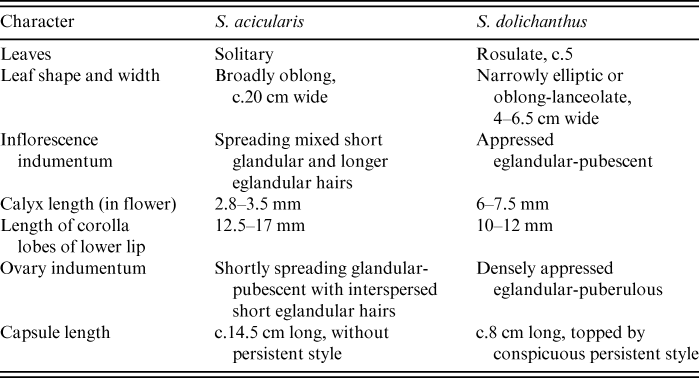
In the Flora Zambesiaca account of Streptocarpus (Hilliard & Burtt, Reference Hilliard, Burtt and Launert1988), this species keys out nearest to S. dolichanthus, one of the Mt Mulanje endemics. Indeed, the very long, slender corolla tube, widened in the upper 1/4, is very similar in the two species. However, they differ significantly in a number of clearcut characters (Table 2) and are unlikely to be closely related. Hilliard & Burtt (Reference Hilliard and Burtt1986) noted the morphological similarity of Streptocarpus dolichanthus to some members of the S. rexii (Hook.) Lindl. aggregate from South Africa, although molecular evidence indicates that they are not closely related (Möller & Cronk, Reference Möller and Cronk2001). Whilst some members of the Streptocarpus rexii group have flowers and fruits comparable in size to S. acicularis, they are always rosulate with rather narrow leaves usually less than 10 cm wide (up to 11 cm fide Hilliard & Burtt, Reference Hilliard and Burtt1971). In addition, the comparably large-flowered species within that group (e.g. Streptocarpus rexii, S. primulifolius Gand.) are always few flowered, with 1–2(–6) flowers per inflorescence, and have broader corolla tubes which are gradually widened along their length.
The main diagnostic characters for separation of Streptocarpus acicularis from S. dolichanthus
Three other unifoliate Streptocarpus species occur on or near the Chimanimani massif: S. grandis N.E.Br. subsp. septentrionalis Hilliard & B.L.Burtt, S. michelmorei B.L.Burtt and S. eylesii S.Moore subsp. eylesii. The former two fall within the Streptocarpus cooperi C.B.Clarke aggregate (Hilliard & Burtt, Reference Hilliard and Burtt1971). All species in this group differ from Streptocarpus acicularis in having a rather broad cylindrical corolla tube, not markedly widened towards the mouth, and a subregular or rather weakly zygomorphic limb, the lobes of the upper lip not being much smaller than those of the lower lip. In addition, the two species from Chimanimani have markedly smaller corollas than in Streptocarpus acicularis, only 20–50 mm long. Streptocarpus cooperi itself, which is restricted to KwaZulu-Natal, can have corollas up to 70 mm long but here the tube is 6–8 mm in diameter at the midpoint, much broader than in S. acicularis. The third Chimanimani species, Streptocarpus eylesii, is easily separated from S. acicularis in having a curved corolla tube with only a short proximal cylindrical portion, the remainder being gradually funnel-shaped. It also has much shorter and broader, rather stout capsules, 40–75 × 2–3 mm.
Acknowledgements
The authors would like to thank Frank Mbago and Henry Ndangalasi at the University of Dar es Salaam and Geoffrey Mwachala at the National Museums of Kenya for providing access to the collections of Streptocarpus held at their respective institutions. Reinhild Raistrick is thanked for providing photographs of Streptocarpus mazumbaiensis in cultivation. We particularly thank Juliet Williamson and Andrew Brown for producing the excellent illustrations. Alice Massingue visited Kew under the Commonwealth Professional Fellowship Programme in February–March 2012.