1. Introduction
Some 250 species have been recorded from the Chengjiang biota, Cambrian Series 2, Stage 3 of Yunnan Province, South China, with arthropods being the most abundant and species-diverse group (Hou et al. Reference Hou, Siveter, Siveter, Aldridge, Cong, Gabbott, Ma, Purnell and Williams2017). These include some 18 artiopodan euarthropod species (sensu Ortega-Hernández et al. Reference Ortega-Hernández, Legg and Braddy2013), with representatives of the trilobitomorph groups Xandarellida, Trilobita, Nektaspida and Conciliterga. Here we describe a new xandarellid species from Chengjiang, Luohuilinella deletres sp. nov., preserved with dorsal exoskeleton and soft-part anatomy.
Four xandarellid species have previously been described, three from the Chengjiang biota and one from the middle Cambrian (Stage 5) of Morocco. They are assigned to three genera, Cindarella Chen, Ramsköld, Edgecombe & Zhou in Chen et al. (Reference Chen, Zhou, Zhu and Yeh1996), Xandarella Hou et al. (Reference Hou, Ramsköld and Bergström1991), and Luohuilinella Zhang et al. (Reference Zhang, Fu and Dai2012). The Moroccan Xandarella mauretanica Ortega-Hernández et al. (Reference Ortega-Hernández, Azizi, Hearing, Harvey, Edgecombe, Hafid and El Hariri2017) is known only from its soft-part anatomy; the type species Luohuilinella rarus from its dorsal exoskeleton; and the type species Cindarella eucalla and Xandarella spectaculum from their dorsal exoskeleton and soft-part anatomy.
The new species of Luohuilinella described here further elucidates the morphology of the eyes, gut and appendages of xandarellids.
2. Methods and material
The material of L. deletres is from Ercaicun, near Haikou town, Yunnan Province (Hou et al. Reference Hou, Siveter, Siveter, Aldridge, Cong, Gabbott, Ma, Purnell and Williams2017, fig. 4.3). It comprises three dorsoventrally flattened specimens and a single laterally flattened specimen (Figs 2–6 below). Type and figured specimens are housed in the collections of the Yunnan Key Laboratory for Palaeobiology, Yunnan University (numbers YKLP 11120a,b, 11121a,b, 11122a,b and YKLP 11123a,b).
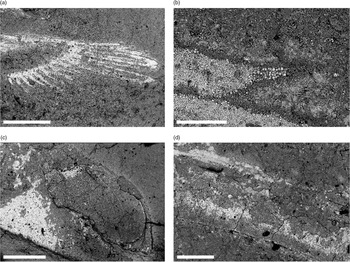
Taphonomy of Luohuilinella deletres. Backscattered electron images of specimen 11123a,b. (a) Appendage showing iron oxide (after pyrite) as bright minerals coating anatomy including lamellae. Scale bar is 1 mm. (b) Lamellae showing that iron oxides in the distal tip are frequently larger than those in the proximal part of the appendage. The dark margin seen around the lamellae is typical. Scale bar is 100 μm. (c) Kidney-shaped eye showing preservation in relief, rather than as a coating of iron oxides. Scale bar is 1 mm. (d) Fine, exsagittally directed cracks on pleura. Scale bar is 500 μm.

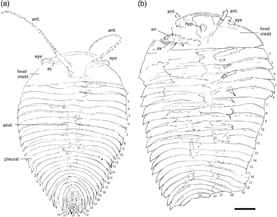
Camera lucida interpretation of two dorsoventrally preserved specimens of Luohuilinella deletres. (a) Holotype, YKLP 11120a. (b) Posteriorly incomplete specimen, YKLP11121a. Abbreviations: ant, antenna; hyp, hypostome; en, endopod; ex, exopod. Scale bar (bottom right) is 1 cm for both specimens. Numbers refer to trunk tergites.

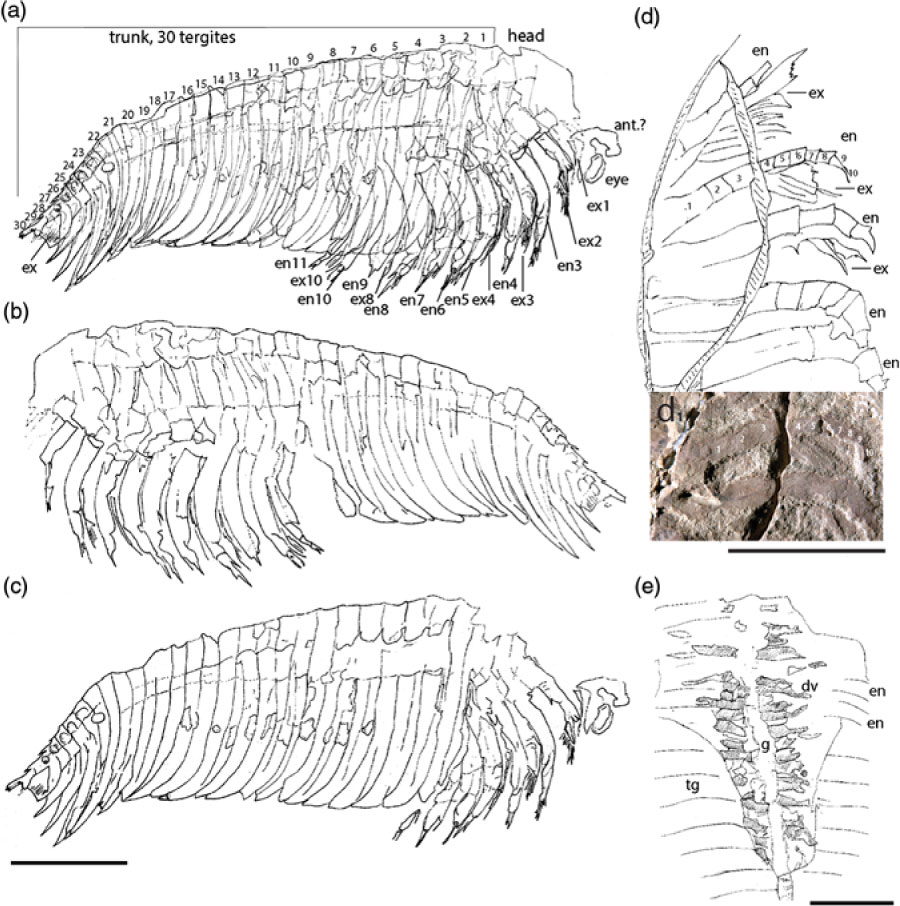
Camera lucida and photographic interpretation of two specimens of Luohuilinella deletres. (a–c) Laterally preserved specimen: (a) composite of 11123a,b; (b) YKLP 11123a; (c) YKLP 11123b. (d, d1, e) YKLP 11122a,b dorsoventrally preserved specimen with appendages (part) and gut (counterpart specimen) respectively. Abbreviations as for Figure 2, plus: tg, tergite; dv, gut diverticula; numbers 1–10 in (d) and (d1) are interpreted as podomeres (see also Fig. 4). In (a) the position of the head–thorax boundary is based on there being 30 trunk-tergites posterior of this (numbered). All scale bars are 1 cm. Bottom left scale bar applies to (a–c).

(a, b) Close-up of endopods in specimen YKLP 11122b (see also Fig. 3d, d1). Numbers 1–10 are interpreted as podomeres, with the podomere boundaries emphasized in (b). We note that in adjacent endopods the boundaries of podomeres are indistinct. Scale bar is 1 cm.

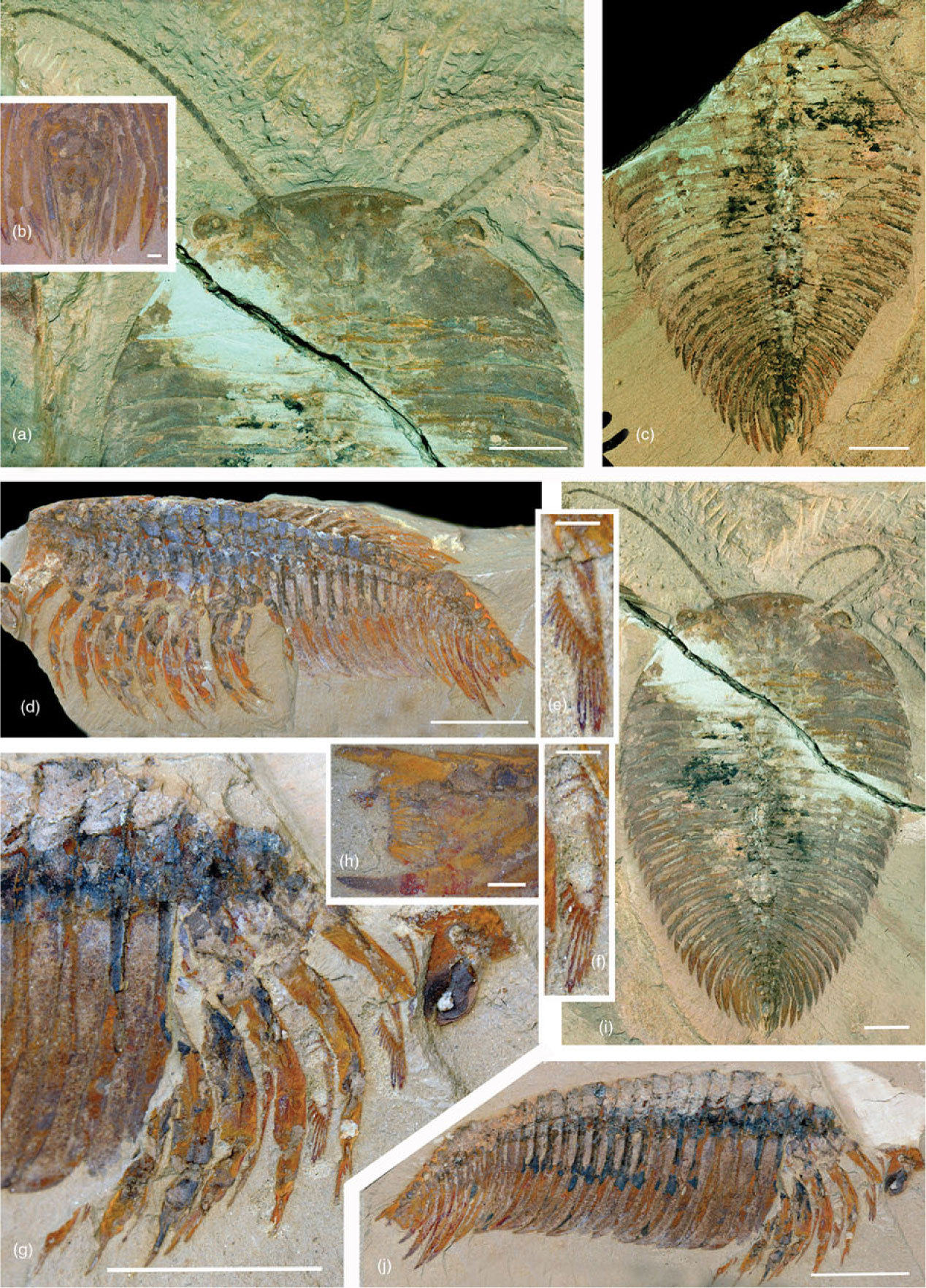
Photographic images of two specimens (parts and counterparts) of Luohuilinella deletres, preserved laterally (d–h, j), and dorsoventrally (a–c, f). (a, b, i) Close-ups of anterior and posterior, and view of whole specimen, YKLP 11120a. (c) Counterpart whole specimen, YKLP 11120b. (d) Specimen YKLP 11123a. (e–h, j) Close-up of two exopods (see (g) for their positions), anterior, posterior with displaced, exposed exopod, and whole specimen, YKLP 11123b. Scale bars for (a, c, d, g, i, j) are 1 cm; for (b, e, f, h) are 1 mm. See Figures 2 and 3 for labelled features.

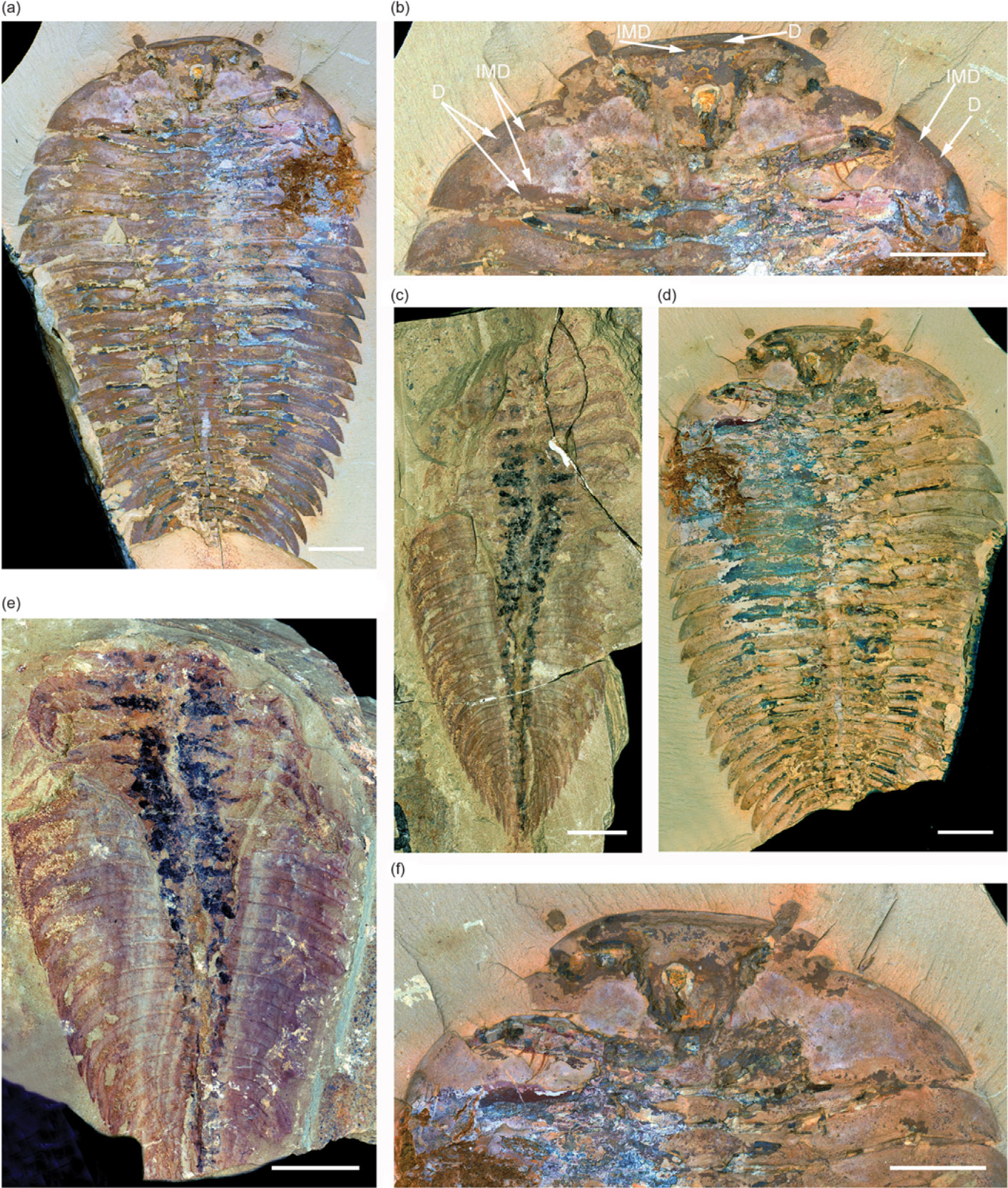
Photographic images of two specimens of Luohuilinella deletres (parts and counterparts) preserved dorsoventrally. (a, b) Counterpart, posteriorly incomplete specimen, whole view and close-up of anterior, YKLP11121b: note this specimen and its counterpart (d, f) shows the only well-preserved biramous limb in the head. (d, f) Whole specimen and anterior of part, YKLP11121a. (c, e) Part and counterpart, YKLP 11122a,b, showing trace of gut. All scale bars are 1 cm. Abbreviations: D, doublure; IMD, inner margin of doublure. See Figures 2 and 3 for other labelled features.
The anatomy of the new species was recorded using a camera lucida attached to a Wild Heerbrug M10 microscope. Macrophotography of the fossil material was undertaken using a Nikon D3X camera with a Af-S VR105 macro lens. The material was also imaged using a Hitachi S-3600N Scanning Electron Microscope (SEM) at the School of Geography, Geology and the Environment, University of Leicester, UK. Chemical analysis was undertaken using an Oxford INCA 350 EDX system, providing elemental mapping and point-and-ID spectrum. The system operated with a standard voltage of 15 kV; carbon was mapped using 5 kV.
Details of our phylogenetic analysis are presented in Section 5.
3. Preservation
The appendages, eye and dorsal exoskeleton of L. deletres have been analysed for their mineralogy and chemical composition. The appendages are preserved as a coating of iron oxides after pyrite (see Gabbott et al. Reference Gabbott, Hou, Norry and Siveter2004; Zhu et al. Reference Zhu, Babcock and Steiner2005), composed of a thin veneer of anhedral to subhedral microcrystals (usually 1.2 μm or less in diameter), and infrequent clusters of microcrystals and/or poorly ordered framboids (Fig. 1a, b). At the distal tip of each lamella the iron oxides are distinctly larger than those in the proximal part of the appendage (the largest evident being 8.5 μm). Typically, a dark margin appears immediately beyond the appendage outline, which has the same chemical composition as the host matrix. Adjacent to this is a light-grey region of mineralization, which is composed of Si, Al and K and minor amounts of Mg, and is likely to be the clay mineral illite, possibly of secondary origin.
The exoskeleton is markedly red against the yellow-coloured sediment. SEM analyses confirm that the red material is iron oxide, which densely coats the fossil. The iron oxides comprise mainly microcrystals and poorly ordered framboids. Some extremely small (<1 mm) patches of carbon can be resolved under high-magnification scanning electron microscopy, although most carbon has oxidized, perhaps when the iron pyrites oxidized to iron oxides releasing H2S. Some fine, exsagittally directed cracks occur on some of the pleurae (Fig. 1d).
The eye has some iron oxides in the form of microcrystals and poorly ordered framboids. However, these are few and scattered, unlike on the dorsal exoskeleton and appendages where they are very dense, and dense, respectively. Small carbon patches occur, but these are found beyond the fossil margin and are not exclusive to the eye.
Elemental mapping of the anatomy failed to discriminate any calcium, the absence of which is typical of the mode of preservation of Chengjiang fossils (Gabbott et al. Reference Gabbott, Hou, Norry and Siveter2004).
4. Systematic palaeontology
Phylum Euarthropoda Lankester, Reference Lankester1904
Class? Artiopoda Hou & Bergström, Reference Hou and Bergstrom1997
Order? Xandarellida Chen, Ramsköld, Edgecombe & Zhou in Chen et al., Reference Chen, Zhou, Zhu and Yeh1996
Genus Luohuilinella Zhang et al., Reference Zhang, Fu and Dai2012
Diagnosis. Head shield one-third to one-fifth of total body length, with paired anterolateral eye notches. Trunk with 27–30 tergites. Posterior of the antennae there are at least 11 pairs of biramous appendages, including three pairs in the head: exopods are slightly shorter than the endopods. (Modified from Zhang et al. Reference Zhang, Fu and Dai2012.)
Remarks. In their assessment of Xandarellida, Ortega-Hernández et al. (Reference Ortega-Hernández, Azizi, Hearing, Harvey, Edgecombe, Hafid and El Hariri2017) noted that each tergite in the anterior half of the trunk covers a single pair of biramous appendages, whereas each succeeding tergite in the posterior half of the trunk covers an increasing number of appendage pairs. In Luohuilinella the posterior-most appendages are mostly not preserved.
Other xandarellids exhibit contrasting eye positions to that of Luohuilinella. In Cindarella the eyes protrude on slender stalks from beneath a head shield that lacks notches (Ramsköld et al. Reference Ramsköld, Chen, Edgecombe and Zhou1997), whereas in Xandarella the eyes are set within dorsal slits in the head shield, well behind the anterior margin, while still being attached to the ventral body by stalks (Strausfeld et al. Reference Strausfeld, Ma, Edgecombe, Fortey, Land, Liu, Cong and Hou2016, fig. 10).
In Cindarella the anterior trunk tergites are associated with a single pair of biramous appendages, but this pattern is decoupled beyond trunk tergite seven, where more than one somite is associated with each tergite. In Luohuilinella the first eight tergites are associated with a single trunk appendage, though with the exception of one exopod protruding beyond the terminal trunk tergite in YKLP 11123a,b (Fig. 5h below), most of the more posterior appendages are not preserved. Luohuilinella differs from Cindarella by possessing anterolateral eye notches in the head shield, by its greater number of trunk tergites (27–30, versus 21–23) and by possessing three (as opposed to four) pairs of biramous appendages in the head. Luohuilinella differs from Xandarella most notably in the position of its eyes (see above). In the type species Xandarella spectaculum there are six pairs of biramous appendages in the head behind the multi-segmented antennae, and the trunk has 12 tergites, the terminal one with a spine. The small (21 mm long including antennae) X. mauretanica Ortega-Hernández et al. (Reference Ortega-Hernández, Azizi, Hearing, Harvey, Edgecombe, Hafid and El Hariri2017) from Morocco, is known only from one specimen that lacks its dorsal exoskeleton. It has at least 22 pairs of post-antennal appendages, the first being about half the size of succeeding ones.
Luohuilinella deletres sp. nov.

Etymology. Greek, deletron, a lantern and -es, pertaining to; alluding to the stalked eyes.
Diagnosis. Luohuilinella with semi-elliptical head shield that is about one-fifth of the total body length, and with small eye notches relative to the size of the head shield. Trunk tergites are not separated by gaps abaxial to the narrow axial region and lack extended pleural spines. Axial region of trunk narrow and gradually tapering posteriorly of the fifth trunk tergite.
Holotype. A dorsoventrally preserved specimen, part and counterpart, YKLP 11120a,b, from Ercaicun, Haikou, Kunming; Yu’anshan Member, Chiungchussu Formation, Eoredlichia-Wutingaspis trilobite biozone of eastern Yunnan, Nangaoan Stage of local usage, Cambrian Series 2, Stage 3.
Material. The holotype (Figs 2a, 5a–c, i), YKLP 11120a, b, and two other dorsoventrally preserved specimens (part and counterpart), YKLP 11121a,b and 11122a,b. A laterally preserved specimen, part and counterpart, YKLP 11123a,b.
Measurements. The exoskeleton of YKLP 11120a,b is 8.45 cm long excluding antennae, its head shield is 1.45 cm long, and its maximum width (at the fifth tergite) is 5.45 cm. The largest specimen, YKLP 11121a,b (Fig. 2b), is missing the posterior-most seven trunk tergites of the exoskeleton; it is 10 cm long as preserved, and 7 cm at its maximum width (at the fifth tergite). The dorsal exoskeleton of this specimen likely approached 12 cm long.
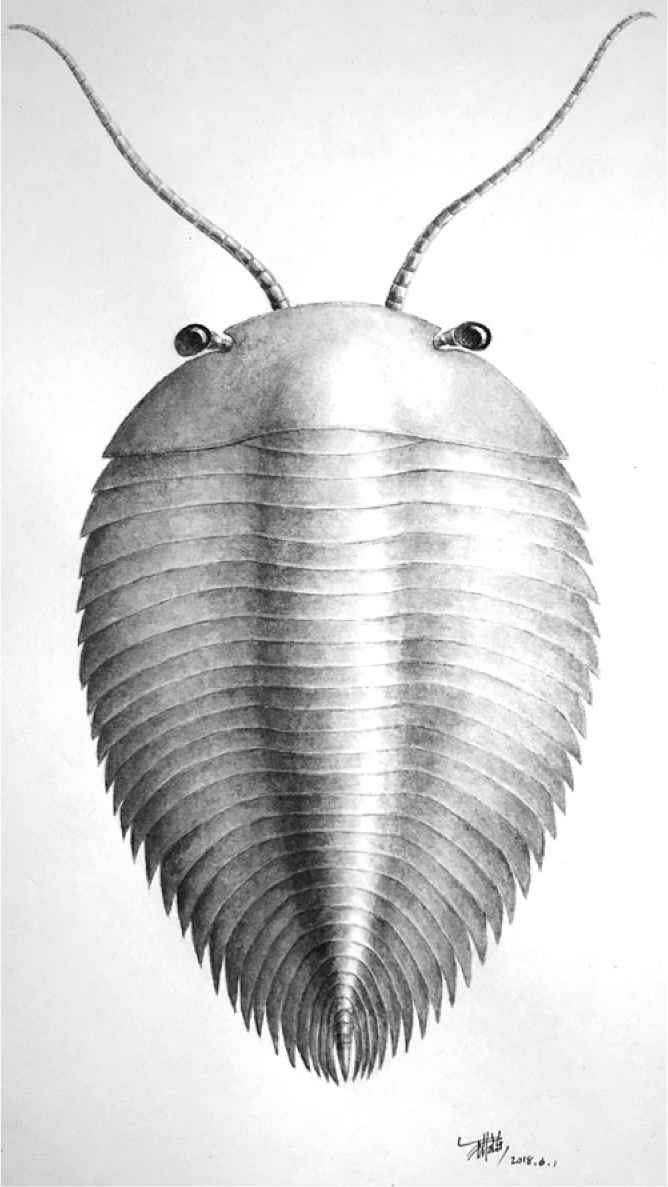
Description. The dorsal exoskeleton possesses a semi-elliptical head shield that is about one-fifth of the total body length and has a rounded anterior margin, with the exception of two anterolateral notches that accommodate the eyes (Fig. 2a, b). The head shield lacks genal prolongations, sutures and surface sculpture. The hypostome is natant, with an elongate sub-oval outline (Fig. 2b). A moderately wide doublure is indicated inside the posterior, lateral and anterior margins of the head shield (Fig. 6b). The true inner margin of the doublure, and thus true width of the doublure, appears to be present near the posterior and one of the lateral margins of the head shield; near the other lateral margin and anteriorly between the eye notches, the inner margin of the doublure is much more irregular, indicating decay in these areas, resulting here in a narrower doublure. A pair of laterally placed stalked eyes project just in front of the anterior margin of the head shield, anterior of which and extending well beyond the edge is a pair of slender uniramous antennae, each with at least 26 podomeres (Fig. 2a). Posterior to the antennae there are at least 11 pairs of biramous appendages preserved, including three pairs in the head (Fig. 3a). The first two post-antennal appendages appear to be shorter than succeeding appendages (Fig. 3a). Each of the appendages comprises a slender endopod that may bear ten podomeres (Figs 3d, d1, 4a, b), lacking endites. The exopods are paddle-shaped distally, slightly shorter than the endopods and have flat lamellae (Fig. 5e, f). Paired tubular diverticula are present along the mid-gut, being transversely wider beneath the head shield and gradually narrowing posteriorly (Fig. 3e).
The trunk has a distinctly convex axial region, demarcated from the pleural regions by a weak axial furrow (Figs 2a, b, 5c, i 6a). It is composed of 30 tergites, the first small and axial, and partly overlapped by the posterior margin of the head shield. The trunk tergites are well defined; abaxially they are progressively more reflexed backwards posteriorly, so that the terminal five tergites with pleural elongations (tergites 23–27) curve and project directly backwards (Fig. 2a). Tergites 2–27 terminate abaxially in a pleural spine; these are short anteriorly in the trunk, becoming progressively longer posteriorly, and the abaxial, gently convex edge of each tergite bears 15 tiny serrations (Fig. 6a). The trunk is weakly abaxially convex in outline and tapers gradually posteriorly of tergite five. The terminal three tergites are axial, each without a pleural extension, and there is a stout terminal spine.
Remarks. The type species of Luohuilinella, L. rarus, possesses paired anterior notches in its head shield and, despite the absence of soft-part anatomy, Zhang et al. (Reference Zhang, Fu and Dai2012) correctly interpreted these features as ‘accommodating ventral eyes’. The only specimen of L. rarus, which is also from the Chengjiang biota, is 16.8 mm long and 8.8 mm wide. The head shield is elongate sub-elliptical with acute genal angles and is approximately one-third of the total length of the exoskeleton. It has a glabella that terminates well behind the eye notches, and a posteriorly narrowing trunk with well-defined axial and pleural regions, which Zhang et al. (Reference Zhang, Fu and Dai2012) recorded as having 27 tergites and a terminal piece. L. deletres is distinguished from L. rarus by the markedly different shape of its head shield, which is semi-elliptical and about one-fifth of the length of the exoskeleton; its trunk tergites, which are not separated by gaps abaxial to the axial region; the shape of the axis, which is narrower and less tapering posteriorly; the smaller size of its eye notches relative to the size of the head shield; and by possessing 30 tergites (comprising an anterior-most (first) axial tergite, 26 tergites with pleural elongations, and 3 terminal tergites without these elongations).
There is a patchy darker region (Fig. 6b, f) surrounding the elongate-oval, natant hypostome of L. deletres (Fig. 2b), but nothing that we could confidently identify as a specific structure.
The three terminal tergites that lack pleural extensions in L. deletres resemble a pygidium (Figs 2a, 3a, 5b), though we cannot determine if the segments are fused or articulated. In its small size this structure resembles the micropygous pygidium of redlichiid trilobites, and its segments are markedly different from those of trunk segments 2–27 in lacking a pleural component. The terminal three tergites and terminal piece of L. rarus also lack pleural extensions and may represent a homologous structure.
The full morphology of the exopod of L. deletres is unclear. In YKLP 11123a,b the distal end is paddle-shaped (Figs 1a, 5e, f) and bears closely spaced flat lamellae. We cannot discern whether these lamellae are morphologically uniform along the length of the exopod. In the single biramous appendage visible in the head of YKLP11121a,b, the distal lamellae of the exopod are narrow and short (Figs 2b, 6a, b, d, f). More proximally on this exopod there appear to be longer structures that resemble spines (Figs 2b, 6b, f), but we cannot be certain whether these are derived from the exopod or from another, associated structure.
5. Phylogenetic affinity
To evaluate the evolutionary significance of the new anatomical data yielded by L. deletres, the new species was added to the phylogenetic study of Siveter et al. (Reference Siveter, Briggs, Siveter, Sutton and Legg2017). This dataset has extensive taxonomic coverage of arthropods including artiopodans. L. deletres has been coded for the subset of characters found to be informative for trilobitomorph and vicissicaudate taxa as defined by Siveter et al. (Reference Siveter, Briggs, Siveter, Sutton, Legg and Joomun2014; see Supplementary Material at https://doi.org/10.1017/S0016756818000730) using the character list taken from an earlier version of this dataset (Siveter et al. Reference Siveter, Briggs, Siveter, Sutton, Legg and Joomun2014). Coding for Acanthomeridion was also updated, to reflect data from Hou et al. (Reference Hou, Williams, Gabbott, Siveter, Siveter, Cong, Ma and Sansom2016). The new dataset (Supplementary Material) was analysed using Bayesian analysis in MrBayes (standard morphological data, with variable coding, gamma rates, four chains, 16 million generations, see Supplementary Material for details; Ronquist et al. Reference Ronquist, Teslenko, Van der Mark, Ayres, Darling, Höhna, Larget, Liu, Suchard and Huelsenbeck2011).
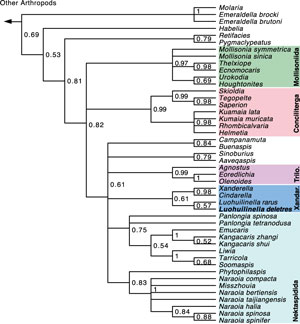
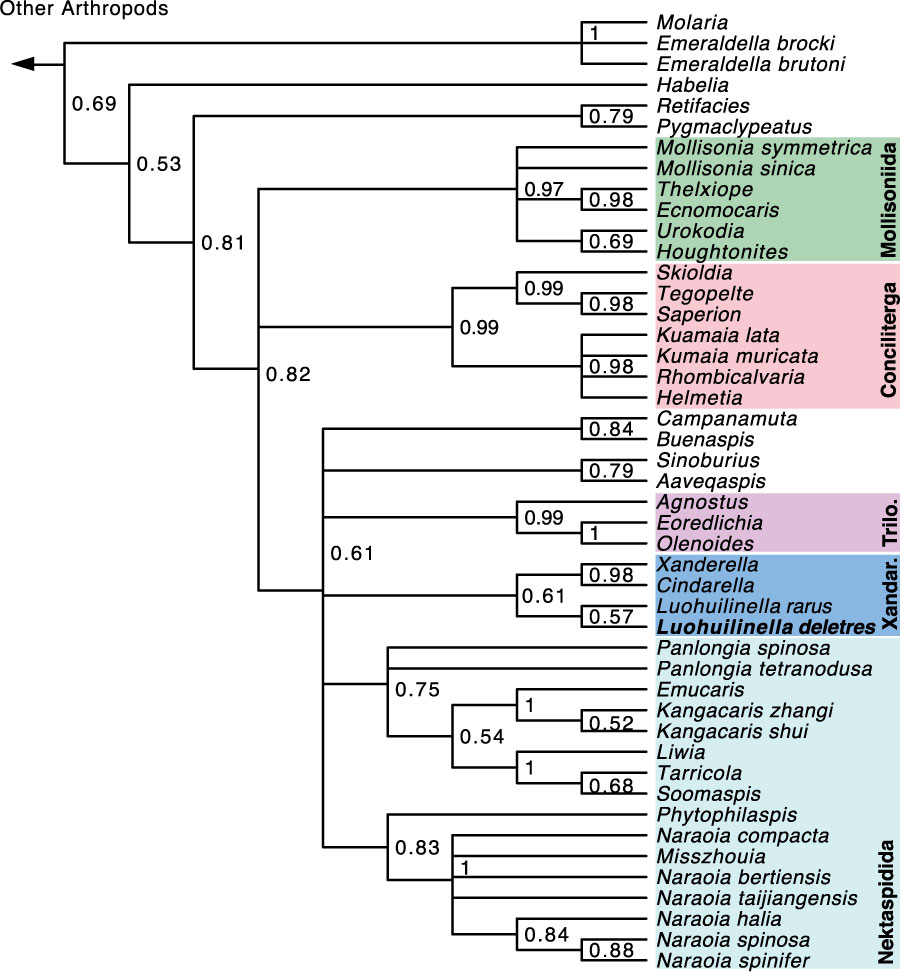
Tree searches using Bayesian analysis resolved a xandarellid affinity for L. deletres and L. rarus as they are placed in a clade with Cindarella and Xandarella (Fig. 8). This placement is supported by the presence of head-shield articulation with a reduced trunk tergite (character 44), strongly curved posterior tergites (character 108) and the presence of eye slits (character 363) (the latter being homoplastic). The relationships within Artiopoda largely mirror those recovered in the analyses of Lerosey-Aubril et al. (Reference Lerosey-Aubril, Paterson, Gibb and Chatterton2017) in that Xandarellida is in a clade with Trilobita and Nektaspidida, but the new result is equivocal with respect to the monophyly of ‘Petalopleura’ and the placement of Sinoburius. The relationships in other parts of the consensus tree are less resolved; the major arthropod clades form a polytomy that includes a wide range of Cambrian taxa, including Acanthomeridion. Alternative searches using parsimony in TNT (Goloboff et al. Reference Goloboff, Carpenter, Arias and Miranda2008a, b) find poor resolution among artiopodan taxa both with and without the application of implied weighting, or the inclusion or exclusion of Habelia (not figured).
Phylogeny of Trilobitomorpha under Bayesian analysis (50% majority rule consensus tree). Luohuilinella deletres and L. rarus are recovered as xandarellids. The selection of taxa relevant to artiopodan relationships are shown, with the root and other arthropods condensed. Abbreviations are: Trilo., Trilobita; Xandar., Xandarellida.
Recent simulation studies have suggested that Bayesian analyses are more accurate than parsimony analyses, and that the latter provide false precision (especially with implied weighting) (Wright & Hillis, Reference Wright and Hillis2014; O’Reilly et al. Reference O’Reilly, Puttick, Parry, Tanner, Tarver, Fleming, Pisani and Donoghue2016; although see Goloboff et al. Reference Goloboff, Torres and Aria2017). Our analyses of new and updated empirical data for arthropods indicate that the results from Bayesian searches provide resolution for the parts of the tree in question here, but yield unconventional results in other parts of the tree (i.e. monophyletic Atelocerata, paraphyletic Chelicerata and monophyly of clades previously interpreted as successive stem-arthropod plesia; SupplementaryMaterial at https://doi.org/10.1017/S0016756818000730). Similar results were obtained in the Bayesian analysis of Wolfe (Reference Wolfe2017). Maximum parsimony searches, however, yielded even less resolved consensus trees (including failing to recover monophyletic Artiopoda). Parsimony searches were very sensitive to taxon inclusion and character weighting. Furthermore, taxon inclusion and character weighting interact in searches with implied weighting in that the relationships and resolution in one part of the tree are affected by taxon exclusion in distant parts of the tree. Future studies would benefit from total evidence analysis (simultaneous analysis of morphological and molecular data) and from focus on character coding of trilobitomorph taxa, some of which may be acting as ‘wildcard’ taxa.
6. Palaeoecology
Luohuilinella deletres is a rare component of the Chengjiang biota and is only recorded from rapidly deposited so-called ‘event beds’ (for which see Hou et al. Reference Hou, Siveter, Siveter, Aldridge, Cong, Gabbott, Ma, Purnell and Williams2017) at a single locality, Ercaicun. Other xandarellids in the Chengjiang biota are also rare. Luohuilinella rarus is known only from one specimen, at Mafang (Zhang et al. Reference Zhang, Fu and Dai2012). Cindarella eucalla and Xandarella spectaculum are known from a few tens of specimens, but are always rare components of fossil assemblages (Hou et al. Reference Hou, Siveter, Siveter, Aldridge, Cong, Gabbott, Ma, Purnell and Williams2017). Until recently xandarellids were known exclusively from the Chengjiang biota. The discovery of a xandarellid in the middle Cambrian (Stage 5) of Morocco suggests a much wider biogeographical reach from the early Palaeozoic continents of South China to Gondwana (Ortega-Hernández et al. Reference Ortega-Hernández, Azizi, Hearing, Harvey, Edgecombe, Hafid and El Hariri2017). It is unclear whether xandarellids were rare components of arthropod assemblages more generally, or whether they are under-represented in these Lagerstätten because of taphonomic/palaeoenvironmental biases.
As in other trilobitomorphs, the dorsoventrally flattened exoskeleton suggests a benthic or nektobenthic mode of life for L. deletres (see Hou et al. Reference Hou, Siveter, Siveter, Aldridge, Cong, Gabbott, Ma, Purnell and Williams2017, fig. 6.2). If it lived at or near the seabed, it likely used its well-developed anteriorly positioned stalked eyes for searching out food, either to scavenge or to find prey. The eyes may have had sophisticated capabilities. Those of the closely related Cindarella are reconstructed as having more than 2,000 ommatidia, a differentiated bright zone and a near-spherical visual field (Zhao et al. Reference Zhao, Bottjer, Hu, Yin and Zhu2013). However, the consistent and close association of the eyes with the marginal notches of the head shield in L. deletres suggests a more limited range of eye movement than in Cindarella, potentially reducing the ability to stabilize the visual field during rapid movement (cf. Schoenemann, Reference Schoenemann2006). Even so, the eyes of L. deletres are likely to have had a greater range of movement than those of Xandarella, which appear to have been tightly integrated into the dorsal head shield during life (see Strausfeld et al. Reference Strausfeld, Ma, Edgecombe, Fortey, Land, Liu, Cong and Hou2016, fig. 10). As a group, therefore, xandarellids exhibit a variety of eye positions that are likely to represent trade-offs between visual range, stability of the visual field, and degree of protection from predation or other physical damage to the eyes. A full account of the evolution of eye position among trilobitomorphs requires a better-resolved phylogeny. However, given that stalked eyes are likely to be plesiomorphic for euarthropods (Strausfeld et al. Reference Strausfeld, Ma, Edgecombe, Fortey, Land, Liu, Cong and Hou2016), the marginal, socketed eye positions of L. deletres may record an intermediate condition in a trend towards progressive integration of the eyes into the head shield of trilobitomorphs, which is more fully expressed in Xandarella and (presumably by convergence) in trilobites.
The extensively preserved digestive system of L. deletres potentially offers additional insights into diet and palaeoecology. The overall architecture, with a midline gut producing lateral, unbranched diverticula that are transversely wider towards the front of the body, recalls that of various trilobites (e.g. Chatterton et al. Reference Chatterton, Johanson and Sutherland1994; Lerosey-Aubril et al. Reference Lerosey-Aubril, Hegna, Kier, Bonino, Habersetzer and Carré2012, Reference Lerosey-Aubril, Hegna, Kier, Bonino, Habersetzer and Carré2017; Gutiérrez-Marco et al. Reference Gutiérrez-Marco, García-Bellido, Rábano and Sá2017). Many extant arthropods with extensive diverticula are fluid feeders (i.e. predators with rich but intermittent intake of food or fluidized food), and the evolution of complex digestive systems has more generally been linked to the rise of predatory and scavenging behaviour (e.g. Vannier et al. Reference Vannier, Liu, Lerosey-Aubril, Vinther and Daley2014). It is notable that the tubular gut diverticula of Luohuilinella are distinctly different from the reniform diverticula of Cindarella, perhaps indicating distinctive feeding habits in different xandarellid taxa.
7. Conclusions
Luohuilinella deletres is the fourth xandarellid species to be described from the Chengjiang biota of South China. It provides additional anatomical evidence of the exoskeletal, eye, appendage and gut morphology for Luohuilinella, and confirms that the anteriorly situated notches in the head shield are associated with the eyes, potentially informing on evolutionary trends in eye position. In having lateral, unbranched diverticula that are wider towards the front of the body, the midline gut of L. deletres is like that of various trilobites.
Supplementary material
To view supplementary material for this article, please visit https://doi.org/10.1017/S0016756818000730.
Acknowledgements
We acknowledge funding for this research from the National Natural Science Foundation of China (Grant numbers U1302232, 41372031 and 41528202), Yunnan Provincial grants 2018FA025 and 2018IA073, the Royal Society (Grant number IE131457) and the Leverhulme Trust (Grant number EM-2014-068). Yu Liu is supported by the 1000 Talents plan (youth program) of China. We thank Dayou Zhai (of YKLP) for measuring the fossils, Xiaodong Wang for making the reconstruction shown in Figure 7, and Javier Ortega-Hernández and an anonymous reviewer for their detailed comments on the manuscript. This publication is undertaken under the auspices of the MEC International Joint Laboratory for Palaeobiology and Palaeoenvironment, Yunnan University, China.