INTRODUCTION
Pronouns can be ambiguous, as they do not consistently map onto any particular referent. They are context-sensitive, as their meaning may be determined anew each time they are used. For example, in (1) the pronoun she could refer to either Sarah or Jane. In another context, (2), the same pronoun she now refers to either Annie or Penelope. Hence, pronouns can pose a challenge to understanding a speaker's referential intent.
(1) Sarah is going out with Jane. She wants her bag.
(2) Annie is playing outside with Penelope. She wants the ball.
Most adult listeners can quickly resolve ambiguous pronouns by using a variety of information present in the speech, such as gender (Arnold, Eisenband, Brown-Schmidt, & Trueswell, Reference Arnold, Eisenband, Brown-Schmidt and Trueswell2000), grammatical function (e.g., the subject of a relative clause; Gordon, Grosz, & Gilliam, Reference Gordon, Grosz and Gilliam1993), and order-of-mention (Arnold, Brown-Schmidt, Trueswell, & Fagnano, Reference Arnold, Brown-Schmidt, Trueswell, Fagnano, Trueswell and Tanenhaus2004). Order-of-mention is the tendency of adults to interpret the first-mentioned entity as the referent for the ambiguous pronoun (also known as first-mentioned or order-of-mention bias).
Young children can also use gender information to resolve ambiguous pronouns, but they have more difficulties in using order-of-mention to determine the referent of an ambiguous pronoun. Arnold, Brown-Schmidt, and Trueswell (Reference Arnold, Brown-Schmidt and Trueswell2007) found that while older children aged five years and above used both gender information and order-of-mention to resolve pronouns, younger children used only gender. The researchers had three- to five-year-old children listen to a puppet telling simple short stories about two characters, visually represented with either stereotypical male or female appearances. The children were asked to give an object to one of the two characters. In one condition, the gender cue coincided with the first-mentioned cue (e.g., Puppy is a male and Froggy is a female, and the puppet said: “Puppy is having lunch with Froggy. He wants some milk.”). They found that children overwhelmingly chose the first-mentioned character. In another condition, the gender cue conflicted with the first-mentioned cue (e.g., “Puppy is having lunch with Froggy. She wants some milk.”). In this condition, children went with the gender cue to select the second-mentioned character. In the last condition, the two characters mentioned were of the same gender, hence children could only use order-of-mention to resolve the pronoun problem. Arnold et al. (Reference Arnold, Brown-Schmidt and Trueswell2007) found that the four- to five-year-olds, but not the younger three- to four-year-olds, used order-of-mention to disambiguate the pronoun.
However, children as young as 2;6 are able to use order-of-mention as a cue when it is given more prominence in a discourse. For example, children perform above chance in selecting the first-entity as the referent when the first-entity is mentioned more than once in subject position. Children also show a greater proportion of fixations on the first-entity in an eye-tracking task when they are given a longer looking-time window (up to 4000 ms) after the onset of the pronoun (Hartshorne, Nappa, & Snedeker, Reference Hartshorne, Nappa and Snedeker2011; Pyykkönen, Matthews, & Jarvikivi, Reference Pyykkönen, Matthews and Jarvikivi2010; Song & Fisher, Reference Song and Fisher2007). This suggests that, given stronger cues and greater opportunity to reveal their knowledge, younger preschoolers are able to use order-of-mention to resolve ambiguous pronouns.
Gestures play an important role in communication (Kelly, Özyürek, & Maris, Reference Kelly, Özyürek and Maris2010). People can extract substantial information from gestures to enhance language comprehension when speech is embedded in noise (Rogers, Reference Rogers1978), to positively influence later recall of language material (Feyereisen, Reference Feyereisen2006), and to function as a disambiguation cue when speech is ambiguous (Holle & Gunter, Reference Holle and Gunter2007; Kelly, Barr, Church, & Lynch, Reference Kelly, Barr, Church and Lynch1999; Obermeier, Dolk, & Gunter, Reference Obermeier, Dolk and Gunter2012). When gestural information is provided that disambiguates the ambiguous referent in speech, gesture is detected and used for interpretation (Kelly et al., Reference Kelly, Barr, Church and Lynch1999; Thompson & Massaro, Reference Thompson and Massaro1994). Hence, gestures may provide additional information to help children determine the referents for ambiguous pronouns in speech. One example of such gestures is the co-referential localizing gesture, or when speakers gesture to a particular location in space when referring to one entity and another location in space for another entity (Kendon, Reference Kendon2004; McNeill, Reference McNeill1992; So, Coppola, Licciardello, & Goldin-Meadow, Reference So, Coppola, Licciardello and Goldin-Meadow2005). Goodrich Smith and Hudson Kam (Reference Goodrich Smith and Hudson Kam2012) found that adults made use of such gestures when determining ambiguous pronouns. They asked adult participants to watch vignettes of a speaker telling short narrations about characters of the same gender and an ambiguous pronoun referring to an entity. The speaker either produced co-referential localizing gestures that were consistent with the first-mentioned character, consistent with the second-mentioned character, or produced no gesture at all. Results indicated that adults interpreted the pronoun as referring to the first-mentioned character when no gesture was provided and when gesture was consistent with the first-mentioned character. The adults were much less likely to interpret the ambiguous pronoun as the first-mentioned character when gesture was consistent with the second-mentioned character.
No studies to date have examined how a speaker's gestures (e.g., co-referential localizing gestures) may influence children's use of order-of-mention cues to determine the referent of an ambiguous pronoun. Hence, the first goal of this study is to explore whether gestures strengthen the order-of-mention cue when used together in pronoun resolution by preschoolers.
While gestures may aid children in resolving ambiguous pronouns, the ability to utilize these cues may be enhanced in certain populations of children. Past studies suggest that children growing up in a bilingual environment may be more sensitive to, and better able to utilize, various sources of information in communication than monolingual children (Comeau, Genesee, & Lapaquette, Reference Comeau, Genesee and Lapaquette2003; Cummins & Mulcahy, Reference Cummins and Mulcahy1978; Genesee, Tucker, & Lambert, Reference Genesee, Tucker and Lambert1975; Siegal, Iozzi, & Surian, Reference Siegal, Iozzi and Surian2009; Yow, Reference Yow, Baiz, Goldman and Hawkes2013; Yow & Markman, Reference Yow and Markman2011a, Reference Yow and Markman2011b). For example, Genesee and colleagues (1975) found that bilingual children were more sensitive to others’ communicative needs, such that they explained the physical aspects of the game to their blindfolded partners more than monolingual children. More recently, Yow and Markman (Reference Yow and Markman2014) found that bilingual preschoolers were better able to integrate multiple cues, such as the semantics of an utterance, gaze direction, and prior knowledge of a speaker, to determine the speaker's referent more successfully than monolingual children.
Bilingual children regularly experience communication challenges due to language switch (e.g., when an inappropriate language is used). Their success in adapting their own speech according to the speaker's language choice (e.g., Comeau et al., Reference Comeau, Genesee and Lapaquette2003) suggests that they cope with such challenges by monitoring the communicative context to figure out the language choice and intent of the speakers. This may in turn lead to a general increase in sensitivity to the various aspects of communication that require meta-cognition when trying to disambiguate a referent compared to their monolingual peers, such as linguistic cues and gestural cues (e.g., Davidson, Jergovic, Imami, & Theodos, Reference Davidson, Jergovic, Imami and Theodos1997; Serratrice, Reference Serratrice2007; Yow, Reference Yow, Baiz, Goldman and Hawkes2013; Yow & Markman, Reference Yow and Markman2011a). However, it is unknown how this sensitivity to referential gestures would influence bilingual children's use of order-of-mention cues to determine the referent of an ambiguous pronoun. Thus, the second goal of the study is to examine how a speaker's gestural cues may influence bilingual children's use of order-of-mention cues and whether bilingual children will show a greater use of these cues than monolingual children to determine the referent of ambiguous pronouns.
METHOD
Participants
Thirty-two four-year-old English-speaking monolingual and bilingual children from the same English-speaking university lab school participated in this study. All of them lived in neighboring areas that consisted mostly of middle- to upper-middle-class families. Sixteen were monolinguals (9 males; mean age = 4;6, SD = 0·3, range = 4;1–4;11) and sixteen were bilinguals (9 males; mean age = 4;5, SD = 0·26, range = 4;1–4;11). Parents completed and returned a language questionnaire that asked for information about language acquired by the child, language used by parents and caregivers, and the amount of time the child was exposed to each language. The bilingual children in the study were all simultaneous bilinguals, and had regular exposure (between 30% and 70% of their waking hours) to another language besides English since birth, mainly either from parents or a nanny. These second languages were Spanish (n = 7), Mandarin (n = 2), Russian (n = 2), French, Italian, Thai, Japanese, and German (n = 1 per language). Twenty-two monolingual English-speaking university students who received introductory psychology course credit for their participation (9 females; 13 males) were recruited to obtain an adult comparison for the study.
Materials
The task required participants to disambiguate cartoon animal referents depicted on cards. There were sixteen pairs of pictures of cartoon animal characters. The animal characters had clothing and accessories that matched their intended gender. The female animal characters were duck, owl, reindeer, bear, bunny, kitty, chick, and mouse. The male animal characters were penguin, teddy, frog, panda, raccoon, bear, dog, and pig. A card-holding structure was constructed to control for distances between pairs of pictures and between pictures and the experimenter. Each pair of pictures remained visible to the participants throughout each trial, potentially freeing up mental resources such as working memory (see Ballard, Hayhoe, Pook, & Rao, Reference Ballard, Hayhoe, Pook and Rao1997). This also served as a visual reminder of the characters’ gender, which was held constant for each pair of animals in each trial.
Procedure
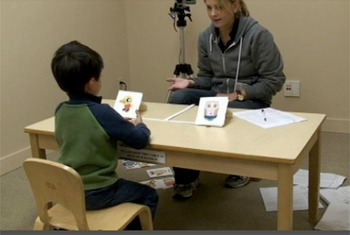
Participants were tested individually in a quiet room in their preschool/university. They were told that they were going to play a giving game. For each trial, a pair of pictures was introduced (e.g., “This is Miss Owl and this is Miss Ducky.”). The experimenter then placed the pictures on the card-holding structure and told a two-sentence story. The first sentence mentioned the two characters doing some reciprocal action (e.g., “Miss Owl is going out with Miss Ducky.”). Such reciprocal predicates help avoid confounds with thematic roles that may alter the first-mentioned bias and make the first-mentioned character more accessible for reference with pronouns (Arnold & Griffin, Reference Arnold and Griffin2007; Garvey & Caramazza, Reference Garvey and Caramazza1974). As the experimenter spoke the first sentence, a palm-up gesture was used towards each of the two characters to associate either the left or right space respectively (see Figure 1). The second sentence of the story then explained that one character wanted a particular item. The same palm-up gesture was used with either one or none of the two characters as the experimenter spoke, depending on which type of trial it was. In the warm-up trials, the palm-up gesture was used with the proper name (e.g., “Miss Owl wants the bag.”). In the experimental trials, there were three conditions: neutral, gesture-1st, and gesture-2nd. In all three conditions, a pronoun consistent with the gender of both characters was used instead of the proper name (e.g., “She wants the ball.”). No gesture was used in the neutral condition in the second sentence. The palm-up gesture was directed towards the first character in the gesture-1st condition and with the second character in the gesture-2nd condition.
Screenshot of experimenter showing a palm-up gesture when referring to one of the two characters.

The experimenter then presented a paper object and asked the participant: “Can you give it to him/her?” During the trial, the experimenter maintained eye contact with the participant. Each session consisted of two warm-up trials and twelve experimental trials (4 trials per condition). The animal characters and the target referent in the two warm-up trials were counterbalanced for side. There were sixteen different orders for the experimental trials. Each order began with a trial from a different condition in a predetermined randomized schedule, counterbalanced for side that was gestured first, gender, and condition, and with the restriction that three of the first six experimental trials must come from each of the three experimental conditions. The orders were randomly assigned to each participant in a way that was balanced across gender, age, and language groups.
Other measures
One of the goals of this study is to compare monolingual and bilingual children's use of gestures and order-of-mention to resolve ambiguous pronouns. There is a need to control for other variables (e.g., SES and receptive vocabulary) that may account for differences in task performance (e.g., Hackman & Farah, Reference Hackman and Farah2009; Hoff, Reference Hoff2003).
Socio-economic status (SES)
We used participants’ residential addresses to obtain an estimated value of each family's dwelling from an Internet website that provides real-estate information such as home prices and home values (www.zillow.com) (see similar procedures in Buck, Msall, Schisterman, Lyon, & Rogers, Reference Buck, Msall, Schisterman, Lyon and Rogers2000; Furth, Garg, Neu, Hwang, Fivush, & Powe, Reference Furth, Garg, Neu, Hwang, Fivush and Powe2000; Rathore et al., Reference Rathore, Masoudi, Wang, Curtis, Foody, Havranek and Krumholz2006; Ward, Reference Ward2008; Westenberg, Siebelink, Warmenhoven, & Treffers, Reference Westenberg, Siebelink, Warmenhoven and Treffers1999). Most of the homes were owned by the families, except for two who were renting their property at the time of the study. We calculated the mean, median, and variance property valuation for the monolingual and bilingual children to determine whether the two groups of children were drawn from the same SES population.
Peabody Picture Vocabulary Test IV (Dunn & Dunn, Reference Dunn and Dunn2007)
We obtained each child's English receptive vocabulary scores using the Peabody Picture Vocabulary Test IV (PPVT). Each child was asked to select one picture from a set of four that depicts the word that was spoken by the experimenter. Raw scores were converted to standard scores using normalized tables based on age. It was not possible to assess the receptive vocabulary scores of the other languages because of the large number of different second languages in the study.
RESULTS
Preliminary analyses
Measures of SES and vocabulary
In order to determine whether monolingual and bilingual children came from similar SES background, statistical analyses were conducted on the ratios of the mean, median, and variance property valuation between monolingual and bilingual children. The ratio of the means was 1:1·02 (t(25) = 0·092, p > ·10), ratio of the median property valuation was 1:1·03 (Z = –0·15, p > ·10), and ratio of the variances was 1:0·54 (F(1,25) = 2·13, p > ·10), all of which indicated that both groups of children came from similar SES background.
The mean scores (and standard deviations) for PPVT for monolingual children and bilingual children were 122·73 (10·68) and 115·19 (14·12), respectively. An independent-samples t-test revealed no significant differences between the two groups of children (t(30) = 1·67, p = ·11, η 2 = ·085).
For the experimental trials, participants were given a score of from 0 to 4 for each of the three conditions that reflects the number of times they selected the character that was first mentioned. There were no significant correlations between scores in the experimental trials, SES, and PPVT (all ps > ·10).
Main results
Adults’ data
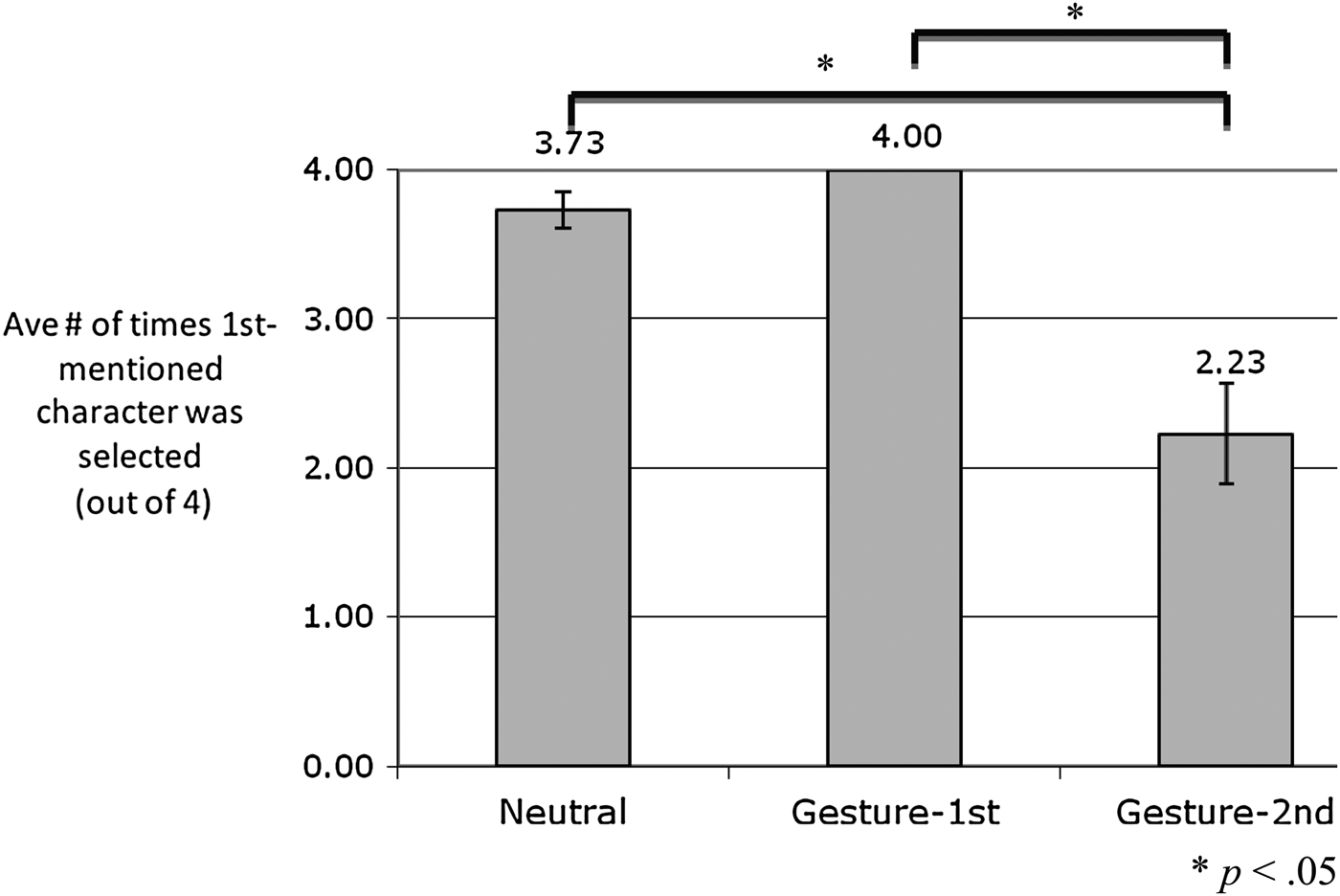
The Kolmogorov–Smirnov test of normality suggested that the data were not normally distributed (neutral K–S = ·46; gesture-1st K–S = ·54; gesture-2nd K–S = ·22, all ps < ·01). Therefore we proceeded with analyzing the data using non-parametric tests. The Friedman test revealed a significant effect of condition (X 2(2, N = 22) = 23·55, p < ·001). Post-hoc Wilcoxon signed rank sum tests were conducted using Bonferroni adjusted alpha levels of ·017 per test (.05/3). Results showed that adults chose the first-mentioned character significantly more often as the identity of the ambiguous pronoun in the gesture-1st condition (gesture consistent with the first-mentioned character) than the gesture-2nd condition (gesture consistent with the second-mentioned character) (Z = –3·25, p = ·001, r = 0·69) (see Figure 2). Adults also chose the first-mentioned character significantly more often in the neutral condition (no gesture) than the gesture-2nd condition (Z = –3·33, p = ·001, r = 0·71). Individual analyses revealed that, for at least 3 out of 4 trials, all 22 adults chose the first-mentioned character in the gesture-1st condition, 21 chose the first-mentioned character in the neutral condition, and 10 chose the first-mentioned character in the gesture-2nd condition.
Average number of times 1st-mentioned character was selected (out of 4) – adults.
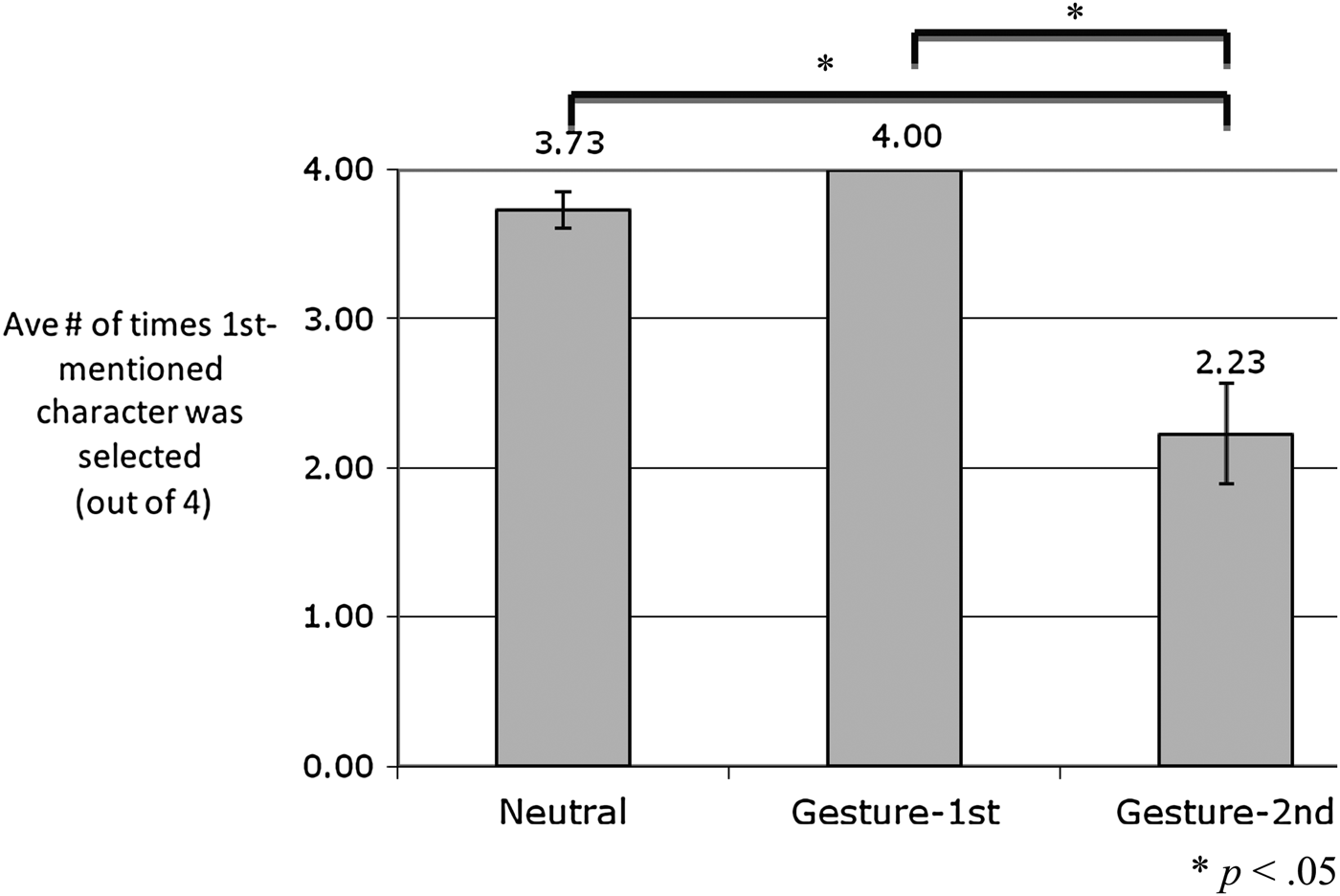
To establish whether adults indeed showed an order-of-mention bias, one-sample Wilcoxon signed rank tests were conducted. In congruence with previous results (Arnold et al., Reference Arnold, Brown-Schmidt, Trueswell, Fagnano, Trueswell and Tanenhaus2004; Goodrich Smith & Hudson Kam, Reference Goodrich Smith and Hudson Kam2012), adults showed a strong order-of-mention bias by choosing the first-mentioned character significantly above chance in the neutral condition (p < ·001). Despite this strong order-of-mention bias, adults were also sensitive to gesture as a cue to pronoun identity. This was most clearly revealed in their responses in the gesture-2nd condition (when the gesture cue was in conflict with the order-of-mention cue), confirming previous analysis that, in general, adults make use of gestures when disambiguating pronouns. In summary, we replicated past findings that adults used order-of-mention as well as a speaker's co-referential localizing gestures to interpret ambiguous pronouns.
Children's data
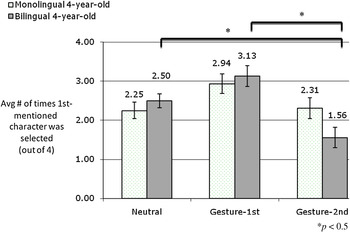
The Kolmogorov–Smirnov test of normality suggested that not all of the children's data were normally distributed (monolinguals: neutral K–S = ·24, p = ·014; gesture-1st K–S = ·28, p = ·002; gesture-2nd K–S = ·20, p = ·092; bilinguals: neutral K–S = ·25, p = ·007; gesture-1st K–S = ·35, p < ·001; gesture-2nd K–S = ·29, p = ·001). The Friedman test revealed a significant effect of condition for the bilingual children but not the monolingual children (bilingual X 2(2, N = 16) = 13·64, p < ·001; monolingual X 2(2, N = 16) = 3·23, p = ·20). Bilingual children's responses, but not monolingual children's responses, differed significantly across the three conditions. Post-hoc Wilcoxon signed rank sum tests were conducted for the bilingual children using Bonferroni adjusted alpha levels of ·017 per test (.05/3). Just like the adults, bilingual children chose the first-mentioned character more often as the identity of the ambiguous pronoun in the gesture-1st condition than the gesture-2nd condition (Z = –2·99, p = ·003, r = 0·74) (see Figure 3). Bilingual children also chose the first-mentioned character more in the neutral condition than the gesture-2nd condition (Z = –2·54, p = ·011, r = 0·64). These results were similar to the adults in our study, suggesting that the bilingual children, but not the monolingual children, showed adult-like sensitivity in the use of gestures and order-of-mention cues to resolve ambiguous pronouns.
Average number of times 1st-mentioned character was selected (out of 4) – monolingual and bilingual children.

Individual analyses revealed that, for at least 3 out of 4 trials, 10 out of 16 bilingual children chose the first-mentioned character in the gesture-1st condition, 8 chose the first-mentioned character in the neutral condition, and only 1 chose the first-mentioned character in the gesture-2nd condition. In comparison, 11 out of 16 monolingual children chose the first-mentioned character in the gesture-1st condition, 6 chose the first-mentioned character in the neutral condition, and 7 chose the first-mentioned character in the gesture-2nd condition.
To determine whether the children showed an order-of-mention bias, one-sample Wilcoxon signed rank tests were conducted using Bonferroni adjusted alpha levels of ·008 per test (.05/6). Results showed that both monolingual and bilingual children were at chance in choosing the first-mentioned character when no gesture was used (monolingual p = ·25, bilingual p = ·02). This suggests that preschoolers did not show an order-of-mention bias (consistent with Arnold et al., Reference Arnold, Brown-Schmidt and Trueswell2007).
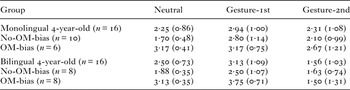
An alternative explanation to bilingual children's greater sensitivity in the use of gestures than monolingual children was that bilingual children have a weaker order-of-mention bias possibly due to their weaker linguistic skills. To test this, bilingual children were split into either no order-of-mention (OM)-bias (2 or less out of 4 in neutral trials) or OM-bias (3 or more out of 4 in neutral trials). There were 8 bilingual children in the no-OM-bias group and 8 in the OM-bias group. If bilingual children used speaker's gestures more because they have a weaker order-of-mention bias, then we should expect a significant effect of condition for the no-OM-bias group but not the OM-bias group. Alternatively, if bilingual children showed greater willingness to use the speaker's gestures despite an order-of-mention bias, like the adults did, then we should expect a significant effect of condition, at least for the OM-bias group. Friedman tests revealed a significant effect of condition (gesture-1st vs. gesture-2nd) for the OM-bias group but not the no-OM-bias group (OM-bias X 2(2, N = 8) = 7·00, p = ·008; no-OM-bias X 2(2, N = 8) = 1·80, p = ·18). Bilingual children in the OM-bias group chose the first-mentioned character more in the gesture-1st condition than the gesture-2nd condition (see Table 1). This suggests that in spite of an order-of-mention bias, bilingual children showed willingness to use a speaker's gestures to resolve ambiguous pronouns. Similar analyses were conducted for the monolingual children but no significant results were found. In summary, these results suggest that bilingual children use the speaker's gestures more than monolingual children to resolve ambiguous pronouns, likely as a result of their greater sensitivity to the speaker's cues and not as a compensatory strategy.
Mean scores and standard deviations (in parentheses) of number of times first-mentioned character was selected (out of 4) by condition

GENERAL DISCUSSION
Our study explored whether preschoolers were able to use co-referential localizing gestures and order-of-mention in pronoun resolution, and whether growing up in a bilingual environment might impact children's sensitivity to communicative gestures when resolving ambiguous pronouns (using adults as a comparison group). Consistent with previous studies, adults showed an order-of-mention bias, as they chose the first-mentioned character when no gestures were used. Adults also showed sensitivity to co-referential localizing gestures, as they chose the first-mentioned character more often when gesture was consistent with the order-of-mention bias than when gesture was targeted at the second-mentioned character. In comparison, preschoolers did not show an order-of-mention bias. However, they chose the first-mentioned character more often when gesture was targeted at the first-mentioned character than when no gesture was provided, suggesting that when provided with stronger cues (gestures consistent with order-of-mention), preschoolers resolved ambiguous pronouns congruous with first-mentioned bias.
Most importantly, there was a significant difference between monolingual and bilingual children. Bilingual children, like adults, showed more sensitivity to a speaker's co-referential localizing gestures than monolingual children, choosing the first-mentioned character more when gesture was consistent with the first-mentioned character than when gesture was consistent with the second-mentioned character. Bilingual children also chose the first-mentioned character less when gesture was consistent with second-mentioned character than when there was no gesture. This suggests that bilingual children showed greater use of the speaker's gestural cues to determine the referent for ambiguous pronouns compared to monolingual children.
One possible alternative explanation is that bilingual children had a weaker order-of-mention bias due to their lower (albeit not significant) levels of English language proficiency compared to their monolingual peers. Hence, bilingual children may have relied more on a speaker's cues than order-of-mention cues. However, our results showed that bilingual children were sensitive to a speaker's gestures despite a possible first-mentioned bias. Thus, it is unlikely that bilingual children use gestures to compensate for their weaker language proficiency.
Another possible alternative explanation could relate to the transfer of gender-marking patterns from the non-English languages of the bilinguals in pronoun resolution in English. Languages are marked with gender-specific or gender-neutral pronominal properties in personal pronouns (e.g., English, Spanish, and Russian vs. conversational Mandarin and Japanese, respectively) (Haspelmath, Dryer, Gil, & Comrie, Reference Haspelmath, Dryer, Gil and Comrie2008; Siewierska, Reference Siewierska, Haspelmath, Dryer, Gil and Comrie2005). Personal pronouns in gender-neutral languages provide less (genderless) information about the referent in speech than those in gender-specific languages. It may be argued that bilingual children who learn another language with gender-neutral pronominal properties may be more willing to look out for other information, including gestures, to help resolve ambiguous pronouns. Some of the bilingual children in this study were bilingual in languages that are both gender-specific (e.g., English–Spanish) while others were bilingual in one gender-specific and one gender-neutral language (e.g., English–Mandarin). Post-hoc analysis revealed no systematic or significant differences in performance between bilingual children from these two different language backgrounds. Thus, the difference in the use of gestural cues between monolingual and bilingual children is unlikely to be due to the different pronominal properties of the languages bilingual children were exposed to. However, we did not systematically sample bilingual children from gender-specific vs. gender-neutral language backgrounds. Future studies should systematically examine the role of transfer of pronominal gender properties from one language in pronoun resolution in another language.
In conclusion, children growing up in a bilingual environment may experience more communicative challenges than those growing up in a monolingual environment. Bilingual children have to regularly figure out what language a speaker is using and to what the speaker is referring (e.g., multiple labels for a single referent in multiple languages). Bilingual children may resolve such communicative challenges by frequently monitoring the context and utilizing verbal and non-verbal cues available in the situation to better understand the speaker's communicative intent. Hence, in the context of this study, bilingual children may also make use of available non-verbal cues (i.e., co-localizing referential gestures) to understand a speaker's referential intent when resolving ambiguous pronouns. The current research provides converging evidence that bilingual children are more sensitive to a speaker's use of gestural cues in a communicative context than monolingual children. Our findings highlight a wider implication of the impact of bilingualism on the socio-cognitive development in children.