Introduction
Why do people gesture when they speak? Co-speech gestures, or meaningful hand movements accompanying speech, can serve many functions for the speaker such as retrieving words, recalling events, or constructing a message (Goldin-Meadow & Alibali, Reference Goldin-Meadow and Alibali2013; Stam & McCafferty, Reference Stam, McCafferty, Stam and McCafferty2008; Stevanoni & Salmon, Reference Stevanoni and Salmon2005). Gestures may also aid interlocutors in interpreting a speaker's meaning, emphasis, and stance (Beattie & Shovelton, Reference Beattie and Shovelton2000; Gullberg, Reference Gullberg1998; Holler, Turner & Varcianna, Reference Holler, Turner and Varcianna2012; Kendon, Reference Kendon1997). In the present study, we focus on the possibility that gestures might help speakers access words or construct the message they wish to communicate.
Specifically, we focus on the Lexical Retrieval Hypothesis, or the possibility that gestures might help people access words for speaking (Krauss, Chen & Gottesman, Reference Krauss, Chen, Gottesman and McNeill2000). We include only iconic (or representational) gestures, since these gestures have been linked most strongly with lexical retrieval (Krauss et al., Reference Krauss, Chen, Gottesman and McNeill2000). Iconic gestures symbolize a speaker's meaning, often by a simulation of an action (Hostetter & Alibali, Reference Hostetter and Alibali2008; McNeill, Reference McNeill1992). For example, a speaker talking about throwing a ball might simultaneously mimic the action of throwing a ball, an iconic gesture for throwing. Some studies have found support for the Lexical Retrieval Hypothesis. For instance, participants allowed to gesture were more likely to resolve tip-of-the-tongue (TOT) states, or blocks in word retrieval, than participants who were restricted from gesturing, with iconic gestures being most helpful (Frick-Horbury & Guttentag, Reference Frick-Horbury and Guttentag1998). However, not all studies have found support for the Lexical Retrieval Hypothesis (Beattie & Coughlan, Reference Beattie and Coughlan1999; Beattie & Shovelton, Reference Beattie and Shovelton2000).
If iconic gestures play an important role in lexical retrieval, bilinguals might gesture more in one language than another. Bilinguals are often more proficient in one language than another, leading to lexical retrieval difficulties, especially in their weaker language (Hadar, Dar & Teitelman, Reference Hadar, Dar and Teitelman2001; Sunderman & Kroll, Reference Sunderman and Kroll2006). Bilinguals tend to experience greater difficulty with lexical access than monolinguals, as in more tip-of-the-tongue states (Gollan & Acenas, Reference Gollan and Acenas2004; Gollan, Montoya, Cera & Sandoval, Reference Gollan, Montoya, Cera and Sandoval2008). Bilinguals might therefore gesture more in their weaker language.
Indeed, Nicoladis, Pika, Yin, and Marentette (Reference Nicoladis, Pika, Yin and Marentette2007) found that intermediate second language (L2) speakers used more iconic gestures in their L2 English than in their first language (L1) Mandarin Chinese. Similar results were found with more advanced Hindi–English bilinguals (Nagpal, Nicoladis & Marentette, Reference Nagpal, Nicoladis and Marentette2011). However, increased use of iconic gestures has also been linked to increased proficiency in the language (Gullberg, Reference Gullberg1998). Similarly, in a study of English native speakers enrolled in beginner, intermediate, and advanced college Spanish courses, advanced learners used the most iconic gestures in Spanish, and participants gestured more in their native language (Gregersen, Olivares-Cuhat & Storm, Reference Gregersen, Olivares-Cuhat and Storm2009). Lastly, some studies report equal iconic gesture rates between languages (Marcos, Reference Marcos1979; Laurent & Nicoladis, Reference Laurent and Nicoladis2015; Sherman & Nicoladis, Reference Sherman and Nicoladis2004).
One possible reason for these inconsistent results is that proficiency effects might interact with task effects. Nicoladis (Reference Nicoladis2007) argued that there may be greater proficiency effects on gesture production in more spatial tasks. The rationale for this argument comes from studies showing that monolinguals tend to use more iconic gestures when talking about spatial concepts than when talking about abstract concepts (Alibali, Reference Alibali2005; Alibali, Kita & Young, Reference Alibali, Kita and Young2000; Feyereisen & Havard, Reference Feyereisen and Havard1999; Kita, Alibali & Chu, Reference Kita, Alibali and Chu2017). For example, people use more gestures when explaining their preferred route between two buildings on campus than when defining abstract words or describing characteristics of their family members (Lavergne & Kimura, Reference Lavergne and Kimura1987). Another study connected task difficulty to spatial content, where speakers used more representational gestures when describing a complex apartment layout than a simple one (Suppes, Tzeng & Galguera, Reference Suppes, Tzeng and Galguera2015). These task effects extend to bilinguals: Stam (Reference Stam2016) found that an L2 language learner used more iconic gestures in a cartoon narration task than in an oral proficiency interview. Both iconic gestures and accessing spatial words or concepts involve a high level of visual imagery (Alibali, Reference Alibali2005; Hadar & Butterworth, Reference Hadar and Butterworth1997). Iconic gestures assist in activating and maintaining visuospatial working memory during descriptive and narrative tasks (Morsella & Krauss, Reference Morsella and Krauss2004; Smithson & Nicoladis, Reference Smithson and Nicoladis2014), and are tightly linked to visual imagery (Alibali, Reference Alibali2005; Hadar & Butterworth, Reference Hadar and Butterworth1997; Kita, Reference Kita and McNeill2000; Kita et al., Reference Kita, Alibali and Chu2017).
There is some indirect support for the argument that proficiency interacts with task for bilinguals (Nicoladis, Reference Nicoladis2007). When Chinese–English bilinguals recounted events from a cartoon in both their languages, there was a positive correlation between number of scenes recalled and iconic gesture rate in their L2 (Nicoladis et al., Reference Nicoladis, Pika, Yin and Marentette2007). The researchers argued that the more scenes the speaker recounted, the more difficult a spatial task they had taken on. A stronger test of the interaction claim would come from a direct comparison of tasks differing on spatial content. The primary purpose of this study was to test whether the effect of language proficiency on bilingual gesture rate depends on how spatial a task they are solving is.
The present research
The bilinguals in this study were asked to perform two tasks differing on spatial content: a cartoon-retell task and a language-history interview (similar to Stam, Reference Stam2016). In the cartoon-retell task, participants watched a Pink Panther cartoon and told the story back. Recounting a story is highly dependent on visuospatial imagery (Rubin, Reference Rubin1995). Previous studies have demonstrated that cartoon-retell tasks elicit iconic gestures across different age groups and genders (McNeill, Reference McNeill1992). Events in the cartoon are highly visuospatial (e.g., trying to destroy a cuckoo clock, flying a plane), increasing our confidence that retelling the cartoon is a spatial task. To elicit more abstract speech content, participants completed an interview task where they answered questions about their language history. We reasoned that the interviews would elicit habitual events and/or events that had taken place over an extended period of time. As a result, this task should not rely extensively on visuospatial imagery. Furthermore, the interview prompts were similar to those used in abstract tasks of past research (e.g., Lavergne & Kimura, Reference Lavergne and Kimura1987). Based on the strong relationship between iconic gestures and spatial content, we predicted that participants would have higher iconic gesture rates in the cartoon-retell task than the interview task, replicating and extending Stam's (Reference Stam2016) work by testing whether this task effect holds across bilinguals’ two languages.
To ensure that most participants had a proficiency difference between their languages, we recruited sequential French–English bilinguals with either English or French as their L1. We verified this classification with standardized measures of receptive vocabulary. Proficiency is a multi-faceted construct, affected by many additional factors such as daily language usage, acquisition history, and self-assessments (Luk & Bialystok, Reference Luk and Bialystok2013). Proficiency can be measured in a myriad of ways (Silva-Corvalán & Treffers-Daller, Reference Silva-Corvalán and Treffers-Daller2016) and it is not clear which aspects of proficiency might most strongly be related to gesture use (Hostetter & Alibali, Reference Hostetter and Alibali2007). Under the assumption that lexical access in production might be the most strongly linked aspect of proficiency to gesture use, we also assessed the participants’ proficiency using two measures of oral language use: oral fluency and the number of different words used. Oral fluency is time-dependent and encompasses articulation, lexical access, and assembling words in novel ways (Cohen & Stanczak, Reference Cohen and Stanczak2000). Oral fluency can be estimated by speech rate and is related to oral language proficiency (Bulc, Hadzi & Horga, Reference Bulc, Hadzi and Horga2012). Variety of word types used in speech is another measure of proficiency, which has been used to establish language dominance in a previous study regarding gesture use (Laurent & Nicoladis, Reference Laurent and Nicoladis2015). The inclusion of multiple measures of proficiency allows us to test if any of them are more strongly related to gesture rate among bilinguals.
We hypothesized that: (a) participants would gesture more in the cartoon-retell task than in the interview task (Stam, Reference Stam2016); (b) low proficiency would predict higher iconic gesture rate; and (c) this proficiency effect would be most salient in the cartoon-retell task (Nicoladis, Reference Nicoladis2007).
Method
Participants
Thirty-one French–English bilingual adults were recruited by convenience sampling from the University of Alberta and surrounding community in Edmonton, Alberta, Canada, a predominantly Anglophone city with a small and active Francophone community (Aunger, 1999). Participants were categorized into two groups: native English speakers who started learning French after age five, primarily through French Immersion (EF group; n = 16); and native French speakers who started learning English after age five (FE group; n = 15). Participants were grouped in this way to observe potential influences of native language/culture on gesture use. Participant age ranged from 18 to 52 (M = 26.94, SE = 1.73). Because EF participants were mainly university students and FE participants were recruited mainly from the broader community, the EF group (M = 22.00, SE = 1.22) was younger than the FE group (M = 32.20, SE = 2.79), t(29) = 3.351, p = .003 (equal variances not assumed). Given this group difference and the high age range, we statistically controlled for age throughout our analyses (see Statistical Analysis section). The sample included 23 female and 8 male participants (EF group: F = 12, M = 4; FE group: F = 11, M = 4); there were no significant gender differences in iconic gesture rate or interactions with language/task. Lastly, although all participants were highly proficient in English and French, some participants (n = 10; n = 7 EF and n = 3 FE) had conversational-level proficiency in a third language (i.e., Lebanese Arabic, Vietnamese, Cantonese, Mandarin, Tagalog, German, Beninese, Amharic, and Spanish). Thus, we assessed whether gesture rate was related to being trilingual. A three-way mixed ANCOVA (between: trilingualism; within: task, language; covariate: age) revealed no significant interactions involving trilingualism, indicating that the main effects on gesture rate reported in the Results were not influenced by being trilingual.
Materials
Cartoon-Retell Task
Participants watched two clips from the Pink Panther series as used previously in studies on gesture elicitation (e.g., Laurent, Nicoladis & Marentette, Reference Laurent, Nicoladis and Marentette2015). The clips lasted around six minutes overall, and although both clips had background music, neither contained any dialogue. In the first clip (“In the Pink of the Night”), the Pink Panther tries multiple methods to destroy his new cuckoo alarm clock but ends up befriending the bird. In the second clip (“Jet Pink”), the Pink Panther sneaks onto a military base and starts flying a jet plane, only to realize, much to his dismay, that he has no idea how to fly a plane. Participants then narrated what they remembered from the two clips to the experimenter. The cartoon-retell task was conducted in both English and French in separate, counterbalanced sessions (see Procedure).
Interview Task
Participants were asked various questions about their language history in English and French, such as time and place of language acquisition, participation in exchanges or abroad studies, and language courses taken at university (see Appendix). While these questions provided a framework for the interview, experimenters were encouraged to ask for points of clarification or ask other relevant questions as the conversation unfolded. The interview task was conducted in both English and French in separate, counterbalanced sessions (see Procedure).
Vocabulary tests
The Peabody Picture Vocabulary Test (PPVT) and the Échelle de Vocabulaire en Images Peabody (EVIP) were used to measure receptive vocabulary in English and French, respectively (Dunn & Dunn, Reference Dunn and Dunn1997; Dunn, Thériault-Whalen & Dunn, Reference Dunn, Thériault-Whalen and Dunn1993). Participants were shown a series of cards with four images on each one and were asked which image best reflected a given word. All scores reported in the results are standardized scores normed by age. Previous research has shown high correlations between receptive and productive vocabularies in bilingual adults (Portocarrero, Burright & Donovick, Reference Portocarrero, Burright and Donovick2007).
Procedure
All participants attended two separate sessions: one in English and one in French. The experimenter in each session was a native speaker who spoke exclusively in the target language of the session throughout the procedure. Sessions were separated by at least one day and counterbalanced to control for memory or practice effects. Both the English and the French session contained all events outlined below.
Upon arriving at the lab, participants were invited to sign a consent form that summarized the study procedure. They also filled out a personal information form about age, gender, and spoken languages. Participants were then brought to a testing room to watch the two Pink Panther clips. They were asked to pay close attention because they would be asked to retell the events in the clip with as many details as they could remember. Participants viewed the clips in a different room than the experimenter to create the impression that the experimenter was unfamiliar with the videos, further encouraging them to elaborate on the events. After finishing the videos, participants emerged to narrate the two stories while the experimenter listened quietly. Participants then underwent the language history interview, where they were all asked the questions in the same order (see Appendix). Both the cartoon-retell and interview tasks were videotaped. The session ended with the vocabulary test (PPVT or EVIP, depending on the session language), after which participants were given a $10 honorarium as recognition for their time. This task order was consistent across all sessions and participants.
Transcription and coding
Speech was transcribed from the videotapes into orthographic words by a French–English bilingual speaker with high proficiency in both languages. Pauses, repetitions, stutters, and corrections were also recorded. Gestures were categorized on a coding scheme inspired by McNeill's (Reference McNeill1992) work, distinguishing between iconic, deictic, beat, and conventional gestures. Iconic (or representational) gestures symbolize the speech content in some way (e.g., shaking fist back and forth to represent “hammer”); we coded metaphorical gestures about abstract concepts (e.g., time) as iconic as well. Deictic gestures indicate a stable location of a person, object, or place and usually involve pointing with the index finger or thumb. Beat gestures are repetitive movements that regulate speech or provide emphasis but have no symbolic meaning. Conventional gestures are typically linked to specific cultures and can be understood without speech (e.g., thumbs up). When a gesture did not seem to fit any category, it was coded as unknown. To control for individual differences in how much participants spoke, we analyzed the gesture rate rather than the number of gestures. The gesture rate for each task was calculated by dividing the number of iconic gestures by the total number of words spoken and then multiplying the quotient by 100 to facilitate interpretation.
Oral proficiency measures
In addition to the measures of receptive vocabulary, we also assessed oral proficiency through oral fluency and number of word types. For each language-task combination, oral fluency was estimated via speech rate, which was calculated by dividing the total number of words by the total duration of speech in seconds (Smithson, Nicoladis & Marentette, Reference Smithson, Nicoladis and Marentette2011). For the interview task, we only counted time periods during which the participant was speaking. We also counted number of word types in each language-task combination as a measure of language proficiency, as done previously (Laurent & Nicoladis, Reference Laurent and Nicoladis2015; Nicoladis, Pika & Marentette, Reference Nicoladis, Pika and Marentette2009).
Statistical analysis
Data were analyzed using IBM SPSS Statistics (v. 24). Due to the large age range of our sample and group differences in age, we chose to statistically control for age throughout our analyses. We used t-tests to examine group differences (e.g., session order, group differences in age). We used repeated measures ANCOVA to test whether categorical proficiency measures (e.g., L1 categorization) would predict iconic gesture rate. We also used ANCOVAs to examine group differences in continuous proficiency measures. Partial η2 were displayed to show relative effect sizes in predicting the outcome variable. Post-hoc pairwise comparisons were done as necessary using t-tests. We used multiple linear regression to test whether continuous proficiency measures (i.e., receptive vocabulary, oral fluency, and word types) would predict iconic gesture rate. Partial correlations accounting for age were used to explore correlations of gesture rate between languages and tasks.
Results
Before running our main analyses, we examined whether session order influenced the results. Session order did not impact story or interview lengths (p ≥ .310) and did not predict iconic gesture rate (p > .5).
Table 1 displays group means for our continuous proficiency measures: receptive vocabulary (Table 1a), oral fluency, and word types (Table 1b). We expected our measures of proficiency to be intercorrelated. Table 2 summarizes the correlations between our proficiency measures. As can be seen in that Table, the participants’ receptive vocabulary was highly correlated with their L1: the Language Group was highly correlated with vocabulary score in both languages, meaning that the EF bilinguals tended to score higher on the English vocabulary than the FE bilinguals and the FE bilinguals on the French vocabulary test. In contrast, the oral proficiency measures were not highly correlated with L1. In contrast, oral fluency and word types were highly correlated with each other, both within and between languages. These results suggest that there are two dimensions of proficiency emerging here: 1) first language and receptive vocabulary on the one hand and 2) oral proficiency measures on the other.
Mean (SE in parentheses) receptive vocabulary scores by group and language (Note: scores are normed by age).

Oral fluency and word types by group, language, and task, with means (and SE in parentheses) adjusted for age.

Intercorrelations of proficiency measures. *p < .05, **p < .01. Language group was dummy coded so that 0 = English-French bilinguals and 1 = French-English bilinguals. The correlations for French are above the diagonal; for English below the diagonal. The correlations on the diagonal are the correlations between languages.

Iconic gesture rate
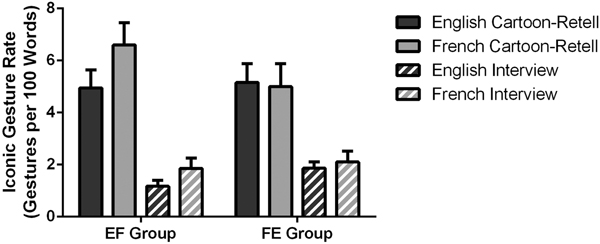
To investigate the effect of language, task, and group on iconic gesture rate, we ran a three-way mixed ANCOVA (between: group; within: task, language) with age as a covariate. Figure 1 displays means adjusted for age across these factors. Overall, participants gestured more in the cartoon-retell task than the interview task (F(1,28) = 9.36, p = .005, η2 = .25). There was a marginally significant interaction between language and group (F(1,28) = 3.80, p = .061, η2 = .12). Pairwise comparisons indicated that the EF participants gestured more in French (i.e., their second language) across the cartoon-retell and interview tasks (p = .001). We also found a language by task interaction (F(1,28) = 4.28, p = .048, η2 = .13) a language by task by age interaction (F(1,28) = 6.08, p = .020, η2 = .18), and a marginally significant language by task by group interaction (F(1,28) = 3.98, p = .056, η2 = .12).
Iconic gesture rate by group, language, and task with means adjusted for age. Both groups gestured more in the cartoon-retell task (p < .0001), and the EF group gestured more in French than in English across tasks (p = .001).

Given that our predictions concerned expressive language, we also categorized participants using the oral proficiency measures. We used word types to categorize participants by language dominance, where their more dominant language was the one in which they used a higher number of word types averaged across tasks. This method categorized 22 participants as English-dominant and nine as French-dominant. We ran a three-way mixed ANCOVA (between: dominance; within: task, language; covariate: age). Analyses revealed no significant interactions involving dominance (ps ≤ .099). Similarly, we categorized participants by language dominance using oral fluency, where their more dominant language was the one in which they displayed greater oral fluency averaged across tasks. This method categorized 19 participants as English-dominant and 12 participants as French-dominant. Our three-way mixed ANCOVA (between: dominance; within: task, language; covariate: age) yielded no significant interactions involving dominance (ps ≤ .108). Finally, we categorized participants based on the language they reported feeling most comfortable speaking in from the second interview question (see Appendix). This method categorized 21 participants as English-dominant and 10 participants as French-dominant. As with the other language dominance categorizations, this three-way mixed ANCOVA (between: dominance; within: task, language; covariate: age) yielded no significant interactions involving dominance (ps ≤ .108).
To test whether continuous proficiency measures would predict iconic gesture rate, we ran multiple linear regressions for each language-task combination with receptive vocabulary, oral fluency, word types, and age as predictors. All predictors were non-significant except for the EVIP when predicting gesture rate in the French cartoon-retell task, β = −.462, t = −2.184, p = .038. There was also a trend for the PPVT to predict gesture rate in the English cartoon-retell task, β = −.382, t = −1.781, p = .087. Note that in both cases, the relationship is negative, so that the lower the vocabulary score, the higher the gesture rate.
Finally, we examined intra-individual correlations in iconic gesture rate (see Table 3). There were generally strong positive correlations of gesture rate between languages and tasks (rs ≥ .522, ps ≤ .003), with only one (i.e., between the English interview and the French cartoon-retell) failing to reach significance (r(29) = .27, p = .151).
Intercorrelations of iconic gesture rate (GestRate) between language-task combinations for all participants (N = 31), controlling for age. *p < .05, **p < .01. EC = English Cartoon-Retell; FC = French Cartoon-Retell; EI = English Interview; FI = French Interview; GestRate = Iconic Gesture Rate.

Discussion
The objective of our study was to help clarify the relationship between language proficiency and iconic gesture use in bilinguals. Specifically, we tested three main hypotheses: (a) participants would gesture more in the cartoon-retell task than in the interview task; (b) low proficiency would predict higher iconic gesture rate; and (c) this proficiency effect would be most salient in the cartoon-retell task (Nicoladis, Reference Nicoladis2007). We found only partial support for these hypotheses.
As expected, participants in both groups gestured more in the cartoon-retell task than the interview task (replicating Stam, Reference Stam2016). This robust difference is likely due to task differences in speech content. For the cartoon-retell task, both Pink Panther storylines contained highly spatial information, with the Panther trying to rid himself of the cuckoo in the first and struggling to control a plane in the second. By contrast, the interview elicited more abstract, autobiographical information, and many of the few iconic gestures observed were metaphors for time (e.g., gesturing different “lengths” of time on an imaginary timeline). This result is consistent with Stam's (Reference Stam2016) reporting more metaphorical gestures in the interview task. People typically gesture more when relaying spatial information than when relaying more verbal or abstract information (Feyereisen & Havard, Reference Feyereisen and Havard1999; Lavergne & Kimura, Reference Lavergne and Kimura1987). Iconic gestures are the most common type used in storytelling and may serve to stimulate visuospatial working memory during narrative tasks (McNeill, Reference McNeill1992; Smithson & Nicoladis, Reference Smithson and Nicoladis2014). These findings suggest a link between spatial content and iconic gestures that is supported by our results. While our results supported our prediction, we acknowledge that our tasks were limited by differing from each other not only in terms of spatial content. For instance, they also differed in narrative perspective, personal relevance of content, and degree of interaction with interlocutor. Our design unfortunately does not allow us to investigate the relative impacts of these differences. Future research could investigate the impact of these other task differences on bilingual gesture use.
We had also hypothesized that bilinguals would gesture more when their proficiency was weaker. Our results showed some support for this hypothesis. In favour, we found that in both languages, the higher the vocabulary scores, the lower the gesture rate, although this relationship did not quite reach significance in English. Furthermore, the EF group gestured more in their weaker language (i.e., French). The FE group, by contrast, gestured at a very similar rate between languages. Also, our measures of oral proficiency (word types and fluency) did not predict gesture use at all.
Why might the EF participants have used more gestures in their weaker language while the FE participants did not? The two groups were relatively equivalent in their receptive vocabulary scores in their weaker language (see Table 1a). However, the EF participants tended to score lower on the oral proficiency measures in their weaker language (French) than the FE participants did in their weaker language (English; see Table 1b). Also, it is likely that the two bilingual groups differed on their day-to-day usage of their weaker language. Because all our participants reside in a majority-language English community, our FE participants are more likely to speak their L2 (i.e., English) frequently. Most of the FE participants had English careers or were studying in English. By contrast, our EF participants – depending on their current studies or employment – were not necessarily speaking their L2 (i.e., French) on a day-to-day basis. Most EF participants were studying at university in English, with a minority of participants pursuing bilingual degrees. Some EF participants had francophone friends/coworkers or engaged with French regularly through reading or music. Given the differences between the two bilingual groups’ daily usage, it is possible that this is an important variable in predicting gesture use.
If this interpretation is correct, then these results are not incompatible with arguments that gestures can be used to aid lexical retrieval (Krauss & Hadar, Reference Krauss, Hadar, Messing and Campbell1999; Krauss et al., Reference Krauss, Chen, Gottesman and McNeill2000). Bilinguals have more difficulties with lexical access than monolinguals, especially in their weaker language (Gollan & Acenas, Reference Gollan and Acenas2004; Sunderman & Kroll, Reference Sunderman and Kroll2006). The Weaker Links Hypothesis connects divided daily usage between languages to lexical access difficulties in bilinguals (Gollan et al., Reference Gollan, Montoya, Cera and Sandoval2008). We argue that a bias toward using English in daily life may have led to weaker links to French among EF participants, causing their L2 to be ‘rustier’ than the FE participants’ L2. By contrast, the FE group reported high daily usage of both languages. The tendency for bilinguals to feel ‘rusty’ in one of their languages or struggle to ‘switch gears’ could refer to lexical access difficulties in one of a bilingual person's languages because of lack of daily usage. The use of gestures may have bolstered the oral fluency and number of word types among the EF bilinguals, such that their oral proficiency measures showed little difference with those of the FE bilinguals.
In support of this argument, consider another study with French–English bilinguals in this same community. Laurent and Nicoladis (Reference Laurent and Nicoladis2015) found that a group of French–English bilinguals gestured at similar rates in their dominant and non-dominant languages. However, when their gestures were restricted, the participants included fewer scenes and used a lower number of word types during a cartoon-retell task, but only in French (Laurent & Nicoladis, Reference Laurent and Nicoladis2015). One possible reason for this French-specific effect is that the participants had less day-to-day usage of French because they were living in an English-majority community. In the present study, we did not systematically measure the participants’ day-to-day usage. Future studies could explore this construct directly by measuring daily usage and lexical access.
Finally, we found minimal support for our third hypothesis, namely a language by task interaction, as predicted by Nicoladis (Reference Nicoladis2007). As illustrated in Figure 1, the EF participants had a trend for a greater difference in gesture rate between languages in the cartoon-retell task than in the interview task. Since complex spatial tasks are known to elicit iconic gestures (Suppes et al., Reference Suppes, Tzeng and Galguera2015), the EF group's need to access spatial content in the French cartoon-retell task may have built on their lexical access difficulties in French to drive up their language difference in gesture rate. However, the significance of this interaction was thwarted by the existence of a language difference in the interview task as well. Overall, these results suggest that language proficiency does not interact with task demands to predict gesture use (cf. Nicoladis, Reference Nicoladis2007).
Other factors influencing gesture use
Our findings allow us to comment on three other factors that might be related to gesture use: age, culture, and individual differences.
We did not control for the age of participants when recruiting for this study. Previous research has shown age effects in the use of gesture among adults, but only starting at old age (e.g., Feyereisen & Havard, Reference Feyereisen and Havard1999). We were surprised to find that age interacted with first language in gesture use among the adults in this study, who ranged in age from 18 to 52 years. Closer inspection revealed that this interaction was driven by four older EF participants. We addressed this issue in this study by statistically controlling for age in our analyses, since age was not one of the variables under study here. We speculate that lexical retrieval difficulties may explain why four older EF participants were driving the language by group interaction. These participants, like most others in the EF group, had learned French primarily through French Immersion in grade school. Because they were older, more time had passed since they were immersed in a French-speaking environment, perhaps making lexical retrieval more challenging and leading to increased gesture use. Future studies on gesture can systematically unpack how age, lexical access, and gesture use might be related.
As for culture, many people believe that Romance (e.g., French, Italian) languages are spoken with more gestures than Germanic (e.g., English, German) or East Asian (e.g., Japanese, Korean) languages (Sekine, Stam, Yoshioka, Tellier & Capirci, Reference Sekine, Stam, Yoshioka, Tellier and Capirci2015). One study found that Italian speakers produced more gestures than English speakers (Cavicchio & Kita, Reference Cavicchio and Kita2013; see also Graham & Argyle, Reference Graham and Argyle1975). If so, bilinguals might gesture more when speaking a high-gesture-frequency language than a low-gesture-frequency language or transfer their gesture use from one language to another (Pika, Nicoladis & Marentette, Reference Pika, Nicoladis and Marentette2006). However, not all studies have supported the claim that Romance languages are high-gesture frequency languages. For example, two studies have shown that English and French monolinguals gesture at similar rates (Nicoladis et al., Reference Nicoladis, Pika and Marentette2009; Nicoladis & O'Carroll, Reference Nicoladis and O'Carroll2012). In the present study, we did not consistently find that the participants gestured more in French than in English. While the EF participants did so, this finding was likely linked to lexical access. Notably, the FE participants gestured at equivalent rates in the two languages. These findings, in conjunction with previous work, suggest that speakers of French do not always gesture more than speakers of English.
In addition to culture, different languages reflect different ways of thinking for speaking. For example, in talking about motion events, speakers of different languages package the elements of motion differently (Özyürek, Kita, Allen, Furman & Brown, Reference Özyürek, Kita, Allen, Furman and Brown2005). Previous studies have shown that speakers tend to produce gestures that reflect the typical packaging of motion elements in their speech (Özyürek et al., Reference Özyürek, Kita, Allen, Furman and Brown2005), including differences between French and English (Hickmann, Hendriks & Gullberg, Reference Hickmann, Hendriks and Gullberg2011). In the present study, we did not code for speech and gestures by different event types. It is possible that gesture frequency is affected by the event types included in the speech. Future studies can test for that possibility.
As for individual differences, we found gesture rate was highly correlated across languages and tasks. In fact, the intercorrelations in gesture use across languages and tasks were stronger than the predictive power of the proficiency measures. Gesture use may therefore be strongly related to individual differences in domain(s) other than proficiency. There are many individual differences other than proficiency that could be driving these correlations. Some examples include personality, storytelling style, and cognitive skills, such as verbal memory capacity (Hostetter & Alibali, Reference Hostetter and Alibali2007; Hostetter & Potthoff, Reference Hostetter and Potthoff2012; Nagpal et al., Reference Nagpal, Nicoladis and Marentette2011; O'Carroll, Nicoladis & Smithson, Reference O'Carroll, Nicoladis and Smithson2015; Smithson & Nicoladis, Reference Smithson and Nicoladis2013).
Conclusions
Our study adds to prior research showing that tasks with high spatial content elicit many iconic gestures. Also, we found that one bilingual group (English–French bilinguals) gestured more in their non-dominant language than in their dominant language while another group (French–English bilinguals) did not. We argue that gesture use is most likely linked to differences in the difficulty of accessing language for speech. These results highlight ‘rustiness’ – or difficulty with lexical access in one language due to lack of daily usage – as a potentially important factor influencing gesture use in bilinguals. Future research should expand on this construct by considering daily language usage and linguistic environment when studying bilinguals’ gesture use.
Appendix Interview Questions
English Session:
1. What language(s) did you grow up with? At what ages did you learn your languages and where?
2. In what language do you feel most comfortable speaking/reading/writing?
3. Are there particular domains or topics with which you are more familiar in English or French?
4. Which language do you typically resort to when expressing strong emotions?
5. What language(s) did you learn in school? Do you remember the language backgrounds of your teachers?
6. Have you taken any language courses at the university level? Which ones?
7. Have you ever participated in any exchange programs, abroad studies, or something similar, to strengthen one of your languages?
8. Is there anything else about your language background that you would like to share?
French Session (séance française):
1. Avec quelle(s) langue(s) avez-vous grandi? A quels âges avez-vous appris vos langues et où?
2. En quelle langue vous sentez-vous le plus à l'aise en parlant? En lisant? Et en écrivant?
3. Y a-t-il des domaines ou des sujets particuliers que vous connaissez mieux en anglais ou en français?
4. A quelle langue recourez-vous en exprimant des émotions fortes?
5. Quelle(s) langue(s) avez-vous apprise(s) à l’école? Est-ce que vous vous souvenez des origines linguistiques de vos professeurs?
6. Avez-vous déjà suivi des cours de langue au niveau universitaire? Lesquels?
7. Avez-vous déjà assisté à un programme d’échange, suivi des cours à l’étranger, ou quelque chose de semblable, pour renforcer une de vos langues?
8. Y a-t-il autre chose à propos de votre expérience linguistique que vous aimeriez partager?