Introduction
Weed management remains one of the greatest challenges in carrot production, given slow and variable crop emergence, relatively poor seedling vigor, and slow, early-season canopy development (Colquhoun et al. Reference Colquhoun, Rittmeyer and Heider2017). Van Heemst (Reference Van Heemst1985) reported that carrot was the most sensitive crop to weed interference of the 26 crops included in a global literature review. Weed interference not only reduces crop yield but also negatively affects root shape and quality. Several studies have documented greater than 90% of marketable carrot root yield loss from weed competition (Bellinder et al. Reference Bellinder, Kirkwyland and Wallace1997; Coelho et al. Reference Coelho, Bianco and Carvalho2009; Freitas et al. Reference Freitas, Almeida, Negreiros, Honorato, Mesquita and Silva2009).
A few new herbicides, such as prometryn and pendimethalin, have been registered for use in some carrot production areas within the relatively recent past (Colquhoun et al., Reference Colquhoun, Chapman, Gevens, Groves, Heider, Jensen, Nice, Ruark and Wang2020). However, carrot can take 180 d or more to reach marketable maturity, far beyond the time for residual weed control from herbicides applied within labeled growth stages and preharvest intervals. POST broadleaf weed control is particularly challenging, with limited herbicide options. In addition, weed resistance to herbicides has been documented for commonly used POST carrot herbicides. For example, in some intense production areas, weeds such as redroot pigweed (Amaranthus retroflexus L.) and common lambsquarters have been identified as resistant to linuron (Heap Reference Heap2020). The lack of season-long weed control and threat of resistant weeds, because of limited herbicide options, calls for a more integrated approach that incorporates diversified strategies other than herbicides, some of which have been explored at least in preliminary ways and reported in the literature.
Modifying seeding timing to enhance carrot seed germination and establishment could be a useful strategy if crop yield is not compromised by a shortened growing season. Swanton et al. (Reference Swanton, O’Sullivan and Robinson2010) investigated the carrot critical weed-free period (i.e., the time when the crop is required to be weed free to minimize yield reduction) at two seeding dates. The critical weed-free period was 930 growing degree days (GDDs; accumulated from seeding date and with a 5 C base temperature) when carrot was seeded in late April. The critical weed-free period was shortened to between 414 and 444 GDDs when carrot was seeded in mid to late May. This weed-free period is somewhat dependent on row spacing. Freitas et al. (Reference Freitas, Almeida, Negreiros, Honorato, Mesquita and Silva2009) compared 15- and 20-cm spacing between carrot rows and concluded that the critical weed-free period was 7 d longer in the wider configuration.
Seeding competitive carrot varieties also could reduce the impact of weeds on yield and quality without requiring significant production changes or additional inputs. As early as 1975, William and Warren compared the ability of two carrot varieties to compete with purple nutsedge (Cyperus rotundus L.). Carrot root yield reduction was 39% where ‘Kuroda’ variety was grown and 50% where ‘Nantes’ was grown (William and Warren Reference William and Warren1975). With such observations in mind, we compared the ability to tolerate and suppress weeds among nine carrot varieties, noting that emergence rate and plant density varied greatly among varieties, as did canopy-development rates, and these growth characteristics affected the ability to tolerate and suppress weeds (Colquhoun et al. Reference Colquhoun, Rittmeyer and Heider2017).
Prior to widespread availability of multiple herbicides for specialty crops, there was at least preliminary interest in exploring the use of plant growth regulators to hasten and synchronize crop canopy closure in slow-growing crops such as carrot. For example, Thomas et al. (Reference Thomas, Barnes, Rankin and Hole1983) reported that 100 to 500 mg L−1 of gibberellic acid (GA) maximized carrot foliar growth and canopy closure consistently over 4 wk. However, widespread commercial adoption of such strategies has not been achieved.
In this work, we explored the utility of a holistic integration of strategies that include optimized seeding timing, seeding configuration, selection of competitive carrot varieties, and use of GA to stimulate carrot canopy development.
Materials and Methods
Studies were conducted in the 2018 and 2019 growing seasons on a mineral soil at the University of Wisconsin Hancock Agricultural Research Station (44.12°N, 89.54°W). The soil type was a Plainfield loamy sand (sandy, mixed, mesic, Typic Udipsamment) with 0.8% organic matter and a pH of 6.5. Soil moisture was monitored and supplemental irrigation was delivered through a pivot system, which is standard commercial practice in that region.
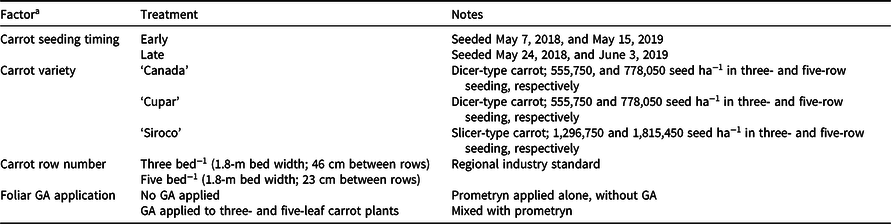
Individual plots measured 1.8 m wide by 6.1 m long, with 1.8 m representing the width of the seedbed, and carrot was seeded in 6.1 m rows. The studies were arranged in a factorial design with four replications of each production system. Factors included carrot seeding timing, carrot variety, carrot row number bed−1, and foliar GA application (Table 1). Carrot varieties included two grown for the processed or frozen diced-carrot market (referred to as “dicers”) and one grown for the sliced-carrot market (known as “slicers”). The regional standard three-row bed−1 seeding configuration, dictated almost exclusively by mechanical harvester configuration, was compared with a five-row bed−1 seeding. The seeding rate row−1 was the same in both the three- and five-row beds; thus, on an area basis, the five-row bed included 40% more seed than the three row bed. Oat (Avena sativa L.) was seeded in three rows between the carrot rows at the same time as carrot seeding to mitigate risk of wind erosion and was terminated prior to tillering with an application of clethodim, which is the industry norm in the area. Pendimethalin (1.1 kg ai ha−1) was applied PRE followed by prometryn (1.1 kg ai ha−1 plus nonionic surfactant [0.5% vol/vol]) applied at the three- and five-leaf carrot growth stage to the entire study area.
Holistic carrot production systems evaluated in 2018 and 2019 at the Hancock Agricultural Research Station in Hancock, WI.

a Abbreviation: Gibberillic acid.
Herbicides and GA were applied with a backpack air-pressure sprayer calibrated to deliver 187 L ha−1 at 186 kPa with Teejet® XR8003VS nozzle tips (Spraying Systems Co., Wheaton, IL). All other production practices, including fertilizer and maintenance insecticide applications, followed typical commercial practices (Colquhoun et al. Reference Colquhoun, Chapman, Gevens, Groves, Heider, Jensen, Nice, Ruark and Wang2020). All fertilizer applications were broadcast applied across the entire study area and, therefore, not adjusted for seeding configuration. In both the early and late seeding timings, initial tillage was conducted approximately 2 wk before bed formation and carrot seeding such that tillage was not a confounding factor with seeding timing.
Carrot and weed plant densities were quantified in a 1-m2 section in the center of each bed. Carrot foliar groundcover was visually estimated on a scale of 0% (no foliar groundcover) to 100% (full carrot foliar groundcover). Carrot roots were harvested at maturity, counted, and weighed. Harvest was conducted on September 16, 2018, and September 30, 2019. The studies were analyzed independently, given a treatment by year interaction. Treatment data were subjected to ANOVA using the PROC GLM procedure in SAS, version 9.4 (SAS Institute Inc., Cary, NC). Data complied with ANOVA requirements related to homogeneity of variety and residual normality. The system factors were analyzed using preplanned contrasts.
Results and Discussion
Carrot Plant Density
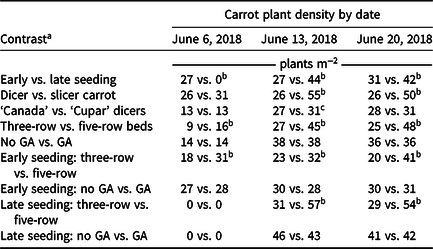
In 2018, as would be expected, carrot plant density was greater in the five-row beds than the three-row beds. The carrot seeding rate was intentionally not adjusted when adding two rows to the industry-standard three-row system, given that the intent was to improve input use efficiency by accommodating more carrot plants within the same physical area. Interestingly, by June 13 and through June 20, carrot plant density was greater in the late seeding than in the early seeding, although the early seeding occurred 17 d earlier. This was particularly true for the five-row, late-seeded carrot, where the plant density was almost two times greater in that system versus in the conventional three-row system seeded at the same time (Table 2).
Carrot plant density quantified in the early season in 2018 in research conducted at the Hancock Agricultural Research Station in Hancock, WI.

a Abbreviation: Gibberillic acid.
b P < 0.0001.
c P = 0.01–0.05.
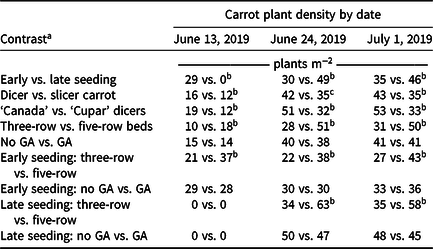
In 2019, carrot plant density was greater in the late seeding than in the early seeding by June 24, despite a 19 d head start with the early seeding. However, carrot plant density comparisons of the dicer versus slicer varieties and of ‘Canada’ versus ‘Cupar’ were the opposite in 2019 of what was observed in 2018. In 2019, the dicer varieties emerged faster and had greater carrot plant density than the slicer variety at each observation date. In addition, the ‘Canada’ dicer variety had significantly more plants than ‘Cupar’ (Table 3). The rather stark differences between study years may be related to differences in the seedbed at the early seeding time in particular. In 2018, the seedbed had received moderate precipitation and was firm at the time of seeding. In 2019, the seedbed was dry and, therefore, remained soft when the carrots were seeded, which can lead to variable depth of the placement of the small seeds. Anecdotally, we have observed that some varieties respond to the variable or deep seeding better than others.
Carrot plant density quantified in the early season in 2019 in research conducted at the Hancock Agricultural Research Station in Hancock, WI.

a Abbreviation: Gibberillic acid.
b P < 0.0001.
c P = 0.0001–0.01.
Carrot Foliar Groundcover
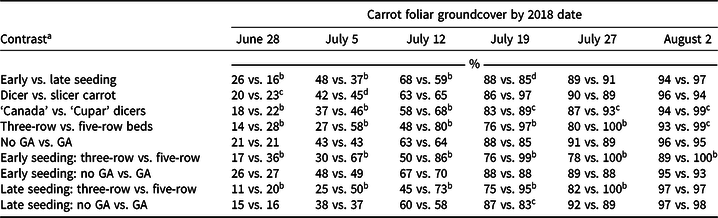
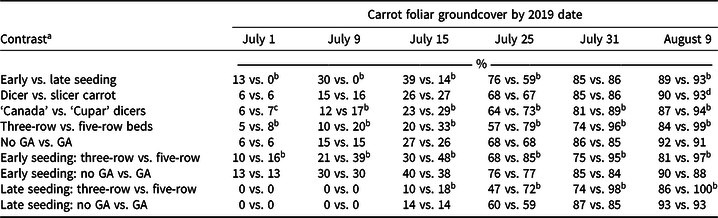
In the 2018 study, despite greater plant-population density, carrot foliar groundcover in the late seeding did not catch up to the early seeding until July 27. This suggested that a denser population early in the season did not translate into early-season canopy development that could compete better with weeds. The ‘Canada’ variety, in particular, was slow to develop a crop canopy where, throughout the measurement period and particularly in the early season, groundcover was less than with the other dicer variety, ‘Cupar.’ In the early season, five-row beds had approximately double the carrot groundcover compared with three-row beds. This advantage was maintained throughout the measurement period and consistent in both early and late seeding. Gibberellic acid did not improve groundcover development at either seeding timing (Table 4).
Carrot foliar groundcover, ranging from 0% (bare ground) to 100% (full groundcover), in 2018 research conducted at the Hancock Agricultural Research Station in Hancock, WI.

a Abbreviation: Gibberillic acid.
b P<0.0001.
c P = 0.0001–0.01.
d P = 0.01–0.05.
Carrot foliar groundcover observations in 2019 were very similar to those in 2018 (Table 5). Two observations were likely most important and consistent between years. First, the number of carrot rows bed−1 was the strongest factor driving carrot canopy cover: groundcover percentages in the early season were up to twice as great in the five-row system compared with the three-row seedings. The early season is when establishing a competitive advantage over weeds is most important to inhibit weed growth and maintain crop development. Second, GA did not enhance carrot foliar growth in either season. This was in contrast to preliminary work in which a 15% to 25% foliar growth enhancement from similar GA applications was observed (Colquhoun, unpublished data).
Carrot foliar groundcover, ranging from 0% (bare ground) to 100% (full groundcover), in 2019 research conducted at the Hancock Agricultural Research Station in Hancock, WI.

a Abbreviation: Gibberillic acid.
b P < 0.0001.
c P = 0.0001–0.01.
d P = 0.01–0.05.
Weed Density
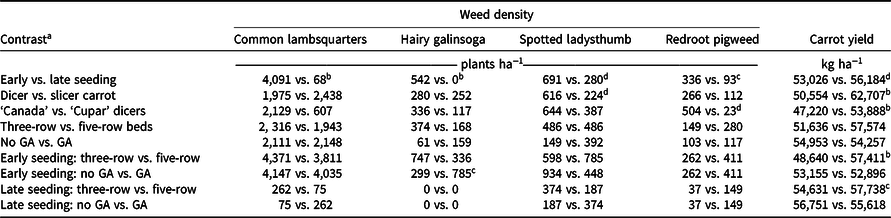
By far, the most important factor affecting weed density was seeding timing in 2018. Late seeding reduced weed density by 60% to 100% (Table 6). For spotted ladysthumb and redroot pigweed, the ‘Cupar’ carrot variety reduced weed density compared with ‘Canada,’ likely as a result of enhanced groundcover. Although only statistically significant in one observation, the trend was for GA to increase weed density. In related research, we have made similar observations among diverse weeds, where very low GA rates (100 ppm) stimulated earlier and more complete seed germination within a population (Colquhoun, unpublished data). In the late seeding in particular, the trend was for fewer weeds in the five-row beds compared with where three rows were seeded, with the exception of redroot pigweed.
Weed density and carrot root yield in 2018 in research conducted at the Hancock Agricultural Research Station in Hancock, WI.

a Abbreviation: Gibberillic acid.
b P < 0.0001.
c P = 0.01–0.05.
d P = 0.0001–0.01.
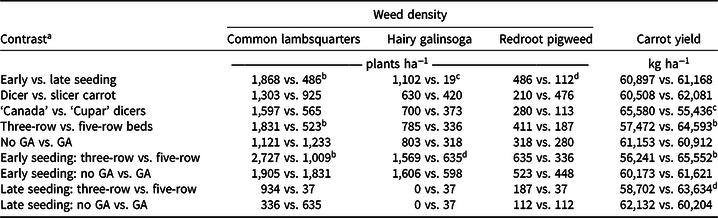
In 2019, the differences in weed density between early and late seeding were again profound, ranging from a 74% to 98% reduction in weed population by simply delaying seeding by 19 d (Table 7). Overall, the weed density was less where five rows were seeded in a bed compared with the standard three rows. In the early seeding, common lambsquarters and hairy galinsoga (Galinsoga quadriradiata Cav.) populations were reduced by 60% or more in the five-row beds compared with the three-row beds.
Weed density and carrot root yield in 2019 in research conducted at the Hancock Agricultural Research Station in Hancock, WI.

a Abbreviation: Gibberillic acid.
b P = 0.0001–0.01.
c P < 0.0001.
d P = 0.01–0.05.
Carrot Root Yield
It should be noted that both seeding timings were harvested at the same time in both study years. No differences in carrot root quality were noted. In 2018, despite a 17-d shorter growing season, carrot root yield was greater in the late seeding compared with the early seeding. Also, carrot root yield was greater in the five-row beds compared with three-row beds, particularly in the early seeding, where nearly an 18% yield gain was realized. Dicer-type carrot yield was greater than that of the slicer variety, largely driven by high ‘Cupar’ root yield (Table 6).
In 2019, although the late seeding did not exceed early-seeding yield, as was observed in 2018, there was no yield penalty either by delaying seeding by 19 d. Across both seeding timings, carrot root yield was 12% greater in the five-row beds compared with the three-row system. The advantage to adding two carrot rows to the same width bed as the three-row standard was particularly pronounced in the early seeding, where yield was 17% greater in the five-row system (Table 7). This was a very similar observation as that in 2018, suggesting a consistent advantage to adding more carrot rows to the existing industry standard.
The results of this work were rather stark for field research. Gibberellic acid as a foliar application was not successful in these studies and, in a few cases, may have even increased weed seed germination and establishment. In related research, we have had better success in using GA as a carrot seed treatment to hasten germination and improve emergence consistency in the early plantings during cool weather in particular (Colquhoun, unpublished data). This strategy would not only enhance competitiveness by establishing a more complete crop canopy earlier but also lessen the time to get the carrots to a growth stage more conducive to safe use of other management tactics such as cultivation or POST herbicide application.
The choice of carrot variety had a moderate influence on carrot foliar canopy development and, subsequently, weed density. For example, ‘Cupar’ carrot formed a complete crop canopy sooner than the other dicer-type ‘Canada’ variety. Likely as a result, density of weed species such as spotted ladysthumb and common lambsquarters was less where ‘Cupar’ was grown compared with ‘Canada’. Although choosing a more competitive variety requires no additional inputs or energy to the production system, it should be seen as one component of an integrated management system and not a mechanism for consistent, broad-spectrum weed management. This strategy could be enhanced by selecting canopy development as a desirable trait during plant breeding and variety development, particularly if accompanied by foliar disease-resistance traits to overcome common carrot diseases such as Alternaria leaf blight that are often associated with dense plant canopies that restrict air movement and foliar drying.
Adding two carrot rows to the current, regional, industry-standard three-row bed system not only enhanced competitiveness with weeds but also improved carrot yield without additional fertilizer, water, or pest management inputs. In this regional production system, water and fertilizer are provided via broadcast overhead pivot irrigation and not targeted specifically to the carrot row, thus the inputs are provided across the field, even where the crop is not present. Adding two rows to this system enhanced the overall efficiency by better using these inputs, as was observed with greater carrot root yield in the five-row system. It is acknowledged that this strategy would require equipment modifications; more specifically, with the seeder and harvester, but carrot equipment manufacturers have indicated to the authors that such modifications are feasible. Where cultivation is a common practice, equipment would also need to be selected or modified to accommodate the row configuration.
By far, though, the most successful strategy to reduce weed density while maintaining or improving carrot yield was to delay planting by 17 to 19 d. It is likely that the weed density was reduced by two mechanisms. First, the later carrot seeding occurred during when soil and air temperature was warmer and so favored faster carrot germination and early growth. Second, although initial tillage occurred about 2 wk prior to both the early and late seeding, few weeds emerged in the waiting period between tillage and bed formation for the early seeding, likely because of low soil temperatures, whereas weed emergence was abundant between tillage and bed formation in the late seeding. Thus, the later seeding acted similar to a stale seedbed technique, where bed formation that occurred at seeding effectively eliminated small weeds that emerged in the waiting period. This strategy may present logistical concerns for large carrot farms; however, accommodations could be made to shift the entire carrot seeding timing without risk of compromising yield or anticipated harvest timing. This also would reduce the amount of inputs needed to produce the crop, such as irrigation, scouting, and pest management. Moreover, the strong positive benefits were realized across years and carrot varieties.
We anticipate more holistic production-system research that integrates low-input alternatives in other crops as herbicide-resistant weeds proliferate while few new herbicides are developed. Although synthetic herbicides may still be an important component of a holistic system in the intermediate term, as they were in this work, the integration of several nonchemical strategies reduces the reliance on herbicides that are often the only weed management technique in current large-scale production systems. As was demonstrated in this research, such novel approaches can be successful without adding significant economic burden to the farmer or increasing risk of crop failure.
Acknowledgments
The authors express appreciation to the U.S. Department of Agriculture, Wisconsin Department of Agriculture, Trade and Consumer Protection Specialty Crop Block Grant Program. No conflicts of interest are declared.