Introduction
It is abundantly clear that the global trend for rising overweight and obesity among children reflects decreases in physical activity and over-consumption of energy dense foods.Reference McMillen, Rattanatray and Duffield 1 Yet the difficulty in treating overweight highlights gaps in current understanding of what underlies the initiation and persistence of this state. Children and adults who are overweight have multiple comorbidities, including depression.Reference Blaine 2 They also have signs of hypothalamic–pituitary–adrenal (HPA) axis perturbations and are more likely to have abnormal cortisol levels or reactivity.Reference Dockray, Susman and Dorn 3 , Reference Marniemi, Kronholm and Aunola 4 For this reason, recent attention has turned to neuroendocrine processes such as cortisol secretion, to illuminate mechanisms by which psychologic processes may influence the development of overweight.Reference Lopez-Duran, Kovacs and George 5
Given the potential role of stress as a causal factor, a life course approach has been advocated to evaluate the temporal relationships between early life stress and the development of overweight.Reference Ben-Shlomo and Kuh 6 , Reference Trasande, Cronk and Durkin 7 Low birth weight and rapid catch-up growth during infancy have been associated with overweight in children.Reference Ong 8 , Reference Dubois and Girard 9 Fetal stressors such as maternal smoking, result in intrauterine growth retardation and higher cortisol levels in infants and children.Reference Seckl and Meaney 10 Higher cortisol reactivity is also seen in infants of mothers with postpartum depression and anxiety.Reference Feldman, Granat and Pariente 11 , Reference Brennan, Pargas and Walker 12 Thus, programming of the HPA axis by early life environmental stressors has the potential to cause overweight in later life. This study was undertaken to determine the association between risk of overweight at age 9–11 years, and exposure to stress during fetal development, the postpartum period and school age. We hypothesized that maternal distress in early life had an impact on the development of overweight in children, independent of in utero stress and recent stress experienced by the child.
Methods
This was a longitudinal follow-up of the nested case-control arm of the 1995 SAGE (study of asthma genes and the environment) birth cohort in Manitoba, Canada, as described previously.Reference Kozyrskyj, HayGlass and Sandford 13 Children with (36%) and without asthma (64%) were recruited into the case-control study at age 8–10 years. This represented all children with asthma of parents agreeing to be contacted for study; their urban–rural distribution was similar to the whole population of Manitoba children with asthma.Reference Kozyrskyj, HayGlass and Sandford 13 Children in the control group were randomly sampled from households stratified by urban-rural and household income area. As part of a research objective to investigate the association between overweight in preadolescence and the onset of asthma in adolescence, waist and hip measurements were obtained during a second clinic visit at 9–11 years of age. In this paper, we report on the stress determinants of overweight in children, using the waist-to-hip ratio as our anthropometric overweight index. The waist-to-hip ratio has been found to be positively correlated with insulin resistance indices and leptin levels in children.Reference Aeberli, Spinas and Lehmann 14
Waist measurements were taken with the child in a standing position in centimeters. A horizontal line was drawn above the uppermost lateral border of the child's right iliac crest and then across the line to indicate the mid-axillary line of the body. Standing on the child's right side, the research nurse placed the measuring tape around the trunk in a horizontal line at the level marked on the right side of the trunk. The widest circumference over the buttocks was located for hip measurement. All measurements were performed three times and the mean was recorded.
In chronological order from pregnancy, child exposures to or markers of stressors were evaluated as: smoking during pregnancy, distress in the mother during the postpartum period and abnormal stress response at school age. The latter included cortisol levels and the ratio of cortisol and dihydroepiandrostrenone (DHEA) following a clinic stressor, both assayed in a plasma sample obtained in children at age 8–10 years. We have reported on cortisol levels in previous analyses on SAGE children, arguing that study procedures such as venepuncture and skin prick tests, and their anticipation functioned as acute stressors in the evaluation of a child's stress response.Reference Dreger, Kozyrskyj, HayGlass, Becker and MacNeil 15 For these analyses, we employed the cortisol/DHEA ratio that has been advocated as a more powerful measure of HPA axis integrity following a stressor than cortisol levels.Reference Jessop and Turner-Cobb 16 Cortisol and DHEA levels were measured in a laboratory at the University of Manitoba where plasma samples (diluted 1:240 and 1:6, respectively) were assayed using commercially available ELISA kits (Cayman Chemical, Diagnostic Systems Laboratories). Assayed values were measured in nanograms per milliliter. Assay sensitivity was 70 pg/ml, with an inter-assay variance of 14.8% and an intra-assay variance of 7.8%. DHEA assay sensitivity was 100 pg/ml. Its inter-assay coefficient of variation (CV) was 5.3% and the intra-assay CV was 4.4%.
Recognizing that low and high cortisol levels are markers of chronic stress, cortisol/DHEA ratios were expressed in quartile format on the basis of assay determinations in all SAGE children at age 8–10 years.Reference Dreger, Kozyrskyj, HayGlass, Becker and MacNeil 15 , Reference Buske-Kirschbaum, von Auer and Krieger 17 Maternal distress during the postpartum period was based on mother's response to a question on whether she felt down, depressed or hopeless during the year after the birth of their child, as per the following categories: not at all, several days, more than half the days and nearly every day. Values in the highest frequency category were defined as the presence of postpartum distress. We found this category to have the greatest agreement with maternal use of health care and prescription medications for depression or anxiety in the postnatal period.Reference Dreger, Kozyrskyj, HayGlass, Becker and MacNeil 15 , Reference Kozyrskyj, Mai and McGrath 18 Maternal smoking during pregnancy, birth weight and other explanatory factors such as child age and Aboriginal status (First Nations or Metis), exclusive breastfeeding >3 months, activity level (vigorous activity in the last week) and maternal education were also based on mother questionnaire. Birth weight categories included: small-for-gestational age (<10th percentile), low birth weight appropriate for gestation (gestational age <37 weeks, and birth weight between 10th and 90th percentile) and not low birth weight, according to sex-specific percentiles for Canadian children.Reference Kramer, Platt and Wen 19 Onset of puberty was assessed in boys and girls through child self-report of the Tanner stages of puberty, based on comparison to standardized drawings for genital and breast development, respectively.Reference Coleman and Coleman 20 – Reference Marshall and Tanner 22 Higher Tanner scores indicated early onset puberty. A pediatric allergist examined children at age 8–10 years to diagnose the presence of asthma.
Multiple linear regression was conducted to determine the relationship between the waist-to-hip ratio and: postpartum maternal distress, maternal smoking during pregnancy and recent stress markers in children (cortisol-DHEA ratio quartiles). The second lowest quartile was set as the reference category in order to determine associations with low and high cortisol/DHEA ratios. All models were tested for age, Tanner stage of puberty, adrenarche stage (DHEA levels), exclusive breastfeeding >3 months, physician activity level, ethnicity, maternal education level and small-for-gestational-age. Interactions terms were also tested. Data were analyzed using SAS statistical software package Version 9.2 (SAS Institute, Inc.). Appropriate institutional ethics committee clearance and participants’ informed consent were obtained. Results are reported as regression coefficients at the 95% level of confidence, separately for girls and boys, and for boys and girls stratified by asthma status to account for overrepresentation by asthma status in the case-control design. To simplify reporting of two-way interactions with cortisol-DHEA ratios, these models are presented as β-coefficients of the other factor for each quartile of the cortisol-DHEA ratio. Our threshold for significance was lowered from 0.05 to 0.0125 (0.05/4 quartiles) for interaction effects to adjust for multiple comparisons and keep the overall cut-off of α = 0.05.
Results
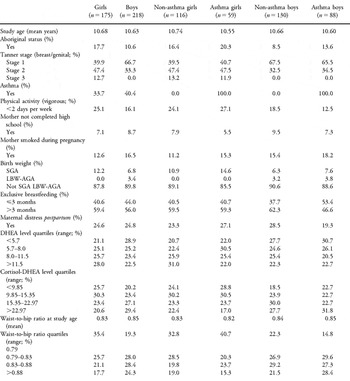
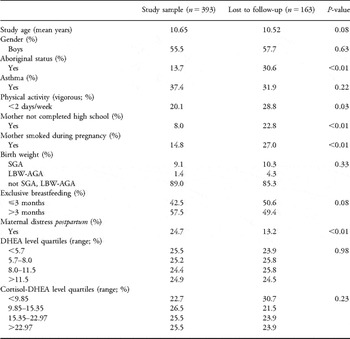
A total of 556 children in the nested case-control SAGE study had cortisol and DHEA levels measured at age 8–10 years. A complete data set with these stress hormones, maternal postpartum distress and other survey measures, and waist and hip measurements at age 9–11 years (mean age = 10.7 years) was available for 393 children (see Table 1). At this age, 50% of children had a waist-to-hip ratio of 0.83 and in 10%, the ratio was 0.92 and higher. The median waist-to-hip ratio was higher in boys (0.84) than girls (0.82). A greater percentage of boys had waist-to-hip ratios in the highest quartile (24% v. 18% in girls). At age 8–10 years, more boys, especially boys with asthma, had cortisol-DHEA ratios in the highest quartile range. Boys with asthma were most likely to have mothers who smoked during pregnancy and breastfed exclusively for <3 months. Girls, however, were more likely to have early-onset puberty (highest percent with Tanner 2 and 3 scores at age 9–11 years) and early adrenarche (highest DHEA levels at age 8–10 years), and to be of Aboriginal (First Nations or Metis) origin. Girls with asthma were the most likely to be born small-for-gestational age and to have cortisol-DHEA ratios in the lowest quartile range. Postpartum distress was more common in mothers of girls with asthma or of boys without asthma. Children lost to follow-up or with missing data (n = 163) were more likely to be of Aboriginal status, and have mothers with a lower level of education and higher rates of smoking during pregnancy (Table 2). The majority of these mothers were Aboriginal, 55% and 64% respectively. Postpartum distress was less common in the lost to follow-up group and found in 7% of Aboriginal mothers.
Sociodemographics, maternal characteristics and waist-to-hip ratios of study children and their stress hormone levels

SGA, small forgestational age; LBW-AGA, low birth weight appropriate for gestational age; DHEA, dihydroepiandrostrenone.
Sociodemographics, maternal characteristics and stress hormone levels of study children and children lost to follow-up

SGA, small forgestational age; LBW-AGA, low birth weight appropriate for gestational age; DHEA, dihydroepiandrostrenone.
In girls without asthma, pregnancy smoking and postpartum maternal distress were positively correlated with the waist-to-hip ratio (r = 0.24, P = 0.009 and r = 0.29, P = 0.0016, respectively). DHEA levels were inversely correlated with birth weight category (r = −0.34, P = 0.010) in girls with asthma. In boys without asthma, waist-to-hip ratio was correlated with DHEA levels (r = 0.21, P = 0.017) and to a lesser extent with birth weight category (r = −0.16, P = 0.068). Maternal smoking during pregnancy was negatively correlated with birth weight category (with the lowest rank for small-for-gestational age as, r = −0.27, P = 0.018) in boys with asthma. Aside from a modest correlation between maternal distress and child cortisol-DHEA ratios in boys without asthma (r = 0.18, P = 0.042), there were no other correlations between the stress indicators of maternal smoking during pregnancy, maternal postpartum distress and child cortisol-DHEA ratios.
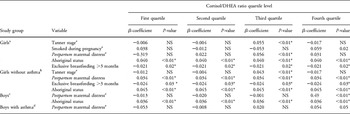
At age 9–11 years, the waist-to-hip ratio in girls was associated with maternal postpartum distress only in the presence of higher stress response levels at age 8–10 years (Table 3). This interaction was such that exposure to maternal distress in the postpartum period predicted an increase of 0.056 in waist-to-hip ratio when cortisol-DHEA ratios fell into the third highest quartile. The Tanner score predicted a 0.055 increase in the waist-to-hip ratio of girls with cortisol-DHEA ratios in the third quartile as well. At the highest cortisol-DHEA quartile range, maternal smoking during pregnancy predicted waist-to-hip ratio by an increase of 0.059. DHEA levels were not related to the waist-to-hip ratio in girls. All of these associations were independent of asthma and Aboriginal status, and an inverse association with duration of exclusive breastfeeding. In boys, the waist-to-hip ratio was also related to an interaction between maternal postpartum distress and the cortisol-DHEA ratio, but by a factor of 0.049 in the highest cortisol-DHEA ratio quartile (Table 3). Aboriginal status was also positively correlated with the waist-to-hip ratio. Aside from a borderline relationship between DHEA levels and waist-to-hip ratio (P = 0.06), no other associations were found in boys.
Maternal postpartumdistress and other predictors of the waist-to-hip ratio in children at age 9–11 years by quartile of the cortisol-DHEA ratio

DHEA, dihydroepiandrostrenone; NS, not significant.
aThe model is also adjusted for DHEA level and asthma status.
bThe model is also adjusted for DHEA level.
cThe model is also adjusted for DHEA level.
dThe model is also adjusted for DHEA level, Aboriginal status and birth weight.
eEffect depending on cortisol/DHEA ratio quartile level.
*Statistically significant at P < 0.05 level for independent effects, and P < 0.0125 level for dependent effects.
Asthma status altered the association between maternal distress and the waist-to-hip ratio. In non-asthmatic girls (Table 3), maternal distress was related to waist-to-hip ratio, independent of other factors (β-coefficient = 0.034). The β-coefficient for maternal distress was 0.036 prior to the addition of the breastfeeding variable to the model. As for the all girls model, Tanner score continued to be associated with waist-to-hip ratio at the third quartile of the cortisol-DHEA ratio. Maternal pregnancy smoking was predictive of waist-to-hip ratio but not after the addition of the interaction term for Tanner score and cortisol-DHEA ratio. A 34.5% of the variation in waist-to-hip ratio in non-asthmatic girls was explained by these factors. Among non-asthmatic boys, neither pregnancy smoking, nor postpartum distress or cortisol-DHEA levels were associated with the waist-to-hip ratio. Instead, the best predictors of waist-to-hip ratio were DHEA levels, and the interaction between physical activity and Aboriginal status. Aboriginal status increased the waist-to-hip ratio by 0.084 (P = 0.01) among less active boys, but was not a predictor in boys with vigorous physical activity. DHEA levels significantly increased the waist-to-hip ratio by 0.0023 (P = 0.047). Physical activity, aboriginal status, their interaction and DHEA explained 12.5% of the waist-to-hip ratio variation in boys without asthma.
In girls with asthma, there was a significant interaction between postpartum distress and maternal smoking during pregnancy. Smoking during pregnancy increased waist-to-hip ratio by a factor of 0.072 (P = 0.038) among girls whose mothers had postpartum distress. It was not associated with the waist-to-hip ratio in the absence of postnatal distress. Aboriginal status also increased risk for overweight (β-coefficient = 0.05, P = 0.01). No other associations were found in girls with asthma. These factors explained 21% of variation in waist-to-hip ratio for girls with asthma. In boys with asthma (Table 3), the waist-to-hip ratio was higher by 0.056, if exposure to maternal distress postpartum was followed by high cortisol-DHEA ratios at age 8–10 years. This association was independent of low birth weight status (small or appropriate for gestational age) but it was not significant after adjustment for multiple comparisons. A total of 19% of the variation in waist-to-hip ratio was explained by these factors in asthmatic boys. Low birth weight was not related to the waist-to-hip ratio in multivariate models in boys or girls.
Conclusions
We found risk for overweight at age 9–11 years to be elevated among Canadian boys and girls whose mothers had experienced distress in the postnatal period. This risk varied by gender and asthma status. In healthy girls, the association between maternal postpartum distress and the waist-to-hip ratio was independent of child stage of puberty and adrenarche, and stress reactivity, as measured by cortisol-DHEA responses to a clinic stressor 2 years before. Among girls with asthma, maternal smoking during pregnancy was associated with an increased waist-to-hip ratio, if the mother also experienced distress in the postpartum period. Among boys with asthma, an association between maternal distress and waist-to-hip ratio was evident at the highest ratios of the cortisol-DHEA response to the clinic stressor. Independently, postpartum distress increased the waist-to-hip ratio by a factor of 0.034 in healthy girls and by 0.072 in girls with asthma, if their mother smoked during pregnancy. In comparison, intrauterine growth retardation has been reported to increase the waist-to-hip ratio in young women by a factor 0.016 following moderate restriction in growth and by 0.025 with severe growth restriction.Reference Barbieri, Portella and Silveira 23
Our findings contribute to the growing body of evidence for the role of maternal and family stress in the development of overweight in children and young adults.Reference Stenhammar, Olsson and Bahmanyar 24 , Reference Perkonigg, Owashi, Stein, Kirschbaum and Wittchen 25 The ‘developmental origins of health and disease (DOHaD)’ or ‘adaptive developmental plasticity’ theory offers a framework for potential pathways. This theory posits that the fetus adjusts its metabolic processes for growth, reproduction and maintenance to be appropriate for the environment in which it predicts it will live; this prediction is based on its in utero environment.Reference Gluckman, Hanson and Beedle 26 , Reference Phillips 27 Poor prenatal nutrition compromises fetal growth; change to an improved postnatal nutrition triggers rapid growth.Reference Dunger, Ahmed and Ong 28 When this mismatch in environments occurs, the risk of overweight, insulin resistance and cardiovascular disease is increased.Reference Ong 8 , Reference Dubois and Girard 9 A mismatched environment can also result in physiologic changes intended to accelerate reproduction. Higher rates of premature puberty and adrenarche (higher DHEA levels) are seen in children, who are born low birth weight and experience rapid weight gain.Reference Rainey and Nakamura 29 – Reference Sloboda, Hart, Doherty, Pennell and Hickey 32 In our study, early onset puberty increased the waist-to-hip ratio in girls and ‘explained away’ the correlation of waist-to-hip with pregnancy smoking. The puberty association was evident only at higher ratios for cortisol-DHEA, both markers of an adverse in utero environment.Reference Seckl and Meaney 10 We also found that DHEA levels were inversely correlated with birth weight in asthmatic girls and positively related to the waist-to-hip ratio in healthy boys. However, the association between maternal postpartum distress and the waist-to-hip ratio was independent of DHEA levels and Tanner stage of puberty in girls. Postpartum distress was also not correlated with maternal smoking during pregnancy.
The window of developmental plasticity has been proposed to extend to the postpartum period, either independent of or interdependent with in utero development.Reference Gluckman, Hanson and Beedle 26 Animal models of maternal care show that low levels of maternal grooming can produce offspring with higher levels of abdominal fat, elevated blood glucose levels and reduced insulin sensitivity.Reference Portella, Silveira, Parent, Diorio and Meaney 33 In humans, maternal psychopathology in the postpartum period has been associated with earlier onset of puberty, which is also accelerated by rapid infant weight gain.Reference Dunger, Ahmed and Ong 28 , Reference Ellis 34 Lessened sensitivity to infant cues and overfeeding have been identified as causes of rapid weight gain in infants.Reference Worobey, Lopez and Hoffman 35 This type of feeding is more common in mothers with postpartum depression.Reference Hurley, Black, Papas and Caulfield 36 Rapid weight gain and future overweight are observed less often in infants who are breast-fed.Reference Harder, Bergmann, Kallischnigg and Plagemann 37 We also found a protective effect for breastfeeding on overweight in healthy girls. The association between postnatal distress and waist hip diminished but only slightly following adjustment for breastfeeding. Thus, we propose an additional pathway to infant overfeeding, one that involves the HPA axis.Reference Meaney, Szyf and Seckl 38 Reduced maternal–infant interaction in women with postpartum depression can evoke cortisol reactivity in the infant.Reference Feldman, Granat and Pariente 11 , Reference Brennan, Pargas and Walker 12 , Reference McLearn, Minkovitz, Strobino, Marks and Hou 39 Stress-induced stimulation of cortisol is accompanied by reductions in leptin in adults, a hormone which regulates appetite.Reference Kain, Zimolo and Heninger 40 Postnatal administration of leptin has prevented rapid weight gain in low birth rat pups fed a high fat diet; weight gain occurred in pups not receiving leptin.Reference Vickers, Gluckman and Coveny 41 Leptin levels are lower in small-for-gestational age than normal weight newborns.Reference Martinez-Cordero, mador-Licona, Guizar-Mendoza, Hernandez-Mendez and Ruelas-Orozco 42 This in utero programming of leptin levels could explain the interaction we found between maternal distress and pregnancy smoking in girls with asthma.
Gender and asthma differences in predictors of the waist-to-hip ratio warrant further comment. Independent effects for maternal distress and puberty-stress reactivity in healthy girls indicate distinct postnatal and in utero pathways for overweight. As low birth weight was not found to be a predictor, we propose that the puberty-stress pathway in healthy girls is not through fetal growth retardation. In contrast, since low birth weight and DHEA levels were associated with the waist-to-hip ratio in healthy boys, a low birth weight and premature adrenarche pathway to overweight may be prominent in boys who do not develop asthma. This hypothesis is consistent with findings that impaired fetal growth affects central fat distribution in boys but not girls, and that postnatal growth is a larger risk factor for central adiposity in women.Reference Labayen, Moreno and Blay 43 , Reference Skidmore, Cassidy and Swaminathan 44 Maternal postpartum distress was related to the waist-to-hip ratio in both girls and boys with asthma, pointing to a postnatal stress pathway for overweight in asthma. We previously reported increased risk for childhood asthma following early life exposure to maternal distress in the SAGE population.Reference Kozyrskyj, Mai and McGrath 18 Since leptin is a putative factor for adolescent asthma, it is a plausible mediator in the stress pathway.Reference Mai, Chen and Krewski 45 In this analysis of SAGE children, the association between postpartum distress and the waist-to-hip ratio was seen in asthmatic boys with a heightened cortisol response after a clinic stressor. This interaction explained more of the variation in waist-to-hip for boys than did the maternal distress-smoking model in girls. Leptin levels are known to be higher in overweight children but elevated levels have also been found in adults with longstanding posttraumatic stress.Reference Mai, Chen and Krewski 45 , Reference Liao, Lee, Lee and Huang 46 Thus, stress-induced lowering of leptin levels postnatally and elevation in later childhood, may both be required for overweight to develop in boys with asthma.Reference Vickers, Gluckman and Coveny 41 However, stress-induced lowering of leptin levels in the postnatal period may be needed for fetal programming of leptin levels to increase risk for overweight in girls who develop asthma. Finally, children with asthma are more likely to become overweight secondary to lower physical activity.Reference Vahlkvist and Pedersen 47 Although physical activity was related to waist-to-hip in healthy boys in our study, this association was not found to be independent of early life stress exposure and Aboriginal status in children with asthma.
In addition, worthy of comment is the discrepancy in our results and the longitudinal study by Ajslev et al.,Reference Ajslev, Andersen, Ingstrup, Nohr and Sorensen 48 which failed to find an association between postpartum distress and childhood overweight. Our study differed from this study in a number of important ways. We employed a measure of postpartum distress that was based on a cut-off value for the highest scores and not unit increases in a distress scale, child overweight was derived from measurement and not parent report, and our population of children was older. We also included measures of recent stress reactivity and conducted gender-specific analyses. However, we were constrained by the original objectives of the SAGE project and did not have access to factors known to affect child weight, such as maternal weight and infant growth.Reference Rogers 49 We selected the waist-to-hip ratio but there are additional measures of fat distribution in children.Reference Rogers 49 Our in utero measure of stress, pregnancy smoking, was at risk for reporting bias, although maternal under-reporting would have biased findings towards the null.Reference Oken, Levitan and Gillman 50 Maternal pregnancy smoking was our exposure of interest in place of birth weight because it is a well-known risk factor for low birth weight,Reference Oken, Levitan and Gillman 50 but can cause fetal changes in addition to fetal growth retardation.Reference Gluckman, Hanson and Beedle 26 We would have preferred to include a measure of maternal distress during pregnancy but it was not available. Not-withstanding our inability to measure these factors, we believe the obtained results represent a true population effect because of the large sample size and method of stratified sampling. The 30% loss to follow-up predominantly affected Aboriginal children, so study findings are less generalizable to this population of children. To adjust for the higher prevalence of childhood asthma subsequent to the case-control design, analyses were stratified by asthma status. We also implemented statistical control of several important confounding variables, including the inclusion of DHEA levels in models to adjust the cortisol-DHEA ratio for rising DHEA levels in adrenarche.Reference Rainey and Nakamura 29 Although we did not use standardized tests for stress reactivity, the cortisol-DHEA ratio which measures the extent to which elevated cortisol levels are unopposed by DHEA has been advocated as a valid measure of the stress response in a clinic setting.Reference Jessop and Turner-Cobb 16
To summarize, we implemented a life course approach to investigate stress determinants of overweight in children. We found that maternal postpartum distress affected the waist-to-hip ratio to a similar extent as fetal growth restriction. The association could not be explained by maternal smoking during pregnancy or short duration of exclusive breastfeeding in healthy girls. Consequently, we propose that programming of the HPA axis in infants by early life environmental stressors has an important role to play. Our findings also suggest gender-specific and childhood asthma pathways for the development of overweight. In the end, many of our findings point to the importance of DOHaD and evolutionary biology in explaining risk for overweight.
Acknowledgments
This research was funded by the Canadian Institutes of Health Research and AllerGen NCE Inc. Sincere thanks are due to the SAGE research team and all study families, without whose participation this research could not have been possible.