Family history of premature coronary heart disease – herein termed positive family history – is an established independent risk factor of cardiovascular disease. Data have suggested that the additional risk conferred in persons with positive family history may be due to an increased vulnerability to subclinical atherosclerosis from cardio-metabolic risk factors.Reference Juonala, Viikari, Räsänen, Helenius, Pietikainen and Raitakari 1 Increased left ventricular mass index, an intermediary to heart failure and risk factor for cardiovascular events, is more common in persons with cardio-metabolic risk factors.Reference Mancia, Bombelli and Facchetti 2 Remodelling of the left ventricle by cardio-metabolic risk factors, particularly adiposity and blood pressure, begins in childhood and persists into adulthood.Reference Li, Li, Ulusoy, Chen, Srinivasan and Berenson 3 , Reference Sivanandam, Sinaiko, Jacobs, Steffen, Moran and Steinberger 4 We examined the association between family history of premature coronary heart disease and left ventricular mass index and undertook preliminary analyses to determine whether cardio-metabolic risk factors in childhood confer an additional risk of increased left ventricular mass index in those with a positive family history.
Data from a subset of 181 individuals (mean (standard deviation) age of 11.5 (2.4) years, 54% male) from the Childhood Determinants of Adult Health study, a 20-year population-based prospective cohort, were used.Reference Magnussen, Thomson, Cleland, Ukoumunne, Dwyer and Venn 5 Cardio-metabolic risk factors of fasting lipids, such as non-HDL-cholesterol, HDL-cholesterol and triglycerides; blood pressure; and anthropometry, such as body mass index, waist circumference, were collected in childhood. Self-reported family history – parental and sibling – of premature (≤50 years) coronary heart disease and echocardiography were collected in adulthood (mean (standard deviation) age of 31.3 (2.6) years). Left ventricular mass index was calculated by the Devereux formula and indexed to height (m)2.7. All patients and/or their parents gave written informed consent. The baseline and follow-up studies were approved by local ethics committees.
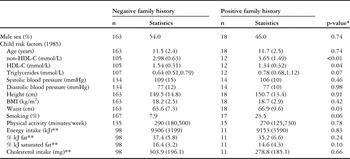
The mean (standard deviation) length of follow-up between surveys was 19.8 (0.6) years. Of the 181 patients, 18, including nine male patients, indicated a positive family history of premature coronary heart disease. Child cardio-metabolic and lifestyle factors among patients with and without a positive family history are displayed in Table 1. Patients with a positive family history in adulthood had significantly higher levels of non-HDL-cholesterol levels and waist circumference, and lower HDL-cholesterol. Those with a positive family history also showed a trend towards significantly higher triglyceride levels and smoking rates compared with those without a positive family history. Although there were no significant differences in lifestyle variables of physical activity and diet between groups, those with a positive family history had a trend towards consuming a lower percent of kilojoules per day from saturated fat.
Childhood characteristics of patients with a negative and positive family history of premature coronary heart disease.

BMI=body mass index; HDL-C=high-density lipoprotein cholesterol; non-HDL-C=non-high-density lipoprotein cholesterol
Statistics are mean (standard deviation) or median (interquartile range) for continuous variables and percent for categorical variables
* Linear regression for continuous variables, χ2 for categorical variables
** Baseline dietary variables measured in those aged 10 years and above. Variables indicate per day amounts
Patients with a family history of premature coronary heart disease had increased left ventricular mass index in adulthood compared with those without (mean±SEM 39.1±1.9 and 34.6±0.7 g/m2.7, p=0.04 from regression analyses) in a multivariable model that also contained child risk factor levels – non-HDL-cholesterol, HDL-cholesterol, triglycerides, systolic blood pressure, body mass index and daily cigarette smoking. The correlation between childhood triglycerides (r=0.66 versus r=−0.03, p=0.02 from Fisher’s r-to-z transformation) and diastolic blood pressure (r=0.65 versus r=0.16, p=0.05 from Fisher’s r-to-z transformation) with adult left ventricular mass index was stronger among those with a family history of coronary heart disease than in those without.
These findings indicate that individuals with a positive family history of coronary heart disease have increased left ventricular mass index that is apparent by early adulthood. The association was not entirely explained by cardio-metabolic risk factor levels despite risk factor levels being generally heightened in this group. The observed stronger associations between child diastolic blood pressure and triglycerides with left ventricular mass index suggests that a positive family history of coronary heart disease makes young adults more vulnerable to the hypertrophic effects of child cardio-metabolic risk factors.
The literature has documented that increased risk associated with a family history of coronary heart disease can be a consequence of both shared genetic (inherited) factors and familial aggregation of environmental or lifestyle-related coronary heart disease risk factors.Reference Mitchell, Kammerer and Blangero 6 Consistent with previous studies in children and young adults, patients in this study with a positive family history had worse risk factor profiles in childhood relative to their peers with a negative family history. Importantly, our findings are the first to demonstrate that even after adjustment for childhood risk variables positive family history of coronary heart disease remained an independent risk factor for left ventricular mass index in adulthood. Thus, increased left ventricular mass index in young adulthood appears to be determined partly by a shared genetic background, although we acknowledge that it is difficult to distinguish genetic versus environmental contributions to left ventricular mass index in the context of this study, and, that some of the genetic component may have already been removed by adjustment for risk factors.
The association of childhood cardio-metabolic risk factors of diastolic blood pressure and triglycerides on adult left ventricular mass index was amplified in the presence of positive family history in our data. This finding is in line with recent data examining subclinical atherosclerosis outcomes with adult risk factors. For example, in the Cardiovascular Risk in Young Finns Study, Juonala et alReference Juonala, Viikari, Räsänen, Helenius, Pietikainen and Raitakari 1 found statistically significant interactions between family history of premature coronary heart disease and HDL-cholesterol, triglycerides, glucose and metabolic syndrome in the prediction of carotid intima-media thickness, suggesting that those with a positive family history were more prone to the proatherogenic effects of cardio-metabolic risk factors. Our study extends these findings by demonstrating the association on left ventricular remodelling and proposes that the interaction between cardio-metabolic risk factors and family history of premature coronary heart disease may begin in childhood. Blood pressure is a well-known determinant of left ventricular geometry, but data linking triglycerides are scant. The available literature suggests an atherogenic lipid phenotype characterised by low HDL-cholesterol, high triglycerides or a combination of both to associate with increased accumulation of triglycerides in the myocardium, elevated liver enzyme alanine aminotransferase and ventricular parameters.Reference Kankaanpaa, Lehto and Parkka 7 , Reference Di Bonito, Moio and Scilla 8 Moreover, data have shown a link between alanine aminotransferase and blood pressure among healthy young adults.Reference Koskinen, Magnussen and Kahonen 9 Collectively, these data postulate that lipids might be directly or, via elevated alanine aminotransferase levels, indirectly impacting left ventricular parameters.
Limitations included the ascertainment of family history from self-report rather than medical records; low numbers with a positive family history, whereby some of our analyses were underpowered to detect potentially important associations; and that a number of unmeasured risk factors could be contributing to increased left ventricular mass index among those with a positive family history. Finally, a specific attempt to determine coronary heart disease as separated from other types of heart disease was not possible as the questionnaire did not differentiate between types. We are therefore unable to discount that some patients may have included types of heart disease that are not specific for coronary heart disease.
Although our data are preliminary and can only be considered as hypothesis generating, they suggest that prevention of cardio-metabolic risk factors in those with a family history of premature coronary heart disease may be most effective if begun in childhood.
Acknowledgements
The Australian Schools Health and Fitness Study was supported by grants from the Commonwealth Departments of Sport, Recreation and Tourism, and Health; The National Heart Foundation; and the Commonwealth Schools Commission. The Childhood Determinants of Adult Health study was supported by grants from the National Health and Medical Research Council; The National Heart Foundation; the Tasmanian Community Fund; and Veolia Environmental Services. CGM holds a National Health and Medical Research Council Early Career Fellowship (Public Health Fellowship, APP1037559).