Introduction
The threat of terrorism in the United States and abroad continues to grow.Reference Cole, Natal, Fox, Cooper, Kennedy, Connell, Sugalski, Kulkarni, Feravolo and Lamba 1 Physicians and other medical caregivers have a prime responsibility in the event of a terrorist or other mass-casualty incident. Yet, the development of courses on medical responses for all-hazard disaster victims remains inadequate.Reference Ablon, Ali and Bahney 2 In particular, the teaching of medical countermeasures specific to terrorist attacks ranges from erratic to nonexistent. To help address this concern, a 2-week course on Terror Medicine (a variant of Disaster and Emergency Medicine) was developed for fourth year students at Rutgers New Jersey Medical School in Newark, New Jersey (USA). The elective is part of a plan to broaden familiarity and develop competency in the subject throughout the medical school curriculum.Reference Schultz, Koenig, Whiteside and Murray 3 This study provides an overview of the course over three iterations and reactions to it by participants.
Rationale
Teaching Terror Medicine necessarily includes key aspects of Disaster and Emergency Medicine, though the converse is not the case. Courses on Disaster Medicine may not address features distinctively associated with a terror attack. Thus, a terror-related focus not only assures attention to this important subject but to accidental or naturally occurring incidents as well.
Methods
“Introduction to Terror Medicine” was initiated in 2014 as an elective course for credit. At the outset, participating faculty deemed a class size of between three and six students as appropriate for initial offerings of the course. It has thus far been offered twice in 2014 (Spring, three students; Fall, five students) and once in 2015 (Spring, six students). More than 50 individuals have participated, including the 14 students, 12 faculty members, and teams of mock patients, exercise facilitators, and observers. The course introduces fourth year students to the field of Terror Medicine and its relationship to Emergency and Disaster Medicine. It explores medical features distinctively associated with terrorism events in four broad areas: preparedness, incident management, nature of injuries, and psychological issues.Reference Cole, Wagner and Scott 4
The faculty comprises experts in relevant areas including in biological and chemical terrorism, disaster management, mechanisms of injury, trauma surgery, psychiatry, and simulation exercises. The teaching modalities include lectures, videos, interviews with victims of terrorism, and student-prepared papers on aspects of the subject. Interactive activities include familiarization with a hospital isolation facility (for suspected Ebola cases) and a high-containment laboratory (for research on anthrax and other select biological agents), and participation in tabletop and hands-on simulations.
As shown in the course syllabus (Appendix 1; available online only),Reference Schultz, Koenig, Whiteside and Murray 3 - Reference Vardi, Levin and Birkenstadt 28 prior to the tabletop and simulation exercises, instruction covers incident management and the incident command system (ICS). Students and observers are also exposed to ICS training via the Federal Emergency Management Agency (FEMA; Washington, DC USA) web site.Reference Swan, Reiner and Blackwood 23 A tabletop example involves the verbal playing out of responses to an organophosphate attack at an airport. Each participant is given a packet that describes his or her role and associated scenario information: the Emergency Medical Service (EMS) chief receives information on conditions at the scene; emergency department (ED) physicians on conditions in the ED; and incident commanders on conditions in the hospital as a whole. Students are expected to work together and apply the principles of disaster management offered during the course.
A simulation exercise begins with summoning students to a mock emergency room filling with people whose symptoms include runny nose, watery eyes, cough, and some convulsing. After a period, a hospital official announces that the patients are victims of a chemical exposure and the caregivers are ordered outside to don protective outerwear. Their powered respirator masks limit visibility and issue a continuous motor noise, making communication more difficult. The students are then tasked with treating the victims. After, action debriefings include assessments by observers/evaluators and students about their performance based on previous instruction and FEMA guidelines.
Performance questions include: How well did the students organize themselves into a constructive responder team? Did they designate a team commander? Did the commander assign team members to particular patients and did the members accede? Did the members offer appropriate treatment (eg, atropine and 2-PAM if a Sarin attack)? Did the students optimally utilize the skills of available nurses and other staff?
Goals, Content, and the Syllabus
The goals and objectives of the elective are aligned with the overall goals of the medical school curriculum. The course syllabus (Appendix 1; available online only) includes student responsibilities as well as a listing of topics and resources for each class session. A paper is required of every student (parameters are described in the syllabus) and the range of the students’ interests is revealed by a sample of their papers’ titles:
-
∙ Education in Terror Medicine for the Primary Care Provider;
-
∙ The Psyche in Terror Medicine;
-
∙ Pediatric Considerations in Terror Medicine; and
-
∙ A Patient Distribution System in a Terror-related Mass-casualty Event.
As may be inferred from the titles, specialty interests of the students were varied. The scope was also reflected in the range of residency programs to which enrollees were applying: emergency medicine, primary care, pediatrics, psychiatry, anesthesiology, and neurosurgery.
The topics covered in class sessions (listed in the syllabus) are distinctive, though all bear on the subject of Terror Medicine. An attack with a biological agent differs markedly from a suicide bombing, and a chemical exposure differs in kind from a radiological exposure. But the four categorical elements of Terror Medicine apply to all. A proper response to every type of terror attack depends on preparedness, management, addressing injury, and dealing with psychological effects.
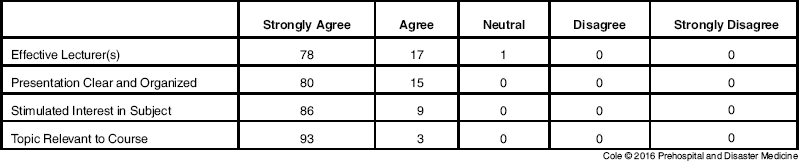
As indicated in the syllabus, students meet as a group for eight sessions (approximately two hours each) in addition to individual contacts with the director or faculty members associated with their areas of interest. The course’s principal limitations and challenges are reflected in student evaluations as recapitulated in the tables (Table 1 – Table 7) and also in Appendix 2 (available online only). The most obvious limitation is that of time. The 2-week allotted period is insufficient to explore the full range of Terror Medicine issues. More time devoted to some aspects means less time for others. Still, end-of-course assessments by students, such as desire for more clinical take-home points or more simulation exercises, should be addressed in future course offerings.
Overall, How Would You Evaluate the Course?

Lecturers/Presentations (Collective Responses of All Student Enrollees)

Why Did You Choose to Take this Course?Footnote a

Most respondents cited having interest in the subject. Others variously cited its “relevance,” chance to build “knowledge and skills in disaster and terror management,” or an opportunity to study a topic “unlike anything previously offered to us medical students.”
a Students sometimes offered multiple answers; table displays only the three most frequently stated answers.
What Aspects Went Well and Why?Footnote a

Simulation exercises were the most frequently and enthusiastically mentioned aspects of the course. Said one student: The exercises were “beyond my expectations in terms of realism and stress.” And another: “truly great in throwing you into the chaos and seeing what a disaster is like.” Lectures were cited variously as “interesting,” “great and engaging,” and “informative and relevant.” Some cited the tours of one of the school’s biodefense laboratories and the hospital’s Ebola isolation facility as especially valuable.
a Students sometimes offered multiple answers; table displays only the three most frequently stated answers.
What Aspects Did Not Go Well and Why?Footnote a

Typical responses demurred from criticism: “All was good though would have liked more ‘sims’ if possible;” “It was great;” and “I have no complaints.” A couple said that some clinical instruction seemed abstract - wished for more specifics on expected performance of the physician.
a Students sometimes offered multiple answers; table displays only the three most frequently stated answers.
How Can the Course be Improved?Footnote a

Enthusiasm for hands-on exercises was re-iterated. Also, all the students evaluated the lectures favorably in general, though three suggested more on clinical response information especially regarding biosecurity, trauma surgery, and psychology. Suggestions for further institution information included more on the incident command system and on cooperative involvement of all medical departments.
a Students sometimes offered multiple answers; table displays only the three most frequently stated answers.
In a Sentence, Please Provide an Overall Assessment of the Course.Footnote a , Footnote b

The most striking impression was the frequent use of superlatives to describe the overall experience: terrific, amazing, etc. Also impressive were two themes suggested by several respondents. First, all students and physicians could benefit from a course on terror medicine: “Valuable lessons—I would recommend to every medical student.” Second, enhancement of the individual’s sense of preparedness: “a terrific primer on the nature of disaster medicine including necessary preparedness and logistics.” Suggestions for improvement principally were for more course time that includes tabletop and simulation exercises.
The principal critiques were in self-assessments by the students, who noted weaknesses in their own exercise performance. Several said at post-exercise debriefings that they felt flustered and uncertain about how to deal with the chaotic situation they were exposed to: whom to treat first and which treatments to offer. They had been slow to perform triage and to organize themselves into effective teams.
a Students sometimes offered multiple answers; table displays only the three most frequently stated answers.
b Appendix 2 (available online only) includes full responses to this item from the 14 enrollees.
Conclusions
An elective course on Terror Medicine, such as the one described here, is feasible and successful. The simulations and other course instruction provide a pathway to understanding how better to respond to a terror or other disaster event. The student participants find the elective relevant to their education and also report that the mixed modality methods are effective for teaching the content. This novel elective course on Terror Medicine may serve as a model for other medical schools contemplating the expansion or inclusion of Terror Medicine-related topics in their curriculum.
Supplementary Material
To view supplementary material for this article, please visit http://dx.doi.org/10.1017/S1049023X15005579