INTRODUCTION
Delirium is a frequent neurological complication in hospitalized cancer patients (Clouston et al., Reference Clouston, de Angelis and Posner1992) and occurs in up to 85% of cancer patients during their last weeks of life (Massie et al., Reference Massie, Holland and Glass1983). The probability of developing delirium is determined by the combined effects of predisposing or vulnerability factors such as age and previous cognitive dysfunction or dementia; incident factors such as drug toxicity and metabolic abnormalities; and other conditions that are often associated with the severity of the underlying illness (Inouye et al., Reference Inouye, Viscoli and Horwitz1993; American Psychiatric Association., 2000). However, the mechanism of delirium remains unclear.
Metaanalyses have shown that women who undergo adjuvant chemotherapy for breast cancer may experience a subtle yet consequential cognitive decline (Falleti et al., Reference Falleti, Sanfilippo and Maruff2005; Stewart et al., Reference Stewart, Bielajew and Collins2006). Thus, cancer patients who receive chemotherapy are at high risk of a treatment-induced decrease in cognitive function. However, few studies have investigated development of delirium following chemotherapy. Furthermore, most such studies are case reports or have no control group and are limited to specific antineoplastic drugs.
Chemotherapeutic agents including methotrexate, fluorouracil, vincristine, vinblastine, bleomycin, bischloronitrosourea, cisplatin, ifosfamide, interferon, asparaginase, and procarbazine have been reported to cause delirium in single case reports or studies with small populations (Brunner & Young, Reference Brunner and Young1965; Holland et al., Reference Holland, Fasanello and Ohnuma1974; Stolinsky et al., Reference Stolinsky, Solomon and Pugh1974; Greenwald, Reference Greenwald1976; Yamada et al., Reference Yamada, Bremer and West1979; Berman & Mann, Reference Berman and Mann1980; Priestman, Reference Priestman1980; Heim et al., Reference Heim, Fiene and Schick1981; Silberfarb, Reference Silberfarb1983). Some larger studies showed the possibility of developing delirium due to the use of vincristine and vinblastine, as well as combinations of vincristine and high-dose methotrexate plus citrovorum factor rescue (Frei et al., Reference Frei, Franzino and Shnider1961; Holland et al., Reference Holland, Scharlau and Gailani1973; Allen & Rosen, Reference Allen and Rosen1978).
In an evaluation of the records of 100 consecutive hospitalized cancer patients referred for psychiatric consultation, another study found that delirium was frequently misdiagnosed as depression, was not recognized, or was recognized but undertreated (Levine et al., Reference Levine, Silberfarb and Lipowski1978). To avoid missing an organic brain syndrome, the importance of examining the mental status of all patients as a routine procedure was emphasized. However, this study did not take into account a possible relationship between chemotherapy and delirium.
Aging, systemic diseases, and ischemic brain injury can disrupt the blood–brain barrier (BBB) and result in a decline in overall BBB function and integrity, as shown by Zeevi and coworkers (Reference Zeevi, Pachter and McCullough2010). Their evidence linked deficits in the cerebral microvasculature and BBB integrity with dementia, medication-related cognitive decline, white matter disease, and related geriatric syndromes (including delirium and gait disorders). Temozolomide, lapatinib, topotecan, nitroso derivatives, tamoxifen, idarubicin and methotrexate can penetrate the BBB (Lin et al., Reference Lin, Bellon and Winer2004; Wong & Berkenblit, Reference Wong and Berkenblit2004), and capecitabine has been shown to cause changes in the brain by penetrating the BBB (Ekenel et al., Reference Ekenel, Hormigo and Peak2007). However, the relationship between delirium and the use of chemotherapy drugs that penetrate the BBB has not been examined sufficiently. Therefore, the objective of our study was to investigate the effects of chemotherapy, in particular with agents that penetrate the blood–brain barrier, and other risk factors on the development of delirium in cancer patients.
DESIGN
We retrospectively analyzed continuous data for 166 cancer patients (97 males, 69 females) who were hospitalized and died at the palliative care unit at Kinki University Sakai Hospital between September of 2007 and January of 2010. Patients were ineligible if they had cognitive dysfunction (e.g., dementia). Two psycho-oncologists reviewed medical charts and diagnosed delirium according to DSM–IV–TR criteria. The effects of anticipated risk factors on development of delirium in cancer patients were investigated. Utilization of hormone therapy, a molecular-targeted drug, and an antineoplastic agent were considered to be chemotherapy. Patients treated with an antineoplastic drug as neoadjuvant or adjuvant therapy were also included in the chemotherapy group, and those treated at least once with a drug that penetrates the BBB were placed in the BBB group (Lin et al., Reference Lin, Bellon and Winer2004; Wong & Berkenblit, Reference Wong and Berkenblit2004; Ekenel et al., Reference Ekenel, Hormigo and Peak2007).
Patients exposed to corticosteroids at daily doses greater than 15 mg had a 2.7-fold increase in the risk of developing delirium, compared with patients exposed to smaller doses (Gaudreau et al., Reference Gaudreau, Gagnon and Harel2005). Therefore, daily use of betamethasone in doses larger than 2 mg (almost equal effect to 15 mg corticosteroids) to treat an illness was considered “steroid use,” but steroid treatment employed in combination with chemotherapy was defined as “non-steroid use,” because daily steroid doses were not larger than 15 mg.
Many potentially important delirium risk factors within one week of onset of delirium were included in our analysis, including infections, anemia, and metabolic abnormalities (hepatic function, renal function, electrolyte imbalance, and dehydration), hypooxgenation, and intracranial disease. Patients with a specific cause of delirium and those with delirium induced by medication, such as that occurring immediately after opioid treatment (within one week before), were excluded to investigate the effects of chemotherapy alone.
Clinically, it is difficult for medical staff such as nurses and oncologists without expertise in delirium to discern hypoactive delirium. Therefore, we limited our study to hyperactive and mixed-type delirium. We also excluded cases of delirium occurring within two weeks before death, because it is difficult to identify a single cause of delirium in an end-term cancer patient (Lawlor et al., Reference Lawlor, Gagnon and Mancini2000).
Our study was approved by the institutional review board of the Kinki University Faculty of Medicine. Because this was a retrospective study using variables obtained during routine clinical practice, written informed consent was not required according to the ethics guidelines for epidemiological studies developed by the Japanese Ministry of Labor, Health, and Welfare. Instead, the study was disclosed on the website of Kinki University Hospital built to receive requests for withdrawal from the study by a patient's family.
Measurements
Logistic regression analysis was performed using univariate and multivariate models with development of delirium as the dependent variable. Age, sex, use of steroids, use of opioids, use of antineoplastic drugs penetrating the BBB, use of antineoplastic drugs not penetrating the BBB, and ECOG performance status were included as independent variables. A two-sided significance level of 0.05 was utilized. All statistical analyses were conducted using SPSS software (v. 19.0; SPSS Japan Inc., Tokyo).
RESULTS
Patient Characteristics
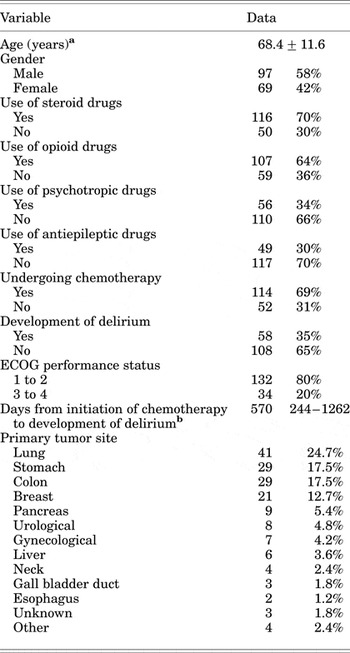
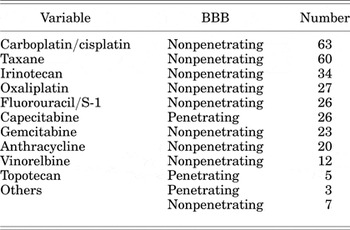
The demographic, disease, and treatment information for the 166 cancer patients are shown in Table 1. Characteristics were assessed at time of death. Performance status was documented at the first medical examination. Some 114 patients received chemotherapy. The drugs employed for chemotherapy are shown in Table 2.
Demographic and clinical characteristics of patients (n = 166)

Data are shown as a number and percentage, unless indicated as a mean ± SD, b median and interquartile range.
Agents used in the 114 treatment groups a

a Some patients received multiple drugs. BBB = blood–brain barrier.
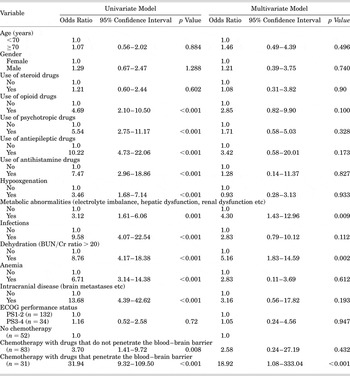
Risk Factors for Delirium (see Table 3)
In the multiple logistic regression model, antineoplastic drugs that penetrate the BBB were significantly associated with development of delirium (odds ratio, 18.92; CI 95 = 1.08–333.04; p < 0.001). Patients suffering from metabolic abnormalities and dehydration were also significantly more likely to develop delirium in the multivariate model.
Results of multiple logistic regression analysis

DISCUSSION
The present study demonstrated that chemotherapy with agents that penetrate the BBB may be a risk factor for development of delirium in cancer patients. There is growing evidence in the medical literature for increased incidence of cognitive decline—so-called “chemobrain” or “chemofog”—in cancer survivors that results from chemotherapy (Argyriou et al., Reference Argyriou, Assimakopoulos and Iconomou2010). A study by Wefel and colleagues (Reference Wefel, Lenzi and Theriault2004) showed that at 3 weeks postchemotherapy, 61% of participants experienced a decline in certain cognitive skills, including verbal and visual memory, executive function, visuospatial ability, and information-processing speed. A prospective, multicenter, longitudinal study using 12 neuropsychological tests showed that chemotherapy-induced cognitive impairment affected 27% of 101 patients with breast cancer after neoadjuvant chemotherapy (Hermelink et al., Reference Hermelink, Untch and Lux2007). Another review showed that impairment induced by chemotherapy significantly affected visual memory only (Jansen et al., Reference Jansen, Miaskowski and Dodd2005). These studies investigated the association between chemotherapy and slight cognitive dysfunction detected by specialized tests. However, prior to our current study, descriptions of delirium after chemotherapy have been limited to case reports. Few macromolecules are transferred into the brain because vesicular transcytosis in the endothelial cells is considerably limited, and the tight junction is located between the endothelial cells. In addition, there are several types of influx or efflux transporters at the BBB, such as P-glycoprotein (P-gp), multidrug resistance-associated protein, and breast cancer-resistant protein (Cordon-Cardo et al., Reference Cordon-Cardo, O'Brien and Casals1989; Ueno, Reference Ueno2009). The reason for the developing delirium might be a disruption of the BBB that leads chemotherapy drugs into brain tissue and results in accumulation of high levels of these drugs within the brain.
There are several limitations of our study. First, this study was not prospective but retrospective in design and employed chart review. The diagnosis of delirium could thus be unreliable, a factor that could not be overcome. Second, we did not investigate differences among duration of illness, presence of comorbidities, duration of the use of drugs, and the patient's psychosocial background (e.g., educational level and employment status). Third, several potentially important delirium risk factors were not taken into account in the analysis, including opioid dose and pain. Fourth, exposure to chemotherapy was not sufficiently examined, with no information included on dose, duration, and route, all of which may have had an impact on delirium onset. Fifth, the temporal link between chemotherapy and delirium that occurs 570 days later may be uncertain. Finally, we limited the study to cases of hyperactive and mixed-type delirium because of the difficulty involved in diagnosing hypoactive delirium by general medical staff. Further studies are needed to clarify the effects of these factors.
In conclusion, our findings suggest that chemotherapy agents that penetrate the BBB can be a risk factor for development of delirium. This information may allow palliative care doctors and medical oncologists to predict which patients are at increased risk of developing delirium.
DISCLOSURE STATEMENT
The authors have no competing financial interests to declare.