


Parliamentary committees are “the most significant internal organisational aspects of modern parliaments” (Coffé et al., Reference Coffé, Bolzendahl and Schnellecke2019), though understudied both generally and in the context of women’s representation specifically. Already underrepresented in most legislatures, women are often further marginalized within legislative committees, which are critical sites of decision-making (Bates et al., Reference Bates, McKay and Goodwin2020; Bolzendahl, Reference Bolzendahl2014; Coffé et al., Reference Coffé, Bolzendahl and Schnellecke2019; Goodwin et al., Reference Goodwin, Bates and McKay2021; Murray and Sénac, Reference Murray and Sénac2018; Pansardi and Vercesi, Reference Pansardi and Vercesi2017). Underrepresentation on committees not only limits women legislators’ influence over legislative content but may also constrain their access to policy expertise (McCallion and Goodyear-Grant, Reference McCallion and Goodyear-Grant2023), leadership opportunities, and political visibility. This doubling of exclusion—first from legislatures, then from their most powerful working groups—raises concerns about the distribution of political power, the reproduction of gender hierarchies, and the substantive representation of women’s interests.
This research note examines women’s representation on Canadian House of Commons standing committees using a novel dataset capturing the gender and partisan composition of the 24 permanent committees over 19 years (2006–2025) and six Parliaments. We assess women’s presence on committees overall, in committee leadership roles, across committee policy areas, and across parties. Our research reveals three key findings: women are underrepresented on House standing committees, disproportionately assigned to committees focused on policy areas such as health and social welfare, and further underrepresented among committee chairs. There is considerable heterogeneity across parties, meaning a party-conditional account of gendered political appointments is needed.
Our analyses make three contributions. First, we extend research on women’s representation in the Canadian Parliament by examining their presence on standing committees, an underexplored area. Second, we situate Canada in comparative work revealing gendered divisions of labour and hierarchical committee structures across multiple regions, pointing to transnational norms that marginalize women. Third, we address calls to examine party differences in committee assignments, showing how parties shape the link between women legislators’ representational interests and the creation of policies affecting women.
Parliamentary Committees
Parliamentary committees are core venues for legislative scrutiny, amendment of bills, and oversight of government (Docherty, Reference Docherty1997; Franks, Reference Franks1971; Malloy, Reference Malloy1996, Reference Malloy2023; Stilborn, Reference Stilborn2014). Naturally, debate exists about the types and strength of influence committees exert in the legislative process, and the associated effects, such as agenda setting, problem definition, and problem visibility (Labelle, Reference Labelle2026). From the 1950s–1990s, reforms were adopted to strengthen the Canadian committee system to counter perceptions of Parliament as a “rubber stamp” and enhance its oversight role (Docherty, Reference Docherty1997; Stilborn, Reference Stilborn2014). Standing committees gained considerable powers, such as the power to investigate ministers and officials, call expert witnesses, travel for evidence-gathering, and hire research staff (Franks, Reference Franks1989). Intended to improve policymaking, these functions make committee composition critical to ensuring diverse perspectives and fair governance.
Standing committees are typically comprised of 10 to 13 MPs appointed by their parties based on the parties’ proportions of House seats. To qualify for committee seats, a party must be a “recognized party,” holding at least 12 seats in the House. Generally, MPs serve on at least one standing committee, with most serving on two and a few serving on three (Chong, Reference Chong, Chong, Simms and Stewart2017; Loat and MacMillan, Reference Loat and MacMillan2015). Standing committees are presided over by a chair and usually two vice-chairs, who are nominally elected by the committee, though such elections are often pro forma, as the respective party whips traditionally control nominations of chairs and vice-chairs (Chong, Reference Chong, Chong, Simms and Stewart2017; McGrandle, Reference McGrandle2021). Notably, women’s representation as whip varies greatly by party: the Liberal Party of Canada (LPC) had five women whips out of a total of 12 (42%) over our time period (2006–2025); the Conservative Party of Canada (CPC) had one out of eight (13%); the New Democratic Party of Canada (NDP) had five out of seven (71%); and the Bloc Québécois (BQ) had three of five (60%).Footnote 1 As provided for in the Standing Orders, the majority of committees are chaired by the governing party and a few are chaired by opposition members. Standing committees usually meet twice per week for a total of four hours, but depending on the meeting, subject matter, or schedule of witnesses, some committees can meet up to 40 hours per week (House of Commons of Canada, 2005).
Committee membership is shaped by formal and informal rules within party caucuses. Party whips and leadership teams play decisive roles in recommending and approving committee appointments, typically balancing partisan loyalty and seniority, regional representation, and perceived competence and interest across policy domains (Atkinson and Nossal, Reference Atkinson and Nossal1980; Loat and MacMillan, Reference Loat and MacMillan2015; Raymond and Holt, Reference Raymond and Holt2014; Skogstad, Reference Skogstad1985). Gender could be a direct consideration in appointments, but its indirect effects may be even more powerful, operating through considerations like competence perceptions and seniority. In other words, while appointments reflect a range of criteria, these criteria are not necessarily gender neutral in their operation and can reproduce gender inequalities in ways that help explain gendered patterns of committee appointments. Committee appointments are fairly opaque and centralized, so they are susceptible to reproducing existing hierarchies in parties and legislatures.
Existing research on women’s representation in legislative committees concentrates on the United States (Bolzendahl, Reference Bolzendahl2014) and Europe, specifically the United Kingdom (Bates et al., Reference Bates, McKay and Goodwin2020; Goodwin et al., Reference Goodwin, Bates and McKay2021), France (Murray and Sénac, Reference Murray and Sénac2018), Italy (Pansardi and Vercesi, Reference Pansardi and Vercesi2017), Germany (Coffé et al., Reference Coffé, Bolzendahl and Schnellecke2019), and Sweden (Bolzendahl, Reference Bolzendahl2014). Several broad trends have been identified. First, there is a positive correlation between women’s representation in legislatures and their representation on legislative committees (Bolzendahl, Reference Bolzendahl2014). More women in legislatures corresponds to more women committee members.
Second, the most consistent finding across countries is gender segregation of committee assignments. Coffé and her colleagues (Coffé et al., Reference Coffé, Bolzendahl and Schnellecke2019: 257) argue that persistent gender segregation on committees reflects “theories on the social construction of gender”—women overrepresented on committees involving, for example, families and health, and underrepresented on committees involving, for example, foreign affairs and defence. This finding is corroborated by other studies (Barnes, Reference Barnes2014; Coffé et al., Reference Coffé, Bolzendahl and Schnellecke2019; Heath et al., Reference Heath, Schwindt-Bayer and Taylor-Robinson2005; Thomas, Reference Thomas1994). Other work on political appointments offers similar classifications, such as Krook and O’Brien’s work on ministerial appointments (Reference Krook and O’Brien2012), though we argue below that such a perception does not account for parties’ differing priorities, including intra-party change over time, potentially, and that less static typologies are needed. For example, left parties like the NDP often value and prioritize social policy domains in their legislative agendas and political appointments.
Gender segregation on committees is anticipated by feminist institutionalist accounts, which recognize “that constructions of masculinity and femininity are intertwined in the daily life or logic of political institutions” (Mackay et al., Reference Mackay, Kenny and Chappell2010: 580). Feminist institutionalists suggest that gender imbues political institutions “to protect masculine privilege” (Bolzendahl, Reference Bolzendahl2014: 848), meaning institutions “are not gender neutral, but systematically privilege men and (hegemonic) masculinity, marginalize women and the ‘feminine,’ and contribute to gender segregation” (Bolzendahl, Reference Bolzendahl2014: 849).
Feminist institutionalism explains gender segregation on committees as a product of institutional logics that embed and reproduce masculine privilege, marginalizing women and “feminine” policy domains. Party effects operate within this institutional terrain, shaping how strongly these gendered logics are expressed. Often more resistant to gender equality measures, conservative parties may align more closely with and reinforce exclusionary institutional norms, resulting in higher segregation. In contrast, left parties may counteract institutional bias through stronger commitments to representational equality. In other words, while party influences committee gender segregation, the pattern reflects deeper, institutionally embedded gender norms that transcend partisan boundaries. Research on legislative committee membership is consistent with this interpretation of the interplay between institutionalist and party effects, revealing committee gender segregation tends to be strongest for conservative parties and weakest within left parties (Heath et al., Reference Heath, Schwindt-Bayer and Taylor-Robinson2005; Pansardi and Vercesi, Reference Pansardi and Vercesi2017).
Third, some scholars find evidence of a gendered hierarchical structure where women are underrepresented in committee leadership roles, such as committee chairs (O’Brien, Reference O’Brien2012; Sawer, Reference Sawer2000; but see Brown et al., Reference Brown, Donaghy, Mackay and Meehan2002; Darcy, Reference Darcy1996). A gendered hierarchical structure reflects institutional norms that prioritize men’s stereotypical traits and competencies for leadership positions, institutional practices that make parliaments an easier workplace for men but also reflect the simple fact of men’s dominance of parliamentary institutions, all insights derived from the feminist institutionalist literature. As Coffé and her colleagues note (Reference Coffé, Bolzendahl and Schnellecke2019: 259), “Men’s over-representation in legislatures has meant that men MPs tend to hold seniority and power within the system, enabling more men to claim their preferred roles within legislatures.”
There is mixed evidence, however, that women are less likely than men to hold chair positions, relative to their proportion of committee memberships or House seats. Factors such as method of selection seem to matter for women’s proportions of committee chair positions. For example, following the 2010 national election, the United Kingdom introduced elections for committee members and chairs to wrest selection from party whips. In the first Parliament in which this selection method was used, there was no gender bias in committee leadership (O’Brien, Reference O’Brien2012). The policy focus of committees might matter too in that when women are appointed to these leadership positions, we may see analogous patterns as with gender segregation in committee membership generally.
Research Expectations and their Implications for Representation
We have five general research expectations regarding the underrepresentation and segregation of women on House committees. First, we anticipate women’s representation on legislative committees to increase as their representation in the House increases (Expectation 1). This is aligned with comparative research.
Second, we expect gendered segregation in committee membership reflecting “theories on the social constructions of gender” (Coffé et al., Reference Coffé, Bolzendahl and Schnellecke2019: 257) (Expectation 2). This is in line with feminist institutionalism and comparative research. We also expect this in Canada due to gender segregation in other parliamentary venues, including cabinet assignments (de Geus and Loewen, Reference De Geus, Loewen, de Geus, Tolley, Elizabeth and Loewen2021) and cabinet committee assignments (Ie, Reference Ie2021; Siklodi et al., Reference Siklodi, Ie and Allen2023). We acknowledge that gender segregation in committee assignments could happen for many reasons, not all of which involve parties relying on gender stereotypes. Other possibilities include MPs’ preferences, constituency differences, or even MPs’ past experience. Indeed, work on legislators’ pre-parliamentary careers indicates consistent gender differences in the occupations of men and women legislators (Barnes and Holman, Reference Barnes and Holman2025; Tremblay and Trimble, Reference Tremblay and Trimble2004). For example, men MPs tend to be more likely than women MPs to come from law and business/managerial backgrounds (Barnes and Holman, Reference Barnes and Holman2025; Sevi, Reference Sevi2019, Reference Sevi2021). These pre-parliamentary careers may contribute to gendered committee assignments. Moreover, these gendered pre-politics occupational patterns are fairly consistent across all three national parties, as our analysis of Sevi’s data on federal MPs (Reference Sevi2019) reveals (data not shown), suggesting that occupational background is unlikely to be a primary driver of cross-party variation in gendered committee assignments.
Leaving aside questions about the impact of pre-political careers, it is still worth analyzing committee assignments through a gendered lens because gender segregation can send signals about who is responsible for issues (for example, “women’s issues” are the responsibility of women). It can also sideline women’s (and men’s) perspectives on committees to which they are (less often) assigned. Also, “feminine” and “masculine” committees do not have equal status: feminine committees are often seen as less prestigious assignments and masculine committees as more prestigious (see Krook and O’Brien Reference Krook and O’Brien2012). As a result, gender segregation in committee assignments can reproduce masculine privilege and further marginalize women and “feminine” policy domains.
Third, we have mixed expectations about potential party differences. Consistent with comparative research, we expect gender segregation in committee assignments to be strongest in conservative parties and weakest in left parties (Expectation 3a). If conservative parties are more resistant to gender equality measures, they may be more likely to rely on stereotypes that place women on traditionally “feminine” committees, thereby contributing to greater gender segregation. In contrast, left parties—given their stronger commitments to representational equality—may be more responsive to critiques of assigning women to “pink-collar” policy areas and take steps to avoid such segregation, resulting in relatively fewer gendered committee assignments. Our expectations are mixed, however, because we recognize that left parties often prioritize “feminine”-coded policy areas (for example, health) while conservative parties tend to emphasize “masculine”-coded areas (for example, crime and public safety). This could complicate expectations as left parties’ substantive policy priorities—coupled with their commitment to representational equality—may inadvertently reinforce traditional gendered patterns in committee assignments (Expectation 3b). In other words, there is a tension between expectations 3a and 3b in that while left parties’ commitments to gender equality might lead to reduced segregation on committees, left parties’ substantive emphasis on “feminine”-coded policy areas may paradoxically reproduce it.
Fourth, we expect to find a gendered hierarchical structure in which women are underrepresented in committee leadership positions (chairs and vice-chairs) (Expectation 4). This expectation aligns with some comparative research (O’Brien Reference O’Brien2012; Sawer Reference Sawer2000; but see Brown et al. Reference Brown, Donaghy, Mackay and Meehan2002; Darcy Reference Darcy1996) and feminist institutionalist theories about men’s dominance in parliamentary institutions. It is also more likely in Canada where these assignments are made by party whips instead of through elections. While some of this underrepresentation may be attributed to men having greater seniority—enabling them to secure leadership roles—it remains important to examine the assignment of chairs and vice-chairs through a gender lens for two reasons. First, a gender gap in seniority may itself stem from gendered dynamics, such as women leaving political office due to harassment or other systemic barriers. Second, even if women are more likely to be passed over for committee leadership roles due to lower seniority, this initial exclusion can compound over time, limiting their access to policy expertise, leadership development, and political visibility, thereby reinforcing broader gender disparities in influence and career advancement.
Finally, we expect women to be better represented in leadership positions on committees working on stereotypically “feminine” policy fields (Expectation 5). This pattern could reflect gender stereotypes, but it may also result from women having greater expertise or longer tenure in these areas, making them well-qualified to lead such committees. Leadership positions, however, warrant examination through a gendered lens because they may shape (1) the areas in which women are given opportunities to develop further expertise—potentially influencing future political roles such as ministerial appointments (Wernick, Reference Wernick2021)—and (2) the degree of political recognition or respect women receive for their leadership, given that not all committees carry the same prestige (Krook and O’Brien, Reference Krook and O’Brien2012). As a result, even when women hold leadership roles, the symbolic and strategic value of those roles may be unevenly distributed.
Data and Methodology
We use the House website to gather data on the composition of the House and the membership of each standing committee from the 39th Parliament (April 3, 2006) until the 44th Parliament (March 23, 2025). We chose this 19-year period for three reasons. First, during this period, the 24 committee portfolios were static.Footnote 2 Second, the four main parties stayed consistent during this period.Footnote 3 Third, this period provided symmetry. In the first nine and a half years studied (2005–2015), the CPC was the governing party across three Parliaments; two were minority Parliaments and one was a majority. In the second nine and a half years (2015–2025), the LPC was the governing party across three Parliaments; two were minority Parliaments and one was a majority.
Of the 11 sessions in the 6 Parliaments included in the period under study, we collected data on ten sessions given that the 40th Parliament, 1st session, saw the 2008 constitutional crisis and the subsequent prorogation of Parliament where all but one committee was unable to meet.
We collect a wide variety of data on the membership of each standing committee. This includes the gender composition of committee membership and leadership positions (chairs and vice-chairs), broken down by political party. Considering that changes in committee membership are quite common during sessions, we weigh each membership and leadership arrangement by the number of days the arrangement was constituted for each Parliament. We also use the Library of Parliament website to account for the number of women elected to each party’s caucus in each general election. Using these data, we calculate averages of women’s representation in committee membership, in membership for each party, and in leadership roles.
Throughout, we present descriptive findings rather than attempting to isolate the causal impact of gender from other intersecting factors such as location, seniority or individual preferences. This approach is appropriate for two key reasons. First, our research expectations—drawn from comparative and feminist institutionalist scholarship—are themselves descriptive and allow us to place the Canadian case in dialogue with comparative work. Second, any attempt to statistically isolate gender from other factors, such as seniority, risks understating the importance of gender (given, for example, that gendered dynamics can contribute to political exits and thus seniority) and overlook important gendered consequences of committee assignments in the context of existing institutional and political realities. Instead, we foreground gender as a critical lens for understanding how opportunities and constraints are distributed, reflecting our commitment to examining the consequences of committee assignments for representation. In this sense, it matters less whether gender is the sole driver of observed patterns and more that these patterns have implications for equity, access to policy expertise, leadership development and political visibility.
Analysis
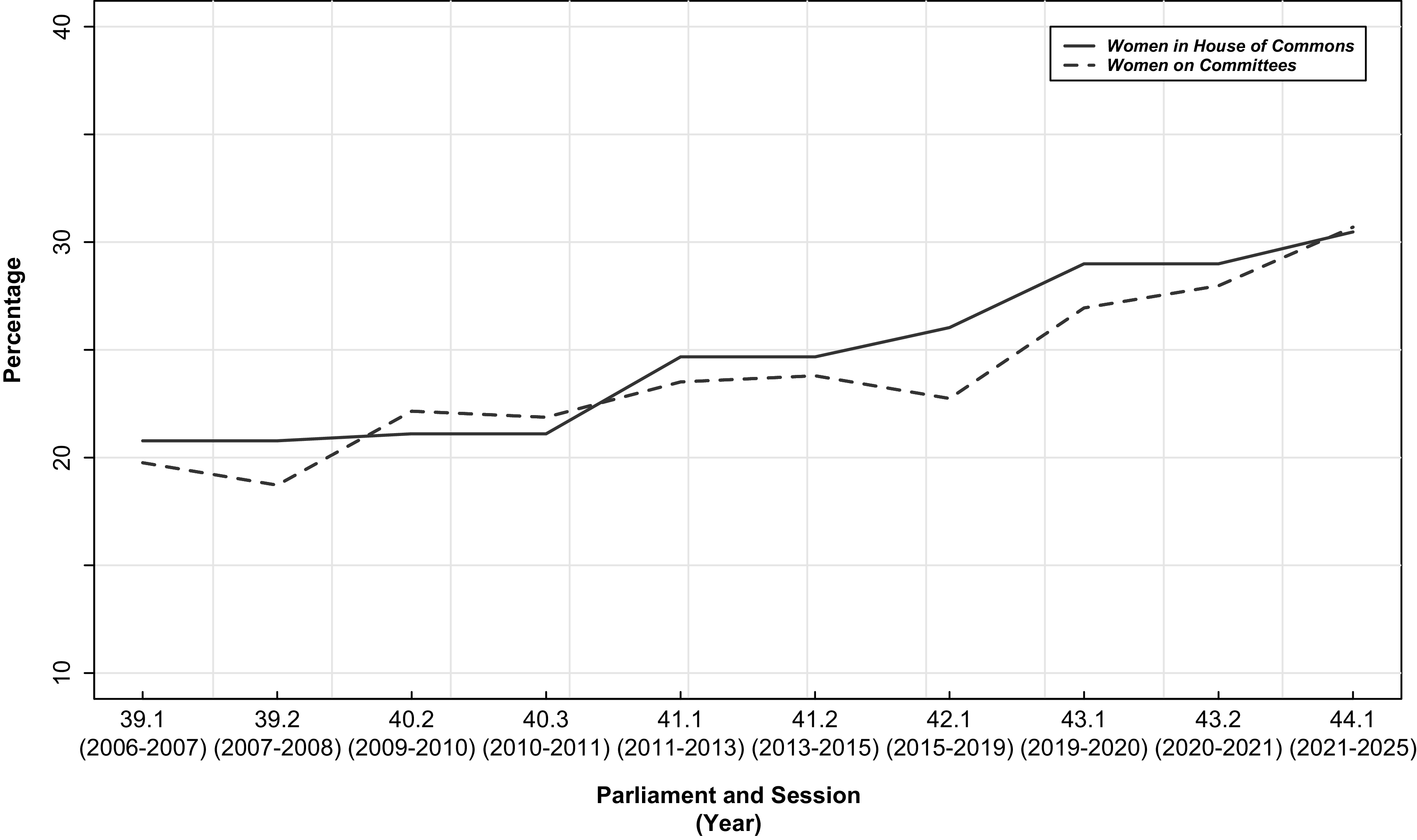
We begin by examining the relationship between women’s representation in the House and on committees. We treat women’s representation in the House as an important baseline since that is the pool from which MPs are assigned to committees. Consistent with comparative research and Expectation 1, Figure 1 shows a close correspondence between the two: although women were slightly underrepresented on committees relative to the House during certain periods (for example, from the early 2010s through the early 2020s), the overall trend indicates that their representation has increased over time—somewhat in tandem—in both venues. Throughout the period studied, we observe an average underrepresentation of only 0.94 percentage points in committee positions compared to House seats.
Women’s shares of House Seats and Committee Positions, 2006–2025.

We interpret this result as good news—at least within our current political context. Women are not substantially less or more likely to be assigned to committees relative to their representation in the House. This suggests that women are not being excluded from critical sites of decision-making, leadership development, or political visibility. It also suggests they are not disproportionately burdened with committee work, which could raise concerns about unequal workloads. Of course, this pattern could reflect a range of dynamics—including institutional norms around relatively equal numbers of assignments for each MP—but its consequences for equity and representation remain important. That said, this is good news within the constraints of who is currently in the legislature: women remain underrepresented in the House relative to the population, and this necessarily spills over into committee composition.
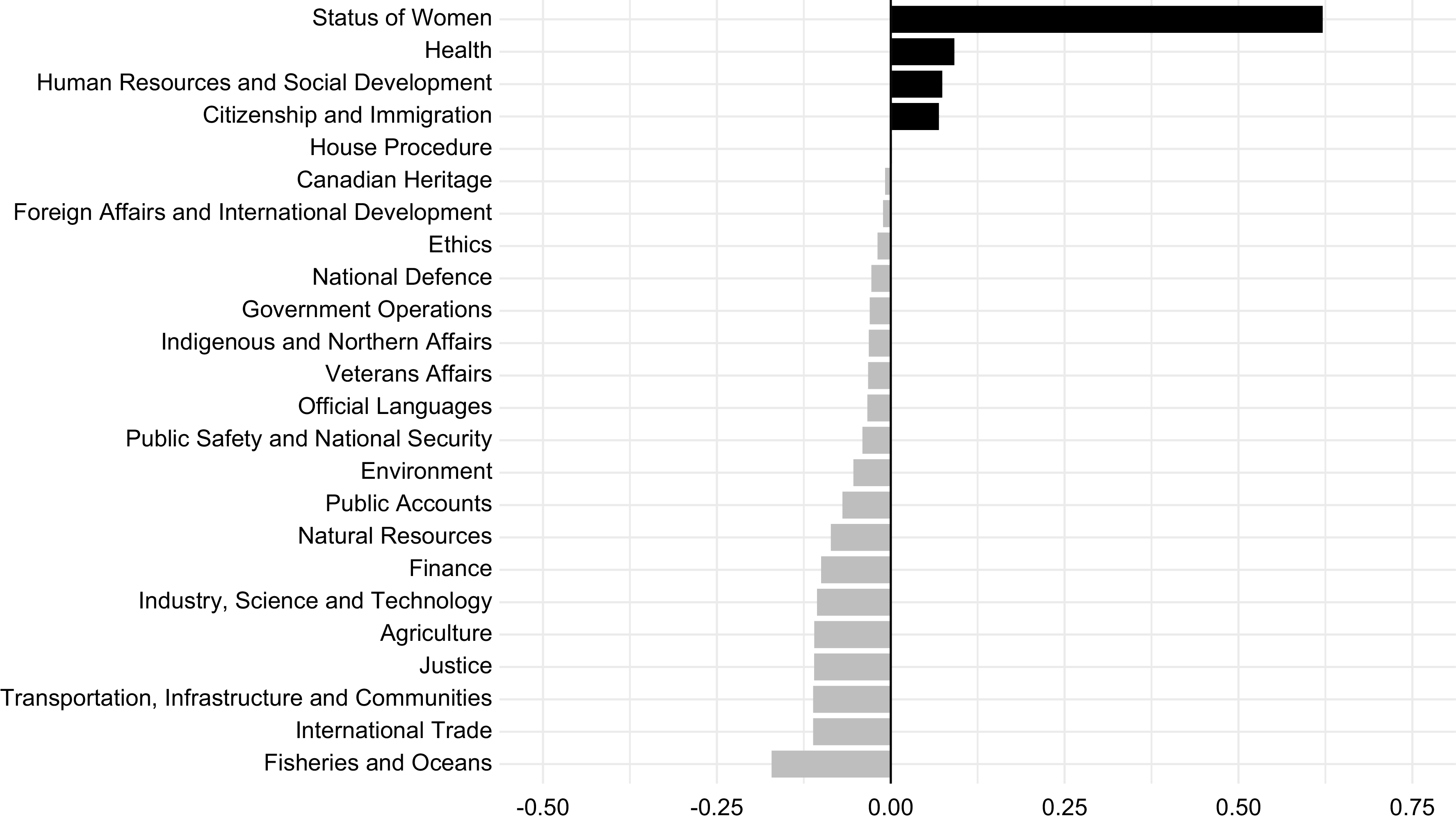
A less optimistic story emerges when we examine the specific committees to which women are assigned. Figure 2 shows the extent to which the representation of women on each committee deviates from equality, following Coffé et al.’s analyses (Reference Coffé, Bolzendahl and Schnellecke2019). If the ratio equals 0, the percentage of women MPs represented on that committee is the same as the percentage of women MPs in the House. A ratio lower than 0 indicates women’s underrepresentation on the committee compared to House and a ratio higher than 0 reveals women’s over-representation. Consistent with comparative research and Expectation 2, Figure 2 reveals gender segregation: women are overrepresented on stereotypically “feminine” committees—such as Status of Women, Health, and Human Resources and Social Development—and underrepresented on stereotypically “masculine” committees—including Fisheries and Oceans, International Trade, Finance, and Public Safety and National Security.
Variations in the Ratio of the Percentage of Women MPs on Each Committee Compared with the Average Percentage of Women MPs in House of Commons, 2006–2025.

For us, this gender segregation raises concerns. While women’s representation on the Status of Women committee is valuable, and while some women may prefer or be more qualified for “feminine” committees due to prior experience, these patterns can nonetheless reinforce gendered dynamics with troubling implications. For example, gendered committee assignments can signal that certain issues—such as “women’s issues”—are almost exclusively the responsibility of women, which can limit broader engagement and even be counterproductive. They can also sideline women’s perspectives on committees where they are less often present, such as those focused on fisheries and oceans, international trade, justice, or finance. This is concerning because all policy areas can have implications for women. In addition, “feminine” and “masculine” committees do not carry equal prestige: the latter are often viewed as more prestigious. As a result, gender segregation in committee assignments can reproduce masculine privilege and further marginalize women and “feminine”-coded policy domains.
Turning to party-specific patterns, we had mixed expectations. There are striking cross-party similarities in where women are over- and underrepresented. As Figure 3 shows, all parties overrepresent women on the most traditionally “feminine”-coded committee (Status of Women) and underrepresent women on some “neutral” or “masculine” committees, such as Justice, International Trade, Finance and Agriculture. These patterns suggest that, regardless of ideology, parties tend to reproduce gendered norms in committee assignments.
Variations in the Ratio of the Percentage of Women MPs on Each Committee Compared with the Average Percentage of Women MPs in Caucus by Party, 2006–2025.

Figure 3 Long description
The image contains four bar graphs labeled a, b, c, and d. Each graph represents a different political party in Canada: Liberal Party of Canada, Conservative Party of Canada, Bloc Québécois, and New Democratic Party of Canada. The horizontal axis of each graph lists various parliamentary committees, while the vertical axis shows the ratio of the percentage of women MPs on each committee compared to the average percentage of women MPs in the caucus. Panel a shows the Liberal Party of Canada with the highest ratio for the Status of Women committee and the lowest for Fisheries and Oceans. Panel b depicts the Conservative Party of Canada with the highest ratio for Status of Women and the lowest for Public Accounts. Panel c illustrates the Bloc Québécois with the highest ratio for Status of Women and the lowest for Finance. Panel d represents the New Democratic Party of Canada with the highest ratio for Status of Women and the lowest for Ethics.
When we turn to party differences, our findings challenge the expectation from comparative research that conservative parties would exhibit greater gender segregation in committee assignments (Expectation 3a). Instead, Figure 3 shows that the CPC is the least prone to gender segregation; the extent to which CPC women MPs are over- or underrepresented on committees stays within a fairly narrow range. This finding is particularly striking given that the CPC had the fewest women whips during the period under study, which raises questions about what explains this pattern. Future research could use qualitative methods to explore how CPC whips make committee assignments and the committee preferences of CPC MPs.
Our expectations about party differences were mixed, in part, because we recognized that left parties often prioritize “feminine” policy areas (for example, health) while conservative parties tend to prioritize “masculine” policy areas (for example, crime and public safety). This raised the possibility that left parties’ policy priorities—combined with their commitments to representational equality—might inadvertently reinforce gendered patterns in committee assignments (Expectation 3b). Figure 3 offers only modest support for this interpretation. For instance, women are overrepresented on the Health committee among the LPC and, to a lesser extent, the NDP—both parties for whom health is traditionally a priority. The NDP also overrepresents women on Indigenous and Northern Affairs, and Environment, both areas of importance to the party. However, if left parties were actively working to represent women well in policy areas central to their platforms, we might expect even stronger women’s representation on committees such as Human Resources and Social Development, and Citizenship and Immigration for the LPC, Health for the NDP, or Official Languages for the BQ.
Moreover, if left parties were consistently challenging gendered norms in committee assignments, we would expect more frequent counter-stereotypic placements. While there are some exceptions—such as women being only slightly underrepresented on National Defence for the LPC and even slightly overrepresented on this committee for the NDP—these instances are limited and not consistent across other traditionally “masculine”-coded committees, such as Finance. Overall, the evidence suggests that left parties are not systematically disrupting gendered patterns in committee assignments. This raises concerns that even when women are present on committees generally, their perspectives may be least represented in the very policy areas—such as Finance—where gendered analyses are most needed to challenge dominant understandings and ensure inclusive policymaking.
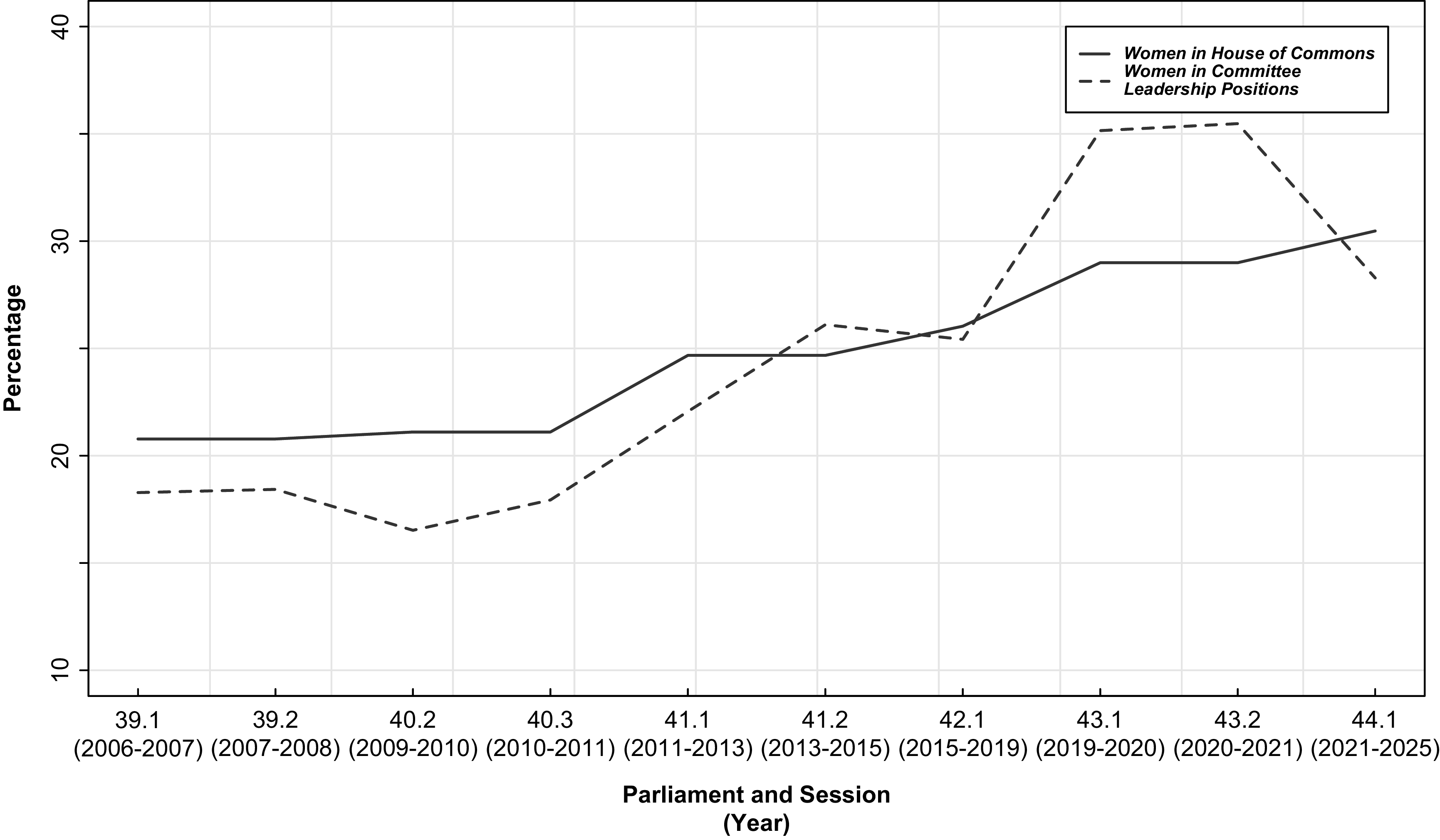
We now turn to committee leadership positions (chairs and vice-chairs). Examining the relationship between women in the House and in committee leadership positions, Figure 4 demonstrates a turbulent correlation between the two. Throughout the period studied, we observe an average underrepresentation of 0.39 percentage points. This result supports Expectation 4, but perhaps not to the anticipated degree of underrepresentation. However, there was important change over time: while women were consistently underrepresented in committee leadership positions in the first half of the period (2006–2013), women’s representation almost doubled in the latter half (2013–2025). This trend roughly aligns with the rise of LPC Leader Justin Trudeau in 2013 and the associated switch from a CPC to LPC government in 2015, and is consistent with growth in women’s representation in other appointed venues under this Liberal government too (i.e., Cabinet, Senate).
Women’s Share of House Seats and Committee Leadership Positions, 2006–2025.

We also consider this good news. This trend signals growing opportunities for women to develop leadership experience, policy expertise and political visibility. Such experience is important for women’s substantive representation in agenda-setting for committee studies and witnesses. Further, exposure to committee leadership positions may have implications for access to other leadership positions within parties, such as ministerial positions.
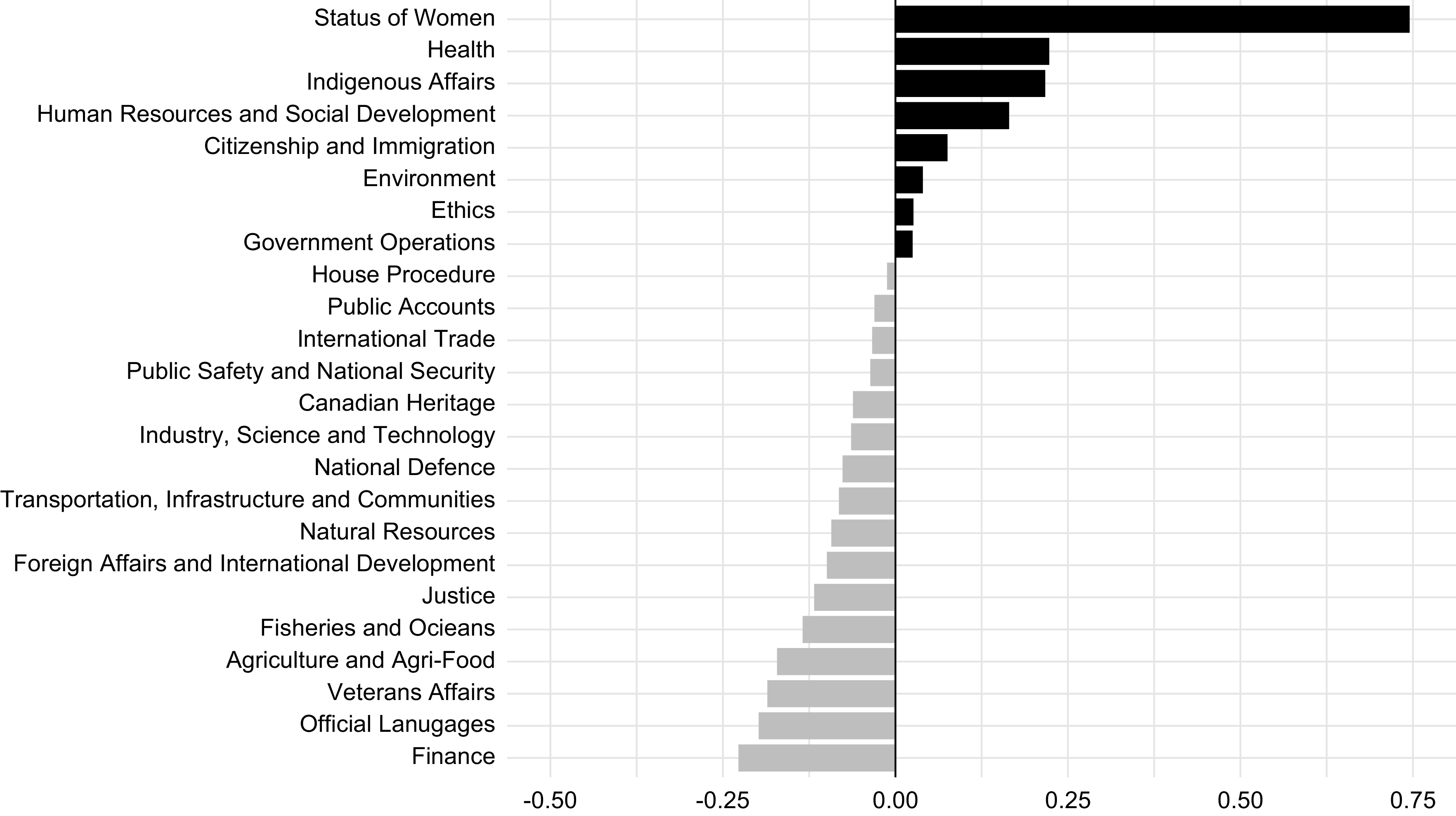
Finally, we examine gender segregation in leadership positions. Consistent with Expectation 5, Figure 5 shows that women are better represented as chairs and vice-chairs on committees working in “feminine”-coded policy fields (for example, Status of Women, Health, and Human Resources and Social Development) and underrepresented as chairs and vice-chairs on “masculine”-coded committees (for example, Finance, Agriculture, Fisheries and Oceans, and Foreign Affairs and International Development), mirroring committee membership (Figure 2). Given that chairs and vice-chairs have unique levers to shape committee agendas and discussions, their gender composition matters. Our findings raise concerns about women’s underrepresentation in leadership roles on committees, such as Finance, and Foreign Affairs and International Development. When women are less likely to be selected as chairs and vice-chairs of these committees, there may be fewer opportunities to incorporate gendered analyses or consider the differential impacts on women, even though the decisions made in these committees have significant consequences for women.
Variations in the Ratio of the Percentage of Women MPs in Leadership Positions on Each Committee Compared with the Average Percentage of Women MPs in House of Commons, 2006–2025.

Discussion and Conclusion
Our dataset spans 24 House standing committees over 19 years, 6 parliaments, and 4 major parties, providing perspective that is both broad and deep. Women’s growing presence in the House has not translated into equivalent representation within the powerful internal arena of standing committees. Although women’s overall committee representation now roughly mirrors their proportions in the House, women’s assignments and leadership roles reflect enduring gender hierarchies. Beyond these enduring gender hierarchies, Labelle’s (Reference Labelle2026) research on FEWO raises additional concerns about women’s substantive representation, finding that the committee’s studies and witness selection tend to privilege universalistic rather than intersectional understandings of women’s interests. That these patterns emerge even within a committee explicitly dedicated to representing women, and overwhelmingly composed of women MPs, raises broader concerns about the inclusiveness of women’s representation across parliamentary committees.
Gendered segregation of committee assignments reflects institutional logics that privilege masculine expertise and leadership. Formal rules appear neutral and norms of gender equality have wide acceptance, yet informal norms about competence and seniority, for example, may sustain gendered hierarchies. That these patterns cut across party lines likely reveals how deeply embedded they are and may suggest that advancing women’s representation requires not only ideological commitment but institutional change that alters how committees are constituted and chaired.
Our findings provide justification for consideration of institutional reforms that make the committee assignment process more transparent and accountable. Party whips and leadership teams have significant discretion in committee assignments, which are not publicly explained or grounded in identified criteria. Committee assignment practices should be publicly documented and periodically reviewed to ensure that they do not reproduce structural bias. A practical starting point is systematic monitoring, which would enable both researchers and legislators to identify disparities early and evaluate whether reforms are working. Independent oversight—such as review by the Speaker’s Office or an external gender equity audit—could help as well. Comparative evidence from parliaments that have introduced committee member and chair elections or formal gender balance rules suggests that procedural visibility itself can reduce bias (O’Brien, Reference O’Brien2012). Going a step further, Parliament could consider reform to selection procedures, perhaps following the direct election of committee members and chairs to United Kingdom select committees, which seems to have dramatically reduced gender gaps in committee composition (O’Brien, Reference O’Brien2012).
Supplementary material
The supplementary material for this article can be found at https://doi.org/10.1017/S0008423926101383.
Acknowledgements
We would like to thank the Journal, its editors and the paper’s anonymous reviewers for their constructive feedback and support. For research assistance, we thank Lyiah Lopes. For comments on previous drafts, we thank Quinn Albaugh, Joanne Arnel, Kehanah Brown, Nick Cigagna, Paul Gardner, Joseph Hodgson, Ben Kinsella, Emma Miller, Nikhil Pandeya, Kate Poehlmann and Emma Sharkey. Kevin Arnel acknowledges support from the Ontario Graduate Scholarship, University of Ottawa’s Faculty of Law and Queen’s University’s Department of Political Studies.
Competing interests
The authors declare none.



 Open access

