Introduction
The Developmental Origins of Health and Disease (DOHaD) Society of Australia and New Zealand (DOHaD ANZ; www.dohad.org.au) was launched in 2014, becoming an affiliate of the International DOHaD Society soon thereafter. As a new society, a major goal was to establish our collective identity through a strong collaborative environment, and to promote engagement, discussion and interdisciplinary research. To this end we established a set of Working Groups that comprise focussed but flexible units of collaborative researchers from diverse backgrounds. These researchers share a common interest in overlapping aspects of the DOHaD field. Many of these Working Groups arose from initial discussions at the inaugural 2014 annual Congress, and some were convened for the first time at the 2015 annual Congress. An additional major aim was to promote an ongoing forum for communication between networks of scientists in the national and international DOHaD arena. More particularly, this was intended to perpetuate engagement, communication and collaboration between annual Congresses.
Each Working Group has one or more of the following aims related to their specific theme, to: (1) develop ideas and hypotheses; (2) increase dialogue between basic scientists, epidemiologists, clinicians and public health researchers; (3) connect with like-minded individuals internationally; (4) work towards translational opportunities; (5) suggest and organize themed sessions at future national and international DOHaD conferences; (6) approach other societies to increase awareness of DOHaD and organize conference sessions; (7) explore opportunities for grant funding and (8) advocate ideas and concepts to state and national governments.
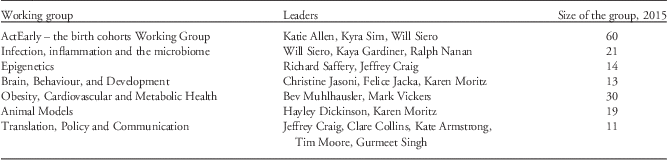
Each Working Group (Table 1) has one or more leaders whose main responsibilities are to communicate with the Working Group, submit annual reports to the DOHaD ANZ Council, organize and chair Working Group meetings at each DOHaD ANZ Annual Congress and, as needed, organize Working Group meetings outside of this Congress. In turn, DOHaD ANZ provides a venue for an annual Working Group meeting at the Annual Congress and support for advocating to government and professional bodies. In the following sections, each Working Group reports on its aims and activities to date.
Summary of DOHaD ANZ working groups

ActEarly: the birth cohorts working group
Throughout Australia and New Zealand a number of studies have been established that investigate the DOHaD hypothesis from a number of different angles from conception to adulthood, and through to the next generation. Some are general cohorts, while others are longitudinal, cross-sectional or intervention studies. These are at various stages of the study process, from planning through to completion. As the results of these studies start to emerge, it is becoming clear that the full impact of the findings relies upon bringing together data from many separate studies. This will provide both a necessary and powerful vehicle for using the information to influence health policy and practice.
The ActEarly Working Group was established in 2014 at the inception of DOHaD ANZ, in line with the founding philosophy that a full scientific potential and capacity to influence health policy can be best realized with collaboration.
The aim of this Working Group is to build on the expertise resident within Australia and New Zealand, and to develop, manage and maximize the output from studies (cohort, longitudinal, cross-sectional and intervention studies) that have a DOHaD focus. We aim to do this in a manner that enables best practice and future harmonization of study protocols and interventions, collaborating to produce tangible strategies that will improve future health and wellbeing. The objectives facilitating the aim are to: (1) share knowledge of what is in development; (2) develop a platform to share successes and problems, and how to assist others in anticipating these; (3) harmonize measures and produce life course data; (4) offer a platform to assist with combined grant applications and publications and (5) develop joint translational projects and Government implementation of combined study findings.
In order to develop a collaborative database, the Working Group is developing a three-tiered level of measures and biospecimens to recommend for future studies (using the same measures, protocol and time points wherever possible). These tiered measures intend to help in developing new studies or study waves and are not necessarily prescriptive. We intend that measures already collected are made available and/or modified to facilitate future harmonization of data. There will be a focus on obtaining information from both biological parents to enable a complete investigation of transgenerational effects. The levels will be dependent on the research area and are divided as follows:
-
∙ Level 1: The essential information/measurements that all studies will endeavour to collect.
-
∙ Level 2: A set of measures that will be collected depending on the focus of the study. For example, common cardiovascular, lung function and attachment measures.
-
∙ Level 3: The gold standard of study measures for depth cohorts if funding and resources are available. This will enable studies to choose additional measures that align with their research programme.
There are two elements to harmonization: one is the measure itself and the other is the construct that the measure is developed from. While it may be challenging to harmonize measures (as these need to be specific to the question(s) asked in a given study) if the construct is harmonized then this will allow the creation of z-scores for pooled analyses.Reference Griffith, van den Heuvel and Fortier 1 This approach has the potential to provide the large sample sizes required to fully understand how risk factors determining a child’s future health and disease status interact with each other.
The ‘ActEarly’ collaboration therefore provides an opportunity for a wider range of expertise to address research questions relating to DOHaD and translates the work into real-world solutions. A list of details of all current cohort studies represented within this Working Group can be found in Supplementary Table 1.
Infection, Inflammation and the Microbiome (IIM)
IIM play a central role in the development of a large number of diseases and disorders.Reference Caballero and Pamer 2 – Reference McKenney and Pamer 4 There is a growing body of evidence suggesting IIM programmes the immune system very early in its development, influencing health and disease outcomes later in life.Reference Hsu and Nanan 5 As such, IIM are central to the DOHaD concept. Australia has considerable expertise and an international reputation in the IIM area, which is documented by a significant number of ongoing studies and trials exploring the role of IIM in the development of non-communicable diseases. The ‘Infection, inflammation and immunity’ Working Group of DOHaD ANZ was formed to bring together Australian and New Zealand researcher and clinicians working in this area.
Aims of the IIM Working Party are to support the conduct of IIM research in the realm of DOHaD, and to provide support and collaborative solutions for future research.
At the conference, researchers outlined key issues that hinder research in the DOHaD IIM area. These included a lack of best practice guidelines and standard operating procedures (SOPs) regarding IIM sample and data collection, analysis and publication in order to reduce duplication and promote harmonization, and access to a network of researchers to act as a source of advice on planning and conducting future research in this area.
To address its aims and overcome the current limitation, the group’s initial objectives are to outline what data already exist and what gaps remain in the field. Specific, early objectives for the group are to (1) establish best practice guidelines for IIM studies regarding which clinical samples and data exist and how they can be used in IIM studies (including how dietary intake can be best assessed, particularly in the context of microbiome studies, and how best to collect, process, store and analyse samples to produce reliable and high-quality data and measurement of infection load and antibiotic exposure); (2) provide access to other IIM experts for research in the DOHaD field and for assistance and/or collaboration and (3) work with the ‘ActEarly’ group to provide a resource of existing SOPs for researchers working in the IIM area.
These objectives support our aim to provide consistent, best-practice protocols in IIM studies in Australia and New Zealand, which ultimately intend to improve the health and wellbeing of children and adults. In particular, the development of harmonized measures and studies will facilitate interaction among researchers to answer important questions about the role of IIM in the development of health and disease. There is already major collaboration between a number of the external groups and studies within the Working Group, providing a successful model for broader collaboration across Australia, New Zealand and beyond.
Epigenetics
By its nature, the field of epigenetics is broad and inclusive, spanning many disciplines. The discovery and development of these mechanisms have provided a major biological platform in the DOHaD fieldReference Gluckman 6 as a major mediator of both transgenerational and early life impacts on many aspects of health across the life course. This is due to: (1) the largely complete ‘resetting’ of epigenetic profiles with each generation, (2) the highly dynamic nature of the epigenetic profile very early in development, (3) the generally overall stable nature of the epigenetic profile across the life course in tissues once established (with some exceptions, e.g. epigenetic ‘drift’Reference Shah, McRae and Marioni 7 ), (4) demonstrated sensitivity to environmental influence in pregnancy and (5) epigenetics’ unequivocal role in the regulation of all gene expression and therefore phenotype. Consequently, it is not surprising that interest in epigenetic methodologies, including analysis approaches, has grown rapidly within Australia and internationally.
The ‘Epigenetics’ Working Group consists of participants from both New Zealand and every state in Australia. From the outset there was general consensus that an ongoing Epigenetics Working Group would be beneficial to those in the DOHaD field locally, particularly to facilitate knowledge sharing and potential future collaboration. Working Group member interests and expertise are wide-ranging and include both experts in the area as well as members with little or no experience. Australasia has been at the forefront of both DOHaD and epigenetic research for some time and we hope that this Working Group will continue to facilitate excellence through collaboration in the region, particularly through our work with the human observational cohorts and animal model studies.
Although most researchers work on DNA methylation (primarily due to analytical factors) our group recognizes that other epigenetic marks, including histone modification and non-coding RNAs, are likely to play a key role in DOHaD-related phenomena. Thus, any initiatives related to epigenetics will not necessarily be ‘methylation-centric’. The potential for smaller interest groups to form under the ‘Epigenetics’ Working Group umbrella was raised but it is unclear whether sufficient individuals are working in these areas to warrant such an approach at present.
A key goal of the group is knowledge sharing, including the development of a database of expertise and SOPs. The importance of sharing information related to epidemiological principles/statistical analysis/bioinformatic approaches in epigenomic studies has been highlighted through this Working Group. Suggestions for an ‘Epigenetics for Beginners’ course at future ANZ DOHaD meetings has been endorsed and is advocated by this Working Group as a whole.
To facilitate further discussion, interaction and knowledge dissemination and translation, a dedicated group homepage will be developed and linked to the ANZ DOHaD site for interested parties. This will act as a hub and directory for discussion forums, protocols and contact details. It will also provide links to other relevant sites, particularly the Australian Epigenetics Alliance website (www.epialliance.org.au/). Other sites of note include Epigenie (epigenie.com/) and EpigenomicsNet (www.epigenomicsnet.com) for epigenetics news and conferences. We have agreed that any such DOHaD site will only be of utility if updated regularly and that volunteers are needed to achieve this.
Brain, Behaviour and Development
This Working Group is focussed on both basic and clinical research, recognizing that both play critical roles in advancing our understanding of the prenatal aspects of DOHaD. The group comprises a mix of clinicians, dietitians, epidemiologists, statisticians and basic scientists from both Australia and New Zealand. Of key importance is the recognition that animal models operate on both ends of the spectrum of research in this field. This is because first, they allow observations made in humans to be understood at a mechanistic (cellular and molecular) level, offering unprecedented understanding of the underlying biology, thus supporting targeted intervention strategies. Second, animal models allow researchers to define key features of in utero development that could be interrogated in humans using less invasive tools. They also offer the opportunity to vet potential interventions at an early stage. Animal models additionally offer great utility in the study of transgenerational effects given their relatively short generation times.
At inauguration, of interest to many participants was the opportunity to collaborate across disciplines and models (human and animal), but there was also clear recognition that securing grant funding for such an approach is difficult. For example, it was noted that many clinicians would like to collaborate with basic scientists, but that there is a feeling that these may not attract national body funding, given the projects may have diffuse focus, notably, the mixing of basic and clinical research. Thus, it was suggested that the Centres of Research Excellence might be a better forum for seeking funding to support such collaborative efforts.
The ‘Brain, behaviour and development’ Working Group has identified a number of potential areas in which collaboration would be most beneficial. A feature of this was that most parties agreed that the territory for potential collaboration was either around specific disorders (e.g. autism spectrum disorder) or chemical determinants/causative agents. The latter include probiotics, organic/environmental pollutants, obesity v. high-fat/high-sugar independent effects, gestational diabetes, alcohol exposure and acute infection. One area in which everyone expressed interest (and which is relatively devoid of substantive current research) is the examination of puberty as a critical window for ‘second-hit’ adversity that increases disease risk.
Additionally, one potentially tenable avenue for collaboration is the development of a human tissue biobank. The group envisions that such a resource would have tissues and physiological data collected across pregnancy and linked with survey, exposure and other information. Additionally, a list of phenotypic outcomes (mother and offspring) should be recorded, and include both behavioural as well as physiological information.
A key initial priority is to foster additional collaborations and to bring other like-minded researchers into the mix. We are considering two broad mechanisms by which we might achieve this. The first of these is to have a developmentally (prenatal) focussed symposium at the next DOHaD meeting. The second is to form a cohort of DOHaD ANZ members to bring the DOHaD perspective to the field-specific meetings we more typically attend. For example, those of us who study fetal development might participate in an allergy or probiotics meeting.
Obesity, Cardiovascular and Metabolic Health
Discussions of the ‘Obesity, cardiovascular and metabolic health’ Working Group have centred on three broad areas: (1) how do we optimize clinical uptake of basic research in this area of DOHaD?; (2) what knowledge gaps remain to be addressed? (including better basic science to clinical science translation and uptake into policy and practice) and (3) how do clinical and basic science researchers work together more effectively to maximize outcomes, utilize data more effectively and reduce research redundancy?
The brief of the Working Group was to identify the key research gaps remaining in this area of DOHaD, and identify remaining barriers to translating the results of basic and clinical studies into policy and practice.
The members of the Working Group agreed that while details of the mechanisms underpinning early life developmental programming remain to be fully defined, the totality of the evidence from both basic, clinical and epidemiological studies provides little doubt of the relationship between exposure to poor nutrition and/or lifestyle choices during the first 1000 days and increased risk of poor cardiometabolic health in later life. Despite this, the group recognized that translation of the results derived from basic and clinical studies into public health policy and practice remains a significant challenge in the DOHaD field. This naturally led us to ask how we can achieve better translation into both clinical and population settings for meaningful improvements in health, as well as identifying the major obstacles to this.
The Working Group identified a key barrier to translation as the difficulty in obtaining long-term data to advocate these measures, which is necessary to confirm both the efficacy as well as the long-term safety of interventions applied during the perinatal period. It was noted that longitudinal studies and the long-term follow-up of interventions were required to successfully achieve this, and to address the question of what potential short-term benefits have the potential for long-term health trade-offs. This question alone underscores the need for specific funding directed towards the long-term follow-up of existing randomized controlled trials and population cohorts on a larger scale. We identified advocating for such specific funding and lobbying government and policy makers on the critical importance of long-term follow-up of intervention trials as an important aim of this Working Group.
Social disparities were identified as another key challenge in promoting awareness and implementing public health messages around early life interventions, particularly for those living in remote communities or in lower socioeconomic environments. A number of group members with direct experience working in such communities made the important point that this issue is typically compounded by complex, interacting environmental risk factors in these populations, which must be considered sensitively when implementing intervention programmes. In addition, they noted that care needs to be taken in maintaining a focus on environmental factors that are modifiable, such as nutrition or smoking. Emphasis was also placed on the need for this to be coupled with an approach that is driven from within communities, with a focus on empowering individuals to make positive gains in addressing the intergenerational cycle of obesity and poor metabolic health in our most vulnerable populations. The Working Group noted that there are examples of successful programmes that are targeted at providing such support to vulnerable population groups, both nationally and internationally. Such examples include the USA Women, Infants and Children programme (WIC; www.fns.usda.gov/wic/women-infants-and-children-wic), and a supplemental nutrition programme for women, infants and children that provides grants to support purchase of supplemental foods, health care referrals and nutrition education for low-income women, and nutritionally at-risk children up to 5 years. In Australia, the Baby One programme (QLD health; www.healthinfonet.ecu.edu.au/key-resources/programs-projects?pid=2522) aims to support the delivery of healthier babies born to Aboriginal and Torres Strait Islander women living in Queensland’s Cape York communities by delivering care to the mother, father and baby through pregnancy and the first 1000 days of life. However, it was clear that these successful small-scale schemes run by individuals in specific communities/regions are not currently well coordinated. Our Working Group thus identified an urgent need for government policy and strategy to facilitate the coordination and roll-out of these programmes more broadly, including a consistency in the messages relayed to the public to ensure uniformity in the advice presented. Identifying a strategy for engaging with government and policy makers in this space will therefore be an important aim of this Working Group. The group also agreed that having a public face, that is a person who is well-known and respected by the general public and/or within target communities to deliver the message would facilitate community engagement. Importantly, this engagement should be targeted not just towards pregnant women and young families but to all ages, in particular adolescents who will be the next generation of parents.
In line with the conclusions of the ActEarly Working Group, our Working Group also identified protocol harmonization and having set of core data for universal collection as a major priority for increasing the utility and translational potential of clinical studies in this area of DOHaD research. We recognized that this would facilitate the harmonization of data from different studies into meta-analyses, an essential prerequisite to translation of research findings into policy and practice. While challenging, the current guidelines for gestational diabetes mellitus (GDMReference Feig and Corcoy 8 ) represent a success story in this area, since they provide a set of clear guidelines of what variables should be measured and when throughout GDM studies. Thus, a recommendation of the Working Group is for a subcommittee that could work towards the development of SOPs for assessment and sample collection, in particular identifying optimal methods for collection. The consensus document would also need to include follow-up studies, for example timing of follow-up and key data to collect at different ages. As such, timing of puberty was deemed to be important. The group also discussed the importance of evaluating sex-specific differences in outcomes, particularly in longer term follow-up studies, since many of the phenotypic characteristics associated with adverse early life cardiometabolic programming are sexually dimorphic in nature.
Overall, we were encouraged by the increasing recognition of the importance of the ‘First 1000 days’ (the period from conception to a child’s second birthday) for laying the foundations for lifelong health, including the risk of obesity and cardiometabolic diseases.Reference Gluckman 6 In addition, is it clear that current DOHaD research has much to offer in addressing the current obesity epidemic through targeted interventions and educational campaigns focussed on the critical importance of nutrition, whether pre-pregnancy, during pregnancy or in childhood? The key activities of this Working Group moving forward will be in taking steps to identify strategies for harmonizing the clinical studies conducted in this area and combining the data obtained. Both of these factors we deem essential to accelerate the translation of evidence into tangible changes in health policy, public awareness and clinical practice. Similarly, promoting the importance of confirming the safety of perinatal interventions through longitudinal follow-up studies, and lobbying government and policy makers for specific funds to be set aside for such studies, will be a major focus.
Recommended resources are the WHO Ending Childhood Obesity interim report (www.who.int/end-childhood-obesity/interim-report-for-comment/en/), and Community-based Obesity Prevention Sites (CO-OPS Collaboration), Deakin University (www.deakin.edu.au/health/who-obesity/co-ops/index.php)
Animal Models
The ‘Animal Models’ Working Group focusses on the animal models that have played a critical role in untangling the mechanisms underlying DOHaD and are now essential in assessing the efficacy and preclinical safety of potential interventions. Often laboratories develop an animal model but have only expertise in a particular organ system/biological pathway. Other tissues and organs may be collected and banked but not examined; some organs may not even be collected and often other important biological pathways are never examined. Similarly, interventions/therapies should always be thoroughly tested and trialled in multiple species before advancing to a clinical trial.
This Working Group set goals to: (1) establish a register of animal models used for DOHaD research and provide a means for collaboration on existing tissue banks; (2) provide a means to develop and share protocols for appropriate tissue collection and analysis of upcoming experiments and (3) provide a means for researchers to easily identify other disease models in which to trial interventions and therapeutic strategies.
Ultimately, this Working Group will provide a means for more comprehensive ‘whole organism’ studies of disease models, as well as efficient and thorough preclinical testing of interventions/therapies.
The ‘Animal Models’ Working Group discussed the benefits of standardized protocols for collecting tissues. This evolved into a discussion of the fundamental principles to which all DOHaD research models should be adhering to ensure the validity of experiments, comparison between models and control of factors known to influence offspring development. All agreed that a review article focussing on these issues was relevant and achievable by the group. All attendees expressed an interest in contributing to the review and a number of other contributors were suggested. Over the past 6 months the group has worked together to prepare a comprehensive review on this topic, which forms a part of this J DOHaD themed issue.
The group discussed areas that members felt they could influence through education and policy change that would increase the value placed on animal research. The group felt that there was an overwhelming lack of importance placed on animal-based research within the wider community. The group felt that Australia’s National Health and Medical Research Council (NHMRC) seemed to be moving completely towards translational research, which raises major concerns for basic scientists. The group felt they could help to stem this change via education of the broader scientific community of the value of basic science research. Questions including ‘How has animal research changed clinical practice?’ and ‘Are animals useful to advancing human health?’ were discussed. Key societies were identified as targets for these presentations and debates. So far, a number of key societies have been identified, for example the Australian and New Zealand Obesity Society, High Blood Pressure Research Council of Australia, the Endocrine Society of Australia, the Perinatal Society of Australia and New Zealand and the Fertility Society of Australia. We strongly suggest that early career researchers become involved in these societies’ activities.
We discussed the NHMRC-funded Monash University Primate Facility at Churchill. This is not currently a facility that supports breeding/fetal development studies. Given the importance of providing the necessary preclinical data for interventions, we suggest that this facility should be invested in to provide the final preclinical testing of interventions that have already proven beneficial in several other animal models. Proposed pathways for human interventions could be rodent, sheep and/or primate. We suggest that the DOHaD ANZ community should lobby for further funding of this facility so that it is established as a breeding/neonatal intensive care unit facility that researchers can then obtain project grant funding to access.
The group discussed the role of clinicians on NHMRC review panels and the risk of having research-‘inactive’ clinical members on the panel. Kent Thornburg reported that all clinicians on National Institutes of Health panels are active research scientists and suggested we raise this as a concern to NHMRC. Kent discussed a manifesto that he and his colleagues recently submitted in defence of animal models including the need for primate studies, because mice rarely replicate human disease states. We discussed engaging with the NHMRC to prepare a submission on the need for a range of animal models.
In summary, ours is very much a ‘Working Group’. This report is a true testament to the willingness and capability of people to work together to achieve important outcomes. We have a number of key issues that remain to be acted upon. For example, we will discuss the position paper on the use of animal models and lobby for further NHMRC funding support to the primate facility in Australia. A repository of robust, well-characterized, repeatable animal models for DOHaD research will be prepared and made available to the DOHaD ANZ community. The group will meet face to face at the 2016 DOHaD ANZ meeting to discuss these and other matters and we encourage other members of the DOHaD community to join us.
Translation, Policy and Communication
The aims of the ‘Translation, Policy and Communication’ Working Group are to use resources in Australia and New Zealand to highlight specific health messages emerging form the DOHaD field. These messages may arise from research, researchers, medical professionals or the public, and ultimately aim to decrease the incidence and severity of non-communicable diseases in Australia and New Zealand. These are huge goals but we are committed to working towards them. The Working Group aims to first assemble a group of experts from all fields, including the lay community and Aboriginal and Torres Strait Islander representatives, to understand the needs of ‘end users’ and the specific translational messages and interventions that need to be implemented to achieve our goals.
We have discussed three broad areas: knowledge synthesis, communicating this knowledge and translating this knowledge. We agree that knowledge synthesis should come first but the other two goals need to be considered simultaneously. Knowledge synthesis is a multidisciplinary family of methodologies for gaining a better understanding of what is known in a given field. Protocols and online resources for various methodologies exist, and some group members are directly involved in their use and maintenance.
We have discussed the DOHaD message at length. The public is confronted with a plethora of information in this area from various sources. We intend to gather such information into one place, even if it is a web page that directs them to reliable resources. Good local examples are the Raising Children Network (http://raisingchildren.net.au/) and the Better Health Channel (https://www.betterhealth.vic.gov.au/). We aim to present a consistent message. In designing messages, we need to synthesize available evidence and consider the mindset of each user group as we ask what their starting point is with each topic. We can use metaphors in all forms of media, including social media; we can outsource expertise such as marketing and multimedia. Messages could remain quite simple, for example explaining the principles of DOHaD, and recommending lifestyle choices within the domains of nutrition, exercise and mindfulness/spirituality. Very early on we need to be listening to the public’s reactions to such messages: what are they most confused about?
Summary
DOHaD ANZ has established seven working groups representing the majority of the DOHaD research fields in the region. Common themes that have emerged include harmonization of data and sample collection protocols and linking different groups together within DOHaD ANZ and with other organizations. All working groups will actively contribute to the field and ensure that knowledge is shared and discussions are continued between annual conferences. In doing so we aim to accelerate discovery in the DOHaD field in our region. Communication within and between Working Groups has already facilitated a response from DOHaD ANZ to the WHO Ending Childhood Obesity interim report.
Acknowledgements
The authors thank Christine Robinson for a critical review of the manuscript.
Financial Support
J.M.C. and R.S. are supported by grants from the Australian National Health and Medical Research Council (grant numbers 437015 and 607358), the Bonnie Babes Foundation (grant number BBF20704 to J.M.C.), the Financial Markets Foundation for Children (grant no. 032–2007 to J.M.C.), and by the Victorian Government’s Operational Infrastructure Support Program. S.P. is an NHMRC Practitioner Fellow whose research also supported with a number of NHMRC project grants. She is Director of the ORIGINS Project which receives funding from the West Australian Government and Joondalup Health Campus. She is on the Scientific Advisory Boards of Nestlé nutrition and Institute Danone Nutricia. B.M. is supported by a Career Development Fellowship from the National Health and Medical Research Council (APP1083009). F.J. has received Grant/Research support from the Brain and Behaviour Research Institute, the National Health and Medical Research Council (NHMRC), Australian Rotary Health, the Geelong Medical Research Foundation, the Ian Potter Foundation, Eli Lilly, the Meat and Livestock Board and The University of Melbourne and has received speakers honoraria from Sanofi-Synthelabo, Janssen Cilag, Servier, Pfizer, Health Ed, Network Nutrition, Angelini Farmaceutica and Eli Lilly. She is the president of the International Society for Nutritional Psychiatry Research (ISNPR) and the Alliance for the Prevention of Mental Disorders. She is supported by an NHMRC Career Development Fellowship (2) (#1108125). MV has received funding support from the Health Research Council of New Zealand, the Marsden Fund of the Royal Society of New Zealand, Gravida: National Centre for Growth and Development and the Faculty Research Development Fund, University of Auckland. C.C. is supported by an NHMRC Senior Research Fellowship and has been a member of the Novo Nordisk Obesity Specialist Advisory Board. W.S. is supported by grants from The Royal Children’s Hospital Foundation and by the Victorian Government’s Operational Infrastructure Support Program. The Melbourne Children’s LifeCourse Consortium and portal was made possible through the support of The Royal Children’s Hospital Foundation.
Conflicts of Interest
None.
Supplementary Material
To view supplementary material for this article, please visit http://dx.doi.org/10.1017/S2040174416000167