I. INTRODUCTION
One of the most attractive strategies for direct conversion of sunlight energy into chemical energy is the use of photoelectrochemical cells in which simultaneous reduction and oxidation of water to hydrogen and oxygen takes place.Reference Lewis and Nocera1, Reference Khaselev and Turner2 Although impressive solar-to-hydrogen efficiencies reaching far beyond the 10% threshold required for commercial implementation have been demonstrated repeatedly,Reference Khaselev and Turner2–Reference Licht, Wang, Mukerji, Soga, Umeno and Tributsch5 all these high-efficiency cells have been based on very expensive materials and cannot be easily scaled-up. The success of the photoelectrochemical water splitting approach therefore depends utterly on the development of novel photoelectrodes based on inexpensive and abundant materials. In this context it is also important to realize that it is particularly the water oxidation reaction that represents a major challenge in photoelectrochemical water splitting. This is because the dioxygen-evolving reaction is a very complex process requiring a proton-coupled transfer of four electrons from two water molecules.Reference Dau, Limberg, Reier, Risch, Roggan and Strasser6 Accordingly, on most inorganic surfaces the kinetics of oxygen evolution is slow and associated with considerable overpotential.Reference Rossmeisl, Qu, Zhu, Kroes and Norskov7, Reference Valdés, Qu, Kroes, Rossmeisl and Nørskov8 Furthermore, the relatively stable metal oxides typically utilized in water-splitting photoanodes either do not absorb visible (λ > 400 nm) light (TiO2), or—if they do absorb in the visible (e.g., Fe2O3, WO3) light—they suffer from too positive conduction band edges, which translates into a requirement of a significant external electric bias applied or the need for photocells with tandem configuration to allow for water reduction at the counter electrode.Reference Wang, Deutsch and Turner9–Reference Alexander, Kulesza, Rutkowska, Solarska and Augustynski11 An interesting alternative is represented by hybrid photoelectrodes utilizing an electron collector with relatively negative conduction band edge (typically TiO2) sensitized by an organic compound (typically a dye) coupled to a colloidal catalyst.Reference Youngblood, Lee, Kobayashi, Hernandez-Pagan, Hoertz, Moore, Moore, Gust and Mallouk12 This approach is highly interesting as it combines two features characteristic for water oxidation in photosystem II (PSII): the kinetic charge separation,Reference Tributsch13 and the flexibility of the oxidation site which has been suggested to be responsible for excellent kinetics of water oxidation in PSII (estimated overpotential for oxygen evolution is ∼0.3 VReference Dau and Zaharieva14) as compared with high overpotentials at rigid inorganic surfaces.Reference Rossmeisl, Dimitrievski, Siegbahn and Norskov15 However, the main obstacle in utilizingsuch hybrid assemblies is typically the instability of the organic component during water oxidation, as observed, for example, in case of TiO2 sensitized by a ruthenium dye coupled to IrO2 colloidal nanoparticles.Reference Youngblood, Lee, Maeda and Mallouk16
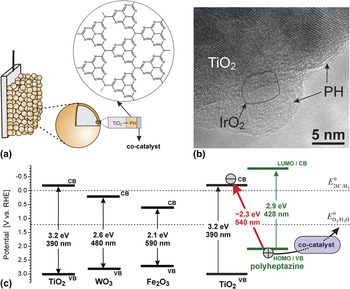
Recently, we have been developing photoanodes based on a novel class of visible-light photoactive inorganic/organic hybrid materials—nanocrystalline TiO2 modified at the surface by a thin (<1–5 nm) layer of polyheptazine (TiO2-PH) (Fig. 1).Reference Bledowski, Wang, Ramakrishnan, Khavryuchenko, Khavryuchenko, Ricci, Strunk, Cremer, Kolbeck and Beranek17–Reference Bledowski, Wang, Ramakrishnan, Betard, Khavryuchenko and Beranek19 Importantly, such photoelectrodes exhibit very different optical and photoelectrochemical properties from those of both TiO2 and pristine polyheptazine. The optical absorption edge of the TiO2-PH hybrid is strongly red-shifted into the visible (2.3 eV; ∼540 nm) as compared with the band gaps of both of the single components, TiO2 (∼3.2 eV; ∼390 nm) and polyheptazine (∼2.9 eV; ∼428 nm), which is due to the formation of an interfacial charge-transfer complex between polyheptazine (donor) and TiO2 (acceptor) [Fig. 1(c)].Reference Bledowski, Wang, Ramakrishnan, Khavryuchenko, Khavryuchenko, Ricci, Strunk, Cremer, Kolbeck and Beranek17 Two further features of these architectures are particularly noteworthy. First, polyheptazine (also known as “graphitic carbon nitride”)Reference Wang, Maeda, Thomas, Takanabe, Xin, Carlsson, Domen and Antonietti20, Reference Wang, Wang and Antonietti21 is a highly robust compound exhibiting thermal stability up to 550 °C in air.Reference Bledowski, Wang, Ramakrishnan, Khavryuchenko, Khavryuchenko, Ricci, Strunk, Cremer, Kolbeck and Beranek17 Second, the visible light-driven optical charge-transfer excitation in the TiO2-PH hybrid leads to photogeneration of electrons with a relatively negative potential of the conduction band edge of TiO2 [−0.2 V versus reversible hydrogen electrode (RHE)], as compared with other mostly studied photoanode materials like monoclinic WO3 or α-Fe2O3 [Fig. 1(c)]. This makes TiO2-PH hybrids very promising in terms of developing photoanodes at which water splitting can be possibly carried out without any external electrical bias applied.
(a) Hybrid photoelectrodes consist of a layer of nanocrystalline TiO2 powder pressed onto an ITO-glass, sintered, and subsequently modified at the surface with polyheptazine and loaded with a cocatalyst. (b) TEM micrograph of powder scratched off from a TiO2-PH photoelectrode with IrO2 cocatalysts loaded by colloidal deposition. (c) Potential scheme (independent of solution pH, i.e., with respect to the reversible hydrogen electrode, RHE) depicting the energetics of TiO2-polyheptazine hybridsReference Bledowski, Wang, Ramakrishnan, Khavryuchenko, Khavryuchenko, Ricci, Strunk, Cremer, Kolbeck and Beranek17 as compared with TiO2, WO3, and α-Fe2O3.Reference van de Krol, Liang and Schoonman10, Reference Alexander, Kulesza, Rutkowska, Solarska and Augustynski11, Reference Gratzel30, Reference Beranek31

Notably, we have observed that complete photooxidation of water to dioxygen was feasible only after the TiO2-PH hybrid photoanodes were loaded with an oxygen-evolving cocatalyst like IrO2 nanoparticles,Reference Bledowski, Wang, Ramakrishnan, Khavryuchenko, Khavryuchenko, Ricci, Strunk, Cremer, Kolbeck and Beranek17, Reference Wang, Bledowski, Ramakrishnan, König, Ludwig and Beranek18 or amorphous CoOx clusters (“Co-Pi”)Reference Bledowski, Wang, Ramakrishnan, Betard, Khavryuchenko and Beranek19 photodeposited from phosphate-buffered solutions containing Co2+ ions.Reference Kanan and Nocera22, Reference Zhong, Cornuz, Sivula, Gratzel and Gamelin23 The coupling of the holes photogenerated in the polyheptazine layer to an efficient cocatalyst is therefore very important. In this article, we compare TiO2-PH photoanodes with two different cocatalysts, IrO2 nanoparticles and Co-Pi, in terms of their photoconversion efficiency and stability. We particularly investigate in detail the effect of applied potential on the efficiency of photocurrent and oxygen generation, and compare the behavior of TiO2-PH photoanodes under visible light irradiation with that of pristine TiO2 photoelectrodes under UV light irradiation. Based on this analysis we discuss some key factors limiting the performance of TiO2-PH hybrid photoanodes in water splitting.
II. EXPERIMENTAL DETAILS
TiO2-PH photoanodes were prepared as described previously.Reference Bledowski, Wang, Ramakrishnan, Khavryuchenko, Khavryuchenko, Ricci, Strunk, Cremer, Kolbeck and Beranek17–Reference Bledowski, Wang, Ramakrishnan, Betard, Khavryuchenko and Beranek19 In brief, a suspension containing 200 mg of TiO2 (Hombikat UV 100, Sachtleben, Duiburg, Germany, specific surface area [Brunauer–Emmett–Teller (BET) ∼300 m2/g, crystallite size <10 nm) in 1 mL of ethanol was sonicated for 15 min and then smeared onto the indium tin oxide (ITO)-coated glass by doctor blading using a scotch tape as frame and spacer. The electrodes were then dried at 100 °C, pressed for 3 min at a pressure of 200 kg/cm2, and heated in air at 450 °C for 30 min for sintering the particles and ensure good electrical contact. Subsequently, TiO2 electrodes were modified with polyheptazine by placing into a Schlenk tube connected via an adapter with a round bottom flask containing 1 g of urea, and heating in a muffle oven for 30 min at 425 °C.
IrO2 nanoparticles were synthesized using the method described by Maeda et al.Reference Maeda, Higashi, Siritanaratkul, Abe and Domen24 Briefly, 0.0080 g of sodium hexachloroiridate (IV) hexahydrate, Na2IrCl6 · 6 H2O was dissolved in 50 mL H2O, and the pH of the solution was adjusted to 12 with sodium hydroxide (NaOH). The solution was heated at 80 °C for 30 min, and then cooled in an ice-water bath. Afterward, pH was adjusted carefully to 9 with a nitric acid (HNO3) solution. Further heating at 80 °C for 30 min resulted in a deep blue solution containing colloidal IrO2. During the colloidal deposition, the photoelectrodes were immersed into a diluted (∼30%) solution of IrO2 nanoparticles overnight and then dried in air.
CoOx oxygen-evolving cocatalyst (Co-Pi) was deposited on TiO2-PH photoelectrodes by photoassisted deposition precipitation using a method described previously.Reference Bledowski, Wang, Ramakrishnan, Betard, Khavryuchenko and Beranek19 Briefly, the TiO2-PH photoelectrode was placed in a photoeletrochemical cell containing 0.5 mM Co2+ in a phosphate buffer (pH = 7.0, 0.1 M). The electrode was biased at 0.5 V versus silver/silver chloride (Ag/AgCl) and irradiated with 450-nm monochromatic light (TiO2-PH + Co-Pi). Control samples using pristine TiO2 electrode (TiO2+ Co-Pi) and photodeposition wave length of 350 nm were prepared in the same way.
The photoelectrochemical setup for monochromatic measurements consisted of a SP-300 BioLogic potentiostat (Claix, France) and a three-electrode cell using a platinum counter electrode and a Ag/AgCl reference electrode. All potential values were recalculated and are reported with respect to the RHE. The photoelectrodes were pressed against an O-ring of the cell leaving an irradiated area of 0.5 cm2. A tunable monochromatic light source (Instytut Fotonowy, http://www.fotonowy.pl) provided with a 150 W xenon lamp and a grating monochromator with a bandwidth of ∼10 nm was used. The photoaction spectra were recorded under intermittent irradiation (5 s light, 10 s dark). The value of photocurrent density was taken as a difference between current density under irradiation and in the dark. The incident photon-to-current conversion efficiency (IPCE) value for each wave length was calculated according to equation IPCE (%) = (i phhc)/(λPq) × 100, where i ph is the photocurrent density, h is Planck’s constant, c velocity of light, P the light power density, λ is the irradiation wave length, and q is the elementary charge. The spectral dependence of lamp power density was measured by the NOVA II optical power meter equipped with a PD300-UV silicon photodiode (Ophir Optronics, Nienburg, Germany).
Oxygen evolution was measured in a glass vial by an OxySense Gen III 325i noninvasive oxygen analyzer system (Dallas, TX) and photocurrent was recorded using a Gamry 600 Reference potentiostat (Philadelphia, PA). A two-electrode setup with platinum as a counter electrode in a one-compartment cell was used. The electrodes were irradiated from the backside (through the ITO glass) by a 150 W xenon lamp (LOT Oriel, Darmstadt, Germany) equipped with a KG-3 (Schott, Mainz, Germany) heat-absorbing filter. To ensure only visible light irradiation, cut-off filter (λ > 420 nm was used). The vial was sealed using a rubber septum and argon was used for purging. After 1 h of bubbling of electrolyte prior to measurement, argon was stopped and only atmosphere above the solution was purged. Before turning on the light setup was left for 45 min to ensure that no oxygen is leaking from outside. Total volume of the vial was 15 mL and the electrolyte volume was 7 mL.
Transmissions electron microscopy (TEM) investigations were performed using a FEI Tecnai F20 G2 TEM (Hillsboro, OR) operating at an acceleration voltage of 200 kV either in bright-field (BF) mode or in scanning mode (STEM) using a high-angle annular dark-field (HAADF) detector.
III. RESULTS AND DISCUSSION
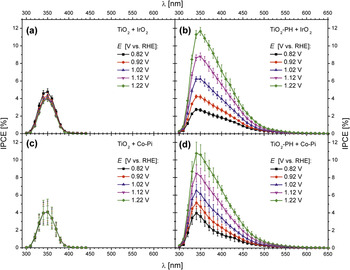
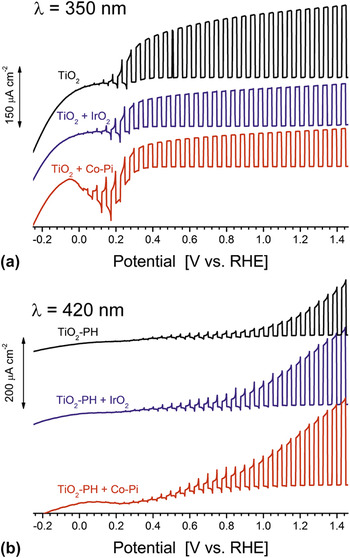
Figure 2 shows photoaction spectra (IPCE versus λ plots) recorded at TiO2 and TiO2-PH photoelectrodes loaded with either IrO2 or Co-Pi. As expected, in contrast to pristine TiO2 whose photoresponse is confined to the UV range (<400 nm), TiO2-PH photoelectrodes exhibit significant IPCE values down to ∼540 nm, corresponding to the optical absorption edge of TiO2-PH.Reference Bledowski, Wang, Ramakrishnan, Khavryuchenko, Khavryuchenko, Ricci, Strunk, Cremer, Kolbeck and Beranek17 Similar IPCE values are observed on photoelectrodes modified with IrO2 and Co-Pi. Most interestingly, while at pristine TiO2 photoelectrodes the IPCE values are relatively insensitive to applied potential, at TiO2-PH photoanodes the IPCE values increase continuously with more positive bias potential. This is further illustrated in Fig. 3 showing photocurrent transients recorded during a slow cathodic potential sweep. Here pristine TiO2 photoelectrodes exhibit a typical profile of nanocrystalline photoelectrodes in which the photocurrent generation is governed by the kinetics of holes at the TiO2-electrolyte interface and by diffusion of electrons through the porous nanocrystalline layer, rather than by the potential drop within the space-charge layer, as in case of compact single- or polycrystalline semiconductors.Reference Hodes, Howell and Peter25, Reference Wahl, Ulmann, Carroy and Augustynski26
Photoaction spectra (IPCE versus λ) measured in a three-electrode setup at different potentials in deaerated phosphate buffer (pH 7) at pristine (a) TiO2, and (b) TiO2-PH loaded with IrO2, and at (c) TiO2 and (d) TiO2-PH loaded with Co-Pi.

Photocurrent measured at (a) pristine TiO2 and at (b) TiO2-PH photoelectrodes without and with different cocatalysts recorded under intermittent monochromatic irradiation (5 s light, 5 s dark; λ = 350 nm for TiO2, λ = 420 nm for TiO2-PH) during a cathodic potential sweep (5 mV/s) in deaerated phosphate buffer (pH 7).

Two further points are noteworthy. First, the deposition of Co-Pi leads to a slight cathodic shift of the photocurrent onset potential for both TiO2 and TiO2-PH, while the colloidal deposition of IrO2 nanoparticles leaves the photocurrent onset practically unchanged. Assuming that at potentials near the conduction band edge of TiO2 (−0.2 V versus RHE) the photocurrent generation is mainly determined by kinetic competition between the transfer of holes to water molecules and the electron-hole recombination, we conclude that Co-Pi performs better as a cocatalyst in our electrodes. This is not surprising as IrO2 nanoparticles are deposited simply by colloidal deposition, Co-Pi is formed photoelectrochemically exactly at surface sites where holes are predominantly generated, which results in better coupling between holes and the cocatalyst. Second, as compared with the UV (λ = 350 nm) light induced photocurrent response at pristine TiO2, the visible (λ = 420 nm) light photocurrents at hybrid TiO2-PH electrodes exhibit pronounced sensitivity to applied potential and the photocurrent onset is shifted anodically by ∼0.4 V. This strong dependence of photoconversion efficiency on applied external bias even at potentials relatively far from the potential of the conduction band edge of TiO2 suggests that in TiO2-PH hybrids severe primary recombination processes [direct back charge transfer following the optical charge-transfer absorption; see Fig. 1(c)] occur unless external bias is applied to drive electrons away. Clearly, these recombination processes are here much faster than the kinetics of water oxidation by holes, even in the presence of cocatalysts. Furthermore, it suggests that the coupling between the photogenerated holes and the Co-Pi cocatalyst is still far from perfect, which leads to accumulation of positive charges in the surface environment of TiO2 and might result in an anodic shift of its conduction band edge.
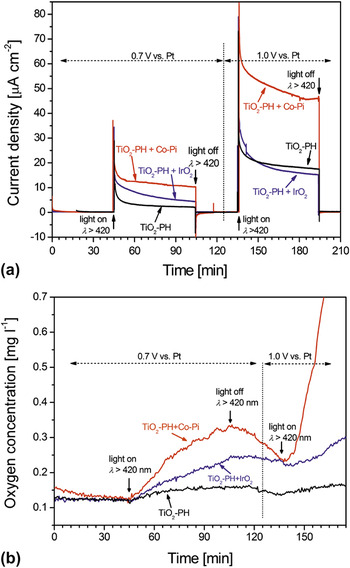
Photocurrent and oxygen evolution measurements under polychromatic visible light irradiation (λ > 420 nm) for TiO2-PH without and with IrO2 and Co-Pi cocatalysts are shown in Fig. 4. These measurements are performed in a two-electrode set-up for effecting the most realistic estimation of the external electric bias needed to drive the water-splitting reaction. At both bias voltages (0.7 and 1.0 V), the results clearly demonstrate the superior behavior of Co-Pi-loaded photoanodes. Both photocurrent and the amount of evolved oxygen are about doubled as compared with photoanodes loaded with IrO2. This might seem rather surprising taking into account the very similar IPCE values shown in Fig. 2. This seeming discrepancy is explained by the very different time-scale of the corresponding measurements, and by the fact that the photocurrent transients recorded at TiO2-PH photoanodes exhibit a “spike-like” behavior (a very fast rise of photocurrent followed by decrease), which is a clear fingerprint of surface recombination processes that are going on.Reference Peter27 In other words, after switching on the light, the holes very quickly accumulate in the surface polyheptazine layer, which increases probability of their recombination with electrons photogenerated in the conduction band of TiO2. However, when sufficient external electric bias is applied to drive electrons away and a suitable cocatalyst is present to catalyze transfer of holes to water molecules, a significant portion of photogenerated holes is able to escape recombination and induce water oxidation to dioxygen. The very small difference in IPCE values between photoelectrodes loaded with IrO2 and Co-Pi arises from the fact that the IPCE measurements are performed under relatively short-pulsed monochromatic irradiation (5 s light, 10 s dark) so that photocurrents are read-off very quickly after the initial rise. Obviously, experiments using prolonged (time-scale ∼ hours) irradiation shown in Fig. 4 give a much more realistic estimation of photoanode performance since the system is allowed to reach steady-state conditions. It should be noted that the better performance of Co-Pi-loaded photoanodes as compared with IrO2-loaded ones is apparently not only due to better coupling of photogenerated holes with the in situ grown Co-Pi but also due to bad adhesion of IrO2 to the surface of TiO2-PH photoanodes, as has been reported for other photoactive materials like [e.g., ferric oxide (Fe2O3)] loaded with IrO2.Reference Tilley, Cornuz, Sivula and Grätzel28
(a) Photocurrent and (b) oxygen evolution measured in a two-electrode setup in phosphate buffer (pH 7) during prolonged irradiation by polychromatic visible light (λ > 420 nm). Working electrode was biased at 0.7 V versus Pt in the first part (till 125 min) and at 1.0 versus Pt in the second part of experiment (after 125 min).

Interestingly, the TiO2-PH photoelectrode without any cocatalyst shows quite significant photocurrents at higher bias (1 V versus Pt), while no oxygen production is observed. When searching for possible intermediates of the water oxidation reaction we failed to detect any hydrogen peroxide (H2O2) using a standard horseradish peroxidase-based photometric test. It cannot be ruled out that in the absence of the cocatalyst the anodic photocurrents lead also to partial oxidation of polyheptazine or some side-products from the polyheptazine-modification procedure.
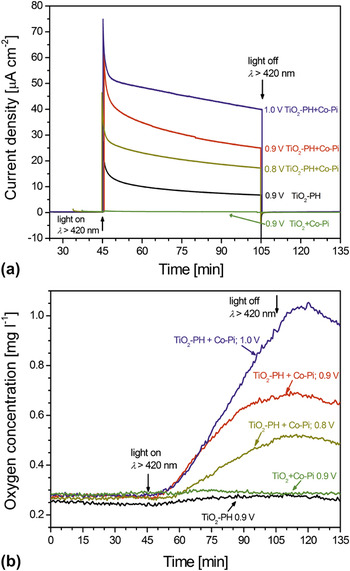
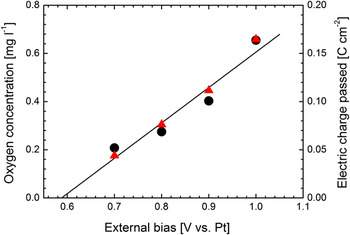
The behavior of TiO2-PH photoelectrodes modified with Co-Pi was investigated in more detail at different bias voltages (Fig. 5). At all voltages the photocurrent transients recorded at Co-Pi-modified photoanodes still exhibit a “spike-like” behavior. This means that these recombination processes are proceeding faster than the Co-Pi-catalyzed transfer of holes to water molecules. It is noteworthy that, as expected, neither TiO2-PH without a cocatalyst nor pristine TiO2 loaded with Co-Pi show oxygen evolution under visible light irradiation (λ > 420 nm). Furthermore, both the photocurrent and the amount of evolved oxygen increase linearly with increase of the applied external bias. This can be further illustrated in Fig. 6 which shows the linear dependence of oxygen concentration and the overall passed electric charge (photocurrent integrated over time) on the applied bias. The minimal external bias needed can be estimated to be approximately 0.6 V versus Pt. This value coincides well with the photocurrent onset measured in a three-electrode setup (Fig. 3), which suggests that the proton reduction reaction proceeds practically without significant overpotential at the platinum electrode. It should be also noted that reasonable photocurrents and oxygen evolution could be still observed in the bias range (∼0.7 V versus Pt) in which, for example, the mostly studied α-Fe2O3 photoanodes typically show no photocurrent response.Reference Kay, Cesar and Graetzel29 However, as already noted above, this bias voltage is significantly higher than that one would expect taking into account the fact that the potential of the conduction band edge of TiO2 slightly straddles the reduction potential of protons [Fig. 1(c)].
(a) Photocurrent and (b) oxygen evolution measured in a phosphate buffer (pH 7) during prolonged irradiation by polychromatic visible light (λ > 420 nm). TiO2-PH electrodes with photodeposited Co-Pi were biased at 0.8, 0.9, and 1.0 V versus Pt. The control samples, i.e., pristine TiO2 with photodeposited Co-Pi and TiO2-PH without Co-Pi, were biased at 0.9 V.

(•) An amount of dioxygen evolved and (▲) electric charge passed at a TiO2-PH + Co-Pi photoelectrode biased at different external potentials during 1 h of irradiation with polychromatic visible light (λ > 420 nm).

IV. CONCLUSIONS
In summary, we investigated the photoelectrochemical properties of TiO2-PH hybrid photoanodes loaded with IrO2 and Co-Pi as oxygen-evolving cocatalysts, particularly with the focus on the effect of external electric bias on the efficiency of visible light-driven water photooxidation. As compared with IrO2-loaded photoanodes, the TiO2-PH photoelectrodes modified with Co-Pi cocatalyst exhibited better stability and performance under prolonged irradiation, presumably because the photoelectrochemical deposition precipitation of Co-Pi helped to establish a better contact between the photogenerated holes and the cocatalyst. Under visible light irradiation, the minimum external electric bias needed to observe complete photooxidation of water to dioxygen at Co-Pi modified TiO2-PH photoanodes was estimated to be ∼0.6 V at pH 7. The key factor limiting the photoconversion efficiency at low bias potentials is the fast primary recombination of photogenerated charges. Further improvements can be possibly achieved if fast back-charge transfer processes are avoided by engineering the interface between polyheptazine and TiO2, and a more effective coupling of photogenerated holes to a cocatalyst is established for avoiding accumulation of positive charges in the surface polyheptazine layer.
ACKNOWLEDGMENTS
We are thankful for financial support by the MIWFT-NRW within the project “Anorganische Nanomaterialien für Anwendungen in der Photokatalyse: Wasseraufbereitung und Wasserstoffgewinnung.” Dr. Pio John Buenconsejo and Prof. Alfred Ludwig are acknowledged for TEM measurements, and Sachtleben Chemie for a free sample of Hombikat UV 100. The support of the Center for Electrochemical Sciences (CES) is gratefully acknowledged.