




No CrossRef data available.
Article contents
Spontaneous measures of morphosyntax in children with specific language impairment
Published online by Cambridge University Press: 27 April 2004
Abstract
Fifteen children with specific language impairment (SLI) were matched in gender, age, and nonverbal mental age to one comparison group and in gender and standardized expressive language age to another comparison group. Their spontaneous speech was recorded while they narrated a cartoon and described their classroom. No group differences were found in mean length of utterance in morphemes or in syntactic complexity. SLI children had a lower percentage of correct irregular past tense forms but were equivalent to controls on regular past tense forms and noun plurals. Lexical diversity in terms of the number of different verbs expressed in the past tense and the number of different nouns pluralized did not differ. Some problems in generating complex sentences were found in the speech of SLI children. The importance of task constraints is stressed in explaining the discrepant performance of SLI children on spontaneous versus standardized measures of language, as well as the contribution of auditory memory limitations.Editor's Note: This article was reviewed and accepted by the previous Editor in Chief, Dr. John Locke.
Information
- Type
- Research Article
- Information
- Copyright
- © 2004 Cambridge University Press
The morphology of children with specific language impairment (SLI) has been singled out as a primary basis of their deficit across several languages. Most of the evidence has been obtained on preschool children and implicates verb-related errors. The purpose of the current study was to determine if such errors persist in school-aged children by studying a sample of SLI children ranging in age from 5 to 10 years. The verb morphemes targeted were regular past -ed and irregular past forms. These morphemes were compared to noun plurals, which generally have not been a weakness in SLI children, and to nominative case pronouns, which have been a problem for SLI children. In addition, possible differences in lexical diversity between SLI and normally developing (ND) children were examined by comparing the number of different verbs put into the past tense and the number of different nouns pluralized. Finally, SLI and ND children were compared in their overall mean length of utterance (MLU) and syntactic complexity. These measures were applied to spontaneous speech samples, because much of the previous evidence has been obtained from elicited production tasks.
Swedish 5-year-old children with SLI displayed more verb-related errors (i.e., in tense, auxiliaries, and modals) in their spontaneous speech than controls matched for MLU (Hansson & Nettelbladt, 1995). Hebrew-speaking SLI children between 4 and 6 years of age were less accurate in their use of most past inflections than their MLU-matched controls in elicited production tasks (Dromi, Leonard, Adam, & Zadunaisky–Ehrlich, 1999). English-learning SLI children between 4 and 6 years of age produced relatively fewer noun plurals and regular past inflections in obligatory contexts than controls matched for MLU in words but did not differ in their irregular past forms (Leonard, Bortolini, Caselli, McGregor, & Sabbadini, 1992). The Italian-learning SLI children, also between 4 and 6 years of age, investigated in this same study, did not differ in their use of noun plurals.
Leonard (1995) hypothesized that SLI children have difficulties with functional categories, consisting of Complementizer, Inflection, and Determiner, according to the principles and parameters theory (e.g., Radford, 1995). In fact, Leonard (1995) found that the English SLI children in the Leonard et al. (1992) study did show evidence of functional categories in their spontaneous speech but to a lesser degree than controls. Thus, they were able to produce such grammatical features as verb inflections and nominative case pronouns, but not as consistently as younger children matched for MLU in words. Loeb and Leonard (1991) found in a previous study that preschool SLI children, more than MLU controls, substituted nonnominative case pronouns when nominative was required (e.g., her instead of she as subject). For both groups, correct case usage was related to correct verb agreement production, as a theory based on inflection would predict. In contrast, Moore (1995) found that 5-year-old SLI children did not make more errors on nominative case pronouns than younger language-matched controls, although they did make more errors than their peers, who made none. Most case errors occurred with the feminine pronoun.
Another account of SLI children's difficulty with morphology that is similarly based on linguistic theory is the proposal of Rice and colleagues (e.g., Rice, Wexler, & Cleave, 1995; Rice, Wexler, & Hershberger, 1998) that SLI children have an extended period, relative to normally developing children, when finite markers are treated as optional. For example, Rice et al. (1995) found that 5-year-old SLI children, compared to both same-age controls and younger MLU controls, were more likely to omit -ed regular past inflection in both spontaneous speech and elicited production tasks.
In a longitudinal study of morphological development in SLI children tested at 6-month intervals between 4 years 5 months (4;5 years) and 8;9, Rice et al. (1998) found that these children performed significantly below MLU controls on the -ed regular past tense inflection in both spontaneous and elicited production tasks at most ages. In contrast, -s plural marking on nouns reached the 90% level by 5;6 for SLI children and was at asymptote from age 3 years for the MLU controls. The authors interpret their findings as indicating that verb-related morphemes show a cohesion in patterns of change not shared by noun plural marking and reflecting a common underlying knowledge of grammatical tense marking. The results for noun plurals confirmed the earlier findings of Rice and Oetting (1993), with a large sample of 4- to 6-year-old SLI children, of quite accurate plural marking on nouns.
In Rice et al. (1998), there was no support for spontaneous measures being ahead of elicited production measures. The spontaneous measures were based on transcripts of spontaneous speech samples, and the elicited production measures were experimental probes (e.g., asking children to describe a completed action). In contrast, Oetting and Rice (1993) found that 5-year-old SLI children, like their MLU controls, produced noun plurals at 90% accuracy in their spontaneous productions but not in their elicited productions. SLI children had more difficulty in elicited production with infrequently pluralized nouns. In this study, the elicited production tasks involved presenting the children with line drawings in singular and multiple forms and asking them to label the multiple forms. Leonard, Eyer, Bedore, and Grela (1997) found, however, that preschool SLI children were lower than controls on both spontaneous and elicited production tasks in the production of noun plurals but again, with infrequent noun plurals being more problematic. They did not differ from MLU controls in their spontaneous production of irregular past tense forms. In a study by Oetting and Horohov (1997), spontaneous production of regular and irregular past tense forms was found to be highly correct in 6-year-old SLI children (87% for regular verbs and 84% for irregular verbs). In contrast, in elicited production, SLI children inflected significantly fewer regular verbs than their MLU controls; but the difference was primarily for infrequently inflected verbs, as with noun plurals. Marchman, Wulfeck, and Ellis Weismer (1999), in a study of SLI children ranging in age from 6 to 12 years, found also that they made more errors than their peers on past tense in an elicited production task. For both groups, low frequency irregular verbs that were similar to other regular verbs were more likely to be regularized (suffixed with an -ed ending) than high frequency irregular verbs. These authors stressed the importance of surface-level, phonological features of verb stems in errors, as opposed to an extended period of optional finiteness marking.
With regard to lexical diversity, three SLI children followed from the ages of 3;9, 5;3, and 5;8 for about 2 years (Conti–Ramsden & Jones, 1997) used a smaller number of different verbs than controls. Although the number of different verbs produced in spontaneous speech was found to be related to finite-verb morphology for both SLI and controls, lack of lexical diversity was not the basis of the SLI children's problems with verb morphology (Leonard, Miller, & Gerber, 1999).
These findings, in general, appear to indicate that SLI children have difficulty with verb morphology. It is verb morphology, rather than noun morphology, that was found to more successfully classify 4- to 6-year-old children in a discriminant analysis (Bedore & Leonard, 1998). These results also suggest that the morphology of SLI children is more correct in their spontaneous productions than in their elicited productions. This difference may be due simply to an avoidance of unfamiliar forms by SLI children in their spontaneous speech. In that event, we might expect that the words to which endings are applied would be less diverse for SLI children than for ND children. Although Conti–Ramsden and Jones (1997) and Leonard et al. (1999) did find that an overall count of verbs revealed less lexical diversity among SLI children, this count was not focused on words with targeted endings.
The purpose of the present study was first to examine further past tense verb morphology and noun plural morphology in older SLI children. Their performance was compared both to same-age ND peers and to language-matched controls equated on a standardized expressive language measure and not on MLU. It was thought that if morphosyntax was the focus of the study, then the children should not be matched on a measure based on morphology (i.e., MLU in morphemes).
The second focus in this study was on spontaneous speech because of the suggestion in previous findings that morphological differences between SLI and ND children are less apparent in spontaneous than in elicited production. It was thought that if older SLI children have mastered morphosyntax that was previously problematic for them, this will be more evident in spontaneous speech.
The third purpose of the study was to compare the three groups on their overall MLU in morphemes and on a general measure of syntactic complexity to determine if these measures differed in spontaneous speech.
METHOD
Participants
The SLI group consisted of 15 children (8 males, 7 females) ranging in age from 5;1 to 9;8. These children were attending language classes either at a clinic (the 4 youngest children) or at one of two public schools (located close to each other) because they had been diagnosed with language impairment. They had no identified hearing impairment. The four children from the clinic were seen at home, and the public school children were seen in an empty room in their school. Each SLI child was individually matched to a child of the same gender in two comparison groups: one matched on both chronological age and nonverbal mental age (CA group) and the other matched on standardized expressive language scores (LM group). Because of the difficulty of matching on both chronological and mental age (MA), the pairs of SLI-CA children could differ by up to 7 months in either CA or MA; but most differences were smaller (M = 3.0 months for CA, M = 2.7 months for MA). Most of the comparison children attended the same public schools and thus lived in similar areas as the SLI children; but 2 CA children and 6 LM children were obtained from day care centers in different areas. No information about maternal education was available to us. All children spoke only English at home. Three of the children were African Canadian. Two of these were SLI, and the third was a CA match for one of them.
Measures
Standardized language measures
The five youngest SLI children, and their matched comparison children, were given the Reynell Developmental Language Scales (Reynell & Gruber, 1990). Four CA children who reached ceiling on the Reynell were given the Test of Language Development (TOLD)—Primary (Newcomer & Hammill, 1988). The remaining SLI children and their matched comparison children were given either the TOLD-Primary or the TOLD-Intermediate (Hammill & Newcomer, 1985), as appropriate for their ages. Each SLI child's expressive language age as determined by these standardized tests was at least 11 months below his or her CA or performance MA, whichever was lower, the mean being 18.6 months (SD = 8.3). The mean difference for receptive language age was 14.2 months (SD = 11.06). All comparison children scored at or above age level on both expressive and receptive language as measured by these tests. The LM children were individually matched to SLI children within 7 months of expressive language age; the mean difference was 2.6 months. The means and standard deviations for CA, expressive language age, and receptive language age are given in Table 1 for the three groups. The CA was not significantly different between the SLI (M = 88.6) and CA (M = 87.3) groups, t (14) = 1.44, p = .17. A significant difference between these groups was found for both expressive language age (SLI: M = 67.6; CA: M = 88.5), t (14) = 10.92, p = .0001, and receptive language age (SLI: M = 72.0; CA: M = 88.0), t (14) = 4.85, p = .0001; the SLI and LM groups did not differ on these measures, t (14) = 0.43, p = .68 for expressive language age (SLI: M = 67.6; LM: M = 68.0), and t (14) = 1.25, p = .23 for receptive language age (SLI: M = 72.0; LM: M = 68.0).

Nonverbal MA
All children were given the Leiter International Performance Scale (Leiter, 1980), on which all scored above 85. The means and standard deviations for performance MA for the three groups are given in Table 1. The SLI children (M = 88.9) did not differ from either the CA group (M = 90.4) or the LM group (M = 82.1) in performance MA, t (14) = 1.88, p = .081, and t (14) = 1.65, p = .12, respectively. It should be stressed that finding matches for the SLI children on performance MA was quite difficult. Whereas the SLI children performed within the normal range, many of the potential CA matches had performance MAs well above their CAs on the Leiter (M = 11.7 months above CA for 15 ND children, not included here, who completed the testing). The LM children in the sample, who were not matched on MA, also displayed this same tendency (see Table 1). Of the 15 SLI children, 6 did have MAs above their CAs but for 2 of these the amount was only slight. Thus, the CA group selected for this sample performed at the lower range of the children tested. This problem was not found in an earlier study of preschool children (Kushnir & Blake, 1996) and may reflect a decline in nonverbal ability with age in children with SLI (see Bishop, Bright, James, Bishop, & Van Der Lely, 2000).
Spontaneous language measures
Each child provided two spontaneous speech samples of 5 min each. For one sample, the children described their classroom while sitting in another room; for the other, they narrated a Mickey Mouse cartoon that they had just been shown. The observer used a set of standard probe questions with each child (e.g., “What does your classroom look like?” and “Can you tell me about the movie?”) The order of speech sample contexts was counterbalanced across the children. The speech samples were video recorded and transcribed from the video recordings. They were scored for MLU in morphemes and for syntactic complexity. These measures are described in detail in Blake and Quartaro (1990) and outlined in Blake, Quartaro, and Onorati (1993). Our rules for calculating MLU were extended from Brown (1973) and made more explicit. The principal changes involved the crediting of more irregular forms if the regular contrast was present. Interrater reliability for the transcription and calculation of MLU based on 11% of the samples was r = .83. The transcription of 17 additional samples was also checked by two coders working together. The measure of syntactic complexity that we have developed is based on the number of grammatical categories (subject, verb, object, and complement) combined in an utterance and is similar to that used by Ramer (1977) and by Crystal, Fletcher, and Garman (1976) in their clausal analysis. Also counted were adjectives in noun phrases or prepositional phrases, negation of verb phrases, and conjunctions except for initial “and” or “and” in lists. Interrater reliability for the calculation of syntactic complexity for 11% of the samples was r = .97.
The speech samples were also examined for the percentage of the following morphemes supplied in obligatory contexts: regular past -ed, irregular past, and noun plural ending. In addition, lexical diversity was analyzed by counting the number of different verbs put into regular or irregular past tense, the number of overregularization of different irregular verbs, and the number of different nouns pluralized.
RESULTS
The results for MLU (in morphemes) and for syntactic complexity are presented in Table 2 according to group (SLI, CA control, and LM control) and task (narrative vs. description). These means were submitted to two Group × Gender × Task analyses of variance, with repeated measures on the last factor. The only significant effect was for task, F (1, 39) = 8.07, p = .007 for MLU, and F (1, 39)= 4.70, p = .04 for syntax. Children in all groups used more complex language, in terms of number of morphemes and number of syntactic components, when narrating the cartoon than when describing their classroom. The order of means for both measures on Table 2 was CA > SLI > LM, but none of the differences between groups was significant.

Table 3 shows the results by group for the mean percentage of three morphemes supplied in obligatory contexts: regular past -ed, irregular past, and noun plurals. These means were subjected to a 3 (Group) × 2 (Gender) multivariate analysis of variance. Task was not included because past tense was elicited almost exclusively by the narrative, whereas the classroom description elicited many more noun plurals. The main effect for group tended to be significant for irregular past tense, F (2, 39) = 2.76, p = .08. SLI children used the correct form 81% of the time when required, whereas LM controls used it 86% of the time and CA controls 91% of the time. Because of the significant tendency, use of the irregular past tense was further compared using two dependent t tests to take advantage of the matching procedure. A significant difference was found between the SLI and CA groups, t (14) = 3.72, p = .002. The difference between SLI and LM children was not significant, t (14) = 1.09, p = .295. In addition, SLI children as a group overregularized a greater number of different irregular verbs than the other groups: a total of 20 different irregular verbs versus only 12 for the LM controls and 9 for the CA controls. Of the 15 children in each group, 11 SLI children overregularized at least one irregular verb, as compared with 9 LM children and 7 CA children. The groups did not differ on the regular past -ed ending or on noun plurals.

The mean number of different verbs put into the regular past tense and the irregular past tense, as well as the mean number of different nouns pluralized, are given for each group in Table 4. These are measures of lexical diversity in terms of the specific morphemes expressed spontaneously. A 3 (Group) × 2 (Gender) multivariate analysis of variance yielded only one significant effect: a Group × Gender interaction for the number of different verbs in the regular past tense, F (2, 39) = 3.80, p = .03. This interaction was due to the fact that female SLI children used the -ed regular past ending with a greater number of different verbs than male SLI children (M = 8.43 vs. M = 4.88), F (1, 13) = 7.42, p = .02; however, no gender differences were found for the other groups (5.57 mean different verbs for CA females vs. 8.63 for CA males; 5.71 for LM females vs. 6.75 for LM males).

These comparisons revealed differences between SLI children and their same-age ND peers only in the irregular past tense morphology of their spontaneous speech. In addition, SLI children alone substituted accusative case pronouns for nominative or genitive (“where her keeps her books,” “that was him present”). However, there were only three errors of this type made by three different SLI children.
Some peculiar syntactic constructions did appear in the language of the SLI children; examples are given in Table 5. These were produced by 6 different SLI children all older than 7 years. They appear to indicate a difficulty with generating dependent clauses, both in terms of using the correct conjunction/relative pronoun and of keeping track of subject–object relations. Such errors were not found in either group of comparison children, although one CA child did omit a relative pronoun (“and there's blocks are big blocks”).

DISCUSSION
The SLI children in this study were clearly below age level in standardized measures of expressive language. In their spontaneous speech, however, these SLI children did not show the same deficits in either morphology or in syntactic complexity. On most measures, their language when describing their classroom or narrating a cartoon did not differ either from their same-age peers or from younger children matched on standardized expressive language age. Whether the measure was a global measure of morphosyntax, such as MLU or syntactic complexity, or a more specific measure of a particular inflection, such as -ed, no significant differences were found. Only on the irregular past tense did SLI children perform differently from their CA peers, providing the correct form significantly less often when it was required. SLI children also regularized irregular verbs somewhat more than controls, and male SLI children did this more than females (15 different overregularization errors for SLI males vs. 5 for females). Thus, the male SLI children in this sample may have had difficulty remembering irregular forms. As Bishop (1994) points out, the irregular inflection could be correctly produced only if it had a lexical representation. Although she found overregularization errors in the speech samples of twelve 8- to 12-year-old children with SLI, they were rare. However, the finding that SLI children do have difficulty with irregular inflectional morphology means that it is not just a question of learning general rules of verb morphology (Bishop, 1994). In this study, the diversity of verbs that male SLI children used in the regular past tense was also lower than for the female SLI children in this sample, but the main effect of group on this measure was not significant. Our finding of differences in the use of irregular past tense forms by SLI children is congruent with those of Marchman et al. (1999) for older SLI children. Our failure to find differences in the regular past tense form is not in agreement with the results of Rice et al. (1998) for older SLI children.
Why did we not find more deficits in the morphosyntax of these SLI children when the bulk of the evidence cited in the introductory section found such differences? We were particularly surprised to find no differences in MLU (in morphemes) among our groups. We think that the probable reason is that the spontaneous production task was not demanding for the SLI children. They appeared quite relaxed on the videotapes while they described their classroom and recounted the film. They produced more utterances than their peers (an average of 88 vs. 80). In contrast, the standardized language measures may have been more challenging as tasks, while at the same time revealing more subtle deficits. For example, on the Grammatic Completion subtest of the TOLD Primary, the eight SLI children given this test received an average standard score of 6.0, whereas their CA controls received an average standard score of 10.1. For the two matched pairs who were given the TOLD Intermediate, average standard scores on Grammatic Comprehension involving judgments of morphological correctness were 14 for SLI and 22.5 for CA children. Thus, the aspects of these tests directed specifically at morphology show large differences between the SLI children and their peers. The Grammatic Completion subtest probes those morphemes targeted in the analysis of spontaneous speech samples, namely noun plurals, regular and irregular past tense, and pronoun case, as well as possessive “s” and possessive pronouns, third person singular inflection, progressive -ing, comparative -er and superlative -est, and the nominal compound (e.g., drummer). The Grammatic Comprehension test includes all of the morphemes targeted in this study as well as comparative and superlative forms, pronoun case, third person inflection, articles, negative, and adverb -ly endings. We did examine most of these additional forms in our speech samples, specifically possessive, third person singular inflection, progressive, adverb -ly, comparative and superlative, copula and auxiliary verbs. For these forms, there were either very few errors by SLI children or unequivalent obligatory contexts to analyze differences between the groups (for third person inflection and comparative/superlative).
We think that these differences between spontaneous and elicited production tasks make it unlikely, then, that a morphological measure based on spontaneous speech alone will be useful in diagnosing SLI (Bedore & Leonard, 1998). It seems that only elicited production will detect a morphological deficit, at least in elementary school children. Under stressed conditions (e.g., when given a standardized test), it is possible that these children revert to a more holistic phonological representation with insufficient detail for accurate performance on the task (Edwards & Lahey, 1998). This interpretation is in line with the “vulnerable markers hypothesis” according to which SLI children do understand the grammatical function of morphological markers but their accuracy in applying this knowledge will vary according to processing demands (Bishop, 1994).
The importance of task can be seen even when speech is essentially spontaneous. In this study, children in all groups exhibited more complex language when narrating a cartoon than when describing their classroom. Their utterances were longer in terms of morphemes and combined a greater number of syntactic categories. They enjoyed the narrative task more, and this affected the complexity of their descriptions.
Because there were no differences between SLI children and CA controls in the overall number of different verbs used in the regular or irregular past tense nor in the number of different nouns pluralized, it seems unlikely that SLI children are avoiding words in spontaneous speech whose past tense or plural endings they do not know. This study confirmed previous findings (Bishop, 1994; Oetting & Rice, 1993; Rice & Oetting, 1993; Rice et al., 1998) that SLI children do not have great difficulty with noun plurals.
One salient difference did appear that is not captured by any of the measures used in this study or in others but that is probably picked up by clinicians: these children sometimes use deviant syntax. Although such structures are rare (typically one per speech sample), they are very noticeable. They seem to reveal a basic underlying difficulty in generating a complex sentence with a dependent clause. Some of the errors in Table 5 illustrate the complex syntax error patterns described by Dykes and Schuele (2002) in their longitudinal study, specifically the omission of obligatory subject relative markers. Thus, in the elementary school years, when such clauses are typically effortless for ND children, SLI children sometimes express their meaning in quite tortured ways. For coders who were blind to the child's group, these odd sentences were a clear cue. Our measure of syntactic complexity did not capture the problem because it focuses on number of components rather than errors. It might be captured by an elicited production measure focused on sentence combining as in the TOLD-Intermediate or by the more sophisticated measures of sentence structures in spontaneous speech found in Scarborough's (1990) Index of Productive Syntax.
It seems likely to us that the SLI children's difficulty in generating complex sentences in spontaneous speech and their poor performance on standardized language tasks are due in large part to their limited memory capacity. In spontaneous speech, the task demands were apparently within their capacity, except for quite complex sentences. Leonard (1998, p. 266) similarly points out that “when time pressures are reduced, as when spontaneous utterances are the focus of analysis…and the child controls the complexity of the sentence as a whole,” problems with grammatical inflections are reduced. In auditory memory span tasks, we found that these same SLI children significantly underperformed relative to their CA controls (Blake, 2000). The deficit in auditory memory found in our earlier study of preschool 3- to 5-year-old SLI children relative to their peers (Kushnir & Blake, 1996) thus persists in older SLI children. This deficit may underlie their failure to supply as many irregular past tense forms as their peers because they may have difficulty remembering them. Unlike Leonard (1998), who appears to support general processing speed as an important cause of SLI, we would then rather specifically invoke auditory memory. However, it is difficult to devise a pure measure of memory that does not include a processing component (see Blake, 2000), and it is also difficult to distinguish between problems in the formation of phonological representations and their storage (Edwards & Lahey, 1998). Leonard (1998) makes an interesting argument that slow processing will result in incomplete retrieval of an item in storage so that the child can proceed with the rest of the sentence. This argument also applies to phonological encoding. If words are not completely encoded or retrieved, then language reception and production will be deficient. Of course, there are also other sources of SLI children's difficulty with language; and these no doubt vary with the characteristics of each sample.
In conclusion, these results replicated other findings showing difficulties for SLI children in the past tense form of irregular verbs and lack of difficulty in noun plurals. Differences in overall measures of morphosyntax were not significant in this study, however. It may be that the sample sizes were not large enough to detect differences. It seems more likely, however, that older SLI children no longer have the same difficulties with morphology as the younger children studied in most of the previous research reviewed. In addition, some researchers have found that SLI children did not have problems with certain morphemes in spontaneous speech (Leonard et al., 1997; Oetting & Horohov, 1997). Thus, elicited production tasks pose special difficulties for these children but they may also be better at detecting subtle deficits in older SLI children.
ACKNOWLEDGMENTS
We are grateful to the four families who let us into their homes and to the staff and children of the public schools in Peel and day care centers in Toronto who participated. We would like to acknowledge the assistance of Réjeanne Dupuis, Sabrina DeToma, Colleen O'Connell, Rebecca Maiese, and Leslea Moore in the transcription and analyses of the speech samples. The research was supported by a grant from the Faculty of Arts at York University to the first author. Portions of this article were presented at the Biennial Meeting of the Society for Research in Child Development, Albuquerque, New Mexico, in April 1999.
References
Bedore L. M., &
Leonard L. B.
1998.
Specific language impairment and grammatical morphology: A discriminant function analysis.
Journal of Speech, Language, and Hearing Research,
41,
1185
1192.Google Scholar
Bishop D. V. M.
1994.
Grammatical errors in specific language impairment: Competence or performance limitations.
Applied Psycholinguistics,
15,
507
550.Google Scholar
Bishop D. V. M.,
Bright P.,
James C.,
Bishop S. J., &
Van Der Lely H. K. J.
2000.
Grammatical SLI: A distinct subtype of developmental language impairment?
Applied Psycholinguistics
21,
159
181.Google Scholar
Blake J.
2000.
Routes to child language: Evolutionary and developmental precursors.
New York:
Cambridge University Press.
Blake J., &
Quartaro G.
1990.
Manual for recording, transcribing, and analyzing preschool children's speech samples (Report No. 189).
York University Department of Psychology.
Blake J.,
Quartaro G., &
Onorati S.
1993.
Evaluating quantitative measures of grammatical complexity in spontaneous speech samples.
Journal of Child Language,
20,
139
152.Google Scholar
Brown R.
1973.
A first language: The early stages.
Cambridge, MA:
Harvard University Press.
Conti–Ramsden G., &
Jones M.
1997.
Verb use in specific language impairment.
Journal of Speech, Language, and Hearing Research,
40,
1298
1313.Google Scholar
Crystal D.,
Fletcher P., &
Garman M.
1976.
The grammatical analysis of language disability: A procedure for assessment and remediation.
London:
Edward Arnold.
Dromi E.,
Leonard L. B.,
Adam G., &
Zadunaisky–Ehrlich S.
1999.
Verb agreement morphology in Hebrew-speaking children with specific language impairment.
Journal of Speech, Language, and Hearing Research,
42,
1414
1431.Google Scholar
Dykes J. C., &
Schuele C. M.
(2002, July).
A longitudinal study of complex syntax production by a child with specific language impairment.
Paper presented at the Joint Meeting of the Symposium on Research in Child Language Disorders and the International Congress for the Study of Child Language, Madison, Wisconsin.
Edwards J., &
Lahey M.
1998.
Nonword repetitions of children with specific language impairment: Exploration of some explanations for their inaccuracies.
Applied Psycholinguistics,
19,
279
309.Google Scholar
Hammill D. D., &
Newcomer P. L.
1985.
Test of Language Development—Intermediate.
Austin, TX:
Pro-Ed.
Hansson K., &
Nettelbladt U.
1995.
Grammatical characteristics of Swedish children with SLI.
Journal of Speech and Hearing Research,
38,
589
598.Google Scholar
Kushnir C. C., &
Blake J.
1996.
The nature of the cognitive deficit in specific language impairment.
First Language,
16,
21
40.Google Scholar
Leiter R. G.
1980.
Leiter International Performance Scale.
Wood Dale, IL:
Stoelting Co.
Leonard L. B.
1995.
Functional categories in the grammars of children with specific language impairment.
Journal of Speech and Hearing Research,
38,
1270
1283.Google Scholar
Leonard L. B.
1998.
Children with specific language impairment.
Cambridge, MA:
MIT Press/Bradford.
Leonard L. B.,
Bortolini U.,
Caselli M. C.,
McGregor K. K., &
Sabbadini L.
1992.
Morphological deficits in children with specific language impairment: The status of features in the underlying grammar.
Language Acquisition,
2,
151
179.Google Scholar
Leonard L. B.,
Eyer J. A.,
Bedore L. M., &
Grela B. G.
1997.
Three accounts of the grammatical morpheme difficulties of English-speaking children with specific language impairment.
Journal of Speech, Language, and Hearing Research,
40,
741
753.Google Scholar
Leonard L. B.,
Miller C., &
Gerber E.
1999.
Grammatical morphology and the lexicon in children with specific language impairment.
Journal of Speech, Language, and Hearing Research,
42,
678
689.Google Scholar
Loeb D. F., &
Leonard L. B.
1991.
Subject case marking and verb morphology in normally developing and specifically language-impaired children.
Journal of Speech and Hearing Research,
34,
340
346.Google Scholar
Marchman V. A.,
Wulfeck B., &
Ellis Weismer S. E.
1999.
Morphological productivity in children with normal language and SLI: A study of the English past tense.
Journal of Speech, Language, and Hearing Research,
42,
206
219.Google Scholar
Moore M. E.
1995.
Error analysis of pronouns by normal and language-impaired children.
Journal of Communication Disorders,
28,
57
72.Google Scholar
Newcomer P. L., &
Hammill D. D.
1988.
Test of language development—Primary
(2nd ed.).
Austin, TX:
Pro-Ed.
Oetting J. B., &
Horohov J. E.
1997.
Past-tense marking by children with and without specific language impairment.
Journal of Speech, Language, and Hearing Research,
40,
62
74.Google Scholar
Oetting J. B., &
Rice M. L.
1993.
Plural acquisition in children with specific language impairment.
Journal of Speech and Hearing Research,
36,
1236
1248.Google Scholar
Radford A.
1995.
Phrase structure and functional categories.
In P. Fletcher &
B. MacWhinney (Eds.),
The handbook of child language
(pp. 483
507).
Oxford:
Blackwell.
Ramer A. L. H.
1977.
The development of syntactic complexity.
Journal of Psycholinguistic Research,
6,
145
161.Google Scholar
Reynell J. K., &
Gruber C. P.
1990.
Reynell Developmental Language Scales (US ed.).
Los Angeles:
Western Psychological Services.
Rice M. L., &
Oetting J. B.
1993.
Morphological deficits of children with SLI: Evaluation of number marking and agreement.
Journal of Speech and Hearing Research,
36,
1249
1257.Google Scholar
Rice M. L.,
Wexler K., &
Cleave P. L.
1995.
Specific language impairment as a period of extended optional infinitive.
Journal of Speech and Hearing Research,
38,
850
863.Google Scholar
Rice M. L.,
Wexler K., &
Hershberger S.
1998.
Tense over time: The longitudinal course of tense acquisition in children with specific language impairment.
Journal of Speech, Language, and Hearing Research,
41,
1412
1431.Google Scholar
Scarborough H. S.
1990.
Index of Productive Syntax.
Applied Psycholinguistics,
11,
1
22.Google Scholar
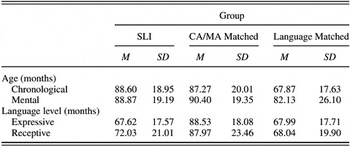
Mean age, performance mental age, and language scores for participant groups
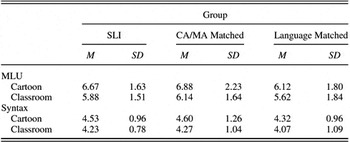
Mean MLUs and mean syntactic complexity for participant groups in each task
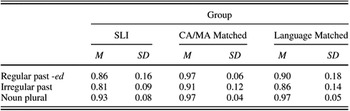
Mean percentage correct for selected morphemes in obligatory contexts by participant groups
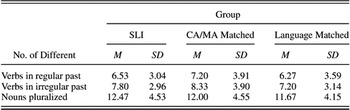
Lexical diversity of verbs in past tense and nouns pluralized by participant groups

Odd syntax in the spontaneous speech of SLI children
 You have
Access
- 11
- Cited by