Stress is a universal condition of life, but if stress is chronic or severe or occurs during critical developmental windows, it can contribute to a variety of disease vulnerabilities, particularly disorders of the brain (McEwen, Reference McEwen2006). In humans, there are known links between stress and a variety of psychiatric disorders (Neigh, Gillespie, & Nemeroff, Reference Neigh, Gillespie and Nemeroff2009; Sinha, Reference Sinha2007). Moreover, it has been demonstrated that a common loss of function variant in the serotonin transporter regulatory region (serotonin transporter linked polymorphic region [5-HTTLPR]) moderates risk in the face of adversity (Caspi et al., Reference Caspi, Sugden, Moffitt, Taylor, Craig and Harrington2003, Reference Caspi, Hariri, Holmes, Uher and Moffitt2010). Rhesus macaques provide an opportunity to examine Gene × Environment (G × E) interactions in a controlled, prospective manner (Barr et al., Reference Barr, Newman, Becker, Parker, Champoux and Lesch2003; Barr, Newman, Lindell, et al., Reference Barr, Newman, Schwandt, Shannon, Dvoskin and Lindell2004; Barr & Goldman, Reference Barr and Goldman2006). Not only can variables such as diet, light–dark cycle, and other factors that contribute to “noise” in human genetic studies be controlled, but environmental factors that might contribute to G × E interactions can also be applied in a controlled manner. Such factors commonly studied in behavioral research include alcohol exposure (prenatal or in adolescence/adulthood), acute challenge (e.g., the presentation of an intruder or separation from attachment sources), response to treatment (pharmacogenetics, including alcohol response), or early life stress (variable foraging demand or peer/nursery rearing; reviewed in Barr & Goldman, Reference Barr and Goldman2006). Of particular relevance to the 5-HTTLPR polymorphism, both rhesus monkeys and humans carry functionally similar variants, making it feasible to study G × E interactions for this particular variant that are likely to translate to the human condition.
Peer rearing is probably the most extensively reported environmental factor for rhesus macaque G × E studies. As with other primate species, rhesus macaque mothers invest much of their energy into defending, comforting, and caring for their infants; and this maternal buffering appears to be critical to normal infant development (Suomi, Reference Suomi, Fobes and King1982). In the PR condition, subjects are removed from their parents at birth and reared with other age-matched infants, so that they develop in the absence of adult influence (Chamove, Rosenblum, & Harlow, Reference Chamove, Rosenblum and Harlow1973; Harlow & Suomi, Reference Harlow and Suomi1974). Peer-reared (PR) monkeys develop strong bonds with their age mates and use them as a base from which to explore. When compared to their mother-reared (MR) counterparts, however, PR subjects exhibit evidence of insecure attachment, higher levels of anxiety, and lower levels of exploration in novel settings (Suomi, Reference Suomi, Fobes and King1982). Because their peers do not necessarily punish inappropriate behavior, they can also have impaired development of the behavioral inhibition system; and, as in humans, macaques that have been exposed to early adversity (in the form of PR) show long-lasting differences in brain function and behavior (Higley, Hasert, Suomi & Linnoila, Reference Higley, Hasert, Suomi and Linnoila1991; Spinelli et al., Reference Spinelli, Chefer, Suomi, Higley, Barr and Stein2009, Reference Spinelli, Chefer, Carson, Jagoda, Lang and Heilig2010). Another advantage of animal studies is that animals can be studied prospectively across developmental and life history stages under these controlled conditions (Barr & Goldman, Reference Barr and Goldman2006).
A number of key neurogenetic studies have been performed in rhesus macaques (Barr, Reference Barr2011). Many of these have illustrated how genetic factors that could be adaptive in certain contexts can also render individuals more or less sensitive to particular environmental variables, ultimately driving potentially maladaptive responses (Barr, Reference Barr2011; Barr et al., Reference Barr, Schwandt, Lindell, Chen, Suomi and Goldman2007, Reference Barr, Schwandt, Lindell, Higley, Maestripieri and Goldman2008, Reference Barr, Dvoskin, Gupte, Sommer, Sun and Schwandt2009; Barr & Goldman, Reference Barr and Goldman2006; Barr, Newman, Shannon, et al., Reference Barr, Newman, Shannon, Parker, Dvoskin and Becker2004; Bennett et al., Reference Bennett, Lesch, Heils, Long, Lorenz and Shoaf2002; Lindell et al., Reference Lindell, Schwandt, Sun, Sparenborg, Bjoerk and Kasckow2010). Notable among these have been studies focusing on interactive effects between early stress and serotonin transporter linked polymorphic region (5-HTTLPR) genotype, which is functionally similar to the polymorphism that confers risk in humans. A high-profile meta-analysis was performed in 2009 that called into question the validity of many of the 5-HTTLPR × Stress findings that had been reported in the literature regarding humans (Risch et al., Reference Risch, Herrell, Lehner, Liang, Eaves and Hoh2009), although other meta-analyses have since been conducted that demonstrate modest 5-HTTLPR × E effects (Karg et al., Reference Karg, Burmeister, Shedden and Sen2011). Debates surrounding this issue are ongoing (Caspi et al., Reference Caspi, Hariri, Holmes, Uher and Moffitt2010), calling out for studies that might verify the validity of G × E interaction results by elucidating mechanisms by which they might occur.
One mechanism by which stress could interact with genotype is via epigenetic modifications. The emergence of next-generation sequencing technologies has broadened our potential for discovery of epigenetic effects. We used these approaches and performed sequencing of chromatin immunoprecipitated DNA (ChIP-Seq) in order to examine effects of early stress on epigenetic regulation in tissue derived from stress-sensitive brain regions (hippocampus). One commonly studied epigenetic mark is the histone 3 protein that is trimethylated at lysine 3 (modified histone, H3K4me3). This is a histone that marks “active” promoters and would therefore be expected to facilitate gene expression. We wanted to examine effects of early stress on levels of H3K4me3 binding at the serotonin transporter (5-HTT) gene (solute carrier family C6 member 4 [SLC6A4]) promoter. This epigenetic modification is a mark for “active” promoters, one that would be predicted to facilitate or promote gene expression. We wanted to determine whether there were effects of early stress on H3K4me3 binding at the SLC6A4 promoter, and whether there were interactions of stress with 5-HTTLPR genotype. Because age may be a factor not only in determining G × E interactions and behavioral responses (Schwandt et al., Reference Schwandt, Lindell, Sjoberg, Chisholm, Higley and Suomi2010) but also in promoting epigenetic regulation, we considered this variable in addition to rearing history and 5-HTTLPR genotype. We then examined in a larger sample whether all of these factors (early rearing history, 5-HTTLPR genotype, and age) interacted to influence functioning of the serotonin system function, as assessed by measuring levels of cerebrospinal fluid 5-hydroxyindoleacetic acid (CSF 5-HIAA), a serotonin metabolite that reflects central serotonin reuptake and for which low levels have been linked to various forms of psychopathology, even among rhesus macaques (Higley, Suomi, & Linnoila, Reference Higley, Suomi and Linnoila1996).
Method
Early rearing conditions
The macaques in this colony are maintained in an outbred state, with frequent introduction of new breeding stock, so that genetic diversity approaches that occurring in free-ranging populations (Yuan et al., Reference Yuan, Zhou, Lindell, Higley, Ferguson and Thompson2012). Rhesus macaque (Macaca mulatta) infants at the NIH Animal Center were randomly selected to be reared with their mothers or in a nursery by human caregivers. MR animals were reared in social groups composed of 8 to 14 females (about half of whom had same-aged infants) and two adult males. PR animals were separated from their mothers at birth and hand reared in a neonatal nursery for the first 37 days of life. For the first 14 days, they were kept in an incubator and hand fed. From day 15 until day 37, they were placed alone in a nursery cage and provided a blanket and a rocking surrogate covered in terry cloth. A bottle from which the infants would feed was fixed to the surrogate. At 37 days of age, they were placed in a cage with three other age mates with whom they had continuous contact. At approximately 8 months of age, animals were placed into age-matched social groups and housed in large indoor–outdoor runs through late adolescence, at which point the cohorts were divided into same-sex groups. Studies were approved by the NIAAA and NICHD Animal Care and Use Committees.
Subjects and tissue collection for epigenetic analysis
Tissues had been archived from a prior study (Lopez & Higley, Reference Lopez and Higley2002). The subjects were 14 male rhesus macaques (Macaca mulatta) that were members of a longitudinal study that investigated genetic and environmental influences on neurobiology, behavior, and alcohol consumption (Higley, Suomi, & Linnoila, Reference Higley, Suomi and Linnoila1996). The animals' ages ranged from 3.5 to 7 years (pre–post adolescence). There were no age differences between the rearing groups (unpaired t test, t = −0.81, p = .43). The mean (±SEM) age in months of the MR group in months was 58 ± 6.7 (range = 47–91), the mean age of the PR group was 66.7 ± 7.3. All subjects were euthanized during the morning hours on four consecutive days. Animals were administered ketamine (15 mg/kg, IM) anesthesia and perfused with ice-cold normal saline. Craniotomies were performed, brains were rapidly removed, and the left and right cerebral hemispheres were separated by a midsagittal incision. Both hemispheres were blocked into 0.5- to 0.8-cm thick coronal sections, frozen in liquid isopentane (−42°C), and stored at −80°C until ready for processing. Brain tissue collections occurred between 8:00 and 11:30 a.m. to control for diurnal variation, making sure that animals from both experimental groups were represented each morning. The hippocampus was identified in the right hemisphere slabs using gross anatomical landmarks and were excised using a fine-toothed saw. The entire dissection was done with the slab sitting on a sheet of dry ice. For this particular study, blocks with the rostral hippocampus (at the level of the red nucleus) were identified, and the hippocampal region was further trimmed at −20°C on a Peltier cooling plate using a razor.
ChIP
Postmortem hippocampal tissue samples (50 mg) were cut into slices less than 1 mm thick and fixed in 3 ml of 1% formaldehyde/phosphate buffered saline solution for 10 min at room temperature to cross-link the chromatin DNA and proteins. After being washed with phosphate buffered saline, the tissue samples were homogenized in a glass–Teflon homogenizer. Following homogenization, chromatin was isolated using the Magna ChIP G kit (Millipore, Temecula, CA) according to the Millipore protocol. Briefly, cells were lysed in cell lysis buffer in the presence of protease inhibitor cocktail. Nuclei were isolated from the lysed cells by centrifugation and resuspended in nuclear lysis buffer. The chromatin DNA was then fragmented into the 150- to 500-bp range by sonication using a Branson Sonifer (Danbury, CN).
To immunoprecipitate specific genomic regions of chromatin DNA, 25 mg of the isolated chromatin fragments were incubated with 0.75 mg of an antibody directed against H3K4me3 (anti-H3K4me3; Abcam, Cambridge, MA) and magnetic protein G beads (Millipore) at 4°C for 2.5 hr. Following incubation, the beads were washed with low salt, high salt, lithium chloride salt, and tris-EDTA buffers; and chromatin fragments were reverse cross-linked by proteinase K digestion at 62°C for 2 hr. The eluted DNA was purified after reverse cross-linking by column purification. The H3K4me3-specific enrichment was validated by polymerase chain reaction (PCR) amplification of select positive and negative genomic regions, and amplification signals were normalized to the input DNA samples, which were extracted from the same pools of chromatin fragments without enrichment by immunoprecipitation.
Sequencing with Illumina Genome Analyzer
Sample preparation and sequencing on an Illumina Genome Analyzer (Illumina, San Diego, CA) were carried out according to Illumina protocols with some modifications. Double-stranded ChIP-enriched genomic DNA fragments were treated with T4 DNA polymerase and Klenow fragments for end repair. The 5′ ends of the DNA fragments were then phosphorylated by T4 polynucleotide kinase, and an adenosine base was added to the 3′ end of the fragments by Klenow (3′–5′ exo−). A universal adaptor was added to the both ends of the DNA fragments by A–T ligation. Following 18 cycles of PCR with Phusion DNA polymerase, the DNA library was purified on a 2% agarose gel and 170- to 350-bp fragments were recovered. Approximately 10 ng of the prepared DNA was then used for cluster generation on a grafted flow cell and sequenced on the Genome Analyzer for 36 cycles using the sequencing by synthesis method.
Sequence base-calling, mapping to genome, and data normalization
Sequences were called from image files with an Illumina Genome Analyzer Pipeline (version 0.3.0) and aligned to the reference genome (UCSC rheMac2) using Extended Eland in the Genome Analyzer Pipeline. The unique mapped reads varied from 4,400,000 to 10,000,000. To control the variation due to total mapped reads, 4,436,000 uniquely mapped H3K4me3 reads for each sample were retrieved from Extended Eland export.txt files based on their physical locations on the sequencing slides. Based on their mapping locations on the reference genome, these selected reads were parsed with in-house Perl scripts to generate base coverage in WIG file format. The raw sequence depths in the WIG files were smoothed with a 201-bases moving window. The chromosome locations of enrichment peaks were identified from pooled WIG files using in-house Perl scripts. For peak identification from the pooled WIG files, the minimum of height, width, and border distance between two peaks (two peaks were merged if they were within this distance) were 15, 80, and 1000 bp, respectively, for H3K4me3 ChIPseq. The numbers of reads and areas under the curve of each individual peak were counted for each sample. The read counts were then log2 transformed and normalized using quantile normalization.
Measurement of CSF 5-HIAA
Male macaques (N = 61) were anesthetized using ketamine hydrochloride (15 mg/kg, intramuscular), and a cisternal CSF sample was drawn into a 5-ml syringe using a 1-in. 22-gauge needle. Samples were taken from all animals within 30 min of ketamine administration. CSF was assayed for concentrations of the serotonin metabolite 5-HIAA with gas chromatography–mass spectrometry using deuterated internal standards (Higley et al., Reference Higley, Suomi and Linnoila1996). Inter- and intraassay variabilities for all assays were <10%. Values are reported in picomoles per milliliter.
Genotyping
Genotyping methods for the rh5-HTTLPR polymorphism have been described in detail elsewhere (Barr, Newman, Shannon, et al., Reference Barr, Newman, Shannon, Parker, Dvoskin and Becker2004; Bennett et al., Reference Bennett, Lesch, Heils, Long, Lorenz and Shoaf2002). DNA was isolated from whole blood that was collected from the femoral vein after the animals had been given ketamine anesthesia (15 mg/kg, intramuscular). The 5-HTTLPR was amplified from 25 ng of genomic DNA with flanking oligonucleotide primers (stpr5, 5′-GGCGTTGCCGCTCTGAATGC; intl, 5′-CAGGGGAGATCCTGGGAGG) in 15-µl reactions using Platinum Taq and the PCRX Enhancer System kit (Invitrogen, Carlsbad, CA), according to the manufacturer's protocol. Amplifications were performed on a thermocycler (9700; Perkin–Elmer, Fremont, CA) with 1 cycle at 96°C for 5 min followed by 30 cycles at 94°C for 15 s, 60°C for 15 s, 72°C for 30 s, and a final 3-min extension at 72°C. Amplicons were separated by electrophoresis on a 10% polyacrylamide gel, and the short (s; 398 bp) and long (l; 419 bp) alleles of the rh5-HTTLPR were identified by direct visualization following ethidium-bromide staining. Approximately 1 out of 20 genotype assays were replicated in separate assays. Genotype completion and accuracy rates were 98% and 99%, respectively.
Statistical analyses
The effects of the 5-HTTLPR genotype and rearing on H3K4me3 binding levels were tested using a two-way analysis of variance. Prior performance of unsupervised clustering had indicated there were age effects on overall H3K4me3 binding in the hippocampus. Therefore, preliminary simple regression analysis was performed to determine whether there were affects of age on H3K4me3 binding at the 5-HTT gene promoter. As there were effects of age on binding at this site, we created H3K4me3 binding z scores that were adjusted for age, and analyses were repeated with H3K4me3 z scores as the dependent variable. An analysis of covariance (ANCOVA) was used to analyze the effects of these variables on the CSF levels of the serotonin metabolite 5-HIAA in the larger sample of male subjects. We examined whether there were interactive effects among age, genotype (long/long [l/l] vs. short [s] allele carrier), and rearing history (PR vs. MR) on CSF levels of 5-HIAA. All analyses were performed using Statview Statistical Software. Post hoc analyses were performed using the Tukey–Kramer method, and p values of ≤.05 were considered significant.
Results
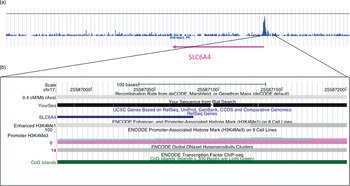
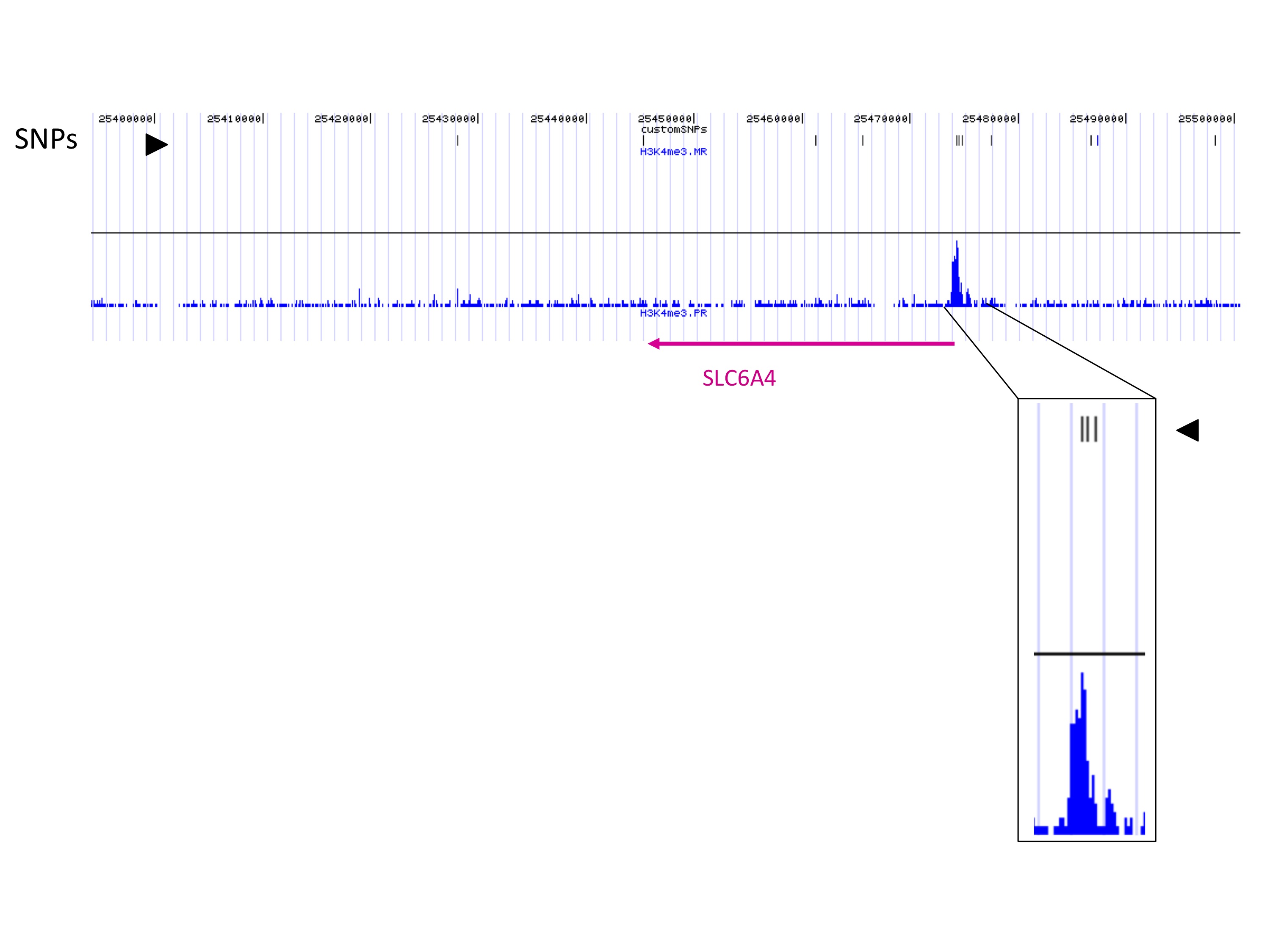
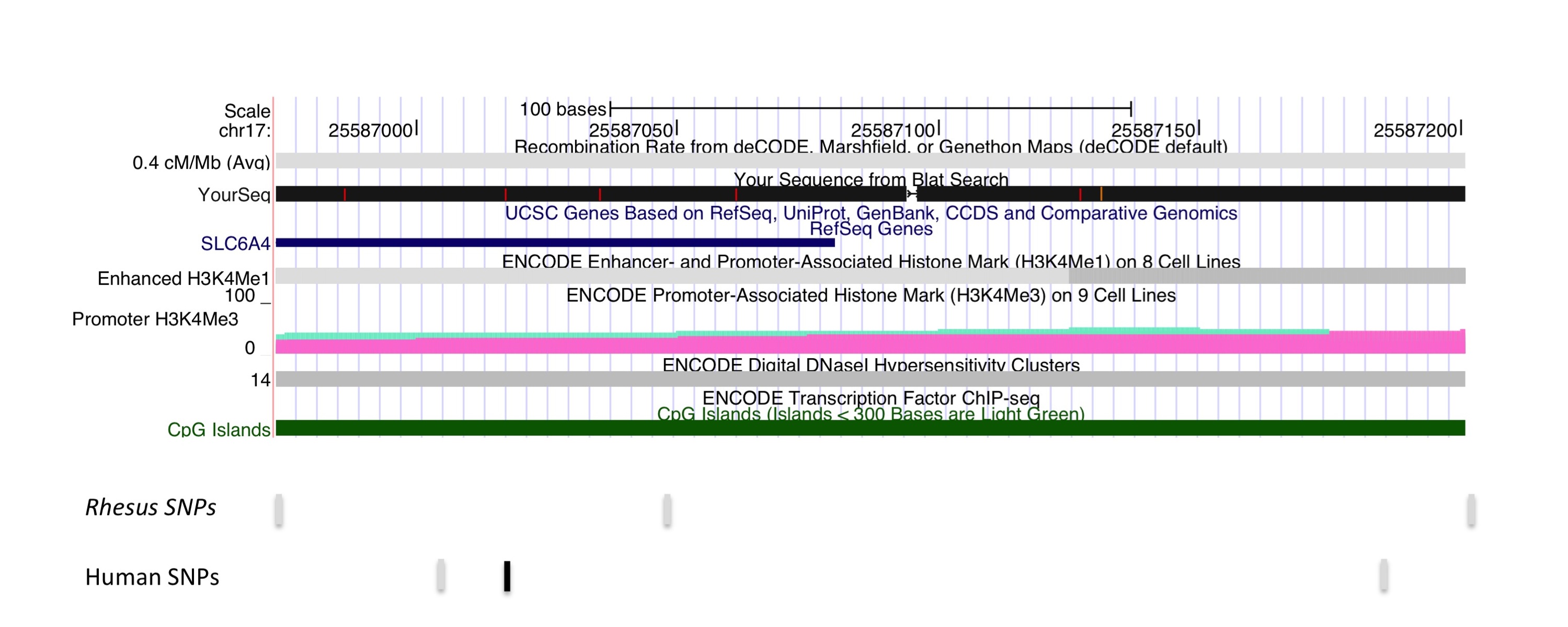
H3K4me3 binding at 5-HTT was found to be present in DNA isolated from rhesus macaque hippocampi (Figure 1a). A binding peak spanning 417 bp was located at the SLC6A4 promoter (rhesus macaque, chr 16:25,474,060–25,474,477). This peak spans from −77 to +339 in relation to the transcription start site described for the corresponding region in humans (Figure 1b).
The histone 3 protein trimethylated at lysine 3 (H3K4me3) binding at the macaque solute carrier family C6 member 4 (SLC6A4) gene. (a) H3K4me3 binding at the serotonin transporter promoter was found to be present in DNA isolated from rhesus macaque hippocampi. (b) This peak spans from −77 to +339 in relation to the transcription start site described for the corresponding region in humans, in which H3K4me3 binding has been indicated from other sources (ENCODE, per UCSC genome gateway). [A color version of this figure can be viewed online at http://journals.cambridge.org/dpp]

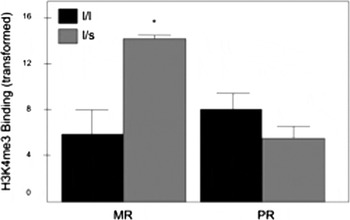
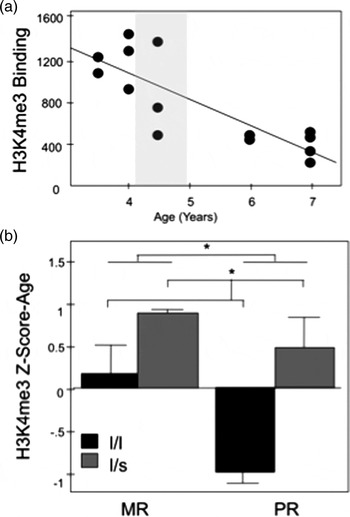
We found an effect of stress exposure on H3K4me3 binding to DNA extracted from hippocampi, F (1, 12), = 5.9, p ≤ .04, with PR monkeys exhibiting lower levels of binding (Figure 2, Tukey–Kramer, p < .05). There were no significant effects of genotype on H3K4me3 binding, F (1, 12) = 3.5, p ≤ .09, but there was a significant interaction between rearing condition and genotype, F (1, 12) = 9.3, p = .01. DNA extracted from hippocampi of MR subjects carrying the short allele had higher levels of binding than that taken from animals in the other groups of study (Figure 2, Tukey–Kramer, p < .05). Because H3K4me3 binding at the SLC6A4 promoter declined with age (Figure 3a: r 2 = −.73, p ≤ .005), we repeated our analyses, controlling for age by creating an age-adjusted z score. When these analyses were performed, the effects of 5-HTTLPR genotype and rearing condition were observed (Figure 3b): genotype, F (1, 12) = 5.4, p ≤ .05, and rearing, F (1, 12) = 5.7, p ≤ .05.
The interaction between the serotonin transporter linked polymorphic region (5-HTTLPR) genotype and rearing history on the histone 3 protein trimethylated at lysine 3 (H3K4me3) binding at the serotonin transporter solute carrier family C6 member 4 (SLC6A4) promoter. Shown are H3K4me3 binding levels as a function of stress exposure (peer-reared [PR] vs. mother-reared [MR]) and genotype (long/long [l/l] vs. l/short [s]). There was a significant interaction between rearing condition and genotype F (1, 12) = 9.3, p = 0.01. MR subjects carrying the short allele had higher levels of binding than other groups of study. *p < .05.

Histone 3 protein trimethylated at lysine 3 (H3K4me3) binding at the serotonin transporter gene solute carrier family C6 member 4 (SLC6A4) as a function of age, rearing history, and the serotonin transporter linked polymorphic region (5-HTTLPR) genotype. (a) Shown is the histone 3 protein trimethylated at lysine 3 (H3K4me3) binding at the SLC6A4 promoter as a function of age (3.5 years to 7 years, shaded area indicates age range at which male macaques reach sexual maturity). (b) Shown is age-adjusted H3K4me3 binding scores as a function of rearing history (peer-reared [PR] vs. mother-reared [MR]) and 5-HTTLPR genotype (long/long [l/l] vs. l/short [s]). p < .05.

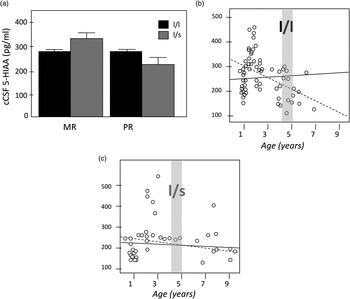
In the larger sample of male subjects for which we had measured CSF levels of the serotonin metabolite 5-HIAA, we observed a qualitative Rearing × 5-HTTLPR interaction (Figure 4a), F (1, 54) = 4.9, p ≤ .03. We also found that there were effects of age, F (1, 54), = 8.15, p = .006, and a Rearing × 5-HTTLPR × Age interaction, F (1, 54) = 4, p = .05. Follow-up ANCOVAs performed separately in l/l and l/s subjects showed that, among short allele carriers, 5-HIAA levels were lower in stress-exposed subjects (Figure 4a, Tukey–Kramer, p ≤ .05) but appeared to show similar declines over adolescence in both groups (Figure 4b, MR, r 2 = .008; and PR, r 2 = .7). Among those homozygous for the long allele, there were no main effects of rearing; but in comparison to MR subjects, PR subjects showed a greater decline in 5-HIAA levels from preadolescence to postadolescence (Figure 4c, MR, r 2 = .009; and PR, r 2 = .2).
Cerebrospinal fluid 5-hydroxyindoleacetic acid levels (CSF 5-HIAA) as a function of age, rearing history, and serotonin transporter linked polymorphic region (5-HTTLPR) genotype in male rhesus macaques. (a) CSF levels of 5-HIAA as a function of rearing history (mother-reared [MR] vs. peer-reared [PR]) and genotype (long/long [l/l] vs. l/short [s]). There were interactive effects among rearing history, genotype, and age. Shown are CSF levels of 5-HIAA as a function of age and rearing history for both (b) l/l and (c) l/s macaques.

Discussion
Of particular interest for the study of G × E interactions is the variation within regulatory or coding regions of genes encoding stress-responsive signaling molecules, which may contribute to environmental sensitivity and stress vulnerability. Perhaps the most extensively studied gene in psychiatric genetics and in nonhuman primate neurobehavioral studies is that encoding the 5-HTT (Barr & Goldman, Reference Barr and Goldman2006; Barr, Reference Barr2011). 5-HTT is a protein critical to regulating serotonin function in the brain because serotonin's action in the synapse is terminated by reuptake. Gene expression studies demonstrate that monkeys with high levels of stress reactivity have lower gene expression levels for 5-HTT (Bethea et al., Reference Bethea, Streicher, Coleman, Pau, Moessner and Cameron2004, Reference Bethea, Streicher, Coleman, Pau, Moessner and Cameron2006); and rh5-HTTLPR has been shown to alter transcriptional efficiency (Bennett et al., Reference Bennett, Lesch, Heils, Long, Lorenz and Shoaf2002), resulting in decreased 5-HTT mRNA levels in brains of l/s macaques (Lopez & Higley, Reference Lopez and Higley2002), which may be further regulated by stress-mediated epigenetic mechanisms (Kinnally et al., Reference Kinnally, Capitanio, Leibel, Deng, Leduc and Haghighi2010). As stated earlier, there is an ongoing debate about the validity of the G × E studies performed in human subjects. Here, we demonstrate epigenetic mechanisms that could contribute to environmental plasticity across life history stages and demonstrate how 5-HTTLPR genotype and early stress exposure interact to predict epigenetic modification and serotonin system functioning.
Many studies performed in human subjects support a role for interactive effects between stress exposure and 5-HTTLPR genotype on vulnerability to psychiatric disorders and related phenotypes (reviewed in Caspi et al., Reference Caspi, Hariri, Holmes, Uher and Moffitt2010). After the discovery that the 5-HTTLPR polymorphism also occurred in the rhesus macaque, the first report demonstrated an interaction between rearing history and 5-HTTLPR genotype on CSF levels of the serotonin metabolite 5-HIAA (Bennett et al., Reference Bennett, Lesch, Heils, Long, Lorenz and Shoaf2002). This was followed by other studies that examined traits related to vulnerability to psychiatric illness in in humans, for example, stress reactivity, sensitization to stress, alcohol consumption, and behavioral dyscontrol (Barr et al., Reference Barr, Newman, Becker, Parker, Champoux and Lesch2003; Barr, Newman, Lindell, et al., Reference Barr, Newman, Schwandt, Shannon, Dvoskin and Lindell2004; Barr, Newman, Schwandt, et al., Reference Barr, Schwandt, Newman and Higley2004; Kraemer et al., Reference Kraemer, Moore, Newman, Barr and Schneider2008; Schwandt et al., Reference Schwandt, Lindell, Sjoberg, Chisholm, Higley and Suomi2010; Spinelli et al., Reference Spinelli, Schwandt, Lindell, Newman, Heilig and Higley2007, Reference Spinelli, Schwandt, Lindell, Heilig, Suomi and Higley2012). In each of these, interactive effects between the 5-HTTLPR genotype and exposure to environmental stressors were observed, sometimes in a sexually dichotomous manner. In the present study, we find interactive effects between a stressful life history and the 5-HTTLPR genotype on epigenetic regulation of the 5-HTT gene in the brain. Consistent with this and in support of the findings of Bennett et al. Reference Bennett, Lesch, Heils, Long, Lorenz and Shoaf(2002), we found interactive effects on CSF levels of 5-HIAA sampled from another cohort of subjects. We also found that the age of sampling is a factor that interacts with genotype and rearing history in regard to H3K4me3 binding to the SLC6A4 promoter and CSF 5-HIAA. Although our sample was not sufficiently large to enter age as a continuous covariable in an ANCOVA for H3K4me3 binding data, we were able to do so for CSF levels of 5-HIAA, which had a larger sample. Although 5-HIAA is reflective of turnover (which is largely dependent on levels of 5-HTT gene expression, because serotonin is broken down intracellularly), it is also reflective of levels of synthesis and release. Therefore, even if we had obtained the equivalent sample, we might not have seen effects that were mimicked exactly between the two types of analyses. However, we did observe effects of age and 5-HTTLPR × Rearing interactions in both studies, with effects occurring in similar directions. The current data may be of relevance to the variation in behavior that occurs across life history stages as well as the existence of developmental time points for emergence or worsening of clinical signs, which are common among the psychiatric and neurodevelopmental disorders. Whether sex could play an additional moderating role needs to be examined.
The methodology employed for the current study involved antibody-based isolation of H3K4me3, after which the levels of H3K4me3 binding were assessed by sequencing the histone-associated DNA, such that the number of reads for a region were the index for the relative degree of H3K4me3 binding and therefore epigenetic regulation via this mechanism. One by-product of using this approach is that genetic variation can also be identified. We identified 11 single nucleotide polymorphisms (SNPs) within the 5-HTT gene and its regulatory region, 3 of which were present in the region of H3K4me3 binding, overlapping with a cytosine nucleotide–phosphate–guanine nucleotide island (a region that can act as a substrate for another, more commonly studied epigenetic regulation, i.e., DNA methylation; Kinnally et al., Reference Kinnally, Capitanio, Leibel, Deng, Leduc and Haghighi2010) and within 100 nucleotides of the transcription start site (Figure S.1). It is interesting that there are 3 SNPs present in the corresponding region in humans as well, rs55753714, rs25533, and rs61274396 (Figure S.2). Though little is known about their functional roles, one of these (rs25533) has been shown to predict individual differences in antidepressant response in major depressive disorder (Lin et al., Reference Lin, Chen, Chang, Gean, Tsai and Yang2009).
Although it was not part of our initial hypothesis and we did not formally analyze the data, the rhesus SNPs present under the H3K4me3 binding peak did not appear to be linked to any obvious differences in the degree of H3K4me3 binding. This would have been of great interest, as genetic variation that altered epigenetic regulation by moderating histone binding would clearly be a valuable substrate for examining G × E interactions. Thus, the identification of abundant, putatively functional polymorphisms in rhesus monkeys and the SNP density observed in the corresponding region for humans (http://genome.ucsc.edu/) is of relevance to studies aiming to examine how variation at or around the SLC6A4 gene relates to individual differences in environmental reactivity and behavior. Because the 5′ region of the gene includes the promoter and important transcription factor binding sites, these regions are typically under selection. The result is that, relative to intergenic regions, there is both increased conservation of sequence across species and lower levels of intraspecific polymorphism within these regions. We have shown previously that in both humans and macaques the average SNP density for the region 5 kb upstream of transcription start sites is low relative to intergenic regions and that it is more similar to that observed in other important regulatory sequences, such as intronic or untranslated regions (which, like the promoter regions, are also under selection; Yuan et al., Reference Yuan, Zhou, Lindell, Higley, Ferguson and Thompson2012). Genome-wide, we previously found that the variability in regulatory, intronic, and untranslated regions is approximately one-third that observed for intergenic regions (e.g., in the 5-kb regions 5′ flanking to the first exon there is an average of ~0.8 SNPs/kb for humans and ~1.8 SNPs/kb for rhesus monkeys). We identified 3 SNPs within the core promoter for the rhesus SLC6A4 gene (even in our sampling of a limited number of subjects), but among humans there also appears to be increased diversity in this region with 25 SNPs within the 1-kb 5′ of the SLC6A4 transcription start site. This is approximately 10-fold of that previously reported for variation occurring in intergenic regions for humans (Yuan et al., Reference Yuan, Zhou, Lindell, Higley, Ferguson and Thompson2012).
There are a number of different interpretations for this increase in diversity in the promoter region for the 5-HTT gene. First, it is possible that there is an increased polymorphism rate as a result of the cytosine nucleotide–phosphate–guanine nucleotide island present in the region (with C > methyl-C > T polymorphisms increasing in frequency) and because such polymorphisms may spontaneously arise without producing large functional effects, there is little selection against them. Second, it is possible that even deleterious variants could be maintained if they are in allelic identity with those that confer beneficial effects. Third, it could be that variation in this region is well tolerated because of compensatory factors such as epigenetic regulation. Fourth, and consistent with the data presented in this article, it may be that certain genetic variants are only “functional” under certain environmental conditions or during certain developmental phases.
One other possibility is that within-species variation at genes that influence behavior and stress response may be favored because they promote alternative strategies, and that this may be particularly true at certain developmental time points or under conditions of stress (Barr, Reference Barr2011). In evolutionary biology, a behavior is adaptive if it makes the organism more fit to survive and to go on to reproduce in comparison to other members of the same species. Several decades ago, Maynard Smith applied game theory to animal behavior and found that aggression and fearfulness are traits that tend to balance each other in any social population (Smith & Price, Reference Smith and Price1973). He described the “hawk–dove game” in which “hawks” (aggressive individuals who were proactive and adopted fight or flight responses to stress) and “doves” (who were fearful, cooperative, and adopted a freeze and hide strategy with stress) were likely to co-occur in the same species. Although hawks are proposed to be fast and superficial explorers who exhibit a degree of behavioral rigidity, doves are proposed to be cautious and thorough explorers who exhibit high levels of behavioral flexibility (Korte et al., Reference Korte, Koolhaas, Wingfield and McEwen2005). As such, both hawk and dove strategies can potentially be adaptive, perhaps especially so in certain environmental contexts or during particular developmental stages. Hawks would be predicted to do better if food is abundant and population density is high (e.g., they are better off fighting for access to mates than foraging), but doves would likely outcompete hawks if the opposite were true (e.g., doves would be better at getting food during periods of scarcity of resources and avoiding danger during times of increased conflict). The two types of temperaments must be balanced in any given population because if there is a population comprised completely of hawks, there will be an excessive level of aggressive encounters among members of the population, reducing the likelihood that any one individual will survive to successfully reproduce. Moreover, if a population comprises only of doves, then they will be killed off by some other hawk species. In other words, the presence of both types of temperaments may be critical to survival of the species, whereas simultaneously there will be selective pressure at the individual level, which will depend on life history variables, sex, or environmental context. It then stands to reason that the genetic factors that underlie alternative strategies would likely be subject to balancing selection, and genetic variation that contributes to individual differences in the expressions of these types of traits or strategies will be observed as a result (Korte et al., Reference Korte, Koolhaas, Wingfield and McEwen2005). The SLC6A4 gene would certainly be a gene at which variation could promote adoption of such alternative strategies (Wendland et al., Reference Wendland, Lesch, Newman, Timme, Gachot-Neveu and Thierry2005).
It may be that genes in which there is both increased polymorphism and epigenetic regulation could be particularly important in stress adaptation and development. It has been demonstrated that loss and gain of function 5-HTT SNPs have arisen and been maintained in rhesus monkeys and humans, suggesting that both types of variation may be under selection (Vallender et al., 2008). It is interesting that 5-HTTLPR variation in rhesus macaques not only predicts individual differences in impulse control and stress reactivity (Barr, Newman, Shannon, et al., Reference Barr, Newman, Shannon, Parker, Dvoskin and Becker2004; Bennett et al., Reference Bennett, Lesch, Heils, Long, Lorenz and Shoaf2002; Champoux et al., Reference Champoux, Bennett, Shannon, Higley, Lesch and Suomi2002; Schwandt et al., Reference Schwandt, Lindell, Sjoberg, Chisholm, Higley and Suomi2010) but is also associated with adaptive traits in free-ranging macaques, such as earlier male dispersal (Trefilov et al., 2000) and male reproductive timing (Krawczak et al., Reference Krawczak, Trefilov, Berard, Bercovitch, Kessler and Sauermann2005). In humans, both gain- and loss of function genetic variation at SLC6A4 and individual differences in central serotonin function (as measured by CSF 5-HIAA) have been shown to relate to risk for an impressive diversity of traits and/or disorders. These include anxiety (Lesch et al., Reference Lesch, Meyer, Glatz, Flügge, Hinney and Hebebrand1997; Mazzanti et al., Reference Mazzanti, Lappalainen, Long, Bengel, Naukkarinen and Eggert1998), compulsivity (Hu et al., Reference Hu, Lipsky, Zhu, Akhtar, Taubman and Greenberg2006), autism (Adamsen et al., 2011; Veenstra-Vanderweele et al., Reference Veenstra-Vanderweele, Jessen, Thompson, Carter, Prasad and Steiner2009), moral judgment (Crockett, Clark, Hauser, & Robbins, Reference Crockett, Clark, Hauser and Robbins2010), aggression (Heinz et al., Reference Heinz, Beck, Meyer-Lindenberg, Sterzer and Heinz2011), depression (Caspi et al., Reference Caspi, Sugden, Moffitt, Taylor, Craig and Harrington2003), sociopathy, and alcohol dependence (Herman et al., Reference Herman, Conner, Anton, Gelernter, Kranzler and Covault2011). Whether such allelic variation at SLC6A4 could be adaptive in humans, despite its relation to psychopathology, has not been elucidated, although there has been speculation that this is the case (Homberg & Lesch, Reference Homberg and Lesch2011).
There are a number of limitations to the current study. First, although they were matched for sex and euthanasia and dissection methodologies, the sample of brains that was studied was relatively small, requiring us to generate z scores in order to be sufficiently powered to perform the analysis. When refined intermediate phenotypes are studied in these types of analyses, they can be quite powerful (Lindell et al., Reference Lindell, Schwandt, Sun, Sparenborg, Bjoerk and Kasckow2010). Another limitation is that we examined effects of H3K4me3 binding in only one brain region and effects may differ in brain regions responsible for anxious responses, reward seeking, and executive cognitive function. Third, we examined only one type of epigenetic mark. Finally, we examined effects only among male subjects, which may not generalize to those observed in females.
Candidate gene-based studies performed in nonhuman primates have been repeatedly demonstrated to have translational value for investigating the effects of genetic variation on traits that increase risk for psychopathology (Barr, Newman, Lindell, et al., Reference Barr, Newman, Schwandt, Shannon, Dvoskin and Lindell2004; Barr, Newman, Schwandt, et al., Reference Barr, Schwandt, Newman and Higley2004; Barr et al., Reference Barr, Schwandt, Lindell, Higley, Maestripieri and Goldman2008, 2009, Reference Barr, Chen, Schwandt, Lindell, Sun and Suomi2010; Copeland et al., Reference Copeland, Sun, Costello, Angold, Heilig and Barr2011; Lindell et al., Reference Lindell, Schwandt, Sun, Sparenborg, Bjoerk and Kasckow2010). Such differences are shown to be influenced by genetic variants that are similar functionally to those present in humans, including those at the SLC6A4 gene (reviewed in Barr, Reference Barr2011), for which moderating effects have been reported to occur only during given developmental stages or in particular environmental contexts. That we can examine the effects of genetic variation in laboratory animal species in addition to G × E interactions (which may be less tractable in humans because of the degree of environmental heterogeneity) can potentially increase our understanding of how genetic variation predicts individual differences in behavior (Barr & Goldman, Reference Barr and Goldman2006). By using tissue archived from such animals, we have also been able to dissect some of the potential epigenetic effects at the 5-HTT gene that occur in the brain. It may be that alterations in H3K4me3 binding occurring at certain developmental stages and in response to a stressful life history is a molecular mechanism through which 5-HTTLPR × E interactions occur and this epigenetic mechanism is important for moderating risk for serotonin system dysregulation-dependent neurodevelopmental and psychiatric disorders.
Supplementary Materials and Methods
The supplementary material referred to in this article can be found online at http://journals.cambridge.org/dpp