

1. Introduction
About 80 per cent of the lead produced worldwide is used in the manufacture of automotive lead acid batteries (Kreusch et al., Reference Kreusch, Ponte, Ponte, Kaminari, Marino and Mymrin2007). India is one of the fastest growing markets for passenger cars and the world's second largest manufacturer of two-wheelers. It holds the distinction of being the largest manufacturer of motorcycles and the fifth largest manufacturer of commercial vehicles. Lead-acid batteries are also being increasingly used for back-up power. The industry manufacturing lead-acid batteries (automotive as well as other) in India is currently growing at a rate of over 20 per cent per annum (Exide India Limited, 2009), and is heavily dependent on lead, which constitutes 50 per cent of the operational cost of producing a battery (Das Capital Management and Advisors, 2009). Thus, the demand for and use of lead in India is expected to significantly expand in the coming years.
Lead acid batteries have a life of three to four years, after which they are typically recycled and the lead is extracted and reused. The process of recycling can contribute to an almost unnoticed but serious environmental problem of hazardous waste.Footnote 1 Lead is a highly toxic metal and is considered one of the 17 most dangerous chemicals in terms of the threat it poses to human beings. Lead can cause behavioral problems and learning disabilities and can be fatal to children who inhale or ingest it. Lead poisoning can lead to impaired physical growth, kidney damage, retardation and, in extreme cases, even death. Birth defects like cardiovascular defects, oral clefts and musculoskeletal anomalies diagnosed in newborns are also associated with lead exposure (Vincetia et al., Reference Vincetia, Rovestia, Bergomia, Calzolarib, Candelac, Campagna and Milan2001). Furthermore, lead can also be toxic to plants, diminishing their productivity or biomass, and eliminating some species (Singh et al., Reference Singh, Dabas, Choudhary and Maheshwari1997; Xiong, Reference Xiong1997; Patra et al., Reference Patra, Bhowmik, Bandopadhyay and Sharma2004).
Globally, recycled lead is an important source of lead, which offers both a solution and challenges to the health hazards posed by this mineral. Demand for lead is met from both primary and secondary sources. Primary sources constitute lead ores extracted from mines, whereas secondary sources of lead are smelters who recycle lead from lead scrap. The scrap mainly comprises used lead-acid batteries, old lead pipes and cables. Lead-acid batteries are among the most recyclable products in the world, with a reported collection and recovery rate of 96 per cent in the US during 2004–2008 (Battery Council International, 2009). Used lead-acid batteries (all types) with an average 10.5 kg of lead (Smith, Reference Smith1999) serve as a source of raw material required for battery manufacturing. High rates of recycling are achieved in the countries where there is legislation governing the collection and recycling of lead-acid batteries. In poorer economies such as Egypt and India, very high rates of recycling are found but not reported because a large quantity of lead is recycled informally (Roberts, Reference Roberts2003). The informal sector in lead recycling can be extremely hazardous, particularly for workers (Toxics Link, Reference Link1999). A presentation made at the UNCTAD by a senior official of the MoEF (Rajagopalan, Reference Rajagopalan2001), acknowledges that the supply of recycled lead from the unorganized sector is substantial in India but there are no reliable estimates of its magnitude. A more recent study conducted by Occupational Knowledge International (2010) on the lead recycling industry in India also found a large presence of the informal sector.
Lead recycling is often supported through a well-functioning deposit refund system (DRS) in the market for batteries (branded and generic). In this system, people can get a discount on the purchase of a new battery if they return the used one to the retailer. Bohm (Reference Bohm1981) describes this as an arrangement between consumers and producers where a refund is provided even without taking a deposit. While a DRS has existed in the Indian battery markets for a long time, in 2001 the Indian Government put in place a set of rules to regulate the recycled lead market. These rules stipulate where and how lead is supposed to be recycled and have supported the development of a market for recycled lead through a DRS for batteries.
Since a legal framework for using recycled lead batteries has been in place in India for over 10 years, it is important to assess how effective the regulations have been in terms of the recycling and disposal of lead-acid batteries. Thus, the objectives of this study are to: (a) understand the strengths and weaknesses of the current DRS in order to ensure better recycling of lead-acid batteries; and (b) to identify policy instruments that could complement the existing system. We do this by studying the roles of and incentives faced by major stakeholders in both the organized and unorganized battery recycling sectors.
The rest of this paper has the following structure: section 2 discusses the DRS and EPR in the context of battery recycling in India. The third and fourth sections describe the data and methodology used in this study. Sections 5 and 6 discuss the results and alternative policy instruments to complement the DRS. The conclusion with policy recommendations forms the last section.
2. The deposit refund scheme and battery recycling in the National Capital Region
While small-scale industries are very valuable for sustainable development, they can create problems when they generate high levels of pollution (Dasgupta et al., Reference Dasgupta, Lucas and Wheeler1998). This is the case with lead-acid batteries in India, which are recycled mainly by small-scale smelting units operating in the organized as well as unorganized sectors.
The lead-acid battery recycling industry in India lacked any kind of regulation until 2001. In the absence of proper smelting facilities and legislation, a large number of backyard smelting units and recyclers operated in India (and some still continue to operate). These backyard smelters recover lead from batteries in a crude manner, causing lead pollution in surrounding areas and affecting the health of the workers. Rajagopalan (Reference Rajagopalan2001) found that only 11.5 per cent of lead scrap reaches the organized smelters while 88.5 per cent reaches scrap dealers who could sell it to unorganized smelters if they paid more for it. Occupational Knowledge International (2010) finds that small recyclers that dominate the Indian market cannot justify the cost of installing pollution controls and their plants operate at low efficiency levels. These plants mainly rely on coal to fuel crude furnaces and the quality of lead recovered is not sufficient to produce high-quality long-life lead batteries.
Rao et al. (Reference Rao, Shetty and Sudha2007) estimate that nearly 11.35 kg of lead are released into the environment from the production of 1,000 batteries. Recycling of battery scrap can cause environmental problems through the emission of dust containing lead particulates and sulfur oxides (Valdez, Reference Valdez1997). In battery manufacturing plants, lead exposure to workers is a major occupational hazard (Yamin, Reference Yamin1999). Poor hygiene, inappropriate protection and lack of awareness increase the risk of lead poisoning. Most workers are ignorant of the ill effects of lead and do not take precautions such as wearing masks, gloves and safety glasses while handling lead. They also indulge in practices like eating, smoking and sleeping in the same premises, resulting in accumulation of dangerously high blood lead levels (Herman et al., Reference Herman, Geraldine and Venkatesh2007). In India, Rao et al. (Reference Rao, Shetty and Sudha2007), for instance, found that the average blood lead levels of battery workers were significantly higher than those of control groups. Hsiao et al. (Reference Hsiao, Wua, Lai and Kuoa2001), in another study in Taiwan, found that long-term exposure to lead among lead battery factory workers resulted in high levels of lead in their bones even after devices to reduce exposure were installed. The occupational hazards resulting from lead battery recycling in the unorganized sector was a motivating factor for India to formulate stronger regulations.
In 2001 the Ministry of Environment and Forests (MoEF) of the Government of India (GoI) came up with ‘The Batteries (Management and Handling) Rules, 2001’ (BMHR), (Government of India, 2001) henceforth referred to as the ‘Rules’, which require retailers to sell the used batteries to registered smelters who are required to use technologies that do not have a harmful impact on the environment. It further stipulates that battery manufacturers must collect (through the DRS or buy-back system) at least 90 per cent of new batteries sold for organized smelting/recycling. The legal framework requires manufacturers and importers of batteries to be involved in the buy-back system either directly or indirectly. By doing this, the BMHR (2001) have (without explicitly naming it) laid down the legal framework for ‘extended producer responsibility’ (EPR) in this industry. EPR is an environmental protection strategy that makes the manufacturer of a product responsible for the entire life-cycle of the product (Lindhqvist, Reference Lindhqvist2000).
A well-functioning DRS exists in the market for lead acid batteries in Delhi and the National Capital Region (NCR). The battery recycling industry in Delhi and NCR includes consumers, battery manufacturers, retailers, registered or organized smelters, scrap dealers and unorganized or backyard smelters called bhattis.
BMHR (2001) requires retailers to sell the batteries collected through the DRS back to manufacturers or registered lead smelters to prevent them from reaching the unorganized or back-yard smelters. This is a variant of a typical DRS in which consumers make deposits that are added to the price of a product and receive refunds when they return used products (Bohm, Reference Bohm1981). The DRS facilitates consumers of lead acid batteries (excluding bulk consumers such as the railways, the defense establishment and large industrial houses) with a discount on the purchase of new batteries on the return of used lead acid batteries to retailers (without any prior deposit made by them). The discount given by the retailers is determined by the market price of lead at the London Metal Exchange (LME).Footnote 2
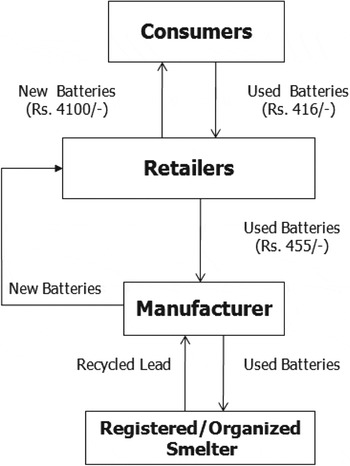
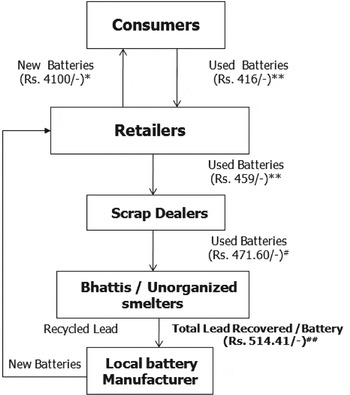
Once consumers return used batteries to retailers, the recycling of these batteries is carried out through two modes (see figures 1 and 2). The first mode complies with the Rules and involves retailers selling used batteries returned by the consumers to the manufacturers.Footnote 3 As shown in figure 1, a used battery goes from the consumer to the retailer and then to the manufacturer or organized smelter. The second pathway is of non-compliance with the Rules, which involves retailers selling the used batteries to scrap dealers, who then sell them further to the unorganized smelters or bhattis.
Recycling pathway of organized smelters

Recycling pathway of unorganized smelters
Notes: *Price of the new car batteries ranges from Rs. 2,700/- to 5,500/-; middle value of the price range (Rs. 4,100/-) has been taken. **Mean value based on survey data. #Scrap dealers sell the used batteries to Bhattis or unorganized smelters at profit margin of Rs. 1.5/- per kg of lead present in the used battery. A car battery, on average, has 8.4 kg of lead (60% of the total weight of the battery of 14 kg). Assuming a profit margin of Rs. 1.50 per kg, the price paid by the Bhattis is Rs. 471.60/- (Rs. 459 + 12.60/-), whereas unorganized smelters buy the batteries by weight at 55% of the LME price of lead. The buying price of Rs. 471.60/- means the LME price would be around Rs. 61.24 per kg. # #Lead recovered from a single battery is about 60% of the total weight of the car battery. Lead recovered multiplied by the LME price (Rs. 61.24/-) gives the price of the total lead recovered from one battery by the unorganized smelters as Rs. 514.41/-. (These calculations are based on interviews with scrap dealers and other informal sector agents. Figures are representative of the prices existing on the day of survey. The prices vary on a daily basis.)

Lead smelters are not legally allowed to operate in the city of Delhi. While registered smelters are located in industrial areas in the NCR, unregistered smelters operate from remote agricultural and other areas on the outskirts of the city. An informal sector smelter is able to extract lead worth approximately Rs. 515 from an average car battery (as shown in figure 2). These unorganized smelters sell the secondary lead (ingots/silli) they produce to local battery manufacturers or scrap dealers.
3. Study area and data
This study was conducted in the NCR of Delhi with an area of 1,483 km2. The data for the study come from questionnaire-based surveys and unstructured interviews carried out in 2010.
A retailer survey was conducted to identify the factors that affect the decision of retailers to sell batteries to manufacturers or scrap dealers. To survey the retailers, we first undertook a pilot survey of some retailers. Then we created a sampling frame of 150 retailers located in the commercial and residential areas of North, South, East, West, Central Delhi and NCR (Vaishali and Gurgaon) using information from the Battery Year Book, 2005, a directory of battery retailers. Finally, 96 retailers were surveyed by randomly identifying markets that had a cluster (more than two) of battery retailers.Footnote 4 Twenty-eight per cent of the sample was located in South Delhi, and 18, 20, 14, 12 and 8 per cent in North, East, West, Central Delhi and NCR, respectively. We obtained information on issues such as: their status (authorized or not); awareness of the Rules; how many used batteries they bought back every week; who they sold the used batteries to; discount given on new batteries; selling price of used batteries; frequency of battery collection by manufacturer and scrap dealer; and their location.
We found that 46 per cent of the retailers surveyed were ‘authorized’ to sell certain brands and sold only those, 18 per cent sold both branded and unbranded batteries of which they were authorized to sell some, and 36 per cent sold only unbranded batteries. Almost 65 per cent of the retailers were not aware of the Rules. Fifty-six per cent of the retailers were located in residential areas. Only 26 per cent of the retailers admitted to complying with the Rules and selling the used batteries to the manufacturers. Sixty per cent sold to scrap dealers and about 13 per cent sold to both manufacturer and scrap dealers.
Simultaneously, another questionnaire was prepared to assess the level of awareness and participation of consumers in the DRS. We divided the city of Delhi and NCR into six zones: North, South, East, West, Central and NCR. From within these zones, we administered the questionnaire to 106 households that owned cars using convenience sampling. Seventy per cent of these households were located in Delhi and 30 per cent in the NCR. This survey was undertaken in January and February 2010.
In order to understand how the formal sector operates, we undertook a case study of Exide India Limited, one of a few battery manufacturers in India and the only one in the NCR with a recycling business for batteries. We obtained data on Exide's recycling unit – Chloride Metals Limited (CML). Data were obtained from annual reports and interviews with senior officials of Exide using a structured questionnaire.
Information from other organized smelters, unorganized smelters and scrap dealers was collected through unstructured interviews. The informal sector stakeholders like scrap dealers and smelters were reluctant to share any information, as their operation is primarily illegal. Small lead smelters in the organized sector were also unwilling to share any financial information. Thus, we used unstructured interviews to understand their role, incentives and the socio-economic and health impacts in the lead recycling industry. We undertook interviews with five organized smelters in addition to CML. The unorganized smelters or bhattis located in Mandoli and Ghaziabad, close to the eastern border of Delhi, were interviewed to understand their mode of operation, availability of raw materials, cost and profitability of their business and problems including health concerns faced by the workers. We visited these bhattis for seven days and interviewed 10 operators.
4. Methodology
The entire chain of recycling depends on the retailers’ choice to sell the used batteries back either to the manufacturer (which results in recycling through the organized sector) or to scrap dealers (which results in recycling through the unorganized sector). As figures 1 and 2 show, the retailer acts as the interface between the consumer, the manufacturer and the recycler of batteries. Local and branded battery manufacturers sell their product through retailers. Once a retailer receives a used battery it gets recycled either by registered smelters or unorganized smelters/bhattis. The recycled lead reaches both types of manufacturers. We also found evidence that indicates some movement of used batteries from scrap dealers to registered smelters.
4.1. Examining consumer and retailer decision-making
The first question of interest to us was the extent to which consumers are willing to sell batteries back to retailers. They have a choice of selling batteries to scrap dealers directly; thus we probed this issue through surveys and report some simple evidence of very high levels of awareness and participation in the buy-back system (DRS).
The second issue of interest is how retailers are making their decisions to sell batteries to the organized or unorganized sector. To address this question, we undertook an econometric analysis of retailers’ sales decisions. Retailers face a dichotomous choice of who to sell the used batteries to – they can either sell to manufacturers or to scrap dealers. The dependent variable (Y) ‘comply’ takes on a value of 1 when retailers sell used batteries only to the manufacturer (compliance with BMHR) and 0 otherwise.
Equation (1) presents a logistic regression model used to analyze the responses from the retailers:
 $$\eqalign{P & = \hbox{Probability} \lpar Y = 1 \vert X_{1}=x_{1}\comma \; X_{2} = x_{2}\cdots\rpar \cr & = \ln \ \lsqb \pi/\lpar 1-\pi\rpar \rsqb = \beta_{0} + \beta_{1}X_{1} + \beta_{2}X_{2} + \cdots + \beta_{p}X_{p} }$$
where π is the probability of the event, i.e., of the retailer complying with BMHR and selling to manufacturers, β0 is the intercept, β p are regression coefficients and X p are a set of predictors that influence the retailer's decision. Y is the decision of retailers to sell batteries only to the manufacturer or not only to the manufacturer (to scrap dealers or scrap dealers and manufacturers).
An important factor that affects compliance is the location of the retailers (location). This variable takes on the value 0 when the location is in a residential area and 1 when the location is in a commercial area. We hypothesize that retailers located in commercial areas are more likely to comply. Therefore this variable is expected to have a positive sign in the regression model.
The type of retailer (type) also matters. We identified three types of retailers: authorized, general and both. Authorized retailers are those who are authorized to sell certain brands and general retailers are those that sell only unbranded batteries. Some retailers sold authorized brands and also unauthorized brands – such retailers were clubbed with the authorized retailers. Thus, the variable type takes the value 0 if the retailer is selling any branded batteries and 1 if he only sells unbranded batteries. A manufacturer is not likely to visit and collect used batteries from a retailer who sells only unbranded batteries; therefore, this variable is expected to have a negative sign.Footnote 5
Awareness about BMHR (2001) (awareness) is a dummy variable and takes on a value of 1 when retailers are aware of BMHR and 0 otherwise. Since awareness is expected to increase compliance, this variable should have a positive sign in the regression model. The number of used batteries bought back for every 100 batteries sold per week (bought back) is a variable that allows us to understand the scale of the retailer's operations. To answer this question, retailers were asked to identify the percentage of batteries bought back by choosing from among various options: 51–60 per cent, 61–70 per cent, 71–80 per cent, 81–90 per cent and 91–100 per cent. The percentage of batteries bought back for every 100 batteries sold was calculated by taking the mid-point of these options. We hypothesize that the higher the percentage of batteries bought back each week, the less likely it is for retailers to comply because of high storage costs (so the variable should have a negative sign).
We have information on two price variables. The price paid by retailers for used batteries is the buy-back price. Retailers were asked about the price (buy-back price) which they paid to consumers for used batteries and the price (selling price) they obtained from manufacturers or scrap dealers for used batteries. Since most responses were in terms of a range of prices, the mid-point was taken. The difference between the buy-back price and selling price is called profit and is hypothesized to have a negative effect on the probability of selling batteries to manufacturers. We also created a ratio of selling prices to the buy-back prices (price ratio). Both these variables are expected to have a negative impact on compliance and are expected to have a negative sign.
The frequency of visits from scrap dealers and manufacturers to collect used batteries is important because retailers find it difficult to store bulky batteries. Two variables reflect frequency of visits by the manufacturer (manufacturer visit) and by scrap dealers (scrap visit). These refer to the number of days per month that the manufacturer/scrap dealer visited retailers to collect used batteries. The frequency of collection visits by the manufacturer is hypothesized to increase the probability of compliance (positive sign), while the frequency of collection visits by scrap dealers is hypothesized to have an opposite effect (negative sign).
There are two explanatory variables that are of interest from a policy perspective: awareness and manufacturer visit. The higher the level of awareness of the Rules and the greater the frequency of manufacturer visits per month, the higher is the probability of compliance. The remaining explanatory variables discussed above act as control variables.
4.2. Incentives faced by the unorganized and organized battery recycling sectors
To better understand the incentives facing the unorganized sector, we used qualitative information obtained from scrap dealers and smelters. It is important to understand the costs of compliance to those in the unorganized sector. Thus, we estimated the costs of setting up a plant in an industrial zone and running a smelting unit (including taxes) and the additional cost incurred on compliance in accordance with the requirements of the pollution control authority (pollution control equipment and its maintenance). Information from the unorganized sector on wages, number of employees, number of days worked, etc. were used to estimate the cost to society if compliance for this sector meant the shutting down of operations.
A final set of issues that we analyzed was the incentives facing the organized sector. An important issue to establish is whether it is profitable for the formal sector to recycle batteries. To understand the economic viability of this business, we did a case study of Exide's recycling unit – Chloride Metals Limited. In this case study, we calculated the net present value (NPV) and internal rate of return (IRR) of operating the unit. Data from CML were used to establish the financial viability of organized smelting.
5. Results and discussion
5.1. Consumers and the DRS
The results of the consumer survey revealed that 88 per cent of the respondents were well aware of the DRS and 90 per cent of them returned their used battery to the retailers irrespective of the discount price. The difference in these numbers could be because the DRS is so well established in the market for lead-acid batteries that some people return/recycle used batteries without even realizing it. The survey results also show that the average consumer in our study was aware of the DRS and about 95 per cent of consumers preferred to buy a branded battery. Consumers sold used batteries back to retailers and received on average about Rs. 372 (this number ranged from Rs. 200 to Rs. 500) for a used battery. This discount is available only when a new battery is purchased and covers approximately 9 per cent of the cost of a new battery.
5.2. The retailers’ decision to comply
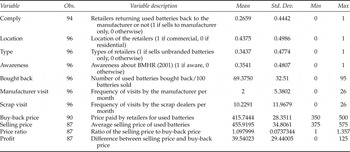
A logistic regression was used to analyze the responses from retailers. Table 1 shows the summary statistics of the dependent and the independent variables. On average, a retailer is able to buy back 69 used batteries for every 100 batteries sold in a week. Table 1 indicates that on average the manufacturer's representatives collect used batteries twice a month, while scrap dealers collect used batteries 10 days per month on average. The mean price retailers pay for buying back used batteries is Rs. 416 while the mean price retailers get for these batteries is about Rs. 456.Footnote 6 Retailers obtain 0.9 per cent higher price when they sell to scrap dealers instead of manufacturers (as shown in figures 1 and 2).
Summary statistics of the variables in the retailer study

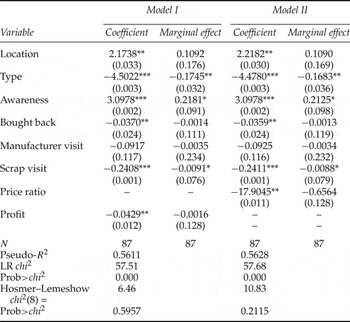
Results of the logit estimation of the compliance decision of retailers are presented in table 2. The models estimated were tested for multicollinearity and model specification. The results of these tests showed neither multicollinearity nor any model misspecification. The signs and significance of the variables in the models I and II are the same. All variables are significant at least at the 5 per cent level of significance except manufacturer visit. This may be because this variable has very little variation, with a mean of 2, standard deviation of 5.38.
Logistic regression of dependent variable ‘comply’: compliance with BMHR by selling used batteries only to manufacturer

Notes: The numbers in parentheses are p-values.
***, **, * denote significance at the 1, 5 and 10% levels, respectively.
As expected, awareness of the BMHR rules and being located in a commercial area have a positive impact on the probability of selling only to the manufacturer. The variables type, scrap visit and bought back have negative signs. This shows that being a general battery retailer (as distinct from an authorized one), the higher the number of scrap dealer visits in a month, and the larger the percentage of used batteries bought back have a negative effect on the probability of selling used batteries only to the manufacturer. This makes sense because the manufacturer is not likely to visit a ‘general’ retailer (who sells only unbranded batteries) to collect battery scrap. Storing used batteries has a cost associated with it, so retailers would be more inclined to reduce this cost by selling to scrap dealers if they come to collect often. How many batteries they have to store would also depend on how many they buy back.
Several retailers told us that the scrap dealers pay more for used batteries.Footnote 7 The coefficient of profit is significant and has a negative sign (in model I), showing that the higher the profit earned by recycling, the less likely it is for retailers to sell the used batteries to manufacturers. So if a retailer gets a higher price from scrap dealers he is less likely to sell to the manufacturer. In model II, the coefficient of the price ratio is significant with a negative sign indicating again that as the ratio of selling price to buying price of battery scrap increases, it is less likely for this scrap to be sold to manufacturers.
5.3. The unorganized battery recycling sector
Lack of awareness, illiteracy, complexity of paper work, restrictions on location, maintenance of pollution control equipment and reluctance to pay taxes keeps the unorganized smelters from getting their units registered and complying with BMHR. There are about 70 unorganized smelters operating in the outskirts of Delhi and in the NCR (40 in Mandoli and 30 in Ghaziabad) with about 840 employees.
Interviews with the organized and unorganized smelters revealed that at present both types use the same pollution control technology – bag-house filters, which collect the ash from the flue. Ash has a high content of lead. Almost 50 per cent of the recycled lead obtained from the used batteries comes from this ash. The recovery of ash controls air pollution since, if not recovered through bag-house filters, the ash and the lead within it would be a potential source of ambient lead exposure. Further, it is also a source of profit for smelters as lead ash is valued at about Rs. 2/- per kg. This is an incentive for all unorganized smelters to install the bag-house filter technology. But, as we observed, the filter equipment used was crude, badly maintained and prone to leakage, and thus posed a threat to the environment and the health of the workers.
Unorganized smelting units are of similar capacity and employ 3–4 workers (1 ‘mistry’ or the main worker and two or three helpers) to run the bhatti in each shift. These units run in three consecutive shifts every day as they have sufficient raw material. In addition, they also employ 8–10 laborers on a contract/daily wage basis (mostly women) to break the batteries. Each smelting unit has a pool of about 100 workers hailing from villages in Varanasi district of Uttar Pradesh.
Most workers in unorganized smelting units live on the premises. The workers are usually employed for a period of two to three months at a stretch. They develop health problems after that and quit or are forced to go back to their villages. The typical symptoms of indigestion, abdominal pain and severe constipation are treated by local doctors. Very few workers are taken to hospitals because the smelters are not willing to disclose their occupation.
Workers earn about Rs. 3,000 a month. Some of them return to work on call while most do not and continue with other jobs in their villages. Those with no other employment options return to these smelters on call once they have recovered. These workers stand to lose about Rs. 30,000 annually because they fall sick and cannot continue working in the smelting units (if we assume that they have no other employment). Sometimes the smelters pay the workers in advance while they are recovering at home to prevent them from moving to other smelting units.
Unorganized smelters face no shortage of raw material as scrap dealers provide them with a constant supply of used batteries. Extracted lead ingots or silli are either sold to units that manufacture lead oxide, cables and generic batteries (usually co-located with the smelters) or to scrap dealers and secondary lead dealers in Delhi. The difference in the price at which smelters buy lead (in the form of batteries) and sell it is, on average, Rs. 5/kg of lead. The smelters also perform ‘job work’ for retailers in Delhi who send used batteries to them and buy back the extracted lead. The hard poly-propylene plastic cover of the batteries is sold to plastic recyclers.
A scrap dealer serves as the middleman who collects used batteries from battery retailers and sells them to the unorganized smelters at a profit margin of Rs. 1.50 per kg of lead in the battery. This is mostly paid in secondary lead. The scrap dealers then sell this secondary lead to small battery manufacturers. Some scrap dealers we interviewed felt that their business had been adversely affected by the recent decision made by some bulk battery consumers to float tenders to sell battery scrap instead of holding open auctions. A few claimed to sell battery scrap only to registered smelters. All the registered smelters we spoke to insisted that they bought used batteries only from bulk consumers through auction or tenders (implying compliance with the Rules) and not from scrap dealers.
An average scrap dealer collects about two tons of used batteries (both branded and generic batteries) every day. This would give the scrap dealer revenue of about Rs. 1,800 per day (at Rs. 1.50 per kg of lead). The scrap dealers reported that retailers prefer to sell the used batteries to them because the manufacturer's representatives visit them infrequently or their collection centers are located at long distances and because they have to buy new batteries in lieu of the ones returned. As a result, the majority of the used batteries recycled under the present DRS find their way to informal smelters through scrap dealers. The results of our retailer survey substantiate this claim because 60 per cent of retailers reported that they sold used batteries to scrap dealers and 13 per cent said they sold to both scrap dealers and manufacturers. Only 26 per cent sold only to manufacturers.
5.4. The organized battery recycling sector
According to the Central Pollution Control Board, as of September 2010, there are 353 registered lead recyclers in India. Only 24 of these have a capacity greater than 10,000 tons/year (which is the minimum size required for similar recyclers in China). Organized smelters acquire the battery scrap through government auctions (railways, defense, etc.) and also from the import of lead scrap (under license from the MoEF). The capacity utilization of organized smelters is low because of a limited supply of battery scrap. A recent survey conducted by the Indian Bureau of Mines (Government of India, 2011) shows that out of 134 units surveyed only 40 per cent were operating and at an average capacity utilization of 50 per cent. The installation and maintenance of pollution control equipment (other than bag filters) together with applicable taxes (as shown in table 3) and transportation costsFootnote 8 add to the cost of running the smelting units. This additional cost can be considered the compliance cost for the organized smelters.
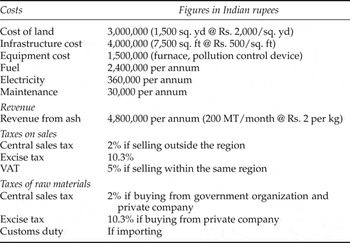
Illustrative costs of setting up a smelting unit in the organized sector in NCR – an example for Mandir Bhatti or open hearth furnace with a capacity of 5,000 MT/year

Source: Interviews with organized smelters.
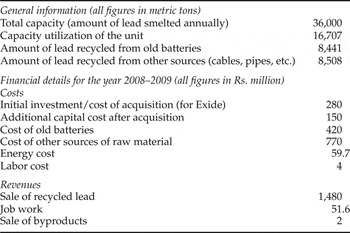
The Rules require battery manufacturers to be involved directly or indirectly in the buy-back of used batteries and ensure that they are smelted by registered smelters with environment-friendly technology. The financial information on the smelting operations of CML, one of Exide's smelters, is shown in table 4 for the year 2008–2009. Exide acquired CML at an initial cost of Rs. 430 million with an installed capacity of smelting 36,000 tons. CML smelted 16,707 tons of lead (8,441 tons from used batteries and 8,508 tons from other sources) during 2008–2009. The operating cost of the unit included cost of energy, labor, occupational health and safety and maintenance. Revenue earned was from sale of recycled lead, job work and sale of byproducts. Analyses of input costs and output revenues (table 4) show that the smelting unit has an NPV of Rs. 960.5 million and Rs. 874.7 million at 8 per cent and 10 per cent discount rates, respectively. As the NPV is positive, running the smelting unit is economically viable. Therefore, at this capacity of operation, the market provides a battery manufacturer with adequate economic incentive to comply with the BMHR.
Financial details of CML

Source: Annual Report and interview with officials, Exide India Ltd.
5.5. Cost of complying with BMHR (2001)
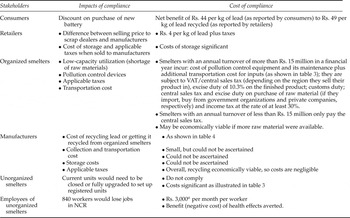
The stakeholders in the organized sector of lead recycling incur a cost of complying with BMHR. We discuss the costs of compliance to each of the different stakeholders in table 5.
Compliance cost

Notes: a Average income of the workers employed in unorganized smelters.
Source: Surveys and interviews conducted.
As shown in table 5, consumers get a discount (Rs. 372) on a new battery when they return a used battery to the retailer. So compliance with BMHR gives them a net benefit of Rs. 44 per kg of recycled lead.
If battery retailers sell all used batteries to the manufacturer (assuming that they do not sell directly to organized smelters) they would be complying with the BMHR. Assuming that the manufacturers’ representatives visit all retailers to collect the battery scrap, the retailers would incur a cost of storing the battery until it is collected, the opportunity cost of not selling it to a scrap dealer, plus the taxes applicable on sales. The retailers we surveyed were unable to quantify the cost of storage. The average price a scrap dealer pays for a battery is about Rs. 459, while a manufacturer's representative pays about Rs. 455. So the compliance cost (excluding storage cost and taxes) incurred by an average retailer who buys back 69 batteries in a week would be the difference between the two prices, i.e. Rs. 4 per battery or approximately Rs. 0.50 per kg week (or Rs. 500 per ton of recycled lead). This is a very small amount and indicates that the main incentive to sell to scrap dealers comes from significant storage costs and taxes.
For organized smelters, the costs of compliance include the installation and maintenance of pollution control equipment (other than bag filters), taxes on the purchase of battery scrap, and transportation costs. Table 3 gives an illustrative estimate of the costs associated with setting up and running a smelting unit of 5,000 MT capacity in the Delhi region based on interviews with organized smelters for illustrative purposes.
The market provides a battery manufacturer with adequate economic incentive to comply with the BMHR (see section 5.4). The main issue is more of coordination. If manufacturers accept their EPR, join the battery buy-back process and ensure more frequent collection from authorized and other retailers, they will be able to capture a larger share of battery scrap. At present Exide is the only manufacturer that buys back batteries in Delhi. Occupational Knowledge International (2010) shows that few manufacturers are complying with BMHR (2001) and buying back only a small percentage of their total sales (on an all-India basis). These include Amara Raja (26 per cent), TAFE (11 per cent) and Tudor (39 per cent). The study also finds that the current system is inadequate to ensure that most used lead batteries are collected and taken to registered recyclers.
The stakeholders in the unorganized sector do not comply with the BMHR so they do not incur a cost of compliance. If scrap dealers were to comply in the current scenario by selling the battery scrap to manufacturers, they would incur a loss of Rs. 4 per battery (since scrap dealers pay Rs. 459 per battery to retailers and manufacturers pay Rs. 455). This would mean that the scrap dealers would go out of business.
Since the smelters in this sector do not feel the need to adopt better technology and get registered with the pollution control authorities, compliance would imply that their operations are shut down. The cost to society of closing these units would be in terms of about 840 workers losing their jobs around Delhi and NCR. (There would, however, also be benefits in terms of health costs averted for these workers as mentioned earlier.) If they did choose to comply, their compliance cost would be reflected by the cost estimates shown in table 3. The cost of compliance is high for these stakeholders.
6. Policy options for safe disposal of used batteries
The current deposit refund instrument is unable to discourage unorganized smelting of used batteries in Delhi. Non-compliance with BMHR happens because of: (a) costs borne by retailers if they sell only to the organized sector; (b) profit incentives for the unorganized smelters to use inefficient technologies; (c) coordination problems that limit the amount and frequency of collection and recycling that is done by the organized sector; and (d) inability of the regulator to fully monitor the market for recycled lead.
The primary focus of any policy measure should be to shut down/completely eliminate the informal sector from this industry. The informal sector operations are illegal but the regulator is not able to fully monitor the market for recycled lead. Since the informal smelters operate in the outskirts of the city and in rural areas, it is very difficult to identify/locate them and shut them down. An indirect way to close down informal sector operation would be to completely restrict the supply of lead (scrap/secondary) to this sector.
A green tax per battery produced on manufacturers and a subsidy for a battery properly disposed of (disposed of by organized smelting) in combination with the current deposit refunding to users of batteries could ensure the manufacturer complies with EPR. Since it is the lead used in making batteries that causes the environmental problem, alternatively there could be a tax on lead used and a subsidy on lead recovered by the manufacturer. A subsidy on the safe disposal of batteries provides incentives to do organized smelting. (As the percentage of batteries bought back for organized smelting increases, the flow of lead scrap and refined lead into the informal sector will decrease.)
This subsidy or refund of the tax paid by the manufacturer on batteries for complying with BMHR should be such that it leaves the manufacturer with no incentive to under-report the number of batteries sold. Suppose a green tax of t rupees per battery sold is collected from the manufacturer. When the battery is recycled by an organized smelter, the manufacturer gets a refund of r rupees. Suppose the manufacturer incurs an additional cost of c rupees per battery for ensuring that its batteries are collected and sent for organized smelting. As long as t and r are such that r≥t+c, the manufacturer will have no incentive to under-report the number of batteries sold.
The advantage of such a tax-subsidy scheme (as opposed to a penalty for not buying back the required number of used batteries) is that it removes the incentive to under-report battery sales. The regulator then has to verify the number of batteries reaching the organized smelter and not the number of batteries being sold. The regulator would, however, need to strictly monitor the number of batteries reaching the organized smelters and penalize over-reporting in order for this scheme to work.
Scrap dealers will be a part of this system because manufacturers would be willing to pay a high enough price to ensure that battery scrap reaches organized smelters. In addition, if the regulator wants this scheme to pay for itself, a lump-sum tax could be imposed on the manufacturers that is high enough to take care of the additional refunds. This tax would, however, have to be adjusted every few years as the scale of operation changes.
Since most organized smelters are operating much below full capacity, they could be given fiscal and other incentives (like lower tax on purchase of battery scrap) to increase production. This would also bring more lead scrap to the organized sector.
7. Conclusions and policy recommendation
This study set out to understand the role of and incentives to different stakeholders in the lead recycling industry and how they affect the efficient functioning of the DRS. The results indicate that the DRS is well established in this industry and 90 per cent of consumers recycle lead-acid batteries by selling them to battery retailers. Consumers, who obtain a net benefit of approximately Rs. 44–49 per kg of lead recycled, have a clear incentive to recycle.
However, the BMHR have not had the desired impact on the structure of the battery recycling industry and the informal sector continues to operate, causing significant environmental pollution. Some 73 per cent of surveyed retailers sold batteries to scrap dealers, who in turn sold them to informal smelters. The higher frequency of scrap dealer visits (almost three times a week), the higher price received, storage costs, and taxes avoided motivate retailers to sell to the informal sector.
For a battery manufacturer, depending on the scale of operation, collecting used batteries from retailers and operating smelting units can be economically viable. Thus, if manufacturers simply increased the frequency with which they collected batteries from retailers and bore the storage costs, they would be in compliance with BMHR. However, the cost of complying with the BMHR is high for registered lead smelters. They are unable to operate at full capacity because of a limited supply of battery scrap.
One policy option that might improve the recycling of lead within the formal sector and lead to the gradual elimination of the informal sector is a green tax and linked subsidy on each battery produced in the organized sector. A large enough tax per battery manufactured along with a subsidy/refund (that covers the tax and any additional cost of ensuring organized smelting) if the manufacturer shows that the battery was properly disposed of, could provide the necessary incentives for organized smelting.