Nocturnal sleep duration and daytime nap duration constitutes our total sleep duration, and both are found to affect older adults’ well-being. Specifically, both short (<7 h) and long sleep (>8 h) at night (“sleep” refers to “nocturnal sleep” hereafter) are associated with poor health outcomes in this age group (Hall et al., Reference Hall2015; Lo et al., Reference Lo, Groeger, Cheng, Dijk and Chee2016). Older adults are recommended to sleep 7–8 h each night (Hirshkowitz et al., Reference Hirshkowitz2015), but it is not uncommon that they have short (25%) or long (5%) sleep duration (Ohayon, Reference Ohayon2004). Daytime nap is also common with about 20% of older adults reporting taking regular naps in the West (Frisoni et al., Reference Frisoni, De Leo, Rozzini and Trabucchi1996; Foley et al., Reference Foley, Vitiello, Bliwise, Ancoli-Israel, Monjan and Walsh2007). Although nap is regarded as a good health practice in some countries (e.g. deemed to provide stress relief in Latin American and Mediterranean countries), nap has been associated with higher risks for all-cause mortality (Zhong et al., Reference Zhong, Wang, Tao, Ying and Zhao2015). Thus, information on its determinants is of paramount importance. In this study, we examine the demographic, psychosocial, and health determinants of older adults’ sleep and nap durations.
It has previously been proposed that knowledge of sleep and nap durations is incomplete without a clear understanding of their determinants (Grandner and Drummond, Reference Grandner and Drummond2007; Grandner et al., Reference Grandner, Hale, Moore and Patel2010). However, the existing gerontology studies have a few shortcomings, which motivate the present investigation. First, from a biological view, sleep, regardless of time of day, is regulated by the same biological processes – circadian and homeostatic processes and hence, it may seem unnecessary to consider nocturnal sleep and daytime nap separately. In fact, some researchers assess self-reported sleep duration by questions such as “how many hours on average do you sleep every day including napping?” (Gu et al., Reference Gu, Sautter, Pipkin and Zeng2010). Note, however, that some previous data have shown that nocturnal sleep and daytime nap are uniquely related to certain demographic, psychosocial, and health correlates among elderly (Frisoni et al., Reference Frisoni, De Leo, Rozzini and Trabucchi1996; Ohayon, Reference Ohayon2004; Ohayon and Vecchierini, Reference Ohayon and Vecchierini2005; Foley et al., Reference Foley, Vitiello, Bliwise, Ancoli-Israel, Monjan and Walsh2007), revealing the need to differentiate sleep and nap so as to better understand these two constructs and capture their unique correlates.
Second, the limited studies that differentiated sleep and nap durations and examined their antecedents were seldom based on longitudinal data. Thus, temporal causations are not clear. Concerning nocturnal sleep, cross-sectional studies have linked older age, depression, and obesity with extreme sleep duration (Ohayon, Reference Ohayon2004; Ohayon and Vecchierini, Reference Ohayon and Vecchierini2005; McHugh et al., Reference McHugh, Casey and Lawlor2011). A longitudinal investigation demonstrated that poorer health as indicated by increased levels of inflammatory markers predicted future long sleep duration (Dowd et al., Reference Dowd, Goldman and Weinstein2011). Regarding daytime nap, the few cross-sectional research has reported that male gender, cognitive impairment, and obesity are associated with long nap duration (Ohayon, Reference Ohayon2004; Ohayon and Vecchierini, Reference Ohayon and Vecchierini2005; Foley et al., Reference Foley, Vitiello, Bliwise, Ancoli-Israel, Monjan and Walsh2007). We attempt to replicate these findings with a longitudinal dataset. Specifically, we examine whether extreme sleep duration is associated with older age, depression, obesity, and poor health, and whether long nap duration is linked with a male gender, impaired cognition, and obesity.
Another limitation in the literature is that investigations with non-Western samples are scarce. Differences in sleep and nap durations have been reported across ethnicities in Europe (Ohayon, Reference Ohayon2004). These findings point out the importance of addressing variations in sleep and nap durations around the globe because ethnic groups may differ in cultural beliefs and practices pertaining to these two attributes (Gu et al., Reference Gu, Sautter, Pipkin and Zeng2010; Knutson, Reference Knutson2013). So far, there is a paucity of research on sleep and nap durations across Asian ethnicities. A recent study in Singapore has demonstrated some demographic and health influences on total sleep duration (Smagula et al., Reference Smagula, Koh, Wang and Yuan2016), but it only included ethnically Chinese elderly. To fill this gap, we capitalize on the multicultural nature of Singapore and explore whether its three main ethnic groups – Chinese, Malays, and Indians – differ in sleep and nap durations.
Moreover, the effect of social relationships on older adults’ sleep and nap durations needs further investigation (Gu et al., Reference Gu, Sautter, Pipkin and Zeng2010; Williams et al., Reference Williams2016). Social relationships are especially influential among older adults (Carstensen, Reference Carstensen2006). Previous studies have addressed the impact of marital status (Choi et al., Reference Choi, DiNitto, Marti and Choiin press; Tu et al., Reference Tu2012) and household size (Gu et al., Reference Gu, Sautter, Pipkin and Zeng2010; Kim et al., Reference Kim2014) on older adults’ total sleep duration but documented mixed findings. On the other hand, the influence of social networks with friends and relatives outside the household has been overlooked. Accumulating evidence has revealed that poor social networks outside the household impair older adults’ well-being (Chan et al., Reference Chan, Malhotra, Malhotra and Ostbye2011). In this longitudinal study, we examine whether social networks outside the household, together with marital status and household size, predict sleep and nap durations in the future among East Asian older adults.
Fifth, despite the abundant evidence of the association of poor physical health status with extreme sleep duration and longer nap duration in elderly (Ohayon, Reference Ohayon2004; Grandner and Drummond, Reference Grandner and Drummond2007), few studies have looked at the role of health behaviors, such as smoking and physical exercise (Williams et al., Reference Williams2016). While smoking impairs respiratory system and should disrupt sleep continuity (Zhang et al., Reference Zhang, Samet, Caffo and Punjabi2006), physical exercise affects endogenous concentration of melatonin and should benefit sleep efficiency (Atkinson and Davenne, Reference Atkinson and Davenne2007). However, their effects have not been consistently observed (Barrett-Connor et al., Reference Barrett-Connor, Dam, Stone, Harrison, Redline and Orwoll2008; Williams et al., Reference Williams2016). Also note that these studies assessed total sleep duration. Here, other than taking health status (e.g. chronic diseases) into consideration, we also investigate the unique effects of smoking and physical exercise on sleep and nap durations of older adults.
The present longitudinal study addresses the influence of demographic, psychosocial, and health factors, particularly ethnicity, social networks outside the household, and health behaviors of smoking and physical exercise, on sleep and nap durations among community-dwelling elderly in an Asian context. From a public health/epidemiological perspective, it is imperative to consider a wide spectrum of factors simultaneously and discern their unique effect on sleep duration and nap duration, respectively (Frisoni et al., Reference Frisoni, De Leo, Rozzini and Trabucchi1996; Ohayon, Reference Ohayon2004; Ohayon and Vecchierini, Reference Ohayon and Vecchierini2005; Grandner et al., Reference Grandner2015; Williams et al., Reference Williams2016).
Methods
Participants
The Panel on Health and Ageing of Singaporean Elderly (PHASE) was a longitudinal, nationally representative survey that aimed at documenting a variety of psychological, social, behavioral, and health conditions of community-dwelling elderly in Singapore. The first wave of data collection was conducted in 2009 (Time 1; T1). A single-stage stratified (by age, gender, and ethnicity) random sampling method was adopted to recruit participants. A total of 4,990 older adults (≥60 years) or their proxies (mostly spouse or adult child; n = 453) were interviewed. Two years later (Time 2; T2), 3,103 follow-up interviews (291 cases through proxies) were conducted. This large sample increased the accuracy of our estimates and enabled us to study demographic, psychosocial, and health factors simultaneously without compromising the statistical power (Gu et al., Reference Gu, Sautter, Pipkin and Zeng2010; Williams et al., Reference Williams2016).
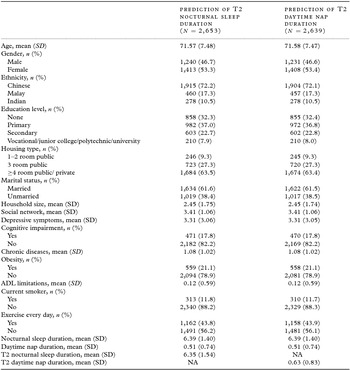
The present analysis did not include older adults who were not Chinese, Malays, or Indians due to the small group size (n = 59). Elderly who had been diagnosed with dementia (self-reported and/or confirmed with household members) were not included in the present analysis – an approach used in some previous studies (Xu et al., Reference Xu2011). For elderly who were unable to respond directly (e.g. due to dementia, speaking difficulties), proxies were interviewed instead, and these cases were excluded here because many variables, including social network were not assessed through the proxies. Over 500 elderly did not participate in the anthropometric measurement of their weight and height, so their body mass indexes (BMI) were missing. After listwise deletion, the sample sizes for the prediction of T2 sleep duration and T2 nap duration were 2,653 and 2,639, respectively (Table 1).
Sample characteristics by analysis

Note: Variables without the prefix of T2 were assessed at T1. Raw (T2) nocturnal sleep and daytime nap durations (in hours) are shown.
Measures
Predictor Variables
Demographic, psychosocial, and health factors were measured at T1.
Demographic factors
Age, gender (dummy coded with 1 = male and 0 = female), ethnicity (2 dummy variables: Malay [1] vs. Chinese [0], and Indian [1] vs. Chinese [0]), education level (four-point ordinal scale: 1 = none, 4 = vocational/junior college/polytechnic/university), and housing type (three-point ordinal scale: 1 indicating 1 to 2 room public, 3 indicating ≥ 4 room public/private; Table 1) were measured. In addition to education level, housing type reflects socioeconomic status (SES) in Singapore. Over 80% of Singaporeans live in public housing. Private housing is usually owned by the top 10% of the income distribution. The type of housing (private or public), and within public housing, the number of rooms can be regarded as proxies of SES (Chan et al., Reference Chan, Malhotra, Malhotra and Ostbye2011).
Psychosocial factors
Marital status was a dichotomous variable (1 = married, 0 = unmarried), with unmarried encompassing widowed, separated, divorced, and never married. Household size referred to the number of people the elderly lived with.
Social network was assessed with a 12-item scale (Chan et al., Reference Chan, Malhotra, Malhotra and Ostbye2011), which assesses the size of network, frequency of contact, and perceived closeness with relatives and friends outside the household (six-point: 1–6; αs = 0.92 in both analyses). A sample item is “How often do you see or hear from friends with whom you have the most contact?”
Depressive symptoms were measured by the 11-item Center for Epidemiological Studies Depression (CES-D) Scale (Kohout et al., Reference Kohout, Berkman, Evans and Cornoni-Huntley1993). A sample item is “I felt that everything I did was an effort” (score range: 0–22; αs = 0.75).
Cognitive impairment (1 = yes, 0 = no) was captured by Short Portable Mental Status Questionnaire (SPMSQ) (Pfeiffer, Reference Pfeiffer1975). SPMSQ includes ten items (score range: 0–10; αs = 0.75). These items test orientation to time and place, memory, current event information (e.g. day of the week), and executive functions (subtract 3s starting with number 20). SPMSQ's validity and reliability are well established (Erkinjuntti et al., Reference Erkinjuntti, Sulkava, Wikstrom and Autio1987). The literature has documented that three errors or more on this measure suggests cognitive impairment (Erkinjuntti et al., Reference Erkinjuntti, Sulkava, Wikstrom and Autio1987), a criterion that has been adopted in research on community-dwelling older adults (Whitson et al., Reference Whitson, Malhotra, Chan, Matchar and Ostbye2014).
Being married, larger household size, stronger social networks, fewer depressive symptoms, and being cognitively unimpaired represent better psychosocial conditions.
Health factors
We recorded the number of presence of ten chronic diseases: Heart attack, any other heart condition, cancer, cerebrovascular disease, high blood pressure, diabetes, respiratory illness, digestive illness, renal/kidney or urinary tract ailment, and liver/gallbladder ailment. We also assessed the number of limitations of seven activities of daily living (ADL): Taking a bath, dressing up, eating, standing up and sitting down from a bed/chair, walking around the house, going out of the house, and using the toilet.
BMI was derived from an anthropometric measurement of elderly's weight and height. Respondents with a BMI greater than 27.4 kg/m2 were regarded as obese based on the Asian classification of BMI (Malhotra et al., Reference Malhotra, Chan, Malhotra and Ostbye2010). Moreover, we asked the elderly whether they currently smoked and did physical exercise everyday (1 = yes, 0 = no).
More chronic diseases and ADL limitations, obesity, smoking, and a lack of physical exercise represent poorer health.
Criterion Variables
Nocturnal sleep and daytime nap durations were measured at T2. Participants indicated their nocturnal sleep duration in hours and minutes by answering the question “On average, approximately how much do you sleep per night?” Participants also indicated their daytime nap duration in hours and minutes. Sleep and nap durations at T1 were included as covariates.
Statistical analysis
To predict T2 nocturnal sleep duration, we employed multinomial logistic regression so as to capture the potentially curvilinear relationships between T2 sleep duration and the demographic, psychosocial and health factors. Sleep duration was classified into five categories: ≤4, 5, 6, 7–8, ≥9 h (fractional hours were coded as rounded integers), with 7–8 h being the reference group as this is the recommended sleep duration for older adults (Hirshkowitz et al., Reference Hirshkowitz2015). To predict T2 daytime nap duration, we performed ordinary least squares (OLS) regressions and included the same set of predictors. To reduce skewness for OLS regression, nap duration was recoded into four categories: 0, 0.1–0.5, 0.6–1, and >1 h (cf. Lan et al., Reference Lan, Lan, Wen, Lin and Chuang2007). We controlled for sleep and nap durations at T1 (autoregressive effect) to reveal the temporally causal effect of the focal predictor variables.
Results
Nocturnal sleep duration
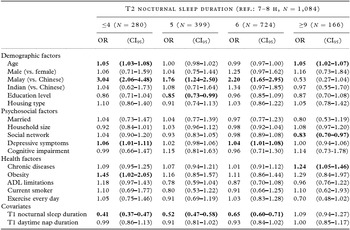
After partialling out the effects of sleep and nap durations at T1, short sleep duration at T2 was predicted by ethnicity with higher risk for Malays relative to Chinese (≤4 h: OR = 3.04, p < 0.001; 5 h: OR = 1.76, p = 0.002; 6 h: OR = 2.20, p < 0.001) and Indians (≤4 h: OR = 2.93, p < 0.001; 5 h: OR = 1.63, marginally significant with p = 0.051; 6 h: OR = 1.65, p = 0.013 based on another set of dummy coding; Table 2). In fact, at T2, Malays reported sleeping 5.80 h (SD = 1.50) at night on average, while Chinese and Indians reported sleeping 6.49 h (SD = 1.53) and 6.33 h (SD = 1.49), respectively. The odds of having a short sleep duration (≤4 h vs. 7–8 h) two years later was also significantly elevated by older age at T1 (OR = 1.05, p < 0.001). In addition, future short sleep duration was predicted by more depressive symptoms (≤4 h: OR = 1.06, p = 0.029; 6 h: OR = 1.04, p = 0.022) and obesity (4 h: OR = 1.45, p = 0.038). There was also evidence that higher education level was associated with lower risks for short sleep (5 h: OR = 0.85, p = 0.041) in two years.
Influence of demographic, psychosocial, and health factors at baseline (T1) on nocturnal sleep duration two years later (T2)

Note: OR = odds ratio. CI95 = 95% confidence interval. All demographic, psychosocial, and health factors were measured at T1. T1 sleep and nap durations were included as covariates. Significant results (p < 0.05) are in bold.
Stronger social networks significantly reduced the odds for long sleep duration (≥9 h vs. 7–8 h) in the future (OR = 0.83, p = 0.023; Table 2). On the other hand, the odds for long sleep duration at T2 increased with older age (OR = 1.05, p < 0.001) and more chronic diseases at T1 (OR = 1.24, p = 0.011).
Daytime nap duration
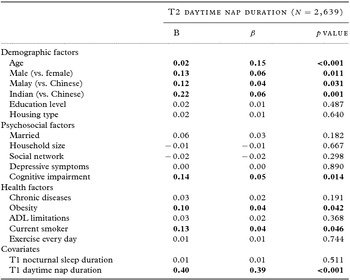
After controlling for the effects of sleep and nap durations at T1, longer T2 nap duration was also found among Malays (52.88 minutes, SD = 59.81; B = 0.12, p = 0.031) and Indians (51.78 minutes, SD = 58.42; B = 0.22, p = 0.001) in comparison to Chinese (32.43 minutes, SD = 44.56; Table 3). Longer nap duration at T2 was also predicted by smoking (B = 0.13, p = 0.046), obesity (B = 0.10, p = 0.042), older age (B = 0.02, p < 0.001), male gender (B = 0.13, p= 0.011), and cognitive impairment (B = 0.14, p = 0.014) at T1. As a side note, there was no concurrent relationship between sleep duration and nap duration (T1 partial correlation = 0.00, p = 0.878; T2 partial correlation = −0.01, p = 0.606).
Influence of demographic, psychosocial, and health factors at baseline (T1) on daytime nap duration two years later (T2)

Note: B = unstandardized coefficient, β = standardized coefficient. All demographic, psychosocial, and health factors were measured at T1. T1 sleep and nap durations were included as covariates. Significant results (p < 0.05) are in bold.
Discussion
Nocturnal sleep duration and daytime nap duration have been shown to play a significant role in older adults’ well-being and longevity. Surprisingly, longitudinal research on determinants of these two attributes separately, particularly in non-Western populations is lacking. Furthermore, the importance of ethnicity, social networks with friends and relatives outside the household, and health behaviors of smoking and physical exercise have not been well studied. Here, we used a longitudinal dataset from a large sample of elderly in Singapore to demonstrate the temporal relationship of various demographic, psychosocial, and health factors with older adults’ sleep duration and nap duration. Our results reveal that the studied factors might not uniformly affect nocturnal sleep duration and daytime nap duration, corroborating the longstanding call for differentiating these two attributes (Frisoni et al., Reference Frisoni, De Leo, Rozzini and Trabucchi1996; Ohayon, Reference Ohayon2004; Ohayon and Vecchierini, Reference Ohayon and Vecchierini2005; Foley et al., Reference Foley, Vitiello, Bliwise, Ancoli-Israel, Monjan and Walsh2007).
Demographic factors
Singapore is a multicultural society with Chinese, Malays, and Indians being the main ethnic groups. This setting enabled us to investigate the role of ethnicity in older adults’ sleep and nap in the East. We found that relative to their Chinese and Indian counterparts, Malay elderly slept 32–41 minutes less at night on average. Ethnic groups might vary in biological predispositions, and they also differ in beliefs and practices pertaining to sleep and nap (Gu et al., Reference Gu, Sautter, Pipkin and Zeng2010; Knutson, Reference Knutson2013). For example, most Malays are Muslims. Muslims are required to perform prayers five times each day, one of which is done before sunrise, potentially leading to early wake time and reduced sleep opportunity (Bahammam et al., Reference Bahammam, Sharif, Spence and Pandi-Perumal2012). Other than its influence on sleep duration, ethnicity also affected nap duration. T2 nap duration was 20 minutes longer in Malays (53 minutes) and Indians (52 minutes) than in Chinese. Also note that older Singaporeans appeared to have longer nap durations (31–38 minutes; Table 1) than their European counterparts (16 minutes, Ohayon, Reference Ohayon2004). Overall, these findings highlight the importance of investigating ethnic influence on sleep and nap (Ohayon, Reference Ohayon2004; Knutson, Reference Knutson2013; Williams et al., Reference Williams2016). Related efforts to modulate sleep and nap durations should take into account individuals’ ethnic background (Williams et al., Reference Williams2016).
Corroborating prior findings (Ohayon, Reference Ohayon2004; Gamaldo et al., Reference Gamaldo2014), our data shows associations of older age with shorter and longer sleep durations, as well as longer nap time. An account is that older-olds may take more medications than their younger counterparts, and the medications may lead to extreme sleep duration (Grandner and Drummond, Reference Grandner and Drummond2007), as well as longer nap duration.
Similar to some other cultures (Ohayon, Reference Ohayon2004), we did not find the two genders to differ in nocturnal sleep duration. However, we did observe in Singaporean older adults that males napped longer than females. This may be related to the gender difference in family role. In many Asian cultures, females are traditionally expected to be the primary homemakers (Gu et al., Reference Gu, Sautter, Pipkin and Zeng2010). Perhaps because of their greater involvement in housework, female older adults are less likely to nap during the daytime.
Education level and housing type reflect SES. While there was an absence of effect of housing type, higher education level was found to protect older adults from short sleep duration (Tu et al., Reference Tu2012). As an indicator of SES, education level might affect sleep duration via its effects on (resources to cope with) stress, living environment, and propensity to take risky behavior (Gu et al., Reference Gu, Sautter, Pipkin and Zeng2010; Knutson, Reference Knutson2013; Yoon et al., Reference Yoon2015). Moreover, individuals with a lower level of education may have short sleep perhaps because of their reduced health knowledge and awareness in the negative health impact of short sleep duration (Yoon et al., Reference Yoon2015).
Psychosocial factors
A key feature of the current work is that it addresses the effect of social networks with friends and relatives outside the household, a construct which has been overlooked, together with marital status and household size on sleep and nap durations in older adults. While the latter two factors did not predict either sleep or nap duration, weaker social networks outside the household predicted longer sleep duration in the future. There is a lack of background literature that can provide a definitive explanation. Our speculation is that older adults with weaker social networks have fewer social engagements, which increase the opportunity for sleep. The contributing effect of weaker social networks to long sleep duration suggests that efforts to develop the social circles, for example, via befriending service may prevent long sleep and in turn its negative health consequences.
In addition to weaker social networks, more depressive symptoms and cognitive impairment also represent poorer psychosocial conditions, and they have negative impacts on sleep and nap, respectively. In our sample, more depressive symptoms led to higher odds of future short sleep, probably because depression and short sleep share common physiological mechanisms, including altered regulation of the hypothalamic–pituitary–adrenal (HPA) axis (Meerlo et al., Reference Meerlo, Sgoifo and Suchecki2008). Another account is that depressed individuals may ruminate on their negative thoughts (Nolen-Hoeksema et al., Reference Nolen-Hoeksema, Wisco and Lyubomirsky2008) when they are in bed and as a result, their sleep is affected.
Our finding that cognitive impairment predicted longer nap duration two years later is consistent with some cross-sectional data from the West (Ohayon and Vecchierini, Reference Ohayon and Vecchierini2005). Reduced cognitive function is accompanied by lower engagement in activities (Conroy et al., Reference Conroy, Golden, Jeffares, O'Neill and McGee2010). With fewer activities, elderly with cognitive impairment may thus nap longer during the daytime.
Health factors
Unlike previous studies which focused on the influence of physical health status (e.g. chronic diseases) on older adults’ sleep as well as nap (Williams et al., Reference Williams2016), here, we also examined the importance of health behaviors, including smoking and physical exercise. We did not find physical exercise to play a significant role in either sleep or nap duration. Smoking was not linked with either short or long sleep, but it predicted long nap duration. Current smokers as well as obese individuals were found to nap for a longer duration after two years, mirroring some previous cross-sectional observations (Ohayon, Reference Ohayon2004).
Smoking impairs respiratory system (Zhang et al., Reference Zhang, Samet, Caffo and Punjabi2006) and leads to idleness (Degens et al., Reference Degens, Gayan-Ramirez and van Hees2015). Hence, older smokers may choose to nap longer. Similarly, their idleness may increase the chance of obese elderly to extend their nap duration. This account surrounding the mediating role of idleness may sound speculative, but it represents a conceptual framework that may oversee the effects of smoking and obesity, corroborating the demand for psychobehavioral explanations of sleep and nap (Grandner and Drummond, Reference Grandner and Drummond2007; Grandner et al., Reference Grandner, Hale, Moore and Patel2010; Knutson, Reference Knutson2013).
In addition to being a significant driver of long daytime nap duration, obesity also predicted short nocturnal sleep duration in two years (for similar results, see Ohayon and Vecchierini, Reference Ohayon and Vecchierini2005), perhaps due to the association between obesity and obstructive sleep apnea (Romero-Corral et al., Reference Romero-Corral, Caples, Lopez-Jimenez and Somers2010). Long sleep duration was predicted by more chronic diseases. People who have health problems are likely to sleep longer (Grandner and Drummond, Reference Grandner and Drummond2007), probably as a side effect of their medications. In contrast, ADL limitations did not significantly contribute to older adults’ sleep or nap duration. Overall, the observed effects of smoking, obesity, and chronic diseases point out the importance of promoting a healthy lifestyle early in life to avoid future sleep and nap issues.
Limitations and future research
We also acknowledge the limitations of this study and discuss some future research directions. The current survey only assessed self-reported sleep and nap durations. It did not examine the demographic, psychosocial, and health determinants of age-related changes in certain sleep features (e.g. increased nocturnal awakenings and reduced slow wave sleep) and circadian rhythms (e.g. reduced circadian amplitude and phase angle of entrainment) (Bliwise, Reference Bliwise, Kryger, Roth and Dement2005) because the former requires the use of objective sleep measurements, like actigraphy and polysomnography, and the latter involves either continuous measurement of core body temperature or collection of biological samples, such as saliva and blood. Future longitudinal studies will do well to establish factors of these sleep and circadian aspects.
We have provided some explanations for the impact of demographic, psychosocial, and health influences on older adults’ sleep and nap durations, which should spark future studies that examine the underlying mechanisms. For example, researchers may study whether education level alters sleep behavior via increasing awareness of sleep and health issues. Moreover, the potential mediating role of idleness underlying longer nap duration should be investigated.
The literature has documented the impact of sleep and nap on older adults’ well-being (Hall et al., Reference Hall2015; Zhong et al., Reference Zhong, Wang, Tao, Ying and Zhao2015), and our study demonstrates the impact of some psychosocial and health factors on sleep and nap. These findings together suggest a bidirectional relationship of well-being with sleep and nap, which may contribute to the formation of vicious cycles (Grandner and Drummond, Reference Grandner and Drummond2007; Grandner et al., Reference Grandner, Hale, Moore and Patel2010). For instance, depression may lead to short sleep which may consolidate depression (Jansson-Frojmark and Lindblom, Reference Jansson-Frojmark and Lindblom2008). Nap and obesity may be related such that obese elderly nap longer, and individuals who nap longer will gain more weight in the future (Patel et al., Reference Patel2014), interesting conjectures to be addressed.
In conclusion, we have observed that older adults’ nocturnal sleep and daytime nap durations may be predicted by different demographic, psychosocial, and health factors. Hence, to further our understanding of the psychobehavioral mechanisms underlying these associations (Frisoni et al., Reference Frisoni, De Leo, Rozzini and Trabucchi1996; Foley et al., Reference Foley, Vitiello, Bliwise, Ancoli-Israel, Monjan and Walsh2007; Grandner and Drummond, Reference Grandner and Drummond2007; Grandner et al., Reference Grandner, Hale, Moore and Patel2010; Knutson, Reference Knutson2013; Whinnery et al., Reference Whinnery, Jackson, Rattanaumpawan and Grandner2014), it is necessary to differentiate between sleep and nap in this age group (Ohayon, Reference Ohayon2004; Ohayon and Vecchierini, Reference Ohayon and Vecchierini2005).
Conflict of interest
None.
Description of authors’ roles
Grand Cheng developed the study concept and design, conducted the data analysis, and wrote the paper. Angelique Chan supervised the data collection and contributed to the writing of this paper. June Lo provided critical revisions.
Acknowledgment
This work was supported by Centre for Ageing Research and Education, Duke-NUS Medical School, Singapore (C-911-000-011-001).