

Introduction
House flies (Musca domestica L.) are key pests of dairy and poultry farms and adversely affect both animals and workers (Scott et al., Reference Scott, Alefantis, Kaufman and Rutz2000; Kaufman et al., Reference Kaufman, Scott and Rutz2001; Abbas et al., Reference Abbas, Khan and Shad2014a). These insects are known vectors of more than 100 intestinal pathogens including protozoa, bacteria, helminths and viruses (Förster et al., Reference Förster, Klimpel, Mehlhorn, Sievert, Messler and Pfeffer2007; Acevedo et al., Reference Acevedo, Zapater and Toloza2009). On a poultry farm, high densities of flies irritate and stress both workers and hens and significantly influence the economics of poultry products (Learmount et al., Reference Learmount, Chapman and MacNicoll2002; Acevedo et al., Reference Acevedo, Zapater and Toloza2009). The chemical management of pests, including house flies, has included several insecticide classes such as carbamates, organophosphates, pyrethroids and new chemicals. However, extensive and injudicious use of insecticides has led to the development of resistance among insect pests (Scott et al., Reference Scott, Alefantis, Kaufman and Rutz2000; Khan et al., Reference Khan, Akram and Shad2013a). In Pakistan, resistance to various insecticides has been previously reported in many insect pests such as American bollworm (Faheem et al., Reference Faheem, Nazir, Saleem, Yasin and Bakhsh2013), army worm (Abbas et al., Reference Abbas, Shad, Razaq, Waheed and Aslam2014c; Zaka et al., Reference Zaka, Abbas, Shad and Shah2014), diamondback moth (Sayyed et al., Reference Sayyed, Saeed, Noor-Ul-Ane and Crickmore2008), house flies (Abbas et al., Reference Abbas, Khan and Shad2014a, Reference Abbas, Khan and Shadb; Khan et al., Reference Khan, Akram and Shad2014), cotton mealybug (Afzal et al., Reference Afzal, Shad, Abbas, Ayyaz and Walker2015) and white fly (Basit et al., Reference Basit, Saeed, Saleem, Denholm and Shah2013).
Insecticide mixtures have been considered as a significant tool for resistance management of a variety of pests (Hemingway and Ranson, Reference Hemingway and Ranson2000; Nauen, Reference Nauen2007), and are used to increase the efficacy of control and/or delay the development of resistance. The chances are low that resistance to two or more insecticides would develop simultaneously within a mixture, particularly when resistance alleles are initially rare (Curtis, Reference Curtis1985). However, Tabashnik (Reference Tabashnik1989) reported potential weaknesses in the use of insecticide mixtures, such as the disruption of biological control, promotion of resistance in secondary pests, and intense selection for cross-resistance. Products are available as commercial formulations or concentrates that can be mixed by farmers. The consensus is that insecticides with different modes of action can complement one another. For example, pyrethroid and organophosphate mixtures have been found to be very effective in enhancing the susceptibility of various pests including Culex quinquefasciatus Say (Corbel et al., Reference Corbel, Raymond, Chandre, Darriet and Hougard2004), Bemisia tabaci Gennadius (Denholm et al., Reference Denholm, Pickett and Devonshire1998), Spodoptera litura Fabricius (Ahmad, Reference Ahmad2009), Helicoverpa armigera Hübner (Ahmad, Reference Ahmad2004) and M. domestica (Islam and Khalequzzaman, Reference Islam and Khalequzzaman2002). However, decreased toxicity with some organophosphate and pyrethroid mixtures has also been reported for different pests such as H. armigera (Martin et al., Reference Martin, Ochou, Vaissayre and Fournier2003) and B. tabaci (Ahmad, Reference Ahmad2007). Insecticide resistance is an ever-increasing problem and presents an alarming situation as relatively few different insecticide classes are available. Development of new insecticides is slow due to the difficulty in identifying products that are both effective and environmentally safe (Ware, Reference Ware2000). Therefore, strategies to counter the development of resistance should include mosaics or rotations of insecticides that have different modes of action (Ahmad et al., Reference Ahmad, Saleem and Sayyed2009).
Knowledge of the geographic distribution and frequency of resistance is necessary before strategies to manage resistance are implemented (Scott et al., Reference Scott, Alefantis, Kaufman and Rutz2000). There are differences between conditions in poultry houses and those in dairy farms as the confined nature of the former limits the migration of house flies (Scott et al., Reference Scott, Alefantis, Kaufman and Rutz2000; Kaufman et al., Reference Kaufman, Scott and Rutz2001), whereas dairy farms have a more open architecture (Kaufman et al., Reference Kaufman, Scott and Rutz2001; Khan et al., Reference Khan, Akram and Shad2013a). Resistance levels on poultry farms have been found to vary significantly from one to another (N. Abbas et al., unpublished) and depend upon the insecticide regime in use at a particular facility (Scott et al., Reference Scott, Alefantis, Kaufman and Rutz2000). Recently, pyrethroid mixtures containing some new insecticides have been evaluated against house flies collected from a dairy farm with promising results (Khan et al., Reference Khan, Akram, Shad and Lee2013b). Therefore, better evaluation is needed of mixtures of commonly used insecticides on poultry farms. In the present study, we evaluated mixtures of a pyrethroid (lambda-cyhalothrin) and an organophosphate (profenofos) with new chemical insecticides (emamectin benzoate, spinosad and nitenpyram). These had not been previously evaluated, so this study is important for the identification and optimization of new insecticide mixtures. This would provide useful information to devise strategies for resistance management of insect pests.
Materials and methods
Insects
About 200 adult house flies were collected in a sweep net from a poultry farm in the Multan region of Punjab, Pakistan, brought to the laboratory for colonization, and designated the field strain. Adults were kept in meshed plastic jars (34 × 17 cm). Powder milk mixed with sugar (1:1 by weight) was provided as food with a water-soaked cotton wick in a separate Petri dish. Larvae were reared on an artificial diet containing wheat bran, grass meal, yeast, sugar and powder milk at a ratio of 20:5:5:1.5:1.5 by weight, which was mixed thoroughly with water (65 ml) (Bell et al., Reference Bell, Robinson and Weaver2010; Abbas et al., Reference Abbas, Khan and Shad2014a). All insects were maintained in laboratory conditions at 27 ± 2 °C, 60–70% relative humidity (RH) and a 14 light–10 dark photoperiod (Abbas et al., Reference Abbas, Khan and Shad2014a). The susceptible strain was collected from an area of low insecticide use and reared in the laboratory without exposure to insecticides for 24 generations. The field strain was reared for one generation in the laboratory to obtain numbers sufficient for bioassay.
Insecticides
Commercially formulated insecticides used for bioassays were lambda-cyhalothrin (Karate 2.5 EC; Syngenta, Pakistan), profenofos (Curacron 50 EC; Syngenta), emamectin benzoate (Proclaim 019 EC; Syngenta), spinosad (Tracer 240 SC; Arysta LifeSciences, Pakistan) and nitenpyram (Paranol 10EC; Kenzo Agrochemicals, Pakistan).
Dose–response bioassays
Toxicities of the aforementioned insecticides were assessed using feeding bioassays (Kaufman et al., Reference Kaufman, Gerry, Rutz and Scott2006). Briefly, 10 randomly collected male and female flies, 2–3 days old, were placed in plastic jars (250 ml). One piece of cotton wick (3 cm long) moistened with 20% sugar solution containing different concentrations of the insecticides was provided. Five concentrations were used for each insecticide bioassay, and a total of 10 flies were used in each. Three technical replicates were performed at each concentration (i.e. a total of 30 flies per concentration). Cotton wicks soaked in 20% sugar solution without the insecticides were provided as a control (three replicates of 10 flies). Cotton wicks were refreshed with water after 24 and 48 h to prevent them from drying (Kaufman et al., Reference Kaufman, Gerry, Rutz and Scott2006). Bioassays were kept at 27 ± 2 °C, 60–70% RH and a 14 light–10 dark photoperiod. Mortality was assessed at 48 h after treatment. All ataxic flies were assumed to be dead. Mortality data were assessed by probit analysis (Finney, Reference Finney1971) using POLO-PC software (LeOra Software, Petaluma, CA, USA) to generate lethal concentration (LC) values. Differences in LC50 values for two given insecticides were considered non-significant if their 95% fiducial limits overlapped (Litchfield and Wilcoxon, Reference Litchfield and Wilcoxon1949).
Mixture evaluation
Mixtures of two insecticides were tested at ratios of 1:1, 1:10 and 1:20. For the 1:1 ratio, equal amounts (μg/ml) of the tested insecticide were made. For the 1:10 and 1:20 ratios, the value of the strength of the highest required concentration was divided by 11 (for the 1:10 mixture ratio) and by 21 (for the 1:20 mixture ratio) to know the comparative value of one unit μg/ml of the mixture. After assessing the relative importance of one unit μg/ml of both solutions, both insecticides were mixed accordingly to make the highest required concentrations of both mixtures, and then serial dilutions were made. To assess whether there were any synergistic interactions, a combination index (CI) was calculated for each mixture according to the formula introduced by Chou and Talalay (Reference Chou and Talalay1984), as it is suitable for comparing agents with differing modes of action. CI values were calculated using the following formula:
 $$\begin{eqnarray} CI_{ x } = ( LC _{ x }^{m}\times p ^{1}/ LC _{ x }^{1}) + ( LC _{ x }^{m}\times p ^{2}/ LC _{ x }^{2}) + (( LC _{ x }^{m}\times p ^{1}/ LC _{ x }^{1})\times ( LC _{ x }^{m}\times p ^{2}/ LC _{ x }^{2})), \end{eqnarray}$$
where  $$LC _{ x }^{1} $$ and
 $$LC _{ x }^{2} $$ are the individual lethal doses of insecticides 1 and 2, giving mortality x, which are mixed with proportions p 1 and p 2 resulting in the lethal dose for the mixture of
 $$LC _{ x }^{m} $$. Two insecticides in a mixture have an additive effect when CI = 1, a synergistic effect when CI < 1, and an antagonistic effect when CI>1. These values were calculated at the LC50 dose.
Results
Toxicities of the insecticides alone and in combination against the susceptible strain of Musca domestica
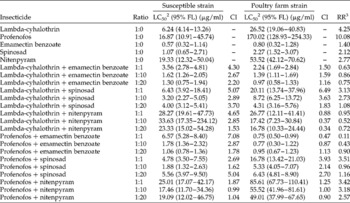
The toxicities of emamectin benzoate and spinosad were significantly higher than those of lambda-cyhalothrin, profenofos and nitenpyram (Table 1). The results for the various mixtures tested generally mirrored the individual toxicities in that increasing the proportion of the more active insecticide reduced the LC50 value. The calculation of the CI did not reveal any synergistic interactions between any of the pairs of insecticides used. The resulting toxicity was lower than expected on the basis of the individual toxicities (Table 1).
Toxicities of lambda-cyhalothrin, profenofos and new insecticides alone and in combination against the susceptible and poultry farm (field) strains of Musca domestica 1

FL, fiducial limits; CI, combination index; RR, resistance ratio.
1 Number of flies exposed in each bioassay was 180 including the control (30 flies).
2 Lethal concentration to kill 50% of the pest population.
3 Calculated as (LC50 of the poultry farm strain/LC50 of the susceptible strain).
Toxicities of the insecticides alone and in combination against the field strain of Musca domestica
Assessment of the toxicities against the field strain revealed that all individual insecticides had unique, non-overlapping, LC50 values, with the order of toxicity being emamectin benzoate>spinosad>lambda-cyhalothrin>nitenpyram>profenofos (Table 1). When compared with the data from the susceptible strain, it was clear that the field strain had significant resistance to the established insecticides lambda-cyhalothrin and profenofos, but was susceptible to the insecticides spinosad and emamectin benzoate. There was an indication that the field strain may have shown some resistance to nitenpyram, although the LC50 values of the susceptible and field strains were not significantly different. In contrast to the susceptible strain, some mixtures of insecticides could act synergistically against the field strain. The mixture of lambda-cyhalothrin and nitenpyram at all three ratios showed a synergistic interaction (Table 1). The mixture of profenofos and emamectin benzoate also showed a synergistic interaction, being more pronounced when a lower proportion of the second insecticide was used.
Discussion
A group of insecticides was tested alone and in combination against a susceptible strain and a field strain of M. domestica collected from a poultry farm. The field strain was found to be resistant to the organophosphate profenofos and showed some resistance to the pyrethroid lambda-cyhalothrin. Little or no resistance was observed to the other insecticides (spinosad, nitenpyram and emamectin benzoate). Organophosphates and pyrethroids have been extensively used to control M. domestica, and resistance to these insecticides has frequently been reported (Scott et al., Reference Scott, Alefantis, Kaufman and Rutz2000; Kaufman et al., Reference Kaufman, Scott and Rutz2001; Kristensen et al., Reference Kristensen, Spencer and Jespersen2001; Marçon et al., Reference Marçon, Thomas, Siegfried, Campbell and Skoda2003; Acevedo et al., Reference Acevedo, Zapater and Toloza2009; Khan et al., Reference Khan, Akram and Shad2013a; Abbas et al., Reference Abbas, Khan and Shad2014b). Emamectin benzoate is a new insecticide yet the above results indicate that resistance is already present in field strains. However, in this study, resistance to emamectin benzoate was not observed in the field strain, and this lack of resistance could be due to differences in farming practices. In poultry farms, the animals are maintained in enclosed spaces, and there is less opportunity for the migration of flies and thus limited spread of resistance alleles (Scott et al., Reference Scott, Alefantis, Kaufman and Rutz2000). Mixtures of insecticides have great potential in both improving the control of flies, through synergistic interactions, and reducing the risk of resistance, particularly if insecticides with different modes of action are combined. When the toxicity of these mixtures was tested, there was little or no evidence of synergism against the susceptible strain; indeed, some combinations appeared to act antagonistically. With the field strain, there was an indication of synergistic interactions. For example, the mixture of lambda-cyhalothrin and nitenpyram at the three different ratios was all more toxic than expected from their individual toxicities. The mixture of lambda-cyhalothrin and either emamectin benzoate or spinosad did not show any synergistic interactions. This difference is difficult to explain simply on the basis of mode of action since both spinosad and nitenpyram are nicotinic acetylcholine receptor agonists (albeit acting at different sites at this target), whereas emamectin benzoate is a chloride channel activator and lambda-cyhalothrin a sodium channel modulator (Nauen et al., Reference Nauen, Elbert, McCaffery, Slater, Sparks, Kramer, Schirmer, Jeschke and Witschel2012). Synergism was also observed for the mixture of profenofos and emamectin benzoate, although the effect was restricted to certain ratios and was lost at higher proportions of the latter insecticide. Unfortunately, no clear picture emerges. Although a 1:10 mixture of lambda-cyhalothrin and nitenpyram was more effective than expected against the field strain, it was less effective than expected against the susceptible strain. When this result is combined with the observation that some ratios of insecticide mixtures are synergistic, while other ratios of the same ingredients are antagonistic, it is clear that developing the best strategy to control this pest is fraught with problems.
Conclusion
Insecticide mixtures that show antagonistic interactions should not be used due to increasing application rates, the development of multiple resistance that extends across other chemical classes, and adverse effects on the environment. Therefore, mosaics, rotation of insecticides having different modes of action, and non-chemical control measures should also be considered as alternative strategies. Moreover, the study of different insecticide mixtures should be strengthened to find out combinations that display the synergistic interaction and are safe to natural enemies and the environment, and to formulate strategies to manage resistance for the control of house flies.
Acknowledgements
The first author is very grateful to Muhammad Khuram Shahzad for strain collection and help in rearing cultures in the laboratory.