Modern humans habitually employ distinctive objects as public signals. Often we are unaware that this is happening; sometimes we explicitly create signals to manipulate our social environments. Our ancestors’ capacity to employ signalling systems is likely to have been critical in our cultural evolution, and hence the ability of archaeologists to establish whether or not signalling was happening, and how it occurred, is important for our interpretations. Production and use of physical symbols leave an archaeological record that can reveal the kinds of signalling systems used in the past. Interpreting the operation of ancient signalling systems has been enhanced by the recognition that different materials and artefacts with different characteristics may yield signals with different properties (e.g. Kuhn & Stiner Reference Kuhn and Stiner2007). Diagnosing the operation of past human signalling systems therefore demands that archaeologists consider the operational opportunities and limits offered by employing different physical objects to convey information. This paper explores the way we might think of small lithic artefacts as signs in such systems.
Even the possibility that lithic artefacts may have operated as complex signals has not always be emphasized. Palaeolithic archaeologists have sometimes minimized the signalling role of lithic tools by arguing that the form of lithic artefacts is primarily constrained by function, and hence forager economics rather than signalling tend to be posited as explanations for assemblage composition. When the idea that lithics have operated as signals is advocated, the analytical framework most often adopted has been the idea that lithics might contain ‘style’, a variously defined phenomenon sometimes framed as that variation that was not constrained by physical functions but also sometimes defined as the variation that is involved in the transfer of information (e.g. Wobst Reference Wobst and Cleland1977). This paper pursues the question of how information transfer relates to the production of distinctive and standardized lithic artefacts, but moves beyond common principles of how style is diagnosed in artefacts such as ideas that information transfer is revealed when standardized artefacts were highly visible to many individuals. In this paper I take a different approach to thinking about lithic tools as signals, using sender-receiver signalling theory that has been well developed by philosophers and biologists. The fundamental idea is that transmission of information requires the existence of a signalling system, in which signals being exchanged are coordinated between senders and receivers to deliver appropriate content.
Here I present a challenging case study for which it can not only be shown that tool function does not correlate with form but also that the objects were not highly visible to many people. Additionally, local ethnographic information is not an obviously useful guide to the structure of the behaviour, as the technology fell out of use 1000–1500 years ago. I argue that in these circumstances signalling is a plausible explanation and signalling theory offers us analytical advantages. I also argue that in this case study archaeological evidence, rather than ethnographic parallels, can be powerfully used to infer the nature of the signalling procedures and its social structuring. Here I will explore the identification of signalling systems, and how we can understand them, through a description of the archaeological evidence for microliths in southeastern Australia. I will also explain why previously proposed functional and social mechanisms have not been successful as explanations for this phenomenon. After that I will lay out the basics of signalling theory as it has recently been framed, and then discuss archaeological patterns that would be indicative of signalling systems in lithics of this kind. At the end of the paper I hypothesize how the signalling systems for microliths were likely to have been structured in Australia.
Small changes in Australia
Australian microliths are stone flakes that have had steep, blunting, marginal retouch on one or more margins opposite or adjacent to an unretouched margin. This retouch was made by sandwiching the flake between an anvil and a hammer and in many instances that flaking involves employing a bipolar technique (see Hiscock Reference Hiscock2015a,Reference Hiscockb). Microliths have conventionally been characterized in terms of both size and shape. Most specimens are small, less than 30 mm in maximum dimension, and many are substantially smaller than that, with minimum sizes often under 10 mm. In some regions significantly larger specimens are occasionally recovered. Size variation is currently poorly described, and in northern Australia there are regions in which specimens are far larger, though these specimens have been traditionally classed as different implements, such as Juan knives or Backed Points (Hiscock Reference Hiscock, Elston and Kuhn2002; Reference Hiscock, Robinson and Sellet2018). However, in southeastern Australia very small sizes are typical (see Hiscock Reference Hiscock2003; Hiscock & Attenbrow Reference Hiscock and Attenbrow2005).
The chronology of microliths varies regionally but the pattern becoming well established in multiple regions is for the long-term production of microliths at low rates since at least 10,000–15,000 bp, followed by a phase of very high microlith production rate initiated in the southeast 2500–3500 bp (Hiscock Reference Hiscock2008). Imprecise dating and taphonomic complexities have made it difficult to infer the precise length of the high production phase, but it is likely to be between 300 and 1000 years long, certainly spanning multiple generations. Subsequently, production rates reduced rapidly and production ceased entirely in the southeast between about 1000 and 1500 bp. This technology has not been used for a millennium or more and represents practices not visible in the ethnographic record. Fine working on small stone objects and standardization of their shapes are distinctive features not typically found in lithic artefacts in southeastern Australia in the last millennium.
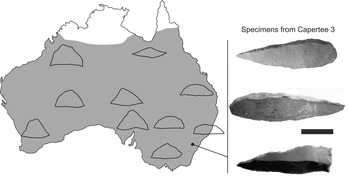
Microlith shapes have often been described as various simple geometric shapes (triangles, trapezes, crescents, etc.), but although some specimens are easily classified as having such simple geometry, others are not. Hence there may be continuous and more complex variation in several independent components of shape than has been acknowledged, though this remains to be evaluated by quantitative studies. For this reason no subdivision of this class is made here, even though there has been a conventional distinction made between symmetrical and asymmetrical specimens. The noteworthy feature of specimens relevant to this paper is their high level of local standardization, in shape but also size (Fig. 1). Continentally there is distinct variation in shapes between regions, but within each region there is typically uniformity of shape, resulting in the distinct differences mapped between regions (Hiscock Reference Hiscock2014). This regularity of form has been discussed extensively and diverse models have been offered. Here I explain how previous explanations for Australian microliths are not capable of explaining fully the localized regularity in form which is apparent in the archaeological record.
Image of variation in microlith shape across Australia. Outlines of typical specimens in locations across the continent shown on the left. Distribution of microliths shown in grey. On the right, photographs of specimens from Capertee 3 shown to exemplify variation in one locality. Scale is 1 cm.

The possibility that engineering constraints impose form on lithic artefacts is always one raised in discussion of standardization. Raw material properties may be a factor limiting specimen size and controlling the capacity of knappers to fashion particular shapes in microliths. However, in Australia a number of studies have shown no statistically significant differences in microlith dimensions between raw materials, indicating that engineering of specimens was not strongly constrained by material employed.
The most persistent explanation offered for microlith form has been a functional one (see references in Fullagar Reference Fullagar, Iovita and Kastuhiro2014; Fullagar et al. Reference Fullagar, McDonald, Field, Donlon, Haslam, Robertson, Crowther, Nugent and Kirkwood2009). Founded on the presumption that there is always a strong form-function relationship in tools, many researchers asserted that given their regular shapes and sizes there must have been a single function for all microliths. Most researchers advocating a functional argument have hypothesized that microliths were armatures on spears, with the specimen being hafted on the spear shaft, with the blunted retouched edge towards the shaft and the sharp unretouched edge protruding from resinous compounds that attached them to the wooden haft. Researchers have asserted that, configured in this way, microliths were used on spears for large game hunting (e.g McBryde Reference McBryde1974; Morwood Reference Morwood1986; Reference Morwood1987) or warfare and personal violence against other humans (e.g. Flood Reference Flood1995; McDonald et al. Reference McDonald, Donlon, Field, Fullagar, Coltrain, Mitchell and Rawson2007).
At least in southeastern Australia these functional claims have been thoroughly refuted. In sites with good organic preservation, residue and wear evidence of hafting has been documented, and the rates of hafting are identical for both microliths and other retouched flakes (Robertson et al. Reference Robertson, Attenbrow and Hiscock2019); hence hafting in itself is not evidence that microliths were part of projectiles. More importantly the residue and wear evidence is not compatible with claims for microliths predominantly being projectile armatures. A series of high quality use-wear and residue studies have now demonstrated that microliths were used for varied craft tasks involving multi-purpose cutting and slicing and gouging of both plants and animal materials (Attenbrow et al. Reference Attenbrow, Robertson and Hiscock2009; Robertson et al. Reference Robertson, Attenbrow and Hiscock2009; Reference Robertson, Attenbrow and Hiscock2019). These studies show no evidence for the use of microliths as projectile armatures, instead they document a large diversity of uses on similar shaped microliths: bone graving, hide scraping, plant scraping and cutting, meat cutting, wood carving, feather whittling, and others. Given this diversity of functions on specimens of similar size and shape, no reference to tool use can offer an explanation for standardization of artefact size and shape. Substantial independence of form and function has recently been revealed by a study showing that both microliths and quite different classes of retouched flakes had virtually identical ranges of functions (Robertson et al. Reference Robertson, Attenbrow and Hiscock2019).
With tool use rejected as an explanation, archaeologists explored other possible mechanisms for standardization of microlith shape. For example, the early version of Hiscock's (Reference Hiscock1994; Reference Hiscock, Elston and Kuhn2002; Reference Hiscock and Lilley2006) risk-reduction model hypothesized that microliths were made as regular shapes to enhance the speed and efficiency of maintenance of composite extractive tools, and that by employing standardized lithic inserts the process of repair was facilitated, so foragers carried previously prepared microliths on hunting trips to reduce down-time. The demonstration that microliths were not projectile armatures need not refute all risk-reduction mechanisms, but it undoubtedly falsifies the idea that microliths were directly acting to reduce the risk of foraging failure by creating more ready extractive equipment. It is not a simple matter to salvage that risk model by substituting maintenance tools for extractive functions. While we can reason that preparation of standardized inserts might have made repairing craft tools more rapid, two key points must be explained if we reference foraging risk alone: i) why would foragers need to speed-repair maintenance tools rather than doing it in daily downtime, and ii) what was the functional benefit of emphasizing a craft tool which was multi-purpose but not functionally specific and optimal? It is conceivable that in time-stressed and unpredictable foraging conditions hunters reduced the downtime of hunting tools by reducing the downtime of the craft tools that repaired them. But that proposition leaves the difficulty of why, if repair efficiency is critical to these foragers, they chose to make multi-purpose craft tools rather than more optimal specialist tools. One answer could be that in conditions of high mobility it might be more efficient to carry a single multi-purpose craft tool than a series of more optimal ones (Hiscock Reference Hiscock and Lilley2006). Hence the risk-reduction model could still explain something of the standardization of inserts into craft tools, in a set of restricted conditions in which highly mobile foragers operated in time-stressed and unpredictable conditions. However, independent demonstration of those specific economic conditions across multiple environmental zones has not yet been presented, and the reason for the particular choice of microliths (and their specific shapes) as the craft tool insert of choice has not been considered in detail. And so while heightened foraging risk may be one selective context in which a standardized technology evolved, this currently does not explain all the detailed features of Australian microliths and may have operated in conjunction with other factors.
Considerations of alternative or additional mechanisms exist but have been constrained by limited theorizing. Discussions of other mechanisms have focused on the idea that microliths may have played ‘social’ roles. But lack of specificity about what the posited ‘social’ behaviours were and how they acted as mechanisms causing microlith standardization has made archaeological testing minimal and slowed the development of evolutionary models. Magnifying that failure is a tendency of Australian researchers to conceive of explanations involving tool function as adaptationist, while viewing ‘social’ behaviours as inherently non-adaptive and non-evolutionary. Bowdler (Reference Bowdler2011), for instance, characterized explanations describing tool-use as ‘environmentally determinist’ and of little explanatory value because, she argued, such explanations inevitably deny agency to people. She advocated that archaeologists should abandon ‘utilitarian’ mechanisms because they are some ‘shade of Darwinian theory’, and employ ‘broadly social explanations’ when discussing the phenomenon of microliths in Australia (Bowdler Reference Bowdler2011, 69). And White (Reference White2011, 69) suggested that the more obvious explanation for microliths would be as a ‘purely stylistic phenomenon’, without attempting to specify what mechanism that could be. While North American scholars considering questions about Australian microliths have been explicit in considering sociality, social dynamics and network structure as having adaptive effects and being central to evolutionary explanations (e.g. Kuhn Reference Kuhn2011, 70), Australian archaeologists have been deeply affected by oppositional conceptual constructions in which evolutionary processes and social mechanisms are incompatible (although see McNiven Reference McNiven2011 for a comparatively neutral view).
Of course, there are numerous examples of social behaviours being key adaptive responses to situational challenges in human groups. I note that those functional models I rejected above, and which were described by Bowdler and White as ‘adaptationist’, imply a variety of fundamental ‘social’ properties since tool use and risk-reduction models required individual and group decision making, extended social learning, resource conceptualization, construction of norms for technological activities, and so on. In biology, adaptive responses of organisms are understood to include altered behavioural patterns as well as altered bodies, and evolutionary models examining shifts in the production of human lithic artefacts often refer to the role of social dynamics and network structures in human groups as significant factors in the creation of technological variation (e.g. Kuhn Reference Kuhn2011).
One proposal involving social behaviours for Australian microliths is the transmission of production norms to create objects that facilitate identity signalling. I explore this mechanism here because it requires considerable theorizing to develop into a viable model. The idea was advocated by David and Lourandos (Reference David and Lourandos1998), who suggested that microliths had acted as devices in inter-group negotiations over territory, an extension of their ideas about rock art as a system of public signalling that was used to express group identity in social landscapes where group membership and identity were critical in the politics of accessing resources (see discussion in Hiscock Reference Hiscock, Robinson and Sellet2018). One variant of this proposition was briefly referred to by McNiven (Reference McNiven2011, 71), who argued that microliths revealed ‘a desire for social inclusiveness by multiple neighbouring communities through shared possession of a mutually recognisable, mundane stone implement type’. As not all shared material culture necessarily signifies the desire for social inclusiveness, there would need to be explicit tests for that proposition. Any consideration of identity inclusiveness models would require numerous elements to be conceptualized and linked to make this kind of mechanism plausible. For example, at what scale would this mechanism work (between groups or within groups, and what sized groups?), how would objects signal information in a way that facilitated political decisions about access to territory and group membership, and why were these particular kinds of artefacts operating as inclusiveness signals? To provide some traction on the idea that microliths may have operated as public signals, of any flavour, I now provide a summary of recent thinking in signalling theory and then evaluate the microlith phenomenon in Australia using that framework.
What is being signalled?
Inferring the nature of information flow, if any, in lithic artefacts has proved somewhat intractable. To help frame a more robust discussion, I discuss the matter from the vantage point of simple sender-receiver models, widely discussed in philosophy and information theory since the foundational work of David Lewis (Reference Lewis1969) and Brian Skyrms’ (Reference Skyrms2010) modification of the Lewis model. I draw specifically on the formulations of sender-receiver models presented recently by Godfrey-Smith (Reference Godfrey-Smith2014; Reference Godfrey-Smith2017), which explore the implications for rock art. This discussion focuses on points that offer value in considering the key issue of standardization in the Australian microliths.
Sender-receiver models are those in which there are two agents who are coordinated, perhaps with common interest and common knowledge, in such a way that the sender sends signs which the receiver receives and acts upon. Lewis (Reference Lewis1969) illustrated such models with this historical example: Robert Newman, sexton at the Old North Church in Boston, used lights as a coded message for Paul Revere, who coordinated military forces in the Revolutionary War. The code had been previously agreed (one lantern by land, two if by sea), so that the senders rule mapped states to signs and the receivers rule mapped signs to acts. This basic model can be elaborated to deal with real-world complexities such as multiple senders to one receiver, chains or networks, and this depiction has proved effective for examining signalling in both biological and cultural systems. Sender-receiver systems may also be used to describe different coordination objectives, such as when sender and receiver coordinate response(s) to contingent and specific features of the world, or more pure coordination where the senders and receiver are only coordinating each other without requiring or being contingent on features in the environment. However, the critical feature in all those sender-receiver systems is the coordination between sender and receiver. Coordination may be privately arranged between individuals, as a one-off or particular event. But if we are thinking of the Australian microliths as revealing a kind of signal repeated on numerous occasions across a continent and over time, then this indicates much the same coordination between senders and receivers on multiple occasions. This implies the existence of widely shared rules that regulated repeated sender-receiver coordination within a broad population. Establishment and maintenance of those shared rules must have operated in multiple social spheres, as they would have involved learning how to make the signal, the actions of signal production and the evaluation of signal validity and clarity by receivers. For a highly standardized signal, which I hypothesize the Australian microliths to have been, the maintenance of coordination implies high social investment and scaffolding required to learn how to produce acceptable versions of microliths and to evaluate their conformity to social norms, so as to maintain local standardization. Models seeking to explain that complex pattern of standardization must offer plausible mechanisms of the persistence of the underlying coordination.
Critically, and forming the relevance of the theory for this consideration of microliths, is the fact that signs often operate as or through material objects, and hence things act as the signs in the transmission. In the exemplar above, it was Newman's choice of a lantern that enabled him to send the signal to Revere over a considerable distance. Since material objects may often be preserved archaeologically, their employment provides opportunities to identify past public signalling. Artefacts being used as signs in sender-receiver systems often have a number of qualities that can facilitate information transfer. One quality is that their obtrusiveness can be constructed to fit the situation, such as making objects large and/or projecting light or sound to signal distant receivers, or making objects that are small or unobtrusive when signalling sensitive information selectively only to specific receivers. Another quality that can be varied is the capacity of artisans to produce standardized and/or very specific forms when high fidelity of information transmission is critical. For microliths in Australia, the relationships between these two qualities must be explored in models of the technology. How did objects so small act as signs and how were they able to be scrutinized to evaluate conformity to social norms and to assess their truthfulness as signals? Mechanisms which address such questions are essential in plausible models about the operation and evolution of microliths as signals in Australian forager societies.
Another characteristic of signs that is important for their functioning as signals is their resilience or mutability, qualities that are relevant to both the persistence of an object and their morphological standardization. Artisans might construct artefacts that were resistant to change by selection of hardy materials or by employing designs that are little modified by any maintenance during their use-life. Such constructions would make objects that could act as fixed and long-lasting signals, capable of being reused and bearing evidence of the signal to others. For example, long-lasting forms make possible the transmission of signals over both time and space. The ability to transfer artefacts between individuals and groups expands the geographic and temporal networks over which the sign can operate and changes the ways that it is able to be viewed by receivers. These qualities connect to the ways in which sender-receiver systems act as a form of memory. There is always a time difference in the activities of the two sides, sender and receiver, with sender acting first and subsequently the receiver observing the signal and drawing their conclusion on its meaning. Delivering signals to more distant receivers is a complex task, demanding the maintenance of coordination between individuals who are rarely or never in direct contact. Modelling the maintenance of coordination is those situations is a fundamental component of modelling any signalling system; we can begin with specifying geographic and temporal scales over which the signal was transmitted, as these are relevant to inferring likely coordination mechanisms.
My final point is about the stability and detail of coordination. For full sender-receiver systems to operate, there must be coordination in place. Social learning may provide understandings that form the basis of coordination, helping people grasp general principles of what senders and receivers typically employ for a specific transmission with the cultural context. If the signal is public, and interpreted and evaluated by strongly developed local social norms, then general and informal learning may be the foundation of coordination. However, even that situation may not provide sufficient feedback to stabilize coordination, and additional interactions might be standard, especially direct coordination between individual senders and receivers. While sender-receiver systems may be stable, by which I mean little changing for short periods, it is likely they would require ongoing and effective regulation to maintain coordination over even medium periods of months or years or longer. Mechanisms for maintaining a coordination include scrutiny of and discussion about the success of the signal between senders and receivers, and such mechanisms would often have been essential. Nevertheless, there would have been variation between individuals and groups, over time and space, in the details and fidelity of coordination, and that may have resulted in drift in the rules agreed by sender and receiver. The outcome would either be coevolution of the rules so that the signalling system remained functional, albeit serially transformed in the information being sent or the signalling practice employed; or alternatively the signalling system might falter as sender and/or receiver rules drift apart to a point where coordination is no longer present.
All these considerations focus on the conditions for making and maintaining coordination. What mechanisms were employed to coordinate senders and receivers, and what context demanded the investment in highly standardized signals? Over what scale was the coordination managed? And in particular, what mechanisms of social learning and scrutiny of norms would be required to maintain signal standardization? I now discuss those questions for Australian microliths.
Microliths as small signals
Were microliths acting as signals in sender-receiver systems?
I begin by reiterating that research has demonstrated that these objects are typically hafted tools, but that tool function does not explain either their form or their standardization. Indeed, on a global scale these microliths are unlike the lithic forms that would be predicted for functions such as bone graving or wood scraping, and the functions of Australian microliths have been shown to be the same as the functions of other lithic tools such as ‘scrapers’ (Robertson et al. Reference Robertson, Attenbrow and Hiscock2019). Additionally, we know that microliths of the same shape and size had quite different tool uses (Robertson et al. Reference Robertson, Attenbrow and Hiscock2009). There was little constraint on microlith morphology imposed by function, and yet these artefacts were standardized in size and shape, a characteristic that indicates their form was constrained by some other factor. My hypothesis here is that microliths operated as public signals and that one constraint on microlith form arose from the rules of coordination.
What mechanisms coordinated senders and receivers?
My first concern is how signalling operated with microliths, given their typically tiny size in the southeast. One partial solution to the problem of signalling with miniature objects is that it was not the unobtrusive object that was being observed by receivers; instead it was the highly visible making of the object that acted as a sign. Such a proposition overcomes the issue of low visibility but encounters other difficulties. For the manufacturing actions to send a sign that could be reliably used by observers to infer the maker made microliths rather than other stone artefacts, the microlith knapping would have to be recognizably different from other knapping. This is not likely. The mechanics and actions of retouching the backed edge of a microlith using a bipolar technique is extremely similar to that of other bipolar knapping, including the flaking of small bipolar cores found in large numbers in the same assemblages as microliths (Hiscock Reference Hiscock2003). The mechanics required for bipolar techniques leave little flexibility for different stoneworking actions; the necessity to strike vertically down with a stone hammer onto an anvil while holding the small objects firmly in a way which that would obscure them from onlookers applies both to microliths and bipolar cores. So if it is argued that the sign was not the stone artefact itself but the actions of the artisan, it would be necessary to hypothesize that it was not the knapping actions that acted as the signal for onlookers, but some associated non-knapping performance such as body paint, dress, song or speech, locality, etc. And yet even if performance during production were distinctive, it would not reference the artefact itself and hence there would still be questions of how performance alone was able to signal the character of backed artefacts, whether they were made to acceptable tolerances or even whether the finished specimen was actually a microlith. In other words, while a hypothesis about performance signalling is one that makes the signal more conventionally visible, it leaves unexplained the mechanisms by which the parties understood the truthfulness of the artefact from the received signal, the conformity of artefactual specimens to the expected norms, and why standardization of the microliths was maintained over time and space. For those reasons I argue the following model is more persuasive.
Most if not all microliths were employed hafted, embedded in resins and other malleable organic materials that perhaps adhered to wooden or bone handles, creating the visible stains preserved on archaeological specimens. Hiscock (Reference Hiscock, Robinson and Sellet2018) has pointed out that when half or more of each small microlith was inserted into the hafting resin it became barely visible, and those features that are most diagnostic such as the backing and plan shape of the backed edge would be almost entirely hidden in the hafting materials. This means that hafted microliths were not identifiable at any large distance; they may have been unrecognizable at distances as close as 15–30 cm. For these specimens to offer truthful signals, they must therefore have been viewed at very close range, so close that tiny protruding parts could be examined. This is a necessary conclusion, because without detailed scrutiny there could not have been maintenance of the truthfulness or standardization of backed artefacts as signals. If cheaper unretouched or less finely made retouched forms could have been substituted without detection, there would have been no selective pressure to continue investment in microlith production or to maintain the specific standardized morphology they have. Without close scrutiny, people could have substituted almost any small flake without having to invest in either production of the microliths or the learning that entailed. Since this did not happen over the multiple centuries when microliths were produced in large numbers, we can be confident that mechanisms for checking the quality of microliths in reference to social norms existed to maintain coordination. Hence robust, close-up examinations would have been the basis for assessment of conformity of the specimens to social norms.
This close scrutiny must have taken place in at two different stages. Once the microliths are wrapped in their mountings, an accurate observation of their plan shape would be impossible, and so there are key aspects about microliths which are standardized and which cannot be assessed post-hafting. Consequently, there would have been a process of scrutinizing microliths before they were hafted. This would happen in any case because the standardization of microliths is extremely high and consistent with levels seen amongst craft specialists (employing measures described in Hiscock Reference Hiscock, Macfarlane, Mountain and Paton2005). Such specialists are likely to transmit techniques and norms for evaluating their success through apprenticeship systems, and in those systems both master and apprentice benefit from an evaluation of the level of skill and norm conformity obtained by apprentices. An apprenticeship mechanism is consistent with the long-term local standardization of microlith form (Hiscock Reference Hiscock, Robinson and Sellet2018), which would have emerged from vertical transmission of manufacturing norms through sequences of masters and their apprentices. Error in that transmission and drift in the norms would be a mechanism to account for inter-regional differences in microlith form. Further tests of these hypothesized transmission mechanisms during production should be sought in future archaeological studies of technological variation in Australian microliths.
However, scrutiny of the conformity of microlith shapes to norms during their production did not evaluate the construction of the composite tool and the conformity of the microliths placed within them. Variation in construction of composite tools could readily have occurred in both the position and attachment of the stone to the haft and whether the hafted inserts were actually microliths. From a distance of less than perhaps 20 cm, it would be difficult to see more than the unretouched edge of a microlith in the haft, and it would be a simple matter to substitute an unretouched flake, thereby saving production effort. ‘Gaming’ the signalling system in this way would potentially offer a benefit to the maker of the composite tool, but would degrade the truthfulness of the signal and if proliferated would damage or end the coordination between sender and receiver. Given the apparent stability in microlith morphology and use over time, for at least multiple centuries as well as over space (Attenbrow et al. Reference Attenbrow, Robertson and Hiscock2009; Hiscock Reference Hiscock2014), the system is likely to have persisted for some time without coordination failing and that indicates the repeated use of trustworthy signals. This implies that the sender-receiver system incorporated a scrutiny of the composite tools, to ensure they were constructed using the components specified under local norms. That scrutiny need not have been costly and may have been achieved simply by holding and inspecting the composite artefact, but it may sometimes have been more invasive and intensive. For instance, when visual inspection did not provide enough clues to establish the inserts were microliths, it would have been possible to deconstruct the composite tool, inspect the stone components and reconstruct the tool. And since tools would break, that would provide frequent opportunities to examine the microliths that had been hafted. The archaeological evidence for very high rates of microliths being reused for different tasks might be an indication of re-hafting and reuse of broken or dismantled composite tools (e.g. Fullagar et al. Reference Fullagar, McDonald, Field, Donlon, Haslam, Robertson, Crowther, Nugent and Kirkwood2009; Robertson et al. Reference Robertson, Attenbrow and Hiscock2009). I would not expect every composite tool to be treated in this way; it would probably be sufficient to assess conformity of a proportion of hafted specimens as a means of evaluating the truthfulness of the activity and imposing a social cost on deception and low quality, and thereby maintain standardization.
These two forms of evaluation would both have been present within social groups, but it is improbable that they would have been carried out by the same individuals. Coordination requires common understanding of the signal between sender and receiver, and in this case, it required a common view on the nature of the object being employed as signal. In practice, this meant the sender produced a signal that conformed to standards expected by, perhaps explicitly agreed with, receivers, while the receiver must ascertain that the expected signal has been delivered and the sender would ideally want to confirm the receiver acted as expected to confirm that coordination was in place. It is likely that microlith production norms were maintained by manufacturers, while other individuals scrutinized the microliths in the hafted tool. In this formulation the makers of the microliths, who perhaps were the same people who hafted the specimens, operated as senders, while other people scrutinizing and probably using the hafted tools acted as receivers. The composition of sender and receiver cohorts is not easily inferred and could vary. For instance, while the cohorts could be mutually exclusive and represent explicitly defined social groupings, there could also have been a pool of people who made and exchanged the tools with each other, so that the same agent acted as sender when making and hafting microliths and receiver when assessing those made by others. The evidence presented here does not reveal the specific identity of senders or receivers, and it is possible that there may have been geographic variation in their configurations. However, I suggest that since these systems appeared stable over multiple generations, it is likely that the coordination was typically limited to people with expertise in recognizing microliths and their norms. That expertise is not immediately acquired; it takes archaeology students roughly 30–100 hours of intense instruction to become reasonably reliable in identifying microliths. This probably indicates that sender-receiver cohorts might have been limited in size, and reinforces the image that they may typically have been experienced artisans.
Even more elaborate configurations of scrutiny processes and signalling systems are conceivable. For instance, microlith makers might have handed specimens to a second group of people who evaluated them and hafted them, and who then passed the composite tools to a third group for scrutiny and use, forming a chain of senders and receivers during production. The system of microlith production and hafting might also have been embedded within iterative arrangements of broader signalling systems, such as if the craft items made with microlithic tools subsequently acted as signals in their own sender-receiver system. But however we model the number of agents in or the ramification of the system, we can conclude that coordination was maintained through repeated scrutiny of microlith conformity and truthfulness by both senders and receivers separately.
What context demanded the investment in highly standardized signals?
I have argued that microliths and the composite tool in which they were inserted operated as material signs in a sender-receiver system, but of course the microlith itself was the signalling device rather than the understandings they conveyed. Modern people can never know the detailed meanings that signals had for ancient people in preliterate societies: even with the most detailed archaeological investigations, those ancient materials remain mute to the ideas, names and emotions possessed by ancient preliterate people. However, with nuanced archaeological interpretations we can grasp the social context of the operation of these signals. I make two observations here.
The first is that local standardization of specimen shape and size has been mentioned throughout this paper as a distinctive feature of Australian microliths and a key piece of evidence for the presence of strong evaluation mechanisms enforcing conformity to norms and resisting rapid chronological drift in specimen shape and size. As noted above, there were learning, production and scrutiny costs associated with establishing high levels of standardization, and the implication is that signal fidelity was sufficiently important to warrant investing in the standardization costs. As explained above, microlith shape is not explicable by reference to tool function, even though the majority of finished specimens appear to have been used as tools. The archaeological evidence is consistent with microliths being used for signalling and the standardization they display may represent costly signals to ensure signal honesty. The social investment in learning very specific production skills necessary to reproduce standardized shapes would have included the effort taken to sustain whatever apprenticeship relationships underpinned the learning and norm validation necessary to maintain standardization: all represents a cost. Furthermore, since the multiple levels of scrutiny inferred here must have provided correction of drift and deceit, they may have been accompanied by at least social penalties such as reputational loss. Those costs acted to enhance signal veracity and stability. The target of this signal can be clarified if we consider specimen visibility.
My second observation relates to the difficulty of observing microliths. In discussing rock art, Godfrey-Smith (Reference Godfrey-Smith2017, 284) made the point that in general it was made to be seen, typically being large, strikingly coloured and placed near eye-level on vertical rock faces. But microliths in southeastern Australia were not meant to be visible to everyone; they were made very small and were mostly hidden in the haft; they are seen only by those who were able to view the objects close up. This implies that the signals were being sent only to a select number of receivers: those who were i) aware that a subtle signal was present; ii) had an understanding of how to observe and assess the signal through knowledge of the subtle norms of microlith form and hafting; and iii) had access to the specimens to make the observation. This logic suggests that while these items operated as signals in a sender-receiver system, the signalling, while technically public, was directed to a restricted audience. This inference need not imply the process was secretive; it might have operated in public even though only a few individuals were acting as senders or receivers—indeed, a public gaze on the senders/receivers may have conferred prestige and heightened the social costs of poor performance.
Restriction would have involved establishing and maintaining coordination between some individuals and effectively excluding others from the microliths signals. This reflects the existence of partitioning of the social universe, with distinctions between senders and receivers as well as those with knowledge of coordination codes and those without. These kinds of social partitions may not have been expensive to maintain, as they may have been in place for other social functions, and the craft items made with the microlithic composite tools might well have been involved with signifying and sustaining the partitions. The restriction of information indicates concern not only for validation of the signal, but also for control over transmission targets, perhaps implying sensitivity of the signal and/or the social context in which it was embedded.
Partitions were probably socially visible and perhaps were articulated with structural features of social organization. These sender-receiver codes and associated coordinated actions were found across much of the continent and over multiple generations, and were not produced spontaneously by pairs of individuals operating alone. Social learning and transmission would have been key elements in the relatively similar operation of coordination across time and space. Apparent regularity of coordination across the continent and through generations is the basis for my speculation that stable social partitions may have formed the basis for both transmission and coordination. Without this linkage it is hard to see how the sender-receiver systems could have been maintained widely in the same form. I can explore this point further by discussing scale.
Over what scale was the coordination managed?
A salient observation about scale is that in Australia microliths were not made on materials that had come from distant sources; they were made from local materials. There is typically no significant difference in microlith dimensions or shape between raw materials, and hence on average material did not significantly constrain the engineering of microliths. This may underpin the use of local rocks in varied geological regimes. Knappers may have selected for the best quality rocks locally available, but they were content to manufacture microliths from rocks available in the immediate vicinity of the sites in which they were ultimately discarded. This indicates that colours and textures were typically not critical parts of coordination; only size and shape were normally important in the coordination code. More importantly, this means that specimens were used as signs within forager groups, not transported for a long distance or exchanged between groups.
The localized patterns of shape and size combined with the use of local materials reveals that signalling was dependent on coordination codes managed within local communities, and not part of uniform and invariant signalling codes across large regions of the continent. It is that local coordination that was probably responsible for the regional diversification on microlith morphology between adjoining regions. I hypothesize that there is an arbitrariness to the microlith forms, that it was the standardization and fineness of manufacture that were critical in their use as signals. Since coordination was negotiated locally, there was not necessarily a reduction in the effectiveness of within-group signalling, as typical microlith form and associated norms drifted from ancestral shapes.
In spite of the evidence for local coordination, there are also significant similarities in microlith production across Australia. This indicates commonality in the fundamental principles and operation of multiple microlithic signalling systems across many regions. If in all regions the microliths were hafted into similar kinds of craft tools that have been demonstrated for the east coast, then a level of stabilization in microlith form may have arisen from constraints imposed by the hafting method. However, function and hafting is only well known from southeastern Australia, and even there a clear pattern of multi-functionality on specimens might be revealing a variety of composite tool designs. Hence the hafting constraint on commonality in form needs to be explored further. Another plausible process creating similar signalling systems across the continent is a common origin, with regional variation in microlith morphology arising from differentiation over time. A model of divergence from a single technological innovation can be tested in future work by identifying phylogenetic signals if they are present, but available evidence does not currently exclude other evolutionary processes that could underpin these similarities, such as the idea of convergence from separate origins (see Clarkson et al. Reference Clarkson, Hiscock, Mackay, Shipton, O'Brien, Buchanan and Eren2018).
Conclusion
Sender-receiver signalling theory is extremely helpful in enhancing our understanding of Australian microliths. In moving beyond unsustainable claims for functional determination of microlith form, and vague references to microlithic symbols enhancing social inclusiveness between groups, the application of this signalling theory has proved to be effective. In exploring archaeological data from this perspective, this paper has reached a number of conclusions. While microliths were commonly hafted and used as tools, they were employed for many different functions, and the shape of microliths did not correspond to their use, revealing that variation in microlith shape is not strongly constrained by function. Hafting may have constrained and standardized size to a small degree, but the variation in shape owes largely to signalling. The regularity of microlith shape is maintained over time and space, a pattern that indicates maintenance of coordination between agents within the signalling system. Understanding signalling with hafted microliths is a challenging task, because embedding tiny artefacts in a haft made them effectively invisible once the tool was completed, unless the tool was held for close inspection. For signalling to take place, the microliths would need to be viewed at close range, and it has been argued that indirect proxies of the presence of microliths (such as song or knapping action) are of insufficient fidelity to stabilize specific standardized shapes. Furthermore, to stabilize different versions of the sign over long periods, that scrutiny must have occurred at multiple points during the life of any microlith and the tool(s) into which it was hafted. Those different evaluations of whether signs conform to the expected morphology, whether they reveal commitment to the signalling act through the quality of craft applied, or whether deception has been detected, would have been undertaken by different people. Makers would have undertaken scrutiny of the production process, but independent agents, probably within the local group, would also have been required to inspect hafted specimens for a stabilization to occur, suggesting that the signalling system may have been linked to role partitions, which might in turn be articulated to some kind of social partition. This idea connects to the conclusion that the microlithic signalling was selective, involving only a portion of each group, perhaps those with the expertise to generate or judge the sign and perhaps those with the social capacity and need to maintain partner relationships in the system.
Microlith signalling systems consumed energy. I suggest the cost of gaining expertise in making and recognizing microlithic signs, and maintaining the coordination between sender and receiver, would have been higher than needed to create cheap lithic tools for simple craft activities. That higher cost may have helped to keep the coordination in place and the signalling honest. This paper has been more concerned with making the argument that microliths must have been involved in signalling, and diagnosing the structure of the signalling system, than with intuiting the meanings of the signals for the people sending and receiving them. Given that in southeastern Australia this microlithic system fell out of use about the same time that the Roman Empire in western Europe ceased, the casual addition of ethnographic framing to this reconstruction is not currently warranted. To place ethnographic details on this model, such as suggesting that senders/receivers belonged to different moieties or initiation grades or other social structures described from the post-contact period, is premature and would constitute a retrofitting of historic structures back to a time where they may not have existed in the same form, offering dubious historicity. Instead, I have used archaeological evidence of technology and residues, wrapped in a framework of sender-receiver signalling theory, to model the operation of these signals in locally managed, socially partitioned interactions in which senders probably obtained through vertical transmission the norms and skills for making signalling tool inserts which they loaned/gifted/exchanged to receivers who also possessed the knowledge to validate and interpret the restricted signal at close range. These inferences generate predictions that can be tested through future archaeological studies, but most importantly they take our understanding away from a focus solely on ethnographically imbued models of microliths as efficient hunting tools/weapons or vague claims of microliths as ‘symbols’ and bring us to an empirically sustainable model of microliths as craft tools involved in the restricted signalling according to well-defined and socially scaffolded coordination codes.
Acknowledgements
I thank Ella Assaf and Francesca Romagnoli for their encouragement and invitation to publish in this themed issue. I thank Kim Sterelny and Peter Godfrey-Smith for not only revealing how relevant signalling models are but also taking the time to provide challenging and constructive critiques on drafts of this paper. Research support was provided by the Tom Austen Brown Endowment.