Introduction
Cannabis use is highly prevalent in people with the diagnosis of schizophrenia (Mueser et al. Reference Mueser, Yarnold, Levinson, Singh, Bellack, Kee, Morrison and Yadalam1990). In this population, the use of cannabis has been consistently associated with treatment non-adherence and increased risk of psychotic relapse (Linszen et al. Reference Linszen, Dingemans and Lenior1994; Zammit et al. Reference Zammit, Moore, Lingford-Hughes, Barnes, Jones, Burke and Lewis2008). Given these negative relationships, it is likely that there are high levels of interpersonal conflicts in households in which a family member with schizophrenia uses cannabis. It has been found that carers tend to be more critical and hostile if their family member with schizophrenia uses drugs (Lopez et al. Reference Lopez, Nelson, Snyder and Mintz1999; Barrowclough et al. Reference Barrowclough, Ward, Weardon and Gregg2005). A critical attitude approach has been thought to increase patients' defensive reactions and to reduce the likelihood that they would change their behaviour (Miller et al. Reference Miller, Benefield and Tonigan1993). Studies have also found that a critical attitude in carers is associated with an increased risk of psychotic relapse (Butzlaff & Hooley, Reference Butzlaff and Hooley1998). One study showed that high levels of criticism within the family were the main predictor of psychotic relapse (Linszen et al. Reference Linszen, Dingemans, Nugter, Van der Does, Scholte and Lenior1997).
Although there is clear need for interventions that help patients with schizophrenia to reduce their substance use, currently the evidence for effective interventions is very limited (Cleary et al. Reference Cleary, Hunt, Matheson and Walter2009), and there has been little attention paid to family-based approaches (Mueser et al. Reference Mueser, Glynn, Cather, Zarate, Fow, Feldman, Wolfe and Clark2009). Motivational interviewing (MI) is a well-studied method to overcome resistance and increase the motivation to change substance use (Hettema et al. Reference Hettema, Steele and Miller2005). Although MI was originally developed for use by professionals (Miller & Rollnick, Reference Miller and Rollnick2002), training parents in MI might change their critical response to cannabis use and help them to overcome patients' resistance to change.
Accordingly, we developed an intervention programme consisting of family-based motivational interviewing and interaction skills, called Family Motivational Intervention (FMI), for parents of patients with recent-onset schizophrenia and co-occurring cannabis use. The programme was adapted from the Interaction Skills Training (IST) programme for schizophrenia (Kuipers, Reference Kuipers2003; van Meijel et al. Reference van Meijel, Megens, Koekkoek, de Vogel, Kruitwagen and Grypdonck2009) to provide parents communication and problem-solving skills to reduce stress and resolve conflicts within the family. This was combined with training parents in skills from MI to enhance patient motivation for changing cannabis use. FMI was delivered in addition to mental health standard care for patients. The aim of the present study was to determine whether FMI would be more effective than routine family support (RFS) in reducing patients' cannabis use. Several secondary outcomes were also examined, including (1) patients' substance use other than cannabis, their craving for cannabis use and their quality of life, and (2) parents' distress and sense of burden.
Method
Participants
Patients were recruited from two psychiatric services in The Netherlands: the Academic Medical Centre of the University of Amsterdam (AMC-UvA) and the Mental Health Service North Holland North (GGZ-NHN). Patients with the following selection criteria were eligible: (1) DSM-IV diagnosis (APA, 1994) of schizophrenia or psychotic-related disorder, based on the Comprehensive Assessment of Symptoms and History (CASH; Andreasen et al. Reference Andreasen, Flaum and Arndt1992); (2) age 16–35 years; (3) onset of schizophrenia or psychotic-related disorder within the previous 5 years; (4) antipsychotic medication prescribed or indicated; (5) cannabis use for at least 2 days/week in the previous 3 months; and (6) having contact with a parent for at least 10 h/week in the past month.
Study design and hypotheses
A single-blind randomized controlled trial was conducted in which parents were allocated to either FMI (the experimental condition) or RFS (the control condition). In both conditions patients received a standard treatment programme for recent-onset schizophrenia, consisting of in-patient treatment lasting 2 months, followed by out-patient treatment for a maximum of 12 months. The content of the patients' treatment programme has been described elsewhere (Linszen et al. Reference Linszen, Dingemans, Van der Does, Nugter, Scholte, Lenior and Goldstein1996), and included psycho-education, medication management, stress reduction and relapse prevention. The primary hypothesis was that FMI would be more effective than RFS in reducing patients' cannabis use. The secondary hypotheses were that FMI would be superior to RFS in (1) decreasing patients' substance use other than cannabis, (2) decreasing craving for cannabis use, and (3) increasing patients' quality of life. With regard to parents, the secondary hypothesis was that FMI would be superior to RFS in decreasing parents' distress and sense of burden resulting from their child's symptoms and cannabis using habits.
Procedure
Patients were invited to participate after being fully informed about the content and aims of the study. Parents were not approached for the study before the patient had given written informed consent. Patients and parents were assured that family support would continue to be offered regardless of whether they agreed or refused to participate in the study. Although both parents were approached about participating, it was possible for only one of them to do so. After informed consent had been given, parents and patients were assessed separately at two time points: within 4 weeks before the start of FMI and RFS (baseline) and 3 months after FMI and RFS had ended (follow-up: 9 months post-baseline). The baseline assessment was planned within the first month of hospitalization. Allocation of the parents to FMI or RFS was based on the randomly assigned condition of their child. The assessments were conducted by the first author, who was blind to participants' treatment allocation. Efforts were made to maintain blindness, including the use of separate locations for therapy and research staff and reminding participants before and at the start of the follow-up assessment not to disclose their treatment allocation. As a standard component of our treatment programme, all parents were invited for two sessions of group psycho-education, which were given in the first month of hospitalization. After psycho-education, parents received either FMI or RFS over a period of 6 months.
Measures
Patients' use of cannabis, alcohol, cocaine, amphetamines, opiates and psychedelic drugs was assessed with the Timeline Followback (TLFB-90) interview (Sobell & Sobell, Reference Sobell, Sobell, Litten and Allen1992). This structured interview uses a calendar method to identify and quantify the respondent's self-reported alcohol and drug use during the previous 90 days. For the present study, measures derived from the TLFB-90 were the mean frequencies of use in days for cannabis, alcohol and other substances, the mean amount of use in grams for cannabis and in glasses for alcohol and percentage of patients in each condition being abstinent from cannabis at follow-up. To validate the patients' self-reports, urine samples were taken for cannabis, cocaine and amphet-amine use.
As an important mediator of continued substance use and relapse after abstinence, craving was assessed with the self-report Obsessive Compulsive Drug Use Scale (OCDUS; Anton et al. Reference Anton, Moak and Latham1996; Schippers et al. Reference Schippers, De Jong, Lehert, Potgieter, Deckers, Casselman and Geerlings1997). The OCDUS measures three factors of craving for cannabis in the past 7 days: (1) thoughts about cannabis and interference they cause, (2) desire to use cannabis and control over the desire, and (3) resistance to thoughts about cannabis and intentions to use.
Patients' subjective quality of life was measured with the short form of the widely used World Health Organization Quality of Life self-report questionnaire WHOQOL-BREF (de Vries & van Heck, Reference de Vries and van Heck1995; WHOQOL Group, 1998).
For the assessment of stress in relation to caring for someone with a schizophrenic disorder who uses cannabis, parents completed three self-report questionnaires: the Experience of Caregiving Inventory (ECI), the Family Questionnaire (FQ) and the General Health Questionnaire 28 (GHQ-28). The ECI (Szmukler et al. Reference Szmukler, Burgess, Herrman, Benson, Colusa and Bloch1996) measure the positive and negative appraisal of caring for someone with mental health problems. The FQ (Quinn et al. Reference Quinn, Barrowclough and Tarrier2003) measures three dimensions of parents' perception: frequency of symptoms, concern about symptoms and ability to cope with symptoms. The GHQ-28 (Goldberg & Hillier, Reference Goldberg and Hillier1979; Koeter & Ormel, Reference Koeter and Ormel1991) is an established brief self-report questionnaire that screens for psychological distress and psychopathology by assessing the person's mental health during the past 4 weeks.
Family interventions
FMI consisted of 12 group sessions scheduled every other week. The training provided parents with skills adapted from the IST and MI. The IST programme was developed by the training company Bureau de Mat®. The purpose was to help parents to practise interaction skills and problem-solving techniques by using a red- and green-coloured mat to visualize interaction problems between child and parent (Kuipers, Reference Kuipers2008). With this method the following key skills were practised: active listening, sending clear signals, and maintaining boundaries. MI was based on counselling techniques and addressed stages identified as those that trainees needed to become competent in MI (Miller & Moyers, Reference Miller and Moyers2006). Parents were trained in the following techniques: asking open questions, using reflections, providing summaries, and overcoming resistance. Parents were allowed to practise these techniques by focusing on identifying and eliciting patients' self-motivational statements (i.e. ‘change talk’) about changing cannabis use. Full details of the interventions can be found in the manuals for IST (Kuipers & Raaij, Reference Kuipers and Raaij2006) and MI (Smeerdijk et al. Reference Smeerdijk, Keet, Merkx, Krikke, De Jager and Schippers2007). The intervention was conducted by two highly experienced family therapists who were trained by certificated professionals in IST and MI. To facilitate treatment fidelity, six pilot sessions of FMI were carried out and recorded on videotape. These tapes were then viewed in supervision sessions to discuss with the trainers their compliance with the treatment manuals. Supervision sessions were continued throughout the trial at regular intervals.
RFS consisted of individual meetings between the parent(s) and an experienced family therapist. RFS was designed to be supportive and encouraging for the parent(s) and consisted of providing the opportunity to talk freely about their feelings, answering questions and providing practical information. Meetings were commonly focused on topics such as emotional processing of grief and loss, medication and crisis management, and social rehabilitation. Parents determined their own topics and there were no formal skills provided during the intervention period. In accordance with the FMI, RFS was held twice a month, with a maximum of 12 meetings.
Statistical analyses
All data were analysed using SPSS version 17 for Windows (SPSS Inc., USA). To compare the conditions on baseline characteristics, continuous data were analysed using independent t tests (normally distributed data) and Mann–Whitney U tests (non-normally distributed data). Categorical data were analysed with Pearson's χ2 test or with Fisher's exact test when frequencies were low. All analyses of changes from baseline to follow-up were conducted on an intention-to-treat (ITT) basis. Missing data from the TLFB, OCDUS and WHOQOL-BREF were imputed by means of the multiple imputation method for missing values. Consistent with the standard practice in substance abuse trials, missing urine samples were imputed as positive. To assess patients' improvement from baseline to follow-up, independent t tests were conducted comparing the experimental and control conditions on patients' change scores in self-reported substance use, craving for cannabis use and quality of life. Differences in urine values between the conditions at follow-up were analysed with the χ2 test. With regard to the parents' outcomes, a linear mixed model was used to correct for differences between patients in the number of participating parents. The level of significance (α) was set for all outcomes at p<0.05, using two-sided tests. Effect sizes (Cohen's d) were calculated for significant outcomes, with d=0.2, 0.5 and 0.8 considered to be a small, medium or large effect respectively.
Results
Participants' progress
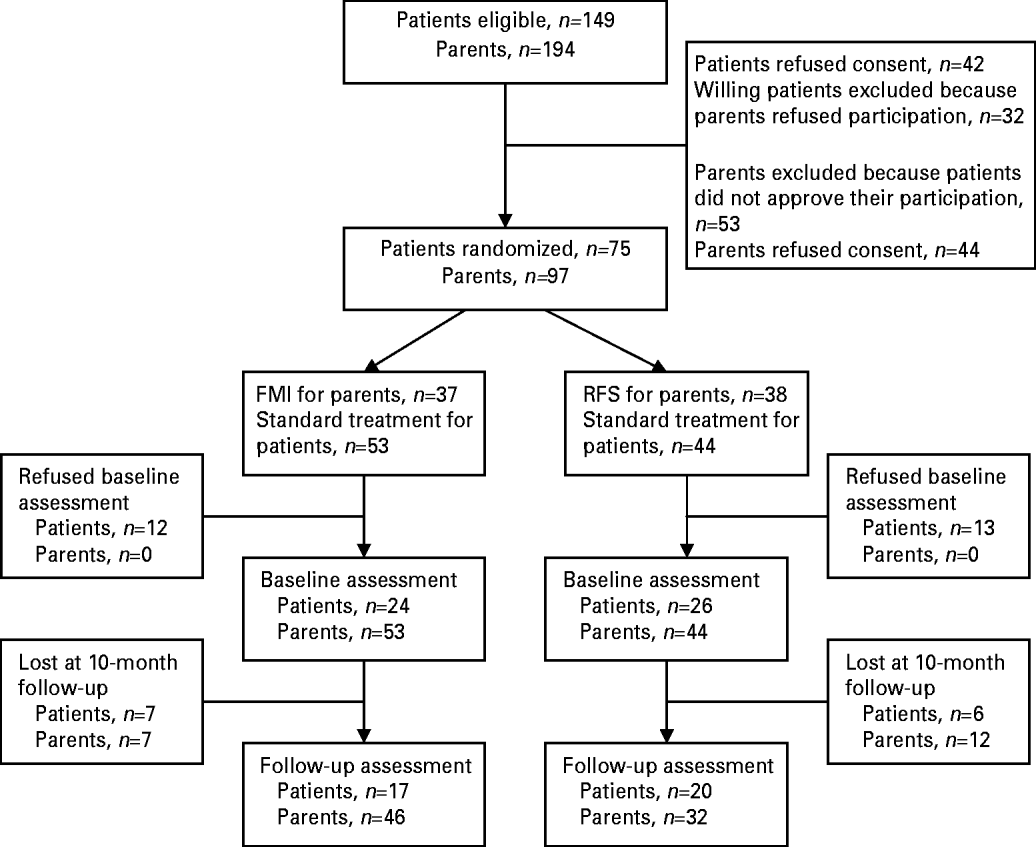
Figure 1 shows the progress of the patients and parents through the trial. Of the 149 patients meeting the inclusion criteria, 74 did not participate because: (1) they were not willing to take part in the study or (2) they were excluded because their parents were not willing to participate. Of the 194 eligible parents, 97 did not participate because: (1) they were not willing to take part in the study or (2) the patient did not approve of their parent's participation. Of the 75 remaining patients who were randomized, 25 (33%) refused to take the baseline assessment but agreed that their parent(s) would participate. Of the participating patients, nine partners and 16 single parents were in the FMI group, and seven couples and 16 single parents were in the RFS group. Of the non-participating patients, five couples and nine single parents were in the FMI group, and three couples and eight single parents were in the RFS group. Of the 53 parents assigned to FMI, 92% attended at least eight of the 12 sessions. Of the 44 parents assigned to RFS, 89% attended at least eight sessions over the 6-month period of the trial. Baseline and follow-up data were collected from 46 carers (87%) in the FMI group and from 32 carers (73%) in the RFS group. For the patients, the follow-up rates were 17 patients (71%) in the FMI group and 20 patients (77%) in the RFS group.
CONSORT diagram. FMI, Family Motivational Intervention; RFS, routine family support.

Participants' characteristics
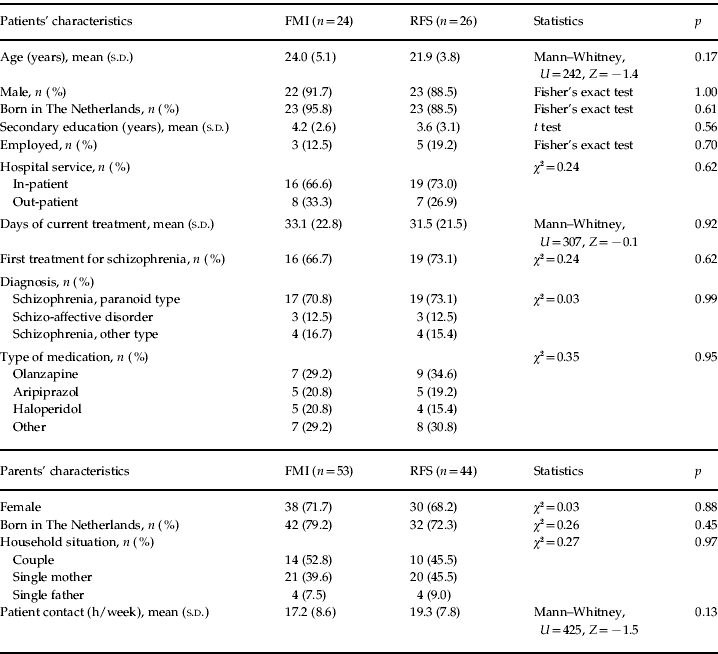
The demographic and clinical characteristics of patients and parents at baseline are shown in Table 1. At baseline, patients in the two conditions were not significantly different on the following variables: age, gender, race, marital status, years of secondary education, employment status, primary schizophrenia diagnosis, prior treatment experience for schizophrenia, treatment status and duration, or type of medication use (all p's>0.05). Parents in the two conditions did not significantly differ in terms of gender, marital status or number of contact hours with the patient (all p's>0.05). Within the conditions, patients who were lost to follow-up did not significantly differ from those who completed the follow-up assessment with respect to any of the demographic and clinical characteristics. Because the opportunity was given to participate in the study at a later time in the patients' treatment programme, 28% (n=14) of the patients and 25% (n=24) of the parents had the baseline assessment after the first month of the in-patient admission. There was no significant difference in mean (s.d.) number of days in treatment before the baseline assessment point between the FMI group [33.08 (±22.80)] and the RFS group [31.54 (±21.49)]. Because the follow-up assessment was planned to occur 3 months after the end of the 6-month family interventions, it was possible for patients to still be in treatment at this evaluation point. However, none of the patients were still receiving the out-patient phase of the intervention when they were seen at the follow-up. During the 9-month study period, one patient in the FMI group and one patient in the RFS group were readmitted to hospital. With regard to the other patients, there was no significant difference in the mean number of treatment weeks from baseline to out-patient discharge between the FMI group [20.71 (±5.73)] and the RFS group [18.75 (±5.16)]. In addition, no significant difference was found in the mean number of weeks from out-patient discharge to follow-up between the FMI group [20.54 (±6.65)] and the RFS group [22.81 (±5.31)].
Participants' characteristics at baseline for Family Motivational Intervention (FMI) and routine family support (RFS)

s.d., Standard deviation.
Patients' outcomes
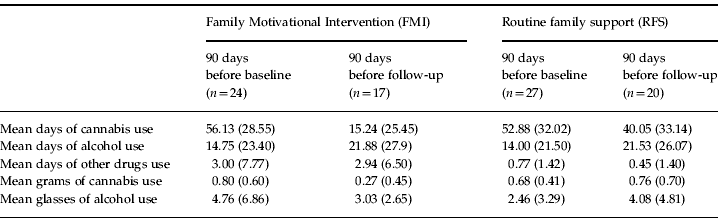
Table 2 shows the baseline and follow-up mean scores on the patients' self-reported frequency and quantity of cannabis, alcohol and other substance use prior to the multiple imputation analyses. At baseline, there were no significant differences between the groups in mean days of use of cannabis, alcohol and other substances during the 3-month period preceding the assessment (all p>0.05). On change scores in mean days of cannabis use from baseline to follow-up, a significant difference was observed between the groups (t 51=2.00, p<0.05, Cohen's d=0.56). Specifi-cally, the mean number of days of cannabis use was decreased in the FMI group by 40.89 (±36.47) days and in the RFS group by 12.83 (±33.25) days. The two groups did not differ significantly in the change in alcohol and other substance use from baseline to follow-up (p>0.05). At baseline, there were no significant differences between the groups in mean daily cannabis or alcohol use. There was, however, a significant difference between the groups in changes from baseline to follow-up in mean grams of cannabis used (t 51=2.06, p=0.04, Cohen's d=0.58). Specifically, in the FMI group the mean use of cannabis was reduced by 0.53 (±0.67) g whereas in the RFS group there was a small increase by 0.08 (±0.62) g. The groups did not differ in change from baseline to follow-up in mean number of glasses of alcohol use.
Patients' cannabis, alcohol and other drug use from the Timeline Followback (TLFB-90)

Standard deviations are given in parentheses.
Complete abstinence from cannabis during the 3-month period preceding the follow-up assessment was reported more frequently in the FMI group than in the RFS group, although this was not significant (58.8% v. 25.0%, χ2=3.07, p=0.08). In addition, at follow-up there was no significant difference between the groups in abstinence rates for alcohol use and drug use other than cannabis. Among the patients seen at follow-up, seven patients (41%) in the FMI group and nine patients (45%) in the RFS group refused to give a urine sample. All missing urine samples were imputed as positive for cannabis. There was no significant difference between the FMI and RFS groups at follow-up with regard to the proportion of patients with a negative urine test result for cannabis use (28.0% v. 17.9%, χ2=0.78, p=0.51).
Scores on the OCDUS at baseline revealed no significant difference between the FMI group and the RFS group in patients' craving for cannabis use. Change scores on the OCDUS from baseline to follow-up, however, showed a significant difference between the groups (t 51=2.75, p=0.01, d=0.77); there was a decrease in craving in the FMI group [−8.13 (±8.29) points] and a very small increase in craving in the RFS group [+0.94 (±12.54) points].
At baseline, there was no significant difference in scores on quality of life between the FMI group and the RFS group. There was also no significant difference in the increase in scores on quality of life from baseline to follow-up between the FMI group [+6.19 (±10.02) points] and the RFS group [+6.26 (±14.32) points].
Parents' outcomes
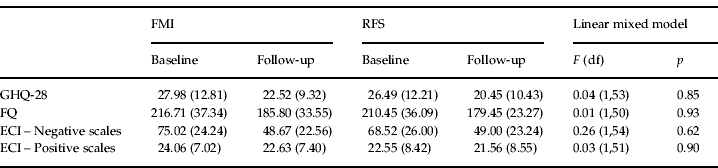
There were no significant differences between the FMI group and the RFS group in baseline scores on the GHQ, the FQ and the ECI. After imputation of missing values, linear mixed model analyses revealed that there were also no significant differences between the groups in change scores from baseline to follow-up on any of these questionnaires. More specifically, there was a significant decrease in both groups in total scores on the GHQ and the FQ, and on the negative scale of the ECI (Table 3). These scores indicate that both parents groups improved from baseline to follow-up on their levels of distress and sense of burden. Exploratory analyses with dependent t tests revealed that these improvements were all significant for the FMI parent group (GHQ: p<0.01, FQ: p=0.01, ECI: p<0.01) and also for the RFS parent group (GHQ: p=0.02, FQ: p=0.02, ECI: p<0.01).
Parents' means scores at baseline and at the 10-month follow-up, and comparison of their change scores

FMI, Family Motivational Intervention; RFS, routine family support; ECI, Experience of Caregiving Inventory; GHQ-28, General Health Questionnaire 28; FQ, Family Questionnaire; df, degrees of freedom.
Values given as mean (standard deviation).
Relationship between patients' and parents' outcomes
Pearson's correlation coefficient (r) was computed to examine the relationship between the significant outcomes for patients and parents. To correct for differences between patients in the number of participating parents, parents' mean change scores were used if both parents had participated. Contrary to expectation, improvements in parents' levels of stress and sense of burden (as measured by the GHQ, FQ and ECI) were not significantly related to reductions in either patients' frequency or amount of cannabis use. These associations were not found for the sample as a whole or for the FMI and RFS group separately. Parents' attendance rates at FMI and RFS sessions were also not significantly correlated with patients' changes in frequency or amount of cannabis use or with parents' improvements in levels of stress and sense of burden.
Discussion
This study demonstrated that training parents of patients with the diagnosis of recent-onset schizophrenia in FMI led to significantly greater reductions in patients' frequency and amount of cannabis use than providing parents RFS for at least 3 months. In addition, patients' craving for cannabis decreased to a significantly greater extent in the FMI group than in the RFS group. These results offer promise for the long-term efficacy of FMI, as craving is an important mediator of relapse after abstinence from cannabis (Anton et al. Reference Anton, Moak and Latham1996). No consistent evidence exists to date to support the effectiveness of pharmacological and psychosocial interventions to reduce cannabis use by people with schizophrenia (Cleary et al. Reference Cleary, Hunt, Matheson and Walter2009; Hjorthøj et al. Reference Hjorthøj, Fohlmann and Nordentoft2009). Although randomized trials have repeatedly shown that family interventions are effective for persons with schizophrenia (Pharoah et al. Reference Pharoah, Rathbone, Mari and Streiner2006) and for persons with substance use (O'Farrell & Fals-Stewart, Reference O'Farrell and Fals-Stewart2006), to our knowledge only two other studies have evaluated a family intervention programme for their co-occurrence (Barrowclough et al. Reference Barrowclough, Haddock, Tarrier, Lewis, Moring, O'Brien, Schofield and McGovern2001; Mueser et al. Reference Mueser, Glynn, Cather, Zarate, Fow, Feldman, Wolfe and Clark2009). The first study demonstrated that a 9-month programme that included psycho-education and support for carers resulted in a significant increase in the percentage of days participants were abstinent from alcohol and other drug use over a 12-month period from baseline to follow-up. The second study also included psycho-education and support for carers and, like the present study, trained carers in communication and problem-solving skills. It revealed that successful involvement of carers in the programme was strongly associated with less severe drug abuse among patients; however, the impact of the intervention on patients' substance use has not yet been published.
On the other outcomes, no additional benefits were obtained in the FMI group beyond those achieved in the RFS group. In both groups there were no effects on patients' alcohol use and drug use other than cannabis. However, on these outcome measures it was difficult to establish any changes because excessive alcohol use and substance use other than cannabis was rare among the patients in this present study. In addition, both FMI and RFS led to significant improvements in patients' quality of life status and in parental sense of burden and stress. These improvements could be due to short-term benefits achieved with the treatment that the patients had received before the follow-up assessment, which included pharmacotherapy and psychosocial interventions. In this case, it would have been difficult to establish any benefits of FMI on the quality of life beyond those already achieved.
The findings of this study should be discussed in the context of its limitations. First, 45% of the patients meeting the inclusion criteria and almost one-third of the parents who were asked to participate refused to do so. However, those parents who did participate showed a high level of commitment, which was shown in both groups. In addition, there was a high response rate among patients and parents in both groups at follow-up. However, the high rate of initial refusal opens the possibility that the sample was biased towards patients who were already considering changing their cannabis use and therefore found it meaningful to participate. This also raises the concern over the small sample size of patients, which makes it difficult to find any statistical differences and reduces the statistical power. Given the high intensity of FMI (12 sessions provided over a 6-month period, each lasting 3 h), it is understandable that the most often-mentioned reason for parents not participating was their inability to integrate the training into their daily activities. This reflects the fact that FMI might not be acceptable for every family.
Second, because the follow-up assessment occurred 3 months after the end of the family intervention, more research is warranted to determine whether the positive results in changes in patients' cannabis use and cannabis craving will be sustained after longer periods.
Third, this study included only patients who had contact with a parent for at least 10 h/week. Therefore, it is difficult to know whether the results can be generalized to patients who have less substantial contact with their families. Furthermore, because within the patients' family only the parents were asked to participate, it is unclear whether our intervention would have similar benefits if family members other than parents were included.
Fourth, compared to treatment for schizophrenia in other countries such as the UK and the USA, the in-patient phase of our treatment programme is relatively long (2 months). Therefore, future studies are warranted to determine whether the observed benefits found in our study can also be attained by mental health services with a short in-patient phase.
A final concern in this study is the high rate of patients who refused to take the urine test at follow-up. Therefore, the results were largely dependent on the patients' self-reports by administrating the TLFB-90 questionnaire. However, the TLFB-90 has good reported reliability and validity to assess substance use in people with a severe psychiatric disorder (Carey et al. Reference Carey, Cary, Maisto and Henson2004; Stasiewicz et al. Reference Stasiewicz, Vincent, Bradizza, Connors, Maisto and Mercer2008). More specifically, for patients with psychosis, the TLFB-90 shows good concurrent validity (Barrowclough et al. Reference Barrowclough, Haddock, Tarrier, Lewis, Moring, O'Brien, Schofield and McGovern2001), and findings even suggest that it may be a more sensitive measure for detecting cannabis use in this patient group than hair analysis (Haddock et al. Reference Haddock, Cross, Beardmore, Tarrier, Lewis, Moring and Barrowclough2009).
In both groups there was an improvement in patients' quality of life status and in parents' stress and sense of burden, but only FMI showed an improvement on cannabis use and craving for cannabis use. This is an important finding because FMI did have a particular focus on changing cannabis use whereas RFS did not. Therefore, it is recommended that, if cannabis use is present in schizophrenia, interventions for family members should include training in interaction and motivational skills that target the cannabis use of the patient. Other authors also mention that psychosocial treatments for psychosis should maintain a well-defined focus (Garety et al. Reference Garety, Fowler, Freeman, Bebbington, Dunn and Kuipers2008). It could be argued, however, that the effects on cannabis use were due to the greater efforts parents made in the FMI condition rather than to the specific skills they were taught. At the same time, parents' efforts to help patients abstain or cut down their cannabis use could be counterproductive, leaving the carers feeling frustrated and stressed because of their failed attempts. FMI aims to teach parents to leave the responsibility for changing to the patient, and that attempts to argue with the patient and persuade them to change only create resistance. Trainers' anecdotal reports confirmed that changing carers' attitude about, and their approach to, the patients' cannabis use was the major achievement of FMI. Further trials are needed to identify what the active and most important ingredients are in FMI, and to examine the long-term effects of the involvement of parents in the treatment of patients with recent-onset schizophrenia.
Acknowledgements
This study was supported by ZonMw (Dutch Organization for Health Research and Development, grant no. 100003014) and by Eli Lilly. We are grateful to all of the participants. We also thank K. Hulstijn, F. Lobban and T. Kuipers for their scientific contributions and A. de Jager for delivering the MI training.
Declaration of Interest
B. van Raaij was invited by AMC-UvA to deliver the IST programme on behalf of the training company Bureau de Mat®.