Significant outcomes
-
The striatal GPR55 is involved in the control of motor functions.
-
The GPR55 agonist and antagonist had similar effects in an experimental model of Parkinson.
-
This receptor may have a modulatory role in the control of motor deficits of Parkinson’s disease.
Limitations
-
It would have been even more interesting if we had measured molecular indices including oxidant and antioxidant parameter.
Introduction
Parkinson’s disease (PD) has been recognised as one of the most common neurodegenerative diseases affecting about 1% of the elderly population (Haddad et al., Reference Haddad, Sawalha, Khawaja, Najjar and Karaman2017). It is characterised by progressive loss of dopaminergic neurons, especially, in the substantia nigra, which leads to the depletion of dopamine in the striatum (Chung et al., Reference Chung, Yoo, Lee, Oh, Kim, Sohn and Lee2018).The striatum is one of the main components of the basal ganglia which is involved in the processes related to voluntary motor control. The striatum and cerebellum work together with the cerebral cortex in mediating movements. Various neurotransmitters, including dopamine and acetylcholine, are involved in these processes (Wagner et al., Reference Wagner, Kim, Savall, Schnitzer and Luo2017). The striatum dysfunction is recognised as a notable cellular pathology in a number of motor and neurodegenerative diseases, such as PD (Kravitz et al., Reference Kravitz, Tye and Kreitzer2012). Despite the recent progress in our understanding of PD, the aetiology of PD remains obscure. PD includes various motor and non-motor properties. The main motor features include akinesia (or bradykinesia), rigidity, tremor at rest and postural instability (Balestrino & Schapira, Reference Balestrino and Schapira2020). Non-motor features are common and include autonomic dysfunction, anxiety and cognitive disorders (Ryman & Poston, Reference Ryman and Poston2019).
Endocannabinoids act via two different types of cannabinoid receptors namely cannabinoid receptor type 1 (CB1) and type 2 (CB2) (Pertwee et al., Reference Pertwee, Howlett, Abood, Alexander, Di Marzo, Elphick, Greasley, Hansen, Kunos and Mackie2010). G protein-coupled receptor 55 (GPR55),as an orphan receptor, has been reported to mediate some non-CB1/CB2-mediated effects of cannabinoids (Al Suleimani et al., Reference Al Suleimani, Al Mahruqi and Hiley2015; Kramar et al., Reference Kramar, Loureiro, Renard and Laviolette2017). The GPR55 gene is expressed in various brain regions, including the cerebellum, hippocampus, striatum, forebrain and cortex (Marichal-Cancino et al., Reference Marichal-Cancino, Fajardo-Valdez, Ruiz-Contreras, Mendez-Diaz and Prospero-Garcia2017). This expression pattern may explain its role in a wide variety of physiological functions, including memory and learning, cognitive processes, pain perception, opioid dependence, anxiety, and motor activity (Wu et al., Reference Wu, Chen, Sun, Zhu, Jew, Wager-Miller, Straiker, Spencer, Bradshaw and Mackie2013; Deliu et al., Reference Deliu, Sperow, Console-Bram, Carter, Tilley, Kalamarides, Kirby, Brailoiu, Brailoiu, Benamar and Abood2015; Rahimi et al., Reference Rahimi, Hajizadeh Moghaddam and Roohbakhsh2015; Alavi et al., Reference Alavi, Hosseinzadeh, Shamsizadeh and Roohbakhsh2016; Kaplan et al., Reference Kaplan, Stella, Catterall and Westenbroek2017; Tuduri et al., Reference Tuduri, Imbernon, Hernandez-Bautista, Tojo, Ferno, Dieguez and Nogueiras2017). In accordance, Rahimi and colleagues found that O-1602, a GPR55 agonist, induced an anxiolytic-like action with no significant effect on the locomotor activity in rats. However, ML193, as a GPR55 antagonist, enhanced anxiety-like behaviours while causing locomotor impairment (Rahimi et al., Reference Rahimi, Hajizadeh Moghaddam and Roohbakhsh2015). Moreover, GPR55 knockout (KO) mice have been reported to have motor coordination dysfunction (Wu et al., Reference Wu, Chen, Sun, Zhu, Jew, Wager-Miller, Straiker, Spencer, Bradshaw and Mackie2013), while the administration of O-1602 was reported to induce hyperlocomotion (Alavi et al., Reference Alavi, Hosseinzadeh, Shamsizadeh and Roohbakhsh2016). Considering the high expression of GPR55 in the striatum (Martinez-Pinilla et al., Reference Martinez-Pinilla, Reyes-Resina, Onatibia-Astibia, Zamarbide, Ricobaraza, Navarro, Moreno, Dopeso-Reyes, Sierra and Rico2014) and its effects on motor activity, we aimed to evaluate the effect of GPR55 ligands on an experimental model of PD.
Materials and methods
Animals
In this study, male Wistar rats (weighing 200–250 g) were used. Rats were housed in groups of six at a 12-h light/dark cycle. Food and water were provided ad libitum and the room temperature was maintained at 22±2.0 °C. Animals were habituated to the housing conditions for 1 week before the study. Animals received humane care in accordance with the US National Institute of Health (NIH publication #85−23, revised in 1985) guidelines for the care of laboratory animals, and all procedures and experiments were performed in accordance with the guidelines for the care and use of laboratory animals in Mashhad University of Medical Sciences.
Cannula implantation and PD induction
Unilateral degeneration of striatal dopaminergic neurons was induced in rats using the method reported by Khan et al. (Reference Khan, Ahmad, Ishrat, Khan, Hoda, Khuwaja, Raza, Khan, Javed, Vaibhav and Islam2010). In brief, a stainless steel guide cannula (22-gauge) was inserted into the right striatum using a stereotaxic apparatus according to the following coordinates: −0.5 mm anteroposterior, 3.8 mm lateral and 4.8 mm below the horizontal plane of the bregma (Paxinos & Watson, Reference Paxinos and Watson2007). Small stainless steel screws and dental acrylic cement were used for cannula fixation to the skull. Following cannula implantation, rats received an intra-striatal injection of 6-hydroxydopamine (6-OHDA, 2 µl, 10 µg/rat), which was dissolved in 0.1% ascorbic acid solution. For recovery, the rats were kept in a well-ventilated room at 25±2 °C in individual cages. After 1 month, the apomorphine-induced rotational test (1 mg/kg, intraperitoneal) was used to confirm the induction of experimental model of Parkinson. Briefly, full ipsilateral (rightwards) and contralateral (leftwards) rotations were recorded following the injection of apomorphine hydrochloride (Sigma-Aldrich, USA) in a 50 × 50 × 50 cm Plexiglas box for 45 min. Finally, the net number of rotations was calculated as positive rotations (Sedaghat et al., Reference Sedaghat, Roghani and Khalili2014).
Drug microinjections
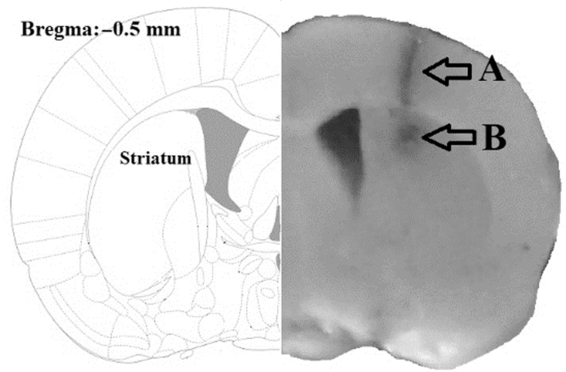
L-α-lysophosphatidylinositol (LPI, Tocris, UK), as an endogenous GPR55 agonist, and ML193 (ML, Tocris, UK), as a selective GPR55 antagonist, were dissolved in a mixture of dimethyl sulfoxide and sterile saline 0.9% (10% v/v). Drugs and vehicle were injected using an infusion pump (WPI, USA) via a 27-gauge injection needle. And 0.5 μl of drug solutions or vehicle were injected into the right striatum of each rat at a rate of 1 μl/min. The injection needle was left in place for an additional 60 s to allow diffusion of the solution away from the needle tip and to prevent the drug backflow. All drugs and vehicle were injected 30 min before behavioural tests. The injection site was verified using an intra-striatal injection of methylene blue (0.2 μl). Figure 1 shows the cannula placements in the striatum.
Cannula placements for intra-striatal administration of the vehicles or drugs. The left panel shows a schematic representation of the rat brain section taken from the atlas of Paxinos and Watson (Paxinos & Watson, Reference Paxinos and Watson2007). The number presents anterior–posterior coordinate according to the bregma. The right panel presents a photomicrograph of the coronal brain section indicating the injection cannula track (A arrow) terminating in the right striatum (B arrow, right striatum).

Experimental groups
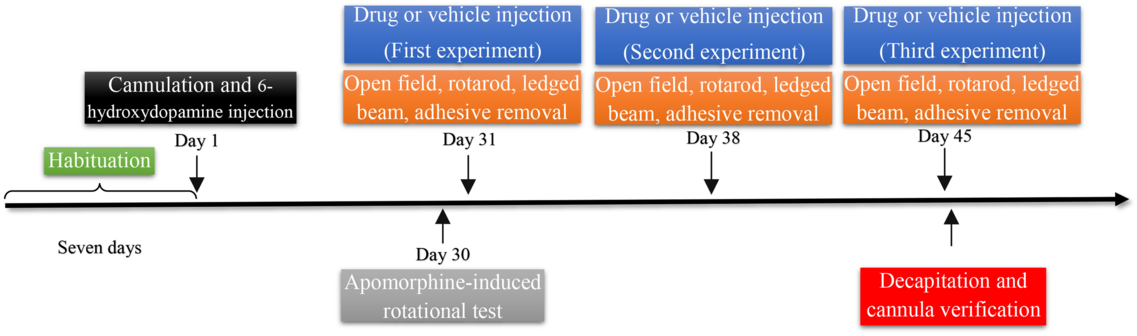
Animals were randomly divided into 10 groups with 8 rats in each. Each sham or 6-OHDA-lesioned rat was tested three times with 1-week intervals (Bishop et al., Reference Bishop, Kamdar and Walker2003). The groups were as follows: (1) Control (naive rats), (2) Sham (striatal cannulation with no treatment), (3) LPI (sham + LPI; 5 µg/rat, intra-striatal), (4) ML193 (sham + ML193; 5 µg/rat, intra-striatal), (5) 6-OHDA (6-OHDA; 10 µg/rat, intra-striatal), (6) 6-OHDA + vehicle (6-OHDA plus vehicle; 0.5 μl/rat, intra-striatal), (7) 6-OHDA + LPI 1 (6-OHDA plus LPI; 1 µg/rat, intra-striatal), (8) 6-OHDA + LPI 5 (6-OHDA plus LPI; 5 µg/rat, intra-striatal), (9) 6-OHDA + ML1931 (6-OHDA plus ML193;1 µg/rat, intra-striatal) and (10) 6-OHDA + ML193 5 (6-OHDA plus ML193; 5 µg/rat, intra-striatal). The doses for LPI and ML193 were selected according to a previous study (Deliu et al., Reference Deliu, Sperow, Console-Bram, Carter, Tilley, Kalamarides, Kirby, Brailoiu, Brailoiu, Benamar and Abood2015). A schematic diagram of experimental protocol is presented in Fig. 2.
A schematic diagram of experimental protocol.

Open field test
The open field test was employed to assess the locomotor activity of the rats. Rats were placed individually in a 50 × 50 × 50 cm white box for 5 min. The activity of rats in the box was digitally recorded and analysed using video-tracking software (EthoVision 7.1, Noldus Information Technology, the Netherlands). At the beginning of the session, each rat was placed in the centre of the arena. The travelled distance was recorded as the main index of activity. At the end of the experiment, the rat was removed from the box and it was cleaned with diluted ethanol (10%) (Fatemi et al., Reference Fatemi, Shamsizadeh, Roohbakhsh, Ayoobi, Sanati and Motevalian2016).
Rotarod test
Balance skills and motor function of the rats were assessed on an accelerating rotating rod (MT 6800, BorjSanat, Iran). The rotarod speed was accelerated from 10 to 60 rpm. The cut-off time was considered at 300 s. Rats were given three trials with 30 min intervals. The time taken for each animal to keep its balance (up to falling from the rod) while walking on top of the rotating rod was measured (Hadadianpour et al., Reference Hadadianpour, Fatehi, Ayoobi, Kaeidi, Shamsizadeh and Fatemi2017).
Ledged beam test
We measured the motor function of the hindlimbs using the ledged beam test as described by Hakimizadeh et al. (Reference Hakimizadeh, Shamsizadeh, Roohbakhsh, Arababadi, Hajizadeh, Shariati, Fatemi, Moghadam-Ahmadi, Bazmandegan, Rezazadeh and Allahtakoli2017a). The percent of slip steps of the impaired (contralateral to the lesion) hindlimb [(number of slips/number of total steps) × 100] was calculated and averaged over three trials.
Adhesive removal test
The sensorimotor function of the forelimbs was evaluated by the adhesive removal test (Hakimizadeh et al., Reference Hakimizadeh, Shamsizadeh, Roohbakhsh, Arababadi, Hajizadeh, Shariati, Rahmani and Allahtavakoli2017b). A tiny adhesive label (1 × 1 cm) was attached to the radial surface of the left forepaw and the latency for touching and removing the label was recorded. It is expected that the animal would raise forelimbs towards its face and detach the label with both forepaws to remove the stimulus. In general, rats remove the adhesive within 10 s. This test was undertaken in the animal’s cage and other rats were temporarily removed during the testing as they could interfere with label removal. In all groups, behavioural tests were performed in order of open field, rotarod, ledged beam, and adhesive removal test.
Statistical analysis
All statistical analyses were performed using the SPSS software package (version 13).The differences between the groups were tested with analysis of variance (one-way ANOVA) followed by the Tukey’s post hoc test. For the apomorphine-induced rotational test, an unpaired t-test was performed. Statistical significance was defined at p < 0.05 and data were expressed as mean ± SEM.
Results
Apomorphine-induced rotation
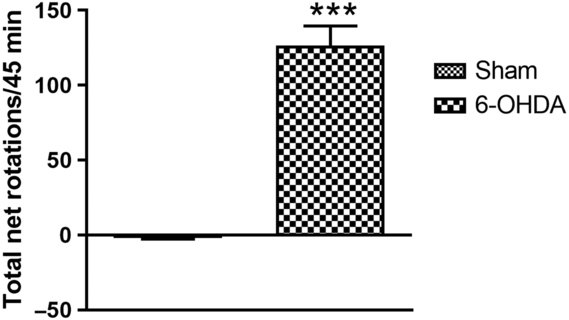
We performed this test in all groups to confirm the induction of experimental Parkinson. For this purpose, the net number of rotations was calculated. If the net number of contralateral (leftwards) rotations was higher, it indicated that the experimental model was induced correctly. Statistical analysis revealed that 6-OHDA-lesioned rats had significant contralateral (leftward) rotations as compared to the sham group (p < 0.001, Fig. 3).The results showed that the administration of either LPI or ML193 alone (sham plus drug) did not induce significant effects on rotations when compared with the sham group. The results are not shown.
Apomorphine-induced rotational behaviour 1 month after intra-striatal injection of 6-OHDA. Values are expressed as means ± SEM. ***: p < 0.001 versus sham group. n = 8. 6-OHDA: 6-hydroxydopamine.

Rotarod test
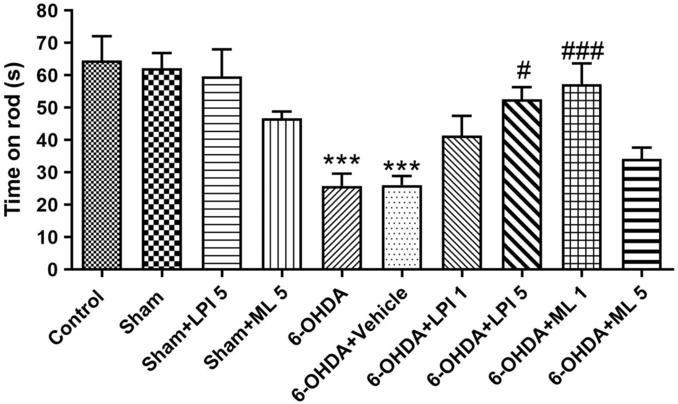
Figure 4 shows the mean of time that animals remained on the rotarod. The rats that were treated with 6-OHDA remained less on the rod than sham-treated animals (p < 0.001).Treatment with LPI (5 μg/rat) and ML193 (1 μg/rat) increased the time of 6-OHDA-lesioned rats on the rotarod (p < 0.05 and p < 0.001, respectively). Surprisingly, ML193, at the higher dose (5 μg/rat), did not induce such effects. This finding implies that LPI- and ML193-treated rats had better motor performance and balance skills.
The effect of intra-striatal administration of LPI and ML193 in 6-OHDA-lesioned rats in the rotarod test. Values are expressed as means ± SEM. ***: p < 0.001 versus sham group, #: p < 0.05 and ###: p < 0.001 versus 6-OHDA+Vehicle group. n = 8. LPI: (L-α-lysophosphatidylinositol, GPR55 agonist), ML193: GPR55 antagonist, 6-OHDA: 6-hydroxydopamine, Vehicle:dimethyl sulfoxide in saline (10%), LPI 1: LPI (1 μg/rat), LPI 5: LPI (5 μg/rat), ML 1: ML193 (1 μg/rat), ML 5: ML193 (5 μg/rat).

Ledged beam test
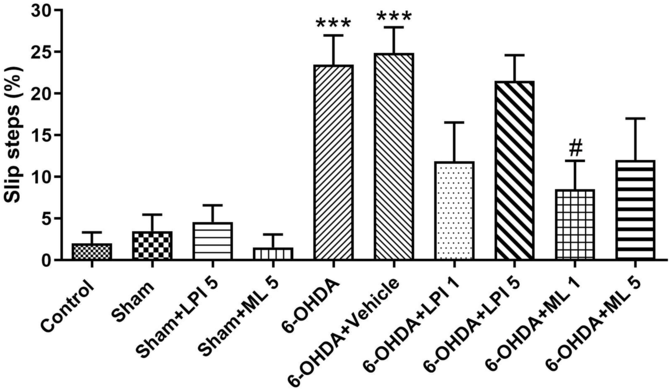
The ledged beam test was used to evaluate the hindlimb function. The results demonstrated that 6-OHDA-lesioned rats had higher rates of slip steps (p < 0.001, Fig. 5). Administration of ML193 at the low dose decreased slip steps when compared to the 6-OHDA+vehicle group (p < 0.05). Neither low nor high dose of LPI induced significant effect on slip steps, when compared to the respective control group.
The effect of intra-striatal administration of LPI and ML193 in 6-OHDA-lesioned rats in the ledged beam test. Values are expressed as means ± SEM. ***: p < 0.001 versus sham group and #: p < 0.05 versus 6-OHDA+Vehicle group. n = 8. LPI: (L-α-lysophosphatidylinositol, GPR55 agonist), ML193: GPR55 antagonist, 6-OHDA: 6-hydroxydopamine, Vehicle:dimethyl sulfoxide in saline (10%), LPI 1: LPI (1 μg/rat), LPI 5: LPI (5 μg/rat), ML 1: ML193 (1 μg/rat), ML 5: ML193 (5 μg/rat).

Adhesive removal test
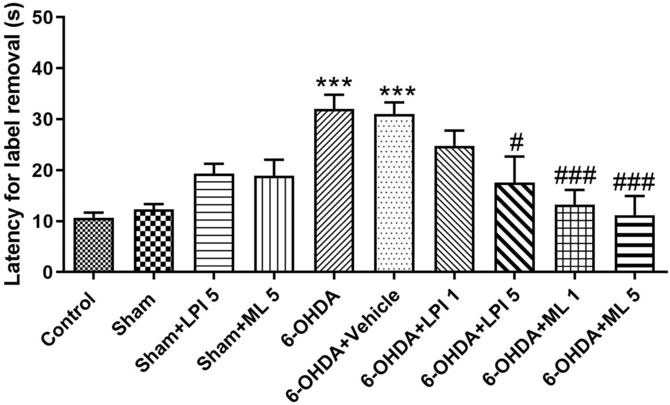
Figure 6 presents the effect of LPI and ML193 on sensorimotor function, which was evaluated by the adhesive removal test. The latency to remove the sticky label from the forepaw was not different in sham groups that were treated with LPI or ML193. However, 6-OHDA-treated rats had increased latency to remove the sticky label (p < 0.001). Administration of both LPI and ML193 decreased the latency to remove the sticky label in 6-OHDA-treated rats (p < 0.05 and p < 0.001, respectively).
The effect of intra-striatal administration of LPI and ML193 in 6-OHDA-lesioned rats in the adhesive removal test. Values are expressed as means ± SEM. ***: p < 0.001 versus sham group, #: p < 0.05 and ###: p < 0.001 versus 6-OHDA+Vehicle group. n = 8. LPI: (L-α-lysophosphatidylinositol, GPR55 agonist), ML193: GPR55 antagonist, 6-OHDA: 6-hydroxydopamine, Vehicle:dimethyl sulfoxide in saline (10%), LPI 1: LPI (1 μg/rat), LPI 5: LPI (5 μg/rat), ML 1: ML193 (1 μg/rat), ML 5: ML193 (5 μg/rat).

Open field test
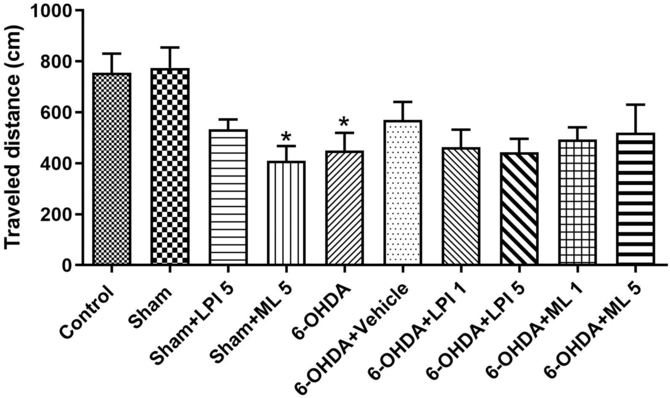
The open field test was used to determine the locomotor activity of rats (Fig. 7). Administration of ML193 to the sham group significantly decreased the travelled distance (p < 0.05). Rats that were treated with 6-OHDA had lower activity in this test (p < 0.05). However,the 6-OHDA+vehicle group did not have lower locomotor activity when compared to the sham group. Statistical analysis showed that they did not have different locomotor activity when compared to the 6-OHDA group. Administration of either LPI or ML193 did not change lower locomotor activity in 6-OHDA-lesioned animals.
The effect of intra-striatal administration of LPI and ML193 in 6-OHDA-lesioned rats in the open field test. Values are expressed as means ± SEM. *: p < 0.05 versus sham group. n = 8. LPI: (L-α-lysophosphatidylinositol, GPR55 agonist), ML193: GPR55 antagonist, 6-OHDA: 6-hydroxydopamine, Vehicle:dimethyl sulfoxide in saline (10%), LPI 1: LPI (1 μg/rat), LPI 5: LPI (5 μg/rat), ML 1: ML193 (1 μg/rat), ML 5: ML193 (5 μg/rat).

Discussion
In this study, we evaluated the role of the striatal GPR55 in an experimental model of PD. For this aim, we used intra-striatal injections of both GPR55 selective agonist and antagonist. The results of the present study showed that administration of LPI, as an endogenous GPR55 agonist, increased motor coordination and attenuated sensorimotor deficits in PD rats. Moreover, the administration of ML193, as a GPR55 selective antagonist, similar to LPI, attenuated sensorimotor deficits and slip steps and increased motor coordination in PD rats with no significant effect on motor activity. It is well established that induction of experimental PD has deleterious effects on locomotor activity, motor coordination, and sensorimotor function (Rauch et al., Reference Rauch, Schwabe and Krauss2010; Prakash et al., Reference Prakash, Chopra and Medhi2013; Voronin et al., Reference Voronin, Kadnikov, Voronkov and Seredenin2019). Consistent with these studies, we observed that locomotor activity and motor performance of rats and their sensorimotor function of forelimbs and hindlimbs were impaired in various behavioural tests.
As an unexpected result, we found that intra-striatal administration of LPI and ML193, as GPR55 agonist and antagonist, improved the motor and the sensorimotor deficits of PD rats suggesting a role for striatal GPR55 in PD. GPR55 is widely expressed in brain areas involved in the control of movement (Marichal-Cancino et al., Reference Marichal-Cancino, Fajardo-Valdez, Ruiz-Contreras, Mendez-Diaz and Prospero-Garcia2017). Previous studies show a role for GPR55 in somatic motor control. Wu et al. (Reference Wu, Chen, Sun, Zhu, Jew, Wager-Miller, Straiker, Spencer, Bradshaw and Mackie2013) observed that muscle strength, gross motor skills, sensorimotor integration and motor learning behaviours were not affected in GPR55 KO mice. However, GPR55 KO mice had impaired movement coordination (Wu et al., Reference Wu, Chen, Sun, Zhu, Jew, Wager-Miller, Straiker, Spencer, Bradshaw and Mackie2013). In other studies, it was shown that the spontaneous locomotor activity of GPR55 KO mice was decreased and they had a higher frequency of immobile behaviour (Meadows et al., Reference Meadows, Lee, Wu, Wei, Pradhan, Yafi, Lu and Sun2016; Hurst et al., Reference Hurst, Badgley, Ellsworth, Bell, Friend, Prince, Welch, Cowan, Williamson, Lyon, Anderson, Poole, Christensen, McNeil, Call and Edwards2017). In a part of the present study, the administration of ML193 (5 μg/rat) to sham group decreased locomotor activity of the rats that is in accordance with previous findings. However, unexpectedly, the results of our study showed that ML193, as a GPR55 antagonist, similar to LPI, attenuated the motor and sensorimotor deficits in PD rats. These effects of ML193 were exhibited mostly at the low dose (1 μg/rat). It is difficult for us to justify the similar effects of both GPR55 agonist and antagonist. However, the results of a recent study showed a similar controversy in an experimental model of PD (Celorrio et al., Reference Celorrio, Rojo-Bustamante, Fernandez-Suarez, Saez, Estella-Hermoso de Mendoza, Muller, Ramirez, Oyarzabal, Franco and Aymerich2017). Celorrio and colleagues hypothesised that GPR55 has a role in PD. They showed that, in PD mice, striatal GPR55 gene expression was attenuated and abnormal cannabidiol, a GPR55 agonist, decreased the locomotor deficits in these mice. Moreover, they demonstrated that cannabidiol, as a GPR55 antagonist, had similar effects in the pole and rotarod tests and histopathological observations. Lower effects of ML193 at a higher dose may be justified by its non-selective effects at higher doses and possible interaction with receptors other than GPR55. For example, AM251, as a selective and potent CB1 antagonist, has been reported as a potent agonist of GPR55 receptors (Kapur et al., Reference Kapur, Zhao, Sharir, Bai, Caron, Barak and Abood2009; Singh et al., Reference Singh, Bernier and Wainer2016). Altogether, these findings suggest that GPR55 has a potential modulatory role in PD. It should be noted that the effects of GPR55 antagonists in the dorsolateral striatum and hippocampus have been reported with deficits in learning and memory, while LPI induced beneficial effects on memory performance (Marichal-Cancino et al., Reference Marichal-Cancino, Sanchez-Fuentes, Mendez-Diaz, Ruiz-Contreras and Prospero-Garcia2016, Reference Marichal-Cancino, Fajardo-Valdez, Ruiz-Contreras, Mendez-Diaz and Prospero-Garcia2018). It was reported that LPI induced neuroprotective effects on dentate gyrus granule cells after N-methyl-D-aspartate-induced lesions (Kallendrusch et al., Reference Kallendrusch, Kremzow, Nowicki, Grabiec, Winkelmann, Benz, Kraft, Bechmann, Dehghani and Koch2013) and promoted early adult hippocampal neurogenesis, as well (Hill et al., Reference Hill, Zuluaga-Ramirez, Gajghate, Winfield and Persidsky2018). Accordingly, it may be suggested that, at least in part, the beneficial effects of LPI on some behavioural indices of PD rats may be mediated by its neuroprotective and/or neurogenesis effects. The striatum has a key role in motor performance and is strictly controlled by neuromodulators such as dopamine and endocannabinoids (Fino et al., Reference Fino, Glowinski and Venance2005). So, the imbalance among these neuromodulators can participate in the pathophysiology of PD (Brotchie, Reference Brotchie2005). It is well documented that the endocannabinoid system has an important role in neurodegenerative diseases such as PD (Basavarajappa et al., Reference Basavarajappa, Shivakumar, Joshi and Subbanna2017). It was reported that the enhancement of anandamide, by inhibition of the fatty acid amide hydrolase, induced significant anti-Parkinson effects in two different experimental models (Celorrio et al., Reference Celorrio, Fernandez-Suarez, Rojo-Bustamante, Echeverry-Alzate, Ramirez, Hillard, Lopez-Moreno, Maldonado, Oyarzabal, Franco and Aymerich2016). On the other hand, the therapeutic effects of cannabinoids on experimental models of Parkinson have been reported in previous studies. Chung et al. observed that treatment of PD rats with WIN55212,2 and HU210, as non-selective cannabinoid receptor agonists, increased survival of dopaminergic neurons in the substantia nigra, elevated dopamine levels in the striatum and improved motor functions. Moreover, rimonabant, as a selective cannabinoid CB1 receptor antagonist, provoked antihypokinetic activity in moderate PD that was not related to changes in dopaminergic transmission of the striatum (Gonzalez et al., Reference Gonzalez, Scorticati, Garcia-Arencibia, de Miguel, Ramos and Fernandez-Ruiz2006). Studies are showing that some effects of endocannabinoids are mediated independently of CB1 and CB2 receptors (De Petrocellis & Di Marzo, Reference De Petrocellis and Di Marzo2010; Henstridge, Reference Henstridge2012; Morales & Reggio, Reference Morales and Reggio2017). On the other hand, CB1 receptors have been reported to modulate GPR55 signalling (Kargl et al., Reference Kargl, Balenga, Parzmair, Brown, Heinemann and Waldhoer2012). In addition, some endogenous ligands of the cannabinoid system, including anandamide, act as GPR55 ligands (Sharir et al., Reference Sharir, Console-Bram, Mundy, Popoff, Kapur and Abood2012). In addition to endocannabinoids, some synthetic cannabinoid ligands also act as GPR55 ligands. For example, AM251, as a CB1 receptor antagonist, and HU210, as a CB1 receptor agonist, have been reported with significant agonist activities at GPR55 (Ryberg et al., Reference Ryberg, Larsson, Sjogren, Hjorth, Hermansson, Leonova, Elebring, Nilsson, Drmota and Greasley2007; Henstridge et al., Reference Henstridge, Balenga, Schroder, Kargl, Platzer, Martini, Arthur, Penman, Whistler, Kostenis, Waldhoer and Irving2010). Interestingly, it was reported that both compounds had anti-Parkinson effects in experimental models (Gilgun-Sherki et al., Reference Gilgun-Sherki, Melamed, Mechoulam and Offen2003; Moghaddam et al., Reference Moghaddam, Khodayar, Abarghouei and Ardestani2010). According to discrepancies regarding the effect of cannabinoids on Parkinson, it was reported that multiple targets, other than classical cannabinoid receptors, may also be responsible for such discrepancies (Papa, Reference Papa2008; More & Choi, Reference More and Choi2015). GPR55 may be an explanation for some of these discrepancies. In line with these findings, a recent study showed that GPR55-KO mice exhibited enhanced responses to cannabinoids implying that GPR55 induced opposite effects versus CB1/CB2 receptors (Wang et al., Reference Wang, Galaj, Bi, Zhang, He, Zhan, Bauman, Gardner and Xi2020).
GPR55-dependent signalling pathways are not well understood. There are reports showing that this receptor, via activation of Gαq and Gα13, activates phospholipase C and Rho-associated protein kinase. These targets mediate various intracellular responses, including activation of protein kinase C, mitogen-activated proteinkinases and enhancement of Ca2+ release, activating transcription factor 2 and cAMP response element-binding protein. It is believed that these changes are responsible for various physiological functions of the GPR55 (Liu et al., Reference Liu, Song, Jones and Persaud2015).
Anxiety disorders are common in PD and have been associated with reduced life satisfaction and functional impairment (Rutten et al., Reference Rutten, Vriend, van der Werf, Berendse, Weintraub and van den Heuvel2017). It is established that PD induction leads to increased anxiety-like behaviour in animal models (O’Connor et al., Reference O’Connor, Feustel, Ramirez-Zamora, Molho, Pilitsis and Shin2016). Rahimi and co-workers showed that O-1602, as a GPR55 agonist, provoked anxiolytic-like behaviour, while ML193, as a GPR55 selective antagonist, increased anxiety-like effects in rats (Rahimi et al., Reference Rahimi, Hajizadeh Moghaddam and Roohbakhsh2015). So, modulation of GPR55 receptors may also modulate anxiety-related behaviours as comorbidity during PD. This work is just a preliminary study, and more studies are needed to uncover the role of GPR55 in PDs and other movement disorders.
In conclusion, our study demonstrated that both GPR55 agonist and antagonist induced beneficial effects in an experimental model of PD. This may imply that GPR55 has a modulatory role in PD and reveals new insight on the GPR55 role in the control of balance, movement and sensorimotor skills. The present study lays as a basic work for future behavioural studies based on GPR55.
Acknowledgement
The authors acknowledge the Research Councils of Rafsanjan and Mashhad Universities of Medical Sciences for their supports.
Author contributions
AR and AS made the design of the study. AAand IF performed the tests and collected the data. MA performed statistical analyses. AR, AS and IF contributed in writing the manuscript. All authors agreed upon the final version of the paper.
Financial support
Results presented in this work were obtained from a master’s thesis. This research has been supported by Research Councils of Mashhad Universities of Medical Sciences (grant no: 941834).
Conflict of interest
None of authors declared conflict of interest.
Ethical Standards
Animals received humane care in accordance with the US National Institute of Health (NIH publication #85−23, revised in 1985) guidelines for the care of laboratory animals, and all procedures and experiments were performed in accordance with the guidelines for the care and use of laboratory animals in Mashhad University of Medical Sciences.