One of the least disputed claims routinely made about the relationship between music and time is that music is in a privileged position to reflect a particular historical consciousness of time and human temporality. As the New Grove entry on ‘Time’ flatly states, music ‘reflects the temporal sensibilities of its cultural milieu’. Rather more eloquently, in Melanie Wald's words, music might well be taken as ‘the most sensitive seismograph’ for the relationship with temporality developed by a culture.Footnote 1 Music allows the historian to explore ‘the cultural construction of time’, claims W. Dean Sutcliffe. ‘Surely no other art could reveal more about how composing and listening subjects might have experienced the temporal succession of their lives.’Footnote 2 In such a vein Theodor W. Adorno, perhaps the most prominent spokesperson for music's historicity, argues that the type of ‘temporal consciousness’ transmitted by a Palestrina choral piece, a Bach fugue, a Beethoven symphony, a Debussy prelude or an aphoristic Webern quartet movement is ‘endlessly different’, an ‘experience of time that is specifically unique to it…. Just as the temporal form of every music, its inner historicity, varies historically, so this inner historicity also always reflects real, external time … the time that is immanent in every music, its inner historicity, is real historical time, reflected as appearance.’Footnote 3
That music has often been understood as uniquely capable of articulating certain aspects of existence in time is closely related to the fact that it has long been considered ‘the temporal art par excellence’.Footnote 4 ‘The field of music is time’, claimed Jean-Jacques Rousseau in his Essay on the Origins of Language.Footnote 5 Music, after all, is an art that is primarily of the ear, not the eye, and ever since St Augustine time has been considered more susceptible to aural than to visual sense.Footnote 6 Such a distinction between spatial and temporal arts is a prominent feature of aesthetic discourse in the later eighteenth century, finding classic formulations in Rousseau's Essay, Gotthold Ephraim Lessing's Laocoon and Johann Gottfried Herder's own Essay on the Origins of Language.Footnote 7 Romantic thinkers such as Friedrich Schlegel, Jean Paul, Novalis and William Wordsworth concurred with Augustine that whereas the eye is spatial, other senses, above all the ear, are temporal, contributing to a reversal of what Samuel Taylor Coleridge called the ‘despotism of the eye’ so firmly entrenched within neoclassical aesthetics.Footnote 8 In contrast to the earlier visually oriented mimesis of the external world, by the turn of the nineteenth century the ear becomes hallowed as the organ of subjectivity.Footnote 9 Furthermore, music's immaterial manifestation seems most akin to the abstract, intangible nature of time, bound up with a similar sense of flow, passing away and correspondingly reliant on memory for its constitution. Thus it becomes a commonplace assertion in the early nineteenth century that music is the quintessential temporal art, an aesthetic medium bound up with time in a manner more pronounced and intimate than any other of the muses’ gifts. Time is the ‘universal element in music’, claims Georg Wilhelm Friedrich Hegel in his Aesthetics, while his antipode, Arthur Schopenhauer, similarly observes that ‘Perceptions through hearing are exclusively in time; hence the whole nature of music consists in the measure of time’.Footnote 10
Yet this notion – that musical time is historical through and through – is surely itself historical: it reflects the ‘temporalization of time’, the awareness of time and those arts bound to it as something that is mutable in conception, a temporal self-consciousness which has arguably only been possible since the later eighteenth century. For why was music heard as pre-eminently capable of articulating time particularly at this historical time? The answer rests on two related features: how the notion of time becomes more problematized in Western Europe by the end of the eighteenth century, and how music by this time had become more capable of articulating this new sense of temporal experience.
Time, Temporalization and History
It has been axiomatic within recent scholarship in the humanities that the eighteenth century witnessed a decisive shift in the conception of time throughout much of Western Europe – a profoundly new awareness of time as a force of change, as a temporalization of history and experience. This idea of ‘temporalization’ was introduced back in the 1930s by the historian and philosopher Arthur Lovejoy in order to describe the growth in the eighteenth century of the idea of progress, but the notion received its most influential articulation from the 1970s onwards in the work of the German conceptual historian Reinhart Koselleck.Footnote 11 For Koselleck, at some stage between 1700 and 1800 the idea of history took on a new dynamic aspect. In the premodern age, the ancient wisdom that there was essentially ‘nothing new under the sun’ still held true: life followed the cyclical agrarian and religious calendars of the medieval world, unchanging through the generations, a static conception in which time was barely cognized as an entity. Time belonged to God; one occupied it for one's allotted share, to be succeeded by the next generation. Since history was essentially unchanging and the past to this extent continuously present, its lessons were ever reapplicable (historia magna vita). Yet by the end of the eighteenth century all this had been swept away. History did not follow the cyclical recurrence of the past but constantly changed, in ways unforeseeable; the present's implicit wedding to the past was replaced by an explicit orientation towards the unknown future. The world one experienced now was unrecognizable from that of one's parents, soon (following the widespread symptoms of acceleration) even from what it had been a decade before. Rather than time being an empty medium in which events happened, it became an insatiable driving force.
Despite some later criticisms directed at specific details of Koselleck's outline, his position still largely holds as a generalization of a broad cultural trend. It has been affirmed by a number of other scholars, who view this shift as arising from the conjunction of many social, intellectual and scientific changes during this period.Footnote 12 Ever since Gottfried Wilhelm Leibniz declared ‘we must recognize a certain constant and unbounded progress of the whole universe such that it always proceeds to greater development’, the idea of progress took increasing hold on the European imagination.Footnote 13 Following the trend started earlier by Nicolaus Copernicus, Galileo Galilei and Isaac Newton, such scientific advancement as the redating of the age of the earth by the geological sciences and speculations on the origins of the universe encouraged a new scepticism towards earlier religious dogma, and technological developments resulted in the ability to measure time more accurately.Footnote 14 Allied to the gradual secularization of history, the ideology of progress resulted in the growth of the idea of universal history, as found in Anne-Robert-Jacques Turgot, Immanuel Kant or Marie-Jean-Antoine-Nicolas de Caritat, Marquis de Condorcet, while in reciprocity to this belief in progress came a relativizing of historical time – historicism – from the newly conscious awareness of the qualitative difference in historical periods (as is seen most prominently in Herder).Footnote 15
Clearly it is dangerous to narrow down an entire era and culture to one viewpoint (even supposing Western Europe can be treated as a collective entity). Just as we may find within the (long) eighteenth century such quintessential Enlightenment formulations as Newton's absolute time and causality, so we encounter equally ‘modern’ objections to both by John Locke, George Berkeley and David Hume. Leibniz's belief in human progress famously finds an ironic echo in Voltaire's Candide, and linear history meets its counterpart in Giambattista Vico's cyclic Principi di scienza nuova. Most pointedly, the wilfully fractured temporal narrative and sense of subjectivity in Laurence Sterne's Tristram Shandy (1759–1767) stands as a reaction against a larger belief in linear development and the ultimate reality of objective time. Perhaps it is more accurate to say that for a multitude of reasons time became more of an issue in the eighteenth century.Footnote 16 Time becomes both temporalized and increasingly problematized: thus it may seem hard to give one, unitary definition for the age. But all this supports the view that time was a fundamental concern in this period precisely because it was so diversified, problematic and therefore all the more apparent. Just as all philosophizing is said to begin with wonder, so the concept of time becomes more discussed, more disputed, the more keenly its impact is felt.
The Temporalization of Musical Time
Correlatively, time seems to become far more of an issue in music during this period. The same general claim – of the temporalization, or at least problematization, of time as a medium – holds for music as for history. As numerous scholars have proposed, by the late eighteenth century, and from there continuing until at least the early twentieth century, music's sensitivity to temporal placement and distinctions becomes fundamental to its construction and cognition.Footnote 17 For David Greene, baroque temporality is an image of that supposed in Newtonian physics. Time is an indifferent, external, homogeneous medium. One time is identical to another: they have the same measure; the same laws apply throughout. It inhabits an orderly and predictable universe where the future is in essence no different from the past. Induction holds.Footnote 18 Given complete information about the current state, one could almost predict the subsequent course of a musical movement (just as J. S. Bach is said by his son Carl Philipp Emanuel to have worked out on first hearing all the possible paradigmatic permutations in a contrapuntal piece at its start).Footnote 19 Baroque music exhibits not only a unity of affect but also a unity of rhythmic intensity. A regular pulse and unit of rhythmic movement usually runs throughout baroque movements (seen particularly clearly in fugues), thus leaving tempo as a neutral backdrop for musical events.Footnote 20
In contradistinction, later music can tolerate far greater discontinuities. Already in Domenico Scarlatti, and especially in C. P. E. Bach, abrupt contrasts can manifest themselves, calling attention to time as more than just an empty vessel for material. This subjectivization of musical time increases throughout the nineteenth century to an even greater fluidity in tempo within a movement, whereby subject groups can be primarily differentiated by contrasts in tempo. The Viennese classical style especially is highly differentiated in its rhythmic aspects: harmonic rhythm and movement are variable, and can be carefully organized in order to build up and dissipate tension.Footnote 21 Thrasybulos Georgiades speaks of the novel nature and uniqueness of classical metre, its concentration on ‘here and now’. In previous music, past, present and future ‘form an unbroken whole. Time was not realized as an independent element…. The Viennese Classical technique consists in our becoming conscious of time. Temporality forces its way in.’Footnote 22 Ever since the later eighteenth century, music more readily suggests a process, an onward-moving stream: not a more-or-less static Being but a dynamic Becoming. Music, as Wilhelm Seidel has put it, becomes a Zeitkunst instead of a Tonkunst.Footnote 23
More recently, this narrative has been given renewed exposure by Karol Berger in his division between cyclical baroque and linear classical conceptions of musical time – symbolized by the circle and the arrow respectively. Berger's central claim is a familiar one: that
in the later eighteenth century European art music began to take seriously the flow of time from past to future. Until then music was simply ‘in time’; it ‘took time’ – events had somehow to be arranged successively, but the distinction between past and future, ‘earlier’ and ‘later’, mattered little to the way the music was experienced and understood.
But ‘at some point between the early and late eighteenth century, between Bach and Mozart, musical form became primarily temporal and the attention of musicians – composers, performers and listeners alike – shifted toward the temporal disposition of events…. From that point on music added the experience of linear time … to its essential subject matter. Music could no longer be experienced with understanding unless one recognized the temporal ordering of events’.Footnote 24 Berger's ideal types have been reproached in some quarters for their evident overschematization, even though their underlying point – that musical time becomes ever more temporalized across the eighteenth century – has long been uncontroversial.Footnote 25
Thus across the eighteenth century, so the prevalent view goes, European music becomes newly temporalized and problematized. This characteristic is found within different periods and styles and should not simply be reduced to Viennese classicism (let alone to Beethoven). Sutcliffe has spoken of a ‘present tenseness’ in Domenico Scarlatti's music, which through its obstinate repetitions, unpredictability and unruly disruptions of projected order ‘makes us aware of the contingent nature of musical time’.Footnote 26 C. P. E. Bach's seemingly wilful temporal discontinuities suggest the extreme subjectivization of musical time, a fitting corollary to the aesthetics of Empfindsamkeit.Footnote 27 Haydn, meanwhile, is a master at problematizing musical succession and the corresponding sense of temporality. Reinhard Kapp describes him as ‘the first composer to have written fully articulated, seamlessly formed movements, in which virtually every note possesses an inherent temporal index’.Footnote 28 For Haydn, the fact that music may be so clearly heard to project a temporal position enables the playing with continuity and discontinuity that so distinguishes his instrumental writing.Footnote 29 Hans-Ulrich Fuß, taking up the long-standing analogy with Laurence Sterne, argues persuasively that Haydn's music similarly plays with ‘multiple possibilities, openness, chance, indeterminateness and deviation from the predetermined path, the interleaving of multiple temporal tendencies’.Footnote 30 On the other hand, with Mozart there is often a sense of the composer seeking to create continuity from the most disparate, heterogeneous materials.Footnote 31 Beethoven and the nineteenth century were by no means the inventors of a dynamic temporal sense in music, but rather the inheritors of a musical idiom already capable of great flexibility and subtlety in the articulation of musical time.
It is clearly simplistic to say that a linear, irreversible time sense was not present in early eighteenth-century culture or in its music (as scholars such as Berger, Raymond Monelle and John Butt show). The early eighteenth century was certainly aware of the irreversible nature of time and of the inescapable fact of human mortality even amidst the cyclical return of the natural world; such themes have been present in Western culture since antiquity.Footnote 32 But the premise that linear time in the early eighteenth century was still generally seen as subsidiary to eternity, an echo or moving image of it in Plato's famous phrase, has long been accepted. As Henry Vaughan had memorably expressed it half a century before:
Given the supposedly only nascent stage of temporalization at this point in history, however, how are such qualities reflected in musical time? Does the musical language available to the early eighteenth century enable the articulation and differentiation of distinct temporal senses? Does baroque music merely inadvertently reflect its surrounding culture's temporality (and an untemporalized one at that), or can it knowingly comment on it (as later composers seem to do)?
Handel's Il Trionfo del Tempo
A pertinent case-study is provided by Handel's oratorio-cum-cantata The Triumph of Time, which sets to music a text expressly concerning questions of time and transience. In fact there are three versions of this work, written across a fifty-year period: Il trionfo del Tempo e del Disinganno (hwv46a) dating from 1707, while the twenty-two-year-old composer was in Rome; the 1737 II trionfo del Tempo e della Verità (hwv46b), enlarged for London audiences; and finally in 1757 a revised English-language The Triumph of Time and Truth (hwv71), put together on the blind composer's behalf by his pupil and amanuensis John Christopher Smith.Footnote 34 Fittingly, in a history spanning half a century, Handel's first oratorio – on the subject of time – became his last.Footnote 35 Handel's piece demonstrates well the complexity of trying to generalize about musical temporality and historical perceptions of time in the first half of the eighteenth century, especially regarding the distinction between the text's expression of temporal themes and the music's capacity to engage with them.
The plot, largely unchanged in essentials across the three versions, thematizes the fading of earthly beauty, an awareness of mortality and the irreversibility of time.Footnote 36 The original text had been written by Cardinal Benedetto Pamphili as a moralistic allegory with neoplatonic overtones, loosely drawing on the fifth of Petrarch's six Triumphs, the Trionfo del Tempo.Footnote 37 Despite the title of the work, it is clear from the text (and in the context of Petrarch's series of Triumphs) that although time triumphs over ephemeral pleasure, eternity ultimately triumphs over time. The moral message of the oratorio thus might better be called ‘The Triumph of Eternity’.
In Part 1, Bellezza (Beauty) is found looking into a mirror, worried that even though the mirror will not change, her youthful beauty will. Piacere (Pleasure) enters and swears she will always remain beautiful; Bellezza promises to stay faithful to Piacere. However, Tempo (Time) and Disinganno (Disillusion or Truth, later called Counsel) tell Bellezza that her beauty is only a flower that remains fair for a single day and will die. The four characters (Tempo, Disinganno, Bellezza and Piacere) decide to contest the truth of the matter. The numerous arguments advanced by Tempo leave Bellezza unmoved. He subsequently urges her that if she wishes to be free of time she must obtain a place in the eternity of heaven, a realm which he cannot reach, but she must not repent too late.
In Part 2, Tempo shows Bellezza Disinganno, who is dressed in white and looking towards the eternal light of the sun, inspecting the mirror of truth which reflects true and false without distortion. Piacere admonishes her to close her eyes or she will lose pleasure and find in its place only sadness. Bellezza is beginning to be won round by Tempo's argument that she is in danger of losing eternity, but she would like to repent without losing pleasure and feels she needs more time to reflect. Piacere offers one final plea for Bellezza to seize the pleasures of the moment and forget the inevitability of sorrow later. This entreaty seems to have a decisive – but unforeseen – effect, for Bellezza now asks to see the mirror of truth and bids farewell to Piacere, throwing to the ground her earthly mirror, with which she was viewing herself at the start. She now desires only repentance: to leave her former flower-strewn path of pleasure and choose the way of thorns and a solitary cell. Bellezza asks the angels to hear her cry and to illuminate her with the eternal light of the sun, and dedicates her new heart to God.Footnote 38
On initial acquaintance, it is difficult to come to any strong conclusion concerning Handel's musical articulation of time in this oratorio: despite the thematization of this subject in the libretto, the temporal qualities of this work seem barely distinguishable from the common practice of the age, the customary alternation of da capo aria and recitative. Such a conclusion would support the view that time, while acknowledged, was somehow less ‘temporalized’ or problematized in the early eighteenth century. I believe that this view is in many ways an accurate reflection of Handel's piece. Yet on further consideration it is still possible to distinguish differences in Handel's musical characterization of Pamphili's allegory that arguably suggest a conscious distinction between time and eternity. In what follows I propose a reading of Handel's work that draws out of this ostensibly unpropitious situation a possible understanding of time as being meaningfully differentiated in certain of the oratorio's most notable numbers. However, as acknowledged in the conclusion to this article, there remain significant problems in any attempt to read the music in such terms. The following analytical reading thus stands both as a provisional exposition of how one might attempt to go about interpreting the temporality of early eighteenth-century music, and as a warning as to the potential dangers of such hermeneutic endeavours.
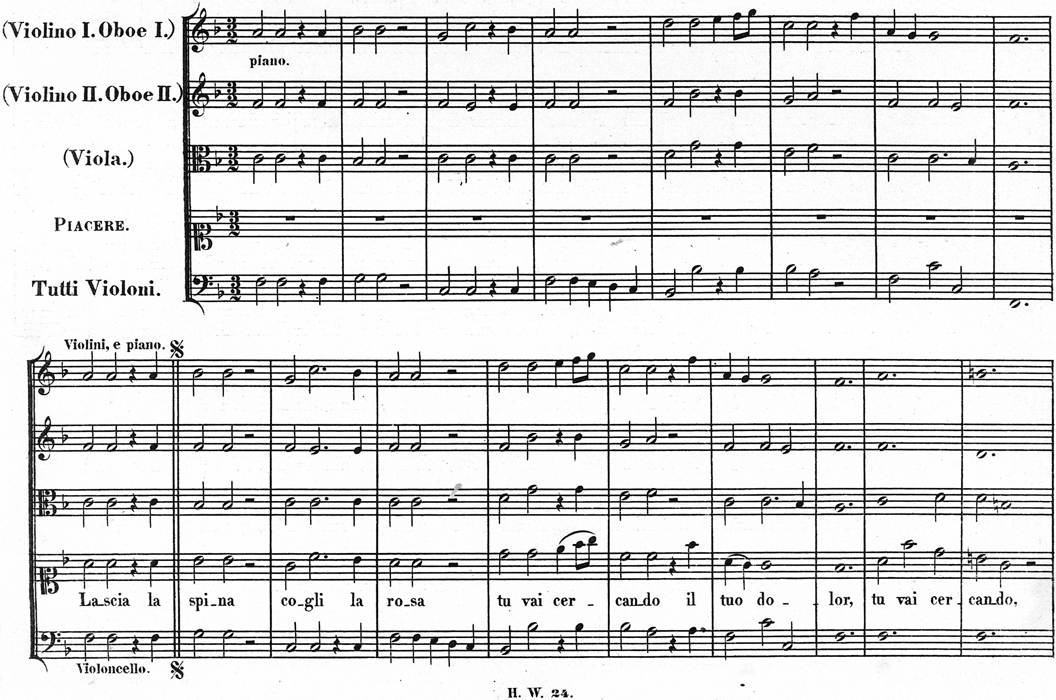
What particularly stands out musically from the cantata is the aria ‘Lascia la spina’, which in the first version of 1707 contains one of Handel's most beautiful creations (Figure 1). Mary Ann Parker justly describes the aria as ‘tortuously affective’, the point at which the drama's emotional intensity reaches ‘its profoundest depths’.Footnote 39 This moment marks the dramatic climax of the work: the point in the second part when Piacere makes one last attempt to lure Bellezza into living solely in the ephemeral present – to gather her rosebuds while she yet may, forgetting sorrow and what must inevitably happen within our mortal lives:

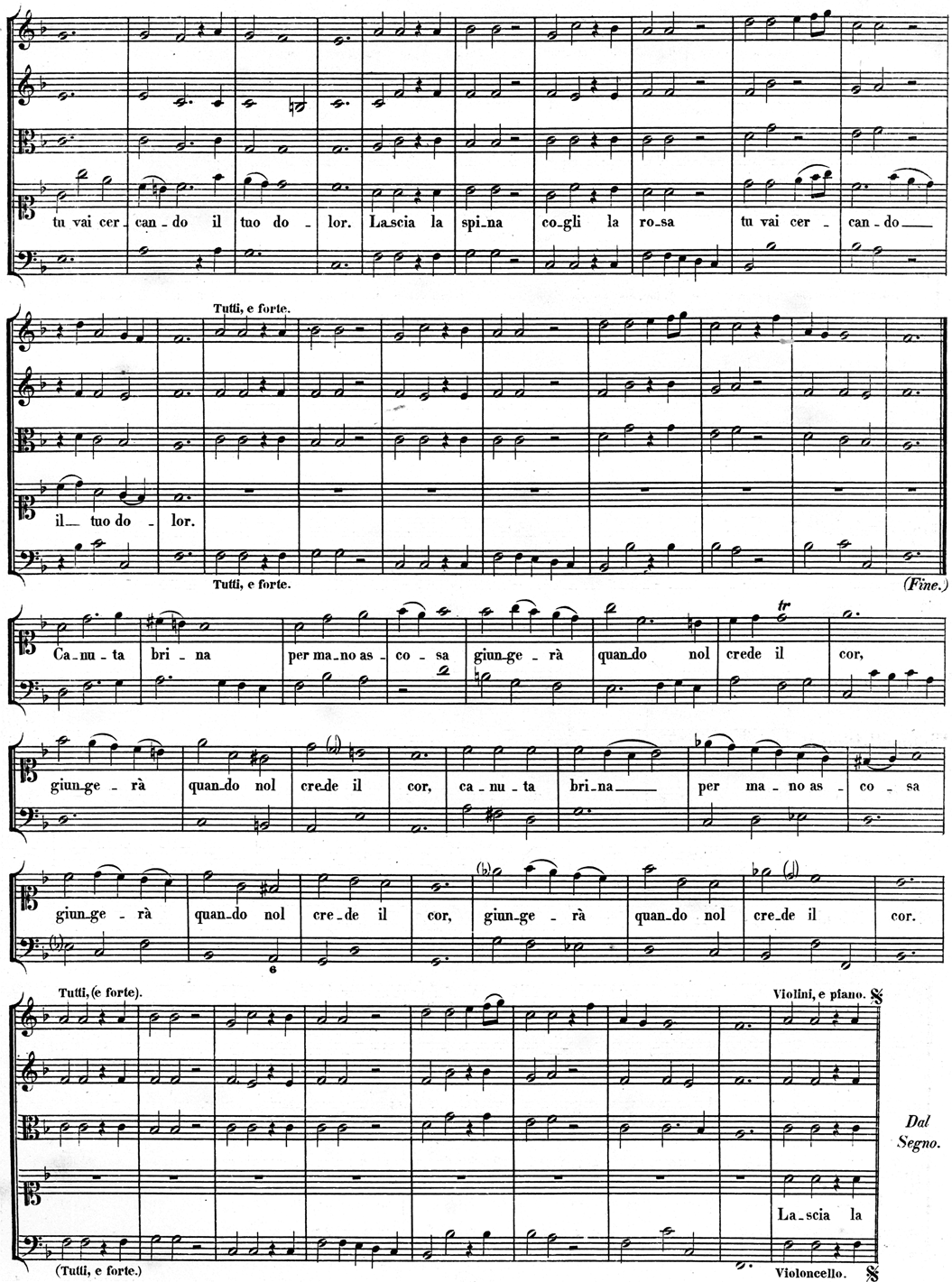
George Frederic Handel, ‘Lascia la spina’, Il trionfo del Tempo e del Disinganno, hwv46a (1707), Part 2. Georg Friedrich Händels Werke: Ausgabe der Deutschen Händelgesellschaft, ed. Friedrich W. Chrysander and Max Seiffert, volume 24 (Leipzig: Deutsche Händelgesellschaft, 1866)
Especially notable here is how the moral status of the musical setting is so ambiguous. To an unenlightened listener, cognizant only of the expressive power of the music and the general message of the oratorio, the aria might appear to be the perfect musical instantiation of the bliss of God's eternity, rather than forming a deceitful fleeting moment of time. The words would seemingly be more appropriate put into the mouth of Disinganno praising the final perfection of life in heaven. Handel seems in this aria to capture a sense of eternity, a beauty, serenity and heavenly peace that might make the true narrative context of its appearance only more ironic.Footnote 40 At the very least, the aria seems set on a wishful denial of temporal passing, of change and mutability, even whilst the music inescapably moves.Footnote 41 These properties are conveyed through the text, the larger significance of the aria within its dramatic context, and most notably here in the music's affinity with possible ‘timeless’ qualities.
The sense of temporal suspension in this aria is created not just by virtue of the soft dynamic and slow tempo customarily adopted in performance but also, importantly, by the 32 sarabande metre. Sarabandes seem to have a curious affinity with timelessness and heavenly transcendence, as the sarabande-like theme of Bach's Goldberg Variations or numerous examples in late Beethoven (most pertinently the theme of Op. 109's finale) demonstrate.Footnote 42 While I have been unable to find any contemporary source pointing to this link between the sarabande and the heavenly sublime, French and German treatises throughout the century certainly describe the sarabande as being associated with solemnity and majesty, with the slow, grave and serious,Footnote 43 and it is possible to venture a further phenomenological cause that might contribute to this perception. Theories of metre from Mattheson to Hauptmann and up to the present day have invariably found difficulties in explaining the constitution of the unequal 34 metre outside an apparently normative 24 pairing.Footnote 44 The ‘extra’ beat in triple time creates a sense of temporal distention to a regular duple grouping, which at a slow tempo further loosens the listener's perception of metre and thus his or her temporal orientation.Footnote 45 This is especially the case in a sarabande, given the initial impression it creates through the accented second beat of being in 22 time. The ‘empty’ third beat, itself almost never phenomenally present in Handel's example, creates a suspension of the projected sense of time, and thus momentarily breaks the temporal out into the quasi-timeless.
In terms of melodic construction, the opening of Handel's aria is based around a simple pattern of parallel tenths with the bass. The first four bars prolong ^3 over I through a changing-note schema, a harmony which is returned to in the penultimate bar of the eight-bar phrase before a perfect cadence is reached.Footnote 46 Within this simple underlying structure the expressive force of Handel's creation is concentrated in bars 5–6, in which the parallel tenths ^6/IV–^5/I6 form an appoggiatura to the ^5 cover-tone touched on in bar 3. But it is in the melodic realization of this basic structure that Handel's setting truly becomes memorable. For the first time in bar 5 the third minim beat becomes heard, the melody ascending gracefully from d2 to g2. Though this third beat is unharmonized (Handel being careful to avoid explicit harmonic dissonance), in the context of the immediately preceding supertonic harmony the melody's e2 forms a ‘diatonically dissonant’ vii43 half-diminished seventh. The newly accented beat corresponds to the moment of the most dissonant and expressive harmonic implication. And yet the ^7/^4 tritone of the implied vii43 does not even resolve to the logically consequential ^8/^3: instead, as we have seen, the melody, overreaching itself, soars up from this leading note to g2 and then reciprocally falls further, down to c2. The leading note does move up to the tonic, at the end of bar 6, and the implied vii43 harmony leads to the I6 earlier in the same bar, but the times of the two are out of joint. In its apparent attempt to break free of the constraints of both its background parallel tenths and (perhaps) earthly time, the music creates a moment of rare expressive beauty, despite – or perhaps owing to – its ultimate failure.
Formally, the calm, almost untroubled procession of the sarabande encloses a tonally mobile B section, starting in the relative minor, that sets Piacere's references to the coming of the hoar-frost, old age and the passing of time. This ternary construction is paralleled in turn at a smaller scale within the A section, as Piacere repeats her darker second pair of lines (‘tu vai cercando / il tuo dolor’) for the modulatory central phrase that finds its way to the dominant (bars 17–22). And the opening vocal phrase is further framed by instrumental statements of this melody at its beginning and end:
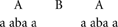
Of course this procedure is utterly conventional for a da capo aria. But in the present context, given the serene, almost timeless quality of the A section and the more troubled tonal mutability of the alternating central portions, the music's design seems to give the impression of continually attempting to enclose time within the overriding framework of a deeper, ontologically primary eternity. As in classical ontology, two points of stable Being are necessarily posited as boundary conditions for any Becoming in between, just as, at a more expressly theological level, in our world, time and life are enclosed within God's eternity.
But, of course, in Piacere's aria this is not the true eternity of God. A ‘quasi-timelessness’ is no real eternity. Music cannot actually be timeless. More deeply, there is a sense that even though Handel's music tries, as does Piacere, to argue for the persistence of beauty, it inescapably passes.Footnote 47 Even the aria's slow hundred bars, easily drawn out to well over six minutes, are time. Although the formal design of the aria lends itself to suggesting that the serenity of the opening music will forever recur, Piacere is being deceitful in that within our own life span, our beautiful opening will not return. Time runs on, fleet of foot; we are not da capo arias. ‘For what is human life but one uncertain day!’, exclaims Petrarch in his Triumph of Time:
In the neoplatonic world-vision of Petrarch and Pamphili, time might be ‘a moving image of eternity’, but a moving image is still temporal, and only an image.Footnote 49 As Parker notes, the mirror plays a crucial symbolic role in both Pamphili's drama and Petrarch's original Trionfo.Footnote 50 At the start of the oratorio, a mirror allows Bellezza an image of herself, as if this would persist taken outside time, like the music's attempt at transcending time. But following Piacere's vain and ultimately self-refuting appeal in ‘Lascia la spina’, Bellezza throws it away; reflections are but a poor shadow. Ultimately time is a mere reflection of eternity. We are not God, and are guilty of hubris and bound to failure if we attempt to turn the passing moment into eternity, as Piacere endeavours to do.
But what of the other mirror, the mirror of truth? In Pamphili's libretto, it is the image in the mirror that Disinganno offers which proves decisive for Bellezza's conversion, just as for Petrarch:
To glimpse the correct attitude to time, we need look to the final number, Bellezza's ‘Tu del ciel ministro eletto’:
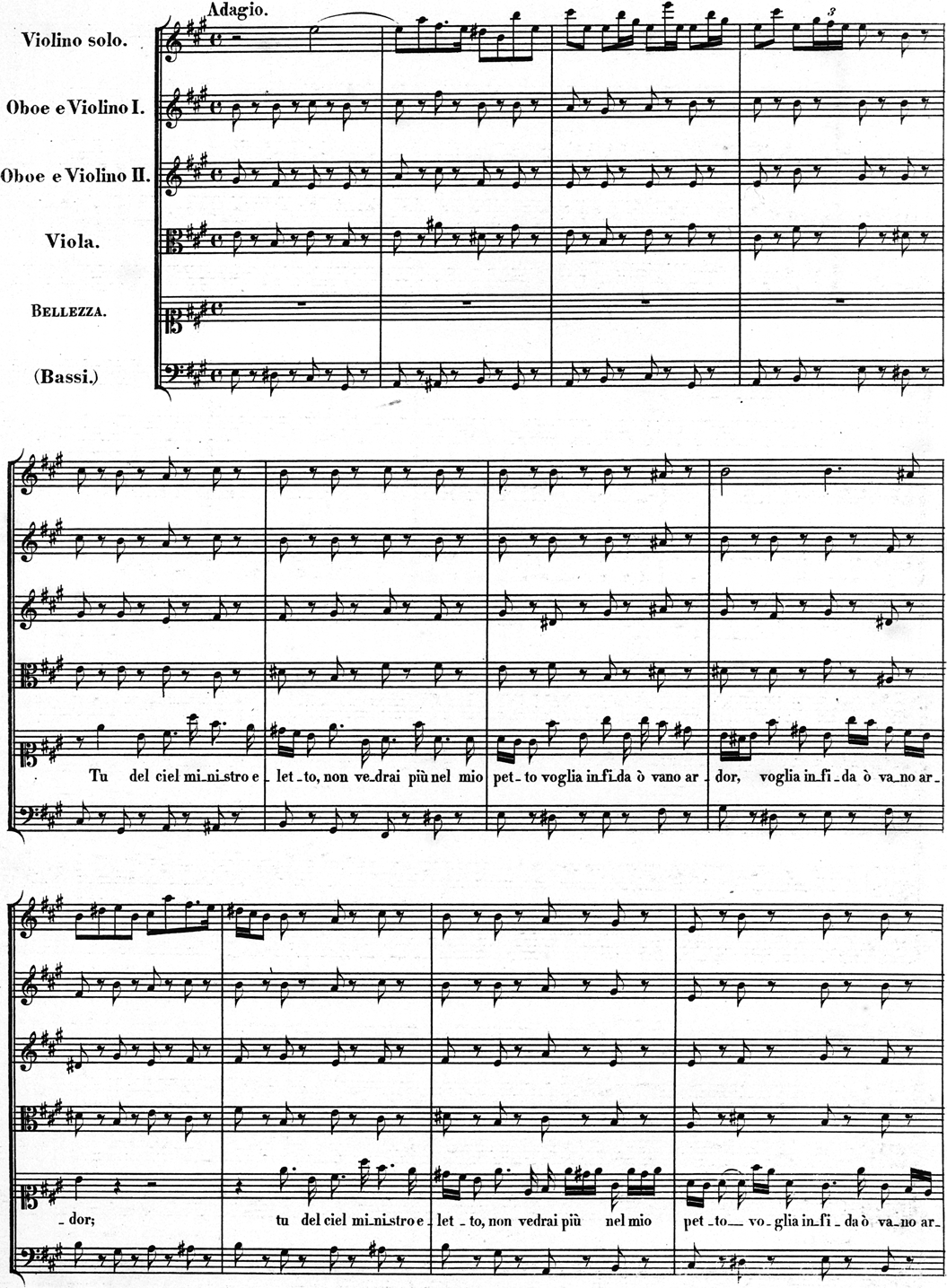
As this is a slow da capo aria just like Piacere's ‘Lascia la spina’, it might seem distinctly unrewarding to attempt to differentiate the two in terms of their expression of musical temporality. But what is most noteworthy about this number is its remarkably subdued quality. For the very end of his first oratorio, Handel lets a solo voice trail off pianissimo: no triumphant paean to virtue is forthcoming here. Though this unassuming close to the first version has bewildered earlier commentators, Parker, surely correctly, reads the intimate E major and understated expression of the 1707 version in terms of the ultimate triumphing of eternity over time that occurs outside the bounds of Petrarch's penultimate Trionfo.Footnote 52
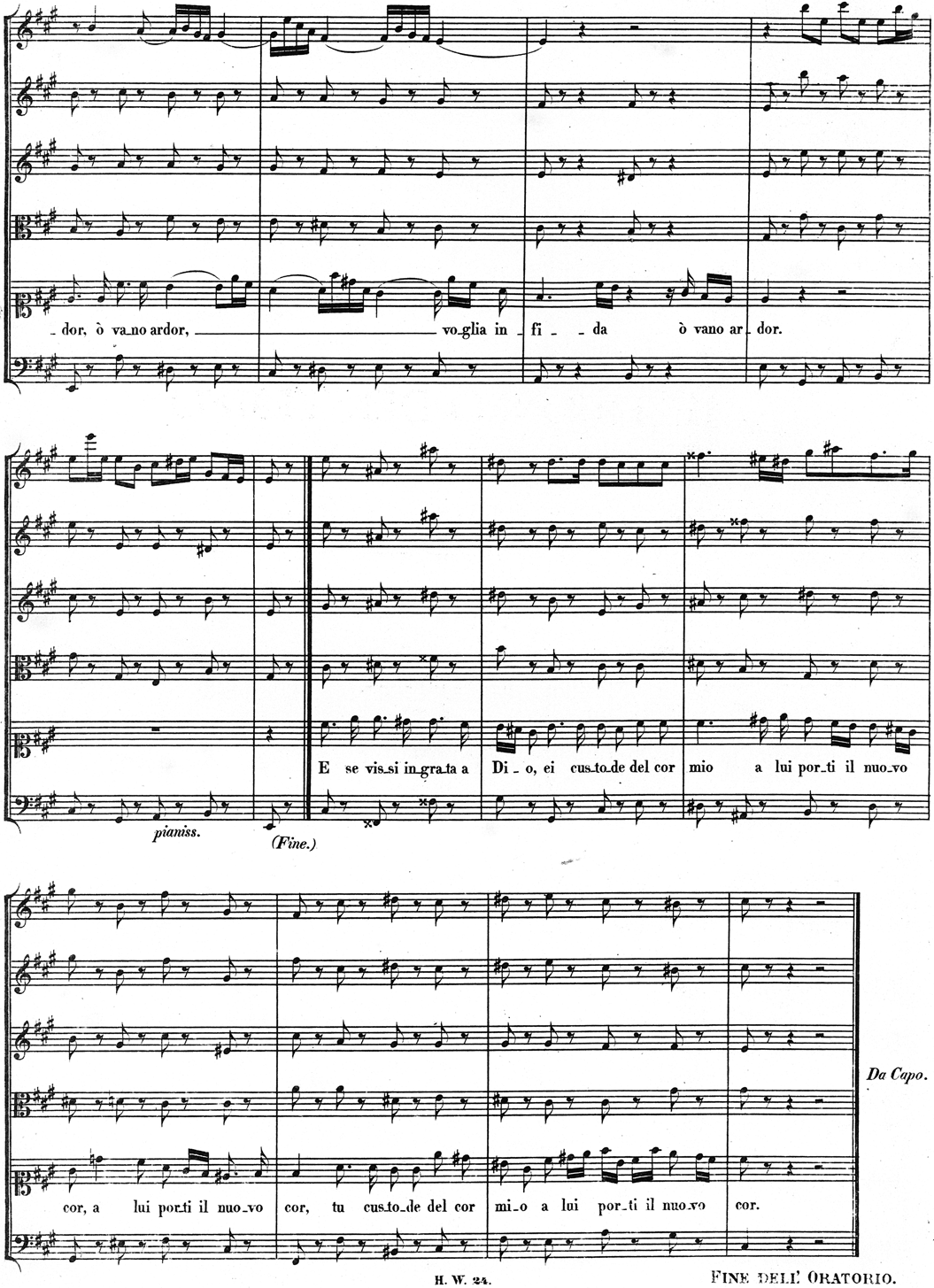
Most evidently different in this aria is its very time-bound nature, articulated through the steady common-time pulse provided by the accompanying strings every crotchet beat (see Figure 2), an almost incessant ticking, like a clock counting down the seconds. The connection with time as measured either by the clock or the natural rhythm of the heart is as overt as could be desired. Only at one point does this figure falter in its step (bar 15), the antepenultimate bar, as Bellezza comes to her final cadence, hinting perhaps at the ultimate passing away of this temporality for her. Though poised and touching in its own right, there is nothing here of the expressivity or the same aching beauty of Piacere's earlier proposal, nor its pseudo-eternity. Nowhere does the music assume the appearance of eternity, to hide the inescapable fact of our temporally bound existence and the passing of time. In fact, it brings this condition before the listener in the most explicit manner possible. Bellezza has learned her lesson. She is content to bide her time now, living in this human world of temporality until God chooses to take her unto Himself and she experiences the true eternity of paradise. The solo violin obbligato that accompanies the vocal line throughout seems to function as a symbol for the soul that is soon to break free and soar aloft in eternity.Footnote 53
George Frederic Handel, ‘Tu del ciel ministro eletto’, Il trionfo del Tempo e del Disinganno, hwv46a (1707), Part 2
We have examined Handel's musical allegory of time at a particular point in his career, in 1707, as he first came to write his oratorio. The conceptions of musical time articulated here could certainly be considered fitting for a composer of religious music in the early years of the eighteenth century. Yet, moving forward in history, everything changes in the revisions he made to this work, a point that affects in particular the two numbers discussed above. For the setting of ‘Lascia la spina’ in the two subsequent versions from 1737 and 1757 the familiar melody is missing. Instead, Handel uses a dance from the 1734 Terpsichore set to the same words.Footnote 54 Appropriately, one might think, the beauty of the first version has disappeared. Carpe diem: no rose but fades; this one brief moment has turned to time and earthly afternoon. The idea is certainly apt, although a more mundane explanation suffices: the melody was taken out because it had subsequently achieved fame with a slightly different text, as ‘Lascia ch'io pianga’ from the 1711 Rinaldo.
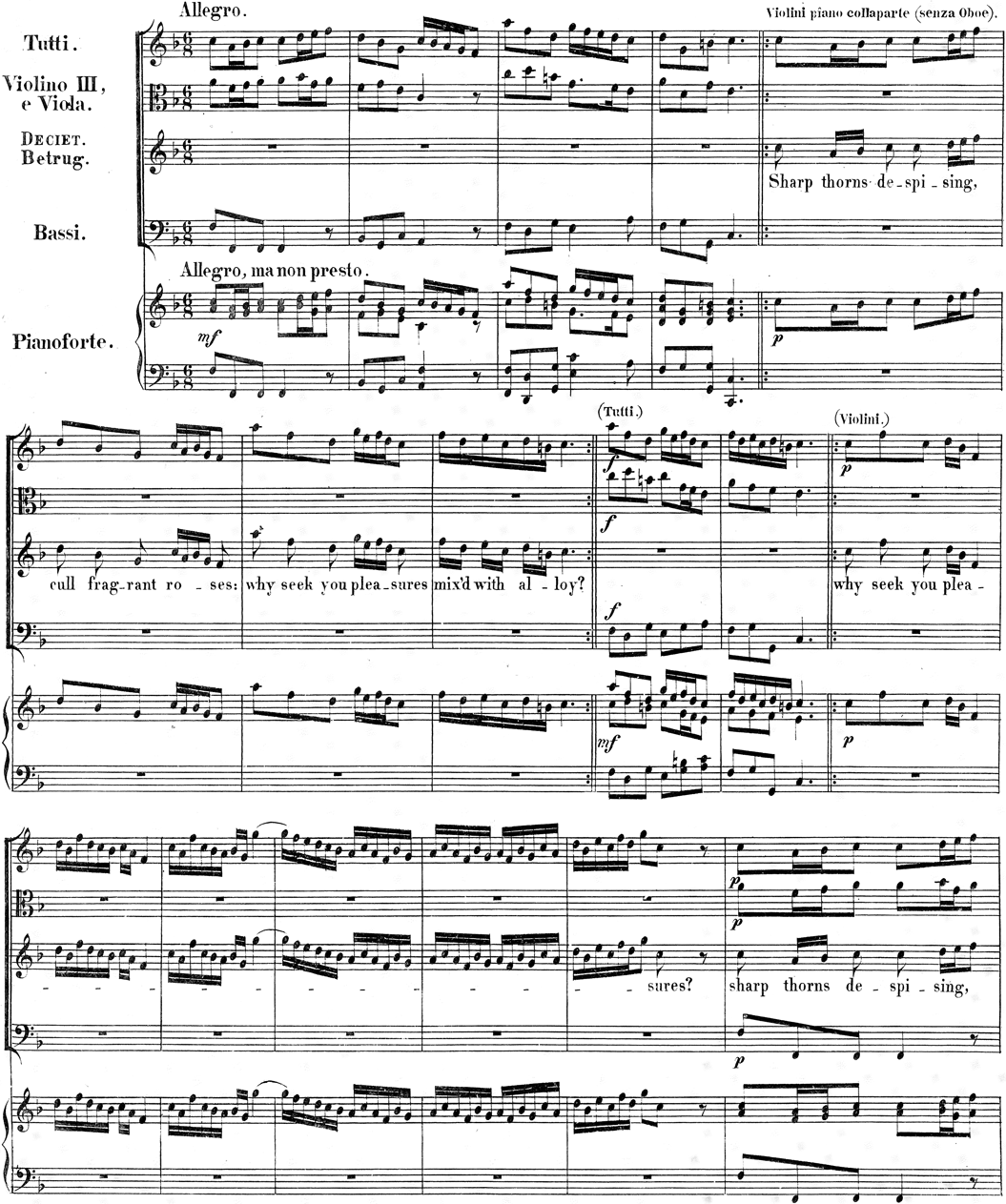
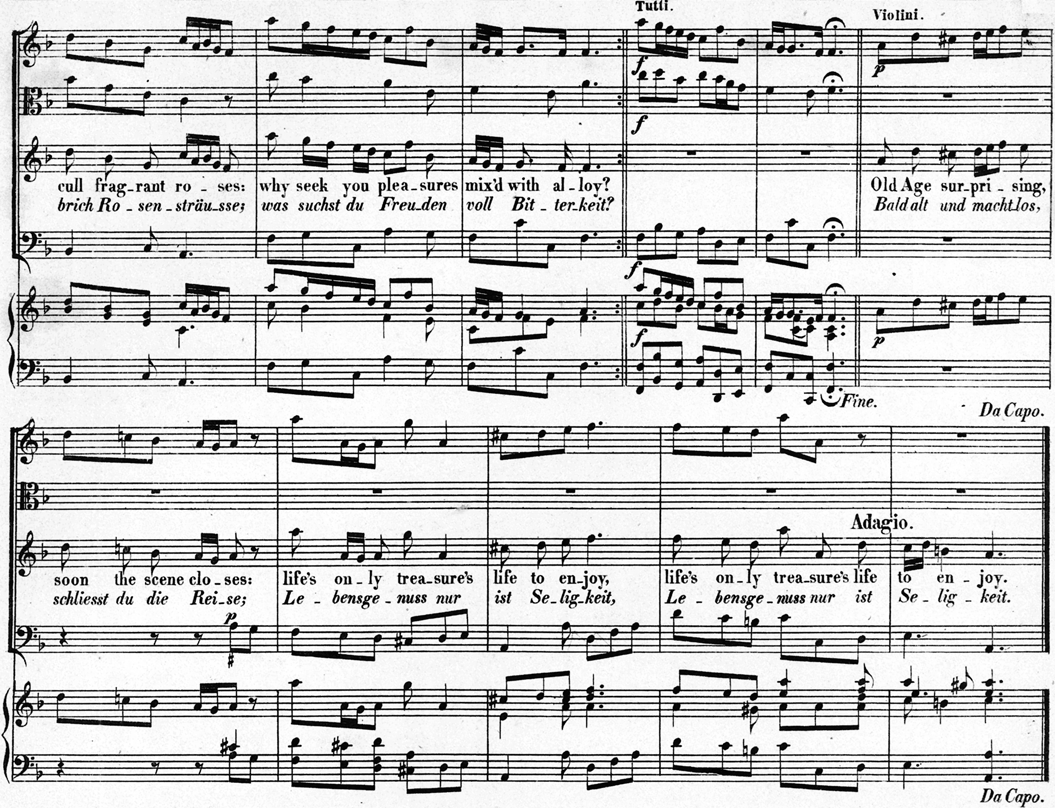
Still, the lilting 68 dance tune that replaces the noble 1707 melody is quite incongruously different (Figure 3). The aria (‘Sharp thorns despising’, in Thomas Morell's 1757 free translation of the original Italian text) now becomes a brisk jog-trot, an allegro lasting barely two minutes.Footnote 55 There seems no attempt at recapturing anything approaching the aesthetic quality of the earlier setting, nothing of the moving beauty allied to irony found in 1707. Should deceitful pleasure not be given the best tune? Perhaps, in the mercantile London of 1737, time is money. Eternity – even its false illusion – is no longer a relevant category, either for Handel or his assumed audience.Footnote 56
George Frederic Handel, ‘Sharp thorns despising’, The Triumph of Time and Truth, hwv71 (1757), Act 3. Georg Friedrich Händels Werke: Ausgabe der Deutschen Händelgesellschaft, ed. Friedrich W. Chrysander and Max Seiffert, volume 20 (Leipzig: Deutsche Händelgesellschaft, 1865)
Whereas the first setting of the oratorio's finale emphasized the contingent nature of human time compared to the deeper reality provided by God's eternity, a modified version of this aria (now in F major and with oboe obbligato) is now succeeded by a double-fugal chorus suited to London audiences of 1757, suggesting a more emphatically worldly triumph. Parker sees the new exultant close as placing greater worth on the sun as bringer of truth – Enlightenment reason – rather than as a symbol of God's time. (The original title – Il trionfo del Tempo e del Disinganno – may also be translated along the lines of The Triumph of Time and Enlightenment.) Certainly the combined choral forces of the closing bars have nothing of the intimacy of the original E major aria. From Catholic Rome to Enlightenment England, the revisions appear to chart a progression across the first half of the eighteenth century from a restrained idea of time as subservient to God's true eternity to time as the triumphant bringer of reason and progress. Reversing Petrarch's order, the triumph of eternity becomes the triumph of time. The familiar narrative of the eighteenth-century ‘temporalization of Being’ is seemingly borne out.
…e del Disinganno: Methodological Concerns in Understanding Musical Time
It seems as a consequence of the account presented above that Handel's use of particular music in particular contexts may be construed as pointing to a self-aware composer deliberately constructing an interpretation of time through the capacities of his musical language. If this proposed reading is accepted, it would suggest that the music of the High Baroque was at least able to articulate both a sense of quasi-timelessness and one of worldly time passing, and that such choices could furthermore have been consciously made by the composer. It does not fundamentally alter our perception of early eighteenth-century temporality, whether in music or at a wider cultural level, but does reinforce the idea that the temporal medium of music, even before it became as temporalized as it later would be, could have expressed the human understanding of temporality at its own particular point in history. An analysis of Handel's work seems to bear out Leon Botstein's assertion that ‘music … becomes an oblique route to finding out how cultures dealt with entropy as reflected in the passage of time; for humans, that is nothing less than the presence and inevitability of death’.Footnote 57
But this should not blind us to the evident difficulties that remain in attempting to formulate a properly historical understanding of this period's concept of time. Such is Handel's propensity for reusing material (both versions of ‘Lascia la spina’ derive from earlier instrumental dances) that it is difficult to make any decisive comment on text setting and choice of musical characterization. Three examples drawn from other numbers in the oratorio's 1757 version highlight this concern. ‘Time is supreme – Time is a mighty power’ sings the four-part choir in the work's opening chorus, the second phrase being temporally distended from the first's four crotchet beats to six (plus anacrusis), as if phenomenologically emphasizing the expressive command of time within the very musical setting. Yet in the Italian text for the 1737 version the same passage occurs to quite different words – ‘Solo al godere aspira il nostro cor’ (Only to delight aspires our heart), which undercuts the suggestion of this technique forming a deliberate illustration of temporal power on the part of Handel. In a similar fashion, the rhythmically elongated continuation of Beauty's Act 1 ‘Ever-flowing tides of pleasure’ – ‘Shall transport me beyond all measure’, which overrides the constant quaver pulse with a slower dotted-crotchet-plus-quaver movement, finds its provenance in a less notable phrase (‘Una schiera di piaceri / Posi in guardia ai miei pensieri’ – ‘A multitude of pleasures / Placed to guard my thoughts’) that has nothing to do with transcending the previous musical measure of time. A final example is provided by the opening chorus of Act 2, ‘Pleasure submits to pain, / As day gives way to night, / And sorrow smiles again, / As Time sets all things right. / Thus are the seasons chang'd, / And all in turn appear, / In various order rang'd, / Throughout the whole revolving year’, where the sequential writing shared imitatively between voices corresponds very aptly to the circular course of time described. However, the original Italian text for this music, ‘Viver, e non amar / Amar, e non languir, / Languir, e non penar, / Possibile non è’ (‘To live, and not to love / To love, and not to languish, / To languish, and not to suffer, / Is not possible’, drawn from the revised Acis and Galatea, hwv49b), has no such connotations. Are we reading too much into compositional decisions which may have had more basic, utilitarian causes? It is also hard to support any claim that the subject of time, explicitly thematized by the piece, is musically distinguished in this particular setting from Handel's general language (although this hardly invalidates the point that musical style in general is inextricably bound up with a culture's understanding of time).
Despite the apparent downplaying of eternity in the later English version, is Handel's musical language any more temporalized in 1757 than fifty years earlier (as the narrative of temporalization would suggest)? In some ways this is an invalid question, as none of the music, including the additions to the 1737 score, was actually newly written for 1757, but it would seem questionable without a great deal more evidence to this effect, that Handel's music changed significantly in this aspect across his life. At best, in the text of 1707 (and more complexly mirrored in Handel's music) there is a distinction between normal, passing time and God's eternity. In later versions, however, the religious content gets dropped in favour of a straightforward narrative of time; musically the sense of temporality is no more marked.
There is a sense that – simplifying greatly – there were two basic types of musical time and movement available to the baroque composer: the forward-running type and the slow, reflective type, or one which is simply temporal and one which more readily suggests timelessness (or at least the freedom from temporal measure).Footnote 58 Recitatives, faster-moving arias and the quick continuations of French overtures are in the former category, many slower, more contemplative arias in the later. This reading might be complicated, in a dramatic context, by the customary distinctions between music in which the represented time and time of representation are matched (most evidently in recitative) and that in which they are dissociated (invariably da capo arias, but including most ensembles too) – between what could be termed ‘dramatic’ and ‘lyric’ times. There is not, however, a strongly developed sense that a given number may qualitatively alter its temporal frame of reference within its course, as can happen later in the century. The rule of unity of affect and unity of temporal type holds. What perhaps is the strongest distinction between the temporality of earlier and later eighteenth-century music is simply that the succession of different temporal modes becomes greatly complicated, later music having the capacity to be far more abrupt and discontinuous within a single piece.
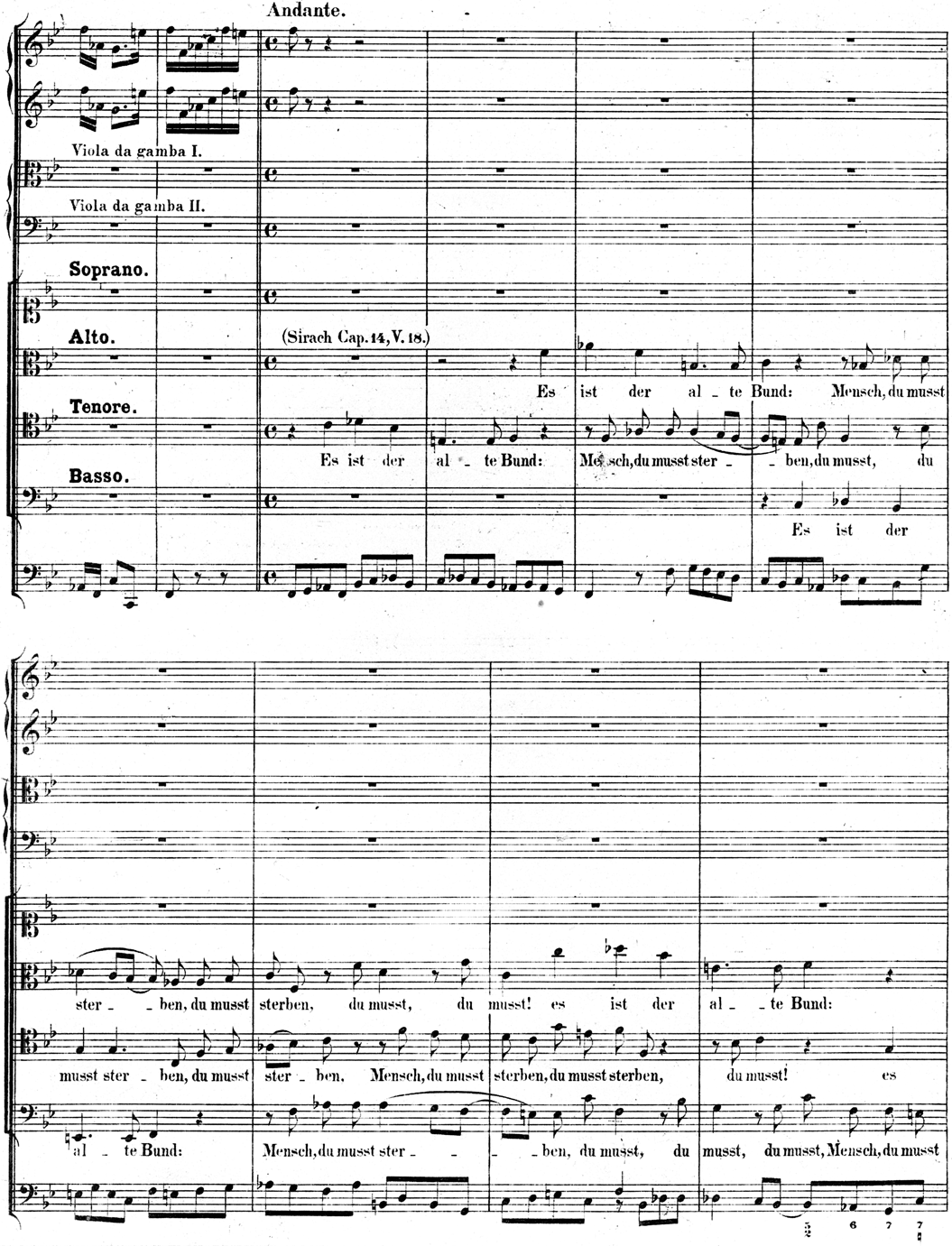
There is a further difficulty that can be encountered in trying to match specific musical features to a defined temporal quality. A classic example is the fugue. We may take for illustration here a contemporaneous baroque work that thematizes the same distinction between worldly time and God's eternity, J. S. Bach's early cantata ‘Gottes Zeit ist die allerbeste Zeit’, bwv106. Towards the end of its opening number Bach sets the words ‘Es ist der alte Bund: Mensch, du musst sterben’ as a three-voice fugue in the choir, the pathos of the F minor tonality emphasized by the expressive falling tritones B♭–E♮ and F–B♮ in the fugal subject and answer, and underpinned by a relentless walking bass (Figure 4). Bach's conception fuses a small-scale sense of linear movement with the larger cyclicism provided by the successive entries of the fugue, resulting in what might seem a decidedly fatalistic conception of time. The allegory of the laws enacted by the preordained fugal entries with the merciless decree of nature and irrevocable passing of time is irresistible: as was witnessed in Handel's use of the da capo aria in ‘Lascia la spina’, generic norms can fit the temporal implications of the text as if they had been designed for just that function. Yet the term fugue originates in the Latin fuga – flight – and has historically been interpreted both as a symbol of the stasis of cyclical time and as a dynamic form of linear telesis.Footnote 59 As noted above, Handel's 1757 Triumph of Time and Truth ends with a fugue, one which is hardly lacking dynamism or drive.
Johann Sebastian Bach, Gottes Zeit ist die allerbeste Zeit (Actus tragicus), bwv106, opening chorus, ‘Gottes Zeit ist die allerbeste Zeit’. Johann Sebastian Bach, Kirchencantaten, volume 11, Bach-Gesellschaft Ausgabe, volume 23, ed. Wilhelm Rust (Leipzig: Breitkopf & Härtel, 1876)
What is the epistemological basis for the connection between a culture's and music's temporality? Berger, for instance, is distinctly coy on the precise causal reasons for the correlation between the development of a linear time sense in culture and music in the eighteenth century, noting merely the ‘structural homology’ between cultural and musical temporalities.Footnote 60 Marshall Brown, on the other hand, appeals to Foucault's notion of episteme to explain a late eighteenth-century Zeitgeist that supported paradigm shifts in temporal consciousness in both philosophy and music.Footnote 61 Though, as we have seen, it is commonly claimed that music offers the modern historian unique insight into the temporal constitution of a past culture, the scholarly procedure often appears to be the reverse: a grand narrative of the changing cultural perception of time is mapped onto musical examples chosen to support the sweep of the historical account. (This charge could well be levelled at the examples from Handel's oratorio used here, where two – albeit significant – numbers are taken to support a preconceived historical narrative; I willingly admit that many of the other arias simply do not appear to be pertinent within this temporal context.)
To give one concrete example of how this procedure might affect accounts of musical temporality, we might look at the third of the great triumvirate of composers born in 1685, Domenico Scarlatti. As noted earlier, the temporality of Scarlatti's music has been interpreted by Dean Sutcliffe as breaking from the continuity and predictability of the High Baroque and conveying a startling modernity in its problematization of time as a medium. Taking the discussion a few generations further back, Susan McClary has similarly argued that while seventeenth-century French culture aspired to a state of timelessness and stability, Italian instrumental music from this period conveys ‘a sense of time in which energies plunge recklessly forward in pursuit of future goals’:
Impatience with the moment, the sacrifice of everything to the lust for progress, the adulation of untrammelled individual will, and (not coincidentally) the distribution and mediation of culture through commercial networks rather than royal control: these characteristics of modern life already find themselves palpably enacted in Italian music of this period.Footnote 62
Both of these interpretations run contrary to a widely accepted reading of the development of a modern temporal sense that sees the forefront of cultural change occurring in Protestant northwest Europe. In a classic account of the development of the modern understanding of time, the historian R. J. Quinones has commented that ‘countries that did not move into the modern world, like Italy or Spain, either lost or never developed [this new] sense of time’.Footnote 63 Clearly, if we are to credit music with any independent agency and not ignore the sonic evidence it presents us with, then we must be ready to allow such findings to add a layer of greater complexity to the customary historical narratives. If we want to take claims for music's irreducible historicity seriously, we should be able to read the cultural construction of time from music, not merely into it. The example provided by a Neapolitan composer living in imperial Spain suggests a possible geographical oversimplification in claims that an accelerated time sense is a northern European, and predominantly Protestant, phenomenon.
Finally, spilling out of this last point and returning to the question posed in the opening section of this article, we reach perhaps the most problematic issue in this entire endeavour. How receptive can we actually be to hearing historical temporality in earlier music? Is it really possible to listen with eighteenth-century ears and temporal assumptions? There is a sense in which the temporal ideology of the later Enlightenment onwards is still ours (notwithstanding well-worn postmodern pronouncements on the end of history), which makes it difficult to relate to what we presume is a different mindset and set of temporal expectations. Especially if it is true that time is more an issue for us now than it was to the early eighteenth century, there is surely a danger that if we hear distinct temporal qualities in older music we are simply projecting our own concerns onto it. Yet, equally, we might be prone to undervaluing earlier music's own temporal qualities. Given the reading of increasing temporalization of experience in the last three hundred years, it could simply be that the linear elements present in earlier music have become less prominent for listeners accustomed to more extreme manifestations of teleological dynamism present, for example, in middle-period Beethoven. Our sensibilities, accustomed to sharper tastes, may lack the aural sensitivity and analytical tools to perceive subtle distinctions in musical temporality in an earlier style.
In light of these problems, it would be reassuring to find documentary sources suggesting that an eighteenth-century listener would concur with some aspects of the above reading of Handel's oratorio. But this seems unlikely for a number of reasons. Most fundamentally, no real contemporary reception for any of the three versions of the oratorio has come down to us. Each was given a handful of times in the couple of years following its first performance (the latter two being immediately repeated three or four times within the first month, suggesting a passing popularity); thereafter all fell from the performing repertoire, unlike some of Handel's other, more famous works.Footnote 64 In fact, we don't even know the date of the first performance of the first Roman version. In this context it is hardly surprising that there appears not to be any contemporary criticism of these works (music criticism being anyway a concept that did not have the same meaning in the eighteenth century as now).
Furthermore, I would surmise that it is highly unlikely anyone in the eighteenth century knowingly heard Handel's music in the temporal terms presented in this article. Obviously part of the larger historiographical premise of the temporalization of experience in the later eighteenth century is that time was not so consciously acknowledged as an issue by subjects before that point, but also at a more concrete level, it is unlikely that the aesthetic conceptions that might enable music to be understood in these terms were even available to early eighteenth-century audiences. Though both the neoclassical aesthetics of mimesis and aspects of the earlier renaissance humanist aesthetic of the Boethian musica mundana were certainly present, music was widely understood at this time as a language of the emotions, a means of conveying affect.Footnote 65 Under such categories, it becomes clear why earlier eighteenth-century listeners and critics would have been unlikely to conceive a work as being ‘about’ such an abstract conception as time. Il Trionfo is a religious allegory about a penitent Mary Magdalene, basing its appeal on music's capacity to move the emotions. As Ruth Smith puts it, The Triumph of Time is a document of ‘eighteenth-century moral psychology, defining and discriminating between differing states of mind and emotion and forms of behaviour in order to assist listeners to the propitious ordering of their own lives’.Footnote 66 In other words, the work is not about time per se but concerns the road to salvation; the music is meant to bring moral truths home to listeners by moving the passions and thus appealing directly to the higher part of the soul.Footnote 67
The point was made earlier that it is probably only when instrumental music becomes more fully emancipated from language later in the century, when the notion of musical form in the strong sense becomes significant, that music can be seen as a means for structuring time, a Zeitkunst. This is not to say that earlier music does not structure time or equally does not reflect a culture's understanding of time, but simply that this is less likely to have been a viewpoint consciously known or articulated by that culture. Likewise, it does not gainsay the idea that while subjects in the early eighteenth century might not have perceived these qualities (since they were supposedly less conscious of time), we may nevertheless hear these properties in the music now, given our greater temporal sensibilities. But it nevertheless suggests the epistemological fragility of the enterprise: we cannot make any appeal to historical verification, and thus the hermeneutic attempt may easily be abused.
And most fundamentally here, if music is more than merely a mirror on past historical perceptions, a tool for deepening our understanding of history as much as history might be a key to ‘decoding’ music, can this knowledge be gained purely from our experience of the music without bringing in wider historiographical assumptions? On consideration I would have to say no. Music becomes music, and not mere sound, by being understood through particular preconceived modes of apprehension or conceptual schemata: in other words, in some cultural context. It seems to be impossible to understand music without any mediation. If one takes seriously claims that music has the capacity to express a sense of temporality, then such attempts are always liable to become ahistorical – or, rather, presentist – in their interpretation of music, offering our own modes of comprehending musical sounds as if they were historically invariant. If not, whether out of a misplaced sense of verbal sources being somehow more epistemologically and historically transparent than musical ones or the fear of dealing with notes rather than words, then such accounts easily miss music altogether, becoming a discourse on an epiphenomenon.Footnote 68 Such an approach denies music any real agency, reducing it to an adjunct of language (an unsustainable position). Moreover, while the historical mediation of music may prove fraught, the ability of language and thus more conventional historical sources to mediate an understanding of time is no less problematic. As it is strongly arguable that our understanding of time via music is qualitatively different from that conveyed by verbal formulations, music thus provides insight into the experience of time (and how this has been constructed through a specific historical and cultural understanding) which is simply irreducible to linguistic formulation.Footnote 69 As McClary recognizes,
we build on quicksand when we speculate about such matters – such are the dangers of studying history and trying to put music of the past into sound. Yet music offers us, for all its indeterminacy at the level of detail, access to dimensions of human experience not available even to this (admittedly shaky) degree [in] any other cultural medium.Footnote 70
The reason why it is still worth engaging with music in this analytical-hermeneutic manner lies, I think, in what it does for us, whether or not it deepens our aesthetic appreciation of the music, whether a given interpretation seems meaningful now. An engagement with eighteenth-century music may be no less meaningful for the present-day listener even if the historical veracity of any such claims remains unproven and quite possibly unprovable. Moreover, such interpretations are not simply arbitrary: the plausibility of any reading lies to a considerable degree in the music's compatibility with the interpretation proposed.Footnote 71 Thus there may be no definitive answer to these numerous concerns, beyond familiar debates in hermeneutics concerning the inescapable historicity of our standpoint and the necessary fusing of horizons in an effort to apprehend the past. What we might take from such inconclusive ruminations, however, is the reciprocal importance of cultural history and music, not least a self-awareness of our own horizon of expectations in the attempt at understanding musical temporality.