Manchukuo existed for less than thirteen years, a colonial moment bookended by violent passages of creation and destruction.Footnote 1 In between, the Japanese who ran the state strove to create and disseminate a discourse of national authenticity, which they hoped would win the hearts and minds of the local population, overcoming their view of the state as an illegitimate contrivance and foreign occupation (Duara Reference Duara2003). They also gave officials room to experiment with a variety of policies designed to demonstrate authenticity (Isoda Reference Kazuo1999; Tucker Reference Tucker and Tamanoi2005). In this article, I discuss how the congruence of this attempt at authenticity, space for experimentation, and the progressive background of leading Japanese educators in the region brought about an education system unlike any other previously seen in the Japanese empire. I will trace the development of a school of thought among Japanese colonial language educators, whom I call “reform optimists,” who held that whole language education could solve the contradiction between the Manchukuo founding ideal of ethnic equality and the reality of Japanese domination, and who disdained the use of strong pro-Japanese and nationalistic messages in the schools.
Immediately after the region was occupied in September 1931, Japanese officials on the scene spoke of creating a new “Manchurian” national consciousness among the Han Chinese. The kind of national consciousness Japanese officials envisioned, and the methods they used to create that consciousness, changed several times over the course of the thirteen-year occupation. In the period from 1932 until 1937, state publications used a rhetoric that emphasized familiar Chinese tropes. Public school textbooks portrayed the new country as an inheritor of both the Confucian values of imperial China and the hardy martial tradition of the non-Han peoples of the north. The textbooks were filled with stories from premodern Chinese history, moral precepts taken from the Confucian classics, and references to the region's supposed long-standing friendly relationship with Japan, ignoring most of the events that had occurred in China since the 1911 Chinese Revolution. Although Japan was portrayed as a friendly neighbor, it was not a focal point in the curriculum, and the Japanese language was taught only in higher grades, for a few hours a week (Hall Reference Hall2003, 260–64).
By 1938, however, the Japanese leadership had decided the emphasis on Chinese culture and simple friendship with Japan had failed. Although some locals cooperated with the regime, few passionately supported the Manchukuo state or viewed it as a legitimate institution. The leadership decided to switch to a system in which students were expected to accept aspects of the Japanese imperial ideology and feel a kinship with Japan. This change in direction was part of an empire-wide shift from a “gradualist” colonial policy to an “optimistic” view of the power of the Japanese language to instill loyalty in the hearts of non-Japanese Asians. In reference to the experience in Korea and Taiwan, it is usually known as the kōminka campaign.Footnote 2
Within the optimistic camp of language imperialists, however, were two widely divergent groups. One group, which I call “nativist optimists,” dominated education in the Japanese colonies of Taiwan and Korea after 1937. Another group, “reform optimists,” dominated education in Manchukuo during this same time. The terms “gradualist,” “nativist optimist,” and “reform optimist” are my own, not terms used by Japanese during the colonial period. I contend, however, that they are useful in understanding the contending philosophies on the question of whether non-Japanese Asians could be assimilated, that is, made to think of themselves as Japanese. Gradualists tended to be pessimistic about the power of the Japanese language to assimilate non-Japanese and win their loyalty, while the nativist and reform optimists were optimistic about the power of the language. In the next section, I will discuss the positions of each group.
Gradualism
Gradualists such as Gotō Shimpei, Tōgō Minoru, Mochiji Rokusaburō, and Kumamoto Shigekichi made up the majority of colonial policy makers in Taiwan and Korea in the first two decades of the twentieth century. Their concept of Japan as superior to its neighbors was based on ideas of racial superiority, influenced by nineteenth-century Western concepts of scientific racism. They held that native culture and traditions were so deeply engrained that state-sponsored efforts at cultural assimilation, including Japanese language education, could not eliminate native identity. The most colonial policy could do was achieve a compliant, intimidated population. They strictly enforced racial segregation through the family registry system, denied the colonized peoples an equal legal footing, and did not expect any change in the system in the near future (Komagome Reference Takeshi1996, 46–51, 87–89; Tai Reference Tai1999, 513).
Gradualists, for the most part, called for a long-term approach to education. While pressuring native-run private schools to conform to pro-Japanese regulations, they opened a limited number of public schools for the upper classes. From 1911 to 1937, Japanese language was taught ten to twelve hours a week in Korean elementary schools, which made up approximately a third of the total class time. In those same years, Korean language classes were taught for three to six hours a week. Other courses were taught in a mixture of Japanese and Korean, depending on the abilities of the teachers and students (Oguma Reference Eiji1998, 74). The system was essentially the same in Taiwan.
Language Optimists and Sacred Language
Language optimists held that Japanese language instruction was the most effective tool for cultivating loyalty among a subjected people, and could overcome even the lack of blood ties. Many expressed their belief that the Japanese language was infused with a living spirit that could be experienced by anyone who became immersed in the language. They were convinced that if the colonized peoples could be made to speak Japanese and learn Japanese customs, their characters would naturally become more refined, and they would appreciate and become allies in Japan's mission to lead a unified East Asia. Those Japanese who supported increased enrollments and eventually even compulsory education in the colonies tended to be language optimists.
The language optimists' ideas about sacred language had their roots in eighteenth-century Japanese nativist thinking. From premodern times in Japan, there had existed a belief that certain words possessed spirits of their own, and when used in rituals and public events, these words could play a role in the relationship between humans and spirits, or kami. This innate power that existed in language was called kotodama, or “word spirit.” This idea was adapted by Edo-period nativist kokugaku (Japanese studies) scholars such as Motoori Norinaga. In their search for what was fundamentally Japanese about society, they saw language as a vital cultural artifact that could be traced to ancient times, even to the age of the gods. For them, Japanese words were nonarbitrary vessels connecting the people to a sacred past (Harootunian Reference Harootunian1988, 30; Nosco Reference Nosco1990, 219–20).
Kotodama theory was brought into the modern age by Ueda Kazutoshi (1867–1937), a Western-trained linguist who promoted the Japanese language as the basis of a modern form of nationalism. In 1894, Ueda returned from three years of study in Germany, sponsored by the Japanese Ministry of Education, and took a position at Tokyo Imperial University. Influenced by European nationalist language scholarship, as well as the Edo-period kokugaku scholars, he became convinced that educators needed to improve Japanese language instruction and encourage their students to be proud of their language. Ueda held that the Japanese language was the unifying force of the nation, the “spiritual blood of the Japanese people.” He insisted that the spirit of the language was the source of Japanese people's moral and intellectual strength, and therefore was what made them Japanese. These ideas were used by pro-assimilation colonial officials, the people whom I call optimists, to support their activist policies. Komagome Takeshi has pointed out Ueda's positions stood in contrast to the idea of blood ties as the basis of the Japanese nation, which was the more powerful idea among Japanese colonial officials (1996, 59–61).Footnote 3
The idea that a language could hold sacred power was not uniquely Japanese; it mirrored the beliefs of many other nationalists and protonationalists around the world before the rise of structuralist linguistics in the early twentieth century. Benedict Anderson has pointed out that Chinese, Latin, and Arabic have been venerated as sacred languages, which were “emanations of reality, not randomly fabricated representations of it” (Reference Anderson1991, 14). Although the idea of Latin being imbued with a sacred power declined during the Enlightenment, by the early nineteenth century, linguistic nationalism had become common in Europe. To many Europeans, their colonial success in the nineteenth century justified a confidence in universal Western superiority, including language. Richard Bailey has pointed out that many British began to see English as the “natural” language of the highest human ideals, intrinsically superior to non-Western languages. They claimed that English language instruction was among the greatest gifts they could provide non-Europeans (Bailey Reference Bailey1991, 106–7). Likewise, the architects of France's colonial policies in the late nineteenth and early twentieth centuries emphasized language instruction as a “civilizing” tool and a molder of minds. For example, Georges Hardy, the inspector general of education in French West Africa from 1912 to 1919, said of an African child learning French, “He cannot possibly forget the good ideas that were introduced to him via this language … these are our ideas, which constitute our moral, social and economic superiority, and little by little they will transform the barbarians of yesterday into disciples and assistants” (White Reference White1996, 14). Accordingly, from 1857 to the end of the colonial era, government-run schools in French sub-Saharan Africa banned the use of all languages besides French in the classrooms.
While the scope and depth of language education differed from colony to colony, a belief in the superiority of the metropole language and its civilizing, or at least ameliorating, power was built into the foundation of each colonial school system in the nineteenth and early twentieth centuries. Today, the idea that European languages are the only means to a wider intellectual life continues to reverberate throughout the third world. Many educators continue to insist that scientific and technological fields must be taught in English because vernaculars cannot develop terminologies precise and modern enough to convey the particulars of these fields. A corollary to the dissemination of English as the language of civilization is that vernaculars, along with vernacular knowledge, are denigrated and maintained in isolation from modern discourses (Collins, Burns, and Ching Reference Collins, Burns and Ching1994, 211).
Nativist Optimists and Reform Optimists
I divide the Japanese colonial language optimists into two groups: nativist optimists and reform optimists. Nativist optimists, led by the linguist Yamada Takao (1873–1958), were ideological allies of Hiraizumi Kiyoshi's conservative “imperial history” (kōkoku shikan) movement, which defended the historicity of the divine origins of the imperial family and the Japanese people. Native optimists saw the Japanese language as fulfilling a unique role, bound to and protecting the Japanese kokutai (national polity). This made comparisons with other language impossible, and reform of the written language sacrilege. Shida Engi, an ally of Yamada's, wrote in 1943,
The national language protects the kokutai and trains the people in righteousness. It was called [in ancient historical anthologies] waga kuni no kotoba (our country's language), never Nihongo (Japanese), which one uses when speaking of it in an international sense, equating it with other languages … The word kotoba (language) is not the same thing as the academic language thought of by scientific linguists. (Lee Reference Yeounsuk1996, 307)
Nativist optimists opposed allowing any residual native language education, in fear that mixing Japanese and native culture in the schools could lead to cultural miscegenation. They supported as complete a cultural assimilation of colonized peoples as possible, including encouraging the colonized to at least partly abandon their native cultural heritage. Therefore, they favored a curriculum that used intense language immersion and textbook content that emphasized the glorious nature of Japan's culture, military, and imperial family.
Reform optimists agreed with the nativists that language has an indefinable power that changes a person who learns it. Unlike the nativists, however, they did not see Japanese as unique in that respect—they thought that learning any language would naturally incline a learner to empathize and even feel allied with the speakers of that language. While they frequently expressed their pride in Japanese cultural achievements, they did not see the language as singular and therefore sacred. They also supported orthographic reform as a way to stimulate language reform in the empire, because they saw the complicated kana system then in use as a barrier to literacy for Japanese and non-Japanese alike.
Reform optimists came to dominate language education in Manchukuo. I find Manchukuo educators to be influenced in particular by two reformist educators from earlier in the century—Hobo Takashi and the “New Education movement,” and Yamaguchi Kiichirō and his “direct language method.”
Hobo Takashi and the New Education Movement
Hobo Takashi worked in the 1910s and 1920s as director of education for the Southern Manchuria Railroad (SMR), a quasi-governmental institution that served as Japan's primary organ of imperialism in Manchuria before 1932. Hobo set up schools for both Japanese children from the settler community and for Chinese children living in cities with Japanese commercial interests, and he organized textbook editing committees to provide the schools with unique materials. In 1925, Hobo created a teacher training school, the Manchuria Education Training School (Manshū Kyōiku Senmon Gakkō), which was designed to supply teachers to work in SMR schools, and he served as its first headmaster.
Hobo drew inspiration from what is sometimes called the “New Education movement,” a loosely connected group of Japanese educators who were influenced by Western theorists such as John Dewey, Maria Montessori, and Johann Heinrich Pestazolli. Among their goals were the increased use of student-centered and hands-on learning; an emphasis on practical learning over rote memorization; the use of physical objects, maps, and charts in teaching; internationalism over nationalism; decentralization over central control; an emphasis on teaching local conditions; and the encouragement of individual talents over group conformity (Lincicome Reference Lincicome1999, 339).
Hobo, a vocal critic of contemporary Japanese education, incorporated many key principles of the New Education movement in the SMR schools. For example, he encouraged his instructors at the Manchuria Education Training School to foster individual initiative and a connection with nature. He promoted his school as superior to the teacher training system in Japan, which he criticized for its promotion of conformity and failure to teach practical skills. In a 1927 address at the school, Hobo said, “In Japan's normal schools youths' natural feelings are suppressed and their individuality is denied … The morals curriculum is over-emphasized, causing the students to lose their ability to reason critically … The schools promote only blindness and obedience.” He instructed the teachers at his school, in contrast, to produce “bright students who can read original texts … and who are not conservative” (Ryōnankai Reference Ryōnankai1972, 37; Suzuki Reference Ken'ichi1989, 555–56).
From around the time of World War I, the New Education movement gained great support among Japanese educators, but in the 1930s, its influence waned in the face of a waxing nativist discourse. Because of the efforts of Hobo and his allies from the SMR, however, the principles of the movement remained vital among Japanese education officials in Manchuria throughout the colonial period, including the education-directing organs of the Manchukuo government.
A prominent example is the first director of the Manchukuo Education General Affairs and School Affairs divisions, Kamimura Tetsuya. Kamimura was an SMR veteran, and he enjoyed close ties with Hobo and the teachers at the Manchuria Education Training School, as well as with Owara Kunio, a leading figure in progressive education in Japan (Ryōnankai 1972, 196–97; Tsukinoki, Nomura, and Ōmori Reference Mizuo, Akira and Naoyuki1993, 170–75). Kamimura gave a speech at the Manchukuo National Teacher Training seminar in June 1932 that was published as a pamphlet by the Manchukuo Ministry of Education and distributed to Chinese teachers throughout the state. In the speech, Kamimura spoke against forcing opinions on students and instead teaching them to think for themselves:
We can describe a pen, tell about its shape, and observe that despite a shortcoming at the top, the ink still comes out well. We give this information to the student, and the student can make a judgment based upon that information. This is education, letting the student make his own choice rather than giving our own predetermined judgment. Propaganda is the opposite, telling them that there is only one pen, and that they don't have a choice. It tells them that there is only one pen that they need, with no other information about other options. This kind of education is truly an evil thing, but tragically it is the norm today, not just in the Chinese Republic, but also in Japan … My hope is that education can be separated from propaganda, and become true education. (Wenjiao-bu Reference Wenjiao-bu1932, 238)
Likewise, he criticized Japan for its “narrow nationalism,” which he claimed it shared with China and Western countries, and called for increased international understanding as a cure (Wenjiao-bu Reference Wenjiao-bu1932, 240). Kamimura clearly placed himself within the New Education camp.
Another New Education advocate was Terada Kijirō (1885–1974), whom Hobo recruited in 1924 to be assistant headmaster in the new Manchuria Education Training School. Terada became a leading figure among Japanese educators in Manchuria, and would later become the head of the Manchukuo government's textbook editing department. Terada was one of many former teachers and students from the Manchuria Education Training School who went to work for the Manchukuo education bureaucracy. They brought to the Manchukuo government a spirit of experimentation and an interest in the region's unique educational needs (Terada Reference Junzō1975).
Yamaguchi Kiichirō and the Direct Method
The second major inspiration for the reform optimists of Manchukuo was the Japanese language educator Yamaguchi Kiichirō. A schoolteacher in Japan since 1887, Yamaguchi went to Taiwan in 1896 to train Japanese language teachers. There, he discovered a book on foreign language immersion by the French educator François Gouin, and he eventually developed his own version of Gouin's method, which he called the “direct method.”
The central concept of the direct method was that a foreign language must be learned through authentic language activity, the same way a child learns his or her native language. Teachers were instructed to use no written characters in the first weeks of instruction, teaching instead listening comprehension and pronunciation, using pictures, physical objects, and “total physical response” activities (physically acting out sentences while speaking them). They could introduce Japanese kana and eventually kanji characters only after the students had mastered basic pronunciation. Students were banned from using their native language in class at all stages of learning. Teachers not only forbade students from asking questions in their native language, but also provided them with no written translations of classroom materials (Komagome Reference Takeshi1996, 331–39; Tai Reference Tai1999, 524).
In 1933, Yamaguchi said that his theory was based on the inherent meaning and spirit of words (kotodama), which could be understood only in the context of other concepts expressed in the same language. Defining a word out of context destroyed its essence, and, in fact, any attempt at defining a word acted as a barrier to learning. As Komagome Takeshi has pointed out, Yamaguchi saw the intellectual process of understanding the meaning of a word (denotation) as fundamentally opposed to feeling it emotionally (connotation) (Komagome Reference Takeshi1996, 333). Language could not be properly learned intellectually, but rather through complete immersion, and therefore he forbade the use of translations. Yamaguchi envisaged his method as the polar opposite of what he called the “translation method,” that is, learning a language by comparing a target language text with a translation in the learner's native language.
In 1942, Yamaguchi wrote,
One learns Japanese (or any foreign language) at school by learning the meaning of a thing, imagining it, considering it, feeling it, and willing it, all through the Japanese language. By doing these things students can feel the true word-sprit (kotodama) of Japanese, understand Japan's culture, and experience the spirit of Japan. (Komagome Reference Takeshi1996, 333–34; see also Yamaguchi Reference Kiichirō1942)
Note that he does not say Japanese language teachers must teach specifically about Japan. Rather, the process of learning the language itself transmits Japanese spirit. For Yamaguchi, it was the form of the language, not the content, that played the vital role. In fact, Yamaguchi opposed the nativist method of using ideological and pro-Japanese propaganda material in the elementary school classroom. He wanted teachers to use materials familiar to the students and universal in nature. These would pique the students' interest, he reasoned, while nationalistic Japanese material could drive them away.
While before 1918, the gradualist Taiwan and Korea colonial governments remained “pessimistic” about the immediate results of language education, they recognized the practical benefits of Yamaguchi's program. The Taiwan regime published two pamphlets on the direct method in 1900, and required all language teachers to attend training courses run by Yamaguchi, who became a school inspector. In November 1911, Yamaguchi transferred to a position at a middle school in Korea, which had become an official Japanese colony the year before. He succeeded in making the direct method widely accepted in that colony as well.
In 1914, the SMR invited Yamaguchi to Manchuria to teach a training course on his direct method. The course was attended by Japanese language teachers from throughout the region, and resulted in the direct method becoming the standard in Japanese-run schools in Manchuria (Takenaka Reference Ken'ichi2000, 263–67). From 1925 to 1938, Yamaguchi taught at Japanese-run schools in Manchuria, where he continued to influence Japanese teachers, some of whom went on to become leaders in the Manchukuo education establishment. In 1938, Yamaguchi moved to occupied Beijing to lead the teaching staff at a new Japanese-run school named Shinmin Gakuin.
The Triumph of Language Optimism
In the years from 1918 to 1922, as a result of the policies of Japanese prime minister Hara Kei, and in reaction to the March 1, 1919, rebellion in Korea, the colonial regimes in Korea and Taiwan began to move away from gradualism and toward optimistic cultural assimilation. They made concessions to local demands for more education opportunities by embarking on a massive school-building program, in the hope that the education provided in the schools would turn the students toward more positive feelings for Japan. Perhaps because of the influence of Yamaguchi, the textbooks from this period featured relatively few stories about Japan (particularly the Japanese state and its divine origins), while including many more stories about fictional and historical Chinese and Koreans (Yi Reference Yi1985).
In the 1930s, however, education throughout the empire shifted toward nativist optimism. The first sign of the change was a set of textbooks published by the Korean colonial government from 1930 to 1935, which included much more material on the Japanese state and its divine origins (Yi Reference Yi1985). The Japanese Ministry of Education, in turn, published its fourth textbook series for students in Japan from 1933 to 1938, which also featured a more assertive and exclusive nationalism than the previous series, including discussion of the power and unique nature of the Japanese language.Footnote 4 The Taiwan and Korea colonial governments launched campaigns aimed at eliminating native identity by removing all non-Japanese language education in the public schools, closing non-Japanese language newspapers, enforcing public worship at Shintō shrines, instituting compulsory name changes, and instituting mandatory military inductions. These policies are generally called the kōminka campaign, kōminka being a Japanese word for “changing the people into imperial subjects.” In April 1937, the Taiwan government removed classical Chinese from the elementary and middle school curriculums and forbade any use of the Chinese language in newspapers. The following year, the Korea regime not only removed Korean language class time from most schools, it also banned students from using Korean at school in any context, and even tried to discourage them from speaking the language outside school. Both governments tried to promote the use of Japanese among general society (Chou Reference Chou, Duus, Myers and Peattie1996, 49).Footnote 5
Concurrent with the shift in colonial regimes toward policies of cultural assimilation and language optimism, the Japanese government in Tokyo began participating in language dissemination policy, which it previously had left entirely to the colonial governments. An example of this kind of activist optimism can be found in a June 1939 speech by Minister of Education Araki Sadao, an Imperial Way general who ramped up militarism in Japan's schools. In the keynote address at a ministry policy conference dedicated to unifying Japanese colonial language education, Araki invoked Ueda Kazutoshi when he stated,
Our national language is the spiritual blood flowing through our people (kokumin), and firmly ties us together. If we can send our language, this spiritual blood, flowing through the peoples of East Asia while we embrace the great ideal of “eight corners under one roof” (hakkō ichiū), they will work with us to achieve a New East Asian Order and the foundation for world peace. That is why it is vitally important to craft policies that work toward this goal. (Monbushō Toshokyoku Reference Toshokyoku1939, 1)
In other words, Japan's “spiritual blood” could be “transfused” throughout East Asia. The optimist view of language, in particular the nativist variety, was by 1939 a central pillar in the ideology of Japan's formal colonies.
Reform Optimism in Manchukuo
Although nativist thought had come to dominate the governments of Taiwan and Korea by the late 1930s, reform optimists controlled education policy in Manchukuo from 1937 until late 1943.
Gradualism dominated Manchukuo cultural policies in the state's first years. As Manchukuo was a puppet state, and the majority of the population were not considered subjects of the Japanese emperor, the possibility of cultural assimilation must have seemed even more remote than in Taiwan and Korea. Leading Chinese officials such as Prime Minister Zheng Xiaoxu and influential Japanese such as journalist Tachibana Shiraki argued that the government and society should pattern itself chiefly on Chinese models. They may have feared that an attempt at assimilation would expose the state's puppet status. Fear of exposing the state as a dependent, however, ultimately proved a weak barrier to the empire-wide rise of assimilation optimism. By 1937, language optimism had swept through the ranks of Japanese officials and educators in Manchukuo, becoming the mainstream opinion.
An example of language optimism can be found in the writings of the Japanese educator Fukui Yū. Fukui had taught Japanese to Chinese students in SMR-run schools in Manchuria since 1918. In 1932, he became a Manchukuo Ministry of Education textbook editor, and he was placed in charge of editing the 1934–35 and 1938–39 series of elementary school Japanese language textbooks. In a 1939 article, he criticized those who defended Japanese language instruction on utilitarian grounds:
They encourage Japanese language study by claiming it will help students advance in the world and find business success. But this is not true, some students, despite years of diligent study, have not succeeded in business nor risen in position, and they now feel that they should have done something more practical in school. Utilitarian encouragement works even less for students living in distant mountain regions who will never meet a Japanese person face to face in their lives. The entire approach is wrong. The purpose of learning Japanese is not to have a good command of language, as in a foreign language course. Rather, Japanese language training in and of itself acts as a complete education. In other words, the students' feelings and lifestyle themselves will be reconstructed by the Japanese language. This is the real reason. Even if they never have the opportunity in their lives to use their Japanese language skills, it is worth it. They will become Manchukuo nationals, without interest in their original ethnicity. It is for this mental training that they must learn Japanese. (Fukui Reference Fukui1939, 3; emphasis added)
Fukui eschewed any pretence of the usefulness of Japanese in the people's daily lives. Instead, the language was a tool for “mental training,” intended to reshape the students' minds so they would become amenable to Japanese interests. His words echo those of the French inspector-general Georges Hardy, who claimed that the French language would introduce the African population to mental discipline.
While other Japanese educators in Manchukuo were less willing to discount the practical uses of Japanese, many agreed with Fukui that the Japanese language had the ability to “reconstruct” the personalities of the students in positive ways. Kazumizu Yoshiyama, a Japanese teacher at the prestigious Fengtian First Normal School, said in a speech to Chinese teachers in 1936,
All Manchukuoans have the duty to learn Japanese … Most people study Japanese in order to learn how to express themselves, but this should not be the main reason. In Japanese there is the expression kotodama. It means when you study a word, you do not just learn its outside meaning; you have to learn its spirit … By understanding the Japanese spirit, the Manchukuo people can learn their correct role, and carry it out faithfully. (1936, 30)
In the same speech, Kazumizu, like Fukui, said that only after students had completed the four Japanese language elementary school readers (two years of material) could they “for the first time be called Manchukuo nationals (Manzhouguoren).” To these educators, the Japanese language was not just an important tool of communication, it was the essence of citizenship in the new state. The faith of Fukui and Kazumizu in the power of the Japanese language appears to have been almost religious in nature. Like most optimistic assimilators of the era, they also showed no indication that they were bothered by their implicit suggestions of Chinese cultural inferiority.
Japanese as a National Language: The Shingakusei
Although the Manchukuo state had encouraged Japanese language education since at least 1934, it still considered Japanese a foreign language. It was to be taught beginning in the third grade, for two to three hours a week. The amount of time spent on Japanese in Manchukuo was quite limited compared to Korea and Taiwan, where, after 1912, Japanese was taught from ten to twelve hours a week beginning in the first grade.
On March 10, 1937, the Manchukuo Ministry of Education sent a directive to all provincial governors that ordered an increased emphasis on the Japanese language. The directive instructed the governors to “thoroughly disseminate the Japanese language in all schools … in order to help students understand the indivisible nature of the hearts and minds of Japan and Manchukuo.” Accompanying the directive was a nine-point plan that directed language teachers to help the students “experience Japanese spirit, culture, and customs.” It also called for an increase in casual Japanese use by teachers and students both at school and at home, encouraged holding speech contests and performances, and called for the use of the Japanese syllabary (kana) to accompany scientific words written in Chinese characters in Chinese language documents (Takaogi Reference Kiyokura1940, 47–48; Wenjiao-bu Reference Wenjiao-bu1937, 91). This final point is reminiscent of the Western idea that non-European languages were incapable of expressing modern concepts.
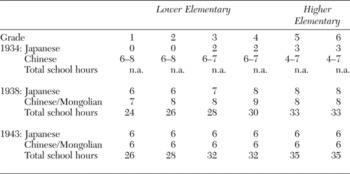
Soon thereafter, the ministry announced a new set of laws and regulations, called the Shingakusei (new education system), that significantly changed the structure and content of elementary and middle school education throughout the state. Under the new system, the ministry raised Japanese to the level of the preeminent national language, although Chinese and Mongolian also remained national languages. Officials significantly increased the number of hours of Japanese instruction, while cutting native language instruction hours. Japanese instruction now began in the first grade, for six to eight hours a week. The number of Japanese language classroom hours remained slightly below Chinese or Mongolian language classroom hours in the lower elementary schools, and was equal in higher elementary schools (see table 1). In middle and normal schools, Japanese language instruction hours surpassed those of Chinese or Mongolian language instruction.
Weekly language curriculum instruction hours in Manchukuo elementary schools.

Sources: Fengtian-sheng Jiaoyu-ting (Reference Fengtian-sheng1935b, 93); Kazumizu (Reference Yoshiyama1936, 31); Minsei-bu Kyōiku-shi (Reference Kyōiku-shi1937b, 35–37); Wang (Reference Yeping and Zhixin2000, 156); Wenjiao-bu (Reference Wenjiao-bu1936, 12; Reference Wenjiao-bu1943, 66, 74). Sources differ as to the hours for the Chinese (Guowen) class during the 1934–37 period.
A related question is the degree to which Japanese was used in nonlanguage courses, such as in ethics, math, and science. From 1934 to 1942, all textbooks in elementary and middle schools were written in Chinese, except for those used in the Japanese language courses themselves. This and other anecdotal evidence suggests that the majority of school instruction during these years took place in Chinese. One source claims that in 1941, middle schools began to require students to use Japanese in a variety of school situations, including formal greetings upon entering and leaving the school, when addressing teachers, and when entering the teachers' room (Wang Reference Yeping and Zhixin2000, 180). In 1943, middle schools began shifting the teaching of nonlanguage courses from Chinese to Japanese, just before the first generation of students who had studied Japanese since the first grade were to enter the middle schools. One former student, for example, claimed that in his higher elementary school in 1940 and 1941, Chinese was the standard classroom language for all classes except for the Japanese language class. At the normal school (then at the same level as the middle schools) he attended in from 1942 to 1944, however, all courses except for math (and presumably Chinese) were taught in Japanese (Ōmori and Li Reference Naoki, Libing and Hiroshi1994, 291).
Throughout the existence of the Manchukuo state, Japanese language instruction in elementary schools did not exceed 25 percent of the total curriculum hours, although it may have gone much higher in the middle schools by 1943. For the most part, Japanese remained one of the courses of study, not the general language of instruction. In this way, the structure of the Manchukuo education policy resembled that of the non-Russian schools in the Soviet Union from 1938 to 1958. During that period, the Soviet government mandated that schools for non-Russians had to begin teaching Russian in the third grade, but that it would remain a course of study, not the general language of instruction. The Soviet government resisted requests from a variety of quarters to increase Russian language instruction in the non-Russian schools because it was determined to support the continuing existence of minority people's native languages and cultures, and thus avoid the image of imperialism. One of the ways the Soviet state tried to legitimize itself was to define the state as a multiethnic partnership of equals, fundamentally different from a Western-style empire. In the schools, therefore, the government expected students to accept the Soviet civic ideology while retaining their ethnic identity. Although the government accepted that a certain amount of instruction in the lingua franca of Russian was needed for national unity, particularly for those eligible to enter the military, for the most part, Soviet ideology could be taught in the students' native languages (Blitstein Reference Blitstein, Suny and Martin2001, 254; Martin Reference Martin, Suny and Martin2001, 69–70).
While the structure of the Manchukuo schools resembled the 1938–1958 non-Russian Soviet schools, the Shingakusei-period ideology of education more closely resembled French colonial policies. Like the Soviets, the Japanese expected civic unity, but not complete ethnic assimilation, to prove that they were different from Western imperialists. Like the French, however, the language optimists among the Japanese (such as Yamaguchi and Fukui) felt that certain principles could only be taught in the metropole language. A major reason for this difference was that in the Soviet case, the government-sponsored civic identity taught in the schools was largely an intellectual construct, based on Marxism. Because Marxism was presented as a logical philosophy, it presumably could be expressed equally well in any language. In the Manchukuo case, however, the civic identity was more of an emotional construct—the people were expected to believe in the divinity of the Japanese emperor and Japan's sacred role as the protector of East Asia. As ideas that required more faith than logic, they were deemed untranslatable by the language optimists, a “nonarbitrary sign.” To teach these important concepts, therefore, they considered aggressive Japanese language instruction to be necessary.
The Battle over Nativist Materials in the Manchukuo Curriculum
While Japanese educators in Manchukuo generally agreed that the local population would benefit from learning Japanese, nativists and reformers were divided over the question of content. Nativists thought schools should present the same emperor-centered ideology that was being taught in schools in Japan, including concepts of Japanese superiority and the divinity of the imperial house, in the expectation that these concepts would teach the students a respect for Japan. Reformers such as Yamaguchi wanted to teach the language in an environment as free from ideology as possible, and they trusted that the kotodama power of the language itself would win over the students. Until late 1943, the Manchukuo education bureaucracy was dominated by reformers who managed to keep elementary textbooks remarkably free of extreme ideological material.
In the 1938–43 period, the Manchukuo state textbook editing and teaching communities were dominated by former SMR educators. They included Terada Kijirō, the head of the Manchukuo Textbook Department from 1938 to 1943, and Fukui Yū, who was in charge of Japanese language curriculum from 1932 to 1943. Terada, Fukui, and the majority of Japanese in the Textbook Department were strongly influenced by the liberal tradition of the SMR education system, fostered by Hobo Takashi. Their background aligned them against the empire-wide swing in emphasis toward the glorification of the military, the divinity of the imperial house, and declarations of Japanese superiority. All appear to have been appalled by a decision made by the Manchukuo government in 1940 to push public participation in state Shintō rituals as a civic duty for all. Despite government insistence on teaching about Amaterasu and the mythical foundation of Japan in Manchukuo schools, the educators resisted including these messages in the curriculum. In 1941, Terada wrote an article criticizing the inclusion of Shintō in the state ideology, saying, “The new state ideology of Founding Spirit is still half-baked. [I always] try to avoid these kind of abstract, ideological theories, but I think in this case I must make a public comment … Frankly, it still very dogmatic, and I do not think it is at a point where the people of the world can accept it” (1941, 223).
The former SMR educators were also influenced by Yamaguchi's position that kotodama was best transmitted through the form of the language, rather than the content. They followed Yamaguchi's admonitions to keep Japanese nationalistic material in elementary school textbooks to a minimum, expecting that the act of learning the language itself, along with adopting the customs of Japanese-style education and hygiene, would be sufficient to instill in the students the Japanese spirit.
Terada spoke up again in a July 1942 roundtable, which was published in Kenkoku Kyōiku, an education journal sponsored by the Manchukuo government. The roundtable participants included Maruyama Rinpei and Uehara Hisashi, two Japanese language professors from Kenkoku University, the state's most prestigious institution of higher learning. The three shared their frustration about those who wanted to use Japanese language class time to teach Japanese nationalistic concepts.
Terada: Some Japanese language teachers see it as their mission to instruct their students in the Japanese spirit. They are interested only in teaching about spirit, with the language … acting merely as an organ of transmission … Their methods are hindering, not helping, true language education.
Maruyama Rinpei (agrees): These attempts to teach about Japanese spirit cause misunderstandings. Overbearing lectures on the subject do nothing but bore the students. Language teachers should [start with] subjects that seem useful to the students … and then gradually start discussing Japanese culture.
Uehara Hisashi: I have noticed this as well. Teaching Japanese by cynically forcing Japan's culture on the students is doomed to failure …
Terada: I am relieved to hear professors like you say this … [I have found] that those who try to teach Japanese spirit and culture from the start in language classes end up producing students with both terrible pronunciation and a faulty understanding of the Japanese spirit … If we focus on teaching the language itself, the students will not only acquire good Japanese language skills, they will also absorb Japanese spirit and culture without even being aware of it. When [a student] uses the Japanese language, he can not help but imbibe the Japanese spirit. (Kenkoku Kyōiku, July 1942, 30–31)
Iwazawa Iwao, a middle school teacher stationed in Manchukuo, wrote in support of Terada's position a few months later in Nihongo, a language education journal that focused on education in Japan's colonies and occupied territories. He wrote,
Japanese spirit naturally resides within the Japanese language. You do not need to go around pointing it out, saying, “here it is, and here.” Japanese words contain kotodama; the words themselves are spirits. Therefore when students speak Japanese they will use the Japanese spirit which exists within it … Japanese is not the only language which acts this way. It is true of Chinese or English as well. If you speak the Chinese language frequently you will naturally come to comprehend the world as a Chinese, or if you use English, you will become like an Englishman. (Reference Iwao1942, 23)
Besides using the idea of kotodama in an attempt to keep out nationalistic material, both Terada and Iwazawa, by using the example of English, undercut the idea of the unique nature of Japanese then being propagated by Yamada Takao and other nativists.
It is quite remarkable that such public conversations and articles occurred in a military-controlled puppet state in 1942, a time when Japanese militarist and emperor-centered discourse was being ratcheted up to unprecedented levels throughout the empire.Footnote 6 It is, therefore, a testament to the power of the concept of kotodama that by invoking it, education officials for a time could keep nationalist and militarist material at bay. The leadership of former SMR employees was the key factor in this defiance.
Some nativist Japanese educators were disturbed by the efforts of the leadership to control the amount of Japanese-centered content in Japanese language textbooks. For example, in 1940, Asakawa Yoshihiko, a teacher at the Jilin Higher Normal School, bemoaned what he saw as Chinese continuing to learn Japanese only for utilitarian purposes, with no interest in Japanese culture or spirit. Besides the Chinese themselves, he blamed the SMR education system and educators, who, he said, had begun the trend of emphasizing utility over spirit. As a corrective, he called for an increase in Japanese literature instruction in Japanese language classes of all levels. Only language classes that emphasized the unique contributions of Japanese culture could change the people's spirits, not linguistic-centered instruction (Asakawa Reference Yoshihiko1940, 22–24). Asakawa, therefore, agreed with the Yamaguchi/Terada view that Japanese language education was the key to inculcating students in the Japanese spirit, but he differed on the question of appropriate content.
In the editing of Manchukuo textbooks, to what extent did the textbook officials put into practice Terada's concern about keeping “Japanese spirit” material from dominating the classroom? I have found copies of about three-fourths of the Japanese language textbooks created or approved by the Manchukuo education bureaucracy, and have calculated the percentage of chapters that contain Chinese or Manchukuo topics, Japan topics, and what I call “imperial” topics. By Chinese or Manchukuo topics, I mean any discussion of Chinese, Mongolian, or other non-Japanese residents of Manchukuo or any other part of China, or the geography or history of either Manchukuo or the rest of China. By Japan topics, I mean any mention of Japan, Japanese individuals, or Japanese customs. By imperial, I mean material that spoke reverently about the Japanese military or the imperial household, or that taught about Japan's founding myths. These imperial topics are what I believe Terada and others referred to as material that asserted “Japanese spirit.” “Imperial topics” is subset of “Japan topics.” For example, if I say that a text contains 20 percent Japan-related material and 10 percent imperial material, then one may deduce that the remaining 10 percent of Japanese-related material is of a less ideologically charged nature. This would include such things as a depiction of Japanese children at play, a description of the train system in Tokyo, or a story about a successful Japanese scientist. While positive about Japan and the Japanese people, these chapters did not present them as objects worthy of awe, uniquely gifted or powerful, or connected to the divine.
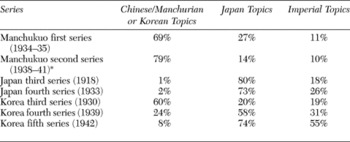
Table 2 compares the amount of Japan-related and imperial material in two series of Manchukuo elementary school Japanese language textbooks to that of textbooks published by the Japanese Ministry of Education for Japanese children, and textbooks published by the colonial Korean government for Korean children.
Topics in elementary school Japanese language textbooks in Manchukuo, Japan, and Korea.

*An estimate based on five textbooks I have found from the eight-volume series.
Note: The Japan and Korea series figures are extrapolated from information provided in Lee (Reference Lee2000) and Yi (Reference Yi1985).
It is to be expected that any Japanese language textbook would contain material that mentions Japan and Japan-related matters. The Manchukuo elementary school textbooks are, in fact, remarkable for their lack of such references, and the amount of such references actually dropped in 1938. A majority of the people, landscapes, and situations depicted in the elementary textbooks are Chinese, not Japanese. This probably reflects the influence of Yamaguchi and the New Education movement educators, who encouraged the use of everyday texts and materials with which students would be familiar. Just as important, the amount of imperial material basically remained unchanged throughout the 1930s. This lack of imperial material occurred despite the outbreak of full-scale war between Japan and China in 1937 and the shift in Manchukuo state ideology in the years between the publications of the two series.Footnote 7
It is instructive to compare these figures to those of Japanese language textbooks produced for students in Japan and Korea. The Japanese Ministry of Education began publishing its third textbook series in 1918 and its fourth series in 1933. The Korean colonial government began publishing its third textbook series in 1930, a fourth in 1939, and a fifth in 1942 (Lee Reference Lee2000, 343–47). In 1941, the Japanese government began publishing its fifth and final series before the end of the war, but I do not have specific information on the content of those textbooks.
The Japan third series was edited during the height of the New Education and internationalist movements in Japan, and as such, it contained an unprecedented amount of material with international settings. The Japan fourth series appeared at a time when a more conservative version of the new education philosophy was ascendant, and therefore contained much more statist and imperial material (Karasawa Reference Tomitarō1956, 12–14). The Korean third series (1930) is notable for the increase in the amount of material about Korea and the decrease in material about Japan, including imperial material, compared to the second series published in 1923. This trend was reversed with the fourth series (1939), when Japan-related material again became dominant and the amount of imperial material greatly expanded.
The amount of imperial material in Korea and Japan texts rose in a parallel manner in the 1930s, with the amount slightly greater in the Korean texts in both periods. The amount of imperial material in the Manchukuo texts, however, remained nearly constant at 10 percent to 11 percent, a much smaller level than in either Japan or Korea during any period. Also, while the amount of general material about Japan was the same in the Korea and Manchukuo texts of the early and mid-1930s, they diverged significantly in 1938–1939, with the amount rising dramatically in Korea while dropping almost as dramatically in Manchukuo.
Assuming that Terada and his allies saw the materials that I define as “imperial” as the excessively ideological “Japanese spirit” materials that they feared would discourage students from studying the language, they were successful in keeping them from becoming major elements in the elementary school textbooks at least through 1941. The elementary school textbooks, particularly in the 1938–41 period, emphasized the lives of Manchukuo students in Manchukuo, while mentioning Japan and the Japanese only occasionally, and using imperial materials very rarely. A third Manchukuo elementary school text series began to be edited in 1943, but few appeared to have been published, and I have found no surviving volumes, so it is not clear whether these trends continued during the more desperately militaristic final years of the regime.
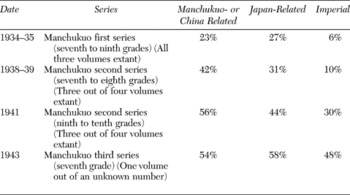
While Manchukuo textbook editors worked to keep imperial Japanese messages to a minimum in the elementary school Japanese language texts, after 1941, they allowed many more to appear in secondary school texts. Middle school Japanese language textbooks published from 1934 to 1939 contained around 30 percent material about Japan, somewhat higher than the elementary school texts, but only around 10 percent imperial material, similar to the elementary school texts. In 1941 and 1943, under the pressures of the war conditions, the middle school textbooks became increasingly ideological, emphasizing the greatness of the Japanese imperial household and military and the people's patriotic duty as industrial and military soldiers. Perhaps it was these texts about which Terada, Murayama, and Uehara expressed frustration in their 1942 conversation.
Manchukuo middle school Japanese language textbook themes.

Source: Copies of the textbooks can be found in the Seijō Gakuen Kyōiku Kenkyūjo (Tokyo).
Education Results
Regardless of shifts in government policy, educators failed to stir up much interest among the people in the Japanese language throughout the Manchukuo period, and ultimately failed to achieve the optimistic goals of the 1938 system. Certainly the primary reason for this failure was the regime's lack of authenticity. Postwar interviews with former Manchukuo students demonstrate how few Chinese were enthusiastic about the Japanese language, much less came to sympathize with Japan's wartime goals. Some, recognizing that Japanese was the key to advancing in school and finding a good job, did make an effort. Even among that group, however, there appear to have been very few who became enamored with Japan. The violence of the Guandong Army's initial invasion, swift crackdowns on any indications of Chinese nationalism or other political dissent, and policies of ethnic inequality bred deep distrust toward the Japanese. The 1940 policy of emphasizing state Shintō ceremonies seems to have eliminated any tolerance the people had for the Manchukuo state. In the final years, a sense of Japan's eventual defeat, which would end the language's usefulness, also acted to depress student interest (Komagome and Chō Reference Takeshi and Kahō1999; Qi Reference Hongsheng1997; Qi Reference Hongsheng2004; Takenaka Reference Ken'ichi2003).
A second reason for the failure was the regime's inability or unwillingness to put adequate resources into Japanese language education. Yamaguchi and the reform optimists hoped that intense language instruction would win the loyalty of schoolchildren. Even if the Japanese leadership in Manchukuo had lived up to their promises of a multiethnic paradise, or even gone beyond those promises by ensuring true equality and protection of human rights, the regime did not have the resources to pay for quality language education on a mass scale.
In response, in 1939, Fukui Yū set forth a vision of Japanese language instruction occurring on two widely separated levels:
In the future the people will be divided into two groups—first the common masses, who will be able to speak simple Japanese but not find it necessary to write complex texts. Then there will be the leadership class, who will become skillful at the Japanese language, understand commonplace writing, and have the responsibility to introduce and guide the common masses in these things. They will be able to both read and speak in both the modern formal and colloquial styles. Because they will be able to read and understand ancient texts, they will understand Japanese traditions and truly be able to enjoy Japanese culture. (1939, 4)
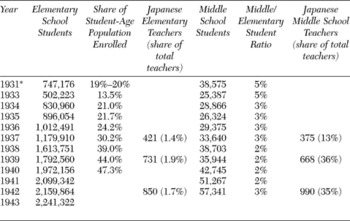
Fukui based his bifurcated view of the future on a realistic understanding of the education resources available. The state could provide only enough adequately trained language teachers to staff the middle schools. In 1935, between 7 percent and 9 percent of the teachers in Fengtian Province's twenty-one elite provincial middle schools were Japanese, while an additional 5 percent to 8 percent of the teachers were Chinese who had studied in Japan or in Japanese-run colonial schools (Fengtian-sheng Reference Fengtian-sheng1935a, 470; Liaoning-Sheng 1990, 822–23). In 1937, Japanese teachers made up 13 percent of Manchukuo's middle school teachers, and the amount rose to more than one-third of the total in 1939. These sizable numbers demonstrate that the government envisaged the middle school as a place in which a small elite population could experience a Japanese-centered education that went far beyond simple language training.
Here lay a fatal contradiction at the heart of Japanese-language education in Manchukuo. Although Japanese leaders wanted to train students in Japanese, they were also extremely wary of inflating the number of middle schools. They often spoke of the need to keep the number of middle school graduates down, as there were limited numbers of jobs requiring secondary education, and excess graduates would create a class of overeducated, disenchanted young people (Terada Reference Kijirō1941, 213). As a result, the number of middle school students was only 2 percent to 5 percent that of the elementary school student population throughout the Manchukuo period. It was only in these middle schools, however, that Yamaguchi-style language immersion was occurring.
Providing teachers for the much larger elementary school population was beyond the state's means throughout its existence. Figures for 1937, 1939, and 1942 indicate that Japanese national teachers made up never more than 2 percent of the elementary school teaching population.
Manchukuo elementary and middle school attendance and ethnic Japanese teacher participation rates.

*Before the Manchurian Incident.
Sources: Minsei-bu (Reference Minsei-bu1942, 114); Minsei-bu Kyōiku-shi (Reference Kyōiku-shi1937a); Monbushō Toshokyoku (Reference Toshokyoku1939, 31); Ōmori (Reference Naoki and Hiroshi1996, 62); Wang (Reference Yeping and Zhixin2000, 151).
The Manchukuo government tried various means to recruit Japanese teachers to the mainland.Footnote 8 Although these methods provided sufficient teachers for the limited number of secondary schools, they placed very few ethnic Japanese teachers in the elementary schools. The alternative was training local non-Japanese to be Japanese language teachers. The government reorganized its system of normal schools for non-Japanese in 1938, placing all under state control and emphasizing instruction in the Japanese language, knowledge about Japan, and “state founding spirit.” The quality of the students in these schools is suspect, however, because of the low number of applicants. Tsukinoki Mizuo has found that in 1939, the four normal schools in Fengtian Province (the economic and cultural heart of the region) had only 853 applicants for 701 positions, or an 82 percent acceptance rate. The average acceptance rate for middle schools throughout the country in that same year, on the other hand, was 38 percent (Tsukinoki Reference Mizuo1990, 15; Wang Reference Yeping and Zhixin2000, 171). A 1942 yearbook stated, “The number of applicants to the normal schools is decreasing, which is terribly troublesome, and makes the achievement of our goals very difficult” (Manshūkoku Tsūshin Reference Sha1942, 229).
Manchukuo education officials Hori Toshio and Terada Kijirō pointed to low teacher pay as the major reason for the lack of Chinese applicants to normal schools. In fact, Terada claimed that the national average pay for non-Japanese teachers, 42 yuan a month, was lower than that of unskilled laborers (Hori Reference Hori1941, 58; Terada Reference Kijirō1941, 23).
Ideological opposition to the goals of the state was doubtless another factor in the low number of normal school applicants. Muramoto Osamu, a Fengtian City elementary school teacher, said of the attitudes of Chinese teachers and students, “Manchurian teachers have no desire to continue learning Japanese. Maybe it is because many already know it to a degree, but you never hear a Manchurian teacher asking how to say a certain word. Students are the same, except for those about to take a test; they have no desire to learn” (Reference Osamu1942, 36). What Muramoto labels obstinacy, others might call passive resistance. It is not surprising given the low pay and ideological barriers that few qualified students applied to the normal schools.
Distrust and disinterest on the part of Chinese teachers and students, the lack of teachers from Japan, and low pay for Chinese teachers resulted in extremely low Japanese language proficiency in elementary schools. A Manchukuo government official, commenting on the state of Japanese language ability among urban elementary school children in 1942, said,
I have yet to meet a Manchurian child who speaks Japanese well … Very few Manchurians who graduate from higher elementary school can pass the lowest language level test, which requires only simple conversational ability. On the street they use their own language, not Japanese. Go to the athletic field, pick out any of the students, and try to talk to them in Japanese—they will not understand. (Yasui Reference Katsumi1942, 34–35)
In 1942, Ōide Masayoshi, a leading Japanese educator in Manchuria, speaking to a group of Japanese language teachers, expressed his doubts about the future of Japanese language education in Manchukuo and, by implication, doubts about the overall effort toward creating Asian allies.
We have been teaching Japanese in Manchukuo for ten years, and we have had the advantage of the experiences of the SMR schools which existed for decades before. We should have seen success by now. Today's results are not good, and there is no indication that it will ever get better, no matter how long we try. I would be glad if I was wrong, but we are not that lucky. Can any of you teachers who have experienced the situation tell me I am wrong? (1942, 51)
Conclusion
Japanese colonialism has sometimes been portrayed as a monolithic, top-driven enterprise. As scholars have begun to focus on the details of policy, however, they have found a surprising degree of regional diversity and experimentation. In Manchukuo, the government tolerated a degree of debate among Japanese colonial officials and educators on the proper content of colonial schools. For a decade, the relatively liberal education leadership was able to keep extreme Japanese nationalistic material to a minimum, as well as try out a variety of reforms. Their form of colonial education was certainly imperialistic, trying to force a language and a worldview on an unwilling population. It was, however, an imperialism based on the power of language, rather than the power of a mythic and militaristic ideology.
After 1943, however, this freedom began to disappear, and Manchukuo education increasingly resembled Japanese emperor-centered education throughout the empire. This destroyed the reform optimists' hope for an educational atmosphere that would foster East Asian brotherhood through a shared language and lifestyle, rather than ideological indoctrination. Additionally, the reform optimists lacked the resources to achieve their vision of language immersion beyond urban schools, and it is doubtful that they were able to win over a significant number of Chinese to pro-Japanese positions, even in the 1938–43 period. Optimism in the power of the Japanese language was another case of Japanese overconfidence in Japanese national spirit, which contributed to the Japanese government's disastrous overextension throughout its imperialist period.
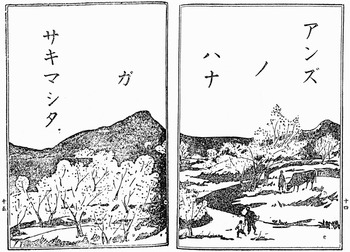
“The apricot blossoms have bloomed.” Lower Elementary School Japanese Language Textbook, vol. 1 (1934) p. 14–15. Copy available in the Seijō Gakuen Kyōiku Kenkyūjo (Tokyo).

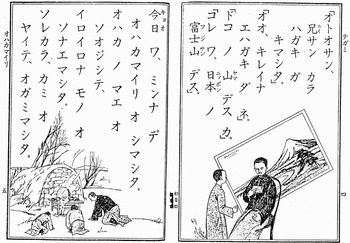
One the left, a Manchukuo family participates in a ceremony honoring their dead at a gravesite. On the right, a Manchukuo boy receives a postcard from his older brother, with a picture of Mt. Fuji on it. Lower Elementary School Japanese Language Textbook, vol. 2 (1934) p. 4–5. Copy available in the Seijō Gakuen Kyōiku Kenkyūjo (Tokyo).

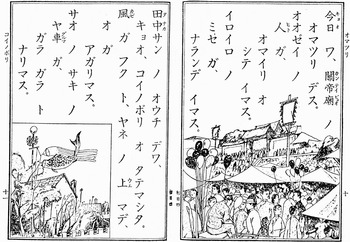
On the left, a Japanese family decorates their house with carp banners, part of the Japanese Tango no Sekku festival. On the right, a Manchukuo town holds a lively festival in honor of the Chinese hero Guan Yu. Lower Elementary School Japanese Language Textbook, vol. 2 (1934) p. 10–11. Copy available in the Seijō Gakuen Kyōiku Kenkyūjo (Tokyo).

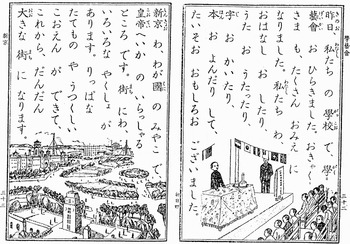
On the left is Shinkyō (Xinjing), the capital of Manchukuo. The text notes that this is where “our Emperor” lives, and it is growing into a great modern city. On the right is a school Art and Scholarship Festival. Lower Elementary School Japanese Language Textbook, vol. 2 (1934) p. 32–33. Copy available in the Seijō Gakuen Kyōiku Kenkyūjo (Tokyo).

Acknowledgments
Earlier versions of this article were presented at the 2003 Conference of the Japanese Society for Historical Studies of Colonial Education in Kagawa, Japan, and 2006 Conference of the Association for Asian Studies in San Francisco; I thank the participants for their valuable feedback. I also would like to thank Richard Smethurst, Evelyn Rawski, Isoda Kazuo, Ōmori Naoki, and the anonymous readers at the Journal of Asian Studies for their suggestions.