Introduction
Growing tourism in Greenland
In recent years Greenland has experienced growing tourism because of its ‘remoteness, wilderness, scenic beauty, wild life and other obvious characteristics of the regions’ (Stonehouse Reference Snyder and Stonehouse2007: 2). Another reason that Greenland is attracting more tourists than ever before is that the ice in Greenland is melting due to global warming.
After the global decline of tourism in 2001 and 2002, tourism in Greenland has been rising, which can be seen from bednight statistics. The total number of these has risen by more than 25% since the trough in 2002 (Statistics Greenland 2009).
Since Greenland is advertising tourism with ‘Our ice is melting, yet it is still here – monumental and giant’ (Greenland 2013) and considering the fact that in recent years the Greenland ice sheet melt extent has increased compared with previous years (Mernild and others Reference Mernild, Mote and Liston2011), there should be a trend that more tourists will visit Greenland in forthcoming years. As a result, growing tourism will increase the need for lodging to meet demand.
Challenges in the Arctic
Greenland is the world's biggest island with an area of 2,166,086 km2. The north-south distance is 2,670 km and the maximum east-west distance is 1,050 km. Greenland has a population of some 56,000 people living in 18 towns and 60 settlements, and most settlements are quite small. In some of them there are only a few inhabitants (Statistics Greenland 2012a). Thus the population in Greenland is scattered, and necessary infrastructure such as electricity, district heating supply, water supply, sewage and waste treatment are sparse or even non-existent in many areas. It is hard and expensive to supply electricity from the grid to remote areas (Seeling-Hochmuth Reference Seeling-Hochmuth1997). So it is costly to run and maintain hotels and hostels in Greenland, especially in remote areas, where the natural attractions are usually located.
Seasonality in tourism
The predominantly Arctic climate is another severe challenge for tourism. Data from Greenland statistics show that in 2011 the mean temperatures in 20 towns and chosen settlements in Greenland vary from 4.8°C to 12.5°C in the warmest month (July), and vary from –19.9°C to –3.8°C in the coldest month (December) (Statistics Greenland 2012b). It can be seen that the climate in Greenland is quite harsh and only in the summer period it is relatively warm, which determines seasonality in the tourism.
The statistics show that from 2007 to 2012 the number of foreign passengers by aircraft increased rapidly in June and peaked in July. Also in August the number is high. From September to October the number declined quickly and from October to the next May the curve stays almost even. Compared with the trough in the low season, the number increases about 300% in the high season (see Table 1). The strong seasonality in tourism also makes it difficult to operate hotels.
The number of foreign passengers by aircraft in the period from October 2007 to September 2012 (Statistics Greenland 2013).

Therefore based on the above background, the aim of the work is to explore a solution for tourist lodging that balances the environment, comfort, flexibility and culture.
Analysis
Tradition and history of Greenlandic huts
In Greenland, people have their own tradition of overnight stays in the wild during hunting seasons. Hundreds of years ago sealskin tents were used by hunters in the spring and the summer, when they went hunting away from home. In the winter when it became colder, the Inuit used igloos, shelters made with snow blocks. When people had the possibility to use timber transported from the outside world, small wooden huts were built for lodging on the way (Mikkelsen Reference Mikkelsen2008). There are a large number of such huts existing in Greenland. Some of them have been ruined but many are still in use (Mikkelsen Reference Mikkelsen2012). In Greenland the huts are normally remotely located. If tourists want to go hiking in the mountains, the hut is a good option for their lodging.
However, the current condition of the huts can hardly meet today's requirements. Only in some huts are bucket toilets available, while in others there are no toilets at all. For example, around the area of Sisimiut and along the hiking route between Sisimiut (the second largest town) and Kangerlussuaq (the air transportation portal), only in 7 out of the total 27 huts toilets are available (Gunnarsdottir and others Reference Gunnarsdottir, Ingeman-Nielsen, Jenssen and Villumsen2009). When using the huts with bucket toilets, people take away their excrement in the plastic bags placed under the toilets, and put the bags in a container next to the hut (Gunnarsdottir and others Reference Gunnarsdottir, Ingeman-Nielsen, Jenssen and Villumsen2009), which is neither sanitary nor convenient. Most huts are not well insulated. The heating sources in such huts are usually oil burners or coal stoves, and thus the poorly insulated huts can consume much energy.
The tourist hut is a traditional element in nomadic Greenlandic culture and history. However, the current austere condition in the existing huts hinders popularity. To retrieve the spirit of this tradition nowadays, new tourist huts that can meet modern requirements and criteria are necessary.
We studied the possibility of making a mobile hut, which is not a permanent building and thus can be moved thoroughly without leaving any marks. Using light materials, making the hut with components that can be assembled together and disassembled when the hut needs to be moved is one way to mitigate the considerable impacts of developing permanent lodging.
In addition, the ice in Greenland is the main reason for tourists to come. So melting ice can cause location change of the tourist attractions in the long run, and therefore flexibility in location change is also desirable considering possible changes. If a tourist attraction changes, the huts that are located in the proximity can be moved to new locations.
Comparison with other transportable structures in the world
Transportable structures have a long history and have been used in many cultures, such as bell tents, yurts and tipis. Nowadays people use modern style tents for a variety of outdoor activities, such as wall tents, cabin tents, dome tents, and so on. All these structures are light-weight and easy to transport.
Our proposed structure for tourists is not permanently erected in one location. However it will only be moved when necessary, for example when retreating ice causes tourist attraction changes. It means that the tourist hut will not be moved frequently. In Greenland the harsh climate makes it necessary to build a sturdy structure that can protect the users against the severe cold and storm. Based on these reasons, robustness and the weight of the hut should be both considered and balanced. Therefore compared to other transportable structures that are easier to transport, our mobile tourist hut uses light but hard materials for the envelope instead of membrane usually used for tents or yurts.
Function of the tourist hut
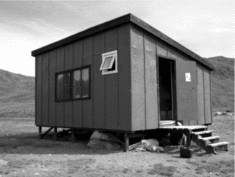
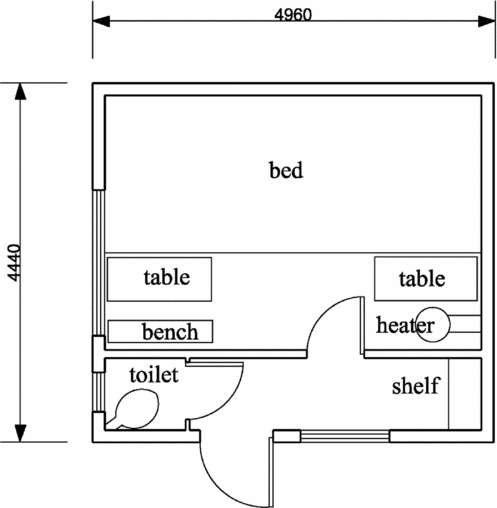
Since the hut should be mobile and light, it needs to be very compact, but still capable of meeting people's basic needs. For this purpose an old tourist hut near the first fjord, Sisimiut, Greenland, which is still being used, was measured (Fig. 1 and 2) and the function of the hut was studied. In the small entrance hall, there are shelves for storage of food etc. It has a bucket toilet. There is a bed, two tables and a heater in the main room. The design and construction of the hut are utilitarian, and there is no luxury or useless space in it (Figs. 1, 2).
An existing tourist hut near the First Fjord, Sisimiut.

Plan of an existing tourist hut at the First Fjord, Sisimiut, Greenland.

Apart from this case, a literature review about Greenlandic huts was undertaken. For most huts the function is quite simple. In some huts there are only a plank bed and a coal stove (Mikkelsen Reference Mikkelsen2008). The sizes of the existing huts are usually quite small. It can be seen that the basic function of a hut is to provide a shelter for the people, where they can eat, sleep and defecate. The fundamental needs of hut users can be therefore considered as following: sleeping, simple cooking and hygiene.
Therefore the target of the new hut is set to realise all the possibilities of the existing huts, improve the quality according to modern standard, and achieve a good balance between function and weight. Except for the basic functions, sustainable off-grid electricity supply, warm water and sustainable waste management are necessary for the new hut, so it can work without infrastructure. In this project energy consumed for the tourist hut comes from renewable sources is an important target of the work. When being used, the energy production and waste management system should have minimum impact on the surrounding environment. Compared with hotels the new tourist hut should be flexible to operate and not difficult to maintain. With the background of growing tourism it should be easy to reproduce the huts and thus potentially increasing needs can be quickly fulfilled. To reduce influence on the surrounding environment, it should be uncomplicated to disassemble the tourist huts and transport them to other locations when necessary, and hence leave the Arctic environment ‘untouched’.
Tourist segments in Greenland
In the ‘Spring 2013 visitor survey report: Greenland’ published by the national tourist board of Greenland, tourists visiting Greenland are divided into 11 groups: ethnophile, authenticity seeker, culture lover, culture appreciator, globetrotter, sightseer, wilderness seeker, nature lover, nature appreciator, extreme adventurer, special interest adventurer (Woodall Reference Woodall2013). Among these segments globetrotters (25%), sightseers (16%), nature lovers (15%) and nature appreciators (15%) are the most common tourists visiting Greenland. Among the entire segments extreme adventurers only take up 2% of the market. Most tourists to Greenland are mainly interested in nature, or a combination of nature and culture. Two main groups of the most common tourists to Greenland, sightseers (16%) and nature appreciators (15%) prefer ‘the comfortable and less physically demanding activities’ according to the Greenlandic tourist survey report (Woodall Reference Woodall2013).
The mobile tourist cabins with improved conditions, which are supposed to be placed close to the natural wonders, are thus suitable for the mainstream tourists to Greenland who are predominantly interested in nature, and a considerable proportion of whom like comfort.
Results and discussion
Design
The shape of the new hut comes from the idea of an igloo that reflects the Arctic climate. An igloo has a small, compact and dome shaped structure, making the strong winds blow over it to reduce wind load. However, for the new hut, dome shape is not the most feasible to produce, disassemble, reassemble or transport. Therefore a newly designed shape is used to take advantages of an igloo, but much easier to produce and transport.
In the past the conventional huts were prepared mostly for hunters, as a result there are few in one area and they are scattered. The new huts are designed both for local people and tourists; therefore it should be taken into account that tourists can come in groups, and need to stay together. Another purpose of the new hut is to replace hotels, so more possibilities for bigger and flexible space are needed. Considering the above mentioned points, vertical walls are used to leave the possibility to connect the huts.
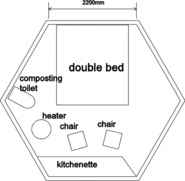
To hold the necessary facilities but still remain compact, the bottom of the hut is a regular hexagon with side lengths of 2.2 m, and 3 out of the 6 ‘wall’ pieces are vertical with a shape of triangle. One is the door and the other two have windows in them, or used as connecting walls. The hut is built on stilts with a height of 0,7 m underneath to hold the container of the composting toilet. Originating from the igloo, the hut is designed with a smaller roof area and a bigger floor area, making it more stable in the windy Arctic environment. The hut is compact so that heat loss due to heat transmission through the building envelope is kept low. Its striking red colour makes it easy to be spotted in any season in the wild Arctic nature.
The hut has an area of 12 m2 and can hold a double bed or two single beds. Besides the bed(s), a simple kitchenette with dining space, 2 chairs, a toilet and an electrical heater can also be placed in the hut (Fig. 3). The toilet can be simply separated with a curtain or light partitions to provide privacy. It is small and compact, but without compromising function and comfort.
A standard tourist hut for 2 persons.

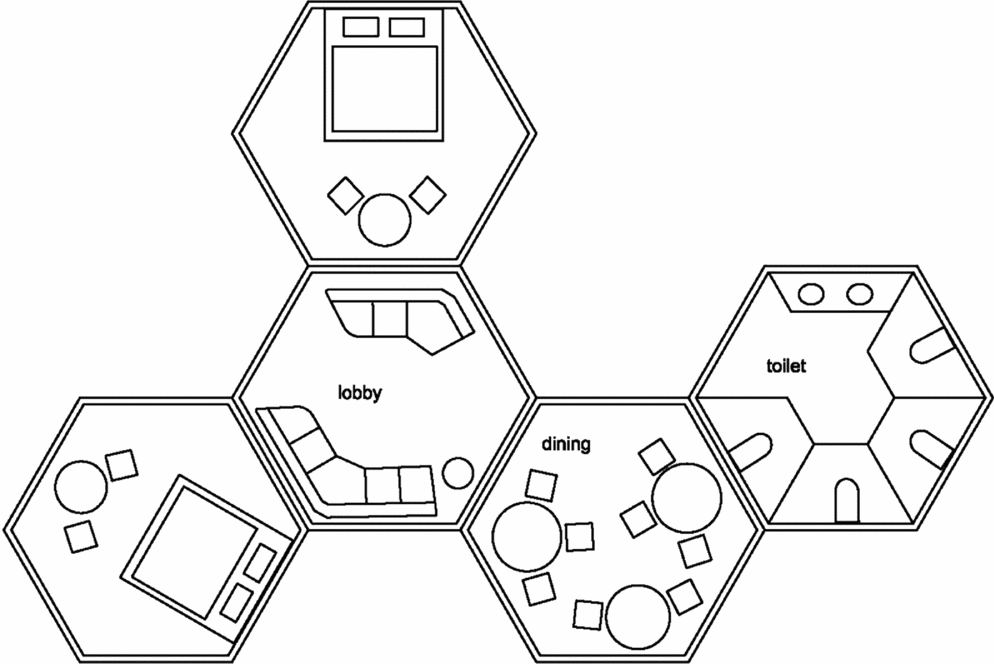
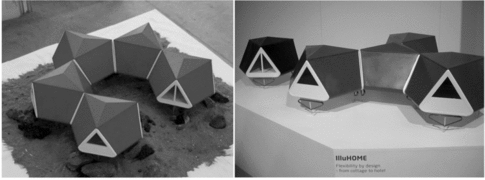
As mentioned before, the shape of the hut units make it easy to freely combine the units, to meet various demands from different groups (single person, family, hiking team, etc.), or used as a hotel if more units are combined together. In this case, the huts that have two units staying next to them have even less envelope areas exposed to the air, and thus less transmission heat loss. If necessary it is possible to have a separate lobby, dining rooms, bedrooms and toilets, each in one unit (Fig. 4). The different combinations of the hut units can make a variety of appearances too (Fig. 5).
A possible combination of the huts used as a hotel.

Models of the huts.

To ensure its light weight the hut is made of fiberglass. The wall and floor systems are carefully designed to achieve both light weight and good insulation effect. Its sandwich wall system consists of Z-sections of fiberglass vertically embedded between fibreglass layers. The roof pieces, wall pieces and the floor piece have the same structures, only with different thickness of insulation.
Electricity, warm water and heating supply
The energy supply for the hut is solved off-grid, not only because it is costly to extend the electricity grids, but also to facilitate the mobility of the hut.
A so-called hybrid energy system is a combination of photovoltaic, wind, diesel, etc. and very often incorporates battery storage (Seeling-Hochmuth Reference Seeling-Hochmuth1997). The energy produced can be either supplied to the load or stored in the battery bank for later use. A hybrid system can fit for long-term autonomous operation at a reasonable price (Seeling-Hochmuth Reference Seeling-Hochmuth1997). In the tourist hut such a hybrid energy system is applied with the energy generation source from photovoltaic panel and wind turbine. Besides PV panel, solar vacuum pipes are mounted to provide domestic hot water.
In Greenland there is opportunity to utilise solar energy. Because of the high latitude, there is more solar radiation in the summer time in Greenland, where space heating is also needed in summer months. In the areas with latitude north of the Arctic Circle, solar radiation is available 24 hours a day in the summer time (Dragsted and others Reference Dragsted, Furbo and Fan2008). Thus it is optimal to use solar energy in Greenland where most areas are inside the Arctic Circle. Since the tourist number in Greenland also peaks during this period, the energy supply for the tourist hut can benefit from solar energy efficiently.
Water supply
As is the case in old huts, unpolluted surface water in Greenland could be used for water supply. Creeks are a convenient solution, but is not a stable source in the winter due to freezing. Then lakes are a better alternative compared to creeks (Villumsen Reference Villumsen, Bjerregaard, Eisted and Løgstrup2009). In the winter snow is a good source of clean water.
Composting toilet
The toilet and toilet waste treatment has always been a challenge for the tourist huts in Greenland. In the existing huts, a sewage system is missing.
Therefore a composting toilet could be a good option (Gunnarsdottir and others Reference Gunnarsdottir, Jenssen, Jensen, Villumsen and Kallenborn2013). The technology of composting toilets has been developing for more than 30 years. This type of toilet requires no water or little water (United States 1999). Thus it is suitable for the remotely located tourist huts without any sewage system. In the composting toilet, organic waste is degraded by various microorganisms, such as bacteria and actinomycetes under aerobic condition. After being degraded, the waste can be used as fertilizer in agriculture (Gunnarsdottir Reference Gunnarsdottir2012). In cold climate freezing/thawing has been observed to reduce pathogens (Sanin and others Reference Sanin, Vesilind and Martel1994). The human excrement contains 80–85% urine and thus needs to be dewatered when it is composted (Gunnarsdottir Reference Gunnarsdottir2012). Freezing also helps to increase dry matter content in sludge (Hedström and Hanaus Reference Hedström and Hanaus1999). Therefore it might be advantageous for composting in the Arctic. In the freezing and thawing process the excess liquid will be absorbed by soil. However this may be a challenge in some Arctic regions for lack of thawed soil layers. Employing commercial biofiltres can be a solution (Gunnarsdottir Reference Gunnarsdottir2012). The disadvantage of cold climate is that in the winter the excrement will freeze, which adds difficulties to the composting and transportation of it. To solve this problem heating produced by the solar vacuum pipes can provide heat for the container. When there is little or no sunshine a backup energy source can heat up the excrement.
In other cold regions composting toilets have been successfully used for tourist huts. For example, in Norway the composting toilet is the major toilet type in 500,000 Norwegian cottages (Hanssen and others Reference Hanssen, Paruch and Jenssen2005). It has been shown that composting toilets function well at extremely low ambient temperatures. Similar experiences are known from cottages in Alaska. A composting toilet at a Norwegian research station in the Antarctic has been successfully tested (Gunnarsdottir and others Reference Gunnarsdottir, Ingeman-Nielsen, Jenssen and Villumsen2009).
There are composting toilets with or without urine diversion. In the system with urine diversion the urine can be used as fertilizer, which apparently does not apply for Greenland, where agriculture is of little importance in its economy. In addition, the urine pipes could become clogged or freeze in the winter. Therefore a composting toilet without urine diversion would be a more suitable solution.
Model and prototype
So far a full-scale model and a prototype of the lightweight tourist hut with a weight of 735.08 kg has been built. The prototype will be installed at the ice cap in Kangerlussuaq, Greenland serving as a toilet and rescue facility for tourists and will be tested after installation. The thermal performance and air tightness of the building envelope and other practical issues of the hut will be evaluated. The design of the mobile tourist hut could be optimised according to the evaluation.
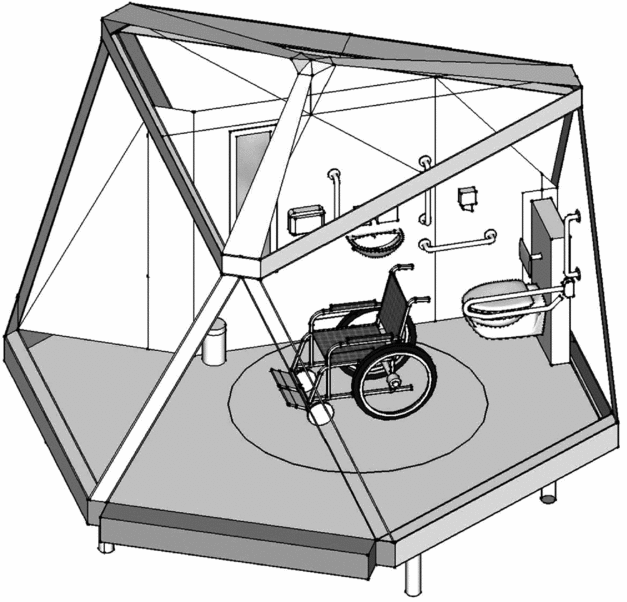
The hut will also be used as a tourist toilet at tourist spots, because the lack of these has been a serious problem for Greenland for years. This easy-to-maintain composting toilet is very suitable for tourist use (Fig. 6). The size of the hut makes it possible for a handicapped toilet.
The hut used as tourist toilet.

Conclusions
In Greenland growing tourist numbers in recent years increases the need for tourist accommodation. The 2013 visitor survey conducted by the national tourist board of Greenland shows that the most tourists to Greenland are mainly interested in nature, or a combination of nature and culture. The flexible tourist cabin designed by us can be put very close to the nature wonders without a big problem of maintenances and lack of municipal infrastructure network. The compact and lightweight hut made of fibreglass can be disassembled and transported to solve another problem of possible changes of tourist attractions due to retreating ice.
Because of its light weight, mobility and ease of being erected almost anywhere, the hut can also be used for tourist toilet, scientific field work, temporary event, (self-service) first aid station in the wilderness, etc. It has a wide range of potential for Arctic use.
Composting toilet is an optimal solution to improve the current sanitary condition of the existing huts, and makes them both environmental friendly and user-friendly. Designed for cold climate, the mobile tourist hut is also suitable for more places in the Arctic except Greenland.
Acknowledgement
The authors would like to express their gratitude to Kristoffer Negendahl, Anders Lyhne Sønderriis and Andreas Schjørring Jørgensen for their work for the project. The work of this paper is part of the project ‘Clim-ATIC’ sponsored by NPP (Northern Periphery Programme 2007–2013).