1. Introduction
Thrust belts that experienced the effects of complete orogenic cycles, from pre-thrusting extension through syn-orogenic contraction to post-orogenic collapse (e.g. Tavarnelli & Prosser, Reference Tavarnelli and Prosser2003), commonly preserve the structural record of these complex deformation histories within brittle, brittle–ductile and ductile fault-related shear zones. In these belts, characterized by repeated and commonly coaxial switches from extension to compression, it may be difficult to establish the correct order of deformation events solely based on the study of the geometric and kinematic relationships between macroscopic contractional and extensional structures. However, detailed mesoscopic structural analysis within well-exposed shear zones exhibiting composite fabrics (i.e. a fabric containing both compressional and extensional features) is helpful to unequivocally constrain the definition of modes and timing of thrusting and normal fault development, and thus may be used to correctly separate the effects of thrust-induced shearing from those of pre-, post- and even syn-thrusting extension.
A rich literature on thrust tectonics illustrates that the most common mesoscopic deformation fabrics related to propagation of regionally important thrusts are S- and S/C-tectonites (Berthé, Choukroune & Gapais, Reference Berthé, Choukroune and Gapais1979; Lister & Snoke, Reference Lister and Snoke1984). Within thrust-related shear zones these structures may record internal variations in strain patterns or rates, especially when observed along oblique thrust ramps, whose kinematics is intrinsically complex owing to the combination of dip- and strike-slip components (Coward & Potts, Reference Coward and Potts1983); by contrast, strain patterns are relatively simple along frontal or lateral thrust ramps, dominated by dip- or strike-slip kinematics, respectively. One difficulty in the analysis of shear fabrics along frontal thrust ramps is that these zones are easily obscured by active erosion as topography grows fast at mountain fronts; lateral thrust ramps, instead, although statistically less abundant than frontal ramps, are yet less subject to intense erosion and hence preserve a better record, thus making these structural settings particularly suitable for studying and inferring the local deformation history of thrust emplacement and evolution. Careful examination of thrust-related shear zones has revealed the local occurrence of extensional, syn-kinematic, mesoscopic fabrics such as extensional crenulation cleavage (Platt & Vissers, Reference Platt and Vissers1980) or extensional, synthetic, foreland-directed shears (Dennis & Secor, Reference Dennis and Secor1987; Yin & Kelty, Reference Yin and Kelty1991; Butler, Reference Butler1992), whose development has alternatively been explained in terms of thrust ‘plucking’ (Platt, Reference Platt1984; Platt & Leggett, Reference Platt and Leggett1986) or thrust zone widening (Butler, Reference Butler1992) during progressive deformation and hence interpreted as produced during single, protracted deformation events of thrust propagation. Similar extensional structures, first observed in frontal thrust ramps or shear zones, have also been reported from oblique and lateral thrust ramps (e.g. Casas & Sàbat, Reference Casas and Sàbat1987; Viola & Henderson, Reference Viola, Henderson, Law, Butler, Holdsworth, Krabbendam and Strachan2010; Viola et al. Reference Viola, Henderson, Bingena and Hendriks2011), so that the occurrence of extensional fabrics within thrust-related shear zones is now accepted as a characteristic 3D geometrical feature of propagating thrusts.
Composite fabrics occurring within well-developed, kilometre-scale thrust-related shear zones, but resulting from the superposition and combination of chronologically distinct compressional and extensional events, are indeed more difficult to recognize and hence to correctly unravel. These have been reported from many orogenic systems and their origin has been variously interpreted: either as due to extensional reactivation of previously formed thrust surfaces (Holdsworth, Reference Holdsworth1989; Powell & Glendinning, Reference Powell and Glendinning1990; Alsop, Reference Alsop1991; Calamita et al. Reference Calamita, Decandia, Deiana and Fiori1991; Tavarnelli, Reference Tavarnelli1999; Bigi, Reference Bigi2006), or as due to outer-arc extension related to development of thrust-related anticlines in the footwall of formerly emplaced thrust sheets, within the framework of a regular, hinterland-to-foreland thrust propagation sequence (Calamita, Satolli & Turtù, Reference Calamita, Satolli and Turtù2012).
A third class of extensional structures that can interfere with thrusts, overprinting and complicating the otherwise relatively simple S- and S/C-fabric within thrust-related shear zones, consists of normal faults produced during gravitational collapse of orogens (e.g. Dewey, Reference Dewey1988). These normal faults develop at upper crustal levels within orogenic fronts during the mature stages of thrust emplacement, so that it is often very difficult to separate these structures from those produced during post-orogenic extension. A common feature of collapsing thrust fronts is the development of normal faults that are confined to the upper thrust sheets within the pile of tectonically superposed units (Platt, Reference Platt1986; Braathen, Bergh & Maher, Reference Braathen, Bergh and Maher1999). Gravitational collapse is generally accommodated by structures ranging in scale from regional (tens or hundreds of kilometres: e.g. McClay et al. Reference McClay, Norton, Coney and Davis1986; Butler et al. Reference Butler, Coward, Harwood, Knipe, Lerche and O'Brien1987) to macroscopic (tens or hundreds of metres: e.g. the Moine Thrust Belt of NW Scotland, Coward, Reference Coward1982, Reference Coward1983; the Ballybofey Slide in NW Ireland, Alsop, Reference Alsop1992; the French Alps, Gamond, Reference Gamond1994; the Iranian Zagros, Tavani, Snidero & Muñoz, Reference Tavani, Snidero and Muñoz2014; the Apennines of Italy, Mazzoli et al. Reference Mazzoli, D'Errico, Aldega, Invernizzi, Shiner and Zattin2008, Reference Mazzoli, Ascione, Buscher, Pignalosa, Valente and Zattin2014; Tavani et al. Reference Tavani, Storti, Bausa and Muñoz2012; Bucci et al. Reference Bucci, Novellino, Tavarnelli, Prosser, Guzzetti, Cardinali, Gueguen, Guglielmi and Adurno2014; Clemenzi et al. Reference Clemenzi, Molli, Storti, Muchez, Swennen and Torelli2014) and are experimentally reproduced through analogue models (Patton et al. Reference Patton, Serra, Humphreys and Nelson1995; Bonini et al. Reference Bonini, Sokoutis, Mulugeta and Katrivanos2000), but are only very rarely reported in field examples examined at the mesoscopic, metric scale (e.g. Coward & Potts, Reference Coward and Potts1983; Holdsworth et al. Reference Holdsworth, Strachan, Alsop, Grant and Wilson2006; Tavani et al. Reference Tavani, Mencos, Bausà and Muñoz2011). Yet, the documentation of these extensional structures at the outcrop scale and the study of their kinematics is indeed very important, in that it may help elucidate the dynamics of gravitational instabilities within collapsing or collapsed thrust fronts.
This paper documents a superbly exposed mesoscopic composite fabric developed by thrusting and subsequent extension within the hanging-wall anticline along a lateral thrust ramp connecting two frontal thrust ramps of a regional curved thrust in the central-northern Apennines of Italy (Fig. 1a). Its study makes it possible to correctly unravel the local deformation history, from early thrusting through syn-/late-thrusting extensional collapse, and to discriminate the extensional structures produced during the advanced stages of thrusting from those due to post-orogenic extension, which yet are widely present in the study area. These findings provide relevant natural constraints that may significantly improve our understanding about the kinematic and dynamic evolution of syn-/late-thrusting collapsing hanging-wall anticlines along curved thrust systems. The case here presented reveals how thrust shear fabrics exposed along minor lateral ramps connecting frontal or oblique segments within curved thrust systems provide critical constraints when unravelling multiphase tectonic deformations.
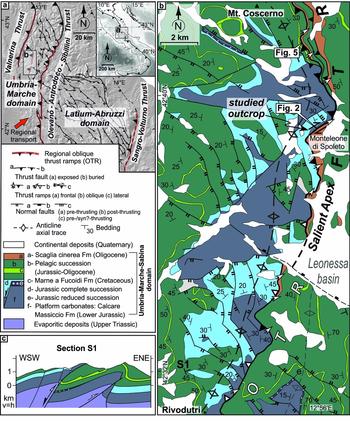
(a) Schematic structural map of the central-northern Apennines foreland fold-and-thrust belt, characterized by regional-scale oblique thrust ramps (OTRs, in red); digital elevation model basemap from GeoMapApp (http://www.geomapapp.org). (b) Simplified geological map along the Mt Coscerno–Rivodutri Thrust (CRT; modified from Tavarnelli, Reference Tavarnelli1993, and integrated with results of an original mapping survey carried out for this contribution). (c) Geological cross-section across the Coscerno–Rivodutri oblique thrust ramp (OTR) showing the relationships between the inherited normal faults (Jurassic and/or Miocene) and the Neogene compressional thrust-fold structures.

2. Regional geological framework
The Apennines of Italy are a NE-directed Neogene fold-and-thrust belt that developed following the closure of the Mesozoic Tethys Ocean and the collision between the African and the European plates during the Alpine Orogeny (Boccaletti, Calamita & Viandante, Reference Boccaletti, Calamita and Viandante2005; Carminati & Doglioni, Reference Carminati and Doglioni2012). The central-northern Apennines are composed of an inner zone, to the southwest, which is characterized by syn-metamorphic accretion followed by subsequent syn-orogenic gravitational collapse and late-/post-orogenic extension (Carmignani & Kligfield, Reference Carmignani and Kligfield1990), and by an outer zone, to the northeast, occupied by a Neogene-to-Present foreland fold-and-thrust-system.
Kilometric-scale, foreland-dipping Miocene and Quaternary low-angle normal faults, from the outer zones of both the northern and southern Apennines, have been increasingly interpreted as due to large-scale, syn-/late-orogenic foreland-directed gravitational collapse (Mazzoli et al. Reference Mazzoli, D'Errico, Aldega, Invernizzi, Shiner and Zattin2008, Reference Mazzoli, Ascione, Buscher, Pignalosa, Valente and Zattin2014; Bucci et al. Reference Bucci, Novellino, Tavarnelli, Prosser, Guzzetti, Cardinali, Gueguen, Guglielmi and Adurno2014; Clemenzi et al. Reference Clemenzi, Molli, Storti, Muchez, Swennen and Torelli2014). In Quaternary time, NW-trending, mainly high-angle seismogenic normal faults formed due to post-orogenic extension affected the axial zone of the Apennines (e.g. Roberts & Michetti, Reference Roberts and Michetti2004; Mantovani et al. Reference Mantovani, Babbucci, Tamburelli and Viti2009), dismembering the orogen into ridges flanked by differentially subsiding graben and intramontane basins.
As in many other perimediterranean orogens of Alpine age originated from the closure of the western Tethys Ocean, the Meso-Cenozoic sedimentary cover of the Umbria–Marche province, in the central-northern Apennines of peninsular Italy, contains both stratigraphic and structural evidence for pre-orogenic syn-sedimentary extensional faulting. Normal faults, active since Triassic time, were responsible for the fragmentation of a formerly continuous carbonate platform into differently subsiding basins separated by intervening fault-bounded seamounts or highs (Alvarez, Reference Alvarez1990; Ciarapica & Passeri, Reference Ciarapica and Passeri2002). The drifting continental margins were separated by the opening of the intervening Tethys Ocean, which spread in Late Jurassic time; the seamounts and basins inherited by the rifting episodes on the Adria margin of Gondwana, seat of the future Apennine belt, were then blanketed by a veneer of mainly pelagic, post-rift deposits of Late Mesozoic – Early Cenozoic age. Normal faults within the Mesozoic Adria palaeomargin were mainly active during Jurassic (Centamore et al. Reference Centamore, Chiocchini, Deiana, Micarelli and Pieruccini1969) and Late Cretaceous–Palaeogene (Decandia, Reference Decandia1982) times; a further, younger episode of Cenozoic, pre-thrusting extensional faulting, documented from the central-northern Apennines, has been interpreted as a manifestation of a foreland flexural process during the orogenic build-up of the Umbria–Marche fold-and-thrust belt (Scisciani, Tavarnelli & Calamita, Reference Scisciani, Tavarnelli and Calamita2001; Mazzoli et al. Reference Mazzoli, Deiana, Galdenzi, Cello, Bertotti, Schulmann and Cloetingh2002; Pace, Di Domenica & Calamita, Reference Pace, Di Domenica and Calamita2014). Thrusting has occurred since Late Miocene time onwards, and was accompanied by the development of important foredeep basins that hosted syn-orogenic clastic deposits, whose ages systematically decrease moving northeast towards the foreland (e.g. Ricci Lucchi, Reference Ricci Lucchi, Allen and Homewood1986; Boccaletti et al. Reference Boccaletti, Calamita, Deiana, Gelati, Massari, Moratti and Ricci Lucchi1990).
Given their complex history, with repeated episodes of pre-orogenic extension, the Apennines are a peculiar fold-and-thrust system where the effects of pre-thrusting faults are particularly evident: this has led to the need to describe the evolution of the entire belt in terms of structural inheritance and positive inversion tectonics (terminology after Cooper & Williams, Reference Cooper and Williams1989) processes (e.g. Tavarnelli, Reference Tavarnelli1996; Tavarnelli & Peacock, Reference Tavarnelli and Peacock1999; Butler, Tavarnelli & Grasso, Reference Butler, Tavarnelli and Grasso2006; Scisciani et al. Reference Scisciani, Agostini, Calamita, Cilli, Giori, Pace and Paltrinieri2010; Calamita et al. Reference Calamita, Satolli, Scisciani, Esestime and Pace2011; Pace, Scisciani & Calamita, Reference Pace, Scisciani and Calamita2011; Pace, Satolli & Calamita, Reference Pace, Satolli and Calamita2012; Satolli et al. Reference Satolli, Pace, Viandante and Calamita2014; Pace et al. Reference Pace, Scisciani, Calamita, Butler, Iacopini, Esestime and Hodgson2015), where the arcuate shape of the southeastern termination of the central-northern province, corresponding to the Umbria–Marche belt, reflects the inherited extensional faults of the Adria Mesozoic palaeomargin. The thrust arcuate map pattern is due to alternating NW-trending frontal and NNE-trending oblique thrust ramps that define high or low angles to the mean ENE-directed thrusting direction. Depending on their trend, at high or low angle to the regional tectonic transport, pre-thrusting normal faults are deformed in two different ways, being truncated at frontal ramps and transpressionally reactivated at oblique ramps (Calamita, Pace & Satolli, Reference Calamita, Pace and Satolli2012; Pace & Calamita, Reference Pace and Calamita2014, Reference Pace and Calamita2015).
Within this context, the regionally important Mt Coscerno–Rivodutri Thrust (CRT; Tavarnelli, Reference Tavarnelli1994; Barchi & Lemmi, Reference Barchi and Lemmi1996; Fig. 1a) owes its arcuate map pattern to the occurrence of a NNE-trending oblique thrust ramp (OTR) that merges northwards into a NNW-trending frontal thrust ramp (FTR) (Fig. 1). The OTR itself results from the envelope of minor frontal and lateral ramps that alternate and are variably oriented with respect to the mean N60°E tectonic transport direction (Fig. 1b). The portion of the CRT investigated in detail in this study (Fig. 2) is a N60°E-trending, dextral strike-slip lateral thrust ramp (LTR) that connects two distinct frontal ramp dip-slip segments along the major NNW-trending FTR slightly northwards to the salient apex of the CRT (location in Fig. 1b). Thickness and facies variations within Jurassic sequences across the OTR indicate that the oblique ramp itself and the considered LTR reactivated pre-existing NNE- and ENE-striking normal faults, resulting in the development of a regional NNE- and a local ENE-trending thrust-related anticline, respectively (Fig. 1c). The occurrence of fault cut-off relationships to bedding observed in both the hanging-wall and footwall of the CRT indicates that the NE-directed compressional shortening along the OTR was quite limited, in the order of a few kilometres, which is consistent with the shortening estimated across the FTR (Tavarnelli, Reference Tavarnelli1993, Reference Tavarnelli1994, Reference Tavarnelli1996). The CRT interacts with extensional structures of different ages, which pre-date and post-date thrusting (Tavarnelli, Reference Tavarnelli1999). NW-trending, either SW- or NE-dipping mainly Jurassic pre-thrusting normal faults in the hanging-wall of the thrust surface intersect and terminate southeastwards against the OTR, a relationship indicating that these extensional faults pre-dated thrusting, and were truncated and carried piggy-back during thrust propagation, thus making it possible to classify them as pre-orogenic. The relationships between these normal faults and the overlying sealing strata indicate for most of these extensional structures a Jurassic age. On the other hand, other normal faults, still widely present in the investigated area, truncate and offset the CRT with displacements of hundred of metres, occasionally bounding Quaternary basins (e.g. the Leonessa basin, Fig. 1b), thus being unequivocally ascribed to post-thrusting extension. A third, distinct class of NNW-trending, mainly ENE-dipping, listric normal faults is observed in the study area, especially along the investigated LTR: these extensional structures, which will be described in detail in the forthcoming sections, define with the thrust surface and with the thrust-related shear fabric, geometrical relationships that are consistent with an origin due to foreland-directed gravitational collapse along the thrust front.
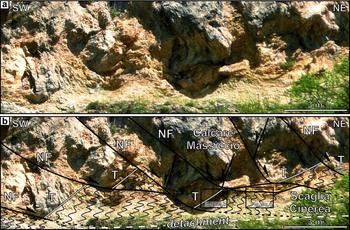
(a) Clean outcrop view and (b) interpreted sketch of the composite shear fabric within the brittle–ductile shear zone associated with the lateral thrust ramp (LTR) of the Mt Coscerno–Rivodutri Thrust (CRT). The main thrust surface (T) and the associated S-fabric are displaced and tilted by mesoscopic, foreland-dipping listric normal faults (NF) with some minor antithetic elements.

3. Structural analysis of composite shear fabric
During compilation of an original geological map of the CRT (Fig. 1b), we discovered a remarkable thrust-related, brittle–ductile shear zone. This is well exposed in the footwall of a local WSW–ENE LTR that connects two distinct frontal ramp dip-slip segments along the major NNW-trending FTR slightly northwards to the salient apex of the CRT developed during the Cenozoic compression (location in Fig. 1b). A composite fabric containing both compressional and extensional elements characterizes this remarkable and structurally complex thrust zone. Unravelling of its overprinting relationships made it possible to reconstruct modes and timing of thrusting, to unravel the relative chronology of superimposed deformations and to infer the process responsible for the switch from early thrusting to syn-/late-thrusting extension. The extensional structures, producing displacements towards the foreland, affect the thrust hanging-wall and the thrust shear zone and root downwards into a footwall splay thrust at the bottom of the shear zone.
3.a. Thrust kinematics
In the study area, Lower Jurassic massive carbonates of the Calcare Massiccio Formation are emplaced onto Upper Eocene–Oligocene marls interbedded with limestone and calcarenite horizons of the Scaglia Cinerea Formation (Fig. 2a, b) along the CRT. In the vicinity of Monteleone di Spoleto, a c. 2 km long segment of the thrust surface is well exposed because of the remarkable erosional contrast between the more resistant hanging-wall and less resistant footwall lithologies. This part of the thrust strikes ENE–WSW on average and dips (from 10° up to 68°) towards the NNW (Fig. 3a, b, e). Calcite shear veins and slickensides on the thrust surface reveal a top-to-the-ENE movement vector trending N60°E (Fig. 3e), consistent with the overall thrust kinematics along the CRT (Fig. 3f) and with the general tectonic transport direction in this part of the Apennines. The data collected along the investigated thrust segment indicate a general right-lateral slip, thus making it possible to kinematically classify it as a lateral ramp.
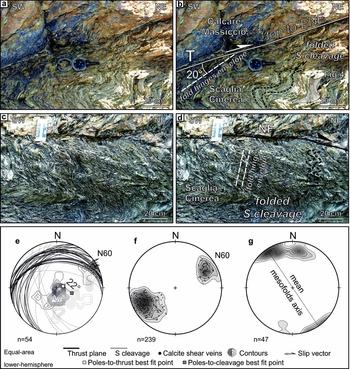
(a) Clean outcrop view and (b) interpreted sketch illustrating a detail of the main thrust; near the thrust surface the S-cleavage is affected by gentle and open mesoscopic folds with axial planes steeply dipping towards the foreland. (c) Clean outcrop view and (d) interpreted sketch illustrating a detail beneath the low-angle segment of a foreland-dipping listric normal fault (NF). The normal fault footwall exhibits pervasive, closely spaced folded S-cleavage surfaces with axial planes slightly dipping towards the foreland. (e–g) Equal-area lower-hemisphere stereographic projections of data collected along the investigated composite shear zone. (e) Thrust kinematics and mean angle between S-cleavages and thrust planes. (f) Calcite shear veins measured along the lateral ramp of the CRT showing the main thrust transport direction. (g) Contouring of the S-cleavage fold axes showing the mean trend of mesoscopic folds.

3.b. Thrust zone fabric
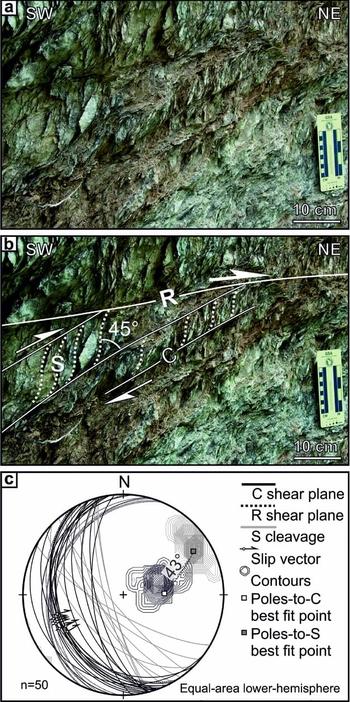
A well-developed, centimetre-to-millimetre spaced pressure-solution cleavage (S) is pervasively developed within the Scaglia Cinerea Fm in the footwall of the considered LTR of the CRT (Figs 3b, 4). This fabric is folded at the mesoscale (Fig. 3). Folding is predominantly concentrated in specific parts of the exposure, for reasons to be described in the forthcoming sections (Figs 2b, 3d). Moving upwards from the footwall to the hanging-wall along the LTR, at the Calcare Massiccio – Scaglia Cinerea fms tectonic contact, mesoscopic folding of the S-fabric is less intense. Here, the enveloping surface of the fold hinges makes a low-angle (c. 20°) to the NNW-dipping thrust surface (Fig. 3a, b). This geometrical relationship suggests that the pre-existing, shear-induced S-foliation was originally sub-parallel to the main thrust surface as it formed along this lateral ramp segment of the CRT, thus defining a shear zone dominated by an S-type fabric (terminology after Ramsay & Graham Reference Ramsay and Graham1970; Logan et al. Reference Logan, Dengo, Higgs, Wang, Evans and Wong1992; Ragan, Reference Ragan2009). In contrast, along the nearby NNW-trending FTR to the north of the considered section the angle between the S-cleavage and C shear-surfaces is c. 45°, indicating that the thrust-related shear zone is dominated by an S/C-fabric (terminology after Berthè, Choukroune & Gapais, Reference Berthé, Choukroune and Gapais1979; Fig. 5a–c). The occurrence of these two geometrically different S- and S/C-fabrics, observed within the shear zones along the lateral and frontal thrust ramps of the CRT, respectively, is reminiscent of and kinematically compatible with the situation described further east (Calamita, Satolli & Turtù, Reference Calamita, Satolli and Turtù2012; Pace, Calamita & Tavarnelli, Reference Pace, Calamita, Tavarnelli, Mukherjee and Mulchrone2015) along the regionally important Olevano–Antrodoco–Sibillini Thrust (Fig. 1a for location). Recent studies (Tesei et al. Reference Tesei, Collettini, Viti and Barchi2013) revealed that shearing along the CRT occurred at shallow crustal depth (2–3 km) under non-metamorphic conditions (T < 100°C).
Polished sample collected within the composite shear zone in the footwall of the main thrust. The centimetre-to-millimetre spaced cleavage is constituted by pressure-solution stylolitic surfaces between the marly limestone of the Scaglia Cinerea Fm and the syn-tectonic calcite shear veins. The pressure-solution deformation mechanism is highlighted by the stylolite surfaces and by the insoluble film of residual insoluble clayey material (view parallel to the XZ plane of the strain ellipsoid of thrusting).

(a) Clean outcrop view and (b) interpreted sketch of the brittle–ductile thrust shear zone along the frontal thrust ramp (FTR) of the Mt Coscerno–Rovodutri Thrust, characterized by an S/C-fabric with associated synthetic R-Riedel shear planes. (c) Equal-area lower-hemisphere stereographic projection of data collected along the thrust shear zone showing the angle relationship between the C and S surfaces.

3.c. Extensional surfaces
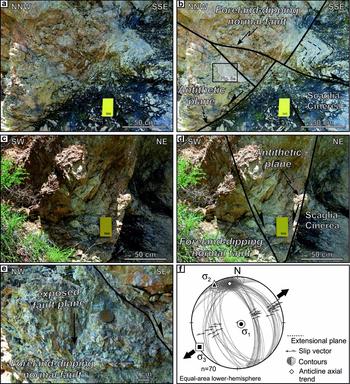
The upper thrust surface and the S-fabrics developed within the LTR are displaced by foreland-dipping, mesoscopic normal faults that trend NNW–SSE and dip ENE, with dip angles ranging from 10° to 70° (Figs 2b, 6). These extensional structures, along with associated minor, antithetic, WSW-dipping normal faults (Fig. 6), accommodate decimetre-to-metre scale displacements, consistent with a cumulative stretching of c. 4.5 m obtained by restoring the sketched outcrop of Figure 2b. These normal faults are listric in geometry, producing a high-angle cut-off when propagating within the massive Lower Jurassic Calcare Massiccio Fm in the thrust hanging-wall, and rapidly flatten over a footwall splay thrust within the marly Eocene–Oligocene Scaglia Cinerea detachment layer located in the uppermost part of the thrust footwall (Fig. 2b). The thrust surface itself, offset by mainly ENE-, foreland-dipping, listric normal faults, was back-tilted and rotated to locally attain a high-angle (50–60°) dip (Fig. 2b). Calcite striae and slickensides on the extensional surfaces indicate that the foreland-directed listric normal faults accommodated extension along a mean N60°E trend (Fig. 6f).
Clean outcrop views (a and c) and interpreted sketches (b and d) illustrating the mutual cross-cutting relationship between the minor hinterland-dipping antithetic extensional planes and the predominant foreland-dipping listric normal faults. (e) Dip-slip kinematic indicators on an exposed striated foreland-dipping normal fault plane indicating top-to-the-ENE movement. (f) Equal-area lower-hemisphere stereographic projection of the mesoscopic listric normal faults with stress inversion obtained from striated fault planes and orientation of the main hanging-wall anticline. Stress tensor inversion obtained from the striated fault planes was achieved using the Win-Tensor 4.0 software (Delvaux & Sperner, Reference Delvaux, Sperner and Nieuwland2003).

3.d. Folded cleavage
The well-developed pressure-solution S-cleavage is affected by both symmetrical and asymmetrical mesoscopic folds (Fig. 3c, d). Minor fold axes trend NW–SE on average and plunge gently towards the northwest (Fig. 3g). The spacing and closure of the mesoscopic folds that affect pressure-solution cleavage domains are observed to decrease in the footwall of the listric normal faults, especially underneath their low-angle segments (Figs 2b, 3d). Here the cleavage becomes penetrative; its spacing progressively decreases and intensifies to become very closely spaced and tightened (Fig. 3c, d). A significant (40–50°) rotation induced by listric normal faulting towards the WSW, i.e. towards the hinterland, is inferred by the verticalized surfaces enveloping the folded S-cleavage (Fig. 3c, d). These observations indicate a dynamic and kinematic compatibility in both space and time between extensional faulting and S-cleavage folding. Approaching the main thrust surface, the mesoscopic folds are more gentle and open (Fig. 3a, b). The geometrical features between listric normal faults and S-cleavage folds are geometrically and kinematically consistent and indicate that extensional failure and shearing occurred together and were achieved within the same brittle–ductile thrusting regime (at an estimated depth of c. 2–3 km, with T < 100°C; Tesei et al. Reference Tesei, Collettini, Viti and Barchi2013) suggesting their synchronous, syn-/late-thrusting activity.
3.e. Possible reactivation of pre-orogenic normal faults during frontal collapse
The extensional faults that truncate the CRT and the related S-fabric within the investigated LTR trend and dip consistently with pre-orogenic normal faults that were recognized and mapped in the thrust hanging-wall (Fig. 1). These faults are mainly sealed by Jurassic sediments and were truncated, passively carried piggy-back by the CRT and incorporated in the orogenic pile of stacked tectonic units during Late Miocene time. Given the remarkable consistency in orientation and kinematics between these pre-orogenic normal faults and the extensional structures that overprint the thrust-related S-fabric within the shear zone developed along the lateral ramp of the CRT, we cannot rule out that some of the mapped pre-orogenic faults were obliquely reactivated during the episode of syn-to-late-thrusting extension described above, although no direct evidence was found to support this statement.
3.f. Summary
In synthesis, the mesoscopic structural assemblage observed within the thrust-related shear zone along the lateral ramp of the CRT results from the superposition of listric normal faults onto a previously formed S-pressure-solution cleavage that was folded during normal fault activity. The resulting shear zone is therefore a composite fabric whose development bears the signature of two distinct deformation episodes, namely early thrusting and syn-to-late-thrusting normal faulting. It seems likely that some syn-to-late-orogenic normal faults, which we interpret as a manifestation of a frontal gravitational collapse process, reactivated pre-orogenic normal faults that were truncated and passively carried piggy-back by thrusting in the hanging-wall of the CRT.
4. Discussion
The evolution of orogenic belts and accretionary wedges is commonly characterized by the development of extensional structures due to both syn- (Wallis, Platt & Knott, Reference Wallis, Platt and Knott1993) and/or late-/post-orogenic (Dewey, Reference Dewey1988) gravitational collapse. Gravitational collapse is mainly accommodated by regionally important foreland-directed extensional structures, as documented from studies along natural mountain fronts (Fig. 7a) that extend for kilometres and tens of kilometres (e.g. Butler et al. Reference Butler, Coward, Harwood, Knipe, Lerche and O'Brien1987). These gravitational collapse phenomena inferred along thrust fronts are also successfully reproduced and validated via experimental sand-box analogue models (Bonini et al. Reference Bonini, Sokoutis, Mulugeta and Katrivanos2000). However, documentation of structures formed due to gravitational collapse observed at the mesoscopic scale is surprisingly rare, though with relevant exceptions (e.g. Holdsworth et al. Reference Holdsworth, Strachan, Alsop, Grant and Wilson2006). Yet, mesoscopic structures, owing to their limited size, may be studied in great detail and the overprinting relationships among fabrics within shear zones provide useful constraints to correctly establish the sequence of deformation events produced during gravitational collapse.
Modes of syn-to-late-thrusting foreland-directed gravitational collapse. (a) Macroscopic kilometre-scale foreland-directed gravitational collapse affecting an orogenic mountain front (modified from Butler et al. Reference Butler, Coward, Harwood, Knipe, Lerche and O'Brien1987). (b) Foreland-directed gravitational collapse deforming the hanging-wall of a thrust-related anticline along a frontal thrust ramp. The process is documented in this study at the mesoscopic scale from a composite shear fabric well exposed within a lateral ramp connecting two frontal segments of the major frontal thrust ramp. Evolution of the mesoscopic metre-scale composite shear zone fabric within the investigated shear zone: (c) prior to syn-thrusting gravity-driven collapse the thrust shear zone is dominated by the development of a diffuse pressure-solution S-fabric (step 1); (d) during syn-thrusting gravitational collapse foreland-directed listric normal faults offset, tilt and steepen the main thrust surface and propagate within the thrust-related shear zone, producing intensive back-folding of the S-cleavage fabric (step 2). Qualitative strain ellipses represent the inferred orientation of x and z axes during each described deformation step.

The central-northern Apennines of Italy present a remarkable stratigraphic and structural record of the Mesozoic rifting-drifting (Alvarez, Reference Alvarez1990; Ciarapica & Passeri, Reference Ciarapica and Passeri2002). Its carbonate-dominated sedimentary cover, largely decoupled from the underlying basement along a level of Upper Triassic evaporites, was affected by folding and thrusting during the Alpine–Apennine orogeny in the Miocene–Pliocene time interval (Boccaletti, Calamita & Viandante, Reference Boccaletti, Calamita and Viandante2005; Scisciani et al. Reference Scisciani, Agostini, Calamita, Pace, Cilli, Giori and Paltrinieri2014). Following thrusting, the belt has experienced post-orogenic extension since Late Pliocene time and is still stretching, as outlined by intense seismic activity (e.g. Roberts & Michetti, Reference Roberts and Michetti2004 and references therein). Within this context, the Apennines offer a unique scenario for unravelling the relationships among compressional structures and those related to pre-, post- (e.g. Tavarnelli, Reference Tavarnelli1999) and even syn-/late-thrusting extension (Calamita, Pace & Satolli, Reference Calamita, Pace and Satolli2012; Tavani et al. Reference Tavani, Storti, Bausa and Muñoz2012; Bucci et al. Reference Bucci, Novellino, Tavarnelli, Prosser, Guzzetti, Cardinali, Gueguen, Guglielmi and Adurno2014; Clemenzi et al. Reference Clemenzi, Molli, Storti, Muchez, Swennen and Torelli2014), as also illustrated in this study.
Late- and post-thrusting normal faults, common in the mature evolution of orogenic systems, may be difficult to ascribe to either gravitational collapse or post-orogenic extension (e.g. Coward, Reference Coward1982, Reference Coward1983; Platt, Reference Platt1986; McClay et al. Reference McClay, Norton, Coney and Davis1986; Butler et al. Reference Butler, Coward, Harwood, Knipe, Lerche and O'Brien1987; Alsop, Reference Alsop1992; Braathen, Bergh & Maher, Reference Braathen, Bergh and Maher1999; Fossen, Reference Fossen2000; Mazzoli et al. Reference Mazzoli, D'Errico, Aldega, Invernizzi, Shiner and Zattin2008, Reference Mazzoli, Ascione, Buscher, Pignalosa, Valente and Zattin2014; Calamita, Satolli & Turtù, Reference Calamita, Satolli and Turtù2012; Tavani et al. Reference Tavani, Storti, Bausa and Muñoz2012; Bucci et al. Reference Bucci, Novellino, Tavarnelli, Prosser, Guzzetti, Cardinali, Gueguen, Guglielmi and Adurno2014; Pace, Di Domenica & Calamita, Reference Pace, Di Domenica and Calamita2014), especially when inferences are only based on structural data with no stratigraphic or absolute age controls. Under similar circumstances, useful criteria may be inferred from detailed observations carried out along structural assemblages within well-exposed thrust-related shear zones. The study of composite deformation fabrics along the investigated LTR of the CRT, described in the previous sections, led to recognition of: (i) a general top-to-ENE sense of shear for Late Miocene thrusting; (ii) penetrative pressure-solution S-cleavage surfaces that are gently dipping at a low (c. 20°) angle with respect to the main thrust ramp; (iii) mesoscopic folds that overprint the S-foliation, folding it, with an envelope surface that dips moderately steeper than the thrust surface; and (iv) foreland-dipping listric extensional faults with minor antithetic elements that flatten and detach over a footwall splay thrust, namely at the base of the thrust-related shear zone in the uppermost part of its footwall; these extensional structures displace and tilt the main thrust surface and the associated S-fabric towards the southwest, i.e. towards the hinterland, consistently with their general kinematics.
The study of cross-cutting and overprinting relationships within the composite shear fabric and kinematic data defines the modes and timing of thrusting, which has been accommodated through the superposition of structures produced during two main steps of deformation: (1) Late Miocene thrusting, including reactivation of NNE- and ENE-trending, pre-thrusting normal faults along the CRT; and (2) syn-/late-thrusting, foreland-directed listric extensional faulting localized in the hanging-wall of the CRT and within the thrust-related shear zone exposed along the LTR connecting two frontal segments within the major NNW-trending FTR (Fig. 7b). During the first step, the simple shear component of deformation related to thrusting produced a zone with an S-fabric moderately steeper that the main thrust surface (Fig. 7c). During the second step, mesoscopic listric extensional faults, involving the inversion ramp anticline in the thrust hanging-wall, truncated and rotated the upper thrust surface itself and the S-fabric, causing their hinterland-directed back-tilting (Fig. 7d). The thrust surface and the pressure-solution S-cleavage became steeper and entered into the field of vertical shortening (z) associated with the pure-shear component of the subordinate syn-thrusting listric extensional faulting. Mesoscopic folding of the S-fabric within the thrust zone, inconsistent with the thrust-induced progressive simple shear rotation, reflects flattening related to the localized extension overprinting compressive structures.
Syn-to-late-thrusting extension related to foreland-directed gravitational collapse involved the NNW-trending hanging-wall anticline along the major FTR of the CRT. ENE-oriented stretching occurred normal to the NNW–SSE anticline axial trend and parallel to the N60°E shortening direction (Figs 1b, 3e, 6f).
5. Conclusions
Pre- and post-thrusting normal faults are widely documented in the Apennines thrust belt. This study adds to the long-lived history of extensional deformation recorded in the Apennines, documenting at the mesoscopic scale an episode of syn-/late-thrusting extension within a thrust sheet and a thrust-related shear zone. This is best interpreted as the mesoscopic manifestation of a foreland-directed gravitational collapse process. Larger extensional structures recognized in the study area at the map-scale (Fig. 1b), mainly foreland-dipping pre-thrusting normal faults, owing to their favourable attitude, may have been reactivated during the syn/late stages of thrusting to accommodate the inferred gravitational instability. Consistent with structural assemblages reported from kilometre-scale natural examples (Fig. 7a), our mesoscopic (metre-scale) observations revealed that the inferred foreland-directed extensional deformation is promoted by the occurrence of a detachment directly activated in the less competent layers at the top of the thrust footwall, related to the stepped thrust geometry characterized by a steep, high-angle ramp and a shallow, low-angle flat (Fig. 7b).
The composite fabric reported in this contribution provides an exceptionally clear example of foreland-directed gravitational collapse documented at the mesoscopic scale, illustrates its structural complexity, and enables the correct unravelling of the relative timing of thrusting and syn-/late-thrusting, top-to-the-foreland extension. Our findings reveal that overprinting relationships between these two deformational events can be easily unravelled within the composite fabrics exposed along minor lateral ramps connecting two frontal segments of a major FTR that is part of a curved thrust system. The mesoscopic composite shear fabric along a LTR presented here, therefore, is diagnostic of frontal collapse processes and provides critical constraints to help correctly unravel the kinematic and dynamic history of gravitational instabilities affecting thrust fronts of orogens that bear the signature of both pre- and post-thrusting extensional episodes.
Acknowledgements
The authors are grateful to Giulio Viola and Stefano Tavani for their helpful and constructive reviews that led to an improved version of the manuscript, and to Mark Allen for careful editorial handling. Rob Butler and David Iacopini provided constructive and useful discussion. Early drafts of the manuscript benefitted from advice by Silvio Seno, Ian Alsop and Alvar Braathen. Enzo Mantovani and Marcello Viti provided useful information on the geodynamic framework of the investigated area. Stereographic projections of structural data were performed using Stereonet 9.0 (http://www.geo.cornell.edu/geology/faculty/RWA/programs/stereonet.html), whereas stress tensor inversion was obtained using the Win-Tensor 4.0 (http://www.damiendelvaux.be/Tensor/tensor-index.html) software package. Preliminary data and ideas from this contribution were first presented as a poster at the TSG annual meeting held in Edinburgh in January 2015. This research was financially supported by a MIUR ex-60% grant awarded to F. Calamita.