




Introduction
Having taught several classes on Southeast Asia at top universities in Japan, the authors have developed mixed feelings about the results of the opinion survey conducted by the Japanese Cabinet Office. This opinion survey, administered by the Ministry of Foreign Affairs annually, offers some basic state of awareness and perceptions of the general public on international issues, including Japan’s bilateral relations with different parts of the world as well as the general perceptions towards the UN and developmental cooperation. The data is to support the diplomatic policy-making of the government of Japan.
Zooming into the public perception of Southeast Asia, more than 70 per cent felt an emotional affinity toward Southeast Asia, compared to 12 per cent for China and 52 per cent for Korea, the two closest neighbours in the region.Footnote 1 The region is familiar to many Japanese people and is a top destination for Japanese tourists. As we shall discuss later, however, this affinity does not match with the lack of basic knowledge about Southeast Asia. What explains the gap?
The first author has been conducting a simple quiz among students who are taking her undergraduate course Southeast Asia in Global Context at the beginning of each semester since 2020. This is to gain an understanding of and levels of knowledge the students have on Southeast Asia. The results were always perplexing. Many students could not locate Myanmar on the map. Many had never heard of Timor-Leste or Vientiane and did not know that Thailand has experienced many coups d’état or that Brunei still practices an absolute monarchy. Students were perplexed upon learning that Laos is the most heavily bombed country per capita in history. Almost none of the students had even heard the term secret wars in Laos. This is not an observation from random high schools; we are discussing the knowledge level of students at some of the top universities in Japan. How can people have an affinity toward a region and yet know so little about it?
The problem lies in the gap between how students think they know and what they actually know about Southeast Asia. This is an issue because perceptions based on a shallow understanding of the facts are always vulnerable to political mood swings and propaganda, which can undermine sound judgements in international relations. It is not unreasonable to expect students at top schools, who are interested enough in the region to take the course, to develop a deeper understanding.
The paper approaches this problem from two angles: First, it reviews the evolution of scholarly literature on Southeast Asia in Japan, analysing the emphasis that characterises the Japanese approach to Southeast Asian studies. We do this because scholars are well-positioned to provide knowledge to the general public. Second, it traces the educational background of Japanese youth to see how scholarly culture has impacted high school to college-level education. In doing so, we problematise the global imaginary of ordinary Japanese citizens and attempt to explain the disjunctions of poor knowledge and rich awareness.
Before we proceed to explore what should be learned, it is important to clarify here why Japanese citizens should know more about Southeast Asia. Since pre-WWII times, Southeast Asia has been a region of significant economic importance to Japan. Japan relies on Southeast Asia for critical natural resources such as palm oil and rubber. Japan’s FDI to Southeast Asia far exceeds that directed to China (p. 12).Footnote 2 Among the 279,274 international students coming to Japan in 2023, Vietnam ranked number 3 and Myanmar ranked number 5.Footnote 3 The ever-increasing interaction between Japan and Southeast Asia is evident.
The need to (re)integrate Southeast Asia into educational materials to broaden the perspectives of Japanese citizens faces political challenges. It needs to overcome the recent conservative tendencies of Japanese students.3 The declining number of students studying abroad and applicants for overseas volunteer programmes cannot be attributed to the weakening Yen currency alone. Indeed, the number of students going overseas has never kept pace with Japan’s economic development. Fundamentally, learning about other parts of Asia will allow Japanese citizens to gain a plurality of perspectives previously dominated by Western ideas. These intimate yet distant connections between Japan and Southeast Asia, we argue, might explain the biased imagery of the region held by the Japanese.
Overview of Southeast Asian research and education in Japan
The term Southeast Asia is commonly known to be a product of the Second World War, originating from the South East Asia Command, the body set up to oversee Allied operations in the Southeast Asian Theatre in 1943.Footnote 4 In Japan, Southeast Asian Studies has pre-war origins in its conceptualisation. Recognition of the region can be traced back at least to 1708 in the world geography book Zoho Kaitsushokou (増補華夷通称考) by Nishikawa Joken (1648–1724). Although the main cities in present-day Southeast Asia were referred to as Gaii (foreign barbarian) according to the Chinese world order, it is clear that at least the Japanese elite readers were aware of the region’s existence even back then.Footnote 5
Since the Edo period, the region was known by the Japanese term Nanyo (南洋) or the Southern Sea, and the term Southeast Asia (東南アジア) has been established as a regional concept since the end of the First World War (p. 3).Footnote 6 After WWI, primary school students could learn about the region in their geography classes. One section in a chapter of an elementary school textbook published in 1919 was devoted to Southeast Asia. Additionally, there were classes about Southeast Asian languages and history taught at the university level.Footnote 7
However, though Japanese scholars began to show serious interest in Southeast Asia, their studies often focused on limited topics that were primarily investigated through classical Chinese material or Western theories rather than through field research driven by intrinsic interest in the region itself (Nagazumi p. 8)Footnote 8 , Footnote 9 Given the historical context, it is not difficult to assume that this research was also overshadowed by Japan’s political and military influence during its southward imperialist expansion policies.Footnote 10
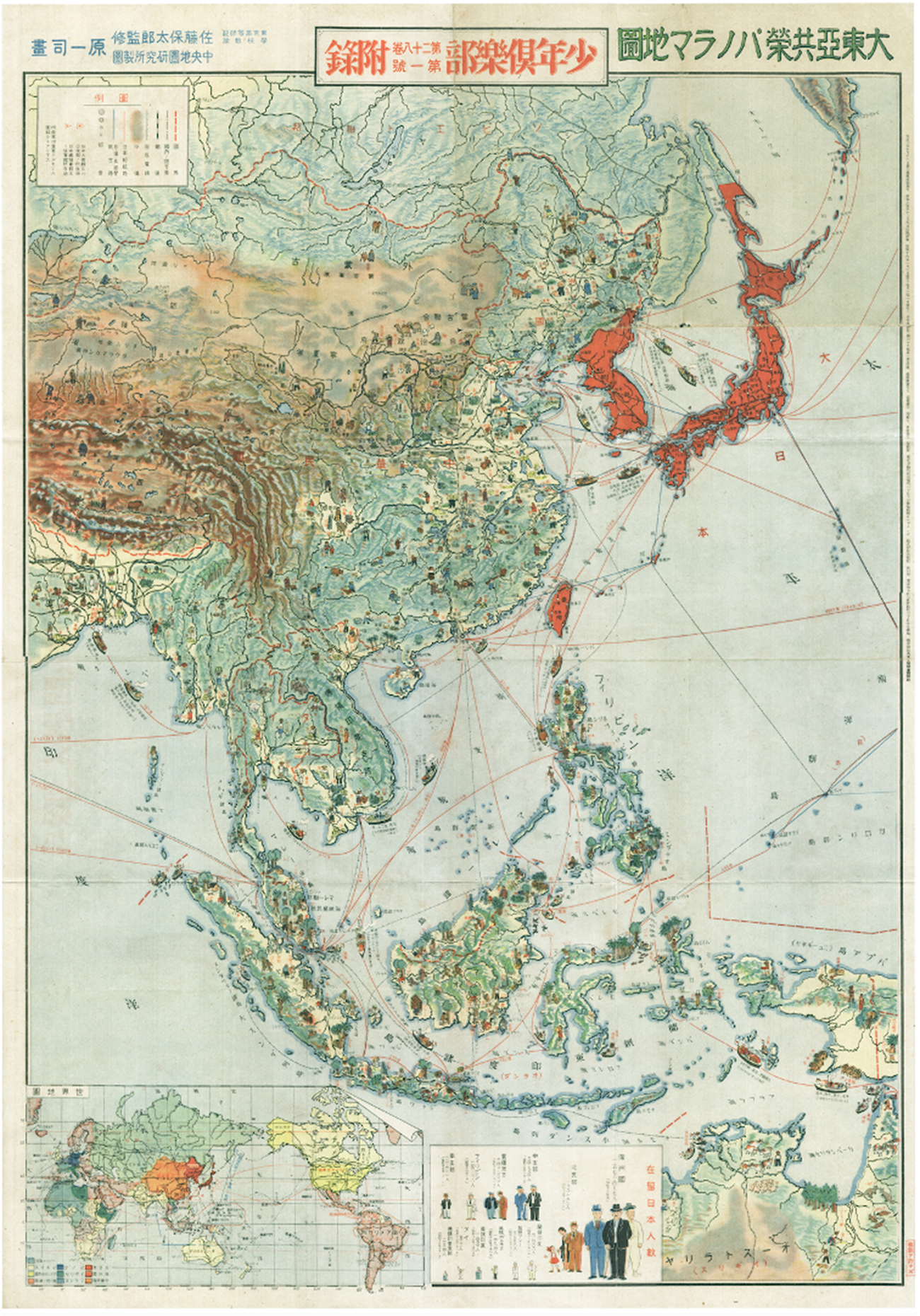
From the 1930s interest in Southeast Asia suddenly increased and peaked in the 1940s. When the war approached, the study of Southeast Asia inevitably accompanied ideologies of the ‘Greater East Asia Co-Prosperity Sphere’ that put Japan at the centre of the narrative. Yokoi studied pre-war geography textbooks and concluded that during the pre-war period, Southeast Asia in geography textbooks was depicted as an abundant source of raw materials, a market for Japanese products, and a destination for Japan’s economic expansion (Figure 1). The main message was that Japan was the (only) leader of Asia, able to stand shoulder-to-shoulder with Western powers. In this portrayal, Japan came to the region with guidance and assistance and introduced the concept of the Greater East Asia Co-Prosperity Sphere to Southeast Asia. This depiction positioned Southeast Asia in a subordinate role, serving as a part of wartime propaganda (p. 49).Footnote 11
Children’s Map of Southeast Asia (1941) showing Japanese territory in RedFootnote 12

Figure 1 Long description
The map is a historical depiction from 1941, illustrating East and Southeast Asia with Japanese-controlled areas marked in red. It covers regions including Japan, China, Korea and various Southeast Asian countries. The map is oriented with north at the top. Major geographic features such as mountains and rivers are detailed. Key labeled locations include Japan, China and Korea. The red shading indicates Japanese territorial extent. Lines on the map represent possible routes or boundaries, as indicated by the legend. Inset maps focus on specific areas, providing additional geographic context. The map serves as a political representation of Japanese influence in the region during this period.
The Youth Club’s Panorama Children’s Map published in 1941 starkly illustrates Japan and its colonies—Korea and Taiwan—as barren orange land, contrasting with the lush East Asia and Southeast Asia marked with the names of abundant natural resources. This is a poignant reflection of the strategic importance of the region. In November of the same year, the Institute of Oriental Culture (later renamed as the Institute for Advanced Studies on Asia), was established at the University of Tokyo, with the mission to conduct a ‘comprehensive study of historical and contemporary problems of the Orient’ (p. 5).Footnote 13 However, this occurred just two weeks before the Pearl Harbor attack and Japan’s subsequent occupation of Southeast Asia.
The war ended with Japan’s defeat, which diminished Japanese political aspirations toward Asia in general (p. 9).8 From the end of WWII to the mid-1960s, scholars across various fields in Southeast Asian studies observed that the majority of Japanese publications were merely ‘rehashes of English-language work’ (Nagazumi p. 6; Takigawa p. 2; Takahashi p. 18).8,Footnote 14 , Footnote 15 However, there is also evidence that Southeast Asian studies had been both encouraged and accelerated through a degree of ideological charge, spanning the political spectrum.Footnote 16
Southeast Asia held different connotations for the political left and right in Japan. For those aligned with the establishment, the region’s image was shaped by the geopolitical influence of the United States and its Cold War global narrative. Japan positioned itself as a bastion of anti-communist strategy, and thus lost access to the Chinese market. In this context, Southeast Asia became an important resource and market (p. 179).Footnote 17 Interest in Southeast Asia surged further after Finance Minister Ikeda Hayato’s 1952 statement on the joint US-Japan development of Southeast Asia. Prime Minister Yoshida Shigeru once emphasised that ‘a prosperous Southeast Asia’ was the best antidote against the spread of communism (p. 87).Footnote 18 Subsequently, Japanese economic assistance poured into the region from the 1960s.
In the midst of confusion in the 1950s, left-wing progressives began questioning what had gone wrong in Japan during World War II.Footnote 19 Asia became an ideology and ideal for these scholars. For some Marxist theorists and modernists, avoiding Asiaticness became crucial to achieving a modern mentality.Footnote 20 For others, Asia symbolises hope, liberation, autonomy and peace. This sentiment was particularly strong after the 1955 Asian-African Conference in Bandung, Indonesia. Unlike the pre-war era when Japan positioned itself at the centre of Asian liberation, this time Asian leaders became sources of inspiration for Japan.20 However, both perspectives remained problematic as they detached the intrinsic understanding of Asia from everyday realities.
It might not be an overstatement to say that despite its early conception, there was seldom a direct glance to the region. It was often either looking at the region through other given lenses or looking through the region for something else. Southeast Asia has consistently been seen as instrumental in achieving what Japan perceived as its intrinsic interests, whether political, economic or academic.
It was not until the 1960s that the institutions forming the foundations of Southeast Asian Studies in Japan began to flourish. The Institute of Developing Economies, established in 1958, was a pioneering effort aimed at enhancing Japanese trade relations with developing areas in Asia.20 However, the pivotal moment that shaped the future of the field came with the establishment of the Center for Southeast Asian Studies (CSEAS) at Kyoto University in 1963, funded with a grant of 350,000 USD from the Ford Foundation (Nagazumi p.13; Hayami p. 67).8,10
A distinctive feature of Southeast Asian Studies in Japan was its inclusion of natural scientists such as agronomists, foresters, and biomedical specialists (p. 67).10 Interdisciplinary teamwork on projects like the Don Deang Village study in Thailand became landmarks for the centre, contributing to the emergence of renowned Southeast Asian scholars. Notable figures like Ishii Yoneo and Sakurai Yumio were associated with these initiatives.
The centre conducted extensive individual and collaborative research across Southeast Asian countries, facilitating the exchange of young specialists and hosting visiting foreign scholars. In 1964, the Institute for the Study of Language and Cultures of Asia and Africa (ILCAA) was established as an affiliate of Tokyo University of Foreign Studies. By 1966, what began as a branch of the Study Group of the History of the South Seas (南方史研究会) had evolved into the Japan Society for Southeast Asian History (JSSEAS or the Tōnan Ajia Gakkai, in Japanese). This society remains active today, boasting over 750 members as of December 2015, encompassing historians, archaeologists, anthropologists, linguists, and other social scientists.Footnote 21
The general interest in Southeast Asia grew in tandem with Japan’s economic expansion and its increasing economic ties with the region. However, this rapid growth also sparked anti-Japanese movements in Thailand, Indonesia and the Philippines. These sentiments and movements came as a shock to the Japanese public, leading to a realisation about their ignorance of Asia, especially Southeast Asia. In 1972, the Asahi Journal published a special issue titled ‘We Know Nothing About Asia,’ and anti-Japanese sentiments became an important keyword in Southeast Asian Studies in the 1970s.Footnote 22
Starting from the 1970s, it became standard practice for Japanese Southeast Asian scholars to immerse themselves in the region, learning local languages during prolonged stays. This marked a significant departure from earlier scholars who primarily relied on Chinese and Western literature. Nagazumi Akira, one of Japan’s foremost historians of Southeast Asia, noted that the postwar prevalence of Marxist historical interpretation and cultural anthropology, coupled with successful agrarian surveys conducted even before World War II, led to the conclusion that for truly original research, Japanese scholars should ‘focus on village communities over major cities, local economies over national politics, and class differentiation over national integration’ (p. 10).8 This shift might explain why rural community (農村) became an increasingly important research keyword in the 1970sFootnote 23 and the source of grassroots solidarity movements in the 1980s,Footnote 24 which would bear fruit in subsequent decades.20
Unlike the academic landscape in the US, interest in Southeast Asian studies among younger scholars and students in Japan did not diminish after the end of the Cold War. Countless publications on Southeast Asia emerged from the 1990s onward. A notable series is the ‘Lectures on the studies of Southeast Asia’ (講座 東南アジア学) edited by Yano Tōru, comprising 11 volumes with 144 academic papers contributed by 85 scholars (p. 280).Footnote 25 This series covers a wide array of topics including politics, society, philosophy, economies, nature, international relations and research methodology. From 2001 to 2003, Iwanami Publisher released the Iwanami’s lecture of Southeast Asian History (岩波講座東南アジア史), a series spanning 10 books that delve into various themes of Southeast Asian history, from the pre-modern to the development era. The series comprises 146 works contributed by 86 scholars.
Despite the vibrant state of Southeast Asian Studies in Japan during the 1990s and 2000s, Sakurai Yumio, a renowned historian specialising in Southeast Asia and Japan, offered a pessimistic assessment of the field in 2009:
As economic ties between Japan and Southeast Asia have strengthened, public interest in humanities and social sciences has declined, it has become clear that “Southeast Asia, where anyone can go, has become a Southeast Asia where no one studies”. (p. 38)Footnote 26
It was not coincidental that during this period, the academic association changed its name from ‘The Japan Society for Southeast Asian History’ (東南アジア史学会) to ‘The Japan Society for Southeast Asian Studies’ (東南アジア学会). This change was likely aimed at fostering a more inclusive and integrated Southeast Asian studies community (p. 50).Footnote 27
Current Japanese research on Southeast Asian history stands out as world-class. This achievement is the result of dedicated efforts by numerous scholars in the last decades. Conceptual frameworks grounded in empirical research, local language sources and extensive fieldwork have brought Japanese scholarship closer to the realities of the region. The interdisciplinary approach, integrating natural sciences, social sciences and humanities, has become a hallmark strength of Japanese scholarship in Southeast Asian studies.10,Footnote 28
However, the nature of field studies also brought limitations. The emphasis on language acquisition and community studies, especially in anthropology, often resulted in a tendency towards single-country studies and a narrow focus on specific subjects as units of study. Another recurring concern raised by scholars across different periods and countries was the one-sided consumer role of Japanese Southeast Asianists (Hayami p. 72; Yu p. 104; Bi p. 33).11,10,28 According to a survey by Saito Shiro, between 1945 and 1991, Japan produced at least 2,640 English-language publications.Footnote 29 In contrast, based on the bibliography database collected by JSSEAS, there were over 5,000 Japanese-language publications from 1975 to 1990, and another 5,000 in the 1990s alone.23 They consumed English-language works but did not produce enough of their own; and produced Japanese works which were rarely read outside Japan.
We now turn to the central question of this paper: with robust scholarly traditions in Japan and a significant domestic market for Southeast Asia-related knowledge, why do Japanese people still know so little about this region? Sakurai’s comments above pointing out that there seems to be a discrepancy between qualitative and quantitative interests and a significant gap between scholarly and public interest in the region provides a starting point.
Discussing the gap between research and education
Active scholarly activities do not necessarily enhance public interest or knowledge about specific issues. One important bottleneck is pre-college education. The basic high school curriculum does not cover enough material on Southeast Asia.
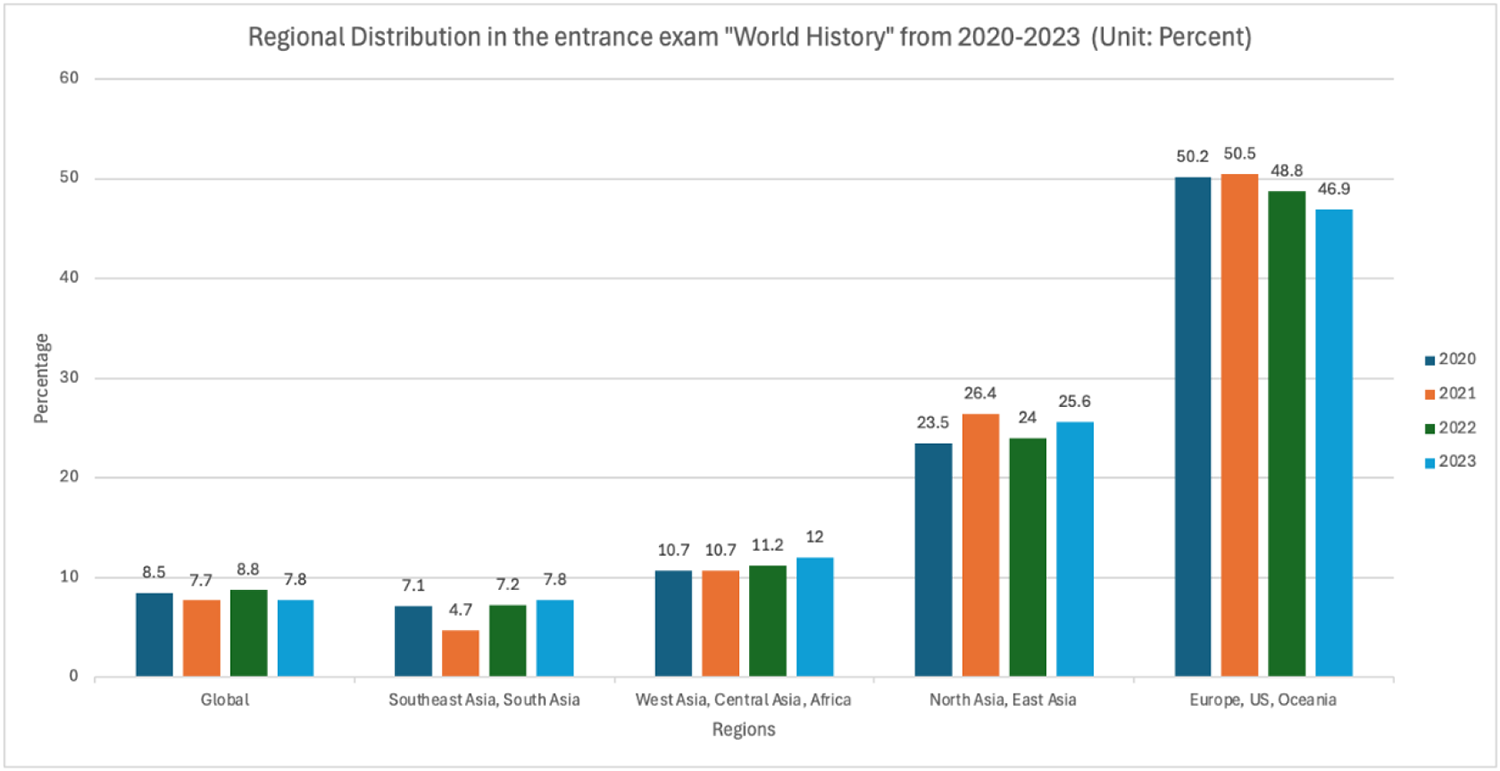
University entrance examinations largely determine the coverage of each geographical region in world history or geography. As Figure 2 shows the regional distribution in Japan’s world history subject indicates that South and Southeast Asia collectively account for approximately 8 per cent of all exam problems in the subject, according to data from the 2023 national university entrance exam analyses published by Obunsha.Footnote 30 While there has been a slight increase from 2021 to 2023 in the percentage dedicated to Southeast Asia, the dominant areas covered are still China and Europe. The 2012 survey on the attitudes of high school teachers by Nakamura also revealed that Southeast Asia is perceived as a complex, minor and hard-to-teach region. More time was devoted to teaching Chinese and European history, partly because teachers are more familiar with these regions and their histories appear more frequently in textbooks and entrance exams (pp. 57–60).Footnote 31 Although we cannot find a more recent survey on high school teachers’ opinions, the regional distribution in recent entrance exams might indicate that Nakamura’s findings are still relevant.
Regional Distribution in the Entrance Exam ‘World History’ from 2020-2023

Figure 2 Long description
The grouped bar graph title reads Regional Distribution in the entrance exam left parenthesis double quote World History double quote right parenthesis from 2020 dash 2023 left parenthesis Unit colon Percent right parenthesis. A legend lists 2020 comma 2021 comma 2022 comma 2023. The y axis label reads Percent. The y axis ranges from 0 to 60. The x axis shows six category labels: Global; Southeast Asia comma South Asia; West Asia comma Central Asia; North Asia comma East Asia; North Africa comma Sub dash Saharan Africa; Europe comma U S comma Oceania. Bar values by category and year: Global: 2020 equals 8.5; 2021 equals 7.7; 2022 equals 8.2; 2023 equals 7.9. Southeast Asia comma South Asia: 2020 equals 7.5; 2021 equals 7.3; 2022 equals 7.8; 2023 equals 8.0. West Asia comma Central Asia: 2020 equals 11.7; 2021 equals 10.7; 2022 equals 11.2; 2023 equals 10.6. North Asia comma East Asia: 2020 equals 29.4; 2021 equals 29.5; 2022 equals 28.4; 2023 equals 30.0. North Africa comma Sub dash Saharan Africa: 2020 equals 4.0; 2021 equals 4.0; 2022 equals 4.0; 2023 equals 4.0. Europe comma U S comma Oceania: 2020 equals 50.2; 2021 equals 50.0; 2022 equals 49.8; 2023 equals 46.3.
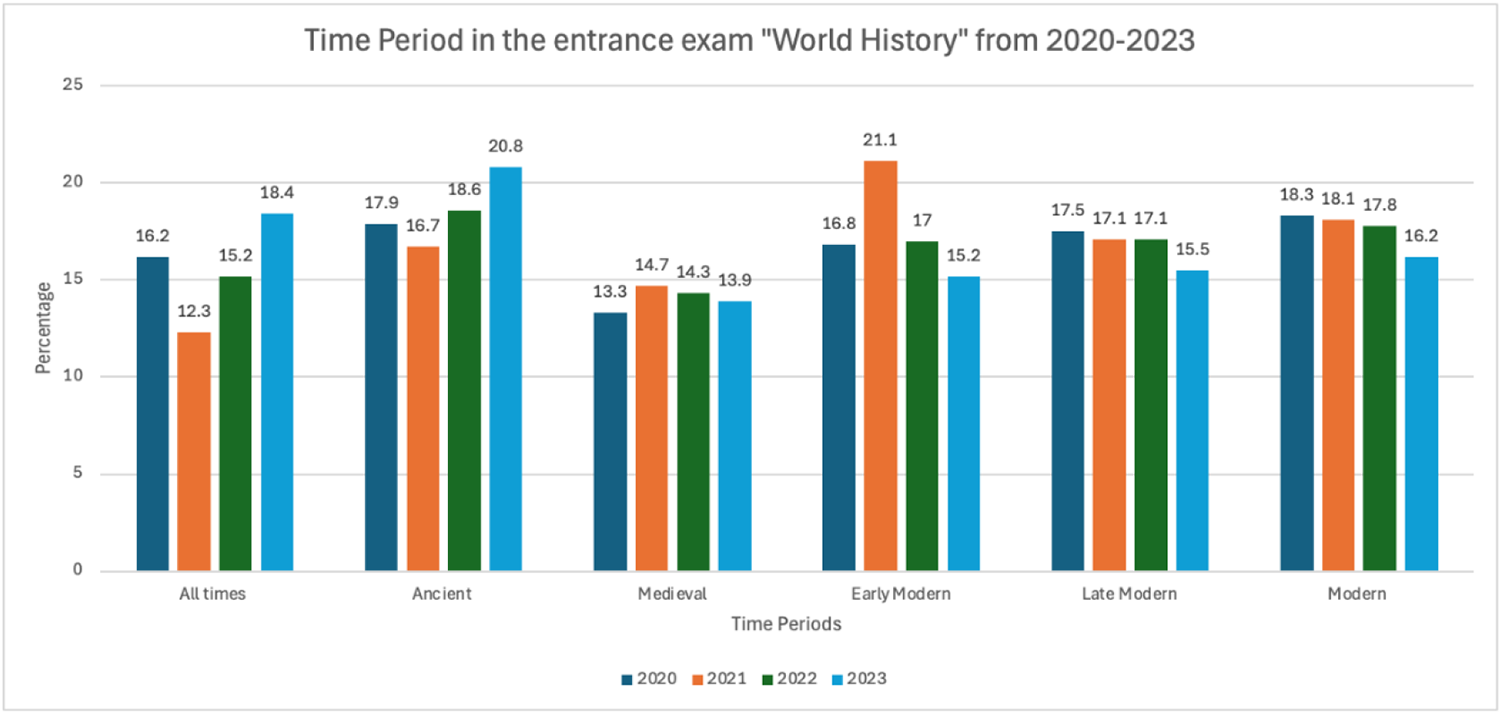
Additionally, as shown in Figure 3, less than 20 per cent of the topics focus on the modern era, which covers the twentieth century onward. More than 80 per cent of the content is about historical periods. While some may view this as a well-balanced distribution of time periods, this approach to learning history might arguably detach it from our understanding of current affairs.Footnote 32 If one important goal of learning history is to help students understand the present, the lack of emphasis on modern history might suggest a weak connection or even a disconnect between the students and the history they are studying. As a result, history could become a subject of memorisation, seemingly irrelevant to their lives.
Time Period in the Entrance Exam ‘World History’ from 2020-2023

Figure 3 Long description
Time Period in the entrance exam comma World History comma from 2020 dash 2023. Grouped bar graph with four bars per category. Horizontal axis label: Time Periods. Categories: All times, Ancient, Medieval, Early Modern, Late Modern, Modern. Vertical axis label: Percentage. Range 0 to 25. Legend: 2020, 2021, 2022, 2023. All times: 2020 equals 18.2, 2021 equals 12.3, 2022 equals 20.4, 2023 equals 18.4. Ancient: 2020 equals 17.5, 2021 equals 17.5, 2022 equals 17.5, 2023 equals 20.8. Medieval: 2020 equals 13.3, 2021 equals 14.1, 2022 equals 13.9, 2023 equals 13.9. Early Modern: 2020 equals 21.5, 2021 equals 17.5, 2022 equals 16.2, 2023 equals 14.8. Late Modern: 2020 equals 17.5, 2021 equals 17.5, 2022 equals 17.5, 2023 equals 16.2. Modern: 2020 equals 18.2, 2021 equals 18.2, 2022 equals 17.5, 2023 equals 16.2.
Then why is insufficient focus on modern history and Southeast Asia a problem? We consider this to be important as it dilutes the opportunity for deeper reflection on the history of Japanese engagement with its Asian neighbours, especially during World War II and the Cold War. The most dominant narrative of World War II history is what political scientist Kiichi Fujiwara called the Hiroshima Discourse.Footnote 36 Although it acknowledges that Japan initiated a war of aggression, the narrative primarily centres on the suffering of Japanese civilians who endured military control, food rationing, air raids and the atrocities of the atomic bombs—disasters caused by a handful of irresponsible militarists. The portrayal of Japan as a military aggressor is less emphasised.
Through teaching the first author’s course on war perceptions in East and Southeast Asian countries, it became evident that while all students were well aware of Hiroshima, and most had heard of the Nanjing Atrocity, only a few knew about the Bataan Death March in the Philippines, the Sook Ching campaign in Singapore, or the Thai-Burma Railway. Emphasising what happened in Hiroshima is crucial and serves as an important part of peace education in Japan, but it should not be decontextualised from what was happening in Nanjing, Bataan and Kanchanaburi. In A Walk Through War Memories in Southeast Asia, Hayase summarised his view on historical awareness in Japan as:
Was it wrong to fight to protect our country and families? Nobody thinks it was wrong. What is lacking here is the recognition that what we consider precious, be it family, friends, history, or culture, also existed in the people we fought against…These peoples, particularly in the Southeast Asian countries, were involuntarily involved in the war between Japan and the European/American countries…The Japanese who experienced air raids and atomic bombs should be able to understand and share the same feelings with the people of Southeast Asia. Then, we are able to think about the war and our experiences together. (p. 171-174)Footnote 37
Thinking about our experience together should be regarded as an important part of history education. By decontextualising Hiroshima from Nanjing, Bataan and Kanchanaburi, students’ understanding of the war can become very partial and biased. This not only hinders their grasp of the historical involvement and current affairs of the region but also impairs their understanding of the sentiments of Asian people toward Japan, which is a crucial aspect of Asian literacy. Without sensitivity and understanding toward the region that Japan claims to be a part of, how can it build a healthy relationship with it? The neglect of shared experiences from historical periods, such as war, leads to a wasted opportunity to use educational resources for peace, especially amidst growing tendencies toward nationalism.Footnote 38
The second avenue pertains to implicit attitudes and the psychology of favouring Western countries over Asian countries.Footnote 39 As previously mentioned, the annual opinion poll conducted by the Cabinet Office in 2023 reported that over 70 per cent of the general public feels an affinity toward Southeast Asia.1 Despite this general popularity, as highlighted earlier, the lack of knowledge about the region requires explanation. Paradoxically, the fact that people know so little could contribute to their affinity for the region.
What people often know about Southeast Asia tends to revolve around tourist attractions, exotic cuisine, cultural elements and its role as a convenient market for resources, reinforcing Japanese self-perceptions as superior providers of technology and aid to the region. These superficial and instrumental understandings may explain the gap between affinity and knowledge. The ignorance and arrogance of Japanese people felt by other Asian neighbours has a long history. In 1970, there was a publication titled Fat Japanese (太った日本人), a parody of Ugly Americans, which included some empirical studies on perception issues.Footnote 40
The perception problem did not end there. Throughout the 1980s and 1990s, scholars from various fields, including Akagi Osamu, Koizumi Masao and Yokoi Kaori, consistently highlighted the issue of peripheral, stereotyped and discriminatory images of Southeast Asia that have persisted since the pre-war period. Southeast Asia continued to be portrayed as dirty, least developed, or a poor region in need of Japanese assistance. For example, Koizumi (p. 252)Footnote 41 pointed out that ‘Unfortunately, our lack of understanding of Southeast Asia and our pattern of contempt has not changed much since before the war. Furthermore, new misunderstandings and prejudices that did not exist during the wartime period have also emerged’. Hashiya (p. 63)Footnote 42 expressed a similar concern: ‘In a sense, we cannot escape the inheritance from the pre-war period, as patterns from before the war continue to reappear in the views and behaviour patterns of Japanese people in Southeast Asia today’.
Yokoi Kaori compared the keywords used in geography textbooks from the pre-war and postwar periods and concluded that they almost overlap. Both periods’ textbooks include keywords such as: rich nature, various ethnic groups, languages, religions and different lifestyles, agriculture, abundant forest resources and underground resources, industrialisation policy, and economic ties between Japan and Southeast Asia (p. 51).11 Yokoi concluded that in both pre-war and postwar periods, Southeast Asia is viewed from the paternalistic perspective of a bigger power, lacking intrinsic perspectives (p. 52).11
Based on our experience teaching undergraduate classes about Southeast Asia at Japanese universities, it seems that this mentality has persisted even into the 2020s. The word intimacy in the opinion survey results might stem from instrumental interests rather than intrinsic ones, while stereotyped and discriminatory images of Southeast Asia have not disappeared.
The third point is about the way research and education has been reproduced in Japanese universities, especially those of the elite schools where graduate students are trained to become the next generation of scholars. The main academic centres on Southeast Asian Studies in Japan have been housed in research institutes rather than teaching departments. The CSEAS in Kyoto University and Institute for Advanced Studies on Asia at the University of Tokyo are prime examples. Advising graduate students is often considered subsidiary to their main function of research. Also, aside from Kyoto, most Asian studies institutes are made up of China specialists.
Knowing little is fine. We have limited knowledge of almost anything in the world. Yet, lacking the willingness to know and to teach is problematic. Because it leads to a biased worldview. If Japanese students are only interested in learning about the Western world, that will create a very limited image of the globe. It is a pity also since Japan and Southeast Asia are geographically and historically close to each other.
Conclusion
Given the persistent gap between advanced scholarly research and relatively poor general knowledge of the public, one may hasten to propose a new educational program on Southeast Asia at the college level or suggest any changes to the high school curriculum. The section above confirms that the issue does not lie in simply adding more information about Southeast Asia to the educational curriculum. Instead, we point to a structural issue that lies between the production and consumption of knowledge about Southeast Asia.
Perhaps, Japanese people do not know enough about any parts of the world, not just Southeast Asia. Yet there is no excuse to leave the gap as it is. As of June 2024, there are over 600,000 Vietnamese and over 300,000 Filipinos who have long-term residency in Japan.Footnote 43 An important step toward filling this gap, therefore, is to enhance our self-awareness of how Southeast Asia is already embedded in the daily lives of people in Japan. One critical aspect of this is the growing population of Southeast Asian nationals in Japan, who are increasingly becoming an indispensable part of the labour force. This demographic shift necessitates a new awareness and understanding of Southeast Asian cultures, languages and perspectives within Japanese society.
A parallel development is the rising number of Japanese youths pursuing college degrees in Southeast Asia, mainly in Singapore and Malaysia. Due to the higher costs of studying abroad in the US and UK, certain Southeast Asian universities have become cost-effective destinations to study English-medium programmes. The survey conducted by JASSO in 2024 indicated that Thailand placed sixth and the Philippines placed 10th among the popular destinations for study abroad, almost equal to the number of students going to the UK.Footnote 44 For short-term study abroad, Asia is more popular than the US. This trend might help to reduce the gap between perception and knowledge.
Meanwhile, Southeast Asian scholars must represent the region in ways that connect with Japanese society beyond tourism. Revisiting the anti-Japanese movements of the 1970s, for instance, can add historical and ethical depth to contemporary travel experiences. As global crises—climate change, depopulation, pandemics and geopolitical instability—transcend borders, Southeast Asia can no longer be perceived as other.Footnote 45 Addressing regional challenges now directly intersects with Japan’s national concerns.
Our conclusion, again, is not a call for the addition of discrete subjects such as history, geography and area studies in the education of Southeast Asia. Such additions are always welcome, but will do little to reduce the fundamental gap that we discussed above. Instead, we advocate for knowledge that is immersed in and integral to Japanese life. That is, the Japanese need to discover and generate the image of Southeast Asia in themselves, whether through convenience store trainees in the neighbourhood, classmates or coworkers. Ultimately, scholars must step beyond disciplinary silos and foster connections between Southeast Asian studies and the broader fabric of Japanese life. Only through such integration can the gap between image and knowledge begin to close.

 Open access

