Introduction
Fish parasites have been used increasingly as biological tags to indicate various aspects of the natural history of their hosts. During the past decade the major goals in the study of parasite fauna of fish have included the assessment of fish stocks, their movement, feeding habits, and recruitment. The use of parasites to discriminate among fish host populations is becoming one of the most useful approaches in multidisciplinary studies concerning fish stock delimitation and characterization. Indeed, the modern concept of ‘fish stock’ integrates all the information gathered from a broad spectrum of methodologies, ranging from morphology (morphometric, meristics, otolith microchemistry) to the biology (life-history characteristics, mark–recapture, parasites) and population genetics [inferred from allozymes, microsatellites, mitochondrial DNA (mtDNA) sequences analysis, etc.] of the fish species, throughout its geographical range. As part of this ‘holistic’ definition of fish stock (Begg & Waldman, Reference Begg and Waldman1999), the use of parasites as ‘biological tags’ has become a useful tool among the biological approaches, mainly concerning species with a high commercial value in fisheries. Trends in the use of parasites as biological tags in population studies of marine fish species were reviewed recently (MacKenzie, Reference MacKenzie2002). Among the parasite species that have been used in fish stock characterization, the anisakid nematodes of the genus Anisakis, genetically identified at species level by allozyme markers, have provided useful information for fish stock identification in a multidisciplinary approach (Mattiucci et al., Reference Mattiucci, Abaunza, Ramadori and Nascetti2004). These genetic markers were first used to differentiate populations of herring Clupea harengus L. in the North Atlantic, on the basis of different allozyme frequencies observed at one enzymatic locus in Anisakis larvae collected from this fish host (Beverly-Burton et al., Reference Beverly-Burton, Nyman and Pippy1977).
Genetic markers inferred from multilocus allozyme electrophoresis have: (1) shown that A. simplex (sensu Davey, Reference Davey1971) is a complex of reproductively isolated, morphologically very similar, sibling species: A. simplex sensu stricto, A. pegreffii and A. simplex C (Nascetti et al., Reference Nascetti, Paggi, Orecchia, Smith, Mattiucci and Bullini1986; Mattiucci et al., Reference Mattiucci, Nascetti, Cianchi, Paggi, Arduino, Margolis, Brattey, Webb, D'Amelio, Orecchia and Bullini1997, Reference Mattiucci, Paggi, Nascetti, Ishikura, Kikuchi, Sato, Cianchi and Bullini1998); (2) confirmed species distinction and assessed the genetic divergence of A. physeteris (Mattiucci et al., Reference Mattiucci, Nascetti, Bullini, Orecchia and Paggi1986) and A. typica (Mattiucci et al., Reference Mattiucci, Paggi, Nascetti, Portes Santos, Costa, Di Beneditto, Ramos, Argyrou, Cianchi and Bullini2002); (3) demonstrated that A. brevispiculata, synonymized with A. physeteris, is a distinct species, reproductively isolated from A. physeteris (Mattiucci et al., Reference Mattiucci, Paggi, Nascetti, Abollo, Webb, Pascual, Cianchi and Bullini2001); and (4) allowed the discovery and description of new species, such as A. ziphidarum (Paggi et al., Reference Paggi, Nascetti, Webb, Mattiucci, Cianchi and Bullini1998), A. paggiae (Mattiucci et al., Reference Mattiucci, Nascetti, Dailey, Webb, Cianchi and Bullini2005) and Anisakis sp. (Mattiucci & Nascetti, Reference Mattiucci and Nascetti2006; Valentini et al., Reference Valentini, Mattiucci, Bondanelli, Webb, Mignucci-Giannone, Colom-Llavina and Nascetti2006).
Progress in molecular systematics has also expanded the use of other molecular markers, to: (1) recognize species of Anisakis using internal transcribed spacer (ITS)-restriction fragment length polymorphism (RFLP) (D'Amelio et al., Reference D'Amelio, Mathiopoulos, Santos, Pugachev, Webb, Picanco and Paggi2000) and sequences of the nuclear large subunit ribosomal DNA (LSU rDNA) (Nadler et al., Reference Nadler, D'Amelio, Dailey, Paggi, Siu and Sakanari2005) and mtDNA cox-2 (Valentini et al., Reference Valentini, Mattiucci, Bondanelli, Webb, Mignucci-Giannone, Colom-Llavina and Nascetti2006); (2) establish genetic relationships among the Anisakis spp. inferred from sequence analysis of the LSU rDNA (Nadler et al., Reference Nadler, D'Amelio, Dailey, Paggi, Siu and Sakanari2005) and mtDNA cox-2 (Valentini et al., Reference Valentini, Mattiucci, Bondanelli, Webb, Mignucci-Giannone, Colom-Llavina and Nascetti2006), in comparison with those inferred from allozyme markers (Mattiucci & Nascetti, Reference Mattiucci and Nascetti2006; Valentini et al., Reference Valentini, Mattiucci, Bondanelli, Webb, Mignucci-Giannone, Colom-Llavina and Nascetti2006); and (3) suggest host–parasite co-evolutionary aspects between this group of anisakid nematodes and their definitive hosts (Mattiucci & Nascetti, Reference Mattiucci and Nascetti2006).
Alleles at diagnostic enzyme loci among the distinct Anisakis spp. have been provided for an easy and reliable identification of the parasites at any stage of their life history. Indeed, it has been shown that Anisakis larvae Type I (sensu Berland, Reference Berland1961) comprises the larval stages of six distinct species: A. simplex (s.s.), A. pegreffii, A. simplex C, A. typica, A. ziphidarum and Anisakis sp. (Mattiucci et al., Reference Mattiucci, Nascetti, Dailey, Webb, Cianchi and Bullini2005; Valentini et al., Reference Valentini, Mattiucci, Bondanelli, Webb, Mignucci-Giannone, Colom-Llavina and Nascetti2006), while in Anisakis Type II (sensu Berland, Reference Berland1961) three species are included so far: A. physeteris, A. brevispiculata and A. paggiae (Mattiucci et al., Reference Mattiucci, Nascetti, Dailey, Webb, Cianchi and Bullini2005). These markers proved to be very useful in the identification of large numbers of Anisakis larvae, collected from several intermediate/paratenic hosts (fish and squids) (Mattiucci & Nascetti, Reference Mattiucci and Nascetti2006).
The nine species of Anisakis recognized so far are not only clearly distinct genetically, but they are also differentiated at ecological level, including host preference and geographical aspects (Mattiucci & Nascetti, Reference Mattiucci and Nascetti2006). Differences in the biogeography of species of Anisakis identified genetically represent the baseline for the use of these parasites as biological indicators of origin and migration routes of their fish host.
So far, among the nine species of Anisakis, those detected genetically by allozyme markers in some demersal and pelagic fish species from Atlantic European waters and in the Mediterranean Sea, are the following: A. simplex (s.s.), A. pegreffii, A. ziphidarum, A. physeteris, A. brevispiculata, and a further taxon indicated as Anisakis sp. (Mattiucci & Nascetti, Reference Mattiucci and Nascetti2006).
In this paper, the differential proportions and assemblages shown by different species of Anisakis at the larval stage, recognized by means of allozyme markers, in demersal species (the European hake Merluccius merluccius) and small pelagic fish species (the horse mackerel Trachurus trachurus) throughout their geographical range, are reviewed and compared. Moreover, data obtained on the genetic identification of Anisakis larvae from a large pelagic fish species (the swordfish Xiphias gladius) are herein newly presented. Finally, congruence and discordant aspects of parasitological data with genetic results inferred from allozyme markers on the same fish populations are discussed.
Materials and methods
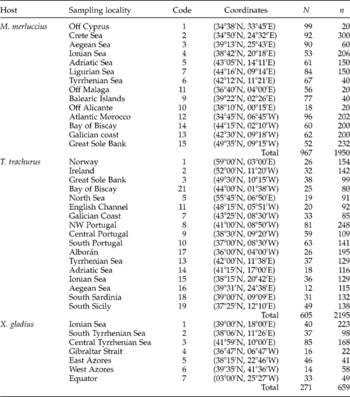
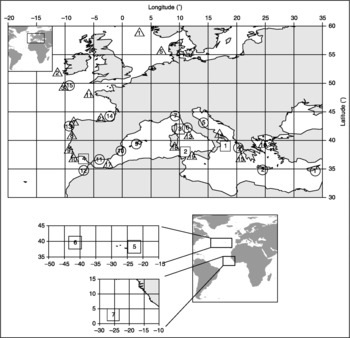
Anisakis larvae Types I and II were collected during a parasitological survey performed on 967 specimens of M. merluccius from 14 localities in the Mediterranean Sea and north-east Atlantic Ocean, 605 specimens of T. trachurus from 17 sampling localities in the north-east Atlantic Ocean and the Mediterranean Sea and, finally, 271 specimens of X. gladius from 7 different areas in Mediterranean Sea and north and central Atlantic Ocean (table 1 and fig. 1). The sampling was performed for the three fish species during different periods: 1998–1999, 2000–2001 and 2003–2006 for European hake, horse mackerel and swordfish, respectively.
Sampling localities of Merluccius merluccius, Trachurus trachurus and Xiphias gladius with their code. N=number of fish examined; n=number of Anisakis genetically identified.

Sampling localities of the three fish species (□ = X. gladius; ○ = M. merluccius; Δ = T. trachurus). Sampling codes and coordinates are reported in table 1 (graphical elaboration: by SURFER Version 7.02©-1999; Surface Mapping System, Golden Software Inc.).

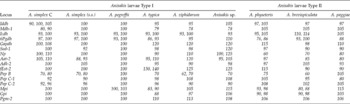
After capture, all the fish were frozen at − 20 °C for parasitological analysis. Anisakis larvae were washed in saline solution and stored in Eppendorf tubes at − 70 °C. They were identified at species level by using genetic markers (20 enzyme loci) obtained from multilocus allozyme electrophoresis (MAE) following the procedures by Nascetti et al. (Reference Nascetti, Paggi, Orecchia, Smith, Mattiucci and Bullini1986) and Mattiucci et al. (Reference Mattiucci, Nascetti, Cianchi, Paggi, Arduino, Margolis, Brattey, Webb, D'Amelio, Orecchia and Bullini1997, Reference Mattiucci, Nascetti, Dailey, Webb, Cianchi and Bullini2005). The alleles at the enzyme loci found to be diagnostic for the Anisakis species so far characterized genetically (table 2) were used to identify a subsample of all the Anisakis larvae collected from each infected fish of the three host species. A total of 1950, 2195 and 659 Anisakis larvae collected from M. merluccius, T. trachurus and X. gladius, respectively, from the sampling localities of the Atlantic Ocean and Mediterranean Sea (fig. 1), were identified genetically at species level.
Genetic markers between the species of Anisakis spp. larvae so far genetically characterized (data from Mattiucci & Nascetti, Reference Mattiucci and Nascetti2006 and present paper).

The statistical significance of the differences observed in the relative proportions of the Anisakis spp. identified between sampling localities was tested by the χ2-test and Fisher's exact test, according to Rósza et al. (Reference Rósza, Reiczigel and Majoros2000). Differences were considered to be significant when P < 0.05. Discriminant analysis (canonical discriminant function) was performed on each infected host by the species of Anisakis, in the different sampling localities, to describe the differences among different well-defined groups and predict the likelihood that an entity of unknown origin will belong to a particular group, based on discriminating characteristics (Legendre & Legendre, Reference Legendre and Legendre1998; McGarigal et al., Reference McGarigal, Cushman and Stafford2000; Martinez & Martinez, Reference Martinez and Martinez2005). Contingency χ2 analysis was performed to determine differences of the relative proportions of distinct species of Anisakis in the fish collected from the same sampling locality, when captured in different years. Differences were considered to be significant when P < 0.05. All analyses were conducted with the statistical software SPSS 14.0 (SPSS Inc., Chicago, Illinois, USA). Fish samples showing < 5 host specimens infected by Anisakis spp were not included in the analysis.
Results
The case of European hake Merluccius merluccius
The genetic markers (allozymes) allowed the recognition in this demersal fish host of seven species of Anisakis: A. pegreffii, A. simplex (s.s.), A. typica, A. ziphidarum (showing the morphotype Type I), and A. physeteris, A. brevispiculata and A. paggiae (showing the morphotype Type II) (Mattiucci et al., Reference Mattiucci, Abaunza, Ramadori and Nascetti2004). A. paggiae Mattiucci et al., Reference Mattiucci, Nascetti, Dailey, Webb, Cianchi and Bullini2005, was previously indicated as Anisakis sp. in Mattiucci et al. (Reference Mattiucci, Abaunza, Ramadori and Nascetti2004).
No statistically significant differences were found between the relative proportions of the different species of Anisakis found in hakes collected from the same locality when sampled in the two different periods (years 2000 and 2001): as a consequence, the data were pooled (fig. 2a).
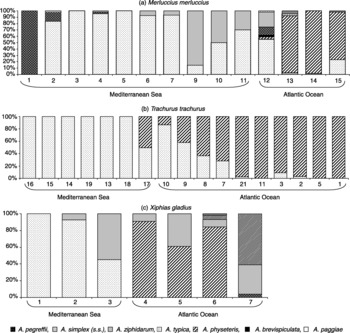
Relative proportions of the Anisakis spp. genetically identified in: (a) Merluccius merluccius; (b) Trachurus trachurus; and (c) Xiphias gladius.

On the contrary, the seven species of Anisakis, genetically detected, showed a significantly different distribution (P < 0.001) in hake samples from Mediterranean and Atlantic localities. A. pegreffii was the dominant species in all the Mediterranean samples, except in those from waters off Cyprus, which were parasitized only by A. typica, and off the Balearic Islands and Alicante, which were dominated by the presence of A. physeteris (fig. 2a). However, A. pegreffii was also found in mixed infections with A. simplex (s.s.) in M. merluccius sampled in Great Sole bank, Bay of Biscay and off the Spanish Galician coast (table 1 and fig. 2a). In contrast, A. simplex (s.s.) was found to be the dominant species in M. merluccius sampled in the north-east Atlantic; it was significantly less in the sample off the Atlantic coast of Morocco.
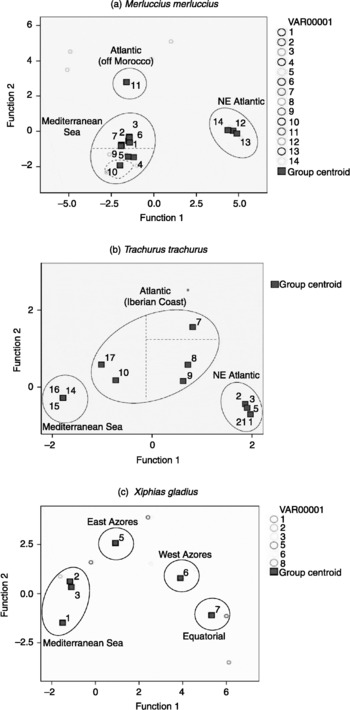
The discriminant analysis performed on the hakes infected by the different species of Anisakis showed two main groups classified by function 1 (71% variance), with a North Atlantic assemblage (including the areas 12, 13 and 14), well distinct from another cluster integrating all the fish captured in the sampling localities of the Mediterranean Sea (1, 2, 3, 4, 5, 6, 7, 8, 9, and 10) (table 1 and fig. 3a). In this last group, a slight sub-structuring was explained by function 2 (fig. 3a), showing three subgroups: one, including the samples 4 and 5 comprising all the fish captured from the Mediterranean Spanish coast, which were found to be infected mainly by A. physeteris (fig. 2a); the second distinguishing the hakes from Cyprus (locality no. 10) infected with only A. typica (figs 2a and 3a), and the remaining samples comprising all the fish captured from the other localities of the Mediterranean Sea. Another group was represented only by the fish captured along the north-west Atlantic coast, off Morocco (locality no. 11), well distinct from both the north-east Atlantic and Mediterranean groups (fig. 3a).
Canonical discriminant analysis for (a) Merluccius merluccius (function 1: 88%; 2: 11%); (b) Trachurus trachurus (function 1: 71.3%; 2: 14.3%); and (c) Xiphias gladius (function 1: 66.7%; 2: 18.9%). The group centroids represent the different sampling sites.

The case of horse mackerel Trachurus trachurus
In this small pelagic fish, five species of Anisakis: A. pegreffii, A. simplex (s.s.), A. typica (showing the morphotype Type I), A. physeteris and A. paggiae (showing the morphotype Type II) were identified genetically, throughout its geographical range.
Of the five species of Anisakis identified in T. trachurus, the two sibling species A. pegreffii and A. simplex (s.s.), were found to be the dominant species in all the fish samples, whereas A. physeteris and A. typica were identified at only very low percentages in two samples from the Mediterranean Sea (fig. 2b).
No statistically significant differences, at the contingency analysis, were found between the relative proportions exhibited by different larval Anisakis species in each fishing locality, when sampled in different periods (years 2000 and 2001). Therefore the distribution frequencies of Anisakis spp. were pooled (fig. 2b).
On the other hand, statistically significant differences (P < 0.001) were found in the comparison of the relative proportions of the different Anisakis spp. between north-east Atlantic and Mediterranean Sea horse mackerel samples (fig. 2b). Indeed, A. pegreffii was the main species parasitizing T. trachurus in the eastern Mediterranean Sea. Similarly, in the western Mediterranean Sea, A. pegreffii was the dominant species in all the fish examined; only rare A. physeteris larvae were identified in specimens caught off the Tyrrhenian coast (fig. 2b). T. trachurus fished in the Alborán Sea (Mediterranean Gibraltar area) showed mixed infections by both the sibling species, A. pegreffii and A. simplex (s.s.), in almost equal proportions (table 1 and fig. 2b). In the Atlantic samples of T. trachurus, A. pegreffii showed a progressively decreasing proportion of occurrence, ranging from 86.5% observed in fish off the Atlantic Portuguese coast off the Algarve (locality no. 10), to 51.4% and 38.7% off the central and north Portuguese coast (localities no. 9 and 8, respectively) and, finally, to 29.4% on the Spanish Galician coast (locality no. 7) (fig. 2b). A. pegreffii was also rarely identified (range 1.3 to 2.1%) in the samples from southern and western waters of Ireland (table 1 and fig. 2b). Conversely, in the same individual fish from Atlantic waters, A. simplex (s.s.) showed an increasing proportion from the samples caught off the south coast of the Iberian Peninsula (Portuguese coast off Algarve), to the Atlantic Galician coast of Spain. Indeed, its relative proportions ranged from 13.5% to 70.6% in Atlantic horse mackerel. It was also the dominant species in T. trachurus from the west coast of Ireland (locality no. 2) (97.9%), off the south coast of Ireland (Great Sole Bank locality no. 3) (98.0%), and in the Bay of Biscay (locality no. 21) (98.7%). It becomes the only species present in the fish from the north-east Atlantic, reaching 100% in the Norwegian Sea (locality no. 1) and along the western English Channel (locality no. 11) (table 1 and fig. 2b).
Discriminant analysis (fig. 3b) showed three main groups well explained by the majority of the variance (88%) of function 1: the first including all the fish captured in the north-east Atlantic (samples from localities 1, 2, 3, 5 and 21); the second comprising the Mediterranean samples (localities 13, 14, 15, 16, 18 and 19) (fig. 3b), and, finally, the third formed by all the fish sampled off Iberian coast and Alborán Sea, that are clustering together (fig. 3b), possibly because all the fish captured in these areas showed a mixed infection by the two species A. simplex (s.s.) and A. pegreffii (fig. 2b). Moreover, off the Atlantic Iberian coast, other sub-groups of horse mackerels could be distinguished based on the Anisakis distribution: one formed by the fish caught off the west Iberian coast (localities 7, 8 and 9), the second including those from the south Iberian coast and Alborán Sea (localities 10 and 17), showing similar percentages of A. simplex (s.s.) in the fish examined (figs 2b and 3b). Sample 11 was not included in the analysis because < 5 host specimens were found infected by Anisakis spp.
The case of the swordfish Xiphias gladius
Seven species of Anisakis were genetically identified in the swordfish samples examined: A. pegreffii, A. simplex (s.s.), A. typica, A. ziphidarum (showing the morphotype Type I) and A. physeteris, A. brevispiculata, A. paggiae (showing the morphotype Type II).
The temporal stability analysis showed that there were no significant differences in the relative proportions of the identified species of Anisakis between swordfish caught in different periods. However, this analysis could not be performed on equatorial swordfish, because only one sample (year 2006) was examined from this geographical area.
Statistically significant differences were observed in their relative proportions in the swordfish samples from Mediterranean Sea with respect to the Atlantic samples (table 3 and fig. 2c). Indeed, A. pegreffii was the dominant species in this large pelagic fish host captured in the Mediterranean Sea; while A. simplex (s.s.) was the dominant species in the North Atlantic Ocean, both in the west and east waters of the Azores Islands; however it was not detected in the samples from the Equatorial area (table 3 and fig. 2c). Moving to the West Atlantic waters off the Azores Islands, two other species of Anisakis were genetically detected: A. paggiae and A. brevispiculata (fig. 2c). A different pattern in the distribution of Anisakis spp. larvae was observed in the swordfish sample from the Equatorial waters, where A. typica, A. ziphidarum, A. brevispiculata, and A. physeteris were genetically recognized (table 3 and fig. 2c). In both swordfish from Mediterranean and Atlantic waters, A. physeteris was genetically identified, at a high percentage, in mixed infections with other Anisakis species (table 3).
Relative proportions of Anisakis spp. larvae identified in Xiphias gladius from Atlantic and Mediterranean waters. P, probability level of the statistical significance of the comparison among number of Anisakis spp. larvae identified in X. gladius from each area, obtained from χ2 test (Yates corrected).

***P < 0.0001; **P < 0.001; NC, not calculated.
The discriminant analysis (fig. 3c) of the distribution patterns of the Anisakis spp. detected in X. gladius samples, clearly differentiates the fish sampled in the Mediterranean Sea (localities 1, 2, 3) from those from the Atlantic Ocean (localities 5, 6 and 7). Moreover, in the Mediterranean Sea, the Ionian sample (locality 1) seems to be slightly different from the other Mediterranean samples; whereas, in the Atlantic, the Equatorial sample (locality 7) appears to be separated from the rest of the North Atlantic samples – west and east off the Azores Islands (localities 5, 6) (fig. 3c). The samples of X. gladius collected in the Gibraltar area were infected by A. simplex (s.s.) and A. physeteris. However, due to the low number of fish found to be infected by Anisakis from this area, this was not included in the discriminant analysis.
Discussion
Geographical and life-cycle aspects of Anisakis spp.
The different spatial distribution exhibited by the species of Anisakis genetically detected in all three fish species examined, was in accordance with the geographical distribution so far known for Anisakis species (Mattiucci & Nascetti, Reference Mattiucci and Nascetti2006). A. simplex (s.s.) is widespread between 35°N and the Arctic Circle, both in western and eastern parts of the Atlantic and Pacific Oceans. Its southern limit in the eastern part of the Atlantic Ocean corresponds to the waters around the Strait of Gibraltar. While A. pegreffii is the main species present in the Mediterranean Sea, being the main parasite of all the fish species captured in this basin water, it is also present in the north-east Atlantic, its upper limit being along the Iberian coast; so far it has been shown to parasitize, at larval stage, 28 species of fish along its geographical range. The Spanish and Portuguese Atlantic coast has been demonstrated to be a sympatric area between the two species, A. pegreffii and A. simplex (s.s.) (Mattiucci et al., Reference Mattiucci, Nascetti, Cianchi, Paggi, Arduino, Margolis, Brattey, Webb, D'Amelio, Orecchia and Bullini1997, Reference Mattiucci, Abaunza, Ramadori and Nascetti2004, 2007; Abollo et al., Reference Abollo, Gestal and Pascual2001). Both hakes and horse mackerels captured off the Atlantic Iberian coast showed a high percentage of mixed infections with A. pegreffii and A. simplex (s.s.). In this area, mixed infections by the two species in several intermediate and definitive host species have been observed (Mattiucci & Nascetti, Reference Mattiucci and Nascetti2006). Despite their sympatric and syntopic occurrence in mixed infections at both the larval and adult stage, reproductive isolation between A. simplex (s.s.) and A. pegreffii was proved by the lack of adult F1 hybrids and/or backcross genotypes clearly demonstrated at nuclear (allozyme) level. Moreover, the finding of a low percentage of A. pegreffii in localities of southern Ireland and Great Sole Bank, in both T. trachurus and in M. merluccius, appears to indicate that a mixing of fish populations also occurs in this area. This seems to suggest that both Galician waters and those off southern Ireland are closer than the south-eastern part of the Bay of Biscay to the distribution of cetaceans in the Atlantic Ocean (Cousteau & Paccalet, Reference Cousteau and Paccalet1986; López et al., Reference Lopez, Santos, Pierce, Gonzales, Valeiras and Guerra2001), which are the definitive hosts of these parasite species.
The range of distribution of A. typica extends from 30°S to 35°N in warmer temperate and tropical waters; in this area it was genetically recognized at larval stage. In the present paper it is reported as parasitizing hake in the waters around Cyprus, probably resulting from lesseptian migration of intermediate hosts from the Indian Ocean (Mattiucci et al., Reference Mattiucci, Abaunza, Ramadori and Nascetti2004). It has also been found at low percentages in swordfish from the Equatorial area.
A. ziphidarum has so far been detected in the beaked whales, Mesoplodon layardii, Ziphius cavirostris, M. mirus and M. grayi in south Atlantic waters and in Mesoplodon sp. and Z. cavirostris from the Caribbean waters. It was also recorded in the Mediterranean Sea, parasitizing Z. cavirostris. Its geographical range seems to be wide and related to that of its definitive hosts. Nevertheless, scanty data are so far available concerning its infection of fish and/or squids (Mattiucci & Nascetti, Reference Mattiucci and Nascetti2006). It is responsible for a low prevalence of infection in the swordfish and European hake analysed in the present paper.
As for A. physeteris, its main definitive host is the sperm whale (Physeter macrocephalus); no adults, genetically identified, have been recorded in other cetacean hosts (Mattiucci & Nascetti, Reference Mattiucci and Nascetti2006). In European waters, Type II larvae of A. physeteris were genetically identified in a squid species and, rarely, in a few fish species (Mattiucci et al., Reference Mattiucci, Paggi, Nascetti, Abollo, Webb, Pascual, Cianchi and Bullini2001; Pontes et al., 2005). An exception is the swordfish, reported here to be parasitized by this species at a relatively high level.
As for A. brevispiculata and A. paggiae, they have been found as adult parasites of the pygmy sperm whale (Kogia breviceps) and the dwarf sperm whale (K. sima), respectively, from both Florida and the South African Atlantic coast (Mattiucci & Nascetti, Reference Mattiucci and Nascetti2006). Few data are so far available to identify the intermediate hosts involved in the life cycle of A. paggiae and A. brevispiculata. In this study very few Anisakis larvae of Type II in the samples of M. merluccius from Atlantic waters were identified as belonging to A. brevispiculata and A. paggiae, whereas they were detected at a higher percentage in the swordfish from Atlantic waters (fig. 2c). This finding suggests that other hosts, perhaps squid (as yet not identified), on which the swordfish could prey, are involved in the life cycles of these Anisakis species.
The observed differences in the relative proportions for Anisakis spp. in the pelagic and demersal fish species considered here are also related to the ecology and feeding behaviour of their fish host. For instance, seven species of Anisakis were found in the European hake, as a result of limited movements between stock management areas. A. simplex (s.s.) was not detected in the hakes captured in the western part of the Mediterranean Sea, suggesting that migration of this fish species does not occur in Atlantic waters. Moreover, the food of M. merluccius includes not only other demersal fish but also squids (Velasco et al., Reference Velasco, Olaso and Sanchez2001), which could explain the detection of A. physeteris and other Anisakis species (i.e. A. brevispiculata and A. paggiae) in this fish host.
In the horse mackerel T. trachurus only A. simplex (s.s.) and A. pegreffii were found as dominant species, suggesting that this fish host acquires the infection by these Anisakis species by preying mostly on other small pelagic fish (i.e. anchovies and sardines) and zooplanktivorous fish (Ben-Salem, 1988) that could be parasitized by Anisakis larvae in this area. Only few larvae were recognized in T. trachurus as belonging to A. physeteris, thus supporting the hypothesis that this Anisakis species involves mostly squids, rather than fish, in its life cycle. A. physeteris has been found as parasites, at the adult stage, of the sperm whale and, at the larval stage, of squid (Mattiucci & Nascetti, Reference Mattiucci and Nascetti2006). This is also in agreement with the finding that A. physeteris is the main species present in all the X. gladius samples examined in this study. However, swordfish could represent only an accidental host in the life cycle of Anisakis. The occurrence of A. physeteris, A. brevispiculata and A. paggiae in Atlantic swordfish samples seems to suggest that feeding behaviour of this large migratory fish is mainly related to the squid rather than to the fish itself.
Fish stock implications
Distinct subpopulations of the demersal and pelagic fish species examined here can be distinguished according to the different relative proportions of the various genetically determined Anisakis spp.
M. merluccius is one of the most important demersal species in European fisheries. In particular, the finding that A. simplex (s.s.) was absent in the Mediterranean hake samples and mainly distributed in the samples from the North Atlantic waters, whereas A. pegreffii was absent from the North Atlantic area and mainly present in the Mediterranean waters, indicated that the Atlantic stock of M. merluccius is separated from the Mediterranean stock (fig. 3a). Moreover, A. simplex (s.s.) was not found in the western waters of Mediterranean Sea. In the Atlantic area, at least two different population units of M. merluccius exist, one northern and the other one off the Moroccan coast (fig. 3a). The parasite data concerning the detection of different species of Anisakis are in accordance with the genetic results obtained from allozyme markers on the same fish samples, demonstrating that Atlantic and Mediterranean populations of M. merluccius belong to two different stocks. These two populations are separated at the Almeria–Oran front (Cimmaruta et al., Reference Cimmaruta, Bondanelli and Nascetti2005), as this front has been proved to be the boundary between Atlantic and Mediterranean stocks of several marine organisms (Pannacciulli et al., Reference Pannacciulli, Bishop and Hawkins1997; Rios et al., Reference Rios, Sanz, Saavedra and Pena2002). In this area a strong inflow of Atlantic waters into the Alborán Sea occurs, creating an Atlantic domain within the Mediterranean and partially isolating the Alborán with respect to the other Mediterranean water masses. It has also been demonstrated that the parameters of salinity and temperature are responsible for maintaining the genetic differentiation of the two population groups of M. merluccius through selective processes (Cimmaruta et al., Reference Cimmaruta, Bondanelli and Nascetti2005).
In the case of horse mackerel, different subpopulations of T. trachurus can be distinguished according to the spatial distribution of the two most dominant parasite species, genetically recognized as A. simplex (s.s.) and A. pegreffii. Indeed, the significant differences evidenced in their relative proportions between the samples from the Mediterranean Sea (excluding the Alborán Sea) in comparison with samples from the Atlantic (fig. 3b), seems to indicate a discrete sub-structuring of populations of T. trachurus in Mediterranean and Atlantic waters. Moreover, in Atlantic waters, the difference found in the relative proportions of A. pegreffii between the southern horse mackerel samples and those remaining from the Atlantic, appears to support the existence of a ‘southern’ subpopulation of T. trachurus readily distinguished from a ‘northern’ one, represented by the samples 1, 5 and 11 (fig. 3b). Moreover the samples of T. trachurus from the Alborán Sea, were closer to the southern populations of the Atlantic than to the other samples from the Mediterranean Sea. This finding, and particularly the presence of A. simplex (s.s.) in some individual hosts (fig. 2b), suggests that these populations could be the result of a migration of this small pelagic fish species from Atlantic waters into this extreme western area of the Mediterranean Sea, also possibly mixing with the horse mackerel Mediterranean populations. In turn, this is related to a possible boundary of the fish species at the level of the Almeria–Alborán in the Mediterranean waters, as also suggested by the population genetic studies on the same fish specimens (Cimmaruta et al., Reference Cimmaruta, Bondanelli, Ruggi and Nascetti2007). Furthermore, the high percentage of fish showing infection by A. simplex (s.s.) from this area (fig. 2b) was in accordance with the high vagility of this small pelagic fish, T. trachurus. This agrees with the high genetic variability values evidenced in the fish host, T. trachurus, at the nuclear level (allozymes) (Cimmaruta et al., Reference Cimmaruta, Bondanelli, Ruggi and Nascetti2007). However, in contrast with the parasitological findings, a substantially genetic homogeneity, inferred from allozyme markers on T. trachurus, was observed between the Atlantic and Mediterranean populations of horse mackerel; a partial sub-structuring was only observed between the far eastern and western Mediterranean Sea (Cimmaruta et al., Reference Cimmaruta, Bondanelli, Ruggi and Nascetti2007).
As for the swordfish, it has been demonstrated recently, by using different genetic–molecular markers and biological data, that the Mediterranean swordfish population is separated from the Atlantic population (Cimmaruta et al., Reference Cimmaruta, Nascetti and Bullini1996, Reference Cimmaruta, Nascetti and Bullini1998, Reference Cimmaruta, Paoletti, Bondanelli, Santos, Garcia and Nascetti2006; Kotoulas et al., Reference Koutulas, Mejuto, Kasapidi, Tserpes, Antoniou, Garcia-Cortes, Peristeraki, Oikonomaki and Magoulas2006; Lu et al., Reference Lu, Mejuto and Yeh2006; Reeb & Block, Reference Reeb and Block2006). The existence of a further separation between northern and southern populations of swordfish in the Atlantic has also been suggested (Alvarado-Bremer et al., Reference Alvarado-Bremer, Mejuto, Gomez-Marquez, Pla-Zanny, Vinas, Marques, Hazin, Griffiths, Ely, Sanchez and Greig2006). In the present study, the occurrence of different species of Anisakis spp. larvae in Mediterranean and Atlantic populations of swordfish was shown. In particular, the absence of A. simplex (s.s.) in the Mediterranean samples appears to confirm that the Mediterranean swordfish population is separated from the Atlantic populations. Moreover, in the Atlantic waters, discriminant analysis has suggested the possible existence of two swordfish populations, one northern and the other southern. This finding seems to be in accordance with the population genetic data obtained on the swordfish, indicating a possible boundary of the two stocks in the Atlantic between 0°N and 5°S (Alvarado-Bremer et al., Reference Alvarado-Bremer, Mejuto, Gomez-Marquez, Pla-Zanny, Vinas, Marques, Hazin, Griffiths, Ely, Sanchez and Greig2006). The Anisakis larvae identified genetically in the present paper were collected from swordfish samples just included in this area of the Atlantic Ocean. Further samples of swordfish from this area, as well as from the southern Atlantic, need to be analysed in order to confirm the present result.
The present study validates the allozyme markers as a precise tool in the identification of a large number of larval specimens of Anisakis collected from fish hosts.
The data also support the possibility of using Anisakis species as good indicators of distinct fish population units of the three fish species examined. Indeed, using these larval anisakids, it is possible to assign a geographical origin to any fish specimen, as belonging to the subpopulations evidenced in the three fish species, with a high level of accuracy, according to the presence/absence of distinct species of Anisakis and their relative proportions. The congruence between the distribution of the Anisakis species and the host boundaries (inferred from data on host biology and genetics) provides independent support for the biological significance of these boundaries. This, in turn, confirms that these anisakid nematodes are good biological tags, to be used within a multidisciplinary approach (Waldmann, Reference Waldman1999) in ‘fish stock assessment’ studies, given the assumption that the parasite data are related to differences in the life history of individual fish hosts, and considering fish stock on a spatial scale. Incongruence between the two datasets (population genetics of the fish species and parasites) could be related to the fact that genetic studies on fish host populations can detect changes and boundaries over an evolutionary scale.
Acknowledgements
The authors wish to express their profound gratitude to all the friends and colleagues participating in the Project Proposals ‘Genhake’ and ‘Homsir’. We are very grateful to the referees whose comments and suggestions were very useful to improve the manuscript. Part of this study was carried out with grant support from the EU: FAIR CT97-3494 (Genhake); EC–QLK5 Ct-1999-01 438 (Homsir); and the Italian Ministry of Agriculture Policies (DG Fisheries and Aquaculture). Swordfish samples were collected within the Portuguese fisheries data collection programme. A.G. is also grateful to the Portuguese Foundation for Science and Technology (FCT) for providing funding for her PhD studies (PhD grant reference SFRH/BD/25 391/2005), in collaboration with the ‘Sapienza’ – University of Rome, and the ‘Tuscia’ – University of Viterbo, Italy.