Introduction
In this era of fundamental changes (e.g., climate change), societies are facing an increasing number of major disruptions, such as pandemics, wars, and global economic crises. These disruptions could have profound effects on individual mental health and trigger severe mental disorders (e.g., the COVID-19 pandemic, ref Hawes et al., Reference Hawes, Szenczy, Klein, Hajcak and Nelson2022). Mental disorders are the leading causes of the global burden of disease, and have significant personal, economic, and societal costs (GBD 2019 Mental Disorders Collaborators, 2019). However, not everyone experiencing these disruptions develops a mental disorder; that is, some people are resilient. Given this background, it is increasingly important to understand how individuals become resilient.
Resilience has been defined as the maintenance or quick recovery of mental health despite substantial adversities or stressors (Bonanno et al., Reference Bonanno, Westphal and Mancini2011; Kalisch et al., Reference Kalisch, Baker, Basten, Boks, Bonanno, Brummelman, Chmitorz, Fernàndez, Fiebach, Galatzer-Levy, Geuze, Groppa, Helmreich, Hendler, Hermans, Jovanovic, Kubiak, Lieb, Lutz and Kleim2017). According to this definition, resilience is an outcome of good mental health in the face of stressor exposure, which can vary with the nature and severity of stressors, as well as the individual’s resources and support systems (Luthar et al., Reference Luthar, Cicchetti and Becker2000). This perspective emphasizes the dynamic nature of resilience and highlights the importance of temporal dynamics for conceptualizing and operationalizing resilience in helping us understand how individuals cope with adversity over time, and how they adapt and transform in response to changing circumstances (Bonanno et al., Reference Bonanno, Romero and Klein2015; Ioannidis et al., Reference Ioannidis, Askelund, Kievit and van Harmelen2020). Thus, understanding how resilience develops over time and what drives it is imperative.
Developmental trajectories of resilience among adolescents
Adolescence is an ideal window for examining the development of resilience (Malhi et al., Reference Malhi, Das, Bell, Mattingly and Mannie2019). During adolescence, individuals begin to gradually expand their social environment to seek independence from their families. With the expansion of the social environment in adolescence, there is a significant increase in the possibility of stress exposure and the type of stressor (Marshall, Reference Marshall2016). At the same time, the brain is highly plastic during this period (Fuhrmann et al., Reference Fuhrmann, Knoll and Blakemore2015), making adolescents more susceptible to the negative effects of stressors (increasing vulnerability) and at their most receptive to positive influences (increasing resilience). Thus, examining the development of resilience in adolescence helps us develop strategies that support adolescents in coping with stressors over time and prevent mental disorders at an early stage by informing resilience-promoting interventions.
With the advent of trajectory-based approaches, such as the latent class growth model, many previous studies have made some efforts to explore the trajectory about resilience. According to the meta-analysis (see Schäfer et al., Reference Schäfer, Kunzler, Kalisch, Tüscher and Lieb2022; Galatzer-Levy et al., Reference Galatzer-Levy, Huang and Bonanno2018), the most commonly observed trajectories are minimal-impact/resilience (stable healthy functioning from before to after stress exposure), recovery (return to the preexposure level of functioning), delayed (worse functioning than before stressor exposure), growth (better functioning than before stressor exposure), and chronic (stable low functioning from before to after stress exposure). However, it is noteworthy that the outcome in most of these studies is some measure of psychological functioning. Thus, it can be said that these studies use trajectory-based approaches as measurements of resilience whose operationalization involves modeling the trajectory of mental health upon the experience of stress (Ahrens et al., Reference Ahrens, Schenk, Kollmann, Puhlmann, Neumann, Schäfer, Reis, Basten, Weichert, Fiebach, Lutz, Wessa, Repple, Lieb, Tüscher, Reif, Kalisch and Plichta2024). To our knowledge, only a few studies to date use a quantitative measure of resilience as the outcome to model its development trajectories. Based on a longitudinal design, previous studies, in which resilience is operationalized as adaptive functioning despite adversity, provide evidence that most adolescents show a stable trajectory of resilience development. Some adolescents may exhibit other trajectories, typically described as increasing or decreasing trajectories of resilience (Cahill et al., Reference Cahill, Hager and Shryane2024; Sattler et al., Reference Sattler, Yoon and Lutolli2024). The specific trajectories emerging from these studies suggest more than one resilience developmental trajectory.
While these studies are informative, they still have some limitations. In resilience research, different conceptualizations of mental health are used when operationalizing resilience. Some focused on the positive subjective well-being (e.g., Infurna & Luthar, Reference Infurna and Luthar2016), while others focused on the absence of psychopathology (e.g., Amstadter et al., Reference Amstadter, Myers and Kendler2014). In these studies, wellbeing and psychopathology were placed on two opposite poles of the same scale. However, the dual-factor model of mental health proposed that wellbeing and psychopathology reflect separate but related, unipolar dimensions, and mental health is a complete state integrating the absence of psychopathology and high wellbeing (Suldo & Shaffer, Reference Suldo and Shaffer2008). Besides, research has demonstrated that resilience is a multidimensional construct (Espinosa Dice et al., Reference Espinosa Dice, Ye, Kim, McLaughlin, Amstadter, Tiemeier and Denckla2023), which should be conceptualized beyond the absence of psychopathology and encapsulate the presence of positive functioning following a stressor (Hofgaard et al., Reference Hofgaard, Nes and Røysamb2021; Nishimi et al., Reference Nishimi, Choi, Cerutti, Powers, Bradley and Dunn2021). Although there is currently no consensus regarding indicators of psychopathology in resilience research, some researchers indicate that the choice of indicators should comply with population groups (Xiao et al., Reference Xiao, Zhang, Lai, Hou and Zhang2021). Considering depression is one of the most common stress-induced mental disorders in adolescents (World Health Organization, 2021), it was chosen as the indicator of psychopathology in the present study. Summarized, the present study aimed to examine the developmental trajectories of resilience based on a multidimensional construct, considering both wellbeing and depression resilience. Specifically, wellbeing resilience is operationalized as the demonstration of more wellbeing than expected relative to the stress experienced, while depression resilience is operationalized as the demonstration of lower depression than expected relative to the stress experienced.
Another limitation is that these studies implicitly assumed that the highly adverse stressor they measured is the only stressor that significantly affects mental health. However, previous studies indicate that mental health problems (such as depression and lower wellbeing) can be triggered by both relatively mild but annoying daily hassles (DHs; such as arguing with others) and major life events (LEs; such as divorce) (Kalisch et al., Reference Kalisch, Köber, Binder, Ahrens, Basten, Chmitorz, Choi, Fiebach, Goldbach, Neumann, Kampa, Kollmann, Lieb, Plichta, Reif, Schick, Sebastian, Walter, Wessa and Engen2021; Liu & Boyatzis, Reference Liu and Boyatzis2021). Besides, it has been argued that studying stressors in isolation is somewhat artificial, as any significant stressor is often preceded or succeeded by additional stressors (Kalisch et al., Reference Kalisch, Müller and Tüscher2015). For example, pandemics may cause major stressors like bereavement, and also be accompanied by daily hassles like separation from friends or difficulty finding work. These studies are thereby likely to promote a certain bias in resilience research against accommodating more commonplace and chronic types of stressors into resilience (Ahrens et al., Reference Ahrens, Schenk, Kollmann, Puhlmann, Neumann, Schäfer, Reis, Basten, Weichert, Fiebach, Lutz, Wessa, Repple, Lieb, Tüscher, Reif, Kalisch and Plichta2024). Thus, the present study extended the measurement of stressors in resilience to a wider range, including potential LEs as well as DHs.
Furthermore, most of these studies have recruited samples of Western adolescents. Accumulating evidence suggests that culture is an important factor in shaping resilience (Troy et al., Reference Troy, Willroth, Shallcross, Giuliani, Gross and Mauss2023). Influenced by Confucianism, the Chinese culture is unique in its focus on the interconversion between adversity and blessings (Xie & Wong, Reference Xie and Wong20211). Specifically, the Chinese culture emphasizes the positive value of adversity, viewing it as an essential part of life that provides an opportunity for personal development and character-building (Pan et al., Reference Pan, Wong, Chan and Chan2008; Shek, Reference Shek2004). Thus, the Chinese culture promotes acceptance of adversity while encouraging efforts to combat it (Xie & Wong, Reference Xie and Wong2021). In contrast, Western cultures generally view adversity as a negative external force that causes distress and strain. Thus, Western cultures tend to encourage individuals to utilize internal sources of strength and individual characteristics to gain control over their circumstances when faced with adversity (Qing et al., Reference Qing, Bakker, van der Meer, Te Brake and Olff2022). Although the value of finding benefits in adversity is also recognized in Western culture, it is primarily used as a context-specific coping strategy to mitigate the negative impact of adversity (Luo et al., Reference Luo, Huang and Su2010). Given these differences in cultural background, it is unreasonable to generalize previous findings in Western populations to Chinese adolescents directly. Therefore, building upon prior work, the present study aimed to explore the developmental trajectories of resilience among Chinese adolescents.
Gratitude, perceived stress, and resilience
Gaining insight into the development of resilience also requires investigating the factors that influence resilience. Specifically, it is important to identify factors that are potentially modifiable through therapeutic and resilience-enhancing interventions. Focusing on character strengths that contribute to good adaptation in adverse situations is part of this effort. The resilience portfolio model posits that gratitude is one of the important interpersonal character strengths that can promote resilience (Grych et al., Reference Grych, Hamby and Banyard2015). It is argued that individuals higher in gratitude tend to be grateful for various positive aspects in life (McCullough et al., Reference McCullough, Emmons and Tsang2002), experience more positive emotion (Bono et al., Reference Bono, Mangan, Fauteux and Sender2020), and show more relationship maintenance behaviors (Lambert & Fincham, Reference Lambert and Fincham2011), all of which can help obtain more personal resources when stressors occur (Grych et al., Reference Grych, Hamby and Banyard2015). Although numerous studies have documented significant and positive links between gratitude and adolescent mental health and resilience (Emmons et al., Reference Emmons, Froh, Rose, Gallagher and Lopez2019; Kumar et al., Reference Kumar, Edwards, Grandgenett, Scherer, DiLillo and Jaffe2022), the impact of gratitude on the development of adolescent resilience remains understudied.
Another direction is to consider adolescents’ subjective appraisal of stress, that is, perceived stress (Cohen et al., Reference Cohen, Kamarck and Mermelstein1983). According to the transactional model of stress, the type, quality, and extent of stress responses are determined not by the stressor itself, but by the individual’s subjective appraisal of the stressors. The results of this appraisal determine the level of stress responses and the specific method of coping with the stressor (Lazarus & Folkman, Reference Lazarus and Folkman1984). Besides, in resilience research, the positive appraisal style theory of resilience (PASTOR) theorizes that individual differences in the subjective appraisal of stress are a key determinant of why some people are more resilient to stressors than others with similar stressors (Kalisch et al., Reference Kalisch, Müller and Tüscher2015). From this perspective, it is important to consider the role of perceived stress when conducting resilience research. It has been well documented that perceived stress is linked to greater physical and mental illness and lower wellbeing regardless of the objective nature of stressors (Wright et al., Reference Wright, Hanlon, Lozano and Teitelman2019; Xia & Ma, Reference Xia and Ma2022; Yan et al., Reference Yan, Gan, Ding, Wu and Duan2021). However, to our knowledge, no studies have examined whether and how perceived stress affects the development of resilience in adolescents.
Current study
In summary, by modeling resilience as a multidimensional construct that simultaneously includes well-being and depression, the current study aimed to (1) identify different developmental trajectories of resilience (a multidimensional construct) among Chinese adolescents, and (2) examine whether gratitude and perceived stress are associated with developmental trajectories of resilience.
Methods
Participants
A cluster sampling method of students in the 7th grade at a secondary school in North China was adopted to recruit participants. Considering the COVID-19 pandemic constitutes a chronic societal-level stressor, which provides a unique opportunity to study resilience in response to a global, synchronously starting, and chronic set of stressors on the individual level (Schäfer et al., Reference Schäfer, Kunzler, Kalisch, Tüscher and Lieb2022), data was collected every semester from 2021 to 2022, with an interval of 6 months (4 semesters over 2 school years). Each adolescent was assigned an anonymous, unique ID to facilitate the tracking and protection of their identity. At each assessment, adolescents were recruited by the classroom teacher or psychological teacher at this school. At Time 1 (T1), 585 adolescents (53.68% boys) participated in this study. The attrition rates from Time 2 (T2) to Time 4 (T4) were 4.27%, 7.52%, and 7.86%, respectively. The attrition occurs because students are absent for personal reasons on the day of data collection. Nonsignificant differences were found in the study variables between retained and dropout adolescents. This study was approved by the ethical committee of Beijing Normal University (approval number 2020-20). All adolescents and their parents gave informed consent.
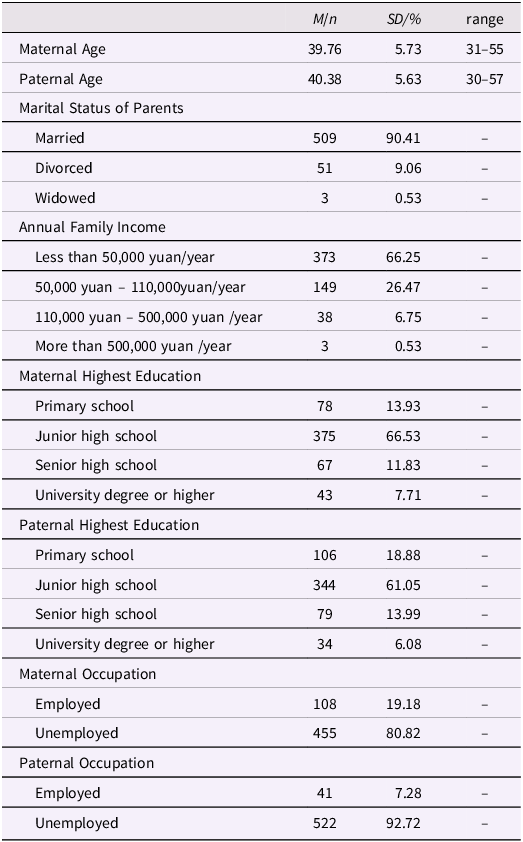
The final analysis included data from 563 adolescents who participated in at least 2 assessments. At T1, the mean age of these adolescents (51.87% boys) was 12.83 years (SD = 0.54). Table 1 shows the family demographic information of these adolescents. 90.41% of adolescents were from two-parent families. 66.25% of adolescents’ families had an annual income of less than 50,000 yuan. Regarding parents’ educational attainment, 80.46% of mothers and 79.93% of fathers had completed only junior high school or less. Regarding parental occupation, 19.18% of mothers and 7.28% of fathers were unemployed. The mean age of mothers and fathers was 39.76 years (SD = 5.73) and 40.38 years (SD = 5.63), respectively.
Family demographic information for all adolescents (n = 563)

Measures
Stressors (T1 – T4)
Stressors were measured using the adopted Adolescent Self-Rating Life Events Checklist (ASLEC; Dong & Lin, Reference Dong and Lin2011; Liu et al., Reference Liu, Liu, Yang, Chai, Wang, Sun and Ma1997). The scale includes 8 categories of life events (e.g., death of a loved one, experiencing a serious natural disaster) and 8 categories of daily hassles (e.g., conflicts or fights with classmates or friends, being misunderstood or misjudged). Given the complex temporal patterns of stressor occurrence and the temporally variable nature of stressor exposure (Kalisch et al., Reference Kalisch, Köber, Binder, Ahrens, Basten, Chmitorz, Choi, Fiebach, Goldbach, Neumann, Kampa, Kollmann, Lieb, Plichta, Reif, Schick, Sebastian, Walter, Wessa and Engen2021), adolescents were asked to report whether they had experienced these stressors in the past 12 months and the extent to which they perceived these stressors to be burdensome, on a scale from 0 (did not occur) to 5 (occurred and was extremely severe). The scale has been proven to be reliable and valid for use among Chinese children (Dong & Lin, Reference Dong and Lin2011). To reduce the overlap between ASLEC-measured stress and perceived stress (i.e., the subjective appraisal of stress), a cumulative stressor index was used in this study to represent the objective stressor exposure. Thus, a binary dummy variable was constructed for all items, where 0 = did not occur and 1 = any other response, to calculate the cumulative stressor index. Then a composite score of these 16 items was created, where higher total scores indicate a greater number of stressors. This scale displayed good reliability from T1 to T4 (Cronbach’s α = 0.77 – 0.94). The frequency and severity of each stressor across time are presented in Supplemental Table 1.
Wellbeing (T1– T4)
The Satisfaction with Life Scale (SWLS, Diener et al., Reference Diener, Emmons, Larsen and Griffin1985) was used to measure adolescents’ overall wellbeing. The scale consists of 5 items rated on a scale of 1 (strongly disagree) to 5 (strongly agree). Higher mean scores indicate higher levels of wellbeing. The scale displayed good reliability from T1 to T4 (Cronbach’s α = 0.86 – 0.95).
Depression symptoms (T1 – T4)
Depression was measured by the 9-item Patient Health Questionnaire (PHQ-9, Kroenke et al., Reference Kroenke, Spitzer and Williams2001). Adolescents were asked to report the frequency of depression symptoms during the past 2 weeks on a scale of 0 (not at all) to 3 (nearly every day). Higher total scores indicate higher levels of depression. The scale displayed good reliability from T1 to T4 (Cronbach’s α = 0.87 – 0.94).
Wellbeing and depression resilience (T1 – T4)
Following previous research (Amstadter et al., Reference Amstadter, Myers and Kendler2014), a residualized approach was used to measure wellbeing and depressive resilience. While this approach has been used in numerous studies, the vast majority have done so based on the linear effect of stress on mental health (e.g., Amstadter et al., Reference Amstadter, Myers and Kendler2014; Thakur & Cohen, Reference Thakur and Cohen2022). However, researchers have recently suggested that moderate stress may facilitate more adaptive functioning than no stress or high stress and that the relationship between stress and mental health may be curvilinear (Höltge et al., Reference Höltge, Mc Gee, Maercker and Thoma2018; Oshri et al., Reference Oshri, Cui, Carvalho and Liu2022; Seery et al., Reference Seery, Leo, Lupien, Kondrak and Almonte2013). Such a sole focus on the linear relationship between stress and mental health may represent a missed opportunity to understand resilience further.
Thus, to measure resilience more accurately, well-being and depression symptoms were regressed on stressors to test for possible linear or quadratic relationships. From the best-fitting regression model, the residual scores were extracted as resilience scores (van Harmelen et al., Reference van Harmelen, Kievit, Ioannidis, Neufeld, Jones, Bullmore, Dolan, Consortium, Fonagy and Goodyer2017). For both well-being and depression symptoms, the results indicated that the model with linear and quadratic effects had a much better fit than the model with only a linear effect (see Supplementary Table 2). Besides, linear and quadratic effects models exhibited changes in depression and wellbeing variability as stressor exposure changed (see Supplemental Figures 1 and 2), satisfying an analytic prerequisite for using a residualized approach (Amstadter et al., Reference Amstadter, Myers and Kendler2014). Thus, the linear and quadratic effects model was used to calculate adolescent resilience scores.
Specifically, we modeled curvilinear regression models between T1 stressors and T1 wellbeing and between T1 stressors and T1 depression symptoms. The regression curve can be viewed as the normative reactivity of mental health to stressor exposure in the current sample. The regression residual expresses the extent to which the adolescent deviates from this normal stress reactivity. Positive depression residuals and negative wellbeing residuals reflect the adolescent’s over-reactivity to stressor exposure; negative depression residuals and positive wellbeing residuals reflect the adolescent’s under-reactivity to stressor exposure. In other words, adolescents with negative wellbeing residuals and positive depression residuals are maladapted, whereas adolescents with positive wellbeing residuals and negative depression are resilient. Then, standardized residuals for T1 wellbeing and T1 depression symptoms were used to measure wellbeing and depression resilience, respectively. For better understanding, the residuals for T1 depression symptoms were reverse-coded. Thus, higher scores indicate higher levels of wellbeing and depression resilience. The same process was repeated for stressors, wellbeing, and depression symptoms at T2, Time 3 (T3), and T4.
Gratitude (T1)
The 6-item Gratitude Questionnaire (GQ-6; McCullough et al., Reference McCullough, Emmons and Tsang2002) was used to examine adolescents’ gratitude. Responses were rated on a 5-point scale of 1(strongly disagree) to 7 (strongly agree). A sample item reads as “I have so much in life to be thankful for.” After reverse-coded items were recoded, higher mean scores indicate higher gratitude. The scale has demonstrated high reliability and validity among Chinese adolescents (Yang et al., Reference Yang, Yan, Jia, Wang and Kong2021). In this study, Cronbach’s α was 0.86.
Perceived stress (T1)
Perceived stress was measured using the 10-item Perceived Stress Scale (PSS-10, Cohen et al., Reference Cohen, Kamarck and Mermelstein1983). Adolescents were asked to report how often they feel or think a certain way on a 5-point Likert scale of 1 (never) to 5 (very often). A sample item reads “How often have you been angered because of things that were outside your control?” Higher mean scores indicate higher perceived stress. The scale has demonstrated reliability and validity in the Chinese population (Huang et al., Reference Huang, Wang, Wang, Zhang, Du, Su, Jia, Ouyang, Wang, Li, Jiang and Zhang2020). In this study, Cronbach’s α was 0.82.
Covariates (T1)
Covariates included adolescents’ sex (1 = boy; 2= girl), age, and family socioeconomic status (SES). Specifically, SES was assessed by the MacArthur Scale of Subjective Social Status-Youth version (SSSY; Goodman et al., Reference Goodman, Adler, Kawachi, Frazier, Huang and Colditz2001). Higher scores indicate higher levels of SES.
Missing data
Missing data on all variables (study variables and covariates) were estimated. The proportion of missingness in the analytic sample ranged from 0% to 9.4%, with the mean level of missing data being 3.7%. Sex, age, and SES were three variables to have 0% missingness and were not imputed. Then, the Missing Completely at Random (MCAR) test was conducted using expectation maximization. Results revealed a nonsignificant chi-square (χ2 = 333.886, df = 223, p <0.001), suggesting the data was missing at random. Thus, the Full Information Maximum Likelihood (FIML), a method for handling missing information under the assumption that the data is missing at random (Cham et al., Reference Cham, Reshetnyak, Rosenfeld and Breitbart2017), was adapted to accommodate missing data.
Data analyses
Following Ahmed et al (Reference Ahmed, Mayo, Scott, Kuspinar and Schwartz2011), each adolescent’s wellbeing and depression resilience were centered on their individual mean. A parallel-process latent growth curve model (PP-LGCM) was constructed to determine the overall shape (linear or quadratic) of the co-developmental trajectories of wellbeing and depression resilience (Jung & Wickrama, Reference Jung and Wickrama2008). After determining the shape of co-developmental trajectories, we explored the heterogeneity of wellbeing and depression resilience trajectories using parallel-process latent class growth models (PP-LCGM). All sets of PP-LCGMs were estimated from one- to six-class models.
To evaluate the fit of the PP-LGCM, Satorra-Bentler scaled chi-square difference tests were utilized. To determine the best-fitting PP-LCGM, the following criteria were considered: (1) smaller Akaike Information Criterion (AIC), Bayesian Information Criterion (BIC), and adjusted Bayesian Information Criterion (aBIC); (2) statistically significant Lo-MendelRubin Likelihood Ratio Test (LMR-LRT) and bootstrap likelihood ratio tests (BLRT); (3) higher entropy (> 0.80) and average latent class probabilities (> 0.70) (Wickrama et al., Reference Wickrama, Lee, O’Neal and Lorenz2016); and (4) no fewer than 50 cases in each class (Weller et al., Reference Weller, Bowen and Faubert2020).
Based on the best-fitting PP-LCGM, predictors of resilience trajectories were entered into the model using the R3STEP approach, which is based on multinomial logistic regression analysis. This approach is the preferred method for protecting class formation from the influences of predictors and covariates (Asparouhov & Muthén, Reference Asparouhov and Muthén2014). The effects of each predictor were examined independently controlling for the other predictors. All models were estimated using maximum likelihood with robust standard errors (MLR) in Mplus 8.3 (Muthén & Muthén, Reference Muthén and Muthén2017).
Results
Preliminary analyses
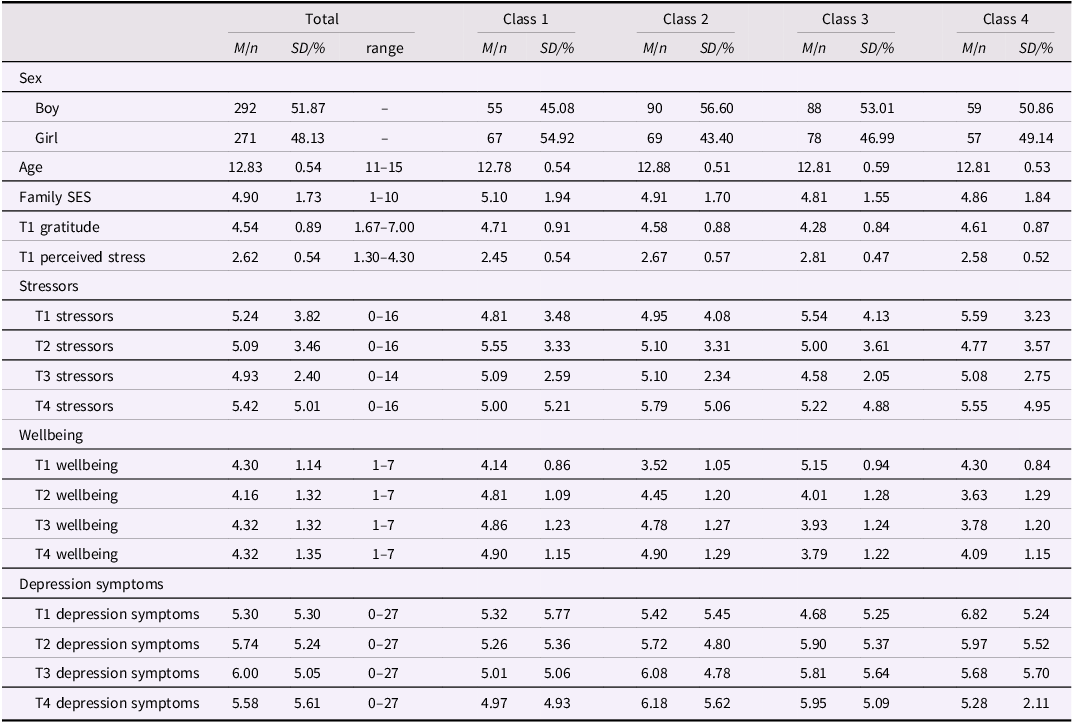
Descriptive statistics for the study variables are presented in Table 2. The results showed that the average stressor score across T1 to T4 was 4.93 – 5.42 (SD = 2.40 – 3.82; the possible range 0 – 16), suggesting that most adolescents had rather low levels of stressor exposure. Most adolescents showed good mental health from T1 to T4, as suggested by rather high levels of wellbeing (M = 4.16 – 4.32, SD = 1.14 – 1.35; the possible range 1 – 7) and low levels of depression (M = 5.30 – 6.00, SD = 5.05 – 5.61; the possible range 0 – 27).
Sample descriptive statistics for all adolescents (n = 563)
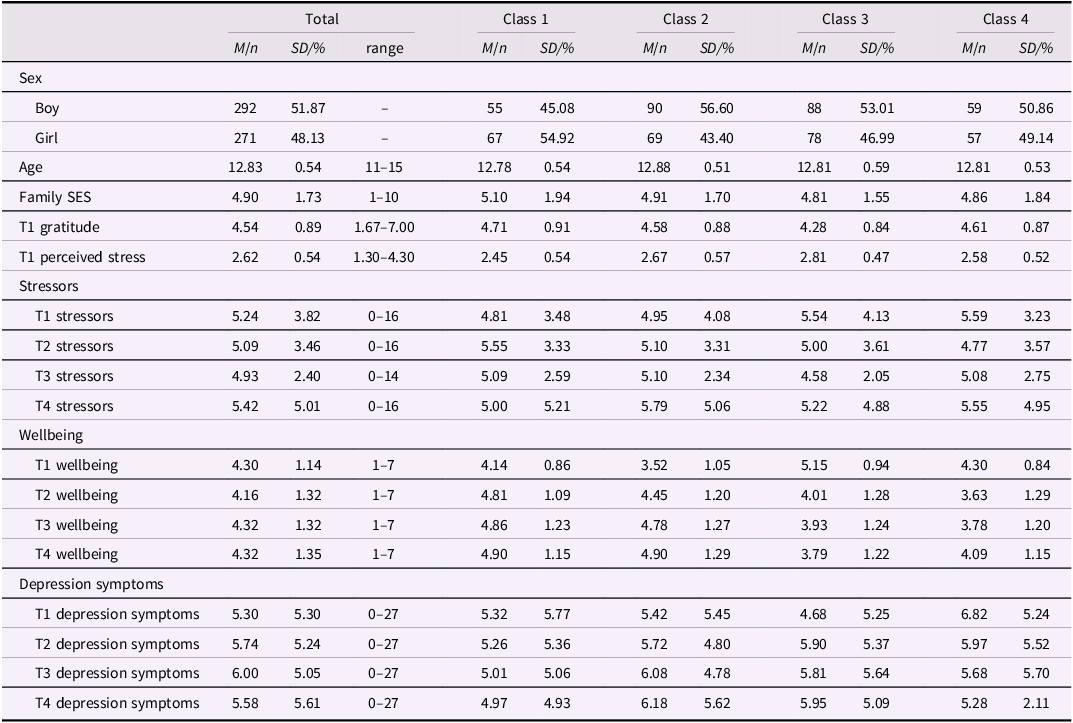
Note: Class 1 = flourishing resilience; Class 2 = increasing wellbeing resilience but decreasing depression resilience; Class 3 = declining resilience; Class 4 = increasing depression resilience but decreasing wellbeing resilience.
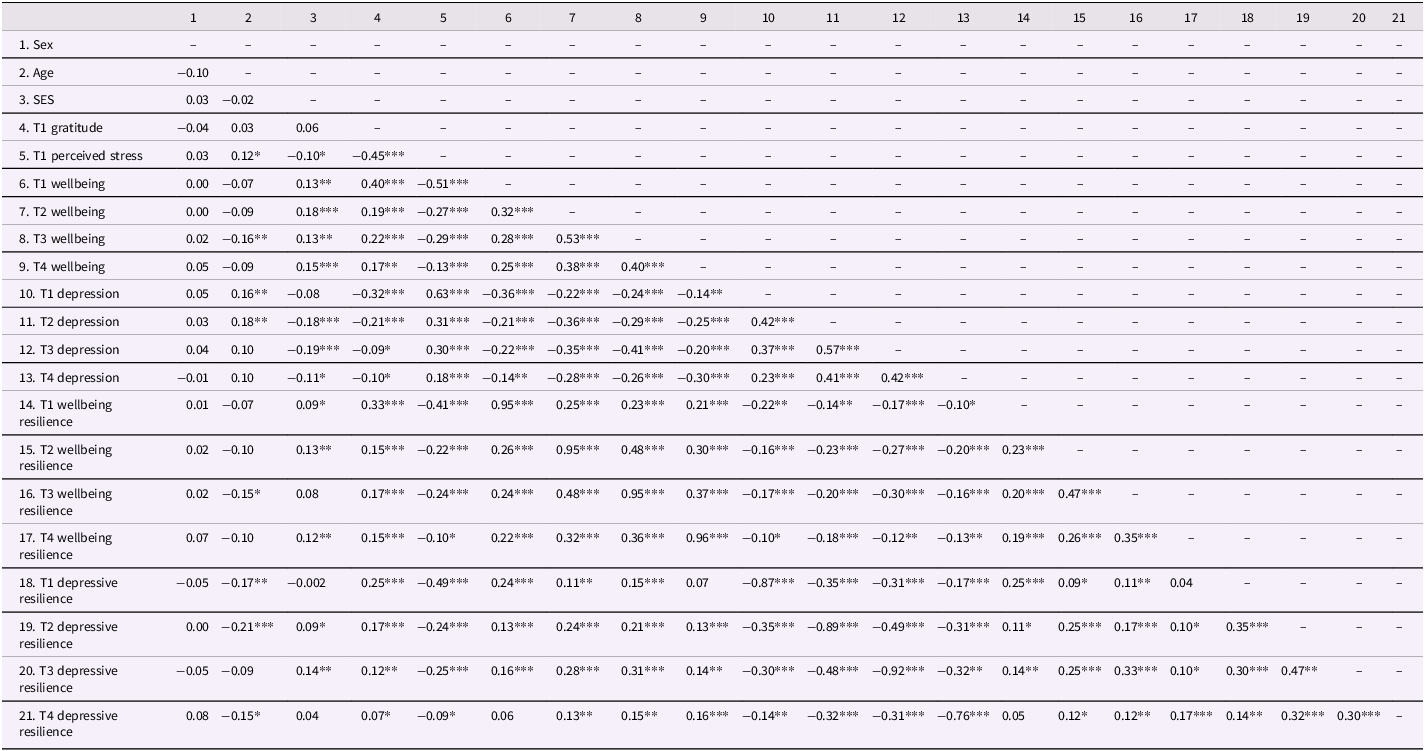
Correlations between study variables are shown in Table 3. Gratitude was positively related to wellbeing (r = 0.15 ∼ 0.33, ps <0.001) and depression resilience (r = 0.07 ∼ 0.25, ps < 0.05) at each time point, whereas perceived stress was negatively related to wellbeing (r = −0.41 ∼ −0.10, ps < 0.05) and depression resilience (r = −0.49 ∼ −0.09, ps < 0.05) at each time point.
Correlations between study variables
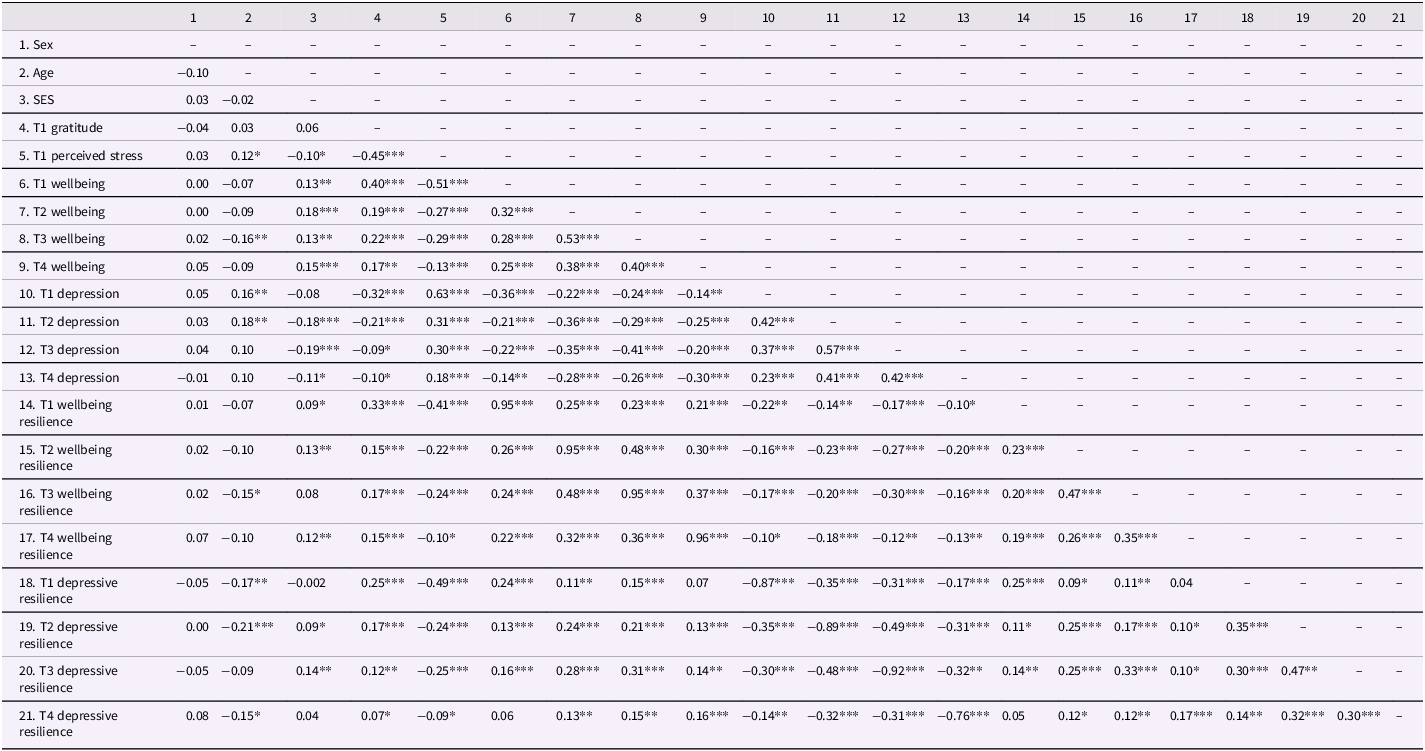
Note: *p < 0.05; **p < 0.01; ***p < 0.001.
Co-developmental trajectories of wellbeing and depression resilience
According to Satorra-Bentler scaled chi-square difference tests, the quadratic model fitted the data better than the linear model for the overall co-developmental trajectories of wellbeing and depression resilience (Δχ2 SB (4) = 14.94, p = 0.005). The PP-LGCM also revealed that the variances of the growth parameters were statistically significant, suggesting individual differences in the development of wellbeing and depression resilience. Detailed information about the results of the PP-LGCM is displayed in the Supplementary Table 3.
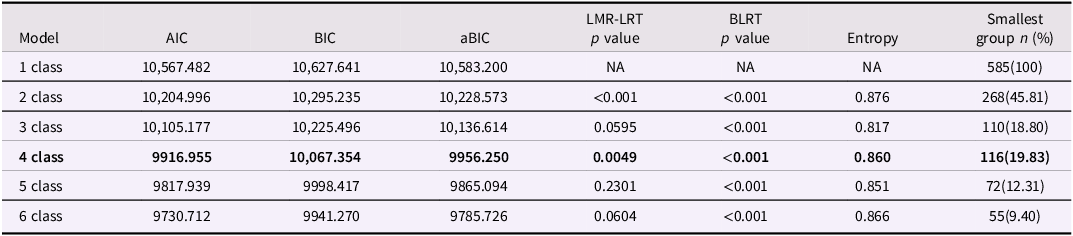
Subsequently, a quadratic growth model was used to examine models ranging from one- to six-class solutions. Fit indices are depicted in Table 4. The LMR-LRT was not significant for the five-class solution, suggesting that the four-class solution fits the data better. Besides, the elbow plot of the BIC values reached a plateau around four classes (see Supplementary Figure 3). The four-class solution showed conceptually clear and interpretable co-developmental trajectories of wellbeing and depression resilience. In addition, the entropy (0.860) and the average latent class posterior probabilities (range of 0.903 – 0.939) of the four-class solution suggested clear and exact class separation. Thus, the four-class PP-LGCM was selected.
Model fit indices of the parallel process latent class growth models
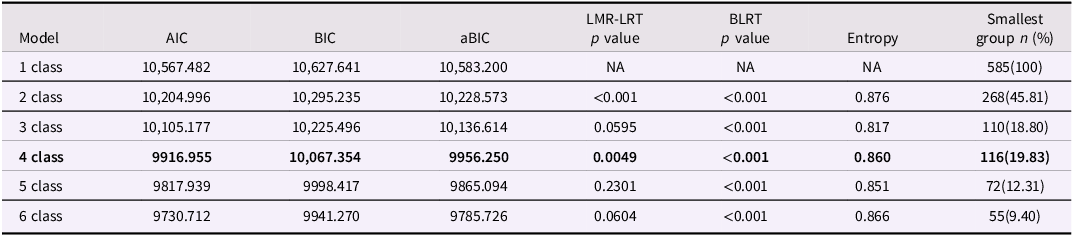
Note: Bold text indicates the final class solution.
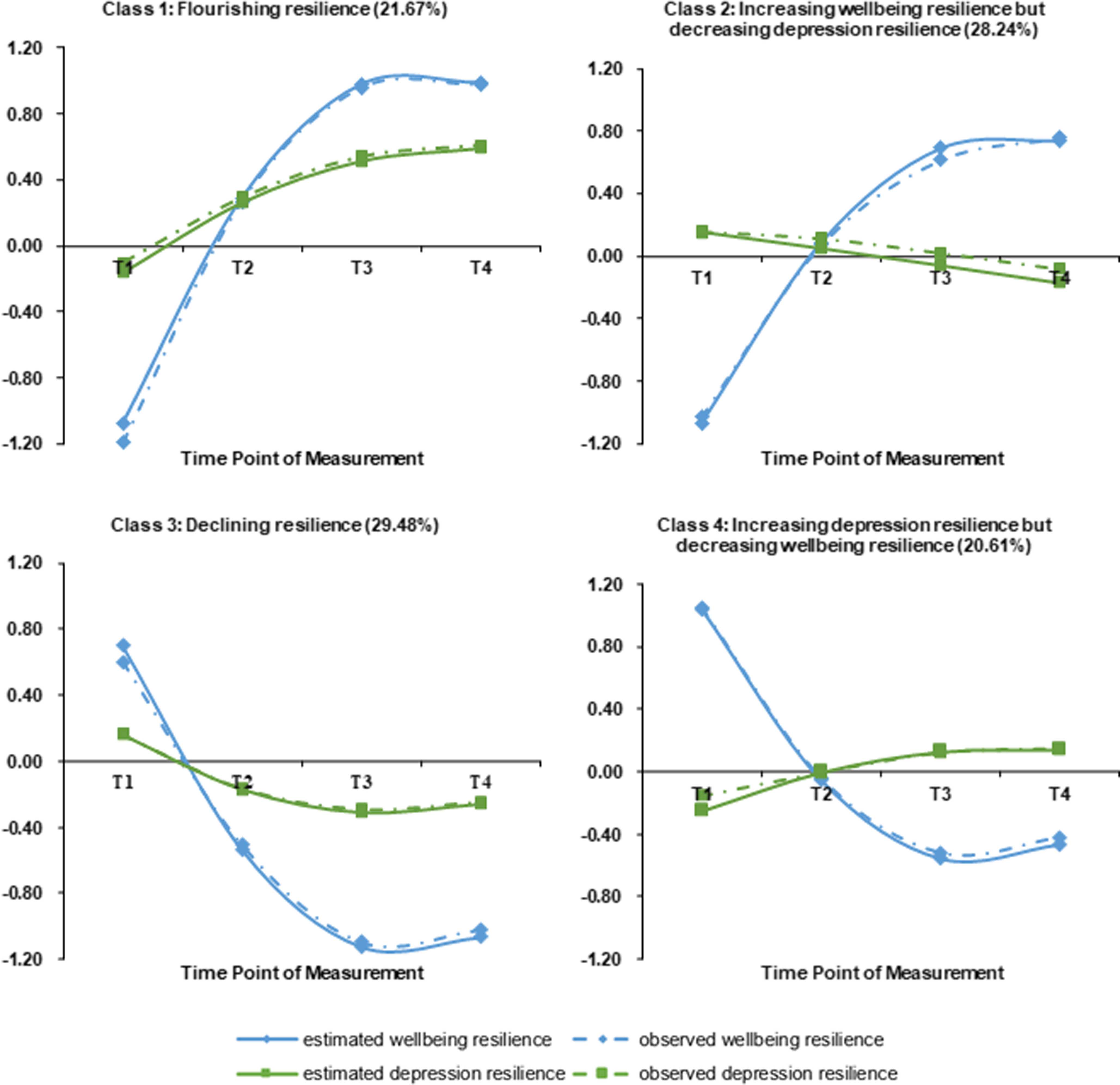
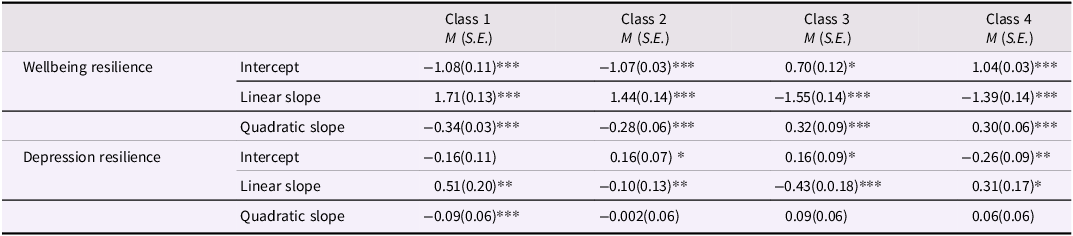
Table 5 shows parameter estimates from the four-trajectory PP-LGMM, and Figure 1 illustrates the trajectories. Appendix S5 shows the mean scores for each classification on wellbeing and depression resilience. Class 1 (n = 144, 24.61%), labeled as “flourishing resilience,” showed an initially low level with subsequent increases in wellbeing and depression resilience. Class 2 (n = 159, 27.18%), labeled as “increasing wellbeing resilience but decreasing depression resilience,” showed initially low, increasing wellbeing resilience but initially high, decreasing depression resilience. Class 3 (n = 166, 28.38%), labeled as “declining resilience,” showed an initially high but decreasing wellbeing and depression resilience. Class 4 (n = 116, 19.83%), labeled as “increasing depression resilience but decreasing wellbeing resilience,” showed initially high, decreasing wellbeing resilience and initially low, increasing depression resilience.
Four-class parallel process latent class growth models for wellbeing and depression resilience.

Growth parameters of the parallel process latent class growth models
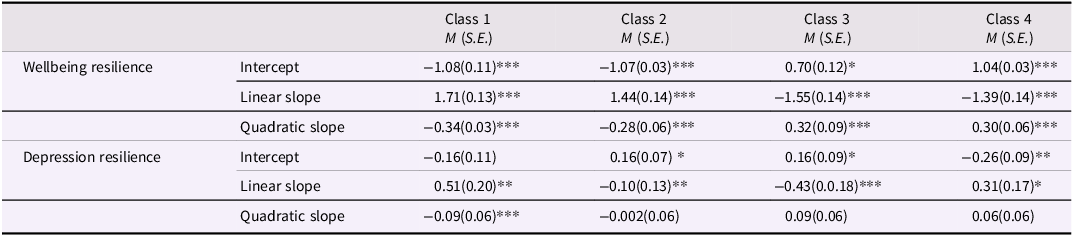
Note: Class 1 = flourishing resilience; Class 2 = increasing wellbeing resilience but decreasing depression resilience; Class 3 = declining resilience; Class 4 = increasing depression resilience but decreasing wellbeing resilience.
M = means; SE = standard errors.
* p < 0.05;**p < 0.01;***p < 0.001
Predictors of resilience trajectories
Table 6 shows the ORs and 95% CIs for gratitude and perceived stress in each of the trajectory pairs. Adolescents with lower levels of gratitude (OR = 0.88, 95% CI = [0.33, 0.95], p < 0.001) and higher levels of perceived stress (OR = 2.46, 95% CI = [1.30, 4.66], p = 0.020) were more likely to be in the increasing wellbeing resilience but decreasing depression resilience group compared to the flourishing resilience group. Adolescents with lower levels of gratitude (OR = 0.70, 95 % CI = [0.38, 0.89], p = 0.020), higher levels of perceived stress (OR = 5.73, 95% CI = [3.05, 10.77], p = 0.031) were more likely to be in the declining resilience group than in the flourishing resilience group. Adolescents with lower levels of gratitude (OR = 0.72, 95% CI = [0.57, 0.90], p = 0.004) and higher levels of perceived stress (OR = 1.82, 95%CI = [1.21, 3.42], p = 0.007) were more likely to be in the increasing depression resilience but decreasing wellbeing resilience group than in the flourishing resilience group.
Multinomial logistic regression odds ratios (ORs) and confidence intervals (CI) for gratitude, perceived stress, and covariates

Note. Class 1 = flourishing resilience; Class 2 = increasing wellbeing resilience but decreasing depression resilience; Class 3 = declining resilience; Class 4 = increasing depression resilience but decreasing wellbeing resilience.
* p<0.05; **p<0.01; ***p<0.001.
In addition, adolescents with lower levels of gratitude (OR = 0.38, 95% CI = [0.16, 0.98], p = 0.033) and higher levels of perceived stress (OR = 1.44, 95% CI = [1.05, 1.98], p = 0.001) were more likely to be in the declining resilience group than in the increasing wellbeing resilience but decreasing depression resilience group was much higher. Adolescents with lower perceived stress (OR = 0.17, 95% CI = [0.09, 0.33], p < 0.001) were more likely to be in the increasing depression resilience but decreasing wellbeing resilience group than in the increasing wellbeing resilience but decreasing depression resilience group. Girls (OR = 1.07, 95% CI = [1.16, 3.30], p = 0.028) and those with lower levels of perceived stress (OR = 0.41, 95% CI = [0.22, 0.77], p = 0.019) were more likely to be in the increasing depression resilience but decreasing wellbeing resilience group than in the declining resilience group.
Sensitivity analyses
To examine the robustness of our major findings, we conducted additional analyses to reproduce the analyses presented in our manuscript using the severity score of assessed stressors. Results indicated that there are the same four trajectories of resilience development (i.e., flourishing resilience, increasing wellbeing resilience but decreasing depression resilience, declining resilience, and increasing depression resilience but decreasing wellbeing resilience) as revealed by the present findings. Gratitude and perceived stress are still important factors that influence the development of resilience. Supplemental Table 4 depicts the model fit indices. Supplemental Table 5 shows parameter estimates from the four-trajectory PP-LCGM, and Supplemental Figure 4 illustrates the trajectories. Supplemental Table 6 shows the ORs and 95% CIs for gratitude and perceived stress in each of the trajectory pairs.
Discussion
This study conceptualized resilience as a multidimensional construct and explored its developmental trajectories, filling gaps in prior research that focused on a single domain of resilience or assessed resilience at a single time point. The results revealed four distinct developmental trajectories among adolescents, specified as the flourishing resilience group, the increasing wellbeing resilience but decreasing depression resilience group, the declining resilience group, and the increasing depression resilience but decreasing wellbeing resilience group. This finding supports the view that resilience is a multifaceted and dynamic construct rather than a fixed trait. These four distinct trajectories of resilience development also reflect the view of the dual-factor model of mental health that well-being and psychopathology reflect separate but related unipolar dimensions (Suldo & Shaffer, Reference Suldo and Shaffer2008), emphasizing the importance of considering both well-being and psychopathology simultaneously to comprehensively assess an individual’s psychological adjustment.
Our typology is partially consistent with previous studies examining children’s emotional behavioral (Yoon et al., Reference Yoon, Yang, Pei, Benavides, Bayar, Logan and Hamby2024), socio-emotional and cognitive (Green et al., Reference Green, Piotrowska, Tzoumakis, Whitten, Laurens, Butler, Katz, Harris and Carr2023), psychosocial (Cahill et al., Reference Cahill, Hager and Shryane2024), and multidimensional resilience (Sattler et al., Reference Sattler, Yoon and Lutolli2024), as similar patterns of development (i.e., increasing, decreasing) were observed in these studies. However, the trajectories associated with decreasing resilience found in our study were more complex than those in previous studies. This difference may be because our study focused on an older sample (i.e., adolescents), whereas other studies used a younger sample (e.g., children under 2 years old in Sattler et al., Reference Sattler, Yoon and Lutolli2024). Alternatively, our findings may be indicative of the extreme complexity of stressors that adolescents encounter and the diversity of their stress responses. Another difference is that we observed nonlinear developmental trajectories of resilience. This may be because our data were collected during the COVID-19 pandemic, which has been proven to have a profound effect on individuals’ resilience (Park et al., Reference Park, Finkelstein-Fox, Russell, Fendrich, Hutchison and Becker2021; Zhang et al., Reference Zhang, Yang and Jia2022).
The most novel finding of our study is that we did not find the stable trajectory (i.e., stable levels of resilience over time), which was the most commonly found trajectory in previous studies (Cahill et al., Reference Cahill, Hager and Shryane2024; Sattler et al., Reference Sattler, Yoon and Lutolli2024). One possible explanation may lie in the distinctive beliefs about adversity in Chinese culture. Chinese culture emphasizes adversity as an opportunity for personal development and character-building, encouraging acceptance of adversity rather than actively seeking control. These positive cultural beliefs enable adolescents to create a personally meaningful view of reality that gives significance to adversity (Xie & Wong, Reference Xie and Wong2021). However, the Western culture places more emphasis on personal competence and taking action to gain control over one’s circumstances facing adversity (Windle, Reference Windle2011). This cultural difference makes Westerners more inclined to alter the environment to meet their goals, compared to the Chinese, who tend to adjust themselves to the environment (Cheng et al., Reference Cheng, Hui and Lam2000). Through such a process, these cultural beliefs empower Chinese adolescents and contribute to their personal growth from adversity (Qing et al., Reference Qing, Bakker, van der Meer, Te Brake and Olff2022), rather than simply maintaining stable functioning.
Regarding predictors of resilience trajectories, we found that gratitude was a robust predictor of being in the flourishing resilience group, which provided empirical support to the resilience portfolio model (Grych et al., Reference Grych, Hamby and Banyard2015). Consistent with previous research, this finding also suggests that gratitude is an important character strength for promoting healthy adolescent development and has enduring effects on adolescent development. Previous studies indicate that gratitude is associated with less negative emotion and more positive emotion (Emmons et al., Reference Emmons, Froh, Rose, Gallagher and Lopez2019). The broaden-and-build theory of positive emotions proposes that positive emotions boost adaptive thoughts and behaviors, which in turn expand personal resources contributing to psychological resilience (Fredrickson, Reference Fredrickson2001). Accordingly, one explanation may be that gratitude could serve to broaden one’s experience of positive emotions and thereby build personal resources for use during a time of adversity. These personal resources gained during states of positive emotion are durable, functioning as protective reserves in both the short- and long-term (Fredrickson, Reference Fredrickson2004). Through these enduring resources, adolescents experience personal growth, becoming more reflective, socially integrated, and resilient (Kumar et al., Reference Kumar, Edwards, Grandgenett, Scherer, DiLillo and Jaffe2022). Besides, gratitude can also broaden adolescents’ scope for thought-action and promote adaptive coping amid adversity, enhancing wellbeing, lessening trauma-related distress, and supporting personal growth (Jans-Beken et al., Reference Jans-Beken, Jacobs, Janssens, Peeters, Reijnders, Lechner and Lataster2020; Kumar et al., Reference Kumar, Jaffe, Brock and DiLillo2022).
We also found that perceived stress was another important predictor of resilience trajectories. Specifically, an important novel finding of this study is that adolescents with higher levels of perceived stress were more likely to be in the declining resilience group, while those with lower levels of perceived stress were more likely to be in the flourishing resilience group. Perceived stress reflects a global subjective evaluation and appraisal of the stressors experienced by the individual (Cohen et al., Reference Cohen, Kamarck and Mermelstein1983). Higher levels of perceived stress mean that adolescents may tend to evaluate stressors more negatively, which can lead to an overestimation of the threat magnitude and cost of stressors, underestimation of one’s own coping potential, consistent overreaction to stressors, and a higher possibility of negative coping (Veer et al., Reference Veer, Riepenhausen, Zerban, Wackerhagen, Puhlmann, Engen, Köber, Bögemann, Weermeijer, Uściłko, Mor, Marciniak, Askelund, Al-Kamel, Ayash, Barsuola, Bartkute-Norkuniene, Battaglia, Bobko and Kalisch2021), thus weakening resilience over time. In contrast, lower levels of perceived stress mean that adolescents may tend to appraise stressors more positively. Such positive appraisal permits individuals to adopt optimal stress responses, avoiding negative coping styles, inefficient use of resources, and concomitant deleterious allostatic load (Veer et al., Reference Veer, Riepenhausen, Zerban, Wackerhagen, Puhlmann, Engen, Köber, Bögemann, Weermeijer, Uściłko, Mor, Marciniak, Askelund, Al-Kamel, Ayash, Barsuola, Bartkute-Norkuniene, Battaglia, Bobko and Kalisch2021), thus promoting resilience over time. This finding is consistent with the PASTOR (Kalisch et al., Reference Kalisch, Müller and Tüscher2015) that positive appraisal of potential stressors is the key mechanism of resilience.
The present findings have several important implications for research and practice. At the research level, the parallel development of wellbeing and depression resilience indicates that future research may benefit from considering the multidimensional and dynamic nature of resilience. At the practice level, the substantial heterogeneity observed in adolescent resilience development in this study suggests that more targeted and individualized resilience-promoting interventions are needed. Furthermore, this study indicated that the resilience developmental trajectories among Chinese adolescents are somewhat different from those of Western adolescents, which suggests the importance of culturally adapting interventions for adolescents from different cultural backgrounds. Our findings also suggest that gratitude and perceived stress may be promising targets for measures to enhance resilience among adolescents. On the one hand, gratitude is conceived as an important factor in determining whether adolescents belong to the flourishing resilience group. Hence, evidence-based gratitude interventions are recommended to ensure the development of resilience in adolescents. On the other hand, given that perceived stress is an important predictor of membership in the declining resilience group, cognitive-behavioral therapy interventions targeting potentially negative appraisal patterns may be another effective approach to maintaining or enhancing adolescent resilience. In addition, stress management training may also be beneficial.
Several limitations should be considered when interpreting our findings. First, given that our sample included adolescents from only one school in China, and most of them with lower family SES, all of which limits the generalizability of our findings. Second, it has been suggested that resilience is best understood as a process of multisystem (e.g., biological, psychological, social, and ecological) interacting in ways that help individuals adapt successfully to stress or threats (Ungar & Theron, Reference Ungar and Theron2020). However, we focus only on the psychological factors in this study. Future studies from a multisystem perspective may provide a more nuanced picture of resilience. Third, as mentioned earlier, the data were collected during the COVID-19 pandemic, so these findings should be interpreted in light of this unique circumstance. Finally, there were several limitations regarding the study measures. All variables in this study were measured by self-report instruments, so there may be issues related to social desirability bias and response bias. Another measurement-related limitation is that resilience was measured at only four time points over 2 years, with intervals of approximately 6 months. Considering the dynamic nature of resilience, shorter intervals between assessments may better reflect fluctuations in resilience over time, while longer study periods may better reflect trends in resilience. Thus, future studies may benefit from longer study periods and shorter assessment intervals. Relatedly, adolescents were asked to report their exposure to stressors in the previous 12 months. Although theoretically designed, this may introduce some bias into the measure due to recall bias and overlap with information from the previous wave.
Conclusions
Overall, the present study revealed four distinct trajectories of adolescent resilience development (i.e., flourishing resilience, increasing wellbeing resilience but decreasing depression resilience, declining resilience, and increasing depression resilience but decreasing wellbeing resilience). Focusing on potentially modifiable factors, this study found that both gratitude and perceived stress were important predictors of the development trajectories of resilience. This study enhances understanding of how resilience develops and the factors that influence it, and highlights the need for interventions that target the unique characteristics of these groups.
Supplementary material
For supplementary material accompanying this paper visit https://doi.org/10.1017/S0954579425100448
Data availability statement
The data that support the findings of this study are available from the corresponding author upon reasonable request.
Acknowledgments
We are extremely grateful to all the adolescents and parents who participated in the current study, as well as the research assistants who contributed to data collection.
Funding statement
This work was supported by the Beijing Office for Education Sciences Planning (grant number BAHA24026)
Competing interests
None.