In an era in which the threat of antimicrobial resistance is increasing, judicious antimicrobial use is mandatory for every healthcare provider. Antimicrobial stewardship programs (ASPs) play a critical role in promoting appropriate antibiotic use to improve patient outcome and in reducing unintended consequences of antibiotic therapy such as resistance selection and side effects.Reference Dellit, Owens and McGowan 1 – Reference Davey, Brown and Charani 3
To date, ASPs have been implemented mainly in acute-care hospitals, but both inappropriate antibiotic use and high prevalence of multidrug-resistant organisms (MDROs) are also commonplace in long-term care facilities (LTCFs).Reference Pope, Dellit, Owens and Hooton 4 , Reference Giannella, Tedeschi, Bartoletti and Viale 5 On the other hand, ASP strategies used in acute-care hospitals cannot automatically be extrapolated to LTCFs due to the differences in residents and available resources.Reference Schuts, Hulscher and Mouton 6
Among several types of LTCFs, rehabilitation units dedicated to patients with spinal cord injuries (SCIs) comprise a unique niche. Patients cared for in these facilities are prone to infections due to several factors including bladder catheterization, pressure sores, impaired bulbar reflexes, hypostasis in bedridden patients, and invasive procedures. Consequently, this population is frequently overexposed to antimicrobials, which are often prescribed for inappropriate indications (eg, bacteriuria, non-infected pressure ulcers) and for prolonged periods of time.Reference Montgomerie 7 – Reference Mylotte, Graham, Kahler, Young and Goodnough 10 In addition, lack of awareness regarding aims and strategies of ASPs has been recently reported among healthcare providers dedicated to SCI patients.Reference Evans, Rogers, Burns, Lopansri and Weaver 11
In view of these concerns, we decided to implement an ASP based on systematic infectious disease consultation (ID) and other structural activities in a rehabilitation hospital for SCI patients, and we assessed its impact on rates of MDRO isolations, Clostridium difficile infections (CDIs), and antibiotic consumption.
METHODS
Setting
Montecatone Rehabilitation Institute (MRI) is a 150-bed rehabilitation hospital in northern Italy that is dedicated to the rehabilitation of patients with SCI. The hospital comprises one 8-bed intensive care unit and one 11-bed respiratory intensive care unit and has a yearly bed occupancy of 100%. Prior to 2012, local physicians were responsible for antibiotic prescriptions, with the support of ID consultants on demand.
Study Design
We performed a quasi-experimental before-and-after study to compare antibiotic consumption, incidence of CDI, and the rate of antimicrobial resistance in a selected group of microorganisms. The “before” period was from January 1, 2011, to June 30, 2012; the “after” period was from July 1, 2012, to December 31, 2014.
Intervention
An ASP was implemented at MRI from July 1, 2012, consisting of 2 parts. First, we implemented a systematic bedside ID consultation activity. A dedicated ID consultant was present on site three times a week and was available for remote consultations (by phone calls and emails) during the remaining period. The ID expertise was obtained through a collaboration with the Infectious Disease Unit of the Sant’Orsola Malpighi Teaching Hospital, which provided the ID consultant. The ID consultant was present on site 20 hours per week, on average, to examine patients with suspected infections upon the request of the attending physicians as well as those who were receiving antibiotics, identified through chart review. The ID consultant visited patients, reviewed their clinical data, discussed the prescribed antibiotic treatment and diagnosis of the infectious syndrome with their physicians, and stopped or changed the antimicrobial therapy if it was inappropriate. Telephone and electronic consultations were used mainly to adjust antibiotic doses according to therapeutic drug monitoring (eg, glycopeptides and aminoglycosides antibiotics) or changes in renal function, or to narrow the spectrum of empirical antibiotic regimens according to culture results. The ID consultant spent approximately 1 hour per week in this kind of activity.
In the second part of this ASP, a structural intervention was implemented in which regular 6-monthly revisions of internal protocol for antibiotic prophylaxis were performed and educational activities were conducted. The 4 main goals of educational program were (1) avoidance of antibiotic treatment of asymptomatic bacteriuria; (2) avoidance of antibiotic treatment in patients with pressure ulcers without signs and symptoms of systemic infection; (3) implementation of the use of oral fosfomycin, nitrofurantoin, or cotrimoxazole instead of fluoroquinolones and third-generation cephalosporins for empiric treatment of non-severe urinary tract infections; and (4) avoidance of the use of carbapenems in empirical therapy. The ID consultant planned the educational program and was directly involved in the educational activities, with the support of some staff members.
Educational sessions consisted of small group meetings directed toward physicians and nurses. The meetings focused on 5 areas: (1) epidemiology and mechanisms of antimicrobial resistance; (2) characteristics of antibiotics in term of antimicrobial spectrum, mechanisms of action, tissue penetration, and adverse events; (3) assessment of clinical severity of infections; (4) diagnostic and therapeutic approach to common infectious syndromes; and (5) key measures of infection control. Meetings dedicated to each topic were repeated twice each month to reach all the staff members, and the topic was changed quarterly. Moreover, during clinical activity, the ID consultant provided practical education to rehabilitation physicians by reviewing the approach to the diagnosis and treatment of the infectious syndrome taken for each patient.
Endpoints
During the study period, antibiotic consumption was assessed as defined daily doses (DDD) per 100 patient days. DDDs were calculated following the Anatomical Therapeutic Chemical (ATC) Classification with DDD (ie, ATC/DDD) methodology recommended by the World Health Organization. 12 Incidence of CDI and rates of drug resistance were determined for the following microorganisms: Escherichia coli, Proteus mirabilis, Klebsiella pneumoniae, Pseudomonas aeruginosa, Acinetobacter baumannii, and Staphylococcus aureus.
Microbiology
Isolates from clinical samples (blood, urine, and respiratory samples obtained from symptomatic patients) were considered for this study. Duplicate isolates were considered only once in computing resistance prevalence. Identification and susceptibility testing were performed with the Vitek 2 automated system (bioMerieux, Marcy l’Etoile, France), according to the manufacturer’s instructions. A positive ESBL test from the automated system was confirmed by disc diffusion tests (Bio-Rad, Milan, Italy), as described previously.Reference Pignanelli, Zaccherini, Schiavone, Nardi Pantoli, Pirazzoli and Nannini 13 The minimum inhibitory concentrations (MICs) obtained with the automated system were interpreted using the European Committee on Antimicrobial Susceptibility Testing (EUCAST) clinical breakpoints for all tested antimicrobials. Carbapenem MICs were confirmed by Epsilon test (bioMerieux) using the manufacturer’s protocol.
The diagnosis of C. difficile infections was performed with the simultaneous detection of C. difficile toxins A and B using a qualitative, horizontal-flow enzyme immunoassay (ImmunoCard Toxins A & B, Meridian, Cincinnati, USA) in stools samples that tested positive for glutamate dehydrogenase antigen. The surveys of the bacterial isolates and the antimicrobial susceptibility were conducted using Mercurio software (NoemaLife, Bologna, Italy).
Definitions
A microorganism was defined as extensively drug-resistant (XDR) if it was non-susceptible to at least 1 agent in all but 2 or fewer antimicrobial classes.Reference Magiorakos, Srinivasan and Carey 14
Statistical Analysis
Categorical variables were compared using the χ2 test or the Fisher’s exact test as appropriate; continuous variables were compared using the Mann–Whitney U-test. Differences were considered statistically significant if the P value was <.05. Statistical analyses were performed with the SPSS version 22.0 statistical package (IBM, Armonk, NY).
RESULTS
Activity of the ID Consultant
During the study period, the activity of the ID consultant progressively increased from 695 patient assessments in 2011 to 1,480 in 2014. Using the principle of management promoted by the ID consultant, the overall number of urine samples and swabs of pressure ulcers sent for culture decreased. In particular, the number of urine samples decreased from 59/1,000 patient days in 2011 to 49/1,000 patient days in 2014 and the number of swabs from 9.5/1,000 patient days in 2011 to 6/1,000 patient days in 2014. Conversely, the number of blood cultures drawn slightly increased from 17 per 1,000 patient days in 2011 to 22 in 2014.
Antibiotic Consumption
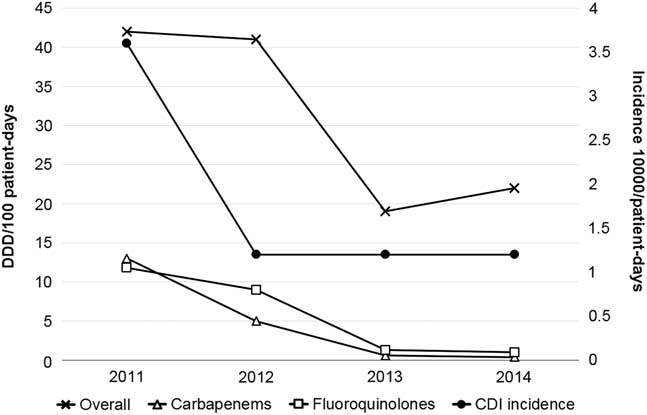
During the ASP study period, overall antibiotic consumption decreased by 48%, from 42 DDD per 100 patient days in 2011 and to 22 in 2014 (P<.001). Specifically, the use of cabapenems was reduced by 97%, from 13 DDD per 100 patient days in 2011 to 0.4 in 2014 (P=.01), and fluoroquinolone use decreased by 92%, from 11.8 DDD per 100 patient days in 2011 to 0.99 in 2014 (P=.006). During the pre-intervention period, these 2 antimicrobial classes accounted for 60% of antibiotic prescriptions, and in 2014 they accounted for only 6%. The use of aminoglycosides, tetracycline, clindamycin, and macrolides decreased as well, while the consumption of third-generation cephalosporins remained stable. Conversely, from 2011 to 2014, the prescription of β-lactam–β-lactamase inhibitors increased, but not statistically significantly, from 8.2 DDD per 100 patient days in 2011 to 11 in 2014, as did glycopeptide use (from 2.5 DDD per 100 patient days in 2011 to 3.9 in 2014), fosfomycin use (from 0.3 DDD per 100 patient days in 2011 to 0.9 in 2014), and the use of other antibiotics (from 1 DDD per 100 patient days 2011 to 2.8 in 2014).
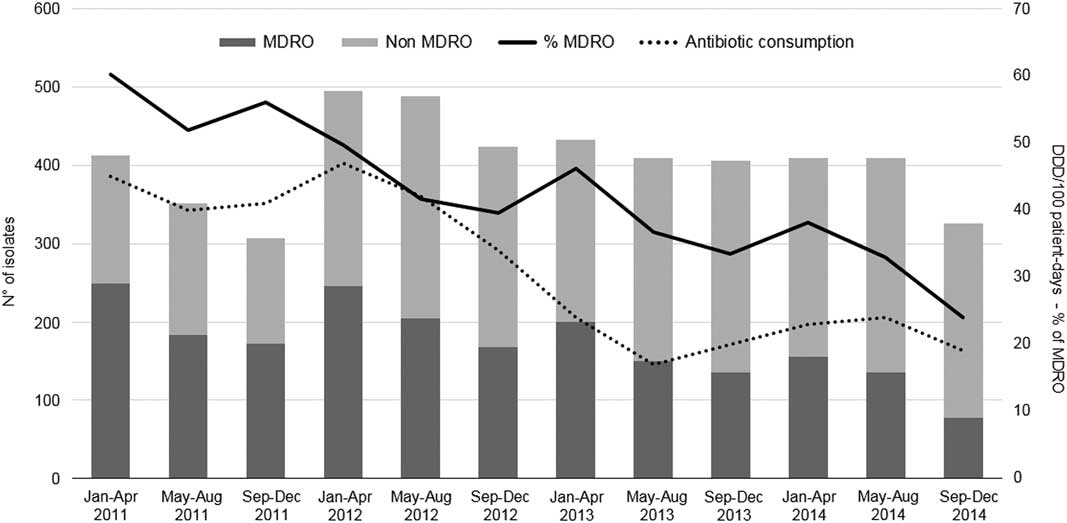
Secular trends of antibiotic use and antibiotic resistance are depicted in Figure 1. During the study period, there was no change in crude mortality, while the mean length of stay decreased significantly (P<.001; Table 1).
Secular trends of antibiotic consumption and overall resistance prevalence from January 2011 to December 2014. MDRO, multidrug-resistant organism; DDD, defined daily dose.

Indicators of Activity and Outcome Measures During Study Period

Incidence of CDI
During the study period, 466 stool samples were sent to the laboratory for diagnosis of CDI; the sample number per year remained stable. CDI episodes decreased from 22 per year in 2011 to 7 in 2012, with a significant decline in the incidence of the disease from 3.6 cases per 10,000 patient days in 2011 to 1.2 in 2012 (P=.001). No further decrease was observed in the subsequent period from 2012 to 2014; the CDI incidence in 2014 was 1.2 cases per 10,000 patient days (Fig. 2).
Decreasing consumption of overall antibiotics, carbapenems, and fluoroquinolons, and incidence of Clostridium difficile infection (CDI) from January 2011 to December 2014.
Non-fermentative Gram-Negative Bacilli
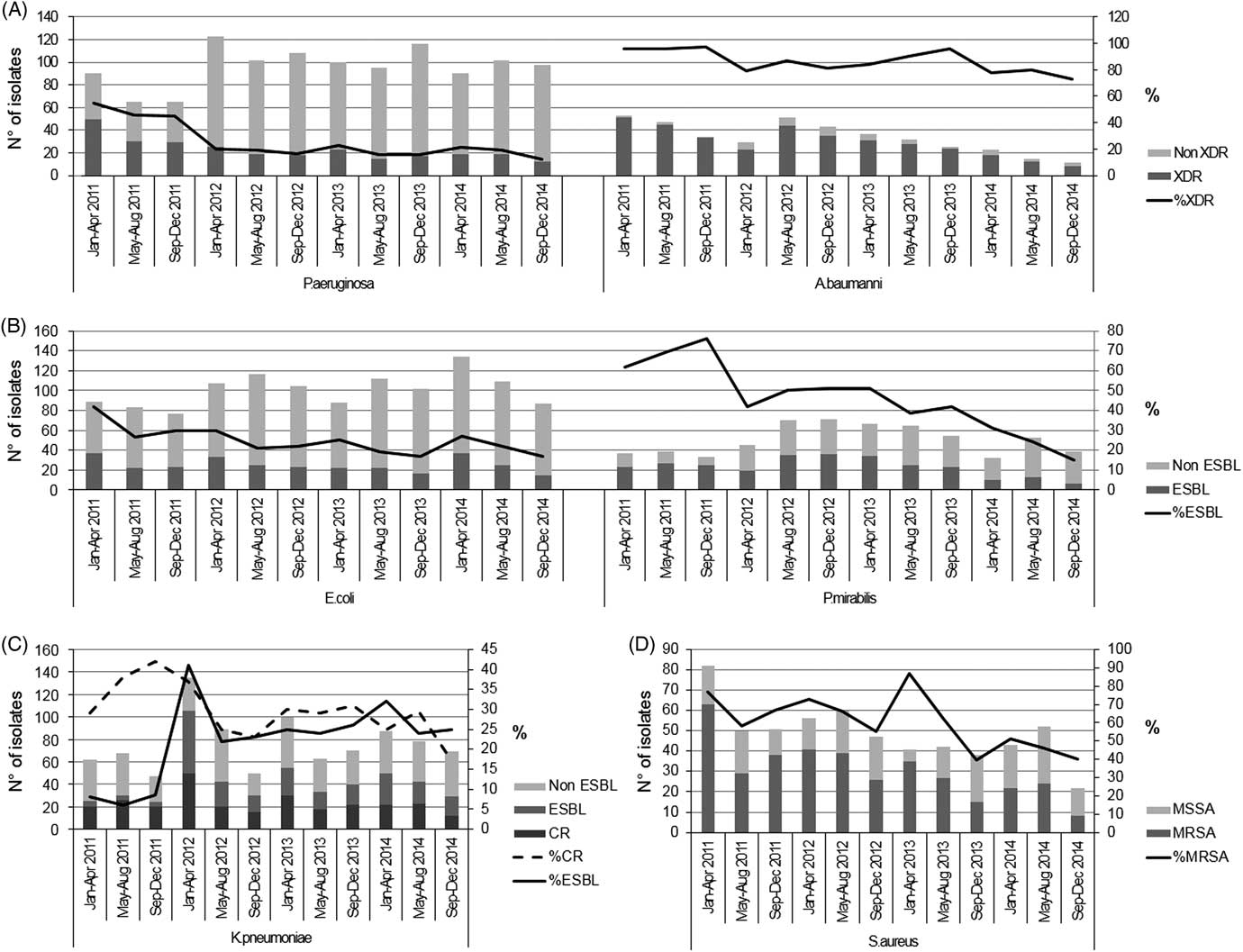
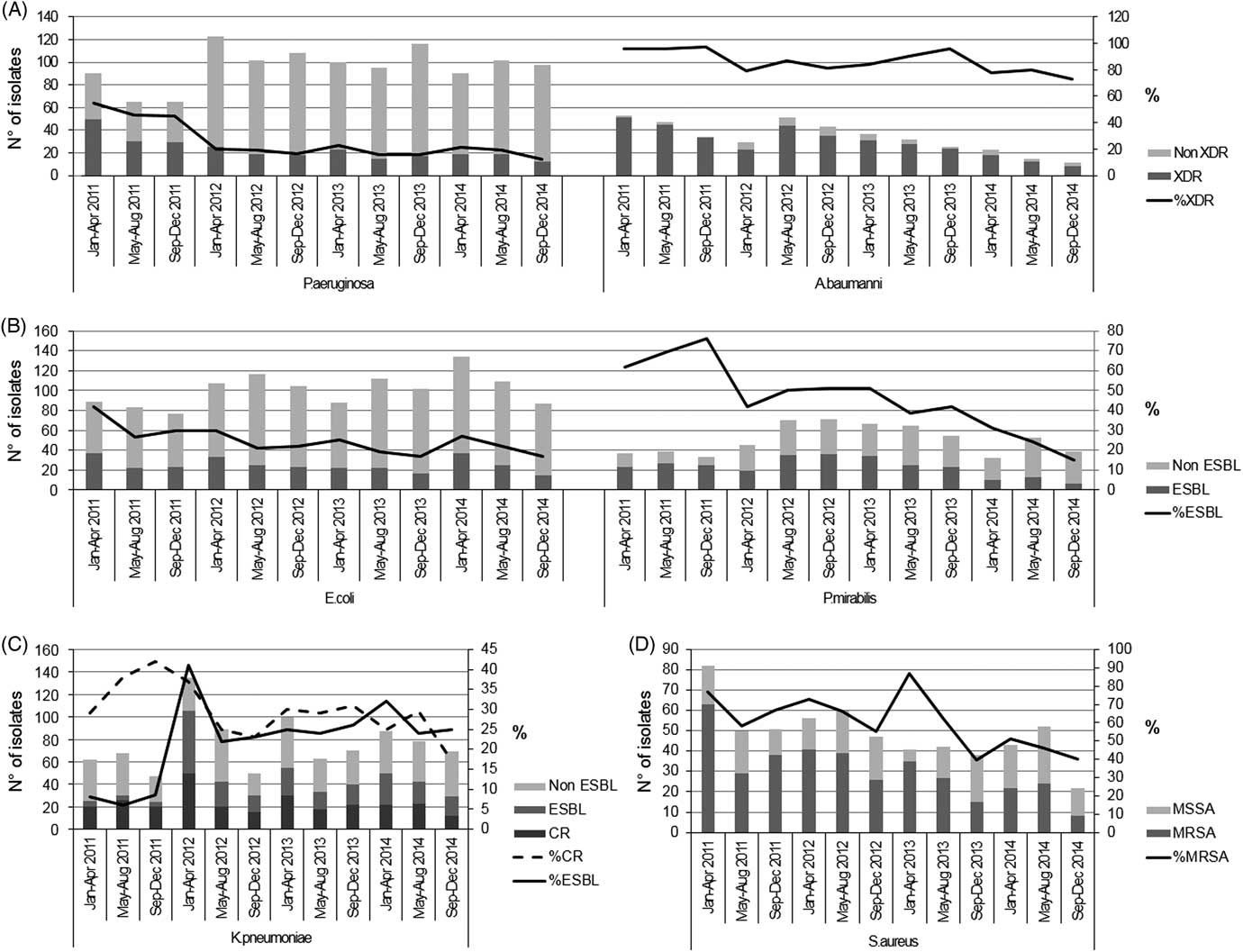
During the study period, 1,598 non-fermentative Gram-negative bacilli (1,194 P. aeruginosa, 400 A. baumanni, 3 Stenotrophomonas maltophilia, and 1 Pseudomonas putida) were isolated from clinical samples. A significant decrease in the prevalence of non-fermentative Gram-negative bacilli was observed during the study period. In the first 4 months of 2011, the prevalence of XDR strains in P. aeruginosa was 55% and in the last 4 months of 2014 it was 12% (P<.001). In the first 4 months of 2011 the prevalence of XDR strains in A. baumannii was 96%, and in the last 4 months of 2014 it was 73% (P=.03; Fig. 3). The respective incidences of XDR P. aeruginosa and A. baumannii decreased from 20 per 10,000 patient days in 2011 to 9 in 2014 and from 23 per 10,000 patient days in 2011 to 7 in 2014.
Proportion of multidrug-resistant organisms among non-fermentative Gram-negative bacilli (A), E. coli and P. mirabilis (B), Klebsiella pneumoniae (C), and Staphylococcus aureus (D) clinical isolates from January 2011 to December 2014. ESBL, extended spectrum β-lactamases; XDR, extensively drug resistant; MSSA, methicillin-susceptible Staphylococcus aureus; MRSA, methicillin-resistant Staphylococcus aureus; CR, carbapenem resistant.
Enterobacteriaceae
Overall, 2,794 Enterobacteriaceae were isolated from clinical samples: 1,210 E. coli, 934 K. pneumoniae, 606 P. mirabilis, 15 Enterobacter spp., 14 Serratia marcescens, 7 Providencia stuardii, 5 Morganella morganii, and 3 Citrobacter spp.
A significant decrease in the prevalence of ESBL-producing strains was observed during the study period in E. coli and P. mirabilis. In the first 4 months of 2011, E. coli prevalence was 42%, and in the last 4 months of 2014, E. coli prevalence was 17% (P=.0007). In the first 4 months of 2011, P. mirabilis prevalence was 62%, and in the last 4 months of 2014, P. mirabilis prevalence was 15% (P=.0001). In K. pneumoniae, the ESBL prevalence increased at the beginning of 2012 (from 8.5% in the last 4 months of 2011 to 41% in the first 4 months of 2012), then decreased but remained significantly higher (~25%) than at the beginning of the study period. An improvement was observed in the prevalence of carbapenem-resistant (CR) strains, which increased during 2011, reaching 42% during the last 4 months of 2011, then decreased to 17% during the last 4 months of 2014 (P=.005; Fig. 3). From 2011 to 2014, the overall incidence of ESBLs remained stable (30 per 10,000 patient days), while the overall incidence of CR Klebsiella pneumoniae decreased from 11.6 to 9.9 per 10,000 patient days.
Staphylococcus aureus
In total, 582 strains of S. aureus were considered. During the study period, a progressive reduction in the number of S. aureus isolates was noticed, with a simultaneous reduction in the prevalence of MRSA strains. MRSA prevalence decreased from 77% in the first 4 months of 2011 to 40% in the last 4 months of 2014 (P=.0008; Fig. 3). The incidence of MRSA decreased from 23 per 10,000 patient days in 2011 to 9.5 per 10,000 patient days in 2014.
DISCUSSION
An ASP strategy centered on an ID specialist dedicated to a rehabilitation hospital for SCI patients resulted in a dramatic decrease in the consumption of some key antibiotics, with a very positive impact on decreasing the selection of antimicrobial resistance and the occurrence of CDI. The ID specialist was involved both in capillary bedside consultation and educational activities aimed to improve the prescription behavior of the healthcare staff dedicated to SCI patients. He conducted small group meetings and face-to-face discussions with rehabilitation physicians about their antibiotic prescriptions.
No consensus has been reached regarding the best approach to antimicrobial stewardship, in particular in settings other than acute-care hospitals, where the implementation of ASP is now recommended in particular to decrease unnecessary antibiotic prescriptions. In this context, tailored strategies are surely needed.Reference Barlam, Cosgrove and Abbo 15 Prior experiences in LTCFs based only on educational activities or formal guidelines have failed,Reference Fleming, Browne and Byrne 16 and the presence of staff dedicated to the ASP has been associated with better results.Reference Jump, Olds and Seifi 17
Considering these reports, we decided to focus our ASP on the role of the ID consultant. Local physicians readily accepted this approach; indeed, the ID consultant progressively became a part of the hospital staff, and he continues to be responsible for the clinical management of patients with infections, providing continuous practical education.
To date, interventions tailored to SCI patients are lacking, and the knowledge and use of antimicrobial stewardship resources in this setting has been poor. According to a survey involving physicians, nurse practitioners, and physician assistants of the Veteran’s Affair SCI program, over-prescribing was recognized by 71% of the participants as a major cause of antibiotic resistance.Reference Evans, Rogers, Weaver and Burns 18 However, 50% of these participants stated that they never used susceptibility tests to choose antibiotic treatment, and >30% never asked for ID consultations.Reference Evans, Rogers, Burns, Lopansri and Weaver 11 Likewise, during the pre-intervention period, we observed excessive use of broad-spectrum antibiotics (ie, carbapenems and fluoroquinolones accounted for 60% of overall prescriptions) with a lack of awareness regarding their impact on the selection of MDROs.
In our country, a huge increase in the prevalence of ESBL producing strains has been reported over the last 10 years.Reference Luzzaro, Mezzatesta and Mugnaioli 19 The spread of antimicrobial resistance, mainly among Gram-negative bacteria, may partially explain the overuse of carbapenems. However, the knowledge of local epidemiology, which is very important for appropriate antibiotic prescribing, is often scarce. Indeed, in our experience, rehabilitation physicians are worried about antibiotic resistance but remain substantially unaware of the local epidemiology and the most common mechanisms of antibiotic resistance. In this study, the empirical use of third-generation cephalosporines and fluoroquinolones was a consolidated clinical practice, but it was often inappropriate according to the local patterns of susceptibility. In addition, the extensive use of carbapenems (routinely employed as first line empirical therapy in patients with fever) was driven by concerns about resistance, but it was frequently unjustified. In this context, education regarding antimicrobial resistance mechanisms and local resistance patterns was fundamental to convincing local staff of the need for a more responsible use of antibiotics.
The problem of antibiotic overuse in SCI patients is known, but to our knowledge, a reference value by which to identify an appropriate antibiotic consumption in the specific setting of rehabilitation hospitals dedicated to SCI patients has not been established. The implementation of our ASP resulted in a significant decrease in the use of antibiotics, mainly driven by the reduction in the prescription of fluoroquinolones and carbapenems. Importantly, the significant reduction in the use of these drugs resulted in no significant changes in mortality after the implementation of this ASP. On the contrary, a trend toward lower mortality and a significant shortening of length of stay (LOS) were observed. This result is very important in this setting because it is related to functional recovery.Reference Mylotte, Graham, Kahler, Young and Goodnough 20 Although such an analysis is outside the aim of this study, we hypothesize that the appropriate management of infectious complications may have contributed to the shortening of the functional recovery period and subsequently of LOS. It would be interesting to investigate this hypothesis in further studies.
The changes in antibiotic use described thus far have had a very favorable impact on the incidence of CDI, an important target for stewardship programs, which declined by 66%. Similar results were obtained in a 160-bed LTCF, where 2 ID consultants (an ID physician and a nurse practitioner) examined residents once a week and were available for remote consultations the remainder of the week.Reference Jump, Olds and Seifi 17 In addition to the prior study, we also analysed the impact on rates of antibiotic resistance among the most common bacteria causing infections in our facility, and the trend toward decreasing the prevalence of multidrug-resistant organisms was very positive.
With respect to the feasibility of the intervention, considering the savings related to the acquisition and administration of antibiotics, as well as the reduction of the costs associated with CDI management, the costs incurred by MRI to incorporate ID expertise were entirely economically justified.
Our study has several limitations. First, the single-center design limited the possibility of generalizing our results. Second, we only monitored the resistance pattern of a selected group of microorganisms, but they are by far the most common causes of healthcare-associated infections in our and in other facilities. Third, long-term monitoring is needed to confirm these data. However, the good results we obtained in a special population at high risk for potentially severe infections are encouraging and suggest that this kind of approach can be effective in implementing antimicrobial stewardship outside acute-care hospitals.
Our experience demonstrates that an ASP based on providing a systematic ID consultation can be effective in reducing antibiotic use and prevalence of antimicrobial resistance in a difficult context such as an SCI rehabilitation facility.
ACKNOWLEDGMENTS
We are indebted with Russell E. Lewis for his collaboration in the preparation of the manuscript.
Financial support: No financial support was provided relevant to this article.
Potential conflicts of interest: All authors report no conflicts of interest relevant to this article.