1. Introduction
Large aperture and high precision optical mirrors put forward higher requirements for optical processing equipment, and the traditional polishing equipment mainly adopts a gantry structure, which has the problems of the huge structure, poor flexibility, and high cost. With the advantages of high flexibility, low cost, and multiple assistance, industrial robots have been introduced into the fields of manufacturing and motion simulation [Reference Canfield, Owens and Zuccaro1–Reference Pellegrinelli, Pedrocchi, Tosatti, Fischer and Tolio3]. Further, compared with the serial mechanism, the parallel manipulator (PM) has the advantages of high stiffness, high precision, and high bearing capacity, which is widely used for many fields [Reference Li, Li and Zhao4, Reference Plitea, Szilaghyi and Pisla5].
Parallel or hybrid robots for polishing operations are required to drive the grinding system to traverse every point of the mirror surface and adjust the motion attitude in real time. Therefore, the robot needs high dynamic performance and motion accuracy. Lin et al. [Reference Lin, Li, Yang and Zhang6] developed a five degrees of freedom (5-DOF) hybrid polishing machine and studied the dynamics and control performance. Xu et al. [Reference Xu, Cheung, Li, Ho and Zhang7] designed a serial–parallel polishing machine for polishing the free-form surface. In addition, a single PM cannot meet the machining need of large-scale parts due to the limitation of the motion workspace, and multiple robots have to be used for collaborative processing. Meanwhile, researchers have developed a hybrid robot, which consists of a rotating module connected to a PM and can achieve five or six degrees of freedom in the workspace [Reference Yang, Liu, Xiao, Zhu, Liu, Gong and Huang8, Reference Dong, Liu, Yue and Huang9]. Besides, the PM consists of several kinematic branched-chains and various motion joints, the elastic deformation of the motion components, the clearance, friction, and contact deformation for the motion joints will affect the dynamic characteristics and motion accuracy of the robot [Reference Xu, Teng, Yao, Zhou and Zhao10, Reference Chebbi, Affi and Romdhane11]. A lot of studies have been carried out on the optimization of structure and control parameters [Reference Jiang, Li and Wang12, Reference Mousavi, Gagnol, Bouzgarrou and Ray13], motion coupling control [Reference Xie, Xie, Liu, Wang and Shen14], disturbance suppression or compensation [Reference Liu, Tang, Shao and Wang15, Reference Shan and Cheng16] for PMs. Dynamic modeling methods for PMs include Newton–Euler method, Lagrange method, virtual work principle method, and Kane method [Reference Guo, Cheng and Pang17–Reference Liu, Li, Zhang, Gao and Zuo20]. Dong et al. [Reference Dong, Liu, Huang and Chetwynd21] present a semi-analytical approach for elastodynamic modeling of Tricept robot based on the screw theory and combined with the dual properties of twist/wrench systems and a static condensation technique. For the elastodynamic of fully flexible parallel robots, Cammarata provided a novel derivation of the Cartesian stiffness and inertia matrices for PMs, the proposed method allows for obtaining consistent Cartesian matrices at different nodes of interest without redefining the transformation matrices typical of the Jacobian-based methods [Reference Cammarata22]. Alessandro et al. [Reference Alessandro and Rosario23] performed the elastodynamic optimization of a 3T1R PM and based on the fixed pose optimization and the global optimization inside a cube, the first natural frequency and its distribution within the robots constant orientation workspace are analyzed. Most researchers usually regard the motion joint as the ideal joint. When the clearance of the motion joint is considered, the clearance can be simplified as fixed assembly clearance [Reference Flores, Machado, Silva and Martins24] or irregular clearance caused by wear in practice [Reference Mukras, Kim and Mauntler25]. However, due to the complexity of the irregular clearance caused by the wear of the moving pair, many studies are focused on the fixed assembly clearance [Reference Wang, Tian, Hu and Flores26]. The existence of the clearance of the motion joint will cause a collision in the motion joint. Chen et al. [Reference Chen, Gao, Deng and Wang27] deduced the nonlinear dynamics equation for 4UPS-RPU PM with spherical clearance by Lagrange method. Based on elastic Hertz theory with a dissipative term, Varedi-Koulaei et al. used a continuous contact force model to evaluate the contact force and analyzed the effects of working speed and clearance size on the dynamic characteristics of a planar mechanical system [Reference Varedi-Koulaei, Daniali and Farajtabar28]. Xu et al. introduced an improved impact force model and a modified friction force model to evaluate the effects of impact and friction in the clearance joints for a planar PM which has two clearance joints in the left wing and right wing [Reference Xu, Wang, Ji, Tong and Xue29]. When a parallel or hybrid robot is applied to large optical mirror polishing, it is necessary to establish a rigid–flexible coupling dynamic model to analyze the distribution characteristics of the robot’s load and motion errors and to consider the influence of the joint effects for improving the dynamic performance and motion accuracy of the polishing robot. In addition, the rigid–flexible coupling dynamics analysis considering the joint clearance also provides the basis for the optimization of structural parameters and the design of control strategies for the polishing robot.
The rest of this article is organized as follows. In Section 2, the structure and coordinate systems of the polishing robot are introduced. In Section 3, the kinematic and dynamic models of the serial component of the polishing robot are established. In Section 4, the rigid–flexible coupling dynamic model of the PM for the polishing robot is established considering the elastic deformation of kinematic branched-chains. In Section 5, considering the influence of the joint clearance, the rigid–flexible coupling dynamic model with the joint clearance is further obtained. In Section 6, the equivalent load distribution of the serial component on the PM is analyzed, and the effect of branch-chains elasticity and joint clearance on the motion error of the moving platform is studied.
2. Description and Coordinate Systems of Polishing Robot
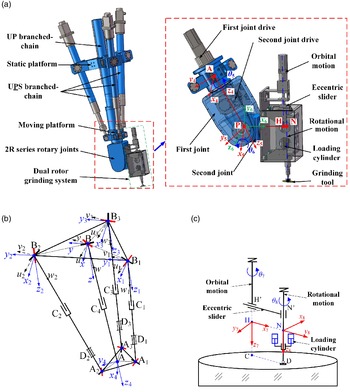
The hybrid polishing robot is composed of a 3UPS/UP PM and a serial component consisting of 2R series rotary joints and a dual rotor grinding system. The structure and topology of the hybrid polishing robot are shown in Fig. 1(a) and (b). The 3UPS/UP PM consists of a static platform, a moving platform, three UPS branched-chains with the same structure, and a UP branched-chain. The UPS branched-chain is connected to the moving platform with a composite spherical joint and to the static platform with a Hooke joint, points A i and B i (i = 1, 2, 3) are the center points of the rotating shaft for the composite spherical joint and Hooke joint. Besides, the composite spherical joint can be seen as a combination of a rotating joint and a Hooke joint, and point D i is the connection point of the rotating joint for the composite spherical joint. The UP branched-chain is fixed to the moving platform and connected to the static platform by a Hooke joint and point B is the center point of the rotating shaft for the Hooke joint. 2R series rotary joints are divided into the first joint and the second joint. The PM and 2R series rotary joints move in concert during the mirror polishing process, which can meet the 5-DOF motion demand of the grinding system in the workspace.
Hybrid polishing robot: (a) CAD model, (b) topology, (c) diagram of dual rotor grinding system.

In the process of large-scale optical mirror polishing, the removal function needs to be closer to the Gauss function to get better surface convergence. Thus, a planetary dual rotor grinding system is designed based on a combination of orbital and rotational motions of a small grinding tool, and the diagram of the grinding system is shown in Fig. 1(c). The orbital motor of the grinding system drives the rotation of the eccentric slider, which is fixed at one end to the orbital frame with two sets of vertical arrangement rails. The rotational motor is located in the orbital frame and drives the grinding tool with a pneumatic pressure system to complete the mirror processing. In addition, the size of the grinding tool can be adjusted to suit different polishing requirements.
Based on the right-hand rule, the base coordinate system {B-xyz} is established at point B, x-axis passes through the midpoint of B1B2, and z-axis is perpendicular to the static platform. The conjoined coordinate system {A-x 4 y 4 z 4} of the UP branched-chain and moving platform are established at point A, x 4-axis passes through the midpoint of A1A2, z 4-axis along the axis of UP branched-chain. The reference coordinate system {B i -x i y i z i } (i = 1, 2, 3) and the conjoined coordinate system {B i -u i v i w i } for UPS branched-chain B i C i D i A i are established at point B i , x i -axis and z i -axis are parallel to x-axis and z-axis, respectively, v i -axis coincides with the axis of the far frame of UPS branched-chain Hooke joint, w i -axis along the axis of UPS branched-chain. For the serial component, the conjoined coordinate system {P-x 5 y 5 z 5} of the first joint and conjoined coordinate system {P-x 6 y 6 z 6} of the second joint are established at point P, which is the intersection of rotation axes of the first joint and the second joint, y 5-axis along the rotation axis of the second joint, z 5-axis coincides with the rotation axis of the first joint, z 6-axis coincides with y 5-axis and has the same direction, and x 6-axis coincides with the installation axis of the supporting part of the grinding system. The conjoined coordinate system {H-x 7 y 7 z 7} of the orbital motion component is established at point H, which is the intersection point of the orbital motion axis and x 6-axis, z 7-axis coincides with the orbital motion axis, and x 7-axis is parallel to the offset direction of the eccentric slider. The conjoined coordinate system {N-x 8 y 8 z 8} is established at point N, which is the intersection point of the rotational motion axis and x 7-axis, z 8-axis coincides with the rotational motion axis, and x 8-axis and y 7-axis are parallel and opposite.
3. Dynamic Model of Serial Component of Polishing Robot
The serial component of the hybrid polishing robot consists of 2R series rotary joints and a dual rotor grinding system, and the kinematics can be analyzed with D-H method. The motion diagram of the serial component is shown in Fig. 2. Combined with Fig. 1, the motion parameters of the serial component are shown in Table I.
Motion diagram of serial component.

D-H parameters of serial component.

The motion parameters of 2R series rotary joints and dual rotor grinding system are measured in the conjoined coordinate system {A-x 4 y 4 z 4}, and we can obtain:
 \begin{align}\left\{ \begin{array}{l}{}_5^4\boldsymbol{T} = \left[ {\begin{array}{c@{\quad}c}{{}_5^4\boldsymbol{R}}&{{\boldsymbol{n}_{54}}}\\ \\[-7pt] 0&1\end{array}} \right]\\ \\[-7pt] {}_6^4\boldsymbol{T} = {}_5^4\boldsymbol{T}{}_6^5\boldsymbol{T} = \left[ {\begin{array}{c@{\quad}c}{{}_6^4\boldsymbol{R}}&{{\boldsymbol{n}_{64}}}\\ \\[-7pt] 0&1\end{array}} \right]\end{array} \right.,\,\left\{ \begin{array}{l}{}_7^4\boldsymbol{T} = {}_5^4\boldsymbol{T}{}_6^5\boldsymbol{T}{}_7^6\boldsymbol{T} = \left[ {\begin{array}{c@{\quad}c}{{}_7^4\boldsymbol{R}}&{{\boldsymbol{n}_{74}}}\\ \\[-7pt] 0&1\end{array}} \right]\\ \\[-7pt] {}_8^4\boldsymbol{T} = {}_5^4\boldsymbol{T}{}_6^5\boldsymbol{T}{}_7^6\boldsymbol{T}{}_8^7\boldsymbol{T} = \left[ {\begin{array}{c@{\quad}c}{{}_8^4\boldsymbol{R}}&{{\boldsymbol{n}_{84}}}\\ \\[-7pt] 0&1\end{array}} \right]\end{array} \right.\end{align}
where
 ${}_i^j\boldsymbol{T}$
and
 ${}_i^j\boldsymbol{R}$
(i, j = 4, 5, 6, 7, 8) are the transformation matrix and attitude matrix of the coordinate system i relative to the coordinate system j, and i and j indicate the subscripts of the axes of the coordinate systems; and
n
ij
is the coordinate origin vector of the coordinate system i in the conjoined coordinate system {A-x
4
y
4
z
4}.
The attitude matrix is rewritten as
 ${}_i^j\boldsymbol{R} = [{\boldsymbol{e}_{xij}}\;{\boldsymbol{e}_{yij}}\;\;{\boldsymbol{e}_{zij}}]$
, and
e
xij
,
e
yij
, and
e
zij
are the unit direction vectors for the x
i
-axis, y
i
-axis and z
i
-axis, and we can obtain:
 \begin{align}\left\{ \begin{array}{l}{\boldsymbol{e}_{kij}} = {}_i^j\boldsymbol{R}{\boldsymbol{e}_{kii}}\\ \\[-7pt] {}_i^0\boldsymbol{R} = {}_4^0\boldsymbol{R}{}_i^4\boldsymbol{R}\end{array} \right.\,\left( {i=5,{\rm{ }}6,{\rm{ }}7,{\rm{ }}8,k = x,y,z} \right)\;\end{align}
where
 ${e_{xii}} = {[\begin{array}{*{20}{c}}1&0&0\end{array}]^T}$
,
 ${e_{yii}} = {[\begin{array}{*{20}{c}}0&1&0\end{array}]^T}$
and
 ${e_{zii}} = {[\begin{array}{*{20}{c}}0&0&1\end{array}]^T}$
,
 ${}_4^0R$
is the attitude matrix of the coordinate system {A-x
4
y
4
z
4} relative to the base coordinate system {B-xyz}.
Based on the principle of angular velocity superposition, the angular velocities of the first joint, the second joint, the orbital motion component, and the rotational motion component are denoted as:
 \begin{align}\left\{ \begin{array}{l}{\boldsymbol{\omega }_{fir}} = {\boldsymbol{\omega }_{40}} + {{\dot \theta }_5}{\boldsymbol{e}_{z50}}\\ \\[-7pt] {\boldsymbol{\omega }_{sec}} = {\boldsymbol{\omega }_{40}} + {{\dot \theta }_5}{\boldsymbol{e}_{z50}} + {{\dot \theta }_6}{\boldsymbol{e}_{z60}}\\ \\[-7pt] {\boldsymbol{\omega }_{orb}} = {\boldsymbol{\omega }_{40}} + {{\dot \theta }_5}{\boldsymbol{e}_{z50}} + {{\dot \theta }_6}{\boldsymbol{e}_{z60}} + {{\dot \theta }_7}{\boldsymbol{e}_{z70}}\\ \\[-7pt] {\boldsymbol{\omega }_{rot}} = {\boldsymbol{\omega }_{40}} + {{\dot \theta }_5}{\boldsymbol{e}_{z50}} + {{\dot \theta }_6}{\boldsymbol{e}_{z60}} + {{\dot \theta }_7}{\boldsymbol{e}_{z70}} + {{\dot \theta }_8}{\boldsymbol{e}_{z80}}\end{array} \right.\end{align}
where
 ${\boldsymbol\omega _{40}}$
is the angular velocity of the moving platform in the base coordinate system, and
e
zi0 (i=5, 6, 7, 8) is the unit direction vector in the corresponding conjoined coordinate system. Further, the angular acceleration of each component for the serial component can be obtained by deriving Eq. (3).
Considering the structure features of 2R series rotary joints and dual rotor grinding system, the elastic deformation can be negligible. The grinding tool of the double rotor grinding system is supplied with output pressure to polish the optical mirror surface by two low friction cylinders, while the output pressure is a constant related to the polishing process. The load acting on 3UPS/UP PM by the serial component can be converted into the equivalent force and moment. Based on the Newton–Euler method, the equivalent force is the sum of the polishing force and the gravity of each component, and the equivalent moment is the sum of the moments produced by the gravity of each component, the polishing force and the inertia force of each component. The equivalent load can be expressed as:
 \begin{align}\left\{ \begin{array}{l}{\boldsymbol{F}_{ser}} = {\boldsymbol{F}_{gri}} + ({\textrm{m}_{rot}}+{\textrm{m}_{orb}}+{\textrm{m}_{sec}}+{\textrm{m}_{fir}})\boldsymbol{g}\\ \\[-7pt] {\boldsymbol{F}_{gri}} = - {{P}_{gri}}\left(\dfrac{{\pi {D}_{tool}^2}}{4}\right){\boldsymbol{e}_{z80}}\end{array} \right.\end{align}
 \begin{align}\left\{ \begin{array}{l}{\boldsymbol{M}_{ser}} = {\boldsymbol{M}_{gri}} + {\boldsymbol{M}_g} + {\boldsymbol{M}_I}\\ \\[-7pt] {\boldsymbol{M}_{gri}} = {}_4^0\boldsymbol{R}({}_8^4\boldsymbol{R}{\boldsymbol{D}_8} + {\boldsymbol{n}_{84}}) \times {\boldsymbol{F}_{gri}}\\ \\[-7pt] {\boldsymbol{M}_g}={}_4^0\boldsymbol{R}({}_8^4\boldsymbol{R}{\boldsymbol{d}_{crot}} + {\boldsymbol{n}_{84}}) \times \left( {{\textrm{m}_{rot}}\boldsymbol{g}} \right) + {}_4^0\boldsymbol{R}({}_7^4\boldsymbol{R}{\boldsymbol{d}_{corb}} + {\boldsymbol{n}_{74}}) \times \left( {{\textrm{m}_{orb}}\boldsymbol{g}} \right)\\ \\[-7pt] \quad \quad +{}_4^0\boldsymbol{R}({}_6^4\boldsymbol{R}{\boldsymbol{d}_{csec}} + {\boldsymbol{n}_{64}}) \times \left( {{\textrm{m}_{sec}}\boldsymbol{g}} \right) + {}_4^0\boldsymbol{R}({}_5^4\boldsymbol{R}{\boldsymbol{d}_{cfir}} + {\boldsymbol{n}_{54}}) \times \left( {{\textrm{m}_{fir}}\boldsymbol{g}} \right)\\ \\[-7pt] {\boldsymbol{M}_I} = {\boldsymbol{I}_{rot{\rm{0}}}}{\boldsymbol{\varepsilon }_{rot}} + {\boldsymbol{\omega }_{rot}} \times {\boldsymbol{I}_{rot0}}{\boldsymbol{\omega }_{rot}} + {\boldsymbol{I}_{orb0}}{\boldsymbol{\varepsilon }_{orb}} + {\boldsymbol{\omega }_{orb}} \times {\boldsymbol{I}_{orb0}}{\boldsymbol{\omega }_{orb}}\\ \\[-7pt] \quad \quad +\ {\boldsymbol{I}_{sec0}}{\boldsymbol{\varepsilon }_{sec}} + {\boldsymbol{\omega }_{sec}} \times {\boldsymbol{I}_{sec0}}{\boldsymbol{\omega }_{sec}} + {\boldsymbol{I}_{fir0}}{\boldsymbol{\varepsilon }_{fir}} + {\boldsymbol{\omega }_{fir}} \times {\boldsymbol{I}_{fir0}}{\boldsymbol{\omega }_{fir}}\end{array} \right. \\[-5pt]\nonumber \end{align}
where F gri is the polishing force, m rot , m orb , m sec , and m fir ( ε rot , ε orb , ε sec , and ε fir ) are the masses (angular accelerations) of the rotational motion component, orbital motion component, second joint and first joint, g is the gravity acceleration vector, P gri is the polishing output pressure, D tool is the diameter of the grinding tool, D 8 is the coordinate vector of point N in the conjoined coordinate system {A-x 4 y 4 z 4}, d crot , d corb , d csec , and d cfir are the coordinate vectors of the centroid of each component, and I rot0, I orb0, I sec0, and I fir0 are the inertia matrices of each component in the base coordinate system.
4. Rigid–Flexible Coupling Dynamic Model of PM
The PM of the polishing robot consists of three UPS branched-chains and a UP branched-chain, and the UPS branched-chains have the same structural parameters. In the rigid–flexible coupling dynamic modeling, there are the following assumptions: (1) The static platform and moving platform are considered as the rigid body; (2) The actual motion of the polishing robot is a linear superposition of rigid and elastic motions, ignoring the coupling term. The rigid–flexible coupling dynamic model of PM is analyzed with Kineto-elasto dynamics method.
4.1. Element dynamic model
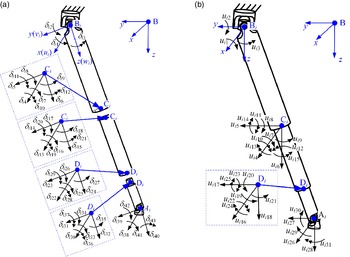
The rods in the UPS branched-chains and UP branched-chain are considered to be elastomers. The beam element containing two nodes is selected as the basic elastic model and the diagram is shown in Fig. 3, and 18 generalized coordinates are used to describe the elastic displacements.
 $\delta$
1–
 $\delta$
3 and
 $\delta$
10–
 $\delta$
12 are the elastic linear displacements at the nodes of the beam element,
 $\delta$
4–
 $\delta$
6 and
 $\delta$
13–
 $\delta$
15 are the elastic angular displacements, and
 $\delta$
7–
 $\delta$
9 and
 $\delta$
16–
 $\delta$
18 are the elastic curvatures. The dynamic model of the beam element can be obtained from Lagrange equation:
 \begin{align}\left\{ \begin{array}{l}{\boldsymbol{M}_0}\boldsymbol{\ddot \delta } + {\boldsymbol{K}_0}\boldsymbol{\delta } = {\boldsymbol{F}_0} + {\boldsymbol{N}_0} + {\boldsymbol{G}_0}\\ \\[-7pt] {\boldsymbol{G}_0} = - {\boldsymbol{M}_0}{{\boldsymbol{\ddot \delta }}_r}\end{array} \right.\end{align}
where
M
0 is the element mass matrix,
K
0 is the element stiffness matrix,
F
0 is the external load matrix,
N
0 is the load matrix of other elements on the beam element,
G
0 is the inertial matrix, and
 ${\boldsymbol{\ddot \delta }_r}$
is the element acceleration array.
Diagram of beam element generalized coordinates.

4.2. Rigid–flexible coupling dynamic model of branched-chains
According to the structural characteristics of the UPS branched-chain, the branched-chain B i C i D i A i (i = 1, 2, 3) can be divided into three beam elements, and the generalized coordinates in the element coordinate system and base coordinate system are shown in Fig. 4. The prismatic joint C i can be considered as a rigid connection to eliminate the degree of freedom, and the branched-chain can be regarded as an “instantaneous structure”. There are 12 non-zero coordinates in the element B i C i . The node D i is a rotating joint connection point of the composite spherical joint, the elastic curvature along the axis is zero, hence there are 17 non-zero coordinates in the element C i D i . Both ends of the element D i A i are rotating joints, and there are 14 non-zero coordinates.
Generalized coordinates of UPS branched-chain: (a) in element coordinate system, (b) in base coordinate system.

The attitude matrix of the element coordinate system {B i -u i v i w i } relative to the base coordinate system {B-xyz} can be obtained by rotating Ψ i around the y-axis and then rotating Φ i around the u i -axis. And the attitude transformation matrix is orthogonal, so we can obtain:
 \begin{align}{}_0^i\boldsymbol{R} = {}_i^0{\boldsymbol{R}^{ - 1}} = {}_i^0{\boldsymbol{R}^{\rm{T}}} = \left[ {\begin{array}{c@{\quad}c@{\quad}c}{c{\psi _i}}&{s{\varphi _i}s{\psi _i}}&{c{\varphi _i}s{\varphi _i}}\\ \\[-7pt] 0&{c{\varphi _i}}&{ - s{\varphi _i}}\\ \\[-7pt] { - s{\psi _i}}&{s{\varphi _i}c{\psi _i}}&{c{\varphi _i}c{\psi _i}}\end{array}} \right]\end{align}
Since node C
i
is assumed to be a rigid connection, the coordinates of the two elements at this node are the same. The node D
i
belongs to two elements, thus the elastic displacements of the two elements are the same, but the angular displacements and curvatures are different in the base coordinate system. The elastic deformation of UPS branched-chain can be expressed by 43 non-zero coordinates in the element coordinate system and
 ${\boldsymbol{\delta }_{{{\rm{A}}_i}{{\rm{B}}_i}}} = {[{\delta _{i1}},{\delta _{i2}},\cdots,{\delta _{i43}}]^{\rm{T}}}$
, and 31 non-zero coordinates in the base coordinate system and
 ${\boldsymbol{U}_i} = {[{u_{i1}},{u_{i2}},\;\cdots\;,{u_{i31}}]^T}$
. And the following correspondence exists:
 \begin{align}{\boldsymbol{\delta }_{{{\rm{A}}_i}{{\rm{B}}_i}}} = {\boldsymbol{B}_i}{\boldsymbol{U}_i}\end{align}
 \begin{align*}{\boldsymbol{B}_i} = {\left[ {\begin{array}{*{20}{c}}{\boldsymbol{R}_{{i}{\rm{1}}}^*}&{}&{}&{}&{}&{}&{}&{}&{}&{}&{}&{}&{}\\ {}&{\boldsymbol{R}_{{i}{\rm{2}}}^*}&{}&{}&{}&{}&{}&{}&{}&{}&{}&{}&{}\\ {}&{}&{{}_0^i\boldsymbol{R}}&{}&{}&{}&{}&{}&{}&{}&{}&{}&{}\\ {}&{}&{}&{{}_0^i\boldsymbol{R}}&{}&{}&{}&{}&{}&{}&{}&{}&{}\\ {}&{}&{}&{}&{{}_0^i\boldsymbol{R}}&{}&{}&{}&{}&{}&{}&{}&{}\\ {}&{}&{{}_0^i\boldsymbol{R}}&{}&{}&{}&{}&{}&{}&{}&{}&{}&{}\\ {}&{}&{}&{{}_0^i\boldsymbol{R}}&{}&{}&{}&{}&{}&{}&{}&{}&{}\\ {}&{}&{}&{}&{}&{{}_0^i\boldsymbol{R}}&{}&{}&{}&{}&{}&{}&{}\\ {}&{}&{}&{}&{}&{}&{{}_0^i\boldsymbol{R}}&{}&{}&{}&{}&{}&{}\\ {}&{}&{}&{}&{}&{}&{}&{{}_0^i\boldsymbol{R}}&{}&{}&{}&{}&{}\\ {}&{}&{}&{}&{}&{}&{}&{}&{\boldsymbol{R}_{{\rm{i2}}}^*}&{}&{}&{}&{}\\ {}&{}&{}&{}&{}&{}&{{}_0^i\boldsymbol{R}}&{}&{}&{}&{}&{}&{}\\ {}&{}&{}&{}&{}&{}&{}&{{}_0^i\boldsymbol{R}}&{}&{}&{}&{}&{}\\ {}&{}&{}&{}&{}&{}&{}&{}&{}&{\boldsymbol{R}_{{\rm{i2}}}^*}&{}&{}&{}\\ {}&{}&{}&{}&{}&{}&{}&{}&{}&{}&{{}_0^i\boldsymbol{R}}&{}&{}\\ {}&{}&{}&{}&{}&{}&{}&{}&{}&{}&{}&{\boldsymbol{R}_{{i}{\rm{2}}}^*}&{}\\ {}&{}&{}&{}&{}&{}&{}&{}&{}&{}&{}&{}&{\boldsymbol{R}_{{i}{\rm{1}}}^{\rm{*}}}\end{array}} \right]_{43 \times 31}}\end{align*}
where
 $\boldsymbol{R}_{{i}{\rm{1}}}^* = \left[ {\begin{array}{c@{\quad}c}{c{\phi _i}}&{s{\varphi _i}s{\phi _i}}\\ 0&{c{\varphi _i}}\end{array}} \right]$
and
 $\boldsymbol{R}_{{i}{\rm{2}}}^* = c{\varphi _i}c{\phi _i}$
.
The UP branched-chain BA is connected with the static platform by a Hooke joint, which can be regarded as a beam element. The generalized coordinates in the element coordinate system and base coordinate system are shown in Fig. 5. The Hooke joint consists of a combination of two rotating joints with mutually perpendicular axes, so the elastic curvatures in these two directions are zero. Point B is the connection point between UP branched-chain and the static platform, the elastic linear displacements and elastic angular displacement around the axis are zero, and there are 12 non-zero generalized coordinates for the UP branched-chain. Similarly, the attitude matrix from the coordinate system {B-xyz} to the element coordinate system {B-u 4 v 4 w 4} can be written as:
 \begin{align}{}_0^4\boldsymbol{R} = {}_4^0{\boldsymbol{R}^{ - 1}} = {}_4^0{\boldsymbol{R}^T} = \left[ {\begin{array}{c@{\quad}c@{\quad}c}{c{\phi _4}}&{s{\varphi _4}s{\phi _4}}&{c{\varphi _4}s{\phi _4}}\\ \\[-7pt]0&{c{\varphi _4}}&{ - s{\varphi _4}}\\ \\[-7pt] { - s{\phi _4}}&{s{\varphi _4}c{\phi _4}}&{c{\varphi _4}c\phi }\end{array}} \right]\end{align}
Generalized coordinates of UP branched-chain: (a) in element coordinate system, (b) in base coordinate system.

The nonzero elastic deformation coordinates of UP branched-chain can be expressed as
 ${\boldsymbol{\delta }_4} = {[{\delta _{41}},{\delta _{42}},\cdots,{\delta _{412}}]^{\rm{T}}}$
in element coordinate system, and written as
 ${\boldsymbol{U}_4} = {[{u_{41}},{u_{42}},\;\cdots\;,{u_{412}}]^{\rm{T}}}$
in the base coordinate system. And the mapping can be described as:
 \begin{align}{\boldsymbol{\delta }_4} &= {\boldsymbol{B}_4}{\boldsymbol{U}_4}\\[3pt] {\boldsymbol{B}_4} &= \textrm{diag}(\boldsymbol{R}_{{\rm{41}}}^*,\boldsymbol{R}_{{\rm{42}}}^*,{}_0^4\boldsymbol{R},{}_0^4\boldsymbol{R}) \nonumber\end{align}
Where
 $\boldsymbol{R}_{{\rm{41}}}^* = \left[ {\begin{array}{c@{\quad}c}{c{\phi _4}}&{s{\varphi _4}s{\psi _4}}\\ 0&{c{\psi _4}}\end{array}} \right]$
and
 $\boldsymbol{R}_{{\rm{42}}}^* = c{\varphi _4}c{\psi _4}$
.
Based on the dynamic model of the beam element Eq. (6), the dynamic models of elements B i C i , C i D i and D i A i of UPS branched-chain B i C i D i A i can be obtained. Furthermore, the dynamic model of UPS branched-chain in the base coordinate system {B-xyz} can be expressed as:
 \begin{align}{\boldsymbol{M}^i}\boldsymbol{\ddot U}{}_i + {\boldsymbol{K}^i}{\boldsymbol{U}_i} = {\boldsymbol{F}^i} + {\boldsymbol{N}^i} + {\boldsymbol{G}^i}\,\left( {i=1,{\rm{ }}2,{\rm{ }}3} \right)\\[3pt] \nonumber {\boldsymbol{M}^i} = \boldsymbol{B}_i^{\rm{T}}{\boldsymbol{M}_{e{\rm{0}}i}}{\boldsymbol{B}_i},\,{\boldsymbol{K}^i} = \boldsymbol{B}_i^{\rm{T}}{\boldsymbol{K}_{e{\rm{0}}i}}{\boldsymbol{B}_i},\,{\boldsymbol{G}^i} = - {\boldsymbol{M}^i}{\boldsymbol{\ddot U}_{ri}} \end{align}
where
M
i
,
K
i
,
U
i
,
F
i
,
N
i
, and
G
i
are the mass matrix, stiffness matrix, elastic deformation generalized coordinates, external load matrix, the load matrix of other elements and inertial force matrix for UPS branched-chain in the base coordinate system;
M
e0i
and
K
e0i
are the mass matrix and stiffness matrix for UPS branched-chain in element coordinate system;
 ${\boldsymbol{\ddot U}_{ri}}$
is the rigid body motion acceleration array of UPS branched-chain.
Similarly, the dynamic model of UP branched-chain can be obtained.
4.3. Kinematic constraint of PM
Considering the elastic deformation of branched-chains, the reference point of the moving platform changes from point A to point
 $A'$
, as shown in Fig. 6. The transformation matrix
 ${}_4^0\boldsymbol{T}$
from the coordinate system {A-x
4
y
4
z
4} to the coordinate system {B-xyz} can be expressed as:
 \begin{align}{}_4^0\boldsymbol{T} = \left[ {\begin{array}{c@{\quad}c}{{}_4^0\boldsymbol{R}}&{{r_A}}\\ \\[-7pt] 0&1\end{array}} \right]\!,\,\,\,{r_A} = {({x_{\rm{A}}},{y_{\rm{A}}},{z_{\rm{A}}})^{\rm{T}}}\end{align}
where r A is the coordinate vector of point A in the coordinate system {B-xyz}.
Position diagram of moving platform considering branched-chains elasticity.

The change of position and attitude parameters (
 $\delta$
x
A,
 $\delta$
y
A,
 $\delta$
z
A,
 $\delta\gamma$
A,
 $\delta$
β
A,
 $\delta$
α
A) of the moving platform caused by the elastic deformation of the branched-chains tend to zero, and based on Taylor formula and Maclaurin expansion, the coordinate of point
 ${{\rm{A}}^{\prime}_i}$
can be expressed as:
 \begin{align}\left[ {\begin{array}{*{20}{c}}{{x_{{{A}^{\prime}_i}}}}\\ \\[-7pt] {{y_{{{A}^{\prime}_i}}}}\\ \\[-7pt] {{z_{{{A}^{\prime}_i}}}}\\ \\[-7pt]1\end{array}} \right] = \Delta \boldsymbol{T}\left[ {\begin{array}{*{20}{c}}{{x_{{A_i}}}}\\ \\[-7pt] {{y_{{A_i}}}}\\ \\[-7pt] {{z_{{A_i}}}}\\ \\[-7pt]1\end{array}} \right],\,\,\Delta \boldsymbol{T} \approx \left[ {\begin{array}{c@{\quad}c@{\quad}c@{\quad}c}1&{ - \delta {\alpha _A}}&{\delta {\beta _A}}&{\delta {x_{\rm{A}}}}\\ \\[-7pt] {\delta {\alpha _A}}&1&{\delta {\gamma _A}}&{\delta {y_{\rm{A}}}}\\ \\[-7pt] { - \delta {\beta _A}}&{\delta {\gamma _A}}&1&{\delta {z_{\rm{A}}}}\\ \\[-7pt] 0&0&0&1\end{array}} \right]\end{align}
The node elastic deformation at point A i can be expressed as:
 \begin{align}\left[ {\begin{array}{*{20}{c}}{\Delta {x_{{A_i}}}}\\ \\[-7pt] {\Delta {y_{{A_i}}}}\\ \\[-7pt] {\Delta {z_{{A_i}}}}\\ \\[-7pt]1\end{array}} \right]=\left[ {\begin{array}{*{20}{c}}{{x_{{{A}^{\prime}_i}}}}\\ \\[-7pt] {{y_{{{A}^{\prime}_i}}}}\\ \\[-7pt] {{z_{{{A}^{\prime}_i}}}}\\ \\[-7pt]1\end{array}} \right] - \left[ {\begin{array}{*{20}{c}}{{x_{{A_i}}}}\\ \\[-7pt] {{y_{{A_i}}}}\\ \\[-7pt] {{z_{{A_i}}}}\\ \\[-7pt]1\end{array}} \right] = (\Delta \boldsymbol{T} - {\boldsymbol{E}_{4 \times 4}})\left[ {\begin{array}{*{20}{c}}{{x_{{A_i}}}}\\ \\[-7pt] {{y_{{A_i}}}}\\ \\[-7pt] {{z_{{A_i}}}}\\ \\[-7pt]1\end{array}} \right]\end{align}
The kinematic constraint between the UPS branched-chain and the moving platform deformation is as follows:
 \begin{align}\left\{ \begin{array}{l}{\boldsymbol{U}_{{{\rm{A}}_i}}} = {\boldsymbol{J}_i}{\boldsymbol{U}_{\rm{A}}}\\ \\[-7pt] {\boldsymbol{J}_i} = \left[ {\begin{array}{c@{\quad}c@{\quad}c@{\quad}c@{\quad}c@{\quad}c}1&0&0&0&{{z_{{{\rm{A}}_i}}}}&{ - {y_{\rm{A}}}_{_i}}\\ \\[-7pt] 0&1&0&{ - {z_{{{\rm{A}}_i}}}}&0&{{x_{{{\rm{A}}_i}}}}\\ \\[-7pt] 0&0&1&{{y_{\rm{A}}}_{_i}}&{ - {x_{{{\rm{A}}_i}}}}&0\end{array}} \right]\end{array} \right. \end{align}
Where
J
i
is the kinematic constraint matrix of PM,
 ${\boldsymbol{U}_{{{\rm{A}}_i}}}$
is the elastic linear displacement vector of the node A
i
, and
U
A is the elastic displacement of the reference point of the moving platform.
The front end of UP branched-chain is fixedly connected with the moving platform, and the elastic linear displacements and elastic angular displacements of the front-end node for UP branched-chain are the same as those of the moving platform. There is a kinematic constraint as follows:
 \begin{align}{\boldsymbol{U}_{\!\!\textrm{A}}^{\prime}} = {\boldsymbol{J}_4}{\boldsymbol{U}_{\!\!\textrm{A}}},\,\,{\boldsymbol{J}_4} = {{\bf{E}}_{6 \times 6}}\end{align}
where
 ${\boldsymbol{U}_{\!\!{\rm{A'}}}}$
is the elastic displacement of the front-end node for UP branched-chain.
4.4. Dynamic model of moving platform
The coupling effect of the rigid motion of the moving platform and the elastic motion caused by branched-chains elasticity is not considered, the velocity and acceleration of the reference point for the moving platform in the base coordinate system {B-xyz} can be expressed as:
 \begin{align}\left\{ \begin{array}{l}{{\dot u}_{{\rm{A'}}}} = {[\begin{array}{c@{\quad}c@{\quad}c@{\quad}c@{\quad}c@{\quad}c}{{{\dot x}_{\rm{A}}} + {{\dot u}_1}}&{{{\dot y}_{\rm{A}}} + {{\dot u}_2}}&{{{\dot z}_{\rm{A}}} + {{\dot u}_3}}&{{{\dot \gamma }_{\rm{A}}} + {{\dot u}_4}}&{{{\dot \beta }_{\rm{A}}} + {{\dot u}_5}}&{{{\dot \alpha }_{\rm{A}}} + {{\dot u}_6}}\end{array}]^T}\\ \\[-7pt] {{\ddot u}_{{\rm{A'}}}} = {[\begin{array}{c@{\quad}c@{\quad}c@{\quad}c@{\quad}c@{\quad}c}{{{\ddot x}_{\rm{A}}} + {{\ddot u}_1}}&{{{\ddot y}_{\rm{A}}} + {{\ddot u}_2}}&{{{\ddot z}_{\rm{A}}} + {{\ddot u}_3}}&{{{\ddot \gamma }_{\rm{A}}} + {{\ddot u}_4}}&{{{\ddot \beta }_{\rm{A}}} + {{\ddot u}_5}}&{{{\ddot \alpha }_{\rm{A}}} + {{\ddot u}_6}}\end{array}]^T}\end{array} \right.\end{align}
where
 ${[{\dot x_{\rm{A}}},{\dot y_{\rm{A}}},{\dot z_{\rm{A}}},{\dot \gamma _{\rm{A}}},{\dot \beta _{\rm{A}}},{\dot \alpha _{\rm{A}}}]^{\rm{T}}}$
and
 ${[{\ddot x_A},{\ddot y_A},{\ddot z_A},{\ddot \gamma _A},{\ddot \beta _A},{\ddot \alpha _A}]^T}$
are the velocity and acceleration of the reference point A when the moving platform is in rigid body motion.
Based on Newton–Euler method, the dynamic model of the moving platforms can be written as:
 \begin{align}\left[ {\begin{array}{c@{\quad}c@{\quad}c@{\quad}c@{\quad}c@{\quad}c@{\quad}c}{{m_{\rm{A}}}}&0&0&0&0&0\\ \\[-7pt] 0&{{m_{\rm{A}}}}&0&0&0&0\\ \\[-7pt] 0&0&{{m_{\rm{A}}}}&0&0&0\\ \\[-7pt] 0&0&0&{{I_{xx}}}&{{I_{xy}}}&{{I_{xz}}}\\ \\[-7pt] 0&0&0&{{I_{yx}}}&{{I_{yy}}}&{{I_{yz}}}\\ \\[-7pt] 0&0&0&{{I_{zx}}}&{{I_{zy}}}&{{I_{zz}}}\end{array}} \right]\left[ \begin{array}{l}{{\ddot x}_{\rm{A}}} + {{\ddot u}_1}\\ \\[-7pt] {{\ddot y}_{\rm{A}}} + {{\ddot u}_2}\\ \\[-7pt] {{\ddot z}_{\rm{A}}} + {{\ddot u}_3}\\ \\[-7pt] {{\ddot \gamma }_{\rm{A}}} + {{\ddot u}_4}\\ \\[-7pt] {{\ddot \beta }_{\rm{A}}} + {{\ddot u}_5}\\ \\[-7pt] {{\ddot \alpha }_{\rm{A}}} + {{\ddot u}_6}\end{array} \right] = \left[ \begin{array}{l}\sum {F_{ix}}\\ \\[-7pt]\sum {F_{iy}}\\ \\[-7pt]\sum {F_{iz}}\\ \\[-7pt]\sum {M_{ix}}\\ \\[-7pt]\sum {M_{iy}}\\ \\[-7pt]\sum {M_{i{\rm{z}}}}\end{array} \right] + \left[ \begin{array}{l}\sum {F_{Ax}}\\ \\[-7pt]\sum {F_{Ay}}\\ \\[-7pt]\sum {F_{Az}}\\ \\[-7pt]\sum {M_{{\rm{A}}x}}\\ \\[-7pt]\sum {M_{{\rm{A}}y}}\\ \\[-7pt]\sum {M_{{\rm{A}}z}}\end{array} \right]\end{align}
where mA is the mass of the moving platform; I
xx
, I
xy
, …, and I
zz
are the rotational inertia for the moving platform;
 $\sum {F_{ik}}$
and
 $\sum {M_{ik}}$
(
 $\sum {F_{Ak}}$
and
 $\sum {M_{Ak}}$
) (k = x, y, z) are the force and moment of the branched-chains acting on the moving platform (the force and moment acting on the moving platform under external loads) along the axis of the base coordinate system.
The external forces and moments of the PM are influenced by 2R series rotary joints and dual rotor grinding system, and we can obtain:
 \begin{align}\left\{ \begin{array}{l}{\left[\!\begin{array}{c@{\quad}c@{\quad}c}{\sum {F_{{\rm{A}}x}}}&{\sum {F_{{\rm{A}}y}}}&{\sum {F_{{\rm{A}}z}}}\end{array}\!\right]^{\rm{T}}} = {\boldsymbol{F}_{ser}}\\ \\[-7pt] {[\begin{array}{c@{\quad}c@{\quad}c}{\sum {M_{{\rm{A}}x}}}&{\sum {M_{{\rm{A}}y}}}&{\sum {M_{{\rm{A}}z}}}\end{array}]^{\rm{T}}} = {\boldsymbol{M}_{ser}}\end{array} \right.\end{align}
The dynamic model of the moving platform can be rewritten as:
 \begin{align}\left\{ \begin{array}{l}{\boldsymbol{M}_{\rm{A}}}{{\boldsymbol{\ddot U}}_{{\rm{A'}}}} = {\boldsymbol{F}_{\rm{A}}} + {\boldsymbol{N}_{\rm{A}}} + {\boldsymbol{G}_0}\\ \\[-7pt] {\boldsymbol{G}_0} = \left[ {\begin{array}{*{20}{c}}{{\textrm{m}_{\rm{A}}}g - {\textrm{m}_{\rm{A}}}{a_{\rm{A}}}}\\ \\[-7pt] { - {\boldsymbol{I}_{\rm{A}}}{{\boldsymbol{\dot \omega }}_{\rm{A}}} - {\boldsymbol{\omega }_{\rm{A}}} \times \left( {{\boldsymbol{I}_{\rm{A}}}{\boldsymbol{\omega }_{\rm{A}}}} \right)}\end{array}} \right]\end{array} \right.\end{align}
where M A is the mass matrix, F A is the external load matrix, N A is the load matrix of other elements on the moving platform, and G 0 is the inertial matrix.
The generalized coordinates for UPS branched-chain can be rewritten as
 $\boldsymbol{U}_i^* = {[{u_{i1}},\;\cdots\;,{u_{i26}},\;{u_{i30}},\;{u_{i31}},{u_1},{u_2},{u_3},{u_4},{u_5},{u_6}]^T}$
, and the generalized coordinates of UP branched-chain can be rewritten as
 $\boldsymbol{U}_4^* = {[{u_{41}},{u_{42}}\;,{u_{43}},{u_{410}},{u_{411}},{u_{412}},{u_1},{u_2},{u_3},{u_4},{u_5},{u_6}]^T}$
. According to the kinematic constraints Eqs. (15) and (16), we can obtain:
 \begin{align}{\boldsymbol{U}_i} = {\boldsymbol{R}_i}\boldsymbol{U}_i^*,\,\,\left\{ \begin{array}{l}{\boldsymbol{R}_i} = {\left[ {\begin{array}{c@{\quad}c@{\quad}c}{{{[{\bf{E}}]}_{25 \times 25}}}&{\rm{0}}&{\rm{0}}\\ \\[-7pt] {\rm{0}}&{\rm{0}}&{{{\left[ {{\boldsymbol{J}_i}} \right]}_{3 \times 6}}}\\ \\[-7pt] {\rm{0}}&{{{[{\bf{E}}]}_{{\rm{3}} \times {\rm{3}}}}}&{\rm{0}}\end{array}} \right]_{31 \times 34}}\\ \\[-7pt] {\boldsymbol{R}_4} = {\left[ {\begin{array}{c@{\quad}c@{\quad}c}{{{[{\bf{E}}]}_{3 \times 3}}}&{\rm{0}}&{\rm{0}}\\ \\[-7pt] {\rm{0}}&{\rm{0}}&{{{[{\boldsymbol{J}_i}]}_{6 \times 6}}}\\ \\[-7pt] {\rm{0}}&{{{[\boldsymbol{E}]}_{3 \times 3}}}&{\rm{0}}\end{array}} \right]_{12 \times 12}}\end{array} \right.\,\,\,\left( {i=1,{\rm{ }}2,{\rm{ }}3} \right)\;\end{align}
Substituting Eq. (21) into Eq. (20), we can obtain:
 \begin{align}{\boldsymbol{M}^i}{\boldsymbol{R}_i}\boldsymbol{\ddot U}_i^{\rm{*}} + {\boldsymbol{K}^i}{\boldsymbol{R}_i}\boldsymbol{U}_i^{\rm{*}} = {\boldsymbol{F}^i} + {\boldsymbol{N}^i} + {\boldsymbol{G}^i}\,\left( {i=1,{\rm{ }}2,{\rm{ }}3,{\rm{ }}4} \right)\end{align}
Eq. (23) is left multiplied by
 $\boldsymbol{R}_i^{\rm{T}}$
, and it can be rewritten as:
 \begin{align}{\boldsymbol{M}_i}\boldsymbol{\ddot U}_i^{\rm{*}} + {\boldsymbol{K}_i}\boldsymbol{U}_i^{\rm{*}} = {\boldsymbol{F}_i},\,\left\{ \begin{array}{l}{\boldsymbol{M}_i} = \boldsymbol{R}_i^{\rm{T}}{\boldsymbol{M}^i}\boldsymbol{R}_i^{}\\ \\[-7pt] {\boldsymbol{K}_i} = \boldsymbol{R}_i^{\rm{T}}{\boldsymbol{K}^i}\boldsymbol{R}_i^{}\\ \\[-7pt] {\boldsymbol{F}_i} = \boldsymbol{R}_i^T\left( {{\boldsymbol{F}^i} + {\boldsymbol{N}^i} + {\boldsymbol{G}^i}} \right)\end{array} \right.\,\left( {i=1,{\rm{ }}2,{\rm{ }}3,{\rm{ }}4} \right)\end{align}
Meanwhile,
M
i
,
K
i
,
F
i
, and
 $U_i^*$
can be decomposed as follows:
 \begin{align*} {\boldsymbol{M}_i} = \left[ {\begin{array}{*{20}{c}}{{{\left[ {\boldsymbol{M}_i^{11}} \right]}_{{\rm{28}} \times {\rm{28}}}}}&{{{\left[ {\boldsymbol{M}_i^{12}} \right]}_{{\rm{28}} \times 6}}}\\ \\[-7pt] {{{\left[ {\boldsymbol{M}_i^{21}} \right]}_{6 \times {\rm{28}}}}}&{{{\left[ {\boldsymbol{M}_i^{22}} \right]}_{6 \times 6}}}\end{array}} \right] &(i = 1, 2, 3), {\boldsymbol{M}_{\rm{4}}} = \left[ {\begin{array}{*{20}{c}}{{{\left[ {\boldsymbol{M}_{\rm{4}}^{11}} \right]}_{{\rm{6}} \times {\rm{6}}}}}&{{{\left[ {\boldsymbol{M}_{\rm{4}}^{12}} \right]}_{{\rm{6}} \times 6}}}\\ \\[-7pt] {{{\left[ {\boldsymbol{M}_{\rm{4}}^{21}} \right]}_{6 \times {\rm{6}}}}}&{{{\left[ {\boldsymbol{M}_{\rm{4}}^{22}} \right]}_{6 \times 6}}}\end{array}} \right]\\ \\[-7pt]{\boldsymbol{K}_i} = \left[ {\begin{array}{*{20}{c}}{{{\left[ {\boldsymbol{K}_i^{11}} \right]}_{{\rm{28}} \times {\rm{28}}}}}&{{{\left[ {\boldsymbol{K}_i^{12}} \right]}_{{\rm{28}} \times 6}}}\\ \\[-7pt] {{{\left[ {\boldsymbol{K}_i^{21}} \right]}_{6 \times {\rm{28}}}}}&{{{\left[ {\boldsymbol{K}_i^{22}} \right]}_{6 \times 6}}}\end{array}} \right] &(i = 1, 2, 3), {\boldsymbol{K}_{\rm{4}}} = \left[ {\begin{array}{*{20}{c}}{{{\left[ {\boldsymbol{K}_{\rm{4}}^{11}} \right]}_{{\rm{6}} \times {\rm{6}}}}}&{{{\left[ {\boldsymbol{K}_{\rm{4}}^{12}} \right]}_{{\rm{6}} \times 6}}}\\ \\[-7pt] {{{\left[ {\boldsymbol{K}_{\rm{4}}^{21}} \right]}_{6 \times {\rm{6}}}}}&{{{\left[ {\boldsymbol{K}_{\rm{4}}^{22}} \right]}_{6 \times 6}}}\end{array}} \right]\\ \\[-7pt]{\boldsymbol{F}_i} = \left[ \begin{array}{l}{\left[ {\boldsymbol{F}_{\rm{1}}^i} \right]_{{\rm{28}} \times 1}}\\ \\[-7pt] {\left[ {\boldsymbol{F}_2^i} \right]_{6 \times 1}}\end{array} \right] &(i = 1, 2, 3), {\boldsymbol{F}_4} = \left[ \begin{array}{l}{\left[ {\boldsymbol{F}_{\rm{1}}^i} \right]_{6 \times 1}}\\ \\[-7pt] {\left[ {\boldsymbol{F}_2^i} \right]_{6 \times 1}}\end{array} \right]\\ \\[-7pt]\boldsymbol{U}_i^{\rm{*}} = \left[ \begin{array}{l}{\left[ {\boldsymbol{U}_i^{}} \right]_{{\rm{28}} \times 1}}\\ \\[-7pt] {\left[ {\boldsymbol{U}_{\rm{A}}^{}} \right]_{6 \times 1}}\end{array} \right] &(i = 1, 2, 3), \boldsymbol{U}_4^{\rm{*}} = \left[ \begin{array}{l}{\left[ {\boldsymbol{U}_1^i} \right]_{{\rm{6}} \times 1}}\\ \\[-7pt] {\left[ {\boldsymbol{U}_2^i} \right]_{6 \times 1}}\end{array} \right]\\ \\[-7pt]\end{align*}
4.5. Rigid–flexible coupling dynamic model of PM
Assembling the dynamic models of the branched-chains and moving platform, the generalized coordinates of the PM can be written as
 $\boldsymbol{U} = {[{\boldsymbol{U}_1},{\boldsymbol{U}_2},{\boldsymbol{U}_3},{\boldsymbol{U}_4}]^{\textrm{T}}}$
, and the rigid–flexible coupling dynamic model can be expressed as follows:
 \begin{align} \left\{ \begin{array}{l}\boldsymbol{M}\ddot{\boldsymbol{U}} + \boldsymbol{KU} = \boldsymbol{F} + \boldsymbol{G}\\ \\[-7pt] \boldsymbol{G} = - \boldsymbol{M}{{\ddot{\boldsymbol{U}}}_r}\end{array} \right. \end{align}
 \begin{align*}\boldsymbol{M} = \left[ {\begin{array}{c@{\quad}c@{\quad}c@{\quad}c@{\quad}c}{\boldsymbol{M}_1^{11}}&{}&{}&{}&{\boldsymbol{M}_1^{12}}\\ \\[-7pt] {}&{\boldsymbol{M}_2^{11}}&{}&{}&{\boldsymbol{M}_2^{12}}\\ \\[-7pt] {}&{}&{\boldsymbol{M}_3^{11}}&{}&{\boldsymbol{M}_3^{12}}\\ \\[-7pt] {}&{}&{}&{\boldsymbol{M}_4^{11}}&{\boldsymbol{M}_4^{12}}\\ \\[-7pt] {\boldsymbol{M}_1^{21}}&{\boldsymbol{M}_2^{21}}&{\boldsymbol{M}_3^{21}}&{\boldsymbol{M}_4^{21}}&{{\boldsymbol{M}_{\rm{A}}} + \boldsymbol{M}_{\rm{1}}^{22}+\boldsymbol{M}_{\rm{2}}^{22}+\boldsymbol{M}_{\rm{3}}^{22}+\boldsymbol{M}_{\rm{4}}^{22}}\end{array}} \right]\end{align*}
 \begin{align*}\boldsymbol{K} = \left[ {\begin{array}{c@{\quad}c@{\quad}c@{\quad}c@{\quad}c}{\boldsymbol{K}_1^{11}}&{}&{}&{}&{\boldsymbol{K}_1^{12}}\\ \\[-7pt] {}&{\boldsymbol{K}_2^{11}}&{}&{}&{\boldsymbol{K}_2^{12}}\\ \\[-7pt] {}&{}&{\boldsymbol{K}_3^{11}}&{}&{\boldsymbol{K}_3^{12}}\\ \\[-7pt] {}&{}&{}&{\boldsymbol{K}_4^{11}}&{\boldsymbol{K}_4^{12}}\\ \\[-7pt] {\boldsymbol{K}_1^{21}}&{\boldsymbol{K}_2^{21}}&{\boldsymbol{K}_3^{21}}&{\boldsymbol{K}_4^{21}}&{\boldsymbol{K}_{\rm{1}}^{22}+\boldsymbol{K}_{\rm{2}}^{22}+\boldsymbol{K}_{\rm{3}}^{22}+\boldsymbol{K}_{\rm{4}}^{22}}\end{array}} \right]\!,\boldsymbol{F} =\left[ \begin{array}{l}{[\boldsymbol{F}_1^1]_{28 \times 1}}\\ \\[-7pt] {[\boldsymbol{F}_1^2]_{28 \times 1}}\\ \\[-7pt] {[\boldsymbol{F}_1^3]_{28 \times 1}}\\ \\[-7pt] {[\boldsymbol{F}_1^4]_{6 \times 1}}\end{array} \right]\end{align*}
where
M
is the total mass matrix of the PM,
K
is the total stiffness matrix of the PM,
F
is the generalized force matrix of the PM, and
 ${\ddot{\boldsymbol{U}}_r}$
is the acceleration array of the rigid body motion corresponding to the generalized coordinates.
Considering the effect of viscous damping in rigid–flexible coupling dynamics modeling, the dynamic model of PM can be expressed as follows:
 \begin{align}\left\{ \begin{array}{l}\boldsymbol{M}\ddot{\boldsymbol{U}} + \boldsymbol{C}\dot{\boldsymbol{U}} + {\boldsymbol{KU}} = \boldsymbol{F} + \boldsymbol{G}\\ \\[-7pt] \boldsymbol{C}={\lambda _1}\boldsymbol{M}+{\lambda _2}\boldsymbol{K}\end{array} \right.\end{align}
where
C
is the damping matrix of the PM,
 $\dot U$
is the first derivative of the generalized coordinates, and
 $\lambda$
1 and
 $\lambda$
2 are the Rayleigh damping coefficients.
5. Rigid–Flexible Coupling Dynamic Model with Joint Clearance
5.1. Kinematic analysis with joint clearance
The branched-chains for the PM consist of several Hooke joints and spherical joints, which are composed of rotating bearings. The local coordinate system {OH-x H y H z H} is established in the rotating joint with clearance, as shown in Fig. 7, OH is the geometric center of the outer ring, x H-axis is along the radial direction of the rotating joint and z H-axis along the axial direction of the rotating joint. R H is the radius of the outer ring with clearance, r h is the radius of the inner ring with clearance, Oh is the geometric center of the inner ring for the rotating joint, and Od is the radial center point of the end face for the rotating joint.
Structure and collision diagram of rotating joint with clearance.

During the polishing robot operation, the radial distance between the inner and outer rings of the rotating joint varies continuously due to the clearance. The polishing robot branched-chains contain rotating joints with various size parameters, and only axial motion errors are taken into account. As shown in Fig. 7, the radial clearance error C r and the axial clearance error C t for the rotating joint can be written as follows:
 \begin{align}\left\{ \begin{array}{l}{\boldsymbol{C}_{\rm{r}}} = {\delta _{\rm{r}}}{\boldsymbol{n}_{\rm{r}}}\\ \\[-7pt] {\boldsymbol{C}_{\rm{t}}} = {\delta _{\rm{t}}}{\boldsymbol{n}_{\rm{t}}}\end{array} \right.\end{align}
where
 $\delta$
r (
 $\delta$
t) is the radial error (axial error) of the rotating joint when there is no collision, and
n
r (
n
t) is the unit direction vector of radial vibration (axial vibration).
With the changing motion state of the polishing robot, the clearance of the rotating joint shows randomness and uncertainty. In order to reflect the motion state of robot joints more realistically, the joint clearance can be described statistically and considered to follow a normal distribution. The probability density functions of the radial clearance and axial clearance can be expressed as:
 \begin{align}\left\{ \begin{array}{l}{f_{\rm{r}}}({x_{\rm{H}}},{y_{\rm{H}}}) = \left\{ {\begin{array}{c@{\quad}c}{\dfrac{1}{{\sqrt {2\pi } {\sigma _{\rm{r}}}}}{e^{\kappa r}}}&{0 \le x_{\rm{H}}^2 + y_{\rm{H}}^2 \le \delta _{{\rm{rm}}}^{\rm{2}}}\\ \\[-7pt] 0&\textrm{other}\end{array}} \right.\quad \\ \\[-7pt] {f_t}({z_{\rm{H}}}) = \left\{ {\begin{array}{c@{\quad}c}{\dfrac{1}{{\sqrt {2\pi } {\sigma _t}}}{e^{\kappa t}}}&{0 \le {z_{\rm{H}}} \le \delta {}_{{\rm{tm}}}}\\ \\[-7pt] 0&\textrm{other}\end{array}} \right.\quad \end{array} \right.\end{align}
where
 $\kappa {\rm{r = }}{\left( {\frac{{\sqrt {x_H^2 + y_H^2} - {\mu _{\rm{r}}}}}{{\sqrt 2 {\sigma _{\rm{r}}}}}} \right)^2}$
and
 $\kappa {\rm{t = }}{\left( {\frac{{{z_{\rm{H}}} - {\mu _t}}}{{\sqrt 2 {\sigma _{\rm{t}}}}}} \right)^2}$
;
 $\delta$
rm is the maximum value of the radial joint clearance without collision and
 ${\delta _{{\rm{rm}}}}={R_{\rm{H}}} - {r_{\rm{h}}}$
;
 $\delta$
tm is the maximum value of the axial joint clearance without collision;
 $\sigma$
r and
 $\sigma$
t (μ
r and μ
t) are the standard deviation (average value) of the probability density function.
When there is no collision in the rotating joint, the radial clearance
 $\delta$
rc is equal to
 $\delta$
r and the axial clearance
 $\delta$
tc is equal to
 $\delta$
t,
 $\delta$
r and
 $\delta$
t are the mathematical expectation of probability density function for the joint clearance. When there is a collision in the rotating joint,
 ${\delta _{rc}} = {\delta _{{\rm{rm}}}}+{\delta _{{\rm{rf}}}}$
and
 ${\delta _{{\rm{tc}}}}={\delta _{{\rm{tm}}}}+{\delta _{{\rm{tf}}}}$
,
 $\delta$
rf and
 $\delta$
tf are the elastic displacements with the joint collision.
The center point of the joint inner ring moves in a cylindrical area with the center point of the joint outer ring as the center and the radius of the maximum distance
 $\delta$
rc between the inner and outer ring axes. The position of any point I of the K+1-th joint connector is shown in Fig. 8. L
K+1 is the modulus of the vector of the point I in the joint coordinate system,
 $\theta$
d1 is the angle between the centerline of the inner ring and outer ring and the x
H-axis positive direction, and
 $\theta$
d2 is the angle between the K+1-th joint connector and the x
H-axis positive direction.
Diagram of motion position for joint connector.

The Hook joints in UPS branched-chains and UP branched-chain can be decomposed into two sets of mutually perpendicular rotating joints, and the composite spherical joints in UPS branched-chains can be decomposed into three sets of mutually vertical rotating joints. And the joint coordinate system with joint clearance is shown in Fig. 9. In the joint coordinate system, the coordinates of the point I of the K+1-th joint connector can be expressed as:
 \begin{align}\left\{ \begin{array}{l}{x_I} = {\delta _{{\rm{rc}}}}\cos {\theta _{{\rm{d1}}}} + {L_{K+1}}\cos {\theta _{{\rm{d2}}}}\\ \\[-7pt] {y_I} = {\delta _{{\rm{rc}}}}\sin {\theta _{{\rm{d1}}}} + {L_{K+1}}\sin {\theta _{{\rm{d2}}}}\\ \\[-7pt] {z_I} = {\delta _{{\rm{tc}}}}\end{array} \right.\end{align}
Diagram of joint coordinate systems: (a) UPS branched-chain, (b) UP branched-chain.

Thus, in the joint coordinate system, considering the joint clearance, the coordinate of any point I of the K+1-th joint connector for i-th branched-chain can be expressed as
 ${\boldsymbol{P}_{{\rm{H}}iI}} = {[{x_{\rm I}},{y_{\rm I}},{z_{\rm I}}]^{\rm{T}}}$
. The transformation matrix of the j-th rotating joint coordinate system of the i-th branched-chain relative to the base coordinate system is
T
H0ij
, thus, the vector of the point I in the K+1-th joint connector can be expressed as
 ${\boldsymbol{P}_{{\rm{H0}}i{\rm I}}} = {\boldsymbol{T}_{{\rm{H0}}ij}}{\boldsymbol{P}_{{\rm{H}}i{\rm I}}}$
.
The joint clearance for the polishing robot is generally small, and the force caused by the speed change is generally small, so only the joint impact force and friction force with the joint clearance are considered, and the diagram of joint collision with clearance is shown in Fig. 7. When the inner and outer of the rotating joint collide with each other, the contact points are Cr1 and Ct1, and the position vectors in the base coordinate system are r Cr1 and r Ct1, respectively. At the end of the joint collision, the contact points of the joint inner ring are Cr2 and Cr2, and the position vectors in the base coordinate system are r Cr2 and r Ct2, respectively. And we can obtain:
 \begin{align}\left\{ \begin{array}{l}{\boldsymbol{r}_{{\rm{Cr1}}}} = {\boldsymbol{R}_{{\rm{OH}}}} + {\boldsymbol{n}_{\rm{R}}}{R_{\rm{H}}}\\ \\[-7pt] {\boldsymbol{r}_{{\rm{Cr2}}}} = {\boldsymbol{r}_{{\rm{Oh}}}} + {\boldsymbol{n}_{\rm{R}}}{r_{\rm{h}}}\end{array} \right.\end{align}
When a radial collision occurs between the inner and outer rings for the rotating joint, the normal and tangential velocities can be expressed as:
 \begin{align}\left\{ \begin{array}{l}{\boldsymbol{v}_{{\rm{Hn}}}} = [{({{\dot{\boldsymbol{r}}}_{{\rm{Cr1}}}} - {{\dot{\boldsymbol{r}}}_{{\rm{Cr2}}}})^{\rm{T}}}{\boldsymbol{n}_{\rm{R}}}]{\dot{\boldsymbol{n}}_{\rm{R}}}\\ \\[-7pt] {\boldsymbol{v}_{{\rm{Ht}}}} = {{\dot{\boldsymbol{r}}}_{{\rm{Cr1}}}} - {{\dot{\boldsymbol{r}}}_{{\rm{Cr2}}}} - {\boldsymbol{v}_{{\rm{Hn}}}}\end{array} \right.\end{align}
In the same way, when an axial collision occurs, we can obtain:
 \begin{align}\left\{ \begin{array}{l}{\boldsymbol{v}_{{\rm{Hn}}}} = [{({{\dot{\boldsymbol{r}}}_{{\rm{Ct1}}}} - {{\dot{\boldsymbol{r}}}_{{\rm{Ct2}}}})^{\rm{T}}}{\boldsymbol{n}_{\rm{R}}}]{\dot{\boldsymbol{n}}_{\rm{R}}}\\ \\[-7pt] {\boldsymbol{v}_{{\rm{Ht}}}} = {{\dot{\boldsymbol{r}}}_{{\rm{Ct1}}}} - {{\dot{\boldsymbol{r}}}_{{\rm{Ct2}}}} - {\boldsymbol{v}_{{\rm{Hn}}}}\end{array} \right.\end{align}
5.2. Joint contact force with clearance
In the polishing process for optical mirrors, the 2R series rotary joints and dual rotor grinding system exert periodic force on the PM. Therefore, the Lankarani–Nikravesh model with a high coefficient of restitution and low energy consumption can be used to represent the contact force.
 \begin{align}\left\{ \begin{array}{l}{{F}_{\rm{N}}} = K{\delta ^{1.5}}\left( {1 + \dfrac{{3\left( {1 - {c^2}} \right){{\dot \delta }_c}}}{{4{{\dot \delta }_0}}}} \right)\\ \\[-7pt] {K} = \dfrac{4}{{3\left( {{\delta _1} + {\delta _2}} \right)}}\sqrt {\dfrac{{{r_{\rm{H}}}{R_{\rm{H}}}}}{{{R_{\rm{H}}}-{r_{\rm{H}}}}}} \end{array} \right.\end{align}
where K is the stiffness coefficient; c is the restitution coefficient;
 $\delta$
i
(i=1, 2) is the parameter related to the component material;
 ${\delta _i} = ({{1 - v_i^2} })/{{E_i}}$
, v
i
and E
i
is the Poisson’s ratio and elastic modulus;
 ${\dot{\delta}_0}$
and
 ${\dot{\delta}_c}$
are the collision velocity and relative velocity.
The joint friction can be described with the Coulomb model,
 \begin{align}{\boldsymbol{f}_{\rm{H}}} = - \mu {F_{\rm{N}}}({\boldsymbol{v}_{{\rm{Hn}}}} + {\boldsymbol{v}_{{\rm{Ht}}}})\end{align}
where μ is the friction coefficient.
Therefore, the joint contact force with the clearance can be expressed as:
 \begin{align}{\boldsymbol{F}_{\rm{H}}} = {\boldsymbol{n}_{\rm{R}}}{F_{\rm{N}}} + {\boldsymbol{f}_{\rm{H}}}\end{align}
5.3. Dynamic model of polishing robot with joint clearance
Based on the Jacobian matrix of the PM, the joint contact force F H with clearance can be transformed into the joint space, and it can be written as:
 \begin{align}{F_{{\rm{HA}}}} = J_{\rm{H}}^{\rm{T}}{F_{\rm{H}}}\end{align}
Substituting Eq. (36) into Eq. (26), the rigid–flexible coupling dynamics of the PM with the joint clearance can be rewritten as:
 \begin{align}{\boldsymbol{M}_{\rm{H}}}{\boldsymbol{\ddot U}_H} + {\boldsymbol{C}_H}{\boldsymbol{\dot U}_H} + {\boldsymbol{K}_H}{\boldsymbol{U}_H} = {\boldsymbol{F}_H} + {\boldsymbol{G}_H}\end{align}
where
M
H,
K
H,
F
H and
G
H are the mass matrix, stiffness matrix, matrix of forces and moments between the elements and matrix of the external force and inertial force for the PM with the joint clearance;
U
H is the generalized coordinate vector of the PM in the elastic motion of the branched-chains with the joint clearance,
 ${\dot{\boldsymbol{U}}_{\rm{H}}}$
and
 ${\boldsymbol{\ddot{\boldsymbol{U}}}_{\rm{H}}}$
are the generalized velocity vector and generalized acceleration vector of the PM in the elastic motion of the branched-chains with the joint clearance.
6. Dynamic Simulation
In the base coordinate system {B-xyz}, the motion trajectory of the moving platform and 2R series rotary joints for the polishing robot is given in Eq. (38) and the units are mm and rad. The angular velocities of the rotational motion and orbital motion for the grinding system during the polishing process of the optical mirror are
 $\omega$
rot
=14
 $\pi$
rad/s and
 $\omega$
orb
=12
 $\pi$
rad/s. And the parameters of the polishing robot are shown in Tables II and III.
 \begin{align}\left\{ \begin{array}{l} x=300\textrm{cos}(0.01\pi t)\\ \\[-7pt]y=300\textrm{cos}(0.01\pi t)\\ \\[-7pt]z=1100\\ \\[-7pt]\theta_{5}=\pi t/100\\ \\[-7pt]\theta_{6}=2(\pi/2-\textrm{atan}(1/3))\textrm{sin}(\pi t/200)\end{array}\right. \end{align}
Structure parameters of polishing robot.

Dynamics parameters of PM with joint clearance.

The equivalent load of the serial component on the moving platform of the PM is shown in Fig. 10. The reference point of the moving platform moves in a circle at a fixed distance from the static platform, so the forces change with time as a trigonometric function. The equivalent force and moment are mainly from the gravity of the 2R series rotary joints and dual rotor grinding system and polishing force. The rotational and orbital axes are parallel for the grinding system, and the force acting on the PM is not affected by the rotational and orbital motions, but only related to the motion attitude of the PM. Figure 10(a) shows that the equivalent force in the z-axis is much greater than that in the x-axis and y-axis, and the equivalent force with smaller amplitude is mainly produced by the motion of the moving platform and larger amplitude is mainly produced by the motion of the 2R series rotary joints.
Equivalent load of PM: (a) equivalent force, (b) equivalent moment.

The frequency of the rotational and orbital motions for the grinding system is relatively high, thus the equivalent load of the serial component on the PM is mainly in the form of the moment, and the equivalent moment is strip in shape. Figure 10(b) shows that the equivalent moment is the superposition of two trigonometric functions, the larger amplitude of the equivalent moment is mainly affected by the orbital motion and the smaller amplitude is mainly affected by the rotational motion. The equivalent moment components along the x-axis and y-axis have large amplitude variations, while the component along the z-axis is small.
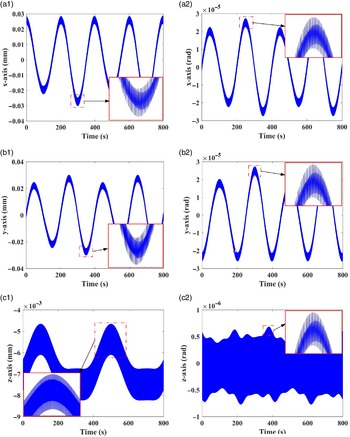
Under the action of the serial component of the polishing robot, the position and angle errors of the moving platform for the PM considering the branched-chains elastic deformation are shown in Fig. 11. Due to the periodic variation of the equivalent force and moment of the serial component on the PM, the motion errors of the PM also present a strip trend. From the local amplification results, it can be seen that the errors are the superposition of two high frequency periodic deformations, the motion error with a smaller amplitude is affected by the rotational motion of the grinding system and the motion error with a larger amplitude is affected by the orbital motion of the grinding system. The position error of the moving platform with the branched-chains elasticity along the x-axis and y-axis varies between ±0.03 mm and the angle error varies between ±2.74×10⁻⁵ rad. Figure 11(c1) and (c2) show that the position error and the angle error along the z-axis have two different amplitudes, this is due to the periodic motion of the second joint of 2R series rotary joints, and at the boundary of motion space, the force and the moment exerted by the serial component on the PM are different. Besides, the motion period of the second joint is twice that of the PM, thus the error also has different amplitudes. The position error along the z-axis varies from −0.008 to 0.0047 mm, and the angle error varies from −7.45×10⁻⁷ rad to 6.33×10⁻⁷ rad. For the polishing robot, the UP branched-chain is fixed to the moving platform and the structure size is large, so the high stiffness of the z-axis leads to less error with the influence of the elastic deformation. Furthermore, the equivalent moment along the z-axis of the serial component is very small, thus the angle error along the z-axis has a small value and presents a straight strip.
Motion error of moving platform considering branched-chains elasticity: (a1) position error in x-axis direction, (a2) angle error in x-axis direction, (b1) position error in y-axis direction, (b2) angle error in y-axis direction, (c1) position error in z-axis direction, and (c2) angle error in z-axis direction.

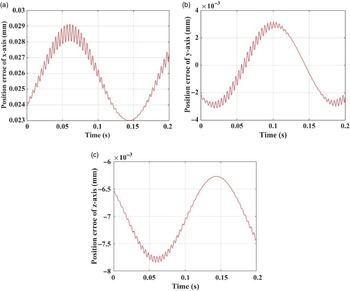
To further analyze the influence of the joint clearance on the motion accuracy of the polishing robot, the polishing robot also follows the motion law of Eq. (38). The Hooke joint of branched-chains is formed by two sets of rolling bearings with the same structure and vertically intersecting axes, and the composite spherical joint of UPS branched-chains is formed by three sets of rolling bearings with the same structure and vertically intersecting axes. The joint clearance parameters of the branched-chains for the dynamics simulation are shown in Table IV. Taking the first 0.2 s of the simulation motion time, the position error at the reference point of the moving platform is shown in Fig. 12 when only the branched-chain elasticity is considered. The simulation motion time is shorter than that of the polishing robot, thus there is no periodic amplitude caused by the orbital and rotational motion of the dual rotor grinding system.
Joint clearance parameters of branched-chains.

Motion error of moving platform considering branched-chain elasticity.

When considering the elasticity of the branched-chains and joint clearance, the position error of the moving platform is shown in Fig. 13. Combined with Fig. 12, we find that the position error of the reference point of the moving platform is greatly affected by the elastic deformation of the branched-chains, and the changing trend is similar to that when only considering the elasticity of the branched-chain. The equivalent force and moment of the dual rotor grinding system on the moving platform are larger than the impact force and friction caused by the joint clearance. The joint clearances of the polishing robot lead to a small amplitude oscillation of the error of the moving platform. At the same time, in the simulation time, the equivalent force and moment of the moving platform along the x-axis are relatively large, which leads to the error of the x-axis is larger than that of the y-axis and z-axis.
Motion error of moving platform considering branched-chain elasticity and joint clearance: (a) x-axis, (b) y-axis, (c) z-axis.

7. Conclusion
This article proposes a hybrid polishing robot consisting of a 3-DOF PM, 2R series rotary joints and a dual rotor grinding system with high polishing accuracy, compactness and stiffness to comply with the trend of high precision operation of optical mirrors.
-
(1) Based on the kinematics of the 2R series rotary joints and dual rotor grinding system of the polishing robot, the equivalent load model of the serial components on the PM is established. The results show that the equivalent force is mainly distributed along z-axis, and the equivalent moment is mainly distributed in x-axis and y-axis and consists of the superposition of two trigonometric functions.
-
(2) Based on the rigid–flexible coupling dynamic model of the PM, the elasticity of the branched-chains mainly leads to motion errors of the moving platform in x-axis and y-axis and the robot is more resistant to deformation in z-axis. Due to the high-frequency motion of the grinding system, the motion errors of the moving platform have a striped distribution in all directions.
-
(3) When the joint clearance is considered in the rigid–flexible coupling dynamics, the motion errors of the PM moving platform considering both joint clearance and branched-chain elasticity have a local runout compared with the motion errors considering only the branched-chain elasticity.
The analysis of rigid–flexible coupling dynamics of the polishing robot including the branched-chain elasticity and joint clearance provides a theoretical basis for improving the motion accuracy and dynamic characteristics of the polishing robot.
Acknowledgments
Financial support for this work, provided by the Priority Academic Program Development of Jiangsu Higher Education Institutions and the National Natural Science Foundation of China (Grant No. 91648105), is gratefully acknowledged.
Conflict of Interest
The authors declare that they have no competing interests.