Since its inception two decades ago, the environmental education program at Falcon School has become institutionalised into the school's culture. In doing so, the program has educated more than 1,000 students and reached an additional 25,000 people in the community. This program was established by a woman in 1996 to protect the Lesser Kestrel, a small, endangered falcon nesting in Falcon School's area. The environmental education program was designed according to place-based education pedagogy and emphasised local community contributions. Because of their deep, long, and meaningful education effect, long-term environmental education programs, like the Falcon School program, are important in responding to such environmental crises in a sustained way (Bonnett, Reference Bonnett2013). However, despite the importance of long-term environmental education programs, many only operate for a short term. As such, most studies have focused on these short-term programs (Bogner, Reference Bogner1998; Zion, Ventura, Yogev, & Stay, Reference Zion, Ventura, Yogev and Stay2005), with researcher criticism on the short-term nature of these projects (Rickinson, Reference Rickinson2001). This study was designed to fill this long-term environmental education program gap in the literature and to influence schools in implementing long-term programs. Furthermore, while many studies have used school culture as a framework for understanding organisational change (Deal & Peterson, Reference Deal and Peterson2016), there remains a knowledge gap regarding school culture as a framework for implementing long-term environmental education programs. This study seeks to add to the literature and fill this critical gap. To better understand the features of the long-term Lesser Kestrel program, this study focused on school culture, through the perspectives of the school staff, which enabled the longevity of the program.
Environmental Education Program at Falcon School — Background and Obstacles
The Lesser Kestrel program meets two hours a week as an extracurricular program integrated into the school's schedule. The program emphasises values, beliefs, norms, knowledge, and skills related to local social and environmental challenges. Many of the classes engage in outdoor learning, allowing students to observe the Lesser Kestrel and contribute to the local action plan of Lesser Kestrel conservation. Students learn about a diverse range of topics from human-nature conflicts to the ongoing tensions between preservation and development. Students also develop skills such as teamwork, reflection writing, oral presentations, data collection, observation, and group discussion. One of the highlights of the program is ‘Lesser Kestrel Day’, a ceremony held in late May when young Lesser Kestrels first open their wings and prepare to leave the breeding colony at the school. As part of the event, fifth-grade students guide over 1,500 visitors through the grounds and explain the plight of the endangered species.
Over the years, the long-term environmental education program at Falcon School faced many obstacles due to the philosophical clashes between environmental education and state-sponsored education influenced by a global, neoliberal educational approach (Hursh, Henderson, & Greenwood, Reference Hursh, Henderson and Greenwood2015). These obstacles included global/local influences on educational systems and schools, formal/informal obstacles, and school/program leader retention. Yet despite mounting global/local and formal/informal pressures, Falcon School's environmental education program has continued to succeed. Despite the increasing gap between environmental education (integrative and holistic in its nature) and national and international policy rhetoric based on globalisation and a neoliberal agenda for schooling (emphasising disciplinary learning and academic achievement), the school continues to invest time and other resources into the program, without emphasising teaching for the national tests (Stevenson, Reference Stevenson2007). From a local perspective, the environmental education program at Falcon School has persisted, even though the Israeli education system emphasised test-based education such as PISA and TIMSS (Gaziel, Reference Gaziel and Zajda2010; Israeli Ministry of Education, 2012). Finally, it is worth noting that despite the trend of educational decisions involving formal assessment (Robertson, Reference Robertson, Weis and Compton2008; Spring, Reference Spring2008), Falcon School's long-term environmental education program has never been formally evaluated (although the longevity of the program informally indicates its effectiveness).
Formal national pressure in Israel has led to the implementation of new educational reforms every two to three years (Gaziel, Reference Gaziel and Zajda2010), due in large part to ministers of education turning over 12 times in the past two decades. The environmental education program at Falcon School, however, was unaffected by this constant change. Although informal national pressure, according to institutionalisation theory (Berends, Goldring, Stein, & Cravens, Reference Berends, Goldring, Stein and Cravens2010) of the isomorphism of school process, suggests schools tend to become similar to each other, once again, Falcon School remained unaffected by continuing to maintain its non-test-based environmental education program, while other schools did not. Moreover, in contrast to many other schools’ short-lived environmental education programs, which span two to four years at most (Rickinson, Reference Rickinson2001) and reflect the trend of isomorphism, the Falcon School environmental education program has been in existence for over 20 years. Both the principal and the program leader developed learning processes that engaged students intellectually, socially, and emotionally. In doing so, they prioritised the learning process itself, as opposed to school achievement. This type of emphasis has been suggested by researchers to be an effective way to implement meaningful learning (Hargreaves & Fink, Reference Hargreaves and Fink2004).
The longevity of Falcon School's environmental education program, unlike other environmental education programs (Corney, Reference Corney2006), is not attributable to just one factor, such as the continued presence of the principal or program leader as change agents. Instead, its success is attributable to the support of many different human and economic resources. As discussed in the literature, sustainable programs that receive the appropriate amount of support from their leaders do not simply disappear when their leaders depart (Hargreaves & Fink, Reference Hargreaves and Fink2004). This was proven true at Falcon School, where the departure of the school's environmental education external program leader and principal did not affect the program's continuation or the school's culture. The long-term success of Falcon School's environmental education program in the face of wide-scale changes and a lack of political support raises the question of how the program survived for so long. In turn, the purpose of this study is to explore school staff perspectives, including environmental values, beliefs, norms, and behaviours related to the environmental education program, and to describe the features of Falcon School's long-term environmental education program that allowed the school's culture to endure despite clear obstacles.
Study Objectives and Research Questions
The aim of this qualitative study was to understand and describe the long-term environmental education program at Falcon School based on available documents and school staff perspectives, including environmental values, beliefs, norms, and behaviours. The study answers the following research questions: How has the Lesser Kestrel long-term environmental education program survived for the past two decades and become institutionalised into the school's culture? What are the features of the program that allowed it to endure at Falcon School despite clear obstacles?
Theoretical Framework
In this study, we are looking at the Falcon School as an organisation that resists global educational trends in a globalised era yet adopts a global environmental approach to protect endangered species. Specifically, we are interested in Falcon School's long-term environmental education program, a vital part of its school culture, and its participants’ environmental values, beliefs, norms, and behaviours. This study, therefore, includes three theoretical lenses: environmental education as a conceptual framework, school culture as a theory that combines the local setting with global influences, and globalisation as a complex cultural and social theory affecting school culture and the environmental education context. These three frameworks enable a broad and integrative approach for understanding a long-term environmental education program.
Environmental education as a conceptual framework
Since the 1977 Tbilisi Declaration (UNESCO/UNEP, 1977), many global efforts have promoted environmental education and education for conservation activities to address the ongoing environmental crisis (Potter, Reference Potter2010). Consequently, two main conceptual approaches have developed worldwide: environmental education and education for sustainability. The main principals of environmental education and education for sustainability are the same, including the interdisciplinary approach of holism, critical thinking, and values, beliefs and norms. With environmental education, however, learners are encouraged to be involved in their environment, to be active learners, and to contribute to the environment (Gough, Reference Gough2006). On the other hand, education for sustainability is focused on how individuals and communities use and share natural and social resources in a just way, and it develops action skills and dispositions for citizenship and environmental justice (Tilbury, Reference Tilbury1995). The main difference between these two approaches is the social component, which is included in education for sustainability but not emphasised in environmental education (Mckeown & Hopkins, Reference Mckeown and Hopkins2003). Not all researchers accept this definition and difference between environmental education and education for sustainability (Bonnett, Reference Bonnett2013; Sauvé, Reference Sauvé1996). Sauvé (Reference Sauvé1996) claims that education for sustainability has the same goals and principals as environmental education, including the need to consider social aspects and adopt global and local perspectives. Furthermore, some scholars oppose the idea of education for sustainability, claiming that education cannot be for a specific, tangible goal because the goal of education is to develop critical thinking (Jickling, Reference Jickling2006; Sauvé, Brunelle, & Berryman, Reference Sauvé, Brunelle and Berryman2005). This criticism of education for sustainability is one that we hold as well. In this study, we adapt Bonnett's approach (Reference Bonnett2013) to environmental education, which integrates education for sustainability and other social environmental approaches. Since the roots of all environmental education approaches is based on a naturalistic approach (Sauvé, Reference Sauvé2005), our study uses the naturalistic approach as the conceptual framework and theoretical underpinning.
According to the naturalistic approach, the goals of environmental education are to provide students with the skills that will enable them to work towards sustainability, ecological awareness, and biodiversity conservation as part of pro-environmental behaviours (IUCN, 1970). Biodiversity conservation as part of environmental education was adopted by many national governments to translate the 1992 Convention on Biological Diversity into concrete measures and actions. The Convention obligates countries to protect biodiversity by using a variety of means, such as policy instruments, communication, research, and education (Dreyfus, Wals, & Van Weelie, Reference Dreyfus, Wals and Van Weelie1999; Jacobson, Reference Jacobson1991). Consequently, environmental education programs may help people understand and appreciate natural and cultural resources, while also developing skills and practices for explaining how to conserve those resources for future generations (Tilbury, Reference Tilbury2010). There are several key environmental education concepts in the context of biodiversity conservation: conducting experiments, promoting outdoor learning through field trips, using live animals (or plants), integrating outdoor activities, and encouraging community engagement (IUCN, 1970). For example, an environmental education program in Australia that uses field experience to support an endangered native Australian animal, the Greater Bilby, includes three stages: preparation in the classroom, half-day touring in the natural environment of the animal, and continued activity in the classroom for several weeks. This program is based on field experience that engages children to learn through play, drama, story-telling, problem-solving, hands-on work, and sensory activities (Gambino, Davis, & Rowntree, Reference Gambino, Davis and Rowntree2009). Another example is an environmental education program in the western Indian Ocean, which uses a conservation program to encourage the protection of three critically endangered fruit bats. The actions taken to help the bats included roost monitoring, forest regeneration, the creation of stickers and posters, and the transformation of students into ‘ambassadors’ for the bats by providing training tools such as peer teaching (Trewhella et al., Reference Trewhella, Rodriguez-Clark, Corp, Entwistle, Garrett, Granek and Sewall2005).
These programs, and environmental education in general, emphasise environmental values, beliefs and norms that encourage pro-environmental behaviours (Stern, Reference Stern2000), requiring time, effort, and resource investments. The number of these programs and the resource investments are increasing in tandem with the surge in environmental awareness (Pizmony-Levy, Reference Pizmony-Levy2011). However, many school environmental education projects, both in Israel and around the world, are only short term (Rickinson, Reference Rickinson2001). The examples presented above lasted several weeks. Studies have shown that five-day environmental activities (defined as a long-term environmental education in practice and in the literature), as opposed to one-day programs (short-term), contributed more to students’ environmental knowledge and awareness (Zion et al., Reference Zion, Ventura, Yogev and Stay2005). A 20-year environmental education program, such as that at Falcon School, will contribute more to students’ environmental knowledge and awareness than any short-term project.
School culture as a theoretical framework
School culture is developed as a theoretical framework using anthropological and sociological perspectives (Wren, Reference Wren1999). The concept of school culture, however, is not clearly defined in educational science (Berkemeyer, Junker, Bos, & Müthing, Reference Berkemeyer, Junker, Bos and Müthing2015; Schoen & Teddlie, Reference Schoen and Teddlie2008). Recent studies, based on organisational culture theories, defined school culture as ‘the set of norms, values and beliefs, rituals and ceremonies, symbols and stories that make up the “persona” of the school’ (Peterson, Reference Peterson2002, p. 3). School culture, as characterised above, has been the focus of diverse studies (Fullan, Reference Fullan2002; Shachar, Gavin, & Shlomo, Reference Shachar, Gavin and Shlomo2010), most of which combine school culture and achievement (Worrell, Reference Worrell2014). Several studies use Schein's (Reference Schein2010) organisational culture theory as a framework for researching school culture (Maslowski, Reference Maslowski2001; Schoen & Teddlie, Reference Schoen and Teddlie2008). Schein (Reference Schein2010) adopted an inclusive approach and developed the classification of organisational culture into three layers. The first layer includes common beliefs and basic assumptions shared by workers in the organisation (i.e., the teachers and school staff in our study), involving the relationship with the environment and relationships between humans. The second layer contains norms and behaviours expected from participants due to the influence of values, and important standards and core values, such as respect for others and collaboration (Maslowski, Reference Maslowski2001). The third layer involves artifacts and practices in the forms of symbols, rituals, and behaviours (Schein, Reference Schein2010). Symbols are processes within schools, rituals are events that have meaning for school staff, and behaviours are the everyday actions of school participants. Adding to the classification of school culture, MacNeil, Prater, and Busch (Reference MacNeil, Prater and Busch2009) developed a leadership element as an important component in developing and sustaining school culture. While Schoen and Teddlie (Reference Schoen and Teddlie2008), Fullan (Reference Fullan2002), and MacNeil et al. (Reference MacNeil, Prater and Busch2009) all based their studies of organisational and school culture on a general perspective of school as an organisational entity, they did not examine the development of school culture within the framework of environmental education.
School culture, using the Schein (Reference Schein2010) classifications and inclusive approach, includes the importance of leaders, newcomers, resources, pedagogy, and community (Baumgartner, Reference Baumgartner2009; Flores, Reference Flores2004; MacNeil et al., Reference MacNeil, Prater and Busch2009). Leaders will more likely succeed in influencing the culture of the school if they change school assumptions, norms, values, beliefs, and behaviours (MacNeil et al., Reference MacNeil, Prater and Busch2009). Leaders who focus on school culture will support new teachers as newcomers to the learning community of their organisation (Flores, Reference Flores2004). As such, newcomers can be an indication of school culture — if they incorporate the norms and behaviours into their daily life, it is an indication of the strength of the school's culture (Baumgartner, Reference Baumgartner2009). Resources for implementing cultural change, especially in implementing sustainability as part of school culture, need to be integrated into the leadership approach. The leadership approach best suited to creating long-lasting programs in schools is one that is developed and shared by others, remains in place for a long time, and distributes leadership authority to ensure the mindset continues after the primary leader leaves (Hargreaves & Fink, Reference Hargreaves and Fink2004). Furthermore, pedagogy is an important aspect, especially in schools at the organisational level, in influencing school culture. Pedagogy that engages community is important for the sustainability, allowing leaders to open the boundaries of the school and spread the school approach (Sobel, Reference Sobel2004).
School culture in the context of globalisation and environmental education
School culture often reflects global and local influences. Global influences usually relate to present globalisation trends. In this study, we use globalisation as a complex cultural and social theory (Zajda, Reference Zajda and Zajda2015) that describes changes in global economics affecting society (Spring, Reference Spring2008) and the environment (Karataş, Reference Karataş2016). The trend of globalisation has influenced all aspects of life, including education systems, school culture (Apple, Reference Apple, Burbules and Torres2000), and environmental education programs (Hursh, Henderson, & Greenwood, Reference Hursh, Henderson and Greenwood2015; Jickling & Wals, Reference Jickling and Wals2008). Globalisation has also influenced school culture to adopt business-like models of management that focus on efficiency, accountability, and profit. This, in turn, caused educational systems to implement standards as part of their educational policy. Consequently, the culture of many schools is focused on assessments based on standardised tests, forcing teachers to implement prescribed curriculum (Hursh et al., Reference Hursh, Henderson and Greenwood2015). Although there is argument since the 1990s about whether test achievement reflects social success, it became the dominant approach in many developed countries (Apple, Reference Apple, Connelly, He, Phillion and Schlein2008; Sturges, Reference Sturges and Sturges2015), including Israel and the United States (Bar-Yishai & Pe'er-Li, Reference Bar-Yishai and Pe'er-Li2008). In this study, however, Falcon School was not affected by these globalisation trends. Instead, over the past 20 years, the school emphasised its own values rather than changing with global trends, while also not developing specific strategies to circumvent globalisation.
Another characteristic of the globalisation agenda that influenced the environmental crisis and consequently environmental education is the rationale for each person to maximise his own personal benefits. By definition, ‘private’ is good and ‘public’ is bad. This trend has resulted in biodiversity loss, as people are more concerned about their own space and less concerned about the public domain (Chawla & Cushing, Reference Chawla and Cushing2007). In our study, the Lesser Kestrel is a globally endangered species (Meroz, Alon, Bahat, & Hazofe, Reference Meroz, Alon, Bahat, Hazofe, Dolev and Parvolotzki2001), which needs behavioural change in the local community to protect its species. Environmental education is viewed as a possible solution in creating this behavioural change (Tilbury, Reference Tilbury1995).
Research Context
In Israel, an example of a rare, long-term environmental education program is the Falcon School program focused on the protection of the Lesser Kestrel, a small falcon categorised as an endangered species. The Lesser Kestrel is also categorised as a vulnerable species by the International Union for Conservation of Nature (IUCN; Meroz et al., Reference Meroz, Alon, Bahat, Hazofe, Dolev and Parvolotzki2001). The Falcon School environmental education program was established in 1996, the same year an International Action Plan was created for the Lesser Kestrel (Biber, Reference Biber, Heredia, Rose and Painter1996). This helped establish the program by providing funding for the first five years. Facets of the program include the development of nature connectedness and environmental protection values by fostering a sense of responsibility towards an endangered species in its natural habitat. The program also encourages students to believe in their ability to protect the Lesser Kestrel and modify their own behaviours according to environmental values and beliefs. These characteristics of the program have not only influenced the values, beliefs, norms and behaviours of students (individual level), they have also become a part of the school's culture (organisational level).
School background
During the study, conducted from 2015 to 2016, 326 students were enrolled in Falcon School, a relatively small primary school in northern Israel. Falcon School was established in 1950 and is in a rural area, surrounded by natural forest, river, and agricultural areas. The school's area is the habitat of the smallest falcon in Israel, the Lesser Kestrel. Typically nesting in natural cliffs, the Lesser Kestrel also nests on old roofs in the school's region. Falcon School, therefore, decided to emphasise the environment as one of its main subjects, taught in all grade levels. Incorporating the environment into its school vision, Falcon School also stressed the importance of community outreach through the engagement of parents and local community in the Lesser Kestrel program.
Pedagogical background
The environment and surrounding community create the foundation of the environmental education program implemented in the school, as part of its holistic educational approach. Consequently, the environmental education pedagogical approach of Falcon School is based on place-based education characteristics. Although this integrative teaching approach was not directly mentioned by the school's staff, it was apparent in the school's culture, demonstrating all the characteristics of place-based education, such as focusing on learning-in-place, the local environment, and the local community (Sobel, Reference Sobel2004). The goal of Falcon School's place-based education was to solve community and environmental problems through a variety of strategies, namely experiential learning to increase environmental awareness. The place-based education approach enhanced the development of the school's Lesser Kestrel program and encouraged pro-environmental behaviours. Ultimately, the educational approach at Falcon School encouraged students to feel a sense of place and nature-connectedness to both human and environmental elements (Buxton & Provenzo, Reference Buxton and Provenzo2012; Sobel, Reference Sobel2004). This unique sense of place, an integral part of the school and its vision, included both place attachment (a bond between people and places) and place meaning (the symbolic meanings ascribed to places themselves; Kudryavtsev, Stedman, & Krasny, Reference Kudryavtsev, Stedman and Krasny2012).
Program background and goals
The Lesser Kestrel program was established in 1996 by a birdwatcher whose children attended Falcon School. To create the program, the birdwatcher identified the decline of the Lesser Kestrel population and convinced the school's principal to commit to an environmental education program that would contribute to the protection of the Lesser Kestrel. Together, they designed a program based on place-based education to encourage a more hospitable habitat for the Lesser Kestrel. Over the next two decades, the fifth-grade students at Falcon School helped protect the local Lesser Kestrel population that nests in their school and in the surrounding area. The program planners defined four main objectives for the program: general goals, social and ethical goals, educational goals, and nature conservation goals. The general goals included changing the character of the surrounding communities to help make them more environmentally friendly. The social and ethical goals included encouraging entrepreneurship, leadership, and collaboration among students, while also leading change in the local community. The educational goals focused on the pedagogical aspects of the learning process. The nature conservation goals included assistance activities related to the Lesser Kestrel population.
Methods
We used an interpretive-constructivist paradigm (Burrell & Morgan, Reference Burrell and Morgan1994) as a lens to capture the subjective reality of Falcon School's school staff, based on their values, beliefs, norms, and behaviours. Qualitative case studies like this one, which have been increasingly used in educational settings (Barth & Thomas, Reference Barth and Thomas2012), are based on a naturalistic and holistic research approach that includes a ‘thick description and interpretation of the phenomenon’ (Merriam, Reference Merriam1985, p. 207). The phenomenon in this case study is a long-term environmental education program focused on biodiversity conservation. Furthermore, we used an instrumental case study, which is a qualitative method that examines the larger phenomenon, and not just the specific case, to establish a general understanding (Stake, Reference Stake1995). We used instrumental case study to develop a general understanding of the longevity of the Lesser Kestrel environmental education program, therefore informing our understanding of long-term environmental education programs. As is common with case study research strategies that examine multiple sources of evidence (Yin, Reference Yin2009), we relied upon several sources: seven open-ended individual interviews that represent the main roles (including the principal, the vice principal, the secretary, two science teachers, an English teacher, and a math teacher) in the school, 15 open-ended questionnaires (including 12 home-room teachers, the librarian, and 2 art teachers), 20 documents (such as school vision, committee protocols, and environmental education program documents), and focus groups. These sources enabled each member of the school's staff (31 in all, consisting of the principal, vice principal, secretary, librarian, 20 teachers, 3 science teachers, 2 art teachers, and 2 English teachers) to contribute to our general understanding of the phenomenon. We included diverse school staff, with no one left out, to elicit perspectives representative of the entire school. During the 2015–2016 school year, interviews and focus groups were recorded and transcribed verbatim. The open-ended questionnaire was designed by the authors to elicit more perspectives of school staff and included open-ended questions focused on the environmental education program characteristics, pedagogy, school culture, barriers to implementing long-term environmental education program, and individual backgrounds.
Data Analysis
We used an inductive approach to analyse the data, which allowed categories to emerge. The inductive analysis process, which enabled a systematic analysis, took place in three steps (Miles & Huberman, Reference Miles and Huberman1994):
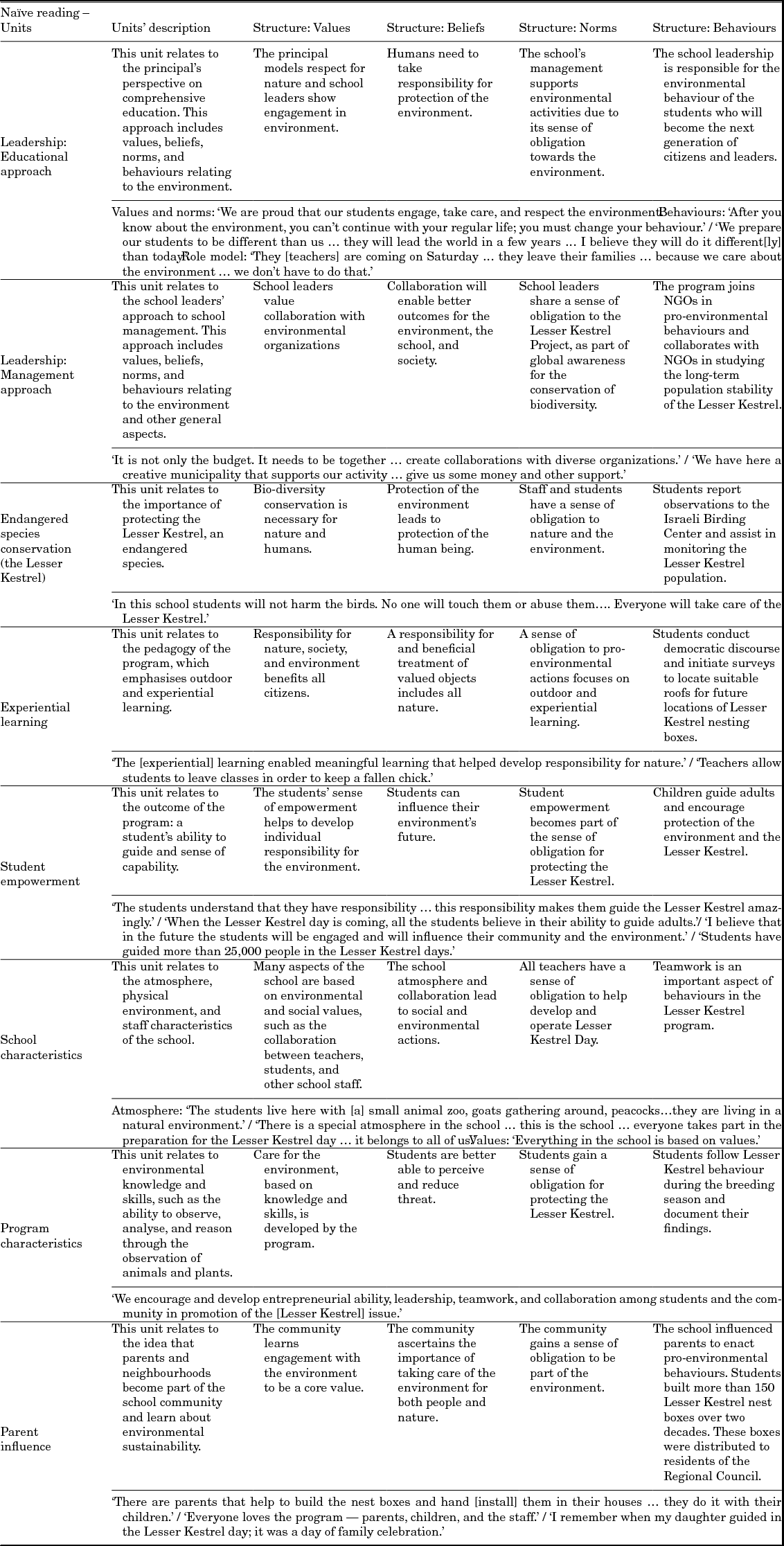
1. Naïve reading. We read the interview transcriptions and other documents several times to ascertain their meaning. We then divided the original descriptions into eight units.
2. Structural analysis. We gave meaning to the units from the naïve reading by creating categories according to Values-Beliefs-Norms theory, a social-psychological environmentalism theory. Values-Beliefs-Norms theory helps explain a person's willingness to change their behaviour. It consists of five factors linked in a causal chain: values, beliefs (such as ecological worldviews), adverse consequences for valued objects, norms about perceived ability to reduce threats, and pro-environmental personal norms. According to Values-Beliefs-Norms theory, this cluster of factors is a strong predictor of behaviour. Although the theory is primarily used for predicting individual behaviours (Stern, Reference Stern2000), according to Klein, Dansereau, and Hall (Reference Klein, Dansereau and Hall1994), if ‘group members are sufficiently similar with respect to the construct in question . . . they may be characterised as a whole’ (p. 199). In this study, therefore, we used Values-Beliefs-Norms theory at the organisational level because of the homogeneous characteristics of the school members, as reflected in their similarities across the Values-Beliefs-Norms categories.
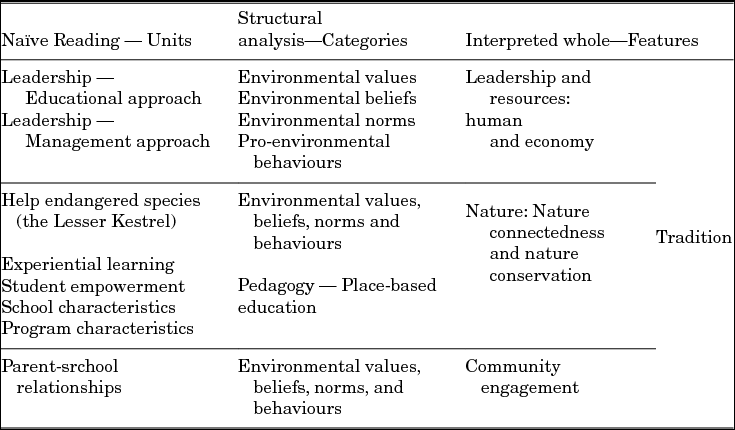
3. Interpreted whole. We combined the categories from the structural analysis to form a general understanding of the case and phenomena. In this article, we present the phenomena according to our interpreted whole analysis. The process of analysis, presented in Table 1, reflects the units identified in the naïve reading (e.g., leadership, endangered species, and experiential learning), the categories identified in the structural analysis (e.g., environmental values, pro-environmental behaviours, and pedagogy as related to place-based education), and the main features identified in the interpreted whole stage of the analysis.
Coding Process: Units, Categories, and Features

Findings: Five Main Features
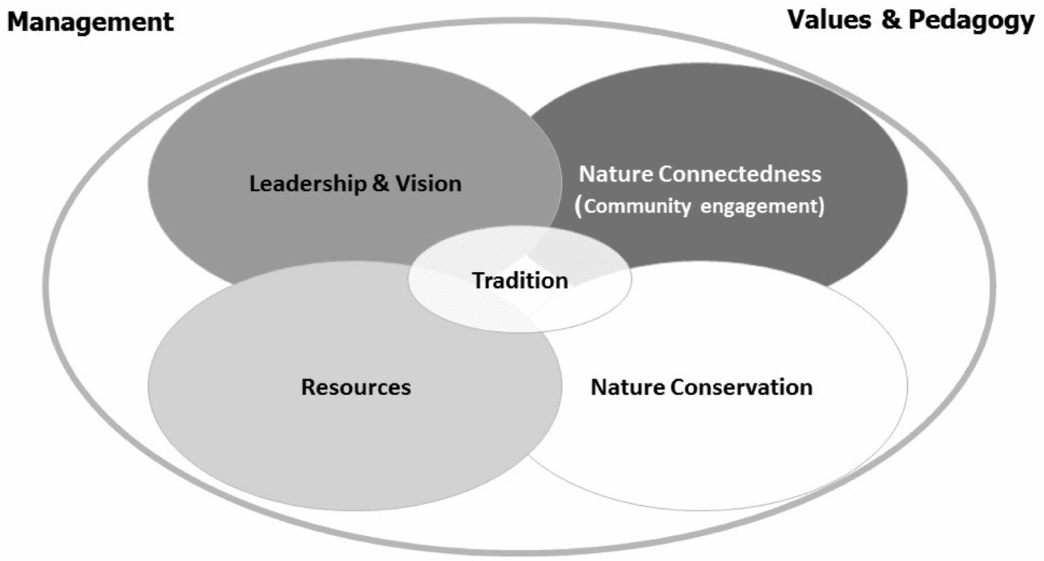
The naïve reading stage of our analysis revealed the following eight units: leadership-educational approach, leadership-management approach, endangered species conservation (the Lesser Kestrel), experiential learning, student empowerment, school characteristics, program characteristics, and parent-school relationships. Detailed explanations of these units and examples of relevant quotations are provided in Table 2. Our structural analysis revealed understandings related to the environmental values-beliefs-norms, behaviours, and pedagogical aspects. The interpreted whole analysis stage of the values, beliefs, norms, behaviours, and pedagogical aspects led to the identification of five main features of the program. Two of these features, leadership and resources (mainly human and economic), originated at the organisational level and focused on management aspects. Two other features, nature connectedness/conservation and community engagement, are related to the values and pedagogy of place-based education. The final emerging feature, tradition, connects the features, creating a long-term environmental education model as demonstrated in Figure 1.
Analysis Process — Units and Structures: Examples and Quotes

Five main features of a long-term environmental education model at the organisational level.

Feature #1: Leadership and Vision
The incorporation of leadership and vision into the goals of Falcon School's environmental education program contributed to the program's long-term sustainability. To promote pro-environmental action, these goals emphasised the reinforcement and development of entrepreneurial ability, leadership, teamwork, and collaboration among students, staff, and the community. Leadership and vision also played a key role in the management and educational approach of the participants. For example, the principal's management approach at Falcon School, unlike typical approaches in the centralised Israeli education system, stemmed from the idea that a principal should make the primary decisions for his school, carry out his vision, and work as an autonomic authority. As Falcon School's principal explained: ‘There is only one person who knows what is best for his school and he has the privilege to implement the things he loves and believes in . . . when something is important, you will find a way to accomplish it.’ This approach gave the principal implicit power which provided him the legitimacy to promote and implement the ‘things he loves and believes’ as part of the school's vision. This approach stands in contrast to the neoliberal agenda, which emphasises the national market-based management approach and Israeli national educational system control.
The educational approach of the school's staff emphasised the idea that students were to be both at the centre of educational activities as well as the main goal. In this view, summative, test-based education catering to Israeli and international tests (e.g., TIMSS and PISA), compared to the formative Lesser Kestrel program, were less important for students’ self-efficacy and development. The Lesser Kestrel program empowered students and enhanced their ability to protect the environment. Consistent with the educational approach of the school's staff, the program de-emphasised goals for creating future economic success. Such an approach differs from that suggested by the neoliberal agenda (Apple, Reference Apple, Burbules and Torres2000). Accordingly, the Falcon School principal clarified the role of the Lesser Kestrel program:
First of all, we embed time for the Lesser Kestrel project. Then we embed the ‘pebbles’ that you can find in every school — Math, English, Bible, literature, etc. [class] . . . We prioritise what is special . . . The Lesser Kestrel adds ‘spice’ to the courses in our school.
The above example clarifies how the vision and ability of the principal allowed the program to exist for almost two decades and become an integral part of the school's culture, without unwanted national influences. As is the case with place-based education, the school leaders did not mention globalisation or the neoliberal agenda. Their actions represent an environmental education program that emphasises a holistic and integrative approach, as opposed to state-sponsored education emphasising standardised-based education.
Feature #2: Human and Economic Resources
Human and economic resources were related to the management aspect, as seen in Figure 1. An environmental education program that provides added value in educational, environmental and social fields needs time, money, and human resources, each of which are connected to one another. A long-term environmental education program cannot rely solely on local teachers and the school's official budget. Ongoing efforts were needed to supplement the limited resources at Falcon School and, in turn, enable the environmental education program to continue in the long term. Throughout the years, the school pooled resources and raised external funds for the program. A local carpentry shop contributed wood to build nesting boxes, and a non-governmental organisation supplied t-shirts and hats. These external contributions were described by one program participant:
Our ‘big stone’, like the Lesser Kestrel program, is not funded from the budgets of the Ministry of Education, but from other funding sources . . . a security company helped to follow the Lesser Kestrel behaviour with small cameras over the internet . . . the grandfather of one of the children studying in the school . . . provides us with the wood to build nesting boxes.
This type of approach demonstrates the holistic view of the program's participants in using creative thinking to overcome economic barriers. This holistic view emphasises the importance of connecting different entities in the community, including businesses, community members, educational institutions and non-governmental organisations, to integrate environmental education into the school culture (Shandas & Messer, Reference Shandas and Messer2008).
Falcon School's principal, along with the support of the school's staff, used their economic efforts to create a highly functional staff. The principal stressed the importance of a stable teaching staff, and worked to identify, train, and retain his team. His deep belief in a teaching staff being the main resource of a school contributed to the school's science teacher position not experiencing a reduction in salary, unlike other schools in Israel. As explained by the principal:
I fought so that the Lesser Kestrel program would not take away from the teaching hours of my teachers. My teachers are my most valuable resource . . . I had a big argument with the Ministry of Education inspector to get extra hours for my school so that it would not be at the expense of science teaching.
The principal's approach demonstrates his understanding of the staff's importance to a successful environmental education program. The need to invest and develop his team to create better educational and environmental results was also demonstrated by the vice principal, the program instructor, and other teachers at Falcon School. They all emphasised the importance of investing in the school staff by implementing professional development. This approach goes against the recent trend of accountability that emphasises evaluating teachers by student achievement rather than values.
Given that teachers had many other extracurricular obligations and the school lacked finances to pay for extracurricular hours, Falcon School's culture placed great importance on incorporating external experts, which in turn required an external budget. In contrast to many other environmental education programs in which the outsourced expert is the only teacher in the class, the Falcon School program combined internal teaching staff with an outsourced expert to create a co-teaching team. The teachers designed the curriculum together, as explained by one of the co-teachers:
With the aid of the outsourced expert we can achieve more broad-based learning on subjects beyond the government mandated educational programs. The Lesser Kestrel program touches upon a wide spectrum of important subjects besides the human aspect of preventing extinction.
Co-teaching is not a new idea, nor is it specific to Falcon School. Research has shown that teamwork is important for promoting, achieving, and advancing various concerns in schools (Bryk, Sebring, Allensworth, Easton, & Luppescu, Reference Bryk, Sebring, Allensworth, Easton and Luppescu2010), especially in the setting of environmental education (Hargreaves, Reference Hargreaves2007).
Feature #3: Nature Connectedness and Nature Conservation
Nature connectedness and nature conservation relate to the values and pedagogy aspects of the long-term environmental education model, as seen in Figure 1. This feature included educational pedagogy characteristics of place-based education, which influenced staff, students, and school culture. The place-based education approach enabled educators and students to focus on local ideas and themes, such as the ecological environment in the local community (Gruenewald & Smith, Reference Gruenewald and Smith2014). This encouraged a sense of nature connectedness and emphasised a sense of place among all participants in the community (Kudryavtsev et al., Reference Kudryavtsev, Stedman and Krasny2012). A sense of place, as part of the place-based education pedagogy, was also developed through experiential and outdoor learning, two pillars of the Lesser Kestrel program's goals. This included outdoor learning and skills development, such as the ability to observe, analyse, and reason through the observation of animals and plants in their real habitats. As one teacher shared, ‘We must give the students the opportunity to feel, smell, see, and hear nature. The outdoor learning, such as observation, contributes to their ability to understand the food chain more than all other indoor learning.’ Providing valuable opportunities for experiential learning that align with a student's field of interest contributes significantly to the student's overall understanding of the local environment. For example, as the principal pointed out, ‘Suddenly, my secretary burst into my office and said: “One of the chicks fell from the nest”. I asked a few students to guard the chicks instead of going to the class.’ Another type of experiential learning was building nest boxes for the Lesser Kestrel. One of the teachers described the effects of experiential learning on the students: ‘We. . .give the students a “taste” of almost everything: using the hammer, electric screwdriver, an expensive telescope . . . This is not a usual situation for the students to get such personal responsibility.’ These examples demonstrate the relationship between experiential learning and pedagogical values that emphasise skills development and care for the environment, leading to a stronger sense of place and nature connectedness. Nature connectedness values, beliefs, and norms at Falcon School are strongly aligned to the pro-environmental behaviour aspect of values-beliefs-norms theory as presented in Table 2.
As seen in Figure 1, nature conservation is an integral part of the values and pedagogy aspects of the long-term environmental education model. Each participant in the environmental education program at Falcon School explicitly acknowledged the value of nature conservation and the pedagogy supporting it. The school's conservation approach included Lesser Kestrel assistance activities and was rooted in participants’ positive attitudes toward nature. The principal described the nature connectedness from his childhood: ‘I grew up in a small agricultural town and started as an agriculture teacher. I loved nature since I was a child. . . . This love of nature constituted the foundation for my actions in my own life and my pedagogical approach.’ One of the teachers in the program had experience teaching nature for more than 25 years, while another teacher grew up near open spaces and had access to wild animals and plants. This example demonstrates the strong relation, found in many studies, between nature connectedness in childhood and environmental attitudes in adulthood (Chawla, Reference Chawla1999). The school's culture was focused on nature values rooted in participants’ childhood.
Nature conservation was fundamental to the program's pedagogical approach of learning outdoors. All participants acknowledged that students need to be outside to develop respect for nature and the ability to protect it. The principal explained, ‘Each lesson that you can, do outside the classroom. . . . The protection of the environment should be studied in the environment and not in the classroom.’ Nature conservation was therefore inherently integrated into the school's culture, as noted by the principal: ‘You cannot destroy nature and harm it, because it will destroy the bench upon which we sit. You save the environment and the environment will guard you. . . . We are only a part of the natural puzzle . . . That is the way we educate our children.’
Nature conservation was not only part of the school's pedagogy, it was also part of the pro-environmental behaviour of the school. Every year, the students and community took care of injured Lesser Kestrels in a rehabilitation centre located in the school and released fledgling Lesser Kestrels back into nature. The program's participants protected the birds and helped in national and international efforts to save the species. This pro-environmental behaviour was explained by teachers as an important activity that enabled students to ‘understand the power of human beings to cause extinction of species, and their own [the students] ability to protect nature by their personal and collective pro-environmental behaviours’. Nature conservation was therefore an important component of the basic values of school, the pedagogical approach, and the pro-environmental behaviour of the students and community. It served as a part of the basic values of school culture and a building block of the environmental education program.
Feature #4: Community Engagement
Community engagement relates to the values and pedagogy aspects in the long-term environmental education model, as seen in Figure 1. The community engagement approach was rooted in the pedagogy of the school and its approach to society and the environment. The principal at Falcon School used unique local opportunities in integrating the Lesser Kestrel program, which created a base for meaningful action in the community and allowed for wider and deeper community engagement. The school's secretary, who lived in the school's neighbourhood, articulated this idea of expansion:
We have all become active participants in the special fascinating lives of the falcons — their nesting in homes on the roof of the office . . . hatching eggs are viewed by tiny cameras that strengthen the emotional connection between students and the Lesser Kestrel. From a small program we have become a groundbreaking program.
This reflects the effectiveness of the place-based education pedagogy characteristics in school, which focused on the local environment to achieve nature connectedness, to influence the community, and to create a strong sense of place.
Further implementation of the principles of place-based education included the relationship between students and the community, which helped to develop community engagement (Semken & Brandt, Reference Semken, Brandt, Tippins, Mueller, van Eijck and Adams2010), an important part of Falcon School's culture. Community engagement sought to develop leadership among the students and collaboration with the community to create local environmental changes. The assumption that children can make a difference and influence the community was a part of the school's ‘community approach’, as explained by the principal:
When children lead something, the adults join in. The people in the region get reports from the children about the Lesser Kestrel . . . People are involved in reporting back to the children [about] where they can find nests. . . . In fact, it creates a bond between the community and the children.
The bonding between students and the community created opportunities for the school's culture of nature connectedness to spread beyond the school boundaries. This fostered community engagement to help protect the local Lesser Kestrel colony and contribute to national and international conservation efforts. The importance of nature connectedness in school culture indicates, according to one of the teachers, ‘This is not a subject of study. . . . The program has become a way of life. All the students and teachers in the school and all the community are partners in the idea. . . . It is part of the community.’ These examples of place-based education characteristics include experiential learning, student and community engagement, and sense of place, each reflecting the deep meaning of the Lesser Kestrel program and its prominence in school culture. This program not only changed student behaviour, it also instilled basic assumptions into the organisation and community. The connection between the people and the local environment created deep feelings of nature-connectedness, which influenced group identity and organisational culture.
Feature #5: Tradition
Tradition, the final feature in the study, unified all identified features, as shown above in Figure 1. During the past 20 years, tradition in the form of symbols, practices, rituals, values, beliefs, and norms at Falcon School developed into behaviours. The tradition of the Lesser Kestrel program at Falcon School is seen in all aspects of school life. In the words of one of the teachers, ‘Falcon School is the Lesser Kestrel, and the Lesser Kestrel is Falcon School.’ The environmental values of the program, outdoor practices, and experiential learning became an integral part of the unique school curriculum. Not only did the learning process continue across the life of the program, but so did the implementation of symbols as part of tradition. The school uniform includes a Lesser Kestrel logo, symbolising the significance of the program for the school. Furthermore, at an all-school ceremony, fifth-grade students received Lesser Kestrel trustee certificates and passed down the Lesser Kestrel flag to fourth-grade students.
Community was also part of this tradition. Every year when the Lesser Kestrel returned to the colony at the school, there was a celebration in which students helped members of the community learn about the Lesser Kestrel. Lesser Kestrel Day is the school's most widely celebrated tradition, with more than 1,500 people from all around the country participating in student-guided tours of the Lesser Kestrel colony. Lesser Kestrel Day became a ritual due to the contributions of the school's staff, reflecting a high level of collaboration. This sentiment was explained by one of the teachers: ‘all the staff is helping, preparing, running as if it's their own class, as if it's their own day. . . . You will not hear, “It's not mine, I can't do it”. . . . Everyone is part of Lesser Kestrel day.’ Likewise, through their participation and enthusiasm, the community also plays an important part in Lesser Kestrel day. These examples demonstrate the deep roots of tradition and cooperation in Falcon School's culture.
These traditions led to behaviour change in the school's community by creating a unique focus on united environmental action. The ‘esprit de corps’ emerging in the school around Lesser Kestrel conservation prompted younger students to want to participate in the program. One staff member described how the program ‘elicits excitement among new students every year and in the entire community . . . the beautiful tradition that should not be abandoned’. This pro-environmental behaviour was not only expressed by school participants and certain members of the community, it also spread past the school's boundaries. Even though leaders of the program changed over the years, including the principal after 29 years and the program leader after nine years, one teacher asserted the following: ‘I do not believe that this project will fail. . . . There is a tradition . . . this is a big tree. This tree continues to flourish alone. People will change . . . teachers will be replaced, and it will continue. . . . I do not think it will end.’
This example demonstrates that the tradition built over the years was stronger than any changes in personnel. As suggested in literature (Hargreaves & Fink, Reference Hargreaves and Fink2004), the school principal and the program leaders created meaningful learning about the Lesser Kestrel that lasted over time and engaged both the students and the staff. This resulted in long-term success even after the principal and original program leaders left. It also created opportunity for other staff leadership in the school and developed resources for sustaining the program.
Tradition unifies the other features identified in the study: leadership and vision have become part of tradition and practices, as evidenced by the persistence of the program despite leadership changes; resources, which is demonstrated by the continuing investment of human and financial resources, for the program has continued for more than 20 years and has become part of school life; nature connectedness, which is represented by the Lesser Kestrel, has become incorporated into the school's image and logo; nature conservation is displayed by the daily pro-environmental behaviours in protecting the Lesser Kestrel population; and community engagement, part of every school activity especially the yearly ceremony, helps sustain the program. The consistency of the Lesser Kestrel program over the years enabled the development of a long-term tradition, uninterrupted by changes in leadership. This tradition, in turn, led to many schools visiting Falcon School as part of their professional development to learn about implementing successful long-term environmental education programs in their own communities.
Discussion
This study focused on ‘What went well’, or how the Lesser Kestrel program became an integral part of the Falcon School's culture and survived for almost two decades, far longer than most other environmental education programs around the world (Rickinson, Reference Rickinson2001) and in Israel (Morag, Tal, & Rotem-Keren, Reference Morag, Tal and Rotem-Keren2013). Furthermore, we explained how Falcon School overcame obstacles to implement and sustain a long-term environmental education program. The discussion below answers the study's research questions in two parts. First, we discuss the institutionalisation process, which includes three layers: the underlying assumption of the school; its values, beliefs, norms, and rules; and its behaviours. Then, we examine how the school overcame barriers and successfully implemented a long-term environmental education program.
School Institutionalisation and Culture
A key part of the unique long-term environmental education program at Falcon School, school institutionalisation and culture, is based on the integration of five main features: leadership and vision, human and economic resources, nature connectedness and conservation, community engagement, and tradition. Falcon School's culture developed through the institutionalisation of the Lesser Kestrel program. The environmental education program was institutionalised in the school, leading to the program's values, rules, and rituals becoming part of the school's norms and culture. When answering the question of ‘What went well?’, a clear answer is the program created a unique culture in the organisation (the school) and outside of that organisation (the community). School culture is a multifaceted concept, defined into three layers consisting of underlying assumptions; values, beliefs, norms; and behaviours (Schoen & Teddlie, Reference Schoen and Teddlie2008). The layers are implicitly and explicitly integrated into the rules, traditions, and behaviours of the school, influencing how students and staff acted in school, how the school acted as an organisation, and how the school inspired the community (Maslowski, Reference Maslowski2001).
The First Layer — Underlying Assumptions
According to our findings, the underlying assumptions of the school are reflected in its vision as an educational organisation and in its individual members’ assumptions. The first assumption is explained in the school vision:
[C]reate holistic education which is based on values . . . to develop a person . . . with self-esteem . . . that will create better, more responsible, more engaged, and more active citizens/students who are aware of their surrounding environment, and social responsibility . . . who is being active towards sustainability. (Falcon School Vision)
This vision led to increased pro-environmental behaviours of the school participants and influenced individual students’ self-efficacy and responsibility towards the environment. As stated by one teacher, ‘The students changed from originally being quiet and hesitant, to expressing responsibility and care towards their environment.’ This assumption is also strongly related to the goals of environmental education (Tilbury, Reference Tilbury2010). The second underlying assumption, at the individual level, was to create a collaborative culture in line with the educational vision of the school. In the words of the vice principal, ‘We are doing everything together . . . in a collaborative way . . . we don't decide alone.’ Collaborative culture among staff, students, and community includes personal cooperation, professional collaboration, and support in the daily interactions. Teamwork, a part of collaborative culture, is an area that is often the most difficult to execute for educational leaders. When there is effective teamwork, it builds the shared commitment and collective skills of the organisation as a whole (Hackman, Reference Hackman2002). Collaboration and teamwork were evident in Falcon School norms at the organisational level and in student, teacher, and parent behaviours at the individual level. Collaboration and teamwork, however, are usually not part of a neoliberal approach, which stresses the success of the individual on standardised assessments.
The Second Layer — Values, Beliefs, Norms, and Rules
The organisational values of Falcon School include respect for the environment and the conservation of biodiversity. These values are demonstrated by the statement of one of the teachers: ‘When a fledgling fell from a tree during recess, all of the students helped to save it. . . . They live with this feeling.’ These organisational beliefs stem from the assumption that human beings harm the environment, so they need to be responsible and take corrective action (as presented in the findings and in Table 2). School beliefs, therefore, focus on the students’ and community's actions to minimise environmental damage. The school's values emphasise nature and endangered species conservation, as explained by one of the teachers: ‘The fact that we are dealing with endangered species . . . that students know from their surrounding . . . with the need to think about our environment, and the awareness that we could change nature . . . help the uniqueness of the school and the program.’ Another aspect of the second layer is related to the organisational rules and norms, demonstrated to newcomers to Falcon School (Schein, Reference Schein2010). The school's culture of collaboration invites newcomers to participate in the conservation efforts of the Lesser Kestrel. As explained by one newcomer, ‘I knew about the program before I came to teach in the school . . . and I came to the Lesser Kestrel Day . . . I was impressed by the students guiding.’ This is also apparent from the norms and rules that remained in place even after the exit of key members, like the principal and project leader (Baumgartner, Reference Baumgartner2009). The fact that the program could survive their departure is significant, given the fact that programs are usually vulnerable because of staff changes (Hargreaves & Fink, Reference Hargreaves and Fink2004). The many years spent by the principal and program leader in guiding the school and the environmental education program helps explain the longevity of the program overall, particularly given that the principal was highly directive in the school, as presented in the findings. To create longevity in an environmental education program, one needs to prepare and plan for that endurance from the inception of the program. The principal at Falcon School, for example, created a network of partners (e.g., the surrounding community, municipalities, and non-governmental organisations) who shared the same values, beliefs, and norms of the school. His method of creating the network involved empowering each of the partners and respecting their needs. For example, the empowerment of the school staff helped create and maintain the network connections. This planning for the longevity of the environmental education program allowed the key leader to leave, with the empowered network remaining to contribute to the preservation of the program.
The Third Layer — Behaviours
The behaviours component, which also can be seen as part of the values-beliefs-norms theory, is apparent in the protection of the Lesser Kestrel, school environmental activities, and the engagement of students, staff, and community members. The participation of the entire community demonstrates the open boundaries of the school's culture through three operations: taking responsibility for the Lesser Kestrel nest boxes and hang them under their private roofs, advertising for a rescue centre, and reporting fallen chicks to the school hotline. Consequently, the collaboration between the school and community developed even deeper, reflecting the school's value of cooperation. This cooperation emphasised how behaviour changed not only inside the organisation (the school) but also in the community. Additionally, student engagement helped expand the program's influence outside the school's borders (Waks, Reference Waks2007), as the local community increased their pro-environmental behaviours. Both the behaviour change and expansion of program influence highlights aspects of place-based education, as the program was based on a real-world situation promoting environmental actions in the community (Stevenson, Reference Stevenson2007). The presence of a small falcon nesting in the roof of Falcon School, paired with a local and global action plan to protect this vulnerable species, served as triggers for creating a meaningful and effective environmental education program. Even though the program was initially triggered by the small action of a birdwatcher, it eventually led to large-scale action and change. This can demonstrate to other schools that even a small change may lead to subsequent transformation in school culture.
Overcoming Barriers
Unlike other Israeli schools, Falcon School did not change its culture, despite formal pressures (worldwide changes in educational policy) and informal pressures (the isomorphic adoption of uniform standards and practices; Berends et al., Reference Berends, Goldring, Stein and Cravens2010). Falcon School overcame these barriers to create a successful and long-term environmental education program. Formal educational policy pressures caused many schools worldwide (Bartosh, Ferguson, Tudor, & Taylor, Reference Bartosh, Ferguson, Tudor and Taylor2009) and in Israel (Tal & Morag, Reference Tal and Morag2013) to change their approach to test-taking and accountability. In Israel, changes in educational policy influenced by globalisation and neoliberal agenda, changes in community characteristics, and changes in school culture led to an increased focus on tests, achievement, and teacher accountability (Gaziel, Reference Gaziel and Zajda2010; Morag et al., Reference Morag, Tal and Rotem-Keren2013). School culture became focused on the achievement of literacy and numeracy, and policy makers restricted the full implementation of environmental education in many schools (Stevenson, Reference Stevenson2007). Unlike many Israeli's schools, however, Falcon School was not affected by the narrowed curricula and emphasis on test achievement and accountability that occurred over the past 20 years. Falcon School resisted these formal and informal pressures due to the authoritative school principal's environmental beliefs (emphasis on nature conservation education over test scores) and the school's managerial approach (emphasis on long-term, student-centred educational programs over test scores).
Despite informal pressures leading to schools losing their identity and becoming similar (Berends et al., Reference Berends, Goldring, Stein and Cravens2010), Falcon School was not influenced by practices of other schools. Furthermore, Falcon School's practices, characterised by the place-based education pedagogical approach, experiential learning and outdoor activities, include a few characteristics that are often barriers for implementing environmental education, such as money, time, and skills for teaching outdoors (Bartosh et al., Reference Bartosh, Ferguson, Tudor and Taylor2009). At Falcon School, however, the principal, staff, and members of the community embraced these characteristics, positioning the school's program to succeed where others might not. These place-based education characteristics included outdoor learning (e.g., Lesser Kestrel behavioural observations) and experiential learning (e.g., investigation of bird characteristics), which required specific skills from teachers; hands-on learning (e.g., students build nest boxes with electric tools), which required addressing safety issues and budgetary constraints; student empowerment (e.g., students guided adults on Lesser Kestrel day), which required time for training the students; development and implementation of alternative assessments (e.g., students developed games related to the Lesser Kestrel); and community engagement (e.g., the community hung nest boxes built by students). While these examples represent challenges for schools that seek to implement similar environmental education programs (Bartosh et al., Reference Bartosh, Ferguson, Tudor and Taylor2009), these place-based education components are important for properly implementing environmental education and contributing to the interconnectedness to a place. Finally, one of the most important characteristics of place-based education is learning about a specific real world problem (Gruenewald & Smith, Reference Gruenewald and Smith2014; Semken & Brandt, Reference Semken, Brandt, Tippins, Mueller, van Eijck and Adams2010). At Falcon School, the real-world problem of the local Lesser Kestrels’ survival provided a heightened relevance for the environmental education program and supported its continuity. Falcon School's ability to overcome the formal and informal pressures facing environmental education programs allowed the school to successfully implement and sustain its long-term environmental education program.
Conclusions and Recommendations
Environmental education is based on the idea of preserving the environment for the next generation. Instilling environmental awareness and activism can turn the students of today into the leaders and decision makers of tomorrow (Checkoway & Gutierrez, Reference Checkoway and Gutierrez2006). The Lesser Kestrel program, started in 1996 by a local birdwatcher, has become ingrained in the culture of an entire school and its community. Students in the program have learned a variety of social, environmental, and educational values. A common theme emanating from participants is ‘[t]here is no way that our children will forget what they have learned with us — it's in their blood, it does not disappear’. Because of the program, the endangered falcons now live in a supportive, peaceful environment among the destruction of surrounding open spaces. Given the program's success, further research into the Lesser Kestrel program is needed to achieve a better understanding of this phenomenon and to improve the implementation of environmental education in Israel and around the world.
This study may help schools, principals, decision makers, and organisations interested in promoting and implementing effective, long-term environmental education programs. The model includes five features for longstanding implementation: leadership and vision, human and economic resources, nature connectedness and conservation, community engagement, and tradition. These features should be implemented collectively, as opposed to individually, and leaders of educational programs should emphasise cultural and behaviour change at the organisational level, rather than at the individual level. Based on our findings, cultural change at the organisational level encourages pro-environmental behaviour in the entire school, its members, and the broader community.
Our findings suggest that creating a meaningful environmental education program depends on environmental action based on real world problems, such as saving a local endangered species. This type of action encourages meaningful environmental behaviour, with values, beliefs, and norms acting as the foundation for cultural change at the organisational level. As more than four decades of environmental education programs have not provided a lasting solution to the environmental crisis, it may be necessary to change how environmental education programs are approached, emphasising a cultural shift at the organisational level. Such a cultural shift may better shape pro-environmental behaviour of an organisation, with the increased potential for influencing the surrounding community.
Although we did not look at environmental education outcome assessment criteria, it is an important aspect of the Lesser Kestrel program. Notwithstanding the fact that many developed countries are focused on globalisation and a neoliberal agenda that influences their educational outcomes assessment via standardised testing, a program's duration should also be considered when assessing its effectiveness. Our conclusions suggest that duration matters. Despite the lack of program outcome assessments, the Falcon School environmental education program has continued to thrive for almost two decades, influencing students and the community. Therefore, when evaluating an environmental education program, environmental education scholars and educators should consider duration in its evaluation and work to find ways to identify and assess the factors in a program's successful and lengthy duration. Further research is needed, however, to better understand long-term environmental education programs through a holistic and integrative context, within an era of globalisation and the neoliberal agenda.
The contribution of this study to environmental education literature is threefold: (1) scholars may use the study's findings to gain a wider, global perspective on environmental education; (2) practitioners may implement the five cultural elements to help create an effective long-term program; and (3) theoretical approaches may be influenced by our suggested model exploring school culture as a significant determinant of long-term program sustainability.
Acknowledgments
Members of the Falcon School, including administrators, teachers, students, parents, and staff, are thanked for their involvement and assistance. Shalom Terem, in particular, is thanked as the school's leader for 29 remarkable years. Prof. Amos Dreyfus is thanked for his contribution to the study by giving us detailed comments and thought-provoking ideas.
Author Biographies
Dr Adiv Gal has a PhD in zoology and is head of the science department at Kibbutzim College of Education, Technology and the Arts. Dr Gal teaches a variety of courses for undergraduate and masters’ degrees in the areas of environment and sustainability. He has led environmental education programs in Israel for more than 20 years and also taught in primary schools for the past 12 years. Recently, his research interests include studies of sustainability, self-efficacy for teaching sustainability, and sustainability and multiculturalism.
Dr Dafna Gan is an environmental education researcher and lecturer at the Kibbutzim College of Education, Technology and the Arts, Israel. Dr Gan's research interests include environmental education, education for sustainability, multicultural education, transformative learning, and leadership in higher education and non-governmental sustainability organisations. Her academic practices in the education field are devoted to sustainability implementation in both the college sector and in Israel.