INTRODUCTION
Teeth are not everlasting, but they come close
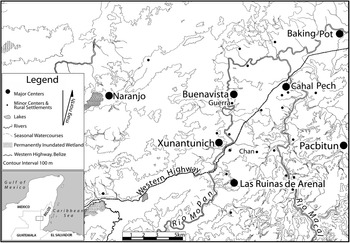
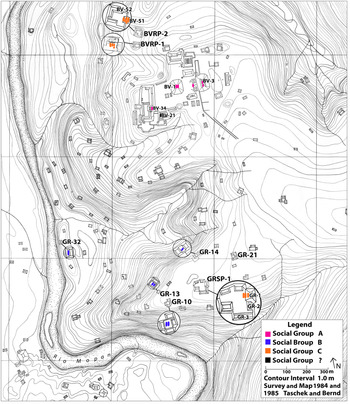
(Jacobi Reference Jacobi, Whittington and Reed1997:138).Throughout the last decade of the twentieth century and the opening decades of the twenty-first, the archaeological study of Classic-era (ca. a.d. 200–900) Maya civilization has been characterized by a recurrent revisiting and persistence of a small number of specific, as yet unresolved, themes. While many aspects of this great tropical lowland civilization have been successfully explored and are now reasonably well understood, questions and debate continue regarding the real nature and causes or even the historical reality of the “Great Collapse” (Aimers Reference Aimers2007; Iannone Reference Iannone2014; Sabloff Reference Sabloff2019; Turner and Sabloff Reference Turner and Sabloff2012; Webster Reference Webster2002a), the true sizes and densities of Classic-period populations (Webster Reference Webster and Iannone2014, Reference Webster2018), the chronology of such major political centers as Chichen Itza (Ringle Reference Ringle2017; Volta and Braswell Reference Volta, Braswell and Braswell2014; Volta et al. Reference Volta, May, Braswell, Wren, Kristan-Graham, Nygard and Spencer2018), and the events and processes involved in the transformative second and third century period known as the “Protoclassic” (Brady et al. Reference Brady, Ball, Bishop, Pring, Hammond and Housley1998; Callaghan Reference Callaghan2013). Based on the active literature, another matter still far from consensus among Mayanists concerns the overall structure and organization of Classic Maya society and the interplay of real as well as fictive kinship relationships in structuring Classic Maya social organization below the level of true royalty—i.e., below the level of the ajawob and their immediate marital and blood relations (Ensor Reference Ensor2013; Gillespie Reference Gillespie2000; Hendon Reference Hendon1991; Reed and Zeleznik Reference Reed, Scott Zeleznik, Gonlin and French2016; Sanders Reference Sanders, Chase and Chase1992; Smith Reference Smith1987; Webster Reference Webster, Chase and Chase1992). As has the fieldwork of so many others, our investigations in the Mopan-Macal Triangle of the upper Belize Valley identified a number of potential “intermediate” or “middle class” status groups between the obvious “commoner/peasant” level and true high elites. The present study employs a dentition-based bioarchaeological approach to examining possible biological and social ties among these lower-level groups within a single, settlement-system-defined, Classic-period Maya social community, that of Buenavista del Cayo (hereafter Buenavista) in the upper Belize River Valley (Figures 1 and 2; Ball and Taschek Reference Ball and Taschek1991, Reference Ball, Taschek and Garber2004).
Areal map locating sites mentioned in text and others of relevance. Map by Taschek.

The greater Buenavista del Cayo-Guerra locality, with contexts cited in-text indicated. Drawing by Taschek.

While many studies have examined the dynamic between the highest status elite Maya and non-elite commoners and peasants, until quite recently the individuals and families who existed between these two extremes have received relatively little serious attention beyond note of their probable existence and the occasional passing notice, mapping, and testing of a number of morphologically potentially germane sites (see Driver and Garber Reference Driver, Garber and Garber2004). Important exceptions to this have been the plazuela-focused studies on the peripheries of Baking Pot (Bedran Group [Conlon and Moore Reference Conlon, Moore, Iannone and Connell2003; Conlon and Powis Reference Conlon, Powis and Garber2004]), Buenavista (Angel Group [BVRP-1; Hyde Reference Hyde2013] and Archangel Group [BVRP-2; Sandoval Reference Sandoval2008), Cahal Pech (Martinez Group [Ebert Reference Ebert2017; Ebert and Fox Reference Ebert, Fox, Hoggarth and Awe2016]), and La Milpa (Medicinal Trail Group [Hyde Reference Hyde2011, Reference Hyde2014; Hyde and Fischbeck Reference Hyde and Fischbeck2007; Hyde and Martin Reference Hyde and Martin2009]), and a handful of plaza group-focused studies (e.g. Chaa Creek [Connell Reference Connell, Iannone and Connell2003], Tzutziiy K'in Group [Ebert Reference Ebert2017], Tikal, Group 7F-1 [Haviland Reference Haviland and Ashmore1981, Reference Haviland2015], Caller Creek [Kurnick Reference Kurnick2016], and Nohoch Ek [Taschek and Ball Reference Taschek and Ball2003]). The focus of this paper is an examination of the kinship relationships existing between contextually high- and low-status individuals and those occupying a seemingly “middle” social rung within a single, settlement-system-defined social community.
BIOARCHAEOLOGY
In the late twentieth century, American anthropologists adopted the term “bioarchaeology” to describe the multidisciplinary study of health, disease, diet, population demographics, and population movements through analysis of archaeological human remains (Buikstra and Beck Reference Buikstra and Beck2006; Larsen Reference Larsen1997). Through appropriate, judicious analyses, human remains can provide researchers with considerable in-depth knowledge about “who” an individual was during life in the form of highly specific information regarding their overall health, heredity, occupational activities, and social status (Parker Pearson Reference Parker Pearson1999). In combination with sound contextual and artifactual data, skeletal remains can provide far more detailed and complete understandings of ancient communities and societies than would ever be possible on the basis of cultural evidence alone. This study differs from many previous examinations of ancient Maya social organization in employing a dentition-based, fully bioarchaeological, rather than essentially archaeological or osteometric, approach.
CLASSIC MAYA SOCIAL STRUCTURE AND ORGANIZATION—POPULAR PERCEPTIONS
There has never been any question that Classic Maya households and individuals represented an enormous range of wealth levels and generally reflect tremendous heterogeneity and sometimes great inequalities demonstrated by housing size, building materials, quality of construction, and differential access to, and quality of, available local and exotic quotidian goods (obsidian). Both household archaeology and conjunctive burial analyses document such inequalities. Similarly, none would question that individual Maya held sometimes significantly differing social ranks. The bases for such might involve heredity and kinship, or be rooted in demonstrated prowess or leadership skills in military, artistic, artisanal, or even agricultural roles among many conceivable possibilities (Gillespie Reference Gillespie2000; Haviland Reference Haviland1966, Reference Haviland, Harrison and Wauchope1968; Sharer Reference Sharer, Sabloff and Henderson1993).
There are sharply differing opinions, however, as to the existence of a discrete Maya “middle class” (cf. Reed and Zeleznik Reference Reed, Scott Zeleznik, Gonlin and French2016:176–179). Ethnohistoric documents include the term azmen uninic which translates to “middle” or “medium men” (Roys Reference Roys1943), and early Colonial Spanish recorded the term açmen winik, which translates to “a man between principal [noble] and plebeian, a man of middle status” (Martinez Hernández Reference Martínez Hernández1929:69). Chase (Reference Chase, Chase and Chase1992) asserts that differences in tomb volume and other burial features at Caracol, Belize, provide evidence for the existence of a distinct middle class (our Social Group D, see section Three Favored Models and "Social Groups"), but Marcus (Reference Marcus, Chase and Chase1992, Reference Marcus, Lohse and Valdez2004) argues that there was no such ancient Maya middle class in the sense of a self-contained economic social unit. Rather, she suggests that these terms more likely applied to commoners who had raised their wealth and status through personal accomplishments, or who had been appointed to a political office. While such individuals could never acquire genuine (hereditary) noble status, their burials and residences might appear intermediate between those of commoners and elites. It is the presence of this social group that we are most interested in for this study.
The majority of older social models make the broad assumption that there was little possibility of social gradations or movement between the elite and non-elite strata, and that these groups were homogenous within themselves. The presence of apparent “intermediate elite” or “subelite” status burials, artifact assemblages, and social groups, however, as well as ethnohistoric accounts of merchants and warriors holding elevated, yet non-noble intermediate social positions all support the probability that ancient Maya social structure and organization were more complex than allowed for by a simple dual class or graduated continuum (“conical clan” [Kirchhoff Reference Kirchhoff1955]) model.
Three Favored Models and “Social Groups”
Among the multiple models proposed to describe Classic Maya social structure and organization, three generally enjoy majority popularity. One of these, the simplest and oldest, relies heavily on ethnohistoric accounts, proposing that there were only two social strata separated and perpetuated by class endogamy (Marcus Reference Marcus, Chase and Chase1992). The higher social group consisted of the ruling family and hereditary nobility; the lower stratum was made up of peasants, non-agricultural commoners, and slaves. Within each of the two strata there was internal hierarchy based on social role and rank, but these differences were based within a larger dyadic division. In this rigid two-strata model, commoners, even when gaining wealth or status through socioeconomic endeavors, remained separate from the nobility and could not move into the higher elite stratum (Marcus Reference Marcus, Chase and Chase1992).
The two generally accepted divisions correspond neatly to what social psychologists Sherif and Sherif (Reference Sherif and Sherif1956) have defined as social groups, and we employ this usefully flexible terminology for their identification in this study. Formally, a “social group” exhibits some clear degree of social cohesion and is more than a simple collection or aggregate of individuals. Characteristics shared by members of a group may include common interests, values, representations, ethnic or social background, and kinship ties (i.e., social bonds based on common ancestry, marriage, or adoption). Some researchers consider the defining characteristic of a social group to be regular social interaction (Hare Reference Hare1962). Sherif and Sherif (Reference Sherif and Sherif1956:143–180) propose defining a social group as a number of individuals interacting with each other with respect to: common motives and goals, an accepted division of labor (i.e., roles), established status (social rank and dominance) relationships, accepted norms and values with reference to matters relevant to the group, and development of accepted sanctions (praise and punishment) if and when norms were respected or violated. Hereafter, we refer to the small hereditary ruling elite as Social Group A, and to the vast and socioeconomically heterogeneous population of commoners as Social Group B.
A second, alternative model identifies consanguine and affinal kinship relations as the primary mechanism underpinning social organization (Ensor Reference Ensor2013; Hendon Reference Hendon1991; Sanders Reference Sanders, Chase and Chase1992; Webster Reference Webster, Chase and Chase1992). This model envisions ancient Maya civilization, even at its most complex, as a ranked society or “chiefdom” (Sanders Reference Sanders, Chase and Chase1992). Consequently, social organization is understood not in terms of clearly defined classes, but as being comprised of a graded continuum of progressive differentiation (Fried Reference Fried1967). This differentiation is argued to be based on relative domestic autonomy and the formation of corporate social groups rooted in kin relationships and holding specific rankings among the lineage groups composing the community (Hendon Reference Hendon1991). Gillespie (Reference Gillespie2000) has suggested that in applying this model the term “house”—as a heterogeneous corporate unit comprised of both real and fictive relationships—is more suitable than the kinship-based limitations suggested by the use of “lineage” (but cf. Watanabe Reference Watanabe2004).
Proponents of this model do concede that gradations of status based on kinship could have been structured within a broader two-class division into elites and commoners, with internal hierarchical ranking (Hyde Reference Hyde2014; Sanders Reference Sanders, Chase and Chase1992). While similar to the previous model, the kinship-based structure is less rigid, allowing for low-level or “intermediate” elites (hereafter Social Group C) to be prominent members or lineage heads of related lineage groups in the commoner population (Webster Reference Webster, Chase and Chase1992).
A third model for ancient Maya social organization asserts the existence of a separate and distinct “middle class” (hereafter Social Group D) between commoners and elites (Chase and Chase Reference Chase and Chase1992, Reference Chase and Chase2004, Reference Chase and Chase2017). This model proposes that social rank and status is rooted in both kinship group membership and ascribed achievement or renown. Allowing that the ruling family held a unique position at the highest level of elite status, proponents of this schema argue that occupational roles or activities, especially those taking place within or facilitating the court, do not fit comfortably with either the noble-commoner distinction or the graded continuum model. It must be said, however, that this model does appear to closely parallel Gillespie's (Reference Gillespie2000) proposed “house” conceptualization.
We suggest the plausible existence of at least four distinct and archaeologically recognizable social groups, as Sherif and Sherif (Reference Sherif and Sherif1956) have defined them.
Social Group A
True “elites,” including “royals” and ancillary “subroyals,” defined by palace residence, elaborate, sumptuary mortuary dispositions, and qualitatively and functionally rich associated artifact and ceramic assemblages (Chase and Chase Reference Chase and Chase1992; Houston and Stuart Reference Houston, Stuart, Inomata and Houston2001; Stuart Reference Stuart and Scarborough2005; Wright Reference Wright2011).
Social Group B
Commoners, agricultural peasants, and non-agricultural (often urban) peons (Lohse and Valdez Reference Lohse and Fred Valdez2004; Robin Reference Robin, Hendon and Joyce2004, Reference Robin2012, Reference Robin2013). The vast population archaeologically represented by more rustic residential circumstances—isolated “house mounds,” patio groups, and mound clusters—but nonetheless manifesting often considerable differences in personal wealth, as reflected in the richness (diversity), quality, and quantities of local and exotic artifacts and ceramics.
Social Group C (Tentative)
Lower-tier “subelites” or “intermediate elites,” associated with rural, suburban, and urban plazuela group residences (Elson and Covey Reference Elson and Alan Covey2006; Hyde Reference Hyde2011; Hyde Reference Hyde2013; Iannone and Connell Reference Iannone and Connell2003; Sandoval Reference Sandoval2008), were materially plainly better off than those comprising Social Group B, as manifest in the greater richness, quality, and size or quantities of their housing and material possessions. Subelites were also generally distinguished sociotechnically, ideotechnically, and by the possession of specific, functionally specialized implements, tools, or other objects or facilities pertaining to the latter material cultural categories.
Social Group D (Hypothetic)
True intermediate elites or upper tier “subelites” associated with rural, suburban, and urban plaza group residence (Elson and Covey Reference Elson and Alan Covey2006; Iannone and Connell Reference Iannone and Connell2003; Kurnick Reference Kurnick2016; Taschek and Ball Reference Taschek and Ball2003). Elevated rank and/or greater wealth sometimes manifest in a qualitatively rich, fine, and abundant associated material culture, but sometimes evinced by no more than significantly larger, more elaborate, and more costly residential construction indicating an ability to command labor and local building materials (Taschek and Ball Reference Taschek and Ball2003). Regrettably, no members of this social group were available for this study.
Reed and Zeleznik (Reference Reed, Scott Zeleznik, Gonlin and French2016:178–180) have presented a somewhat more nuanced and elaborated series of models based in large extent on conceptualizations by Webster (Reference Webster2002a, Reference Webster, Love, de Hatch and Escobedo2002b) complemented by their own addition of a “house society” model. In their typology—comprising distinct class, ranked, stratified, and house models— the structuring principles, relations, and relationships are considerably more complex and sophisticated as articulated, but in all cases incorporate a subroyal “middle level” of society as a matter of course. The impetus of their study is to test each of these against the robust data base resulting from the multiple research programs at Copan from the 1930s through the 1990s in order to identify the best possible fit for that polity's sociopolitical organization and, in so doing, shed some light on lowland Maya society overall (Reed and Zeleznik Reference Reed, Scott Zeleznik, Gonlin and French2016:176–178).
Their conclusions identify collateral support from different data sets for the simultaneous existence of both “a lineage model such as the ranked or stratified models,” and “a society closer in organization to a class-based one,” suggesting to them “a society in transition from one type of social organization to another…a society moving out of a ranked form of organization into a stratified society” (Reed and Zeleznik Reference Reed, Scott Zeleznik, Gonlin and French2016:199–200). They further propose the probable existence of two distinct middle levels of this society, an upper-middle level roughly equivalent to our tentative Social Group D, and a lower-middle level closely corresponding to our suggested Social Group C, the latter comprising individuals and families for whom “status was more likely defined by one's association with the corporate lineage…and access to items of distinction was determined by this association.” Their overall assessment is that “there must have been considerable ambiguity in the political system” (Reed and Zeleznik Reference Reed, Scott Zeleznik, Gonlin and French2016:200; also see Hyde Reference Hyde2014).
In our own study, we do not attempt any new testing of the paradigmatic models, but accept as a point of departure the proposition that at least two and potentially as many as four or more distinct social groups (sensu Sherif and Sherif Reference Sherif and Sherif1956) can readily be recognized as present within most regions of the southern and eastern Classic Maya lowlands based on consistent reiterative combinations of specific domestic residential, architectural, burial, and qualitative/quantitative artifactual patterns (Reed and Zeleznik Reference Reed, Scott Zeleznik, Gonlin and French2016). These combinations occur within zonal settlement patterns of both urban site-cores (centers) and the surrounding and intervening suburban and fully rural hinterlands. What we will examine are the possible existence and degree of heredity as expressed in dental characteristics (crown size and cusp expression) among members of Social Groups C, B, and A as residentially, artifactually, and otherwise materially identified within one small society on the eastern edge of the southern Maya lowlands.
Classic Maya Social Groups and Social Organization—The Present Study
The Data
The human skeletal remains considered in this paper all were recovered by the San Diego State University Mopan-Macal Triangle Archaeological Project (MMTAP) in the upper Belize River Valley between 1984 and 1989 (Ball and Taschek Reference Ball and Taschek1991, Reference Ball, Taschek, Inomata and Houston2001, Reference Ball, Taschek and Garber2004; Taschek and Ball Reference Taschek and Ball1986, Reference Taschek, Ball and Garber2004). Three distinct social populations were defined by the project based on each interment's combined physical location (within settlement and/or center) and context (dwelling, patio, or dedicated monument), grave type (per Smith Reference Smith1950; Welsh Reference Welsh1988), and material associations (grave goods).
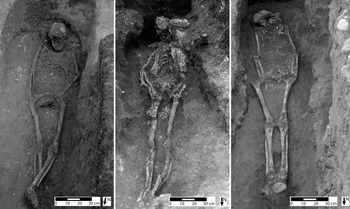
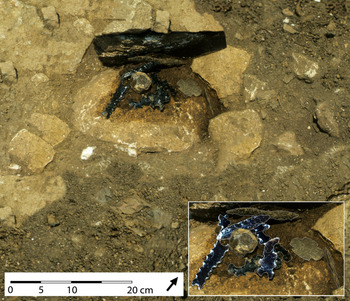
(1) Village commoners (Figure 3) belonging to the local agricultural population base, all from the suburban Buenavista settlement of Guerra (n = 11); our Social Group B.
Representative Social Class B subfloor patio burials from Patio Groups GR-10, GR-32, and GR-14. No material accompaniments. Photographs byTaschek.

(2) Royal or regal elites representing the highest social status and probable ruling members of the local society, comprising 14 individuals buried at the twin centers of Buenavista del Cayo (n = 8) and Cahal Pech (n = 6), all belonging to Social Group A.
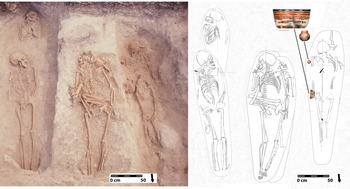
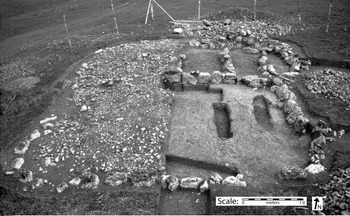
(3) Seventeen individuals of intermediate elite or subelite status, who were residents of two urban plazuela groups on the northwest edge of the Buenavista center (Plazuela Groups BVRP-1 and BVRP-2; Figures 2 and 4) and 19 residents of what is believed to have been the senior or superordinate household within the Guerra village (Plazuela Group GRSP-1; Figures 2 and 5), these together composing our Social Group C.
Representative Social Class C subsurface patio burials from Plazuela Group BVRP-1 (Burials BV85-B1–B6). Multiple contemporary and sequential interments in a simple, slab-covered burial pit, middle to late eighth century (late Mills–full Paloverde ceramic phases). Minimal ceramic and artifactual accompaniments, including one probable tobacco flask. Photograph and drawing by Taschek.

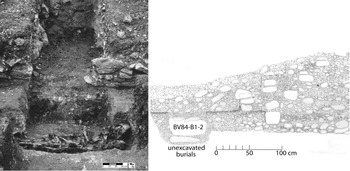
Representative Social Class C eastside mortuary platform interment from Plazuela Group GRSP-1 (Burials BV84-B1 and B2). Multiple, superposed interments, reflecting either a single mass burial or several reentries in a simple, limestone slab-covered burial pit, late seventh to late eighth century (late Mills–full Paloverde ceramic phases). No ceramic or artifactual accompaniments. Photograph and drawing by Taschek.

Our Approach
One way to address the issue posed is to examine the evidence for genealogical affinities among and between members of the contextually and materially identified social groups. The challenge is how to most validly and effectively do so. The present study attempts to investigate this aspect of ancient Maya social organization by using dentally expressed genetic markers (Cucina Reference Cucina and Cucina2015; Cucina et al. Reference Cucina, Ortega and Tiesler2008; Irish and Scott Reference Irish and Richard Scott2017; Scott and Turner Reference Scott and Turner1997; Scott et al. Reference Scott, Turner, Townsend and Mantinón-Torres2018; Serafin et al. Reference Serafin, Lopé, Cucina and Cucina2015; Turner et al. Reference Turner, Nichol, Scott, Kelley and Larsen1991; Wrobel and Graham Reference Wrobel, Graham and Cucina2015). In it, we compare dental and cultural data from 61 individuals comprising three distinct contextually defined Classic-period social groups (A, B, and C) in the hope of better understanding how they might have been connected during life.
Background and Previous Studies
Extensive archaeological investigations and complementary stable isotope analyses of recovered human burials over the last 60 years indicate the Belize Valley to have been relatively stable demographically from at least the second century b.c. until the eleventh century a.d. or later (Freiwald Reference Freiwald2011; Spotts Reference Spotts2013; Novotny Reference Novotny2015). The sole seeming exception to this involves what appear to have been somewhat regular movements to and fro between the upper Macal drainage and the Cahal Pech-Buenavista vicinity by some members of the local elite in both cases (Ball and Taschek Reference Ball and Taschek2018; Freiwald Reference Freiwald2011; Green Reference Green2016; Spotts Reference Spotts2013). Freiwald (Reference Freiwald2011) and Spotts (Reference Spotts2013), as well as Green (Reference Green2016), document clear evidence of modest but regular intersettlement mobility both within the greater Belize Valley and between it and the immediately adjacent upper Macal River zone and the eastern Peten marshlands to the west. Such mobility in no way negates the findings of this study, or those of Black (Reference Black2007) and Mitchell (Reference Mitchell2006), but rather highlights the importance of intercommunity kinship bonds and relations in the Classic period. Additionally, Novotny (Reference Novotny2015) found that individuals buried around Cahal Pech were of consistently local origin, suggesting a fairly stable demographic population in the region we discuss in the present study (also Freiwald Reference Freiwald2011; Spotts Reference Spotts2013). The distances travelled in such cases, however, would appear to have been no more than 10 to less than 20 kilometers in any instance (Freiwald Reference Freiwald2011:83–88, 90–91, Figure 4.5). This suggests that there was likely minimal gene flow from communities outside the region, which would influence genetic variation within the social groups at Buenavista. Additionally, the archaeological signatures identifying regal or high-status elite, intermediate elite, and commoner status levels have also been extensively explored and convincingly documented locally and for the Maya lowlands overall (Chase and Chase Reference Chase, Chase and Chase1992; Elson and Covey Reference Elson and Alan Covey2006; Lohse and Valdez Reference Lohse and Fred Valdez2004; Robin Reference Robin, Hendon and Joyce2004, Reference Robin2012, Reference Robin2013; Schele and Miller Reference Schele and Miller1986; Stuart Reference Stuart and Scarborough2005; Webster and Gonlin Reference Webster and Gonlin1988; Wright Reference Wright2011).
Three earlier studies (Black Reference Black2007; Blankenship-Sefczek Reference Blankenship-Sefczek2011; Mitchell Reference Mitchell2006) have established the internal biological homogeneity of Social Groups C, B, and A as represented in the study area. Additionally, the biological segregation of Social Group A members from Social Groups C (Black Reference Black2007) and B (Blankenship-Sefczek Reference Blankenship-Sefczek2011) has previously been determined and documented. The findings suggesting that Social Group A was separated from Groups B and C are not surprising, given that almost all previously discussed models anticipate that Maya elites were culturally and even biologically distinct from the non-elites.
Artifactual and architectural evidence also indicates that status-related cultural distinctions existed between those belonging to Social Group C and Social Group B, as well (Hyde Reference Hyde2013; Sandoval Reference Sandoval2008). What remained unknown, however, were the extent and nature of biological connections between these two social groups. The focus of this paper is an examination of the dentally expressed biological relationships between the contextually lower status individuals of Social Group B and those of Social Group C within the expansive archaeological locality composing the greater Buenavista del Cayo community.
Although our available study sample is small, totaling 61 individuals, the results of the several analyses previously performed on the population have proved to be surprisingly consistent, and when evaluated using the consistency and significance tools available for vetting small samples, they are highly suggestive. Our goal is to assess whether there is evidence of biological affinity between members of the known culturally non-elite commoner population (Social Group B) and individuals who appear to have enjoyed a more elevated social status but clearly were still well below the level of the ruling high elites within the social hierarchy of Classic Maya society. Did members of Social Group B share biological affinity with members of Social Group C? And, if so, to what extent, and what might that indicate? While this trial study will not resolve the question, of course, its judicious application to a carefully selected sample should provide some interesting insights and good hints as to its most likely eventual resolution.
The Archaeological Sample: Buenavista del Cayo, Guerra de Buenavista, and Cahal Pech
The Buenavista del Cayo-Guerra locality is nestled within the land triangle formed by the Mopan and Macal Rivers within the upper Belize River Valley of central western Belize (Figures 1 and 2). Buenavista was a medium-size, regional center that served as a theater for high-status residence, public ceremonies, and zonal economic activities (Ball and Taschek Reference Ball and Taschek1991, Reference Ball, Taschek and Garber2004; Cap et al. Reference Cap, Yaeger and Kathryn Brown2017; Taschek and Ball Reference Taschek, Ball and Garber2004; Yaeger et al. Reference Yaeger, Batty, Bratsch, Cap and Whitaker2013). Its time of local ascendancy and florescence appears to have extended from the initial Early Classic into the early Late Classic period (ca. a.d. 250/300–730). Physically, the site consists of three contiguous plaza-complexes, an acropolis-palace, two plaza groups, two ball courts, and at least 10 residential courtyard groups (Figure 2; Ball and Taschek Reference Ball and Taschek1991; Cap et al. Reference Cap, Yaeger and Kathryn Brown2017). Two of the courtyard groups, BVRP-1 and BVRP-2, conform to the residential group category of “plazuela group,” generally taken to be the housing units of extended or nuclear families of a lower-tier, subelite or intermediate elite pertaining to our Social Group C.
The two “plaza groups” edging the center's north and south sides (Groups 10–13 and 20–24; Figure 2) are believed to have been associated residentially and functionally with the activities of members of our Social Group D, nonregal subelites or intermediate elites, but ones of a higher level social rank or status than those comprising Social Group C. While four fragmentary human burials—three of these being intrusive ninth-century interments—were recovered from the South Plaza Group, data from these were too incomplete to be included in the present study.
Guerra de Buenavista
Extending southward from the Buenavista center along the Mopan River for roughly one kilometer is a “house mound” settlement-cluster of over 90 isolated mounds and patio groups and, at its southern end, one larger, architecturally more complex plazuela group (Figure 2). These are distributed fairly evenly over all three terraces edging the river, with the greatest concentration of isolated mounds on the lowermost terrace and that of patio groups on the uppermost. Initial survey in 1981 suggested that the entire site lay within a band delimited on three sides by the southern edge of the Buenavista center and the Mopan River and extending eastward about two hundred meters back from the edge of the river's uppermost terrace, but in subsequent years it became evident that while settlement did thin and become more dispersed at that distance, it nonetheless continued farther back from the river in the form of ever fewer scattered groups and individual mounds surrounded by much more arable open space. A contiguous residential suburb of the Buenavista center, we labeled the settlement “Guerra” after the patronym of the present landowners (Taschek and Ball Reference Taschek and Ball1986).
In addition to one substantial plazuela group (GRSP-1; Figure 2) made up of six pole-and-thatch, masonry, and adobe structural units ringing an elevated patio or courtyard area of approximately 2,810 m2, the Guerra settlement consists of at least 87 separate isolated mounds and mound groups potentially equating with at least that many or, allowing for nonresidential buildings and multiple dwelling households (Sanders Reference Sanders and Ashmore1981), somewhat slightly fewer discrete homesteads. Individual mounds vary considerably in size, as do the larger two- to five-unit patio groups. For example, excavation of the GR-10 patio group (Figure 2) revealed a considerably greater investment in materials (e.g., limestone block masonry footings) and labor for building and maintenance in comparison to most neighboring groups, suggesting that the residents of GR-10 might have enjoyed greater wealth, if not higher status, than the majority of their fellow villagers. Artifactually and ceramically, we identified nothing that might otherwise set the GR-10 household apart as differing in any way in its sociocultural, ideological, or economic functions or social rank. Each of its two recovered burials, for example, was accompanied by nothing more than a single incomplete medial or proximal obsidian blade segment. Evidence from GR-14 and GR-32, in contrast, suggests that the residents of these two patio groups belonged to the larger, socially, and economically undifferentiated bulk of the subsistence farmers composing the community.
Since our 1984 work, Yaeger (Reference Yaeger2007; Yaeger et al. Reference Yaeger, Kurnick, Dykstra and Peuramaki-Brown2012) of the University of Texas at San Antonio (UTSA) has resurveyed the Guerra locality and directed new excavations at Buenavista as part of a larger project examining the occupational, economic, and sociopolitical histories of the landscape between Buenavista and Xunantunich (Peuramaki-Brown Reference Peuramaki-Brown2012, Reference Peuramaki-Brown2014). More than a quarter century of sheep and cattle pasturage, surface exposure, vegetational change, and erosion have transformed the natural and archaeological landscapes, both exposing and revealing more features and details than were visible to us, and significantly altering or eradicating others. Together with the use of newer, more sophisticated technologies than were available to us in 1984, these factors have brought to light a number of shortcomings in our original survey results, and more are certainly likely. It would appear that a good number more landform modifications, rock alignments or walls, and foundationless structures were present than we identified. This is not surprising, nor even particularly problematic, in that our primary concerns were with a basic substantive documentation of the domestic and non-domestic artifactual and ceramic assemblages of the households and community comprising the site, whereas the ongoing UTSA effort is seeking to address complex socioeconomic and political historical questions involving Buenavista and its hinterland and their relationships to Xunantunich and the greater Belize Valley (Yaeger Reference Yaeger2007). In truth, the substantive portrayal of the Guerra community as documented in 1984 (Taschek and Ball Reference Taschek and Ball1986) remains fundamentally unchanged and valid and suitable to the purposes of the present study.
Situated near the southernmost end of the settlement is an architecturally large, substantial, and complex plazuela group, GRSP-1 (Figure 2). Of its six, masonry-based, pole-and-thatch buildings, four appear to have been residential in function. Two of these (GR-3 and GR-4) plainly were occupied by members of the resident elevated status family; two others on the north edge of the group possibly pertained to service personnel or activities, or represent later, “post-abandonment” reoccupation. One, Structure GR-1, served as a specialized funerary monument or mausoleum, and another, Structure GR-2, may have functioned as a cookhouse associated with feasting activities provided for the greater community by the residents of the plazuela complex.
Over the 1984 field season at Guerra, the MMTAP carried out the complete horizontal stripping of four patio groups (Figure 6) and two isolated mounds, as well as that of five of the six structural units composing the plazuela. The resulting data were complemented by footing trench and summit tests of 32 other groups and isolates. In the course of these excavations, a very small number of inhumations were encountered and recovered for study. These included interments of 11 individuals from three of the patio group residences (Figure 3; GR-10, GR-14, and GR-32), all members of commoner status Social Group B, and 19 individuals from both within and immediately in front of the plazuela charnel platform, Structure GR-1 (Figures 2 and 5), all taken to be members of the subroyal intermediate elite Social Group C, potentially comparable in social rank to the occupants of the Buenavista center plazuela groups, BVRP-1 and BVRP-2 (Figures 2 and 4). Frustratingly, subfloor excavations in a number of patio groups (e.g., GR-13 and GR-21) exposed nicely prepared and covered but shallow burial crypts completely devoid of any remains sufficiently preserved for recovery or recording (Figure 6).
Mound GR-13 from the south. A one-building, elevated patio group with prepared, sub-cobble patio graves. Skeletal remains too badly decomposed for recovery or recording. Photograph by Taschek.

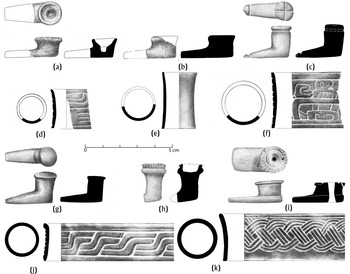
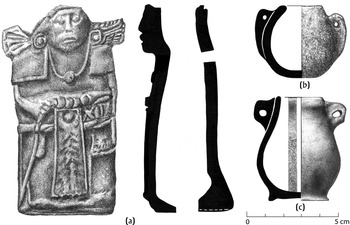
With its apparent community banqueting facilities and spatially associated ancestral shrine, the family residing within the GRSP-1 plazuela group are excellent candidates to have served as Guerra's community leaders from at least the late fourth century well into the eighth. This role and attendant elevated social status are also attested to by a rich, functionally specialized, and qualitatively very fine artifactual inventory found throughout the plazuela that included polished limestone labrets (Figures 7a–7c), fine ceramic annular ornaments (Figures 7d–7f; Iglesias Ponce de León Reference de León, Josefa and Braswell2003:181–182), ceramic effigy ocarinas (Figure 8a; Taschek Reference Taschek1994:211–212), and possible tobacco flasks (Figures 4, 8b, and 8c; Loughmiller-Newman and Zagorevski Reference Loughmiller-Newman and Zagorevski2016), local chert and imported obsidian eccentrics (chipped stone zodiacal and other astronomical images) in sets replicating others found within the ceremonial precinct of the Buenavista center (Figure 9; Otto Reference Otto1995; Ramos Ponciano Reference Ramos Ponciano2017), possibly “gifted” glyph-bearing sherd-tokens neatly sawn from fine polychrome vases, and dental modifications. Notably, proportionate to compound size and excavation volume, the GRSP-1 residents appeared to have had no greater access to or need of obsidian blades or cores than did any other households within the settlement, suggesting that this material was more a quotidian than prestige commodity (Rice Reference Rice, Brumfiel and Earle1987) in the Valley during the Classic, and not an especially “expensive” one.
Cross-contextual, status-related artifacts. Labret-style facial ornaments from Buenavista palace and Guerra plazuela group, GRSP-1, all late eighth century: (a–c) carved limestone labrets from periabandonment, de facto refuse, Platform GR-2, Guerra and (g–i) marine shell labrets from palace refuse deposits. Ceramic annular ornaments from Buenavista palace and suburban plazuela group, BVRP-1, all early fifth century: (d–f) associated with Burial BV85-B10, plazuela group BVRP-1 and (j and k) from a palace refuse deposit. Drawings by Taschek.

Status-related objects from Social Group C plazuelas. (a) Two-stop ocarina (Plazuela Group BVRP-1, Structure BV-52). (b and c) Possible tobacco flasks (both from Plazuela Group GRSP-1, Structure GR-2). All eighth century. Drawings by Taschek.

Cosmographically patterned, subfloor cache of chert and obsidian eccentrics. Structure GR-3, Plazuela Group GRSP-1, Guerra. Photograph by Taschek.

Both the Buenavista and Guerra localities were initially occupied sometime during the full Middle Preclassic period (ca. 800–650 b.c.) by discontinuous successions of small agricultural households and hamlets with ample evidence of simple residential housing dating to that time (Ball and Taschek Reference Ball, Taschek and Garber2004). By the second century b.c., if not earlier, well-built stuccoed masonry platforms—including even a simple, two-range ballcourt (South Ballcourt)—were being constructed on the site of the Buenavista center core (Ball and Taschek Reference Ball, Taschek and Garber2004). Occupation and construction continued episodically at both sites until well into the tenth or early eleventh century, with major incremental surges at each in the late fourth to early fifth century, and indications of significant declines or even temporary, large-scale abandonments in the middle (Buenavista) and late (Guerra) eighth century (Ball and Taschek Reference Ball, Taschek and Garber2004; Peuramaki-Brown Reference Peuramaki-Brown2014).
Just under five kilometers to the east, the palace-complex acropolis of Cahal Pech sits atop a steep limestone knoll above the Macal River. Within a context of unusually deep and continuous occupational and construction histories, the site has been documented to have been the burial place of an apparent dynastic line of high-status interments, including at least some definite royals (Zender Reference Zender, Hoggarth and Awe2004), from at least as early as the Late Preclassic era (ca. 200 b.c.) well into the ninth century (Awe Reference Awe2013; Ball Reference Ball1993; Novotny et al. Reference Novotny, Awe, Santasilia and Knudson2018). Ball and Taschek (Reference Ball, Taschek, Inomata and Houston2001) have previously argued that Cahal Pech and Buenavista in fact constituted alternative dual palace-centers of the single same royal lineage, a premise ostensibly confirmed by Mitchell's (Reference Mitchell2006) independent dental biometric findings of homogeneity between the two associated elite burial populations. This allows of a valid expansion of the regal elite-level (Social Group A) comparative base.
The recovered burial inventories from Buenavista and Guerra each derive from a period extending from the late fourth or early fifth century well into the late ninth or early tenth century in the case of Social Group A (regal elites), and from the late fourth into the middle eighth century for representatives of Social Groups B (commoners) and C (subelites/nonregal intermediate elites). If anything, this might suggest a likelihood of increased temporally influenced diversity within each social group, but the independent, separate analyses by Mitchell (Reference Mitchell2006), Black (Reference Black2007), and Blankenship-Sefczek (Reference Blankenship-Sefczek2011) demonstrated that this was not the case. Their discrete internal homogeneity supports the proposition that any such diversity as does exist between the social groups is likely to be a function of factors other than chronological differentiation. Similarly, the correspondences between those members of Social Group A interred at Cahal Pech and those found at Buenavista is more likely to reflect genuine affinity than confounding spatial or temporal factors (Black Reference Black2007; Blankenship-Sefczek Reference Blankenship-Sefczek2011; Mitchell Reference Mitchell2006). The same applies to the apparently biologically affined individuals inhumed at Plazuela Groups BVRP-1, BVRP-2, and GRSP-1 (Black Reference Black2007; Blankenship-Sefczek Reference Blankenship-Sefczek2011).
The social construction of the Guerra suburb likely approximated a corporate group pattern in which multiple nuclear and extended families were linked together by common descent ties with one “First Tier” family holding a demonstrably more elevated social position than others and ostentatiously maintaining control over the group's economic endeavors and ritual practices (Lohse Reference Lohse, Lohse and Valdez2004). Typically, corporate groups are comprised of farming households that have developed into localized coalitions, or communities, and a major premise of the corporate group model is that the vast majority of group member, the “non-elites,” were directly or otherwise engaged in the full-time production of food, while overtly “elite” community members were more focused on the distribution of agricultural products and other commodities. In addition to their lineage bonds, community members thus were also tied together by the shared agricultural duties they performed. Both ethnographic observations and archaeological data support such a model as that constituting traditional Maya village settlement structure and social organization from at least the Classic period through the present (Marcus Reference Marcus, Lohse and Valdez2004; Vogt Reference Vogt1970, Reference Vogt1993). In light of this, it is not surprising that Blankenship-Sefczek (Reference Blankenship-Sefczek2011) found an indisputable real biological relationship among all individuals represented in the recovered Guerra burial population.
Carmean (Reference Carmean1998) and Scherer (Reference Scherer2007) have suggested that some local “First Tier” (Lohse Reference Lohse, Lohse and Valdez2004:130) or plazuela-group rank households might even have acted as paramount local religious and political decision makers and overseers for adjacent residential groups. This might seem to imply that urban regal elites did not exert direct supervision over groups outside the immediate urban center, however, direct social connections between these groups and the centers still would have been desirable, if not necessary, to facilitate multiple organizational and administrative dealings in a range of economic, political, martial, and ideological realms. Classic patron-client and fictive kinship relationships could certainly have played important roles in establishing and maintaining such bonds, but connections also could have been promoted through the residential movement of suburban and rural First Tier subelite families or individuals to the urban centers or through possible marriage with other, already resident urban subelites of equivalent or higher social rank. We will examine the possibility of such interactions by comparing those interred at urban Plazuela Groups BVRP-1 and BVRP-2 with individuals recovered from suburban plazuela group GRSP-1 as well as other commoner members of the larger suburban Guerra community. Our initial working hypothesis was that the suburban subelite occupants of GRSP-1 likely shared some biological affinity with those buried at BVRP-1 and/or BVRP-2, as well as with the larger commoner population of the Guerra suburban settlement.
Biological Variation and Dental Variation Studies in the Maya Lowlands
In this study, we are concerned with biological relationships and the resulting observable variation found between populations. Biological variation is based on evolutionary processes such as gene flow (migration resulting in breeding), genetic drift (random change in allele frequency), natural selection, and mutation. Here, we focus on gene flow, as there is evidence that Classic Maya interaction networks resulted in the mixing of genes between populations (Cucina Reference Cucina and Cucina2015; Cucina et al. Reference Cucina, Douglas Price, Peralta and Sosa2015; Scherer Reference Scherer2007; Scherer and Wright Reference Scherer, Wright and Cucina2015; Willermet et al. Reference Willermet, J.H. Edgar, Ragsdale and Scott Aubry2013), which would alter the observable phenotypes between and within groups. Modern humans exhibit geographically clustered traits, and while there is much overlap and within group variation, populations can be classified reliably at the individual and regional level (Ousley et al. Reference Ousley, Jantz and Freid2009; Stojanowski and Schillaci Reference Stojanowski and Schillaci2006). When gene flow occurs, there is a change in trait frequencies within the two populations in question; as new traits are introduced to each population, intrapopulation variation increases and previously distinguishing traits become shared, decreasing interpopulation variation. Thus, differences between populations become less obvious when gene flow has occurred (Ousley et al. Reference Ousley, Jantz and Freid2009)
While there are many biological systems available for discussions of this kind (e.g. nonmetric or postcranial traits), dental characteristics (crown dimensions and trait expression) are some of the most reliable sources for assessing affilial relationships, as they are heritable, slow to evolve, less affected by extrinsic factors (e.g. physiological stress, nutritional deprivation, and localized trauma), and exhibit low sexual dimorphism compared to other systems (Baily and Hublin Reference Shara H., Hublin, Richard Scott and Irish2013; Biggerstaff Reference Biggerstaff1973; Corruccini et al. Reference Corruccini Robert, Sharma and Yap Potter1986; Hughes and Townsend Reference Hughes, Townsend, Richard Scott and Irish2013; Irish and Scott Reference Irish and Richard Scott2017; Lundstrom Reference Lundstrom1962; Scott and Turner Reference Scott and Turner1988; Scott et al. Reference Scott, Turner, Townsend and Mantinón-Torres2018; Turner et al. Reference Turner, Nichol, Scott, Kelley and Larsen1991). Heritability rates show that assessments of biological affinity are possible through analyses of dental traits (extra cusps or grooves between cusps; Biggerstaff Reference Biggerstaff1970, Reference Biggerstaff1973, Reference Biggerstaff1975; Corruccini et al. Reference Corruccini Robert, Sharma and Yap Potter1986, Reference Corruccini, Townsend, Richards and Brown1990; Hughes and Townsend Reference Hughes, Townsend, Richard Scott and Irish2013; Hughes et al. Reference Hughes, Brockmann, Seow, Gotjamanos, Gully, Richards and Townsend2007) and crown dimensions (tooth length and width; Dempsey and Townsend Reference Dempsey and Townsend2001; Garn et al. Reference Garn, Lewis and Kerewsky1965; Kabban et al. Reference Kabban, Fearne, Jovanovski and Zou2001).
Biological distinction from the parent or ancestral population as seen in dental characteristics can be caused by long-term isolation for generations (Scott and Turner Reference Scott and Turner1997; Scott et al. Reference Scott, Turner, Townsend and Mantinón-Torres2018). Through analyses of tooth morphology, Scherer (Reference Scherer2007) and Cucina (Reference Cucina and Cucina2015) have demonstrated that the idea of “isolation by distance,” the increase in biological dissimilarity between geographically separated populations (Wright Reference Wright1943), does not fit with broad affinity patterns in the Maya region. These and other studies suggest there was a large amount of gene flow occurring, particularly during the Classic period (Cucina Reference Cucina and Cucina2015; Cucina et al. Reference Cucina, Douglas Price, Peralta and Sosa2015; Scherer Reference Scherer2007; Scherer and Wright Reference Scherer, Wright and Cucina2015; Willermet et al. Reference Willermet, J.H. Edgar, Ragsdale and Scott Aubry2013). Many studies have contextualized one or more sites within the broader Maya region and found that geographic and temporal clustering do not yield distinctions between major centers (Aubry Reference Aubry2009; Cucina and Tiesler Blos Reference Cucina and Blos2004; Cucina et al. Reference Cucina, Ortega and Tiesler2008, Reference Cucina, Douglas Price, Peralta and Sosa2015; Scherer Reference Scherer2007; Willermet et al. Reference Willermet, J.H. Edgar, Ragsdale and Scott Aubry2013). For example, using morphometric and strontium data, Scherer and Wright (Reference Scherer, Wright and Cucina2015) suggest that Tikal saw an immigration influx during the Early Classic, which resulted in increased phenotypic variation. Looking at broad population patterns across the lowlands, Scherer (Reference Scherer2007:371) assessed dental characteristics from major zones within the region (Central, the southern lowlands; Belize, the [southern] Highlands) and found no geographic clustering of sites within each. Sites within the southern lowlands (Scherer's Central Zone), however, exhibited less among-group variation suggesting different levels of gene flow (Scherer Reference Scherer2007). Cucina (Reference Cucina and Cucina2015) also argues that there is genetic homogeneity in the Maya region, but shows that sites in the Peten regularly cluster more closely compared to those in other areas.
These studies suggest that gene flow occurred during the Classic period resulting in a decrease in interpopulation dental variation across the Maya lowlands. Given the expectation that increased genetic sharing would result in more similarity between populations, this is not surprising. Additionally, given the level of mobility across the area (Cucina Reference Cucina and Cucina2015; Scherer Reference Scherer2017), the absence of clear distinctions between sites within a given time period is to be expected.
In the present study, we focus on intralocality comparisons as these have not yet been undertaken in the Belize Valley. Our goals are not to contextualize Buenavista within the larger biological geographic picture, but rather to examine affilial connections of people residing within this community. There is one major caveat to the present study: very few other studies using dentition to determine biological affinity across differing social strata have been conducted or attempted (Lukacs and Hemphill Reference Lukacs and Hemphill1993; Wrobel and Graham Reference Wrobel, Graham and Cucina2015). The possibility does exist, therefore, that status-related extrinsic factors may be more important in suggesting biological distance than we allow for. Conversely, however, we are unlikely to see or suggest any closer affinities than actually did exist within the study population on such bases.
GENERAL METHODOLOGY
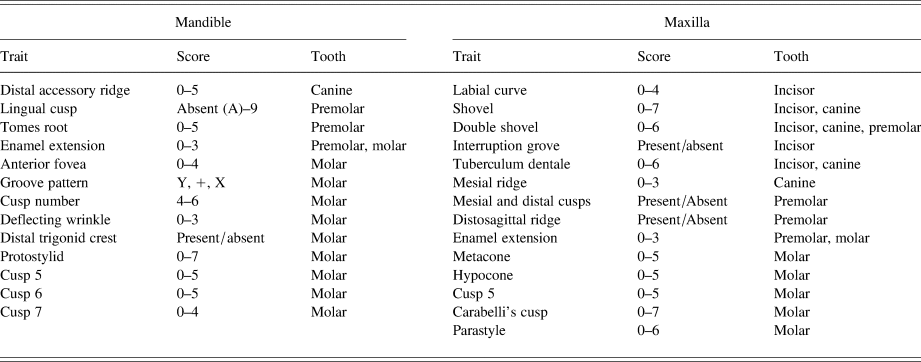
The recording of dental morphology potentially indicative of probable biological affinity employed the extensive sequencing protocols established by Turner and colleagues (Reference Turner, Nichol, Scott, Kelley and Larsen1991) in which 52 discrete dental traits (two to four per tooth) are examined and scored for all teeth present. Recording of discrete traits followed the scaled standards set by the Arizona State University Dental Anthropology System wherein descriptions of individual traits were consulted along with the corresponding reference casts (Turner et al. Reference Turner, Nichol, Scott, Kelley and Larsen1991). Scales range from “0” for absent up to “7,” which represents a fully developed example of a trait (Table 1; Turner et al. Reference Turner, Nichol, Scott, Kelley and Larsen1991). For example, the upper molar Carabelli's cusp (Figure 10a) is recorded from 0–7, and lower molar cusp 6 (Figure 10b) is recorded from 0–5 (Turner et al. Reference Turner, Nichol, Scott, Kelley and Larsen1991). For statistical analyses, each trait was treated as “present” or “absent.” In a few cases, dental attrition or taphonomic processes inhibited the scoring of morphological variation and these teeth were not included in the statistical analyses. In addition, due to the fragmentary condition of the skeletal collection and the limited amount of alveolar bone preserved, traits such as incisal winging and torsomolar were not consistently available for reliable comparison. To address issues arising from the small sample size, Fisher's Exact Tests with 2 × 2 tables were run comparing each of the available suburban village burial contexts (GRSP-1, GR-10, Dart, and GR-14) with each other, and with the urban, middle-status plazuela populations from BVRP-1 and BVRP-2. Fisher's Exact Test is a nonparametric test that determines if associations between variables are due to random chance or actual differences. Because we were interested in assessing phenotypic variation between groups, the Fisher's Test addressed the presence of observable differences associated with the chosen dental traits. Significance was accepted at p < .05.
Traits analyzed and all possible corresponding scores used, following procedures outlined by Turner et al. (Reference Turner, Nichol, Scott, Kelley and Larsen1991).

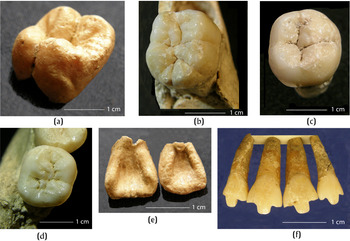
Idiomorphic dental features and modification. (a) Low-score expression of Carabelli's Cusp on upper molar (Burial BV84-B8, Patio Group GR-32, Guerra). (b) Cusp 6 on lower molar (Burial BV85-B8, Plazuela Group BVRP-1). (c) Four-cusped lower molar (Burial BV85-B15, Plazuela Group BVRP-1). (d) Y-shaped groove pattern on lower molar (Burial BV85-B5, Plazuela Group BVRP-2). (e) Shoveling on upper incisors (Burial BV84-B8, Patio Group GR-32, Guerra). (f) T-shape filing (Burial BV84-B1(2), Plazuela Group GRSP-1). Photographs by Blankenship-Sefczek.

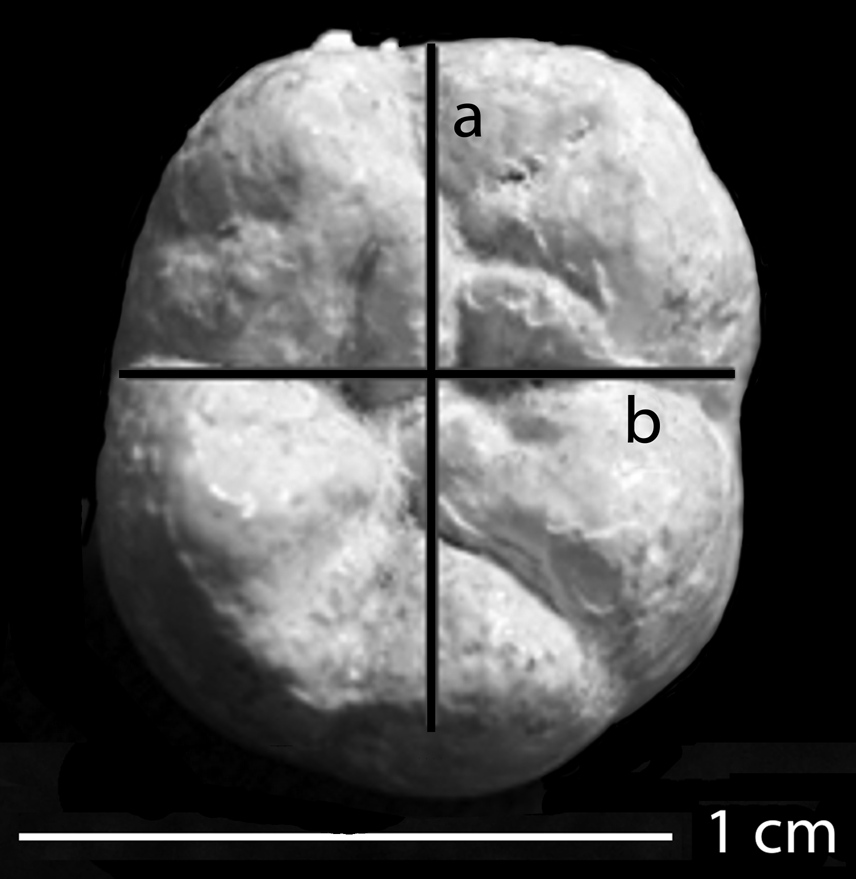
For each tooth, crown measurements were recorded with digital calipers for mesiodistal (MD), and buccolingual (BL) distances (Figure 11) following standards descripted by Moorrees (Reference Moorrees1957). Each measurement was taken three times and the average was used for analysis. Highly varying degrees of dental attrition reflecting antemortem wear was present on all teeth, so crown height measurements were not included in the statistical analyses to maintain consistency and reliability. Similarly, occlusal surfaces obstructed by caries, teeth exhibiting postmortem damage, and teeth exhibiting severe calculus were excluded from some measurements. Independent samples Kruskal-Wallis one-way analysis of variance (ANOVA) statistics were run on all dental metrics between individuals with a significance level of p < .05 to determine whether any significant differences existed among the four village burial samples, or between them and the urban plazuela BVRP-1 and BVRP-2 populations.
(a) Mesiodistal and (b) buccolingual diameters measured on all teeth. Photograph by Blankenship-Sefczek.

QUANTITATIVE ANALYSES AND RESULTS
A total of 239 were available for analysis from Guerra, and 254 from both BVRP-1 (n = 156) and BVRP-2 (n = 98).
Nonmetric Tooth Traits
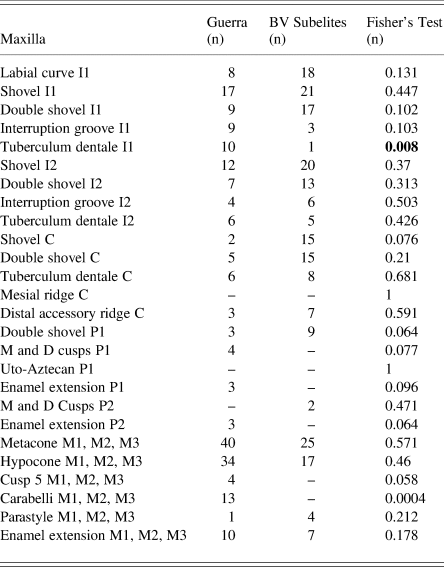
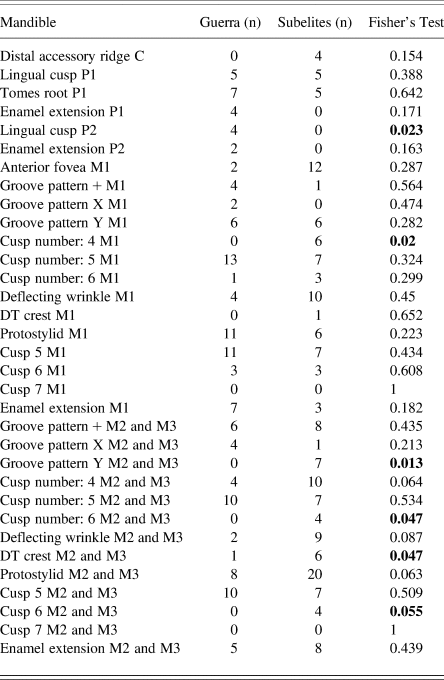
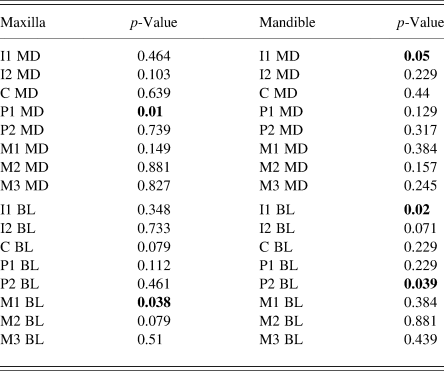
Fifty-two maxillary and mandibular nonmetric dental traits were recorded for 493 teeth. Given the size of the sample available for comparing dental traits among and between the populations, Fisher's Exact Test was used to compare the frequency of distributions between each locus in 2 × 2 contingency tables. Significance was accepted at a p-value of 0.05. The results of the test are presented in Tables 2 and 3.
Fisher's Exact test results for maxillary dental morphology for Guerra and Pooled BVRP-1 and BVRP-2 populations. Bold numbers indicate statistical significance. I, incisor; C, canine; P, premolar; M, molar.

Fisher's Exact test results for mandibular dental morphology for Guerra and pooled BVRP-1 and BVRP-2 Subelite Populations. Bold numbers indicate statistical significance. C, canine; P, premolar; M, molar.

Of the 52 traits observed, there were eight significant differences in the exhibition of hereditary traits between the overall Guerra population and the individuals buried at BVRP-1 and BVRP-2. No rare or unusual traits were observed in only one group, suggesting that there was some degree of biological continuity between the populations.
Metric Analysis
To better assess the biological distance between the village commoner (Social Group B) and plazuela subelite (Social Group C) populations, a comparison of their dental metrics was also undertaken. A total of 213 measurements of mesiodistal and buccolingual diameters were taken on teeth from the Guerra village population and compared with 145 measurements available for the individuals buried beneath plazuela groups BVRP-1 and BVRP-2. For those cases where only two independent samples could be compared, a Mann-Whittney U test was applied and, in cases where more than two could be considered, a Kruskal-Wallis one-way ANOVA test was used. Significance was accepted with a p-value of 0.05 for all tests. In addition to comparing the village population as a whole to the urban plazuela population as a whole, an effort was made to identify the existence of variance among subgroups within the overall study population. In this attempt, a separate series of comparisons were made between individuals from the architecturally and artifactually distinguished, and possibly elevated-status, principal village residential compound, GRSP-1, and the fully contemporary Late Classic urban subelite burial set from BVRP-1.
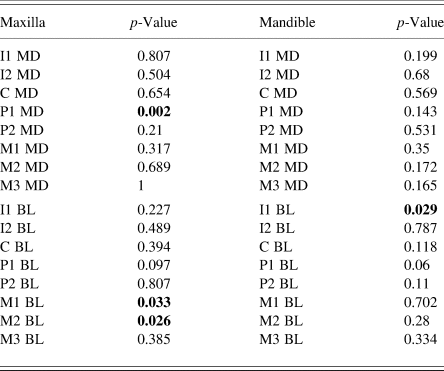
Table 4 provides the results from the Mann-Whittney ANOVA tests performed. The analysis for mesiodistal diameters and buccolingual diameters in the two groups (Guerra and urban subelites) yielded four teeth, of the 32 types observed, with significant differences in measurement.
Mann-Whitney ANOVA test for dental metrics for Guerra and pooled BVRP-1 and BVRP-2 populations. Bold numbers indicate statistical significance. MD, mesiodistal; BL, buccolingual; I, incisor; C, canine; P, premolar; M, molar.

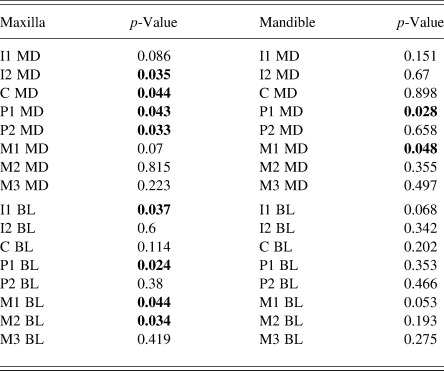
Table 5 shows results of the Guerra population compared to the three separate subpopulations constituting the full urban intermediate elite set. The latter consisted of: (a) Late Classic urban plazuela population BVRP-1; (b) Early Classic urban plazuela population BVRP-2a; and (c) Late Classic urban plazuela population BVRP-2b. A Kruskal-Wallis ANOVA test was used in this comparison of seven independent samples. The analysis for mesiodistal diameter and buccolingual diameter identified 10 teeth, of the 32 types observed, with significant differences in measurement.
Kruskal-Wallis ANOVA tests for dental metrics for Guerra nonelites and urban subelite subpopulations (BVRP-1, BVRP-2a, and BVRP-2b). Bold numbers indicate statistical significance. MD, mesiodistal; BL, buccolingual; I, incisor; C, canine; P, premolar; M, molar.

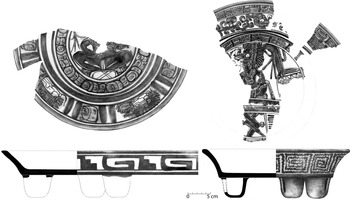
Plazuela group GRSP-1 is the largest and most elaborate residential complex of the Guerra settlement. Architecturally and artifactually, it is richer and more diverse than 87 other recorded mound groups at the site and clearly housed a population of tangibly higher status, although seemingly not more evidently wealthy than is represented elsewhere across the community. Recovered ceramics and ritual artifacts suggest a tangible material and ideological connection to the urban center and its intermediate elites, particularly in the case of the BVRP-2 plazuela and its east side ancestor shrine. Among the items found alongside one residential building of the group in what might have been either a provisional discard deposit or primary refuse was about 55 percent of a striking Cabrito Cream-polychrome tripod tamale plate, likely of “foreign” manufacture and most probably presented to one of the plazuela's occupants by a member of the nearby royal court in recognition of services performed or some social relationship (Figure 12).
Cabrito Cream-polychrome tripod plates. (a) From on-floor primary refuse or provisional discard deposit adjacent to north side residential building, Plazuela Group BVRP-2, Buenavista. (b) From Buenavista palace refuse deposit, Depositional Context BVDC 32-3. Both late eighth century. Drawings by Taschek.

A Mann-Whittney test was employed to check for possible biological affinities between the two residential groups (Table 6). Comparisons of the mesiodistal diameter and buccolingual diameter identified four teeth, of the 32 types observed, with significant differences in measurement. The results indicate that those buried within the formal ancestor platform-shrine of the architecturally focal village plazuela group (GRSP-1) may have shared greater biological affinity with the urban intermediate elite resident at and buried within the Buenavista Plazuela BVRP-2 east-side mausoleum than did any others of the village population sampled.
Mann-Whitney ANOVA test for dental metrics for GRSP-1 and BVRP-2 populations. Bold numbers indicate statistical significance. MD, mesiodistal; BL, buccolingual; I, incisor; C, canine; P, premolar; M, molar.

DISCUSSION
The three social groups discussed here were part of the same ancestral population: some element of biological similarity will therefore be present regardless of rank. Additionally, given that isotope data suggests minimal immigration into this region (Novotny Reference Novotny2015; Spotts Reference Spotts2013), effectively minimizing the inclusion of genetic variation from surrounding populations, we expect there to be some level of biological similarity between these three social groups. This is nicely exemplified within a previous study comparing Social Group A, the ruling elites, to Social Group C, the intermediate elites, wherein there were some similar traits expressed but enough significant differences to identify Social Group A as a distinct biological community (Black Reference Black2007). Additionally, some level of genetic variation is to be expected within a group (Ousley et al. Reference Ousley, Jantz and Freid2009). For instance, the two differences which exist when analyzing tooth size of only Social Group B individuals is likely the result of normal variation within a continuous gene pool (Blankenship-Sefczek Reference Blankenship-Sefczek2011).
Based on comparisons of tooth metrics and discrete (nonmetric) dental traits, suburban Guerra villagers and the intermediate elite residents within the Buenavista center did share some degree of biological affinity. Supporting this is the finding that when the suburban village population as a whole is compared to the entire composite urban plazuela population, there are four significant differences between them, which is lower than would expected from random chance. When the four separate Guerra sample-sets are each compared discretely against plazuela populations BVRP-1 (entirely Late Classic), BVRP-2a (entirely Early Classic), and BVRP-2b (entirely Late Classic), 10 significant differences in tooth measurements emerge. This discrepancy in significance data could be a result of the increasingly smaller sample sizes that result as each population is further subdivided. Another quite plausible explanation, however, is that normal variation present within the local population becomes more apparent and pronounced when each residential/burial unit is considered as an independent set than is so when all are lumped together. Given that there is typically more variation present within a population than exists between populations when gene flow has occurred (Irish and Scott Reference Irish and Richard Scott2017; Ousley et al. Reference Ousley, Jantz and Freid2009) the differences identified may simply reflect the normal distribution of variation within communities sharing some degree of consanguinity.
No rare or unusual morphological dental traits that might suggest biological dissimilarity (Scott and Turner Reference Scott and Turner1997; Scott et al. Reference Scott, Turner, Townsend and Mantinón-Torres2018) were found among either the Guerra or urban plazuela populations. Rather, comparisons of discrete dental traits do yield similar results to the metric data discussed below. While Social Groups B and C shared enough similarities to suggest some degree of biological affinity, the differences in dental characteristics give a clear indication of genetic divergence between the two communities. Comparing dental traits of Late Terminal Classic and Buk-phase burials at Lamanai, Wrobel and Graham (Reference Wrobel, Graham and Cucina2015:92) found 11 significant differences, which they interpret as “higher than would be expected to fall randomly.” They argue that, given these differences, there is evidence of genetic distinctions between the two cultural groups. As is the case in the present study, the presence of eight significant differences could represent the biological separation of these two populations at Buenavista.
It is not just the number of traits that are different, but the specific cusps which are present or absent that can be indicative of familial relations. For instance, the presence of only four cusps (representing the loss of the hypoconulid; Figure 10c) on the lower first molar is rare in most world populations (Scott and Turner Reference Scott and Turner1997; Scott et al. Reference Scott, Turner, Townsend and Mantinón-Torres2018). Thus, the absence of this trait may speak to affilial connections. Additionally, the retention of the Y-groove pattern on lower molars (Figure 10d) is a trait which is more sensitive to individual genetic contribution than a trait which results from broad geographic groupings (Scott and Turner Reference Scott and Turner1997; Scott et al. Reference Scott, Turner, Townsend and Mantinón-Torres2018). Huffman (Reference Huffman2014) found that Central and South American samples exhibited intermediate expressions of this trait wherein the expectation is for many individuals from these regions to possess a Y-groove pattern on lower molars. The fact that Social Group C exhibits the presence of four cusps and the Y-groove pattern, but no individuals in Social Group B express these traits suggests that there are some biological distinctions between these communities. Shoveling is another trait associated with large population affinity (Figure 10e; Huffman Reference Huffman2014; Scott and Turner Reference Scott and Turner1997; Scott et al. Reference Scott, Turner, Townsend and Mantinón-Torres2018). Comparison of maxillary first and second incisal shoveling at Guerra, BVRP-1, and BVRP-2 found comparable expressions of this trait among all three populations. Because there appears to have been population stability in the local region (Aubry Reference Aubry2009; Novotny Reference Novotny2015; Spotts Reference Spotts2013) as well as favorable geographic proximity, it is likely that these populations had connections through marriage. In this instance, given the specific traits that are significantly different, it seems more likely that individuals of intermediate status had enough of a social divide to be genetically differentiated while maintaining some cultural affiliation to the common population.
Statistical comparisons of the pooled GRSP-1, BVRP-1, and BVRP-2 plazuela dental metrics yielded one more significant distinction than did comparison of GRSP-1 to BVRP-2 alone, suggesting that a shared biological affinity did exist between those particular two residential groups. Because the individuals included in the present analysis resided within the same general geographic locality, the impact of extrinsic factors such as developmental physiological stress on differences in crown size is likely small (Cucina and Tiesler Reference Cucina and Tiesler2003). Our findings are consistent with a social model identifying the residents of the GRSP-1 plazuela as enjoying a distinguished and likely elevated status within the Guerra community and also having a real and direct connection to the inhabitants of the nearby urban center. Already noted artifactual and ceramic data independently support the existence of close social and ideological connections between the occupants of Guerra plazuela GRSP-1 and the inhabitants of the Buenavista center, including the residents of the two intermediate elite plazuelas.
The moderate number of differences found in both dental morphology and metrics suggests that the village commoner (Social Group B) and urban subelite (Social Group C) populations likely shared biological affinity. It is possible they were genetically separated from each other by at least several generations, but did still maintain something of an affinal connection, most plausibly through periodic or occasional intermarriage.
The moderate number of differences found in both dental morphology and metrics suggests that the village commoner (Social Group B) and urban subelite (Social Group C) populations were related. They were likely genetically separated from each other by at least several generations, but did still maintain something of an affinal connection, most plausibly through periodic or occasional intermarriage.
The consanguine, affinal, and purely social relationships among the high (regal) elites, plazuela subelites, and commoner village populations of the Classic-period Belize Valley involved something much more complex than a simple dichotomy between elite and non-elite population segments, or a simple, gradational but ultimately infrangible continuum. While dental evidence suggests no definitive biological ties between the Buenavista-Cahal Pech high elites (Social Group A) and the plazuela subelites (Social Group C; Black Reference Black2007; Mitchell Reference Mitchell2006), material cultural analyses of BVRP-1, BVRP-2, and GRSP-1 demonstrate the likely existence of functional interactions and close social bonds between them and the regal elites, very possibly extending even to the existence of a fictive kin-relationship between the BVRP-2 occupants and the palace population (Hyde Reference Hyde2013; Sandoval Reference Sandoval2008).
Artifactual and offertory cache data also document the existence of direct, formal, and very tight ideological as well as social connection between GRSP-1 and the high elites of the Buenavista center. The construction and regular maintenance of a formal architectural plazuela complex requires decidedly more overt effort, energy, and material resources than is so for ordinary nuclear and extended family residential compounds. Based on that, plazuela complexes are generally considered to be associated with wealthier or higher status families. A subfloor architectural cache found at GRSP-1 (Figure 9) held two sets of ritually symbolic obsidian and chert eccentrics identical in composition and arrangement to a contemporary offering emplaced in one of the major architectural monuments on Buenavista's sacred Central Plaza (Otto Reference Otto1995). This ideotechnic bundle credibly documents a powerful, formally sanctioned social and ideological bond between the center and the plazuela's inhabitants. Such an offering embodied enormous formal socioceremonial significance in its recognition of a powerful social relationship between the bestower and recipient, tangibly demonstrating the existence of such a relationship between the Guerra village subelite and the governing elite of the Buenavista center. What there was not, however, was a consanguine or affinal tie of any identifiable kind between the plazuela GRSP-1 residents—or the Guerra village population as a whole—and the high elites of the Buenavista-Cahal Pech court (Black Reference Black2007; Blankenship-Sefczek Reference Blankenship-Sefczek2011; Mitchell Reference Mitchell2006).
Other sociotechnical aspects of the material culture of the conjoint Social Group C urban subelites and suburban village plazuela inhabitants also reveal significant similarities. Dental modifications are present in all three subpopulations, and are similar in character and style (Blankenship-Sefczek Reference Blankenship-Sefczek2011). Three individuals belonging to the urban plazuela population exhibit jadeite inlays; one exhibits filed notching of the central incisors in the Classic Sun God T-shape often displayed by Maya elites and in Maya art (Figure 10f; Black Reference Black2007; Blankenship-Sefczek Reference Blankenship-Sefczek2011; Tiesler and Cucina Reference Tiesler, Cucina, Tiesler and Cucina2007). Both of these modification types also occur among the adults buried in the GRSP-1 funerary platform (Blankenship-Sefczek Reference Blankenship-Sefczek2011). Comparable dental modifications are also found among the Buenavista and Cahal Pech regal burials (Mitchell Reference Mitchell2006), another direct social behavioral link between the several plazuela populations and the high elites (Blankenship-Sefczek Reference Blankenship-Sefczek2011). There is little support for an exclusive, elites only practice of dental modification (Blankenship-Sefczek Reference Blankenship-Sefczek2011:111-113; Romero Reference Romero1958; Williams and White Reference Williams and White2006). Romero (Reference Romero and Stewart1970) found similar frequencies of modification among elite and nonelite groups. Individuals who exhibit dental modification must have had access to someone with professional knowledge and skill, and so the expressions of these procedures do indicate an elevated position, but the meaning does not seem to be elite versus nonelite. Williams and White (Reference Williams and White2006) suggest that the differences in modification types might be distinguishing markers between different social levels within the elite and nonelite sectors, and Tiesler Bos (Reference Tiesler Bos2001) has argued that dental modification could be a means of local familial or lineage identification and organization. That said, dental modification takes skill, and access to a trained professional (Gwinnette and Gorlick Reference Gwinnette and Gorelick1979; Linné Reference Linné1940). The fact that individuals associated with the focal village plazuela exhibit both inlaying with precious jadeite and T-shape incisor modification strongly supports the probability of their sanctioned participation in at least some elevated or elite status communal social practices.
While membership in each larger residence-defined subpopulation (urban plazuela subelites; suburban village community) appears to have been rooted in consanguine biological affinity, at least some individuals from Guerra—those belonging to the subgroup occupying the architecturally focal plazuela—may have been able to marry “upward” into the intermediate elite status represented by the occupants of urban plazuelas BVRP-1 and BVRP-2. Given that all individuals involved can be assigned archaeologically and culturally to the same Social Group C status level, however, these specific marriages might equally well have represented lateral, exogamous interactions between members of the same, parallel, and fundamentally equivalent social ranks from two different residential communities. Still, in weighing this, it should be remembered that the residents of GRSP-1 were genetically full members of the fundamentally commoner/peasant status Guerra village population.
The combined weight of the several factors considered in this study is sufficient to identify the plazuela-based individuals as comprising a separate, distinct, emically recognized intermediate elite or subelite population, Social Group C, one emanating from the broad, commoner-peasant demographic base of Social Group B, but one clearly elevated above that, and one recognized to have had overt social, ideological, and service ties to the ruling regal elite, Social Group A, ties possibly extending even to some form of fictive kinship relationship.
FINAL THOUGHTS
While acknowledging the issue of small sample size, the results from this initial examination of the dental characteristics of a local, Classic-period Maya population are intriguing—perhaps even compelling. In the upper Belize Valley, at least two, distinct, dentally defined biological populations were present among individuals buried within the Buenavista del Cayo center, the Cahal Pech hilltop citadel, and the Guerra de Buenavista settlement. These two biological populations corresponded with what were three contextually, materially, and otherwise culturally distinct social populations that we have identified as Social Group A (royal or regal high elites) and Social Groups B-C (commoners, peasants, and nonregal subelites of enhanced or elevated social rank, possibly so-called “intermediate elites” [Elson and Covey Reference Elson and Alan Covey2006]).
While manifestly distinct from each other, the two biological populations expressed an expected amount of variation (Ousely et al. Reference Ousley, Jantz and Freid2009) to be essentially homogeneous in composition, at least within the study-community. It is imperative to note, however, that within each of the two composite biosocial groupings, there are also internal contradistinctions that suggest discernible variation and even gradations, some subtle, some not so. These are especially pronounced in the case of the Social Group(s) B-C clustering, within which we found not only “cultural” (technomic, sociotechnic, and ideotechnic artifacts and facilities) but also readily evident biodental discriminants, none so pronounced, however, as to exclude those in whom they were expressed from the larger collocation. For example, no unusual dental traits were found in either population that would exclude them from sharing affinity with the other. When gene flow has occurred, which we argue here, the expectation is increased variation within populations and reduced variance between them, as new alleles are introduced to each group, making one similar to the other. We found few significant differences in either tooth traits or dental metrics that suggest that these populations shared affinity, at least for several generations. The presence of Carabelli's cusp in the Guerra group (Figure 10a), but not Plazuelas BVRP-1 and BVRP-2, suggests that biological ties—i.e., marriages—may have occurred every few generations, rather than on a regular basis. Taking the entirety of the dental indicators and cultural evidence into consideration, however, it is clear that these two populations did maintain a biological connection.
The suburban plazuela or First Tier residents were members of the larger suburban/rural Guerra settlement biological population, albeit somewhat slightly removed from it. At the same time, they enjoyed a social position and rank overtly above that of the population in which they were embedded, a status recognized manifestly and tangibly by the regal elites of the Buenavista center, as evidenced by the presence within the plazuela complex of high-status sociofacts (Figures 7 and 8; ceramic tobacco flasks, ocarinas, ornamental labrets, and fine polychrome pottery “tokens”) and ideofacts (elaborate eccentric caches; Figure 9) presumably gifted or presented to its residents by the lords of the center.
The Guerra First Tier family also were tied by blood, possibly through marriage, to the urban plazuela residents of the Buenavista center core. All three plazuela residential groups appear to have enjoyed a comparable “high” social rank or status, one decidedly above that of the overwhelming mass of commoners and peasantry. And yet, they were not of the regal elite, either in blood or socially. To term them “subelite,” therefore, is accurate, but their standing among the biologically related masses to which they belonged was certainly an elevated one, and so the appellation, “intermediate elite,” is also appropriate in their case. For members of this group resident within the urban center proper, there are also good indications of their recognition by the ruling lords with ties of fictive kinship, again expressed in specific sociofacts and ideofacts found at Plazuela Groups BVRP-1 and BVRP-2 (Figure 12; Hyde Reference Hyde2013; Sandoval Reference Sandoval2008).
And how do our findings for the upper Belize Valley relate to the perennial questions regarding the structure and organization of ancient Maya society with which we began this study? On the surface, our evidence would best seem to fit and support the “modified” version of the ranked society model (Sanders Reference Sanders, Chase and Chase1992) in which a continuum of gradation in social rank was structured within a two-tier (biological) binary most directly and strongly, or, possibly—albeit somewhat more weakly—the oldest, simplest two-strata model (Marcus Reference Marcus, Chase and Chase1992). Reed and Zeleznik (Reference Reed, Scott Zeleznik, Gonlin and French2016:199–200) came to somewhat analogous conclusions based on their rich multivariate analysis of the far more robust but quite dissimilar Copan data. In both cases, the “separate and distinct middle class” model would seem to be ruled out for the moment, but it remains to be seen how those of plaza group-level residence and burial (our Social Group D) will fit into the picture. Until these and a considerably larger and more comprehensive sampling of dental data have been recorded and considered, our findings and their evaluation must remain suggestive rather than conclusive. Still, the tentative results from this first foray into Belize Valley dental bioarchaeology are both promising and informative in their usefulness and conclusions. We hope others will build on them.
RESUMEN
Los análisis no métricos (morfológicos) y métricos de los rasgos dentales y la dentición son un medio establecido y efectivo para determinar las relaciones biológicas entre los individuos que comprenden una población a lo largo de varias generaciones. Tales análisis representan un aspecto de la ciencia de la bioarqueología: el estudio sistemático multidisciplinario de la salud, la dieta, la enfermedad, la demografía de la población y los movimientos de la población a través del análisis de restos humanos arqueológicos (Buikstra and Beck Reference Buikstra and Beck2006; Larsen Reference Larsen1997). En combinación con datos contextuales y de artefactos, los análisis bioarqueológicos pueden proporcionar una comprensión mucho más detallada y completa de las comunidades y sociedades antiguas que lo que es posible sobre la base únicamente de la evidencia cultural. Este estudio combina el análisis dental bioarqueológico, las estadísticas de pequeñas muestras, y un enfoque a la organización social adoptado a partir de la psicología social (Sherif and Sherif Reference Sherif and Sherif1956) para examinar la extensión y el grado de las relaciones de parentesco dentro y entre los individuos pertenecientes a tres rangos o estratos sociales arqueológicamente percibidos y definidos presentes dentro de la comunidad del período clásico de Buenavista del Cayo-Guerra en el Valle superior de Belice en las tierras bajas orientales. La comunidad de Buenavista se define por asentamiento (Ball and Taschek Reference Ball and Taschek1991), y ha producido un corpus de entierros humanos que varían en estado social aparente desde el nivel del campesinado hasta el de las élites altas, o incluso de la realeza. Para este estudio, los entierros individuales se clasificaron como los de plebeyos (clase social B), elites (clase social A) o elites intermedias (sub-élites) (clase social C), según la ubicación del entierro, tipo de entierro, y los bienes que lo acompañan. Las tres clases sociales definidas son aproximadamente paralelas a las estructuras representadas en los tres modelos más populares de la organización social maya del período clásico, aunque nuestro modelo no concuerda exactamente con ninguno de estos. Nuestros hallazgos fueron que cada uno de los tres grupos sociales percibidos demostró heterogeneidad interna, pero que cada uno también manifiesta una homogeneidad individual suficiente para distinguir a los miembros de cada grupo como biológicamente distintos de los otros grupos. Al mismo tiempo, aunque descubrimos que los miembros de la clase social A, la clase social B, y la clase social C eran biológicamente distintos de los miembros de las otras clases y se relacionaban más estrechamente con otros miembros de su propia clase, también descubrimos que los individuos que pertenecían a la clase social C, las élites intermedias, mostraron suficiente afinidad genética con los miembros de la clase social B, los plebeyos, para indicar su origen probable en este grupo, y una probabilidad de interacciones genéticas periódicas continuas con los miembros de este grupo, así como con otras expresiones del grupo C, muy probablemente a través de matrimonios periódicos.
La bioarqueología es el estudio multidisciplinario de la salud, la dieta, la enfermedad, la demografía de la población y los movimientos de población a través del análisis de restos humanos arqueológicos. En combinación con datos contextuales y de artefactos, los restos esqueléticos pueden proporcionar una comprensión mucho más detallada y completa de las comunidades y sociedades antiguas que lo que es posible sobre la base únicamente de la evidencia cultural. Los análisis no métricos (morfológicos) y métricos de los rasgos dentales y la dentición son un medio establecido y efectivo pero aún muy poco utilizado para determinar las relaciones biológicas entre los individuos que comprenden una población a lo largo de varias generaciones. Combinando tales análisis dentales; una tipología de organización social adaptada de la psicología social; y las estadísticas de pequeñas muestras, este estudio ofrece un examen de prueba de la evidencia de afinidad biológica dentro y entre tres grupos sociales arqueológicamente percibidos representados en la comunidad del período clásico de Buenavista del Cayo en el Valle de Belice. Los grupos comprenden categorías tradicionales de alta élite y plebeyas, y un supuesto nivel medio de “elites intermedias.” Los hallazgos sugieren una estructura dicotómica de parentesco de élites y no élites, pero dentro de la cual había emergido un grupo emicamente y arqueológicamente distinto de elites intermedias o sub-élites que permanecían relacionadas por la sangre con los plebeyos no elites y los campesinos. El estudio difiere de los exámenes previos de la antigua organización social maya en el empleo de un enfoque genuinamente integrado bioarqueológico al tema en lugar de lo que en general han sido enfoques intrínsecamente puramente arqueológicos u osteométricos.
ACKNOWLEDGMENTS
The investigations reported on in this article were supported by grants from the National Science Foundation (BNS-8310677 and BNS-8719157), San Diego State University, and several private donors. Permission to carry out fieldwork at Buenavista and Guerra was graciously extended through the Belize Department of Archaeology by successive Commissioners of Archaeology, Harriot Topsey† and Winnel Branche†, and by Pablo Guerra† and Hector Guerra, on whose ranch the sites are located. Among the many who participated in and contributed to these investigations from 1984 through 1989, we would especially like to acknowledge Field Assistants Ubaldamir Alfaro, Eduardo Chi, Ventura Cocom, and the 72 other men from San Jose Succotz and Benque Viejo who worked with us during those years, as well as Field Staff Laura Bernd†, Marc Brown, Cynthia James, Richalene Kelsay, and Carol Winkler, and Lab Supervisor JoAnne Gilmer. Thanks to Jennifer Shaw and Brenda Wills for their assistance in completing this project on schedule. To Seth Mallios and Mark Hubbe, thank you for consulting on statistics. Special thanks to Dr. Thomas Ira Sweet, M.D., but for whom this paper would never have been. Special acknowledgement also to Tim Sefczek for his comments and unwavering support of this work. Our understanding of Buenavista has benefitted immensely from input on its archaeology from many colleagues, but most especially, Jason Yaeger, Christophe Helmke, and Carolyn Freiwald. We especially thank David M. Hyde and our anonymous reviewers for their extensive and helpful comments on an earlier draft of this article. Their input and recommendations enormously improved its final content. The authors take full and sole responsibility for any errors of fact, interpretation, or any other shortcomings from which the article may suffer.