Introduction
Mirid bugs, Sahlbergella singularis Haglund and Distantiella theobroma (Distant) (both Hemiptera: Miridae), are the most important insect pests of the cocoa (cacao) tree, Theobroma cacao L. (Malvaceae), in West Africa (Babin et al., Reference Babin, Anikwe, Dibog and Lumaret2011). The brown cocoa mirid, S. singularis is the most important insect pest of the cocoa tree in Nigeria (Opeke, Reference Opeke1992), and yield losses of approximately 30–70% have been attributed to the insect pest infestation and damage (Idowu, Reference Idowu1989; Ojelade et al., Reference Ojelade, Anikwe and Idowu2005; Anikwe et al., Reference Anikwe, Omoloye and Okelana2010). Yield losses of up to 75% have been reported in Ghana on cocoa farms that left unattended for a period of at least 3 years (Padi, Reference Padi1997). Mirid nymphs and adults feed on cocoa fruits and shoots. Short-term crop losses are mainly due to the destruction of the branch tips, while long-term crop losses emanate from feeding lesions that have become infected by parasitic fungi, which usually develop into cankers that weaken and eventually kill cocoa trees when the infection is severe (Babin et al., Reference Babin, Anikwe, Dibog and Lumaret2011).
The damage sustained by the cocoa tree is due, in part, to the direct effects of feeding by this insect pest, but largely due to the subsequent invasion of the resulting lesions by wound parasitic fungi, such as Lasiodiplodia spp. and the weakly pathogenic Calonectria rigidiuscula, otherwise known as Albonectria rigidiuscula (Berk. & Broome) (Rossman et al., Reference Rossman, Samuels, Rogerson and Lowen1999). In the field, the mirid damage can be classified into three categories: (1) ‘Blast’, which is the result of light diffuse attack and is so named because of its similarity to fire damage; (2) ‘Stagheaded cacao’ is more severe, with trees showing numerous small crown branches but forming a poor canopy and (3) ‘Mirid pocket’, which describes severe damage, normally limited to a small area, with trees losing the crown completely and the pole-like trunks bearing numerous lateral chupons. In general, the stagheaded symptoms are more prevalent where the cocoa is grown without shade, and the pocket symptoms are found where the cultivation of cocoa utilizes shade trees (Williams, Reference Williams1953; Entwistle, Reference Entwistle1972). Degraded cocoa trees are prevented from recovery, not by mirid attack alone, but by the interaction of the trees with Lasiodiplodia theobromae and C. rigidiuscula, and by increased exposure. Normal flowering and pod setting are severely affected as a result of the previous season's attack. In extreme cases, whole trees can become unproductive and eventually die. Seedlings may completely fail to become established if not killed. Mirid attacks may delay the start of cacao production of seedlings by several years. Mirids on pods feed largely on the parenchymatous husk tissue but the depth of stylet penetration is not known (Entwistle, Reference Entwistle1972). Cherelles may wilt, and pods less than 3 months old have a very little chance of surviving, usually dying from mirid damage or from fungal invasion of the pods through the lesions (Padi, Reference Padi1997); however, the cherelles and young pods that only have few feeding lesions can develop normally. In addition, estimating capsid (mirid) impact is complicated because they are part of a pest–disease complex and associated with physiological dieback (Entwistle, Reference Entwistle1972; Padi et al., Reference Padi, Ackonor and Opeku2001).
An important disease of cocoa is black pod disease caused by two species of Phytophthora: P. palmivora and the more virulent P. megakarya. Black pod, if not controlled, can cause a yield loss ranging from 60 to 100% (Opoku et al., Reference Opoku, Appiah, Akrofi and Owusu2000). Insects have been implicated in the spread of black pod disease in cocoa. Ants such as Camponotus acvapimensis and Pheidole megacephala, beetles, and the pod borer Characoma stictigrapta have been implicated in the spread of black pod disease (Padi, Reference Padi1997). It has been suggested that control of the ant species implicated in the spread of the disease could considerably slow down the upward movement of the pathogen from the ground or from pods near the ground, thus delaying the development of an epidemic (Okaisabor, Reference Okaisabor and Gregory1974).
Until now, there has not been any extensive study on the relationship between the infestation of S. singularis and the occurrence of economically important diseases of cocoa in Nigeria. The objectives of the current study were as follows: (1) to evaluate dieback condition and recovery of cocoa twigs associated with mirid damage in the field, and to isolate and identify the fungal species responsible for the dieback condition in cocoa, and (2) to investigate the relationship between mirid infestation and pathogenic fungal infection in the field.
Materials and methods
Study site
This study was conducted on a 2 ha cocoa hybrid plantation from 2010 to 2012. This plantation was established in the year 2000 at the Cocoa Research Institute of Nigeria (CRIN) headquarters in Idi-Ayunre, Ibadan, Nigeria. Ibadan has an annual rainfall average of 2000 mm with a bimodal pattern, and Idi-Ayunre is located in the tropical humid rainforest ecosystem. Idi-Ayunre lies between the latitude 7°30′N and longitude 3°54′E at an altitude of 200 m above sea level. The cocoa trees were planted at the recommended spacing of 3.1 × 3.1 m. All agronomic practices were performed manually and no pesticide treatment was given over the course of this study. Weather parameters (temperature [°C], relative humidity [%] and rainfall [mm]) were recorded during the period of this study at the CRIN metrological station, Idi-Ayunre.
Evaluation of dieback condition associated with mirid damage
The ability of cocoa plants to withstand or recover from the mirid damage was assessed. The experiment was based on the level of dieback of twigs and recovery from damage in response to mirid feeding punctures. A total of 20 cocoa trees were randomly selected and tagged. Thereafter, a one-day-old adult mirid from laboratory cultures, starved for 24 h, was confined on a succulent twig of each selected cocoa tree in a muslin cloth and sleeved for 2 days. One adult mirid was also confined per sleeved cocoa pod and removed after 48 h. The attacked pods were left covered with the sleeve cage. A control sleeve (without mirid) was also set up on a different twig of the same selected trees, and each twig was punctured twice on the internodes with the aid of an entomological pin to an approximate depth of 2 mm for the last 10 terminal buds. Mechanical wounding using entomological pins was performed to determine whether wounds from other sources other than mirid feeding points could cause dieback. Two sleeves were placed on one tree, and this constituted one replicate. A total of 20 sleeves were used for each of mirid confinement and mechanical punctures. Confinement of mirids on twigs in this experiment commenced in October 2010 and observations were concluded in March 2011, just before the rains began. The physiological reaction of the shoot to mirid attack was observed weekly for 3 months and means were computed on a monthly basis. The following data were recorded:
(i) The physiological reaction of the twigs, which was measured by death of twigs, was recorded weekly during the first month and monthly thereafter for 3 months. A five-point scale was used with 0 = all twigs healthy, 1 = 1/4 twigs showing dieback, 2 = 1/2 twigs showing dieback, 3 = 3/4 twigs showing dieback, and 4 = all twigs dead.
(ii) The length of progression of dieback of twigs.
Isolation of fungi from lesions on pods and twigs
Twigs and cocoa pod samples attacked by mirids, and those punctured with entomological pins, were collected from the tagged cocoa trees on which the dieback experiment was conducted. Pieces of pod and twig tissues were excised from the edge of actively growing lesions and disinfected by surface sterilizing in 1% sodium hypochlorite solution for 60 s, washed in three changes of sterile water, and then blotted dry using Whatman No. 1 filter paper. Direct plating was performed on the extract of Potato Dextrose Agar (PDA) medium (per litre: 200 g peeled and sliced Solanum tuberosum, 15 g agar powder and 20 g dextrose) with 1 g/100 ml streptomycin antibiotic, in three pieces of excise infected pod samples plated in triangular forms in a 9 cm plastic Petri dish. Three replicates were kept for each pod and twig sample collected from each cocoa tree (n= 20). The plates were incubated at 25 ± 2 °C in the dark and examined for fungal growth at 72 h after plating. Emerging hyphae were transferred from the area mycelium of the fungus in culture that does not involve cutting an agar disc from the culture onto new PDA plates to obtain pure cultures of the fungi.
Colony appearance (growth pattern and pigmentation) was employed to describe the characteristics of the fungal colonies from the samples, as described by Rayner (Reference Rayner1970). Colony count was performed on the 5th day after plating when the emerging fungal colonies were fully developed and easy to describe. Slide cultures of the fungi were prepared from 10-day-old cultures of fungi on the PDA medium. The culture slides were stained with Lactophenol Blue and viewed under a Zeiss photomicroscope (Jena, Germany) to determine mycelia, spore shape and structure. Identification of isolated fungi was performed by comparing relevant spore structures and its forms with the illustrated dichotomous key of Barnett and Hunter (Reference Barnett and Hunter1998).
Phytophthora pod rot infection versus mirid infestation
This study assessed the possible relationship between the two most economically important pests of cocoa in West Africa. For this purpose, the cocoa plantation was divided into four blocks in a randomized complete block design (RCBD) and a total of 50 cocoa trees were randomly selected and tagged per block. The RCBD was chosen to minimize variations due to the effect of topography and overhead shade in the cocoa plantation. The tagged trees were fortnightly sampled for the presence of black pod disease and mirid infestation/damage on pods over three cocoa seasons (2010–2012). Each sampled tree was observed from the base to a height of 1.5 m. Tree trunks, flower buds, flower cushions, basal chupons, cherelles and pods, fan branches, and abaxial and adaxial surfaces of leaves were closely observed for the presence of mirids, while pods and trunks alone were observed for Phytophthora pod rot and canker. The trees were examined from 06.30 h to mid-day. The average number of mirids found and pods with mirid lesions during this period were correlated with the black pod disease infection.
Statistical analysis
All data were analysed using the SPSS statistical software (version 16.0). Count data for physiological reaction of the twigs were analysed using a non-parametric test (Kolmogorov–Smirnov test), while the data on dieback progression were analysed using the analysis of variance and means separated using the Tukey's Studentized range honestly significant difference (HSD) test. The relationship between Phytophthora pod rot and mirid infestation, and climatic data were tested by the Spearman's Correlation Analysis. Trends of monthly means of climatic parameters such as temperature, relative humidity and rainfall were graphically analysed.
Results
Dieback progression and recovery
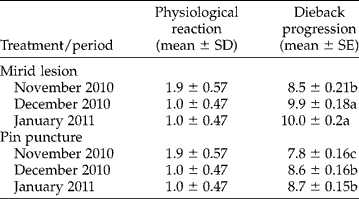
The mean monthly reaction of cocoa twigs to mirid feeding and pin punctures is presented in Table 1. Both twigs with mirid lesions and pin punctures showed significant dieback. However, dieback progression from mirid lesions (8.5 mm) was significantly different (P< 0.05) from that of the pin punctures (7.8 mm) in November 2010. The physiological reaction of twigs at the onset of mirid attack and mechanical wounding was very slow at 1.9 ± 0.18 and 1.9 ± 0.17, respectively. However, as time progressed, the plant was able to recover from the twig damage. The results for physiological reaction and dieback progression remained the same from January to March 2010.
Physiological reaction and dieback progression of cocoa twigs from mirid feeding lesions and mechanical wounding
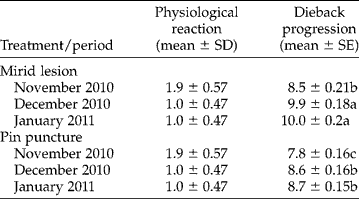
Mean values with different letters in a column are significantly different (P>0.05; Tukey's studentized range honestly significant difference (HSD) test).
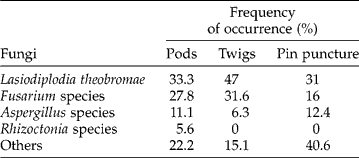
Frequency and morphological characteristics of fungi pathogens isolated from lesions of pods and twigs
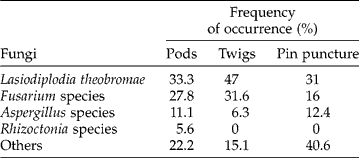
The percentage of fungi isolated from the different substrates (twigs and pods) is presented in Table 2. Lasiodiplodia theobromae occurred the most (33%) from mirid lesions on pods, 47% from mirid lesions on twigs, and 38% from pin punctures on twigs. This was closely followed by Fusarium decemcellulare and two other species of Fusarium that on pathogenicity test could not produce observed symptoms, accounting for 27.8% and 31.6% colony cultures isolated from pods and twigs. Fusarium decemcellulare was not isolated from the pin punctures, but the cultures of other Fusarium species were isolated. These Fusarium species observed may be saprophytic, living on the dead tissues of the infected cocoa part. Therefore, L. theobromae and F. decemcellulare were the most predominant fungi involved in dieback due to mirid damage on cocoa from this study. All the other fungi species were found in varying proportions in all the three sample types (Table 2).
Frequency of fungal species isolated from mirid lesions from different parts of cocoa plant (Theobroma cacao L.)
Fungal identification
Macroscopically, L. theobromae cultures at 2 days of colony development exhibited whitish mycelia that changed from the 3rd day of colony development to dark-grey cottony fluffy mycelia when viewed from the top of plate and greenish dark when viewed from the bottom of the plate. As the culture aged further, it changed to dark brown when viewed from the top of plate and black when observed from the base of plate. The colony of F. decemcellulare (A. rigidiuscula) was initially white in appearance, that gradually turned pink with concentric rings, and then developed powdery spore/conidia structures as the culture aged when viewed from top of plate and red when viewed from the bottom of plate. The colony culture of isolated Aspergillus species ranged from brown spore heads, smoky blue to dark spore heads when viewed from the top, while the base of the cultures appeared translucent to faint amber. Rhizoctonia species had a similar colony appearance with L. theobromae, with the colony pigmentation changing to a black colour with age; the main difference was that the colony of Rhizoctonia species was not cottony in appearance.
The microscopic examination of L. theobromae initially showed unicellular spore structure that is hyaline, which at maturity became dark brown two-cell, ovoid-shaped conidia. While F. decemcellulare showed a single hyaline spore structure at the initial stage, which at mature stage showed 5–9 celled hyaline boat-shaped (slightly curved) macro-conidia structures. Aspergillus species had a round unicellular spore structure, with green to dark brown spores that were carried in a chain on the sporangiophore. Rhizoctonia species showed specialized mycelia structures that were slightly swollen and almost cylindrical in shape that contained the fungus conidia.
Association between mirid infestation and blackpod infection
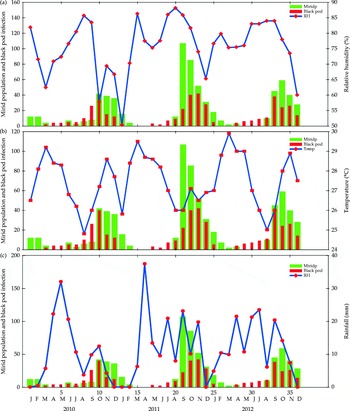
The mean monthly fluctuations of mirid populations and blackpod infection as well as some weather parameters such as rainfall, relative humidity and temperature in a cocoa plantation for a period of 3 years (2010–2012) are presented in Fig. 1. Mirid populations usually peaked in the last quarter of each year: October 2010 (42), September 2011 (107) and October 2012 (59), whereas for black pod infection, there was a gradual initiation of the disease around June of each year and the build-up of the disease leading to a very high pod infection in August of each year. Peak pod infections were recorded in the last quarter of each year (Fig. 1). There was a significantly strong positive correlation coefficient of 0.74 between mirid population and black pod disease infection in the field (Table 3). Mirid population and black pod infection increased during the major fruit-bearing season of cocoa. There was a general decline of mirid population during the rainy season and this culminated in the absence of the pest in the field from March to July 2011 (Fig. 1). Population buildup of the pest occurred in the last quarter of each year.
Fluctuations in the monthly population of mirid and black pod infection with (a) relative humidity (%), (b) temperature (°C) and (c) rainfall pattern (mm) at Ibadan, Nigeria (2010–2012). Miridp, Mirid population; RH, relative humidity; temp, temperature.

Correlation analysis of mirid population, black pod infection, pod yield, mirid lesions and climatic variables in a cocoa plantation (2010–2012)

* Correlation is significant at the 0.01 level (two-tailed).
Discussion
The reaction of cocoa plants to fungi associated with dieback has been reported by several researchers (Crowdy, Reference Crowdy1947; Anikwe et al., Reference Anikwe, Omoloye, Aikpokpodion, Okelana and Eskes2009; N'Guessan et al., Reference N'Guessan, Lachenaud and Eskes2010). It has been reported that feeding wounds of mirids were subsequently invaded by a pathogenic fungus known as A. rigidiuscula (identified as F. decemcellulare) and this results in cankering or bark roughening, destruction of flower cushions and severe dieback of twigs and branches (Crowdy, Reference Crowdy1947). The result from our study is in agreement with the findings of earlier studies in that significant dieback progression was recorded from wounds created from mirid feeding lesions as well as from mechanical pin punctures. This result also agrees with the findings of N'Guessan et al. (Reference N'Guessan, Kébé, Tahi, Eskes and Eskes2011) who reported the invasion of cocoa genotypes by L. theobromae after mechanical injury of cocoa twigs in the field. Also, opportunistic fungi species such as the ones identified in this study may gain entry into the cocoa plant tissues after wounds have been created by either a biological or a mechanical source. However, L. theobromae is well known as an endophyte of cocoa (Arnold and Herre, Reference Arnold and Herre2003; Arnold et al., Reference Arnold, Mejía, Kyllo, Rojas, Maynard, Robbins and Herre2003) and normally present in many of the plants tissues without causing any disease symptoms. However, the species of Lasiodiplodia isolated from this study were from dead tissues and hence were symptomatic. Moreover, it has been reported that in Cameroon more than one species of Lasiodiplodia can be present on/in cocoa and these species are difficult to distinguish morphologically (Boyogueno, Reference Boyogueno2010). Furthermore, F. decemcellulare has also been implicated elsewhere due its ability to invade woody tissues of cocoa and spread in its host five-to-six times more quickly than L. theobromae (Holliday, Reference Holliday1980). Fusarium decemcellulare, apart from contributing to dieback conditions in cocoa, also retards the healing of P. palmivora canker through subsequent invasion via stem lesions caused by capsids (Holliday, Reference Holliday1980). Fusarium decemcellulare isolation from biological wound source and L. theobromae isolation from biological and mechanical wound sources of cocoa tissues in this study are in accordance with the results of previous studies. These opportunistic fungi all help to aggravate dieback conditions in cocoa. By implication, crop husbandry activities, especially on young cocoa plantations such as slashing with cutlasses during the dry season, must be carried out with extreme caution to avoid bruises on young cocoa shoots. Such bruises could serve as entry points for opportunistic fungi pathogens that could result in dieback. The impact of dieback on cocoa tissues is quite severe during the dry season.
Previously, an array of insects have been implicated in the spread of Phytophthora pod rot disease in cocoa and these include ants such as C. acvapimensis and P. megacephala, beetles, and the pod borer C. stictigrapta (Taylor and Griffin, Reference Taylor and Griffin1981). Before the current study, mirids had not been implicated in the spread of black pod disease. However, in this study, there is a strong positive correlation between mirid population and black pod infection (0.74) as well as a positive correlation between lesioned pods and blackpod disease (0.68) in the field. Also, it is noteworthy that mirids are usually not present or very low in numbers during the rainy season, which coincided with the period of the initiation of primary infection of black pod in the field. Meanwhile, some other arthropods, especially some ants were observed to be present in the field all year round.
Major information that this study has brought to the fore is the relationship between population fluctuations of mirids and black pod infection. For three seasons, the high infestation and infection peaks of mirid and Phytophthora, respectively were highly favoured by the abundance of food, that is, mature cocoa pods. Mirid population fluctuations are consistent with the earlier study by Anikwe et al. (Reference Anikwe, Omoloye and Okelana2010), while the Phytophthora infection rates are consistent with the findings of Opoku et al. (Reference Opoku, Appiah, Akrofi and Owusu2000, Reference Opoku, Assuah and Aneani2007) showed that primary infection starts in June but the peak of the P. megakarya blackpod disease generally occurs between August and October. Very little of the black pod disease is seen before August. This information is very important in the management of these two notorious pest problems of cocoa in Nigeria. While blackpod is controlled much earlier when the primary infection is noticeable in the field; mirids, on the other hand, can be effectively controlled when population densities have reached the threshold levels that will warrant control of the pest.
Acknowledgement
The authors are thankful for the technical support granted by personnel of the Crop Protection Division of the CRIN, Ibadan. The authors do not have any conflict of interest.