

Introduction
The Food and Agriculture Organization of the United Nations (FAO) aims to support the conservation of rare livestock breeds, as they represent important genetic resources for breeding and conservation programmes (FAO, 2007). The most prominent breeds in Brazil today are Indian zebu breeds such as Nelore, Gyr and their hybrids, which have been introduced as exotic breeds over the last 100 years (Egito et al., Reference Egito, Paiva, Albuquerque, Mariante, Almeida, Castro and Grattapaglia2007). These exotic breeds are characterized by strong artificial selection and low effective population sizes. The other group of breeds, termed Creole, are referred to “naturalized”, because after their introduction several centuries ago they developed new morphological and physiological traits (Rangel, Zucci and Ferreira, Reference Rangel, Zucci and Ferreira2004; Mariante and Cavalcante, Reference Mariante and Cavalcante2006).
Brazil is the only country in South America where naturalized breeds are descended not only from Spanish but also from Portuguese breeds (Mariante and Egito, Reference Mariante and Egito2002). The five extant naturalized bovine breeds – Pantaneiro, Crioulo, Lageano, Mocho Nacional and Curraleiro – originated via the hybridization of distinct Portuguese and Spanish breeds that adapted over the centuries to a wide range of local environmental conditions (Egito, Mariante and Albuquerque, Reference Egito, Mariante and Albuquerque2002; Fioravanti et al., Reference Fioravanti, Juliano, Costa, Abud, Cardoso, Carpio and Costa2011).
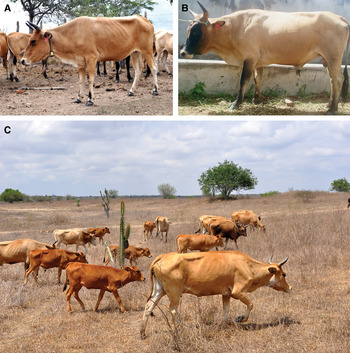
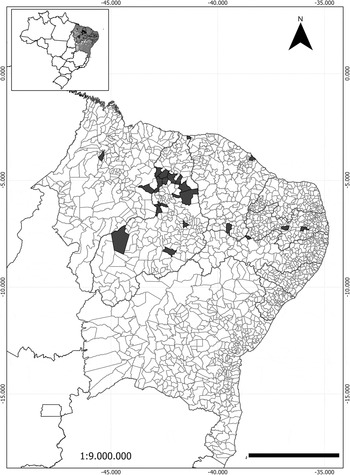
In 2012, the Brazilian Ministry for Agriculture officially recognized the Curraleiro, which is also known as Pé-Duro (Figure 1), as a distinct bovine breed (Process No. 21038.001530/2011-89). Curraleiro originated from an admixture of the three Bos taurus ibericus breeds, Alentajana, Galega and Mirandesa, whose introduction to Brazil, from Spain, Portugal and the Cape Verde Islands started in the first half of the sixteenth century (Primo, Reference Primo1992; Britto and Mello, Reference Britto and Mello1999; Rangel, Zucci and Ferreira, Reference Rangel, Zucci and Ferreira2004; Mariante and Cavalcante, Reference Mariante and Cavalcante2006). It developed initially in the states of Pernambuco, Sergipe, Alagoas, Paraíba, Ceára, Maranhão and Piauí, and also spread to the north into the state of Pará and to the southwest into the states of Tocantins and Goias (Britto and Mello, Reference Britto and Mello1999; Carvalho et al., Reference Carvalho, Almeida, Azevêdo, Neto and Neto2010; Fioravanti et al., Reference Fioravanti, Juliano, Costa, Abud, Cardoso, Carpio and Costa2011). Today, the Curraleiro is the only naturalized bovine breed in Northeastern Brazil (Figure 2), a large territory of about 980 000 km2 mainly dominated by the Caatinga, a semiarid bush–savannah characterized by a mean precipitation of 900 mm/year, high levels of evaporation and relative humidity that is sometimes lower than 30 percent during the dry season (Bianchini et al., Reference Bianchini, McManus, Concepta, Carolina, Barbosa, Prescott, Mariante and Egito2006).
An adult cow (A), bull (B) and a herd (C) of Curraleiro cattle on an INSA pasture. Photos (A) and (C) were taken during the dry season in December, whereas (B) was taken during the raining season in July.

The Northeast Region of Brazil is marked in grey within the inlay. Notes: The magnification of Northeast Region shows the geographic distribution of the 22 municipal districts with Curraleiro herds. Numbers at the borders indicate the geographic latitudes and longitudes. Scale bar: 500 km.

Previous studies have indicated that the Curraleiro shows several adaptations to the harsh local conditions of this semiarid region. Animals are considered to have some level of tolerance to the worm parasites and toxic plants (e.g. Stryphnoden droncoriaceum and Palicourea marcgravii) found in their production environment (Carvalho and Girão, Reference Carvalho and Girão1999;Mariante and Cavalcante, Reference Mariante and Cavalcante2006). They perform well on pastures consisting of native grass species of a low nutritional value, and graze even in the natural bush-land of the Caatinga (Carvalho et al., Reference Carvalho, Almeida, Azevêdo, Neto and Neto2010; Fioravanti et al., Reference Fioravanti, Juliano, Costa, Abud, Cardoso, Carpio and Costa2011).
Compared with zebu breeds, individuals are small and light. The average shoulder height and mean weight of adult males is 122.29 cm and 342.94 kg, respectively; the equivalent figures for females are 106.98 cm and 220.92 kg (Carvalho et al., Reference Carvalho, Almeida, Azevêdo, Neto and Neto2010). This may be advantageous in the bush-land, with its lack of feed resources and its dry and hot tropical climate. The breed's adaptive characteristics have developed over 400 years as a result of the selective pressures of the local environment and the extensive breeding conditions, with little or no artificial selection by humans (Carvalho and Amorim, Reference Carvalho and Amorim1989; Fioravanti et al., Reference Fioravanti, Juliano, Costa, Abud, Cardoso, Carpio and Costa2011).
Despite the low costs of breeding the Curraleiro, and its good adaption to local environmental conditions, the absence of artificial selection has been accompanied by low economic efficiency (Fioravanti et al., Reference Fioravanti, Juliano, Costa, Abud, Cardoso, Carpio and Costa2011). In order to intensify agricultural production, more productive European and (mainly African) zebu breeds were introduced to Brazil and started to displace the Curraleiro at the end of the nineteenth century (Mariante and Egito, Reference Mariante and Egito2002; Egito et al., Reference Egito, Paiva, Albuquerque, Mariante, Almeida, Castro and Grattapaglia2007; Oliveira, Reference Oliveira2008). Little is known about the Curraleiro's total population size. Fioravanti et al. (Reference Fioravanti, Juliano, Costa, Abud, Cardoso, Carpio and Costa2011) estimated that there may be between 1 000 and 5 000 reproductive cows. A breed with a population size of less than 5 000 reproductive females is considered to be at risk of extinction (Hodges, Reference Hodges1992). The Domestic Animal Diversity Information System (DAD-IS; http://www.fao.org/dad-is) classifies the Curraleiro as an endangered-maintained breed.
In 2011, the Associação Brasileira de Criadores de Bovinos Curraleiro Pé-Duro (ABCBCP) (Brazilian Association of Breeders of Curraleiro Pé-Duro) was founded by fusing existing breeders' associations (http://abcpd.com.br/). Salles et al. from the Instituto Nacional do Semiarido (INSA; National Institute of the Semiarid Region) developed a conservation and breeding programme for the breed (Salles et al., Reference Salles, Medeiros, Costa, Ramos, Borburema, Almeida, Rocha and Weller2011). No molecular data on the population genetics of the Curraleiro have been published, but because of the low effective population size, inbreeding within single herds may be high and gene flow between herds may be low. In addition, a large proportion of existing Curraleiro herds may have interbred with other breeds.
This paper describes a study, undertaken in collaboration with ABCBCP, that aimed to obtain information about existing Curraleiro herds and their owners in Northeastern Brazil. The study focused on the identification of herds and on the breeding practices of registered breeders, with the objective of facilitating the future establishment of a conservation programme. It sought to obtain information on the degree of admixture between Curraleiro and other breeds and to identify breeders who would be interested in participating in a programme of conservation and improvement for the Curraleiro.
Methods
The data collection protocol and the consent procedure were reviewed and approved by the National Committee for Research Ethics (CONEP; http://conselho.saude.gov.br/web_comissoes/conep/index.html; Brazil).
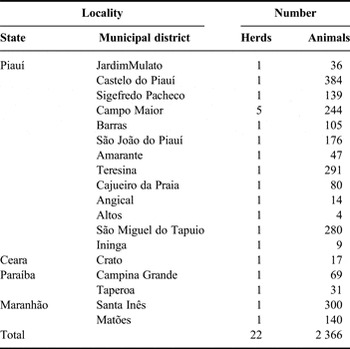
Data were obtained by interviewing 22 Curraleiro breeders belonging to the ABCPD. Owing to the large distances involved, interviews were carried out with the help of questionnaires and by telephone. In addition, data were obtained from one herd owned by INSA in the state of Paraíba. The number of sampled herds, their sizes and their locations in the states of Ceará, Maranhão, Paraíba and Piaui are summarized in Table 1 and Figure 2. Data were analysed using the software program Microsoft Excel® (version 14.2.3).
Number of studied herds, animals and their location

Results
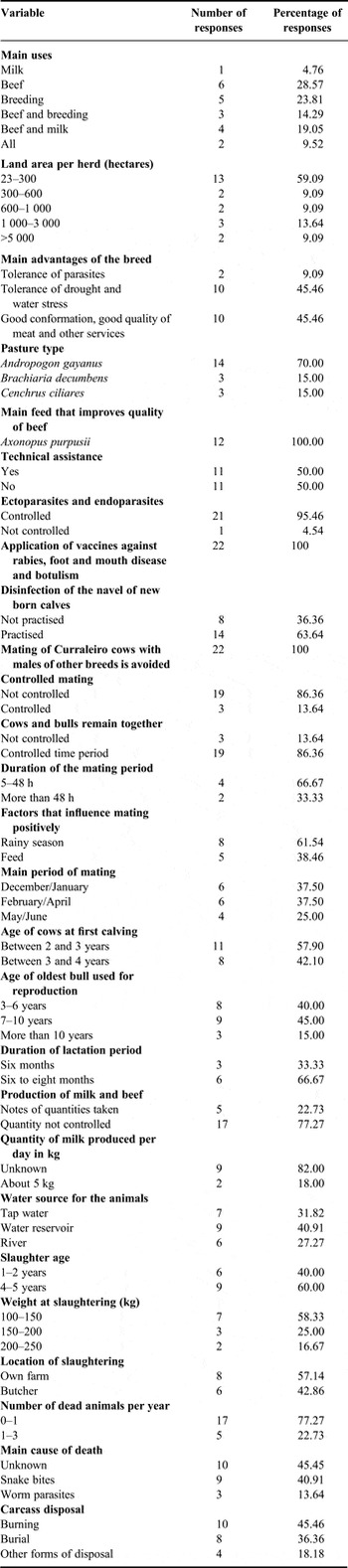
The average size of the 22 sampled cattle herds was 131.4 (standard deviation = 120.3), varying from 4 to 384 animals. Results obtained from the interviews are summarized in Table 2.
Frequency of reported husbandry practices of Curraleiro cattle

The findings indicate that breeding targeted not only the production of dairy products but also the production of beef for home consumption and animals for sale. When asked about the breed's main positive attributes, the breeders described the Curraleiroas having high levels of tolerance to diseases and parasites and excellent maternal abilities. It was also pointed out that animals are tame and that the breed is very tolerant of drought and water stress. All the herds in the study sample were bred under extensive conditions. All 20 breeders who provided a response cited the native grass species Andropogon gayanus, Brachiaria decumbens or Cenchrus ciliares as the most important feed resources. All the breeders reported that Curraleiro cattle can survive on all types of native grass.
Only half the breeders stated that they obtained specialized technical assistance for their livestock, but nearly all stated that their animals were treated for parasites and vaccinated. All breeders said that they avoided deliberately mating Curraleiro cows with males of other breeds. Most breeders stated that they did not control mating, but that they controlled the period of time during which cows and bulls stayed together.
About 58 percent of the breeders who provided a response stated that the first offspring were born when cows were between 2 and 3 years old. We did not obtain reliable data about the birth weight of new-born calves. Six breeders out of nine stated that the length of the lactation period was between 6 and 8 months. In about 77 percent of all cases, breeders stated that milk production, which is mainly used for home consumption, was not systematically recorded. Two breeders estimated that a cow is able to produce about 5 kg of milk per day during the lactation period; the other respondents were unable to provide an estimate. No breeders reported that their animals received any kind of supplementary feed, with the exception of minerals in the form of salt. Fifteen out of 22 breeders reported that their animals use natural water sources.
Nine breeders reported that animals were slaughtered between 4 and 5 years of age and six reported that animals are slaughtered between 1 and 2 years of age. Seven breeders reported that the weight of slaughtered animals was between 100 and 150 kg and five reported that the weight of slaughtered animals was between 150 and 250 kg. In most cases, only one animal per year was killed by natural causes. Nine breeders cited snake bites as a main cause of death.
Discussion
Previous studies have indicated that most Curraleiro herds and animals are found in the states of Tocantins and Goiás (Fioravanti et al., Reference Fioravanti, Juliano, Costa, Abud, Cardoso, Carpio and Costa2011). In contrast, the ABCBCP indicated that the state of Piauí has the most herds and animals (Personal communication with Fernando Gayoso). The latter opinion could reflect the true distribution of Curraleiro herds within Northeastern Brazil. This idea is supported by the fact that the Curraleiro can be regarded as part of the heritage of the state of Piauí, where until beginning of the twentieth century beef production was mainly based on this breed (Carvalho, Reference Carvalho1985, Reference Carvalho1997). However, it could also represent a biased view, influenced by the fact that the ABCBCP is located in Teresina, the capital of Piauí, and therefore attracts mainly breeders from this region. It is also important to point out that all members of the ABCBCP pay a monthly membership fee, which may discourage breeders with a low income from registering as members. Therefore, the results presented in this paper may not necessarily be representative for the whole population of the breed in the state of Piauí. The breeders that participated in the present study did not practise other agricultural activities, and Curraleiro cattle were not their main source of income. Their income was based on non-agricultural activities; they included lawyers, health professionals, professors and civil servants.
When asked about the advantages of the Curraleiro, breeders mainly referred to its tolerance of drought and water stress, the tameness of the animals and the good quality of their meat. Fioravanti et al. (Reference Fioravanti, Juliano, Costa, Abud, Cardoso, Carpio and Costa2011) found identical arguments among breeders living mainly on agriculture in the states of Tocantins and Goias. This previous study also showed that all herds were bred under extensive conditions. Breeders applied 4 (46.4 percent) or 8 (53.6 percent) out of 12 management techniques that had been defined to determine the technical level of breeding (Fioravanti et al., Reference Fioravanti, Juliano, Costa, Abud, Cardoso, Carpio and Costa2011). The cattle in the present study were also bred exclusively under extensive conditions and only about half of them received specialized technical assistance. This is similar to the observations made by Fioravanti et al. (Reference Fioravanti, Juliano, Costa, Abud, Cardoso, Carpio and Costa2011). Also similar to the previous results, the present study found that mating and production of milk and beef were in most cases not recorded and that in 8 out of 22 herds the navel of new-born calves was not disinfected. However, when asked about vaccination and parasite control, all breeders reported that animals were vaccinated against most serious diseases and in most cases also treated for ecto- and endoparasites. Interestingly, several breeders pointed out that ecto- and endoparasites did not represent a serious problem for the Curraleiro. This indicates that technical services did not focus on production but on the care and conservation of the animals. The idea of conservation was further supported by the fact that breeders claimed never to cross Curraleiro cows with bulls of other breeds.
The mean number of animals was 131.4 per herd, compared with 77.5 and 66.5 found by Fioravanti et al. (Reference Fioravanti, Juliano, Costa, Abud, Cardoso, Carpio and Costa2011) in Goias and Tocantins, respectively. This could indicate more productive pastures in regions covered by the present study or may mean that herds of sampled cattle populations are generally larger. As Curraleiro animals do not need supplementary feed, and can live on native grass pastures, they can be bred at low costs and without destruction of the autochthonous flora and fauna. However, it will be important to determine maximal population densities that do not overburden pastures. Data indicate that the Curraleiro is ecologically attractive for the semi-arid region of Northeast Brazil, as it could help to decrease the burning of natural vegetation, a process that accelerates land degradation and desertification in the region (Bianchini et al., Reference Bianchini, McManus, Concepta, Carolina, Barbosa, Prescott, Mariante and Egito2006; Fioravanti et al., Reference Fioravanti, Juliano, Costa, Abud, Cardoso, Carpio and Costa2011).
As in the study of Fioravanti et al. (Reference Fioravanti, Juliano, Costa, Abud, Cardoso, Carpio and Costa2011), first calving was reported to occur between 2 and 3 years of age. However, some breeders reported that first calving occurs between 3 and 4 years of age.
The data indicate that Curraleiro animals are slaughtered at 48–60 months old and at a weight of between 200 and 250 kg. In comparison, animals of the zebu Nelore breed are slaughtered at mean weights of 353.8–424.8 kg at the age of 24–30 months (Lôbo et al., Reference Lôbo, Martins, Malhado, Filho and Moura2002). The quantity of milk produced by the Curraleiro cows was reported to be about 5 kg per day, with a lactation period of about 6–8 months. According to the Associação Brasileira dos criadores de Gir leiteiro (Association of breeders of the Dairy Gir) the zebu breed Gir produces an average of 12 kg of milk per day over a 10-month lactation period (http://www.girleiteiro.org.br). This underlines the fact that it would be desirable to determine the potential for improving the milk production of the Curraleiro.
Conclusions
The Curraleiro's low breeding costs and its tolerance of drought and water stress indicate that it would be advantageous for low-income families living on small areas of farmland. A conservation and breeding programme should include this perspective and monitor Curraleiro cattle keeping. To date, estimates of the number of Curraleiro cattle in Northeastern Brazil remain speculative because many breeders may not be members of any association. The ABCBCP, in collaboration with cattle farmers involved in the present study, could serve as a basis for breed improvement and a conservation programme. A conservation and breeding programme would need to identify definitive morphological and molecular characteristics of the Curraleiro for crossing pure animals, but would also need to avoid inbreeding. Subsequently, productive traits of the breed should be improved.
Statement
None of the authors have any conflict of interest.
Acknowledgements
This work was supported by the Instituto Nacional do Semiárido (INSA) in cooperation with the Universidade Estadual da Paraíba (UEPB), the Associação Brasileira de Criadores de Bovinos Curraleiro Pé-Duro (ABCBCP) and by the programme of the CNPq”Programa Institucional de Iniciação Científica (PBIC).”