

Introduction
Minimally invasive techniques are a revolutionary and innovative approach to the practice of surgery. These techniques are being used in an increasing number of patients with cardiovascular conditions, which can offer a number of significant advantages [Bettex et al, Reference Bettex, Lachat, Pfammatter and Schmidlin2001]. The surgical nurse should be alert in order to adapt to the new approach in anaesthesia management for these procedures.
Materials and methods
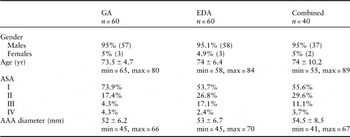
Between 2002 and 2008, 160 patients (152 men, 76.9%; and 8 women, 4%; average age 72.9 years and range 55 to 96 years), underwent endovascular aneurysm repair (EVAR). All patients signed the consent inform and the study was approved by the hospital’s ethics committee. Patients’ data was retrospectively recorded for the preoperative, perioperative and postoperative periods (Table 1). Descriptive statistics, including the mean, median, ranges and standard deviations were calculated for all the continuous baseline demographic and laboratory characteristics. Operative and postoperative variables were compared using the χ 2-test. Group differences were evaluated by Mann–Whitney test. Differences were considered significant at p⩽0.05.
Patient characteristics

GA = general anaesthesia; EDA = epidural anaesthesia; Combined = combined spinal and epidural anaesthesia; ASA = American Society of Anesthesiologists, physical status classification; AAA = abdominal aortic aneurysm.
Results
EVAR results were successful in all patients and no mortality was noticed.
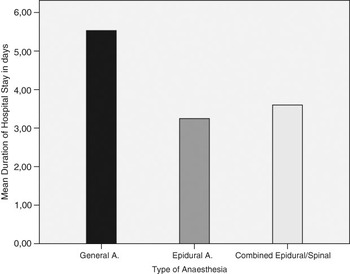
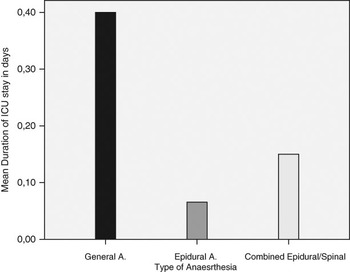
There were substantial differences in favour of anaesthesia techniques with regard to the duration of hospital stay and ICU care. The regional anaesthesia (RA) group was shown to be significantly more successful in terms of outcome than the general anaesthesia (GA) group, since from the RA group and the combined spinal and epidural anaesthesia (Combined) group, only 5 patients needed ICU care in comparison with 11 patients of the GA group (p = 0.00 and p= 0.01, respectively) (see Figs 1 and 2). Furthermore, a statistically significant difference regarding median hospital stay was also noticed, in favour of the regional group (p = 0.01) (see Fig. 3).
Comparison of the type of anaesthesia with the mean duration of hospital stay in days.

Comparison of the type of anaesthesia with the mean duration of ICU care in days.

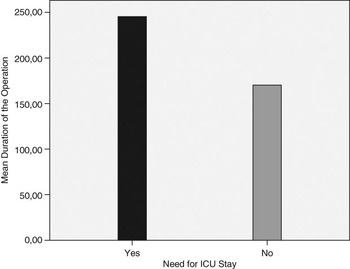
Comparison of operating time (in minutes) with the need of ICU care.

Discussion
The main finding of this study was that RA is a safe and effective technique for EVAR in most patients. It has significant advantages over GA because of the haemodynamic stability it provides, and the subsequent reduced need for ICU stay and shorter hospitalisation as previously described [Parra et al, Reference Parra, Crabtree, McLafferty, Ayerdi, Gruneiro and Ramsey2005].
There are few publications which have studied the effect of the anaesthesia technique for EVAR, but all have concluded that RA had an advantage in reducing hospital and ICU stay and that general anaesthesia was an independent risk factor for perioperative complications after EVAR [Cao et al, Reference Cao, Zannetti, Parlani, Verzini, Caporali and Spaccatini1999; Walschot et al, Reference Walschot, Laheij and Verbeek2002; Ruppert, Reference Ruppert2006]. The authors recognise that co-morbidities are common for patients with any form of vascular disease due to the end-product of generalised disease. Therefore, it is prudent to assume that all patients for endovascular surgery have coronary and cerebral vascular disease, and accordingly to manage them with this in mind when planning care [Hertzer et al, Reference Hertzer, Beven and Young1984; Clark and Stanley, Reference Clark and Stanley1994]. With this new surgical technique, the cardiac strain is reduced and in combination with the lighter anaesthesia the overall results are improved. The limitations of our study include the fact that the results are from a single surgical centre and therefore do not represent the general situation.
Surgical Nursing Interventions
Nurses of the anaesthesia department are called to play a key role in these innovative surgical techniques. The patient is not intubated, but is still undergoing a serious procedure. The role of the anaesthetic nurse in EVAR surgery has to adapt accordingly, but should always include the following procedures. The nurse should meet the patient before the procedure and crosscheck the personal data, checking the preoperative laboratory results and carefully studying the past medical history. Along with the anaesthetist, the nurse should be in a position to inform the patient about the anaesthesiology procedures and answer questions. Throughout the preoperative phase, it is still vital that observations are recorded [Kozon et al, Reference Kozon, Fortner and Holzenbein1998; Sullivan, Reference Sullivan2000; Ramage et al, Reference Ramage, Lovell and Derose2001; Latessa, Reference Latessa2002; Hall, Reference Hall2003]. During the procedure, monitoring should include ECG, pulse oximetry, PCO2, temperature and intra-arterial pressure. It is also critical to monitor urine flow, since contrast is used perioperatively which may have an impact on kidney function [Baker, Reference Baker2002]. Blood loss is usually not a major issue, but there will be a steady loss through the valved access catheters when there are catheters or wires in the vessels, compromising valve closure. In addition to intra-operative heparinisation, there is a common surgical usage of low-molecular-weight heparin (LMWH) for prophylaxis against deep-vein thrombosis and pulmonary embolisation. This use of epidural with LMWH has attracted much attention due to epidural haematoma in patients on LMWH [Horlocker and Wedel, Reference Horlocker and Wedel1998].
The anaesthesia nurse should never forget that the patient is in their senses throughout the procedure and must advocate privacy and safety at all times [Sullivan, Reference Sullivan2000].
Due to the reduction of perioperative stress experienced by the patient, there is no need for a planned ICU stay, therefore the patient is transferred to the Post-anaesthesia Care Unit (PACU) postoperatively. The patient stays at the PACU until he/she is stabilised. It is vital that PACU staff record neurovascular observations in these patients [Baker, Reference Baker2002].
Conclusions
Endovascular technology continues to improve. It is very likely that more of these endovascular procedures will be performed under RA in favour of its better postoperative results for the patient. Since anaesthesia will continue to adapt to these changes, so will the demands of patients and surgeons/radiologists so as not to compromise the safety or comfort of the patient.