Film review of Da Kali: the pledge of the art of the griot (2013, 86 minutes) and Dò Farala A Kan: something has been added (2013, 69 minutes). French and Bamanankan, with English subtitles. Directed by Lucy Durán, edited by Michele Banal, and made with assistance from Lassana Diabaté.
‘We haven't learned it. It's in our blood. We live in it.’ (Mandé griot)
The Mandé griots of West Africa, or jeliw (singular jeli) as they call themselves in Mandenkan, are hereditary artisans who specialize in the arts of music, praise song, dance and storytelling. Their professional origins date to the thirteenth century, when the Mali Empire was founded by the renowned warrior-king Sunjata Keita. In Mandé society, griots are one of the so-called nyamakala ‘castes', along with blacksmiths, potters, leatherworkers and other specialist artisans; and, like their counterparts, they practise endogamy. As nyamakala, griots possess the power to transform the world, and they do so with words. Speech is recognized throughout the region as a source of social power for diplomatically persuading, pacifying, evoking emotion, and inciting action in fellow human beings. In the past, griots served political rulers and the horon free nobles, reciting their genealogies and singing patronymic fasaw (praise songs) that glorify the heroic feats of their ancestors. In addition, they were delegated ambassadorial roles, acting as mediators between worldly and spiritual forces; their oral histories preserved the social memory of traditional culture, customs and morals; they were sanctioned to make political commentary; and, importantly, they provided entertainment for villagers and townsfolk. Today's griots enjoy the patronage and fandom of a much wider spectrum of the population than in the past. National politicians and successful entrepreneurs with the means to hire them can employ griots to celebrate their lineage, ethnicity, accomplishments and ambitions in song. Their skilled oration and musicianship has earned them prestige across West Africa, and recording technologies have launched some individual griots to superstar status around the globe.
The griots' art – and, more particularly, the ways in which their musical skills are taught and learned during childhood – is explored meticulously in two new documentary films directed by ethnomusicologist, record producer and radio broadcaster Lucy Durán. Durán's films are outputs from Growing Into Music, a collaborative study between members of the music departments at SOAS and Royal Holloway College. The study documents children's acquisition of musical skills in diverse cultural settings, including India, Azerbaijan, Cuba, Venezuela, Mali and Guinea. Growing Into Music is one of more than forty research projects funded by Beyond Text, a programme of the UK's Arts and Humanities Research Council (AHRC) that aims to promote greater appreciation and understanding of how humans communicate across time and space using performance, sound, images and objects. This agenda aligns with a burgeoning academic trend to recognize, document and analyse humankind's myriad ways of knowing and communicating beyond spoken language and text. Research on embodied forms of cognition and communication, for example, includes investigation into on-site learning, apprenticeship, and practice and performance in sport, dance, music, crafts and everyday tasks. Equally, it includes studies of the role played by gesture, posture, comportment and facial expression in communicating (or concealing) thoughts, ideas, desires and emotional states.
Durán's films make significant contributions to several of these domains of inquiry. They demonstrate that griots' oral recounting of histories, parables, legends and genealogies is intricately entwined with their physical performance of music, dance, gesture and carefully choreographed bodily comportment. Their focus on oral history and the ways in which it is learned, memorized and creatively transformed and updated by successive generations reveals that the griot's art is a complex one, involving considerable mental dexterity. It also undermines the hierarchy imputed by an enduring divide between orality and literacy.
But, to my mind, the most provocative message delivered is that ‘You don't become a jeli (griot); you are born one.’ This belief is widely shared and reiterated by griots. In doing so, they unambiguously capitalize on the hereditary status they enjoy and, relatedly, on the historical idea that genealogy blesses them with privileged access to a powerful, specialized knowledge that can be commoditized and profitably sold. Professional identity and musical ability are construed as innate – literally ‘in the blood’ or coming from ‘the breast milk of their mothers' – and no amount of musical or oral training can turn an outsider into a griot. This position squarely challenges constructivist theories (i.e. that identity is a social construct) entrenched in contemporary Western academia, and it does so in ways similar to how ethnic categories invented or reified by colonial authorities are, today, adhered to as immutable by West African populations.
But, patently, not every child of griot lineage grows up to be a virtuoso performer. The griots interviewed by Durán – both young and old – acknowledge that latent potential must be fostered and made manifest through a combination of apprenticeship, self-motivation and plenty of practice.
‘Let me explain to you briefly how we came to be jeliw,’ begins a voluminous jelimuso (female griot), bejewelled in gold and donning a neatly tied head wrap and matching dress. Her sung story sets the scene for the first of Durán's films, Da Kali: the pledge of the art of the griot. A compelling montage of interviews with singers and musicians, cultural activists and a director at the National Museum in Bamako introduces the viewer to the history and diversity of roles played by Mandé griots. The film then moves to a series of four chapters, each exploring a core theme. Throughout, we visit a variety of urban and rural locales where we meet griot children and their families. One of the great strengths of Durán's study is its duration. The footage, shot between 2009 and 2012, follows the progression of a handful of girls and boys as they ‘grow into music’, and the visuals beautifully illustrate the intricate teaching–learning processes and the contexts in which they take place.
Chapter 1 in Da Kali begins with Rokia, a grade-five student living in Bamako. She is a member of the Diabaté family whose origins can be traced to Kela, a village located in the heart of Mandé country. Rokia's mother, a celebrity griot singer, is her teacher. We learn that, because of the power associated with the spoken word, song is the most prestigious of the jeli arts. A novice must therefore attend to memorizing and performing the correct lyrics of each song. Rokia's learning, like that of other griot children, is grounded in a repetitive cycle of demonstration, imitation and correction. Her mentoring mother sings a line or two, accentuating the correct rhythm, tone, melody and words, and accompanying them with certain facial expressions, gestures and postures. Rokia watches and listens carefully, and then imitates the total performance. Rokia's mother reminds her that she must be confident when she sings in order ‘to show everyone that she is a jeli’. The body language not only emphasizes the message of the song, it also serves as a mnemonic for delivering the correct words with the right cadence, and the right force. Constant repetition and rehearsal are pivotal to the success of this rote-style learning. The demanding nature of this education on children's time and resources competes with the effort needed for formal classroom schooling. The films reveal that griot parents and children – especially those living in the city – must make difficult life choices; schooling in Mali delivers no guarantee of a job, but equally the pursuit of a musical career is not without risk.
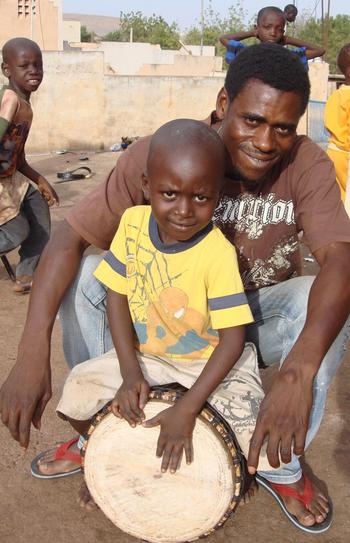
Travelling across sprawling Bamako brings us to the home of young Thierré, the four-year-old son of a gifted and popular player of djembé (a skin-covered goblet drum played with the hands). Thierré sits with his own drum next to his father, who performs slow, deliberate hand movements (see Figure 1 and Film clip 1, which is available with the online version of this article). The little boy looks over his shoulder, scrutinizing his father's beating hands while simultaneously imitating the patterns in time. He then briefly looks down to his own drum before lifting his head high and staring straight ahead with his tiny tongue squeezed out of one corner of his mouth in focused absorption. He periodically clasps his hands and blows on his fingertips to sooth the stinging from the animated blows he metes out on the drum skin. At times, Thierré imitates without looking at his father. Instead, he just listens in order to reproduce the percussive rhythms. He glances up at his father for smiling reassurance. Later, while they are playfully bantering together, Thierré boldly informs his father that he will one day be the better djembé player. Confidence, as previously witnessed in Rokia's case, is an essential griot quality. In his socialization, Thierré also receives instruction on the gendered division of labour among performers: boys play instruments while girls sing and dance. When asked what else girls do, the four-year-old astutely replies that ‘old women kill chickens and cook’.
Four-year-old djembé prodigy Thierré Diarra with his father, master djembé player Adama Diarra, at home in Bamako. Photo by Lucy Durán, 2010.

The last of the young musicians we meet in Chapter 1 is Salif, the nephew and student of world-renowned kora player Toumani Diabaté. Snappily dressed in a crisp white cotton shirt and dark blue jeans, Mamadou – Toumani's younger brother and father of Salif – guides the third-grader's fingers with his own long, graceful hands, tenderly plucking the kora's harp-like strings to demonstrate the precise sequence of movements and sounds. Salif is intensely self-conscious about his learning. He began playing at two years old on a miniature kora given to him by his grandmother. Mamadou compares his nephew's introduction to music with his own childhood experiences: ‘It's like buying a doll for your child. Little by little …,’ he says, implying that young girls and boys are gradually socialized through play and practice into future adult roles and responsibilities.
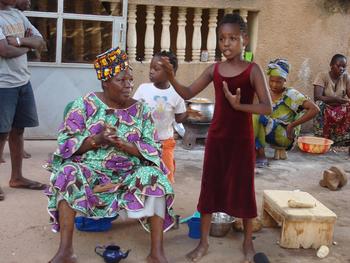
The second chapter in the first film takes us to the village compound of Madame Bako Dagnon, ‘Mali's most treasured and respected living jeli’. The rhythm of the women's chores and interactions, often with slumbering infants strapped to their backs, forms an instrumental backdrop to their children's musical education. Bako Dagnon is teaching two of her granddaughters to sing (see Figure 2 and Film clip 2). Eight-year-old Saran is precocious and overtly self-assured. When asked questions by the film team, she replies to the camera with directness and authority, forming full sentences that rephrase the questions and embed the key words within her narrative response. This characteristic style of speech assists griots in memorizing what they hear and reiterating it verbatim. Bako Dagnon advises that they must also eat buffalo meat from the bush to hone their skills of recollection. She physically demonstrates other tricks for committing to memory the stories and histories of the many peoples of Mali. Ami, Saran's five-year-old sister, is actively coached by her grandmother to respond to questions with complete sentences and to underscore her words with appropriate movements and gestures. Bako Dagnon tells the girls about their forefathers and she recounts parables and fables that teach right from wrong.
Master singer Bako Dagnon at home in Bamako, teaching songs to her granddaughters Ami Diabaté (middle) and Saran Kouyaté (right). Photo by Lucy Durán, 2009.

The thinking and behaviour of the younger generations of griots, like youth elsewhere, are also influenced by what they hear on the radio and watch on television. Popular music cassettes and television programmes, such as Mini Star Mali, offer a cornucopia of new sounds and lyrics, as well as glimpses of the latest fashions and mannerisms to which youth across the nation aspire. Griot traditions are, by necessity, dynamic, continually absorbing new content, rhythms, techniques, musical instruments and styles of presentation, and integrating these into the ever-distinctive repertoire.Footnote 1
Chapters 3 and 4 preface the core theme of the second film: namely ‘something has been added’. These chapters document the advancements made over time by the children met previously. To catalyse their progression, children may be sent away to a distant place to study their instrument or their singing with a family relative or close acquaintance. Parent–child apprenticeships (jeliblon), though common, can be riddled with complications because children are distracted by the comforts of home life and they more easily discover how to negotiate their way out of lessons and practice time. Mothers and fathers find it equally challenging to discipline in a consistent manner, and to remain objective in their correction and criticism, and unbiased in their praise.
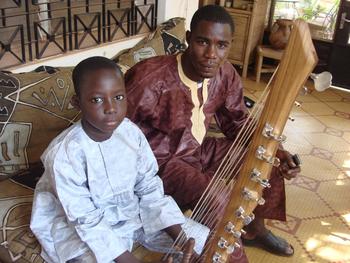
We meet young Salif again. During the interim, Toumani Diabaté had sent him to learn kora with a distant relative who arrived in Bamako from Senegal (see Figure 3). Salif has struggled to strike a balance between his school work and kora practice, and therefore only ‘a little has been added’. Rokia, on the other hand, is now performing with her mother at lavish sumus (women's celebrations) in the streets of Bamako. Three years after first meeting the film team, she went on to become a finalist in the popular Mini Star Mali television programme. Reflecting on that experience, Rokia concedes that she now thinks more seriously about what it means to be a jeli. For her, this includes being humble and respectful, while at the same time exuding confidence. Rokia's mother decided that it was time for her daughter to learn a pivotal song of the griots' stock, namely the fasa of Sunjata Keita. Soon after, Rokia is improvising of her own volition and singing variations of the song. ‘It means that she is starting to understand the song,’ her mother declares proudly. ‘Little by little, the water is getting to the river,’ she adds, describing her daughter's progress.
Salif Diabaté learns the kora with Senegalese kora player Boubacar Cissoko. Photo by Lucy Durán, Bamako, 2010.

The second film in Durán's two-part series is entitled Dò Farala A Kan: something has been added. The film follows the progress of children of two prestigious jeli families sharing the patronymic surname Kouyaté. The origins of both families are in the deep countryside: one from the village of Garana, near Segou, and the other from Niagassola, a village in the heart of the old Mali Empire, in what is now upper Guinea. Some members of both families have moved to Bamako, and so the film seizes the opportunity to explore differences in musical progress among children in rural and in city settings.
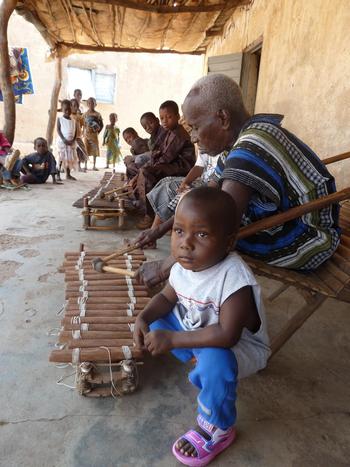
Part one takes us first to Niagassola, where the Kouyatés are the custodians of a sacred balafon that allegedly belonged to Sumaworo Kanté, the powerful thirteenth-century rival of Sunjata Keita. All males in this Kouyaté line are expected to play balafon, and females are expected to sing – but so, too, can males (see Figure 4 and Film clip 3). Next, in Garana, we discover that Kouyaté males specialize in the ngoni (a lute-like string instrument). The biggest international star to emerge from the family is Bassekou Kouyaté, whose superb Segu Blue album was produced by Durán in 2006. Bassekou has modernized ngoni techniques and significantly expanded the repertoire for that instrument. He shrewdly comments: ‘If the world evolves and changes, so must we.’ In his Bamako home, Bassekou's daughter Oumou and his niece Sali are following in the footsteps of their mothers and training to be singers. Again, we see that the children imitate not only the voice and delivery of the songs, but the entire comportment, set of gestures, facial expressions, and eye movements as well. And, like young Rokia, they have been finalists on Mini Star Mali (see Film clip 4).
El Hadj Jeli Sekou Kouyaté, custodian of the sosso bala (sacred balafon, designated a UNESCO Site of Intangible Cultural Heritage), plays balafon with some of his many grandchildren. Photo by Lucy Durán, Niagassola, Guinea, 2011.

Dò Farala A Kan contains superb footage of the micro-practices involved in hands-on guidance and performance, and of the intimate exchanges of correction, praise, questions and frustrations that unfold between mentors and pupils during lessons. Musical learning, however, is not solely achieved through direct one-to-one instruction. Within griot households, there are no set days or hours for instruction; rather, education is ongoing. We are told that the ‘instrument must be in the family so that children hear it all the time’. Children are regularly exposed to adults rehearsing and they watch their senior kinfolk perform at local ceremonies or on television. They also listen to their songs played on the radio or on cassette. Children learn to sing and make music as a form of entertainment while carrying out household chores, working in the fields, or washing by the river. Sophisticated hand-clapping games and counting songs (tegere tulon) hone rhythmic and physical coordination, and encourage boys and girls to express themselves individually – but, notably, within the structure and rules of the contest. Therefore, they learn by example from one another. It is deemed vital to encourage competition between children, since without it ‘you can't become a good musician’. Of those who improve their technique and expand their repertoire, it is said that ‘something has been added’. In contrast, for those who have neglected their practice, it may be said that ‘something has been taken away’.
The second film concludes in the style that the first began, with a medley of sentiments voiced by various musical artists. The emphasis here is on the importance of transmission to younger generations and the need to uphold the specialized, hard-earned knowledge and defend the griot's livelihood from disappearance. Responsibility ultimately lies with griots themselves, because, we are reminded, being a griot is ‘in the blood’. So, only they can authentically reproduce their art and make it thrive.
Together, Da Kali and Dò Farala A Kan make a splendid contribution to the scholarship on West Africa's griots. Griots today reside in villages and cities, moving fluidly between the two, and over international borders, to earn a living by serving diverse audiences. Although they are rooted in a tradition that stresses rote learning and faithful recitation, Durán shows that, in fact, the griot's art – both the instrumental music and the song – is responsive to change and embraces technologies that effectively deliver their ‘word’ worldwide. The films' microanalyses of enskilment brilliantly demonstrate the incremental growth of artistic knowledge in children, and, equally, they convey that improvisation and individual style are inseparable from the learning process. This reinforces the idea that tradition and change are mutually constitutive categories. Perhaps most notably, the films lucidly demonstrate that musical performance is a way of knowing that involves the whole person: mind and body in vibrant dialogue with the immediate environment of people and things, each with their respective histories. Da Kali and Dò Farala A Kan are exquisitely shot and the editing strikes a satisfying balance between narrated background information, compelling interviews, and colourful, sonically arresting segments of music and dance. The films are certain to win appreciation from audiences worldwide and become compulsory viewing for students of ethnomusicology, anthropology, West African studies and educational studies.
SUPPLEMENTARY MATERIALS
Supplementary material is available with the online version of this article at http://dx.doi.org/10.1017/S0001972015000054. This includes the following clips from Lucy Durán's films reviewed in this article:
FILM CLIP 1 Thierré is the son of a premier Malian percussionist, Adama Diarra. Already at four years old, the boy has embodied the mannerisms of an adult performer and is a confident djembé player. His father proclaims that Thierré is largely self-taught, having learned through observation and immersion.
FILM CLIP 2 Bako Dagnon is one of Mali's most revered female griot singers. Born in the remote village of Golobladji, she now lives in Bamako, where family members come to visit. In this film clip, Bako teaches one of her granddaughters a poignant song about circumcision.
FILM CLIP 3 The Kouyaté family of Niagassola is custodian of Sumaworo Kanté's sacred balafon (listed as a UNESCO Site of Intangible Cultural Heritage). The film clip shows male family members in Bamako keeping their musical tradition alive by adapting older pedagogical methods to more modern ones.
FILM CLIP 4 The Kouyatés of Garana are a talented family of ngoni players, drummers, singers and dancers committed to perpetuating the Segou griot tradition. In this film clip, Yakaré Damba explains how she trains her grandchildren and the children perform the special hand-clapping songs of the village.